
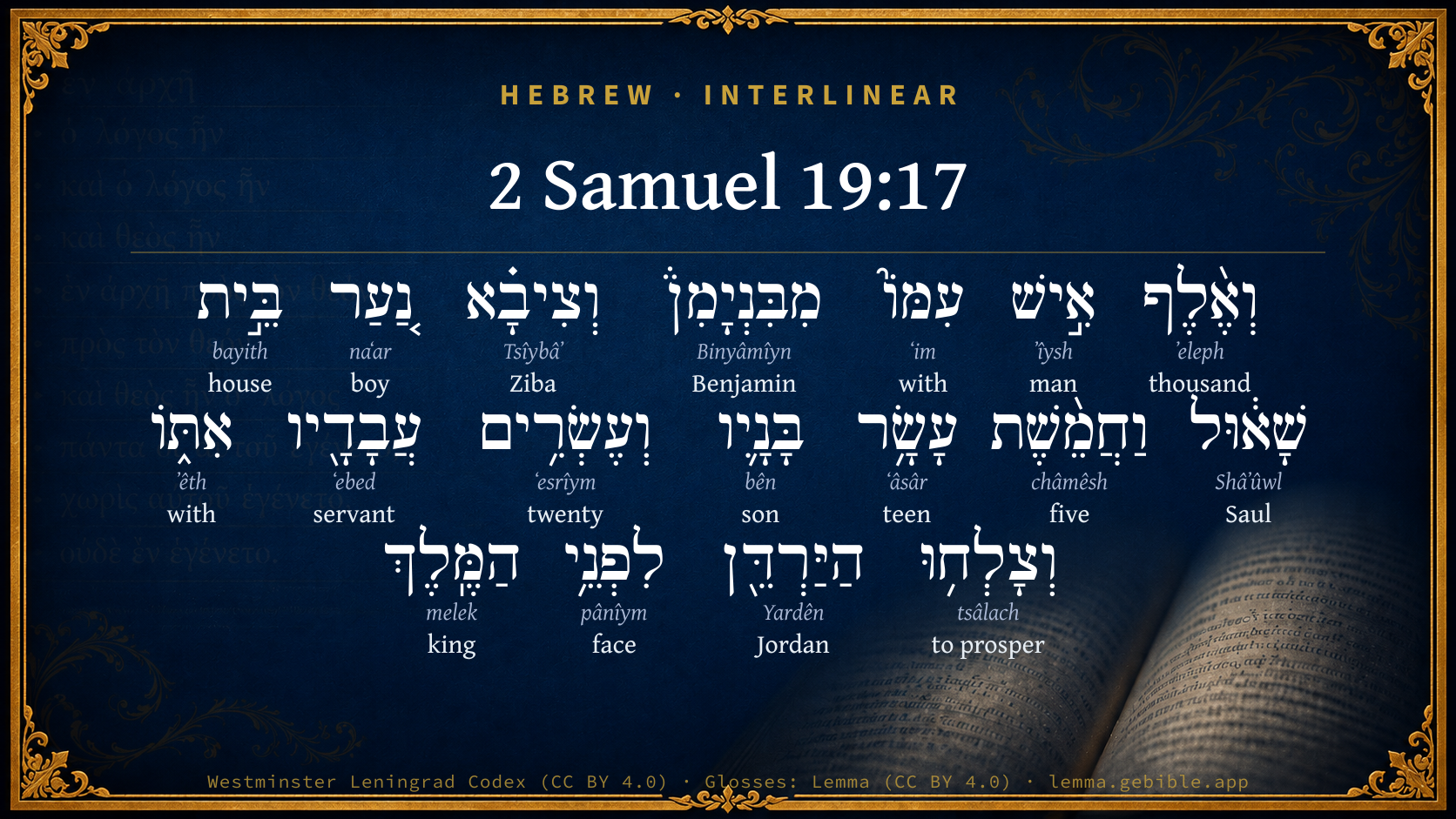
2 Samuel 19:17

Hebrew (Westminster Leningrad Codex) 2 Samuel 19:17 appears in the Hebrew Old Testament. The text above is from the Westminster Leningrad Codex. Each word links to its Strong’s number, a concise gloss, and parsing drawn from the Open Scriptures Hebrew Bible morphology. Click any word for its full Brown-Driver-Briggs (BDB) entry.
Download image
Cite this verse

2 Samuel 19:17 (World English Bible). Public Domain. Lemma interlinear Bible study tool, https://lemma.gebible.app/v/2-samuel/19/17.

Show BibTeX & RIS
BibTeX
RIS
English Translation
There were a thousand men of Benjamin with him, and Ziba the servant of the house of Saul, and his fifteen sons and his twenty servants with him; and they went through the Jordan in the presence of the king.
World English Bible · Public Domain
Download a study sheet

One document with this verse’s original text, its word-by-word gloss line, the meaning frame, cross-references with their text, attributed commentary, and full source and license credits — printable, and it pastes into notes with its structure intact.

This verse Autodidact and up

Study sheet (.html) Plain text (.txt)

A passage Seminary Student

Up to 50 verses in one chapter. A passage sheet keeps up to 6 commentary sources and 12 cross-references per verse, in the order this page ranks them, and says so on the sheet whenever that leaves anything out. Ask for a single verse and you get the Autodidact verse sheet above.

Everything on this page stays free to read, with no account — the sheet is a download of what is already on screen, not access to it.

Want to remove ads? Support Godless Engineer
Compare translations 3

The same verse in 3 English versions, stacked beneath the original-language interlinear above. Click any original word for its lexicon entry.

Each is an independent rendering of the whole verse — the interlinear is not word-aligned to these translations.

Highlighted words mark where these versions differ — a whole-verse word diff, not a word-by-word alignment.

  • World English Bible Public Domain
    There were a thousand men of Benjamin with him, and Ziba the servant of the house of Saul, and his fifteen sons and his twenty servants with him; and they went through the Jordan in the presence of the king.
  • King James Version Public Domain
    And there were a thousand men of Benjamin with him, and Ziba the servant of the house of Saul, and his fifteen sons and his twenty servants with him; and they went over Jordan before the king.
  • unfoldingWord Literal Text CC BY-SA 4.0
    and 1,000 men with him from Benjamin. And Ziba, the young man of the house of Saul, and his 15 sons and his 20 servants with him. And they rushed the Jordan to the face of the king.

unfoldingWord Literal Text — © unfoldingWord, licensed CC BY-SA 4.0. Word-aligned USFM3 via Door43 (git.door43.org/unfoldingWord/en_ult).

Versions to compare (up to 4)

3 of 4 selected

Show all 18 translations

Every available English version of this verse, each an independent rendering of the whole verse.

  • World English Bible Public Domain
    There were a thousand men of Benjamin with him, and Ziba the servant of the house of Saul, and his fifteen sons and his twenty servants with him; and they went through the Jordan in the presence of the king.
  • Berean Standard Bible Public Domain
    along with a thousand men of Benjamin, as well as Ziba the steward of the house of Saul and his fifteen sons and twenty servants. They rushed down to the Jordan before the king
  • Majority Standard Bible Public Domain
    along with a thousand men of Benjamin, as well as Ziba the steward of the house of Saul and his fifteen sons and twenty servants. They rushed down to the Jordan before the king
  • King James Version Public Domain
    And there were a thousand men of Benjamin with him, and Ziba the servant of the house of Saul, and his fifteen sons and his twenty servants with him; and they went over Jordan before the king.
  • American Standard Version (1901) Public Domain
    And there were a thousand men of Benjamin with him, and Ziba the servant of the house of Saul, and his fifteen sons and his twenty servants with him; and they went through the Jordan in the presence of the king.
  • Revised Version (1885) Public Domain
    And there were a thousand men of Benjamin with him, and Ziba the servant of the house of Saul, and his fifteen sons and his twenty servants with him; and they went through Jordan in the presence of the king.
  • Geneva Bible (1599) Public Domain
    And a thousande men of Beniamin with him, and Ziba the seruant of the house of Saul, and his fifteene sonnes and twentie seruants with him: and they went ouer Iorden before ye king.
  • Douay-Rheims (1899) Public Domain
    With a thousand men of Benjamin, and Siba the servant of the house of Saul: and his fifteen sons, and twenty servants were with him: and going over the Jordan,
  • Young's Literal Translation Public Domain
    and a thousand men `are' with him from Benjamin, and Ziba servant of the house of Saul, and his fifteen sons and his twenty servants with him, and they have gone prosperously over the Jordan before the king.
  • Literal Standard Version CC BY-SA 4.0
    and one thousand men [are] with him from Benjamin, and Ziba servant of the house of Saul, and his fifteen sons and his twenty servants with him, and they have gone prosperously over the Jordan before the king.
  • Unlocked Literal Bible CC BY-SA 4.0
    There were one thousand men from Benjamin with him, and Ziba the servant of Saul, and his fifteen sons and twenty servants with him. They crossed through the Jordan in the presence of the king.
  • unfoldingWord Literal Text CC BY-SA 4.0
    and 1,000 men with him from Benjamin. And Ziba, the young man of the house of Saul, and his 15 sons and his 20 servants with him. And they rushed the Jordan to the face of the king.
  • Darby Bible Public Domain
    And there were a thousand men of Benjamin with him, and Ziba the servant of the house of Saul, and his fifteen sons and his twenty servants with him; and they forded the Jordan before the king.
  • World Messianic Bible Public Domain
    There were a thousand men of Benjamin with him, and Ziba the servant of Saul’s house, and his fifteen sons and his twenty servants with him; and they went through the Jordan in the presence of the king.
  • Webster's Bible Public Domain
    And there were a thousand men of Benjamin with him, and Ziba the servant of the house of Saul, and his fifteen sons and his twenty servants with him; and they went over Jordan before the king.
  • Free Bible Version CC BY-SA 4.0
    With him were one thousand men from the tribe of Benjamin, including Ziba, servant of Saul's family, as well as Ziba's fifteen sons and twenty servants. They rushed down to the Jordan to meet the king.
  • Bible in Basic English Public Domain
    And with him a thousand men of Benjamin, and Ziba, the servant of Saul, with his fifteen sons and twenty servants, came rushing to Jordan before the king,
  • JPS Tanakh (1917) Public Domain
    (19-18) And there were a thousand men of Benjamin with him, and Ziba the servant of the house of Saul, and his fifteen sons and his twenty servants with him. And they rushed into the Jordan before the king.

Literal Standard Version (2020), Covenant Press — licensed CC BY-SA 4.0. Text via the HelloAO Bible API (eBible.org). Unlocked Literal Bible (unfoldingWord) — licensed CC BY-SA 4.0. Text via the HelloAO Bible API (eBible.org). unfoldingWord Literal Text — © unfoldingWord, licensed CC BY-SA 4.0. Word-aligned USFM3 via Door43 (git.door43.org/unfoldingWord/en_ult). Free Bible Version, Dr. Jonathan Gallagher — licensed CC BY-SA 4.0. Text via the HelloAO Bible API (eBible.org).

Word by word

More ways to search: Search by grammar → Find every occurrence → Compare this word →

Practice this passage: Drill this verse → Learn its vocabulary →

וְצִיבָ֗א
Tsîybâʼ
H6717
“and · Ziba”
Conjunction + Noun, Proper
Part of Speech
Conjunction + Noun
Type
Proper
Full BDB Definition

Origin: from the same as H6678

TWOT: None

Ziba = "statue" - a servant of Saul whom David made steward of Jonathan's son Mephibosheth
  1. וְאֶ֨לֶף ʼeleph H505 “and · thousand” Conjunction + Adjective, Cardinal number, Both, Singular, Absolute
  2. אִ֣ישׁ ʼîysh H376 “man” Noun, Common, Masculine, Singular, Absolute
  3. עִמּוֹ֮ ʻim H5973 “with · him” Preposition + Suffix, Personal, 3rd Person, Masculine, Singular
  4. מִבִּנְיָמִן֒ Binyâmîyn H1144 “from · Benjamin” Preposition + Noun, Proper
  5. נַ֚עַר naʻar H5288 “boy of” Noun, Common, Masculine, Singular, Construct
  6. בֵּ֣ית bayith H1004 “house of” Noun, Common, Masculine, Singular, Construct
  7. שָׁא֔וּל Shâʼûwl H7586 “Saul” Noun, Proper
  8. וַחֲמֵ֨שֶׁת châmêsh H2568 “and · five” Conjunction + Adjective, Cardinal number, Masculine, Singular, Construct
  9. עָשָׂ֥ר ʻâsâr H6240 “teen” Adjective, Cardinal number, Masculine, Singular, Absolute
  10. בָּנָ֛יו bên H1121 “sons · his” Noun, Common, Masculine, Plural, Construct + Suffix, Personal, 3rd Person, Masculine, Singular
  11. וְעֶשְׂרִ֥ים ʻesrîym H6242 “and · twenty” Conjunction + Adjective, Cardinal number, Both, Plural, Absolute
  12. עֲבָדָ֖יו ʻebed H5650 “servants · his” Noun, Common, Masculine, Plural, Construct + Suffix, Personal, 3rd Person, Masculine, Singular
  13. אִתּ֑וֹ ʼêth H854 “with · him” Preposition + Suffix, Personal, 3rd Person, Masculine, Singular
  14. וְצָלְח֥וּ tsâlach H6743 “and · to prosper” Conjunction + Verb, Qal, Perfect, 3rd Person, Common, Plural
  15. הַיַּרְדֵּ֖ן Yardên H3383 “the · Jordan” Particle, Definite Article + Noun, Proper
  16. לִפְנֵ֥י pânîym H6440 “to/for · face(s) of” Preposition + Noun, Common, Both, Plural, Construct
  17. הַמֶּֽלֶךְ melek H4428 “the · king” Particle, Definite Article + Noun, Common, Masculine, Singular, Absolute

About this verse

These counts appear in no published source. They are computed here, from the morphology-tagged text and Lemma’s own curated glosses. What Lemma adds →

18
words
18
distinct lemmas
Historical
section

Notable vocabulary

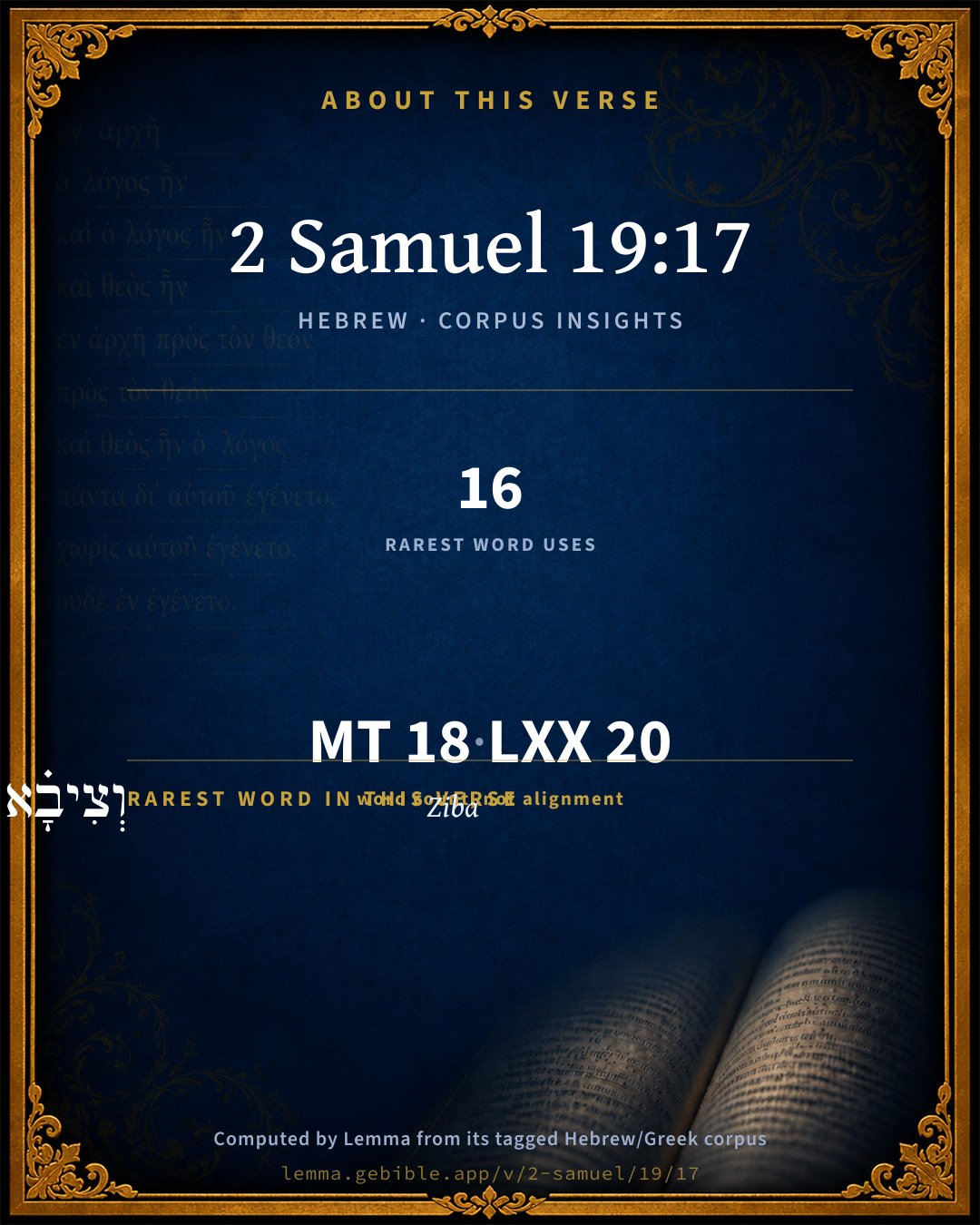
The rarest word here is וְצִיבָ֗א Ziba H6717 — appearing just 16 times in the whole Hebrew Bible.

Shared distinctive vocabulary

וְצִיבָ֗א Ziba H6717 occurs in 13 verses of the Hebrew Bible. Also found in:

Grammatical profile

  • 1 verb
  • 11 nouns
  • 4 adjectives
  • 2 prepositions

Verb forms

  • וְצָלְח֥וּ Qal · Perfect

Hebrew & Septuagint length

In English translation the verse runs 40 words from the Hebrew and 40 from the Septuagint (LXX English) — the same length.

A rough comparison of the two English renderings, which tokenize alike — not a word-level alignment.

Word counts can differ between the Hebrew and the Greek without any difference in meaning — e.g. the Hebrew direct-object marker אֵת has no separate Greek word, and Greek often adds the article ὁ.

In the original languages it is 18 Hebrew tokens and 20 Greek tokens — but the two are counted differently (Hebrew bundles its prefixes and suffixes into one token; the Greek is in lemma form), so that isn’t a like-for-like length.

Cross-references

4

Topical passages linked to 2 Samuel 19:17 in the Treasury of Scripture Knowledge — connected by theme and wording, ordered by reader-vote popularity; previews shown in the World English Bible.

  • 2 Samuel 9:2 There was of the house of Saul a servant whose name was Ziba, and they called him to David; and the king said to him, Are you Ziba? He said, Your servant is he.
  • 2 Samuel 16:1–4 When David was a little past the top [of the ascent], behold, Ziba the servant of Mephibosheth met him, with a couple of donkeys saddled, and on them two hundred loaves of bread, and one hundred clusters of raisins, and one hundred summer fruits, and a bottle of wine.
  • 2 Samuel 9:10 You shall till the land for him, you, and your sons, and your servants; and you shall bring in [the fruits], that your master's son may have bread to eat: but Mephibosheth your master's son shall eat bread always at my table." Now Ziba had fifteen sons and twenty servants.
  • 2 Samuel 19:26–27 He answered, My lord, O king, my servant deceived me: for your servant said, I will saddle me a donkey, that I may ride thereon, and go with the king; because your servant is lame.

Cross-references courtesy of OpenBible.info (CC BY 4.0).

Hebrew and Greek witnesses Masoretic Hebrew ↔ Greek Septuagint

The same verse in the two great witnesses to the Old Testament, shown verse-for-verse.

These are two independent witnesses, not word-aligned to each other, and the Septuagint is shown in lemma (dictionary) form.

Hebrew 2 Samuel 19:17 Masoretic · Westminster Leningrad Codex

וְאֶ֨לֶף אִ֣ישׁ עִמּוֹ֮ מִבִּנְיָמִן֒ וְצִיבָ֗א נַ֚עַר בֵּ֣ית שָׁא֔וּל וַחֲמֵ֨שֶׁת עָשָׂ֥ר בָּנָ֛יו וְעֶשְׂרִ֥ים עֲבָדָ֖יו אִתּ֑וֹ וְצָלְח֥וּ הַיַּרְדֵּ֖ן לִפְנֵ֥י הַמֶּֽלֶךְ

There were a thousand men of Benjamin with him, and Ziba the servant of the house of Saul, and his fifteen sons and his twenty servants with him; and they went through the Jordan in the presence of the king.

World English Bible · Public Domain

Greek LXX 2 Samuel 19:17 Septuagint · lemma form

καί ταχύνω σεμεϊ υἱός γηρα υἱός ὁ ιεμενι ἐκ βαουριμ καί καταβαίνω μετά ἀνήρ ιουδα εἰς ἀπαντή ὁ βασιλεύς δαυίδ

And a thousand men of Benjamin were with him, and Siba the servant of the house of Saul, and his fifteen sons with him, and his twenty servants with him: and they went directly down to Jordan before the king,

LXX2012 (modern English Septuagint) · Public Domain

Hebrew: Westminster Leningrad Codex (CC BY 4.0). Greek: Septuagint (public domain); English from LXX2012 (modern English Septuagint) (Public Domain). How the Septuagint differs from the Hebrew →

Targum (Aramaic paraphrase)

1

The Targum is the ancient Jewish Aramaic paraphrase of the Hebrew Scriptures — an interpretive translation, not the Hebrew text itself. Onkelos (literal) and Pseudo-Jonathan (expansive) render the Torah, and Jonathan the Prophets. Coverage is partial: where no permissively-licensed English translation exists for a verse, only the Aramaic is shown. This is verse-level text, not a word-by-word alignment to the Hebrew.

  1. Targum Jonathan Prophets (Joshua–Malachi)
    וְאוֹחִי שִׁמְעִי בַר גֵרָא בַּר שֵׁבֶט בִּנְיָמִן דִי מֵעַלְמַת וּנְחַת עִם אֱנַשׁ יְהוּדָה לִקֳדָמוּת מַלְכָּא דָוִד:

    (no public-domain English translation for this verse)

    Targum Jonathan — Aramaic: “Mikraot Gedolot” (public domain). English: “Sefaria Community Translation” (CC0 1.0 (public-domain dedication)); “London "Chaldee Paraphrase," 1871” (public domain). Text via Sefaria.

Commentary

Notes on 2 Samuel 19:17 from classic Christian and Jewish commentators (each source and its license shown beneath its notes). The classic Christian expositions comment on the surrounding passage and are grouped to its opening verse, so a note may address several verses; the Jewish commentaries on the Tanakh (Rashi and others) are per-verse, so they appear only where the commentator wrote on this verse.

Lemma curates 59 commentaries, every one of them public domain or Creative Commons licensed, each selected and text-cleaned for this edition rather than reprinted as found. About our sources →

Trapp's Complete Commentary

John Trapp

2Sa 19:17 And [there were] a thousand men of Benjamin with him, and Ziba the servant of the house of Saul, and his fifteen sons and his twenty servants with him; and they went over Jordan before the king.

Ver. 17. And there were a thousand men of Benjamin with him.] And, as some think, under him as their captain; for he was of the house of Saul, and haply a great man in that tribe.

And they went over Jordan before the king,] sc., To salute him, and to see him set safe over the river.

John Trapp, A Commentary or Exposition upon All the Books of the Old and New Testament (1647–1656) — public domain. Text from a community e-Sword module.

Tyndale Open Study Notes

Tyndale Open Resources

19:17 Ziba: See 16:1-4.

Tyndale Open Study Notes — © Tyndale Open Resources, licensed CC BY-SA 4.0. Text via the HelloAO Bible API.

Jamieson, Fausset & Brown

Robert Jamieson, A. R. Fausset & David Brown

Ziba, the servant of the house of Saul--He had deceived his master; and when ordered to make ready the ass for the lame prince to go and meet the king, he slipped away by himself to pay court first; so that Mephibosheth, being lame, had to remain in Jerusalem till the king's arrival.

Jamieson, Fausset & Brown — Commentary Critical and Explanatory on the Whole Bible (1871) — public domain (CC PDM 1.0). Text via the HelloAO Bible API.

Ellicott's Commentary for English Readers

(17) Before the king.—Comp. the same phrase in 2Sa_20:8. In both cases “before” is, literally, before the face of, and is equivalent to saying “they went over Jordan to meet the king.” In their eagerness to prove their very doubtful allegiance, they dashed through the waters of the ford, and met the king on the eastern side of the Jordan.

A Bible Commentary for English Readers, edited by Charles John Ellicott (1878–1897) — public domain. Text from a community e-Sword module.

The Cambridge Bible for Schools and Colleges

gen. ed. J. J. S. Perowne

17. And there were a thousand men of Benjamin with him] Omit there were, and join this clause to 2Sa_19:16.

they went over Jordan before the king] Ziba and his retinue dashed into the river and crossed it—the word for went over is a peculiar one, expressing impetuous movement—to shew their zeal by meeting the king on the eastern bank.

The Cambridge Bible for Schools and Colleges (gen. ed. J. J. S. Perowne; Cambridge University Press, 1878–1918) — public domain. Text from a community e-Sword module.

John Gill's Exposition

And there were a thousand men of Benjamin with him,.... Of which tribe he was, and these were either a band of soldiers, of which he was the chiliarch; or tenants of his, which showed him to be a great man; or his neighbours, and persons of some figure, whom he prevailed upon to come as intercessors for him:

and Ziba the servant of the house of Saul; who had imposed upon David, and got his master's inheritance from him, knowing that David would be undeceived by Mephibosheth his master, when he came to Jerusalem; and therefore that he might be more tenderly dealt with, and come off the better, he was thus forward to meet the king, and pay his respects to him:

and his fifteen sons and his twenty servants with him: which made a considerable appearance; see Sa2 9:10,

and they went over Jordan before the king: to meet him on the other side, both Shimei and his a thousand men, and Ziba with his sons and servants.

John Gill's Exposition of the Whole Bible (1746–1763) — public domain (CC PDM 1.0). Text via the HelloAO Bible API.

Albert Barnes' Notes on the Bible

Before the king - i. e., “to meet the king.” Compare 2Sa 20:8. The king was on the east bank, and they crossed over (by the ford) from the west bank to go to him.

Albert Barnes' Notes on the Bible (1834–1885) — public domain. Text from a community e-Sword/MySword module.

Haydock's Catholic Bible Commentary

Over, or "into:" (irrumpentes.; Haydock) probably on horseback. (Menochius)

George Leo Haydock (1774–1849), Haydock's Catholic Family Bible and Commentary, 1859 edition — public domain. Excludes Psalms (Douay-Rheims chapter numbering differs from Protestant) and Deuterocanonical books (Catholic canon only).

Matthew Poole's English Annotations

A thousand men of Benjamin with him; whom he brought, partly to show his power and interest in the people, whereby he was able to do David either great service or great disservice; and partly as intercessors on his behalf, and as witnesses of David’s clemency or severity, that in him they might see what the rest of them might expect.

And Ziba; who, being conscious of his former abuse of David, and of his master Mephibosheth, which he knew the king would understand, designed to sweeten David’s spirit towards him, by his great officiousness and forwardness in meeting him, and congratulating his return.

They went over Jordan before the king; they did not tarry on this side Jordan, waiting till the king came over, as the most of the men of Judah did; but went over Jordan to pay their respects and duty to the king there, to express their eager and impatient desire to see the king.

Matthew Poole's English Annotations on the Holy Bible (1683–1685) — public domain. Text from a community e-Sword/MySword module.

Whedon's Commentary on the Bible

Daniel D. Whedon

SHIMEI’S CONFESSION AND PARDON, 2Sa_19:15-23.

17. A thousand men of Benjamin with him — From which it seems that Shimei was a man of much power and influence among the Benjamites.

Daniel D. Whedon (gen. ed.), Commentary on the Old and New Testaments (1874–1909) — public domain. Text from a community e-Sword module.

The Pulpit Commentary

They went over Jordan before the king. This might mean that, in bringing the king across, Shimei and the Benjamites led the way. But, first, the verb, which is a rare one, means that they dashed through the river impetuously; and secondly, before the king, means "in the king"s presence." While the tribe of Judah remained on the left bank to receive the king on his landing, Shimei and Ziba sought favour by a show of excessive zeal, and forded the Jordan, so as to be the first to welcome him (see ver. 20).

The Pulpit Commentary (1880–1919), ed. H.D.M. Spence-Jones & Joseph S. Exell — public domain. Text from a community e-Sword module.

John Wesley's Explanatory Notes

With him - Whom he brought, partly to shew his interest in the people, and partly, as intercessors on his behalf, and as witnesses of David's clemency or severity, that in him they might see what the rest of them might expect. Ziba - Who, being conscious of his former abuse of David, and of his master Mephibosheth, which he knew the king would understand, designed to sweeten David's spirit towards him, by forwardness in meeting him.

John Wesley, Explanatory Notes Upon the Whole Bible (1754–1765) — public domain. Text via the GEBible commentary corpus.

Keil & Delitzsch

C. F. Keil & F. Delitzsch

There also came along with Shimei a thousand men of Benjamin, and Ziba the servant of the house of Saul, with his fifteen sons and twenty servants (see Sa2 9:10); and they went over the Jordan before the king, viz., through a ford, and the ferry-boat had crossed over to carry over the king's family, and to do whatever seemed good to him, i.e., to be placed at the king's sole disposal. And Shimei fell down before the king, בּעברו, i.e., "when he (David) was about to cross over the Jordan," not "when Shimei had crossed over the Jordan;" for after what has just been stated, such a remark would be superfluous: moreover, it is very doubtful whether the infinitive with בּ can express the sense of the pluperfect. Shimei said, "Let not my lord impute to me any crime, and do not remember how thy servant hath sinned."

Keil & Delitzsch — Biblical Commentary on the Old Testament (1861–1891) — public domain (CC PDM 1.0). Text via the HelloAO Bible API. (Old Testament only.)

Lesson kit

Teaching starters — assembled from the data on this page, not authored interpretation. Every prompt links to the verse data it draws on. Edit before teaching.

2 Samuel, in the Historical, opens this verse with 18 words (18 distinct Hebrew lemmas). Its most distinctive word is Tsîybâʼ (“Ziba”). A historical commentator’s framing appears above. Read the whole chapter for the surrounding context.

Discussion questions

  1. The word Tsîybâʼ carries the sense “Ziba.” How does it shape the verse?
  2. How does 2 Samuel 9:2, which shares the word «Ziba», read alongside this verse?
  3. The translations on this page render this verse differently — a whole-verse word diff, not a word-by-word alignment. What might account for the different wordings?
  4. «וְצָלְח֥וּ» is a Qal Perfect verb. How does that grammatical form shape the action described?
  5. Compare how Trapp's Complete Commentary and Tyndale Open Study Notes read this verse. Where do they agree or differ?

Things to notice

Reading settings

Reading text

Shown beneath each verse's original-language words.

Old Testament
Old Testament edition

Read the OT as the Masoretic Hebrew (MT) or the Greek Septuagint (LXX).

English shown for the Greek Septuagint (in the Hebrew ↔ Greek comparison).

Comparing translations? Open the Compare panel on any verse page to stack up to four side by side.