1 Kings 11:17

Hebrew (Westminster Leningrad Codex) 1 Kings 11:17 appears in the Hebrew Old Testament. The text above is from the Westminster Leningrad Codex. Each word links to its Strong’s number, a concise gloss, and parsing drawn from the Open Scriptures Hebrew Bible morphology. Click any word for its full Brown-Driver-Briggs (BDB) entry.
Download image
Cite this verse

1 Kings 11:17 (World English Bible). Public Domain. Lemma interlinear Bible study tool, https://lemma.gebible.app/v/1-kings/11/17.

Show BibTeX & RIS
BibTeX
RIS
English Translation
that Hadad fled, he and certain Edomites of his father's servants with him, to go into Egypt, Hadad being yet a little child.
World English Bible · Public Domain
Highlights
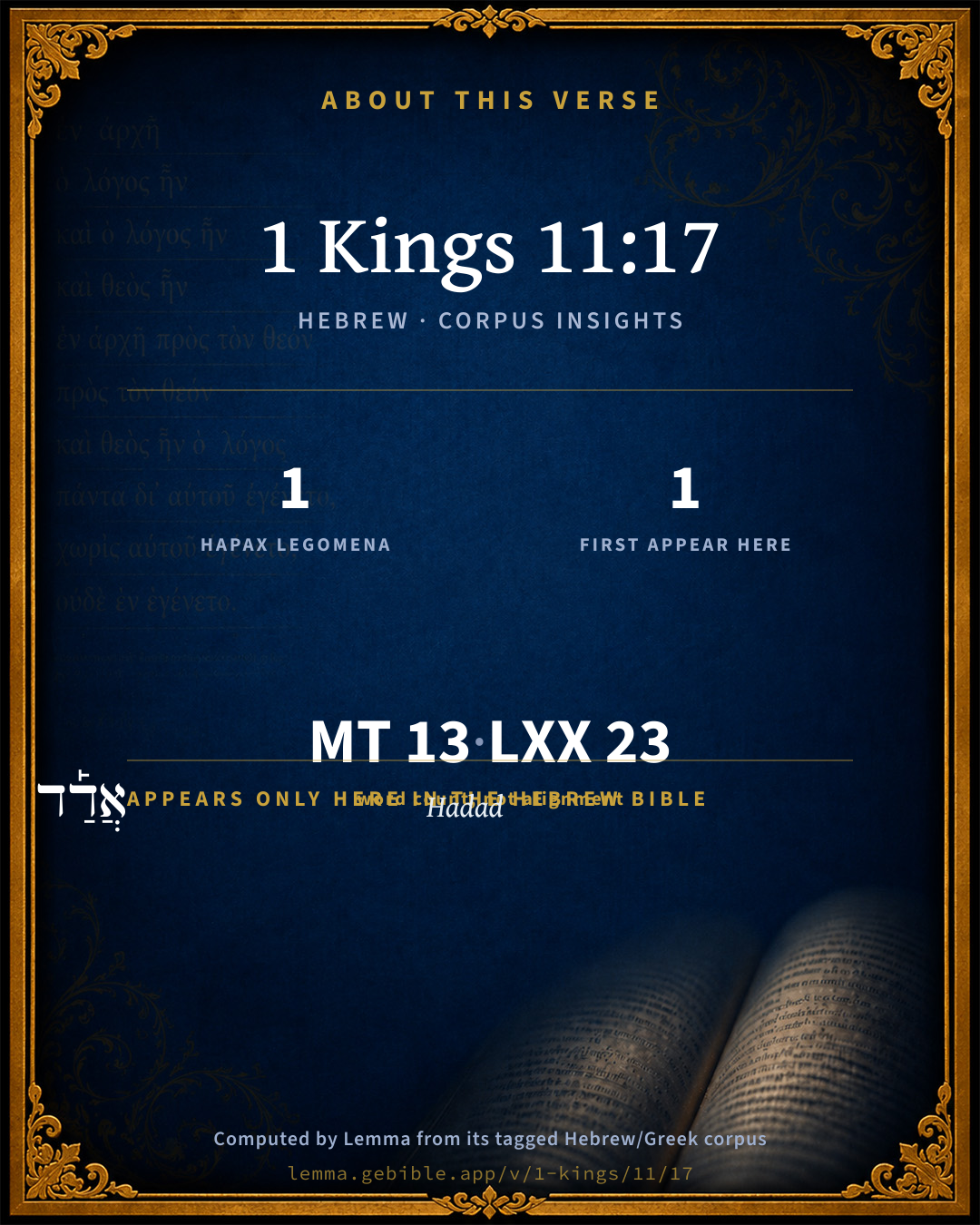
  • 1 hapax legomenon — only here in the Hebrew Bible
  • 1 first appearance in the Hebrew Bible
Full analysis ↓
Download a study sheet

One document with this verse’s original text, its word-by-word gloss line, the meaning frame, cross-references with their text, attributed commentary, and full source and license credits — printable, and it pastes into notes with its structure intact.

This verse Autodidact and up

Study sheet (.html) Plain text (.txt)

A passage Seminary Student

Up to 50 verses in one chapter. A passage sheet keeps up to 6 commentary sources and 12 cross-references per verse, in the order this page ranks them, and says so on the sheet whenever that leaves anything out. Ask for a single verse and you get the Autodidact verse sheet above.

Everything on this page stays free to read, with no account — the sheet is a download of what is already on screen, not access to it.

Want to remove ads? Support Godless Engineer
Compare translations 3

The same verse in 3 English versions, stacked beneath the original-language interlinear above. Click any original word for its lexicon entry.

Each is an independent rendering of the whole verse — the interlinear is not word-aligned to these translations.

Highlighted words mark where these versions differ — a whole-verse word diff, not a word-by-word alignment.

  • World English Bible Public Domain
    that Hadad fled, he and certain Edomites of his father's servants with him, to go into Egypt, Hadad being yet a little child.
  • King James Version Public Domain
    That Hadad fled, he and certain Edomites of his father's servants with him, to go into Egypt; Hadad being yet a little child.
  • unfoldingWord Literal Text CC BY-SA 4.0
    But Adad fled, he and Edomite men from the servants of his father with him, to enter Egypt. And Hadad a little boy.

unfoldingWord Literal Text — © unfoldingWord, licensed CC BY-SA 4.0. Word-aligned USFM3 via Door43 (git.door43.org/unfoldingWord/en_ult).

Versions to compare (up to 4)

3 of 4 selected

Show all 18 translations

Every available English version of this verse, each an independent rendering of the whole verse.

  • World English Bible Public Domain
    that Hadad fled, he and certain Edomites of his father's servants with him, to go into Egypt, Hadad being yet a little child.
  • Berean Standard Bible Public Domain
    But Hadad, still just a young boy, had fled to Egypt, along with some Edomites who were servants of his father.
  • Majority Standard Bible Public Domain
    But Hadad, still just a young boy, had fled to Egypt, along with some Edomites who were servants of his father.
  • King James Version Public Domain
    That Hadad fled, he and certain Edomites of his father's servants with him, to go into Egypt; Hadad being yet a little child.
  • American Standard Version (1901) Public Domain
    that Hadad fled, he and certain Edomites of his father's servants with him, to go into Egypt, Hadad being yet a little child.
  • Revised Version (1885) Public Domain
    that Hadad fled, he and certain Edomites of his father’s servants with him, to go into Egypt; Hadad being yet a little child.
  • Geneva Bible (1599) Public Domain
    Then this Hadad fled and certaine other Edomites of his fathers seruants with him, to goe into Egypt, Hadad being yet a litle childe.
  • Douay-Rheims (1899) Public Domain
    Then Adad fled, he and certain Edomites, of his father's servants with him, to go into Egypt: and Adad was then a little boy.
  • Young's Literal Translation Public Domain
    and Hadad fleeth, he and certain Edomites, of the servants of his father, with him, to go in to Egypt, and Hadad `is' a little youth,
  • Literal Standard Version CC BY-SA 4.0
    and Hadad flees, he and certain Edomites, of the servants of his father, with him, to go to Egypt, and Hadad [is] a little youth,
  • Unlocked Literal Bible CC BY-SA 4.0
    But Hadad was taken with other Edomites by his father's servants into Egypt, since Hadad was still a little child.
  • unfoldingWord Literal Text CC BY-SA 4.0
    But Adad fled, he and Edomite men from the servants of his father with him, to enter Egypt. And Hadad a little boy.
  • Darby Bible Public Domain
    that Hadad fled, he and certain Edomites of his father's servants with him, to go into Egypt, Hadad being yet a little child.
  • World Messianic Bible Public Domain
    Hadad fled, he and certain Edomites of his father’s servants with him, to go into Egypt, when Hadad was still a little child.
  • Webster's Bible Public Domain
    That Hadad fled, he and certain Edomites of his father's servants with him, to go into Egypt; Hadad being yet a little child.
  • Free Bible Version CC BY-SA 4.0
    But Hadad and some Edomites who had been his father's officials had run away to Egypt—Hadad was just a boy at the time.
  • Bible in Basic English Public Domain
    Hadad, being still a young boy, went in flight to Egypt, with certain Edomites, servants of his father;
  • JPS Tanakh (1917) Public Domain
    that Hadad fled, he and certain Edomites of his father's servants with him, to go into Egypt; Hadad being yet a little child.

Literal Standard Version (2020), Covenant Press — licensed CC BY-SA 4.0. Text via the HelloAO Bible API (eBible.org). Unlocked Literal Bible (unfoldingWord) — licensed CC BY-SA 4.0. Text via the HelloAO Bible API (eBible.org). unfoldingWord Literal Text — © unfoldingWord, licensed CC BY-SA 4.0. Word-aligned USFM3 via Door43 (git.door43.org/unfoldingWord/en_ult). Free Bible Version, Dr. Jonathan Gallagher — licensed CC BY-SA 4.0. Text via the HelloAO Bible API (eBible.org).

Word by word

More ways to search: Search by grammar → Find every occurrence → Compare this word →

Practice this passage: Drill this verse → Learn its vocabulary →

אֲדַ֡ד
ʼĂdad
H111
“Hadad”
Noun, Proper
Part of Speech
Noun
Type
Proper
Full BDB Definition

Origin: probably an orthographical variation for H2301

TWOT: None

Hadad = "I shall move softly: I shall love" - an Edomite enemy God raised up to punish Solomon for his sins
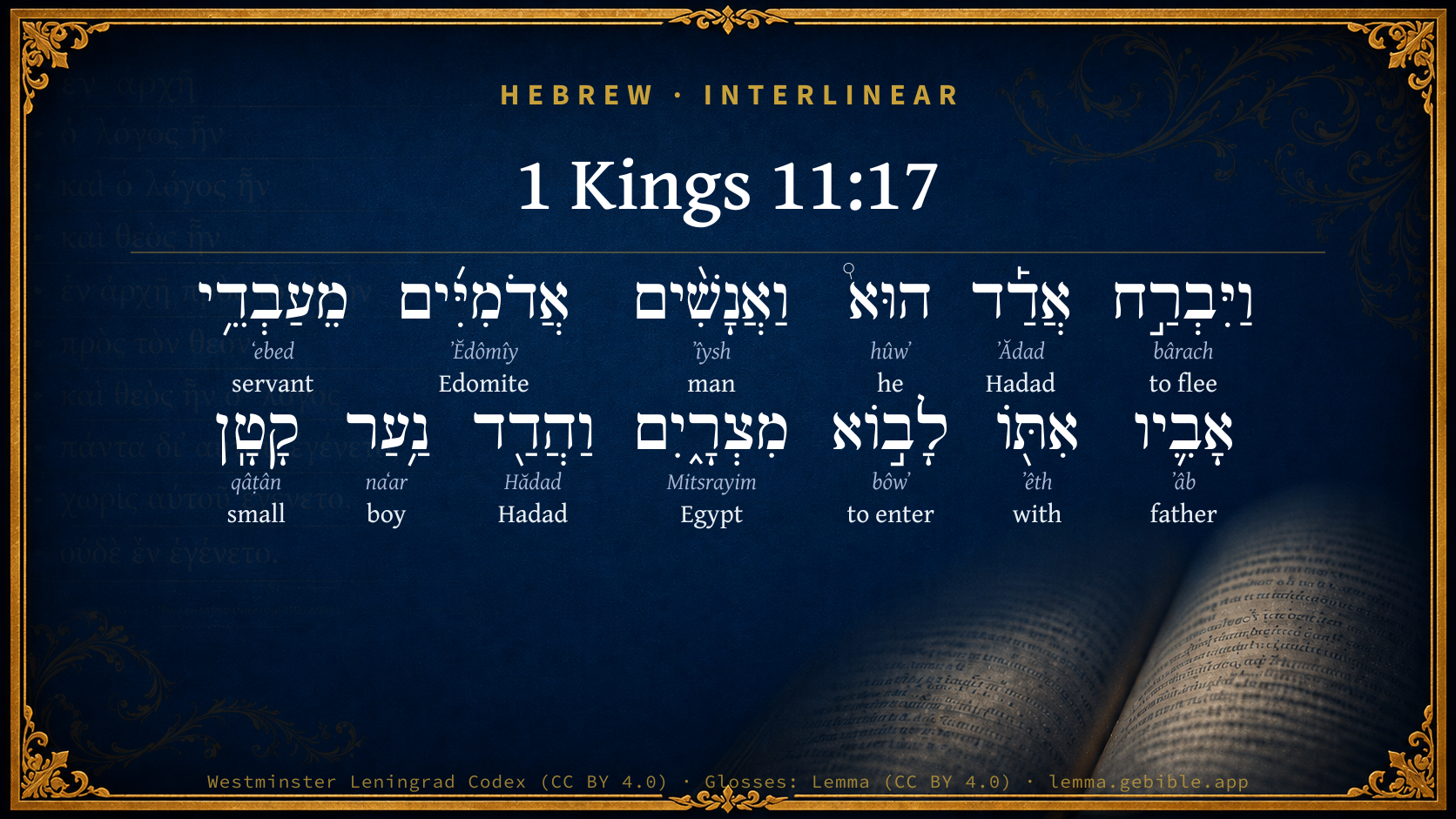
  1. וַיִּבְרַ֣ח bârach H1272 “and · to flee” Conjunction + Verb, Qal, Sequential Imperfect, 3rd Person, Masculine, Singular
  2. הוּא֩ hûwʼ H1931 “he” Pronoun, Personal, 3rd Person, Masculine, Singular
  3. וַאֲנָשִׁ֨ים ʼîysh H376 “and · men” Conjunction + Noun, Common, Masculine, Plural, Absolute
  4. אֲדֹמִיִּ֜ים ʼĔdômîy H130 “Edomites” Noun, Gentilic, Masculine, Plural, Absolute
  5. מֵעַבְדֵ֥י ʻebed H5650 “from · servants of” Preposition + Noun, Common, Masculine, Plural, Construct
  6. אָבִ֛יו ʼâb H1 “father · his” Noun, Common, Masculine, Singular, Construct + Suffix, Personal, 3rd Person, Masculine, Singular
  7. אִתּ֖וֹ ʼêth H854 “with · him” Preposition + Suffix, Personal, 3rd Person, Masculine, Singular
  8. לָב֣וֹא bôwʼ H935 “to enter” Preposition + Verb, Qal, Infinitive Construct
  9. מִצְרָ֑יִם Mitsrayim H4714 “Egypt” Noun, Proper
  10. וַהֲדַ֖ד Hădad H1908 “and · Hadad” Conjunction + Noun, Proper
  11. נַ֥עַר naʻar H5288 “boy” Noun, Common, Masculine, Singular, Absolute
  12. קָטָֽן qâṭân H6996 “small” Adjective, Adjective, Masculine, Singular, Absolute

About this verse

These counts appear in no published source. They are computed here, from the morphology-tagged text and Lemma’s own curated glosses. What Lemma adds →

13
words
13
distinct lemmas
Historical
section

Notable vocabulary

1 hapax legomenon — a word that appears only here in the entire Hebrew Bible:

  • אֲדַ֡ד Hadad H111

First appearance in Scripture

This word makes its first canonical appearance in the Hebrew Bible here:

  • אֲדַ֡ד Hadad H111

Shared distinctive vocabulary

אֲדֹמִיִּ֜ים Edomite H130 occurs in 12 verses of the Hebrew Bible. Also found in:

Grammatical profile

  • 2 verbs
  • 8 nouns
  • 1 adjective
  • 1 pronoun
  • 1 preposition

Verb forms

  • וַיִּבְרַ֣ח Qal · Sequential Imperfect
  • לָב֣וֹא Qal · Infinitive Construct

Hebrew & Septuagint length

In English translation the verse runs 23 words from the Hebrew and 29 from the Septuagint (LXX English) — closely comparable.

A rough comparison of the two English renderings, which tokenize alike — not a word-level alignment.

Word counts can differ between the Hebrew and the Greek without any difference in meaning — e.g. the Hebrew direct-object marker אֵת has no separate Greek word, and Greek often adds the article ὁ.

In the original languages it is 13 Hebrew tokens and 23 Greek tokens — but the two are counted differently (Hebrew bundles its prefixes and suffixes into one token; the Greek is in lemma form), so that isn’t a like-for-like length.

Cross-references

4

Topical passages linked to 1 Kings 11:17 in the Treasury of Scripture Knowledge — connected by theme and wording, ordered by reader-vote popularity; previews shown in the World English Bible.

  • Exodus 2:1–10 A man of the house of Levi went and took a daughter of Levi as his wife.
  • 2 Samuel 4:4 Now Jonathan, Saul's son, had a son who was lame of his feet. He was five years old when the news came of Saul and Jonathan out of Jezreel; and his nurse took him up, and fled: and it happened, as she made haste to flee, that he fell, and became lame. His name was Mephibosheth.
  • 2 Kings 11:2 But Jehosheba, the daughter of king Joram, sister of Ahaziah, took Joash the son of Ahaziah, and stole him away from among the king's sons who were slain, even him and his nurse, [and put them] in the bedchamber; and they hid him from Athaliah, so that he was not slain;
  • Matthew 2:13–14 Now when they had departed, behold, an angel of the Lord appeared to Joseph in a dream, saying, "Arise and take the young child and his mother, and flee into Egypt, and stay there until I tell you, for Herod will seek the young child to destroy him."

Cross-references courtesy of OpenBible.info (CC BY 4.0).

Hebrew and Greek witnesses Masoretic Hebrew ↔ Greek Septuagint

The same verse in the two great witnesses to the Old Testament, shown verse-for-verse.

These are two independent witnesses, not word-aligned to each other, and the Septuagint is shown in lemma (dictionary) form.

Hebrew 1 Kings 11:17 Masoretic · Westminster Leningrad Codex

וַיִּבְרַ֣ח אֲדַ֡ד הוּא֩ וַאֲנָשִׁ֨ים אֲדֹמִיִּ֜ים מֵעַבְדֵ֥י אָבִ֛יו אִתּ֖וֹ לָב֣וֹא מִצְרָ֑יִם וַהֲדַ֖ד נַ֥עַר קָטָֽן

that Hadad fled, he and certain Edomites of his father's servants with him, to go into Egypt, Hadad being yet a little child.

World English Bible · Public Domain

Greek LXX 1 Kings 11:17 Septuagint · lemma form

καί ἀποδιδράσκω αδερ αὐτός καί πᾶς ἀνήρ ιδουμαῖος ὁ παῖς ὁ πατήρ αὐτός μετά αὐτός καί εἰςἔρχομαι εἰς αἴγυπτος καί αδερ παιδάριον μικρός

that Ader ran away, he and all the Idumaeans of the servants of his father with him; and they went into Egypt; and Ader was then a little child.

LXX2012 (modern English Septuagint) · Public Domain

On this verse, The Cambridge Bible for Schools and Colleges discusses the Septuagint’s reading. Read the note in Commentary ↓

Hebrew: Westminster Leningrad Codex (CC BY 4.0). Greek: Septuagint (public domain); English from LXX2012 (modern English Septuagint) (Public Domain). How the Septuagint differs from the Hebrew →

Targum (Aramaic paraphrase)

1

The Targum is the ancient Jewish Aramaic paraphrase of the Hebrew Scriptures — an interpretive translation, not the Hebrew text itself. Onkelos (literal) and Pseudo-Jonathan (expansive) render the Torah, and Jonathan the Prophets. Coverage is partial: where no permissively-licensed English translation exists for a verse, only the Aramaic is shown. This is verse-level text, not a word-by-word alignment to the Hebrew.

  1. Targum Jonathan Prophets (Joshua–Malachi)
    וַעֲרַק אֲדַד הוּא וְגַבְרִין אֱדוֹמָאִין מֵעַבְדֵי אֲבוּהִי עִמֵיהּ לְמֵיעַל לְמִצְרָיִם וַהֲדַד יָנִיק זְעֵיר:

    (no public-domain English translation for this verse)

    Targum Jonathan — Aramaic: “Mikraot Gedolot” (public domain). English: “Sefaria Community Translation” (CC0 1.0 (public-domain dedication)); “London "Chaldee Paraphrase," 1871” (public domain). Text via Sefaria.

Commentary

Notes on 1 Kings 11:17 from classic Christian and Jewish commentators (each source and its license shown beneath its notes). The classic Christian expositions comment on the surrounding passage and are grouped to its opening verse, so a note may address several verses; the Jewish commentaries on the Tanakh (Rashi and others) are per-verse, so they appear only where the commentator wrote on this verse.

Lemma curates 59 commentaries, every one of them public domain or Creative Commons licensed, each selected and text-cleaned for this edition rather than reprinted as found. About our sources →

Trapp's Complete Commentary

John Trapp

1Ki 11:17 That Hadad fled, he and certain Edomites of his father’s servants with him, to go into Egypt; Hadad [being] yet a little child.

Ver. 17. That Hadad fled.] So did Muleasses, king of Tunis, to Charles V, who protected him: so did Zemes, the great Turk’s younger brother, to the Pope, who for money betrayed him into the hands of the tyrant.

John Trapp, A Commentary or Exposition upon All the Books of the Old and New Testament (1647–1656) — public domain. Text from a community e-Sword module.

Geneva Bible (1599)

Geneva Bible translators

Thus God reserved this idolater to be a scourge to punish his people’s sins.

Geneva Bible (1599) marginal notes — public domain. Text via Bolls.life.

Adam Clarke's Commentary

Verse 17. Hadad being yet a little child.] נער קטן naar katan, a little boy; one who was apprehensive of his danger, and could, with his father's servants, make his escape: not an infant.

Adam Clarke's Commentary on the Bible (1810–1826) — public domain. Text from a community e-Sword/MySword module.

The Cambridge Bible for Schools and Colleges

gen. ed. J. J. S. Perowne

17. Hadad fled] Here the Hebrew text by an error of the scribe gives Adad as the name. Or is it because the aspirate gave people trouble then as now?

his father’s servants] This seems conclusive that Hadad’s father had been king of Edom. The LXX. says all his father’s servants escaped with him.

to go into Egypt] In David’s days, Egypt was not, as it became in the reign of Solomon, closely bound up with the interests of Israel. Hence the defeated Edomites could look for a refuge there.

Hadad being yet a little child] Solomon uses the same expression of himself in 1Ki_3:7. It implies youth, but not necessarily infancy.

The Cambridge Bible for Schools and Colleges (gen. ed. J. J. S. Perowne; Cambridge University Press, 1878–1918) — public domain. Text from a community e-Sword module.

John Gill's Exposition

And they arose out of Midian,.... A country which lay in their way to Egypt, and where it seems they made some stay, and then departed:

and came to Paran; near to which was a wilderness of the same name, in which the Israelites wandered when they came out of Egypt, and which lay between Edom and Egypt:

and they took men with them out of Paran; either as guides and guards through the wilderness, or to make the better appearance before Pharaoh, and that they might meet with the better reception:

and they came to Egypt, unto Pharaoh king of Egypt; and told their case, and informed him who Hadad was: who, pitying an unfortunate young prince,

gave him an house; for him and his servants to dwell in:

and appointed him victuals; a daily provision for him and his men:

and gave him land; for his servants to cultivate, and from thence to raise a revenue for his support; the Jewish writers say he gave him cities to rule over; but as he was but a little child when he came, it cannot be thought that was done, at least directly.

John Gill's Exposition of the Whole Bible (1746–1763) — public domain (CC PDM 1.0). Text via the HelloAO Bible API.

Haydock's Catholic Bible Commentary

Boy. About five (Salien) or 12 years of age. (Pineda)

George Leo Haydock (1774–1849), Haydock's Catholic Family Bible and Commentary, 1859 edition — public domain. Excludes Psalms (Douay-Rheims chapter numbering differs from Protestant) and Deuterocanonical books (Catholic canon only).

The Pulpit Commentary

That Hadad fled This word excludes the idea that he was carried off in infancy by servants, something like Joash, (2Ki_11:2) he and certain Edomites of his father"s servants with him, to go into Egypt (cf.; Mat_2:13) Hadad being yet a little child. (The words used of Solomon 1Ki_3:7)

The Pulpit Commentary (1880–1919), ed. H.D.M. Spence-Jones & Joseph S. Exell — public domain. Text from a community e-Sword module.

Lesson kit

Teaching starters — assembled from the data on this page, not authored interpretation. Every prompt links to the verse data it draws on. Edit before teaching.

1 Kings, in the Historical, opens this verse with 13 words (13 distinct Hebrew lemmas). Its most distinctive word is ʼĂdad (“Hadad”). A historical commentator’s framing appears above. Read the whole chapter for the surrounding context.

Discussion questions

  1. The word ʼĂdad carries the sense “Hadad.” How does it shape the verse?
  2. 1 word here appears nowhere else in the Hebrew Bible. Why might the author reach for such rare wording?
  3. This is the first place “Hadad” appears in Scripture (first appears here). What does its debut here establish?
  4. How does Deuteronomy 23:7, which shares the word «Edomite», read alongside this verse?
  5. These translations render this verse differently. What is at stake in choosing one wording over another?
  6. «וַיִּבְרַ֣ח» is a Qal Sequential Imperfect verb. How does that grammatical form shape the action described?
  7. Compare how Trapp's Complete Commentary and Geneva Bible (1599) read this verse. Where do they agree or differ?

Things to notice

Reading settings

Reading text

Shown beneath each verse's original-language words.

Old Testament
Old Testament edition

Read the OT as the Masoretic Hebrew (MT) or the Greek Septuagint (LXX).

English shown for the Greek Septuagint (in the Hebrew ↔ Greek comparison).

Comparing translations? Open the Compare panel on any verse page to stack up to four side by side.