Genesis 21:20

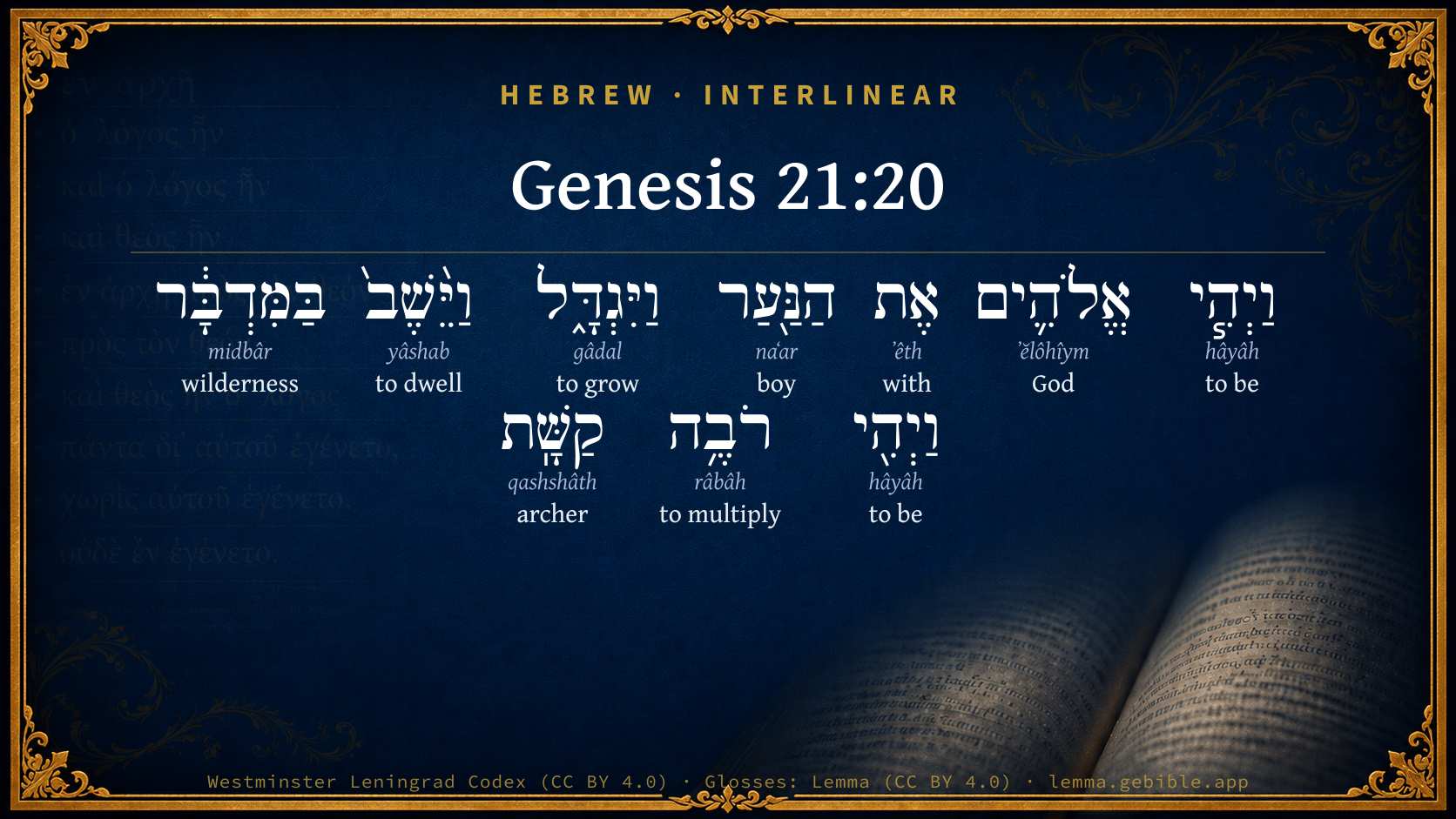
Hebrew (Westminster Leningrad Codex) Genesis 21:20 appears in the Hebrew Old Testament. The text above is from the Westminster Leningrad Codex. Each word links to its Strong’s number, a concise gloss, and parsing drawn from the Open Scriptures Hebrew Bible morphology. Click any word for its full Brown-Driver-Briggs (BDB) entry.
Download image
Cite this verse

Genesis 21:20 (World English Bible). Public Domain. Lemma interlinear Bible study tool, https://lemma.gebible.app/v/genesis/21/20.

Show BibTeX & RIS
BibTeX
RIS
English Translation
God was with the boy, and he grew. He lived in the wilderness, and became, as he grew up, an archer.
World English Bible · Public Domain
Highlights
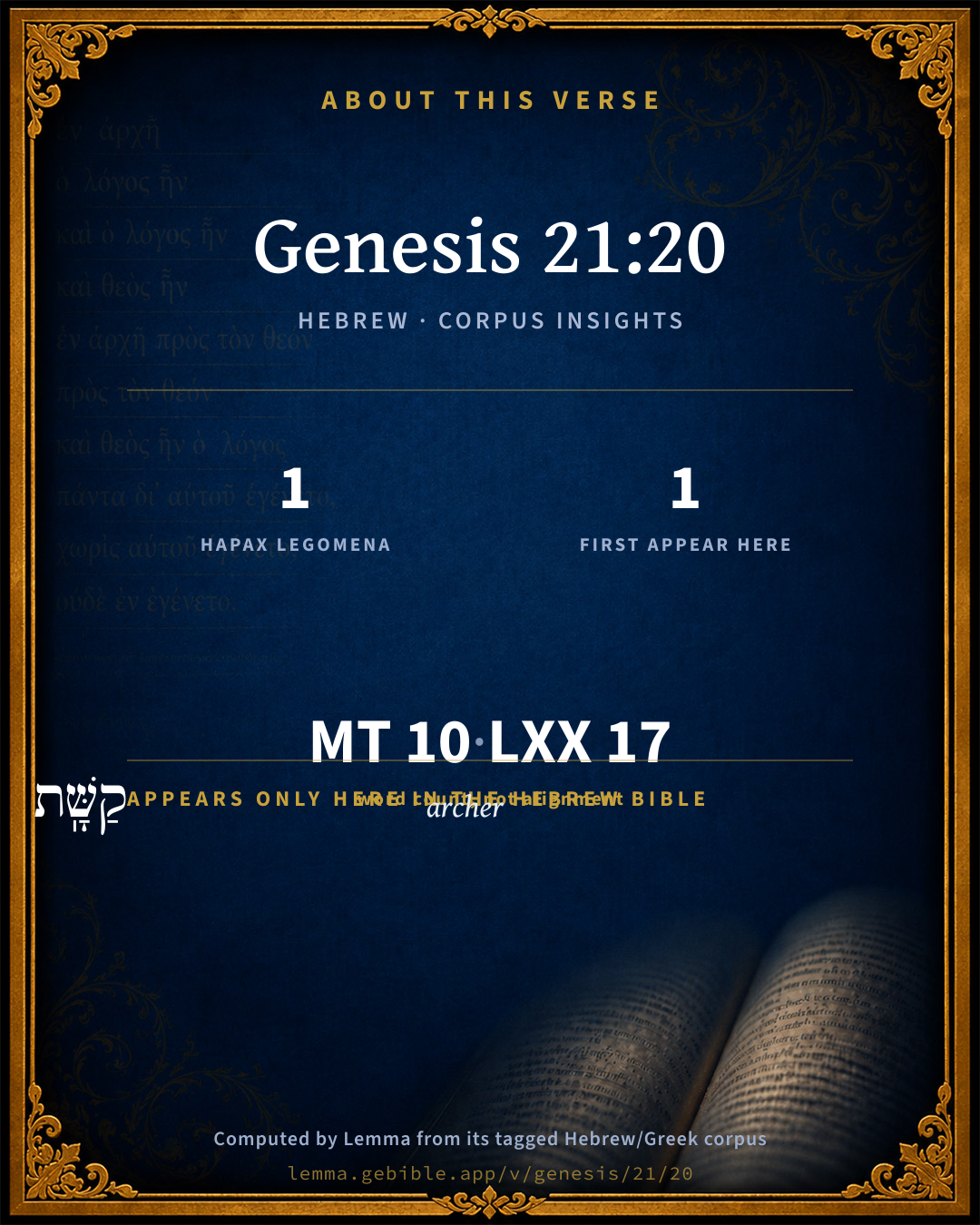
  • 1 hapax legomenon — only here in the Hebrew Bible
  • 1 first appearance in the Hebrew Bible
Full analysis ↓
Download a study sheet

One document with this verse’s original text, its word-by-word gloss line, the meaning frame, cross-references with their text, attributed commentary, and full source and license credits — printable, and it pastes into notes with its structure intact.

This verse Autodidact and up

Study sheet (.html) Plain text (.txt)

A passage Seminary Student

Up to 50 verses in one chapter. A passage sheet keeps up to 6 commentary sources and 12 cross-references per verse, in the order this page ranks them, and says so on the sheet whenever that leaves anything out. Ask for a single verse and you get the Autodidact verse sheet above.

Everything on this page stays free to read, with no account — the sheet is a download of what is already on screen, not access to it.

Want to remove ads? Support Godless Engineer
Compare translations 3

The same verse in 3 English versions, stacked beneath the original-language interlinear above. Click any original word for its lexicon entry.

Each is an independent rendering of the whole verse — the interlinear is not word-aligned to these translations.

Highlighted words mark where these versions differ — a whole-verse word diff, not a word-by-word alignment.

  • World English Bible Public Domain
    God was with the boy, and he grew. He lived in the wilderness, and became, as he grew up, an archer.
  • King James Version Public Domain
    And God was with the lad; and he grew, and dwelt in the wilderness, and became an archer.
  • unfoldingWord Literal Text CC BY-SA 4.0
    And God was with the boy, and he grew up. And he lived in the wilderness and became a great bowman.

unfoldingWord Literal Text — © unfoldingWord, licensed CC BY-SA 4.0. Word-aligned USFM3 via Door43 (git.door43.org/unfoldingWord/en_ult).

Versions to compare (up to 4)

3 of 4 selected

Show all 18 translations

Every available English version of this verse, each an independent rendering of the whole verse.

  • World English Bible Public Domain
    God was with the boy, and he grew. He lived in the wilderness, and became, as he grew up, an archer.
  • Berean Standard Bible Public Domain
    And God was with the boy, and he grew up and settled in the wilderness and became a great archer.
  • Majority Standard Bible Public Domain
    And God was with the boy, and he grew up and settled in the wilderness and became a great archer.
  • King James Version Public Domain
    And God was with the lad; and he grew, and dwelt in the wilderness, and became an archer.
  • American Standard Version (1901) Public Domain
    And God was with the lad, and he grew. And he dwelt in the wilderness, and became, as he grew up, an archer.
  • Revised Version (1885) Public Domain
    And God was with the lad, and he grew; and he dwelt in the wilderness, and became an archer.
  • Geneva Bible (1599) Public Domain
    So God was with the childe, and he grewe and dwelt in the wildernesse, and was an archer.
  • Douay-Rheims (1899) Public Domain
    And God was with him: and he grew, and dwelt in the wilderness, and became a young man, an archer.
  • Young's Literal Translation Public Domain
    and God is with the youth, and he groweth, and dwelleth in the wilderness, and is an archer;
  • Literal Standard Version CC BY-SA 4.0
    and God is with the youth, and he grows, and dwells in the wilderness, and is an archer;
  • Unlocked Literal Bible CC BY-SA 4.0
    God was with the lad, and he grew. He lived in the wilderness and became an archer.
  • unfoldingWord Literal Text CC BY-SA 4.0
    And God was with the boy, and he grew up. And he lived in the wilderness and became a great bowman.
  • Darby Bible Public Domain
    And God was with the lad, and he grew; and he dwelt in the wilderness, and became an archer.
  • World Messianic Bible Public Domain
    God was with the boy, and he grew. He lived in the wilderness, and as he grew up, he became an archer.
  • Webster's Bible Public Domain
    And God was with the lad; and he grew, and dwelt in the wilderness, and became an archer.
  • Free Bible Version CC BY-SA 4.0
    God blessed Ishmael and he grew up, living in the desert. He became a skilled archer.
  • Bible in Basic English Public Domain
    And God was with the boy, and he became tall and strong, and he became a bowman, living in the waste land.
  • JPS Tanakh (1917) Public Domain
    And God was with the lad, and he grew; and he dwelt in the wilderness, and became an archer.

Literal Standard Version (2020), Covenant Press — licensed CC BY-SA 4.0. Text via the HelloAO Bible API (eBible.org). Unlocked Literal Bible (unfoldingWord) — licensed CC BY-SA 4.0. Text via the HelloAO Bible API (eBible.org). unfoldingWord Literal Text — © unfoldingWord, licensed CC BY-SA 4.0. Word-aligned USFM3 via Door43 (git.door43.org/unfoldingWord/en_ult). Free Bible Version, Dr. Jonathan Gallagher — licensed CC BY-SA 4.0. Text via the HelloAO Bible API (eBible.org).

Word by word

More ways to search: Search by grammar → Find every occurrence → Compare this word →

Practice this passage: Drill this verse → Learn its vocabulary →

קַשָּֽׁת
qashshâth
H7199
“archer”
Noun, Common, Masculine, Singular, Absolute
Part of Speech
Noun
Type
Common
Gender
Masculine
Number
Singular
State
Absolute
Full BDB Definition

Origin: intensive (as denominative) from H7198

TWOT: 2094

bowman, archer
  1. וַיְהִ֧י hâyâh H1961 “and · to be” Conjunction + Verb, Qal, Sequential Imperfect, 3rd Person, Masculine, Singular
  2. אֱלֹהִ֛ים ʼĕlôhîym H430 “God(s)” Noun, Common, Masculine, Plural, Absolute
  3. אֶת ʼêth H854 “with” Preposition
  4. הַנַּ֖עַר naʻar H5288 “the · boy” Particle, Definite Article + Noun, Common, Masculine, Singular, Absolute
  5. וַיִּגְדָּ֑ל gâdal H1431 “and · to grow” Conjunction + Verb, Qal, Sequential Imperfect, 3rd Person, Masculine, Singular
  6. וַיֵּ֨שֶׁב֙ yâshab H3427 “and · to dwell” Conjunction + Verb, Qal, Sequential Imperfect, 3rd Person, Masculine, Singular
  7. בַּמִּדְבָּ֔ר midbâr H4057 “in/at the · wilderness” Preposition, Determined + Noun, Common, Masculine, Singular, Absolute
  8. וַיְהִ֖י hâyâh H1961 “and · to be” Conjunction + Verb, Qal, Sequential Imperfect, 3rd Person, Masculine, Singular
  9. רֹבֶ֥ה râbâh H7235 “multiplying” Verb, Qal, Participle Active, Masculine, Singular, Construct

About this verse

These counts appear in no published source. They are computed here, from the morphology-tagged text and Lemma’s own curated glosses. What Lemma adds →

10
words
9
distinct lemmas
Pentateuch
section

Notable vocabulary

1 hapax legomenon — a word that appears only here in the entire Hebrew Bible:

  • קַשָּֽׁת archer H7199

First appearance in Scripture

This word makes its first canonical appearance in the Hebrew Bible here:

  • קַשָּֽׁת archer H7199

Grammatical profile

  • 5 verbs
  • 4 nouns
  • 1 preposition

Verb forms

  • וַיְהִ֧י Qal · Sequential Imperfect
  • וַיִּגְדָּ֑ל Qal · Sequential Imperfect
  • וַיֵּ֨שֶׁב֙ Qal · Sequential Imperfect
  • וַיְהִ֖י Qal · Sequential Imperfect
  • רֹבֶ֥ה Qal · Participle Active

Repetition

A word recurs within this verse — often emphatic in Hebrew:

  • וַיְהִ֧י to be H1961 ×2

Hebrew & Septuagint length

In English translation the verse runs 21 words from the Hebrew and 18 from the Septuagint (LXX English) — closely comparable.

A rough comparison of the two English renderings, which tokenize alike — not a word-level alignment.

Word counts can differ between the Hebrew and the Greek without any difference in meaning — e.g. the Hebrew direct-object marker אֵת has no separate Greek word, and Greek often adds the article ὁ.

In the original languages it is 10 Hebrew tokens and 17 Greek tokens — but the two are counted differently (Hebrew bundles its prefixes and suffixes into one token; the Greek is in lemma form), so that isn’t a like-for-like length.

Cross-references

13

Topical passages linked to Genesis 21:20 in the Treasury of Scripture Knowledge — connected by theme and wording, ordered by reader-vote popularity; previews shown in the World English Bible.

  • Genesis 28:15 Behold, I am with you, and will keep you, wherever you go, and will bring you again into this land. For I will not leave you, until I have done that which I have spoken of to you."
  • Genesis 39:21 But Yahweh was with Joseph, and showed kindness to him, and gave him favor in the sight of the keeper of the prison.
  • Genesis 16:12 He will be like a wild donkey among men. His hand will be against every man, and every man's hand against him. He will live opposite all of his brothers."
  • Genesis 10:9 He was a mighty hunter before Yahweh. Therefore it is said, "Like Nimrod, a mighty hunter before Yahweh."
  • Genesis 17:20 As for Ishmael, I have heard you. Behold, I have blessed him, and will make him fruitful, and will multiply him exceedingly. He will become the father of twelve princes, and I will make him a great nation.
  • Genesis 25:27 The boys grew. Esau was a skillful hunter, a man of the field. Jacob was a quiet man, living in tents.
  • Genesis 39:2–3 Yahweh was with Joseph, and he was a prosperous man. He was in the house of his master the Egyptian.
  • Genesis 49:23–24 The archers have sorely grieved him, Shot at him, and persecute him:
  • Judges 6:12 The angel of Yahweh appeared to him, and said to him, Yahweh is with you, you mighty man of valor.
  • Judges 13:24–25 The woman bore a son, and named him Samson: and the child grew, and Yahweh blessed him.
  • Luke 1:80 The child was growing, and becoming strong in spirit, and was in the desert until the day of his public appearance to Israel.
  • Genesis 27:3 Now therefore, please take your weapons, your quiver and your bow, and go out to the field, and take me venison.
  • Luke 2:40 The child was growing, and was becoming strong in spirit, being filled with wisdom, and the grace of God was upon him.

Cross-references courtesy of OpenBible.info (CC BY 4.0).

Hebrew and Greek witnesses Masoretic Hebrew ↔ Greek Septuagint

The same verse in the two great witnesses to the Old Testament, shown verse-for-verse.

These are two independent witnesses, not word-aligned to each other, and the Septuagint is shown in lemma (dictionary) form.

Hebrew Genesis 21:20 Masoretic · Westminster Leningrad Codex

וַיְהִ֧י אֱלֹהִ֛ים אֶת הַנַּ֖עַר וַיִּגְדָּ֑ל וַיֵּ֨שֶׁב֙ בַּמִּדְבָּ֔ר וַיְהִ֖י רֹבֶ֥ה קַשָּֽׁת

God was with the boy, and he grew. He lived in the wilderness, and became, as he grew up, an archer.

World English Bible · Public Domain

Greek LXX Genesis 21:20 Septuagint · lemma form

καί εἰμί ὁ θεός μετά ὁ παιδίον καί αὐξάνω καί καταοἰκέω ἐν ὁ ἔρημος γίγνομαι δέ τοξότης

And God was with the child, and he grew and lived in the wilderness, and became an archer.

LXX2012 (modern English Septuagint) · Public Domain

On this verse, The Pulpit Commentary discusses the Septuagint’s reading. Read the note in Commentary ↓

Hebrew: Westminster Leningrad Codex (CC BY 4.0). Greek: Septuagint (public domain); English from LXX2012 (modern English Septuagint) (Public Domain). How the Septuagint differs from the Hebrew →

Targum (Aramaic paraphrase)

2

The Targum is the ancient Jewish Aramaic paraphrase of the Hebrew Scriptures — an interpretive translation, not the Hebrew text itself. Onkelos (literal) and Pseudo-Jonathan (expansive) render the Torah, and Jonathan the Prophets. Coverage is partial: where no permissively-licensed English translation exists for a verse, only the Aramaic is shown. This is verse-level text, not a word-by-word alignment to the Hebrew.

  1. Targum Onkelos Torah (Genesis–Deuteronomy)
    וַהֲוָה מֵימְרָא דַּיְיָ בְּסַעְדֵהּ דְּרַבְיָא וּרְבָא וִיתֵב בְּמַדְבְּרָא וַהֲוָה רָבֵי קַשְׁתָּא

    (no public-domain English translation for this verse)

    Targum Onkelos — Aramaic: “Onkelos Genesis” (public domain); “Onkelos Exodus” (public domain); “Onkelos Leviticus” (public domain); “Onkelos Numbers” (public domain); “Onkelos Deuteronomy” (public domain). English: “Sefaria Community Translation” (CC0 1.0 (public-domain dedication)); “J.W. Etheridge. The Targums of Onkelos and Jonathan Ben Uzziel on the Pentateuch. London: Longmans, Green, 1862” (public domain). Text via Sefaria.

  2. Targum Pseudo-Jonathan Torah (Genesis–Deuteronomy)
    וַהֲוָה מֵימְרָא דַיְיָ בְּסַעֲדֵיהּ דְטַלְיָא וּרְבָא וְיָתִיב בְּמַדְבְּרָא וַהֲוָה יַלִיף רַבֵּי קַשְׁוָותָא

    And the Word of the Lord was the helper of the youth, and he grew and dwelt in the wilderness, and became a skilful master of the bow.

    Targum Pseudo-Jonathan — Aramaic: “Targum Jonathan on Genesis” (public domain); “Targum Jonathan on Exodus” (public domain); “Targum Jonathan on Leviticus” (public domain); “Targum Jonathan on Numbers” (public domain); “Targum Jonathan on Deuteronomy” (public domain). English: “The Targum of Jonathan ben Uzziel, trans. J. W. Etheridge, London, 1862” (public domain). Text via Sefaria.

Commentary

Notes on Genesis 21:20 from classic Christian and Jewish commentators (each source and its license shown beneath its notes). The classic Christian expositions comment on the surrounding passage and are grouped to its opening verse, so a note may address several verses; the Jewish commentaries on the Tanakh (Rashi and others) are per-verse, so they appear only where the commentator wrote on this verse.

Lemma curates 59 commentaries, every one of them public domain or Creative Commons licensed, each selected and text-cleaned for this edition rather than reprinted as found. About our sources →

Trapp's Complete Commentary

John Trapp

Gen 21:20 And God was with the lad; and he grew, and dwelt in the wilderness, and became an archer.

Ver. 20. And God was with the lad, &c.] The fountain of Hagar, saith a divine, lying between Bared and Kadesh Barnea, was afterwards called the well of the living God; and seemeth mystically to represent baptism, the laver of regeneration. For the Church, like Hagar with her son Ishmael, travelling through the wilderness of this world, is pressed with a multitude of sins and miseries, &c. Wherefore they, joining together in prayer, crave to be refreshed with the water of life. For Hagar signifieth a pilgrim. Ishmael, a man whom the Lord heareth; who, travelling together with his mother the Church in this world, fighteth against the enemies thereof, and shooteth the arrows of faith against all infernal and cruel beasts and lusts. Thus he. {a}

{a} Itinerar. Script., fol. 95.

John Trapp, A Commentary or Exposition upon All the Books of the Old and New Testament (1647–1656) — public domain. Text from a community e-Sword module.

Joseph Benson's Commentary

Gen 21:20-21. God was with the lad — This accounts for his preservation and support in that wilderness, in which, had not God been with him in an extraordinary manner, in answer to Abraham’s prayer, in all probability he must have perished.

Joseph Benson's Commentary on the Old and New Testaments (1811–1818) — public domain. Text from a community e-Sword module.

Geneva Bible (1599)

Geneva Bible translators

As touching outward things God caused him to prosper.

Or, shot in the bow, and was an hunter.

Geneva Bible (1599) marginal notes — public domain. Text via Bolls.life.

Jamieson, Fausset & Brown

Robert Jamieson, A. R. Fausset & David Brown

God was with the lad, &c.--Paran (that is, Arabia), where his posterity has ever dwelt (compare Gen 16:12; also Isa 48:19; Pe1 1:25).

his mother took him a wife--On a father's death, the mother looks out for a wife for her son, however young; and as Ishmael was now virtually deprived of his father, his mother set about forming a marriage connection for him, it would seem, among her relatives.

Jamieson, Fausset & Brown — Commentary Critical and Explanatory on the Whole Bible (1871) — public domain (CC PDM 1.0). Text via the HelloAO Bible API.

Adam Clarke's Commentary

Verse 20. Became an archer.] And by his skill in this art, under the continual superintendence of the Divine Providence, (for God was with the lad,) he was undoubtedly enabled to procure a sufficient supply for his own wants and those of his parent.

Adam Clarke's Commentary on the Bible (1810–1826) — public domain. Text from a community e-Sword/MySword module.

John Calvin's Commentaries

20. And God was with the lad. There are many ways in which God is said to be present with men. He is present with his elect, whom he governs by the special grace of his Spirit; he is present also, sometimes, as it respects external life, not only with his elect, but also with strangers, in granting them some signal benediction: as Moses, in this place, commends the extraordinary grace by which the Lord declares that his promise is not void, since he pursues Ishmael with favor, because he was the son of Abraham. Hence, however, this general doctrine is inferred; that it is to be entirely ascribed to God that men grow up, that they enjoy the light and common breath of heaven, and that the earth supplies them with food. Only it must be remembered, the prosperity of Ishmael flowed from this cause, that an earthly blessing was promised him for the sake of his father Abraham. In saying, that Hagar took a wife for Ishmael, Moses has respect to civil order; for since marriage forms a principal part of human life, it is right that, in contracting it, children should be subject to their parents, and should obey their counsel. This order, which nature prescribes and dictates, was, as we see, observed by Ishmael, a wild man in the barbarism of the desert; for he was subject to his mother in marrying a wife. Whence we perceive, what a prodigious monster was the Pope, when he dared to overthrow this sacred right of nature. To this is also added the impudent boast of authorizing a wicked contempt of parents, in honor of holy wedlock. Moreover the Egyptian wife was a kind of prelude to the future dissension between the Israelites and the Ishmaelites.

John Calvin's Commentaries (1540-1563) — public domain. Text from the Calvin Translation Society English edition (1840s-50s) via the Christian Classics Ethereal Library (ccel.org). Calvin's coverage is partial (roughly two-thirds of the Bible); uncommented books and verses are honest gaps, never fabricated. The 19th-century editor's footnotes and remarks are omitted so the notes are faithfully Calvin's own voice.

Ellicott's Commentary for English Readers

(20) He grew.—Literally, became great, that is, grew to manhood.

And dwelt in the wilderness.—He sought no refuge in Egypt, where so large a Semitic population was gathering, nor in any Canaanite town, but took to the wandering life in the desert, such as is still usual with the Arabs.

An archer.—Heb., a shooter of bowshots. Another explanation, from a verb signifying to multiply, or be great, is not tenable.

A Bible Commentary for English Readers, edited by Charles John Ellicott (1878–1897) — public domain. Text from a community e-Sword module.

The Cambridge Bible for Schools and Colleges

gen. ed. J. J. S. Perowne

20. God was with the lad] Cf. 22, Gen_26:3, Gen_39:2.

became an archer] R.V. marg. rightly, became, as he grew up, an archer. Lat. factusque est juvenis Sagittarius. His descendants were famous in later times for their skill in the use of the bow (cf. Isa_21:17). Cf. Jetur the son of Ishmael (Gen_25:15), the reputed ancestor of the Ituraeans.

The Cambridge Bible for Schools and Colleges (gen. ed. J. J. S. Perowne; Cambridge University Press, 1878–1918) — public domain. Text from a community e-Sword module.

John Gill's Exposition

And he dwelt in the wilderness of Paran,.... So called from Paran, a city in Arabia Petraea; it reached from the wilderness of Shur to Mount Sinai: the account Adrichomius (q) gives of it is this; Paran or"Pharan is a wilderness, very large, desolate, impassable, and without water, containing, from Mount Sinai to Kadeshbarnea, a journey of eleven days; its land can neither be ploughed nor sown, is wholly dry, barren, and uncultivated; uninhabitable to men, destitute of villages, houses, and cottages; where neither men are seen, nor beasts nor birds; yea, neither trees nor any grass, only rocks and high rough stony mountains; it is taken sometimes for the first part of the desert of Arabia, near Mount Sinai, and sometimes for the last part, towards the land of promise; sometimes it is called the desert of Sin, and sometimes the desert of Sinai, from the mount; but this name Pharan seems to be the most general of the names of this very long desert:''this is the wilderness the Israelites wandered in thirty eight years; what this writer says of it must be understood only of some parts of it, otherwise Ishmael could not have lived in it:

and his mother took him a wife out of the land of Egypt: her own country, for she was an Egyptian, Gen 16:1; and where they dwelt was not far from it: according to the Jewish writers, he had two wives; the first he divorced, and then married the Egyptian; his first wife, they say (r), he sent for, and took out of the plains of Moab, whose name was Aishah, and the other Phatimah; so the Targum of Jonathan here,"and he dwelt in the wilderness of Paran, and took to wife Adisha (or Aisha), whom he divorced, and then his mother took him Phatimah to wife, out of the land of Egypt:''the names of Ishmael's wives seem to be taken from the Arabic writers; for Aishah, or Ayesha, was the name of a daughter of Abubeker, and one of the wives of Mahomet, and Phatimah the name of one of his daughters.

(q) Theatrum Terrae, S. p. 116. (r) Pirke Eliezer, ut supra. (c. 30.)

John Gill's Exposition of the Whole Bible (1746–1763) — public domain (CC PDM 1.0). Text via the HelloAO Bible API.

Haydock's Catholic Bible Commentary

Wilderness, in Arabia Petrea. --- An archer, living on plunder. (Calmet)

George Leo Haydock (1774–1849), Haydock's Catholic Family Bible and Commentary, 1859 edition — public domain. Excludes Psalms (Douay-Rheims chapter numbering differs from Protestant) and Deuterocanonical books (Catholic canon only).

Matthew Poole's English Annotations

i.e. A skilful hunter of beasts, and warrior with men too, according to the prediction, Gen 16:12. For the bow was a principal instrument in war, as well as in hunting, Gen 48:22; 49:23,24. And these two professions oft went together. See Gen 10:9.

Matthew Poole's English Annotations on the Holy Bible (1683–1685) — public domain. Text from a community e-Sword/MySword module.

Whedon's Commentary on the Bible

Daniel D. Whedon

20. God was with the lad — A divine providence watched over and cared for him, although he passed outside the chosen household of Jehovah’s covenant.

He grew — There was room for this, for as yet he was but an undeveloped lad.

Became an archer — Hebrews, he was growing an archer. He became increasingly a skilful bow-man. His descendants were long after noted for their use of the bow. Isa_21:17.

Daniel D. Whedon (gen. ed.), Commentary on the Old and New Testaments (1874–1909) — public domain. Text from a community e-Sword module.

The Pulpit Commentary

Vers. 20, 21. And God was with the lad. Not simply in the ordinary sense in which he is with all men (Psa_139:3-9; Act_17:27, Act_17:28) not, certainly, in the spiritual sense in which he had promised to be with, (Gen_17:21) and in which he is with believers (Isa_41:10; Mat_28:20) but in the particular sense of exercising towards him a special providence, with a view to implementing the promise made concerning him to Abraham and Hagar. And he grew (literally, became great, i.e. progressed towards manhood), and dwelt in the wilderness (i.e. led a roving and unsettled life), and became an archer. Literally, and he was tVqhbro i.e. deriving hb,ro from hbr to grow great or multiply, either

(1) when he grew up, an archer, or man using the bow (Gesenius, Keil);

(2) growing an archer, or acquiring skill as a bowman (Kalisch, Wordsworth); or

(3) growing, or multiplying into, a tribe of archers (Murphy). With the first of these substantially agree the renderings kaineto toxothv (LXX), and factus est juvenis sagittarius (Vulgate). Others, connecting hbro with kbr in the sense of to cast arrows, (cf. Gen_49:23) read,

(1) "and he was a shooter of arrows from the bow" (Jarchi, Kimchi, Rosenm though in this case tv,q, would have to be read for tV; q (Furst);

(2) a marksman, archer, i.e. a marksman skilled in using the bow (Ewald, vide " Hebrews Synt.," Baumgarten translates, a hero (or great one), an archer. And he dwelt in the wilderness of Paran: the desert of El-Tih, on the south of Canaan (cf. Gen_14:6) and his mother took him a wife out of the land of Egypt (cf. Gen_24:4, Gen_24:55; Exo_21:10)

HOMILIES BY F. HASTINGS Ver. 20.

God"s care for Ishmael.

"And God was with the lad." The encampment of Abraham was the scene of joy and festivity on the occasion of the recognition of Isaac publicly as his heir. It is said in Jewish lore that Abraham called a number of the patriarchs to the feast, and that Melchizedek, Nahor, and even Noah were present. Ishmael had been heir-presumptive up to that time. He was then put in the position of a subject to the son of Sarah. He and his mother despised the weakling and nursling. They "mocked." This roused the indignation of Sarah, and she insisted on the banishment of both. Abraham was very unwilling to consent to the proposal, for he had great affection for Ishmael. No wonder that he loved him, for he was, if not the child of promise, at least the son who first roused in his breast the pride and joy of paternity. He seems to have hoped that Ishmael would be the one through whom the great blessings promised to him would be bestowed. Hence he had prayed, "O that Ishmael might live before thee". (Gen_17:18) Perhaps unbelief had much to do with the expression of the hope. He indicated his own contentment with that mode of fulfillment of the premise; God, however, has another. Abraham evidently loved the lad, and now that he is grown to be a stalwart youth of about sixteen, it is strongly against his inclination to send him away. Sarah insists. She in her indignation will not even speak of him by his name, but calls him contemptuously "the son of this bondwoman". (Gen_21:10) Abraham was very grieved (Ver. 11), but he can see that there is no prospect of any peace in his encampment unless he should do as Sarah wishes. Two jealous women are enough to embitter his life, and bring discord eventually among his retainers For typical reasons the banishment was permitted by God (Ver. 12), and Abraham sends both away, laden probably not only with trinkets, which shall suffice for barter, but with a flask of water and strings of small loaves. Abraham had thus to sacrifice his own inclinations in Ishmael, his son after the flesh, as afterwards his will in offering up Isaac, his child of promise. Away towards Egypt Hagar and Ishmael travel. They enter the wilderness of Beersheba. Happiness and home is behind; desolateness, dreariness, lonely journeyings, imminent dangers from the wild beasts and fierce hordes of men, with Egypt, before them. Hagar, with bread dry and water spent, losing her way, waits for some one to guide. Unable to proceed, she and her son sink down to die, to perish in the scorching heat from that most fearful of all deprivations, water. Hagar, with bitter memories of lost happiness and unjust treatment crowding, cannot bear the sight of her son"s woe and sound of his moaning, therefore removes to a slight distance, that she might not see his death nor disturb it as she sought to ease her poor heart with tears. Oh, what moral beauty blossoms in the desert in the maternal love of this outcast bondwoman. No human eye detects it, but God notices and hears her voice, and that of the child. Then comes the direction from heaven, and the promise, "I will make of him a great nation." We are told immediately afterwards in the brief record concerning Ishmael that "God was with the lad," and so the promise was fulfilled. We notice Gods care even for an Ishmael, for one who would appear to be outside all covenant blessings. He was one whose "hand was to be against every man, and every man"s against him". (Gen_16:12) God manifested care, however, to this Ishmael

I BY PRESERVING HIS LIFE. He heard his cry in distress. He knew his needs. God always knows our needs; whence to supply them, and where to find us even in the wilderness. A well of water is unexpectedly pointed out to the mother. Her eyes were opened to see its whereabouts. So God teaches many a mother, that she may lead her children to the well of living water. Every life preserved is only through the mercy of God. "In his hand our breath is". (Dan_5:23) There is a well for bondsmen as well as free. God"s living well is to be reached in any position of life. It is near to us when we think it far off. "The word is nigh thee, in thine heart," &c. ; (Rom_10:8) If we are to see the treasure, our spiritual understanding must be quickened, our "eyes opened" by the Holy Spirit. If we desire to know the way and well of life, we can pray for that opening. Only as we have this spiritual sight and life can we rejoice in the present existence, in our preservation. God preserved Ishmael that he might know him.

II GOD ADVANCED HIM IN LIFE. He was with him as he grew up, and gave him favor in the sight of others. God is ever seeking by his Holy Spirit to mould the character of the worst for good. If we have any prosperity and grow up to influence, we should remember that it is from God. The darkest hour for Ishmael had ushered in the dawning of the brightest day. God knew what he would do with Ishmael. Ishmael is to found a nation. It is remarkable that he was the ancestor of the same number of tribes as was Israel. (Gen_25:16) He found various scattered people in the Arabian desert, but the tribes descended from him seem to have absorbed all others. What an honor to be the founder of a house, a dynasty; how much more of a nation! This God granted to an Ishmael.

III GOD GAVE HIM SKILL. "He became an archer." He had to learn to defend himself, and secure for himself, by God"s help, a position. The fighting power is not the highest, but man has always had to protect himself before he could make progress in civilization. Alas, when he supposes himself to be civilized he often clings to the old habit, and still loves the fighting. The archers, like Ishmael, have their sphere as well as the shepherds, like Isaacs. The fiery defenders of faith and the controversial champions of the truth have their sphere as well as the pious, plodding pastors of Christ"s flock. If men have skill for the one thing, let them not despise the powers of others. We have all to learn to appreciate diversity of talents, and to remember that skill in any work is the outcome of independence, resolution, and energy. Ishmael had been endowed with these by God.

IV GOD FURNISHED ISHMAEL WITH A PLACE OF HABITATION. He gave to him the desert for his domain. Here he might roam and pitch his tent at his own suggestion. God knew that the hot blood of his Egyptian mother, which coursed in his veins, would find its most fitting sphere in the desert. Instead of mingling with gentle herdsmen, he had to dwell among the fierce and untrained spirits of the desert. He became an ancestor of those who despised town life, and who were hardy and frugal enough to exist where others would have perished. Thus to Ishmael, the desert, with its widespread, sun-scorched sands, its scant herbage, its infrequent wells and scattered oases, became a fitting home. God chose for him his dwelling-place, and defined for him the bounds of his habitation. And is it not best for us to leave ourselves in God"s hands? He knows best where to place any of us, and what work to give us to do, what sphere to fill. We might prefer the green pasture and hills flowing with milk and honey of the Canaan of prosperity, but the desert of trial and loneliness may be the best for training our spirits. We may have losses to endure outwardly, but if we can acquire a spirit of content and faith, that is great gain. That spirit will lead us to say, "He shall choose our inheritance for us.

V GOD ALSO INSURED ISHMAEL"S HONOR AMONG HIS BRETHREN. He was to "dwell in the presence of his brethren". (Gen_16:12) Though cast out by Abraham, he was not cast off by God or cut off from all interchange with others. We find (Gen_25:6) that Abraham gave portions to the sons of his second wife, Keturah, and sent them away. Doubtless he gave a portion to Ishmael, for we find him uniting with Isaac in the funeral obsequies of his father. (Gen_25:9) The two sons were not at enmity now. Further, he seems to have kept up his union with his brother, for his daughter Bashemath (Gen_36:3) married Esau, Isaac"s son. Thus two families in the line of promise, but who had cast themselves out Esau by his indifference, and Ishmael by his mocking were united. Thus, although of fierce and fiery nature, Ishmael "dwelt in the presence of his brethren." God was with him. He had a shorter life than Isaac. Ishmael died at 130 years old, Isaac at 180. Evidently the active, restless, wandering, hazardous life was more wearing and consuming than the calm and meditative life of the pastoral Isaac. But when he died God cared for him as well as for Isaac, only his purposes with respect to Isaac were different. Isaac Was an ancestor after the flesh of the Messiah, but Ishmael had not that honor. Still we must not think that God had cast off Ishmael, and left him utterly and everlastingly to perish. Our God cares for those outside the pale of the Church, even as for those within. The former have not taken up their privileges, nor seen how Christ loves them. They are suffering great loss, and are in danger of further loss, but God cares for and pities them. He wills not the death of a sinner. He pitied the people of Nineveh, sent them a warning, and gave them space for repentance. He healed a Naaman; sent his prophet to dwell with a woman of Sarepta, and so conferred honor upon her; and he brought a Nebuchadnezzar to his right mind by a judicious infliction. All this was mercy shown outside the pale of Israel to those who would be accounted as Ishmaelites. Oh, how much more widely flows the channel of Divine mercy and love than we imagine I How little we conceive the depth of the Father"s love to all his creatures I In every heart he is seeking to find a reflection of his image. By the side of every soul, however much of an Ishmaelite, he is seeking by his Holy Spirit to walk, that he may win back to the fold of love and mercy. Oh, ye who think yourselves too sinful to have a share in the Divine compassion, see God"s treatment of an Ishmael. Remember that Christ came "not to call the righteous, but sinners to repentance." God is merciful even to thoughtless sinners, and gives streams in the desert. If this be the spirit of our God and Savior, should it not teach us to take an interest in all? As the sun when setting in the west throws his golden and purple rays not only over the broad ocean, but on the dank ditches of the meadows and the puddles of the street, so should we remember that there is no heart so depraved but the love of God in Christ may light it up. If only we looked at our fellows thus, with deeper sympathy, we should see them won to Christ. H.

The Pulpit Commentary (1880–1919), ed. H.D.M. Spence-Jones & Joseph S. Exell — public domain. Text from a community e-Sword module.

Rashi

Rabbi Shlomo Yitzchaki (Rashi)

רבה קשת AN ARCHER — One who shoots arrows by a bow.

(This is the explanation of רבה קַשָּׁת he is so designated after his occupation, that of a bow-man — just as חַמָּר denotes one who is an ass driver, גַּמָּל a camel driver, צַיָּד a huntsman; consequently the ש has a Dagesh (which distinguishes all these forms). — He used to live in the wilderness and rob travelers. It is to this the statement refers, (15:12) ידו בכל “his hand shall be against everyone, etc.”

Rashi on the Tanakh — English translations: “The Judaica Press complete Tanach with Rashi, translated by A. J. Rosenberg” (CC BY 4.0); “Pentateuch with Rashi's commentary by M. Rosenbaum and A.M. Silbermann, 1929-1934” (public domain); “The Metsudah Tanach series, Lakewood, N.J” (CC BY 4.0); and “The Book of Joshua, Metsudah Publications, 1997” (CC BY 4.0). Text via Sefaria.

Ramban (Nachmanides)

Rabbi Moshe ben Nachman (Ramban / Nachmanides)

ROVEH KASHOTH (AN ARCHER). Since kashoth is an adjective, they is an adjective, or more precisely, a shem hatoar, (a noun-adjective), as is also roveh, how could two adjectives appear without a noun? Therefore they said that the two words, roveh kashoth, are not in construct with one another, but they are interpreted as roveh vekashoth (a shooter of arrows and maker of bows) with the companion noun of each adjective being tacitly understood. Ramban’s opinion, however, is that since roveh may mean either “a shooter of arrows” or “a thrower of stones,” the word kashoth is used in order to explain that he was a shooter with the bow, meaning, a shooter of arrows and not a thrower of stones. have said that roveh is one who shoots arrows, the word being derived from the expressions: His archers compass me round about; The archers have dealt bitterly with him, — and kashoth is one who makes arrows.A more correct interpretation is that roveh is a shooter, and it can refer to one who shoots arrows or throws stones or other objects, even as it is said, Behold this heap… which I have thrown up between me and thee., 31:51. Therefore, the verse describes him further by saying that he was a shooter with the bow. In a similar sense is the verse, And the shooters of arrows by the bow overtook him.

Ramban (Nachmanides) on the Tanakh — English translation: “Commentary on the Torah by Ramban (Nachmanides). Translated and annotated by Charles B. Chavel. New York, Shilo Pub. House, 1971-1976” (CC BY 4.0). Text via Sefaria.

Radak

Rabbi David Kimhi (Radak)

ויהי אלוקים את הנער, He ensured Ishmael’s success in his undertakings.

ויגדל, he amassed wealth. We encounter a similar meaning of the word ויגדל in Genesis 26,13 describing Yitzchok’s economic success in the land of the Philistines.

וישב במדבר, first he settled in the desert nearby, moving further afield to the desert of Paran later on.

ויהי רובה קשת, the word רבה may be understood as נער, lad. Onkelos translates it as רביא. The word קשת is an adjective mode of the word keshet, bow. The mode is similar to that of ganav, someone practicing thievery, or salach, someone apt to forgive. An alternative way of understanding the word רובה is that it means the same as יורה, someone shooting. He developed the technique of shooting arrows by means of a bow. [a far less dangerous mode of hunting than bodily facing the adversary. At this point Kimchi draws on the points made already by Rash’bam on our verse. Ed.] He adds that the ability to hit distant targets enables archers to practice what the Torah called ידו בכל, attacking all and sundry, even distant targets. He quotes examples of ancient peoples who became known for this skill, apparently distant descendants of Ishmael, especially the בני קדר. Reference is made to these people, (in that capacity?) in Isaiah 21,17 Our sages suggest that it is appropriate for the sons to perfect themselves in the trade, vocation or skills in which their father excels. (Erchin 16) They also base this on Kings I 7,14 where Chirom is described as having mastered the art of being a coppersmith just like his father. Yaakov’s sons, when presented to Pharaoh in Genesis 47,3, also were described as continuing the tradition of their father as shepherds.

Radak on the Tanakh — English translations: “Sefaria Community Translation” (CC0 1.0 (public-domain dedication)); “Eliyahu Munk, HaChut Hameshulash” (CC BY 4.0); “Rabbi Mike Feuer, Jerusalem Anthology” (CC BY 4.0); and “R. David Kimhi on the first book of Psalms, Translated by R.G. Finch, London, 1919” (public domain). Text via Sefaria.

Lesson kit

Teaching starters — assembled from the data on this page, not authored interpretation. Every prompt links to the verse data it draws on. Edit before teaching.

Genesis, in the Pentateuch, opens this verse with 10 words (9 distinct Hebrew lemmas). Its most distinctive word is qashshâth (“archer”). A historical commentator’s framing appears above. Read the whole chapter for the surrounding context.

Discussion questions

  1. How does “archer” (qashshâth) shape what this verse is saying?
  2. 1 word here appears nowhere else in the Hebrew Bible. Why might the author reach for such rare wording?
  3. This is the first place “archer” appears in Scripture (first appears here). What does its debut here establish?
  4. How does Genesis 28:15, which shares this passage’s theme, read alongside this verse?
  5. What does the repetition of “to be” (2× in this one verse) do in this verse?
  6. These translations render this verse differently. What is at stake in choosing one wording over another?
  7. «וַיְהִ֧י» is a Qal Sequential Imperfect verb. How does that grammatical form shape the action described?
  8. Compare how Trapp's Complete Commentary and Joseph Benson's Commentary read this verse. Where do they agree or differ?

Things to notice

  • 1 word in this verse appears nowhere else in the Hebrew Bible.
  • 1 word makes its first canonical appearance in Scripture here.
  • This verse counts 10 Hebrew ↔ 17 Greek words.
  • These translations choose different wording for 8 words in this verse.
  • “to be” occurs 2× in this single verse.

Reading settings

Reading text

Shown beneath each verse's original-language words.

Old Testament
Old Testament edition

Read the OT as the Masoretic Hebrew (MT) or the Greek Septuagint (LXX).

English shown for the Greek Septuagint (in the Hebrew ↔ Greek comparison).

Comparing translations? Open the Compare panel on any verse page to stack up to four side by side.