

2 Samuel 17:18

Hebrew (Westminster Leningrad Codex) 2 Samuel 17:18 appears in the Hebrew Old Testament. The text above is from the Westminster Leningrad Codex. Each word links to its Strong’s number, a concise gloss, and parsing drawn from the Open Scriptures Hebrew Bible morphology. Click any word for its full Brown-Driver-Briggs (BDB) entry.
Download image
Cite this verse

2 Samuel 17:18 (World English Bible). Public Domain. Lemma interlinear Bible study tool, https://lemma.gebible.app/v/2-samuel/17/18.

Show BibTeX & RIS
BibTeX
RIS
English Translation
But a boy saw them, and told Absalom: and they went both of them away quickly, and came to the house of a man in Bahurim, who had a well in his court; and they went down there.
World English Bible · Public Domain
Download a study sheet

One document with this verse’s original text, its word-by-word gloss line, the meaning frame, cross-references with their text, attributed commentary, and full source and license credits — printable, and it pastes into notes with its structure intact.

This verse Autodidact and up

Study sheet (.html) Plain text (.txt)

A passage Seminary Student

Up to 50 verses in one chapter. A passage sheet keeps up to 6 commentary sources and 12 cross-references per verse, in the order this page ranks them, and says so on the sheet whenever that leaves anything out. Ask for a single verse and you get the Autodidact verse sheet above.

Everything on this page stays free to read, with no account — the sheet is a download of what is already on screen, not access to it.

Want to remove ads? Support Godless Engineer
Compare translations 3

The same verse in 3 English versions, stacked beneath the original-language interlinear above. Click any original word for its lexicon entry.

Each is an independent rendering of the whole verse — the interlinear is not word-aligned to these translations.

Highlighted words mark where these versions differ — a whole-verse word diff, not a word-by-word alignment.

  • World English Bible Public Domain
    But a boy saw them, and told Absalom: and they went both of them away quickly, and came to the house of a man in Bahurim, who had a well in his court; and they went down there.
  • King James Version Public Domain
    Nevertheless a lad saw them, and told Absalom: but they went both of them away quickly, and came to a man's house in Bahurim, which had a well in his court; whither they went down.
  • unfoldingWord Literal Text CC BY-SA 4.0
    But a young man saw them, and he declared to Absalom. So the two of them went haste, and they came to the house of a man in Bahurim, and to him a well in his courtyard, and they went down there.

unfoldingWord Literal Text — © unfoldingWord, licensed CC BY-SA 4.0. Word-aligned USFM3 via Door43 (git.door43.org/unfoldingWord/en_ult).

Versions to compare (up to 4)

3 of 4 selected

Show all 18 translations

Every available English version of this verse, each an independent rendering of the whole verse.

  • World English Bible Public Domain
    But a boy saw them, and told Absalom: and they went both of them away quickly, and came to the house of a man in Bahurim, who had a well in his court; and they went down there.
  • Berean Standard Bible Public Domain
    But a young man did see them and told Absalom. So the two left quickly and came to the house of a man in Bahurim. He had a well in his courtyard, and they climbed down into it.
  • Majority Standard Bible Public Domain
    But a young man did see them and told Absalom. So the two left quickly and came to the house of a man in Bahurim. He had a well in his courtyard, and they climbed down into it.
  • King James Version Public Domain
    Nevertheless a lad saw them, and told Absalom: but they went both of them away quickly, and came to a man's house in Bahurim, which had a well in his court; whither they went down.
  • American Standard Version (1901) Public Domain
    But a lad saw them, and told Absalom: and they went both of them away quickly, and came to the house of a man in Bahurim, who had a well in his court; and they went down thither.
  • Revised Version (1885) Public Domain
    But a lad saw them, and told Absalom: and they went both of them away quickly, and came to the house of a man in Bahurim, who had a well in his court; and they went down thither.
  • Geneva Bible (1599) Public Domain
    Neuerthelesse a yong man sawe them, and tolde it to Absalom. therefore they both departed quickely, and came to a mans house in Bahurim, who had a well in his court, into the which they went downe.
  • Douay-Rheims (1899) Public Domain
    But a certain boy saw them, and told Absalom: but they making haste went into the house of a certain man in Bahurim, who had a well in his court, and they went down into it.
  • Young's Literal Translation Public Domain
    And a youth seeth them, and declareth to Absalom; and they go on both of them hastily, and come in unto the house of a man in Bahurim, and he hath a well in his court, and they go down there,
  • Literal Standard Version CC BY-SA 4.0
    And a youth sees them, and declares [it] to Absalom; and both of them go on quickly, and come to the house of a man in Bahurim, and he has a well in his court, and they go down there,
  • Unlocked Literal Bible CC BY-SA 4.0
    But a young man saw them this time and told Absalom. So Jonathan and Ahimaaz went away quickly and came to the house of a man in Bahurim, who had a well in his courtyard, into which they descended.
  • unfoldingWord Literal Text CC BY-SA 4.0
    But a young man saw them, and he declared to Absalom. So the two of them went haste, and they came to the house of a man in Bahurim, and to him a well in his courtyard, and they went down there.
  • Darby Bible Public Domain
    But a lad saw them, and told Absalom. Then they went both of them away quickly, and came to the house of a man at Bahurim, who had a well in his court; and they went down there.
  • World Messianic Bible Public Domain
    But a boy saw them, and told Absalom. Then they both went away quickly and came to the house of a man in Bahurim, who had a well in his court; and they went down there.
  • Webster's Bible Public Domain
    Nevertheless, a lad saw them, and told Absalom: but they went both of them away quickly, and came to the house of a man in Bahurim, who had a well in his court; into which they descended.
  • Free Bible Version CC BY-SA 4.0
    But a boy did see them and he told Absalom. So the two left immediately and went to the house of a man in the town of Bahurim. He had a well in his courtyard, and they climbed into it.
  • Bible in Basic English Public Domain
    But a boy saw them, and gave word of it to Absalom: so the two of them went away quickly, and came to the house of a man in Bahurim who had a water-hole in his garden, and they went down into it.
  • JPS Tanakh (1917) Public Domain
    But a lad saw them, and told Absalom; and they went both of them away quickly, and came to the house of a man in Bahurim, who had a well in his court; and they went down thither.

Literal Standard Version (2020), Covenant Press — licensed CC BY-SA 4.0. Text via the HelloAO Bible API (eBible.org). Unlocked Literal Bible (unfoldingWord) — licensed CC BY-SA 4.0. Text via the HelloAO Bible API (eBible.org). unfoldingWord Literal Text — © unfoldingWord, licensed CC BY-SA 4.0. Word-aligned USFM3 via Door43 (git.door43.org/unfoldingWord/en_ult). Free Bible Version, Dr. Jonathan Gallagher — licensed CC BY-SA 4.0. Text via the HelloAO Bible API (eBible.org).

Word by word

More ways to search: Search by grammar → Find every occurrence → Compare this word →

Practice this passage: Drill this verse → Learn its vocabulary →

בְּבַחוּרִ֗ים
Bachurîym
H980
“in/at · Bahurim”
Preposition + Noun, Proper
Part of Speech
Preposition + Noun
Type
Proper
Full BDB Definition

Origin: masculine plural of H970

TWOT: None

Bahurim = "young men's village" - a town in Benjamin between Jerusalem and Jericho beyond the Mount of Olives on the way to Jericho
  1. וַיַּ֤רְא râʼâh H7200 “and · to see” Conjunction + Verb, Qal, Sequential Imperfect, 3rd Person, Masculine, Singular
  2. אֹתָם֙ ʼêth H853 “- · them” Particle, Direct Object + Suffix, Personal, 3rd Person, Masculine, Plural
  3. נַ֔עַר naʻar H5288 “boy” Noun, Common, Masculine, Singular, Absolute
  4. וַיַּגֵּ֖ד nâgad H5046 “and · to make known” Conjunction + Verb, Hiphil, Sequential Imperfect, 3rd Person, Masculine, Singular
  5. לְאַבְשָׁלֹ֑ם ʼĂbîyshâlôwm H53 “to/for · Absalom” Preposition + Noun, Proper
  6. וַיֵּלְכוּ֩ yâlak H3212 “and · to walk” Conjunction + Verb, Qal, Sequential Imperfect, 3rd Person, Masculine, Plural
  7. שְׁנֵיהֶ֨ם shᵉnayim H8147 “two · their” Adjective, Cardinal number, Masculine, Dual, Construct + Suffix, Personal, 3rd Person, Masculine, Plural
  8. מְהֵרָ֜ה mᵉhêrâh H4120 “haste” Noun, Common, Feminine, Singular, Absolute
  9. וַיָּבֹ֣אוּ bôwʼ H935 “and · to enter” Conjunction + Verb, Qal, Sequential Imperfect, 3rd Person, Masculine, Plural
  10. אֶל ʼêl H413 “to” Preposition
  11. בֵּֽית bayith H1004 “house of” Noun, Common, Masculine, Singular, Construct
  12. אִ֣ישׁ ʼîysh H376 “man” Noun, Common, Masculine, Singular, Absolute
  13. בְאֵ֛ר bᵉʼêr H875 “well” Noun, Common, Feminine, Singular, Absolute
  14. בַּחֲצֵר֖וֹ châtsêr H2691 “in/at · court · his” Preposition + Noun, Common, Both, Singular, Construct + Suffix, Personal, 3rd Person, Masculine, Singular
  15. וַיֵּ֥רְדוּ yârad H3381 “and · to go down” Conjunction + Verb, Qal, Sequential Imperfect, 3rd Person, Masculine, Plural
  16. שָֽׁם shâm H8033 “there” Adverb

About this verse

These counts appear in no published source. They are computed here, from the morphology-tagged text and Lemma’s own curated glosses. What Lemma adds →

18
words
17
distinct lemmas
Historical
section

Notable vocabulary

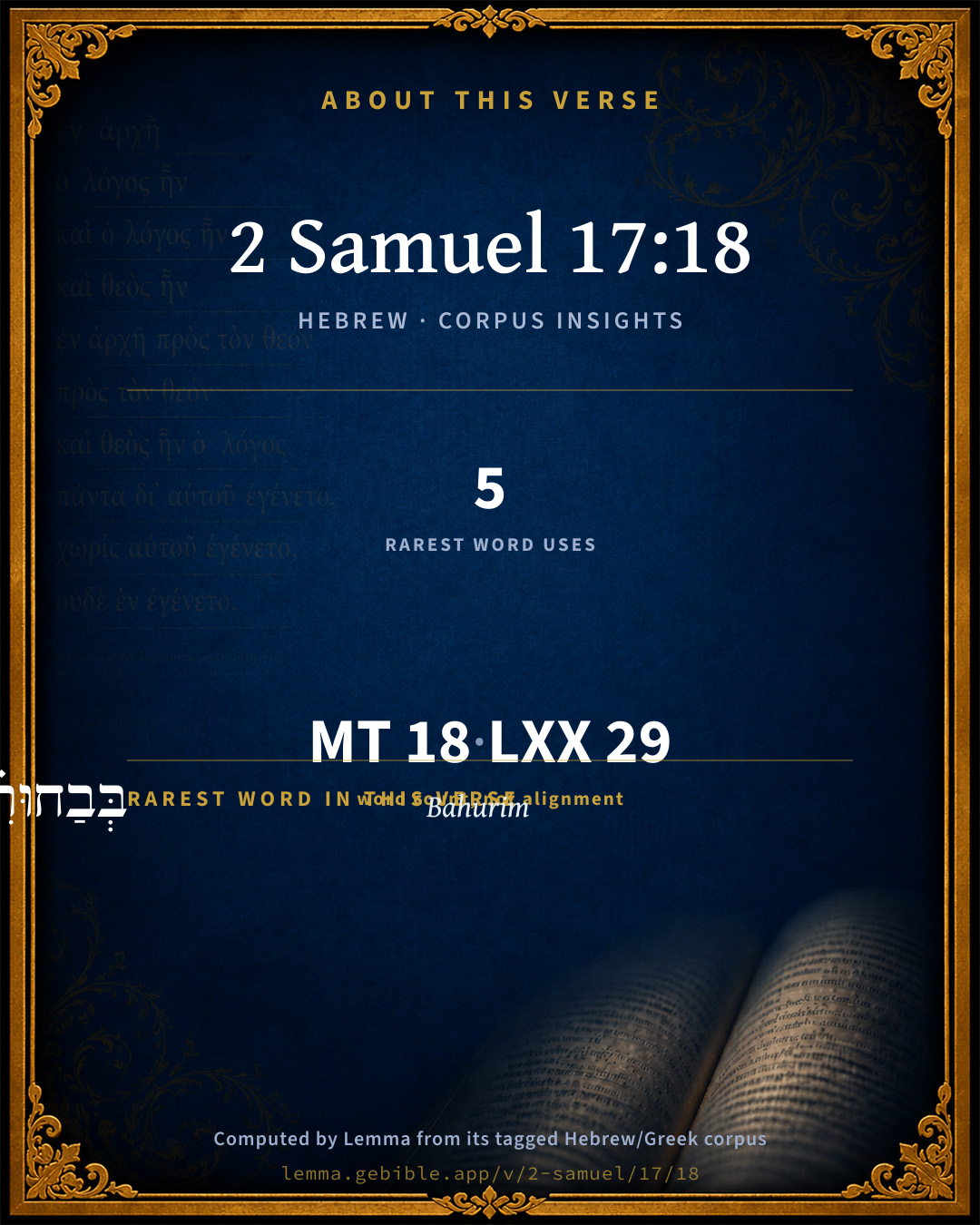
The rarest word here is בְּבַחוּרִ֗ים Bahurim H980 — appearing just 5 times in the whole Hebrew Bible.

Shared distinctive vocabulary

בְּבַחוּרִ֗ים Bahurim H980 occurs in 5 verses of the Hebrew Bible. Also found in:

Grammatical profile

  • 5 verbs
  • 8 nouns
  • 1 adjective
  • 2 prepositions
  • 1 adverb
  • 1 particle

Verb forms

  • וַיַּ֤רְא Qal · Sequential Imperfect
  • וַיַּגֵּ֖ד Hiphil · Sequential Imperfect
  • וַיֵּלְכוּ֩ Qal · Sequential Imperfect
  • וַיָּבֹ֣אוּ Qal · Sequential Imperfect
  • וַיֵּ֥רְדוּ Qal · Sequential Imperfect

Hebrew & Septuagint length

In English translation the verse runs 38 words from the Hebrew and 38 from the Septuagint (LXX English) — the same length.

A rough comparison of the two English renderings, which tokenize alike — not a word-level alignment.

Word counts can differ between the Hebrew and the Greek without any difference in meaning — e.g. the Hebrew direct-object marker אֵת has no separate Greek word, and Greek often adds the article ὁ.

In the original languages it is 18 Hebrew tokens and 29 Greek tokens — but the two are counted differently (Hebrew bundles its prefixes and suffixes into one token; the Greek is in lemma form), so that isn’t a like-for-like length.

Cross-references

3

Topical passages linked to 2 Samuel 17:18 in the Treasury of Scripture Knowledge — connected by theme and wording, ordered by reader-vote popularity; previews shown in the World English Bible.

  • 2 Samuel 3:16 Her husband went with her, weeping as he went, and followed her to Bahurim. Then said Abner to him, Go, return: and he returned.
  • 2 Samuel 16:5 When king David came to Bahurim, behold, a man of the family of the house of Saul came out, whose name was Shimei, the son of Gera. He came out, and cursed still as he came.
  • 2 Samuel 19:16 Shimei the son of Gera, the Benjamite, who was of Bahurim, hurried and came down with the men of Judah to meet king David.

Cross-references courtesy of OpenBible.info (CC BY 4.0).

Hebrew and Greek witnesses Masoretic Hebrew ↔ Greek Septuagint

The same verse in the two great witnesses to the Old Testament, shown verse-for-verse.

These are two independent witnesses, not word-aligned to each other, and the Septuagint is shown in lemma (dictionary) form.

Hebrew 2 Samuel 17:18 Masoretic · Westminster Leningrad Codex

וַיַּ֤רְא אֹתָם֙ נַ֔עַר וַיַּגֵּ֖ד לְאַבְשָׁלֹ֑ם וַיֵּלְכוּ֩ שְׁנֵיהֶ֨ם מְהֵרָ֜ה וַיָּבֹ֣אוּ אֶל בֵּֽית אִ֣ישׁ בְּבַחוּרִ֗ים וְל֥וֹ בְאֵ֛ר בַּחֲצֵר֖וֹ וַיֵּ֥רְדוּ שָֽׁם

But a boy saw them, and told Absalom: and they went both of them away quickly, and came to the house of a man in Bahurim, who had a well in his court; and they went down there.

World English Bible · Public Domain

Greek LXX 2 Samuel 17:18 Septuagint · lemma form

καί ὁράω αὐτός παιδάριον καί ἀποἀγγέλλω ὁ αβεσσαλωμ καί πορεύομαι ὁ δύο ταχύς καί εἰςἔρχομαι εἰς οἰκία ἀνήρ ἐν βαουριμ καί αὐτός λάκκος ἐν ὁ αὐλή καί καταβαίνω ἐκεῖ

But a young man saw them and told Abessalom: and the two went quickly, and entered into the house of a man in Baurim; and he had a well in his court, and they went down into it.

LXX2012 (modern English Septuagint) · Public Domain

Hebrew: Westminster Leningrad Codex (CC BY 4.0). Greek: Septuagint (public domain); English from LXX2012 (modern English Septuagint) (Public Domain). How the Septuagint differs from the Hebrew →

Targum (Aramaic paraphrase)

1

The Targum is the ancient Jewish Aramaic paraphrase of the Hebrew Scriptures — an interpretive translation, not the Hebrew text itself. Onkelos (literal) and Pseudo-Jonathan (expansive) render the Torah, and Jonathan the Prophets. Coverage is partial: where no permissively-licensed English translation exists for a verse, only the Aramaic is shown. This is verse-level text, not a word-by-word alignment to the Hebrew.

  1. Targum Jonathan Prophets (Joshua–Malachi)
    וַחֲזָא יַתְהוֹן עוּלֵימָא וְחַוִי לְאַבְשָׁלוֹם וַאֲזַלוּ תַרְוֵיהוֹן בִּפְרִיעַ וְעָלוּ לְבֵית גַבְרָא בְּעָלֵימַת וְלֵיהּ גוֹבָא בְּדַרְתֵּיהּ וּנְחָתוּ תַמָן:

    (no public-domain English translation for this verse)

    Targum Jonathan — Aramaic: “Mikraot Gedolot” (public domain). English: “Sefaria Community Translation” (CC0 1.0 (public-domain dedication)); “London "Chaldee Paraphrase," 1871” (public domain). Text via Sefaria.

Commentary

Notes on 2 Samuel 17:18 from classic Christian and Jewish commentators (each source and its license shown beneath its notes). The classic Christian expositions comment on the surrounding passage and are grouped to its opening verse, so a note may address several verses; the Jewish commentaries on the Tanakh (Rashi and others) are per-verse, so they appear only where the commentator wrote on this verse.

Lemma curates 59 commentaries, every one of them public domain or Creative Commons licensed, each selected and text-cleaned for this edition rather than reprinted as found. About our sources →

Trapp's Complete Commentary

John Trapp

2Sa 17:18 Nevertheless a lad saw them, and told Absalom: but they went both of them away quickly, and came to a man’s house in Bahurim, which had a well in his court; whither they went down.

Ver. 18. Nevertheless a lad saw them.] As the devil never wanteth instruments in such cases to work mischief. Who this lad was, it mattereth not: but sure he was none of Absalom’s horsemen, as Josephus writeth.

John Trapp, A Commentary or Exposition upon All the Books of the Old and New Testament (1647–1656) — public domain. Text from a community e-Sword module.

Joseph Benson's Commentary

2Sa 17:18-19. Nevertheless a lad saw them — Who knew them to be favourers of David, and observed that they waited there with design to gain intelligence, and possibly saw the girl speaking privately to them. But they went away quickly — Suspecting by the observation which the lad made, and his after conduct, that they were discovered. And came to a man’s house in Bahurim — Turning out of the public road, as Josephus explains it, they made haste to this village. Which had a well in his court, whither they went down — For at that time of the year their wells were in many places dry, or had little water in them. And spread ground corn thereon — Under pretence of drying it by the sun, which shows that it was summer- time. Thus the woman effectually concealed them.

Joseph Benson's Commentary on the Old and New Testaments (1811–1818) — public domain. Text from a community e-Sword module.

Tyndale Open Study Notes

Tyndale Open Resources

17:18-20 Bahurim was the home of Shimei, the pro-Saul Benjaminite (16:5; 19:16). Shimei’s cursing of David at Bahurim reflected David’s decline, while the escape of Ahimaaz and Jonathan pictured the hope of David’s resurgence.

Tyndale Open Study Notes — © Tyndale Open Resources, licensed CC BY-SA 4.0. Text via the HelloAO Bible API.

Jamieson, Fausset & Brown

Robert Jamieson, A. R. Fausset & David Brown

and came to a man's house in Bahurim, which had a well in his court--The court was that of the house, and the well an empty cistern. All the houses of the better class are furnished with such reservoirs. Nothing could more easily happen than that one of these wells, in consequence of a deficiency of water, should become dry and it would then answer as a place of retreat, such as David's friends found in the man's house at Bahurim. The spreading of a covering over the well's mouth for the drying of corn is a common practice.

Jamieson, Fausset & Brown — Commentary Critical and Explanatory on the Whole Bible (1871) — public domain (CC PDM 1.0). Text via the HelloAO Bible API.

The Cambridge Bible for Schools and Colleges

gen. ed. J. J. S. Perowne

18. a well] A cistern, dry at the time. The existence of numerous rock-cut cisterns with narrow mouths at Almît, the probable site of Bahurim, illustrates the incident. See Pal. Expl. Fund Quarterly Statement, Jan. 1881, p. 45.

The Cambridge Bible for Schools and Colleges (gen. ed. J. J. S. Perowne; Cambridge University Press, 1878–1918) — public domain. Text from a community e-Sword module.

John Gill's Exposition

And the woman took and spread a covering over the well's mouth,.... This woman, very probably, was the man's wife of the house, as Abarbinel notes; who took a cloth, and spread it over the well's mouth, that it could not be seen or known that there was a well there:

and spread ground corn thereon: just taken out of the mill, before it was sifted, while in the bran; or corn unhusked, or just threshed out, in order to be dried in the sun, and then parched; or wheat bruised for that purpose: Josephus says (q) they were locks of wool she spread:

and the thing was not known; that the young men were in the well.

(q) Antiqu. l. 7. c. 9. sect. 7.

John Gill's Exposition of the Whole Bible (1746–1763) — public domain (CC PDM 1.0). Text via the HelloAO Bible API.

Albert Barnes' Notes on the Bible

Bahurim - See the marginal reference. They were not all Shimeis in Bahurim.

Albert Barnes' Notes on the Bible (1834–1885) — public domain. Text from a community e-Sword/MySword module.

Haydock's Catholic Bible Commentary

It, as it was level with the ground; so that a cloth being spread over it, prevented all suspicion. It had no water.

George Leo Haydock (1774–1849), Haydock's Catholic Family Bible and Commentary, 1859 edition — public domain. Excludes Psalms (Douay-Rheims chapter numbering differs from Protestant) and Deuterocanonical books (Catholic canon only).

Matthew Poole's English Annotations

A lad saw them, who knew them to be favourers of David, and observed them to wait there upon design, and to gain intelligence, and possibly saw the wench speaking privately to them.

They went both of them away quickly; suspecting by this lad’s observation and carriage that they were discovered.

Wither they went down; either to some hole in the side of the pit; or to the bottom of the pit, it being then dry, as pits often were in those hot countries. And this being in so open a place, they concluded none would imagine them to be hid there. And besides, they relied upon God’s good providence, which they knew watched over David, and them for his sake.

Matthew Poole's English Annotations on the Holy Bible (1683–1685) — public domain. Text from a community e-Sword/MySword module.

The Pulpit Commentary

A lad saw them. Probably Absalom had sent out spies to watch the route which David had taken, to prevent any friends totaling him from the city, who would give him information as to the progress of events there. The word "lad" does not mean a boy; more probably he was one of the young men who formed Absalom"s body guard, like the ten "lads," translated "young men," in 2Sa_18:15, Who bare Joab"s armour. It Would be his duty to seize them, but when he tried to approach them, they fled, and made their way at full speed to Bahurim, where they were saved by the shrewdness and fidelity of a woman. Two such fleet runners would have had no difficulty in outstripping a boy, but one of Absalom"s young men would have roused the neighbourhood to join in the pursuit. The well in his court really signifies a cistern for storing rainwater; but it was at that time dry, and served as a convenient hiding place for the two messengers.

The Pulpit Commentary (1880–1919), ed. H.D.M. Spence-Jones & Joseph S. Exell — public domain. Text from a community e-Sword module.

Keil & Delitzsch

C. F. Keil & F. Delitzsch

"And a lad (servant) saw them, and told Absalom." Absalom had most likely set spies to watch the priests and their sons. But the two sons who had noticed the spy hurried into the house of a man at Bahurim, who had a well (or cistern that was dry at the time) in his court, and went down into the well.

Keil & Delitzsch — Biblical Commentary on the Old Testament (1861–1891) — public domain (CC PDM 1.0). Text via the HelloAO Bible API. (Old Testament only.)

Lesson kit

Teaching starters — assembled from the data on this page, not authored interpretation. Every prompt links to the verse data it draws on. Edit before teaching.

2 Samuel, in the Historical, opens this verse with 18 words (17 distinct Hebrew lemmas). Its most distinctive word is Bachurîym (“Bahurim”). A historical commentator’s framing appears above. Read the whole chapter for the surrounding context.

Discussion questions

  1. What does “Bahurim” (Bachurîym) contribute to the verse as a whole?
  2. 2 Samuel 3:16 shares the word «Bahurim» with this verse. How do the two illuminate each other?
  3. The translations on this page render this verse differently — a whole-verse word diff, not a word-by-word alignment. What might account for the different wordings?
  4. The verb «וַיַּ֤רְא» is Qal Sequential Imperfect. How does its form color the action?
  5. Reading how Trapp's Complete Commentary and Joseph Benson's Commentary read this verse, where do the two commentators agree and where do they part?

Things to notice

Reading settings

Reading text

Shown beneath each verse's original-language words.

Old Testament
Old Testament edition

Read the OT as the Masoretic Hebrew (MT) or the Greek Septuagint (LXX).

English shown for the Greek Septuagint (in the Hebrew ↔ Greek comparison).

Comparing translations? Open the Compare panel on any verse page to stack up to four side by side.