
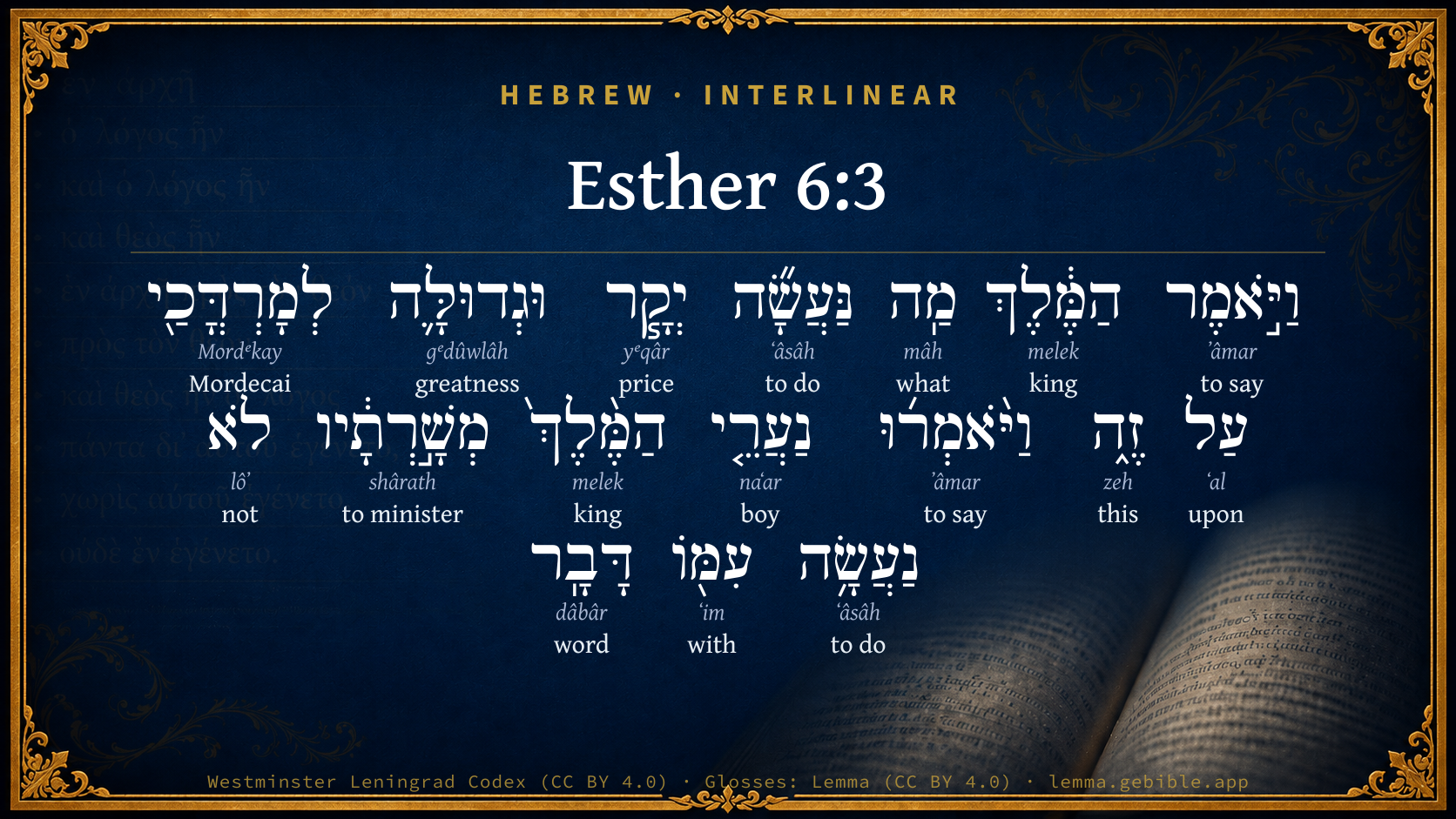
Esther 6:3

Hebrew (Westminster Leningrad Codex) Esther 6:3 appears in the Hebrew Old Testament. The text above is from the Westminster Leningrad Codex. Each word links to its Strong’s number, a concise gloss, and parsing drawn from the Open Scriptures Hebrew Bible morphology. Click any word for its full Brown-Driver-Briggs (BDB) entry.
Download image
Cite this verse

Esther 6:3 (World English Bible). Public Domain. Lemma interlinear Bible study tool, https://lemma.gebible.app/v/esther/6/3.

Show BibTeX & RIS
BibTeX
RIS
English Translation
The king said, What honor and dignity has been bestowed on Mordecai for this? Then the king's servants who ministered to him said, "Nothing has been done for him."
World English Bible · Public Domain
Download a study sheet

One document with this verse’s original text, its word-by-word gloss line, the meaning frame, cross-references with their text, attributed commentary, and full source and license credits — printable, and it pastes into notes with its structure intact.

This verse Autodidact and up

Study sheet (.html) Plain text (.txt)

A passage Seminary Student

Up to 50 verses in one chapter. A passage sheet keeps up to 6 commentary sources and 12 cross-references per verse, in the order this page ranks them, and says so on the sheet whenever that leaves anything out. Ask for a single verse and you get the Autodidact verse sheet above.

Everything on this page stays free to read, with no account — the sheet is a download of what is already on screen, not access to it.

Want to remove ads? Support Godless Engineer
Compare translations 3

The same verse in 3 English versions, stacked beneath the original-language interlinear above. Click any original word for its lexicon entry.

Each is an independent rendering of the whole verse — the interlinear is not word-aligned to these translations.

Highlighted words mark where these versions differ — a whole-verse word diff, not a word-by-word alignment.

  • World English Bible Public Domain
    The king said, What honor and dignity has been bestowed on Mordecai for this? Then the king's servants who ministered to him said, "Nothing has been done for him."
  • King James Version Public Domain
    And the king said, What honour and dignity hath been done to Mordecai for this? Then said the king's servants that ministered unto him, There is nothing done for him.
  • unfoldingWord Literal Text CC BY-SA 4.0
    And the king said, “What honor or greatness was done for Mordecai on account of this?” And the young men of the king who served him said, “Not a thing has been done with him.”

unfoldingWord Literal Text — © unfoldingWord, licensed CC BY-SA 4.0. Word-aligned USFM3 via Door43 (git.door43.org/unfoldingWord/en_ult).

Versions to compare (up to 4)

3 of 4 selected

Show all 18 translations

Every available English version of this verse, each an independent rendering of the whole verse.

  • World English Bible Public Domain
    The king said, What honor and dignity has been bestowed on Mordecai for this? Then the king's servants who ministered to him said, "Nothing has been done for him."
  • Berean Standard Bible Public Domain
    The king inquired, “What honor or dignity has been bestowed on Mordecai for this act?” “Nothing has been done for him,” replied the king’s attendants.
  • Majority Standard Bible Public Domain
    The king inquired, “What honor or dignity has been bestowed on Mordecai for this act?” “Nothing has been done for him,” replied the king’s attendants.
  • King James Version Public Domain
    And the king said, What honour and dignity hath been done to Mordecai for this? Then said the king's servants that ministered unto him, There is nothing done for him.
  • American Standard Version (1901) Public Domain
    And the king said, What honor and dignity hath been bestowed on Mordecai for this? Then said the king's servants that ministered unto him, There is nothing done for him.
  • Revised Version (1885) Public Domain
    And the king said, What honour and dignity hath been done to Mordecai for this? Then said the king’s servants that ministered unto him, There is nothing done for him.
  • Geneva Bible (1599) Public Domain
    Then the King sayde, What honour and dignitie hath bene giuen to Mordecai for this? And the Kings seruants that ministred vnto him, sayd, There is nothing done for him.
  • Douay-Rheims (1899) Public Domain
    And when the king heard this, he said: What honour and reward hath Mardochai received for this fidelity? His servants and ministers said to him: He hath received no reward at all.
  • Young's Literal Translation Public Domain
    And the king saith, `What honour and greatness hath been done to Mordecai for this?' And the servants of the king, his ministers, say, `Nothing hath been done with him.'
  • Literal Standard Version CC BY-SA 4.0
    And the king says, “What honor and greatness has been done to Mordecai for this?” And the servants of the king, his ministers, say, “Nothing has been done with him.”
  • Unlocked Literal Bible CC BY-SA 4.0
    The king asked, “What was done to give honor or recognition to Mordecai for doing this?” Then the king's young men who served him said, “Nothing was done for him.”
  • unfoldingWord Literal Text CC BY-SA 4.0
    And the king said, “What honor or greatness was done for Mordecai on account of this?” And the young men of the king who served him said, “Not a thing has been done with him.”
  • Darby Bible Public Domain
    And the king said, What honour and dignity has been done to Mordecai for this? And the king's servants that attended upon him said, Nothing has been done for him.
  • World Messianic Bible Public Domain
    The king said, “What honor and dignity has been given to Mordecai for this?” Then the king’s servants who attended him said, “Nothing has been done for him.”
  • Webster's Bible Public Domain
    And the king said, What honor and dignity hath been done to Mordecai for this? Then said the king's servants that ministered to him, There is nothing done for him.
  • Free Bible Version CC BY-SA 4.0
    “What honor or position did Morcedai receive as a reward for doing this?” asked the king. “Nothing has been done for him,” replied the king's attendants.
  • Bible in Basic English Public Domain
    And the king said, What honour and reward have been given to Mordecai for this? Then the servants who were waiting on the king said, Nothing has been done for him.
  • JPS Tanakh (1917) Public Domain
    And the king said: 'What honour and dignity hath been done to Mordecai for this?' Then said the king's servants that ministered unto him: 'There is nothing done for him.'

Literal Standard Version (2020), Covenant Press — licensed CC BY-SA 4.0. Text via the HelloAO Bible API (eBible.org). Unlocked Literal Bible (unfoldingWord) — licensed CC BY-SA 4.0. Text via the HelloAO Bible API (eBible.org). unfoldingWord Literal Text — © unfoldingWord, licensed CC BY-SA 4.0. Word-aligned USFM3 via Door43 (git.door43.org/unfoldingWord/en_ult). Free Bible Version, Dr. Jonathan Gallagher — licensed CC BY-SA 4.0. Text via the HelloAO Bible API (eBible.org).

Word by word

More ways to search: Search by grammar → Find every occurrence → Compare this word →

Practice this passage: Drill this verse → Learn its vocabulary →

וּגְדוּלָּ֛ה
gᵉdûwlâh
H1420
“and · greatness”
Conjunction + Noun, Common, Feminine, Singular, Absolute
Part of Speech
Conjunction + Noun
Type
Common
Gender
Feminine
Number
Singular
State
Absolute
Full BDB Definition

Origin: from H1419

TWOT: 315e

greatness - of man - of God's greatness (as an attribute)
  1. וַיֹּ֣אמֶר ʼâmar H559 “and · to say” Conjunction + Verb, Qal, Sequential Imperfect, 3rd Person, Masculine, Singular
  2. הַמֶּ֔לֶךְ melek H4428 “the · king” Particle, Definite Article + Noun, Common, Masculine, Singular, Absolute
  3. מַֽה mâh H4100 “what” Particle, Interrogative
  4. נַּעֲשָׂ֞ה ʻâsâh H6213 “to do” Verb, Niphal, Perfect, 3rd Person, Masculine, Singular
  5. יְקָ֧ר yᵉqâr H3366 “price” Noun, Common, Masculine, Singular, Absolute
  6. לְמָרְדֳּכַ֖י Mordᵉkay H4782 “to/for · Mordecai” Preposition + Noun, Proper
  7. עַל ʻal H5921 “upon” Preposition
  8. זֶ֑ה zeh H2088 “this” Pronoun, Demonstrative, Masculine, Singular
  9. וַיֹּ֨אמְר֜וּ ʼâmar H559 “and · to say” Conjunction + Verb, Qal, Sequential Imperfect, 3rd Person, Masculine, Plural
  10. נַעֲרֵ֤י naʻar H5288 “boys of” Noun, Common, Masculine, Plural, Construct
  11. הַמֶּ֨לֶךְ֙ melek H4428 “the · king” Particle, Definite Article + Noun, Common, Masculine, Singular, Absolute
  12. מְשָׁ֣רְתָ֔יו shârath H8334 “ministering · him” Verb, Piel, Participle Active, Masculine, Plural, Construct + Suffix, Personal, 3rd Person, Masculine, Singular
  13. לֹא lôʼ H3808 “not” Particle, Negative
  14. נַעֲשָׂ֥ה ʻâsâh H6213 “to do” Verb, Niphal, Perfect, 3rd Person, Masculine, Singular
  15. עִמּ֖וֹ ʻim H5973 “with · him” Preposition + Suffix, Personal, 3rd Person, Masculine, Singular
  16. דָּבָֽר dâbâr H1697 “word” Noun, Common, Masculine, Singular, Absolute

About this verse

These counts appear in no published source. They are computed here, from the morphology-tagged text and Lemma’s own curated glosses. What Lemma adds →

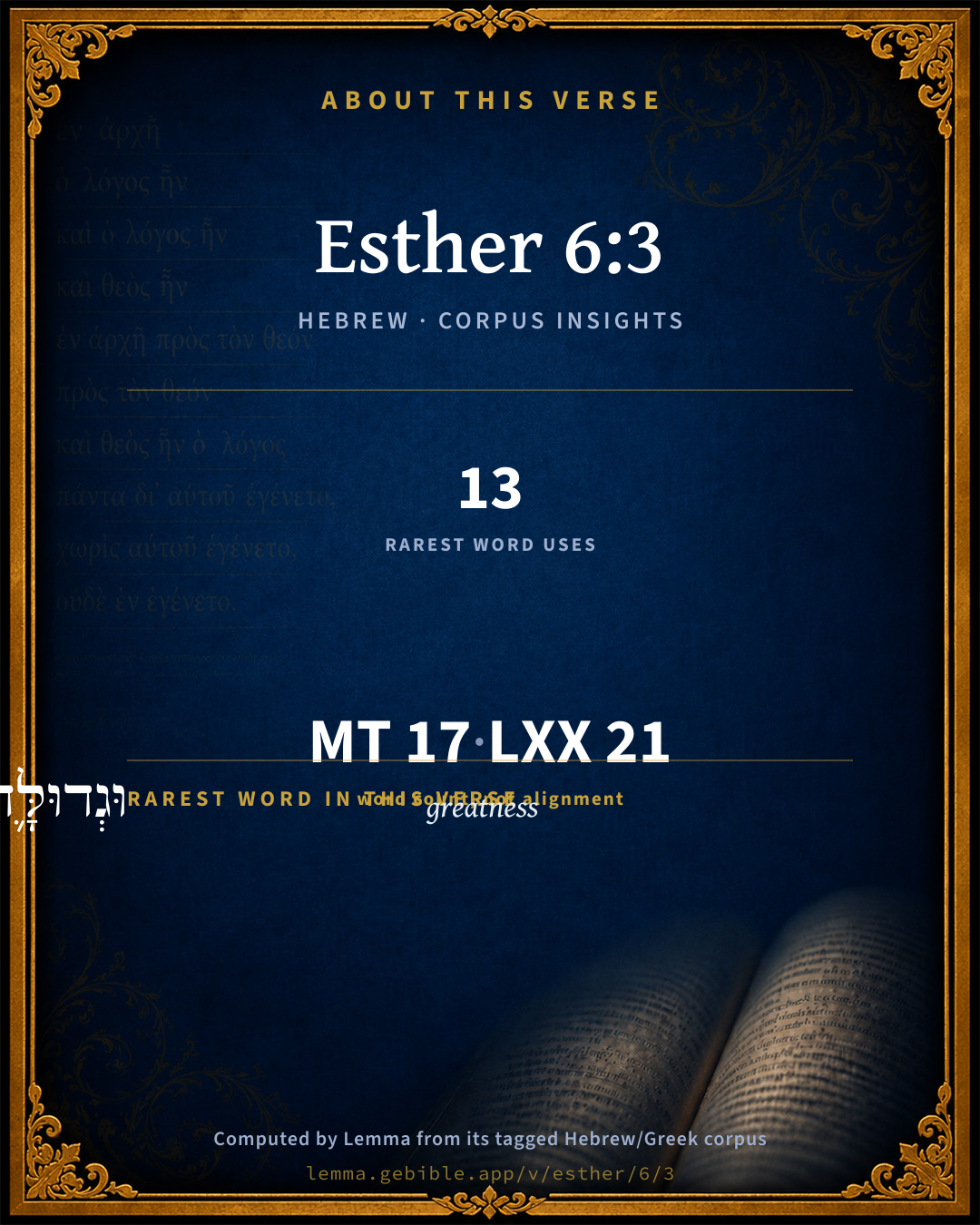
17
words
14
distinct lemmas
Historical
section

Notable vocabulary

The rarest word here is וּגְדוּלָּ֛ה greatness H1420 — appearing just 13 times in the whole Hebrew Bible.

Shared distinctive vocabulary

וּגְדוּלָּ֛ה greatness H1420 occurs in 11 verses of the Hebrew Bible. Also found in:

Grammatical profile

  • 5 verbs
  • 7 nouns
  • 1 pronoun
  • 2 prepositions
  • 2 particles

Verb forms

  • וַיֹּ֣אמֶר Qal · Sequential Imperfect
  • נַּעֲשָׂ֞ה Niphal · Perfect
  • וַיֹּ֨אמְר֜וּ Qal · Sequential Imperfect
  • מְשָׁ֣רְתָ֔יו Piel · Participle Active
  • נַעֲשָׂ֥ה Niphal · Perfect

Repetition

Words recur within this verse — often emphatic in Hebrew:

  • וַיֹּ֣אמֶר to say H559 ×2
  • הַמֶּ֔לֶךְ king H4428 ×2
  • נַּעֲשָׂ֞ה to do H6213 ×2

Hebrew & Septuagint length

In English translation the verse runs 29 words from the Hebrew and 25 from the Septuagint (LXX English) — closely comparable.

A rough comparison of the two English renderings, which tokenize alike — not a word-level alignment.

Word counts can differ between the Hebrew and the Greek without any difference in meaning — e.g. the Hebrew direct-object marker אֵת has no separate Greek word, and Greek often adds the article ὁ.

In the original languages it is 17 Hebrew tokens and 21 Greek tokens — but the two are counted differently (Hebrew bundles its prefixes and suffixes into one token; the Greek is in lemma form), so that isn’t a like-for-like length.

Cross-references

10

Topical passages linked to Esther 6:3 in the Treasury of Scripture Knowledge — connected by theme and wording, ordered by reader-vote popularity; previews shown in the World English Bible.

  • Ecclesiastes 9:15 Now a poor wise man was found in it, and he by his wisdom delivered the city; yet no man remembered that same poor man.
  • Genesis 40:23 Yet the chief cupbearer didn't remember Joseph, but forgot him.
  • Judges 1:12–13 Caleb said, He who strikes Kiriath Sepher, and takes it, to him will I give Achsah my daughter as wife.
  • 1 Samuel 17:25–26 The men of Israel said, Have you seen this man who is come up? surely to defy Israel is he come up: and it shall be, that the man who kills him, the king will enrich him with great riches, and will give him his daughter, and make his father's house free in Israel.
  • 1 Chronicles 11:6 David said, Whoever strikes the Jebusites first shall be chief and captain. Joab the son of Zeruiah went up first, and was made chief.
  • Psalms 118:8–9 It is better to take refuge in Yahweh, Than to put confidence in man.
  • Daniel 5:7 The king cried aloud to bring in the enchanters, the Chaldeans, and the soothsayers. The king spoke and said to the wise men of Babylon, Whoever shall read this writing, and show me the interpretation of it, shall be clothed with purple, and have a chain of gold about his neck, and shall be the third ruler in the kingdom.
  • Daniel 5:16 But I have heard of you, that you can give interpretations, and dissolve doubts; now if you can read the writing, and make known to me the interpretation of it, you shall be clothed with purple, and have a chain of gold about your neck, and shall be the third ruler in the kingdom.
  • Daniel 5:29 Then commanded Belshazzar, and they clothed Daniel with purple, and put a chain of gold about his neck, and made proclamation concerning him, that he should be the third ruler in the kingdom.
  • Acts 28:8–10 It happened that the father of Publius lay sick of fever and dysentery. Paul entered in to him, prayed, and laying his hands on him, healed him.

Cross-references courtesy of OpenBible.info (CC BY 4.0).

Hebrew and Greek witnesses Masoretic Hebrew ↔ Greek Septuagint

The same verse in the two great witnesses to the Old Testament, shown verse-for-verse.

These are two independent witnesses, not word-aligned to each other, and the Septuagint is shown in lemma (dictionary) form.

Hebrew Esther 6:3 Masoretic · Westminster Leningrad Codex

וַיֹּ֣אמֶר הַמֶּ֔לֶךְ מַֽה נַּעֲשָׂ֞ה יְקָ֧ר וּגְדוּלָּ֛ה לְמָרְדֳּכַ֖י עַל זֶ֑ה וַיֹּ֨אמְר֜וּ נַעֲרֵ֤י הַמֶּ֨לֶךְ֙ מְשָׁ֣רְתָ֔יו לֹא נַעֲשָׂ֥ה עִמּ֖וֹ דָּבָֽר

The king said, What honor and dignity has been bestowed on Mordecai for this? Then the king's servants who ministered to him said, "Nothing has been done for him."

World English Bible · Public Domain

Greek LXX Esther 6:3 Septuagint · lemma form

εἶπον δέ ὁ βασιλεύς τίς δόξα ἤ χάρις ποιέω ὁ μαρδοχαῖος καί εἶπον ὁ διάκονος ὁ βασιλεύς οὐ ποιέω αὐτός οὐδείς

And the king said, What honor or favor have we done to Mardochaeus? And the king's servants said, You have not done anything to him.

LXX2012 (modern English Septuagint) · Public Domain

Hebrew: Westminster Leningrad Codex (CC BY 4.0). Greek: Septuagint (public domain); English from LXX2012 (modern English Septuagint) (Public Domain). How the Septuagint differs from the Hebrew →

Commentary

Notes on Esther 6:3 from classic Christian and Jewish commentators (each source and its license shown beneath its notes). The classic Christian expositions comment on the surrounding passage and are grouped to its opening verse, so a note may address several verses; the Jewish commentaries on the Tanakh (Rashi and others) are per-verse, so they appear only where the commentator wrote on this verse.

Lemma curates 59 commentaries, every one of them public domain or Creative Commons licensed, each selected and text-cleaned for this edition rather than reprinted as found. About our sources →

Trapp's Complete Commentary

John Trapp

Est 6:3 And the king said, What honour and dignity hath been done to Mordecai for this? Then said the king’s servants that ministered unto him, There is nothing done for him.

Ver. 3. And the king said, What honour and dignity hath been done to Mordecai for this?] Lyra saith that he had waited six years for reward and had none. In princes’ courts men are sure to meet with two evils, Aναβολη and Mεταβολη, not so in heaven. The butler forgat Joseph. Solomon speaketh of a poor wise man, who by his wisdom delivered the city, yet no man remembered that same poor man, Ecc 9:15. This is merces mundi, the world’s wages. Mordecai had saved the king’s life, and yet is unrewarded. The kings of Persia used to be very bountiful to those that had well deserved them, or of the commonwealth; calling such Orosangae, and setting down both their names and their acts in the Chronicles, as Herodotus testifieth. Among the rest he mentioned one Phylacus, Qui inter bene de rege meritos ascriptus est, et multo tractu soli donatus, who was put upon record for his good service to the king, and rewarded with a great deal of land given him. Others had great store of gold and silver, and a gallant house, as Democedes Crotoniates, the physician who cured Darius, had at Susis. It is well known out of Xenophon, what rich gifts Cyrus gave to his friends and followers, chains of gold, armlets, bridles embossed with gold, Persian stools, called Dorophoricae, &c. Herodotus telleth us, that this Ahasuerus, alias Xerxes, gave Megabyzus, for his good service at Babylon, a golden mill weighing six talents. Plutarch writeth, that he gave Themistocles over two hundred talents, and three cities besides, viz. Magnesia, Lampsacus, and Myuntis, to find him food, and for clothing and furniture two more, viz. Percos and Palaescepsis. How came it then to pass that good Mordecai was so forgotten? Surely it was a great fault in this ungrateful king, but God’s holy hand was in it, that Mordecai should not have a present recompense, but that it should be deferred till a fitter opportunity, when God might be more glorified in the preservation of his people and destruction of their enemies. Let us not therefore be weary of well doing; for (however men deal by us) we shall be sure to reap in due season if we faint not, Gal 6:9. God best seeth when a mercy will be most sweet and seasonable. When his people are low enough, and the enemy high enough, then usually it appeareth that there is a God that judgeth in the earth, and a rich reward for the righteous. Men may neither remunerate nor remember the good turns we have done them; but there is a book of remembrance written before tbe Lord for all them that fear him, and that think upon his name, Mal 3:16. See my treatise on that text, called, The Righteous Man’s Recompense, annexed to my Comment upon the Small Prophets.

Then said the king’s servants] The eunuchs or gentlemen of the bedchamber: ingenuous men they were, and not disaffected to Mordecai, whom yet they could not but know to be a great eyesore to Prince Haman. Si iuvenes isti vulgari invidentiae morbo laborasscnt, saith Lavater. If these young men had been sick of that common disease of envy, they would have extenuated his good service, and have said, Mordecai is a despised Jew, a stranger, a captive. If he revealed the conspiracy, he did but his duty, and provided thereby well for his own safety. Is it not reward enough that he lives, and at court, where he hath a place, an office, &c.? Courtiers, we know, love not to have others come over their heads, but think all lost which themselves acquire not, as Seneca saith Sejanus did, Quicquid non acquiritur damnum est. Whatever he did not own, was consumed. We know how it was in the courts of Pharaoh, Saul, Herod. That is a rare commendation that is given by Xenophon of Cyrus’s courtiers, that though a man should seek or choose blindfold, he could not miss of a good man, Eνθα καν μυων βαλη τις ουκ αν αμαρτοι ανδρος αγαθου (Xen. Cyrop. 1. 8). David’s court might very well be such, Psa 101:1-8, and Queen Elizabeth’s, and George’s, prince of Anhalt, of whom Melancthon writeth, that his chamber was Ecclesia, Academia, Curia, a church, a university, and a court; Palaestra pietatis et literarum, as Tremellius saith of Cranmer’s family, a school of piety and learning.

There is nothing done for him] And yet the Apocryphal additions, Esther 12:5,6, say otherwise.

John Trapp, A Commentary or Exposition upon All the Books of the Old and New Testament (1647–1656) — public domain. Text from a community e-Sword module.

The Biblical Illustrator

Joseph S. Exell

Est_6:3

There is nothing done for him.

Merit overlooked

Modest merit is overlooked, while the aspiring, the ambitious, and the time-serving rise to honour and riches. Nor is ingratitude confined to courts. (T. McCrie, D. D.)

Ingratitude to God

But if gratitude to man for his comparatively little kindness (for man cannot do much for his fellow) animate the believers bosom, it glows with still more fervent gratitude to God, for the invaluable and merited blessing of salvation. (T. Hughes.)

A resurrection of good works

Things are done and forgotten, and men never suppose that they will come up again; yet after many days they are vivified, and history begins to take up the thread where it was dropped. (J. Parker, D. D.)

Gods time best

But God is never surprised, and the end of all is to make us think of Him. Nothing entered in His book of remembrance is ever forgotten. His time for bringing the good deeds of His people to light may seldom be the time we would judge best, but it is always the most fit. Look to this ease. Had it been a day, an hour, half an hour sooner, would the effect have been as good for Mordecai or for his people? Would humility, prayer, patience, have been called into strengthening exercise? (A. M. Symington, B. A.)

Unearthed

The loyalty and faithfulness of Mordecai had not been rewarded at the time. On the human side that might have been regarded as a piece of ingratitude, it not a reprehensible oversight; but on the Divine side it was a prepared cause, secreted and hidden for a long period, and yet waiting, and ready for the accomplishment, at the right time of a beneficent result. It was destined to come to the light. It was a seed-corn buried in the earth, which should bear fruit in due season. In an opposite direction there is the same particular providence often manifested in the unveiling of crime, and the bringing home of guilt to the hearts of those who have contracted it, as in the envy and malice of Josephs brethren and the avaricious covetousness of Achan. As shells, deep in the sea, grope their way to the shore, or as hidden springs burst their way through to the surface, and form little rivulets, so is there in providence a great law, constantly in operation, for the disclosure of all that is either good or bad in human character or conduct. If bad, it is as though the avenger was tracking the steps of the transgressor, and at some turning in his path, and by some trivial accident, the evil is unearthed, and the doer of it brought to judgment. Or if good, it is as though the rewarder was following in the way of the righteous, and at the best time, and apparently by the most fortuitous combination of circumstances, the well-doing is made known, and meets with its recompense. Even now it is so. But the lines are drawn out far beyond the present, and converge in the transactions of a distant day. (T. McEwan.)

Reward and retribution

I. It teaches us how well a good man can afford to wait for the due acknowledgment of his uprightness, and for any reward he may need for the good he has done. The conjecture is that six long years had gone by since Mordecai revealed the plot of the chamberlains and saved the kings life, and not even a word of acknowledgment had come to him during all that time. But what we most admire is his behaviour meantime. If he had been a self-seeking man, he could easily have found means to refresh the kings memory as to his services; but he kept silence. If he had been a malignant man, he might have sought what he would, in that case, have called a just revenge for the ungrateful neglect with which he had been treated, by hatching or falling in with some other plot. And then, how well all turns out in the end! How much better than if the reward had been given at the time! He that believeth shall not make haste; Gods time is always the best. Righteousness is its own reward, and we are never righteous as God would have us be until we feel this deeply and act accordingly. He who, in Gods strength, looks every day on the face of duty, and walks with her along whatever paths her sacred feet may tread, has in his own spirit, in his own character, what soon or late will blossom out into all beauty and grandeur; what will in the end become glory, honour, and immortality.

II. The next lesson is just the opposite of this, viz., How certainly a bad man must be overtaken and punished! We say how certainly because there is in his badness the root and element of the retribution, and often, without knowing it, he carefully develops and ripens by his own action the retribution that falls on his head.

III. For there is an increscent power in evil (as indeed there is also in good), in view of which we cannot be too watchful and anxious, lest by any means we should fall under the power of it. The power of it, remember, is very silent and gentle, generally, in its operations. (A. Raleigh, D. D.)

Pacification of conscience

The king was determined to rectify this matter, for he thought that by the pacification of conscience sleep might return. Many men are willing to purchase sleep on high terms. Could the murder but be undone; could the evil deed be but blotted out; could the stolen money be but safely returned; could the cruel word but be recalled; in short, could anything be done that sleep might once more come to the house, and fold all memories and anxieties within its healing robes! (J. Parker, D. D.)

The Biblical Illustrator, edited by Joseph S. Exell (c. 1880s–1900s) — public domain. Text from a community e-Sword module.

Joseph Benson's Commentary

Est 6:3-4. There is nothing done for him — He hath had no recompense for this great and good service. The king said, Who is in the court — It is likely it was now morning, when the courtiers used to be in waiting; and the king is so impatient to have Mordecai honoured, that he sends to know who was come, that was fit to be employed in the business. Now Haman was come — Early in the morning, because his malice would not suffer him to sleep; and he was impatient till he had executed his revenge; and was resolved to watch for the very first opportunity of speaking to the king, before he was engaged in other matters. Into the outward court — Where he waited; because it was dangerous to come into the inner court without special license, Est 4:11. So that the king and his minister were equally impatient about this poor Jew Mordecai, the former to have him honoured, and the latter to have him hanged!

Joseph Benson's Commentary on the Old and New Testaments (1811–1818) — public domain. Text from a community e-Sword module.

Tyndale Open Study Notes

Tyndale Open Resources

6:3 What reward or recognition did we ever give Mordecai? The Persian kings were known for generosity to their supporters, so the king was probably surprised that nothing had been done.

Tyndale Open Study Notes — © Tyndale Open Resources, licensed CC BY-SA 4.0. Text via the HelloAO Bible API.

Geneva Bible (1599)

Geneva Bible translators

For he thought it unworthy his estate to receive a benefit, and not reward it.

Geneva Bible (1599) marginal notes — public domain. Text via Bolls.life.

Adam Clarke's Commentary

Verse 3. What honour and dignity hath been done to Mordecai] It is certain he found nothing in the record; and had any thing been done, that was the most likely place to find it.

Adam Clarke's Commentary on the Bible (1810–1826) — public domain. Text from a community e-Sword/MySword module.

Ellicott's Commentary for English Readers

(3) What honour and dignity hath been done.—The names of those who were thought worthy of being accounted “royal benefactors” were enrolled on a special list, and they were supposed to be suitably rewarded, though not necessarily at the time. The reward however was. in theory at any rate, a thing to which the “benefactor” had a distinct claim, and an almost legal right.

A Bible Commentary for English Readers, edited by Charles John Ellicott (1878–1897) — public domain. Text from a community e-Sword module.

The Cambridge Bible for Schools and Colleges

gen. ed. J. J. S. Perowne

3. What honour and dignity etc.?] We are not obliged to suppose that Xerxes had forgotten the fact of his deliverance or the person who had saved his life; but only that he had no recollection what recompense, if any, had been made. In Persia there was a list kept of those who did the king service (Herod. viii. 85, 90), and thus special stress was laid upon the duty of acknowledging their devotion.

The Cambridge Bible for Schools and Colleges (gen. ed. J. J. S. Perowne; Cambridge University Press, 1878–1918) — public domain. Text from a community e-Sword module.

John Gill's Exposition

And the king said, what honour and dignity hath been done to Mordecai for this?.... He judged it an action worthy of regard, and what ought to be rewarded, as it was the saving of his life; but had forgot whether any royal favour had been shown to the person for it:

then said the king's servants that ministered unto him; the lords of his bedchamber then in waiting:

there is nothing done for him; not on that account, nothing more than what he had; he had an office at court before, but was not advanced to anything higher on this account.

John Gill's Exposition of the Whole Bible (1746–1763) — public domain (CC PDM 1.0). Text via the HelloAO Bible API.

Albert Barnes' Notes on the Bible

It was a settled principle of the Persian government that “Royal Benefactors” were to receive an adequate reward. The names of such persons were placed on a special roll, and care was taken that they should be properly recompensed, though they sometimes waited for months or years before they were rewarded.

Albert Barnes' Notes on the Bible (1834–1885) — public domain. Text from a community e-Sword/MySword module.

Haydock's Catholic Bible Commentary

No reward at all. He received some presents from the king; (chap. xii. 5.) but these were so inconsiderable in the opinion of the courtiers, that they esteemed them as nothing at all; (Challoner) and they were not specified in the history. (Calmet)

George Leo Haydock (1774–1849), Haydock's Catholic Family Bible and Commentary, 1859 edition — public domain. Excludes Psalms (Douay-Rheims chapter numbering differs from Protestant) and Deuterocanonical books (Catholic canon only).

Matthew Poole's English Annotations

He hath had no recompence for this great and good service; which might happen, either through the king’s forgetfulness, or through the envy of the courtiers, or because he was a Jew, and therefore odious and contemptible.

Matthew Poole's English Annotations on the Holy Bible (1683–1685) — public domain. Text from a community e-Sword/MySword module.

Whedon's Commentary on the Bible

Daniel D. Whedon

3. What honour… to Mordecai — We have a life-picture here. We seem to see the excited monarch start up and raise this question, as if some great duty had been forgotten. “It was a settled principle of the Persian government that ‘royal benefactors’ were to receive adequate reward. The names of such persons were placed on a special roll, (Herod., 8:85,) and great care was taken that they should be properly recompensed. See Herod., 3:140; 5:11; 8:85; Thucyd., 1:138; Xen., ‘Hel.,’ iii; 1:6. It is a mistake, however, to suppose (Davidson) that they were always rewarded at once. Themistocles was inscribed on the list in B.C. 480, but did not obtain a reward until B.C. 465. Other benefactors waited for months, (Herod., Est_5:11,) or perhaps years, (ib., 9:107,) before they were recompensed. Sometimes a benefactor seems to have received no reward at all. (Ib., 3:138.”) — Rawlinson.

Daniel D. Whedon (gen. ed.), Commentary on the Old and New Testaments (1874–1909) — public domain. Text from a community e-Sword module.

The Pulpit Commentary

The king said, What honour and dignity hath been done to Mordecai for this? The discoverer of a conspiracy against the life of the king would in any country have been regarded as entitled to some reward. In Persia, where "royal benefactors" formed a distinct class, and had their names inscribed on a special list (Herod., 8:85), it was especially incumbent on the monarch to see that every such person received a return proportioned to the value of his service. Ahasuerus seems to have supposed that some honour or dignity must have been conferred upon Mordecai, though he could not recollect what it was; and it is difficult to understand how the omission to reward him had occurred, unless there was a prejudice against him among the high court officials, who may have known that he was a Jew, though his fellow-servants did not. (Est_3:4)

Royal ingratitude.

The awakening conscience of Ahasuerus deserves our attention.

I HE IS SENSIBLE THAT HIS PRESERVER DESERVED "HONOUR AND DIGNITY." The king had rewarded a worthless favourite with wealth and power; but, as he now learned, a man who had preserved his life had been passed over unnoticed and unrewarded. It was discreditable in the sight of the nation and before his own judgment that it should have been so.

II HE IS SURPRISED AT HIMSELF UPON LEARNING THAT NOTHING HAS BEEN DONE FOR HIM. How this could have happened we do not know. It was customary for "royal benefactors" to be lavishly rewarded with riches, jewels, offices, or favour. But Mordecai had been left at the gate of the palace, as though he had done nothing but porter"s work, as though the king had not been indebted to him for his life.

III HE AWAKES TO SELF-REPROACH AND TO A PURPOSE OF RECOMPENSING THE NEGLECTED. It is tOO customary for the great to take all services as a matter of course. Well is it when such a mood gives place to a juster view and endeavour

Sweet music"s melting fall, but sweeter far The still, small voice of gratitude.

Practical lessons:

1. Gratitude is a duty and a virtue. Nothing is baser than ingratitude. Thosewho have served us should never be forgotten by us, and when opportunity occurs we should testify our gratitude by deeds.

2. As we owe more to God than to our fellow-men, to be ungratefultowards him is to be insensible of the highest benefits, is to incur the sharpest condemnation. "Forget not all his benefits." And show forth his praise not only by your lips, but by your lives.

The Pulpit Commentary (1880–1919), ed. H.D.M. Spence-Jones & Joseph S. Exell — public domain. Text from a community e-Sword module.

John Wesley's Explanatory Notes

Nothing - He hath had no recompence for this great and good service. Which might either happen through the king's forgetfulness; or through the envy of the courtiers; or because he was a Jew, and therefore odious and contemptible.

John Wesley, Explanatory Notes Upon the Whole Bible (1754–1765) — public domain. Text via the GEBible commentary corpus.

Lesson kit

Teaching starters — assembled from the data on this page, not authored interpretation. Every prompt links to the verse data it draws on. Edit before teaching.

Esther, in the Historical, opens this verse with 17 words (14 distinct Hebrew lemmas). Its most distinctive word is gᵉdûwlâh (“greatness”). A historical commentator’s framing appears above. Read the whole chapter for the surrounding context.

Discussion questions

  1. How does “greatness” (gᵉdûwlâh) shape what this verse is saying?
  2. 2 Samuel 7:21 shares the word «greatness» with this verse. How do the two illuminate each other?
  3. “to say” occurs 2× in this one verse. What is the effect of the repetition?
  4. The translations on this page render this verse differently — a whole-verse word diff, not a word-by-word alignment. What might account for the different wordings?
  5. The verb «וַיֹּ֣אמֶר» is Qal Sequential Imperfect. How does its form color the action?
  6. Reading how Trapp's Complete Commentary and The Biblical Illustrator read this verse, where do the two commentators agree and where do they part?

Things to notice

Reading settings

Reading text

Shown beneath each verse's original-language words.

Old Testament
Old Testament edition

Read the OT as the Masoretic Hebrew (MT) or the Greek Septuagint (LXX).

English shown for the Greek Septuagint (in the Hebrew ↔ Greek comparison).

Comparing translations? Open the Compare panel on any verse page to stack up to four side by side.