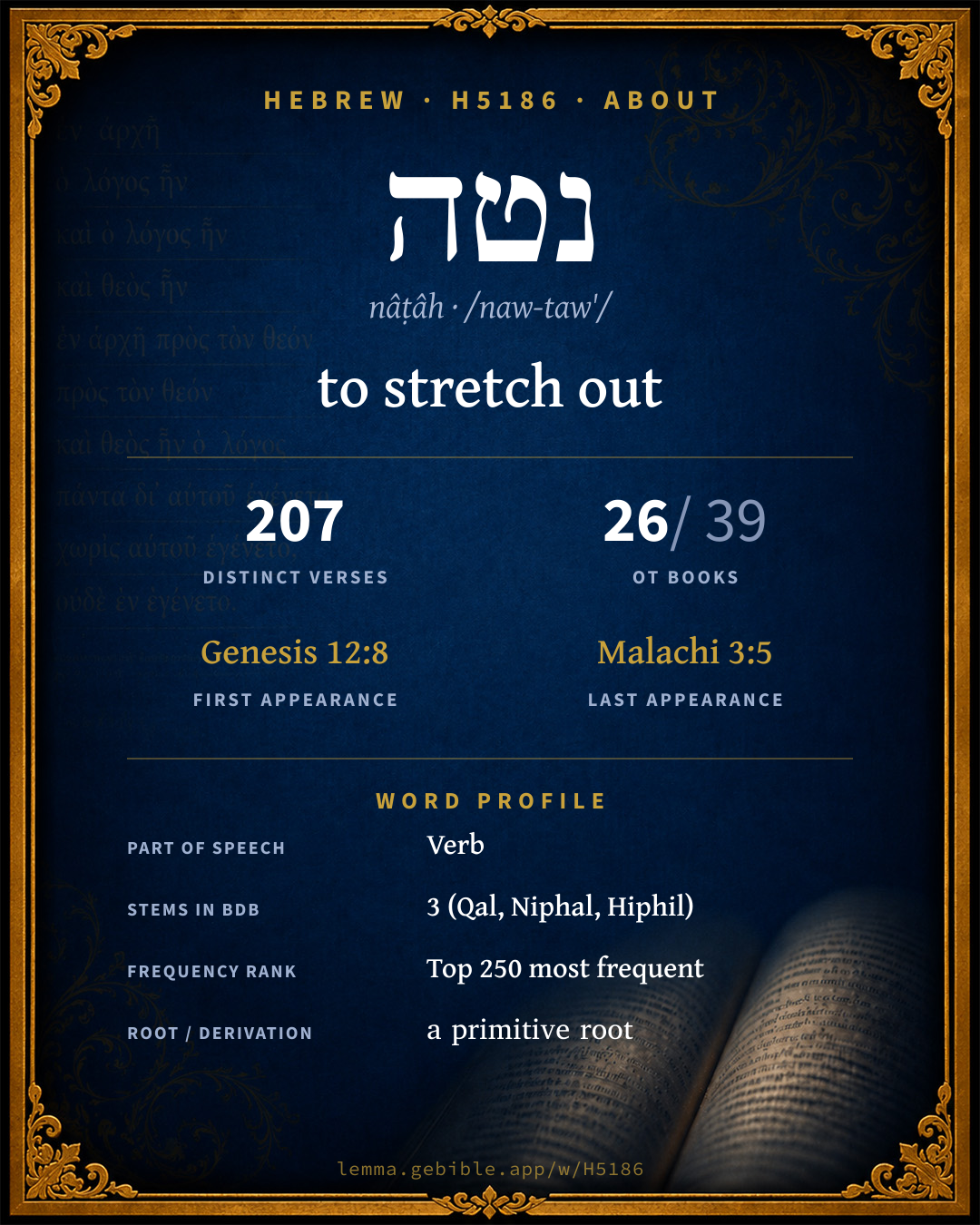
נָטָה
to stretch out
also: extend, spread out, pitch, turn fuller range ↓
Full lexicon entry — Brown-Driver-Briggs (BDB)
From Brown-Driver-Briggs (BDB)
Where this word appears
See every Qal verb in the Hebrew Bible →
Grammar key — what these labels mean
Part of speech
- Verb
- An action or state-of-being word.
Stem
- Qal
- The basic, simple active stem — the plain form of the verb (“he wrote”). Here: ‘stretch out’
- Hiphil
- The causative active stem (“he caused / brought about”). Here: ‘rarely stretch out’
- Niphal
- Usually the simple passive or reflexive of the Qal (“he was written”). Here: ‘be stretched out’
Form
- Sequential Imperfect
- An imperfect with prefixed waw — the standard past-narrative form (waw-consecutive imperfect).
- Perfect
- A completed action or state — Hebrew marks aspect (completeness) more than strict tense (“he wrote”).
- Participle Passive
- A verbal adjective expressing action received (“written”).
- Imperative
- A direct command (“write!”).
- Participle Active
- A verbal adjective expressing ongoing or characteristic action (“writing / one who writes”).
- Sequential Perfect
- A perfect with prefixed waw continuing a preceding imperfect or command (waw-consecutive perfect).
- Infinitive Construct
- A bound verbal noun, frequently with prepositions (“to write / in writing”).
- Imperfect
- An incomplete, ongoing, or future action (“he will / would write”).
- Jussive
- A third- or second-person volitional form expressing wish or command (“let him write”).
State
- Absolute
- The independent form of a noun, not bound to a following word.
- Construct
- A noun bound to a following noun in a possessive / “of” relationship (the construct chain).
Person
- 3rd Person
- The one spoken about (“he / she / it / they”).
- 2nd Person
- The one addressed (“you”).
- 1st Person
- The speaker (“I / we”).
Gender
- Masculine
- Grammatically masculine.
- Feminine
- Grammatically feminine.
- Common
- Either gender — not distinguished for this form.
Number
- Singular
- One.
- Plural
- More than one (in Hebrew, generally three or more).
Grammatical forms 48 distinct
- Verb, Qal, Participle Passive, Feminine, Singular, Absolute 25 times (12%)
- Verb, Qal, Sequential Imperfect, 3rd Person, Masculine, Singular 24 times (11%)
- Verb, Qal, Perfect, 3rd Person, Masculine, Singular 18 times (8%)
- Verb, Hiphil, Imperative, 2nd Person, Masculine, Singular 14 times (6%)
- Verb, Qal, Participle Active, Masculine, Singular, Absolute 11 times (5%)
- Verb, Qal, Imperative, 2nd Person, Masculine, Singular 11 times (5%)
- Verb, Hiphil, Perfect, 3rd Person, Common, Plural 9 times (4%)
- Verb, Qal, Sequential Perfect, 1st Person, Common, Singular 8 times (4%)
+40 more forms (96 occurrences)
Parsed forms decoded from the imported morphology (morphhb / Westminster Leningrad Codex — WLC text public domain, morphhb tagging CC BY 4.0), counted across 216 parsed occurrences — not distinct verses.
Page 1 of 2 — showing verses 1–200 of 207 distinct verses where H5186 appears, across 26 books. Click any verse to open its interlinear word-by-word view. Verse text shown in the World English Bible for context — . Each verse’s Hebrew form is shown with its reference; the English is not keyword-highlighted, since the data carries no word-level English alignment. Use “Compare translations” on any verse to read it across multiple English versions. This concordance covers the Hebrew Bible; Septuagint (Greek Old Testament) occurrences are not indexed here.
Genesis 9 verses
- Genesis 12:8 וַ/יֵּ֣ט conj + Qal wimpf 3ms He left from there to the mountain on the east of Bethel, and pitched his tent, having Bethel on the west, and Ai on the east. There he built an altar to Yahweh, and called on the name of Yahweh.
- Genesis 24:14 הַטִּי Hiphil impv 2fs Let it happen, that the young lady to whom I will say, 'Please let down your pitcher, that I may drink.' She will say, 'Drink, and I will also give your camels a drink.' Let the same be she who you have appointed for your servant Isaac. Thereby will I know that you have shown kindness to my master."
- Genesis 26:25 וַ/יֶּט conj + Qal wimpf 3ms He built an altar there, and called on the name of Yahweh, and pitched his tent there. There Isaac's servants dug a well.
- Genesis 33:19 נָֽטָה Qal pf 3ms He bought the parcel of ground, where he had spread his tent, at the hand of the children of Hamor, Shechem's father, for one hundred pieces of money.
- Genesis 35:21 וַ/יֵּ֣ט conj + Qal wimpf 3ms Israel traveled, and spread his tent beyond the tower of Eder.
- Genesis 38:1 וַ/יֵּ֛ט conj + Qal wimpf 3ms It happened at that time, that Judah went down from his brothers, and visited a certain Adullamite, whose name was Hirah.
- Genesis 38:16 וַ/יֵּ֨ט conj + Qal wimpf 3ms He turned to her by the way, and said, "Please come, let me come in to you:" for he didn't know that she was his daughter-in-law. She said, "What will you give me, that you may come in to me?"
- Genesis 39:21 וַ/יֵּ֥ט conj + Qal wimpf 3ms But Yahweh was with Joseph, and showed kindness to him, and gave him favor in the sight of the keeper of the prison.
- Genesis 49:15 וַ/יֵּ֤ט conj + Qal wimpf 3ms He saw a resting-place, that it was good, The land, that it was pleasant; He bows his shoulder to the burden, And becomes a servant doing forced labor.
Exodus 21 verses
- Exodus 6:6 נְטוּיָ֔ה Qal ptcp.pass fs Therefore tell the children of Israel, 'I am Yahweh, and I will bring you out from under the burdens of the Egyptians, and I will rid you out of their bondage, and I will redeem you with an outstretched arm, and with great judgments:
- Exodus 7:5 בִּ/נְטֹתִ֥/י prep + Qal inf.cs + sfx pers 1cs The Egyptians shall know that I am Yahweh, when I stretch forth my hand on Egypt, and bring out the children of Israel from among them."
- Exodus 7:19 וּ/נְטֵֽה conj + Qal impv 2ms Yahweh said to Moses, "Tell Aaron, 'Take your rod, and stretch out your hand over the waters of Egypt, over their rivers, over their streams, and over their pools, and over all their ponds of water, that they may become blood; and there shall be blood throughout all the land of Egypt, both in vessels of wood and in vessels of stone.'"
- Exodus 8:5 נְטֵ֤ה Qal impv 2ms Yahweh said to Moses, "Tell Aaron, 'Stretch forth your hand with your rod over the rivers, over the streams, and over the pools, and cause frogs to come up on the land of Egypt.'"
- Exodus 8:6 וַ/יֵּ֤ט conj + Qal wimpf 3ms Aaron stretched out his hand over the waters of Egypt; and the frogs came up, and covered the land of Egypt.
- Exodus 8:16 נְטֵ֣ה Qal impv 2ms Yahweh said to Moses, "Tell Aaron, 'Stretch out your rod, and strike the dust of the earth, that it may become lice throughout all the land of Egypt.'"
- Exodus 8:17 וַ/יֵּט֩ conj + Qal wimpf 3ms They did so; and Aaron stretched out his hand with his rod, and struck the dust of the earth, and there were lice on man, and on animal; all the dust of the earth became lice throughout all the land of Egypt.
- Exodus 9:22 נְטֵ֤ה Qal impv 2ms Yahweh said to Moses, "Stretch forth your hand toward the sky, that there may be hail in all the land of Egypt, on man, and on animal, and on every herb of the field, throughout the land of Egypt."
- Exodus 9:23 וַ/יֵּ֨ט conj + Qal wimpf 3ms Moses stretched forth his rod toward the heavens, and Yahweh sent thunder, hail, and lightning flashed down to the earth. Yahweh rained hail on the land of Egypt.
- Exodus 10:12 נְטֵ֨ה Qal impv 2ms Yahweh said to Moses, "Stretch out your hand over the land of Egypt for the locusts, that they may come up on the land of Egypt, and eat every herb of the land, even all that the hail has left."
- Exodus 10:13 וַ/יֵּ֨ט conj + Qal wimpf 3ms Moses stretched forth his rod over the land of Egypt, and Yahweh brought an east wind on the land all that day, and all the night; and when it was morning, the east wind brought the locusts.
- Exodus 10:21 נְטֵ֤ה Qal impv 2ms Yahweh said to Moses, "Stretch out your hand toward the sky, that there may be darkness over the land of Egypt, even darkness which may be felt."
- Exodus 10:22 וַ/יֵּ֥ט conj + Qal wimpf 3ms Moses stretched forth his hand toward the sky, and there was a thick darkness in all the land of Egypt three days.
- Exodus 14:16 וּ/נְטֵ֧ה conj + Qal impv 2ms Lift up your rod, and stretch out your hand over the sea, and divide it: and the children of Israel shall go into the midst of the sea on dry ground.
- Exodus 14:21 וַ/יֵּ֨ט conj + Qal wimpf 3ms Moses stretched out his hand over the sea, and Yahweh caused the sea to go back by a strong east wind all the night, and made the sea dry land, and the waters were divided.
- Exodus 14:26 נְטֵ֥ה Qal impv 2ms Yahweh said to Moses, "Stretch out your hand over the sea, that the waters may come again on the Egyptians, on their chariots, and on their horsemen."
- Exodus 14:27 וַ/יֵּט֩ conj + Qal wimpf 3ms Moses stretched out his hand over the sea, and the sea returned to its strength when the morning appeared; and the Egyptians fled against it. Yahweh overthrew the Egyptians in the midst of the sea.
- Exodus 15:12 נָטִ֨יתָ֙ Qal pf 2ms You stretched out your right hand. The earth swallowed them.
- Exodus 23:2 לִ/נְטֹ֛ת לְ/הַטֹּֽת prep + Qal inf.cs prep + Hiphil inf.cs You shall not follow a crowd to do evil; neither shall you testify in court to side with a multitude to pervert justice;
- Exodus 23:6 תַטֶּ֛ה Hiphil impf 2ms "You shall not deny justice to your poor people in their lawsuits.
- Exodus 33:7 וְ/נָֽטָה conj + Qal wpf 3ms Now Moses used to take the tent and to pitch it outside the camp, far away from the camp, and he called it "The tent of meeting." It happened that everyone who sought Yahweh went out to the tent of meeting, which was outside the camp.
Numbers 8 verses
- Numbers 20:17 נִטֶּה֙ Qal impf 1cp Please let us pass through your land: we will not pass through field or through vineyard, neither will we drink of the water of the wells: we will go along the king's highway; we will not turn aside to the right hand nor to the left, until we have passed your border.
- Numbers 20:21 וַ/יֵּ֥ט conj + Qal wimpf 3ms Thus Edom refused to give Israel passage through his border: why Israel turned away from him.
- Numbers 21:15 נָטָ֖ה Qal pf 3ms The slope of the valleys That inclines toward the dwelling of Ar, Leans on the border of Moab.
- Numbers 21:22 נִטֶּה֙ Qal impf 1cp Let me pass through your land: we will not turn aside into field, or into vineyard; we will not drink of the water of the wells: we will go by the king's highway, until we have passed your border.
- Numbers 22:23 וַ/תֵּ֤ט לְ/הַטֹּתָ֖/הּ conj + Qal wimpf 3fs prep + Hiphil inf.cs + sfx pers 3fs The donkey saw the angel of Yahweh standing in the way, with his sword drawn in his hand; and the donkey turned aside out of the way, and went into the field: and Balaam struck the donkey, to turn her into the way.
- Numbers 22:26 לִ/נְט֖וֹת prep + Qal inf.cs The angel of Yahweh went further, and stood in a narrow place, where was no way to turn either to the right hand or to the left.
- Numbers 22:33 וַ/תֵּ֣ט נָטְתָ֣ה conj + Qal wimpf 3fs Qal pf 3fs and the donkey saw me, and turned aside before me these three times: unless she had turned aside from me, surely now I had even slain you, and saved her alive.
- Numbers 24:6 נִטָּ֔יוּ Niphal pf 3cp As valleys are they spread forth, As gardens by the river-side, As lign-aloes which Yahweh has planted, As cedar trees beside the waters.
Deuteronomy 9 verses
- Deuteronomy 4:34 נְטוּיָ֔ה Qal ptcp.pass fs Or has God tried to go and take him a nation from the midst of [another] nation, by trials, by signs, and by wonders, and by war, and by a mighty hand, and by an outstretched arm, and by great terrors, according to all that Yahweh your God did for you in Egypt before your eyes?
- Deuteronomy 5:15 נְטוּיָ֑ה Qal ptcp.pass fs You shall remember that you were a servant in the land of Egypt, and Yahweh your God brought you out of there by a mighty hand and by an outstretched arm: therefore Yahweh your God commanded you to keep the Sabbath day.
- Deuteronomy 7:19 הַ/נְּטוּיָ֔ה ptcl def.art + Qal ptcp.pass fs the great trials which your eyes saw, and the signs, and the wonders, and the mighty hand, and the outstretched arm, by which Yahweh your God brought you out: so shall Yahweh your God do to all the peoples of whom you are afraid.
- Deuteronomy 9:29 הַ/נְּטוּיָֽה ptcl def.art + Qal ptcp.pass fs Yet they are your people and your inheritance, which you brought out by your great power and by your outstretched arm.
- Deuteronomy 11:2 הַ/נְּטוּיָֽה ptcl def.art + Qal ptcp.pass fs Know you this day: for I don't speak with your children who have not known, and who have not seen the chastisement of Yahweh your God, his greatness, his mighty hand, and his outstretched arm,
- Deuteronomy 16:19 תַטֶּ֣ה Hiphil impf 2ms You shall not wrest justice: you shall not respect persons; neither shall you take a bribe; for a bribe does blind the eyes of the wise, and pervert the words of the righteous.
- Deuteronomy 24:17 תַטֶּ֔ה Hiphil impf 2ms You shall not wrest the justice [due] to the foreigner, [or] to the fatherless, nor take the widow's clothing to pledge;
- Deuteronomy 26:8 נְטוּיָ֔ה Qal ptcp.pass fs and Yahweh brought us forth out of Egypt with a mighty hand, and with an outstretched arm, and with great terror, and with signs, and with wonders;
- Deuteronomy 27:19 מַטֶּ֛ה Hiphil ptcp.act ms Cursed be he who wrests the justice [due] to the foreigner, fatherless, and widow. All the people shall say, Amen.
Joshua 4 verses
- Joshua 8:18 נְ֠טֵה וַ/יֵּ֧ט Qal impv 2ms conj + Qal wimpf 3ms Yahweh said to Joshua, Stretch out the javelin that is in your hand toward Ai; for I will give it into your hand. Joshua stretched out the javelin that was in his hand toward the city.
- Joshua 8:19 כִּ/נְט֣וֹת prep + Qal inf.cs The ambush arose quickly out of their place, and they ran as soon as he had stretched out his hand, and entered into the city, and took it; and they hurried and set the city on fire.
- Joshua 8:26 נָטָ֖ה Qal pf 3ms For Joshua didn't draw back his hand, with which he stretched out the javelin, until he had utterly destroyed all the inhabitants of Ai.
- Joshua 24:23 וְ/הַטּוּ֙ conj + Hiphil impv 2mp Now therefore put away, [said he], the foreign gods which are among you, and incline your heart to Yahweh, the God of Israel.
Judges 4 verses
- Judges 4:11 וַ/יֵּ֣ט conj + Qal wimpf 3ms Now Heber the Kenite had separated himself from the Kenites, even from the children of Hobab the brother-in-law of Moses, and had pitched his tent as far as the oak in Zaanannim, which is by Kedesh.
- Judges 9:3 וַ/יֵּ֤ט conj + Qal wimpf 3ms His mother's brothers spoke of him in the ears of all the men of Shechem all these words: and their hearts inclined to follow Abimelech; for they said, He is our brother.
- Judges 16:30 וַ/יֵּ֣ט conj + Qal wimpf 3ms Samson said, Let me die with the Philistines. He bowed himself with all his might; and the house fell on the lords, and on all the people who were therein. So the dead that he killed at his death were more than those who he killed in his life.
- Judges 19:8 נְט֣וֹת Qal inf.cs He arose early in the morning on the fifth day to depart; and the young lady's father said, Please strengthen your heart and stay until the day declines; and they ate, both of them.
1 Samuel 2 verses
- 1 Samuel 8:3 וַ/יִּטּ֖וּ וַ/יַּטּ֖וּ conj + Qal wimpf 3mp conj + Hiphil wimpf 3mp His sons didn't walk in his ways, but turned aside after lucre, and took bribes, and perverted justice.
- 1 Samuel 14:7 נְטֵ֣ה Qal impv 2ms His armor bearer said to him, Do all that is in your heart: turn you, behold, I am with you according to your heart.
2 Samuel 9 verses
- 2 Samuel 2:19 נָטָ֣ה Qal pf 3ms Asahel pursued after Abner; and in going he didn't turn to the right hand nor to the left from following Abner.
- 2 Samuel 2:21 נְטֵ֤ה Qal impv 2ms Abner said to him, Turn you aside to your right hand or to your left, and lay you hold on one of the young men, and take you his armor. But Asahel would not turn aside from following him.
- 2 Samuel 3:27 וַ/יַּטֵּ֤/הוּ conj + Hiphil wimpf 3ms + sfx pers 3ms When Abner was returned to Hebron, Joab took him aside into the midst of the gate to speak with him quietly, and struck him there in the body, so that he died, for the blood of Asahel his brother.
- 2 Samuel 6:10 וַ/יַּטֵּ֣/הוּ conj + Hiphil wimpf 3ms + sfx pers 3ms So David would not remove the ark of Yahweh to him into the city of David; but David carried it aside into the house of Obed-edom the Gittite.
- 2 Samuel 6:17 נָטָה Qal pf 3ms They brought in the ark of Yahweh, and set it in its place, in the midst of the tent that David had pitched for it; and David offered burnt offerings and peace-offerings before Yahweh.
- 2 Samuel 16:22 וַ/יַּטּ֧וּ conj + Hiphil wimpf 3mp So they spread Absalom a tent on the top of the house; and Absalom went in to his father's concubines in the sight of all Israel.
- 2 Samuel 19:14 וַ/יַּ֛ט conj + Hiphil wimpf 3ms He bowed the heart of all the men of Judah, even as [the heart of] one man; so that they sent to the king, [saying], Return you, and all your servants.
- 2 Samuel 21:10 וַ/תַּטֵּ֨/הוּ conj + Hiphil wimpf 3fs + sfx pers 3ms Rizpah the daughter of Aiah took sackcloth, and spread it for her on the rock, from the beginning of harvest until water was poured on them from the sky; and she allowed neither the birds of the sky to rest on them by day, nor the animals of the field by night.
- 2 Samuel 22:10 וַ/יֵּ֥ט conj + Qal wimpf 3ms He bowed the heavens also, and came down; Thick darkness was under his feet.
1 Kings 7 verses
- 1 Kings 2:28 נָטָה֙ נָטָ֑ה Qal pf 3ms Qal pf 3ms The news came to Joab; for Joab had turned after Adonijah, though he didn't turn after Absalom. Joab fled to the Tent of Yahweh, and caught hold on the horns of the altar.
- 1 Kings 8:42 הַ/נְּטוּיָ֑ה ptcl def.art + Qal ptcp.pass fs (for they shall hear of your great name, and of your mighty hand, and of your outstretched arm); when he shall come and pray toward this house;
- 1 Kings 8:58 לְ/הַטּ֥וֹת prep + Hiphil inf.cs that he may incline our hearts to him, to walk in all his ways, and to keep his commandments, and his statutes, and his ordinances, which he commanded our fathers.
- 1 Kings 11:2 יַטּ֣וּ Hiphil impf 3mp of the nations concerning which Yahweh said to the children of Israel, You shall not go among them, neither shall they come among you; for surely they will turn away your heart after their gods: Solomon joined to these in love.
- 1 Kings 11:3 וַ/יַּטּ֥וּ conj + Hiphil wimpf 3mp He had seven hundred wives, princesses, and three hundred concubines; and his wives turned away his heart.
- 1 Kings 11:4 הִטּ֣וּ Hiphil pf 3cp For it happened, when Solomon was old, that his wives turned away his heart after other gods; and his heart was not perfect with Yahweh his God, as was the heart of David his father.
- 1 Kings 11:9 נָטָ֣ה Qal pf 3ms Yahweh was angry with Solomon, because his heart was turned away from Yahweh, the God of Israel, who had appeared to him twice,
2 Kings 4 verses
- 2 Kings 17:36 נְטוּיָ֖ה Qal ptcp.pass fs but Yahweh, who brought you up out of the land of Egypt with great power and with an outstretched arm, him shall you fear, and to him shall you bow yourselves, and to him shall you sacrifice:
- 2 Kings 19:16 הַטֵּ֨ה Hiphil impv 2ms Incline your ear, Yahweh, and hear; open your eyes, Yahweh, and see; and hear the words of Sennacherib, with which he has sent him to defy the living God.
- 2 Kings 20:10 לִ/נְט֖וֹת prep + Qal inf.cs Hezekiah answered, It is a light thing for the shadow to decline ten steps: nay, but let the shadow return backward ten steps.
- 2 Kings 21:13 וְ/נָטִ֣יתִי conj + Qal wpf 1cs I will stretch over Jerusalem the line of Samaria, and the plummet of the house of Ahab; and I will wipe Jerusalem as a man wipes a dish, wiping it and turning it upside down.
1 Chronicles 5 verses
- 1 Chronicles 13:13 וַ/יַּטֵּ֕/הוּ conj + Hiphil wimpf 3ms + sfx pers 3ms So David didn't move the ark to him into the city of David, but carried it aside into the house of Obed-edom the Gittite.
- 1 Chronicles 15:1 וַ/יֶּט conj + Qal wimpf 3ms [David] made him houses in the city of David; and he prepared a place for the ark of God, and pitched for it a tent.
- 1 Chronicles 16:1 נָֽטָה Qal pf 3ms They brought in the ark of God, and set it in the midst of the tent that David had pitched for it: and they offered burnt offerings and peace-offerings before God.
- 1 Chronicles 21:10 נֹטֶ֣ה Qal ptcp.act ms Go and speak to David, saying, Thus says Yahweh, I offer you three things: choose you one of them, that I may do it to you.
- 1 Chronicles 21:16 נְטוּיָ֖ה Qal ptcp.pass fs David lifted up his eyes, and saw the angel of Yahweh standing between earth and the sky, having a drawn sword in his hand stretched out over Jerusalem. Then David and the elders, clothed in sackcloth, fell on their faces.
2 Chronicles 2 verses
- 2 Chronicles 1:4 נָֽטָה Qal pf 3ms But David had brought the ark of God up from Kiriath Jearim to [the place] that David had prepared for it; for he had pitched a tent for it at Jerusalem.
- 2 Chronicles 6:32 הַ/נְּטוּיָ֑ה ptcl def.art + Qal ptcp.pass fs Moreover concerning the foreigner, who is not of your people Israel, when he shall come from a far country for your great name's sake, and your mighty hand, and your outstretched arm; when they shall come and pray toward this house:
Ezra 2 verses
- Ezra 7:28 הִטָּה Hiphil pf 3ms and has extended loving kindness to me before the king, and his counselors, and before all the king's mighty princes. I was strengthened according to the hand of Yahweh my God on me, and I gathered together out of Israel chief men to go up with me.
- Ezra 9:9 וַֽ/יַּט conj + Hiphil wimpf 3ms For we are bondservants; yet our God has not forsaken us in our bondage, but has extended loving kindness to us in the sight of the kings of Persia, to give us a reviving, to set up the house of our God, and to repair the ruins of it, and to give us a wall in Judah and in Jerusalem.
Job 9 verses
- Job 9:8 נֹטֶ֣ה Qal ptcp.act ms Who alone stretches out the heavens, Treads on the waves of the sea;
- Job 15:25 נָטָ֣ה Qal pf 3ms Because he has stretched out his hand against God, And behaves himself proudly against the Almighty;
- Job 15:29 יִטֶּ֖ה Qal impf 3ms He shall not be rich, neither shall his substance continue, Neither shall their possessions be extended on the earth.
- Job 23:11 אָֽט Hiphil impf 1cs My foot has held fast to his steps. His way have I kept, and not turned aside.
- Job 24:4 יַטּ֣וּ Hiphil impf 3mp They turn the needy out of the way. The poor of the earth all hide themselves.
- Job 26:7 נֹטֶ֣ה Qal ptcp.act ms He stretches out the north over empty space, And hangs the earth on nothing.
- Job 31:7 תִּטֶּ֣ה Qal impf 3fs If my step has turned out of the way, If my heart walked after my eyes, If any defilement has stuck to my hands,
- Job 36:18 יַטֶּֽ/ךָּ Hiphil juss 3ms + sfx pers 2ms Don't let riches entice you to wrath, Neither let the great size of a bribe turn you aside.
- Job 38:5 נָטָ֖ה Qal pf 3ms Who determined the measures of it, if you know? Or who stretched the line on it?
Psalms 29 verses
- Psalms 17:6 הַֽט Hiphil impv 2ms I have called on you, for you will answer me, God: Turn your ear to me. Hear my speech.
- Psalms 17:11 לִ/נְט֥וֹת prep + Qal inf.cs They have now surrounded us in our steps. They set their eyes to cast us down to the earth.
- Psalms 18:9 וַ/יֵּ֣ט conj + Qal wimpf 3ms He bowed the heavens also, and came down. Thick darkness was under his feet.
- Psalms 21:11 נָט֣וּ Qal pf 3cp For they intended evil against you. They plotted evil against you which cannot succeed.
- Psalms 27:9 תַּט Hiphil juss 2ms Don't hide your face from me. Don't put your servant away in anger. You have been my help. Don't abandon me, Neither forsake me, God of my salvation.
- Psalms 31:2 הַטֵּ֤ה Hiphil impv 2ms Bow down your ear to me. Deliver me speedily. Be to me a strong rock, A house of defense to save me.
- Psalms 40:1 וַ/יֵּ֥ט conj + Qal wimpf 3ms I waited patiently for Yahweh. He turned to me, and heard my cry.
- Psalms 44:18 וַ/תֵּ֥ט conj + Qal wimpf 3fs Our heart has not turned back, Neither have our steps strayed from your path,
- Psalms 45:10 וְ/הַטִּ֣י conj + Hiphil impv 2fs Listen, daughter, consider, and turn your ear. Forget your own people, and also your father's house.
- Psalms 49:4 אַטֶּ֣ה Hiphil impf 1cs I will incline my ear to a proverb. I will open my riddle on the harp.
- Psalms 62:3 נָט֑וּי Qal ptcp.pass ms How long will you assault a man, Would all of you throw him down, Like a leaning wall, like a tottering fence?
- Psalms 71:2 הַטֵּֽה Hiphil impv 2ms Deliver me in your righteousness, and rescue me. Turn your ear to me, and save me.
- Psalms 73:2 נטוי נָטָ֣יוּ Qal ptcp.pass ms cs Qal pf 3cp But as for me, my feet were almost gone. My steps had nearly slipped.
- Psalms 78:1 הַטּ֥וּ Hiphil impv 2mp Hear my law, my people. Turn your ears to the words of my mouth.
- Psalms 86:1 הַטֵּֽה Hiphil impv 2ms Hear, Yahweh, and answer me, For I am poor and needy.
- Psalms 88:2 הַטֵּֽה Hiphil impv 2ms Let my prayer enter into your presence. Turn your ear to my cry.
- Psalms 102:2 הַטֵּֽה Hiphil impv 2ms Don't hide your face from me in the day of my distress. Turn your ear to me. Answer me quickly in the day when I call.
- Psalms 102:11 נָט֑וּי Qal ptcp.pass ms My days are like a long shadow. I have withered like grass.
- Psalms 104:2 נוֹטֶ֥ה Qal ptcp.act ms He covers himself with light as with a garment. He stretches out the heavens like a curtain.
- Psalms 109:23 כִּ/נְטוֹת֥/וֹ prep + Qal inf.cs + sfx pers 3ms I fade away like an evening shadow. I am shaken off like a locust.
- Psalms 116:2 הִטָּ֣ה Hiphil pf 3ms Because he has turned his ear to me, Therefore I will call on him as long as I live.
- Psalms 119:36 הַט Hiphil impv 2ms Turn my heart toward your statutes, Not toward selfish gain.
- Psalms 119:51 נָטִֽיתִי Qal pf 1cs The arrogant mock me excessively, But I don't swerve from your law.
- Psalms 119:112 נָטִ֣יתִי Qal pf 1cs I have set my heart to perform your statutes forever, Even to the end.
- Psalms 119:157 נָטִֽיתִי Qal pf 1cs Many are my persecutors and my adversaries. I haven't swerved from your testimonies.
- Psalms 125:5 וְ/הַ/מַּטִּ֤ים conj + ptcl def.art + Hiphil ptcp.act mp But as for those who turn aside to their crooked ways, Yahweh will lead them away with the workers of iniquity. Peace be on Israel.
- Psalms 136:12 נְטוּיָ֑ה Qal ptcp.pass fs With a strong hand, and with an outstretched arm; For his loving kindness endures forever:
- Psalms 141:4 תַּט Hiphil juss 2ms Don't incline my heart to any evil thing, To practice deeds of wickedness with men who work iniquity. Don't let me eat of their delicacies.
- Psalms 144:5 הַט Hiphil impv 2ms Part your heavens, Yahweh, and come down. Touch the mountains, and they will smoke.
Proverbs 12 verses
- Proverbs 1:24 נָטִ֥יתִי Qal pf 1cs Because I have called, and you have refused; I have stretched out my hand, and no one has paid attention;
- Proverbs 2:2 תַּטֶּ֥ה Hiphil impf 2ms So as to turn your ear to wisdom, And apply your heart to understanding;
- Proverbs 4:5 תֵּ֝֗ט Qal juss 2ms Get wisdom. Get understanding. Don't forget, neither swerve from the words of my mouth.
- Proverbs 4:20 הַט Hiphil impv 2ms My son, attend to my words. Turn your ear to my sayings.
- Proverbs 4:27 תֵּט Qal juss 2ms Don't turn to the right hand nor to the left. Remove your foot from evil.
- Proverbs 5:1 הַט Hiphil impv 2ms My son, pay attention to my wisdom. Turn your ear to my understanding:
- Proverbs 5:13 הִטִּ֥יתִי Hiphil pf 1cs Neither have I obeyed the voice of my teachers, Nor turned my ear to those who instructed me!
- Proverbs 7:21 הִ֭טַּתּ/וּ Hiphil pf 3fs + sfx pers 3ms With persuasive words, she led him astray. With the flattering of her lips, she seduced him.
- Proverbs 17:23 לְ֝/הַטּ֗וֹת prep + Hiphil inf.cs A wicked man receives a bribe in secret, To pervert the ways of justice.
- Proverbs 18:5 לְ/הַטּ֥וֹת prep + Hiphil inf.cs To be partial to the faces of the wicked is not good, Nor to deprive the innocent of justice.
- Proverbs 21:1 יַטֶּֽ/נּוּ Hiphil impf 3ms + sfx pers 3ms The king's heart is in Yahweh's hand like the watercourses. He turns it wherever he desires.
- Proverbs 22:17 הַ֥ט Hiphil impv 2ms Turn your ear, and listen to the words of the wise. Apply your heart to my teaching.
Isaiah 25 verses
- Isaiah 3:16 נטוות נְטוּי֣וֹת Qal ptcp.pass fp Qal ptcp.pass fp Moreover Yahweh said, "Because the daughters of Zion are haughty, And walk with outstretched necks and flirting eyes, Walking to trip as they go, Jingling ornaments on their feet;
- Isaiah 5:25 וַ/יֵּ֣ט נְטוּיָֽה conj + Qal wimpf 3ms Qal ptcp.pass fs Therefore Yahweh's anger burns against his people, And he has stretched out his hand against them, and has struck them. The mountains tremble, And their dead bodies are as refuse in the midst of the streets. For all this, his anger is not turned away, But his hand is still stretched out.
- Isaiah 9:12 נְטוּיָֽה Qal ptcp.pass fs the Syrians before, and the Philistines behind; and they shall devour Israel with open mouth. For all this his anger is not turned away, but his hand is stretched out still.
- Isaiah 9:17 נְטוּיָֽה Qal ptcp.pass fs Therefore the Lord will not rejoice over their young men, neither will he have compassion on their fatherless and widows; for everyone is profane and an evil-doer, and every mouth speaks folly. For all this his anger is not turned away, but his hand is stretched out still.
- Isaiah 9:21 נְטוּיָֽה Qal ptcp.pass fs Manasseh, Ephraim; and Ephraim, Manasseh; and they together shall be against Judah. For all this his anger is not turned away, but his hand is stretched out still.
- Isaiah 10:2 לְ/הַטּ֤וֹת prep + Hiphil inf.cs to turn aside the needy from justice, and to rob the poor of my people of their right, that widows may be their spoil, and that they may make the fatherless their prey!
- Isaiah 10:4 נְטוּיָֽה Qal ptcp.pass fs They shall only bow down under the prisoners, and shall fall under the slain. For all this his anger is not turned away, but his hand is stretched out still.
- Isaiah 14:26 הַ/נְּטוּיָ֖ה ptcl def.art + Qal ptcp.pass fs This is the purpose that is purposed on the whole earth; and this is the hand that is stretched out on all the nations.
- Isaiah 14:27 הַ/נְּטוּיָ֖ה ptcl def.art + Qal ptcp.pass fs For Yahweh of Hosts has purposed, and who shall annul it? and his hand is stretched out, and who shall turn it back?
- Isaiah 23:11 נָטָ֣ה Qal pf 3ms He has stretched out his hand over the sea, he has shaken the kingdoms: Yahweh has given commandment concerning Canaan, to destroy the strongholds of it.
- Isaiah 29:21 וַ/יַּטּ֥וּ conj + Hiphil wimpf 3mp that make a man an offender in [his] cause, and lay a snare for him who reproves in the gate, and turn aside the just with a thing of nothing.
- Isaiah 30:11 הַטּ֖וּ Hiphil impv 2mp get out of the way, turn aside out of the path, cause the Holy One of Israel to cease from before us."
- Isaiah 31:3 יַטֶּ֣ה Hiphil impf 3ms Now the Egyptians are men, and not God; and their horses flesh, and not spirit: and when Yahweh shall stretch out his hand, both he who helps shall stumble, and he who is helped shall fall, and they all shall be consumed together.
- Isaiah 34:11 וְ/נָטָ֥ה conj + Qal wpf 3ms But the pelican and the porcupine shall possess it; and the owl and the raven shall dwell therein: and he will stretch over it the line of confusion, and the plummet of emptiness.
- Isaiah 37:17 הַטֵּ֨ה Hiphil impv 2ms Turn your ear, Yahweh, and hear; open your eyes, Yahweh, and behold; and hear all the words of Sennacherib, who has sent to defy the living God.
- Isaiah 40:22 הַ/נּוֹטֶ֤ה ptcl def.art + Qal ptcp.act ms [It is] he who sits above the circle of the earth, and the inhabitants of it are as grasshoppers; who stretches out the heavens as a curtain, and spreads them out as a tent to dwell in;
- Isaiah 42:5 וְ/נ֣וֹטֵי/הֶ֔ם conj + Qal ptcp.act ms cs + sfx pers 3mp Thus says God Yahweh, he who created the heavens, and stretched them forth; he who spread abroad the earth and that which comes out of it; he who gives breath to the people on it, and spirit to those who walk therein:
- Isaiah 44:13 נָ֣טָה Qal pf 3ms The carpenter stretches out a line; he marks it out with a pencil; he shapes it with planes, and he marks it out with the compasses, and shapes it after the figure of a man, according to the beauty of a man, to dwell in a house.
- Isaiah 44:20 הִטָּ֑/הוּ Hiphil pf 3ms + sfx pers 3ms He feeds on ashes; a deceived heart has turned him aside; and he can't deliver his soul, nor say, Is there not a lie in my right hand?
- Isaiah 44:24 נֹטֶ֤ה Qal ptcp.act ms Thus says Yahweh, your Redeemer, and he who formed you from the womb: I am Yahweh, who makes all things; who stretches forth the heavens alone; who spreads abroad the earth (who is with me?);
- Isaiah 45:12 נָט֣וּ Qal pf 3cp I have made the earth, and created man on it: I, even my hands, have stretched out the heavens; and all their host have I commanded.
- Isaiah 51:13 נוֹטֶ֣ה Qal ptcp.act ms and have forgotten Yahweh your Maker, who stretched forth the heavens, and laid the foundations of the earth; and fear continually all the day because of the fury of the oppressor, when he makes ready to destroy? and where is the fury of the oppressor?
- Isaiah 54:2 יַטּ֖וּ Hiphil impf 3mp Enlarge the place of your tent, and let them stretch forth the curtains of your habitations; don't spare: lengthen your cords, and strengthen your stakes.
- Isaiah 55:3 הַטּ֤וּ Hiphil impv 2mp Turn your ear, and come to me; hear, and your soul shall live: and I will make an everlasting covenant with you, even the sure mercies of David.
- Isaiah 66:12 נֹטֶֽה Qal ptcp.act ms For thus says Yahweh, Behold, I will extend peace to her like a river, and the glory of the nations like an overflowing stream: and you shall suck [of it]; you shall be borne on the side, and shall be dandled on the knees.
Jeremiah 22 verses
- Jeremiah 5:25 הִטּוּ Hiphil pf 3cp Your iniquities have turned away these things, and your sins have withheld good from you.
- Jeremiah 6:4 יִנָּט֖וּ Niphal impf 3mp Prepare you war against her; arise, and let us go up at noon. Woe to us! for the day declines, for the shadows of the evening are stretched out.
- Jeremiah 6:12 אַטֶּ֧ה Hiphil impf 1cs Their houses shall be turned to others, their fields and their wives together; for I will stretch out my hand on the inhabitants of the land, says Yahweh.
- Jeremiah 7:24 הִטּ֣וּ Hiphil pf 3cp But they didn't listen nor turn their ear, but walked in [their own] counsels [and] in the stubbornness of their evil heart, and went backward, and not forward.
- Jeremiah 7:26 הִטּ֖וּ Hiphil pf 3cp yet they didn't listen to me, nor inclined their ear, but made their neck stiff: they did worse than their fathers.
- Jeremiah 10:12 נָטָ֥ה Qal pf 3ms He has made the earth by his power, he has established the world by his wisdom, and by his understanding has he stretched out the heavens:
- Jeremiah 10:20 נֹטֶ֥ה Qal ptcp.act ms My tent is destroyed, and all my cords are broken: my children are gone forth from me, and they are no more: there is none to spread my tent any more, and to set up my curtains.
- Jeremiah 11:8 הִטּ֣וּ Hiphil pf 3cp Yet they didn't obey, nor turn their ear, but walked everyone in the stubbornness of their evil heart: therefore I brought on them all the words of this covenant, which I commanded them to do, but they didn't do them.
- Jeremiah 14:8 נָטָ֥ה Qal pf 3ms You hope of Israel, the Savior of it in the time of trouble, why should you be as a foreigner in the land, and as a wayfaring man who turns aside to stay for a night?
- Jeremiah 15:6 וָ/אַ֨ט conj + Hiphil wimpf 1cs You have rejected me, says Yahweh, you are gone backward: therefore have I stretched out my hand against you, and destroyed you; I am weary with repenting.
- Jeremiah 17:23 הִטּ֖וּ Hiphil pf 3cp But they didn't listen, neither turn their ear, but made their neck stiff, that they might not hear, and might not receive instruction.
- Jeremiah 21:5 נְטוּיָ֖ה Qal ptcp.pass fs I myself will fight against you with an outstretched hand and with a strong arm, even in anger, and in wrath, and in great indignation.
- Jeremiah 25:4 הִטִּיתֶ֥ם Hiphil pf 2mp Yahweh has sent to you all his servants the prophets, rising up early and sending them, (but you have not listened, nor inclined your ear to hear),
- Jeremiah 27:5 הַ/נְּטוּיָ֑ה ptcl def.art + Qal ptcp.pass fs I have made the earth, the men and the animals that are on the surface of the earth, by my great power and by my outstretched arm; and I give it to whom it seems right to me.
- Jeremiah 32:17 הַ/נְּטוּיָ֑ה ptcl def.art + Qal ptcp.pass fs Ah Lord Yahweh! behold, you have made the heavens and the earth by your great power and by your outstretched arm; there is nothing too hard for you,
- Jeremiah 32:21 נְטוּיָ֔ה Qal ptcp.pass fs and brought forth your people Israel out of the land of Egypt with signs, and with wonders, and with a strong hand, and with an outstretched arm, and with great terror;
- Jeremiah 34:14 הִטּ֖וּ Hiphil pf 3cp At the end of seven years you shall let go every man his brother who is a Hebrew, who has been sold to you, and has served you six years, you shall let him go free from you: but your fathers didn't listen to me, neither inclined their ear.
- Jeremiah 35:15 הִטִּיתֶם֙ Hiphil pf 2mp I have sent also to you all my servants the prophets, rising up early and sending them, saying, Return you now every man from his evil way, and amend your doings, and don't go after other gods to serve them, and you shall dwell in the land which I have given to you and to your fathers: but you have not inclined your ear, nor listened to me.
- Jeremiah 43:10 וְ/נָטָ֥ה conj + Qal wpf 3ms and tell them, Thus says Yahweh of Hosts, the God of Israel: Behold, I will send and take Nebuchadrezzar the king of Babylon, my servant, and will set his throne on these stones that I have hidden; and he shall spread his royal pavilion over them.
- Jeremiah 44:5 הִטּ֣וּ Hiphil pf 3cp But they didn't listen, nor inclined their ear to turn from their wickedness, to burn no incense to other gods.
- Jeremiah 51:15 נָטָ֥ה Qal pf 3ms He has made the earth by his power, he has established the world by his wisdom, and by his understanding has he stretched out the heavens:
- Jeremiah 51:25 וְ/נָטִ֨יתִי conj + Qal wpf 1cs Behold, I am against you, destroying mountain, says Yahweh, which destroy all the earth; and I will stretch out my hand on you, and roll you down from the rocks, and will make you a burnt mountain.
Lamentations 2 verses
- Lamentations 2:8 נָ֣טָה Qal pf 3ms Yahweh has purposed to destroy the wall of the daughter of Zion; He has stretched out the line, he has not withdrawn his hand from destroying; He has made the rampart and wall to lament; they languish together.
- Lamentations 3:35 לְ/הַטּוֹת֙ prep + Hiphil inf.cs To turn aside the right of a man before the face of the Most High,
Ezekiel 12 verses
- Ezekiel 1:22 נָט֥וּי Qal ptcp.pass ms Over the head of the living creature there was the likeness of an expanse, like the awesome crystal to look on, stretched forth over their heads above.
- Ezekiel 6:14 וְ/נָטִ֤יתִי conj + Qal wpf 1cs I will stretch out my hand on them, and make the land desolate and waste, from the wilderness toward Diblah, throughout all their habitations: and they shall know that I am Yahweh.
- Ezekiel 14:9 וְ/נָטִ֤יתִי conj + Qal wpf 1cs If the prophet be deceived and speak a word, I, Yahweh, have deceived that prophet, and I will stretch out my hand on him, and will destroy him from the midst of my people Israel.
- Ezekiel 14:13 וְ/נָטִ֤יתִי conj + Qal wpf 1cs Son of man, when a land sins against me by committing a trespass, and I stretch out my hand on it, and break the staff of the bread of it, and send famine on it, and cut off from it man and animal;
- Ezekiel 16:27 נָטִ֤יתִי Qal pf 1cs See therefore, I have stretched out my hand over you, and have diminished your ordinary [food], and delivered you to the will of those who hate you, the daughters of the Philistines, who are ashamed of your lewd way.
- Ezekiel 20:33 נְטוּיָ֛ה Qal ptcp.pass fs As I live, says the Lord Yahweh, surely with a mighty hand, and with an outstretched arm, and with wrath poured out, will I be king over you:
- Ezekiel 20:34 נְטוּיָ֔ה Qal ptcp.pass fs and I will bring you out from the peoples, and will gather you out of the countries in which you are scattered, with a mighty hand, and with an outstretched arm, and with wrath poured out;
- Ezekiel 25:7 נָטִ֨יתִי Qal pf 1cs therefore, behold, I have stretched out my hand on you, and will deliver you for a spoil to the nations; and I will cut you off from the peoples, and I will cause you to perish out of the countries: I will destroy you; and you shall know that I am Yahweh.
- Ezekiel 25:13 וְ/נָטִ֤תִי conj + Qal wpf 1cs therefore thus says the Lord Yahweh, I will stretch out my hand on Edom, and will cut off man and animal from it; and I will make it desolate from Teman; even to Dedan shall they fall by the sword.
- Ezekiel 25:16 נוֹטֶ֤ה Qal ptcp.act ms therefore thus says the Lord Yahweh, Behold, I will stretch out my hand on the Philistines, and I will cut off the Cherethites, and destroy the remnant of the sea coast.
- Ezekiel 30:25 וְ/נָטָ֥ה conj + Qal wpf 3ms I will hold up the arms of the king of Babylon; and the arms of Pharaoh shall fall down; and they shall know that I am Yahweh, when I shall put my sword into the hand of the king of Babylon, and he shall stretch it out on the land of Egypt.
- Ezekiel 35:3 וְ/נָטִ֤יתִי conj + Qal wpf 1cs and tell it, Thus says the Lord Yahweh: Behold, I am against you, Mount Seir, and I will stretch out my hand against you, and I will make you a desolation and an astonishment.
Daniel 1 verse
Hosea 1 verse
Amos 3 verses
About this entry
At a glance — auto-summarized from this page’s data, not written by a person. Every figure links to its source below. This summary describes the numbers; it doesn’t interpret them.
נטה — transliterated nâṭâh — is a Hebrew verb carrying the sense “to stretch out.” Debuting at Genesis 12:8, it then recurs through the corpus. Spanning 207 verses in 26 books, it ranks among the common words of the Hebrew Bible. The verb spans 3 stems, from Qal to Niphal. From the same root come מטה, מטה and מטה. See the sense tree, 207-verse concordance, and the renderings breakdown below.
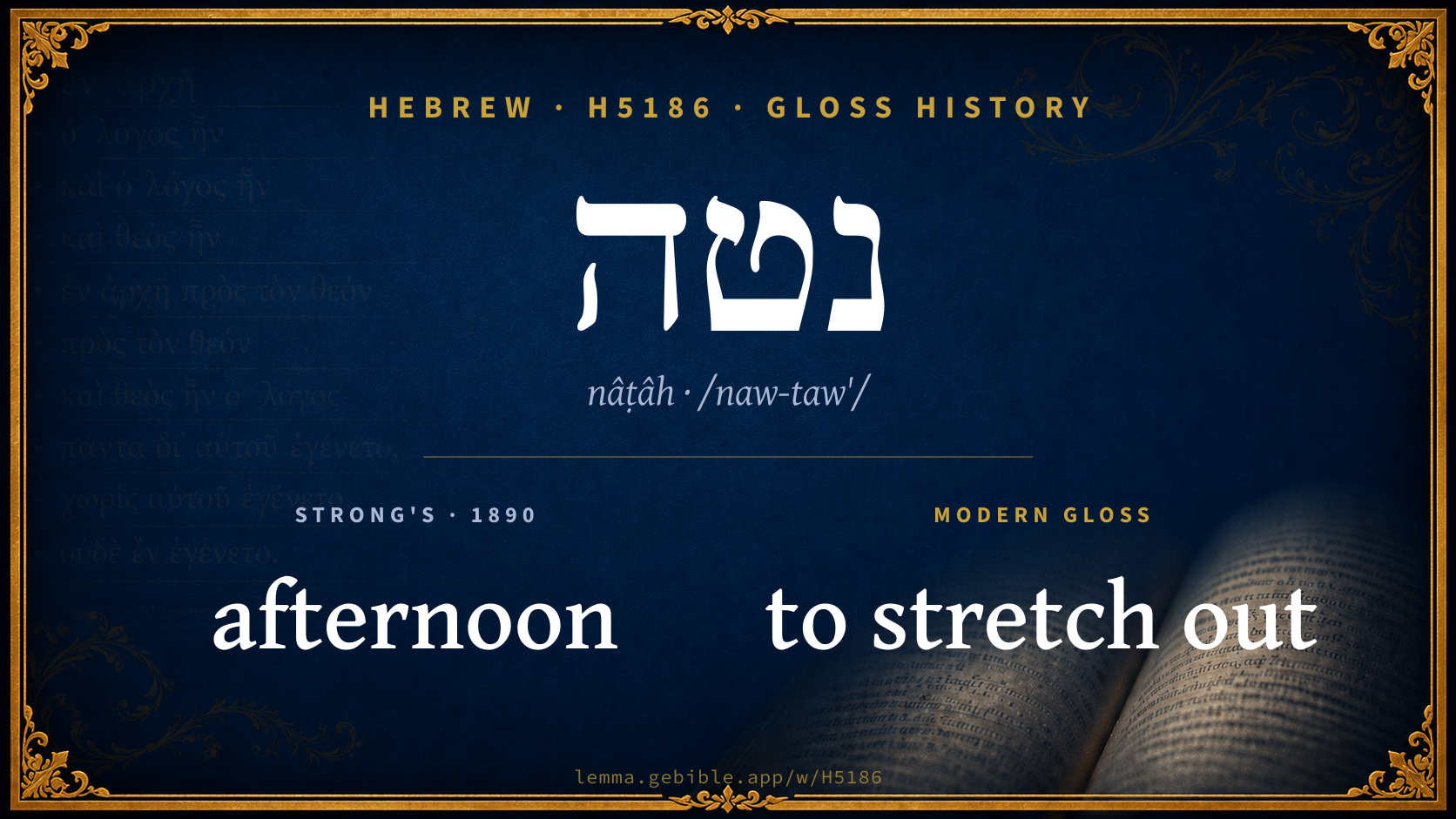
Gloss history
Strong's 1890 vs modern scholarship
About this word
Strong's H5186 catalogs a Hebrew word from the Hebrew Old Testament.
These counts are not copied from any lexicon or concordance. They are computed here, from the morphology-tagged Hebrew Old Testament. What Lemma adds →
- 207
- distinct verses
- The word appears in 207 distinct verses.
- 26 / 39
- OT books
- The word appears in 26 of 39 Old Testament books.
- #220
- by frequency
- Top 250 most frequent Hebrew words (rank 220 of 8,640 Hebrew words by occurrence).
View all 207 occurrences in the concordance →
By section of the Old Testament
By traditional corpus
Conventional, traditional groupings — biblical authorship is debated, so this is a traditional corpus grouping, not an authorship claim. Each share is this word’s portion of its verses in that division of the Hebrew canon. Each figure is a share of the word’s 207 distinct verses.
- Prophets (Nevi'im) 98 verses · 47%
- Writings (Ketuvim) 62 verses · 30%
- Torah (Pentateuch) 47 verses · 23%
How translations render this word
Counts come from each version’s own published word-to-Strong’s tagging or interlinear alignment — an approximate guide to how each version renders this word, not a word-level alignment the data otherwise carries. Because each total is that version’s own tagged count, the per-version totals vary from one another and need not match the appearance or distinct-verse counts above. These counts may also differ from a printed concordance because Lemma counts each distinctly tagged rendering and does not collapse phrase taggings into a single head-word total. This is a fixed set of word-tagged versions (KJV, ASV, BSB, ULT) and does not change with the reading translation you choose elsewhere. Each version’s license is shown beside its name below (and on Sources).
- King James Version: Stretched out 18×, Incline 11×, Inclined 9×
- American Standard Version: Outstretched 15×, Incline 13×, Turn aside 10×
- Berean Standard Bible: Incline 18×, Outstretched 18×, Stretched out 13×
- unfoldingWord Literal Text: Incline 20×, And 14×, Outstretched 14×
King James Version Public Domain
Renders H5186 across 214 tagged occurrences — most commonly:
Plus other, less common renderings. Plus 85 renderings that appear only once — usually multi-word phrases or single function words the recovered tagging swept in, not distinct renderings. Not rendered by a distinct English word in 2 further occurrences.
American Standard Version Public Domain
Renders H5186 across 215 tagged occurrences — most commonly:
Plus other, less common renderings. Plus 84 renderings that appear only once — usually multi-word phrases or single function words the recovered tagging swept in, not distinct renderings.
Berean Standard Bible Public Domain
Renders H5186 across 214 tagged occurrences — most commonly:
Plus other, less common renderings. Plus 94 renderings that appear only once — usually multi-word phrases or single function words the recovered tagging swept in, not distinct renderings.
unfoldingWord Literal Text CC BY-SA 4.0
Renders H5186 across 251 tagged occurrences — most commonly:
Plus other, less common renderings. Plus 97 renderings that appear only once — usually multi-word phrases or single function words the recovered tagging swept in, not distinct renderings.
21 senses and sub-senses in the full BDB
Hebrew verbs can shift meaning by stem (binyan): Qal is the basic action, Niphal is often passive or reflexive, Piel often intensifies or makes it factitive, and Hiphil is typically causative. The senses below are grouped under the stem BDB assigns to each.
What do BDB’s symbols mean?
BDB uses these scholarly abbreviations:
| Symbol | Meaning |
|---|---|
| 𝔊 | the Septuagint (the ancient Greek translation, LXX) |
| 𝔙 | the Vulgate (the Latin translation) |
| 𝔖 | the Syriac version (the Peshitta) |
| 𝔗 | the Targum (the Aramaic translation) |
| ψ | the Psalms |
| √ | root (the underlying root or stem) |
| ‖ | parallel passage (a synonymous or contrasted parallel) |
| † | the dagger: every passage where the word occurs is cited |
The 21 senses and sub-senses the full Brown-Driver-Briggs lexicon distinguishes for this word, in lexicon order (not ranked by frequency), with BDB’s own verbatim wording and sub-sense lettering. Shown in Hebrew script with BDB’s own scholarly abbreviations. The condensed entry is in the Lexicon Entry tab. See also the Forms in the corpus table below.
Qal
- Pf. 3 ms. נ׳ Gn 33:19 +; 3 fs. נָֽטְתָה Nu 22:33; 2 ms. נָטִיתָ Ex 15:12; 3 pl. נָטוּ ψ 21:12 Is 45:12, נָטָ֫יוּ ψ 73:2 Qr, etc.; Impf. יִטֶּה Jb 15:29, juss. יֵט Zp 2:13; וַיֵּט Gn 12:8 +, וַיֶּט־ Gn 26:27 +; 3 fs. תִּטֶּה Jb 31:7, וַתֵּט Nu 22:23 +; 2 ms. juss. תֵּט Pr 4:5, 27; Impf. Is אָט Jb 23:11; 3 mpl. וַיִּטּוּ 1 S 8:3; 1 pl. נִטֶּה Nu 20:17; Imv. נְטֵה Ex 8:1 +; Inf. cstr. נְטוֹת Ju 19:8 + 4 times, נְטֹת Ex 23:2; sf. נְטֹתִי Ex 7:5, נְטוֹתוֹ ψ 109:23; Pt. act. נֹטֶה Je 10:20 + 6 times, נוֹטֶה Ez 25:16 + 3 times; sf. נוֹטֵיהֶם Is 42:5; pass. נָטוּי ψ 62:4 + 2 times, + ψ 73:2 (v. infr.); fs. נְטוּיָה Is 5:25 + 24 times; pl. נְטֻיוֹת Is 3:16 Qr (Kt נטוות):— e.g. Genesis 33:19
- 1.
- a. stretch out, extend, hand, rod, usually c. acc. + עַל of direction Ex 9:22, 23; 10:12, 13, 21, 22 (all E), 7:19; 14:16, 21, 26, 27 (all P), abs. Jos 8:19 (JE), Ex 8:12 (P); c. ב of dart or rod נ׳ בַּכִּידוֹן אֶל־ Jos 8:18(×2) (JE), נ׳ יָֽדְךָ בְּמַטֶּ֔ךָ עַל־ Ex 8:1 (P), cf. v 2 and (עַל om.) v 13 (all P), Jos 8:26 (JE); fig. of hostility to God נ׳ יָדוֹ אֶל־ Jb 15:25; especially of God stretching out his hand over (עַל), often with idea of against, i. e. in judgment, Is 5:25; 23:11 Zp 1:4; 2:13 Ez 6:14 + 7 times Ez, Ex 7:5 (P); c. אֶל־ against Je 51:25, cf. sword Ez 30:25; abs. Ex 15:12 (song); pt. pass. נ׳ גָּרוֹן Is 3:16 outstretched of neck; often זְרוֹע נְטוּיָה arm stretched out (of י׳) to deliver, Dt 4:34 + 14 times (v. זְרוֹעַ); אֶזְרוֹעַ נ׳ Je 32:21; יָד נ׳, to oppose, Je 21:5; עוֹד יָדוֹ נְטוּיָה in judgment, Is 5:25 (‖ לֹא שָׁב אַפּוֹ), so 9:11, 16, 20; 10:4 (all ‖ id.), cf. 14:27; הַיָּד הַנְּטוּיָה עַל־ v 26; נָטִיתִי יָדִי Pr 1:24 (of wisdom’s appeal; ‖ קָרָאתִי). e.g. Exodus 9:22
- b. stretch line and plummet, c. עַל, 2 K 21:13 (subj. י׳; fig. of destruction), cf. Is 34:11 La 2:8; line, of artisan’s measurements (abs.) Is 44:13, and (c. עַל) Jb 38:5. e.g. 2 Kings 21:13
- c. = offer, only שָׁלוֹשׁ אֲנִי נֹטֶה עָלֶיךָ 1 Ch 21:10 three things do I offer unto thee (so read prob. also ‖ 2 S 24:12, v. נטל). e.g. 1 Chronicles 21:10
- 2. Spread out, i. e. pitch, tent Gn 12:8; 26:25; 35:21 (all J), 33:19 (E), Ju 4:11, cf. Je 43:10; fig. of establishing people Je 10:20; of sacred tent Ex 33:7 (JE), 2 S 6:17 = 1 Ch 16:1, 1 Ch 15:1 2 Ch 1:4; obj. heavens (spread out by י׳ as tent) Je 10:12 + 9 times, cf. Jb 26:7; obj. likeness of firmament in Ezek.’s vision Ez 1:22. e.g. Genesis 12:8
- 3. Bend, turn, incline:
- a. intrans., of wady Nu 21:15 (JE; c. לְ); turn aside, of Balaam’s ass 22:23 (מִן־הַדֶּרֶךְ), v 33 (מִפָּנַי), cf. v 33 (לְפָנַי); c. adv. acc. 22:26, so of Isr. 20:17, and (c. מֵעָלָיו) v 21; c. ב into, 21:22; of individ. 2 S 2:19 (לָלֶכֶת עַל), v 21 (עַל), Je 14:8 (c. inf.); cf. Gn 38:1 (עַד), v 16 (אֶל־); fig. of deviating from path of loyalty 1 K 2:28 (c. אַחֲרֵי), cf. Ju 9:3 (of heart), or of righteousness Ex 23:2 [yet on text cf. Bu ZAW xi (1891), 113 Ry ad loc.], 1 S 8:3 (all c. אַחֲרֵי); c. מִן Jb 31:7 ψ 44:19, cf. Pr 4:5 and (c. adv. acc.) v 27; מֵעִם י׳ 1 K 11:9 (of heart), cf. ψ 119:51, 157; incline, of heart, c. לְ 1 S 14:7 (read לְבָֽבְךָ נָטָה לוֹ or נֹטֶה ל׳ Th We Dr Klo Bu HPS Löhr); decline, of shadow on dial 2 K 20:10 (‖ הָלַךְ, opp. אֲחֹרַנִּית שׁוּב), fig. of failing life ψ 102:12; 109:23; of day Ju 19:8 + v 9 (text emend., v. GFM); bend down יִטֶּה לָאָרֶץ Jb 15:29, לִנְטוֹת בָּאָרֶץ ψ 17:11; appar. וַיֵּט בְּכחַ Ju 16:30 and he bowed with all his might (after וַיִּלְפֹּת, וַיִּסָּמֵךְ; al. stretched himself, i. e. gave a thrust, Be GFM, but vb. less often intrans. in this sense); of י׳, וַיֵּט אֵלַי ψ 40:2 and he inclined unto me. e.g. Numbers 21:15
- b. less often trans., bend, bow, וַיֵּט שִׁכְמוֹ לִסְבֹּל Gn 49:15 (Issachar under fig. of ass); קִיר נָטוּי ψ 62:4 (sim. of fate of wicked; ‖ גָּדֵר הַדְּחוּיָה); here belongs also prob. וַאֲנִי כִּמְעַט נָטוּי רַגְלָ֑י ψ 73:2 (Kt) and I was almost prostrated as to my feet (i.e. by stumbling; Qr נָטָיוּ Pf. 3 mpl. but needless, cf. Ol Bae; ‖ כְּאַיִן שֻׁפְּכֻה אֲשֻׁרָֽי׃); נָטִיתִי לִבִּי ψ 119:112 I have inclined my heart (c. inf.); of י׳, שָׁמַיִם וַיֵּרַ֑ד וַיֵּט 2 S 22:10 = ψ 18:10; also fig., hold out, extend unto, of י׳, obj. חֶסֶד Gn 39:21 (J), שָׁלוֹם, etc., Is 66:12 (both c. אֶל־); of men רָעָה ψ 21:12 (עַל). e.g. Genesis 49:15
Niphal
- be stretched out;—Pf. 3 mpl. נִטָּ֫יוּ Nu 24:6 (JE; cf. ii. נַחַל); Impf. 3 ms. יִנָּטֶה עַל־ Zc 1:16 (of measuring line, for building); stretch themselves out, i. e. grow long, 3 mpl. יִנָּטוּ Je 6:4 (of shadows, ‖ פָּנָה הַיּוֹם). e.g. Numbers 24:6
Hiphil
- Pf. הִטָּה Ezr 7:28 ψ 116:2, sf. הִטָּ֫הוּ; 3 fs. sf. הִטַּ֫תּוּ Pr 7:21; 1 s. הִטִּיתִי Pr 5:13; 3 pl. הִטּוּ Am 5:12 + 8 times; 2 mpl. הִטִּיתֶם Je 25:4; 35:15; Impf. יַטֶּה Is 31:3, וַיַּט 2 S 19:15 Ezr 9:9; 2 ms. תַּטֶּה Ex 23:6 + 3 times, juss. תַּט ψ 27:9; 141:4; 1 s. אַטֶּה Je 6:12 ψ 49:5, אָ֑ט Jb 23:11, וְאַט Ho 11:4, but read perhaps וָאַט (cf. Now) as Je 15:6; etc.; Imv. הַטֵּה 2 K 19:16 + 7 times, הַט ψ 17:6 + 5 times ψψ Pr; fs. הַטִּי Gn 24:14 ψ 45:11; mpl. הַטּוּ Jos 24:23 + 3 times; Inf. cstr. לְהַטּוֹת Is 10:8 + 4 times, לְהַטֹּת Ex 23:2; sf. לְהַטּוֹתָהּ Nu 22:23; Pt. מַטֶּה Dt 27:19; mpl. מַטִּים ψ 125:5, cstr. מַטֵּי Mal 3:5;— e.g. Ezra 7:28
- 1. rarely stretch out (as Qal 1), hand Is 31:3 (of י׳ in hostility), c. עַל Je 6:12; 15:6. e.g. Isaiah 31:3
- 2. rarely spread out cloth on (אֶל) rock 2 S 21:10; as Qal 2: tent 16:22 (+ ל pers.), tent-curtains (fig. of growth) Is 54:2. e.g. 2 Samuel 21:10
- 3. usually turn, incline, c. acc., in many senses:
- a. lit. turn ass into (acc.) road Nu 22:23 (JE); take aside 2 S 3:27 (acc. pers. + אֶל־), 6:10 (acc. rei + acc. = to) = 1 Ch 13:13 (אֶל־); incline, turn jar of water Gn 24:14 (J; to give drink); intrans. only יַטּוּ עַל־ Am 2:8 on garments taken in pledge they recline, and הַטּוּ מִנֵּי־אֹרַח Is 30:11 turn aside, out of the path (i. e. do not interfere with us; ‖ סוּרוּ מִנֵּי־דֶרֶךְ). e.g. Numbers 22:23
- b. fig., הַמַּטִּים עֲקַלְקַלּוֹתָם ψ 125:5 those turning aside their crooked (ways), i. e. making their ways crooked; cf. (neg.) Jb 23:11. e.g. Psalms 125:5
- c. turn, = influence, heart 2 S 19:15; turn (away) heart (cause to apostatize) 1 K 11:2, 4 (c. אַחֲרֵי), v 3 (abs.); לֵב subj., c. acc. pers. Is 44:20 cf. Jb 36:18 (acc. pers.); of persuasion, c. acc. pers. Pr 7:21 (‖ תַּדִּיחֶנּוּ). e.g. 2 Samuel 19:15
- d. incline one’s own heart unto (אֶל) God and his commands, Jos 24:23 (E), cf. Pr 2:2 (ל); subj. י׳, 1 K 8:58 ψ 119:36, c. עַל־ Pr 21:1; neg. (c. ל) ψ 141:4. e.g. Joshua 24:23
- e. especially incline the ear, of men (in obedience to God), usually ‖ שָׁמַע: abs. Je 7:24 + 6 times Je (all neg.), so 25:4; 44:5 (+ inf.), Is 55:3; to inspired teacher Pr 4:20 (‖ הִקְשִׁיב), 5:1 (‖ id.) v 13 (all c. ל), 22:17 ψ 45:11; 78:1 (‖ הַאֲזִינָה); to receive revelation ψ 49:5; of God, listening to men, sometimes ‖ שָׁמַע: 2 K 19:16 = Is 37:17, Dn 9:18, c. ל ψ 17:6; also (c. אֶל־) 31:3; 71:2; 102:3, c. לְ 88:3; 116:2, abs. 86:1; once וְאַט אֵלָיו Ho 11:4 and I used to incline etc. (either rare intrans., or obj. om., e.g. אָזְנִי; read perhaps וָאַט (וָאֵט?) and I inclined, after וָאֶהְיֶה). e.g. Jeremiah 7:24
- f. bend down heavens, of י׳ (cf. Qal 3 b), ψ 144:5; = hold out, extend unto (from above, עַל) Ezr 7:28; 9:9 (obj. חֶסֶד). e.g. Psalms 144:5
- g. thrust aside, especially c. acc. מִשְׁפָּט, of perverting or wresting justice: Ex 23:6 (E), 1 S 8:3 Dt 16:19; 24:17; 27:19 La 3:35, cf. Am 2:7; לְהַטּוֹת אָרְחוֹת מִשְׁפָּט Pr 17:23; also c. acc. pers. לְהַטּוֹת מִדִּין דַּלִּים Is 10:2 Am 5:12; Is 29:21 Mal 3:5, יַטּוּ אֶבְיֹנִים מִדָּ֑רֶךְ Jb 24:4, לְהַטּוֹת צַדִּיק בַּמִּשְׁפָּט Pr 18:5; here belongs prob. לְהַטֹּת Ex 23:2 (E; abs.), perhaps ins. מִשְׁפָּט (cf. Bu ZAW xi. (1891), 113 Ryad loc.). e.g. Exodus 23:6
- h. thrust away, of י׳, אַל־תַּט בְּאַף עַבְדֶּ֑ךָ ψ 27:9; cf. עֲוֹנוֹתֵיכֶם הִטּוּ־אֵלֶּה Je 5:25 your iniquities have thrust away (deprived you of) these (harvests). e.g. Psalms 27:9
Senses from the full Brown-Driver-Briggs lexicon (Brown, Driver, Briggs; Oxford 1906 — public domain), digitized via Sefaria, supplemented by the OpenScriptures HebrewLexicon (CC BY 4.0). Full attribution on Sources.
Word origin
vb. stretch out, spread out, extend, incline, bend (NH id., incline, spread tent, etc.; Arabic نطو, نَطَا stretch out);—
— Brown-Driver-Briggs (Oxford 1906, public domain), digitized via Sefaria, supplemented by the OpenScriptures HebrewLexicon (CC BY 4.0). See Sources.
Origin: a primitive root
Jastrow Dictionary
A second Hebrew/Aramaic lexicon for comparison, covering Aramaic and post-biblical (Talmudic, Targumic, Midrashic) usage that the biblical-Hebrew BDB does not. Matched by lemma rather than by Strong’s number, so a lemma may carry more than one Jastrow headword (shown separately below), and the entries cover usage well beyond the Bible.
נְטֵי
- Snh. 26ᵃ דילמא … נַטְיָיה דעתיה וכ׳ perhaps the opinion of the Lord inclines after the majority. Y. B. Bath. II, end, 13ᶜ חד אילן נטה גו וכ׳ a tree the branches of which hung over that Roman’s ground. Ib. זיל קוץ מה דנטה גו דידיה go and cut off what hangs over his ground; a. e.
- to bend. Y. Ber. II, 4ᵇ top לית איפשר דלא יַטֵּי מילה it is not possible that he should not turn the discussion (so as to mention the exodus from Egypt; v. Bab. Ber. 13ᵇ).
A Dictionary of the Targumim, the Talmud Babli and Yerushalmi, and the Midrashic Literature (Marcus Jastrow; London, Luzac, 1903) — Public Domain. Digitized via Sefaria. Digitized via Sefaria. Full attribution on Sources.
Forms in the corpus
The 139 distinct written forms H5186 takes in the Hebrew Bible, most frequent first — each parse links to that stem’s occurrences in the concordance. Hebrew forms include their vowel points and cantillation, so a single lemma takes many written forms.
The 60 most common forms are shown; 79 rarer forms follow in the full concordance.
Same root — word family
Other BDB entries built from the same root as H5186, grouped by Strong’s listed origin. These share a root / origin per the lexicon — not necessarily a shared meaning. Each links to that word’s own entry.
Derived from this word
Proper names from this root
People and places named from this root — a name, not an additional meaning of the word.
Compare all same-root words → Showing 4 of 6 — not the complete family. 1 of the same-root words is a proper name (a person or place). They share a root, not necessarily a meaning.
Septuagint verse parallels
This word appears in 197 verses that also exist in the Greek Old Testament (Septuagint), out of the 207 Hebrew verses it occurs in. You can read those verses in Greek by switching the Old Testament edition to the Septuagint.
Read these verses in the Septuagint
- Genesis 12:8
- Exodus 6:6
- Numbers 20:17
- Deuteronomy 4:34
- Joshua 8:18
- Judges 4:11
- 1 Samuel 8:3
- 2 Samuel 2:19
- 1 Kings 2:28
- 2 Kings 17:36
- 1 Chronicles 13:13
- 2 Chronicles 1:4
This is a verse-level parallel only — the same verses exist in both the Hebrew and Greek Old Testaments. No word-level Hebrew↔Greek correspondence is claimed: the data carries no such alignment, so no Greek word is shown as this Hebrew word’s translation. Coverage is not total — the Septuagint omits the deuterocanon and renumbers the Psalms, so some Hebrew verses have no direct Greek parallel.