
Psalms 88:2

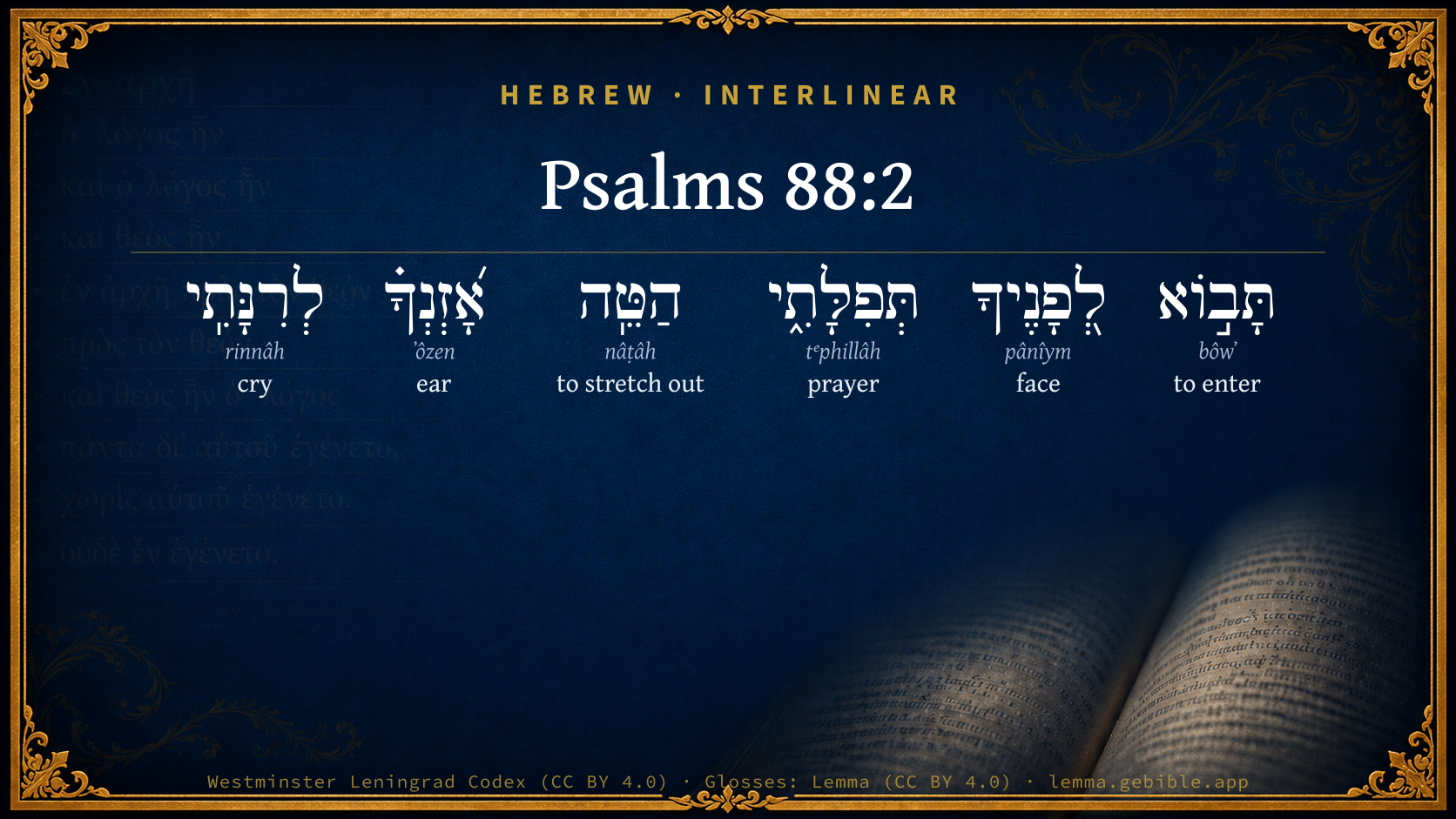
Hebrew (Westminster Leningrad Codex) Psalms 88:2 appears in the Hebrew Old Testament. The text above is from the Westminster Leningrad Codex. Each word links to its Strong’s number, a concise gloss, and parsing drawn from the Open Scriptures Hebrew Bible morphology. Click any word for its full Brown-Driver-Briggs (BDB) entry.
Download image
Cite this verse

Psalms 88:2 (World English Bible). Public Domain. Lemma interlinear Bible study tool, https://lemma.gebible.app/v/psalms/88/2.

Show BibTeX & RIS
BibTeX
RIS
English Translation
Let my prayer enter into your presence. Turn your ear to my cry.
World English Bible · Public Domain
Download a study sheet

One document with this verse’s original text, its word-by-word gloss line, the meaning frame, cross-references with their text, attributed commentary, and full source and license credits — printable, and it pastes into notes with its structure intact.

This verse Autodidact and up

Study sheet (.html) Plain text (.txt)

A passage Seminary Student

Up to 50 verses in one chapter. A passage sheet keeps up to 6 commentary sources and 12 cross-references per verse, in the order this page ranks them, and says so on the sheet whenever that leaves anything out. Ask for a single verse and you get the Autodidact verse sheet above.

Everything on this page stays free to read, with no account — the sheet is a download of what is already on screen, not access to it.

Want to remove ads? Support Godless Engineer
Compare translations 3

The same verse in 3 English versions, stacked beneath the original-language interlinear above. Click any original word for its lexicon entry.

Each is an independent rendering of the whole verse — the interlinear is not word-aligned to these translations.

Highlighted words mark where these versions differ — a whole-verse word diff, not a word-by-word alignment.

  • World English Bible Public Domain
    Let my prayer enter into your presence. Turn your ear to my cry.
  • King James Version Public Domain
    Let my prayer come before thee: incline thine ear unto my cry;
  • unfoldingWord Literal Text CC BY-SA 4.0
    Let my prayer come to your face; incline your ear to my cry.

unfoldingWord Literal Text — © unfoldingWord, licensed CC BY-SA 4.0. Word-aligned USFM3 via Door43 (git.door43.org/unfoldingWord/en_ult).

Versions to compare (up to 4)

3 of 4 selected

Show all 18 translations

Every available English version of this verse, each an independent rendering of the whole verse.

  • World English Bible Public Domain
    Let my prayer enter into your presence. Turn your ear to my cry.
  • Berean Standard Bible Public Domain
    May my prayer come before You; incline Your ear to my cry.
  • Majority Standard Bible Public Domain
    May my prayer come before You; incline Your ear to my cry.
  • King James Version Public Domain
    Let my prayer come before thee: incline thine ear unto my cry;
  • American Standard Version (1901) Public Domain
    Let my prayer enter into thy presence; Incline thine ear unto my cry.
  • Revised Version (1885) Public Domain
    Let my prayer enter into thy presence; incline thine ear unto my cry:
  • Geneva Bible (1599) Public Domain
    Let my prayer enter into thy presence: incline thine eare vnto my cry.
  • Douay-Rheims (1899) Public Domain
    O Lord, the God of my salvation: I have cried in the day, and in the night before thee.
  • Young's Literal Translation Public Domain
    My prayer cometh in before Thee, Incline Thine ear to my loud cry,
  • Literal Standard Version CC BY-SA 4.0
    My prayer comes in before You, || Incline Your ear to my loud cry,
  • Unlocked Literal Bible CC BY-SA 4.0
    Listen to my prayer; pay attention to my cry.
  • unfoldingWord Literal Text CC BY-SA 4.0
    Let my prayer come to your face; incline your ear to my cry.
  • Darby Bible Public Domain
    Let my prayer come before thee; incline thine ear unto my cry.
  • World Messianic Bible Public Domain
    Let my prayer enter into your presence. Turn your ear to my cry.
  • Webster's Bible Public Domain
    \\88:1\\A Song or Psalm for the sons of Korah, to the chief Musician upon Mahalath Leannoth, Maschil of Heman the Ezrahite. O LORD God of my salvation, I have cried day and night before thee:
  • Free Bible Version CC BY-SA 4.0
    Please listen to my prayer; hear my words as I plead with you.
  • Bible in Basic English Public Domain
    Let my prayer come before you; give ear to my cry:
  • JPS Tanakh (1917) Public Domain
    (88-3) Let my prayer come before Thee, incline Thine ear unto my cry.

Literal Standard Version (2020), Covenant Press — licensed CC BY-SA 4.0. Text via the HelloAO Bible API (eBible.org). Unlocked Literal Bible (unfoldingWord) — licensed CC BY-SA 4.0. Text via the HelloAO Bible API (eBible.org). unfoldingWord Literal Text — © unfoldingWord, licensed CC BY-SA 4.0. Word-aligned USFM3 via Door43 (git.door43.org/unfoldingWord/en_ult). Free Bible Version, Dr. Jonathan Gallagher — licensed CC BY-SA 4.0. Text via the HelloAO Bible API (eBible.org).

Word by word

More ways to search: Search by grammar → Find every occurrence → Compare this word →

Practice this passage: Drill this verse → Learn its vocabulary →

לְרִנָּתִֽי
rinnâh
H7440
“to/for · cry · my”
Preposition + Noun, Common, Feminine, Singular, Construct + Suffix, Personal, 1st Person, Common, Singular
Part of Speech
Preposition + Noun
Type
Common
Gender
Feminine
Number
Singular
State
Construct
Full BDB Definition

Origin: from H7442

TWOT: 2179c

ringing cry - of entreaty, supplication - in proclamation, joy, praise
  1. תָּב֣וֹא bôwʼ H935 “to enter” Verb, Qal, Imperfect, 3rd Person, Feminine, Singular
  2. לְ֭פָנֶיךָ pânîym H6440 “to/for · face(s) · your” Preposition + Noun, Common, Both, Plural, Construct + Suffix, Personal, 2nd Person, Masculine, Singular
  3. תְּפִלָּתִ֑י tᵉphillâh H8605 “prayer · my” Noun, Common, Feminine, Singular, Construct + Suffix, Personal, 1st Person, Common, Singular
  4. הַטֵּֽה nâṭâh H5186 “stretch out” Verb, Hiphil, Imperative, 2nd Person, Masculine, Singular
  5. אָ֝זְנְךָ֗ ʼôzen H241 “ear · your” Noun, Common, Feminine, Singular, Construct + Suffix, Personal, 2nd Person, Masculine, Singular

About this verse

These counts appear in no published source. They are computed here, from the morphology-tagged text and Lemma’s own curated glosses. What Lemma adds →

6
words
6
distinct lemmas
Wisdom
section

Shared distinctive vocabulary

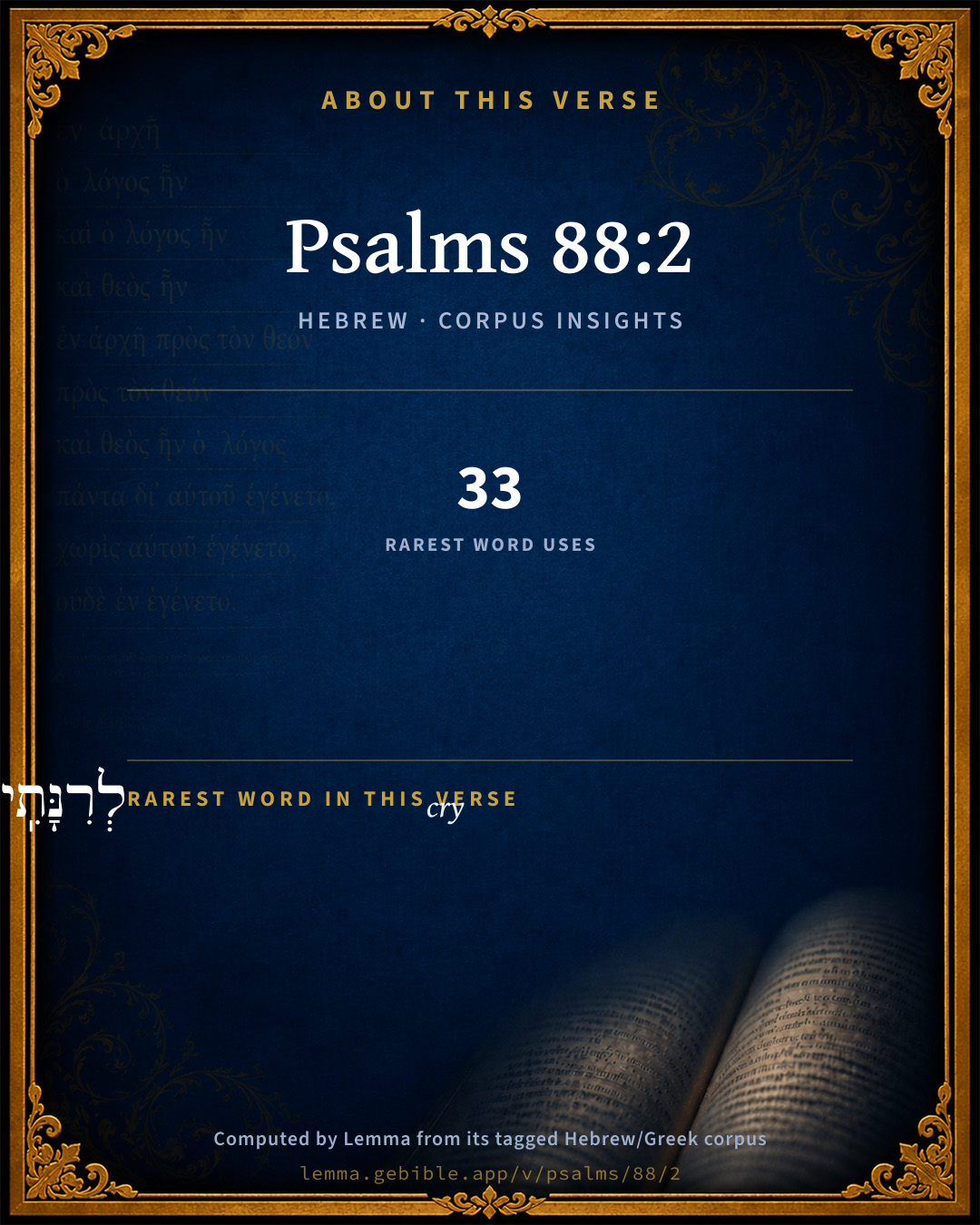
לְרִנָּתִֽי cry H7440 occurs in 33 verses of the Hebrew Bible. Also found in:

Grammatical profile

  • 2 verbs
  • 4 nouns

Verb forms

  • תָּב֣וֹא Qal · Imperfect
  • הַטֵּֽה Hiphil · Imperative

Hebrew & Septuagint length

In English translation the verse runs 13 words from the Hebrew and 15 from the Septuagint (LXX English) — closely comparable.

A rough comparison of the two English renderings, which tokenize alike — not a word-level alignment.

Word counts can differ between the Hebrew and the Greek without any difference in meaning — e.g. the Hebrew direct-object marker אֵת has no separate Greek word, and Greek often adds the article ὁ.

Cross-references

5

Topical passages linked to Psalms 88:2 in the Treasury of Scripture Knowledge — connected by theme and wording, ordered by reader-vote popularity; previews shown in the World English Bible.

  • Psalms 31:2 Bow down your ear to me. Deliver me speedily. Be to me a strong rock, A house of defense to save me.
  • Psalms 141:1–2 Yahweh, I have called on you. Come to me quickly! Listen to my voice when I call to you.
  • Lamentations 3:8 Yes, when I cry, and call for help, he shuts out my prayer.
  • Psalms 79:11 Let the sighing of the prisoner come before you. According to the greatness of your power, preserve those who are sentenced to death;
  • 1 Kings 8:31 If a man sin against his neighbor, and an oath be laid on him to cause him to swear, and he come [and] swear before your altar in this house;

Cross-references courtesy of OpenBible.info (CC BY 4.0).

Hebrew and Greek witnesses Masoretic Hebrew ↔ Greek Septuagint

The same verse in the two great witnesses to the Old Testament, shown verse-for-verse.

You’re reading Greek Psalm 87 (Hebrew Psalm 88). The Septuagint counts the superscription, so verse numbers can differ from the Hebrew — chapter-level alignment, not verse-by-verse. Numbering follows Rahlfs.

These are two independent witnesses, not word-aligned to each other, and the Septuagint is shown in lemma (dictionary) form.

Hebrew Psalms 88:2 Masoretic · Westminster Leningrad Codex

תָּב֣וֹא לְ֭פָנֶיךָ תְּפִלָּתִ֑י הַטֵּֽה אָ֝זְנְךָ֗ לְרִנָּתִֽי

Let my prayer enter into your presence. Turn your ear to my cry.

World English Bible · Public Domain

Greek LXX Greek Psalm 87:2 Septuagint · lemma form

κύριος ὁ θεός ὁ σωτηρία ἐγώ ἡμέρα κράζω καί ἐν νύξ ἐναντίον σύ

Let my prayer come in before you; incline your ear to my supplication, O Lord.

LXX2012 (modern English Septuagint) · Public Domain

Hebrew: Westminster Leningrad Codex (CC BY 4.0). Greek: Septuagint (public domain); English from LXX2012 (modern English Septuagint) (Public Domain). How the Septuagint differs from the Hebrew →

Commentary

Notes on Psalms 88:2 from classic Christian and Jewish commentators (each source and its license shown beneath its notes). The classic Christian expositions comment on the surrounding passage and are grouped to its opening verse, so a note may address several verses; the Jewish commentaries on the Tanakh (Rashi and others) are per-verse, so they appear only where the commentator wrote on this verse.

Lemma curates 59 commentaries, every one of them public domain or Creative Commons licensed, each selected and text-cleaned for this edition rather than reprinted as found. About our sources →

Trapp's Complete Commentary

John Trapp

Psa 88:2 Let my prayer come before thee: incline thine ear unto my cry;

Ver. 2. Let my prayer come before thee] He did not cast out brutish and wild complaints and moans in misery, as it is natural for people to do, but poured forth his soul into God’s blessed bosom, and now prayeth an answer.

John Trapp, A Commentary or Exposition upon All the Books of the Old and New Testament (1647–1656) — public domain. Text from a community e-Sword module.

J. A. Alexander on Psalms

Joseph Addison Alexander

3. (Psa 88:2) Let my prayer come before thee; incline thine ear unto my cry. The first petition is that his prayer may attract the divine attention, which is varied in the last clause by the figure of one bending down to catch a faint or distant cry. See above, on Psa 17:6; Psa 31:2; Psa 71:2.

Joseph Addison Alexander, The Psalms Translated and Explained (1850) — public domain. Text from a community e-Sword module.

Adam Clarke's Commentary

Verse 2. Let my prayer come before thee] It is weak and helpless, though fervent and sincere: take all hinderances out of its way, and let it have a free passage to thy throne. One of the finest thoughts in the Iliad of Homer concerns prayer; I shall transcribe a principal part of this incomparable passage-incomparable when we consider its origin: -

Και γαρ τε Λιται εισι Διος κουραι μεγαλοιο,

Χωλαι τε, ῥυσσαι τε, παραβλωπες τ' οφθαλμω·

Αἱ ῥα τε και μετοπισθ' Ατης αλεγουσι κιουσαι·

Ἡ δ' Ατη σθεναρη τε και αρτιπος· οὑνεκα πασας

Πολλον ὑπεκπροθεει, φθανει δε τε πασαν επ' αιαν,

Βλαπτους' ανθρωπους· αἱ δ' εξακεονται ποισσω·

Ὁς μεν τ' αιδεσεται κουρας Διος, ασσον ιουσας,

Τονδε μεγ' ωνησαν, και τ' εκλυον ευξαμενοιο.

Ὁς δε κ' ανῃνηται, και τε στερεως αποειπῃ,

Λισσονται δ' αρα ταιγε Δια Κρονιωνα κιουσαι,

Τῳ Ατην ἁμ' ἑπεσθαι, ἱνα βλαφθεις αποτιση.

Αλλ', Αχιλευ, πορε και συ Διος κουρησιν ἑπεσθαι

Τιμην, ῃτ' αλλων περ επιγναμπτει φρενας εσθλων.

Iliad., ix. 498-510.

Prayers are Jove's daughters; wrinkled, lame, slant-eyed,

Which, though far distant, yet with constant pace

Follow offence. Offence, robust of limb,

And treading firm the ground, outstrips them all,

And over all the earth, before them runs

Hurtful to man: they, following, heal the hurt.

Received respectfully when they approach,

They yield us aid, and listen when we pray.

But if we slight, and with obdurate heart

Resist them, to Saturnian Jove they cry.

Against, us supplicating, that offence

May cleave to us for vengeance of the wrong.

Thou, therefore, O Achilles! honour yield

To Jove's own daughters, vanquished as the brave

Have ofttimes been, by honour paid to thee.

COWPER.

On this allegory the translator makes the following remarks: "Wrinkled, because the countenance of a man, driven to prayer by a consciousness of guilt, is sorrowful and dejected. Lame, because it is a remedy to which men recur late, and with reluctance. Slant-eyed, either because in that state of humiliation they fear to lift up their eyes to heaven, or are employed in taking a retrospect of their past misconduct. The whole allegory, considering when and where it was composed, forms a very striking passage."

Prayer to God for mercy must have the qualifications marked above. Prayer comes from God. He desires to save us: this desire is impressed on our hearts by his Spirit, and reflected back to himself. Thus says the allegory, "Prayers are the daughters of Jupiter." But they are lame, as reflected light is much less intense and vivid than light direct. The desire of the heart is afraid to go into the presence of God, because the man knows, feels, that he has sinned against goodness and mercy. They are wrinkled-dried up and withered, with incessant longing: even the tears that refresh the soul are dried up and exhausted. They are slant-eyed; look aside through shame and confusion; dare not look God in the face. But transgression is strong, bold, impudent, and destructive: it treads with a firm step over the earth, bringing down curses on mankind. Prayer and repentance follow, but generally at a distance. The heart, being hardened by the deceitfulness of sin does not speedily relent. They, however, follow: and when, with humility and contrition, they approach the throne of grace, they are respectfully received. God acknowledges them as his offspring, and heals the wounds made by transgression. If the heart remain obdurate, and the man will not humble himself before his God, then his transgression cleaves to him, and the heartless, lifeless prayers which he may offer in that state, presuming on God's mercy, will turn against him; and to such a one the sacrificial death and mediation of Christ are in vain. And this will be the case especially with the person who, having received an offence from another, refuses to forgive. This latter circumstance is that to which the poet particularly refers. See the whole passage, with its context.

Adam Clarke's Commentary on the Bible (1810–1826) — public domain. Text from a community e-Sword/MySword module.

The Cambridge Bible for Schools and Colleges

gen. ed. J. J. S. Perowne

2. come before thee] Enter into thy presence (R.V. from P.B.V.). Cp. Psa_18:6; Psa_79:11.

my prayer … my cry] Cp. Psa_17:1; Psa_61:1. The word for ‘cry’ denotes a shrill piercing cry, frequently of joy, but sometimes, as here, of supplication, “expressive of emotional excitement such as an Eastern scruples not to use in prayer” (Cheyne).

The Cambridge Bible for Schools and Colleges (gen. ed. J. J. S. Perowne; Cambridge University Press, 1878–1918) — public domain. Text from a community e-Sword module.

John Gill's Exposition

Let my prayer come before thee,.... Not before men, as hypocrites desire, but before the Lord; let it not be shut out, but be admitted; and let it come with acceptance, as it does when it ascends before God, out of the hands of the angel before the throne, perfumed with the much incense of his mediation, Rev 8:3,

incline thine ear unto my cry; hearken to it, receive it, and give an answer to it; Christ's prayers were attended with strong crying, and were always received and heard, Heb 5:7.

John Gill's Exposition of the Whole Bible (1746–1763) — public domain (CC PDM 1.0). Text via the HelloAO Bible API.

Albert Barnes' Notes on the Bible

Let my prayer come before thee - As if there were something which hindered it, or which had obstructed the way to the throne of grace; as if God repelled it from him, and turned away his ear, and would not hear.

Incline thine ear unto my cry - See the notes at Psa 5:1.

Albert Barnes' Notes on the Bible (1834–1885) — public domain. Text from a community e-Sword/MySword module.

The Treasury of David

Charles H. Spurgeon

Ver. 2. Let my prayer come before thee. Admit it to an audience; let it speak with thee. Though it be my prayer, and therefore very imperfect, yet deny it not thy gracious consideration.

Incline thine ear unto my cry. It is not music save to the ear of mercy, yet be not vexed with its discord, though it be but a cry, for it is the most natural expression of my soul's anguish. When my heart speaks, let thine ear hear. There may be obstacles which impede the upward flight of our prayerslet us entreat the Lord to remove them; and as there may also be offences which prevent the Lord from giving favourable regard to our requestslet us implore him to put these out of the way. He who has prayed day and night cannot bear to lose all his labour. Only those who are indifferent in prayer will be indifferent about the issue of prayer.

Ver. 2. Incline thine ear, etc. It is necessary that God should incline his ear unto our prayer, else it would be in vain to come before Him. The prodigal did not venture to present his prayer before the father ran and fell upon his neck and kissed him. For then he said, Lu 15:21, "Father, I have sinned against heaven, and in thy sight", etc...and so he obtained mercy. Esther did not present her prayer to Ahasuerus before he descended from his throne and inclined himself to her. Es 5:2, etc. Le Blanc.

Ver. 2. Prayer as an ambassador.

1. An audience sought, or the benefit of access.

2. Attention entreated, or the blessing of success.

3. The Process explained, or prayer comes and God inclines.

Psalms 88:3*

Charles H. Spurgeon's The Treasury of David (1869–1885) — public domain. Psalms only. Text from a community e-Sword/MySword module.

Whedon's Commentary on the Bible

Daniel D. Whedon

2. Let my prayer come before thee—My prayer shall come before thee. The future tense and declarative form of the verb indicate faith and purpose in the suppliant to seek help only and continually in God.

Daniel D. Whedon (gen. ed.), Commentary on the Old and New Testaments (1874–1909) — public domain. Text from a community e-Sword module.

The Pulpit Commentary

Let my prayer come before thee: incline thine ear unto my cry. (comp. Psa_86:1, Psa_86:6)

The fear that prayer will not be answered.

With what historical conditions may we fairly associate and illustrate this psalm? Suggest Uzziah smitten with leprosy. Jeremiah cast into the dungeon. Hezekiah humbled by sickness. Job crushed by accumulated sufferings. Probably the case of Job provides the most effective and varied illustration. When it pleases God to delay the answer, or to send the answer in unexpected forms, it is our common temptation to think that he does not mean to answer. The plaint of the psalmist is that he "had cried unto God day and night," and nothing seemed to have come of his crying. Happily this only drives him the more earnestly to seek an answer. "Oh let my prayer come into thy presence!" Spurgeon says, "His distress had not blown out the sparks of his prayer, but quickened them into a greater ardency, till they burned perpetually, like a furnace at full blast.

I FEAR THAT PRAYER WILL NOT BE ANSWERED MAY BE REASONABLE. There may be good ground for the fear in the character of the prayer itself.

1. Its tone may indicate that we are not greatly interested in it ourselves. We cannot expect God to be if we are not.

2. The prayer may have in it no note of submission. God cannot heed prayer that does not express the cherished feeling, "Not as I will, but as thou wilt." Delay often means God"s waiting until we are in right moods.

3. There may be in prayer a dictating to God the time and the way in which he shall answer. If so, and his delay excites fears, those fears are most reasonable.

II FEAR THAT PRAYER WILL NOT BE ANSWERED MAY BE UNREASONABLE. That is God"s ways with us, though somewhat strange, may really give no occasion for such fears.

1. Delay is not refusal. We know that our delay in responding to requests is not refusal, and we are grieved if it is so taken. But in our case, too often, delayed answer means neglect, which may be more cruel than refusal. It is full of gracious assurance that, with God, delay no more means neglect than it means refusal.

2. Delay may be answer. At least, it may be if we can see that the moral answers God sends are always more important than the material. Delay sets us upon thought, self-searching, clearing of ourselves, and makes us at once simpler minded and more earnest; and that is God"s first soul answer to our prayer.

3. Delay prepares for answer. It may be God"s time for looking round, so that the answer may be a better one than he could have sent at once.

III FEAR THAT PRAYER WILL NOT BE ANSWERED MAY BE UNWORTHY. It will be if in it there is any cherished doubt of God"s power, or wisdom, or willingness to bless us. R.T.

The Pulpit Commentary (1880–1919), ed. H.D.M. Spence-Jones & Joseph S. Exell — public domain. Text from a community e-Sword module.

Rashi

Rabbi Shlomo Yitzchaki (Rashi)

I cried by day; at night And also at night I am ready before You.

Rashi on the Tanakh — English translations: “The Judaica Press complete Tanach with Rashi, translated by A. J. Rosenberg” (CC BY 4.0); “Pentateuch with Rashi's commentary by M. Rosenbaum and A.M. Silbermann, 1929-1934” (public domain); “The Metsudah Tanach series, Lakewood, N.J” (CC BY 4.0); and “The Book of Joshua, Metsudah Publications, 1997” (CC BY 4.0). Text via Sefaria.

Lesson kit

Teaching starters — assembled from the data on this page, not authored interpretation. Every prompt links to the verse data it draws on. Edit before teaching.

Psalms, in the Wisdom, opens this verse with 6 words (6 distinct Hebrew lemmas). Its most distinctive word is rinnâh (“cry”). A historical commentator’s framing appears above. Read the whole chapter for the surrounding context.

Discussion questions

  1. How does “cry” (rinnâh) shape what this verse is saying?
  2. 1 Kings 8:28 shares the word «cry» with this verse. How do the two illuminate each other?
  3. These translations render this verse differently; the difference is in the English rendering, not the original. What questions does that raise?
  4. The verb «תָּב֣וֹא» is Qal Imperfect. How does its form color the action?
  5. Reading how Trapp's Complete Commentary and J. A. Alexander on Psalms read this verse, where do the two commentators agree and where do they part?

Things to notice

Reading settings

Reading text

Shown beneath each verse's original-language words.

Old Testament
Old Testament edition

Read the OT as the Masoretic Hebrew (MT) or the Greek Septuagint (LXX).

English shown for the Greek Septuagint (in the Hebrew ↔ Greek comparison).

Comparing translations? Open the Compare panel on any verse page to stack up to four side by side.