Isaiah 10:4

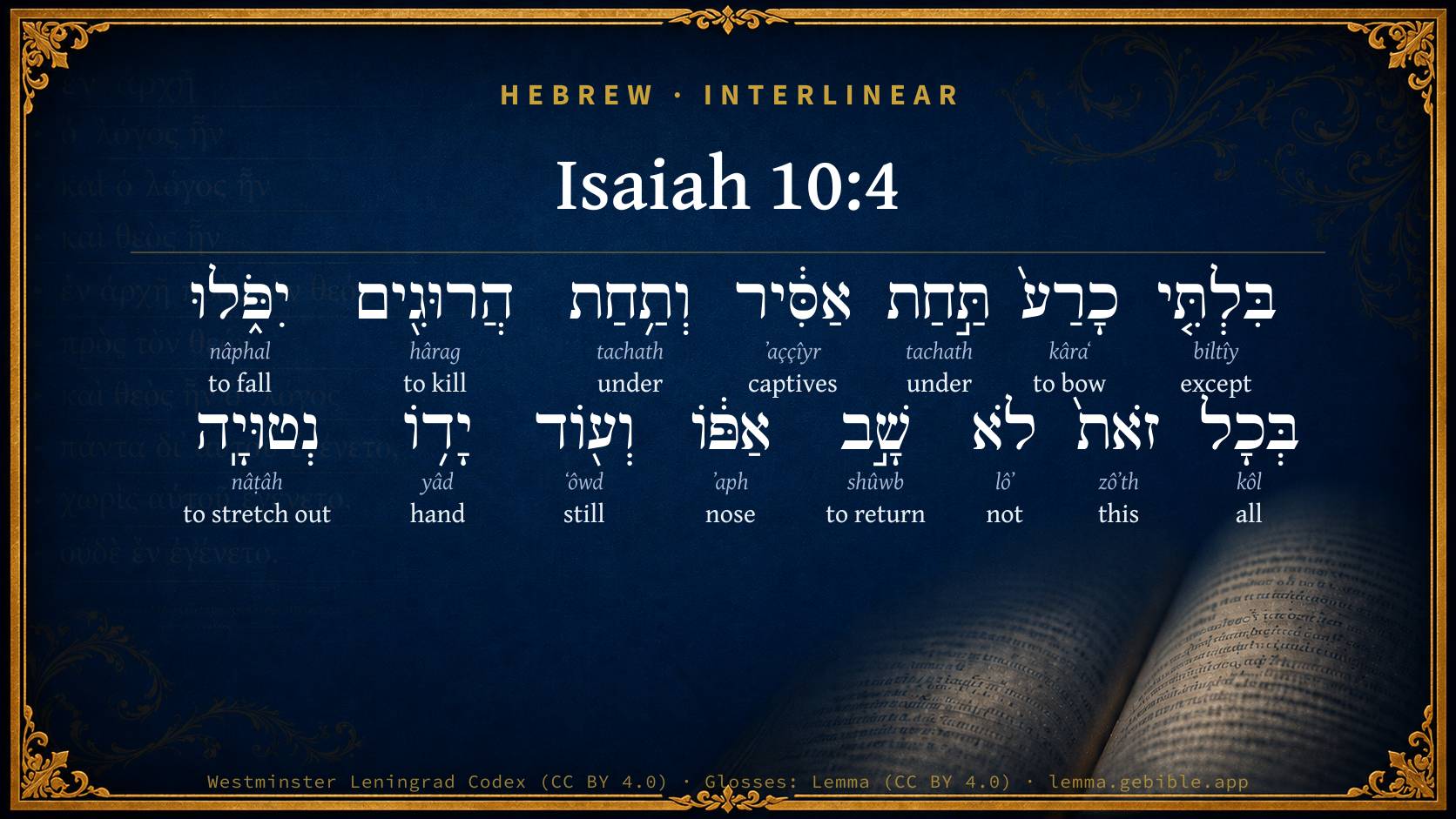
Hebrew (Westminster Leningrad Codex) Isaiah 10:4 appears in the Hebrew Old Testament. The text above is from the Westminster Leningrad Codex. Each word links to its Strong’s number, a concise gloss, and parsing drawn from the Open Scriptures Hebrew Bible morphology. Click any word for its full Brown-Driver-Briggs (BDB) entry.
Download image
Cite this verse

Isaiah 10:4 (World English Bible). Public Domain. Lemma interlinear Bible study tool, https://lemma.gebible.app/v/isaiah/10/4.

Show BibTeX & RIS
BibTeX
RIS
English Translation
They shall only bow down under the prisoners, and shall fall under the slain. For all this his anger is not turned away, but his hand is stretched out still.
World English Bible · Public Domain
Download a study sheet

One document with this verse’s original text, its word-by-word gloss line, the meaning frame, cross-references with their text, attributed commentary, and full source and license credits — printable, and it pastes into notes with its structure intact.

This verse Autodidact and up

Study sheet (.html) Plain text (.txt)

A passage Seminary Student

Up to 50 verses in one chapter. A passage sheet keeps up to 6 commentary sources and 12 cross-references per verse, in the order this page ranks them, and says so on the sheet whenever that leaves anything out. Ask for a single verse and you get the Autodidact verse sheet above.

Everything on this page stays free to read, with no account — the sheet is a download of what is already on screen, not access to it.

Want to remove ads? Support Godless Engineer
Compare translations 3

The same verse in 3 English versions, stacked beneath the original-language interlinear above. Click any original word for its lexicon entry.

Each is an independent rendering of the whole verse — the interlinear is not word-aligned to these translations.

Highlighted words mark where these versions differ — a whole-verse word diff, not a word-by-word alignment.

  • World English Bible Public Domain
    They shall only bow down under the prisoners, and shall fall under the slain. For all this his anger is not turned away, but his hand is stretched out still.
  • King James Version Public Domain
    Without me they shall bow down under the prisoners, and they shall fall under the slain. For all this his anger is not turned away, but his hand is stretched out still.
  • unfoldingWord Literal Text CC BY-SA 4.0
    One will only bow down with the prisoner, and they will fall among the slain. q1 In all of this, his nose has not turned back, and his hand still stretched out. q1

unfoldingWord Literal Text — © unfoldingWord, licensed CC BY-SA 4.0. Word-aligned USFM3 via Door43 (git.door43.org/unfoldingWord/en_ult).

Versions to compare (up to 4)

3 of 4 selected

Show all 18 translations

Every available English version of this verse, each an independent rendering of the whole verse.

  • World English Bible Public Domain
    They shall only bow down under the prisoners, and shall fall under the slain. For all this his anger is not turned away, but his hand is stretched out still.
  • Berean Standard Bible Public Domain
    Nothing will remain but to crouch among the captives or fall among the slain. Despite all this, His anger is not turned away; His hand is still upraised.
  • Majority Standard Bible Public Domain
    Nothing will remain but to crouch among the captives or fall among the slain. Despite all this, His anger is not turned away; His hand is still upraised.
  • King James Version Public Domain
    Without me they shall bow down under the prisoners, and they shall fall under the slain. For all this his anger is not turned away, but his hand is stretched out still.
  • American Standard Version (1901) Public Domain
    They shall only bow down under the prisoners, and shall fall under the slain. For all this his anger is not turned away, but his hand is stretched out still.
  • Revised Version (1885) Public Domain
    They shall only bow down under the prisoners, and shall fall under the slain. For all this his anger is not turned away, but his hand is stretched out still.
  • Geneva Bible (1599) Public Domain
    Without me euery one shall fall among them that are bound, and they shall fall downe among the slayne: yet for all this his wrath is not turned away, but his hand is stretched out still.
  • Douay-Rheims (1899) Public Domain
    That you be not bowed down under the bond, and fall with the slain? In all these things his anger is not turned away, but his hand is stretched out still.
  • Young's Literal Translation Public Domain
    Without Me it hath bowed down In the place of a bound one, And in the place of the slain they fall. With all this not turned back hath His anger, And still His hand is stretched out.
  • Literal Standard Version CC BY-SA 4.0
    It has bowed down without Me || In the place of a bound one, || And they fall in the place of the slain.” With all this His anger has not turned back, || And His hand is still stretched out.
  • Unlocked Literal Bible CC BY-SA 4.0
    Nothing remains, and you crouch among the prisoners or fall among the killed. In all these things, his anger does not subside; instead, his hand is still stretched out.
  • unfoldingWord Literal Text CC BY-SA 4.0
    One will only bow down with the prisoner, and they will fall among the slain. q1 In all of this, his nose has not turned back, and his hand still stretched out. q1
  • Darby Bible Public Domain
    They can but crouch under the prisoners, and they shall fall under the slain. For all this his anger is not turned away, and his hand is stretched out still.
  • World Messianic Bible Public Domain
    They will only bow down under the prisoners, and will fall under the slain. For all this his anger is not turned away, but his hand is stretched out still.
  • Webster's Bible Public Domain
    Without me they shall bow down under the prisoners, and they shall fall under the slain. For all this his anger is not turned away, but his hand is stretched out still.
  • Free Bible Version CC BY-SA 4.0
    All you'll be able to do is to bow down as prisoners, or lie among the dead! In all of this he is still angry and his hand is still raised.
  • Bible in Basic English Public Domain
    ... For all this his wrath is not turned away, but his hand is stretched out still.
  • JPS Tanakh (1917) Public Domain
    They can do nought except crouch under the captives, and fall under the slain. For all this His anger is not turned away, but His hand is stretched out still.

Literal Standard Version (2020), Covenant Press — licensed CC BY-SA 4.0. Text via the HelloAO Bible API (eBible.org). Unlocked Literal Bible (unfoldingWord) — licensed CC BY-SA 4.0. Text via the HelloAO Bible API (eBible.org). unfoldingWord Literal Text — © unfoldingWord, licensed CC BY-SA 4.0. Word-aligned USFM3 via Door43 (git.door43.org/unfoldingWord/en_ult). Free Bible Version, Dr. Jonathan Gallagher — licensed CC BY-SA 4.0. Text via the HelloAO Bible API (eBible.org).

Word by word

More ways to search: Search by grammar → Find every occurrence → Compare this word →

Practice this passage: Drill this verse → Learn its vocabulary →

אַסִּ֔יר
ʼaççîyr
H616
“captives”
Noun, Common, Masculine, Singular, Absolute
Part of Speech
Noun
Type
Common
Gender
Masculine
Number
Singular
State
Absolute
Full BDB Definition

Origin: for H615

TWOT: 141c

prisoners (collective) - (CLBL) prisoner, captive
  1. בִּלְתִּ֤י biltîy H1115 “except” Conjunction
  2. כָרַע֙ kâraʻ H3766 “to bow” Verb, Qal, Perfect, 3rd Person, Masculine, Singular
  3. תַּ֣חַת tachath H8478 “under” Preposition
  4. וְתַ֥חַת tachath H8478 “and · under” Conjunction + Preposition
  5. הֲרוּגִ֖ים hârag H2026 “killed” Verb, Qal, Participle Passive, Masculine, Plural, Absolute
  6. יִפֹּ֑לוּ nâphal H5307 “to fall” Verb, Qal, Imperfect, 3rd Person, Masculine, Plural
  7. בְּכָל kôl H3605 “in/at · all of” Preposition + Noun, Common, Masculine, Singular, Construct
  8. זֹאת֙ zôʼth H2063 “this” Pronoun, Demonstrative, Feminine, Singular
  9. לֹא lôʼ H3808 “not” Particle, Negative
  10. שָׁ֣ב shûwb H7725 “to return” Verb, Qal, Perfect, 3rd Person, Masculine, Singular
  11. אַפּ֔וֹ ʼaph H639 “nose · his” Noun, Common, Masculine, Singular, Construct + Suffix, Personal, 3rd Person, Masculine, Singular
  12. וְע֖וֹד ʻôwd H5750 “and · still” Conjunction + Adverb
  13. יָד֥וֹ yâd H3027 “hand · his” Noun, Common, Both, Singular, Construct + Suffix, Personal, 3rd Person, Masculine, Singular
  14. נְטוּיָֽה nâṭâh H5186 “stretched out” Verb, Qal, Participle Passive, Feminine, Singular, Absolute

About this verse

These counts appear in no published source. They are computed here, from the morphology-tagged text and Lemma’s own curated glosses. What Lemma adds →

15
words
14
distinct lemmas
Prophets
section

Notable vocabulary

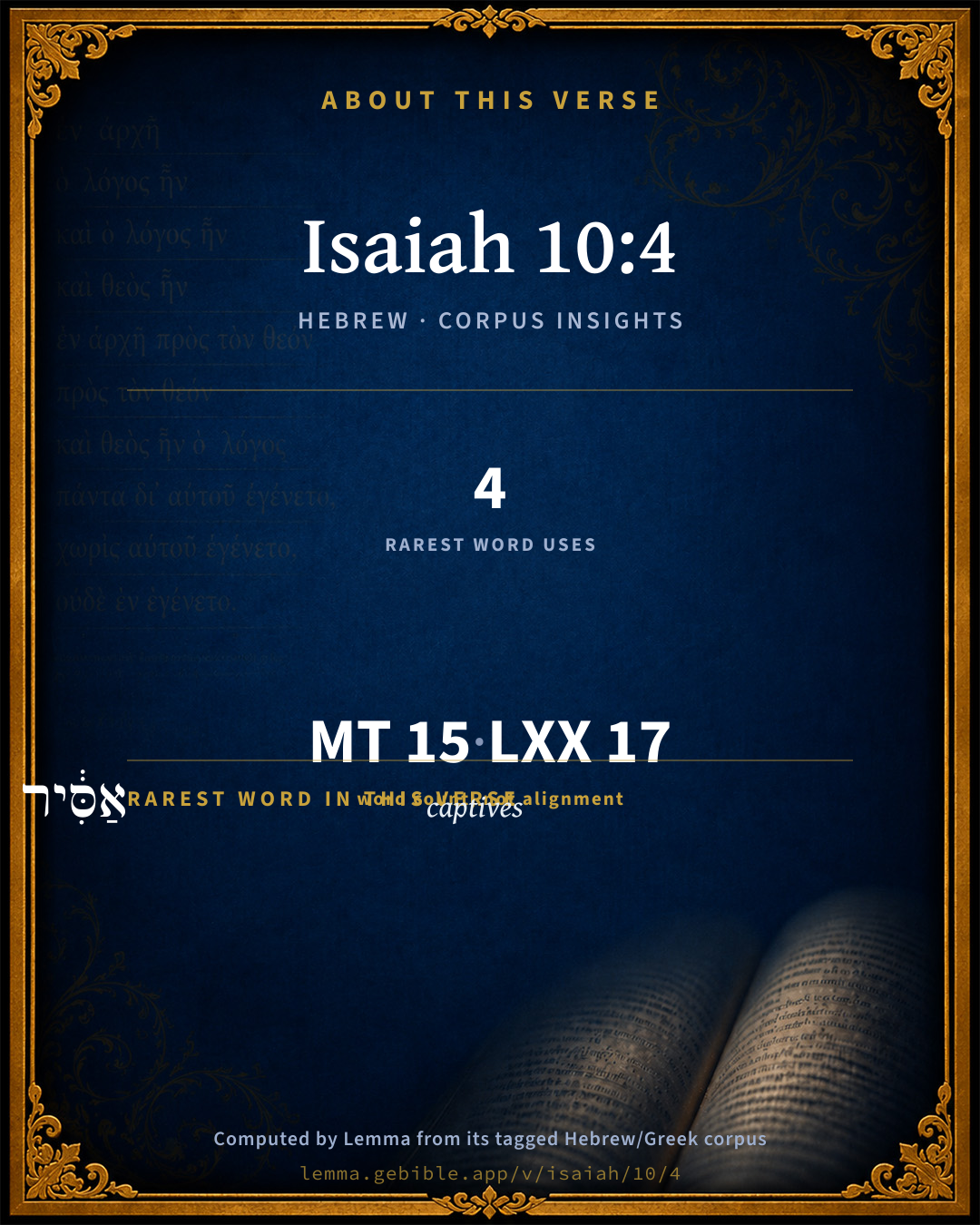
The rarest word here is אַסִּ֔יר captives H616 — appearing just 4 times in the whole Hebrew Bible.

Shared distinctive vocabulary

אַסִּ֔יר captives H616 occurs in 4 verses of the Hebrew Bible. Also found in:

Grammatical profile

  • 5 verbs
  • 4 nouns
  • 1 pronoun
  • 2 prepositions
  • 1 conjunction
  • 1 adverb
  • 1 particle

Verb forms

  • כָרַע֙ Qal · Perfect
  • הֲרוּגִ֖ים Qal · Participle Passive
  • יִפֹּ֑לוּ Qal · Imperfect
  • שָׁ֣ב Qal · Perfect
  • נְטוּיָֽה Qal · Participle Passive

Repetition

A word recurs within this verse — often emphatic in Hebrew:

  • תַּ֣חַת under H8478 ×2

Hebrew & Septuagint length

In English translation the verse runs 30 words from the Hebrew and 22 from the Septuagint (LXX English) — closely comparable.

A rough comparison of the two English renderings, which tokenize alike — not a word-level alignment.

Word counts can differ between the Hebrew and the Greek without any difference in meaning — e.g. the Hebrew direct-object marker אֵת has no separate Greek word, and Greek often adds the article ὁ.

In the original languages it is 15 Hebrew tokens and 17 Greek tokens — but the two are counted differently (Hebrew bundles its prefixes and suffixes into one token; the Greek is in lemma form), so that isn’t a like-for-like length.

Cross-references

14

Topical passages linked to Isaiah 10:4 in the Treasury of Scripture Knowledge — connected by theme and wording, ordered by reader-vote popularity; previews shown in the World English Bible.

  • Isaiah 5:25 Therefore Yahweh's anger burns against his people, And he has stretched out his hand against them, and has struck them. The mountains tremble, And their dead bodies are as refuse in the midst of the streets. For all this, his anger is not turned away, But his hand is still stretched out.
  • Deuteronomy 32:30 How should one chase a thousand, Two put ten thousand to flight, Except their Rock had sold them, Yahweh had delivered them up?
  • Isaiah 9:12 the Syrians before, and the Philistines behind; and they shall devour Israel with open mouth. For all this his anger is not turned away, but his hand is stretched out still.
  • Jeremiah 37:10 For though you had struck the whole army of the Chaldeans who fight against you, and there remained but wounded men among them, yes would they rise up every man in his tent, and burn this city with fire.
  • Leviticus 26:17 I will set my face against you, and you will be struck before your enemies. Those who hate you will rule over you; and you will flee when no one pursues you.
  • Leviticus 26:36–37 "'As for those of you who are left, I will send a faintness into their hearts in the lands of their enemies: and the sound of a driven leaf will put them to flight; and they shall flee, as one flees from the sword; and they will fall when no one pursues.
  • Deuteronomy 31:15–18 Yahweh appeared in the Tent in a pillar of cloud: and the pillar of cloud stood over the door of the Tent.
  • Isaiah 9:17 Therefore the Lord will not rejoice over their young men, neither will he have compassion on their fatherless and widows; for everyone is profane and an evil-doer, and every mouth speaks folly. For all this his anger is not turned away, but his hand is stretched out still.
  • Isaiah 9:21 Manasseh, Ephraim; and Ephraim, Manasseh; and they together shall be against Judah. For all this his anger is not turned away, but his hand is stretched out still.
  • Isaiah 22:2 You that are full of shouting, a tumultuous city, a joyous town; your slain are not slain with the sword, neither are they dead in battle.
  • Isaiah 24:22 They shall be gathered together, as prisoners are gathered in the pit, and shall be shut up in the prison; and after many days shall they be visited.
  • Isaiah 34:3 Their slain also shall be cast out, and the stench of their dead bodies shall come up; and the mountains shall be melted with their blood.
  • Isaiah 66:16 For by fire will Yahweh execute judgment, and by his sword, on all flesh; and the slain of Yahweh shall be many.
  • Hosea 9:12 Though they bring up their children, Yet I will bereave them, so that not a man shall be left. Indeed, woe also to them when I depart from them!

Cross-references courtesy of OpenBible.info (CC BY 4.0).

Hebrew and Greek witnesses Masoretic Hebrew ↔ Greek Septuagint

The same verse in the two great witnesses to the Old Testament, shown verse-for-verse.

These are two independent witnesses, not word-aligned to each other, and the Septuagint is shown in lemma (dictionary) form.

Hebrew Isaiah 10:4 Masoretic · Westminster Leningrad Codex

בִּלְתִּ֤י כָרַע֙ תַּ֣חַת אַסִּ֔יר וְתַ֥חַת הֲרוּגִ֖ים יִפֹּ֑לוּ בְּכָל זֹאת֙ לֹא שָׁ֣ב אַפּ֔וֹ וְע֖וֹד יָד֥וֹ נְטוּיָֽה

They shall only bow down under the prisoners, and shall fall under the slain. For all this his anger is not turned away, but his hand is stretched out still.

World English Bible · Public Domain

Greek LXX Isaiah 10:4 Septuagint · lemma form

ὁ μή ἐνπίπτω εἰς ἐπαγωγή ἐπί πᾶς οὗτος οὐ ἀποστρέφω ὁ θυμός ἀλλά ἔτι ὁ χείρ ὑψηλός

that you⌃ may not fall into captivity? For all this his wrath is not turned away, but his hand is yet exalted.

LXX2012 (modern English Septuagint) · Public Domain

On this verse, Albert Barnes' Notes on the Bible discusses the Septuagint’s reading. Read the note in Commentary ↓

Hebrew: Westminster Leningrad Codex (CC BY 4.0). Greek: Septuagint (public domain); English from LXX2012 (modern English Septuagint) (Public Domain). How the Septuagint differs from the Hebrew →

Targum (Aramaic paraphrase)

1

The Targum is the ancient Jewish Aramaic paraphrase of the Hebrew Scriptures — an interpretive translation, not the Hebrew text itself. Onkelos (literal) and Pseudo-Jonathan (expansive) render the Torah, and Jonathan the Prophets. Coverage is partial: where no permissively-licensed English translation exists for a verse, only the Aramaic is shown. This is verse-level text, not a word-by-word alignment to the Hebrew.

  1. Targum Jonathan Prophets (Joshua–Malachi)
    בְּכֵן בַּר מִן אַרְעֲכוֹן אֲסִירִין תִּתְאַסְרוּן וּבַר מִקִרְוֵיכוֹן קְטִילִין תִּתְרְמוּן בְּכָל דָא לָא תָבוּ מֵחוֹבֵיהוֹן דִיתוּב רוּגְזֵיהּ מִנְהוֹן וְעַד כְּעַן מַתְקְפִין מָרְדֵיהוֹן וְעוֹד מָחָתֵיהּ עֲתִידָא לְאִתְפְּרָע מִנְהוֹן:

    Therefore out of your land ye shall be fettered amongst the captives; and out of your cities ye shall be cast out slain. For all this they do not turn away from their sins, that His anger might turn away from them; but still they hold fast their rebellion, and yet His stroke will be to take vengeance on them.

    Targum Jonathan — Aramaic: “Mikraot Gedolot” (public domain). English: “Sefaria Community Translation” (CC0 1.0 (public-domain dedication)); “London "Chaldee Paraphrase," 1871” (public domain). Text via Sefaria.

Commentary

Notes on Isaiah 10:4 from classic Christian and Jewish commentators (each source and its license shown beneath its notes). The classic Christian expositions comment on the surrounding passage and are grouped to its opening verse, so a note may address several verses; the Jewish commentaries on the Tanakh (Rashi and others) are per-verse, so they appear only where the commentator wrote on this verse.

Lemma curates 59 commentaries, every one of them public domain or Creative Commons licensed, each selected and text-cleaned for this edition rather than reprinted as found. About our sources →

Trapp's Complete Commentary

John Trapp

Isa 10:4 Without me they shall bow down under the prisoners, and they shall fall under the slain. For all this his anger is not turned away, but his hand [is] stretched out still.

Ver. 4. Without me they shall bow down under the prisoners,] i.e., Without any fault of mine. {Hos 13:9} Or, as some render it, Ne corruat inter vinctos, et inter occisos cadant; that it, your glory, should not bow down under the prisoners, and they fall under the slain; i.e., that ye be not some of you captivated, and others slain by the enemy. And yet behold a worse matter.

For all this his anger is not turned away.] Endless torments will follow, unless ye prevent them by repentance, and all your present sufferings are nothing else but a typical hell. {a} Ecce quot mala a contemptu Dei proveniunt.

{a} Hac oratione vir sanctus impios crueatat, et vulaerat. - Osor.

John Trapp, A Commentary or Exposition upon All the Books of the Old and New Testament (1647–1656) — public domain. Text from a community e-Sword module.

Geneva Bible (1599)

Geneva Bible translators

Because they have forsaken me, some shall go into captivity, and the rest shall be slain.

Geneva Bible (1599) marginal notes — public domain. Text via Bolls.life.

Jamieson, Fausset & Brown

Robert Jamieson, A. R. Fausset & David Brown

Without me--not having Me to "flee to" (Isa 10:3).

bow down--Bereft of strength they shall fall; or else, they shall lie down fettered.

under . . . under--rather, "among" (literally, "in the place of") [HORSLEY]. The "under" may be, however, explained, "trodden under the (feet of the) prisoners going into captivity," and "overwhelmed under the heaps of slain on the battlefield" [MAURER].

Jamieson, Fausset & Brown — Commentary Critical and Explanatory on the Whole Bible (1871) — public domain (CC PDM 1.0). Text via the HelloAO Bible API.

Adam Clarke's Commentary

Verse 4. Without me] That is, without my aid: they shall be taken captive even by the captives, and shall be subdued even by the vanquished. "The י yod in בלתי bilti is a pronoun, as in Ho 13:4." - Kimchi on the place. One MS. has לבלתי lebilti.

As the people had hitherto lived without God in worship and obedience; so they should now be without his help, and should perish in their transgressions.

Adam Clarke's Commentary on the Bible (1810–1826) — public domain. Text from a community e-Sword/MySword module.

Ellicott's Commentary for English Readers

(4) Without me they shall bow down . . .—The Hebrew text is obscure, but these words were probably intended as the answer to the taunting question that had preceded them. Dropping the direct address, and passing to the third person, the prophet seems to say as with a kind of ominous “aside,” “No, there is no ally, no hiding-place but this, except they bow down among the captives or fall among the slain.” Exile or death, that was their only alternative. When that sentence has been uttered, the doom-bell, as we have called it, “For all this . . .” tolls once more. If we adopt the Authorised version we have the same fact asserted, with the suggested thought that there was a refuge to be found in God.

A Bible Commentary for English Readers, edited by Charles John Ellicott (1878–1897) — public domain. Text from a community e-Sword module.

The Cambridge Bible for Schools and Colleges

gen. ed. J. J. S. Perowne

4. Without me … slain] This clause is very difficult. The easiest explanation perhaps is to take it as the answer to the questions of Isa_10:3 : (they can do nothing) except crouch under the captives and fall under the slain. Another is “Except one (here and there) crouch among captives, they must fell under the slain.” Objections to both occur readily enough to anyone who reads the Hebrew, especially the abrupt changes from singular to plural. An ingenious conjecture of Lagarde’s gives the sense “Beltis crouches, Osiris is broken (חַת אֹסִיר כֵּלְתִּי כֹּרַעַת cf. Isa_46:1; Jer_50:2), they fall, &c.”; i.e. the heathen gods shall be unable to give protection to their votaries. But there is no evidence that Egyptian deities (Osiris) were worshipped in Israel in Isaiah’s time; and in any case their sudden introduction here would be surprising.

his hand is stretched out still] See on ch. Isa_5:25 ff.

The Cambridge Bible for Schools and Colleges (gen. ed. J. J. S. Perowne; Cambridge University Press, 1878–1918) — public domain. Text from a community e-Sword module.

John Gill's Exposition

Without me they shall bow down under the prisoners, and they shall fall under the slain,.... That is, either, being forsaken by me, and destitute of my help, they shall bow down; or, "because they are without me", are not my people, and do not hearken to me, therefore they shall bow down, so David Kimchi; or, were it not for me, they would, as others; or that they might not bow down and fall; and so the words may be connected with the preceding verse Isa 10:3, others render the word, translated "without me, besides"; and the sense is either, as Moses Kimchi, besides their bowing in their own land, when subdued by the Gentiles, a greater affliction shall befall them, captivity; when they should be either carried captive or slain; or besides him that shall bow down under the prisoners, they shall fall under the slain; besides those that are taken, others shall be killed; or none shall escape, but, or "except", him that bows, and hides himself under the prisoners, or in the place of the slain, that he might not be thought to be alive: or the sense is, the desolation shall be so general, that none shall escape, either they shall be taken prisoners, or they shall be slain; agreeably to which Noldius (i) renders the words, "without me", everyone "shall bow down among the prisoners, or shall fall among the slain"; which gives the best sense of them; that, being left of God for their sins, they would either be bound and carried captive, or else slain with the sword, and one or the other would be the lot of everyone of them:

for all this his anger is not turned away, but his hand is stretched out still; the final and utter destruction of the nation of the Jews being then not yet come, when carried captive to Babylon, there remained a greater calamity for them, to come by the hands of the Romans. These first four verses Isa 10:1 seem more properly to belong to the preceding chapter Isa 9:1, and this should begin with the next verse Isa 10:5.

(i) Ebr. Concord. Part. p. 201, 771.

John Gill's Exposition of the Whole Bible (1746–1763) — public domain (CC PDM 1.0). Text via the HelloAO Bible API.

Albert Barnes' Notes on the Bible

Without me - בלתי biltı̂y. There has been a great variety of interpretation affixed to this expression. The sense in which our translators understood it was, evidently, that they should be forsaken of God; and that, as the effect of this, they should bow down under the condition of captives, or among the slain. The Vulgate and the Septuagint, however. and many interpreters understand the word bore as a simple negative. ‘Where will you flee for refuge? Where will you deposit your wealth so as not to bow down under a chain?’ Vulgate, Ne incurvemini sub vinculo. Septuagint, Τοῦ μὴ ἐμπεσεῖν εἰς ἀπαγωνήν tou mē empesein eis apagōnēn - ‘Not to fall into captivity.’ The Hebrew will bear either mode of construction. Vitringa and Lowth understand it as our translators have done, as meaning that God would forsake them, and that without him, that is, deprived of his aid, they would be destroyed.

They shall bow down - They shall be subdued, as armies are that are taken captive.

Under the prisoners - That is, under the “condition” of prisoners; or as prisoner. Some understand it to mean, that they should bear down “in the place of prisoners;” that is, in prison, But it evidently means, simply, that they should be captives.

They shall fall under the slain - They shall be slain. Gesenius renders it, “‘Among the prisoners, and “among” the slain.’” The Chaldee reads it, ‘You shall be east into chains out of your own land, and beyond your own cities you shall be cast out slain.’ Vitringa supposes that the prophet, in this verse, refers to the custom, among the ancients, of placing prisoners in war under a yoke of wood to indicate their captivity. That such a custom obtained, there can be no doubt; but it is not probable that Isaiah refers to it here. The simple idea is, that many of them should be taken captive, and many of them slain. This prediction was fulfilled in the invasion of Tiglath-pileser; 2 Kings 15; 16.

For all this - Notwithstanding these calamities. The cup of punishment is not filled by these, but the divine judgment shall still be poured out further upon the nation. The anger of God shall not be fully expressed by these minor inflictions of his wrath, but his hand shall continue to be stretched out until the whole nation shall be overwhelmed and ruined; see the note at Isa 10:12.

Albert Barnes' Notes on the Bible (1834–1885) — public domain. Text from a community e-Sword/MySword module.

Matthew Poole's English Annotations

Without me they shall bow down: the words thus translated seem to contain an answer to the foregoing questions: In vain do you seek for a refuge and help from others; for without me, without my favour and help which you have forfeited, and do not seek to recover, and which I shall withdraw from you, or because you are without me, or forsaken by me,

you shall bow down, notwithstanding all your succours. In the Hebrew here is a change of the person and number, which is very usual in prophetical writings. The LXX., and some others, join these words to the foregoing verse, and translate them thus, that you may not bow down: so the sense of the place is, What will you do to prevent your captivity or slaughter? And it is true, that the first word is elsewhere taken for a negative particle. But the former translation seems more genuine.

Under the prisoners; or rather, in the place (as this particle signifies, and is rendered by interpreters, Gen 30:2; 50:19; Exo 16:29; Jos 5:8, and elsewhere) of the prisoners, or among the prisoners; and so in the next clause, among or in the place of the slain.

Matthew Poole's English Annotations on the Holy Bible (1683–1685) — public domain. Text from a community e-Sword/MySword module.

Whedon's Commentary on the Bible

Daniel D. Whedon

4. Without me — Apart from my help. The moral is, Leave all else, and flee to me. There is no other door to safety.

They shall bow down — Sinking for very shame and self-reproach lower than other captives, or even to lie beneath the slain in war. The refrain is again chanted, and the series of strophes pointing to the captivity of Israel closes. But black as the prophecy is for Israel, it becomes blacker for Assyria, its foe and captor, in the next piece recited by Isaiah. However dark the shades settle on Israel — God’s own chosen but erring ones — somehow they retire, measurably in virtue of a better few still preserved among them.

Daniel D. Whedon (gen. ed.), Commentary on the Old and New Testaments (1874–1909) — public domain. Text from a community e-Sword module.

The Pulpit Commentary

Without me. That this is a possible rendering of the word used seems proved by Hos_13:4. But here it scarcely suits the context. God does not speak directly, in the first person, elsewhere in the entire prophecy, (Isa_9:8-21; Isa_10:1-4) but is spoken of in the third person throughout, as even in the present verse, where we have "his anger," "his hand." It is better, therefore, to give the word its ordinary meaning "except." Have they anywhere to flee to, unless they shall crouch amid the captives that are being carried off, or fall amid the slain? In other words, there is no escape for them; they must either submit to captivity or death. For all this, etc. Even when the two kingdoms were destroyed, and the captivity of both was complete, God"s wrath was not fully appeased, his anger was not wholly turned away. Both peoples suffered grievous things in their captivity, as appears from the Book of Daniel (Isa 3:, Isa_3:6) and other places. It took seventy years for God"s anger to be appeased in the case of Judah, (2Ch_36:21) while in the case of Israel it was never appeased. Crushed beneath the iron heel of their conquerors, Israel ceased to exist as a nation.

The Pulpit Commentary (1880–1919), ed. H.D.M. Spence-Jones & Joseph S. Exell — public domain. Text from a community e-Sword module.

John Wesley's Explanatory Notes

Without me - Without my favour and help, which you have forfeited. Shall bow down - Notwithstanding all your succors.

John Wesley, Explanatory Notes Upon the Whole Bible (1754–1765) — public domain. Text via the GEBible commentary corpus.

J. A. Alexander on Isaiah

Joseph Addison Alexander

“It (your glory) does not bow beneath the prisoners, and (yet) they shall fall beneath the slain” (i.e., if they do not bow under the captives they shall fall under the slain), or, such of them as do not bow, etc. ‘Beneath’ may either be strictly understood as meaning under their feet, or simply among them. The most natural interpretation of this difficult and much disputed verse is that which explains it as a solemn declaration that their glory and especially their noble chiefs must either go into captivity or fall in battle. The concluding formula (for all this his wrath is not turned back and still his hand is stretched out) again suggests the fearful thought that all these accumulated judgments would be insufficient to arrest the progress of the sinner or appease the wrath of God.

Joseph Addison Alexander, The Prophecies of Isaiah (1846–1847; New York: Scribner, 1870–1878) — public domain. Text from a community e-Sword module.

Rashi

Rabbi Shlomo Yitzchaki (Rashi)

Where he never knelt In the place where none of you ever knelt or lay down, where there was no kneeling to lie down, in that place you shall be prisoners, i.e., to say, outside of your land you shall be imprisoned, and so did Jonathan render: Outside of your land you shall be bound as prisoners.

in that place Heb. תַּחַת, a place. Comp. (Exodus 16:29) “Let every man stay in his place (תַּחְתָּיו).”

and in that place they will fall slain Heb. וְתַחַתהֲרוּגִים יִפֹּלוּ, and in that place they will fall slain.

Rashi on the Tanakh — English translations: “The Judaica Press complete Tanach with Rashi, translated by A. J. Rosenberg” (CC BY 4.0); “Pentateuch with Rashi's commentary by M. Rosenbaum and A.M. Silbermann, 1929-1934” (public domain); “The Metsudah Tanach series, Lakewood, N.J” (CC BY 4.0); and “The Book of Joshua, Metsudah Publications, 1997” (CC BY 4.0). Text via Sefaria.

Ibn Ezra

Rabbi Abraham ibn Ezra

All this you have done. בלתי וגו׳ Except they bow down, etc. None will escape except those that will bow down amongst the captives, or throw themselves amongst the slain, as if they were slain with them.

Ibn Ezra on the Tanakh — English translations: “Sefaria Community Translation” (CC0 1.0 (public-domain dedication)); “Yalkut, Sifsei Chachomim Chumash, Metsudah Publications, 2009” (CC BY 4.0); and “Commentary of Ibn Ezra on Isaiah - trans. by M. Friedlander, 1873” (public domain). Text via Sefaria.

Lesson kit

Teaching starters — assembled from the data on this page, not authored interpretation. Every prompt links to the verse data it draws on. Edit before teaching.

Isaiah, in the Prophets, opens this verse with 15 words (14 distinct Hebrew lemmas). Its most distinctive word is ʼaççîyr (“captives”). A historical commentator’s framing appears above. Read the whole chapter for the surrounding context.

Discussion questions

  1. The word ʼaççîyr carries the sense “captives.” How does it shape the verse?
  2. Psalms 79:11 shares the word «captives» with this verse. How do the two illuminate each other?
  3. “under” occurs 2× in this one verse. What is the effect of the repetition?
  4. These translations render this verse differently. What is at stake in choosing one wording over another?
  5. The verb «כָרַע֙» is Qal Perfect. How does its form color the action?
  6. Reading how Trapp's Complete Commentary and Geneva Bible (1599) read this verse, where do the two commentators agree and where do they part?

Things to notice

Reading settings

Reading text

Shown beneath each verse's original-language words.

Old Testament
Old Testament edition

Read the OT as the Masoretic Hebrew (MT) or the Greek Septuagint (LXX).

English shown for the Greek Septuagint (in the Hebrew ↔ Greek comparison).

Comparing translations? Open the Compare panel on any verse page to stack up to four side by side.