Genesis 49:15

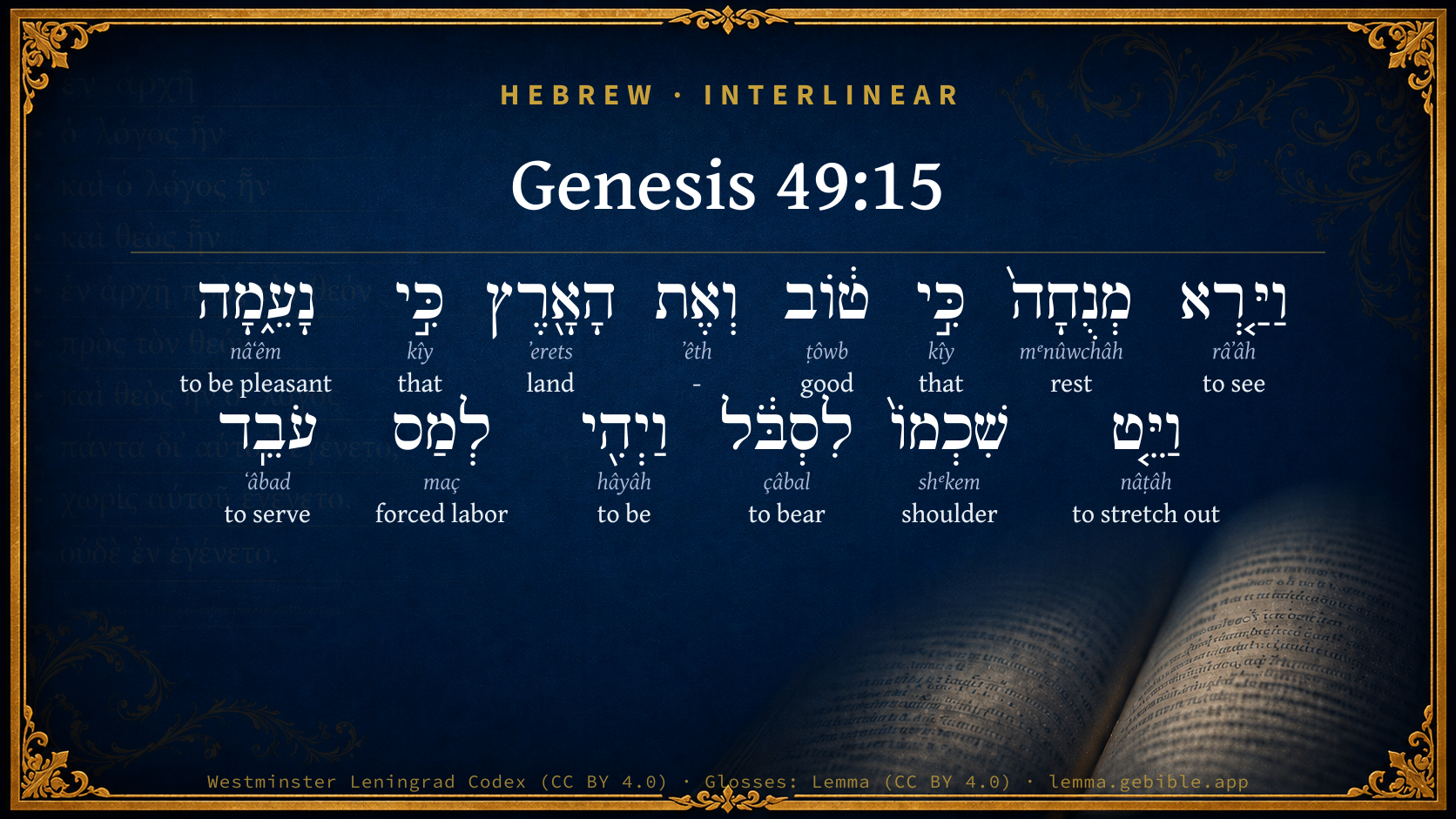
Hebrew (Westminster Leningrad Codex) Genesis 49:15 appears in the Hebrew Old Testament. The text above is from the Westminster Leningrad Codex. Each word links to its Strong’s number, a concise gloss, and parsing drawn from the Open Scriptures Hebrew Bible morphology. Click any word for its full Brown-Driver-Briggs (BDB) entry.
Download image
Cite this verse

Genesis 49:15 (World English Bible). Public Domain. Lemma interlinear Bible study tool, https://lemma.gebible.app/v/genesis/49/15.

Show BibTeX & RIS
BibTeX
RIS
English Translation
He saw a resting-place, that it was good, The land, that it was pleasant; He bows his shoulder to the burden, And becomes a servant doing forced labor.
World English Bible · Public Domain
Highlights
  • 4 first appearances in the Hebrew Bible
Full analysis ↓
Download a study sheet

One document with this verse’s original text, its word-by-word gloss line, the meaning frame, cross-references with their text, attributed commentary, and full source and license credits — printable, and it pastes into notes with its structure intact.

This verse Autodidact and up

Study sheet (.html) Plain text (.txt)

A passage Seminary Student

Up to 50 verses in one chapter. A passage sheet keeps up to 6 commentary sources and 12 cross-references per verse, in the order this page ranks them, and says so on the sheet whenever that leaves anything out. Ask for a single verse and you get the Autodidact verse sheet above.

Everything on this page stays free to read, with no account — the sheet is a download of what is already on screen, not access to it.

Want to remove ads? Support Godless Engineer
Compare translations 3

The same verse in 3 English versions, stacked beneath the original-language interlinear above. Click any original word for its lexicon entry.

Each is an independent rendering of the whole verse — the interlinear is not word-aligned to these translations.

Highlighted words mark where these versions differ — a whole-verse word diff, not a word-by-word alignment.

  • World English Bible Public Domain
    He saw a resting-place, that it was good, The land, that it was pleasant; He bows his shoulder to the burden, And becomes a servant doing forced labor.
  • King James Version Public Domain
    And he saw that rest was good, and the land that it was pleasant; and bowed his shoulder to bear, and became a servant unto tribute.
  • unfoldingWord Literal Text CC BY-SA 4.0
    And he sees resting place that good and the land that it is pleasant. Then he will bend his shoulder to bear, and he will be a forced labor servant. ts\*

unfoldingWord Literal Text — © unfoldingWord, licensed CC BY-SA 4.0. Word-aligned USFM3 via Door43 (git.door43.org/unfoldingWord/en_ult).

Versions to compare (up to 4)

3 of 4 selected

Show all 17 translations

Every available English version of this verse, each an independent rendering of the whole verse.

  • World English Bible Public Domain
    He saw a resting-place, that it was good, The land, that it was pleasant; He bows his shoulder to the burden, And becomes a servant doing forced labor.
  • Berean Standard Bible Public Domain
    He saw that his resting place was good and that his land was pleasant, so he bent his shoulder to the burden and submitted to labor as a servant.
  • Majority Standard Bible Public Domain
    He saw that his resting place was good and that his land was pleasant, so he bent his shoulder to the burden and submitted to labor as a servant.
  • King James Version Public Domain
    And he saw that rest was good, and the land that it was pleasant; and bowed his shoulder to bear, and became a servant unto tribute.
  • American Standard Version (1901) Public Domain
    And he saw a resting-place that it was good, And the land that it was pleasant; And he bowed his shoulder to bear, And became a servant under taskwork.
  • Revised Version (1885) Public Domain
    And he saw a resting place that it was good, And the land that it was pleasant; And he bowed his shoulder to bear, And became a servant under taskwork.
  • Geneva Bible (1599) Public Domain
    And he shall see that rest is good, and that the land is pleasant, and he shall bow his shoulder to beare, and shalbe subiect vnto tribute.
  • Young's Literal Translation Public Domain
    And he seeth rest that `it is' good, And the land that `it is' pleasant, And he inclineth his shoulder to bear, And is to tribute a servant.
  • Literal Standard Version CC BY-SA 4.0
    And he sees rest, that [it is] good, || And the land, that [it is] pleasant, || And he inclines his shoulder to bear, || And is a servant for tribute.
  • Unlocked Literal Bible CC BY-SA 4.0
    He sees a good resting place and the pleasant land. He will bend his shoulder to the burden and become a servant for the task.
  • unfoldingWord Literal Text CC BY-SA 4.0
    And he sees resting place that good and the land that it is pleasant. Then he will bend his shoulder to bear, and he will be a forced labor servant. ts\*
  • Darby Bible Public Domain
    And he saw the rest that it was good, And the land that it was pleasant; And he bowed his shoulder to bear, And was a tributary servant.
  • World Messianic Bible Public Domain
    He saw a resting place, that it was good, the land, that it was pleasant. He bows his shoulder to the burden, and becomes a servant doing forced labor.
  • Webster's Bible Public Domain
    And he saw that rest was good, and the land that it was pleasant; and bowed his shoulder to bear, and became a servant to tribute.
  • Free Bible Version CC BY-SA 4.0
    He sees that the place where he's resting is good, and the land is lovely, so he's willing to lower his back to accept the burden and to work as a slave.
  • Bible in Basic English Public Domain
    And he saw that rest was good and the land was pleasing; so he let them put weights on his back and became a servant.
  • JPS Tanakh (1917) Public Domain
    For he saw a resting-place that it was good, and the land that it was pleasant; and he bowed his shoulder to bear, and became a servant under task-work

Literal Standard Version (2020), Covenant Press — licensed CC BY-SA 4.0. Text via the HelloAO Bible API (eBible.org). Unlocked Literal Bible (unfoldingWord) — licensed CC BY-SA 4.0. Text via the HelloAO Bible API (eBible.org). unfoldingWord Literal Text — © unfoldingWord, licensed CC BY-SA 4.0. Word-aligned USFM3 via Door43 (git.door43.org/unfoldingWord/en_ult). Free Bible Version, Dr. Jonathan Gallagher — licensed CC BY-SA 4.0. Text via the HelloAO Bible API (eBible.org).

Word by word

More ways to search: Search by grammar → Find every occurrence → Compare this word →

Practice this passage: Drill this verse → Learn its vocabulary →

נָעֵ֑מָה
nâʻêm
H5276
“to be pleasant”
Verb, Qal, Perfect, 3rd Person, Feminine, Singular
Part of Speech
Verb
Stem
Qal
Form
Perfect
Person
3rd Person
Gender
Feminine
Number
Singular
Full BDB Definition

Origin: a primitive root

TWOT: 1384

(Qal) to be pleasant, be beautiful, be sweet, be delightful, be lovely
  1. וַיַּ֤רְא râʼâh H7200 “and · to see” Conjunction + Verb, Qal, Sequential Imperfect, 3rd Person, Masculine, Singular
  2. מְנֻחָה֙ mᵉnûwchâh H4496 “rest” Noun, Common, Both, Singular, Absolute
  3. כִּ֣י kîy H3588 “that” Conjunction
  4. ט֔וֹב ṭôwb H2896 “good” Adjective, Adjective, Masculine, Singular, Absolute
  5. וְאֶת ʼêth H853 “and · -” Conjunction + Particle, Direct Object
  6. הָאָ֖רֶץ ʼerets H776 “the · land” Particle, Definite Article + Noun, Common, Both, Singular, Absolute
  7. כִּ֣י kîy H3588 “that” Conjunction
  8. וַיֵּ֤ט nâṭâh H5186 “and · to stretch out” Conjunction + Verb, Qal, Sequential Imperfect, 3rd Person, Masculine, Singular
  9. שִׁכְמוֹ֙ shᵉkem H7926 “shoulder · his” Noun, Common, Masculine, Singular, Construct + Suffix, Personal, 3rd Person, Masculine, Singular
  10. לִסְבֹּ֔ל çâbal H5445 “to bear” Preposition + Verb, Qal, Infinitive Construct
  11. וַיְהִ֖י hâyâh H1961 “and · to be” Conjunction + Verb, Qal, Sequential Imperfect, 3rd Person, Masculine, Singular
  12. לְמַס maç H4522 “to/for · forced labor of” Preposition + Noun, Common, Masculine, Singular, Construct
  13. עֹבֵֽד ʻâbad H5647 “serving” Verb, Qal, Participle Active, Masculine, Singular, Absolute

About this verse

These counts appear in no published source. They are computed here, from the morphology-tagged text and Lemma’s own curated glosses. What Lemma adds →

14
words
13
distinct lemmas
Pentateuch
section

Notable vocabulary

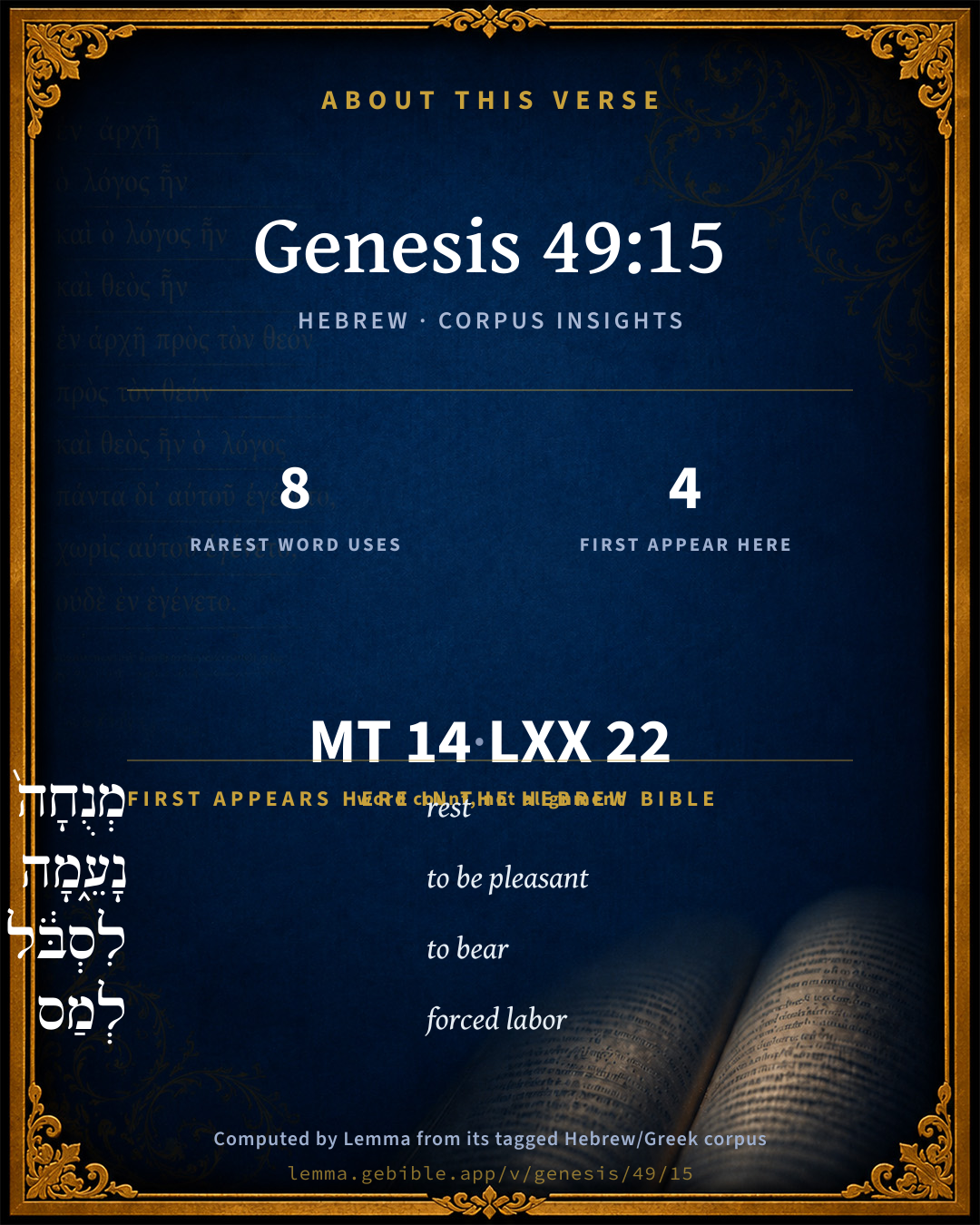
The rarest word here is נָעֵ֑מָה to be pleasant H5276 — appearing just 8 times in the whole Hebrew Bible.

First appearance in Scripture

These words make their first canonical appearance in the Hebrew Bible here:

  • מְנֻחָה֙ rest H4496
  • נָעֵ֑מָה to be pleasant H5276
  • לִסְבֹּ֔ל to bear H5445
  • לְמַס forced labor H4522

Shared distinctive vocabulary

נָעֵ֑מָה to be pleasant H5276 occurs in 8 verses of the Hebrew Bible. Also found in:

Grammatical profile

  • 6 verbs
  • 4 nouns
  • 1 adjective
  • 2 conjunctions
  • 1 particle

Verb forms

  • וַיַּ֤רְא Qal · Sequential Imperfect
  • נָעֵ֑מָה Qal · Perfect
  • וַיֵּ֤ט Qal · Sequential Imperfect
  • לִסְבֹּ֔ל Qal · Infinitive Construct
  • וַיְהִ֖י Qal · Sequential Imperfect
  • עֹבֵֽד Qal · Participle Active

Repetition

A word recurs within this verse — often emphatic in Hebrew:

  • כִּ֣י that H3588 ×2

Hebrew & Septuagint length

In English translation the verse runs 28 words from the Hebrew and 27 from the Septuagint (LXX English) — closely comparable.

A rough comparison of the two English renderings, which tokenize alike — not a word-level alignment.

Word counts can differ between the Hebrew and the Greek without any difference in meaning — e.g. the Hebrew direct-object marker אֵת has no separate Greek word, and Greek often adds the article ὁ.

In the original languages it is 14 Hebrew tokens and 22 Greek tokens — but the two are counted differently (Hebrew bundles its prefixes and suffixes into one token; the Greek is in lemma form), so that isn’t a like-for-like length.

Cross-references

6

Topical passages linked to Genesis 49:15 in the Treasury of Scripture Knowledge — connected by theme and wording, ordered by reader-vote popularity; previews shown in the World English Bible.

  • Joshua 14:15 Now the name of Hebron before was Kiriath Arba; [which Arba was] the greatest man among the Anakim. The land had rest from war.
  • Judges 3:11 The land had rest forty years. Othniel the son of Kenaz died.
  • 2 Samuel 7:1 It happened, when the king lived in his house, and Yahweh had given him rest from all his enemies round about,
  • Psalms 81:6 "I removed his shoulder from the burden. His hands were freed from the basket.
  • Ezekiel 29:18 Son of man, Nebuchadrezzar king of Babylon caused his army to serve a great service against Tyre: every head was made bald, and every shoulder was worn; yet had he no wages, nor his army, from Tyre, for the service that he had served against it.
  • Matthew 23:4 For they bind heavy burdens that are grievous to be borne, and lay them on men's shoulders; but they themselves will not lift a finger to help them.

Cross-references courtesy of OpenBible.info (CC BY 4.0).

Hebrew and Greek witnesses Masoretic Hebrew ↔ Greek Septuagint

The same verse in the two great witnesses to the Old Testament, shown verse-for-verse.

These are two independent witnesses, not word-aligned to each other, and the Septuagint is shown in lemma (dictionary) form.

Hebrew Genesis 49:15 Masoretic · Westminster Leningrad Codex

וַיַּ֤רְא מְנֻחָה֙ כִּ֣י ט֔וֹב וְאֶת הָאָ֖רֶץ כִּ֣י נָעֵ֑מָה וַיֵּ֤ט שִׁכְמוֹ֙ לִסְבֹּ֔ל וַיְהִ֖י לְמַס עֹבֵֽד

He saw a resting-place, that it was good, The land, that it was pleasant; He bows his shoulder to the burden, And becomes a servant doing forced labor.

World English Bible · Public Domain

Greek LXX Genesis 49:15 Septuagint · lemma form

καί ὁράω ὁ ἀνάπαυσις ὅτι καλός καί ὁ γῆ ὅτι πίων ὑποτίθημι ὁ ὦμος αὐτός εἰς ὁ πονέω καί γίγνομαι ἀνήρ γεωργός

And having seen the resting place that it was good, and the land that it was fertile, he subjected his shoulder to labor, and became a husbandman.

LXX2012 (modern English Septuagint) · Public Domain

On this verse, The Cambridge Bible for Schools and Colleges discusses the Septuagint’s reading. Read the note in Commentary ↓

Hebrew: Westminster Leningrad Codex (CC BY 4.0). Greek: Septuagint (public domain); English from LXX2012 (modern English Septuagint) (Public Domain). How the Septuagint differs from the Hebrew →

Targum (Aramaic paraphrase)

2

The Targum is the ancient Jewish Aramaic paraphrase of the Hebrew Scriptures — an interpretive translation, not the Hebrew text itself. Onkelos (literal) and Pseudo-Jonathan (expansive) render the Torah, and Jonathan the Prophets. Coverage is partial: where no permissively-licensed English translation exists for a verse, only the Aramaic is shown. This is verse-level text, not a word-by-word alignment to the Hebrew.

  1. Targum Onkelos Torah (Genesis–Deuteronomy)
    וַחֲזָא חוּלָקָא אֲרֵי טַב וְיָת אַרְעָא אֲרֵי מְעַבְּדָא פֵירִין וִיכַבֵּשׁ מָחוֹזֵי עַמְמַיָּא וִישֵׁיצֵי יָת דַּיָרֵיהוֹן וּדְאִשְׁתַּאֲרוּן בְּהוֹן יְהוֹן לֵהּ פַּלְחִין וּמַסְּקֵי מַסִּין

    (no public-domain English translation for this verse)

    Targum Onkelos — Aramaic: “Onkelos Genesis” (public domain); “Onkelos Exodus” (public domain); “Onkelos Leviticus” (public domain); “Onkelos Numbers” (public domain); “Onkelos Deuteronomy” (public domain). English: “Sefaria Community Translation” (CC0 1.0 (public-domain dedication)); “J.W. Etheridge. The Targums of Onkelos and Jonathan Ben Uzziel on the Pentateuch. London: Longmans, Green, 1862” (public domain). Text via Sefaria.

  2. Targum Pseudo-Jonathan Torah (Genesis–Deuteronomy)
    וַחֲמָא נַיְיחָא דְעַלְמָא דְאָתֵי אֲרוּם טָב וְחוּלְקָא דְאַרְעָא דְיִשְרָאֵל אֲרוּם בְּסִימָא הוּא בְגִין כֵּן אַרְכִין כַּתְפֵיהּ לְמִלְעֵי בְּאוֹרַיְיתָא וַהֲווֹ לֵיהּ אָחוֹי מַסְקֵי דוֹרוֹנִין

    And he saw the rest of the world to come that it is good, and the portion of the land of Israel that it is pleasant; therefore bowed he his shoulders to labour in the law, and unto him shall come his brethren bearing presents.

    Targum Pseudo-Jonathan — Aramaic: “Targum Jonathan on Genesis” (public domain); “Targum Jonathan on Exodus” (public domain); “Targum Jonathan on Leviticus” (public domain); “Targum Jonathan on Numbers” (public domain); “Targum Jonathan on Deuteronomy” (public domain). English: “The Targum of Jonathan ben Uzziel, trans. J. W. Etheridge, London, 1862” (public domain). Text via Sefaria.

Commentary

Notes on Genesis 49:15 from classic Christian and Jewish commentators (each source and its license shown beneath its notes). The classic Christian expositions comment on the surrounding passage and are grouped to its opening verse, so a note may address several verses; the Jewish commentaries on the Tanakh (Rashi and others) are per-verse, so they appear only where the commentator wrote on this verse.

Lemma curates 59 commentaries, every one of them public domain or Creative Commons licensed, each selected and text-cleaned for this edition rather than reprinted as found. About our sources →

Trapp's Complete Commentary

John Trapp

Gen 49:15 And he saw that rest [was] good, and the land that [it was] pleasant; and bowed his shoulder to bear, and became a servant unto tribute.

Ver. 15. And he saw that rest was good.] He submitted to any burdens and hard conditions for a quiet life. This was a low poor spirit; and his posterity were, for the general, very unworthy and vile. For Issachar’s lot fell in Galilee. {Jos 19:18, &c.} Now, doth "any good come out of Galilee?" The best that we read of them was that they "had understanding of the times, to know what Israel ought to do," {1Ch 12:32} and were therefore in great account with David. But for action, it seems they were heavy-spirited, dull-mettled men; much like those "potters," mentioned in 1Ch 4:23, "that dwelt among plants and hedges"; the base brood of their degenerated forefathers in Babylon. "He, he, come forth, and flee from the land of the north," said the Lord unto them. {Zec 2:6} Cyrus also had proclaimed liberty to all that would, to return to Jerusalem. But these dull drones, because they got a poor living by making pots for the king of Babylon, thought themselves well as they were, and chose rather to stay under the hedges of Babylon. These are res obsoletae, so Junius renders the text there; things worn out and forgotten; and indeed they deserve to be forgotten.

John Trapp, A Commentary or Exposition upon All the Books of the Old and New Testament (1647–1656) — public domain. Text from a community e-Sword module.

Adam Clarke's Commentary

Verse 15. He saw that rest] The inland portion that was assigned to him between the other tribes. He inclined his shoulder to the load; the Chaldee paraphrast gives this a widely different turn to that given it by most commentators: "He saw his portion that it was good, and the land that it was fruitful; and he shall subdue the provinces of the people, and drive out their inhabitants, and those who are left shall be his servants, and his tributaries." Grotius understands it nearly in the same way. The pusillanimity which is generally attributed to this tribe certainly does not agree with the view in which they are exhibited in Scripture. In the song of Deborah this tribe is praised for the powerful assistance which it then afforded, Jdg 5:15. And in 1Ch 7:1-5, they are expressly said to have been valiant men of might in all their families, and in all their generations; i. e., through every period of their history. It appears they were a laborious, hardy, valiant tribe, patient in labour and invincible in war; bearing both these burdens with great constancy whenever it was necessary. When Tola of this tribe judged Israel, the land had rest twenty-three years, Jud 10:1.

Adam Clarke's Commentary on the Bible (1810–1826) — public domain. Text from a community e-Sword/MySword module.

Ellicott's Commentary for English Readers

(15) A servant unto tribute.—Heb., task-work. It means service paid in actual labour, such as was exacted by Solomon of the descendants of the Canaanites (1Ki_9:21, where the phrase used here is translated “a tribute of bondservice;” and 2Ch_8:8). In the Middle Ages this forced labour—called” service without wages in Jer_22:13—was one of the wrongs most deeply felt by the peasantry, as they had to neglect their own plots of ground to labour for their seigneurs. The picture, then, is that of a race settled in a rich agricultural country, and content to endure a great deal of injustice because their condition as a whole was prosperous.

A Bible Commentary for English Readers, edited by Charles John Ellicott (1878–1897) — public domain. Text from a community e-Sword module.

The Cambridge Bible for Schools and Colleges

gen. ed. J. J. S. Perowne

15. a resting place] Better, as R.V. marg., rest. “Rest,” as opposed to the wandering life of nomads. Cf. Deu_12:9; Psa_95:11.

pleasant] Vulg. optima. LXX πίων = “fat,” possibly following a slightly different reading.

bowed his shoulder] Issachar was ready to kneel, and bear any heavy burden, for the sake of a quiet life in a fertile land.

a servant under taskwork] Cf. Jos_16:10, “became servants to do taskwork.” Issachar is reproached for being ready to undertake forced labour, and so to acknowledge the Canaanites as his overlords. The phrase is the regular one for becoming tributary; cf. Deu_20:11; Jdg_1:30; Isa_31:8. In all probability there is a play upon the name “Issachar” and its derivation in the sense of “a man of hire,” îsh and sâchar; cf. Gen_30:18. LXX, apparently seeking to mitigate the severity of the reproach, ἐγενήθη ἀνὴρ γεωργός = “became a labourer.” Targ. Onk. “he will subdue the provinces of the peoples, destroy their inhabitants, and those who are left among them shall be servants unto him and bringers of tribute.”

The Cambridge Bible for Schools and Colleges (gen. ed. J. J. S. Perowne; Cambridge University Press, 1878–1918) — public domain. Text from a community e-Sword module.

John Gill's Exposition

And he saw that rest was good,.... Not the house of the sanctuary, and attendance there, and the service of that, as the Targum of Jerusalem; nor the rest of the world to come, the happiness of a future state, as that of Jonathan; but rather, as Onkelos, the part and portion of the good land allotted him; he saw that a quiet industry exercised in a diligent cultivation and manuring his land was preferable to the hurry of a court, or the fatigue of a camp, or the dangers of the seas:

and the land that it was pleasant; a fine delightful country, which, if well looked after and improved, would produce plenty of pleasant fruits; and within this tribe were the rich vale of Esdraelon or Jezreel, and the fruitful mountains of Gilboa: of the former it is agreed by all travellers the like has never been seen by them, being of vast extent and very fertile, and formerly abounded with corn, wine, and oil; See Gill on Hos 1:5 and the latter were famous for their fruitfulness, through the dews that descended on them, Sa2 1:21.

and bowed his shoulders to bear; the fatigues of ploughing and sowing, and reaping, and carrying in the fruits of the earth:

and became a servant unto tribute; which greatly arises from agriculture and the fruits of the earth; and this tribe chose rather to pay more tribute than the rest, that they might abide at home and attend the business of their fields, when others were called to go forth to war.

John Gill's Exposition of the Whole Bible (1746–1763) — public domain (CC PDM 1.0). Text via the HelloAO Bible API.

Matthew Poole's English Annotations

Rest, or rather, his resting-place, as this very word signifies, Gen 8:9; Psa 116:7; 132:8; Isa 11:10, i.e. his portion or habitation, as the Chaldee and Syriac translate it. So this agrees with the following member, where, after the manner of the Hebrews, the same thing is repeated in other words. And if it be objected against this version, that it is not said his rest, but

rest in the general, it may be replied, that so it is in the following branch,

the land, though it be apparently meant of his land, or portion of land allotted to him. Besides, the pronouns are often omitted, and to be understood in Hebrew text; as may appear by comparing 1Ki 10:7, with 2Ch 9:6; and Psa 41:9, with Joh 13:18; and Mat 3:12, with Luk 3:17.

Became a servant unto tribute; willingly paying whatsoever tributes were imposed upon him, either by the neighbouring tribes, or by foreign powers, rather than to forfeit his pleasant and fruitful country, and his sweet repose.

Matthew Poole's English Annotations on the Holy Bible (1683–1685) — public domain. Text from a community e-Sword/MySword module.

Whedon's Commentary on the Bible

Daniel D. Whedon

15. Rest… good — His love of ease, and a pleasant territory, including the rich valley of Jezreel, led him to bear burdens, and to submit to tribute rather than to enter into any struggle for political eminence. For this reason, probably, Zebulun was placed before him. In the war against Sisera, he was a supporter of Barak, but no leader. He followed at the feet of his leader, as one obedient to orders. Jdg_5:15.

Daniel D. Whedon (gen. ed.), Commentary on the Old and New Testaments (1874–1909) — public domain. Text from a community e-Sword module.

Rashi

Rabbi Shlomo Yitzchaki (Rashi)

וירא מנחה כי טוב AND HE SAW THAT REPOSE WAS GOOD — He chose (ראה) as his portion a land that was blessed and well-fitted to produce fruits (cf. Onkelos; so that he need not engage overmuch in business.

ויט שכמו לסבול AND HE INCLINED THE SHOULDER TO RECEIVE THE BURDEN namely the burden of tracking the Torah.

ויהי AND BECAME unto all Israel his brethren.

למס עובד A SERVANT UNTO TRIBUTE — deciding for them points of Law and the rules with regard to the fixing of leap-years, as it is said (1 Chronicles 12:32) “And of the children of Issachar, men that had understanding of the times, to know what Israel ought to do; the heads of them were two hundred” — two hundred heads of the Sanhedrin he provided — “and all their brethren were at their commandment” (Genesis Rabbah 99:10).

ויט שכמו AND HE INCLINED HIS SHOULDER — he lowered his shoulder; similar are, (2 Samuel 22:10) “He bowed (ויט) the heavens” and (Psalms 78:1) “Incline (הטו) your ear”. Onkelos, however, explains it differently: HE BOWED HIS SHOULDER to wage wars and to conquer new districts — for he (Issachar) dwelt on the marches — AND the enemy BECAME subject to him AS A SERVANT TO PAY TRIBUTE.

Rashi on the Tanakh — English translations: “The Judaica Press complete Tanach with Rashi, translated by A. J. Rosenberg” (CC BY 4.0); “Pentateuch with Rashi's commentary by M. Rosenbaum and A.M. Silbermann, 1929-1934” (public domain); “The Metsudah Tanach series, Lakewood, N.J” (CC BY 4.0); and “The Book of Joshua, Metsudah Publications, 1997” (CC BY 4.0). Text via Sefaria.

Lesson kit

Teaching starters — assembled from the data on this page, not authored interpretation. Every prompt links to the verse data it draws on. Edit before teaching.

Genesis, in the Pentateuch, opens this verse with 14 words (13 distinct Hebrew lemmas). Its most distinctive word is nâʻêm (“to be pleasant”). A historical commentator’s framing appears above. Read the whole chapter for the surrounding context.

Discussion questions

  1. The word nâʻêm carries the sense “to be pleasant.” How does it shape the verse?
  2. 4 words make their first appearance in Scripture here. What does this debut establish?
  3. How does 2 Samuel 1:26, which shares the word «to be pleasant», read alongside this verse?
  4. What does the repetition of “that” (2× in this one verse) do in this verse?
  5. These translations render this verse differently. What is at stake in choosing one wording over another?
  6. «וַיַּ֤רְא» is a Qal Sequential Imperfect verb. How does that grammatical form shape the action described?
  7. Compare how Trapp's Complete Commentary and Adam Clarke's Commentary read this verse. Where do they agree or differ?

Things to notice

Reading settings

Reading text

Shown beneath each verse's original-language words.

Old Testament
Old Testament edition

Read the OT as the Masoretic Hebrew (MT) or the Greek Septuagint (LXX).

English shown for the Greek Septuagint (in the Hebrew ↔ Greek comparison).

Comparing translations? Open the Compare panel on any verse page to stack up to four side by side.