
Exodus 8:17

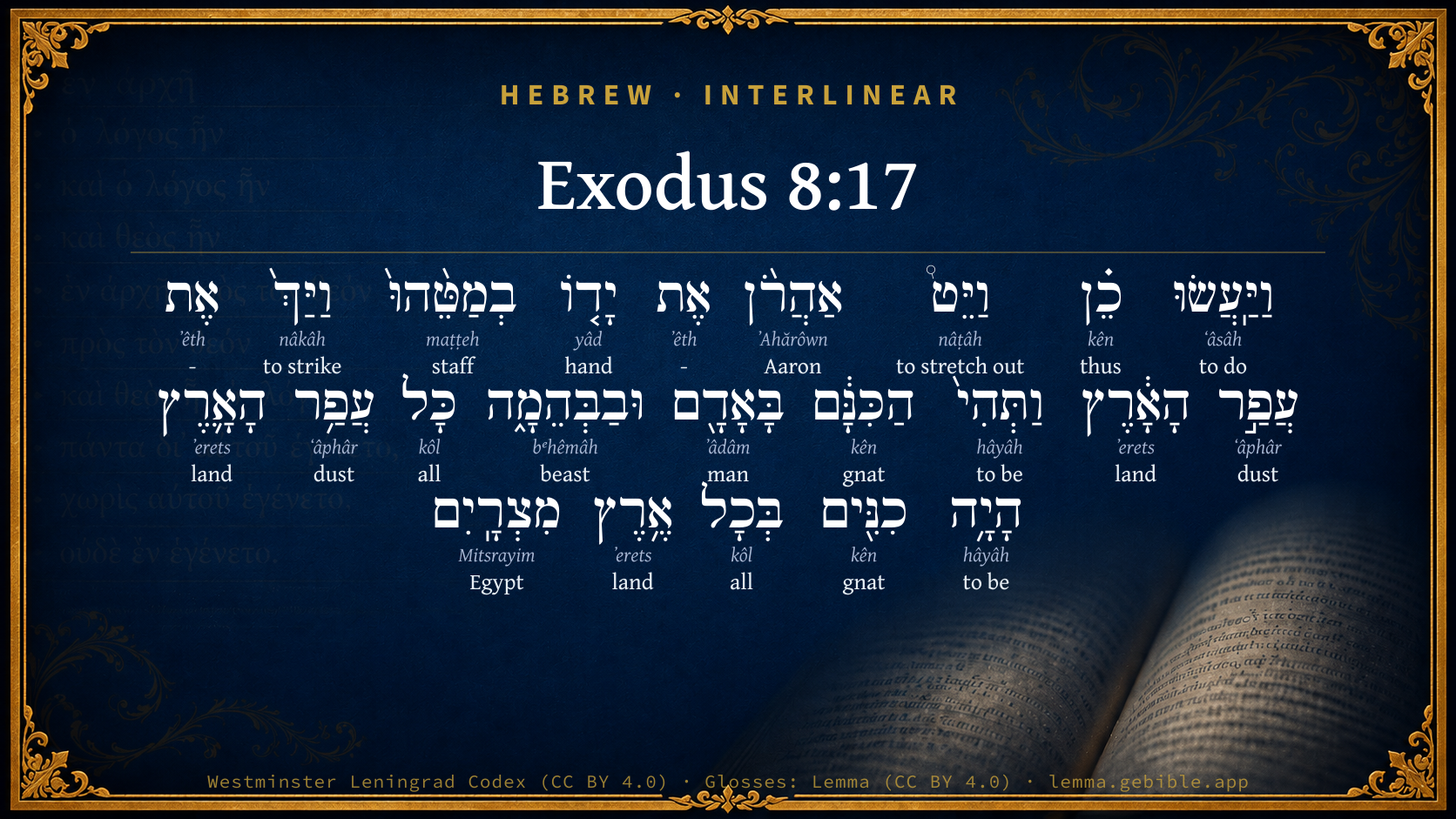
Hebrew (Westminster Leningrad Codex) Exodus 8:17 appears in the Hebrew Old Testament. The text above is from the Westminster Leningrad Codex. Each word links to its Strong’s number, a concise gloss, and parsing drawn from the Open Scriptures Hebrew Bible morphology. Click any word for its full Brown-Driver-Briggs (BDB) entry.
Download image
Cite this verse

Exodus 8:17 (World English Bible). Public Domain. Lemma interlinear Bible study tool, https://lemma.gebible.app/v/exodus/8/17.

Show BibTeX & RIS
BibTeX
RIS
English Translation
They did so; and Aaron stretched out his hand with his rod, and struck the dust of the earth, and there were lice on man, and on animal; all the dust of the earth became lice throughout all the land of Egypt.
World English Bible · Public Domain
Download a study sheet

One document with this verse’s original text, its word-by-word gloss line, the meaning frame, cross-references with their text, attributed commentary, and full source and license credits — printable, and it pastes into notes with its structure intact.

This verse Autodidact and up

Study sheet (.html) Plain text (.txt)

A passage Seminary Student

Up to 50 verses in one chapter. A passage sheet keeps up to 6 commentary sources and 12 cross-references per verse, in the order this page ranks them, and says so on the sheet whenever that leaves anything out. Ask for a single verse and you get the Autodidact verse sheet above.

Everything on this page stays free to read, with no account — the sheet is a download of what is already on screen, not access to it.

Want to remove ads? Support Godless Engineer
Compare translations 3

The same verse in 3 English versions, stacked beneath the original-language interlinear above. Click any original word for its lexicon entry.

Each is an independent rendering of the whole verse — the interlinear is not word-aligned to these translations.

Highlighted words mark where these versions differ — a whole-verse word diff, not a word-by-word alignment.

  • World English Bible Public Domain
    They did so; and Aaron stretched out his hand with his rod, and struck the dust of the earth, and there were lice on man, and on animal; all the dust of the earth became lice throughout all the land of Egypt.
  • King James Version Public Domain
    And they did so; for Aaron stretched out his hand with his rod, and smote the dust of the earth, and it became lice in man, and in beast; all the dust of the land became lice throughout all the land of Egypt.
  • unfoldingWord Literal Text CC BY-SA 4.0
    And they did so, and Aaron stretched out his hand with his staff and he struck the dust of the ground, and it became lice on man and on beast. All the dust of the ground was lice in all the land of Egypt.

unfoldingWord Literal Text — © unfoldingWord, licensed CC BY-SA 4.0. Word-aligned USFM3 via Door43 (git.door43.org/unfoldingWord/en_ult).

Versions to compare (up to 4)

3 of 4 selected

Show all 18 translations

Every available English version of this verse, each an independent rendering of the whole verse.

  • World English Bible Public Domain
    They did so; and Aaron stretched out his hand with his rod, and struck the dust of the earth, and there were lice on man, and on animal; all the dust of the earth became lice throughout all the land of Egypt.
  • Berean Standard Bible Public Domain
    This they did, and when Aaron stretched out his hand with his staff and struck the dust of the earth, gnats came upon man and beast. All the dust of the earth turned into gnats throughout the land of Egypt.
  • Majority Standard Bible Public Domain
    This they did, and when Aaron stretched out his hand with his staff and struck the dust of the earth, gnats came upon man and beast. All the dust of the earth turned into gnats throughout the land of Egypt.
  • King James Version Public Domain
    And they did so; for Aaron stretched out his hand with his rod, and smote the dust of the earth, and it became lice in man, and in beast; all the dust of the land became lice throughout all the land of Egypt.
  • American Standard Version (1901) Public Domain
    And they did so; and Aaron stretched out his hand with his rod, and smote the dust of the earth, and there were lice upon man, and upon beast; all the dust of the earth became lice throughout all the land of Egypt.
  • Revised Version (1885) Public Domain
    And they did so; and Aaron stretched out his hand with his rod, and smote the dust of the earth, and there were lice upon man, and upon beast; all the dust of the earth became lice throughout all the land of Egypt.
  • Geneva Bible (1599) Public Domain
    And they did so: for Aaron stretched out his hand with his rod, and smote the dust of the earth: and lyce came vpon man and vpon beast: all the dust of the earth was lyce throughout all the land of Egypt.
  • Douay-Rheims (1899) Public Domain
    And they did so. And Aaron stretched forth his hand, holding the rod: and he struck the dust of the earth, and there came sciniphs on men and on beasts: all the dust of the earth was turned into sciniphs through all the land of Egypt.
  • Young's Literal Translation Public Domain
    And they do so, and Aaron stretcheth out his hand with his rod, and smiteth the dust of the land, and the gnats are on man and on beast; all the dust of the land hath been gnats in all the land of Egypt.
  • Literal Standard Version CC BY-SA 4.0
    And they do so, and Aaron stretches out his hand with his rod, and strikes the dust of the land, and the gnats are on man and on beast; all the dust of the land has been gnats in all the land of Egypt.
  • Unlocked Literal Bible CC BY-SA 4.0
    They did so: Aaron reached out with his hand and his staff. He struck the dust on the ground. Gnats came onto man and beast. All the dust on the ground became gnats throughout the whole land of Egypt.
  • unfoldingWord Literal Text CC BY-SA 4.0
    And they did so, and Aaron stretched out his hand with his staff and he struck the dust of the ground, and it became lice on man and on beast. All the dust of the ground was lice in all the land of Egypt.
  • Darby Bible Public Domain
    And they did so; and Aaron stretched out his hand with his staff, and smote the dust of the earth, and there arose gnats on man and on beast: all the dust of the land became gnats throughout the land of Egypt.
  • World Messianic Bible Public Domain
    They did so; and Aaron stretched out his hand with his rod, and struck the dust of the earth, and there were lice on man, and on animal; all the dust of the earth became lice throughout all the land of Egypt.
  • Webster's Bible Public Domain
    And they did so: for Aaron stretched out his hand with his rod, and smote the dust of the earth, and it became lice in man and in beast; all the dust of the land became lice throughout all the land of Egypt.
  • Free Bible Version CC BY-SA 4.0
    They did what the Lord said. When Aaron lifted up his walking stick and hit the dust of the earth, gnats swarmed over both people and animals. The dust in the whole of Egypt turned into gnats.
  • Bible in Basic English Public Domain
    And they did so; and Aaron, stretching out the rod in his hand, gave a touch to the dust of the earth, and insects came on man and on beast; all the dust of the earth was changed into insects through all the land of Egypt.
  • JPS Tanakh (1917) Public Domain
    (8-13) And they did so; and Aaron stretched out his hand with his rod, and smote the dust of the earth, and there were gnats upon man, and upon beast; all the dust of the earth became gnats throughout all the land of Egypt.

Literal Standard Version (2020), Covenant Press — licensed CC BY-SA 4.0. Text via the HelloAO Bible API (eBible.org). Unlocked Literal Bible (unfoldingWord) — licensed CC BY-SA 4.0. Text via the HelloAO Bible API (eBible.org). unfoldingWord Literal Text — © unfoldingWord, licensed CC BY-SA 4.0. Word-aligned USFM3 via Door43 (git.door43.org/unfoldingWord/en_ult). Free Bible Version, Dr. Jonathan Gallagher — licensed CC BY-SA 4.0. Text via the HelloAO Bible API (eBible.org).

Word by word

More ways to search: Search by grammar → Find every occurrence → Compare this word →

Practice this passage: Drill this verse → Learn its vocabulary →

הַכִּנָּ֔ם
kên
H3654
“the · gnat”
Particle, Definite Article + Noun, Common, Masculine, Singular, Absolute
Part of Speech
Particle + Noun
Type
Common
Gender
Masculine
Number
Singular
State
Absolute
Full BDB Definition

Origin: from H3661 in the sense of fastening

TWOT: 999a

gnat, gnats, gnat-swarm
  1. וַיַּֽעֲשׂוּ ʻâsâh H6213 “and · to do” Conjunction + Verb, Qal, Sequential Imperfect, 3rd Person, Masculine, Plural
  2. כֵ֗ן kên H3651 “thus” Adverb
  3. וַיֵּט֩ nâṭâh H5186 “and · to stretch out” Conjunction + Verb, Qal, Sequential Imperfect, 3rd Person, Masculine, Singular
  4. אַהֲרֹ֨ן ʼAhărôwn H175 “Aaron” Noun, Proper
  5. אֶת ʼêth H853 “-” Particle, Direct Object
  6. יָד֤וֹ yâd H3027 “hand · his” Noun, Common, Both, Singular, Construct + Suffix, Personal, 3rd Person, Masculine, Singular
  7. בְמַטֵּ֨הוּ֙ maṭṭeh H4294 “in/at · staff · his” Preposition + Noun, Common, Masculine, Singular, Construct + Suffix, Personal, 3rd Person, Masculine, Singular
  8. וַיַּךְ֙ nâkâh H5221 “and · to strike” Conjunction + Verb, Hiphil, Sequential Imperfect, 3rd Person, Masculine, Singular
  9. אֶת ʼêth H853 “-” Particle, Direct Object
  10. עֲפַ֣ר ʻâphâr H6083 “dust of” Noun, Common, Masculine, Singular, Construct
  11. הָאָ֔רֶץ ʼerets H776 “the · land” Particle, Definite Article + Noun, Common, Both, Singular, Absolute
  12. וַתְּהִי֙ hâyâh H1961 “and · to be” Conjunction + Verb, Qal, Sequential Imperfect, 3rd Person, Feminine, Singular
  13. בָּאָדָ֖ם ʼâdâm H120 “in/at the · man” Preposition, Determined + Noun, Common, Masculine, Singular, Absolute
  14. וּבַבְּהֵמָ֑ה bᵉhêmâh H929 “and · in/at the · beast” Conjunction + Preposition, Determined + Noun, Common, Feminine, Singular, Absolute
  15. כָּל kôl H3605 “all of” Noun, Common, Masculine, Singular, Construct
  16. עֲפַ֥ר ʻâphâr H6083 “dust of” Noun, Common, Masculine, Singular, Construct
  17. הָאָ֛רֶץ ʼerets H776 “the · land” Particle, Definite Article + Noun, Common, Both, Singular, Absolute
  18. הָיָ֥ה hâyâh H1961 “to be” Verb, Qal, Perfect, 3rd Person, Masculine, Singular
  19. כִנִּ֖ים kên H3654 “gnats” Noun, Common, Masculine, Plural, Absolute
  20. בְּכָל kôl H3605 “in/at · all of” Preposition + Noun, Common, Masculine, Singular, Construct
  21. אֶ֥רֶץ ʼerets H776 “land of” Noun, Common, Both, Singular, Construct
  22. מִצְרָֽיִם Mitsrayim H4714 “Egypt” Noun, Proper

About this verse

These counts appear in no published source. They are computed here, from the morphology-tagged text and Lemma’s own curated glosses. What Lemma adds →

23
words
16
distinct lemmas
Pentateuch
section

Notable vocabulary

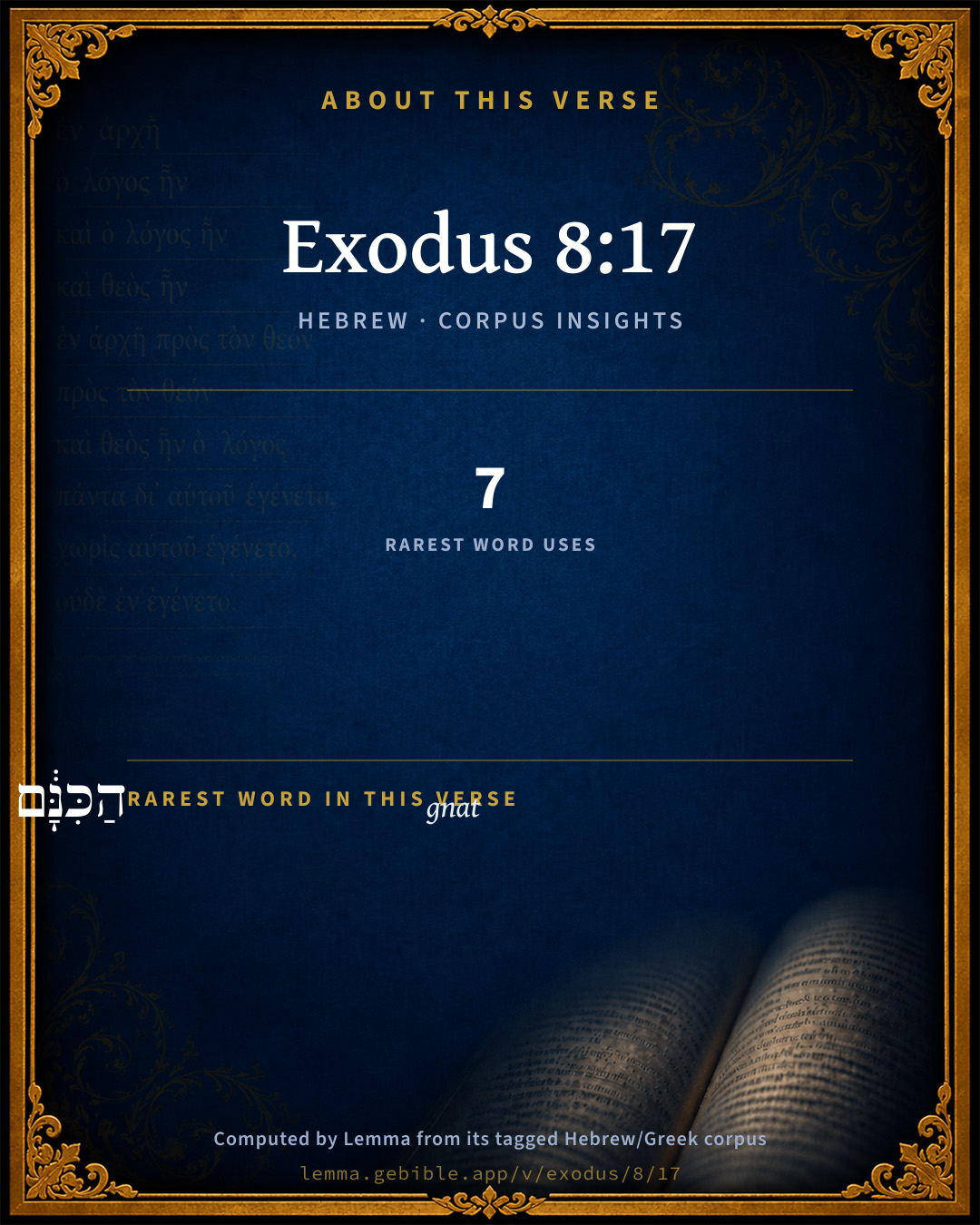
The rarest word here is הַכִּנָּ֔ם gnat H3654 — appearing just 7 times in the whole Hebrew Bible.

Shared distinctive vocabulary

הַכִּנָּ֔ם gnat H3654 occurs in 5 verses of the Hebrew Bible. Also found in:

Grammatical profile

  • 5 verbs
  • 15 nouns
  • 1 adverb
  • 2 particles

Verb forms

  • וַיַּֽעֲשׂוּ Qal · Sequential Imperfect
  • וַיֵּט֩ Qal · Sequential Imperfect
  • וַיַּךְ֙ Hiphil · Sequential Imperfect
  • וַתְּהִי֙ Qal · Sequential Imperfect
  • הָיָ֥ה Qal · Perfect

Repetition

Words recur within this verse — often emphatic in Hebrew:

  • הָאָ֔רֶץ land H776 ×3
  • עֲפַ֣ר dust H6083 ×2
  • וַתְּהִי֙ to be H1961 ×2
  • הַכִּנָּ֔ם gnat H3654 ×2
  • כָּל all H3605 ×2

Hebrew & Septuagint length

In English translation the verse runs 42 words from the Hebrew and 36 from the Septuagint (LXX English) — closely comparable.

A rough comparison of the two English renderings, which tokenize alike — not a word-level alignment.

Word counts can differ between the Hebrew and the Greek without any difference in meaning — e.g. the Hebrew direct-object marker אֵת has no separate Greek word, and Greek often adds the article ὁ.

Cross-references

3

Topical passages linked to Exodus 8:17 in the Treasury of Scripture Knowledge — connected by theme and wording, ordered by reader-vote popularity; previews shown in the World English Bible.

  • Psalms 105:31 He spoke, and swarms of flies came, And lice in all their borders.
  • Isaiah 23:9 Yahweh of hosts has purposed it, to stain the pride of all glory, to bring into contempt all the honorable of the earth.
  • Acts 12:23 Immediately an angel of the Lord struck him, because he didn't give God the glory, and he was eaten by worms and died.

Cross-references courtesy of OpenBible.info (CC BY 4.0).

Hebrew and Greek witnesses Masoretic Hebrew ↔ Greek Septuagint

The same verse in the two great witnesses to the Old Testament, shown verse-for-verse.

These are two independent witnesses, not word-aligned to each other, and the Septuagint is shown in lemma (dictionary) form.

Hebrew Exodus 8:17 Masoretic · Westminster Leningrad Codex

וַיַּֽעֲשׂוּ כֵ֗ן וַיֵּט֩ אַהֲרֹ֨ן אֶת יָד֤וֹ בְמַטֵּ֨הוּ֙ וַיַּךְ֙ אֶת עֲפַ֣ר הָאָ֔רֶץ וַתְּהִי֙ הַכִּנָּ֔ם בָּאָדָ֖ם וּבַבְּהֵמָ֑ה כָּל עֲפַ֥ר הָאָ֛רֶץ הָיָ֥ה כִנִּ֖ים בְּכָל אֶ֥רֶץ מִצְרָֽיִם

They did so; and Aaron stretched out his hand with his rod, and struck the dust of the earth, and there were lice on man, and on animal; all the dust of the earth became lice throughout all the land of Egypt.

World English Bible · Public Domain

Greek LXX Exodus 8:17 Septuagint · lemma form

ἐάν δέ μή βούλομαι ἐκ ἀποστέλλω ὁ λαός ἐγώ ἰδού ἐγώ ἐπι ἀποστέλλω ἐπί σύ καί ἐπί ὁ θεράπων σύ καί ἐπί ὁ λαός σύ καί ἐπί ὁ οἶκος σύ κυνόμυια καί πίμπλημι ὁ οἰκία ὁ αἰγύπτιος ὁ κυνόμυια καί εἰς ὁ γῆ ἐπί ὅς εἰμί ἐπί αὐτός

So Aaron stretched out his rod with his hand, and struck the dust of the earth; and the lice were on men and on quadrupeds, and in all the dust of the earth there were lice.

LXX2012 (modern English Septuagint) · Public Domain

Hebrew: Westminster Leningrad Codex (CC BY 4.0). Greek: Septuagint (public domain); English from LXX2012 (modern English Septuagint) (Public Domain). How the Septuagint differs from the Hebrew →

Targum (Aramaic paraphrase)

2

The Targum is the ancient Jewish Aramaic paraphrase of the Hebrew Scriptures — an interpretive translation, not the Hebrew text itself. Onkelos (literal) and Pseudo-Jonathan (expansive) render the Torah, and Jonathan the Prophets. Coverage is partial: where no permissively-licensed English translation exists for a verse, only the Aramaic is shown. This is verse-level text, not a word-by-word alignment to the Hebrew.

  1. Targum Onkelos Torah (Genesis–Deuteronomy)
    אֲרֵי אִם לֵיתָךְ מְשַׁלַח יָת עַמִי הָא אֲנָא מַשְׁלַח בָּךְ וּבְעַבְדָיךְ וּבְעַמָךְ וּבְבָתָּיךְ יָת עָרוֹבָא וְיִמְלוּן בָּתֵּי מִצְרַיִם יָת עָרוֹבָא וְאַף אַרְעָא דְאִנוּן עֲלַהּ:

    (no public-domain English translation for this verse)

    Targum Onkelos — Aramaic: “Onkelos Genesis” (public domain); “Onkelos Exodus” (public domain); “Onkelos Leviticus” (public domain); “Onkelos Numbers” (public domain); “Onkelos Deuteronomy” (public domain). English: “Sefaria Community Translation” (CC0 1.0 (public-domain dedication)); “J.W. Etheridge. The Targums of Onkelos and Jonathan Ben Uzziel on the Pentateuch. London: Longmans, Green, 1862” (public domain). Text via Sefaria.

  2. Targum Pseudo-Jonathan Torah (Genesis–Deuteronomy)
    אֲרוּם אִין לֵיתָךְ מִפְטַר יַת עַמִי הָאֲנָא מְגָרֵי בָךְ וּבְעַבְדָךְ וּבְעַמָךְ וּבְבֵיתָךְ יַת עִירְבּוּב חֵיוַת בָּרָא וְיִתְמְלוּן בָּתֵּי מִצְרָאֵי עִירְבּוּב חֵיוַת בָּרָא וְאוּף יַת אַרְעָא דְהִינוּן עֲלָהּ

    but if thou wilt not set My people free, behold, I will stir up among thee, and thy servants, and thy people, and thy house, a mixed multitude of wild beasts and the houses of the Mizraee shall be filled with a swarm of wild beasts, and they shall be upon the land also.

    Targum Pseudo-Jonathan — Aramaic: “Targum Jonathan on Genesis” (public domain); “Targum Jonathan on Exodus” (public domain); “Targum Jonathan on Leviticus” (public domain); “Targum Jonathan on Numbers” (public domain); “Targum Jonathan on Deuteronomy” (public domain). English: “The Targum of Jonathan ben Uzziel, trans. J. W. Etheridge, London, 1862” (public domain). Text via Sefaria.

Commentary

Notes on Exodus 8:17 from classic Christian and Jewish commentators (each source and its license shown beneath its notes). The classic Christian expositions comment on the surrounding passage and are grouped to its opening verse, so a note may address several verses; the Jewish commentaries on the Tanakh (Rashi and others) are per-verse, so they appear only where the commentator wrote on this verse.

Lemma curates 59 commentaries, every one of them public domain or Creative Commons licensed, each selected and text-cleaned for this edition rather than reprinted as found. About our sources →

Trapp's Complete Commentary

John Trapp

Exo 8:17 And they did so; for Aaron stretched out his hand with his rod, and smote the dust of the earth, and it became lice in man, and in beast; all the dust of the land became lice throughout all the land of Egypt.

Ver. 17. All the dust of the land became lice.] Or, gnats. Quid cniphe villus? saith Philo; what so base and vile a creature as a louse, a gnat? And yet by this poor vermin God so plagued all Egypt, that fainting under it, they were forced to cry out, "This is the very finger of God." Ciniphes sunt muscae minutisslmae, aculeis permolestae, saith Rupert. Others say, that here are meant pediculi inguinales, crab lice; Honos set auribus.

John Trapp, A Commentary or Exposition upon All the Books of the Old and New Testament (1647–1656) — public domain. Text from a community e-Sword module.

Joseph Benson's Commentary

Exo 8:17. The frogs were produced out of the waters, but the lice out of the dust of the earth; for out of any part of the creation God can fetch a scourge wherewith to correct those that rebel against him. This plague was probably sent because it would be peculiarly grievous to the Egyptians, as being a very cleanly people. According to Herodotus, their priests were wont to shave or scrape their whole bodies every third day, lest any lice should breed upon them.

Joseph Benson's Commentary on the Old and New Testaments (1811–1818) — public domain. Text from a community e-Sword module.

The Cambridge Bible for Schools and Colleges

gen. ed. J. J. S. Perowne

17. with his rod] See on v. 5.

The Cambridge Bible for Schools and Colleges (gen. ed. J. J. S. Perowne; Cambridge University Press, 1878–1918) — public domain. Text from a community e-Sword module.

John Gill's Exposition

And the magicians did so with their enchantments, to bring forth lice,.... They made use of their magical art, and juggling tricks they were masters of, to produce the like sort of creatures, or at least to make such appear, or seem to appear, to the eyes of men:

but they could not; God would not suffer them to do it, to impose upon Pharaoh, and deceive him and the Egyptians any longer; and a stop is put to them, when such small and despicable creatures were produced, the more to put them to shame and confusion, and to show that what they did before was not real, and that what they did in appearance was only by divine permission:

so there were lice upon man and upon beast; these lay in great numbers on both, biting and distressing them in a most terrible manner; for as the magicians could not produce such creatures, it was not in their power to remove them.

John Gill's Exposition of the Whole Bible (1746–1763) — public domain (CC PDM 1.0). Text via the HelloAO Bible API.

Matthew Poole's English Annotations

The dust was not fit matter to produce lice, and therefore shows this work to be Divine and miraculous.

All the dust of the land, i.e. a great part of it, the word all being commonly so understood in Scripture.

Matthew Poole's English Annotations on the Holy Bible (1683–1685) — public domain. Text from a community e-Sword/MySword module.

The Pulpit Commentary

And in beast. Kalisch notes that mosquitoes -molest especially beasts, as oxen and horses, flying into their eyes and nostrils, driving them to madness and fury, and sometimes even torturing them to death." He quotes Theodoret, Hist. Ecc 8:26.

The Pulpit Commentary (1880–1919), ed. H.D.M. Spence-Jones & Joseph S. Exell — public domain. Text from a community e-Sword module.

John Wesley's Explanatory Notes

The frogs were produced out of the waters, but the lice out of the dust of the earth; for out of any part of the creation God can fetch a scourge wherewith to correct those that rebel against him.

John Wesley, Explanatory Notes Upon the Whole Bible (1754–1765) — public domain. Text via the GEBible commentary corpus.

Rashi

Rabbi Shlomo Yitzchaki (Rashi)

משליח בך means I WILL INCITE AGAINST THEE. Another example is. (Deuteronomy 32:24) “I will incite (אשלח) the tooth of beasts against them”, where it signifies letting loose an animal against a person; old French inciter. English to incite.

את הערב this means all kinds of wild beasts, serpents, and scorpions (a mixture [ערב] of noxious creatures) in a crowd (Exodus Rabbah 11:3) — these played havoc with them. There is a reason given in the Midrash in the case of each plague why this particular one and why that: God came against them with the tactics of warlike operations as carried out by kings in orderly sequence: a government (monarch) who is besieging a city first destroys its water supply, then they blow the trumpets and sound an alarm in order to terrify and dismay them — thus [their water supply was turned into blood], the frogs croaked and made a noise etc. - just as you will find it stated in the Midrash of Rabbi Tanchuma 2:3:4.

Rashi on the Tanakh — English translations: “The Judaica Press complete Tanach with Rashi, translated by A. J. Rosenberg” (CC BY 4.0); “Pentateuch with Rashi's commentary by M. Rosenbaum and A.M. Silbermann, 1929-1934” (public domain); “The Metsudah Tanach series, Lakewood, N.J” (CC BY 4.0); and “The Book of Joshua, Metsudah Publications, 1997” (CC BY 4.0). Text via Sefaria.

Lesson kit

Teaching starters — assembled from the data on this page, not authored interpretation. Every prompt links to the verse data it draws on. Edit before teaching.

Exodus, in the Pentateuch, opens this verse with 23 words (16 distinct Hebrew lemmas). Its most distinctive word is kên (“gnat”). A historical commentator’s framing appears above. Read the whole chapter for the surrounding context.

Discussion questions

  1. What does “gnat” (kên) contribute to the verse as a whole?
  2. Exodus 8:16 shares the word «gnat» with this verse. How do the two illuminate each other?
  3. “land” occurs 3× in this one verse. What is the effect of the repetition?
  4. These translations render this verse differently; the difference is in the English rendering, not the original. What questions does that raise?
  5. The verb «וַיַּֽעֲשׂוּ» is Qal Sequential Imperfect. How does its form color the action?
  6. Reading how Trapp's Complete Commentary and Joseph Benson's Commentary read this verse, where do the two commentators agree and where do they part?

Things to notice

Reading settings

Reading text

Shown beneath each verse's original-language words.

Old Testament
Old Testament edition

Read the OT as the Masoretic Hebrew (MT) or the Greek Septuagint (LXX).

English shown for the Greek Septuagint (in the Hebrew ↔ Greek comparison).

Comparing translations? Open the Compare panel on any verse page to stack up to four side by side.