
Psalms 18:9

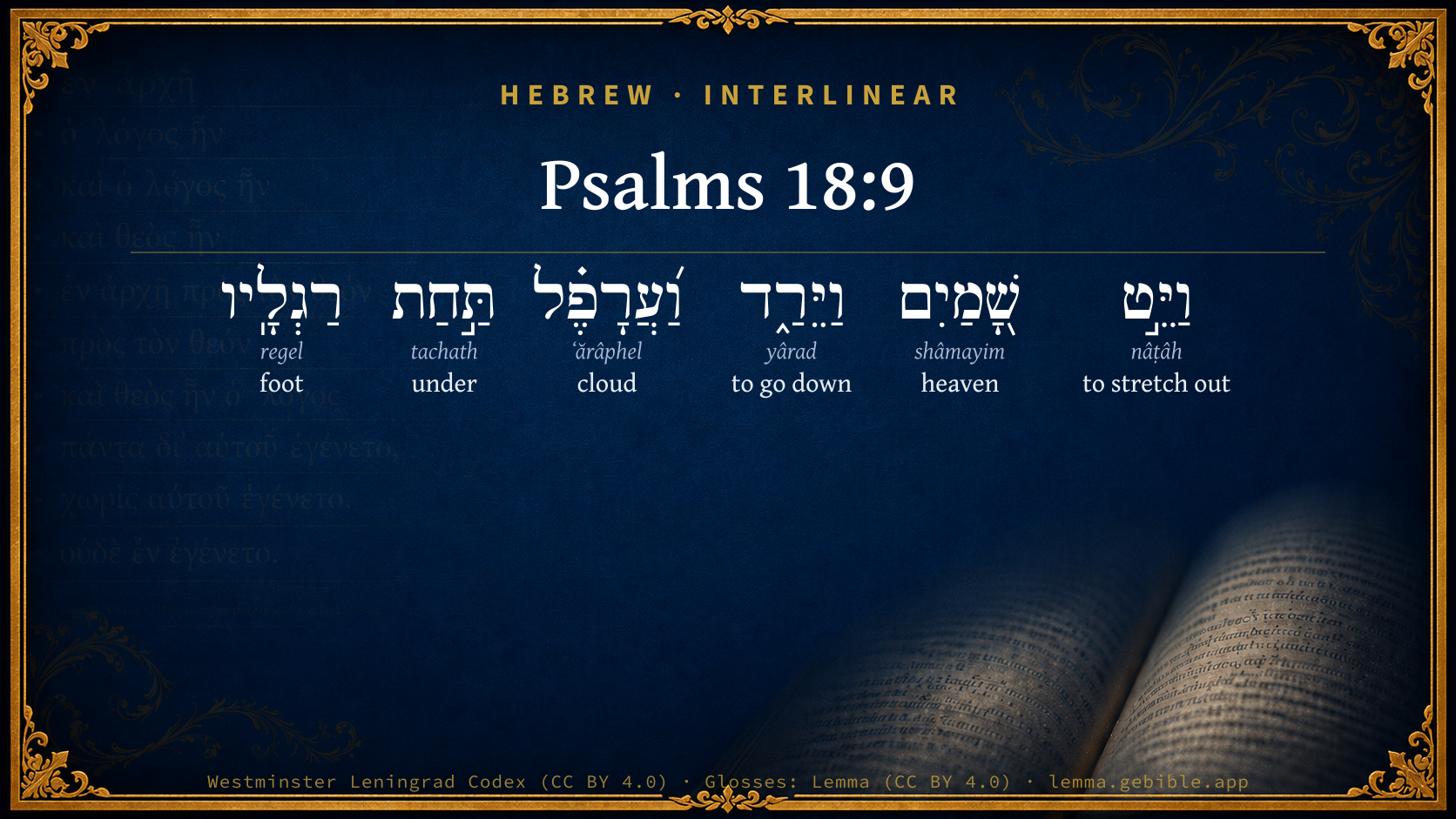
Hebrew (Westminster Leningrad Codex) Psalms 18:9 appears in the Hebrew Old Testament. The text above is from the Westminster Leningrad Codex. Each word links to its Strong’s number, a concise gloss, and parsing drawn from the Open Scriptures Hebrew Bible morphology. Click any word for its full Brown-Driver-Briggs (BDB) entry.
Download image
Cite this verse

Psalms 18:9 (World English Bible). Public Domain. Lemma interlinear Bible study tool, https://lemma.gebible.app/v/psalms/18/9.

Show BibTeX & RIS
BibTeX
RIS
English Translation
He bowed the heavens also, and came down. Thick darkness was under his feet.
World English Bible · Public Domain
Download a study sheet

One document with this verse’s original text, its word-by-word gloss line, the meaning frame, cross-references with their text, attributed commentary, and full source and license credits — printable, and it pastes into notes with its structure intact.

This verse Autodidact and up

Study sheet (.html) Plain text (.txt)

A passage Seminary Student

Up to 50 verses in one chapter. A passage sheet keeps up to 6 commentary sources and 12 cross-references per verse, in the order this page ranks them, and says so on the sheet whenever that leaves anything out. Ask for a single verse and you get the Autodidact verse sheet above.

Everything on this page stays free to read, with no account — the sheet is a download of what is already on screen, not access to it.

Want to remove ads? Support Godless Engineer
Compare translations 3

The same verse in 3 English versions, stacked beneath the original-language interlinear above. Click any original word for its lexicon entry.

Each is an independent rendering of the whole verse — the interlinear is not word-aligned to these translations.

Highlighted words mark where these versions differ — a whole-verse word diff, not a word-by-word alignment.

  • World English Bible Public Domain
    He bowed the heavens also, and came down. Thick darkness was under his feet.
  • King James Version Public Domain
    He bowed the heavens also, and came down: and darkness was under his feet.
  • unfoldingWord Literal Text CC BY-SA 4.0
    And he lowered the heavens, and he came down, and a dark cloud was under his feet.

unfoldingWord Literal Text — © unfoldingWord, licensed CC BY-SA 4.0. Word-aligned USFM3 via Door43 (git.door43.org/unfoldingWord/en_ult).

Versions to compare (up to 4)

3 of 4 selected

Show all 18 translations

Every available English version of this verse, each an independent rendering of the whole verse.

  • World English Bible Public Domain
    He bowed the heavens also, and came down. Thick darkness was under his feet.
  • Berean Standard Bible Public Domain
    He parted the heavens and came down with dark clouds beneath His feet.
  • Majority Standard Bible Public Domain
    He parted the heavens and came down with dark clouds beneath His feet.
  • King James Version Public Domain
    He bowed the heavens also, and came down: and darkness was under his feet.
  • American Standard Version (1901) Public Domain
    He bowed the heavens also, and came down; And thick darkness was under his feet.
  • Revised Version (1885) Public Domain
    He bowed the heavens also, and came down, and thick darkness was under his feet.
  • Geneva Bible (1599) Public Domain
    He bowed the heauens also and came downe, and darkenes was vnder his feete.
  • Douay-Rheims (1899) Public Domain
    There went up a smoke in his wrath: and a fire flamed from his face: coals were kindled by it.
  • Young's Literal Translation Public Domain
    And He inclineth the heavens, and cometh down, And thick darkness `is' under His feet.
  • Literal Standard Version CC BY-SA 4.0
    And He inclines the heavens, and comes down, || And thick darkness [is] under His feet.
  • Unlocked Literal Bible CC BY-SA 4.0
    He opened the heavens and came down, and thick darkness was under his feet.
  • unfoldingWord Literal Text CC BY-SA 4.0
    And he lowered the heavens, and he came down, and a dark cloud was under his feet.
  • Darby Bible Public Domain
    And he bowed the heavens, and came down; and darkness was under his feet.
  • World Messianic Bible Public Domain
    He bowed the heavens also, and came down. Thick darkness was under his feet.
  • Webster's Bible Public Domain
    \\18:8\\There went up a smoke out of his nostrils, and fire out of his mouth devoured: coals were kindled by it.
  • Free Bible Version CC BY-SA 4.0
    He parted the heavens and came down, with dark clouds beneath his feet.
  • Bible in Basic English Public Domain
    The heavens were bent, so that he might come down; and it was dark under his feet.
  • JPS Tanakh (1917) Public Domain
    (18-10) He bowed the heavens also, and came down; and thick darkness was under His feet.

Literal Standard Version (2020), Covenant Press — licensed CC BY-SA 4.0. Text via the HelloAO Bible API (eBible.org). Unlocked Literal Bible (unfoldingWord) — licensed CC BY-SA 4.0. Text via the HelloAO Bible API (eBible.org). unfoldingWord Literal Text — © unfoldingWord, licensed CC BY-SA 4.0. Word-aligned USFM3 via Door43 (git.door43.org/unfoldingWord/en_ult). Free Bible Version, Dr. Jonathan Gallagher — licensed CC BY-SA 4.0. Text via the HelloAO Bible API (eBible.org).

Word by word

More ways to search: Search by grammar → Find every occurrence → Compare this word →

Practice this passage: Drill this verse → Learn its vocabulary →

About this verse

These counts appear in no published source. They are computed here, from the morphology-tagged text and Lemma’s own curated glosses. What Lemma adds →

6
words
6
distinct lemmas
Wisdom
section

Notable vocabulary

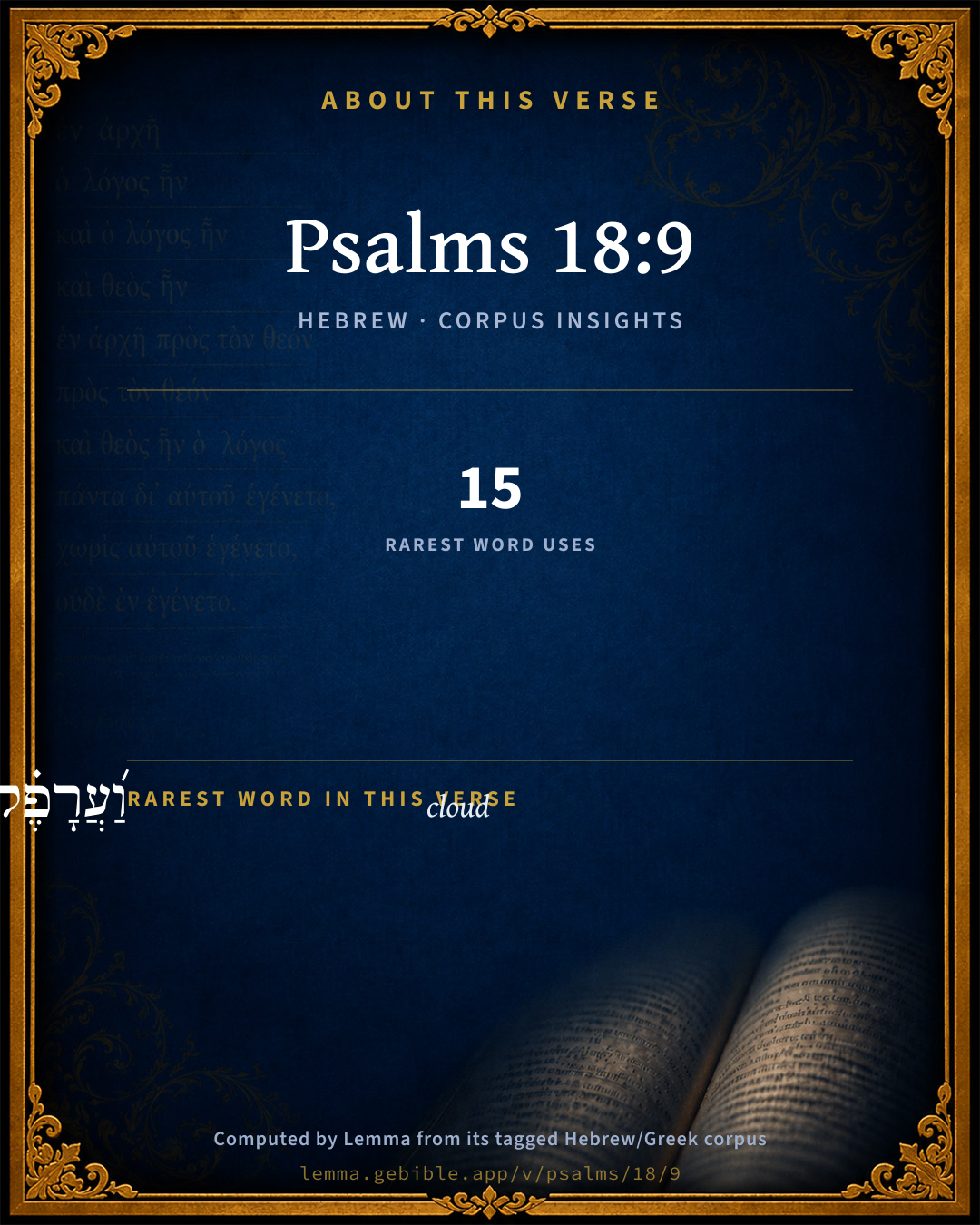
The rarest word here is וַ֝עֲרָפֶ֗ל cloud H6205 — appearing just 15 times in the whole Hebrew Bible.

Shared distinctive vocabulary

וַ֝עֲרָפֶ֗ל cloud H6205 occurs in 15 verses of the Hebrew Bible. Also found in:

Grammatical profile

  • 2 verbs
  • 3 nouns
  • 1 preposition

Verb forms

  • וַיֵּ֣ט Qal · Sequential Imperfect
  • וַיֵּרַ֑ד Qal · Sequential Imperfect

Hebrew & Septuagint length

In English translation the verse runs 14 words from the Hebrew and 15 from the Septuagint (LXX English) — closely comparable.

A rough comparison of the two English renderings, which tokenize alike — not a word-level alignment.

Word counts can differ between the Hebrew and the Greek without any difference in meaning — e.g. the Hebrew direct-object marker אֵת has no separate Greek word, and Greek often adds the article ὁ.

Cross-references

13

Topical passages linked to Psalms 18:9 in the Treasury of Scripture Knowledge — connected by theme and wording, ordered by reader-vote popularity; previews shown in the World English Bible.

  • Psalms 144:5–15 Part your heavens, Yahweh, and come down. Touch the mountains, and they will smoke.
  • Deuteronomy 33:26 There is none like God, Jeshurun, Who rides on the heavens for your help, In his excellency on the skies.
  • 2 Samuel 22:10 He bowed the heavens also, and came down; Thick darkness was under his feet.
  • 2 Peter 3:10 But the day of the Lord will come as a thief in the night; in which the heavens will pass away with a great noise, and the elements will be dissolved with fervent heat, and the earth and the works that are in it will be burned up.
  • Deuteronomy 5:22–23 These words Yahweh spoke to all your assembly on the mountain out of the midst of the fire, of the cloud, and of the thick darkness, with a great voice: and he added no more. He wrote them on two tables of stone, and gave them to me.
  • Joel 3:16 Yahweh will roar from Zion, And thunder from Jerusalem; And the heavens and the earth will shake; But Yahweh will be a refuge to his people, And a stronghold to the children of Israel.
  • Matthew 24:29 But immediately after the oppression of those days, the sun will be darkened, the moon will not give its light, the stars will fall from the sky, and the powers of the heavens will be shaken;
  • Mark 15:33 When the sixth hour had come, there was darkness over the whole land until the ninth hour.
  • John 13:7 Jesus answered him, "You don't know what I am doing now, but you will understand later."
  • Hebrews 12:26 whose voice shook the earth, then, but now he has promised, saying, "Yet once more I will shake not only the earth, but also the heavens."
  • Revelation 20:11 I saw a great white throne, and him who sat on it, from whose face the earth and the heaven fled away. There was found no place for them.
  • Psalms 68:4 Sing to God! Sing praises to his name! Extol him who rides on the clouds: To Yah, his name! Rejoice before him!
  • Isaiah 51:6 Lift up your eyes to the heavens, and look on the earth beneath; for the heavens shall vanish away like smoke, and the earth shall wax old like a garment; and those who dwell therein shall die in like manner: but my salvation shall be forever, and my righteousness shall not be abolished.

Cross-references courtesy of OpenBible.info (CC BY 4.0).

Hebrew and Greek witnesses Masoretic Hebrew ↔ Greek Septuagint

The same verse in the two great witnesses to the Old Testament, shown verse-for-verse.

You’re reading Greek Psalm 17 (Hebrew Psalm 18). The Septuagint counts the superscription, so verse numbers can differ from the Hebrew — chapter-level alignment, not verse-by-verse. Numbering follows Rahlfs.

These are two independent witnesses, not word-aligned to each other, and the Septuagint is shown in lemma (dictionary) form.

Hebrew Psalms 18:9 Masoretic · Westminster Leningrad Codex

וַיֵּ֣ט שָׁ֭מַיִם וַיֵּרַ֑ד וַ֝עֲרָפֶ֗ל תַּ֣חַת רַגְלָֽיו

He bowed the heavens also, and came down. Thick darkness was under his feet.

World English Bible · Public Domain

Greek LXX Greek Psalm 17:9 Septuagint · lemma form

ἀναβαίνω καπνός ἐν ὀργή αὐτός καί πῦρ ἀπό πρόσωπον αὐτός καταφλογίζω ἄνθραξ ἀναἅπτω ἀπό αὐτός

And he bowed the heaven, and came down: and thick darkness was under his feet.

LXX2012 (modern English Septuagint) · Public Domain

On this verse, John Gill's Exposition discusses the Septuagint’s reading. Read the note in Commentary ↓

Hebrew: Westminster Leningrad Codex (CC BY 4.0). Greek: Septuagint (public domain); English from LXX2012 (modern English Septuagint) (Public Domain). How the Septuagint differs from the Hebrew →

Commentary

Notes on Psalms 18:9 from classic Christian and Jewish commentators (each source and its license shown beneath its notes). The classic Christian expositions comment on the surrounding passage and are grouped to its opening verse, so a note may address several verses; the Jewish commentaries on the Tanakh (Rashi and others) are per-verse, so they appear only where the commentator wrote on this verse.

Lemma curates 59 commentaries, every one of them public domain or Creative Commons licensed, each selected and text-cleaned for this edition rather than reprinted as found. About our sources →

Trapp's Complete Commentary

John Trapp

Psa 18:9 He bowed the heavens also, and came down: and darkness [was] under his feet.

Ver. 9. He bowed the heavens] i.e. Velociter venit, saith R. David, he came speedily to destroy mine enemies.

And darkness was under his feet] He came invisible.

John Trapp, A Commentary or Exposition upon All the Books of the Old and New Testament (1647–1656) — public domain. Text from a community e-Sword module.

Joseph Benson's Commentary

Psa 18:9. He bowed the heavens — By producing thick and dark clouds, by which the heavens seemed to come down to the earth; and came down — Not by change of place, but by the manifestation of his presence and power on my behalf. In other words, he, as it were, made the heavens bend under him, when he descended to take vengeance on his and my enemies. And darkness was under his feet — The psalmist seems here to express the appearance of the Divine Majesty in a glorious cloud, descending from heaven, which, underneath, was substantially dark, but above bright, and shining with an amazing lustre; and which, by its gradual descent, would appear as if the heavens themselves were bending down and approaching toward the earth.

Joseph Benson's Commentary on the Old and New Testaments (1811–1818) — public domain. Text from a community e-Sword module.

J. A. Alexander on Psalms

Joseph Addison Alexander

10. (Psa 18:9). So he bowed the heavens and came down, and gloom (was) under his feet. The scene seems here to be transferred from heaven to earth, where the psalmist sees not only the divine operation but the personal presence of Jehovah. The word so, familiarly employed in English to continue a narrative, here represents the vau conversive of the Hebrew. The word translated gloom is not the usual term for darkness, but a poetical expression specially applied to dense clouds and vapours. The expression seems to be derived from Deu 5:22. Compare with this clause, Exo 19:16, and with the first, Isa 63:19 (also Isa 64:1).

Joseph Addison Alexander, The Psalms Translated and Explained (1850) — public domain. Text from a community e-Sword module.

Tyndale Open Study Notes

Tyndale Open Resources

18:9-11 The Lord’s sovereignty extends over all of nature (see 104:2-4; 148:5-6).

Tyndale Open Study Notes — © Tyndale Open Resources, licensed CC BY-SA 4.0. Text via the HelloAO Bible API.

Geneva Bible (1599)

Geneva Bible translators

Darkness signifieth the wrath of God as the clear light signifieth God’s favor.

Geneva Bible (1599) marginal notes — public domain. Text via Bolls.life.

Jamieson, Fausset & Brown

Robert Jamieson, A. R. Fausset & David Brown

darkness--or, a dense cloud (Exo 19:16; Deu 5:22).

Jamieson, Fausset & Brown — Commentary Critical and Explanatory on the Whole Bible (1871) — public domain (CC PDM 1.0). Text via the HelloAO Bible API.

Adam Clarke's Commentary

Verse 9. He bowed the heavens also, and came down] - He made the heavens bend under him when he descended to take vengeance on his enemies. The psalmist seems here to express the appearance of the Divine majesty in a glorious cloud, descending from heaven, which underneath was substantially dark, but above, bright, and shining with exceeding lustre; and which, by its gradual approach to the earth, would appear as though the heavens themselves were bending down and approaching towards us.

Adam Clarke's Commentary on the Bible (1810–1826) — public domain. Text from a community e-Sword/MySword module.

Ellicott's Commentary for English Readers

(9) Darkness.—Better, black cloud. The dark masses of rain-cloud are now gathered, and bend to the earth under the majestic tread of God. (Comp. Nah_1:3, “and the clouds are the dust of his feet.” (Comp. Psa_144:5.)

A Bible Commentary for English Readers, edited by Charles John Ellicott (1878–1897) — public domain. Text from a community e-Sword module.

The Cambridge Bible for Schools and Colleges

gen. ed. J. J. S. Perowne

9. The dark canopy of storm clouds, which is the pavement under His feet (Nah_1:3), lowers as He descends to judgment. God is said to come down when He manifests His power in the world (Gen_11:7; Gen_18:21; Isa_64:1). The darkness, or better as R.V., thick darkness, in which He conceals Himself from human view, symbolises the mystery and awfulness of His Advent (Exo_19:16; Exo_20:21, 1Ki_8:12; Psa_97:2).

The Cambridge Bible for Schools and Colleges (gen. ed. J. J. S. Perowne; Cambridge University Press, 1878–1918) — public domain. Text from a community e-Sword module.

John Gill's Exposition

And he rode upon a cherub, and did fly,.... The Targum renders it in the plural number, "cherubim"; and so the Septuagint, Syriac, and Arabic versions; and by whom may be meant, either the angels, who are as horses and chariots, on whom Jehovah rides, and who art he makes use of as executioners of his wrath and vengeance, Zac 6:5; and to whom wings are assigned as a token of swiftness, Isa 6:2; or rather the ministers of the Gospel, who are the living creatures in Rev 4:7; and answer to the "cherubim" in Ezekiel's visions; and whom God made use of, especially after the death of Christ, and when the Gospel was rejected by the Jews, to carry it into the Gentile world, which was done by them with great speed and swiftness; and Maimonides (u) gives a caution, not to understand the phrase, "he did fly", as of God, but of the cherub;

yea, he did fly upon the wings of the wind; which may design the speedy help and assistance God gave to his Son, and gives to his people; and the swift destruction of their enemies; see Psa 104:3; the words in Sa2 22:11, with only the variation of a letter in one word, are, "and he was seen upon the wings of the wind"; which were both true; nor need a various reading be supposed, the psalmist using both words at different times, suitable to his purpose, and which both express his sense. Wings are ascribed to the winds by the Heathen poets, and they are represented as winged on ancient monuments (w).

(u) Moreh Nevochim. par. 1. c. 49. (w) Vide Cuperi Apotheos. Homeri, p. 178. Wings are given to the south wind by Ovid, Metamorph. l. 1. Fab. 7. and by Juvenal, Satyr. 5. v. 10. and by Virgil, Aeneid. 8. v. 430. and who also speaks of wings of lightning, Aeneid. 5. v. 319.

John Gill's Exposition of the Whole Bible (1746–1763) — public domain (CC PDM 1.0). Text via the HelloAO Bible API.

Albert Barnes' Notes on the Bible

He bowed the heavens also - He seemed to bend down the heavens - to bring them nearer to the earth. “He inclines the canopy of the heavens, as it were, toward the earth; wraps himself in the darkness of night, and shoots forth his arrows; hurls abroad his lightnings, and wings them with speed.” Herder, Spirit of Hebrew Poetry (Marsh), ii. 157. The allusion is still to the tempest, when the clouds ran low; when they seem to sweep along the ground; when it appears as if the heavens were brought nearer to the earth - as if, to use a common expression, “the heavens and earth were coming together.”

And came down - God himself seemed to descend in the fury of the storm.

And darkness was under his feet - A dark cloud; or, the darkness caused by thick clouds. Compare Nah 1:3, “The Lord hath his way in the whirlwind and in the storm, and the clouds are the dust of his feet.” Deu 4:11, “the mountain burned ... with thick darkness.” Deu 5:22, “these words the Lord spake out of the thick darkness.” Psa 97:2, “clouds and darkness are round about him.” The idea here is that of awful majesty and power, as we are nowhere more forcibly impressed with the idea of majesty and power than in the fury of a storm.

Albert Barnes' Notes on the Bible (1834–1885) — public domain. Text from a community e-Sword/MySword module.

Matthew Poole's English Annotations

He bowed the heavens, by producing thick and dark clouds, by which the heavens seem to come down to the earth.

Came down; not by change of place, but by the manifestation of his presence and power on my behalf.

Matthew Poole's English Annotations on the Holy Bible (1683–1685) — public domain. Text from a community e-Sword/MySword module.

The Treasury of David

Charles H. Spurgeon

Ver. 9. Amid the terror of the storm Jehovah the Avenger descended, bending beneath his foot the arch of heaven.

He bowed the heavens also, and came down. He came in haste, and spurned everything which impeded his rapidity. The thickest gloom concealed his splendour,

and darkness was under his feet; he fought within the dense vapours, as a warrior in clouds of smoke and dust, and found out the hearts of his enemies with the sharp falchion of his vengeance. Darkness is no impediment to God; its densest gloom he makes his tent and secret pavilion. See how prayer moves earth and heaven, and raises storms to overthrow in a moment the foes of God's Israel. Things were bad for David before he prayed, but they were much worse for his foes so soon as the petition had gone up to heaven. A trustful heart, by enlisting the divine aid, turns the tables on its enemies. If I must have an enemy let him not be a man of prayer, or he will soon get the better of me by calling in his God into the quarrel.

Ver. 9. He bowed the heavens also, and came down. As in a tempest the clouds come nearer to the earth, and from the mountains to the valleys, so the psalmist adopts this figure peculiar to such occasions as described God's near approach to judgment (Ps 144:5, etc.; Heb 3:6); and darkness was under his feet. We have here the increase of the horrors of the tempest, and its still nearer approach, but God is not yet revealed, it is darkness under his feet. Thick darkness was the accompaniment of God's descent on Mount Sinai

(Ex 20:21 De 4:11): and it invests his throne, to veil from us the overwhelming majesty of deity. Ps 97:2. But this darkness, while it hides his coming judgment, bespeaks sorrow and anguish to the objects of his wrath. Lu 21:25-26. W. Wilson, in loc.

Ver. 9-11:

"He also bowed the heavens,

And thence he did descend;

And thickest clouds of darkness did

Under his feet attend."

"And he upon a cherub rode,

And thereon he did fly;

Yea, on the swift wings of the wind,

His flight was from on high."

"He darkness made his secret place;

About him for his tent

Dark waters were, and thickest clouds

Of the airy firmament." Scotch Version, 1649.

Ver. 9-12:

"In his descent, bowed heaven with earth did meet,

And gloomy darkness rolled beneath his feet;

A golden winged cherub he bestrid,

And on the swiftly flying tempest rid."

"He darkness made his secret cabinet;

Thick fogs and dropping clouds about him set;

The beams of his bright presence these expel,

Whence showers of burning coals and hailstones fell." George Sandys, 1577-1643.

None.

Psalms 18:10*

Charles H. Spurgeon's The Treasury of David (1869–1885) — public domain. Psalms only. Text from a community e-Sword/MySword module.

Whedon's Commentary on the Bible

Daniel D. Whedon

9. He bowed the heavens… and came down—At his command the heavens bend low, as if to convey him to battle. The imagery is partly taken from a severe thunderstorm and is partly Sinaitic. Exo_19:20; Psa_144:5.

Darkness—Same as thick clouds, Psa_18:11. See also Exo_34:5; compare Psa_97:2. They were as the floor of his pavilion. Nahum (Nah_1:3) calls them, “the dust of his feet.”

Daniel D. Whedon (gen. ed.), Commentary on the Old and New Testaments (1874–1909) — public domain. Text from a community e-Sword module.

The Pulpit Commentary

He bowed the heavens also, and came down. (comp. Psa_145:5) In a storm the clouds do actually descend, and the whole heaven seems to be bowed down to earth. God is said to "come down" to earth whenever he delivers the oppressed, and takes vengeance on their oppressors. (see Exo_3:8 2Sa_22:10 Psa_144:5 Isa_64:1, Isa_64:3, etc.) And darkness was under his feet. A deep darkness commonly accompanies both earthquake and storm. When God actually descended on Mount Sinai, it was amid thunders and lightnings, and "a thick cloud", (Exo_19:16) elsewhere called "thick darkness". (Deu_5:22)

The Pulpit Commentary (1880–1919), ed. H.D.M. Spence-Jones & Joseph S. Exell — public domain. Text from a community e-Sword module.

John Wesley's Explanatory Notes

Bowed - By producing thick and dark clouds, whereby the heavens seem to come down to the earth. Came - Not by change of place, but by the manifestation of his presence and power on my behalf.

John Wesley, Explanatory Notes Upon the Whole Bible (1754–1765) — public domain. Text via the GEBible commentary corpus.

unfoldingWord translationNotes

Door43 World Missions Community

He opened

The word "He" refers to Yahweh.

thick darkness was under his feet

Though Yahweh does not actually have feet, the Psalmist gives him human characteristics. AT: "thick darkness was beneath him" (See: Personification)

wings of the wind

Here the Psalmist speaks of the wind as if it had wings like an angel. (See: Personification and Metaphor)

translationWords

heaven

darkness

cherub

unfoldingWord translationNotes — © Distant Shores Media and the Door43 World Missions Community, licensed CC BY-SA 4.0. Source: git.door43.org/Door43/en_tn.

Rashi

Rabbi Shlomo Yitzchaki (Rashi)

Smoke went up in His nostrils (En ses nariles in Old French, in his nostrils.) So is the custom of every anger, to cause smoke to ascend from his nostrils.

Rashi on the Tanakh — English translations: “The Judaica Press complete Tanach with Rashi, translated by A. J. Rosenberg” (CC BY 4.0); “Pentateuch with Rashi's commentary by M. Rosenbaum and A.M. Silbermann, 1929-1934” (public domain); “The Metsudah Tanach series, Lakewood, N.J” (CC BY 4.0); and “The Book of Joshua, Metsudah Publications, 1997” (CC BY 4.0). Text via Sefaria.

Lesson kit

Teaching starters — assembled from the data on this page, not authored interpretation. Every prompt links to the verse data it draws on. Edit before teaching.

Psalms, in the Wisdom, opens this verse with 6 words (6 distinct Hebrew lemmas). Its most distinctive word is ʻărâphel (“cloud”). A historical commentator’s framing appears above. Read the whole chapter for the surrounding context.

Discussion questions

  1. The word ʻărâphel carries the sense “cloud.” How does it shape the verse?
  2. Exodus 20:21 shares the word «cloud» with this verse. How do the two illuminate each other?
  3. These translations render this verse differently; the difference is in the English rendering, not the original. What questions does that raise?
  4. The verb «וַיֵּ֣ט» is Qal Sequential Imperfect. How does its form color the action?
  5. Reading how Trapp's Complete Commentary and Joseph Benson's Commentary read this verse, where do the two commentators agree and where do they part?

Things to notice

Reading settings

Reading text

Shown beneath each verse's original-language words.

Old Testament
Old Testament edition

Read the OT as the Masoretic Hebrew (MT) or the Greek Septuagint (LXX).

English shown for the Greek Septuagint (in the Hebrew ↔ Greek comparison).

Comparing translations? Open the Compare panel on any verse page to stack up to four side by side.