
Proverbs 4:20

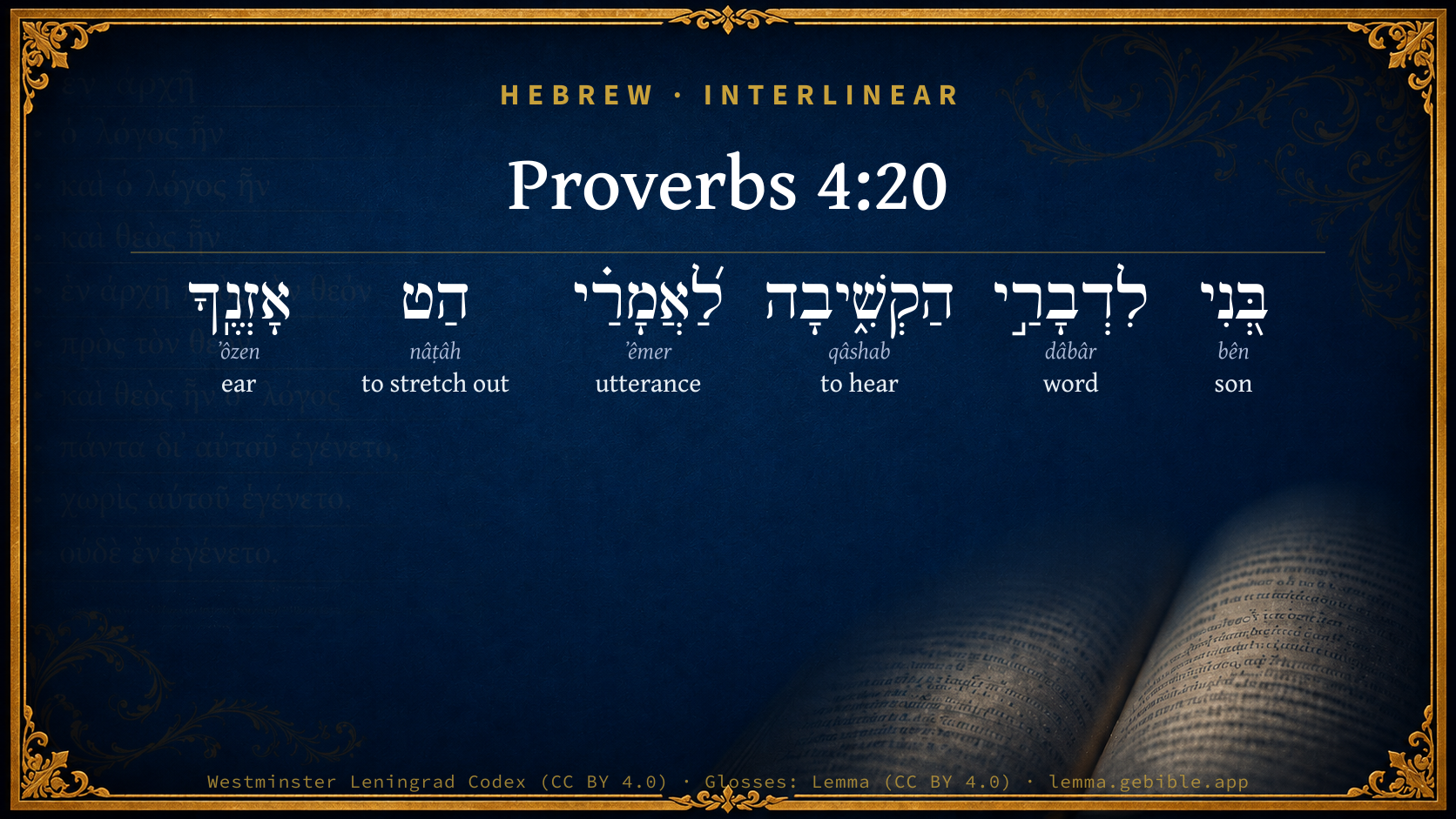
Hebrew (Westminster Leningrad Codex) Proverbs 4:20 appears in the Hebrew Old Testament. The text above is from the Westminster Leningrad Codex. Each word links to its Strong’s number, a concise gloss, and parsing drawn from the Open Scriptures Hebrew Bible morphology. Click any word for its full Brown-Driver-Briggs (BDB) entry.
Download image
Cite this verse

Proverbs 4:20 (World English Bible). Public Domain. Lemma interlinear Bible study tool, https://lemma.gebible.app/v/proverbs/4/20.

Show BibTeX & RIS
BibTeX
RIS
English Translation
My son, attend to my words. Turn your ear to my sayings.
World English Bible · Public Domain
Download a study sheet

One document with this verse’s original text, its word-by-word gloss line, the meaning frame, cross-references with their text, attributed commentary, and full source and license credits — printable, and it pastes into notes with its structure intact.

This verse Autodidact and up

Study sheet (.html) Plain text (.txt)

A passage Seminary Student

Up to 50 verses in one chapter. A passage sheet keeps up to 6 commentary sources and 12 cross-references per verse, in the order this page ranks them, and says so on the sheet whenever that leaves anything out. Ask for a single verse and you get the Autodidact verse sheet above.

Everything on this page stays free to read, with no account — the sheet is a download of what is already on screen, not access to it.

Want to remove ads? Support Godless Engineer
Compare translations 3

The same verse in 3 English versions, stacked beneath the original-language interlinear above. Click any original word for its lexicon entry.

Each is an independent rendering of the whole verse — the interlinear is not word-aligned to these translations.

Highlighted words mark where these versions differ — a whole-verse word diff, not a word-by-word alignment.

  • World English Bible Public Domain
    My son, attend to my words. Turn your ear to my sayings.
  • King James Version Public Domain
    My son, attend to my words; incline thine ear unto my sayings.
  • unfoldingWord Literal Text CC BY-SA 4.0
    My son, listen attentively to my words; incline your ear to my sayings.

unfoldingWord Literal Text — © unfoldingWord, licensed CC BY-SA 4.0. Word-aligned USFM3 via Door43 (git.door43.org/unfoldingWord/en_ult).

Versions to compare (up to 4)

3 of 4 selected

Show all 18 translations

Every available English version of this verse, each an independent rendering of the whole verse.

  • World English Bible Public Domain
    My son, attend to my words. Turn your ear to my sayings.
  • Berean Standard Bible Public Domain
    My son, pay attention to my words; incline your ear to my sayings.
  • Majority Standard Bible Public Domain
    My son, pay attention to my words; incline your ear to my sayings.
  • King James Version Public Domain
    My son, attend to my words; incline thine ear unto my sayings.
  • American Standard Version (1901) Public Domain
    My son, attend to my words; Incline thine ear unto my sayings.
  • Revised Version (1885) Public Domain
    My son, attend to my words; incline thine ear unto my sayings.
  • Geneva Bible (1599) Public Domain
    My sonne, hearken vnto my wordes, incline thine eare vnto my sayings.
  • Douay-Rheims (1899) Public Domain
    My son, hearken to my words, and incline thy ear to my sayings.
  • Young's Literal Translation Public Domain
    My son, to my words give attention, To my sayings incline thine ear,
  • Literal Standard Version CC BY-SA 4.0
    My son, give attention to my words, || Incline your ear to my sayings,
  • Unlocked Literal Bible CC BY-SA 4.0
    My son, pay attention to my words; incline your ear to my sayings.
  • unfoldingWord Literal Text CC BY-SA 4.0
    My son, listen attentively to my words; incline your ear to my sayings.
  • Darby Bible Public Domain
    My son, attend to my words; incline thine ear unto my sayings.
  • World Messianic Bible Public Domain
    My son, attend to my words. Turn your ear to my sayings.
  • Webster's Bible Public Domain
    My son, attend to my words; incline thy ear to my sayings.
  • Free Bible Version CC BY-SA 4.0
    My son, pay attention to what I tell you; listen to the words I'm saying.
  • Bible in Basic English Public Domain
    My son, give attention to my words; let your ear be turned to my sayings.
  • JPS Tanakh (1917) Public Domain
    My son, attend to my words; incline thine ear unto my sayings.

Literal Standard Version (2020), Covenant Press — licensed CC BY-SA 4.0. Text via the HelloAO Bible API (eBible.org). Unlocked Literal Bible (unfoldingWord) — licensed CC BY-SA 4.0. Text via the HelloAO Bible API (eBible.org). unfoldingWord Literal Text — © unfoldingWord, licensed CC BY-SA 4.0. Word-aligned USFM3 via Door43 (git.door43.org/unfoldingWord/en_ult). Free Bible Version, Dr. Jonathan Gallagher — licensed CC BY-SA 4.0. Text via the HelloAO Bible API (eBible.org).

Word by word

More ways to search: Search by grammar → Find every occurrence → Compare this word →

Practice this passage: Drill this verse → Learn its vocabulary →

הַקְשִׁ֑יבָה
qâshab
H7181
“hear”
Verb, Hiphil, Imperative, 2nd Person, Masculine, Singular + Suffix, h
Part of Speech
Verb
Stem
Hiphil
Form
Imperative
Person
2nd Person
Gender
Masculine
Number
Singular
Full BDB Definition

Origin: a primitive root

TWOT: 2084

to hear, be attentive, heed, incline (of ears), attend (of ears), hearken, pay attention, listen - (Qal) incline, attend (of ears), hearken, pay attention, listen - (Hiphil) to pay attention, give attention
  1. בְּ֭נִי bên H1121 “son · my” Noun, Common, Masculine, Singular, Construct + Suffix, Personal, 1st Person, Common, Singular
  2. לִדְבָרַ֣י dâbâr H1697 “to/for · words · my” Preposition + Noun, Common, Masculine, Plural, Construct + Suffix, Personal, 1st Person, Common, Singular
  3. לַ֝אֲמָרַ֗י ʼêmer H561 “to/for · utterances · my” Preposition + Noun, Common, Masculine, Plural, Construct + Suffix, Personal, 1st Person, Common, Singular
  4. הַט nâṭâh H5186 “stretch out” Verb, Hiphil, Imperative, 2nd Person, Masculine, Singular
  5. אָזְנֶֽךָ ʼôzen H241 “ear · your” Noun, Common, Feminine, Singular, Construct + Suffix, Personal, 2nd Person, Masculine, Singular

About this verse

These counts appear in no published source. They are computed here, from the morphology-tagged text and Lemma’s own curated glosses. What Lemma adds →

6
words
6
distinct lemmas
Wisdom
section

Shared distinctive vocabulary

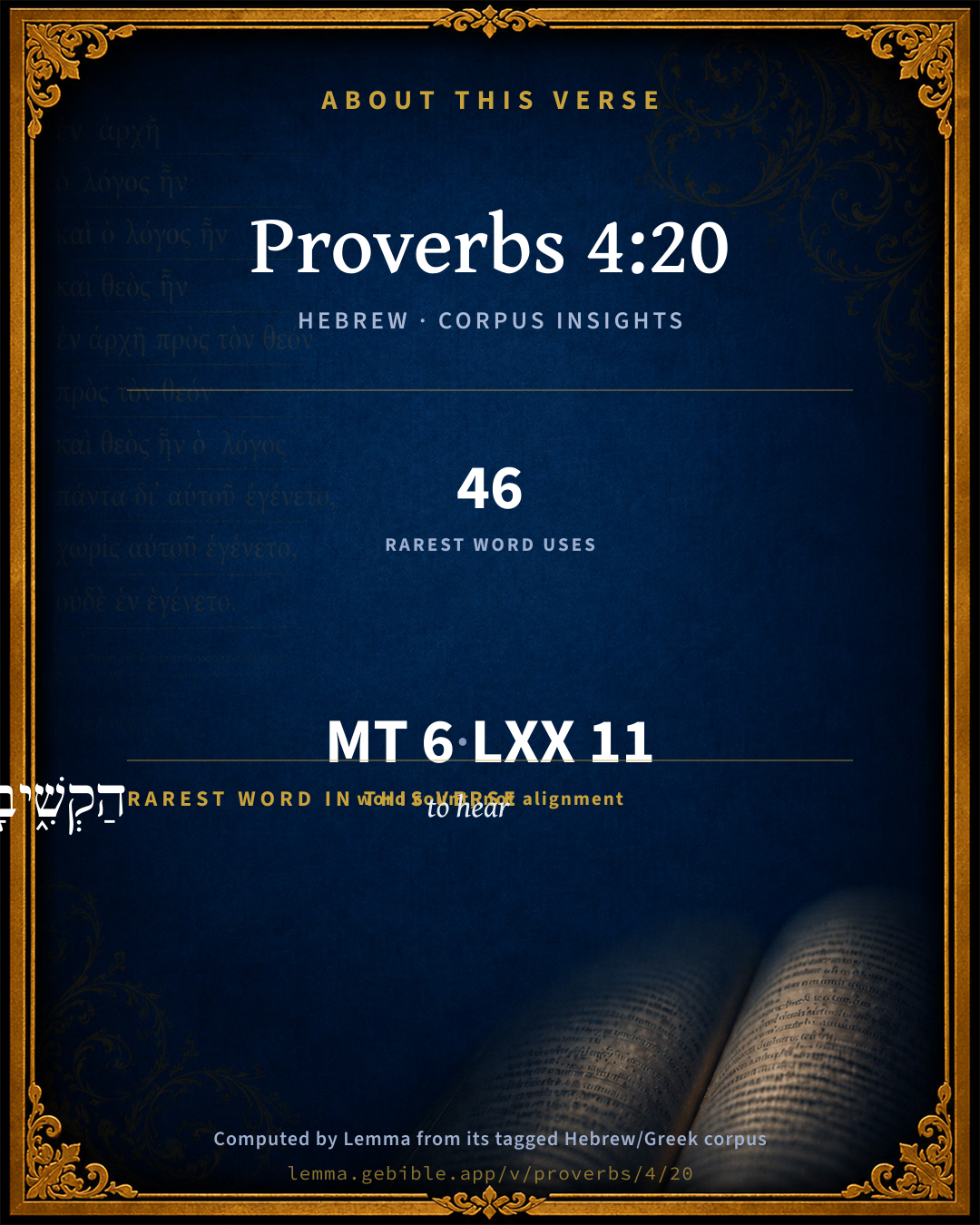
הַקְשִׁ֑יבָה to hear H7181 occurs in 45 verses of the Hebrew Bible. Also found in:

Grammatical profile

  • 2 verbs
  • 4 nouns

Verb forms

  • הַקְשִׁ֑יבָה Hiphil · Imperative
  • הַט Hiphil · Imperative

Hebrew & Septuagint length

In English translation the verse runs 12 words from the Hebrew and 13 from the Septuagint (LXX English) — closely comparable.

A rough comparison of the two English renderings, which tokenize alike — not a word-level alignment.

Word counts can differ between the Hebrew and the Greek without any difference in meaning — e.g. the Hebrew direct-object marker אֵת has no separate Greek word, and Greek often adds the article ὁ.

In the original languages it is 6 Hebrew tokens and 11 Greek tokens — but the two are counted differently (Hebrew bundles its prefixes and suffixes into one token; the Greek is in lemma form), so that isn’t a like-for-like length.

Cross-references

7

Topical passages linked to Proverbs 4:20 in the Treasury of Scripture Knowledge — connected by theme and wording, ordered by reader-vote popularity; previews shown in the World English Bible.

  • Proverbs 5:1 My son, pay attention to my wisdom. Turn your ear to my understanding:
  • Isaiah 55:3 Turn your ear, and come to me; hear, and your soul shall live: and I will make an everlasting covenant with you, even the sure mercies of David.
  • Proverbs 6:20–21 My son, keep your father's commandment, And don't forsake your mother's teaching.
  • Proverbs 7:1 My son, keep my words. Lay up my commandments within you.
  • Psalms 78:1 Hear my law, my people. Turn your ears to the words of my mouth.
  • Psalms 90:12 So teach us to number our days, That we may gain a heart of wisdom.
  • Matthew 17:5 While he was still speaking, behold, a bright cloud overshadowed them. Behold, a voice came out of the cloud, saying, "This is my beloved Son, in whom I am well pleased. Listen to him."

Cross-references courtesy of OpenBible.info (CC BY 4.0).

Hebrew and Greek witnesses Masoretic Hebrew ↔ Greek Septuagint

The same verse in the two great witnesses to the Old Testament, shown verse-for-verse.

These are two independent witnesses, not word-aligned to each other, and the Septuagint is shown in lemma (dictionary) form.

Hebrew Proverbs 4:20 Masoretic · Westminster Leningrad Codex

בְּ֭נִי לִדְבָרַ֣י הַקְשִׁ֑יבָה לַ֝אֲמָרַ֗י הַט אָזְנֶֽךָ

My son, attend to my words. Turn your ear to my sayings.

World English Bible · Public Domain

Greek LXX Proverbs 4:20 Septuagint · lemma form

υἱός ἐμός ῥῆσις προςἔχω ὁ δέ ἐμός λόγος παραβάλλω σός οὖς

My son, attend to my speech; and apply your ear to my words:

LXX2012 (modern English Septuagint) · Public Domain

On this verse, Matthew Henry's Commentary discusses the Septuagint’s reading. Read the note in Commentary ↓

Hebrew: Westminster Leningrad Codex (CC BY 4.0). Greek: Septuagint (public domain); English from LXX2012 (modern English Septuagint) (Public Domain). How the Septuagint differs from the Hebrew →

Commentary

Notes on Proverbs 4:20 from classic Christian and Jewish commentators (each source and its license shown beneath its notes). The classic Christian expositions comment on the surrounding passage and are grouped to its opening verse, so a note may address several verses; the Jewish commentaries on the Tanakh (Rashi and others) are per-verse, so they appear only where the commentator wrote on this verse.

Lemma curates 59 commentaries, every one of them public domain or Creative Commons licensed, each selected and text-cleaned for this edition rather than reprinted as found. About our sources →

Matthew Henry's Commentary

Solomon, having warned us not to do evil, here teaches us how to do well. It is not enough for us to shun the occasions of sin, but we must study the methods of duty.

I. We must have a continual regard to the word of God and endeavour that it may be always ready to us.

1. The sayings of wisdom must be our principles by which we must govern ourselves, our monitors to warn us of duty and danger; and therefore, (1.) We must receive them readily: "Incline thy ear to them (Pro 4:20); humbly bow to them; diligently listen to them." The attentive hearing of the word of God is a good sign of a work of grace begun in the heart and a good means of carrying it on. It is to be hoped that those are resolved to do their duty who are inclined to know it. (2.) We must retain them carefully (Pro 4:21); we must lay them before us as our rule: "Let them not depart from thy eyes; view them, review them, and in every thing aim to conform to them." We must lodge them within us, as a commanding principle, the influences of which are diffused throughout the whole man: "Keep them in the midst of thy heart, as things dear to thee, and which thou art afraid of losing." Let the word of God be written in the heart, and that which is written there will remain.

2. The reason why we must thus make much of the words of wisdom is because they will be both food and physic to us, like the tree of life, Rev 22:2; Eze 47:12. Those that seek and find them, find and keep them, shall find in them, (1.) Food: For they are life unto those that find them, Pro 4:22. As the spiritual life was begun by the word as the instrument of it, so by the same word it is still nourished and maintained. We could not live without it; we may by faith live upon it. (2.) Physic. They are health to all their flesh, to the whole man, both body and soul; they help to keep both in good plight. They are health to all flesh, so the Septuagint. There is enough to cure all the diseases of this distempered world. They are a medicine to all their flesh (so the word is), to all their corruptions, for they are called flesh, to all their grievances, which are as thorns in the flesh. There is in the word of God a proper remedy for all our spiritual maladies.

II. We must keep a watchful eye and a strict hand upon all the motions of our inward man, Pro 4:23. Here is, 1. A great duty required by the laws of wisdom, and in order to our getting and preserving wisdom: Keep thy heart with all diligence. God, who gave us these souls, gave us a strict charge with them: Man, woman, keep thy heart; take heed to thy spirit, Deu 4:9. We must maintain a holy jealousy of ourselves, and set a strict guard, accordingly, upon all the avenues of the soul; keep our hearts from doing hurt and getting hurt, from being defiled by sin and disturbed by trouble; keep them as our jewel, as our vineyard; keep a conscience void of offence; keep out bad thoughts; keep up good thoughts; keep the affections upon right objects and in due bounds. Keep them with all keepings (so the word is); there are many ways of keeping things - by care, by strength, by calling in help, and we must use them all in keeping our hearts; and all little enough, so deceitful are they, Jer 17:9. Or above all keepings; we must keep our hearts with more care and diligence than we keep any thing else. We must keep our eyes (Job 31:1), keep our tongues (Psa 34:13), keep our feet (Ecc 5:1), but, above all, keep our hearts. 2. A good reason given for this care, because out of it are the issues of life. Out of a heart well kept will flow living issues, good products, to the glory of God and the edification of others. Or, in general, all the actions of the life flow from the heart, and therefore keeping that is making the tree good and healing the springs. Our lives will be regular or irregular, comfortable or uncomfortable, according as our hearts are kept or neglected.

III. We must set a watch before the door of our lips, that we offend not with out tongue (Pro 4:24): Put away from thee a froward mouth and perverse lips. Our hearts being naturally corrupt, out of them a great deal of corrupt communication is apt to come, and therefore we must conceive a great dread and detestation of all manner of evil words, cursing, swearing, lying, slandering, brawling, filthiness, and foolish talking, all which come from a froward mouth and perverse lips, that will not be governed either by reason or religion, but contradict both, and which are as unsightly and ill-favoured before God as a crooked distorted mouth drawn awry is before men. All manner of tongue sins, we must, by constant watchfulness and stedfast resolution, put from us, put far from us, abstaining from all words that have an appearance of evil and fearing to learn any such words.

IV. We must make a covenant with our eyes: "Let them look right on and straight before thee, Pro 4:25. Let the eye be fixed and not wandering; let it not rove after every thing that presents itself, for then it will be diverted form good and ensnared in evil. Turn it from beholding vanity; let thy eye be single and not divided; let thy intentions be sincere and uniform, and look not asquint at any by-end." We must keep our eye upon our Master, and be careful to approve ourselves to him; keep our eye upon our rule, and conform to that; keep our eye upon our mark, the prize of the high calling, and direct all towards that. Oculum in metam - The eye upon the goal.

V. We must act considerately in all we do (Pro 4:26): Ponder the path of thy feet, weigh it (so the word is); "put the word of God in one scale, and what thou hast done, or art about to do, in the other, and see how they agree; be nice and critical in examining whether thy way be good before the Lord and whether it will end well." We must consider our past ways and examine what we have done, and our present ways, what we are doing, whither we are going, and see that we walk circumspectly. It concerns us to consider what are the duties and what the difficulties, what are the advantages and what the dangers, of our way, that we may act accordingly. "Do nothing rashly."

VI. We must act with steadiness, caution, and consistency: "Let all thy ways be established (Pro 4:26) and be not unstable in them, as the double-minded man is; halt not between two, but go on in an even uniform course of obedience; turn not to the right hand not to the left, for there are errors on both hands, and Satan gains his point if he prevails to draw us aside either way. Be very careful to remove thy foot from evil; take heed of extremes, for in them there is evil, and let thy eyes look right on, that thou mayest keep the golden mean." Those that would approve themselves wise must always be watchful.

Matthew Henry's Commentary on the Whole Bible (1708–1710) — public domain (CC PDM 1.0). Text via the HelloAO Bible API.

Trapp's Complete Commentary

John Trapp

Pro 4:20 My son, attend to my words; incline thine ear unto my sayings.

Ver. 20. My son, attend to my words.] Still he calls for attention, as knowing our dulness and fickle headedness. It fared with the prophet Zechariah as with a drowsy person, who, though awaked and set to work, is ready to sleep at it. {Zec 4:1} It fares with many of us as with little children, who, though saying their lessons, yet must needs look off to see the feather that flies by them.

John Trapp, A Commentary or Exposition upon All the Books of the Old and New Testament (1647–1656) — public domain. Text from a community e-Sword module.

The Biblical Illustrator

Joseph S. Exell

Pro_4:20-22

My son, attend to my words.

Divine principles

The words of wisdom are the vehicles of those Divine principles the reception and embodiment of which by man are essential to his well-being.

I. The method of gaining them.

1. There must be the attentive ear.

2. There must be the steadfast look.

3. There must be the enshrining heart.

II. The blessedness of having them.

1. They are life to those who find them; they are the soul-quickening elements.

2. They are health.

Life without health is scarcely worth living. These principles not only give life to the soul, but they also supply the nutriment and stimulate the activities that ensure health--health of all kinds. (D. Thomas, D.D.)

Call to attention

The motives that call for our attention are exceedingly powerful. It is a father that speaks. The things which are spoken are of quickening and invigorating virtue. They are life to such as find them, and health not only to the soul, but to the body; not to a particular part of it, but to all flesh. A medicine effectual to the cure of a single member might soon enrich the inventor of it. Here is a medicine for all the flesh, and yet the physician that prescribes it without reward finds so few willing to make use of it that he must proclaim its virtues again and again. Here is a physician of infinite value; attend to the directions which he gives for the management of our whole life. (G. Lawson.)

The Biblical Illustrator, edited by Joseph S. Exell (c. 1880s–1900s) — public domain. Text from a community e-Sword module.

The Preacher's Complete Homiletical Commentary

Joseph S. Exell (gen. ed.)

CRITICAL NOTES.—

Pro_4:22. Health, or “healing.”

Pro_4:23. “Above all other watching, keep thy heart,” some read: “Keep thy heart with all (kinds of) keeping.” Issues—“currents,” “outgoings.”

Pro_4:24. Froward mouth, Lit., “distortion,” “crookedness.”

Pro_4:26. Ponder, “make level, or straight.”

NOTE ON Pro_4:20.—There is an aspect of sameness in these beginnings. But they are beginnings. One of the characteristics of Scripture is a division, like Childe Harold into cantos, or separate sonnets. They are most conspicuous in the prophet Isaiah; and, like grapes upon a bunch, each wrapped in its individual rind, but all clustered on a common stem. If we ventured a conjecture, it would be that this suited the Israelitish worship. The synagogue would take one of these cantos and use it for the day. They were of irregular length, but that would allow variety. They have some repetitions, but so have missals and breviaries, that allow of choice on different occasions. There was an aim to provide most of the points for recitation on each occasion. What for one reading would seem very same, for many readings would seem wonderfully diversified.—Miller.

MAIN HOMILETICS OF THE PARAGRAPH.—Pro_4:20-27

THE PATH OF SAFETY

For Homiletics on Pro_4:20-22, see chap. Pro_2:1-8, etc.

Pro_4:23-27.

I. A man’s most precious and real possession. “Thy heart.” The heart here, and in other parts of Holy Scripture, is that part of a man for which the Bible exists, that in man to which the revelation of God appeals, that which places a great gulf between him and all other creatures in the world, that which links him to the angels of God, that which entails upon him responsibilities and endows him with capabilities which will last throughout all the ages to come. It is that spiritual nature which our Lord calls a man’s “own soul” (Mat_16:26), which Paul speaks of as the “inner man” (Eph_3:16).

II. The need of “keeping,” or “guarding” the heart. There are elements of evil as well as good in it. In any kingdom where there are bad subjects as well as good, there must be a watch kept over those out of whom submission to law is not to be got voluntarily. They must be guarded lest they get the upper hand and overpower and tyrannise over the peace-loving obedient citizens. In every human body there is some organ which is more prone to disease than others. While some are strong and vigorous, others are more or less delicate; therefore a man needs to exercise care over his body. So in the heart of the child of wisdom there is an evil element as well as a good one. “I see another law in my members,” says Paul, “warring against the law of my mind” (Rom_7:23). Every godly man has a tendency to moral weakness, some opening in his spiritual armour, some weak part in his moral constitution. Therefore it behoves him to keep guard over, to watch vigilantly, the lawless, rebellious, or diseased elements within him, lest sin have dominion, if only for a time, where grace ought to rule.

III. The importance of keeping the heart. “Out of it are the issues of life.” The physical heart of man is well defended by nature, because it is the spring of our bodily life. From it, as from a well, issues life-blood, which flows into every part of the body, and without which a man ceases to live. The strong ribs and the inner coverings of the heart which so well defend it show the necessity there is that it should be free to do its work without let or hindrance. “A sound heart is the life of the flesh,” says Solomon (chap. Pro_14:30). If the heart is healthy, the benefit is felt to the extremities of the body; if it is diseased, the whole physical frame suffers. Out of it are the issues of animal life. A man who has charge of a well of water is bound to keep it covered and secured against the entrance of anything that might poison or even defile it. Upon its safe keeping depends, perhaps, not only the health of himself and his household, but that of an entire district. It is a centre of health if pure, of disease if impure. So upon the condition of the inner man depends the character of the outward life. It is a well-spring of life in the sense that it determines the character of the life. The streams which issue from it are the actions of man, actions repeated are habits, and habits form character; and character influences other lives. What a man is blesses or curses those around him, and entails blessing or curse upon generations to come. A good man in a neighbourhood is like a well of living water, he diffuses and preserves moral health all around him.

IV. The way to keep the heart.—The vigilance of a sentinel is manifested by his notice of the distant motion of the grass under cover of which the enemy is creeping towards the citadel. He is ever on the look-out for the distant enemy. The watchful general notes the first symptoms of mutiny in the army, and treads out the spark before it becomes a flame. So the watchful heart-keeper takes notice of the first movement of rebels within. The thoughts take their rise in the soul under the eye of none but God and the keeper, and he must be on the alert at the first motion. And as when the sentinel sees the first movement of the enemy he never thinks of advancing to fight him alone, but communicates with one who has power to overthrow him, so when a man becomes aware of the first motion of evil in his heart, God must receive the information—He must be called upon to exercise His power to disperse or take prisoners the thoughts before they can become actions. Keeping of the heart includes a guarding of every inlet of temptation, a watchfulness over the senses, and any organ of the outward man which might lead us into temptation. Hence Solomon exhorts his son to guard his eyes and his feet. It has been asserted by some that there is nothing in the mind that has not first been in the senses; and though this is a disputed point, we are quite sure that there is much in the heart, both of good and evil, which entered by those gates. There are thoughts there which have been kindled by what we have seen, as Achan’s covetous desires were created by the sight of the goodly spoils of Jericho. The eye of David was the entrance-gate of the thought which ended in adultery and murder. And the feet may lead us in forbidden paths—into the way of temptation—into the society of those whose words, finding entrance by the ear, may sow seeds of impurity within.

OUTLINES AND SUGGESTIVE COMMENTS

Pro_4:20. Still he calls for attention. It fares with many of us as with little children, who, though saying their lessons, must needs look off to see the feather that flies by them.—Trapp.

The former verse having spoken of hearing God’s Word, this speaketh of reading it. For the beginning of obedience is to be willing to know what is commanded, and it is a part of performance to have learned what is to be performed.… Let God’s Word be in our heart, it will be in the midst of it. For the heart hath no outside, all is the midst there: the heart hath no outward show, all there is inward truth.—Jermin.

Pro_4:21. The terms of this verse may be compared, for illustration, with those of Deu_6:6; Deu_6:8 : “And these words, which I command thee this day, shall be in thine heart. And thou shalt bind them for a sign upon thine hand, and they shall be as frontlets between thine eyes.” Amongst the Jews there was a sad propensity to take the latter injunction literally and externally. Hypocrites and formalists satisfied themselves with having little scraps of the law written on parchment, and worn as frontlets on the forehead. But this was a delusion. The laws of God are never rightly “before the eyes” unless they are “in the heart.” The meaning of the former clause of the verse is, that the commandments of God should be kept constantly in view as the guides of the whole conduct. And this will be the case when they are kept “in the midst of the heart.”—Wardlaw.

Pro_4:22. Some medicines are good for one part of the body, some for another. This is good for all the body, and all the soul.—Cartwright.

Pro_4:23. That thou mayest keep thy heart sincere, to use the similitude of a castle, for so the heart is,—

1. Repair and fortify it diligently. Weak walls are soon broken down. Breaches give occasion for an enemy to enter. Thou wilt find something to mend every day in the understanding, or conscience, or memory, or will, or affections, if not in all of them. Victual this fort, else it cannot hold out against a siege. Feed it with good meditations from the creatures, and out of the Scriptures. Starved soldiers cannot defend a fort.

3. Set up a regiment in thy soul. No fort can be kept without government; soldiers, else, will rebel and betray the fort. Commit that charge to a well-informed conscience; submit all thoughts, and words, and deeds to it.

4. Get arms in it to keep out enemies; to wit, God’s prohibitions and threats in His Word. This is the sword of the Spirit (Eph_6:17).—Francis Taylor.

The man is as his heart is. The heart is the spring and fount of all natural and spiritual actions, it is the primum mobile, the great wheel that sets all other wheels agoing; it is the great monarch in the isle of man, therefore, keep it with all custody and caution, or else bid farewell to all true joy, peace, and comfort. When the heart stands right with Christ He will pardon much and pass by much.… Therefore we should keep our hearts as under lock and key, that they may be always at hand when the Lord shall call for them.… The word heart is here put comprehensively for the whole soul, with all its powers, noble faculties, and endowments, together with their several operations, all which are to be watched over.… It is a duty incumbent upon every Christian to keep his own heart. Thou mayest make another thy park-keeper, thy housekeeper, thy shopkeeper, thy cashkeeper, but thou must be thy own heartkeeper. “With all diligence.” Some understand this of all kind of watchfulness.

1. As men keep a prison. How vigilant are they in looking after their prisoners.

2. As they keep a besieged garrison, or castle, in time of war. A gracious heart is Christ’s fort-royal. Against this fort Satan will employ his utmost art, therefore it must have a strong guard.

3. As the Levites kept the sanctuary of God and all the holy things committed to their charge (Eze_44:8-15). Our hearts are the temples of the Holy Ghost, and therefore we should keep a guard about them, that nothing may pass in or out that may be displeasing, grieving, or provoking to Him.

4. As a man keeps his life. The same word (shamar) is used in Job 10. in reference to life. With what care, what diligence, do men labour to preserve their natural lives.

5. As men keep their treasures. There are few men who know how to value their hearts as they should. It is that pearl of price for which a man should lay down his all.

6. As spruce men and women do their fine clothes. They won’t endure a spot upon them. Let not others be more careful to keep their outsides clean, than you are to keep your insides clean.—Brooks.

The fountains and wells of the East were watched over with special care. A stone was rolled to the mouth of the well, so that “a spring shut up, a fountain sealed,” became the type of all that is most jealously guarded (Song Son_4:12). So it is here. The heart is such a fountain—out of it flow “the issues of life.” Shall we let the stream be tainted at the fountain head?—Plumptre.

Keep the heart.

1. Because it falls directly under the inspection of God. Man can judge only by what is external, but “I, the Lord, search the heart.”

2. Because of the influence the heart has upon the life. He that is concerned about making the tree good will probably make the fruit so.

3. Care in keeping the heart is greatly to be regarded for itself. Is there nothing pleasant, nothing honourable in being masters at home—in being possessors of our own spirits? Is it nothing that the peace of the kingdom is broken, even though the constitution of it be not overthrown?—Doddridge.

A heart purified by the grace of God, and firmly rooted in truth as its ground, is the source and common fountain for the successful development of all the main activities and functions of human life, those belonging to the sphere of sense, as well as to the psychical and spiritual realms, and this must more and more manifest itself as such a centre of the personality, sending forth light and life.—Lange’s Commentary.

Though to keep the heart be God’s work, it is man’s agency. Our efforts are his instrumentality.—Bridges.

All vital principles are lodged there, and only such as are good and holy will give you pleasure. The exercises of religion will be pleasing when they are natural, and flow easily out of their own fountain.—John Howe.

Although Solomon repeats himself, he always advances upon the thought. There is always some characteristic novelty; and that novelty is the hinge of the purpose, and imbeds its meaning in the life of the passage. Here it is the function of the heart. It circulates life. Give it good blood, and it will throw off disease; give it bad blood, and it will produce disease. Give it health enough, and it will throw off incipient mortification; give it no health, and it will produce mortification. Solomon weaves this into experimental godliness.… Guard the great central guard-post, and no out-station will be cut off. If it be, for a time, the heart will win it again.—Miller.

Pro_4:24. While we speak, we should never forget that God is one of the listeners.… Take the principle of Hagar’s simple and sublime confession, accommodated in thought to the case in hand, “Thou, God, hearest me.” If our words were all poured through that strainer, how much purer and fewer they would be.—Arnot.

It is true that vigilance over the heart is vigilance over the tongue, inasmuch as out of the abundance of the heart the mouth speaketh.… There is no surer index of the state of the “inner man.” As is the conversation, so is the heart.—Wardlaw.

While a fire is confined to one man’s house, even if it burns that house to its foundation, all other dwellings are unharmed; but when it lays hold of surrounding buildings, all the city is endangered. When an evil thought is confined to a man’s own spirit, kept within the limits of thinking or desiring, though it may char his own soul with the blackness of perdition, the evil ends with himself. But when he allows his thought to become words, he kindles a fire outside himself which may go on burning even after he has forgotten it himself.

Pro_4:25. Let them be fixed upon right objects … Be well skilled in Moses’ optics (Heb_11:27). Do as mariners do that have their eye on the star, their hand on the stern. A man may not look intently upon that he may not love.—Trapp.

Like one ploughing, who must not look back.—Cartwright.

Had Eve done so she would have looked at the command of God, not at the forbidden tree. Had Lot’s wife looked straight before her instead of behind her, she would, like her husband, have been a monument of mercy.… In asking the way to Zion, be sure that your faces are thitherward (Jer_1:5). The pleasures of sin and the seductions of the world do not lie in the road. They belong to the bye-paths. They would not, therefore, meet the eye looking right on.—Bridges.

Pro_4:26. Lift not up one foot till you find firm footing for another, as those in Psa_35:6. The way of this world is like the vale of Siddim, slimy and slippery.—Trapp.

The habit of calm and serious thinking makes the difference between one man and another.—Dr. Abercrombie.

The feet of the soul are generally understood to be the affections. And surely we have need to ponder the path of them before we give way to them. St. Bernard maketh the two feet to be nature and custom, for, indeed, by them we are much carried, and great need we have to ponder the path of them, so that they do not lead us amiss.—Jermin.

The best time to ponder any path is not at the end, not even in the middle, but at the beginning of it.—Arnot.

Pro_4:27. It is as if the royal way was hemmed in by the sea, and a fall over either side were danger of drowning. Some are too greedy; others too ascetic. Some are too bold; others too diffident. Some neglect the one Mediator; others seek more mediators than one. Some flee the cross; others make one. Some tamper with Popery; others, from dread of it, hazard the loss of valuable truth.—Cartwright.

The Preacher's Complete Homiletical Commentary (gen. ed. Joseph S. Exell; Funk & Wagnalls, c. 1892) — public domain (pre-1929). A full-Bible homiletical/sermon-outline anthology covering 65 of 66 books (2 John is absent from the source module). Text from a community e-Sword module.

Keil & Delitzsch

C. F. Keil & F. Delitzsch

The paternal admonition now takes a new departure:

20 My son, attend unto my words,

Incline thine ear to my sayings.

21 Let them not depart from thine eyes;

Keep them in the midst of thine heart.

22 For they are life to all who get possession of them,

And health to their whole body.

Regarding the Hiph. הלּין (for הלין), Pro 4:21, formed after the Chaldee manner like הלּין, הנּיח, הסּיג, vid., Gesenius, 72, 9; - Ewald, 114, c, gives to it the meaning of "to mock," for he interchanges it with הלין, instead of the meaning to take away, efficere ut recedat (cf. under Pro 2:15). This supposed causative meaning it has also here: may they = may one (vid., under Pro 2:22) not remove them from thine eyes; the object is (Pro 4:20) the words of the paternal admonition. Hitzig, indeed, observes that "the accusative is not supplied;" but with greater right it is to be remarked that ילּיזוּ (fut. Hiph. of לוּז) and ילוּזוּ (fut. Kal of id.) are not one and the same, and the less so as הלּיז occurs, but the masoretical and grammatical authorities (e.g., Kimchi) demand ילּיזוּ. The plur. למצאיהם is continued, 22b, in the sing., for that which is said refers to each one of the many (Pro 3:18, Pro 3:28, Pro 3:35). מצא is fundamentally an active conception, like our "finden," to find; it means to attain, to produce, to procure, etc. מרפּא means, according as the מ is understood of the "that = ut" of the action or of the "what" of its performance, either health or the means of health; here, like רפאוּת, Pro 3:8, not with the underlying conception of sickness, but of the fluctuations connected with the bodily life of man, which make needful not only a continual strengthening of it, but also its being again and again restored. Nothing preserves soul and body in a healthier state than when we always keep before our eyes and carry in our hearts the good doctrines; they give to us true guidance on the way of life: "Godliness has the promise of this life, and of that which is to come." Ti1 4:8.

Keil & Delitzsch — Biblical Commentary on the Old Testament (1861–1891) — public domain (CC PDM 1.0). Text via the HelloAO Bible API. (Old Testament only.)

Tyndale Open Study Notes

Tyndale Open Resources

4:20-27 The wise walk the path of life with eyes straight ahead.

4:20-21 pay attention: See also 1:8, 23; 2:1; 5:1-2; 7:1-3; 8:1. The child is to let these teachings transform his personality, represented by his heart. A lifelong commitment to follow wisdom requires a change of heart.

Tyndale Open Study Notes — © Tyndale Open Resources, licensed CC BY-SA 4.0. Text via the HelloAO Bible API.

Jamieson, Fausset & Brown

Robert Jamieson, A. R. Fausset & David Brown

(Compare Pro 4:10, Pro 4:13; Pro 3:8, &c.).

Jamieson, Fausset & Brown — Commentary Critical and Explanatory on the Whole Bible (1871) — public domain (CC PDM 1.0). Text via the HelloAO Bible API.

John Gill's Exposition

My son, attend to my words,.... Which go before and which follow after, his doctrines, instructions, cautions, and exhortations;

incline thine ear unto my sayings; stoop and bow the ear; listen attentively to what is said, as being of the greatest moment and importance.

John Gill's Exposition of the Whole Bible (1746–1763) — public domain (CC PDM 1.0). Text via the HelloAO Bible API.

The Pulpit Commentary

The teacher here resumes his admonitions after thus citing the example of his father"s teaching, and showing how it resembled the tenor of his own precepts, which, upon such a consideration, were most worthy of attention.

Vers. 20-22. Self-preservation.

The instinct of self-preservation is the very root of all our activity. "Every individual existence strives to remain what it is," and would defend its integrity from all attack.

I THE INSTINCT IS RECOGNIZED. As it must be by all genuine teachers. It is a fact, and cannot be properly ignored; a Divine fact, and ought not to be obscured. It includes

(1) the desire to live, the sense of life"s sweetness;

(2) the desire for health and happiness.

II THE INSTINCT IS DIRECTED. It needs direction; for all instinct is in itself blind, and men, in seeking health and happiness, ignorantly and viciously purchase disease and death.

III THERE IS NO SECRET OF SELF-PRESERVATION BUT (IN THE MOST COMPREHENSIVE SENSE) GODLINESS. This teaches the renunciation of the immediate for the further and lasting good. A paradox is here involved, a seeming contradiction containing a unity. To lose life is to gain it; to gain it, to lose it. For in true conduct there is ever a denial of the lower contained in the affirmation of the higher, and in evil conduct vice versa (compare on this section, Pro_3:2, Pro_3:8, Pro_3:13, 16 4:13) J.

Vers. 20-27. The course of wisdom.

In these verses we may trace the course of wisdom from the beginning to its full development. We have

I ITS BEGINNING IS THE SOUL. (Ver. 20) It commences in attention. When a man "inclines his ear unto the sayings of Wisdom," when he eagerly listens to what God says to him, when he is a disciple sitting at the feet of the great Teacher, he has taken an important step in the heavenward course. The "grace of God" is upon him. (Act_13:43)

II ITS ESTABLISHMENT IN THE SOUL. (Ver. 21, latter clause.) When the counsels of the Wise One are once fairly and fully welcomed to the soul, so that they may be said to be "in the midst of thine heart," then it may be said that the decisive point is turned. When there is the "cherishing of a cordial attachment;" when we say, "How love I thy Law!" when our heart is given to the truth of God because given to him, the gracious Lord of truth; then wisdom is established within our soul.

III THE NEED FOR HOLY VIGILANCE CONCERNING ITS MAINTENANCE. (Ver. 23; see homily infra. Ver. 26, first clause.)

IV ONE OF ITS MANIFESTATIONS. (Ver. 24) It will show itself in clean lips; it will put far away the froward and perverse mouth. Its utterances will be pure, temperate, reverent. The child of folly is detected by his foolish, vain, culpable expressions. His "speech bewrayeth him." "By his words he is condemned." The son of wisdom is known by his blamelessness in this particular; by his words he is justified. (Mat_12:36, 37 Eph_4:29 Jam_1:26)

V RESOLUTENESS IN THE RIGHT PATH. (Ver. 27) There must be no "turning again to folly"; (Psa_85:8) no turning to the right or left into either main highways of vice and open sin, or any byways of error and ill-doing. Even the pleasant path that seems to skirt the King"s highway so closely that at any time we may return thereto, is a danger to be avoided. The road that leads off from that highway of holiness by ever so small an angle is a road that finds its way at last to a "City of Destruction." The best preservative from the perilous wandering is here indicated; it is

VI STEADFAST GAZE UPON THE GOAL. (Ver. 25) Look right on to the goal in front; be so intent on reaching that, and on attaining to the prize which awaits the winner, that there will be no temptation to depart from the straight course. We keep a straighter path by fixing our eye on the object toward which we walk than by watching the steps we take; how much more so than by looking about us on every hand! Our heavenly wisdom is to be looking "right on," "straight before us," unto Jesus, the Leader and Perfecter of the faith. (Heb_12:2)

VII ITS ISSUE. It issues in life and health (vers. 22, 23). Long life was promised to the wise and holy under the old dispensation; now we look confidently forward, as the issue of heavenly wisdom, to

(1) a blessed life below, of spiritual wholeness, and

(2) everlasting life beyond, where the inhabitants are never sick. C. (Isa_33:24)

The Pulpit Commentary (1880–1919), ed. H.D.M. Spence-Jones & Joseph S. Exell — public domain. Text from a community e-Sword module.

Bridges on Proverbs

Charles Bridges

These repeated injunctions (Pro 3:1 ; Pro 5:1 ; Pro 6:20-21 ; Pro 22:17 ) are an admirable pattern to the Christian Parent or Minister. The desire of wisdom, the first step in the path, is encouraged. The means of obtaining, and the privilege when obtained, are pointed out. Eye, then, the treasure of wisdom habitually. A neglected Bible is the melancholy proof of a heart "alienated from God." For how can we have a spark of love to him, if that Book, which is the full manifestation of his glory, be despised? And yet a superficial acquaintance with it is of no avail. If our ears were bored to the doors of the sanctuary; if the words never departed from our eyes; yet, except they were kept in the heart, our religion would be a notion, not a principle; speculative, not practical; conviction, not love. Nor even here must they possess the mere threshold. Let the word be kept in the midst of the heart. Here only can it be operative (Pro 23:26 . Psa 40:8 ; Psa 119:11 ); "for out of the heart are the issues of life." (Pro 4:23 .) Here it becomes lively and substantial truth. Here, then, let a home be made for it,†1 a consecrated sanctuary in the most honoured chambers of the heart. This inhabitation of the word is a covenant promise — the test of our interest in the Lord. (Jer 31:33 .)

This keeping of the word will be life to those that find it. (Pro 4:4, Pro 4:10, Pro 4:13 ; Pro 3:18 .) ’Some medicines are good for one part of the body; some for another. This is good for all the body, and all the soul.’†2 Vigorous and healthy (Pro 3:8 ) shall we be, in feeding upon this heavenly manna. We shall not then bear our religion as our cross — as a cumbrous appendage. We shall not drag on in Christian duties as a chain. Godliness will be to us an element of joy. Its functions will be free and lively. The spirit will be a vital glow. The mind will be enriched with Divine wisdom. The heart will be established with gospel grace.

Footnotes

†1 Enoikeitw en ’umin. Col 3:16 . ().

†2 Cartwright.

Charles Bridges, An Exposition of the Book of Proverbs (1846) — public domain. Text from a community e-Sword module.

unfoldingWord translationNotes

Door43 World Missions Community

pay attention

"listen carefully"

incline your ear to my sayings

Here the word "ear" represents the person who is listening. The writer speaks of listening attentively to someone as if it were leaning forward so that the ear is closer to the one speaking. The word "sayings" can be translated as a verb. AT: "listen attentively to the things that I am saying" (See: Synecdoche and Metaphor and Abstract Nouns)

Do not let them turn away from your eyes

The writer speaks of always thinking about something as if it were keeping it where one can see it. AT: "Do not stop thinking about them" (See: Metaphor)

keep them in your heart

The writer speaks of remembering something as if it were keeping it within one's heart. AT: "always remember them" (See: Metaphor)

translationWords

word

heart

unfoldingWord translationNotes — © Distant Shores Media and the Door43 World Missions Community, licensed CC BY-SA 4.0. Source: git.door43.org/Door43/en_tn.

Lesson kit

Teaching starters — assembled from the data on this page, not authored interpretation. Every prompt links to the verse data it draws on. Edit before teaching.

Proverbs, in the Wisdom, opens this verse with 6 words (6 distinct Hebrew lemmas). Its most distinctive word is qâshab (“to hear”). A historical commentator’s framing appears above. Read the whole chapter for the surrounding context.

Discussion questions

  1. The word qâshab carries the sense “to hear.” How does it shape the verse?
  2. How does 1 Samuel 15:22, which shares the word «to hear», read alongside this verse?
  3. These translations render this verse differently. What is at stake in choosing one wording over another?
  4. «הַקְשִׁ֑יבָה» is a Hiphil Imperative verb. How does that grammatical form shape the action described?
  5. Compare how Matthew Henry's Commentary and Trapp's Complete Commentary read this verse. Where do they agree or differ?

Things to notice

Reading settings

Reading text

Shown beneath each verse's original-language words.

Old Testament
Old Testament edition

Read the OT as the Masoretic Hebrew (MT) or the Greek Septuagint (LXX).

English shown for the Greek Septuagint (in the Hebrew ↔ Greek comparison).

Comparing translations? Open the Compare panel on any verse page to stack up to four side by side.