
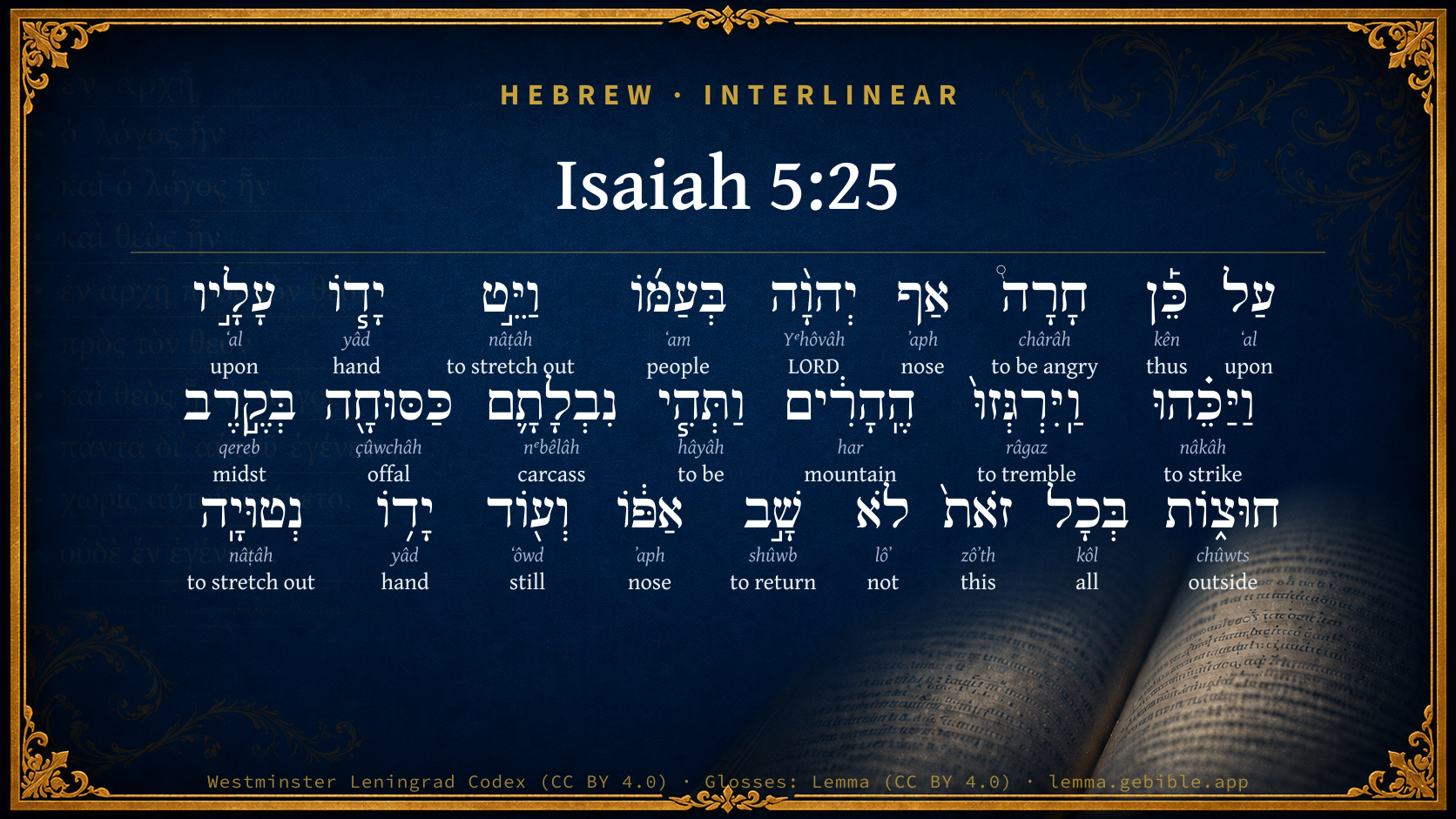
Isaiah 5:25

Hebrew (Westminster Leningrad Codex) Isaiah 5:25 appears in the Hebrew Old Testament. The text above is from the Westminster Leningrad Codex. Each word links to its Strong’s number, a concise gloss, and parsing drawn from the Open Scriptures Hebrew Bible morphology. Click any word for its full Brown-Driver-Briggs (BDB) entry.
Download image
Cite this verse

Isaiah 5:25 (World English Bible). Public Domain. Lemma interlinear Bible study tool, https://lemma.gebible.app/v/isaiah/5/25.

Show BibTeX & RIS
BibTeX
RIS
English Translation
Therefore Yahweh's anger burns against his people, And he has stretched out his hand against them, and has struck them. The mountains tremble, And their dead bodies are as refuse in the midst of the streets. For all this, his anger is not turned away, But his hand is still stretched out.
World English Bible · Public Domain
Highlights
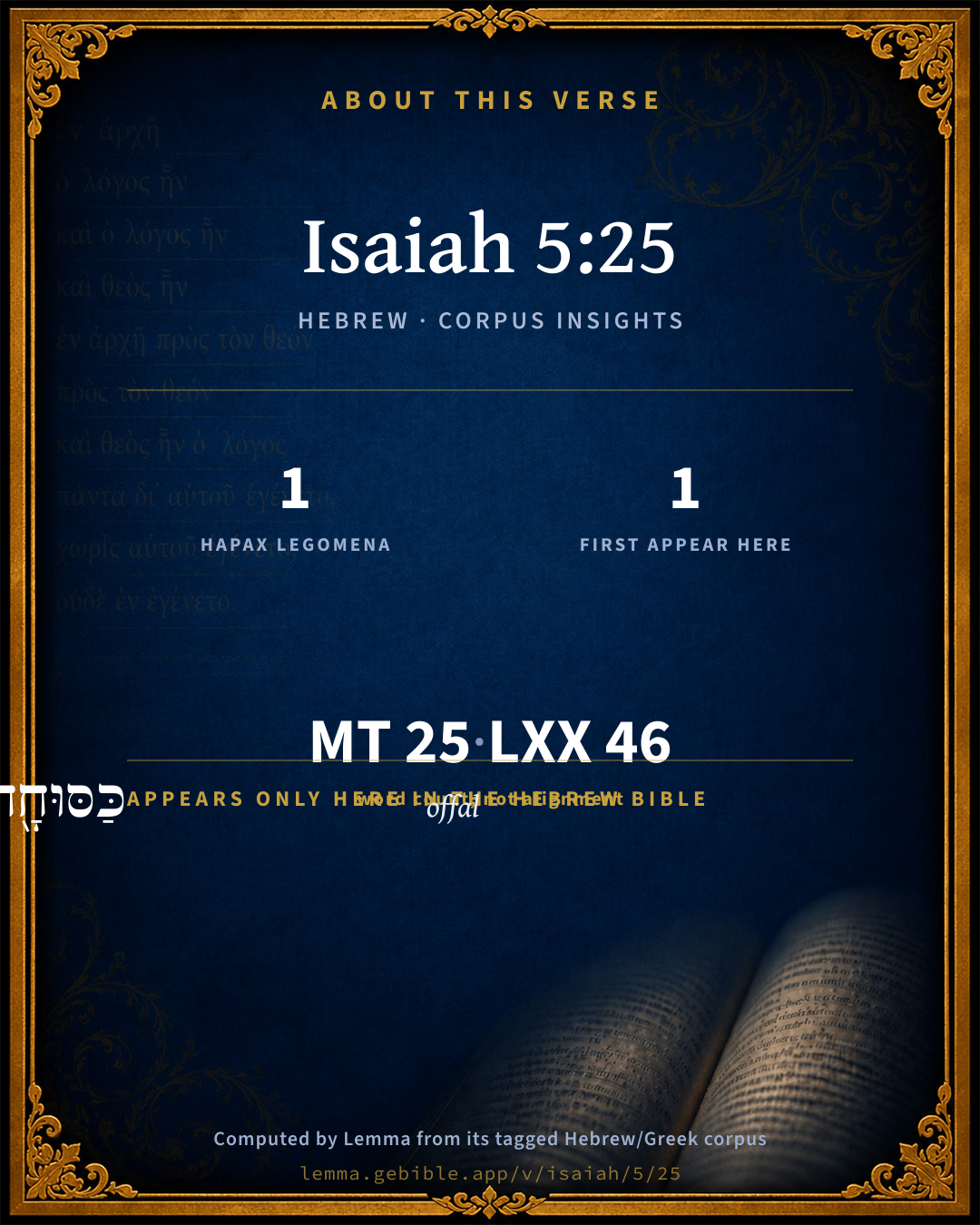
  • 1 hapax legomenon — only here in the Hebrew Bible
  • 1 first appearance in the Hebrew Bible
Full analysis ↓
Download a study sheet

One document with this verse’s original text, its word-by-word gloss line, the meaning frame, cross-references with their text, attributed commentary, and full source and license credits — printable, and it pastes into notes with its structure intact.

This verse Autodidact and up

Study sheet (.html) Plain text (.txt)

A passage Seminary Student

Up to 50 verses in one chapter. A passage sheet keeps up to 6 commentary sources and 12 cross-references per verse, in the order this page ranks them, and says so on the sheet whenever that leaves anything out. Ask for a single verse and you get the Autodidact verse sheet above.

Everything on this page stays free to read, with no account — the sheet is a download of what is already on screen, not access to it.

Want to remove ads? Support Godless Engineer
Compare translations 3

The same verse in 3 English versions, stacked beneath the original-language interlinear above. Click any original word for its lexicon entry.

Each is an independent rendering of the whole verse — the interlinear is not word-aligned to these translations.

Highlighted words mark where these versions differ — a whole-verse word diff, not a word-by-word alignment.

  • World English Bible Public Domain
    Therefore Yahweh's anger burns against his people, And he has stretched out his hand against them, and has struck them. The mountains tremble, And their dead bodies are as refuse in the midst of the streets. For all this, his anger is not turned away, But his hand is still stretched out.
  • King James Version Public Domain
    Therefore is the anger of the LORD kindled against his people, and he hath stretched forth his hand against them, and hath smitten them: and the hills did tremble, and their carcases were torn in the midst of the streets. For all this his anger is not turned away, but his hand is stretched out still.
  • unfoldingWord Literal Text CC BY-SA 4.0
    Therefore the nose of Yahweh burns against his people, and he has stretched out his hand against it and struck it, and the mountains have quaked, and their corpse has become like refuse in the midst of the streets. In all of this, his nose has not turned back, and his hand still stretched out. q1

unfoldingWord Literal Text — © unfoldingWord, licensed CC BY-SA 4.0. Word-aligned USFM3 via Door43 (git.door43.org/unfoldingWord/en_ult).

Versions to compare (up to 4)

3 of 4 selected

Show all 18 translations

Every available English version of this verse, each an independent rendering of the whole verse.

  • World English Bible Public Domain
    Therefore Yahweh's anger burns against his people, And he has stretched out his hand against them, and has struck them. The mountains tremble, And their dead bodies are as refuse in the midst of the streets. For all this, his anger is not turned away, But his hand is still stretched out.
  • Berean Standard Bible Public Domain
    Therefore the anger of the LORD burns against His people; His hand is raised against them to strike them down. The mountains quake, and the corpses lay like refuse in the streets. Despite all this, His anger is not turned away; His hand is still upraised.
  • Majority Standard Bible Public Domain
    Therefore the anger of the LORD burns against His people; His hand is raised against them to strike them down. The mountains quake, and the corpses lie like refuse in the streets. Despite all this, His anger is not turned away; His hand is still upraised.
  • King James Version Public Domain
    Therefore is the anger of the LORD kindled against his people, and he hath stretched forth his hand against them, and hath smitten them: and the hills did tremble, and their carcases were torn in the midst of the streets. For all this his anger is not turned away, but his hand is stretched out still.
  • American Standard Version (1901) Public Domain
    Therefore is the anger of Jehovah kindled against his people, and he hath stretched forth his hand against them, and hath smitten them; and the mountains tremble, and their dead bodies are as refuse in the midst of the streets. For all this his anger is not turned away, but his hand is stretched out still.
  • Revised Version (1885) Public Domain
    Therefore is the anger of the LORD kindled against his people, and he hath stretched forth his hand against them, and hath smitten them, and the hills did tremble, and their carcases were as refuse in the midst of the streets. For all this his anger is not turned away, but his hand is stretched out still.
  • Geneva Bible (1599) Public Domain
    Therefore is the wrath of the Lord kindled against his people, and hee hath stretched out his hand vpon them, and hath smitten them that the mountaines did tremble: and their carkases were torne in the middes of the streetes, and for all this his wrath was not turned away, but his hande was stretched out still.
  • Douay-Rheims (1899) Public Domain
    Therefore is the wrath of the Lord kindled against his people, and he hath stretched out his hand upon them, and struck them: and the mountains were troubled, and their carcasses became as dung in the midst of the streets. For all this his anger is not turned away, but his hand is stretched out still.
  • Young's Literal Translation Public Domain
    Therefore hath the anger of Jehovah burned among His people, And He stretcheth out His hand against it, And smiteth it, and the mountains tremble, And their carcase is as filth in the midst of the out-places. With all this His anger did not turn back, And still His hand is stretched out!
  • Literal Standard Version CC BY-SA 4.0
    Therefore the anger of YHWH has burned among His people, || And He stretches out His hand against it, || And strikes it, and the mountains tremble, || And their carcass is as filth in the midst of the out-places. With all this His anger did not turn back, || And still His hand is stretched out!
  • Unlocked Literal Bible CC BY-SA 4.0
    Therefore the anger of Yahweh is kindled against his people. He has reached out with his hand against them and has punished them. The mountains tremble, and their corpses are like garbage in the streets. In all these things, his anger does not subside; instead, his hand is still stretched out.
  • unfoldingWord Literal Text CC BY-SA 4.0
    Therefore the nose of Yahweh burns against his people, and he has stretched out his hand against it and struck it, and the mountains have quaked, and their corpse has become like refuse in the midst of the streets. In all of this, his nose has not turned back, and his hand still stretched out. q1
  • Darby Bible Public Domain
    Therefore is the anger of Jehovah kindled against his people, and he hath stretched out his hand against them and hath smitten them; and the mountains trembled, and their carcases are become as dung in the midst of the streets. For all this his anger is not turned away, and his hand is stretched out still.
  • World Messianic Bible Public Domain
    Therefore the LORD’s anger burns against his people, and he has stretched out his hand against them and has struck them. The mountains tremble, and their dead bodies are as refuse in the middle of the streets. For all this, his anger is not turned away, but his hand is still stretched out.
  • Webster's Bible Public Domain
    Therefore is the anger of the LORD kindled against his people, and he hath stretched forth his hand against them, and hath smitten them: and the hills trembled, and their carcasses were torn in the midst of the streets. For all this his anger is not turned away, but his hand is stretched out still.
  • Free Bible Version CC BY-SA 4.0
    That's why the Lord burns with anger against his people. He has lifted up his hand and hit them, shaking the mountains, and leaving their corpses lying like refuse in the streets. Despite all this, his anger is not finished, and his hand is still lifted up.
  • Bible in Basic English Public Domain
    For this reason the wrath of the Lord has been burning against his people, and his hand has been stretched out against them in punishment, and the hills were shaking, and their dead bodies were like waste in the open places of the town.
  • JPS Tanakh (1917) Public Domain
    Therefore is the anger of the LORD kindled against His people, and He hath stretched forth His hand against them, and hath smitten them, and the hills did tremble, and their carcasses were as refuse in the midst of the streets. For all this His anger is not turned away, but His hand is stretched out still.

Literal Standard Version (2020), Covenant Press — licensed CC BY-SA 4.0. Text via the HelloAO Bible API (eBible.org). Unlocked Literal Bible (unfoldingWord) — licensed CC BY-SA 4.0. Text via the HelloAO Bible API (eBible.org). unfoldingWord Literal Text — © unfoldingWord, licensed CC BY-SA 4.0. Word-aligned USFM3 via Door43 (git.door43.org/unfoldingWord/en_ult). Free Bible Version, Dr. Jonathan Gallagher — licensed CC BY-SA 4.0. Text via the HelloAO Bible API (eBible.org).

Word by word

More ways to search: Search by grammar → Find every occurrence → Compare this word →

Practice this passage: Drill this verse → Learn its vocabulary →

כַּסּוּחָ֖ה
çûwchâh
H5478
“like/as the · offal”
Preposition, Determined + Noun, Common, Feminine, Singular, Absolute
Part of Speech
Preposition + Noun
Type
Common
Gender
Feminine
Number
Singular
State
Absolute
Full BDB Definition

Origin: from the same as H5477

TWOT: 1473a

offal
  1. עַל ʻal H5921 “upon” Preposition
  2. כֵּ֡ן kên H3651 “thus” Particle, Demonstrative
  3. חָרָה֩ chârâh H2734 “to be angry” Verb, Qal, Perfect, 3rd Person, Masculine, Singular
  4. אַף ʼaph H639 “nose” Particle, Accusative
  5. יְהוָ֨ה Yᵉhôvâh H3068 “LORD” Noun, Proper
  6. בְּעַמּ֜וֹ ʻam H5971 “in/at · people · his” Preposition + Noun, Common, Masculine, Singular, Construct + Suffix, Personal, 3rd Person, Masculine, Singular
  7. וַיֵּ֣ט nâṭâh H5186 “and · to stretch out” Conjunction + Verb, Qal, Sequential Imperfect, 3rd Person, Masculine, Singular
  8. יָד֧וֹ yâd H3027 “hand · his” Noun, Common, Both, Singular, Construct + Suffix, Personal, 3rd Person, Masculine, Singular
  9. עָלָ֣יו ʻal H5921 “upon · him” Preposition + Suffix, Personal, 3rd Person, Masculine, Singular
  10. וַיַּכֵּ֗הוּ nâkâh H5221 “and · to strike · him” Conjunction + Verb, Hiphil, Sequential Imperfect, 3rd Person, Masculine, Singular + Suffix, Personal, 3rd Person, Masculine, Singular
  11. וַֽיִּרְגְּזוּ֙ râgaz H7264 “and · to tremble” Conjunction + Verb, Qal, Sequential Imperfect, 3rd Person, Masculine, Plural
  12. הֶֽהָרִ֔ים har H2022 “the · mountains” Particle, Definite Article + Noun, Common, Masculine, Plural, Absolute
  13. וַתְּהִ֧י hâyâh H1961 “and · to be” Conjunction + Verb, Qal, Sequential Imperfect, 3rd Person, Feminine, Singular
  14. נִבְלָתָ֛ם nᵉbêlâh H5038 “carcass · their” Noun, Common, Feminine, Singular, Construct + Suffix, Personal, 3rd Person, Masculine, Plural
  15. בְּקֶ֣רֶב qereb H7130 “in/at · midst of” Preposition + Noun, Common, Masculine, Singular, Construct
  16. חוּצ֑וֹת chûwts H2351 “streets” Noun, Common, Masculine, Plural, Absolute
  17. בְּכָל kôl H3605 “in/at · all of” Preposition + Noun, Common, Masculine, Singular, Construct
  18. זֹאת֙ zôʼth H2063 “this” Pronoun, Demonstrative, Feminine, Singular
  19. לֹא lôʼ H3808 “not” Particle, Negative
  20. שָׁ֣ב shûwb H7725 “to return” Verb, Qal, Perfect, 3rd Person, Masculine, Singular
  21. אַפּ֔וֹ ʼaph H639 “nose · his” Noun, Common, Masculine, Singular, Construct + Suffix, Personal, 3rd Person, Masculine, Singular
  22. וְע֖וֹד ʻôwd H5750 “and · still” Conjunction + Adverb
  23. יָד֥וֹ yâd H3027 “hand · his” Noun, Common, Both, Singular, Construct + Suffix, Personal, 3rd Person, Masculine, Singular
  24. נְטוּיָֽה nâṭâh H5186 “stretched out” Verb, Qal, Participle Passive, Feminine, Singular, Absolute

About this verse

These counts appear in no published source. They are computed here, from the morphology-tagged text and Lemma’s own curated glosses. What Lemma adds →

25
words
21
distinct lemmas
Prophets
section

Notable vocabulary

1 hapax legomenon — a word that appears only here in the entire Hebrew Bible:

  • כַּסּוּחָ֖ה offal H5478

First appearance in Scripture

This word makes its first canonical appearance in the Hebrew Bible here:

  • כַּסּוּחָ֖ה offal H5478

Shared distinctive vocabulary

וַֽיִּרְגְּזוּ֙ to tremble H7264 occurs in 40 verses of the Hebrew Bible. Also found in:

Grammatical profile

  • 7 verbs
  • 11 nouns
  • 1 pronoun
  • 2 prepositions
  • 1 adverb
  • 3 particles

Verb forms

  • חָרָה֩ Qal · Perfect
  • וַיֵּ֣ט Qal · Sequential Imperfect
  • וַיַּכֵּ֗הוּ Hiphil · Sequential Imperfect
  • וַֽיִּרְגְּזוּ֙ Qal · Sequential Imperfect
  • וַתְּהִ֧י Qal · Sequential Imperfect
  • שָׁ֣ב Qal · Perfect
  • נְטוּיָֽה Qal · Participle Passive

Repetition

Words recur within this verse — often emphatic in Hebrew:

  • עַל upon H5921 ×2
  • אַף nose H639 ×2
  • וַיֵּ֣ט to stretch out H5186 ×2
  • יָד֧וֹ hand H3027 ×2

Hebrew & Septuagint length

In English translation the verse runs 52 words from the Hebrew and 56 from the Septuagint (LXX English) — closely comparable.

A rough comparison of the two English renderings, which tokenize alike — not a word-level alignment.

Word counts can differ between the Hebrew and the Greek without any difference in meaning — e.g. the Hebrew direct-object marker אֵת has no separate Greek word, and Greek often adds the article ὁ.

In the original languages it is 25 Hebrew tokens and 46 Greek tokens — but the two are counted differently (Hebrew bundles its prefixes and suffixes into one token; the Greek is in lemma form), so that isn’t a like-for-like length.

Cross-references

38

Topical passages linked to Isaiah 5:25 in the Treasury of Scripture Knowledge — connected by theme and wording, ordered by reader-vote popularity; previews shown in the World English Bible.

  • Isaiah 9:21 Manasseh, Ephraim; and Ephraim, Manasseh; and they together shall be against Judah. For all this his anger is not turned away, but his hand is stretched out still.
  • Isaiah 10:4 They shall only bow down under the prisoners, and shall fall under the slain. For all this his anger is not turned away, but his hand is stretched out still.
  • 2 Kings 9:37 and the body of Jezebel shall be as dung on the face of the field in the portion of Jezreel, so that they shall not say, This is Jezebel.
  • Isaiah 9:17 Therefore the Lord will not rejoice over their young men, neither will he have compassion on their fatherless and widows; for everyone is profane and an evil-doer, and every mouth speaks folly. For all this his anger is not turned away, but his hand is stretched out still.
  • Jeremiah 4:24 I saw the mountains, and, behold, they trembled, and all the hills moved back and forth.
  • Daniel 9:16 Lord, according to all your righteousness, let your anger and please let your wrath be turned away from your city Jerusalem, your holy mountain; because for our sins, and for the iniquities of our fathers, Jerusalem and your people are become a reproach to all who are round about us.
  • 2 Chronicles 36:16 but they mocked the messengers of God, and despised his words, and scoffed at his prophets, until the wrath of Yahweh arose against his people, until there was no remedy.
  • Psalms 18:7 Then the earth shook and trembled. The foundations also of the mountains quaked and were shaken, Because he was angry.
  • Jeremiah 16:4 They shall die grievous deaths: they shall not be lamented, neither shall they be buried; they shall be as dung on the surface of the ground; and they shall be consumed by the sword, and by famine; and their dead bodies shall be food for the birds of the sky, and for the animals of the earth.
  • Nahum 1:5 The mountains quake before him, and the hills melt away. The earth trembles at his presence, yes, the world, and all who dwell in it.
  • 1 Thessalonians 2:16 forbidding us to speak to the Gentiles that they may be saved; to fill up their sins always. But wrath has come on them to the uttermost.
  • Hosea 14:4 "I will heal their waywardness. I will love them freely; For my anger is turned away from him.
  • Micah 1:4 The mountains melt under him, And the valleys split apart, Like wax before the fire, Like waters that are poured down a steep place.
  • Habakkuk 3:10 The mountains saw you, and were afraid. The tempest of waters passed by. The deep roared and lifted up its hands on high.
  • Zephaniah 1:17 I will bring distress on men, that they will walk like blind men, because they have sinned against Yahweh, and their blood will be poured out like dust, and their flesh like dung.
  • Revelation 20:11 I saw a great white throne, and him who sat on it, from whose face the earth and the heaven fled away. There was found no place for them.
  • Leviticus 26:14–46 "'But if you will not listen to me, and will not do all these commandments;
  • Deuteronomy 31:17 Then my anger shall be kindled against them in that day, and I will forsake them, and I will hide my face from them, and they shall be devoured, and many evils and troubles shall come on them; so that they will say in that day, Haven't these evils come on us because our God is not among us?
  • Deuteronomy 32:19–22 Yahweh saw [it], and abhorred [them], Because of the provocation of his sons and his daughters.
  • 1 Kings 14:11 Him who dies of Jeroboam in the city shall the dogs eat; and him who dies in the field shall the birds of the sky eat: for Yahweh has spoken it.
  • 1 Kings 16:4 Him who dies of Baasha in the city shall the dogs eat; and him who dies of his in the field shall the birds of the sky eat.
  • 1 Kings 21:24 Him who dies of Ahab in the city the dogs shall eat; and him who dies in the field shall the birds of the sky eat.
  • 2 Kings 13:3 The anger of Yahweh was kindled against Israel, and he delivered them into the hand of Hazael king of Syria, and into the hand of Benhadad the son of Hazael, continually.
  • 2 Kings 22:13–17 Go you, inquire of Yahweh for me, and for the people, and for all Judah, concerning the words of this book that is found; for great is the wrath of Yahweh that is kindled against us, because our fathers have not listened to the words of this book, to do according to all that which is written concerning us.
  • Psalms 68:8 The earth trembled. The sky also poured down rain at the presence of the God of Sinai-- At the presence of God, the God of Israel.
  • Psalms 77:18 The voice of your thunder was in the whirlwind. The lightnings lit up the world. The earth trembled and shook.
  • Psalms 78:38 But he, being merciful, forgave iniquity, and didn't destroy them. Yes, many times he turned his anger away, And didn't stir up all his wrath.
  • Psalms 83:10 Who perished at Endor, Who became as dung for the earth.
  • Psalms 106:40 Therefore Yahweh burned with anger against his people. He abhorred his inheritance.
  • Psalms 114:7 Tremble, you earth, at the presence of the Lord, At the presence of the God of Jacob,
  • Isaiah 9:12–13 the Syrians before, and the Philistines behind; and they shall devour Israel with open mouth. For all this his anger is not turned away, but his hand is stretched out still.
  • Isaiah 14:26–27 This is the purpose that is purposed on the whole earth; and this is the hand that is stretched out on all the nations.
  • Jeremiah 4:8 For this gird you with sackcloth, lament and wail; for the fierce anger of Yahweh hasn't turned back from us.
  • Jeremiah 8:2 and they shall spread them before the sun, and the moon, and all the host of the sky, which they have loved, and which they have served, and after which they have walked, and which they have sought, and which they have worshiped: they shall not be gathered, nor be buried, they shall be for dung on the surface of the earth.
  • Jeremiah 9:22 Speak, Thus says Yahweh, The dead bodies of men shall fall as dung on the open field, and as the handful after the harvester; and none shall gather [them].
  • Jeremiah 15:3 I will appoint over them four kinds, says Yahweh: the sword to kill, and the dogs to tear, and the birds of the sky, and the animals of the earth, to devour and to destroy.
  • Lamentations 2:1–3 How has the Lord covered the daughter of Zion with a cloud in his anger! He has cast down from heaven to the earth the beauty of Israel, And hasn't remembered his footstool in the day of his anger.
  • Lamentations 5:22 But you have utterly rejected us; You are very angry against us.

Cross-references courtesy of OpenBible.info (CC BY 4.0).

Hebrew and Greek witnesses Masoretic Hebrew ↔ Greek Septuagint

The same verse in the two great witnesses to the Old Testament, shown verse-for-verse.

These are two independent witnesses, not word-aligned to each other, and the Septuagint is shown in lemma (dictionary) form.

Hebrew Isaiah 5:25 Masoretic · Westminster Leningrad Codex

עַל כֵּ֡ן חָרָה֩ אַף יְהוָ֨ה בְּעַמּ֜וֹ וַיֵּ֣ט יָד֧וֹ עָלָ֣יו וַיַּכֵּ֗הוּ וַֽיִּרְגְּזוּ֙ הֶֽהָרִ֔ים וַתְּהִ֧י נִבְלָתָ֛ם כַּסּוּחָ֖ה בְּקֶ֣רֶב חוּצ֑וֹת בְּכָל זֹאת֙ לֹא שָׁ֣ב אַפּ֔וֹ וְע֖וֹד יָד֥וֹ נְטוּיָֽה

Therefore Yahweh's anger burns against his people, And he has stretched out his hand against them, and has struck them. The mountains tremble, And their dead bodies are as refuse in the midst of the streets. For all this, his anger is not turned away, But his hand is still stretched out.

World English Bible · Public Domain

Greek LXX Isaiah 5:25 Septuagint · lemma form

καί θυμόω ὀργή κύριος σαβαωθ ἐπί ὁ λαός αὐτός καί ἐπιβάλλω ὁ χείρ αὐτός ἐπί αὐτός καί πατάσσω αὐτός καί παραὀξύνω ὁ ὄρος καί γίγνομαι ὁ θνησιμαῖος αὐτός ὡς κόπριον ἐν μέσος ὁδός καί ἐν πᾶς οὗτος οὐ ἀποστρέφω ὁ θυμός ἀλλά ἔτι ὁ χείρ ὑψηλός

Therefore the Lord of hosts was greatly angered against his people, and he reached forth his hand upon them, and struck them: and the mountains were troubled, and their carcasses were as dung in the midst of the way: yet for all this his anger has not been turned away, but his hand is yet raised.

LXX2012 (modern English Septuagint) · Public Domain

On this verse, John Gill's Exposition discusses the Septuagint’s reading. Read the note in Commentary ↓

Hebrew: Westminster Leningrad Codex (CC BY 4.0). Greek: Septuagint (public domain); English from LXX2012 (modern English Septuagint) (Public Domain). How the Septuagint differs from the Hebrew →

Targum (Aramaic paraphrase)

1

The Targum is the ancient Jewish Aramaic paraphrase of the Hebrew Scriptures — an interpretive translation, not the Hebrew text itself. Onkelos (literal) and Pseudo-Jonathan (expansive) render the Torah, and Jonathan the Prophets. Coverage is partial: where no permissively-licensed English translation exists for a verse, only the Aramaic is shown. This is verse-level text, not a word-by-word alignment to the Hebrew.

  1. Targum Jonathan Prophets (Joshua–Malachi)
    עַל כֵּן תְּקֵיף רוּגְזָא דַייָ צְבָאוֹת בְּעַמֵיהּ וַאֲרִים מְחַת גְבוּרְתֵּיהּ עֲלֵיהוֹן כַּד מְחָנוּן וְזָעוּ טוּרַיָא וַהֲוָאָה נְבֶלְתְּהוֹן מְשַׁגְרָן כְּסָחִיתָא בְּגוֹ שׁוּקַיָא בְכָל דָא לָא תָבוּ מֵחוֹבֵיהוֹן דִיתוּב רוּגְזֵיהּ מִנְהוֹן וְעַד כְּעַן מַתְקְפִין מַרְדֵיהוֹן וְעוֹד מַחֲתֵיהּ עֲתִידָא לְאִתְפְּרַע מִנְהוֹן:

    Therefore is the anger of the Lord of hosts mighty against His people, and He has lifted the stroke of His power upon them. When He smote them, then the mountains moved, and their carcasses were cast out as dung into the midst of the streets. By all this they turn not away from their sins, that His fury may turn away from them; but until now their rebellion groweth stronger, and His stroke is again to take vengeance on them.

    Targum Jonathan — Aramaic: “Mikraot Gedolot” (public domain). English: “Sefaria Community Translation” (CC0 1.0 (public-domain dedication)); “London "Chaldee Paraphrase," 1871” (public domain). Text via Sefaria.

Commentary

Notes on Isaiah 5:25 from classic Christian and Jewish commentators (each source and its license shown beneath its notes). The classic Christian expositions comment on the surrounding passage and are grouped to its opening verse, so a note may address several verses; the Jewish commentaries on the Tanakh (Rashi and others) are per-verse, so they appear only where the commentator wrote on this verse.

Lemma curates 59 commentaries, every one of them public domain or Creative Commons licensed, each selected and text-cleaned for this edition rather than reprinted as found. About our sources →

The Cambridge Bible for Schools and Colleges

gen. ed. J. J. S. Perowne

25. Therefore] The Hebr. word differs from that in Isa_5:13-14; Isa_5:24, and agrees with that in Isa_9:17. The following tenses are perfects (or consec. impf.) usually taken as prophetic pert.; but this is scarcely natural. Past judgments are probably referred to (see on Isa_9:8 ff.). Some think of a pestilence (Amo_4:10), pestilence being preeminently the stroke of God (he hath smitten them); others (from the next clause) of an earthquake. Both may be meant.

their carcases were torn] rather, were as offal, a very common figure (2Ki_9:37; Jer_16:4; Jer_25:33; Zep_1:17; Psa_83:10).

For all this …] See on ch. Isa_9:12.

25–30. A warlike Nation, summoned from the Ends of the Earth, is the destined Instrument of Israel’s final Chastisement

That the Assyrians are here alluded to is certain both from the explicit statements of later prophecies, and from the terms of the description itself. It speaks of the foe as characterised by the rapidity of his movements, the perfection of his discipline and military equipment, his love of conquest, and his irresistible might. These features are no doubt highly idealised (as was natural in a first sketch), but it is clear that some particular nation is meant, and we can have no hesitation in saying that the reference is to the most perfect military machine that then existed, the Assyrian army.

Although the passage might be explained fairly enough as the continuation of Isa_5:24, it gains immensely in significance when read as the final strophe of the prophecy in ch. Isa_9:8 to Isa_10:4, a position to which several considerations lead us to assign it. (1) The latter part of Isa_5:25 occurs as a refrain in Isa_9:12; Isa_9:17; Isa_9:21 and Isa_10:4. It is found nowhere else and its isolated occurrence in Isa_5:25 distinctly weakens the force of Isa_5:24. (2) The four equal strophes of Isa_9:8 to Isa_10:4 correspond very nearly in length with Isa_5:26-30. (3) After reading Isa_10:4, we feel that the last word has not been spoken: the hand is still outstretched, we wait to hear of the final blow. The verses before us supply the appropriate climax. On the other hand, they are not necessary where they stand, Isa_5:24 affording a satisfactory conclusion. The hypothesis, to be sure, does not remove every difficulty. It is vain to speculate as to the reasons which may have led to the transference; although it might have been suggested by the appositeness of the passage as a reply to the challenge of Isa_5:19. Further, Isa_5:25 is far too short for a complete strophe, and therefore can hardly have followed immediately on Isa_10:4. We must suppose that some verses have been omitted in the process of transference, as irrelevant in their new context.

The Cambridge Bible for Schools and Colleges (gen. ed. J. J. S. Perowne; Cambridge University Press, 1878–1918) — public domain. Text from a community e-Sword module.

Trapp's Complete Commentary

John Trapp

Isa 5:25 Therefore is the anger of the LORD kindled against his people, and he hath stretched forth his hand against them, and hath smitten them: and the hills did tremble, and their carcases [were] torn in the midst of the streets. For all this his anger is not turned away, but his hand [is] stretched out still.

Ver. 25. Therefore is the anger of the Lord kindled.] For contempt of the law, but especially of the gospel, "wrath came upon" that wretched people of the Jews "to the utmost," {1Th 2:16} or until the end, as some read it. They are to this day a people of God’s wrath and curse, and become a woeful example of that rule, Atrocia delicta puniuntur atrocibus poenis, Heinous sins bring heavy punishments. This desolation of theirs (as Daniel prophesieth, Dan 9:27) shall continue to the end.

And he hath stretched forth his hand against them.] His mighty hand, as St James hath it, wherewith he oft leaveth bloody wales on the backs of the best when they provoke, but crusheth the wicked in pieces, and crumbleth them to shreds.

And hath smitten them.] Revenge is the next effect of anger.

And the hills did tremble,] {a} i.e., The highest among them; or, literally, the senseless hills seemed sensible of so great displeasure.

And their carcases were torn in the midst of the streets.] What havoc there was made of men at the last destruction of Jerusalem, Josephus, Egesippus, Orosius, and Eusebius fully tell us. What with the extremity of famine, what with the fury of the sword, and what with sickness during the siege, there perished about 600,000 able men; or, as others say, 1,100,000, besides 97,000 carried captive. Titus, the Roman general, seeing the infinite number of carcases of the Jews cast out unburied without the walls of the city was much grieved, and took God to witness that he was not the author of that calamity, but that the fault was altogether in those stubborn Jews, that held out the city against him. {b}

For all this his anger is not turned away.] With those "froward ones God will show himself froward," {Psa 18:26} and not give place to their pertinacity, till they have enough of it. It must be a humble submission that pacifieth God’s wrath.

{a} Hyperbole.

{b} Josephus.

John Trapp, A Commentary or Exposition upon All the Books of the Old and New Testament (1647–1656) — public domain. Text from a community e-Sword module.

The Biblical Illustrator

Joseph S. Exell

Isa_5:25-30

Therefore is the anger of the Lord kindled against His people

The prophecy explained

Jehovah is about to bring foreign armies as the instruments of His judgment; the vision of the worst of human calamities--the invasion of a rich, civilised, luxurious nation by overwhelming hordes of barbarians--rises before the prophet: he speaks of them as present, and his words have a terrible force to him who reads them now, while he thinks of their fearful import then.

Jehovah has set up a standard to which He is gathering the nations under the Assyrian rule, and the prophet sees them steadily though swiftly coming on in war-like array--bowmen, horses and chariots: they rush to battle with the roar of lions, they seize and hold down their prisoners and their booty with the growl which marks the lions refusal to give up his prey; they come on like the sea in its rage; and when the helpless in, habitant of Judah turns from this rising tide to the land--his own land--he sees only the darkness of woe; and when he turns again from the earth to look upward he sees only the thick clouds gathering over the heavens above him. (Sir E. Strachey, Bart.)

Prophecy perpetually fulfilled

This is such a picture of the life of things that it is equally the description of the same judgment of God in whatever age or to whatever nation occurring. In successive ages it told the Jew of the Assyrian, the Babylonian, the Greek and the Roman; to the subject of the Roman Empire it spoke no less clearly of the Goth and the Vandal; the British monk must have recalled it in the days when Gildas learnt its truth from the Dane and the Norman and the Spaniard from the Mohammedan; the Byzantine from Timour the incarnate wrath of God; the continental nations from the revolutionary armies and Napoleon; and, in our own day, the people of France from the Germans. (Sir E. Strachey, Bart.)

Gods anger and its manifestation

I. IN GODS INFINITE NATURE THERE IS THE QUALITY OF ANGER. It is not a stormy passion, like wrath in sinful man, but the settled, intense, burning antagonism to moral evil which must necessarily exist in one who is infinitely perfect. The man who most nearly resembles God will be angry and sin not?

II. GODS ANGER MAY BE KINDLED BY THE SPIRIT AND CONDUCT OF HIS PEOPLE. Therefore is the anger of the Lord kindled against His people. Guilt is in proportion to the light and privilege abused.

III. GODS ANGER MAY MANIFEST ITSELF IN ACTUAL AND FEARFUL PUNISHMENT. It is an active antagonism to moral evil. He hath stretched forth His hand against them, etc. The hand of God is the symbol of His mighty power. It is a fearful thing to fall, etc. (H. M. Booth.)

Hills trembling

(Isa_5:25):--The words seem to allude to the tremor occasioned by the stroke of the workmans hammer upon some hard body. (R. Macculloch.)

Horses hoofs as flint

(Isa_5:28):--Therefore he will not shrink from riding them on the rocky soil of Palestine, which was extremely unfavourable to the use of horses (Amo_6:12). Similar allusions are frequent in ancient literature, the shoeing of horses being unknown in antiquity. (Prof. J. Skinner, D. D.)

A darkened heaven

(Isa_5:30):--It is our wisdom, by keeping a good conscience, to keep all clear between us and heaven, that we may have light from above, when clouds and darkness are round about us. (M. Henry.)

.

The Biblical Illustrator, edited by Joseph S. Exell (c. 1880s–1900s) — public domain. Text from a community e-Sword module.

Joseph Benson's Commentary

Isa 5:25. Therefore is the anger of the Lord kindled — This implies that, before the time of that final vengeance, concerning which the prophecy principally treats, God had afflicted, or, rather, would afflict and chastise this rebellious people, with the most grievous calamities: that those calamities should consume many, who, being slain in the wars, should be trod upon by their enemies, like the dung in the streets; most certain indications these of the divine justice and wrath, while they, unawakened by these chastisements, would not so much as attempt to appease the divine displeasure, but would provoke it still more by repeated crimes; till, at length, it should come upon them to the uttermost. — Vitringa. And the hills did tremble — A metaphorical and hyperbolical description of a grievous calamity, familiar to the prophets: see the margin. For all this, his anger is not turned away, &c. — This is not the end, as you vainly imagine, but, if you repent not, only the beginning of your sorrows, and an earnest of further miseries.

Joseph Benson's Commentary on the Old and New Testaments (1811–1818) — public domain. Text from a community e-Sword module.

Tyndale Open Study Notes

Tyndale Open Resources

5:25 mountains tremble: God’s wrath against sinners is often expressed as the shaking of the earth’s foundations (13:13; 23:11; 24:18-19; 29:6; 54:10). God’s appearance in judgment or salvation in natural phenomena such as smoke, darkness, lightning, and earthquake is called a theophany (see 6:1-4, 6; 13:13; Exod 19:18-19; Ps 18:7-15; Mic 1:3-4; Rev 8:5; 16:17-18; 18:21-22).

Tyndale Open Study Notes — © Tyndale Open Resources, licensed CC BY-SA 4.0. Text via the HelloAO Bible API.

Geneva Bible (1599)

Geneva Bible translators

He showeth that God had so sore punished this people, that the dumb creatures, if they had been so plagued, would have been more sensible, and therefore his plagues must continue, till they begin to feel them.

Geneva Bible (1599) marginal notes — public domain. Text via Bolls.life.

Jamieson, Fausset & Brown

Robert Jamieson, A. R. Fausset & David Brown

anger . . . kindled-- (Kg2 22:13, Kg2 22:17).

hills . . . tremble--This probably fixes the date of this chapter, as it refers to the earthquake in the days of Uzziah (Amo 1:1; Zac 14:5). The earth trembled as if conscious of the presence of God (Jer 4:24; Hab 3:6).

torn--rather, were as dung (Psa 83:10).

For all this, &c.--This burden of the prophet's strains, with dirge-like monotony, is repeated at Isa 9:12, Isa 9:17, Isa 9:21; Isa 10:4. With all the past calamities, still heavier judgments are impending; which he specifies in the rest of the chapter (Lev 26:14, &c.).

Jamieson, Fausset & Brown — Commentary Critical and Explanatory on the Whole Bible (1871) — public domain (CC PDM 1.0). Text via the HelloAO Bible API.

Adam Clarke's Commentary

Verse 25. The hills did tremble - "And the mountains trembled"] Probably referring to the great earthquakes in the days of Uzziah king of Judah, in or not long before the time of the prophet himself, recorded as a remarkable era in the title of the prophecies of Amos., Am 1:1, and by Zechariah, Zec 14:5.

Adam Clarke's Commentary on the Bible (1810–1826) — public domain. Text from a community e-Sword/MySword module.

Ellicott's Commentary for English Readers

(25) The hills did tremble.—We again trace the influence of the earthquake which was still fresh in the memories of men. (See Note on Isa_2:10.)

Their carcases were torn.—Better, were as sweepings, or, as refuse. The words may point either to pestilence, or war, or famine. The stress laid on scarcity in Isa_5:10 makes it probable that the last was prominent in the prophet’s mind.

For all this his anger is not turned away.—The same formula meets us in Isa_9:12; Isa_9:21; Isa_10:4; Isa_14:27, with a solemn knell-like iteration. It bids the people remember after each woe that this is not all. They do not as yet see the end of the chastisement through which God is leading them. “For all this” may mean (1) because of all the sins, or (2) notwithstanding all the punishment already inflicted. (Comp. Lev_26:18; Lev_26:23.)

A Bible Commentary for English Readers, edited by Charles John Ellicott (1878–1897) — public domain. Text from a community e-Sword module.

John Gill's Exposition

Therefore is the anger of the Lord kindled against his people,.... His professing people; which character, as it aggravated their sin in rejecting and despising the word of the Lord, so it increased his anger and indignation against them:

and he hath stretched forth his hand against them, and hath smitten them; which some understand of past judgments and afflictions upon them, under Joash, Amaziah, and Ahaz; and others of future ones, under Shalmaneser and Nebuchadnezzar:

and the hills did tremble; which Jarchi interprets of their kings and princes; or it may be only a figurative expression, setting forth the awfulness of the dispensation:

and their carcasses were torn in the midst of the streets. The Targum renders it, "were as dung"; so the Septuagint, Vulgate Latin, and Arabic versions; being slain there, and lying unburied, were trampled upon, and trodden down like "clay", as the Syriac version; or like the mire of the streets.

For all this his anger is not turned away; this being abundantly less than their sins deserved; which shows how great were their sins, and how much the Lord was provoked to anger by them:

but his hand is stretched out still; to inflict yet sorer judgments. The Targum is

"by all this they turn not from their sins, that his fury may turn from them; but their rebellion grows stronger, and his stroke is again to take vengeance on them;''

which expresses their impenitence and hardness of heart, under the judgments of God, which caused him to take more severe methods with them.

John Gill's Exposition of the Whole Bible (1746–1763) — public domain (CC PDM 1.0). Text via the HelloAO Bible API.

Albert Barnes' Notes on the Bible

Therefore is the anger of the Lord kindled - The Lord is “enraged,” or is angry. Similar expressions often occur; Num 11:33; 2Ki 23:26; Deu 11:17; Psa 56:1-13 :40; Job 19:11; Psa 2:12. The “cause” of his anger was the crimes which are specified in this chapter.

And he hath stretched forth his hand - To stretch forth the hand may be an action expressive of protection, invitation, or punishment. Here it is the latter; compare Isa 14:27.

And hath smitten them - Punished them. To what this refers particularly is not clear. Gesenius supposes that the expressions which follow are descriptive of pestilence. Lowth and Rosenmuller suppose that they refer to the earthquakes which occurred in the days of Uzziah, and in the time of the prophets; Amo 1:1; Zec 14:5. The words, perhaps, will bear either construction.

And the hills did tremble - This expression is one that is often used in the Scriptures to denote the presence and anger of God. It is well adapted to describe an earthquake; but it is also often used poetically, to describe the presence and the majesty of the Most High; compare Psa 144:5; Job 9:6; Job 26:11; Psa 114:7; Jer 4:24; Hab 3:10; Psa 18:7; Psa 97:5; Psa 104:32. The image is one that is very sublime. The earth, as if conscious of the presence of God, is represented as alarmed, and trembling. Whether it refers here to the earthquake, or to some other mode of punishment, cannot be determined. The fact, however, that such an earthquake had occurred in the time of Isaiah, would seem to fix the expression to that. Isaiah, from that, took occasion also to denounce future judgments. This was but the beginning of woes.

And their carcasses were torn - The margin here is the more correct translation. The passage means that their dead bodies were strewed, unburied, like filth, through the streets. This expression would more naturally denote a pestilence. But it may be descriptive of an earthquake, or of any calamity.

For all this - Notwithstanding all this calamity, his judgments are not at an end. He will punish the nation more severely still. In what way he would do it, the prophet proceeds in the remainder of the chapter to specify; compare Isa 9:12; Isa 10:4.

Albert Barnes' Notes on the Bible (1834–1885) — public domain. Text from a community e-Sword/MySword module.

Haydock's Catholic Bible Commentary

Still. After the ruin of Jerusalem, the people were led away. (Calmet) --- Grievous sins must be severely punished, as was that of the murderers of Christ. (Worthington)

George Leo Haydock (1774–1849), Haydock's Catholic Family Bible and Commentary, 1859 edition — public domain. Excludes Psalms (Douay-Rheims chapter numbering differs from Protestant) and Deuterocanonical books (Catholic canon only).

Matthew Poole's English Annotations

The hills did tremble; a metaphorical and hyperbolical description of a grievous calamity, familiar in the prophets, as Isa 64:1,2; Jer 4:24, and in other authors.

His hand is stretched out still, ready to give you another and a sorer blow. This is not the end, as you vainly imagine, but, if you repent not, the beginning, of your sorrows, and an earnest of further calamities.

Matthew Poole's English Annotations on the Holy Bible (1683–1685) — public domain. Text from a community e-Sword/MySword module.

Whedon's Commentary on the Bible

Daniel D. Whedon

25. The declaration just made is virtually repeated here, probably as a backing to the closing refrain. The verbs of this verse are of the prophetic preterite for future; that is, the ideal standpoint is in the future, from which the prophet sees, in the past, wave after wave of divine judgment rapidly following each other over the nation.

For all this — In all this, or notwithstanding all this, God shall inflict still other judgments. Though the blows be heavy, his anger, or ethical intuition, abates not, because his judgments do not, as intended, bring the people to repentance.

Lev_26:18; Lev_26:23; Lev_26:27. (See this dirge-like strain repeated in Isa_9:12; Isa_9:17, and Isa_10:4.)

Daniel D. Whedon (gen. ed.), Commentary on the Old and New Testaments (1874–1909) — public domain. Text from a community e-Sword module.

The Pulpit Commentary

Vers. 25-30. THE NATURE OF THE COMING JUDGMENT EXPLAINED. Hints have been already given that the judgment which is to fall on the nation is a foreign war, or a series of foreign wars (see Isa_3:25; 5:13). But now for the first time a terrible invasion, in which many nations will participate, is clearly announced. At first the imagery is obscure (ver. 25), but it soon grows more distinct. "Nations" are summoned to the attack; a vast army comes, and comes" with speed swiftly" (ver. 26); then their array is described (vers. 27, 28); and finally their ravin is compared to that of lions, and their success in catching and carrying off their prey is prophesied (ver. 29). In the last verse of the chapter the prophet falls back into vaguer imagery, comparing the roar of the invaders to the roaring of the sea, and the desolated land to one seen under the gloom of a preternatural darkness (ver. 30).

The threats of this verse are all vague and general, for there is no reason to suppose that the phrase," the hills did tremble, "refers to an actual earthquake. That there was an earthquake in the reign of Uzziah is, indeed, clear from Amo_1:1; but it was probably a thing of the past when Isaiah wrote this chapter, and he is spiking of the future. A "trembling of the hills" is, in prophetic language, a commotion among the chief men of the land. He hath stretched forth his hand. Again the "perfect of prophetic certitude." Their carcasses were torn; rather, were as refuse. (comp. Lam_3:45) There would be many slain, and lying unburied, in the streets of Jerusalem. For all this, etc.. (comp. Isa_9:12, Isa_9:17, Isa_9:21, and Isa_10:4, where the same words are used as a refrain) The words imply that God"s judgment upon Judah will not be a single stroke, but a continuous smiting, covering some considerable space of time.

Vers. 25-29. Wicked men used by God as instruments for working out his purposes.

The psalmist declares the wicked to be "God"s sword". (Psa_17:13) In a later chapter Isaiah calls Assyria "the rod of God"s anger". (Isa_10:5) Nothing is more clearly set forth in the prophetical writings than the fact that

I CONQUERING NATIONS ARE RAISED UP BY GOD TO CHASTISE THE NATIONS THAT ARE HIS ENEMIES.

1. Assyria was "the axe" with which God hewed down offending peoples, (Isa_10:14) "the rod" wherewith he smote them. God exalted her, in order that she might "lay waste defensed cities into ruinous heaps". (Isa_37:26) This was her raison d"etre, the purpose of her existence. (Isa_37:26) She was sent against one openly wicked or "hypocritical nation" after another, and given a charge "to take the spoil, and to take the prey, and to tread them down like the mire in the streets". (Isa_10:6)

2. Babylon was raised up for the castigation of Tyre, (Eze_26:7) of, (Eze_29:19, 20 30:10-26) and of Judah. (Jer_25:9)

3. Media and Persia were raised up to work the will of God upon Assyria and Babylon. (Isa_13:17 Isa_21:2 Jer_51:11, etc.)

4. Greece and Macedon were raised up to punish Persia and Media; (Dan_8:5-8) and so on. Each of these nations was ungodly full of impurity, pride, selfishness, greed, cruelty. Yet God made use of them for his purposes, and does not scruple to call their rulers his servants," "his shepherds," "those who performed all his pleasure". (Isa_44:28 Jer_25:11 Jer_27:6, etc.)

II BAD MEN ARE EXALTED TO POWER TO CHASTISE BOTH NATIONS AND INDIVIDUALS. Samson, Sennacherib, and Nebuchadnezzar seem to have been rather instruments for punishing nations and states. But such men as Joab, Jehu, Hazael, effected God"s purposes mainly with respect to individuals. God made use of them, and of their sinful tempers, to execute vengeance upon certain special offenders. Jehu was anointed king by God"s prophet to punish Jezebel and the house of Ahab. (2Ki_9:2-26 2Ki_10:1-11) Fired by ambition, he rushed into crime, and "the blood of Jezreel" was afterwards avenged upon his house. (Hos_1:4) But for Joab the crimes of Abner and of Absalom would probably have gone unpunished. He may be viewed as God"s instrument to requite their ill deeds; but as he punished the one treacherously and the other against his king"s commands, their blood, or at any rate that of Abner, "returned upon the head of Joab". (1Ki_2:33) Hazael"s case is like that of Jehu, only not set before us with such distinctness. He was "God"s sword" to the wicked Benhadad; but not thereby excused. God turns the wickedness of men into particular channels, making it effect his ends; but it is wickedness none the less.

The unappeasable wrath of Jehovah.

I "OUR GOD IS A CONSUMING FIRE." Whether to burn and destroy the moral refuse of a people, to chasten and refine its remnant and elect, he is revealed as the pure Flame. The Gentiles had a deep sense of the national significance of fire, as the pure element not to be united with aught foreign to itself. In their simple way, the hymns of the Veda to Agni, the god of fire, betray this feeling; and, again, the idea, in Greek and Roman religion, of Hestia or Vesta, on whose altar the fire was kept ever burning, who refused to wed," whose priestesses must be virgins.

II WAR THE SCOURGE OF GOD. Deep has been the sense also of this truth. There is an obscure perception in the minds of men that war, with its attendant horrors, comes as a retribution. Attila the Hun was spoken of as the "scourge of God." To have seen a fair city black with smoking ruins, and corpses lying in its streets, is to have read with ineffaceable impressions the lesson that "it is a fearful thing to fall into the hands of the living God." There are moments when the solid base of things seems trembling beneath our feet, the "eternal hills" as floors trembling beneath the awful tread of the Eternal as he "cometh to judge the earth.

III THE DURATION OF PUNISHMENT. It seems as if it could not be exhausted, so vast is the mass of guilt to be purged away. A protracted war, a dragging famine, a prolonged season of ruin, seem, as we say in common speech, "interminable." The broad blue heaven, that seemed in sunny days as a benignant hand outspread above mankind, wears the expression of a stern and relentless frown. Long scores must be followed by long payment. The guilt of centuries cannot be wiped out in a day. Divine judgment may require even the obliteration of a whole people. But the individual may be saved. At no time are Jehovah"s "mercies clean forgotten." In the saddest times, the repentant heart pierces through the gloom to the sanctuary and heart of him who slays to make alive, who by means of war reconciles to himself in Christ Jesus. J.

The Pulpit Commentary (1880–1919), ed. H.D.M. Spence-Jones & Joseph S. Exell — public domain. Text from a community e-Sword module.

Keil & Delitzsch

C. F. Keil & F. Delitzsch

"Therefore is the wrath of Jehovah kindled against His people, and He stretches His hand over them, and smites them; then the hills tremble, and their carcases become like sweepings in the midst of the streets. For all this His anger is not appeased, and His hand is stretched out still." We may see from these last words, which are repeated as a refrain in the cycle of prophecies relating to the time of Ahaz (Isa 9:11, Isa 9:16; Isa 10:4), that the prophet had before his mind a distinct and complete judgment upon Judah, belonging to the immediate future. It was certainly a coming judgment, not one already past; for the verbs after "therefore" (‛al-cên), like those after the three previous lâcēn, are all prophetic preterites. It is impossible, therefore, to take the words "and the hills tremble" as referring to the earthquake in the time of Uzziah (Amo 1:1; Zac 14:5). This judgment, which was closer at hand, would consist in the fact that Jehovah would stretch out His hand in His wrath over His people (or, as it is expressed elsewhere, would swing His hand: Luther, "wave His hand," i.e., move it to and fro; vid., Isa 11:15; Isa 19:16; Isa 30:30, Isa 30:32), and bring it down upon Judah with one stroke, the violence of which would be felt not only by men, but by surrounding nature as well. What kind of stroke this would be, was to be inferred from the circumstance that the corpses would lie unburied in the streets, like common street-sweepings. The reading תּצּות must be rejected. Early editors read the word much more correctly תּצּות; Buxtorf (1618) even adopts the reading תוּצות, which has the Masoretic pointing in Num 22:39 in its favour. It is very natural to connect Cassuchâh with the Arabic kusâcha (sweepings; see at Isa 33:12): but kusâc is the common form for waste or rubbish of this kind (e.g., kulâm, nail-cuttings), whereas Cassuach is a form which, like the forms fâōl (e.g., Châmōts) and fâūl (compare the Arabic fâsūs, a wind-maker, or wind-bag, i.e., a boaster), has always an intensive, active (e.g., Channun), or circumstantial signification (like shaccul), but is never found in a passive sense. The Caph is consequently to be taken as a particle of comparison (followed, as is generally the case, with a definite article); and sūchâh is to be derived from sūach (= verrere, to sweep). The reference, therefore, is not to a pestilence (which is designated, as a stroke from God, not by hiccâh, but by nâgaph ), but to the slaughter of battle; and if we look at the other terrible judgment threatened in Isa 5:26., which was to proceed from the imperial power, there can be no doubt that the spirit of prophecy here points to the massacre that took place in Judah in connection with the Syro-Ephraimitish war (see Ch2 28:5-6). The mountains may then have trembled with the marching of troops, and the din of arms, and the felling of trees, and the shout of war. At any rate, nature had to participate in what men had brought upon themselves; for, according to the creative appointment of God, nature bears the same relation to man as the body to the soul. Every stroke of divine wrath which falls upon a nation equally affects the land which has grown up, as it were, with it; and in this sense the mountains of Judah trembled at the time referred to, even though the trembling was only discernible by initiated ears. But "for all this" (Beth, = "notwithstanding," "in spite of," as in Job 1:22) the wrath of Jehovah, as the prophet foresaw, would not turn away, as it was accustomed to do when He was satisfied; and His hand would still remain stretched out over Judah, ready to strike again.

Keil & Delitzsch — Biblical Commentary on the Old Testament (1861–1891) — public domain (CC PDM 1.0). Text via the HelloAO Bible API. (Old Testament only.)

J. A. Alexander on Isaiah

Joseph Addison Alexander

Having declared in the foregoing verse what should be, he recalls to mind what has already been. As if he had said, ‘God will visit you for these things; nay, He has done so already, but without reclaiming you or satisfying His own justice, for which purpose further strokes are still required.’ The previous inflictions here referred to are described as a stroke from Jehovah’s outstretched hand, so violent as to shake the mountains, and so destructive as to fill the streets with corpses. “Therefore (referring to the last clause of v. 24) the anger of Jehovah has burned against His people (literally in them, (i.e., in the very midst of them) as a consuming fire), and He stretched forth his hand against them (literally him, referring to the singular noun people) and smote them, and the mountains trembled, and their carcass (put collectively for corpses) was like sweeping (refuse, filth) in the midst of the streets. In all this (i.e., even after all this, or notwithstanding all this) His anger has not turned back (abandoned its object, or regarded it as already gained), and still His hand is stretched out (to inflict new judgments).” It is not necessary to suppose, although it is most probable, that what is here described had actually taken place before the Prophet wrote. In this, as in some other cases, he may be supposed to take his stand between a nearer and a more remote futurity, the former being then of course described as past. The trembling of the mountains is referred by some to the earthquake mentioned in Amo 1:1; Zec 14:5. It is most probable, however, that these strong expressions were intended simply to convey the idea of violent commotion and a general mortality. There is no need of referring what is said exclusively to evils suffered in the days of Joash and Amaziah or in those of Ahaz, since the Prophet evidently means to say that all preceding judgments had been insufficient and that more were still required.

Joseph Addison Alexander, The Prophecies of Isaiah (1846–1847; New York: Scribner, 1870–1878) — public domain. Text from a community e-Sword module.

unfoldingWord translationNotes

Door43 World Missions Community

the anger of Yahweh is kindled

Isaiah speaks of Yahweh's anger as if it were a fire. AT: "Yahweh is very angry" (See: Metaphor)

He has reached out with his hand against them and has punished them

The prophet speaks of the future as if it had already happened. He does this to insist that the prophecy certainly will come about. AT: "he will punish them with his powerful hand" (See: Predictive Past)

has reached out with his hand against them

Here "hand" refers to God's power and control. AT: "has shown his power against them" (See: Metonymy)

corpses

dead bodies

their corpses are like garbage in the streets

The dead bodies are allowed to lie in the streets as if they were garbage. This implies that many will die but that no one will be there to bury them. The word "garbage" can also be translated as "refuse" or "manure." (See: Simile)

In all these things, his anger does not subside; instead, his hand

"Even though all these things have happened, he is still angry, and his hand"

his hand is still stretched out

Here "hand" represents God's power and control. Isaiah speaks as if Yahweh were a person about to hit another person with his fist. This is a metaphor for Yahweh punishing Israel. AT: "he will still be ready to punish them" (See: Metonymy and Metaphor)

translationWords

anger

Yahweh

people of God

hand

unfoldingWord translationNotes — © Distant Shores Media and the Door43 World Missions Community, licensed CC BY-SA 4.0. Source: git.door43.org/Door43/en_tn.

Rashi

Rabbi Shlomo Yitzchaki (Rashi)

therefore [i.e.,] because of these deeds of theirs.

and the mountains have quaked [This is symbolic of] their kings and their princes.

like spittle Heb. כַּסּוּחָה, like spittle and vomit, which is expelled (נִיסָח) from a person’s body, which is repugnant. In the language of the Rabbis, it is called סְחִי and so (Lamentations 3:45): “Loathsome and rejected.”

in the midst of the streets So they will be loathsome among the nations.

with all this that has come upon them.

His anger has not turned back They have not been rectified with their deeds to cause His anger to turn back.

and His hand is still outstretched to harm them.

Rashi on the Tanakh — English translations: “The Judaica Press complete Tanach with Rashi, translated by A. J. Rosenberg” (CC BY 4.0); “Pentateuch with Rashi's commentary by M. Rosenbaum and A.M. Silbermann, 1929-1934” (public domain); “The Metsudah Tanach series, Lakewood, N.J” (CC BY 4.0); and “The Book of Joshua, Metsudah Publications, 1997” (CC BY 4.0). Text via Sefaria.

Ibn Ezra

Rabbi Abraham ibn Ezra

Therefore. For having forsaken His law.

And the hills did tremble, in consequence of the heavy blow.

כסוחה Cast away; the כ is radical; comp. כסוחה thrown down (Ps. 80:17). These two words are various forms of the same root.

Ibn Ezra on the Tanakh — English translations: “Sefaria Community Translation” (CC0 1.0 (public-domain dedication)); “Yalkut, Sifsei Chachomim Chumash, Metsudah Publications, 2009” (CC BY 4.0); and “Commentary of Ibn Ezra on Isaiah - trans. by M. Friedlander, 1873” (public domain). Text via Sefaria.

Lesson kit

Teaching starters — assembled from the data on this page, not authored interpretation. Every prompt links to the verse data it draws on. Edit before teaching.

Isaiah, in the Prophets, opens this verse with 25 words (21 distinct Hebrew lemmas). Its most distinctive word is çûwchâh (“offal”). A historical commentator’s framing appears above. Read the whole chapter for the surrounding context.

Discussion questions

  1. How does “offal” (çûwchâh) shape what this verse is saying?
  2. 1 word here appears nowhere else in the Hebrew Bible. Why might the author reach for such rare wording?
  3. This is the first place “offal” appears in Scripture (first appears here). What does its debut here establish?
  4. How does Genesis 45:24, which shares the word «to tremble», read alongside this verse?
  5. What does the repetition of “upon” (2× in this one verse) do in this verse?
  6. The translations on this page render this verse differently — a whole-verse word diff, not a word-by-word alignment. What might account for the different wordings?
  7. «חָרָה֩» is a Qal Perfect verb. How does that grammatical form shape the action described?
  8. Compare how The Cambridge Bible for Schools and Colleges and Trapp's Complete Commentary read this verse. Where do they agree or differ?

Things to notice

  • 1 word in this verse appears nowhere else in the Hebrew Bible.
  • 1 word makes its first canonical appearance in Scripture here.
  • This verse counts 25 Hebrew ↔ 46 Greek words.
  • These translations choose different wording for 28 words in this verse.
  • “upon” occurs 2× in this single verse.

Reading settings

Reading text

Shown beneath each verse's original-language words.

Old Testament
Old Testament edition

Read the OT as the Masoretic Hebrew (MT) or the Greek Septuagint (LXX).

English shown for the Greek Septuagint (in the Hebrew ↔ Greek comparison).

Comparing translations? Open the Compare panel on any verse page to stack up to four side by side.