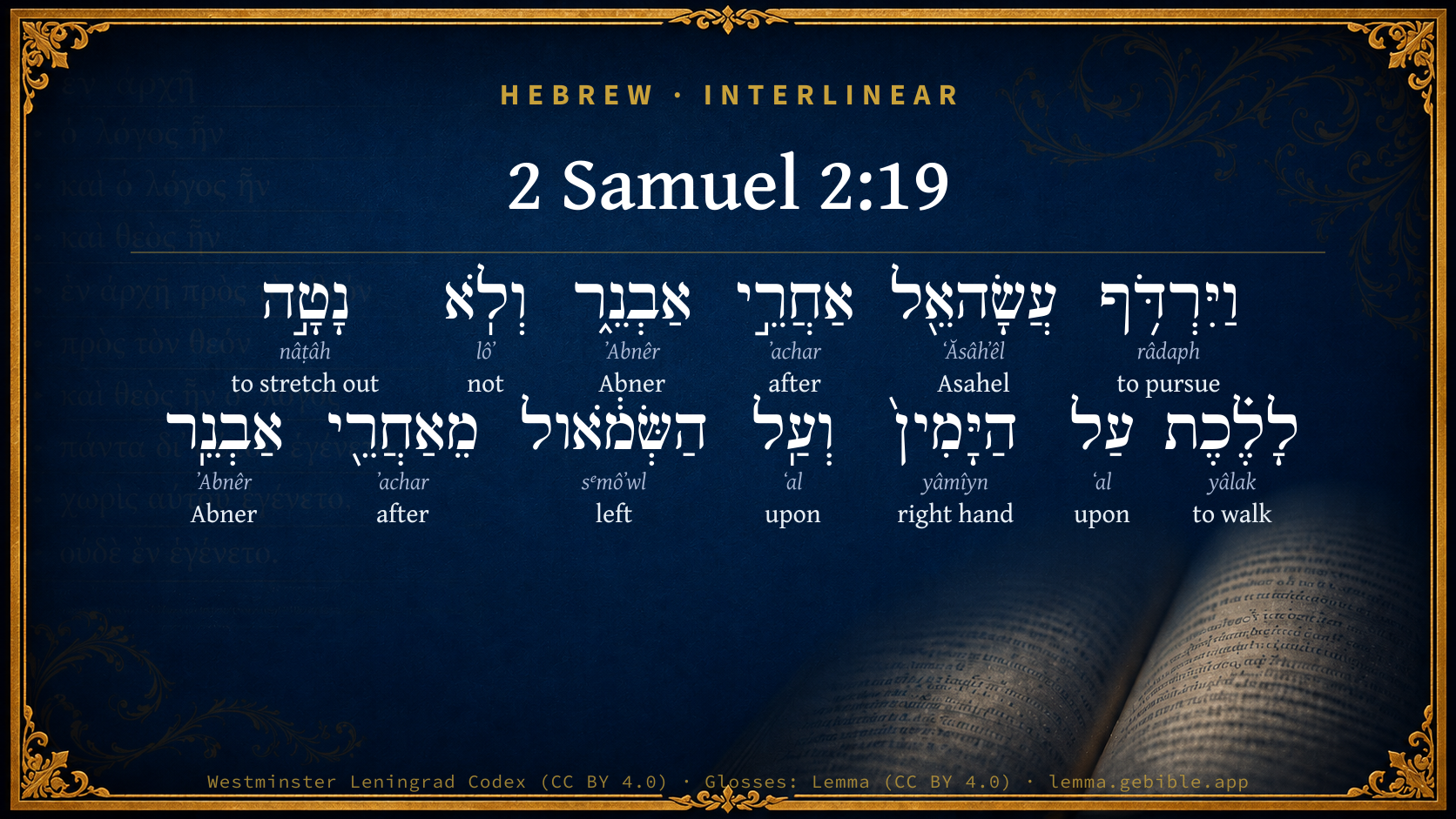
2 Samuel 2:19

Hebrew (Westminster Leningrad Codex) 2 Samuel 2:19 appears in the Hebrew Old Testament. The text above is from the Westminster Leningrad Codex. Each word links to its Strong’s number, a concise gloss, and parsing drawn from the Open Scriptures Hebrew Bible morphology. Click any word for its full Brown-Driver-Briggs (BDB) entry.
Download image
Cite this verse

2 Samuel 2:19 (World English Bible). Public Domain. Lemma interlinear Bible study tool, https://lemma.gebible.app/v/2-samuel/2/19.

Show BibTeX & RIS
BibTeX
RIS
English Translation
Asahel pursued after Abner; and in going he didn't turn to the right hand nor to the left from following Abner.
World English Bible · Public Domain
Download a study sheet

One document with this verse’s original text, its word-by-word gloss line, the meaning frame, cross-references with their text, attributed commentary, and full source and license credits — printable, and it pastes into notes with its structure intact.

This verse Autodidact and up

Study sheet (.html) Plain text (.txt)

A passage Seminary Student

Up to 50 verses in one chapter. A passage sheet keeps up to 6 commentary sources and 12 cross-references per verse, in the order this page ranks them, and says so on the sheet whenever that leaves anything out. Ask for a single verse and you get the Autodidact verse sheet above.

Everything on this page stays free to read, with no account — the sheet is a download of what is already on screen, not access to it.

Want to remove ads? Support Godless Engineer
Compare translations 3

The same verse in 3 English versions, stacked beneath the original-language interlinear above. Click any original word for its lexicon entry.

Each is an independent rendering of the whole verse — the interlinear is not word-aligned to these translations.

Highlighted words mark where these versions differ — a whole-verse word diff, not a word-by-word alignment.

  • World English Bible Public Domain
    Asahel pursued after Abner; and in going he didn't turn to the right hand nor to the left from following Abner.
  • King James Version Public Domain
    And Asahel pursued after Abner; and in going he turned not to the right hand nor to the left from following Abner.
  • unfoldingWord Literal Text CC BY-SA 4.0
    And Asahel pursued after Abner, and he did not turn aside to go to the right or to the left from after Abner.

unfoldingWord Literal Text — © unfoldingWord, licensed CC BY-SA 4.0. Word-aligned USFM3 via Door43 (git.door43.org/unfoldingWord/en_ult).

Versions to compare (up to 4)

3 of 4 selected

Show all 18 translations

Every available English version of this verse, each an independent rendering of the whole verse.

  • World English Bible Public Domain
    Asahel pursued after Abner; and in going he didn't turn to the right hand nor to the left from following Abner.
  • Berean Standard Bible Public Domain
    and he chased Abner, not turning to the right or to the left in his pursuit.
  • Majority Standard Bible Public Domain
    and he chased Abner, not turning to the right or to the left in his pursuit.
  • King James Version Public Domain
    And Asahel pursued after Abner; and in going he turned not to the right hand nor to the left from following Abner.
  • American Standard Version (1901) Public Domain
    And Asahel pursued after Abner; and in going he turned not to the right hand nor to the left from following Abner.
  • Revised Version (1885) Public Domain
    And Asahel pursued after Abner; and in going he turned not to the right hand nor to the left from following Abner.
  • Geneva Bible (1599) Public Domain
    And Asahel followed after Abner, and in going he turned neither to the right hand nor to the left from Abner.
  • Douay-Rheims (1899) Public Domain
    And Asael pursued after Abner, and turned not to the right hand nor to the left from following Abner.
  • Young's Literal Translation Public Domain
    And Asahel pursueth after Abner, and hath not turned aside to go to the right or to the left, from after Abner.
  • Literal Standard Version CC BY-SA 4.0
    and Asahel pursues after Abner, and has not turned aside to go to the right or to the left, from after Abner.
  • Unlocked Literal Bible CC BY-SA 4.0
    Asahel closely pursued Abner and followed him without turning away in any direction.
  • unfoldingWord Literal Text CC BY-SA 4.0
    And Asahel pursued after Abner, and he did not turn aside to go to the right or to the left from after Abner.
  • Darby Bible Public Domain
    And Asahel pursued after Abner; and in going he turned not to the right hand nor to the left from behind Abner.
  • World Messianic Bible Public Domain
    Asahel pursued Abner. He didn’t turn to the right hand or to the left from following Abner.
  • Webster's Bible Public Domain
    And Asahel pursued after Abner; and in going he turned not to the right hand nor to the left from following Abner.
  • Free Bible Version CC BY-SA 4.0
    He chased after Abner with single-minded determination.
  • Bible in Basic English Public Domain
    Asahel went running after Abner, not turning to the right or to the left.
  • JPS Tanakh (1917) Public Domain
    And Asahel pursued after Abner; and in going he turned not to the right hand nor to the left from following Abner.

Literal Standard Version (2020), Covenant Press — licensed CC BY-SA 4.0. Text via the HelloAO Bible API (eBible.org). Unlocked Literal Bible (unfoldingWord) — licensed CC BY-SA 4.0. Text via the HelloAO Bible API (eBible.org). unfoldingWord Literal Text — © unfoldingWord, licensed CC BY-SA 4.0. Word-aligned USFM3 via Door43 (git.door43.org/unfoldingWord/en_ult). Free Bible Version, Dr. Jonathan Gallagher — licensed CC BY-SA 4.0. Text via the HelloAO Bible API (eBible.org).

Word by word

More ways to search: Search by grammar → Find every occurrence → Compare this word →

Practice this passage: Drill this verse → Learn its vocabulary →

עֲשָׂהאֵ֖ל
ʻĂsâhʼêl
H6214
“Asahel”
Noun, Proper
Part of Speech
Noun
Type
Proper
Full BDB Definition

Origin: from H6213 and H410

TWOT: None

Asahel = "God-made" - nephew of David, son of David's sister Zeruiah, and brother of Joab and Abishai; swift of foot he was killed by Abner when he pursued him in battle and caught him - a Levite in the reign of king Jehoshaphat of Judah who went through the kingdom giving instruction in the law - a Levite in the reign of king Hezekiah of Judah in charge of the tithes and dedicated things in the temple - a priest, father of Jonathan, in the time of Ezra
  1. וַיִּרְדֹּ֥ף râdaph H7291 “and · to pursue” Conjunction + Verb, Qal, Sequential Imperfect, 3rd Person, Masculine, Singular
  2. אַחֲרֵ֣י ʼachar H310 “after” Preposition
  3. אַבְנֵ֑ר ʼAbnêr H74 “Abner” Noun, Proper
  4. וְלֹֽא lôʼ H3808 “and · not” Conjunction + Particle, Negative
  5. נָטָ֣ה nâṭâh H5186 “to stretch out” Verb, Qal, Perfect, 3rd Person, Masculine, Singular
  6. לָלֶ֗כֶת yâlak H3212 “to walk” Preposition + Verb, Qal, Infinitive Construct
  7. עַל ʻal H5921 “upon” Preposition
  8. הַיָּמִין֙ yâmîyn H3225 “the · right hand” Particle, Definite Article + Noun, Common, Feminine, Singular, Absolute
  9. וְעַֽל ʻal H5921 “and · upon” Conjunction + Preposition
  10. הַשְּׂמֹ֔אול sᵉmôʼwl H8040 “the · left” Particle, Definite Article + Noun, Common, Masculine, Singular, Absolute
  11. מֵאַחֲרֵ֖י ʼachar H310 “from · after” Preposition + Preposition
  12. אַבְנֵֽר ʼAbnêr H74 “Abner” Noun, Proper

About this verse

These counts appear in no published source. They are computed here, from the morphology-tagged text and Lemma’s own curated glosses. What Lemma adds →

13
words
10
distinct lemmas
Historical
section

Notable vocabulary

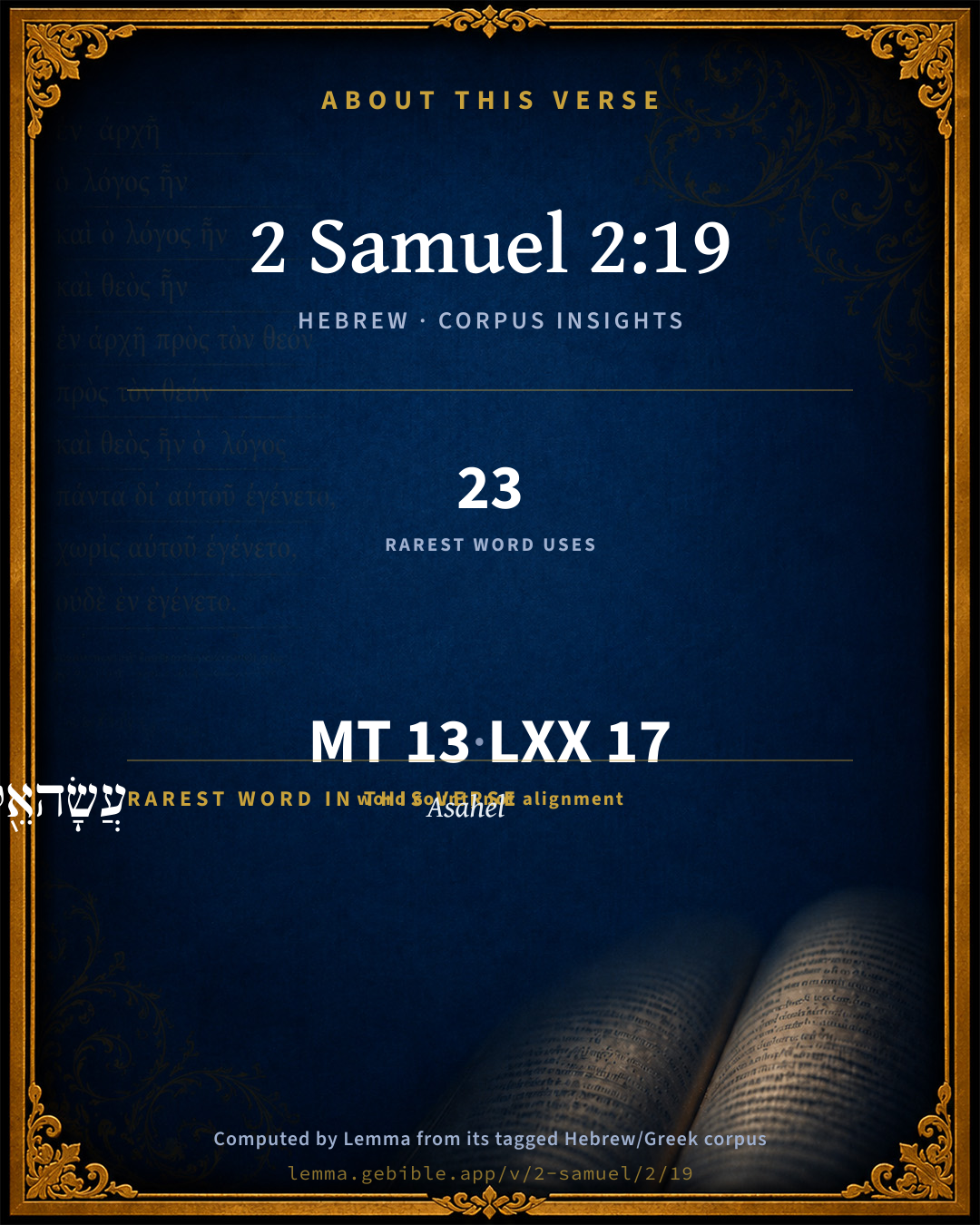
The rarest word here is עֲשָׂהאֵ֖ל Asahel H6214 — appearing just 23 times in the whole Hebrew Bible.

Shared distinctive vocabulary

עֲשָׂהאֵ֖ל Asahel H6214 occurs in 17 verses of the Hebrew Bible. Also found in:

Grammatical profile

  • 3 verbs
  • 5 nouns
  • 4 prepositions
  • 1 particle

Verb forms

  • וַיִּרְדֹּ֥ף Qal · Sequential Imperfect
  • נָטָ֣ה Qal · Perfect
  • לָלֶ֗כֶת Qal · Infinitive Construct

Repetition

Words recur within this verse — often emphatic in Hebrew:

  • אַחֲרֵ֣י after H310 ×2
  • אַבְנֵ֑ר Abner H74 ×2
  • עַל upon H5921 ×2

Hebrew & Septuagint length

In English translation the verse runs 21 words from the Hebrew and 21 from the Septuagint (LXX English) — the same length.

A rough comparison of the two English renderings, which tokenize alike — not a word-level alignment.

Word counts can differ between the Hebrew and the Greek without any difference in meaning — e.g. the Hebrew direct-object marker אֵת has no separate Greek word, and Greek often adds the article ὁ.

In the original languages it is 13 Hebrew tokens and 17 Greek tokens — but the two are counted differently (Hebrew bundles its prefixes and suffixes into one token; the Greek is in lemma form), so that isn’t a like-for-like length.

Cross-references

5

Topical passages linked to 2 Samuel 2:19 in the Treasury of Scripture Knowledge — connected by theme and wording, ordered by reader-vote popularity; previews shown in the World English Bible.

  • Joshua 1:7 Only be strong and very courageous, to observe to do according to all the law, which Moses my servant commanded you: don't turn from it to the right hand or to the left, that you may have good success wherever you go.
  • Joshua 23:6 Therefore be you very courageous to keep and to do all that is written in the book of the law of Moses, that you not turn aside from it to the right hand or to the left;
  • 2 Samuel 2:21 Abner said to him, Turn you aside to your right hand or to your left, and lay you hold on one of the young men, and take you his armor. But Asahel would not turn aside from following him.
  • 2 Kings 22:2 He did that which was right in the eyes of Yahweh, and walked in all the way of David his father, and didn't turn aside to the right hand or to the left.
  • Proverbs 4:27 Don't turn to the right hand nor to the left. Remove your foot from evil.

Cross-references courtesy of OpenBible.info (CC BY 4.0).

Hebrew and Greek witnesses Masoretic Hebrew ↔ Greek Septuagint

The same verse in the two great witnesses to the Old Testament, shown verse-for-verse.

These are two independent witnesses, not word-aligned to each other, and the Septuagint is shown in lemma (dictionary) form.

Hebrew 2 Samuel 2:19 Masoretic · Westminster Leningrad Codex

וַיִּרְדֹּ֥ף עֲשָׂהאֵ֖ל אַחֲרֵ֣י אַבְנֵ֑ר וְלֹֽא נָטָ֣ה לָלֶ֗כֶת עַל הַיָּמִין֙ וְעַֽל הַשְּׂמֹ֔אול מֵאַחֲרֵ֖י אַבְנֵֽר

Asahel pursued after Abner; and in going he didn't turn to the right hand nor to the left from following Abner.

World English Bible · Public Domain

Greek LXX 2 Samuel 2:19 Septuagint · lemma form

καί καταδιώκω ασαηλ ὀπίσω αβεννηρ καί οὐ ἐκκλίνω ὁ πορεύομαι εἰς δεξιός οὐδέ εἰς ἀριστερός κατόπισθεν αβεννηρ

And Asael followed after Abenner, and turned not to go to the right hand or to the left from following Abenner.

LXX2012 (modern English Septuagint) · Public Domain

Hebrew: Westminster Leningrad Codex (CC BY 4.0). Greek: Septuagint (public domain); English from LXX2012 (modern English Septuagint) (Public Domain). How the Septuagint differs from the Hebrew →

Targum (Aramaic paraphrase)

1

The Targum is the ancient Jewish Aramaic paraphrase of the Hebrew Scriptures — an interpretive translation, not the Hebrew text itself. Onkelos (literal) and Pseudo-Jonathan (expansive) render the Torah, and Jonathan the Prophets. Coverage is partial: where no permissively-licensed English translation exists for a verse, only the Aramaic is shown. This is verse-level text, not a word-by-word alignment to the Hebrew.

  1. Targum Jonathan Prophets (Joshua–Malachi)
    וּרְדַף עֲשָׂהאֵל בָּתַר אַבְנֵר וְלָא אִיתְפְּנֵי לְמֵיזַל עַל יַמִינָא אוֹ עַל סְמָלָא מִבָּתַר אַבְנֵר:

    (no public-domain English translation for this verse)

    Targum Jonathan — Aramaic: “Mikraot Gedolot” (public domain). English: “Sefaria Community Translation” (CC0 1.0 (public-domain dedication)); “London "Chaldee Paraphrase," 1871” (public domain). Text via Sefaria.

Commentary

Notes on 2 Samuel 2:19 from classic Christian and Jewish commentators (each source and its license shown beneath its notes). The classic Christian expositions comment on the surrounding passage and are grouped to its opening verse, so a note may address several verses; the Jewish commentaries on the Tanakh (Rashi and others) are per-verse, so they appear only where the commentator wrote on this verse.

Lemma curates 59 commentaries, every one of them public domain or Creative Commons licensed, each selected and text-cleaned for this edition rather than reprinted as found. About our sources →

Jamieson, Fausset & Brown

Robert Jamieson, A. R. Fausset & David Brown

ASAHEL SLAIN. (Sa2 2:19-32)

Asahel pursued after Abner--To gain the general's armor was deemed the grandest trophy. Asahel, ambitious of securing Abner's, had outstripped all other pursuers, and was fast gaining on the retreating commander. Abner, conscious of possessing more physical power, and unwilling that there should be "blood" between himself and Joab, Asahel's brother, twice urged him to desist. The impetuous young soldier being deaf to the generous remonstrance, the veteran raised the pointed butt of his lance, as the modern Arabs do when pursued, and, with a sudden back thrust, transfixed him on the spot, so that he fell, and lay weltering in his blood. But Joab and Abishai continued the pursuit by another route till sunset. On reaching a rising ground, and receiving a fresh reinforcement of some Benjamites, Abner rallied his scattered troops and earnestly appealed to Joab's better feelings to stop the further effusion of blood, which, if continued, would lead to more serious consequences--a destructive civil war. Joab, while upbraiding his opponent as the sole cause of the fray, felt the force of the appeal and led off his men; while Abner probably dreading a renewal of the attack when Joab should learn his brother's fate, and vow fierce revenge, endeavored, by a forced march, to cross the Jordan that night. On David's side the loss was only nineteen men, besides Asahel. But of Ish-bosheth's party there fell three hundred and sixty. This skirmish is exactly similar to the battles of the Homeric warriors, among whom, in the flight of one, the pursuit by another, and the dialogue held between them, there is vividly represented the style of ancient warfare.

Next: 2 Samuel Chapter 3

Jamieson, Fausset & Brown — Commentary Critical and Explanatory on the Whole Bible (1871) — public domain (CC PDM 1.0). Text via the HelloAO Bible API.

Trapp's Complete Commentary

John Trapp

2Sa 2:19 And Asahel pursued after Abner; and in going he turned not to the right hand nor to the left from following Abner.

Ver. 19. And Asahel pursued after Abner.] Too great a prize for him, who was impar conyressus Achilli: but he trusted too much to his own abilities-as being no less valiant of his hands, than swift of foot - and so perished. See Ecc 9:11.

John Trapp, A Commentary or Exposition upon All the Books of the Old and New Testament (1647–1656) — public domain. Text from a community e-Sword module.

Ellicott's Commentary for English Readers

(19) Asahel pursued after Abner.—Asahel, the youngest of the three nephews of David, took part in the battle with his elder brothers, and well knowing how completely the cause of Ish-bosheth depended upon Abner, pertinaciously sought him out in the pursuit. His great fleetness enabled him to overtake Abner and, coming behind him, endanger his life. Abner was unwilling to injure him, and only after remonstrating with him, and urging him to seek the spoil of some warrior more nearly his equal (2Sa_2:20-22), did he unwillingly slay him “with the hinder end of his spear.” The spears were sharpened at the “hinder end” for the purpose of sticking them into the ground (1Sa_26:7). Abner’s reluctance to kill Asahel may have been partly on account of his extreme youth, but was chiefly through dread of the vengeance of Joab (2Sa_2:22). “The fifth rib” here, and wherever else it occurs (2Sa_3:27; 2Sa_4:6; 2Sa_20:10), should be translated abdomen.

A Bible Commentary for English Readers, edited by Charles John Ellicott (1878–1897) — public domain. Text from a community e-Sword module.

John Gill's Exposition

And Asahel pursued after Abner,.... Ambitious of the glory of taking or slaying the general of the army of Israel; trusting to his swiftness, not considering that the race is not always to the swift, and that he had to do with a veteran soldier, and he a raw young man, though valiant:

and in going he turned not to the right hand nor to the left in following Abner; he kept his eye upon him, and pursued him closely, disregarding persons on the right or left he could have made prisoners; but those he neglected, being bent on taking Abner if possible.

John Gill's Exposition of the Whole Bible (1746–1763) — public domain (CC PDM 1.0). Text via the HelloAO Bible API.

The Pulpit Commentary

Asahel pursued after Abner. This episode is fully narrated, both because of Asahel"s rank as David"s nephew, and also because of its tragical consequences to Abner himself. Asahel was a son of Zeruiah, David"s sister, and, while his own brothers were of little use to him, his nephews, Joab, Abishai, and Asahel, were the mainstays of David"s throne. As their father"s name is never mentioned, but only the mother"s, Zeruiah was probably a woman of great ability, and her sons inherited it from her. Possibly she had married beneath her station, or her husband had died early; but certainly her sons, thinking more of her than of their father, had soon thrown in their lot with David her brother (but see note on ver. 32). The youngest of the three, Asahel, was remarkable for his personal accomplishments, and especially for swiftness of foot, for which he was compared to the Zebi, the camp name of Jonathan. (2Sa_1:19) It now caused his death. For conscious that Abner was the sole support of Ishbosheth"s party, and indignant at his challenge to useless slaughter, he pursued after him, allowing nothing to divert him from his object, and hoping to end the war by slaying the veteran commander. But though he had the fleetness of an Achilles, he had not his robust strength, and Abner, knowing that the combat was unequal, remonstrated with him, and bade him turn aside, and be content with winning the spoils of some meaner warrior. It is evident from this that Abner saw in this defeat in a battle of his own choosing, the certainty of the near downfall of the house of Saul, and, as he would then be in Joab"s power, he was unwilling to have a blood feud with a man of such determined character. "How," he asks, "should I hold up my face to Joab thy brother?" It would be his duty, as the avenger of blood, to slay me. Apparently, during this conference, he was standing with the butt end of his lance held towards Asahel, to ward off his blows, but, as the spearhead was turned the other way, Asahel forgot that even so it might be used for offence. For it was pointed, that it might be stuck in the ground at night, (1Sa_26:7) and possibly shod with iron, though it is more likely that it was only hardened by being thrust into the fire. So when he saw that his words had no avail, and that Asahel was not on his guard, he suddenly struck him with it so violent a blow that it pierced his body right through, and Asahel fell down dead. It is probable, from the merciless force used, that there was a sudden outburst of anger on Abner"s part.

The Pulpit Commentary (1880–1919), ed. H.D.M. Spence-Jones & Joseph S. Exell — public domain. Text from a community e-Sword module.

Lesson kit

Teaching starters — assembled from the data on this page, not authored interpretation. Every prompt links to the verse data it draws on. Edit before teaching.

2 Samuel, in the Historical, opens this verse with 13 words (10 distinct Hebrew lemmas). Its most distinctive word is ʻĂsâhʼêl (“Asahel”). A historical commentator’s framing appears above. Read the whole chapter for the surrounding context.

Discussion questions

  1. What does “Asahel” (ʻĂsâhʼêl) contribute to the verse as a whole?
  2. How does 2 Samuel 2:18, which shares the word «Asahel», read alongside this verse?
  3. What does the repetition of “after” (2× in this one verse) do in this verse?
  4. These translations render this verse differently; the difference is in the English rendering, not the original. What questions does that raise?
  5. «וַיִּרְדֹּ֥ף» is a Qal Sequential Imperfect verb. How does that grammatical form shape the action described?
  6. Compare how Jamieson, Fausset & Brown and Trapp's Complete Commentary read this verse. Where do they agree or differ?

Things to notice

Reading settings

Reading text

Shown beneath each verse's original-language words.

Old Testament
Old Testament edition

Read the OT as the Masoretic Hebrew (MT) or the Greek Septuagint (LXX).

English shown for the Greek Septuagint (in the Hebrew ↔ Greek comparison).

Comparing translations? Open the Compare panel on any verse page to stack up to four side by side.