
Proverbs 5:13

Hebrew (Westminster Leningrad Codex) Proverbs 5:13 appears in the Hebrew Old Testament. The text above is from the Westminster Leningrad Codex. Each word links to its Strong’s number, a concise gloss, and parsing drawn from the Open Scriptures Hebrew Bible morphology. Click any word for its full Brown-Driver-Briggs (BDB) entry.
Download image
Cite this verse

Proverbs 5:13 (World English Bible). Public Domain. Lemma interlinear Bible study tool, https://lemma.gebible.app/v/proverbs/5/13.

Show BibTeX & RIS
BibTeX
RIS
English Translation
Neither have I obeyed the voice of my teachers, Nor turned my ear to those who instructed me!
World English Bible · Public Domain
Download a study sheet

One document with this verse’s original text, its word-by-word gloss line, the meaning frame, cross-references with their text, attributed commentary, and full source and license credits — printable, and it pastes into notes with its structure intact.

This verse Autodidact and up

Study sheet (.html) Plain text (.txt)

A passage Seminary Student

Up to 50 verses in one chapter. A passage sheet keeps up to 6 commentary sources and 12 cross-references per verse, in the order this page ranks them, and says so on the sheet whenever that leaves anything out. Ask for a single verse and you get the Autodidact verse sheet above.

Everything on this page stays free to read, with no account — the sheet is a download of what is already on screen, not access to it.

Want to remove ads? Support Godless Engineer
Compare translations 3

The same verse in 3 English versions, stacked beneath the original-language interlinear above. Click any original word for its lexicon entry.

Each is an independent rendering of the whole verse — the interlinear is not word-aligned to these translations.

Highlighted words mark where these versions differ — a whole-verse word diff, not a word-by-word alignment.

  • World English Bible Public Domain
    Neither have I obeyed the voice of my teachers, Nor turned my ear to those who instructed me!
  • King James Version Public Domain
    And have not obeyed the voice of my teachers, nor inclined mine ear to them that instructed me!
  • unfoldingWord Literal Text CC BY-SA 4.0
    And I did not listen to the voice of my teachers, and to my instructors I did not incline my ear.

unfoldingWord Literal Text — © unfoldingWord, licensed CC BY-SA 4.0. Word-aligned USFM3 via Door43 (git.door43.org/unfoldingWord/en_ult).

Versions to compare (up to 4)

3 of 4 selected

Show all 18 translations

Every available English version of this verse, each an independent rendering of the whole verse.

  • World English Bible Public Domain
    Neither have I obeyed the voice of my teachers, Nor turned my ear to those who instructed me!
  • Berean Standard Bible Public Domain
    I did not listen to the voice of my teachers or incline my ear to my mentors.
  • Majority Standard Bible Public Domain
    I did not listen to the voice of my teachers or incline my ear to my mentors.
  • King James Version Public Domain
    And have not obeyed the voice of my teachers, nor inclined mine ear to them that instructed me!
  • American Standard Version (1901) Public Domain
    Neither have I obeyed the voice of my teachers, Nor inclined mine ear to them that instructed me!
  • Revised Version (1885) Public Domain
    Neither have I obeyed the voice of my teachers, nor inclined mine ear to them that instructed me!
  • Geneva Bible (1599) Public Domain
    And haue not obeied the voyce of them that taught mee, nor enclined mine eare to them that instructed me!
  • Douay-Rheims (1899) Public Domain
    And have not heard the voice of them that taught me, and have not in- dined my ear to masters?
  • Young's Literal Translation Public Domain
    And I have not hearkened to the voice of my directors, And to my teachers have not inclined mine ear.
  • Literal Standard Version CC BY-SA 4.0
    And I have not listened to the voice of my teachers, || And have not inclined my ear to my teachers.
  • Unlocked Literal Bible CC BY-SA 4.0
    I would not obey my teachers or incline my ear to my instructors.
  • unfoldingWord Literal Text CC BY-SA 4.0
    And I did not listen to the voice of my teachers, and to my instructors I did not incline my ear.
  • Darby Bible Public Domain
    and I have not hearkened unto the voice of my teachers, nor inclined mine ear to those that instructed me;
  • World Messianic Bible Public Domain
    I haven’t obeyed the voice of my teachers, nor turned my ear to those who instructed me!
  • Webster's Bible Public Domain
    And have not obeyed the voice of my teachers, nor inclined my ear to them that instructed me!
  • Free Bible Version CC BY-SA 4.0
    I didn't listen to what my teacher said. I didn't pay attention to my instructors.
  • Bible in Basic English Public Domain
    I did not give attention to the voice of my teachers, my ear was not turned to those who were guiding me!
  • JPS Tanakh (1917) Public Domain
    Neither have I hearkened to the voice of my teachers, nor inclined mine ear to them that instructed me!

Literal Standard Version (2020), Covenant Press — licensed CC BY-SA 4.0. Text via the HelloAO Bible API (eBible.org). Unlocked Literal Bible (unfoldingWord) — licensed CC BY-SA 4.0. Text via the HelloAO Bible API (eBible.org). unfoldingWord Literal Text — © unfoldingWord, licensed CC BY-SA 4.0. Word-aligned USFM3 via Door43 (git.door43.org/unfoldingWord/en_ult). Free Bible Version, Dr. Jonathan Gallagher — licensed CC BY-SA 4.0. Text via the HelloAO Bible API (eBible.org).

Word by word

More ways to search: Search by grammar → Find every occurrence → Compare this word →

Practice this passage: Drill this verse → Learn its vocabulary →

מוֹרָ֑י
yârâh
H3384
“archers · my”
Noun, Common, Masculine, Plural, Construct + Suffix, Personal, 1st Person, Common, Singular
Part of Speech
Noun
Type
Common
Gender
Masculine
Number
Plural
State
Construct
Full BDB Definition

Origin: a primitive root

TWOT: 910

to throw, shoot, cast, pour - (Qal) - to throw, cast - to cast, lay, set - to shoot arrows - to throw water, rain - (Niphal) to be shot - (Hiphil) - to throw, cast - to shoot - to point out, show - to direct, teach, instruct - to throw water, rain
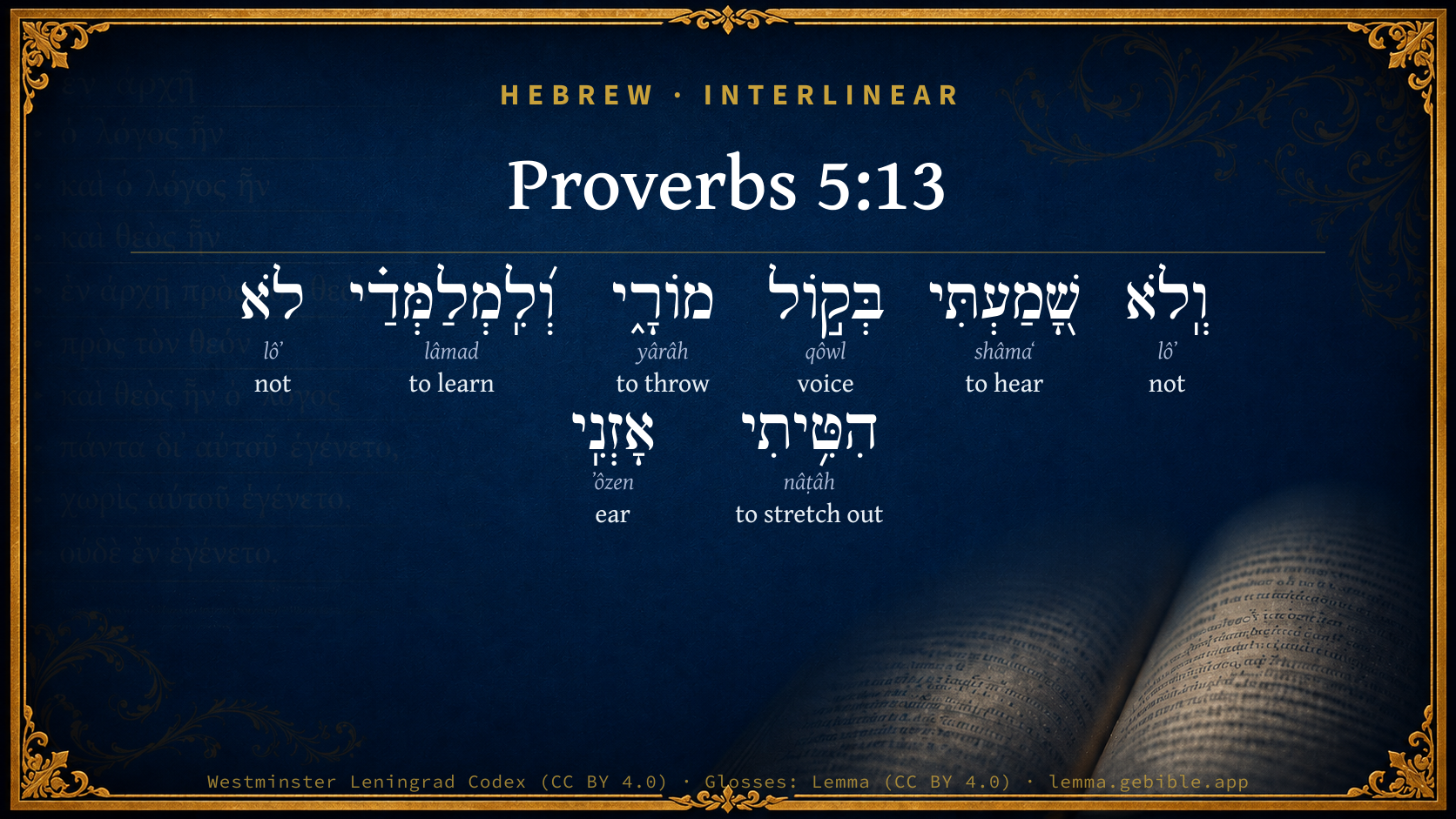
  1. וְֽלֹא lôʼ H3808 “and · not” Conjunction + Particle, Negative
  2. שָׁ֭מַעְתִּי shâmaʻ H8085 “to hear” Verb, Qal, Perfect, 1st Person, Common, Singular
  3. בְּק֣וֹל qôwl H6963 “in/at · voice of” Preposition + Noun, Common, Masculine, Singular, Construct
  4. וְ֝לִֽמְלַמְּדַ֗י lâmad H3925 “and · to/for · learning · me” Conjunction + Preposition + Verb, Piel, Participle Active, Masculine, Singular, Construct + Suffix, Personal, 1st Person, Common, Singular
  5. לֹא lôʼ H3808 “not” Particle, Negative
  6. הִטִּ֥יתִי nâṭâh H5186 “to stretch out” Verb, Hiphil, Perfect, 1st Person, Common, Singular
  7. אָזְנִֽי ʼôzen H241 “ear · my” Noun, Common, Feminine, Singular, Construct + Suffix, Personal, 1st Person, Common, Singular

About this verse

These counts appear in no published source. They are computed here, from the morphology-tagged text and Lemma’s own curated glosses. What Lemma adds →

8
words
7
distinct lemmas
Wisdom
section

Grammatical profile

  • 3 verbs
  • 3 nouns
  • 2 particles

Verb forms

  • שָׁ֭מַעְתִּי Qal · Perfect
  • וְ֝לִֽמְלַמְּדַ֗י Piel · Participle Active
  • הִטִּ֥יתִי Hiphil · Perfect

Repetition

A word recurs within this verse — often emphatic in Hebrew:

  • וְֽלֹא not H3808 ×2

Hebrew & Septuagint length

In English translation the verse runs 18 words from the Hebrew and 19 from the Septuagint (LXX English) — closely comparable.

A rough comparison of the two English renderings, which tokenize alike — not a word-level alignment.

Word counts can differ between the Hebrew and the Greek without any difference in meaning — e.g. the Hebrew direct-object marker אֵת has no separate Greek word, and Greek often adds the article ὁ.

In the original languages it is 8 Hebrew tokens and 13 Greek tokens — but the two are counted differently (Hebrew bundles its prefixes and suffixes into one token; the Greek is in lemma form), so that isn’t a like-for-like length.

Cross-references

4

Topical passages linked to Proverbs 5:13 in the Treasury of Scripture Knowledge — connected by theme and wording, ordered by reader-vote popularity; previews shown in the World English Bible.

  • 1 Thessalonians 4:8 Therefore he who rejects doesn't reject man, but God, who has also given his Holy Spirit to you.
  • Luke 15:18 I will get up and go to my father, and will tell him, "Father, I have sinned against heaven, and in your sight.
  • Hebrews 13:7 Remember your leaders, men who spoke to you the word of God, and considering the results of their conduct, imitate their faith.
  • 1 Thessalonians 5:12–13 But we beg you, brothers, to know those who labor among you, and are over you in the Lord, and admonish you,

Cross-references courtesy of OpenBible.info (CC BY 4.0).

Hebrew and Greek witnesses Masoretic Hebrew ↔ Greek Septuagint

The same verse in the two great witnesses to the Old Testament, shown verse-for-verse.

These are two independent witnesses, not word-aligned to each other, and the Septuagint is shown in lemma (dictionary) form.

Hebrew Proverbs 5:13 Masoretic · Westminster Leningrad Codex

וְֽלֹא שָׁ֭מַעְתִּי בְּק֣וֹל מוֹרָ֑י וְ֝לִֽמְלַמְּדַ֗י לֹא הִטִּ֥יתִי אָזְנִֽי

Neither have I obeyed the voice of my teachers, Nor turned my ear to those who instructed me!

World English Bible · Public Domain

Greek LXX Proverbs 5:13 Septuagint · lemma form

οὐ ἀκούω φωνή παιδεύω ἐγώ καί διδάσκω ἐγώ οὐδέ παραβάλλω ὁ οὖς ἐγώ

I heard not the voice of him that instructed me, and taught me, neither did I apply my ear.

LXX2012 (modern English Septuagint) · Public Domain

Hebrew: Westminster Leningrad Codex (CC BY 4.0). Greek: Septuagint (public domain); English from LXX2012 (modern English Septuagint) (Public Domain). How the Septuagint differs from the Hebrew →

Commentary

Notes on Proverbs 5:13 from classic Christian and Jewish commentators (each source and its license shown beneath its notes). The classic Christian expositions comment on the surrounding passage and are grouped to its opening verse, so a note may address several verses; the Jewish commentaries on the Tanakh (Rashi and others) are per-verse, so they appear only where the commentator wrote on this verse.

Lemma curates 59 commentaries, every one of them public domain or Creative Commons licensed, each selected and text-cleaned for this edition rather than reprinted as found. About our sources →

Trapp's Complete Commentary

John Trapp

Pro 5:13 And have not obeyed the voice of my teachers, nor inclined mine ear to them that instructed me!

Ver. 13. Nor inclined mine ear.] I would not so much as hear them, nmch less obey their voice. Intus existens prohibet alienum. The songs of those syrens had so enchanted him, that it was past time of day to give him counsel. If you speak against his sweet sin, and dissuade him from that, he shrinks back into the shell, and lets his hood hearken. All that is of ‘Davy Dutton’s dream,’ as the proverb is, and therefore, Surdo fabulam, he will in nowise give ear to you.

John Trapp, A Commentary or Exposition upon All the Books of the Old and New Testament (1647–1656) — public domain. Text from a community e-Sword module.

The Biblical Illustrator

Joseph S. Exell

Pro_5:13

And have not obeyed the voice of my teachers.

Consequences of disobedience

Can any state be more distressing than that of an individual who has enjoyed the best opportunities of securing his own happiness and promoting that of others, totally failing in both these, and becoming the subject of bitter self-reproach?

I. There is the admission of having had the great advantage of teachers. There are scarcely any but have had some very considerable advantages and means of religious instruction. They involve you all in a serious responsibility to God and your own conscience.

1. The best, purest, most commanding instruction in the Bible.

2. The living voice of teachers, either parents or ministers, or kind friends in schools.

3. The Spirit of God unfolding the truth to your understanding and conscience; striving with your heart, and inwardly calling you to seek those things which belong to your peace.

II. There is an implied connection between instruction and obedience. The text admits the obligation resulting from such advantages. I ought to have obeyed, but I have not.

1. You are bound to obey the good instruction you have received, because it is clearly the will of God, the Being who is above all, and who holds you amenable at His tribunal.

2. By the tender and unspeakable love of the Saviour, Jesus Christ, who came forth from His Father, and became the Redeemer of men by the sacrifice of Himself.

3. By a regard to your own highest interests. Obeying the Divine precepts is the only way to secure your own peace of mind, your joy through life, your hope in death, and your immortal felicity after death.

4. By a regard to the interests of others to whom you may be related in this life. You have social relations, duties, and obligations which you ought to regard, and cannot neglect without great criminality. You ought to become yourselves, and endeavour to make them, such as God would have us all to be.

5. By the obligation which arises from your final accountableness at the bar of judgment.

III. There is a confession that instruction had not been obeyed. This text does not express the case of those who have only partially, or in some respects, failed of obedience, but have in the main been mindful of the instruction they have received. It is applied to those who have failed altogether, and in the general habits of their mind and life have disregarded the great and holy principles inculcated upon them in early life. Some of the causes of this failure are--

1. There is in our own hearts a disinclination to serve God, and an aversion to the Divine precepts.

2. There are innumerable and incessant temptations to forsake the guide of our youth.

3. There will be a direct and powerful influence of the worst kind exerted over those who give themselves to evil companions.

IV. There is an expression of penitential regret for disobedience. The text seems to be the language of remorse.

1. A perception that our misery has resulted from wilful disobedience, not from ignorance.

2. The feeling that this disobedience has been maintained against light and knowledge.

3. The consciousness that you once possessed all the means necessary to promote your happiness and secure your salvation. (The Evangelist.)

The Biblical Illustrator, edited by Joseph S. Exell (c. 1880s–1900s) — public domain. Text from a community e-Sword module.

John Gill's Exposition

And have not obeyed the voice of my teachers,.... Parents, tutors, masters, and ministers of the word; neither regarded the advice of parents, nor the instructions of tutors, nor the commands of masters, nor the sermons of ministers: these are all lost on some persons; they are proof against them all; these make no impressions upon them, and are of no use to them;

nor inclined mine ear to them that instructed me! or to my masters, as the Targum and Vulgate Latin version; turned away the ear from them, stopped it to them, and would not hear what they had to say; at least would not receive it, and act according to it.

John Gill's Exposition of the Whole Bible (1746–1763) — public domain (CC PDM 1.0). Text via the HelloAO Bible API.

Matthew Poole's English Annotations

Of my teachers; of my parents, and friends, and ministers, who faithfully and seasonably informed me of those mischiefs and miseries which now I feel.

Matthew Poole's English Annotations on the Holy Bible (1683–1685) — public domain. Text from a community e-Sword/MySword module.

The Pulpit Commentary

And have not obeyed the voice of my teachers, nor inclined mine ear to them that instructed me. The ruined profligate admits he was not without teachers and advisers, but that he gave no heed to their warnings and reproofs. Have not obeyed the voice (lo-shama"ti b"kol). The same phrase occurs in Gen_27:13 Exo_18:19 Deu_26:14 2Sa_12:18. The verb shama is primarily "to hear," and then "to obey," "to give heed to," like the Greek akouw .

The Pulpit Commentary (1880–1919), ed. H.D.M. Spence-Jones & Joseph S. Exell — public domain. Text from a community e-Sword module.

unfoldingWord translationNotes

Door43 World Missions Community

incline my ear to my instructors

Here the word "ear" represents the person who is listening. The writer speaks of listening attentively to someone as if it were leaning forward so that the ear is closer to the one speaking. See how you translated a similar phrase in Proverbs 4:20. AT: "listen to those who instructed me" (See: Synecdoche and Metaphor)

in the midst of the assembly, among the gathering of the people

These two phrases mean basically the same thing and refer to the person's community that has gathered together either 1) to worship God or 2) to judge him for his offense. (See: Parallelism)

translationWords

obey

teacher

assembly

unfoldingWord translationNotes — © Distant Shores Media and the Door43 World Missions Community, licensed CC BY-SA 4.0. Source: git.door43.org/Door43/en_tn.

Lesson kit

Teaching starters — assembled from the data on this page, not authored interpretation. Every prompt links to the verse data it draws on. Edit before teaching.

Proverbs, in the Wisdom, opens this verse with 8 words (7 distinct Hebrew lemmas). Its most distinctive word is yârâh (“to throw”). A historical commentator’s framing appears above. Read the whole chapter for the surrounding context.

Discussion questions

  1. How does “to throw” (yârâh) shape what this verse is saying?
  2. 1 Thessalonians 4:8 shares this passage’s theme. How do the two illuminate each other?
  3. “not” occurs 2× in this one verse. What is the effect of the repetition?
  4. The translations on this page render this verse differently — a whole-verse word diff, not a word-by-word alignment. What might account for the different wordings?
  5. The verb «שָׁ֭מַעְתִּי» is Qal Perfect. How does its form color the action?
  6. Reading how Trapp's Complete Commentary and The Biblical Illustrator read this verse, where do the two commentators agree and where do they part?

Things to notice

Reading settings

Reading text

Shown beneath each verse's original-language words.

Old Testament
Old Testament edition

Read the OT as the Masoretic Hebrew (MT) or the Greek Septuagint (LXX).

English shown for the Greek Septuagint (in the Hebrew ↔ Greek comparison).

Comparing translations? Open the Compare panel on any verse page to stack up to four side by side.