
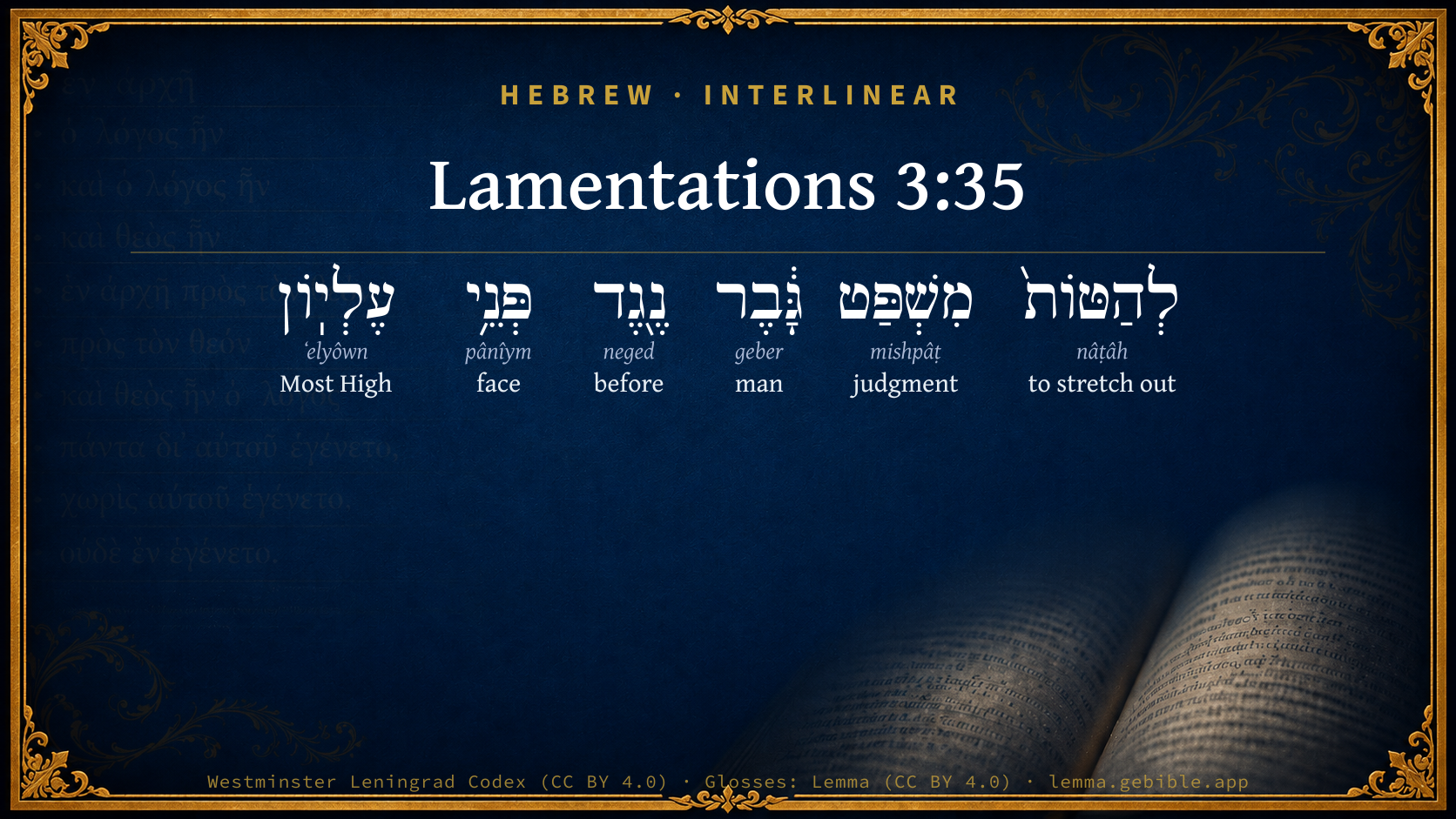
Lamentations 3:35

Hebrew (Westminster Leningrad Codex) Lamentations 3:35 appears in the Hebrew Old Testament. The text above is from the Westminster Leningrad Codex. Each word links to its Strong’s number, a concise gloss, and parsing drawn from the Open Scriptures Hebrew Bible morphology. Click any word for its full Brown-Driver-Briggs (BDB) entry.
Download image
Cite this verse

Lamentations 3:35 (World English Bible). Public Domain. Lemma interlinear Bible study tool, https://lemma.gebible.app/v/lamentations/3/35.

Show BibTeX & RIS
BibTeX
RIS
English Translation
To turn aside the right of a man before the face of the Most High,
World English Bible · Public Domain
Download a study sheet

One document with this verse’s original text, its word-by-word gloss line, the meaning frame, cross-references with their text, attributed commentary, and full source and license credits — printable, and it pastes into notes with its structure intact.

This verse Autodidact and up

Study sheet (.html) Plain text (.txt)

A passage Seminary Student

Up to 50 verses in one chapter. A passage sheet keeps up to 6 commentary sources and 12 cross-references per verse, in the order this page ranks them, and says so on the sheet whenever that leaves anything out. Ask for a single verse and you get the Autodidact verse sheet above.

Everything on this page stays free to read, with no account — the sheet is a download of what is already on screen, not access to it.

Want to remove ads? Support Godless Engineer
Compare translations 3

The same verse in 3 English versions, stacked beneath the original-language interlinear above. Click any original word for its lexicon entry.

Each is an independent rendering of the whole verse — the interlinear is not word-aligned to these translations.

Highlighted words mark where these versions differ — a whole-verse word diff, not a word-by-word alignment.

  • World English Bible Public Domain
    To turn aside the right of a man before the face of the Most High,
  • King James Version Public Domain
    To turn aside the right of a man before the face of the most High,
  • unfoldingWord Literal Text CC BY-SA 4.0
    to turn aside the justice of a man before the face of the Most High,

unfoldingWord Literal Text — © unfoldingWord, licensed CC BY-SA 4.0. Word-aligned USFM3 via Door43 (git.door43.org/unfoldingWord/en_ult).

Versions to compare (up to 4)

3 of 4 selected

Show all 18 translations

Every available English version of this verse, each an independent rendering of the whole verse.

  • World English Bible Public Domain
    To turn aside the right of a man before the face of the Most High,
  • Berean Standard Bible Public Domain
    to deny a man justice before the Most High,
  • Majority Standard Bible Public Domain
    to deny a man justice before the Most High,
  • King James Version Public Domain
    To turn aside the right of a man before the face of the most High,
  • American Standard Version (1901) Public Domain
    To turn aside the right of a man before the face of the Most High,
  • Revised Version (1885) Public Domain
    To turn aside the right of a man before the face of the Most High,
  • Geneva Bible (1599) Public Domain
    In ouerthrowing the right of a man before the face of the most high,
  • Douay-Rheims (1899) Public Domain
    Lamed. To turn aside the judgment of a man before the face of the most High,
  • Young's Literal Translation Public Domain
    To turn aside the judgment of a man, Over-against the face of the Most High,
  • Literal Standard Version CC BY-SA 4.0
    To turn aside the judgment of a man, || Before the face of the Most High,
  • Unlocked Literal Bible CC BY-SA 4.0
    to deny a man justice in the presence of the Most High,
  • unfoldingWord Literal Text CC BY-SA 4.0
    to turn aside the justice of a man before the face of the Most High,
  • Darby Bible Public Domain
    to turn aside the right of a man before the face of the Most High,
  • World Messianic Bible Public Domain
    to turn away the right of a man before the face of the Most High,
  • Webster's Bible Public Domain
    To turn aside the right of a man before the face of the most High,
  • Free Bible Version CC BY-SA 4.0
    Or denying someone their rights as the Most High watches,
  • Bible in Basic English Public Domain
    In his turning away the right of a man before the face of the Most High.
  • JPS Tanakh (1917) Public Domain
    To turn aside the right of a man before the face of the Most High,

Literal Standard Version (2020), Covenant Press — licensed CC BY-SA 4.0. Text via the HelloAO Bible API (eBible.org). Unlocked Literal Bible (unfoldingWord) — licensed CC BY-SA 4.0. Text via the HelloAO Bible API (eBible.org). unfoldingWord Literal Text — © unfoldingWord, licensed CC BY-SA 4.0. Word-aligned USFM3 via Door43 (git.door43.org/unfoldingWord/en_ult). Free Bible Version, Dr. Jonathan Gallagher — licensed CC BY-SA 4.0. Text via the HelloAO Bible API (eBible.org).

Word by word

More ways to search: Search by grammar → Find every occurrence → Compare this word →

Practice this passage: Drill this verse → Learn its vocabulary →

About this verse

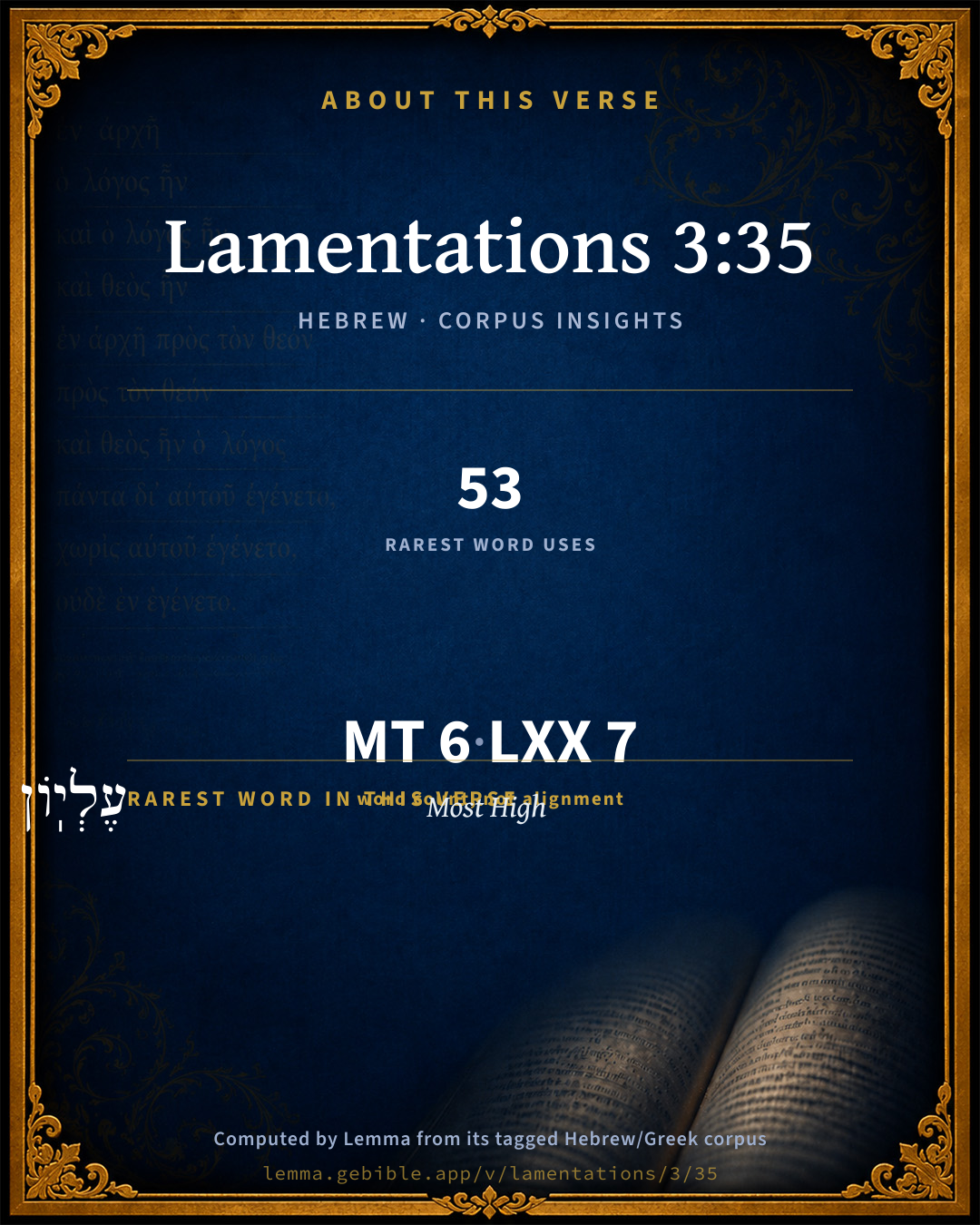
These counts appear in no published source. They are computed here, from the morphology-tagged text and Lemma’s own curated glosses. What Lemma adds →

6
words
6
distinct lemmas
Prophets
section

Shared distinctive vocabulary

עֶלְיֽוֹן Most High H5945 occurs in 53 verses of the Hebrew Bible. Also found in:

Grammatical profile

  • 1 verb
  • 3 nouns
  • 1 adjective
  • 1 preposition

Verb forms

  • לְהַטּוֹת֙ Hiphil · Infinitive Construct

Hebrew & Septuagint length

In English translation the verse runs 15 words from the Hebrew and 15 from the Septuagint (LXX English) — the same length.

A rough comparison of the two English renderings, which tokenize alike — not a word-level alignment.

Word counts can differ between the Hebrew and the Greek without any difference in meaning — e.g. the Hebrew direct-object marker אֵת has no separate Greek word, and Greek often adds the article ὁ.

In the original languages it is 6 Hebrew tokens and 7 Greek tokens — but the two are counted differently (Hebrew bundles its prefixes and suffixes into one token; the Greek is in lemma form), so that isn’t a like-for-like length.

Hebrew and Greek witnesses Masoretic Hebrew ↔ Greek Septuagint

The same verse in the two great witnesses to the Old Testament, shown verse-for-verse.

These are two independent witnesses, not word-aligned to each other, and the Septuagint is shown in lemma (dictionary) form.

Hebrew Lamentations 3:35 Masoretic · Westminster Leningrad Codex

לְהַטּוֹת֙ מִשְׁפַּט גָּ֔בֶר נֶ֖גֶד פְּנֵ֥י עֶלְיֽוֹן

To turn aside the right of a man before the face of the Most High,

World English Bible · Public Domain

Greek LXX Lamentations 3:35 Septuagint · lemma form

ὁ ἐκκλίνω κρίσις ἀνήρ κατέναντι πρόσωπον ὕψιστος

to turn aside the judgment of a man before the face of the Most High,

LXX2012 (modern English Septuagint) · Public Domain

On this verse, The Pulpit Commentary discusses the Septuagint’s reading. Read the note in Commentary ↓

Hebrew: Westminster Leningrad Codex (CC BY 4.0). Greek: Septuagint (public domain); English from LXX2012 (modern English Septuagint) (Public Domain). How the Septuagint differs from the Hebrew →

Commentary

Notes on Lamentations 3:35 from classic Christian and Jewish commentators (each source and its license shown beneath its notes). The classic Christian expositions comment on the surrounding passage and are grouped to its opening verse, so a note may address several verses; the Jewish commentaries on the Tanakh (Rashi and others) are per-verse, so they appear only where the commentator wrote on this verse.

Lemma curates 59 commentaries, every one of them public domain or Creative Commons licensed, each selected and text-cleaned for this edition rather than reprinted as found. About our sources →

Trapp's Complete Commentary

John Trapp

Lam 3:35 To turn aside the right of a man before the face of the most High,

Ver. 35. To turn aside the right of a man.] To wrest his right by false witness and corrupt means, as wicked men use to do before the face of the Most High, or of a superior under colour of law. God liketh none of all this, though again for excellent ends he allows it so to be, and orders it when so it is.

John Trapp, A Commentary or Exposition upon All the Books of the Old and New Testament (1647–1656) — public domain. Text from a community e-Sword module.

Jamieson, Fausset & Brown

Robert Jamieson, A. R. Fausset & David Brown

before . . . face of . . . most High--Any "turning aside" of justice in court is done before the face of God, who Is present, and "regardeth," though unseen (Ecc 5:8).

Jamieson, Fausset & Brown — Commentary Critical and Explanatory on the Whole Bible (1871) — public domain (CC PDM 1.0). Text via the HelloAO Bible API.

Adam Clarke's Commentary

Verse 35. To turn aside the right of a man] To make a man lose his right, because one of the higher orders opposes him. Dr. Blayney thinks that עליון elyon, instead of being referred to God, should be considered as pointing out one of the chief of the people. I do not see that we gain any thing by this. The evil fact is, turning aside the right of a man; and the aggravation of it is, doing it before the face of the Most High; that is, in a court of justice, where God is ever considered to be present.

Adam Clarke's Commentary on the Bible (1810–1826) — public domain. Text from a community e-Sword/MySword module.

John Gill's Exposition

Out of the mouth of the most High proceed not evil and good? Certainly they do; they come to pass, both one and the other, as God has pronounced, and his will determined; even "evils", as it is in the plural number; not the evil of sin, or of fault; this comes not out of the mouth of God, but is forbidden and condemned by him; much less is he the author of it, or tempter to it; indeed it is not without his knowledge, nor in some sense without his will; not with his will of approbation, but by his permissive will, which he suffers to be, and overrules for good; but evils here design the judgments of God, or punishment inflicted on sinners, and chastisement on his own people; the evil of affliction, or adverse dispensations of providence, Isa 45:7; they are all by his appointment; he has said or determined what shall be the kind and nature of them; the measure, how far they shall go; and the duration, how long they shall last; and the end and use of them; see Job 2:10; and so all good comes from God, who is goodness itself; all created good, as every creature of God is good; every good thing in providence; all temporal good things; as to have a being; to be preserved in it; to have a habitation to dwell in; to have food and raiment, health and long life; these are all by the appointment of God, and according to the determination of his will: all spiritual good things are purposed, promised, and prepared by him in council and covenant; the great good of all, salvation by Christ; this is what God has appointed his son far, and his people to, and fixed the time of it, and all things relating to it; the effectual calling of the redeemed ones is according to his purpose and grace; the persons, thing itself, time, place, and means; also eternal glory and happiness, which is the kingdom prepared, the crown laid up, and inheritance reserved in heaven, according to the purpose of God; all good things, in time and eternity, are as God has pronounced them.

; and so all good comes from God, who is goodness itself; all created good, as every creature of God is good; every good thing in providence; all temporal good things; as to have a being; to be preserved in it; to have a habitation to dwell in; to have food and raiment, health and long life; these are all by the appointment of God, and according to the determination of his will: all spiritual good things are purposed, promised, and prepared by him in council and covenant; the great good of all, salvation by Christ; this is what God has appointed his son far, and his people to, and fixed the time of it, and all things relating to it; the effectual calling of the redeemed ones is according to his purpose and grace; the persons, thing itself, time, place, and means; also eternal glory and happiness, which is the kingdom prepared, the crown laid up, and inheritance reserved in heaven, according to the purpose of God; all good things, in time and eternity, are as God has pronounced them.

Lamentations 3:39

lam 3:39

lam 3:39

lam 3:39Wherefore doth a living man complain?.... Or murmur, or fret and vex, or bemoan himself; all which the word (k) may signify; as the prophet had done in his own person; or as representing the church, Lam 3:1; and here checks himself for it; and especially since the mercies and compassions of God never fail, and are daily renewed; and the Lord himself is the portion of his people, Lam 3:23; and seeing he is good to them that seek him, and it is good to wait quietly for the salvation of God, and to bear the yoke patiently, Lam 3:25; and because of the unwillingness of God to afflict men, and his sympathy and compassion towards them under affliction, Lam 3:32; and especially since all is from the sovereignty of God, who does according to his will; and from whom all good and evil come, Lam 3:37; he is not to be complained of, or against, for anything he does; or to be murmured at; nor should men vex and fret themselves at their own adversity, or at the prosperity of others; or bemoan themselves, as if no case was like theirs, or so bad. It does not become "a man", a reasonable creature, a man grown up, to behave in this manner; as such should quit themselves like men, and conduct as such; a "man" that God is so mindful of, and cares for, and visits every moment, and follows with his goodness continually; a "man", sinful man, that has rendered himself unworthy of the least favour; and yet such is the lovingkindness, favour, and good will of God to man, that he has provided his own Son to be his Saviour; and therefore man, of all God's creatures, has no reason to complain of him; and is a "living" man too, in a natural sense; is upheld in life by the Lord, and has the common mercies of life; is in health, or however in the land of the living; out of hell, where he deserves to be; and therefore should praise, and not complain, Isa 38:19; especially if he is a living man in a spiritual sense; has a principle of spiritual life implanted in him; Christ lives in him, and his life is hid with him in God, and has a right and title to eternal life:

a man for the punishment of his sins? the word "punishment" is not in the text; but, admitting the supplement, if a man is a wicked man (and so the Targum interprets it), and is punished for his sins, no injustice is done him; he has no reason to complain; and especially of his punishment in this world, which is greatly less than his sins deserve, Ezr 9:13; and if he is a good man, and is chastised for his sins, he ought not to complain "for the chastisement" of them; since it is the chastisement of a father, is in love, and for his good: but the words may be rendered literally, "a man for", or "of his sins" (l); and be considered as a distinct clause, and as an answer to the former, so Jarchi; if a man will complain, let him complain of his sins; of the corruptions of his heart; of the body of sin and death he carries about with him of his daily iniquities; let him mourn over them, and bemoan himself for them; and if he does this in an evangelic manner, he is happy; for he shall be comforted.

(k) Sept. "quiritaretur", Junius & Tremellius; "taedio se confecit", Calvin; "fremet", Strigelius; "murmurabit", Cocceius. (l) "unusquisque propter sua peccata quiritatur", Piscator; "vel contra sua peccata fremat", Strigelius.

John Gill's Exposition of the Whole Bible (1746–1763) — public domain (CC PDM 1.0). Text via the HelloAO Bible API.

The Pulpit Commentary

Before the face of the most High. In ancient phraseology, to bring a case before the judges was to bring it "unto the deity" ("el ha-"elohim), Exo_21:6; comp. Exo_22:8; or (as the Septuagint in one passage paraphrases it, "unto God"s judgment place," i.e. to a sacred spot where judges held their session.

The Pulpit Commentary (1880–1919), ed. H.D.M. Spence-Jones & Joseph S. Exell — public domain. Text from a community e-Sword module.

Lesson kit

Teaching starters — assembled from the data on this page, not authored interpretation. Every prompt links to the verse data it draws on. Edit before teaching.

Lamentations, in the Prophets, opens this verse with 6 words (6 distinct Hebrew lemmas). Its most distinctive word is ʻelyôwn (“Most High”). A historical commentator’s framing appears above. Read the whole chapter for the surrounding context.

Discussion questions

  1. What does “Most High” (ʻelyôwn) contribute to the verse as a whole?
  2. Genesis 14:18 shares the word «Most High» with this verse. How do the two illuminate each other?
  3. These translations render this verse differently; the difference is in the English rendering, not the original. What questions does that raise?
  4. The verb «לְהַטּוֹת֙» is Hiphil Infinitive Construct. How does its form color the action?
  5. Reading how Trapp's Complete Commentary and Jamieson, Fausset & Brown read this verse, where do the two commentators agree and where do they part?

Things to notice

Reading settings

Reading text

Shown beneath each verse's original-language words.

Old Testament
Old Testament edition

Read the OT as the Masoretic Hebrew (MT) or the Greek Septuagint (LXX).

English shown for the Greek Septuagint (in the Hebrew ↔ Greek comparison).

Comparing translations? Open the Compare panel on any verse page to stack up to four side by side.