2 Samuel 6:10

Hebrew (Westminster Leningrad Codex) 2 Samuel 6:10 appears in the Hebrew Old Testament. The text above is from the Westminster Leningrad Codex. Each word links to its Strong’s number, a concise gloss, and parsing drawn from the Open Scriptures Hebrew Bible morphology. Click any word for its full Brown-Driver-Briggs (BDB) entry.
Download image
Cite this verse

2 Samuel 6:10 (World English Bible). Public Domain. Lemma interlinear Bible study tool, https://lemma.gebible.app/v/2-samuel/6/10.

Show BibTeX & RIS
BibTeX
RIS
English Translation
So David would not remove the ark of Yahweh to him into the city of David; but David carried it aside into the house of Obed-edom the Gittite.
World English Bible · Public Domain
Highlights
  • 1 first appearance in the Hebrew Bible
Full analysis ↓
Download a study sheet

One document with this verse’s original text, its word-by-word gloss line, the meaning frame, cross-references with their text, attributed commentary, and full source and license credits — printable, and it pastes into notes with its structure intact.

This verse Autodidact and up

Study sheet (.html) Plain text (.txt)

A passage Seminary Student

Up to 50 verses in one chapter. A passage sheet keeps up to 6 commentary sources and 12 cross-references per verse, in the order this page ranks them, and says so on the sheet whenever that leaves anything out. Ask for a single verse and you get the Autodidact verse sheet above.

Everything on this page stays free to read, with no account — the sheet is a download of what is already on screen, not access to it.

Want to remove ads? Support Godless Engineer
Compare translations 3

The same verse in 3 English versions, stacked beneath the original-language interlinear above. Click any original word for its lexicon entry.

Each is an independent rendering of the whole verse — the interlinear is not word-aligned to these translations.

Highlighted words mark where these versions differ — a whole-verse word diff, not a word-by-word alignment.

  • World English Bible Public Domain
    So David would not remove the ark of Yahweh to him into the city of David; but David carried it aside into the house of Obed-edom the Gittite.
  • King James Version Public Domain
    So David would not remove the ark of the LORD unto him into the city of David: but David carried it aside into the house of Obededom the Gittite.
  • unfoldingWord Literal Text CC BY-SA 4.0
    And David was not willing to bring to himself the Box of Yahweh to the City of David. So David turned it aside the house of Obed Edom the Gittite.

unfoldingWord Literal Text — © unfoldingWord, licensed CC BY-SA 4.0. Word-aligned USFM3 via Door43 (git.door43.org/unfoldingWord/en_ult).

Versions to compare (up to 4)

3 of 4 selected

Show all 18 translations

Every available English version of this verse, each an independent rendering of the whole verse.

  • World English Bible Public Domain
    So David would not remove the ark of Yahweh to him into the city of David; but David carried it aside into the house of Obed-edom the Gittite.
  • Berean Standard Bible Public Domain
    So he was unwilling to move the ark of the LORD to the City of David; instead, he took it aside to the house of Obed-edom the Gittite.
  • Majority Standard Bible Public Domain
    So he was unwilling to move the ark of the LORD to the City of David; instead, he took it aside to the house of Obed-edom the Gittite.
  • King James Version Public Domain
    So David would not remove the ark of the LORD unto him into the city of David: but David carried it aside into the house of Obededom the Gittite.
  • American Standard Version (1901) Public Domain
    So David would not remove the ark of Jehovah unto him into the city of David; but David carried it aside into the house of Obed-edom the Gittite.
  • Revised Version (1885) Public Domain
    So David would not remove the ark of the LORD unto him into the city of David; but David carried it aside into the house of Obed-edom the Gittite.
  • Geneva Bible (1599) Public Domain
    So Dauid would not bring the Arke of the Lord vnto him into the citie of Dauid, but Dauid caried it into ye house of Obed-edom a Gittite.
  • Douay-Rheims (1899) Public Domain
    And he would not have the ark of the Lord brought in to himself into the city of David: but he caused it to be carried into the house of Obededom the Gethite.
  • Young's Literal Translation Public Domain
    And David hath not been willing to turn aside unto himself the ark of Jehovah, to the city of David, and David turneth it aside to the house of Obed-Edom the Gittite,
  • Literal Standard Version CC BY-SA 4.0
    And David has not been willing to turn aside the Ark of YHWH to himself, to the City of David, and David turns it aside to the house of Obed-Edom the Gittite,
  • Unlocked Literal Bible CC BY-SA 4.0
    So David was not willing to take the ark of Yahweh with him into the city of David. Instead, he put it aside in the house of Obed Edom the Gittite.
  • unfoldingWord Literal Text CC BY-SA 4.0
    And David was not willing to bring to himself the Box of Yahweh to the City of David. So David turned it aside the house of Obed Edom the Gittite.
  • Darby Bible Public Domain
    So David would not bring the ark of Jehovah home unto himself into the city of David; but David carried it aside into the house of Obed-Edom the Gittite.
  • World Messianic Bible Public Domain
    So David would not move the LORD’s ark to be with him in David’s city; but David carried it aside into Obed-Edom the Gittite’s house.
  • Webster's Bible Public Domain
    So David would not remove the ark of the LORD to him into the city of David: but David carried it aside into the house of Obed-edom the Gittite.
  • Free Bible Version CC BY-SA 4.0
    Not wanting to bring the Ark of the Lord to be with him in the City of David, he had it taken to the home of Obed-edom the Gittite.
  • Bible in Basic English Public Domain
    So David did not let the ark of the Lord come back to him to the town of David: but had it turned away and put into the house of Obed-edom the Gittite.
  • JPS Tanakh (1917) Public Domain
    So David would not remove the ark of the LORD unto him into the city of David; but David carried it aside into the house of Obed-edom the Gittite.

Literal Standard Version (2020), Covenant Press — licensed CC BY-SA 4.0. Text via the HelloAO Bible API (eBible.org). Unlocked Literal Bible (unfoldingWord) — licensed CC BY-SA 4.0. Text via the HelloAO Bible API (eBible.org). unfoldingWord Literal Text — © unfoldingWord, licensed CC BY-SA 4.0. Word-aligned USFM3 via Door43 (git.door43.org/unfoldingWord/en_ult). Free Bible Version, Dr. Jonathan Gallagher — licensed CC BY-SA 4.0. Text via the HelloAO Bible API (eBible.org).

Word by word

More ways to search: Search by grammar → Find every occurrence → Compare this word →

Practice this passage: Drill this verse → Learn its vocabulary →

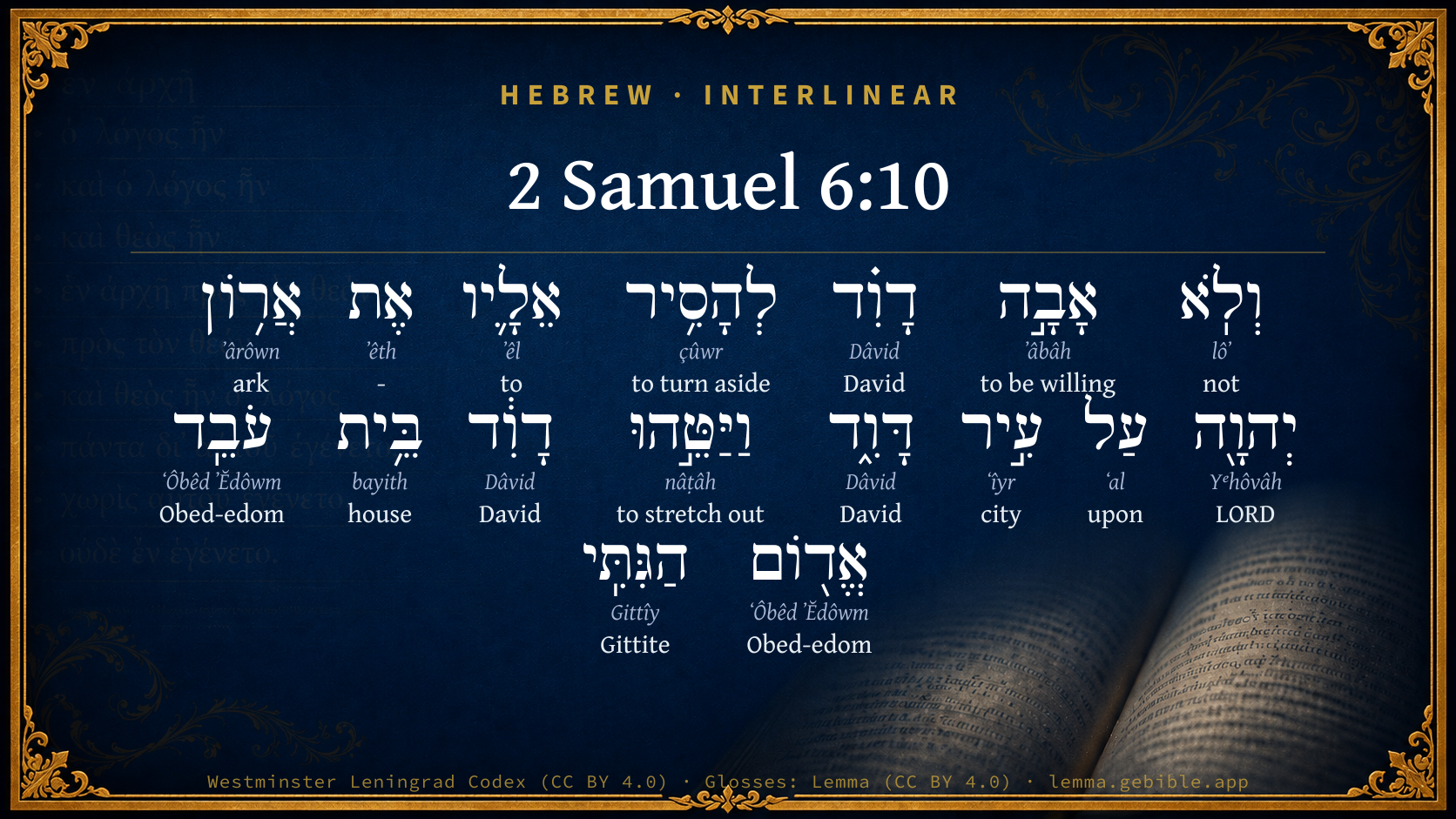
הַגִּתִּֽי
Gittîy
H1663
“the · Gittite”
Particle, Definite Article + Noun, Gentilic, Masculine, Singular, Absolute
Part of Speech
Particle + Noun
Type
Gentilic
Gender
Masculine
Number
Singular
State
Absolute
Full BDB Definition

Origin: patrial from H1661

TWOT: None

Gittite = "belonging to Gath" - an inhabitant of Gath
  1. וְלֹֽא lôʼ H3808 “and · not” Conjunction + Particle, Negative
  2. אָבָ֣ה ʼâbâh H14 “to be willing” Verb, Qal, Perfect, 3rd Person, Masculine, Singular
  3. דָוִ֗ד Dâvid H1732 “David” Noun, Proper
  4. לְהָסִ֥יר çûwr H5493 “to turn aside” Preposition + Verb, Hiphil, Infinitive Construct
  5. אֵלָ֛יו ʼêl H413 “to · him” Preposition + Suffix, Personal, 3rd Person, Masculine, Singular
  6. אֶת ʼêth H853 “-” Particle, Direct Object
  7. אֲר֥וֹן ʼârôwn H727 “ark of” Noun, Common, Both, Singular, Construct
  8. יְהוָ֖ה Yᵉhôvâh H3068 “LORD” Noun, Proper
  9. עַל ʻal H5921 “upon” Preposition
  10. עִ֣יר ʻîyr H5892 “city of” Noun, Common, Feminine, Singular, Construct
  11. דָּוִ֑ד Dâvid H1732 “David” Noun, Proper
  12. וַיַּטֵּ֣הוּ nâṭâh H5186 “and · to stretch out · him” Conjunction + Verb, Hiphil, Sequential Imperfect, 3rd Person, Masculine, Singular + Suffix, Personal, 3rd Person, Masculine, Singular
  13. דָוִ֔ד Dâvid H1732 “David” Noun, Proper
  14. בֵּ֥ית bayith H1004 “house of” Noun, Common, Masculine, Singular, Construct
  15. עֹבֵֽד ʻÔbêd ʼĔdôwm H5654 “Obed-edom” Noun, Proper
  16. אֱד֖וֹם ʻÔbêd ʼĔdôwm H5654 “Obed-edom” Noun, Proper

About this verse

These counts appear in no published source. They are computed here, from the morphology-tagged text and Lemma’s own curated glosses. What Lemma adds →

17
words
14
distinct lemmas
Historical
section

Notable vocabulary

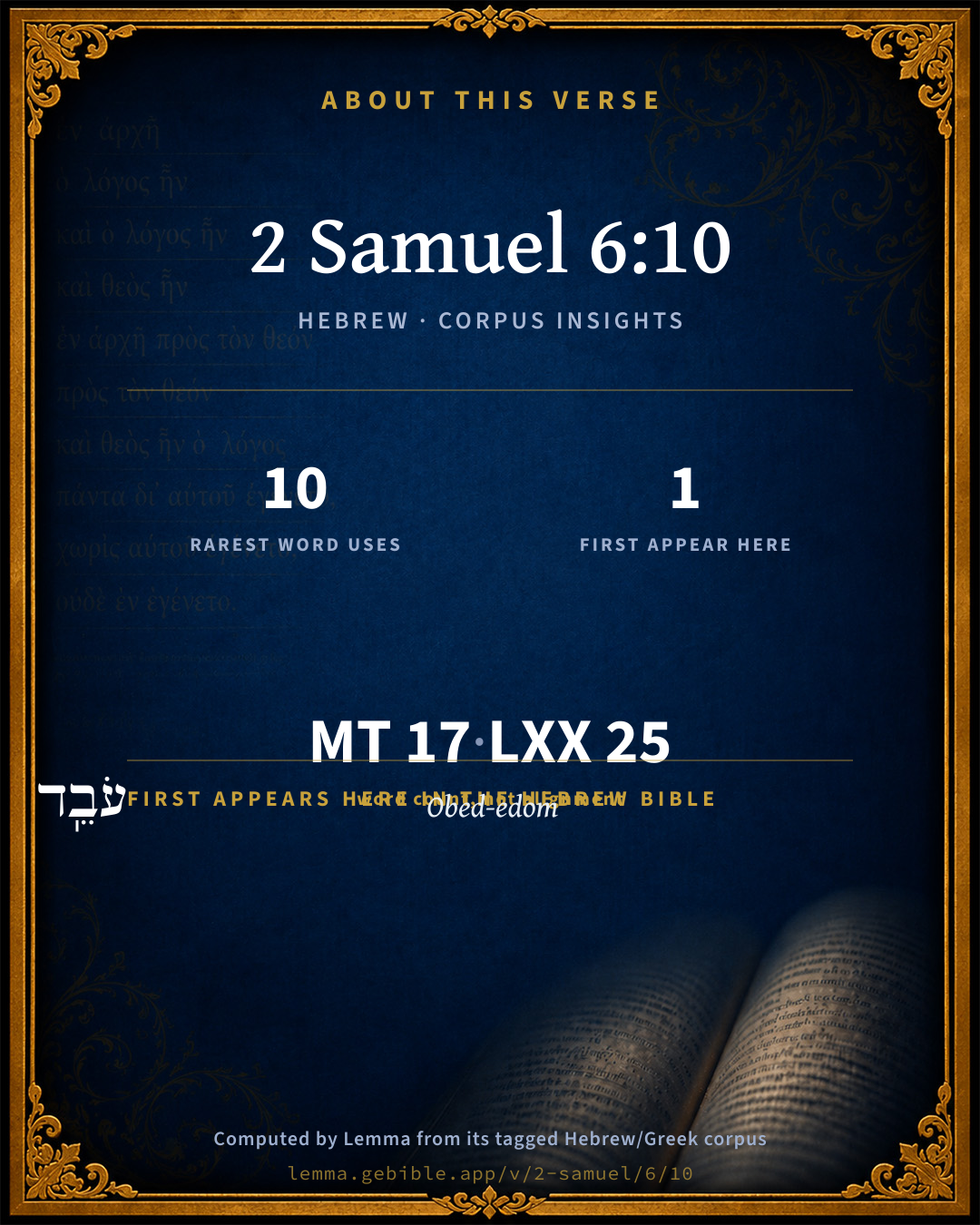
The rarest word here is הַגִּתִּֽי Gittite H1663 — appearing just 10 times in the whole Hebrew Bible.

First appearance in Scripture

This word makes its first canonical appearance in the Hebrew Bible here:

  • עֹבֵֽד Obed-edom H5654

Shared distinctive vocabulary

הַגִּתִּֽי Gittite H1663 occurs in 10 verses of the Hebrew Bible. Also found in:

Grammatical profile

  • 3 verbs
  • 10 nouns
  • 2 prepositions
  • 2 particles

Verb forms

  • אָבָ֣ה Qal · Perfect
  • לְהָסִ֥יר Hiphil · Infinitive Construct
  • וַיַּטֵּ֣הוּ Hiphil · Sequential Imperfect

Repetition

Words recur within this verse — often emphatic in Hebrew:

  • דָוִ֗ד David H1732 ×3
  • עֹבֵֽד Obed-edom H5654 ×2

Hebrew & Septuagint length

In English translation the verse runs 28 words from the Hebrew and 33 from the Septuagint (LXX English) — closely comparable.

A rough comparison of the two English renderings, which tokenize alike — not a word-level alignment.

Word counts can differ between the Hebrew and the Greek without any difference in meaning — e.g. the Hebrew direct-object marker אֵת has no separate Greek word, and Greek often adds the article ὁ.

In the original languages it is 17 Hebrew tokens and 25 Greek tokens — but the two are counted differently (Hebrew bundles its prefixes and suffixes into one token; the Greek is in lemma form), so that isn’t a like-for-like length.

Cross-references

7

Topical passages linked to 2 Samuel 6:10 in the Treasury of Scripture Knowledge — connected by theme and wording, ordered by reader-vote popularity; previews shown in the World English Bible.

  • 1 Chronicles 26:4–8 Obed-edom had sons: Shemaiah the firstborn, Jehozabad the second, Joah the third, and Sacar the fourth, and Nethanel the fifth,
  • 2 Samuel 4:3 and the Beerothites fled to Gittaim, and have lived as foreigners there until this day).
  • 2 Samuel 15:19 Then said the king to Ittai the Gittite, Why go you also with us? return, and abide with the king: for you are a foreigner, and also an exile; [return] to your own place.
  • 2 Samuel 18:2 David sent forth the people, a third part under the hand of Joab, and a third part under the hand of Abishai the son of Zeruiah, Joab's brother, and a third part under the hand of Ittai the Gittite. The king said to the people, I will surely go forth with you myself also.
  • 1 Chronicles 13:13–14 So David didn't move the ark to him into the city of David, but carried it aside into the house of Obed-edom the Gittite.
  • 1 Chronicles 15:18 and with them their brothers of the second degree, Zechariah, Ben, and Jaaziel, and Shemiramoth, and Jehiel, and Unni, Eliab, and Benaiah, and Maaseiah, and Mattithiah, and Eliphelehu, and Mikneiah, and Obed-edom, and Jeiel, the doorkeepers.
  • 1 Chronicles 16:5 Asaph the chief, and second to him Zechariah, Jeiel, and Shemiramoth, and Jehiel, and Mattithiah, and Eliab, and Benaiah, and Obed-edom, and Jeiel, with psalteries and with harps; and Asaph with cymbals, sounding aloud;

Cross-references courtesy of OpenBible.info (CC BY 4.0).

Hebrew and Greek witnesses Masoretic Hebrew ↔ Greek Septuagint

The same verse in the two great witnesses to the Old Testament, shown verse-for-verse.

These are two independent witnesses, not word-aligned to each other, and the Septuagint is shown in lemma (dictionary) form.

Hebrew 2 Samuel 6:10 Masoretic · Westminster Leningrad Codex

וְלֹֽא אָבָ֣ה דָוִ֗ד לְהָסִ֥יר אֵלָ֛יו אֶת אֲר֥וֹן יְהוָ֖ה עַל עִ֣יר דָּוִ֑ד וַיַּטֵּ֣הוּ דָוִ֔ד בֵּ֥ית עֹבֵֽד אֱד֖וֹם הַגִּתִּֽי

So David would not remove the ark of Yahweh to him into the city of David; but David carried it aside into the house of Obed-edom the Gittite.

World English Bible · Public Domain

Greek LXX 2 Samuel 6:10 Septuagint · lemma form

καί οὐ βούλομαι δαυίδ ὁ ἐκκλίνω πρός ἑαυτοῦ ὁ κιβωτός διαθήκη κύριος εἰς ὁ πόλις δαυίδ καί ἀποκλίνω αὐτός δαυίδ εἰς οἶκος αβεδδαρα ὁ γεθθαῖος

And David would not bring in the ark of the covenant of the Lord to himself into the city of David: and David turned it aside into the house of Abeddara the Gethite.

LXX2012 (modern English Septuagint) · Public Domain

Hebrew: Westminster Leningrad Codex (CC BY 4.0). Greek: Septuagint (public domain); English from LXX2012 (modern English Septuagint) (Public Domain). How the Septuagint differs from the Hebrew →

Targum (Aramaic paraphrase)

1

The Targum is the ancient Jewish Aramaic paraphrase of the Hebrew Scriptures — an interpretive translation, not the Hebrew text itself. Onkelos (literal) and Pseudo-Jonathan (expansive) render the Torah, and Jonathan the Prophets. Coverage is partial: where no permissively-licensed English translation exists for a verse, only the Aramaic is shown. This is verse-level text, not a word-by-word alignment to the Hebrew.

  1. Targum Jonathan Prophets (Joshua–Malachi)
    וְלָא אָבָא דָוִד לְאַפְנָאָה לְוָתֵיהּ יַת אֲרוֹנָא דַייָ לְקַרְתָּא דְדָוִד וְאַפְנֵיהּ דָוִד לְבֵית עוֹבֵד אֱדוֹם גִיתָּאָה:

    (no public-domain English translation for this verse)

    Targum Jonathan — Aramaic: “Mikraot Gedolot” (public domain). English: “Sefaria Community Translation” (CC0 1.0 (public-domain dedication)); “London "Chaldee Paraphrase," 1871” (public domain). Text via Sefaria.

Commentary

Notes on 2 Samuel 6:10 from classic Christian and Jewish commentators (each source and its license shown beneath its notes). The classic Christian expositions comment on the surrounding passage and are grouped to its opening verse, so a note may address several verses; the Jewish commentaries on the Tanakh (Rashi and others) are per-verse, so they appear only where the commentator wrote on this verse.

Lemma curates 59 commentaries, every one of them public domain or Creative Commons licensed, each selected and text-cleaned for this edition rather than reprinted as found. About our sources →

Trapp's Complete Commentary

John Trapp

2Sa 6:10 So David would not remove the ark of the LORD unto him into the city of David: but David carried it aside into the house of Obededom the Gittite.

Ver. 10. So David would not remove.] For he taketh it for granted that it was not God’s will he should.

Into the house of Obededom the Gittite,] i.e., Born in Gathrimmon, a city of priests, {Jos 21:24-25} and himself a Levite, a good man, and glad of such a guest as the ark, which he entertained cheerfully, and resolved to handle holily. Sancte magis quam scite, as he once said to the Vestalis Virgo.

John Trapp, A Commentary or Exposition upon All the Books of the Old and New Testament (1647–1656) — public domain. Text from a community e-Sword module.

Joseph Benson's Commentary

2Sa 6:10. David carried it to the house of Obed-edom, the Gittite — He is not called a Gittite from his being born in, or dwelling at, that Gath which was a city of the Philistines, but from Gath-rimmon, a Levitical city, Jos 21:24. For it is certain he was a Levite, 1Ch 15:18-24; 1Ch 16:5. Obed-edom knew what slaughter the ark had made among the Philistines and the Bethshemites; he saw Uzzah struck dead; yet invites it to his house, and opens his doors without fear, knowing it was a savour of death only to them that treated it ill. “O the courage,” says Bishop Hall, “of an honest and faithful heart! Nothing can make God otherwise than amiable to him; even his justice is lovely.”

Joseph Benson's Commentary on the Old and New Testaments (1811–1818) — public domain. Text from a community e-Sword module.

Tyndale Open Study Notes

Tyndale Open Resources

6:10 Obed-edom was a Levite (1 Chr 15:18, 21; 16:38; 26:4, 8, 15; 2 Chr 25:24) who lived either in the Philistine city of Gath or in an Israelite town of a similar name (e.g., Gath-rimmon, a city given to the Levites, Josh 21:25).

Tyndale Open Study Notes — © Tyndale Open Resources, licensed CC BY-SA 4.0. Text via the HelloAO Bible API.

Geneva Bible (1599)

Geneva Bible translators

Who was a Levite, and had dwelt in Gittaim, 1 Chron. 15:25.

Geneva Bible (1599) marginal notes — public domain. Text via Bolls.life.

Adam Clarke's Commentary

Verse 10. But David carried it aside] The house of Obed-edom appears to have been very near the city, which they were about to enter, but were prevented by this accident, and lodged the ark with the nearest friend.

Adam Clarke's Commentary on the Bible (1810–1826) — public domain. Text from a community e-Sword/MySword module.

Ellicott's Commentary for English Readers

(10) Obed-edom the Gittite.—He was a Levite, but whether of the family of Kohath or of Merari is uncertain, since at this time the name appears in both these families (see for Merari, 1Ch_15:17-18, and for Kohath, 1Ch_26:1; 1Ch_26:4; 1Ch_26:8; 1Ch_26:13-15). The one hero mentioned was a Gittite, i.e., born at, or belonging to, Gath-rimmon, a Levitical city on the confines of Dan and Manasseh (Jos_21:24-25). One of these Levites is described as “the son of Jeduthun” (1Ch_16:38, where both are mentioned), and as Jeduthun probably belonged to the family of Merari, it is probable that the one here mentioned was called “the Gittite” for distinction’s sake, and belonged to the family of Kohath, to which Gath-rimmon belonged (Jos_21:20). Moreover, it is said of the Obed-edom of 1Ch_26:4-5, that “God blessed him,” which seems to refer to this passage. The name, although a singular one (servant of Edom) was not uncommon, and was also borne by one having charge of the vessels of the sanctuary in the days of King Amaziah (2Ch_25:24). The Obed-edoms of David’s time were porters of the Tabernacle, Levitical musicians, and took an active part in bringing the ark to Jerusalem, and afterwards in ministering before it (1Ch_15:16; 1Ch_15:18; 1Ch_15:21; 1Ch_15:24; 1Ch_16:4-5; 1Ch_16:37-38; 1Ch_26:1; 1Ch_26:4; 1Ch_26:13-15).

A Bible Commentary for English Readers, edited by Charles John Ellicott (1878–1897) — public domain. Text from a community e-Sword module.

The Cambridge Bible for Schools and Colleges

gen. ed. J. J. S. Perowne

10. Obed-edom the Gittite] Obed-edom was a Levite belonging to the family of the Korahites, who were descended from Kohath (1Ch_26:1; 1Ch_26:4-8; Num_16:1). He is called a Gittite probably because he was a native of the Levitical city of Gath-rimmon, in Dan or Manasseh, which was assigned to the Kohathites (Jos_21:24-25). Thus there was an appropriateness in his being chosen to take charge of the Ark, since he belonged to the family which was originally appointed to carry it from place to place (Num_4:15). The site of Gath-rimmon is not determined, but it seems to have been further from Jerusalem than Kirjath-jearim, and this appears to indicate either that Obed-edom had removed from his native place and was living near Jerusalem, or that “Perez-uzzah” was not far from Kirjath-jearim, and that the special fitness of Obed-edom to take charge of the Ark induced David to take it to his house, though at a greater distance from Jerusalem.

The name Obed-edom (= servant of Edom) is peculiar. It may possibly refer to the servitude of some member of the family to the Edomites.

The Cambridge Bible for Schools and Colleges (gen. ed. J. J. S. Perowne; Cambridge University Press, 1878–1918) — public domain. Text from a community e-Sword module.

John Gill's Exposition

And the ark of the Lord continued in the house of Obededom the Gittite three months,.... David, and those with him, returned to their habitations, where they continued during this time:

and the Lord blessed Obededom, and all his household; him, and all his family, with spiritual blessings, and with an affluence of temporal good things; for godliness has the promise of this life, and of that which is to come; men are not losers but gainers, even in things temporal, for their attachment to the cause of religion, and the service of God, and their regard to that in their own houses, as well as in the house of God. Josephus (o) says, that Obededom was very poor before, and in a low condition, out of which he soon emerged, and came into affluent circumstances, so as to be taken notice of by his neighbours, and reported abroad; by which means David came to the hearing of it, as follows.

(o) Antiqu. l. 7. c. 4. sect. 2.

John Gill's Exposition of the Whole Bible (1746–1763) — public domain (CC PDM 1.0). Text via the HelloAO Bible API.

Albert Barnes' Notes on the Bible

Obed-edom was a Levite of the family of Merari, being 1Ch 15:18-24; 1Ch 16:38 a son of Jeduthun, who was a Merarite. He was a porter, a player on the harp, and was one of the Levites especially designated to take part in the musical services on the occasion of bringing up the ark to Zion, and to minister before it when brought up. He is called a Gittite perhaps from Gath-Rimmon, in Manasseh, which belonged to the Kohathites Jos 21:25. Marriage with a Kohathite, or some other cause, would account for his dwelling in a Kohathite city.

Albert Barnes' Notes on the Bible (1834–1885) — public domain. Text from a community e-Sword/MySword module.

Haydock's Catholic Bible Commentary

Gethite, a native of Geth-remmon, a Levitical city; (Josue xxi. 24,) or he might have been born at Geth; (Calmet) or his father might have resided there a long time, (Serarius; Tirinus) unless he was there with David. (Salien) --- He was a Levite, 1 Paralipomenon xv. 18., and xvi. 5., and xxvi. 4. (Calmet)

George Leo Haydock (1774–1849), Haydock's Catholic Family Bible and Commentary, 1859 edition — public domain. Excludes Psalms (Douay-Rheims chapter numbering differs from Protestant) and Deuterocanonical books (Catholic canon only).

Matthew Poole's English Annotations

Which doubtless was done by the consent and desire of the owner of it, who for the enjoyment of so great a privilege, was willing to expose himself to some hazard; and wisely considered that the late judgment was not to be imputed to the ark, but to Uzzah’s carelessness in managing it.

The Gittite: he was certainly a Levite, 1Ch 15:18,21,21; 16:5; 26:4, and here called a Gittite, either, first, from Gath of the Philistines, where he or his father might be born or have sojourned, which might be upon divers occasions; or, secondly, from Gath-rimmon, which was a Levitical city, Jos 21:24,25.

Matthew Poole's English Annotations on the Holy Bible (1683–1685) — public domain. Text from a community e-Sword/MySword module.

Whedon's Commentary on the Bible

Daniel D. Whedon

10. Obed-edom — A Levite descended from Kohath, (see 1Ch_26:8,) and afterwards honoured as one of the “doorkeepers for the ark.” 1Ch_15:24. His family long continued in the sanctuary service as keepers of the sacred vessels. 2Ch_25:24.

The Gittite — So called from the name of his birthplace, the Levitical city of Gath-rimmon in the tribe of Dan. Jos_19:45; Jos_21:24.

Daniel D. Whedon (gen. ed.), Commentary on the Old and New Testaments (1874–1909) — public domain. Text from a community e-Sword module.

The Pulpit Commentary

Obed-Edom. We find two Levites of this name among David"s officials one belonging to the family of Merari, a singer and doorkeeper for the ark; (1Ch_15:18, 1Ch_15:21, 1Ch_15:24) the other of the family of Korah. (1Ch_26:4, 1Ch_26:5) And as it is there said that "God blessed him," he probably it was into whose house the ark was taken. He is called a Gittite, because he belonged to Gath-Rimmon, a Levitical city in the tribe of Dan. (Jos_19:45 Jos_21:24)

Vers. 10, 11 (THE HOUSE OF OBEDEDOM.) (1Ch_13:13, 1Ch_13:14)

The ark received with a right spirit.

By means of the ark "the thoughts of many hearts" were "revealed." Whilst Uzzah treated it with irreverence, and David regarded it with dread, Obed-Edom the Gittite (of Gath-rimmon) received it" with reverence and godly fear." He was a Levite, and (like Samuel) of the sons of Korah, a branch of the Kohathites, whose office it was to "bear upon their shoulders" (Num_7:9) and is subsequently mentioned as porter (musician), and doorkeeper of the ark. (1Ch_15:18, 1Ch_15:21, 24 16:5, 38; perhaps "the son of Jeduthun He did not seek to have the ark placed under his care; but, when requested by the king, he was not afraid to receive it, well knowing "that, although God is a consuming fire to those who treat him with irreverence, he is infinite in mercy to those who obey him." "Oh, the courage of an honest and faithful heart!" (Hall). The ark in the house of Obed-Edom may be considered as representing religion in the home; and wherever it truly dwells there is:

1. A consciousness of the presence of God; of which the ark was the divinely ordained symbol As often as he and his household looked upon the sacred vessel, mysteriously veiled with its blue covering, they would be the more deeply impressed with the conviction of that presence. We have no longer the symbol; but we have the spiritual reality which it signified; the one is taken away that the other may be more fully recognized, and its recognition cannot but produce in the home thoughtfulness, reverence, and self-restraint.

2. Obedience to his commandments; which were deposited in the ark. (2Ch_2:10) The Law must be written on the fleshy tablets of the heart; made the rule of life; and diligently taught to the children. (Deu_6:4-9) The sins which it forbids will thus be avoided, the virtues which it enjoins practised; "righteousness, goodness, and truth," the foundation on which the home is built; and the will of God being recognized as supreme, order and harmony will prevail.

3. Confidence in his mercy; according to the appointed method of reconciliation set forth by the mercy seat, and fulfilled in Christ (Rom_3:25; 2Co_5:19; 1Jn_2:1) The fatherly love of God, being "known and believed," becomes a perpetual incentive to love God and one another (Eph_4:32; Rom_13:10) The pervading element of the home should be love. "Jesus Christ Love; the same.

1. The enjoyment of his fellowship; which was assured at the mercy seat. "There will I commune with thee". (Exo_25:22) "Communion with God is the very innermost essence of all true Christian life;" and it is maintained and perfected in the home by family prayer (ver. 20).

1. Repose under his protection; represented by the overshadowing cherubim. While Obed-Edom guarded the ark of God, he was himself

2. guarded by the God of the ark. "The Lord is thy Keeper". (Psa_121:5) "He shall give his angels charge over thee," etc.. (Psa_91:1, Psa_91:11)

3. The reception of his blessing. "And Jehovah blessed Obed-Edom, and all his household" (ver. 11), "all that he had" (1Ch_13:14) blessed him with spiritual, providential, enduring benefits. (1Ch_26:4-8) "It paid well for its entertainment. The same hand that punished Uzzah"s proud presumption rewarded Obed-Edom"s humble boldness, and made the ark to him "a savour of life unto life (Matthew Henry). "A good man leaveth an inheritance to his children"s children" (Pro_13:22; Psa_102:28)

1. The promotion of his honour and glory. "And it was told King David," etc. Religion in the home "cannot be hid;" the fame thereof goes abroad and incites many perchance a whole nation to render to God the honour which is his due, "so that glory may dwell in our land. D.

The Pulpit Commentary (1880–1919), ed. H.D.M. Spence-Jones & Joseph S. Exell — public domain. Text from a community e-Sword module.

John Wesley's Explanatory Notes

House of Obed-edom - Obed-edom knew what slaughter the ark had made among the Philistines and the Bethshemites. He saw Uzzah struck dead; yet invites it to his house, and opens his doors without fear, knowing it was a savour of death, only to them that treated it ill. "O the courage, says Bishop Hall, of an honest and faithful heart! Nothing can make God otherwise than amiable to him: even his justice is lovely."

John Wesley, Explanatory Notes Upon the Whole Bible (1754–1765) — public domain. Text via the GEBible commentary corpus.

unfoldingWord translationNotes

Door43 World Missions Community

Obed Edom the Gittite

This is the name of a man. (See: How to Translate Names)

blessed him

Here "him" refers to Obed Edom the Gittite.

translationWords

David

ark of the covenant

city of David

house

month

bless

household

unfoldingWord translationNotes — © Distant Shores Media and the Door43 World Missions Community, licensed CC BY-SA 4.0. Source: git.door43.org/Door43/en_tn.

Rashi

Rabbi Shlomo Yitzchaki (Rashi)

Oveid Edom. He was a Levite as it is wriiten in Divrei Hayomim (I, 15:24) and he was one of the gatekeepers.

Rashi on the Tanakh — English translations: “The Judaica Press complete Tanach with Rashi, translated by A. J. Rosenberg” (CC BY 4.0); “Pentateuch with Rashi's commentary by M. Rosenbaum and A.M. Silbermann, 1929-1934” (public domain); “The Metsudah Tanach series, Lakewood, N.J” (CC BY 4.0); and “The Book of Joshua, Metsudah Publications, 1997” (CC BY 4.0). Text via Sefaria.

Lesson kit

Teaching starters — assembled from the data on this page, not authored interpretation. Every prompt links to the verse data it draws on. Edit before teaching.

2 Samuel, in the Historical, opens this verse with 17 words (14 distinct Hebrew lemmas). Its most distinctive word is Gittîy (“Gittite”). A historical commentator’s framing appears above. Read the whole chapter for the surrounding context.

Discussion questions

  1. How does “Gittite” (Gittîy) shape what this verse is saying?
  2. The word “Obed-edom” first appears here in Scripture. What is being introduced at this debut?
  3. Joshua 13:3 shares the word «Gittite» with this verse. How do the two illuminate each other?
  4. “David” occurs 3× in this one verse. What is the effect of the repetition?
  5. The translations on this page render this verse differently — a whole-verse word diff, not a word-by-word alignment. What might account for the different wordings?
  6. The verb «אָבָ֣ה» is Qal Perfect. How does its form color the action?
  7. Reading how Trapp's Complete Commentary and Joseph Benson's Commentary read this verse, where do the two commentators agree and where do they part?

Things to notice

Reading settings

Reading text

Shown beneath each verse's original-language words.

Old Testament
Old Testament edition

Read the OT as the Masoretic Hebrew (MT) or the Greek Septuagint (LXX).

English shown for the Greek Septuagint (in the Hebrew ↔ Greek comparison).

Comparing translations? Open the Compare panel on any verse page to stack up to four side by side.