
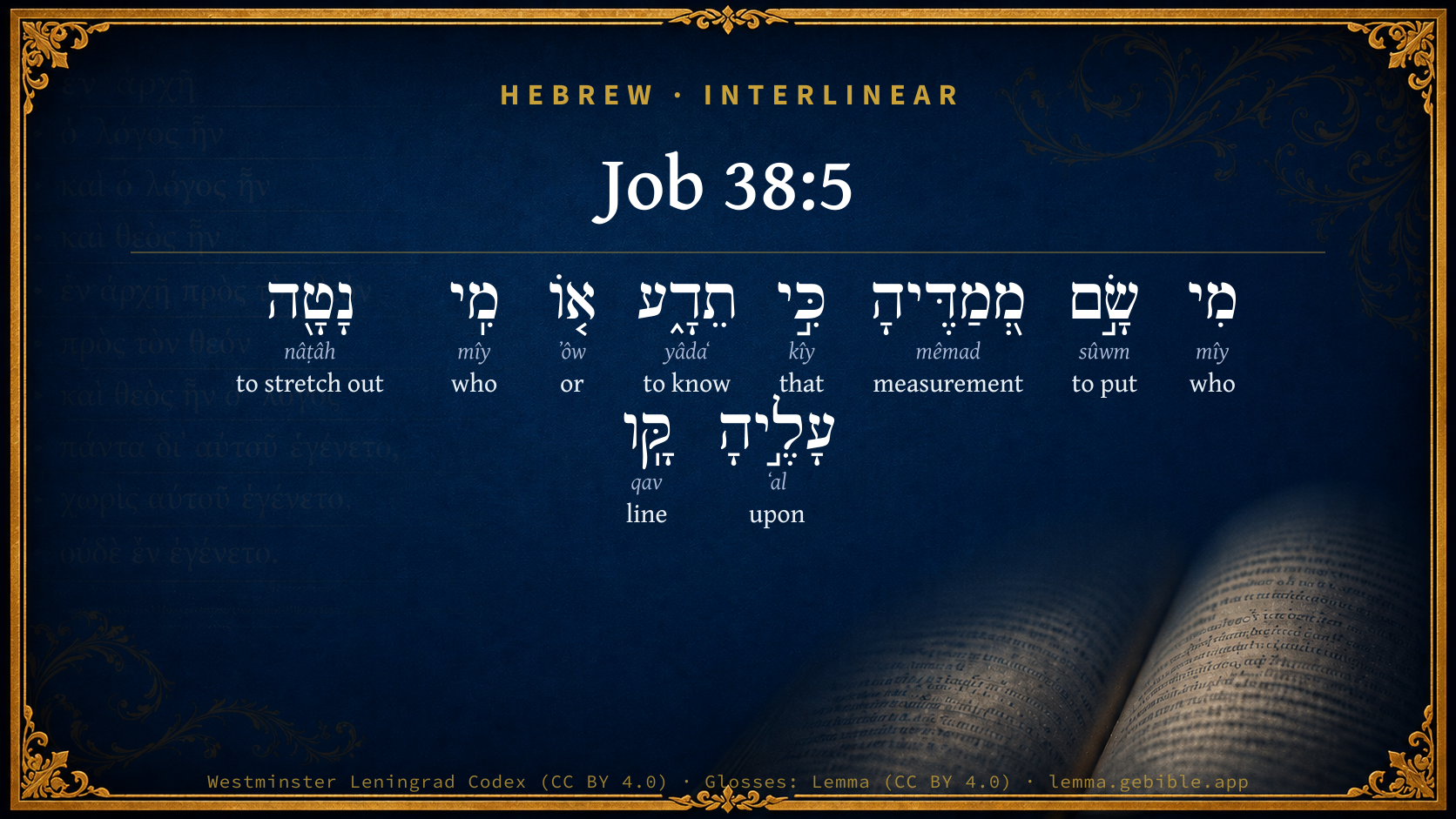
Job 38:5

Hebrew (Westminster Leningrad Codex) Job 38:5 appears in the Hebrew Old Testament. The text above is from the Westminster Leningrad Codex. Each word links to its Strong’s number, a concise gloss, and parsing drawn from the Open Scriptures Hebrew Bible morphology. Click any word for its full Brown-Driver-Briggs (BDB) entry.
Download image
Cite this verse

Job 38:5 (World English Bible). Public Domain. Lemma interlinear Bible study tool, https://lemma.gebible.app/v/job/38/5.

Show BibTeX & RIS
BibTeX
RIS
English Translation
Who determined the measures of it, if you know? Or who stretched the line on it?
World English Bible · Public Domain
Highlights
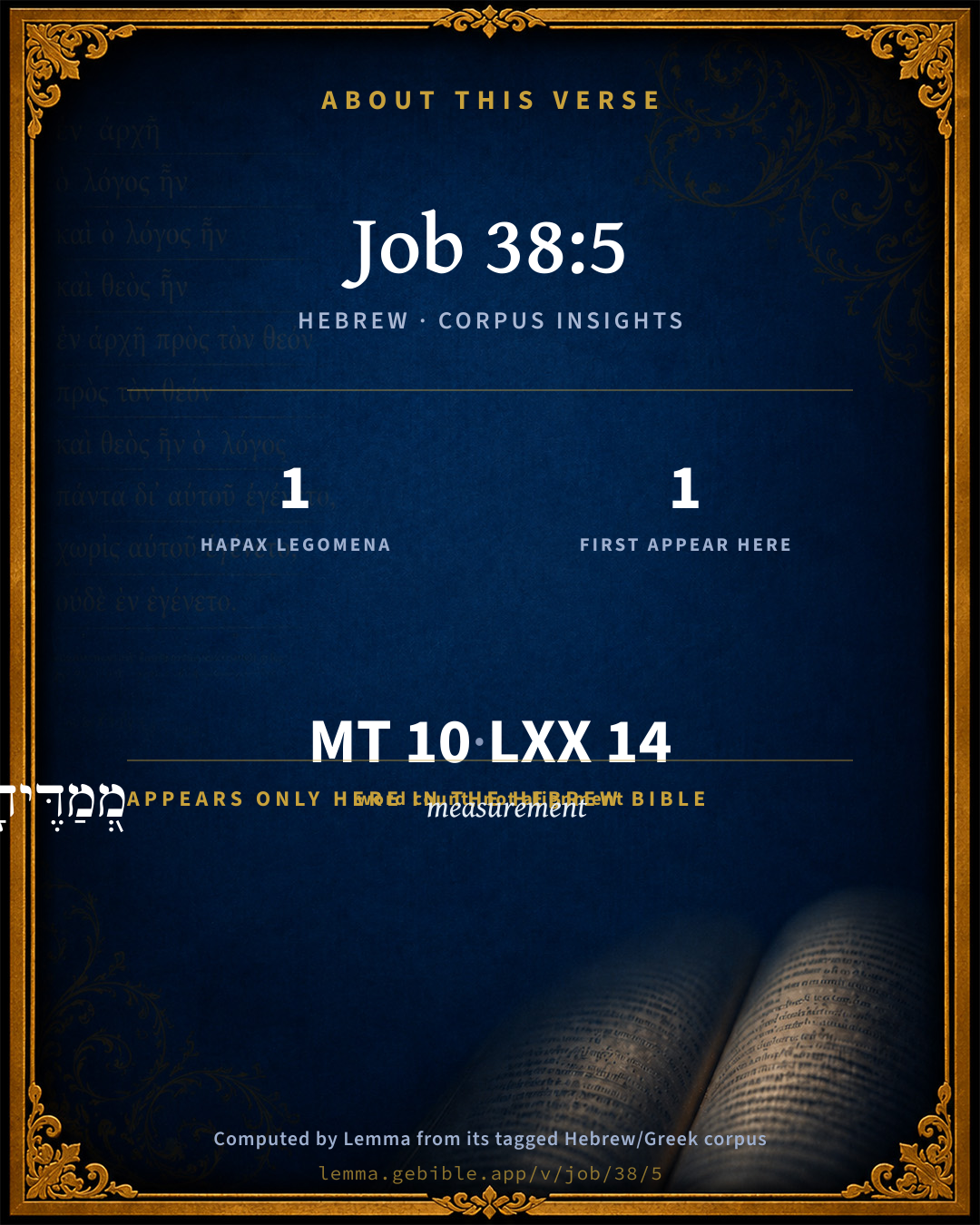
  • 1 hapax legomenon — only here in the Hebrew Bible
  • 1 first appearance in the Hebrew Bible
Full analysis ↓
Download a study sheet

One document with this verse’s original text, its word-by-word gloss line, the meaning frame, cross-references with their text, attributed commentary, and full source and license credits — printable, and it pastes into notes with its structure intact.

This verse Autodidact and up

Study sheet (.html) Plain text (.txt)

A passage Seminary Student

Up to 50 verses in one chapter. A passage sheet keeps up to 6 commentary sources and 12 cross-references per verse, in the order this page ranks them, and says so on the sheet whenever that leaves anything out. Ask for a single verse and you get the Autodidact verse sheet above.

Everything on this page stays free to read, with no account — the sheet is a download of what is already on screen, not access to it.

Want to remove ads? Support Godless Engineer
Compare translations 3

The same verse in 3 English versions, stacked beneath the original-language interlinear above. Click any original word for its lexicon entry.

Each is an independent rendering of the whole verse — the interlinear is not word-aligned to these translations.

Highlighted words mark where these versions differ — a whole-verse word diff, not a word-by-word alignment.

  • World English Bible Public Domain
    Who determined the measures of it, if you know? Or who stretched the line on it?
  • King James Version Public Domain
    Who hath laid the measures thereof, if thou knowest? or who hath stretched the line upon it?
  • unfoldingWord Literal Text CC BY-SA 4.0
    Who set its measurements? If you know! Or who stretched a line over it?

unfoldingWord Literal Text — © unfoldingWord, licensed CC BY-SA 4.0. Word-aligned USFM3 via Door43 (git.door43.org/unfoldingWord/en_ult).

Versions to compare (up to 4)

3 of 4 selected

Show all 18 translations

Every available English version of this verse, each an independent rendering of the whole verse.

  • World English Bible Public Domain
    Who determined the measures of it, if you know? Or who stretched the line on it?
  • Berean Standard Bible Public Domain
    Who fixed its measurements? Surely you know! Or who stretched a measuring line across it?
  • Majority Standard Bible Public Domain
    Who fixed its measurements? Surely you know! Or who stretched a measuring line across it?
  • King James Version Public Domain
    Who hath laid the measures thereof, if thou knowest? or who hath stretched the line upon it?
  • American Standard Version (1901) Public Domain
    Who determined the measures thereof, if thou knowest? Or who stretched the line upon it?
  • Revised Version (1885) Public Domain
    Who determined the measures thereof, if thou knowest? or who stretched the line upon it?
  • Geneva Bible (1599) Public Domain
    Who hath layde the measures thereof, if thou knowest, or who hath stretched the line ouer it:
  • Douay-Rheims (1899) Public Domain
    Who hath laid the measures thereof, if thou knowest? or who hath stretched the line upon it?
  • Young's Literal Translation Public Domain
    Who placed its measures -- if thou knowest? Or who hath stretched out upon it a line?
  • Literal Standard Version CC BY-SA 4.0
    Who placed its measures—if you know? Or who has stretched out a line on it?
  • Unlocked Literal Bible CC BY-SA 4.0
    Who determined its dimensions? Tell me, if you know. Who stretched the measuring line over it?
  • unfoldingWord Literal Text CC BY-SA 4.0
    Who set its measurements? If you know! Or who stretched a line over it?
  • Darby Bible Public Domain
    Who set the measures thereof -- if thou knowest? or who stretched a line upon it?
  • World Messianic Bible Public Domain
    Who determined its measures, if you know? Or who stretched the line on it?
  • Webster's Bible Public Domain
    Who hath laid the measures of it, if thou knowest? or who hath stretched the line upon it?
  • Free Bible Version CC BY-SA 4.0
    Who decided its dimensions? Don't you know? Who stretched out a measuring line?
  • Bible in Basic English Public Domain
    By whom were its measures fixed? Say, if you have wisdom; or by whom was the line stretched out over it?
  • JPS Tanakh (1917) Public Domain
    Who determined the measures thereof, if thou knowest? Or who stretched the line upon it?

Literal Standard Version (2020), Covenant Press — licensed CC BY-SA 4.0. Text via the HelloAO Bible API (eBible.org). Unlocked Literal Bible (unfoldingWord) — licensed CC BY-SA 4.0. Text via the HelloAO Bible API (eBible.org). unfoldingWord Literal Text — © unfoldingWord, licensed CC BY-SA 4.0. Word-aligned USFM3 via Door43 (git.door43.org/unfoldingWord/en_ult). Free Bible Version, Dr. Jonathan Gallagher — licensed CC BY-SA 4.0. Text via the HelloAO Bible API (eBible.org).

Word by word

More ways to search: Search by grammar → Find every occurrence → Compare this word →

Practice this passage: Drill this verse → Learn its vocabulary →

About this verse

These counts appear in no published source. They are computed here, from the morphology-tagged text and Lemma’s own curated glosses. What Lemma adds →

10
words
9
distinct lemmas
Wisdom
section

Notable vocabulary

1 hapax legomenon — a word that appears only here in the entire Hebrew Bible:

  • מְ֭מַדֶּיהָ measurement H4461

First appearance in Scripture

This word makes its first canonical appearance in the Hebrew Bible here:

  • מְ֭מַדֶּיהָ measurement H4461

Shared distinctive vocabulary

קָּֽו line H6957 occurs in 14 verses of the Hebrew Bible. Also found in:

Grammatical profile

  • 3 verbs
  • 2 nouns
  • 1 preposition
  • 2 conjunctions
  • 2 particles

Verb forms

  • שָׂ֣ם Qal · Perfect
  • תֵדָ֑ע Qal · Imperfect
  • נָטָ֖ה Qal · Perfect

Repetition

A word recurs within this verse — often emphatic in Hebrew:

Hebrew & Septuagint length

In English translation the verse runs 16 words from the Hebrew and 16 from the Septuagint (LXX English) — the same length.

A rough comparison of the two English renderings, which tokenize alike — not a word-level alignment.

Word counts can differ between the Hebrew and the Greek without any difference in meaning — e.g. the Hebrew direct-object marker אֵת has no separate Greek word, and Greek often adds the article ὁ.

In the original languages it is 10 Hebrew tokens and 14 Greek tokens — but the two are counted differently (Hebrew bundles its prefixes and suffixes into one token; the Greek is in lemma form), so that isn’t a like-for-like length.

Cross-references

11

Topical passages linked to Job 38:5 in the Treasury of Scripture Knowledge — connected by theme and wording, ordered by reader-vote popularity; previews shown in the World English Bible.

  • Isaiah 40:12 Who has measured the waters in the hollow of his hand, and meted out the sky with the span, and comprehended the dust of the earth in a measure, and weighed the mountains in scales, and the hills in a balance?
  • Job 11:9 The measure of it is longer than the earth, And broader than the sea.
  • Zechariah 2:1–2 I lifted up my eyes, and saw, and, behold, a man with a measuring line in his hand.
  • Job 28:25 He establishes the force of the wind; Yes, he measures out the waters by measure.
  • Psalms 19:4 Their voice has gone out through all the earth, Their words to the end of the world. In them he has set a tent for the sun,
  • Psalms 78:55 He also drove out the nations before them, Allotted them for an inheritance by line, And made the tribes of Israel to dwell in their tents.
  • Proverbs 8:27 When he established the heavens, I was there; When he set a circle on the surface of the deep,
  • Isaiah 34:11 But the pelican and the porcupine shall possess it; and the owl and the raven shall dwell therein: and he will stretch over it the line of confusion, and the plummet of emptiness.
  • Isaiah 40:22 [It is] he who sits above the circle of the earth, and the inhabitants of it are as grasshoppers; who stretches out the heavens as a curtain, and spreads them out as a tent to dwell in;
  • 2 Corinthians 10:16 so as to preach the Gospel even to the parts beyond you, not to boast in what someone else has already done.
  • Proverbs 8:29 When he gave to the sea its boundary, That the waters should not violate his commandment, When he marked out the foundations of the earth;

Cross-references courtesy of OpenBible.info (CC BY 4.0).

Hebrew and Greek witnesses Masoretic Hebrew ↔ Greek Septuagint

The same verse in the two great witnesses to the Old Testament, shown verse-for-verse.

These are two independent witnesses, not word-aligned to each other, and the Septuagint is shown in lemma (dictionary) form.

Hebrew Job 38:5 Masoretic · Westminster Leningrad Codex

מִי שָׂ֣ם מְ֭מַדֶּיהָ כִּ֣י תֵדָ֑ע א֤וֹ מִֽי נָטָ֖ה עָלֶ֣יהָ קָּֽו

Who determined the measures of it, if you know? Or who stretched the line on it?

World English Bible · Public Domain

Greek LXX Job 38:5 Septuagint · lemma form

τίς τίθημι ὁ μέτρον αὐτός εἰ οἶδα ἤ τίς ὁ ἐπιἄγω σπαρτίον ἐπί αὐτός

who set the measures of it, if you know? or who stretched a line upon it?

LXX2012 (modern English Septuagint) · Public Domain

Hebrew: Westminster Leningrad Codex (CC BY 4.0). Greek: Septuagint (public domain); English from LXX2012 (modern English Septuagint) (Public Domain). How the Septuagint differs from the Hebrew →

Commentary

Notes on Job 38:5 from classic Christian and Jewish commentators (each source and its license shown beneath its notes). The classic Christian expositions comment on the surrounding passage and are grouped to its opening verse, so a note may address several verses; the Jewish commentaries on the Tanakh (Rashi and others) are per-verse, so they appear only where the commentator wrote on this verse.

Lemma curates 59 commentaries, every one of them public domain or Creative Commons licensed, each selected and text-cleaned for this edition rather than reprinted as found. About our sources →

Trapp's Complete Commentary

John Trapp

Job 38:5 Who hath laid the measures thereof, if thou knowest? or who hath stretched the line upon it?

Ver. 5. Who hath laid the measures thereof] In that circumference and diameter that it holdeth?

If thou knowest] Or, For thou knowest; quandoquidem scitus es, a tart irony. Geometricians take upon them to know the various dimensions of the earth; and Archimedes boasted, that if he had but where to set his foot from off the earth he could shake the whole body of it. As also, that he could number all the sands that were in the whole world, habitable and inhabitable. But these were vain boasts.

Or who hath stretched the line upon it?] A metaphor from masons and other master builders, who work by line and by rule. Vitruvius in his 7th book saith thus, Longitudines ad regulam et lineam, altitudines ad perpendiculum, anguli ad normam respondentes exigantur.

John Trapp, A Commentary or Exposition upon All the Books of the Old and New Testament (1647–1656) — public domain. Text from a community e-Sword module.

Jamieson, Fausset & Brown

Robert Jamieson, A. R. Fausset & David Brown

measures--of its proportions. Image from an architect's plans of a building.

line--of measurement (Isa 28:17). The earth is formed on an all-wise plan.

Jamieson, Fausset & Brown — Commentary Critical and Explanatory on the Whole Bible (1871) — public domain (CC PDM 1.0). Text via the HelloAO Bible API.

Adam Clarke's Commentary

Verse 5. Who hath laid the measures thereof] Who hath adjusted its polar and equatorial distances from the centre?

Who hath stretched the line] Who hath formed its zones and its great circles, and adjusted the whole of its magnitude and gravity to the orbit in which it was to move, as well as its distance from that great centre about which it was to revolve? These questions show the difficulty of the subject; and that there was an unfathomable depth of counsel and design in the formation of the earth.

Adam Clarke's Commentary on the Bible (1810–1826) — public domain. Text from a community e-Sword/MySword module.

The Cambridge Bible for Schools and Colleges

gen. ed. J. J. S. Perowne

5. if thou knowest] Rather, that thou shouldest know. Job knew well who laid (rather, fixed) the measures of the earth, but the point of the question is, Was he present to see who fixed them and how they were fixed, so as to be able to speak with knowledge?

The Cambridge Bible for Schools and Colleges (gen. ed. J. J. S. Perowne; Cambridge University Press, 1878–1918) — public domain. Text from a community e-Sword module.

John Gill's Exposition

Who hath laid the measures thereof, if thou knowest?.... Did God or a creature? The Lord, no doubt. He laid them out in his divine mind, and laid them forth by his divine power; who does all things by weight and measure. He fixed the dimensions of the earth, how long, how thick, and how broad it should be; he settled the borders and boundaries of it. This Job might know that the Lord did; but he laid them, and what they are that are laid, he knew not. Mathematicians pretend to give us the circumference and diameter of the earth; but in their accounts are not agreed, but widely differ; which shows they are at no certainty about them (e); and Job and the men of his age might be still less knowing: though the words may be rendered, "for thou knowest" (f); surely such a knowing man as thou art must needs know this and so are a severe sarcasm upon him;

or who hath stretched the line upon it? The measuring line being formed according to rule, with exact symmetry and proportion. This may be the same with the circle of the earth, and the compass set upon the face of the deep or terraqueous globe, Pro 8:27. And with the same exactness and just proportion are the ways and works of Providence, which Job ought to have acquiesced in as being well and wisely done.

(e) The mathematicians in Aristotle's time reckoned the breadth of the earth a little less than forty myriads of furlongs, and the length of it seventy myriads. Aristot. de Mundo, c. 3. Vid. Plin. Nat. Hist. l. 2. c. 108, 109. According to the moderns, the circumference of the earth is 25,031.5 of our statute miles, and its diameter 7967 such miles. See Chamber's Dictionary on the word "Earth". (f) "quadoquidem", Junius & Tremellius, Piscator; "quia", Michaelis; "nam", Schultens; so Broughton.

John Gill's Exposition of the Whole Bible (1746–1763) — public domain (CC PDM 1.0). Text via the HelloAO Bible API.

Albert Barnes' Notes on the Bible

Who hath laid the measures thereof - That is, as an architect applies his measures when he rears a house.

If thou knowest - Or rather, “for thou knowest.” The expression is wholly ironical, and is designed to rebuke Job’s pretensions of being able to explain the divine administration.

Or who hath stretched the line upon it - As a carpenter uses a line to mark out his work; see the notes at Isa 28:17. The earth is represented as a building, the plan of which was laid out beforehand, and which was then made according to the sketch of the architect. It is not, therefore, the work of chance or fate. It is laid out and constructed according to a wise plan, and in a method evincing infinite skill.

Albert Barnes' Notes on the Bible (1834–1885) — public domain. Text from a community e-Sword/MySword module.

Haydock's Catholic Bible Commentary

Upon it. He speaks of the world as of a vast house, (Calmet) or palace, (Menochius) in which the Architect has shewn his art. (Haydock)

George Leo Haydock (1774–1849), Haydock's Catholic Family Bible and Commentary, 1859 edition — public domain. Excludes Psalms (Douay-Rheims chapter numbering differs from Protestant) and Deuterocanonical books (Catholic canon only).

Matthew Poole's English Annotations

Who hath prescribed how long and broad and deep it should be?

Or who hath stretched the line, to wit, the measuring line, to regulate all its dimensions, so as might be most convenient both for beauty and use?

Matthew Poole's English Annotations on the Holy Bible (1683–1685) — public domain. Text from a community e-Sword/MySword module.

Whedon's Commentary on the Bible

Daniel D. Whedon

5. If thou knowest — Rather, That thou shouldst know. This sounds the key-note to the whole series of questions — the folly of man’s assuming to comprehend the work of God. The puniness of the human mind will be set forth, just as a molehill finds its true dimensions beneath the shadow of a mountain. Each question conveys an oblique allusion to Job for his folly in arraigning an incomprehensible God. Job_9:35; Job_13:18; Job_13:22; Job_23:3-7; Job_31:35-37. Stretched the line — Like a wise master-builder, with measuring-line he lays out the world. “Behold,” says Samuel Wesley, “the architecture of God! The terms are those of the geometer or builder. The bases, the hinges, the lines, the perpendicular, the corner-stone, the measures.”

Daniel D. Whedon (gen. ed.), Commentary on the Old and New Testaments (1874–1909) — public domain. Text from a community e-Sword module.

The Pulpit Commentary

Who determined the measures thereof? Everything in creation is orderly, measured, predetermined, governed by law and will The actual weight of the planets is fixed by Divine wisdom, with a view to the stability and enduringness of the solar system. (comp. Isa_40:12) If thou knowest; literally, for thou knowest an anticipation of the lofty irony which comes out so remarkably in ver. 21. Or who hath stretched the line upon it? Human builders determine the dimensions of their constructions by means of a measuring-line. (Eze_40:3-49, etc.) The writer carries out his metaphor of a building by supposing a measuring-rod to have been used at the creation of the earth also. Some find a trace of the idea in Gen_1:9, where they translate Wwq, "Let the waters be marked out with a line."

The Pulpit Commentary (1880–1919), ed. H.D.M. Spence-Jones & Joseph S. Exell — public domain. Text from a community e-Sword module.

John Wesley's Explanatory Notes

Measures - Who hath prescribed how long and broad and deep it should be. Line - the measuring line to regulate all its dimensions.

John Wesley, Explanatory Notes Upon the Whole Bible (1754–1765) — public domain. Text via the GEBible commentary corpus.

Rashi

Rabbi Shlomo Yitzchaki (Rashi)

its measures Heb. מְמַדֶיהָ [like] מִדוֹתֶיהָ.

Rashi on the Tanakh — English translations: “The Judaica Press complete Tanach with Rashi, translated by A. J. Rosenberg” (CC BY 4.0); “Pentateuch with Rashi's commentary by M. Rosenbaum and A.M. Silbermann, 1929-1934” (public domain); “The Metsudah Tanach series, Lakewood, N.J” (CC BY 4.0); and “The Book of Joshua, Metsudah Publications, 1997” (CC BY 4.0). Text via Sefaria.

Lesson kit

Teaching starters — assembled from the data on this page, not authored interpretation. Every prompt links to the verse data it draws on. Edit before teaching.

Job, in the Wisdom, opens this verse with 10 words (9 distinct Hebrew lemmas). Its most distinctive word is mêmad (“measurement”). A historical commentator’s framing appears above. Read the whole chapter for the surrounding context.

Discussion questions

  1. What does “measurement” (mêmad) contribute to the verse as a whole?
  2. 1 word here appears nowhere else in the Hebrew Bible. Why might the author reach for such rare wording?
  3. This is the first place “measurement” appears in Scripture (first appears here). What does its debut here establish?
  4. How does 2 Kings 21:13, which shares the word «line», read alongside this verse?
  5. What does the repetition of “who” (2× in this one verse) do in this verse?
  6. These translations render this verse differently. What is at stake in choosing one wording over another?
  7. «שָׂ֣ם» is a Qal Perfect verb. How does that grammatical form shape the action described?
  8. Compare how Trapp's Complete Commentary and Jamieson, Fausset & Brown read this verse. Where do they agree or differ?

Things to notice

  • 1 word in this verse appears nowhere else in the Hebrew Bible.
  • 1 word makes its first canonical appearance in Scripture here.
  • This verse counts 10 Hebrew ↔ 14 Greek words.
  • These translations choose different wording for 11 words in this verse.
  • “who” occurs 2× in this single verse.

Reading settings

Reading text

Shown beneath each verse's original-language words.

Old Testament
Old Testament edition

Read the OT as the Masoretic Hebrew (MT) or the Greek Septuagint (LXX).

English shown for the Greek Septuagint (in the Hebrew ↔ Greek comparison).

Comparing translations? Open the Compare panel on any verse page to stack up to four side by side.