Jeremiah 17:23

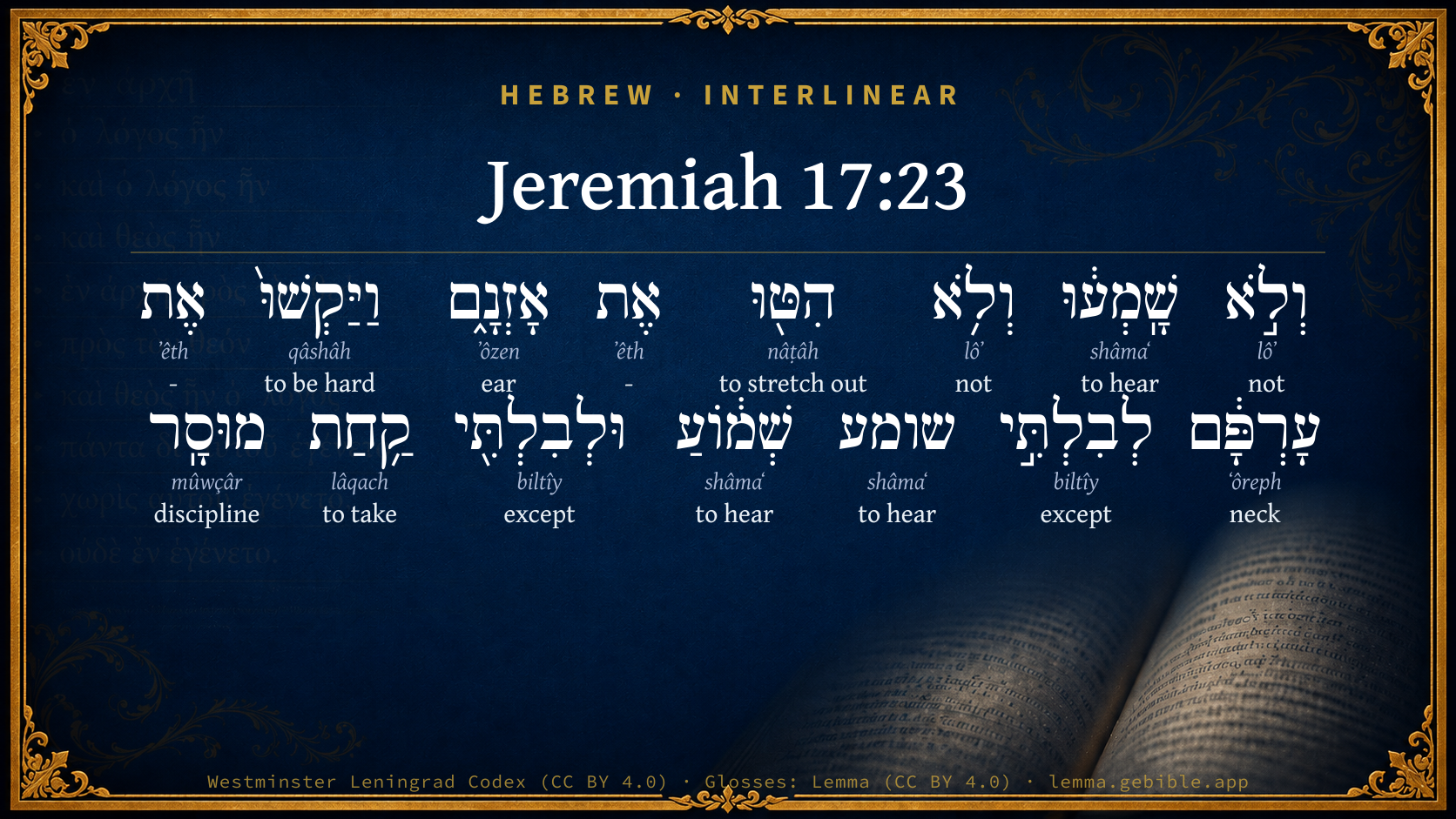
Hebrew (Westminster Leningrad Codex) Jeremiah 17:23 appears in the Hebrew Old Testament. The text above is from the Westminster Leningrad Codex. Each word links to its Strong’s number, a concise gloss, and parsing drawn from the Open Scriptures Hebrew Bible morphology. Click any word for its full Brown-Driver-Briggs (BDB) entry.
Download image
Cite this verse

Jeremiah 17:23 (World English Bible). Public Domain. Lemma interlinear Bible study tool, https://lemma.gebible.app/v/jeremiah/17/23.

Show BibTeX & RIS
BibTeX
RIS
English Translation
But they didn't listen, neither turn their ear, but made their neck stiff, that they might not hear, and might not receive instruction.
World English Bible · Public Domain
Download a study sheet

One document with this verse’s original text, its word-by-word gloss line, the meaning frame, cross-references with their text, attributed commentary, and full source and license credits — printable, and it pastes into notes with its structure intact.

This verse Autodidact and up

Study sheet (.html) Plain text (.txt)

A passage Seminary Student

Up to 50 verses in one chapter. A passage sheet keeps up to 6 commentary sources and 12 cross-references per verse, in the order this page ranks them, and says so on the sheet whenever that leaves anything out. Ask for a single verse and you get the Autodidact verse sheet above.

Everything on this page stays free to read, with no account — the sheet is a download of what is already on screen, not access to it.

Want to remove ads? Support Godless Engineer
Compare translations 3

The same verse in 3 English versions, stacked beneath the original-language interlinear above. Click any original word for its lexicon entry.

Each is an independent rendering of the whole verse — the interlinear is not word-aligned to these translations.

Highlighted words mark where these versions differ — a whole-verse word diff, not a word-by-word alignment.

  • World English Bible Public Domain
    But they didn't listen, neither turn their ear, but made their neck stiff, that they might not hear, and might not receive instruction.
  • King James Version Public Domain
    But they obeyed not, neither inclined their ear, but made their neck stiff, that they might not hear, nor receive instruction.
  • unfoldingWord Literal Text CC BY-SA 4.0
    Yet they listened not nor inclined their ear, but stiffened their neck to not hear and to not receive instruction.

unfoldingWord Literal Text — © unfoldingWord, licensed CC BY-SA 4.0. Word-aligned USFM3 via Door43 (git.door43.org/unfoldingWord/en_ult).

Versions to compare (up to 4)

3 of 4 selected

Show all 18 translations

Every available English version of this verse, each an independent rendering of the whole verse.

  • World English Bible Public Domain
    But they didn't listen, neither turn their ear, but made their neck stiff, that they might not hear, and might not receive instruction.
  • Berean Standard Bible Public Domain
    Yet they would not listen or incline their ear, but they stiffened their necks and would not listen or receive My discipline.
  • Majority Standard Bible Public Domain
    Yet they would not listen or incline their ear, but they stiffened their necks and would not listen or receive My discipline.
  • King James Version Public Domain
    But they obeyed not, neither inclined their ear, but made their neck stiff, that they might not hear, nor receive instruction.
  • American Standard Version (1901) Public Domain
    But they hearkened not, neither inclined their ear, but made their neck stiff, that they might not hear, and might not receive instruction.
  • Revised Version (1885) Public Domain
    But they hearkened not, neither inclined their ear, but made their neck stiff, that they might not hear, and might not receive instruction.
  • Geneva Bible (1599) Public Domain
    But they obeied not, neither inclined their eares, but made their neckes stiffe and would not heare, nor receiue correction.
  • Douay-Rheims (1899) Public Domain
    But they did not hear, nor incline their ear: but hardened their neck, that they might not hear me, and might not receive instruction.
  • Young's Literal Translation Public Domain
    And they have not hearkened nor inclined their ear, And they stiffen their neck not to hear, And not to receive instruction.
  • Literal Standard Version CC BY-SA 4.0
    And they have not listened nor inclined their ear, || And they stiffen their neck not to hear, || And not to receive instruction.
  • Unlocked Literal Bible CC BY-SA 4.0
    They did not listen or pay attention, but stiffened their neck so they would not hear me nor accept discipline.
  • unfoldingWord Literal Text CC BY-SA 4.0
    Yet they listened not nor inclined their ear, but stiffened their neck to not hear and to not receive instruction.
  • Darby Bible Public Domain
    but they hearkened not, neither inclined their ear, but hardened their neck, that they might not hear nor receive instruction.
  • World Messianic Bible Public Domain
    But they didn’t listen. They didn’t turn their ear, but made their neck stiff, that they might not hear, and might not receive instruction.
  • Webster's Bible Public Domain
    But they obeyed not, neither inclined their ear, but made their neck stiff, that they might not hear, nor receive instruction.
  • Free Bible Version CC BY-SA 4.0
    However, they refused to listen or pay attention. Instead they were stubborn and refused to obey or accept instruction.
  • Bible in Basic English Public Domain
    But they gave no attention and would not give ear, but they made their necks stiff so that they might not give ear and might not get teaching.
  • JPS Tanakh (1917) Public Domain
    but they hearkened not, neither inclined their ear, but made their neck stiff, that they might not hear, nor receive instruction.

Literal Standard Version (2020), Covenant Press — licensed CC BY-SA 4.0. Text via the HelloAO Bible API (eBible.org). Unlocked Literal Bible (unfoldingWord) — licensed CC BY-SA 4.0. Text via the HelloAO Bible API (eBible.org). unfoldingWord Literal Text — © unfoldingWord, licensed CC BY-SA 4.0. Word-aligned USFM3 via Door43 (git.door43.org/unfoldingWord/en_ult). Free Bible Version, Dr. Jonathan Gallagher — licensed CC BY-SA 4.0. Text via the HelloAO Bible API (eBible.org).

Word by word

More ways to search: Search by grammar → Find every occurrence → Compare this word →

Practice this passage: Drill this verse → Learn its vocabulary →

וַיַּקְשׁוּ֙
qâshâh
H7185
“and · to be hard”
Conjunction + Verb, Hiphil, Sequential Imperfect, 3rd Person, Masculine, Plural
Part of Speech
Conjunction + Verb
Stem
Hiphil
Form
Sequential Imperfect
Person
3rd Person
Gender
Masculine
Number
Plural
Full BDB Definition

Origin: a primitive root

TWOT: 2085

to be hard, be severe, be fierce, be harsh - (Qal) - to be hard, be difficult - to be hard, be severe - (Niphal) - to be ill-treated - to be hard pressed - (Piel) to have severe labour (of women) - (Hiphil) - to make difficult, make difficulty - to make severe, make burdensome - to make hard, make stiff, make stubborn - of obstinacy (figuratively) - to show stubbornness
  1. וְלֹ֣א lôʼ H3808 “and · not” Conjunction + Particle, Negative
  2. שָֽׁמְע֔וּ shâmaʻ H8085 “to hear” Verb, Qal, Perfect, 3rd Person, Common, Plural
  3. וְלֹ֥א lôʼ H3808 “and · not” Conjunction + Particle, Negative
  4. הִטּ֖וּ nâṭâh H5186 “to stretch out” Verb, Hiphil, Perfect, 3rd Person, Common, Plural
  5. אֶת ʼêth H853 “-” Particle, Direct Object
  6. אָזְנָ֑ם ʼôzen H241 “ear · their” Noun, Common, Feminine, Singular, Construct + Suffix, Personal, 3rd Person, Masculine, Plural
  7. אֶת ʼêth H853 “-” Particle, Direct Object
  8. עָרְפָּ֔ם ʻôreph H6203 “neck · their” Noun, Common, Masculine, Singular, Construct + Suffix, Personal, 3rd Person, Masculine, Plural
  9. לְבִלְתִּ֣י biltîy H1115 “to/for · except” Preposition + Conjunction
  10. שומע shâmaʻ H8085 “hearing” Verb, Qal, Participle Active, Masculine, Singular, Absolute
  11. שְׁמ֔וֹעַ shâmaʻ H8085 “to hear” Verb, Qal, Infinitive Construct
  12. וּלְבִלְתִּ֖י biltîy H1115 “and · to/for · except” Conjunction + Preposition + Particle, Negative
  13. קַ֥חַת lâqach H3947 “to take” Verb, Qal, Infinitive Construct
  14. מוּסָֽר mûwçâr H4148 “discipline” Noun, Common, Masculine, Singular, Absolute

About this verse

These counts appear in no published source. They are computed here, from the morphology-tagged text and Lemma’s own curated glosses. What Lemma adds →

15
words
10
distinct lemmas
Prophets
section

Shared distinctive vocabulary

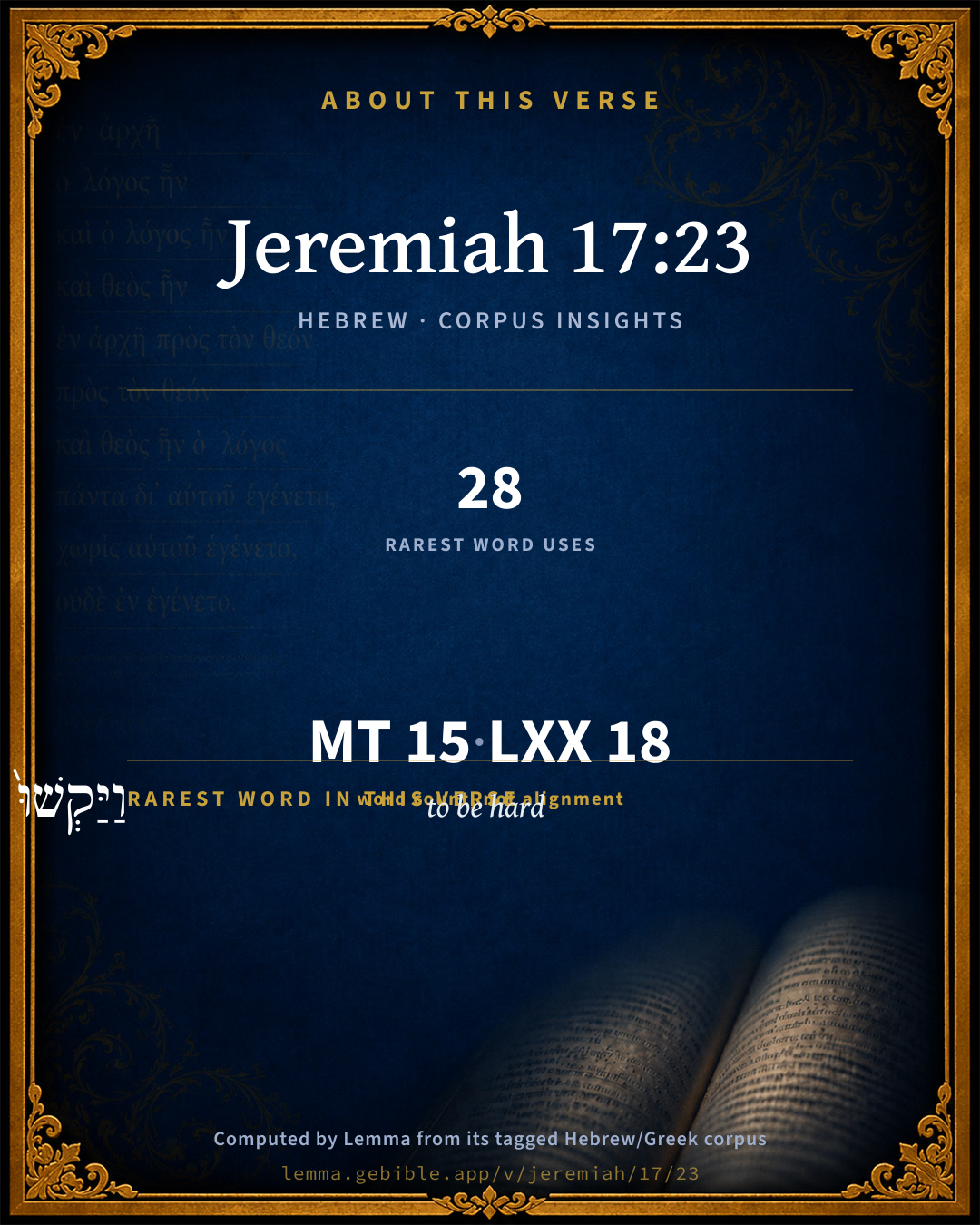
וַיַּקְשׁוּ֙ to be hard H7185 occurs in 28 verses of the Hebrew Bible. Also found in:

Grammatical profile

  • 6 verbs
  • 3 nouns
  • 1 conjunction
  • 5 particles

Verb forms

  • שָֽׁמְע֔וּ Qal · Perfect
  • הִטּ֖וּ Hiphil · Perfect
  • וַיַּקְשׁוּ֙ Hiphil · Sequential Imperfect
  • שומע Qal · Participle Active
  • שְׁמ֔וֹעַ Qal · Infinitive Construct
  • קַ֥חַת Qal · Infinitive Construct

Repetition

Words recur within this verse — often emphatic in Hebrew:

  • שָֽׁמְע֔וּ to hear H8085 ×3
  • לְבִלְתִּ֣י except H1115 ×2
  • וְלֹ֣א not H3808 ×2

Hebrew & Septuagint length

In the original languages it is 15 Hebrew tokens and 18 Greek tokens — but the two are counted differently (Hebrew bundles its prefixes and suffixes into one token; the Greek is in lemma form), so that isn’t a like-for-like length.

Cross-references

22

Topical passages linked to Jeremiah 17:23 in the Treasury of Scripture Knowledge — connected by theme and wording, ordered by reader-vote popularity; previews shown in the World English Bible.

  • Proverbs 29:1 He who is often rebuked and stiffens his neck Will be destroyed suddenly, with no remedy.
  • Jeremiah 7:24–26 But they didn't listen nor turn their ear, but walked in [their own] counsels [and] in the stubbornness of their evil heart, and went backward, and not forward.
  • Jeremiah 11:10 They are turned back to the iniquities of their forefathers, who refused to hear my words; and they are gone after other gods to serve them: the house of Israel and the house of Judah have broken my covenant which I made with their fathers.
  • Jeremiah 19:15 Thus says Yahweh of Hosts, the God of Israel, Behold, I will bring on this city and on all its towns all the evil that I have pronounced against it; because they have made their neck stiff, that they may not hear my words.
  • Acts 7:51 "You stiff-necked and uncircumcised in heart and ears, you always resist the Holy Spirit! As your fathers did, so you do.
  • Isaiah 48:4 Because I knew that you are obstinate, and your neck is an iron sinew, and your brow brass;
  • Jeremiah 32:33 They have turned to me the back, and not the face: and though I taught them, rising up early and teaching them, yet they have not listened to receive instruction.
  • Ezekiel 20:21 But the children rebelled against me; they didn't walk in my statutes, neither kept my ordinances to do them, which if a man do, he shall live in them; they profaned my Sabbaths. Then I said I would pour out my wrath on them, to accomplish my anger against them in the wilderness.
  • Zephaniah 3:7 I said, "Just fear me. Receive correction, so that her dwelling won't be cut off, according to all that I have appointed concerning her." But they rose early and corrupted all their doings.
  • Zechariah 7:11–12 But they refused to listen, and turned their backs, and stopped their ears, that they might not hear.
  • Psalms 50:17 Seeing you hate instruction, And throw my words behind you?
  • Proverbs 1:3 To receive instruction in wise dealing, In righteousness, justice, and equity;
  • Proverbs 1:5 That the wise man may hear, and increase in learning; That the man of understanding may attain to sound counsel:
  • Proverbs 5:12 And say, "How I have hated instruction, And my heart despised reproof;
  • Proverbs 8:10 Receive my instruction rather than silver; Knowledge rather than choice gold.
  • Jeremiah 6:8 Be instructed, Jerusalem, lest my soul be alienated from you; lest I make you a desolation, a land not inhabited.
  • Jeremiah 7:28 You shall tell them, This is the nation that has not listened to the voice of Yahweh their God, nor received instruction: truth is perished, and is cut off from their mouth.
  • Jeremiah 16:11–12 Then shall you tell them, Because your fathers have forsaken me, says Yahweh, and have walked after other gods, and have served them, and have worshiped them, and have forsaken me, and have not kept my law;
  • Jeremiah 35:15 I have sent also to you all my servants the prophets, rising up early and sending them, saying, Return you now every man from his evil way, and amend your doings, and don't go after other gods to serve them, and you shall dwell in the land which I have given to you and to your fathers: but you have not inclined your ear, nor listened to me.
  • Ezekiel 20:13 But the house of Israel rebelled against me in the wilderness: they didn't walk in my statutes, and they rejected my ordinances, which if a man keep, he shall live in them; and my Sabbaths they greatly profaned. Then I said I would pour out my wrath on them in the wilderness, to consume them.
  • Ezekiel 20:16 because they rejected my ordinances, and didn't walk in my statutes, and profaned my Sabbaths: for their heart went after their idols.
  • John 3:19–21 This is the judgment, that the light has come into the world, and men loved the darkness rather than the light; for their works were evil.

Cross-references courtesy of OpenBible.info (CC BY 4.0).

Hebrew and Greek witnesses Masoretic Hebrew ↔ Greek Septuagint

The same verse in the two great witnesses to the Old Testament, shown verse-for-verse.

These are two independent witnesses, not word-aligned to each other, and the Septuagint is shown in lemma (dictionary) form.

Hebrew Jeremiah 17:23 Masoretic · Westminster Leningrad Codex

וְלֹ֣א שָֽׁמְע֔וּ וְלֹ֥א הִטּ֖וּ אֶת אָזְנָ֑ם וַיַּקְשׁוּ֙ אֶת עָרְפָּ֔ם לְבִלְתִּ֣י שומע שְׁמ֔וֹעַ וּלְבִלְתִּ֖י קַ֥חַת מוּסָֽר

But they didn't listen, neither turn their ear, but made their neck stiff, that they might not hear, and might not receive instruction.

World English Bible · Public Domain

Greek LXX Structure differs

In the Septuagint, Jeremiah is about an eighth shorter than the Hebrew and arranges its material differently — the Oracles Against the Nations (Hebrew chapters 46–51) appear in the middle of the Greek book, after 25:13. Because the chapter and verse boundaries do not line up, a verse-for-verse comparison with the Hebrew is not shown.

A verse-for-verse comparison isn’t shown here because the chapters and verses don’t line up. Switch to the LXX edition with the MT / LXX toggle above to read the Greek directly.

On this verse, John Gill's Exposition discusses the Septuagint’s reading. Read the note in Commentary ↓

Hebrew: Westminster Leningrad Codex (CC BY 4.0). Greek: Septuagint (public domain); English from a public-domain English Septuagint. How the Septuagint differs from the Hebrew →

Targum (Aramaic paraphrase)

1

The Targum is the ancient Jewish Aramaic paraphrase of the Hebrew Scriptures — an interpretive translation, not the Hebrew text itself. Onkelos (literal) and Pseudo-Jonathan (expansive) render the Torah, and Jonathan the Prophets. Coverage is partial: where no permissively-licensed English translation exists for a verse, only the Aramaic is shown. This is verse-level text, not a word-by-word alignment to the Hebrew.

  1. Targum Jonathan Prophets (Joshua–Malachi)
    וְלָא קַבִּילוּ וְלָא אַרְכִינוּ יַת אוּדְנֵיהוֹן וְאַקְשִׁיאוּ יַת קְדַלְהוֹן בְּדִיל דְלָא לְמִשְׁמַע וּבְדִיל דְלָא לְקַבָּלָא אוּלְפָן:

    (no public-domain English translation for this verse)

    Targum Jonathan — Aramaic: “Mikraot Gedolot” (public domain). English: “Sefaria Community Translation” (CC0 1.0 (public-domain dedication)); “London "Chaldee Paraphrase," 1871” (public domain). Text via Sefaria.

Commentary

Notes on Jeremiah 17:23 from classic Christian and Jewish commentators (each source and its license shown beneath its notes). The classic Christian expositions comment on the surrounding passage and are grouped to its opening verse, so a note may address several verses; the Jewish commentaries on the Tanakh (Rashi and others) are per-verse, so they appear only where the commentator wrote on this verse.

Lemma curates 59 commentaries, every one of them public domain or Creative Commons licensed, each selected and text-cleaned for this edition rather than reprinted as found. About our sources →

Trapp's Complete Commentary

John Trapp

Jer 17:23 But they obeyed not, neither inclined their ear, but made their neck stiff, that they might not hear, nor receive instruction.

Ver. 23. But they obeyed not.] See Jer 7:24; Jer 7:26.

John Trapp, A Commentary or Exposition upon All the Books of the Old and New Testament (1647–1656) — public domain. Text from a community e-Sword module.

Tyndale Open Study Notes

Tyndale Open Resources

17:23 they did not listen or obey: The people probably considered the Sabbath too costly to observe, so they ignored it or overlooked its violations.

Tyndale Open Study Notes — © Tyndale Open Resources, licensed CC BY-SA 4.0. Text via the HelloAO Bible API.

Jamieson, Fausset & Brown

Robert Jamieson, A. R. Fausset & David Brown

(Jer 7:24, Jer 7:26).

Jamieson, Fausset & Brown — Commentary Critical and Explanatory on the Whole Bible (1871) — public domain (CC PDM 1.0). Text via the HelloAO Bible API.

John Calvin's Commentaries

Here the Prophet exaggerates their crime, — that the Jews had not now begun for the first time to violate this precept of the Law; for he reminds them that the Sabbath had been before violated by their fathers. We have said elsewhere that men are less excusable when the children follow the bad examples of their fathers. This is indeed what the world does not commonly think; for we see at this day, that most men boast of the examples of their fathers, when they wish to reject both the Law and the Prophets and the gospel: they think themselves to be defended by a strong shield, when they can object to us and say that the fathers had done otherwise. But we have seen from many passages how frivolous is such a defense; and Jeremiah here confirms the same thing, by saying that the crime of the people was the more atrocious, because their fathers had many ages before begun to despise this command of God.

But they heard not, he says, nor inclined their ear, but hardened their neck. By these words he shews most clearly that their fathers had not sinned through inadvertence or ignorance, but because they had hardened themselves in the contempt of God. It often happens that men, rightly taught, go astray through ignorance, as their want of knowledge may prevent them to understand what they hear: but when men incline not their ear, but harden their neck, their obstinacy becomes manifest, for they knowingly and wilfully reject God. Such perverseness then does Jeremiah here set forth by the various expressions he employs, as we have seen done in other places.

As to the hardening of the neck, it is a metaphor, as stated elsewhere, taken from untameable oxen. God compares his law to a yoke, and for the best reason; for as the oxen are tamed that they may labor and are trained to obey when the yoke is laid on them; so also God proves our obedience, when he rules us by his law, for we otherwise wander after our lusts. As therefore God corrects and checks in us by his law, all the unruly passions of the flesh, he is said to lay his yoke on us. Now, if we are intractable and do not submit to the authority of God, we are said to harden our neck. Jeremiah speaks afterwards without a metaphor, and says, That they heard not, nor received instruction, or correction. The word מוסר musar, means teaching or correction. The import of the whole is, that the Jews were not only unteachable when the will of God was plainly made known to them, but that they were also refractory and perverse in their spirit: for when to teaching were added exhortations the more to stimulate them, and when to these were added threatenings, yet God could not by any means subdue their wantonness. It now follows--

John Calvin's Commentaries (1540-1563) — public domain. Text from the Calvin Translation Society English edition (1840s-50s) via the Christian Classics Ethereal Library (ccel.org). Calvin's coverage is partial (roughly two-thirds of the Bible); uncommented books and verses are honest gaps, never fabricated. The 19th-century editor's footnotes and remarks are omitted so the notes are faithfully Calvin's own voice.

The Cambridge Bible for Schools and Colleges

gen. ed. J. J. S. Perowne

23. Substantially the same as ch. Jer_7:26.

instruction] correction. See on Jer_6:8.

The Cambridge Bible for Schools and Colleges (gen. ed. J. J. S. Perowne; Cambridge University Press, 1878–1918) — public domain. Text from a community e-Sword module.

John Gill's Exposition

But they obeyed not,.... Or, "heard not" (c); so as to observe and do; that is, their fathers did not; this command was very early disobeyed, and more or less in all intervening times:

neither inclined their ear; or listened attentively to what was said to them; but if they heard at all, it was in a very indifferent and careless manner, as if they cared not whether they heard or not; whereas persons intent on hearing bow the head, and turn the ear; and if they have one better than another, will turn that, in order to take in what they are attentive to; but so did not the Jewish fathers:

but made their neck stiff; or "hard" (d); and would not bend it, to take upon them the yoke of the commandments: a metaphor taken from untamed oxen, that will not submit the neck to the yoke, but draw back from it. The Septuagint and Arabic versions understand all this, not of the Jewish fathers of old, but of their children, even of the then present generation, rendering the words, "but hardened their neck more than their fathers"; they were more stiffnecked, refractory, and disobedient than they were; this was always the character of this people; as were the fathers, so were the children, if not worse; see Act 7:51;

that they might not hear nor receive instruction; about the command of the sabbath, or any other: or "correction", or "discipline" (e); the yoke of which they were as unwilling to bear as the yoke of the commandments, Jer 31:18.

(c) "non audiverunt", Pagninus, Montanus, Schmidt. (d) "sed obturarunt cervicem suam", Junius & Tremellius, Piscator; "indurarunt", Pagninus, Montanus, Schmidt. (e) "discliplinam", V. L. Pagninus, Montanus, Schmidt.

John Gill's Exposition of the Whole Bible (1746–1763) — public domain (CC PDM 1.0). Text via the HelloAO Bible API.

Matthew Poole's English Annotations

The Jews were a very covetous people, and their covetousness as well as their other lusts were temptations to them to profane the Lord’s sabbaths, Neh 13:19; Eze 20:2.

Matthew Poole's English Annotations on the Holy Bible (1683–1685) — public domain. Text from a community e-Sword/MySword module.

The Pulpit Commentary

This verse is modeled on Jer_7:26, Jer_7:28.

The Pulpit Commentary (1880–1919), ed. H.D.M. Spence-Jones & Joseph S. Exell — public domain. Text from a community e-Sword module.

Rashi

Rabbi Shlomo Yitzchaki (Rashi)

But they did not hearken i.e., your forefathers did not hearken to what I commanded them.

Rashi on the Tanakh — English translations: “The Judaica Press complete Tanach with Rashi, translated by A. J. Rosenberg” (CC BY 4.0); “Pentateuch with Rashi's commentary by M. Rosenbaum and A.M. Silbermann, 1929-1934” (public domain); “The Metsudah Tanach series, Lakewood, N.J” (CC BY 4.0); and “The Book of Joshua, Metsudah Publications, 1997” (CC BY 4.0). Text via Sefaria.

Lesson kit

Teaching starters — assembled from the data on this page, not authored interpretation. Every prompt links to the verse data it draws on. Edit before teaching.

Jeremiah, in the Prophets, opens this verse with 15 words (10 distinct Hebrew lemmas). Its most distinctive word is qâshâh (“to be hard”). A historical commentator’s framing appears above. Read the whole chapter for the surrounding context.

Discussion questions

  1. How does “to be hard” (qâshâh) shape what this verse is saying?
  2. Genesis 35:16 shares the word «to be hard» with this verse. How do the two illuminate each other?
  3. “to hear” occurs 3× in this one verse. What is the effect of the repetition?
  4. These translations render this verse differently. What is at stake in choosing one wording over another?
  5. The verb «שָֽׁמְע֔וּ» is Qal Perfect. How does its form color the action?
  6. Reading how Trapp's Complete Commentary and Tyndale Open Study Notes read this verse, where do the two commentators agree and where do they part?

Things to notice

Reading settings

Reading text

Shown beneath each verse's original-language words.

Old Testament
Old Testament edition

Read the OT as the Masoretic Hebrew (MT) or the Greek Septuagint (LXX).

English shown for the Greek Septuagint (in the Hebrew ↔ Greek comparison).

Comparing translations? Open the Compare panel on any verse page to stack up to four side by side.