2 Kings 20:10

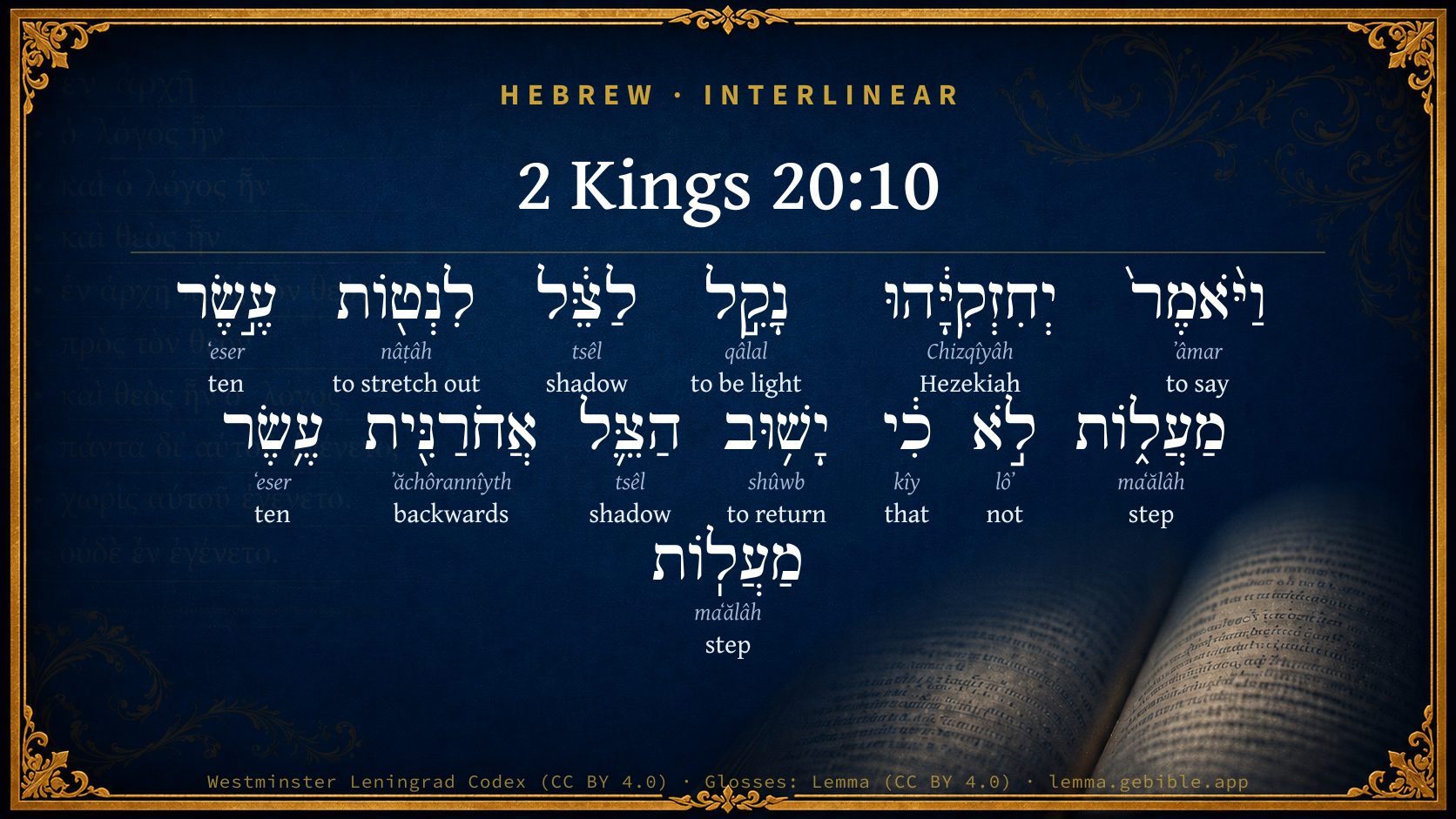
Hebrew (Westminster Leningrad Codex) 2 Kings 20:10 appears in the Hebrew Old Testament. The text above is from the Westminster Leningrad Codex. Each word links to its Strong’s number, a concise gloss, and parsing drawn from the Open Scriptures Hebrew Bible morphology. Click any word for its full Brown-Driver-Briggs (BDB) entry.
Download image
Cite this verse

2 Kings 20:10 (World English Bible). Public Domain. Lemma interlinear Bible study tool, https://lemma.gebible.app/v/2-kings/20/10.

Show BibTeX & RIS
BibTeX
RIS
English Translation
Hezekiah answered, It is a light thing for the shadow to decline ten steps: nay, but let the shadow return backward ten steps.
World English Bible · Public Domain
Download a study sheet

One document with this verse’s original text, its word-by-word gloss line, the meaning frame, cross-references with their text, attributed commentary, and full source and license credits — printable, and it pastes into notes with its structure intact.

This verse Autodidact and up

Study sheet (.html) Plain text (.txt)

A passage Seminary Student

Up to 50 verses in one chapter. A passage sheet keeps up to 6 commentary sources and 12 cross-references per verse, in the order this page ranks them, and says so on the sheet whenever that leaves anything out. Ask for a single verse and you get the Autodidact verse sheet above.

Everything on this page stays free to read, with no account — the sheet is a download of what is already on screen, not access to it.

Want to remove ads? Support Godless Engineer
Compare translations 3

The same verse in 3 English versions, stacked beneath the original-language interlinear above. Click any original word for its lexicon entry.

Each is an independent rendering of the whole verse — the interlinear is not word-aligned to these translations.

Highlighted words mark where these versions differ — a whole-verse word diff, not a word-by-word alignment.

  • World English Bible Public Domain
    Hezekiah answered, It is a light thing for the shadow to decline ten steps: nay, but let the shadow return backward ten steps.
  • King James Version Public Domain
    And Hezekiah answered, It is a light thing for the shadow to go down ten degrees: nay, but let the shadow return backward ten degrees.
  • unfoldingWord Literal Text CC BY-SA 4.0
    And Hezekiah said, “It is easy for the shadow to stretch out ten steps. No, but let the shadow go backward ten steps.”

unfoldingWord Literal Text — © unfoldingWord, licensed CC BY-SA 4.0. Word-aligned USFM3 via Door43 (git.door43.org/unfoldingWord/en_ult).

Versions to compare (up to 4)

3 of 4 selected

Show all 18 translations

Every available English version of this verse, each an independent rendering of the whole verse.

  • World English Bible Public Domain
    Hezekiah answered, It is a light thing for the shadow to decline ten steps: nay, but let the shadow return backward ten steps.
  • Berean Standard Bible Public Domain
    “It is easy for the shadow to lengthen ten steps,” answered Hezekiah, “but not for it to go back ten steps.”
  • Majority Standard Bible Public Domain
    “It is easy for the shadow to lengthen ten steps,” answered Hezekiah, “but not for it to go back ten steps.”
  • King James Version Public Domain
    And Hezekiah answered, It is a light thing for the shadow to go down ten degrees: nay, but let the shadow return backward ten degrees.
  • American Standard Version (1901) Public Domain
    And Hezekiah answered, It is a light thing for the shadow to decline ten steps: nay, but let the shadow return backward ten steps.
  • Revised Version (1885) Public Domain
    And Hezekiah answered, It is a light thing for the shadow to decline ten steps: nay, but let the shadow return backward ten steps.
  • Geneva Bible (1599) Public Domain
    And Hezekiah answered, It is a light thing for the shadowe to passe forward ten degrees: not so then, but let ye shadow go backe ten degrees.
  • Douay-Rheims (1899) Public Domain
    And Ezechias said: It is an easy matter for the shadow to go forward ten lines: and I do not desire that this be done, but let it return back ten degrees.
  • Young's Literal Translation Public Domain
    And Hezekiah saith, `It hath been light for the shadow to incline ten degrees: nay, but let the shadow turn backward ten degrees.'
  • Literal Standard Version CC BY-SA 4.0
    And Hezekiah says, “It has been light for the shadow to incline ten degrees; no, but let the shadow turn backward ten degrees.”
  • Unlocked Literal Bible CC BY-SA 4.0
    Hezekiah answered, “It is an easy thing for the shadow to go forward ten steps. No, let the shadow go backward ten steps.”
  • unfoldingWord Literal Text CC BY-SA 4.0
    And Hezekiah said, “It is easy for the shadow to stretch out ten steps. No, but let the shadow go backward ten steps.”
  • Darby Bible Public Domain
    And Hezekiah said, It is a light thing for the shadow to go down ten degrees: no, but let the shadow return backward ten degrees.
  • World Messianic Bible Public Domain
    Hezekiah answered, “It is a light thing for the shadow to go forward ten steps. No, but let the shadow return backward ten steps.”
  • Webster's Bible Public Domain
    And Hezekiah answered, It is a light thing for the shadow to go forward ten degrees: no, but let the shadow return backward ten degrees.
  • Free Bible Version CC BY-SA 4.0
    “It's easy enough for the shadow to go forward ten steps, but not to go back ten steps,” Hezekiah answered.
  • Bible in Basic English Public Domain
    And Hezekiah said in answer, It is a simple thing for the shade to go forward; but let it go back ten degrees.
  • JPS Tanakh (1917) Public Domain
    And Hezekiah answered: 'It is a light thing for the shadow to decline ten degrees; nay, but let the shadow return backward ten degrees.'

Literal Standard Version (2020), Covenant Press — licensed CC BY-SA 4.0. Text via the HelloAO Bible API (eBible.org). Unlocked Literal Bible (unfoldingWord) — licensed CC BY-SA 4.0. Text via the HelloAO Bible API (eBible.org). unfoldingWord Literal Text — © unfoldingWord, licensed CC BY-SA 4.0. Word-aligned USFM3 via Door43 (git.door43.org/unfoldingWord/en_ult). Free Bible Version, Dr. Jonathan Gallagher — licensed CC BY-SA 4.0. Text via the HelloAO Bible API (eBible.org).

Word by word

More ways to search: Search by grammar → Find every occurrence → Compare this word →

Practice this passage: Drill this verse → Learn its vocabulary →

אֲחֹרַנִּ֖ית
ʼăchôrannîyth
H322
“backwards”
Adverb
Part of Speech
Adverb
Full BDB Definition

Origin: prolonged from H268

TWOT: 68d

backwards, back part, the rear
  1. וַיֹּ֨אמֶר֙ ʼâmar H559 “and · to say” Conjunction + Verb, Qal, Sequential Imperfect, 3rd Person, Masculine, Singular
  2. יְחִזְקִיָּ֔הוּ Chizqîyâh H2396 “Hezekiah” Noun, Proper
  3. נָקֵ֣ל qâlal H7043 “to be light” Verb, Niphal, Perfect, 3rd Person, Masculine, Singular
  4. לַצֵּ֔ל tsêl H6738 “to/for the · shadow” Preposition, Determined + Noun, Common, Masculine, Singular, Absolute
  5. לִנְט֖וֹת nâṭâh H5186 “to stretch out” Preposition + Verb, Qal, Infinitive Construct
  6. עֶ֣שֶׂר ʻeser H6235 “ten” Adjective, Cardinal number, Feminine, Singular, Absolute
  7. מַעֲל֑וֹת maʻălâh H4609 “steps” Noun, Common, Feminine, Plural, Absolute
  8. לֹ֣א lôʼ H3808 “not” Particle, Negative
  9. כִ֔י kîy H3588 “that” Conjunction
  10. יָשׁ֥וּב shûwb H7725 “to return” Verb, Qal, Imperfect, 3rd Person, Masculine, Singular
  11. הַצֵּ֛ל tsêl H6738 “the · shadow” Particle, Definite Article + Noun, Common, Masculine, Singular, Absolute
  12. עֶ֥שֶׂר ʻeser H6235 “ten” Adjective, Cardinal number, Feminine, Singular, Absolute
  13. מַעֲלֽוֹת maʻălâh H4609 “steps” Noun, Common, Feminine, Plural, Absolute

About this verse

These counts appear in no published source. They are computed here, from the morphology-tagged text and Lemma’s own curated glosses. What Lemma adds →

14
words
11
distinct lemmas
Historical
section

Notable vocabulary

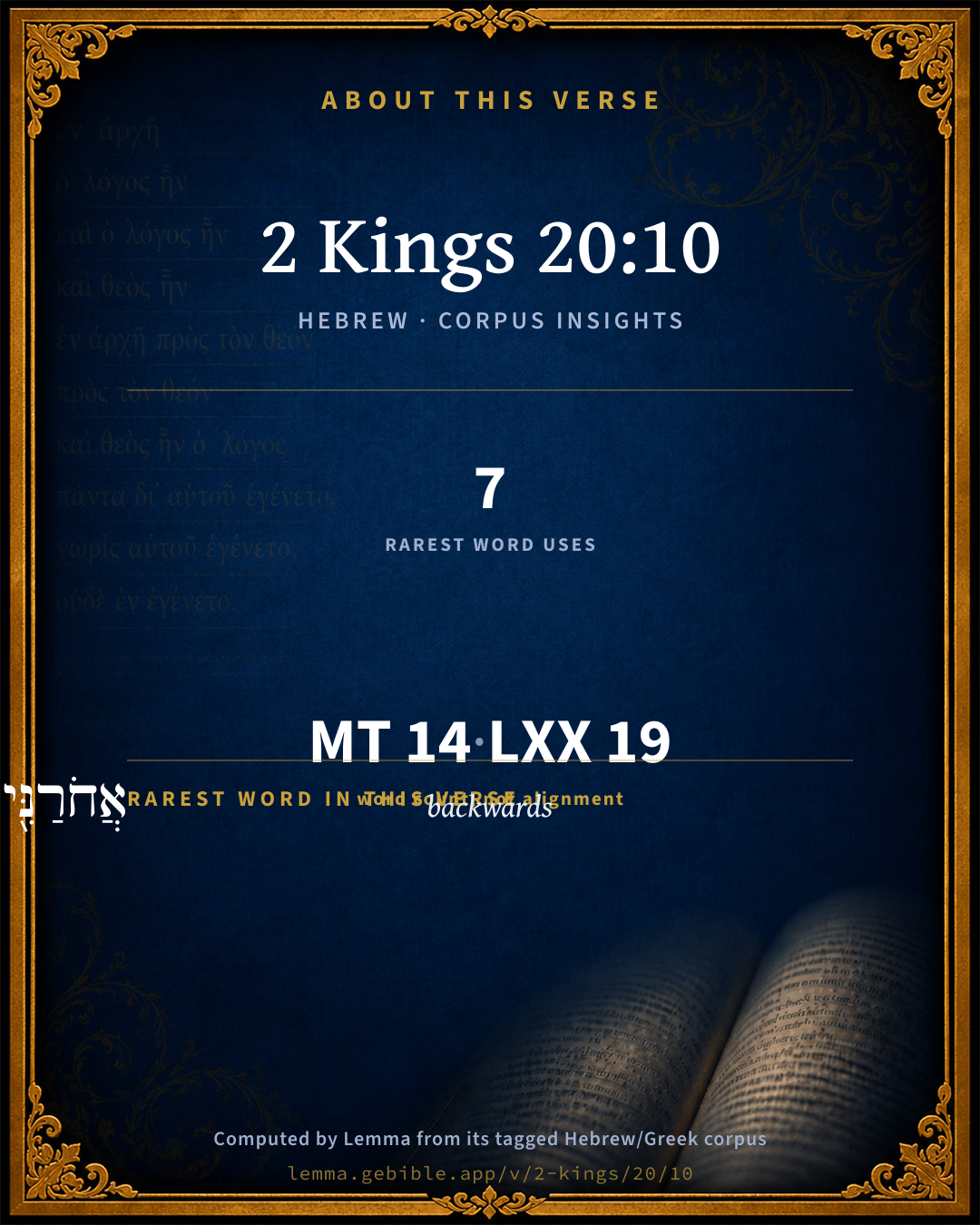
The rarest word here is אֲחֹרַנִּ֖ית backwards H322 — appearing just 7 times in the whole Hebrew Bible.

Shared distinctive vocabulary

אֲחֹרַנִּ֖ית backwards H322 occurs in 6 verses of the Hebrew Bible. Also found in:

Grammatical profile

  • 4 verbs
  • 5 nouns
  • 2 adjectives
  • 1 conjunction
  • 1 adverb
  • 1 particle

Verb forms

  • וַיֹּ֨אמֶר֙ Qal · Sequential Imperfect
  • נָקֵ֣ל Niphal · Perfect
  • לִנְט֖וֹת Qal · Infinitive Construct
  • יָשׁ֥וּב Qal · Imperfect

Repetition

Words recur within this verse — often emphatic in Hebrew:

  • לַצֵּ֔ל shadow H6738 ×2
  • עֶ֣שֶׂר ten H6235 ×2
  • מַעֲל֑וֹת step H4609 ×2

Hebrew & Septuagint length

In English translation the verse runs 23 words from the Hebrew and 28 from the Septuagint (LXX English) — closely comparable.

A rough comparison of the two English renderings, which tokenize alike — not a word-level alignment.

Word counts can differ between the Hebrew and the Greek without any difference in meaning — e.g. the Hebrew direct-object marker אֵת has no separate Greek word, and Greek often adds the article ὁ.

In the original languages it is 14 Hebrew tokens and 19 Greek tokens — but the two are counted differently (Hebrew bundles its prefixes and suffixes into one token; the Greek is in lemma form), so that isn’t a like-for-like length.

Cross-references

5

Topical passages linked to 2 Kings 20:10 in the Treasury of Scripture Knowledge — connected by theme and wording, ordered by reader-vote popularity; previews shown in the World English Bible.

  • 2 Kings 2:10 He said, You have asked a hard thing: [nevertheless], if you see me when I am taken from you, it shall be so to you; but if not, it shall not be so.
  • 2 Kings 3:18 This is but a light thing in the sight of Yahweh: he will also deliver the Moabites into your hand.
  • Isaiah 49:6 yes, he says, It is too light a thing that you should be my servant to raise up the tribes of Jacob, and to restore the preserved of Israel: I will also give you for a light to the Gentiles, that you may be my salvation to the end of the earth.
  • Mark 9:28–29 When he had come into the house, his disciples asked him privately, "Why couldn't we cast it out?"
  • John 14:12 Most assuredly I tell you, he who believes in me, the works that I do, he will do also; and greater works than these will he do; because I am going to my Father.

Cross-references courtesy of OpenBible.info (CC BY 4.0).

Hebrew and Greek witnesses Masoretic Hebrew ↔ Greek Septuagint

The same verse in the two great witnesses to the Old Testament, shown verse-for-verse.

These are two independent witnesses, not word-aligned to each other, and the Septuagint is shown in lemma (dictionary) form.

Hebrew 2 Kings 20:10 Masoretic · Westminster Leningrad Codex

וַיֹּ֨אמֶר֙ יְחִזְקִיָּ֔הוּ נָקֵ֣ל לַצֵּ֔ל לִנְט֖וֹת עֶ֣שֶׂר מַעֲל֑וֹת לֹ֣א כִ֔י יָשׁ֥וּב הַצֵּ֛ל אֲחֹרַנִּ֖ית עֶ֥שֶׂר מַעֲלֽוֹת

Hezekiah answered, It is a light thing for the shadow to decline ten steps: nay, but let the shadow return backward ten steps.

World English Bible · Public Domain

Greek LXX 2 Kings 20:10 Septuagint · lemma form

καί εἶπον εζεκιας κοῦφος ὁ σκιά κλίνω δέκα βαθμός οὐ ἀλλά ἐπιστρέφω ὁ σκιά δέκα βαθμός εἰς ὁ ὀπίσω

And Ezekias said, It is a light thing for the shadow to go down ten degrees: nay, but let the shadow return ten degrees backward on the dial.

LXX2012 (modern English Septuagint) · Public Domain

On this verse, Ellicott's Commentary for English Readers discusses the Septuagint’s reading. Read the note in Commentary ↓

Hebrew: Westminster Leningrad Codex (CC BY 4.0). Greek: Septuagint (public domain); English from LXX2012 (modern English Septuagint) (Public Domain). How the Septuagint differs from the Hebrew →

Targum (Aramaic paraphrase)

1

The Targum is the ancient Jewish Aramaic paraphrase of the Hebrew Scriptures — an interpretive translation, not the Hebrew text itself. Onkelos (literal) and Pseudo-Jonathan (expansive) render the Torah, and Jonathan the Prophets. Coverage is partial: where no permissively-licensed English translation exists for a verse, only the Aramaic is shown. This is verse-level text, not a word-by-word alignment to the Hebrew.

  1. Targum Jonathan Prophets (Joshua–Malachi)
    וַאֲמַר חִזְקִיָה קַלִלָא דָא דִיהַךְ טוּלָא עֲסַר שָׁעִין בְּרַם נִסָא יְתוּב טוּלָא לַאֲחוֹרוֹהִי עֲסַר שָׁעִין:

    (no public-domain English translation for this verse)

    Targum Jonathan — Aramaic: “Mikraot Gedolot” (public domain). English: “Sefaria Community Translation” (CC0 1.0 (public-domain dedication)); “London "Chaldee Paraphrase," 1871” (public domain). Text via Sefaria.

Commentary

Notes on 2 Kings 20:10 from classic Christian and Jewish commentators (each source and its license shown beneath its notes). The classic Christian expositions comment on the surrounding passage and are grouped to its opening verse, so a note may address several verses; the Jewish commentaries on the Tanakh (Rashi and others) are per-verse, so they appear only where the commentator wrote on this verse.

Lemma curates 59 commentaries, every one of them public domain or Creative Commons licensed, each selected and text-cleaned for this edition rather than reprinted as found. About our sources →

Trapp's Complete Commentary

John Trapp

2Ki 20:10 And Hezekiah answered, It is a light thing for the shadow to go down ten degrees: nay, but let the shadow return backward ten degrees.

Ver. 10. It is a light thing,] viz., In comparison of the sun’s retrogradation, wherein both the substance of the thing and the manner were wholly miraculous, whether it were done in an instant, or in the set course of time, or its ordinary continual motion. See on 2Ki 20:9.

John Trapp, A Commentary or Exposition upon All the Books of the Old and New Testament (1647–1656) — public domain. Text from a community e-Sword module.

Joseph Benson's Commentary

2Ki 20:10. It is a light thing for the sun to go down — Namely, in an instant: for that motion of the sun is natural as to the kind of it, though miraculous for the swiftness of it; but the motion backward would be both ways miraculous.

Joseph Benson's Commentary on the Old and New Testaments (1811–1818) — public domain. Text from a community e-Sword module.

Tyndale Open Study Notes

Tyndale Open Resources

20:10 ten steps backward: Such a retreat of the shadow was contrary to nature, and the miracle confirmed God’s message to Hezekiah.

Tyndale Open Study Notes — © Tyndale Open Resources, licensed CC BY-SA 4.0. Text via the HelloAO Bible API.

Geneva Bible (1599)

Geneva Bible translators

Let the sun go so many degrees back, that the hours may be so many the fewer in the king’s dial.

Geneva Bible (1599) marginal notes — public domain. Text via Bolls.life.

Ellicott's Commentary for English Readers

(10) It is a light thing for the shadow to go down.—Because that was the ordinary course of things. As a natural phenomenon, of course, the sudden extension of the shadow would have been as wonderful as its retrogression; but what is in any way a familiar occurrence must needs seem easier than what has never fallen under observation.

To go down.—Rather, to spread. The LXX. has κλῖναι, another use of the Hebrew verb. The Targum, Syriac, and Arabic render “to go forward” (march).

A Bible Commentary for English Readers, edited by Charles John Ellicott (1878–1897) — public domain. Text from a community e-Sword module.

The Cambridge Bible for Schools and Colleges

gen. ed. J. J. S. Perowne

10. It is a light thing for the shadow to go down [R.V. decline] ten degrees] R.V. steps. The verb is not the same as that translated ‘to go down’ in verse 11. The king’s meaning is that it appears more natural and therefore easier, for the shadow to make a sudden advance in the direction in which it has been already going, than to turn in the contrary way.

let the shadow return backward ten degrees] R.V. steps. Thus reversing the order of nature.

The Cambridge Bible for Schools and Colleges (gen. ed. J. J. S. Perowne; Cambridge University Press, 1878–1918) — public domain. Text from a community e-Sword module.

John Gill's Exposition

And Isaiah the prophet cried unto the Lord,.... Or prayed, as the Targum; and was very earnest in prayer, that what Hezekiah had desired might be granted:

and he brought the shadow ten degrees backward, by which it had gone down in the dial of Ahaz; Ben Gersom understands it not of the sun itself, but of the shadow of it only; See Gill on Isa 38:8.

John Gill's Exposition of the Whole Bible (1746–1763) — public domain (CC PDM 1.0). Text via the HelloAO Bible API.

Albert Barnes' Notes on the Bible

It is a light thing - It seemed to Hezekiah comparatively easy that the shadow, which had already begun to lengthen, should merely make a sudden jump in the same direction; but, wholly contrary to all experience that it should change its direction, advancing up the steps again when it had once begun to descend them.

Albert Barnes' Notes on the Bible (1834–1885) — public domain. Text from a community e-Sword/MySword module.

Haydock's Catholic Bible Commentary

Lines, according to the usual course of the sun. An instantaneous motion of this kind would, in reality, be as difficult, as the retrogradation. But it might not strike the people so much. (Haydock) --- Some take the lines to designate hours. But the sun is never up twenty hours in that country; and it must have been at such a height, as that it might appear visibly to recede, or to go forward, ten lines. We may therefore suppose, that they consisted only of half hours, (Tirinus) or less. (Calmet) --- If the retrograde motion were instantaneous, as Cajetan believes, the day would only be five hours longer than usual; (Menochius) but if otherwise, it would be ten; as the sun would occupy five hours in going back, and as many to regain its former station. (Tirinus) --- Usher supposes that the night was as much shortened, that so astronomical observations may still be verified without any confusion. But that would introduce a fresh miracle. Some assert that only the shadow went back, without any derangement in the heavenly bodies. Spinosa laughs at the ignorance of those people, who mistook the effects of a parhelion for a miracle. This author may boast of his superior knowledge. But how came the sages of Babylon (ver. 12.) to be unacquainted with such a natural cause? How came it so opportunely (Calmet) at the time appointed by the prophet? What improbable explanations are not those forced to admit, who deny to the Almighty the power of changing his own works! (Haydock) --- The silence of profane historians respecting this miracle, is of little consequence. Herodotus (ii. 142.) seems to hint at it, as well as at that under Josue; (x.) being informed "by the Egyptians, that during 10340 years, the sun had risen four times in an extraordinary manner. It had risen twice where it ought naturally to set, and had set as often where it should rise." He might have said more simply, that the sun had twice gone back. See Solin, 45. (Calmet) --- St. Dion. Areop. ep. 7. ad Polycarp. --- This last author thinks that this day was twenty hours longer than usual, supposing that the lines designate so many hours, and that the sun kept going back for ten hours. (Worthington)

George Leo Haydock (1774–1849), Haydock's Catholic Family Bible and Commentary, 1859 edition — public domain. Excludes Psalms (Douay-Rheims chapter numbering differs from Protestant) and Deuterocanonical books (Catholic canon only).

Matthew Poole's English Annotations

To go down ten degrees, to wit, in an instant; for that course or motion of the sun is natural for the kind of it, though miraculous for the swiftness of it; but the other would be both ways miraculous.

Matthew Poole's English Annotations on the Holy Bible (1683–1685) — public domain. Text from a community e-Sword/MySword module.

The Pulpit Commentary

And Hezekiah answered, It is a light thing for the shadow to go down ten degrees. Hezekiah views it as a comparatively easy thing for the shadow, which is already descending the steps, to accelerate its pace and rapidly descend fifteen degrees instead of slowly traversing them; and therefore accepts Isaiah"s other offer. Nay, but let the shadow return backward ten degrees. Let it, i.e. , change its direction, and having descended a certain distance, suddenly return and ascend again. This will be no "light thing," but a great marvel, which will thoroughly convince him. The thought was natural, though perhaps not strictly logical.

The Pulpit Commentary (1880–1919), ed. H.D.M. Spence-Jones & Joseph S. Exell — public domain. Text from a community e-Sword module.

John Wesley's Explanatory Notes

Go down - In an instant: for that motion of the sun is natural for the kind of it, though miraculous for the swiftness of it; but the other would be both ways miraculous.

John Wesley, Explanatory Notes Upon the Whole Bible (1754–1765) — public domain. Text via the GEBible commentary corpus.

unfoldingWord translationNotes

Door43 World Missions Community

It is an easy thing for the shadow to go forward ten steps

Why "it is an easy thing" can be stated clearly. "It is easy to cause the shadow to move forward ten steps, because that is the normal thing for it to do" (See: Assumed Knowledge and Implicit Information)

the stairway of Ahaz

This was probably a special stairway built for King Ahaz in such a way that its steps marked the hours of daylight as the sun's rays advanced along them. In this way, the staircase served to tell the time during the day. AT: "the steps that had been built for King Ahaz" (See: Assumed Knowledge and Implicit Information)

translationWords

Ahaz

unfoldingWord translationNotes — © Distant Shores Media and the Door43 World Missions Community, licensed CC BY-SA 4.0. Source: git.door43.org/Door43/en_tn.

Rashi

Rabbi Shlomo Yitzchaki (Rashi)

And Chizkiyohu said, ”It is easier for the shade to advance ten steps.” It is easy [for the shade] to remain in its place, and stay for ten steps, it is not something that is so conspicuous. Not so, rather let the shade go back, and the event will be a wonder, for they saw that the day was turning toward evening, and it returns to become morning [again].

Rashi on the Tanakh — English translations: “The Judaica Press complete Tanach with Rashi, translated by A. J. Rosenberg” (CC BY 4.0); “Pentateuch with Rashi's commentary by M. Rosenbaum and A.M. Silbermann, 1929-1934” (public domain); “The Metsudah Tanach series, Lakewood, N.J” (CC BY 4.0); and “The Book of Joshua, Metsudah Publications, 1997” (CC BY 4.0). Text via Sefaria.

Lesson kit

Teaching starters — assembled from the data on this page, not authored interpretation. Every prompt links to the verse data it draws on. Edit before teaching.

2 Kings, in the Historical, opens this verse with 14 words (11 distinct Hebrew lemmas). Its most distinctive word is ʼăchôrannîyth (“backwards”). A historical commentator’s framing appears above. Read the whole chapter for the surrounding context.

Discussion questions

  1. What does “backwards” (ʼăchôrannîyth) contribute to the verse as a whole?
  2. How does Genesis 9:23, which shares the word «backwards», read alongside this verse?
  3. What does the repetition of “shadow” (2× in this one verse) do in this verse?
  4. These translations render this verse differently; the difference is in the English rendering, not the original. What questions does that raise?
  5. «וַיֹּ֨אמֶר֙» is a Qal Sequential Imperfect verb. How does that grammatical form shape the action described?
  6. Compare how Trapp's Complete Commentary and Joseph Benson's Commentary read this verse. Where do they agree or differ?

Things to notice

Reading settings

Reading text

Shown beneath each verse's original-language words.

Old Testament
Old Testament edition

Read the OT as the Masoretic Hebrew (MT) or the Greek Septuagint (LXX).

English shown for the Greek Septuagint (in the Hebrew ↔ Greek comparison).

Comparing translations? Open the Compare panel on any verse page to stack up to four side by side.