Numbers 24:6

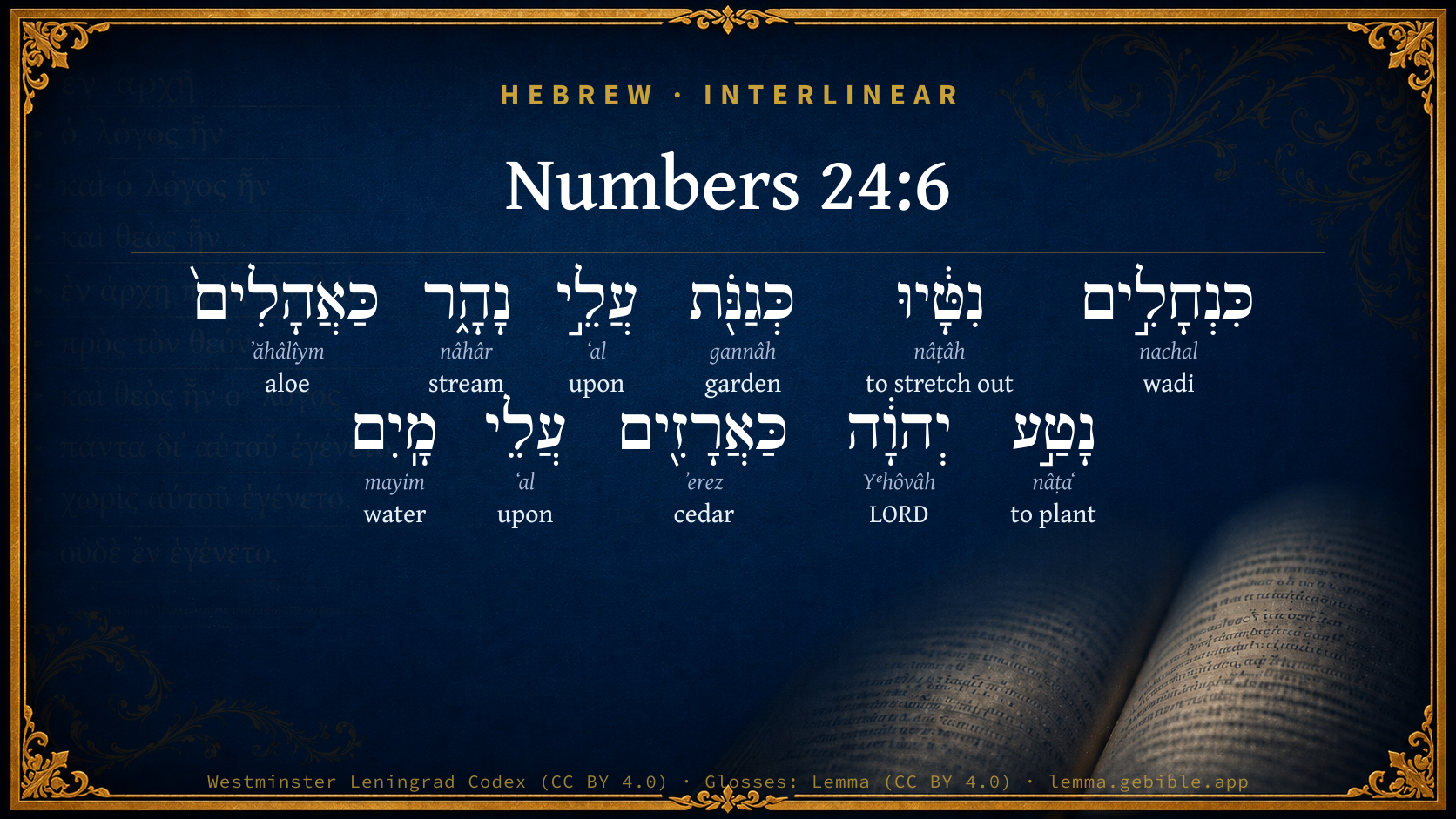
Hebrew (Westminster Leningrad Codex) Numbers 24:6 appears in the Hebrew Old Testament. The text above is from the Westminster Leningrad Codex. Each word links to its Strong’s number, a concise gloss, and parsing drawn from the Open Scriptures Hebrew Bible morphology. Click any word for its full Brown-Driver-Briggs (BDB) entry.
Download image
Cite this verse

Numbers 24:6 (World English Bible). Public Domain. Lemma interlinear Bible study tool, https://lemma.gebible.app/v/numbers/24/6.

Show BibTeX & RIS
BibTeX
RIS
English Translation
As valleys are they spread forth, As gardens by the river-side, As lign-aloes which Yahweh has planted, As cedar trees beside the waters.
World English Bible · Public Domain
Highlights
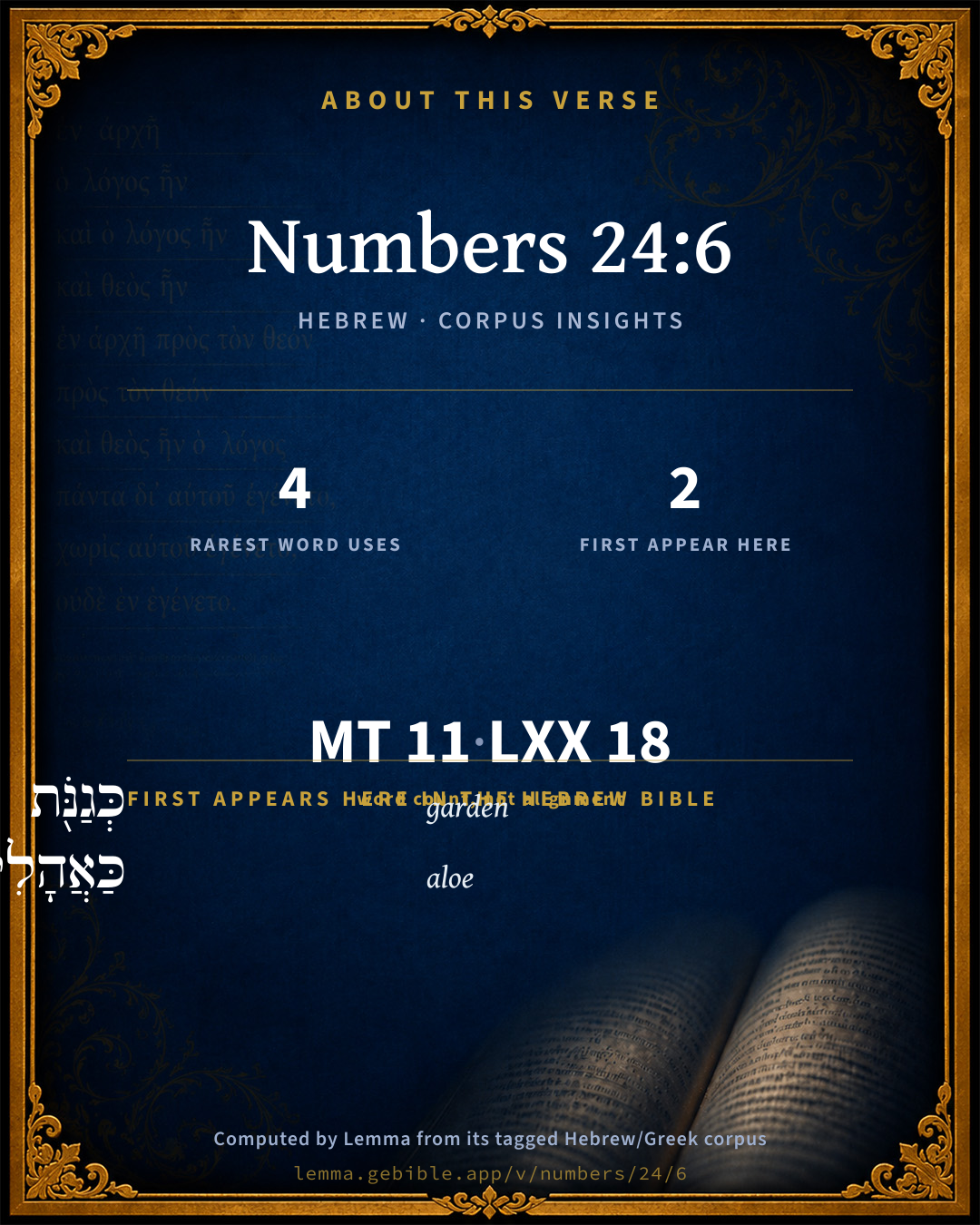
  • 2 first appearances in the Hebrew Bible
Full analysis ↓
Download a study sheet

One document with this verse’s original text, its word-by-word gloss line, the meaning frame, cross-references with their text, attributed commentary, and full source and license credits — printable, and it pastes into notes with its structure intact.

This verse Autodidact and up

Study sheet (.html) Plain text (.txt)

A passage Seminary Student

Up to 50 verses in one chapter. A passage sheet keeps up to 6 commentary sources and 12 cross-references per verse, in the order this page ranks them, and says so on the sheet whenever that leaves anything out. Ask for a single verse and you get the Autodidact verse sheet above.

Everything on this page stays free to read, with no account — the sheet is a download of what is already on screen, not access to it.

Want to remove ads? Support Godless Engineer
Compare translations 3

The same verse in 3 English versions, stacked beneath the original-language interlinear above. Click any original word for its lexicon entry.

Each is an independent rendering of the whole verse — the interlinear is not word-aligned to these translations.

Highlighted words mark where these versions differ — a whole-verse word diff, not a word-by-word alignment.

  • World English Bible Public Domain
    As valleys are they spread forth, As gardens by the river-side, As lign-aloes which Yahweh has planted, As cedar trees beside the waters.
  • King James Version Public Domain
    As the valleys are they spread forth, as gardens by the river's side, as the trees of lign aloes which the LORD hath planted, and as cedar trees beside the waters.
  • unfoldingWord Literal Text CC BY-SA 4.0
    Like wadis they spread out, like gardens beside a river, like aloes Yahweh has planted, like cedars beside water.

unfoldingWord Literal Text — © unfoldingWord, licensed CC BY-SA 4.0. Word-aligned USFM3 via Door43 (git.door43.org/unfoldingWord/en_ult).

Versions to compare (up to 4)

3 of 4 selected

Show all 18 translations

Every available English version of this verse, each an independent rendering of the whole verse.

  • World English Bible Public Domain
    As valleys are they spread forth, As gardens by the river-side, As lign-aloes which Yahweh has planted, As cedar trees beside the waters.
  • Berean Standard Bible Public Domain
    They spread out like palm groves, like gardens beside a stream, like aloes the LORD has planted, like cedars beside the waters.
  • Majority Standard Bible Public Domain
    They spread out like palm groves, like gardens beside a stream, like aloes the LORD has planted, like cedars beside the waters.
  • King James Version Public Domain
    As the valleys are they spread forth, as gardens by the river's side, as the trees of lign aloes which the LORD hath planted, and as cedar trees beside the waters.
  • American Standard Version (1901) Public Domain
    As valleys are they spread forth, As gardens by the river-side, As lign-aloes which Jehovah hath planted, As cedar-trees beside the waters.
  • Revised Version (1885) Public Domain
    As valleys are they spread forth, As gardens by the river side, As lign-aloes which the LORD hath planted, As cedar trees beside the waters.
  • Geneva Bible (1599) Public Domain
    As the valleis, are they stretched forth, as gardes by the riuers side, as the aloe trees, which the Lord hath planted, as the cedars beside the waters.
  • Douay-Rheims (1899) Public Domain
    As woody valleys, as watered gardens near the rivers, as tabernacles which the Lord hath pitched, as cedars by the waterside.
  • Young's Literal Translation Public Domain
    As valleys they have been stretched out, As gardens by a river; As aloes Jehovah hath planted, As cedars by waters;
  • Literal Standard Version CC BY-SA 4.0
    They have been stretched out as valleys, || As gardens by a river; As aloes YHWH has planted, || As cedars by waters;
  • Unlocked Literal Bible CC BY-SA 4.0
    Like valleys they spread out, like gardens by the riverside, like aloes planted by Yahweh, like cedars beside the waters.
  • unfoldingWord Literal Text CC BY-SA 4.0
    Like wadis they spread out, like gardens beside a river, like aloes Yahweh has planted, like cedars beside water.
  • Darby Bible Public Domain
    Like valleys are they spread forth, like gardens by the river side, Like aloe-trees which Jehovah hath planted, like cedars beside the waters.
  • World Messianic Bible Public Domain
    As valleys they are spread out, as gardens by the riverside, as aloes which the LORD has planted, as cedar trees beside the waters.
  • Webster's Bible Public Domain
    As the valleys are they spread forth, as gardens by the river's side, as the trees of lign-aloes which the LORD hath planted, and as cedar-trees beside the waters.
  • Free Bible Version CC BY-SA 4.0
    They look like wooded valleys, like gardens beside a river, like aloe trees the Lord has planted, like cedars at the water's edge.
  • Bible in Basic English Public Domain
    They are stretched out like valleys, like gardens by the riverside, like flowering trees planted by the Lord, like cedar-trees by the waters.
  • JPS Tanakh (1917) Public Domain
    As valleys stretched out, as gardens by the river-side; as aloes planted of the LORD, as cedars beside the waters;

Literal Standard Version (2020), Covenant Press — licensed CC BY-SA 4.0. Text via the HelloAO Bible API (eBible.org). Unlocked Literal Bible (unfoldingWord) — licensed CC BY-SA 4.0. Text via the HelloAO Bible API (eBible.org). unfoldingWord Literal Text — © unfoldingWord, licensed CC BY-SA 4.0. Word-aligned USFM3 via Door43 (git.door43.org/unfoldingWord/en_ult). Free Bible Version, Dr. Jonathan Gallagher — licensed CC BY-SA 4.0. Text via the HelloAO Bible API (eBible.org).

Word by word

More ways to search: Search by grammar → Find every occurrence → Compare this word →

Practice this passage: Drill this verse → Learn its vocabulary →

כַּאֲהָלִים֙
ʼăhâlîym
H174
“like/as · aloes”
Preposition + Noun, Common, Masculine, Plural, Absolute
Part of Speech
Preposition + Noun
Type
Common
Gender
Masculine
Number
Plural
State
Absolute
Full BDB Definition

Origin: of foreign origin

TWOT: 34

aloes, aloe tree - aloe tree - aloe (perfume)
  1. כִּנְחָלִ֣ים nachal H5158 “like/as · wadis” Preposition + Noun, Common, Masculine, Plural, Absolute
  2. נִטָּ֔יוּ nâṭâh H5186 “to stretch out” Verb, Niphal, Perfect, 3rd Person, Common, Plural
  3. כְּגַנֹּ֖ת gannâh H1593 “like/as · gardens” Preposition + Noun, Common, Feminine, Plural, Absolute
  4. עֲלֵ֣י ʻal H5921 “upon” Preposition
  5. נָהָ֑ר nâhâr H5104 “stream” Noun, Common, Masculine, Singular, Absolute
  6. נָטַ֣ע nâṭaʻ H5193 “to plant” Verb, Qal, Perfect, 3rd Person, Masculine, Singular
  7. יְהוָ֔ה Yᵉhôvâh H3068 “LORD” Noun, Proper
  8. כַּאֲרָזִ֖ים ʼerez H730 “like/as · cedars” Preposition + Noun, Common, Masculine, Plural, Absolute
  9. עֲלֵי ʻal H5921 “upon” Preposition
  10. מָֽיִם mayim H4325 “water(s)” Noun, Common, Masculine, Plural, Absolute

About this verse

These counts appear in no published source. They are computed here, from the morphology-tagged text and Lemma’s own curated glosses. What Lemma adds →

11
words
10
distinct lemmas
Pentateuch
section

Notable vocabulary

The rarest word here is כַּאֲהָלִים֙ aloe H174 — appearing just 4 times in the whole Hebrew Bible.

First appearance in Scripture

These words make their first canonical appearance in the Hebrew Bible here:

  • כְּגַנֹּ֖ת garden H1593
  • כַּאֲהָלִים֙ aloe H174

Shared distinctive vocabulary

כַּאֲהָלִים֙ aloe H174 occurs in 4 verses of the Hebrew Bible. Also found in:

Grammatical profile

  • 2 verbs
  • 7 nouns
  • 2 prepositions

Verb forms

  • נִטָּ֔יוּ Niphal · Perfect
  • נָטַ֣ע Qal · Perfect

Repetition

A word recurs within this verse — often emphatic in Hebrew:

  • עֲלֵ֣י upon H5921 ×2

Hebrew & Septuagint length

In English translation the verse runs 23 words from the Hebrew and 21 from the Septuagint (LXX English) — closely comparable.

A rough comparison of the two English renderings, which tokenize alike — not a word-level alignment.

Word counts can differ between the Hebrew and the Greek without any difference in meaning — e.g. the Hebrew direct-object marker אֵת has no separate Greek word, and Greek often adds the article ὁ.

In the original languages it is 11 Hebrew tokens and 18 Greek tokens — but the two are counted differently (Hebrew bundles its prefixes and suffixes into one token; the Greek is in lemma form), so that isn’t a like-for-like length.

Cross-references

15

Topical passages linked to Numbers 24:6 in the Treasury of Scripture Knowledge — connected by theme and wording, ordered by reader-vote popularity; previews shown in the World English Bible.

  • Psalms 1:3 He will be like a tree planted by the streams of water, That brings forth its fruit in its season, Whose leaf also does not wither. Whatever he does shall prosper.
  • Isaiah 58:11 and Yahweh will guide you continually, and satisfy your soul in dry places, and make strong your bones; and you shall be like a watered garden, and like a spring of water, whose waters don't fail.
  • Psalms 104:16 Yahweh's trees are well watered, The cedars of Lebanon, which he has planted;
  • Genesis 2:8–10 Yahweh God planted a garden eastward, in Eden, and there he put the man whom he had formed.
  • Genesis 13:10 Lot lifted up his eyes, and saw all the plain of the Jordan, that it was well watered every where, before Yahweh destroyed Sodom and Gomorrah, like the garden of Yahweh, like the land of Egypt, as you go to Zoar.
  • Psalms 45:8 All your garments smell like myrrh, aloes, and cassia. Out of ivory palaces stringed instruments have made you glad.
  • Psalms 92:12–14 The righteous shall flourish like the palm tree. He will grow like a cedar in Lebanon.
  • Song of Solomon 4:12–15 A locked up garden is my sister, my bride; A locked up spring, A sealed fountain.
  • Song of Solomon 6:11 I went down into the nut tree grove, To see the green plants of the valley, To see whether the vine budded, And the pomegranates were in flower.
  • Isaiah 41:19 I will put in the wilderness the cedar, the acacia, and the myrtle, and the oil tree; I will set in the desert the fir tree, the pine, and the box tree together:
  • Jeremiah 17:18 Let them be disappointed who persecute me, but let not me be disappointed; let them be dismayed, but don't let me be dismayed; bring on them the day of evil, and destroy them with double destruction.
  • Jeremiah 31:12 They shall come and sing in the height of Zion, and shall flow to the goodness of Yahweh, to the grain, and to the new wine, and to the oil, and to the young of the flock and of the herd: and their soul shall be as a watered garden; and they shall not sorrow any more at all.
  • Ezekiel 31:3–4 Behold, the Assyrian was a cedar in Lebanon with beautiful branches, and with a forest-like shade, and of high stature; and its top was among the thick boughs.
  • Ezekiel 47:12 By the river on the bank of it, on this side and on that side, shall grow every tree for food, whose leaf shall not wither, neither shall the fruit of it fail: it shall bring forth new fruit every month, because the waters of it issue out of the sanctuary; and the fruit of it shall be for food, and the leaf of it for healing.
  • Joel 3:18 It will happen in that day, That the mountains will drop down sweet wine, The hills will flow with milk, All the brooks of Judah will flow with waters; And a fountain will come forth from the house of Yahweh, And will water the valley of Shittim.

Cross-references courtesy of OpenBible.info (CC BY 4.0).

Hebrew and Greek witnesses Masoretic Hebrew ↔ Greek Septuagint

The same verse in the two great witnesses to the Old Testament, shown verse-for-verse.

These are two independent witnesses, not word-aligned to each other, and the Septuagint is shown in lemma (dictionary) form.

Hebrew Numbers 24:6 Masoretic · Westminster Leningrad Codex

כִּנְחָלִ֣ים נִטָּ֔יוּ כְּגַנֹּ֖ת עֲלֵ֣י נָהָ֑ר כַּאֲהָלִים֙ נָטַ֣ע יְהוָ֔ה כַּאֲרָזִ֖ים עֲלֵי מָֽיִם

As valleys are they spread forth, As gardens by the river-side, As lign-aloes which Yahweh has planted, As cedar trees beside the waters.

World English Bible · Public Domain

Greek LXX Numbers 24:6 Septuagint · lemma form

ὡσεί νάπη σκιάζω καί ὡσεί παράδεισος ἐπί ποταμός καί ὡσεί σκηνή ὅς πήγνυμι κύριος ὡσεί κέδρος παρά ὕδωρ

as shady groves, and as gardens by a river, and as tents which God pitched, and as cedars by the waters.

LXX2012 (modern English Septuagint) · Public Domain

On this verse, Haydock's Catholic Bible Commentary discusses the Septuagint’s reading. Read the note in Commentary ↓

Hebrew: Westminster Leningrad Codex (CC BY 4.0). Greek: Septuagint (public domain); English from LXX2012 (modern English Septuagint) (Public Domain). How the Septuagint differs from the Hebrew →

Targum (Aramaic paraphrase)

2

The Targum is the ancient Jewish Aramaic paraphrase of the Hebrew Scriptures — an interpretive translation, not the Hebrew text itself. Onkelos (literal) and Pseudo-Jonathan (expansive) render the Torah, and Jonathan the Prophets. Coverage is partial: where no permissively-licensed English translation exists for a verse, only the Aramaic is shown. This is verse-level text, not a word-by-word alignment to the Hebrew.

  1. Targum Onkelos Torah (Genesis–Deuteronomy)
    כְּנַחֲלִין דִמְדַבְּרִין כְּגִינַת שַׁקְיָא דְעַל פְּרָת כְּבוּסְמַיָא דִנְצִיב יְיָ כְּאַרְזִין דִנְצִבִין עַל מַיָא

    (no public-domain English translation for this verse)

    Targum Onkelos — Aramaic: “Onkelos Genesis” (public domain); “Onkelos Exodus” (public domain); “Onkelos Leviticus” (public domain); “Onkelos Numbers” (public domain); “Onkelos Deuteronomy” (public domain). English: “Sefaria Community Translation” (CC0 1.0 (public-domain dedication)); “J.W. Etheridge. The Targums of Onkelos and Jonathan Ben Uzziel on the Pentateuch. London: Longmans, Green, 1862” (public domain). Text via Sefaria.

  2. Targum Pseudo-Jonathan Torah (Genesis–Deuteronomy)
    כְּנַחְלִין דְמַיָין דְמִתְגַבְּרִין כֵּן הִינוּן בְּנֵי יִשְרָאֵל יַתְבִין עִדְרִין עִדְרִין מִתְגַבְּרִין בְּאוּלְפַן אוֹרַיְיתָא וְהֵי כְּגַנִין שְׁתִילִין עַל פְּרַקְטוֹנֵי נַהֲרִין כֵּן הִינוּן תַּלְמִידֵיהוֹן חֲבוּרַן חֲבוּרַן בְּבֵית מֶדְרָשֵׁיהוֹן זִיו אַפֵּיהוֹן יַנְהַר כְּזִיו רְקִיעִין דִי בְרָא יְיָ בְּיוֹם תִּנְיַין לִבְּרִיאַת עַלְמָא וּמַתְחִינוּן לִיקַר שְׁכִינְתָּא רַמְיַין וּמְנַטְלִין עַל כָּל אוּמַיָא כַּאֲרָזַיָא דְלִיבְנוֹם דִשְׁתִילִין עַל מַבּוּעֵי מַיָין

    As tides of waters, so are the house of Israel, dwelling like flocks made strong by the doctrine of the law; and as gardens planted by the flowing streams, so are their disciples in the fellowships of their schools. The light of their faces shineth as the brightness of the firmament which the Lord created on the second day of the creation of the world, and outspread for the glory of the Shekinah. They are exalted and lifted up above all the nations, like cedars of Lebanon planted by fountains of waters.

    Targum Pseudo-Jonathan — Aramaic: “Targum Jonathan on Genesis” (public domain); “Targum Jonathan on Exodus” (public domain); “Targum Jonathan on Leviticus” (public domain); “Targum Jonathan on Numbers” (public domain); “Targum Jonathan on Deuteronomy” (public domain). English: “The Targum of Jonathan ben Uzziel, trans. J. W. Etheridge, London, 1862” (public domain). Text via Sefaria.

Commentary

Notes on Numbers 24:6 from classic Christian and Jewish commentators (each source and its license shown beneath its notes). The classic Christian expositions comment on the surrounding passage and are grouped to its opening verse, so a note may address several verses; the Jewish commentaries on the Tanakh (Rashi and others) are per-verse, so they appear only where the commentator wrote on this verse.

Lemma curates 59 commentaries, every one of them public domain or Creative Commons licensed, each selected and text-cleaned for this edition rather than reprinted as found. About our sources →

Trapp's Complete Commentary

John Trapp

Num 24:6 As the valleys are they spread forth, as gardens by the river’s side, as the trees of lign aloes which the LORD hath planted, [and] as cedar trees beside the waters.

Ver. 6. As the trees of lign aloes.] An odoriferous sweet smelling tree, growing in Arabia, which is said to be a country so sweet that swine cannot live in it.

John Trapp, A Commentary or Exposition upon All the Books of the Old and New Testament (1647–1656) — public domain. Text from a community e-Sword module.

Tyndale Open Study Notes

Tyndale Open Resources

24:6-7 The Lord’s favor is emphasized by the comparison of Israel’s situation with groves and gardens that have access to abundant water. Their growing population already reflected God’s blessing (24:7), as mentioned in 23:10. This would also become clear in the second registration (ch 26).

Tyndale Open Study Notes — © Tyndale Open Resources, licensed CC BY-SA 4.0. Text via the HelloAO Bible API.

Geneva Bible (1599)

Geneva Bible translators

Or, tents.

Geneva Bible (1599) marginal notes — public domain. Text via Bolls.life.

Jamieson, Fausset & Brown

Robert Jamieson, A. R. Fausset & David Brown

As the valleys--Hebrew, "brooks," the watercourses of the mountains.

lign aloes--an aromatic shrub on the banks of his native Euphrates, the conical form of which suggested an apt resemblance to a tent. The redundant imagery of these verses depicts the humble origin, rapid progress, and prosperity of Israel.

Jamieson, Fausset & Brown — Commentary Critical and Explanatory on the Whole Bible (1871) — public domain (CC PDM 1.0). Text via the HelloAO Bible API.

Adam Clarke's Commentary

Verse 6. Lign aloes which the Lord hath planted] Or, as the tents which the Lord hath pitched; for it is the same word, אהלים ohalim, which is used in the 5th verse. But from other parts of Scripture we find that the word also signifies a species of tree, called by some the sandal tree, and by others the lignum or wood aloes. This tree is described as being eight or ten feet high, with very large leaves growing at the top; and it is supposed that a forest of those at some distance must bear some resemblance to a numerous encampment. As the word comes from the root אהל ahal, which signifies to spread or branch out, and therefore is applied to tents, because of their being extended or spread out on the ground; so when it is applied to trees it must necessarily mean such as were remarkable for their widely-extended branches; but what the particular species is, cannot be satisfactorily ascertained. By the Lord's planting are probably meant such trees as grow independently of the cultivation of man. - Nullis hominum cogentibus; or, as Virgil expresses it,

Sponte sua quae se tollunt in luminis oras.

VIRG., Geor. ii., 47.

"Such as sprung up, spontaneously into the regions of light.

As cedar trees] Gabriel Sionita, a very learned Syrian Maronite, who assisted in editing the Paris Polyglot, a man worthy of all credit, thus describes the cedars of Mount Lebanon, which he had examined on the spot: -

"The cedar grows on the most elevated part of the mountain, is taller than the pine, and so thick that five men together could scarcely fathom one. It shoots out its branches at ten or twelve feet from the ground; they are large, and distant from each other, and are perpetually green. The cedar distils a kind of gum, to which different effects are attributed. The wood of it is of a brown colour, very solid, and incorruptible if preserved from wet. It bears a small apple, like to that of the pine."

De la Roque relates some curious particulars concerning this tree, which he learned from the Maronites of Mount Libanus: "The branches grow in parallel rows round the tree, but lessen gradually from the bottom to the top, shooting out parallel to the horizon, so that the tree is, in appearance, similar to a cone. As the snows, which fall in vast quantities on this mountain, must necessarily, by their weight on such a vast surface, break down these branches, nature, or rather the God of nature, has so ordered it, that at the approach of winter, and during the snowy season, the branches erect themselves, and cling close to the body of the tree, and thus prevent any quantity of snow from lodging on them."

Mr. Maundrell, who visited Mount Libanus in 1697, gives the following description of the cedars still growing there: -

"These noble trees grow among the snow, near the highest part of Lebanon, and are remarkable, as well for their own age and largeness as for those frequent allusions to them in the word of God. Some of them are very old, and of a prodigious bulk; others younger, and of a smaller size. Of the former I could reckon only sixteen, but the latter are very numerous. I measured one of the largest, and found it twelve yards and six inches in girt, and yet sound, and thirty-seven yards in the spread of its branches. At about five or six yards from the ground it was divided into five limbs, each of which was equal to a great tree." - Journey from Aleppo to Jerusalem, p. 142.

Adam Clarke's Commentary on the Bible (1810–1826) — public domain. Text from a community e-Sword/MySword module.

Ellicott's Commentary for English Readers

(6) As gardens by the river’s side.—It is probable that the allusion may be to the Euphrates, although the definite article is not prefixed to the word nahar (river) in the Hebrew. (Comp. Isa_7:20.)

As cedar trees beside the waters.-The difference between cedars which grow beside running water which their roots can reach, and the ordinary type of cedars which throw out their strength in lateral branches is illustrated in Eze_31:3-4, where the proud Assyrian is compared to a cedar having “his top among the thick boughs” (or, the clouds), which “the waters made great.” (Comp. Psa_1:3; Psa_92:12.)

A Bible Commentary for English Readers, edited by Charles John Ellicott (1878–1897) — public domain. Text from a community e-Sword module.

The Cambridge Bible for Schools and Colleges

gen. ed. J. J. S. Perowne

6. As valleys are they spread forth] As wadies that stretch themselves out; beautifully watered glens stretching away into the distance. Like the three following, it is a simile of luxuriant prosperity.

As lign-aloes &c.] Heb. ’ahâlîm. But this word elsewhere denotes a fragrant perfume brought from the far east (Psa_45:8, Pro_7:17); the tree or plant which yielded it was not indigenous in Palestine or the neighbourhood. See next note.

As cedar trees beside the waters] But cedars do not grow beside water; see art. ‘Cedars’ in Hastings’ DB. i. On the other hand cedars (not aloes) are spoken of as planted by Jehovah (Psa_104:16). It is therefore possible that the words ‘which Jehovah hath planted’ and ‘beside the waters’ have been accidentally transposed. If so, Dillmann’s conjecture ’êlîm ‘palms’ for ’ahâlîm would be very suitable, since palms grow beside water (cf. Exo_15:27).

The Cambridge Bible for Schools and Colleges (gen. ed. J. J. S. Perowne; Cambridge University Press, 1878–1918) — public domain. Text from a community e-Sword module.

John Gill's Exposition

As the valleys are they spread forth,.... Long and broad, lying between several mountains, and reaching from hill to hill; so the armies of Israel lay encamped in the plains and villages of Moab, making a very considerable length and breadth; the camp of Israel is said to be twelve miles long, and twelve miles broad; so the Targum on Num 2:3 and this may denote the lowness of the saints and people of God in their own eyes, and their largeness in themselves; and especially when the place of their tents shall be enlarged, and the curtains of their habitations be stretched forth in the latter day; and also their fruitfulness, meads, and valleys abounding with herbs and flowers, as the churches of God do with the fruits of the Spirit, grace, and righteousness, and with plants of the Lord's right hand planting. Some render it as brooks and torrents of water, so the Targum of Jonathan; which diffuse and spread themselves, and on the banks of which stand beautiful trees in goodly order:

as gardens by the river's side: laid out in a delightful manner, full of flowers, plants, and trees, and well watered; like to these, in several spots, were the people of Israel formed into several camps; and to these may the churches of God be compared, who are distinguished and enclosed by sovereign grace, full of trees of righteousness of the Lord's planting, watered by the river of divine love, and from Christ the fountain of gardens; see Sol 4:12,

as the trees of lign aloes, which the Lord hath planted: which are not planted and raised by the art and industry of man, but grow up without culture, as the mere produce of nature, under a divine providence; these are called lign wood or tree aloes, to distinguish them from another sort of aloes, which are no other than plants; but these are what the Indians call Calambra or Calembac, and, physicians Xyloaloes and Agallochium, and are of a very aromatic and fragrant scent. This tree is said to be about eight or ten feet high; at the head of it is a large bunch of leaves, which are thick and indented, broad at bottom, but growing narrower towards the point, and about four feet in length; the blossom of it is red, intermixed with yellow, and double like a pink; from this blossom comes fruit, round like a large pea, white and red; the juice of these leaves is drawn out by cutting them with a knife, and received into bottles; the smell of the wood is exquisite (w). P. Martyr (x) speaks of a trunk of lign aloes, which being cut, a sweet savour proceeds from it. It may be observed what Isidore (y) remarks, that it grows in Arabia, as well as in India, and so might be well known to Balaam. And to these the Israel of God may be compared for their fragrancy, being clothed with the righteousness of Christ, all whose garments smell of or like these aloes, Psa 45:8 and having the graces of the Spirit of God in them, the smell of which is preferable to all spices, and they themselves are signified by the same, Sol 4:10,

and as cedar trees beside the waters; which are tall and high, large and spreading, durable lasting, to which the righteous are compared; see Gill on Psa 92:12.

(w) See Calmet's Dictionary, and the Supplement to Chamber's Dictionary, in the word "Aloes". (x) Decad. 1. l. 2. (y) Origin. l. 17. c. 8.

John Gill's Exposition of the Whole Bible (1746–1763) — public domain (CC PDM 1.0). Text via the HelloAO Bible API.

Albert Barnes' Notes on the Bible

As gardens by the river’s side - Balaam’s language reflects the famous artificial gardens along the banks of his own river, the Euphrates.

As the trees of lign aloes which the Lord hath planted - The latter words contain an apparent reference to Paradise (compare Gen 2:8). The aloe, imported from China and the far distant east, furnished to the ancients one of the most fragrant and precious of spices; compare Psa 45:8; Pro 7:17,

As cedar trees beside the waters - i. e., as the noblest of trees branching forth in the fairest of situations: an image of majestic beauty, as that of the last verse was of rare fecundity.

Albert Barnes' Notes on the Bible (1834–1885) — public domain. Text from a community e-Sword/MySword module.

Haydock's Catholic Bible Commentary

Woody. Hebrew also "extensive torrents." --- Tabernacles. Hebrew ahalim, which some render lign-aloes, or stacte, as St. Jerome does, Psalm xliv. 9.; Proverbs vii. 17.; Canticle of Canticles iv. 14. The aloe-tree, however, was brought from India, and was not common in Arabia. The Syrian aloe was only a shrub; and this tree, of which Balaam speaks, must have been tall and beautiful. --- Pitched. Hebrew, "planted." (Calmet) --- The Septuagint agree however with the Vulgate. (Haydock) --- Side. Cedars grow very large on the top of Libanus, and are always green; the fruit resembles the pine-apple; the wood is incorruptible. (Sionita 6.) By humility we must rise to the summit of perfection. (Du Hamel)

George Leo Haydock (1774–1849), Haydock's Catholic Family Bible and Commentary, 1859 edition — public domain. Excludes Psalms (Douay-Rheims chapter numbering differs from Protestant) and Deuterocanonical books (Catholic canon only).

Matthew Poole's English Annotations

Valleys ofttimes from a small beginning are spread forth fir and wide. Others, as the brooks, or rivers, as the word signifies, which stretch out and disperse their waters into several channels, and sometimes farther. Are they spread forth, i.e. the Israelites last mentioned. As gardens by the river’s side; pleasant and fruitful, and secured by a fence.

Trees of lign-aloes; an Arabian and Indian tree, of a sweet smell, yielding good shade and shelter both to man and beast; such is Israel, famous among the nations, and not only save themselves, but yielding shelter to all that join themselves to them.

Which the Lord hath planted; which are the best of the kind; such as not man, but God, might seem to have planted, as the best of all sorts are ascribed to God, as the trees, hills, cities, of God, &c. Compare Psa 104:16.

As cedar trees, which are famous for growth, and height, and strength, and durableness, whence Solomon’s temple was built of this wood, 1Ki 6:9,10.

Beside the waters, where trees thrive best.

Matthew Poole's English Annotations on the Holy Bible (1683–1685) — public domain. Text from a community e-Sword/MySword module.

Whedon's Commentary on the Bible

Daniel D. Whedon

6. As the valleys — Well watered by brooks.

As gardens — Still more lovely than the verdant and flowery valleys.

Lignaloes — Aloe-trees abound in Eastern Asia. On account of their fragrance they are highly prized for the preparation of incense and unguents. See Joh_19:39. Although this tree is rare in Chaldea or Syria, it is reasonable to suppose it was known to Balaam or he would scarcely have mentioned it as he does.

The Lord hath planted — Extraordinary trees are described as “the trees of Jehovah.” See Psa_104:16.

Daniel D. Whedon (gen. ed.), Commentary on the Old and New Testaments (1874–1909) — public domain. Text from a community e-Sword module.

The Pulpit Commentary

As the valleys, or, "as the torrents" ( which pour down in parallel courses from the upper slopes. As gardens by the river"s side. The river (rhn), as in Num_22:5 means the Euphrates. Balaam combines the pleasant imagery of his own cultivated land with that of the wilder scene amidst which he now stood. As the trees of lign aloes. Aloe trees, such as grew in the further east, where Balaam had perhaps seen them. Which the Lord hath planted, or, "the Lord"s planting," a poetical,way of describing their beauty and rarity. (cf. Psa_1:3 Psa_104:16)

The Pulpit Commentary (1880–1919), ed. H.D.M. Spence-Jones & Joseph S. Exell — public domain. Text from a community e-Sword module.

John Wesley's Explanatory Notes

As the valleys - Which often from a small beginning are spread forth far and wide. As gardens - Pleasant and fruitful and secured by a fence. As lign-aloes - An Arabian and Indian tree of a sweet smell, yielding shade and shelter both to man and beast; such is Israel, not only safe themselves, but yielding shelter to all that join themselves to them. Which the Lord hath planted - Nature, not art.

John Wesley, Explanatory Notes Upon the Whole Bible (1754–1765) — public domain. Text via the GEBible commentary corpus.

unfoldingWord translationNotes

Door43 World Missions Community

General Information:

Balaam continues to prophesy under the control of the Spirit of God.

Like valleys they spread out

Balaam speaks of the Israelies as if they were numerous enough to cover entire valleys. (See: Simile)

like gardens by the riverside

Balaam speaks of the Israelies as if they were well-watered gardens that produce an abundant harvest. (See: Simile)

aloes planted by Yahweh

Aloes are plants with a pleasant smell that grow well even in dry conditions. Balaam speaks of the Israelies as if they would thrive and be pleasant like aloe plants. This can be stated in active form. AT: "aloes which Yahweh has planted" (See: Translate Unknowns and Simile and Active or Passive)

like cedars beside the waters

Cedar trees were the largest trees in Israel. Balaam speaks of the Israelies as if they grew as large as well-watered cedar trees. (See: Simile)

translationWords

cedar

water

unfoldingWord translationNotes — © Distant Shores Media and the Door43 World Missions Community, licensed CC BY-SA 4.0. Source: git.door43.org/Door43/en_tn.

Rashi

Rabbi Shlomo Yitzchaki (Rashi)

כנחלים נטיו AS THE BROOKS THAT WIND — which lengthen and draw themselves out so that they extend (נטיו) into the distance. — Our Rabbis said: From the blessings uttered by that wicked man we may learn what was in his heart as regards cursing them, when he thought to set his face towards the wilderness (cf. v. 1). When the Omnipresent turned the words of his mouth he uttered blessings corresponding to the contents of those curses which he had wished to pronounce as it is related in the chapter beginning with the word חלק Sanhedrin 105b.

כאהלים — Understand this as the Targum does (“as aromatic plants”), — taking it in the same meaning as in (Psalms 45:9) “Myrrh and aloes (אהלים).

נטע ה' (LIKE THE ALOES] WHICH THE LORD HATH PLANTED in the Garden of Eden. - Another explanation: כאהלים נטע ה׳ LIKE TENTS WHICH THE LORD HATH PLANTED — i.e., like the heavens which are stretched forth as a tent (cf. Isaiah 40:22: וימתחם כאהל לשבת).

נטע ה׳ [LIKE TENTS] WHICH THE LORD HAS PLANTED — We can speak of planting a tent for we find the expression “planting” in connection with tents, as it is said, (Daniel 11:45) “And he shall plant (ויטע) the tents of his palace”.

Rashi on the Tanakh — English translations: “The Judaica Press complete Tanach with Rashi, translated by A. J. Rosenberg” (CC BY 4.0); “Pentateuch with Rashi's commentary by M. Rosenbaum and A.M. Silbermann, 1929-1934” (public domain); “The Metsudah Tanach series, Lakewood, N.J” (CC BY 4.0); and “The Book of Joshua, Metsudah Publications, 1997” (CC BY 4.0). Text via Sefaria.

Lesson kit

Teaching starters — assembled from the data on this page, not authored interpretation. Every prompt links to the verse data it draws on. Edit before teaching.

Numbers, in the Pentateuch, opens this verse with 11 words (10 distinct Hebrew lemmas). Its most distinctive word is ʼăhâlîym (“aloe”). A historical commentator’s framing appears above. Read the whole chapter for the surrounding context.

Discussion questions

  1. What does “aloe” (ʼăhâlîym) contribute to the verse as a whole?
  2. 2 words here appear for the first time in Scripture. What is being introduced at this debut?
  3. Psalms 45:8 shares the word «aloe» with this verse. How do the two illuminate each other?
  4. “upon” occurs 2× in this one verse. What is the effect of the repetition?
  5. These translations render this verse differently. What is at stake in choosing one wording over another?
  6. The verb «נִטָּ֔יוּ» is Niphal Perfect. How does its form color the action?
  7. Reading how Trapp's Complete Commentary and Tyndale Open Study Notes read this verse, where do the two commentators agree and where do they part?

Things to notice

Reading settings

Reading text

Shown beneath each verse's original-language words.

Old Testament
Old Testament edition

Read the OT as the Masoretic Hebrew (MT) or the Greek Septuagint (LXX).

English shown for the Greek Septuagint (in the Hebrew ↔ Greek comparison).

Comparing translations? Open the Compare panel on any verse page to stack up to four side by side.