Joshua 24:23

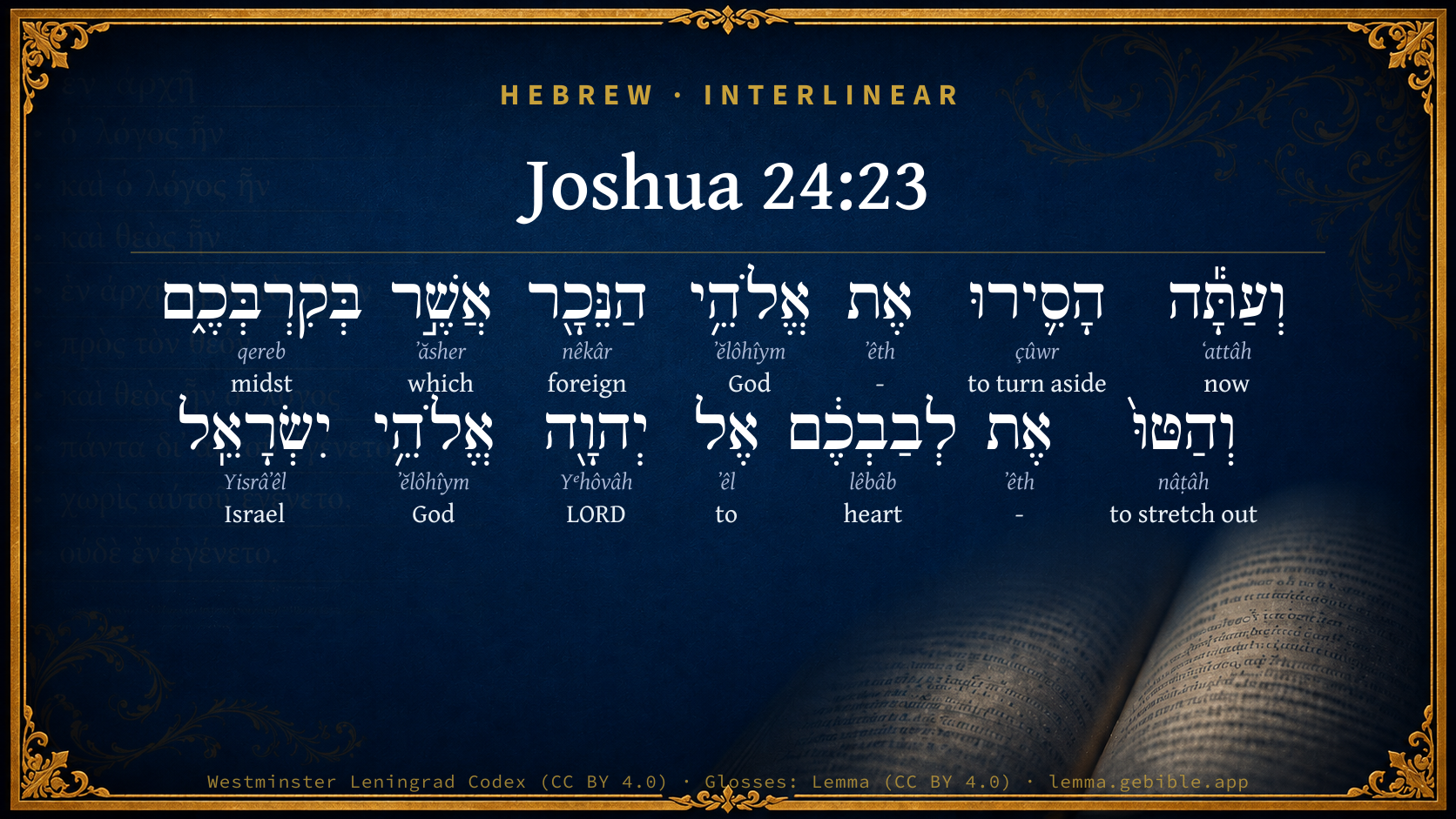
Hebrew (Westminster Leningrad Codex) Joshua 24:23 appears in the Hebrew Old Testament. The text above is from the Westminster Leningrad Codex. Each word links to its Strong’s number, a concise gloss, and parsing drawn from the Open Scriptures Hebrew Bible morphology. Click any word for its full Brown-Driver-Briggs (BDB) entry.
Download image
Cite this verse

Joshua 24:23 (World English Bible). Public Domain. Lemma interlinear Bible study tool, https://lemma.gebible.app/v/joshua/24/23.

Show BibTeX & RIS
BibTeX
RIS
English Translation
Now therefore put away, [said he], the foreign gods which are among you, and incline your heart to Yahweh, the God of Israel.
World English Bible · Public Domain
Download a study sheet

One document with this verse’s original text, its word-by-word gloss line, the meaning frame, cross-references with their text, attributed commentary, and full source and license credits — printable, and it pastes into notes with its structure intact.

This verse Autodidact and up

Study sheet (.html) Plain text (.txt)

A passage Seminary Student

Up to 50 verses in one chapter. A passage sheet keeps up to 6 commentary sources and 12 cross-references per verse, in the order this page ranks them, and says so on the sheet whenever that leaves anything out. Ask for a single verse and you get the Autodidact verse sheet above.

Everything on this page stays free to read, with no account — the sheet is a download of what is already on screen, not access to it.

Want to remove ads? Support Godless Engineer
Compare translations 3

The same verse in 3 English versions, stacked beneath the original-language interlinear above. Click any original word for its lexicon entry.

Each is an independent rendering of the whole verse — the interlinear is not word-aligned to these translations.

Highlighted words mark where these versions differ — a whole-verse word diff, not a word-by-word alignment.

  • World English Bible Public Domain
    Now therefore put away, [said he], the foreign gods which are among you, and incline your heart to Yahweh, the God of Israel.
  • King James Version Public Domain
    Now therefore put away, said he, the strange gods which are among you, and incline your heart unto the LORD God of Israel.
  • unfoldingWord Literal Text CC BY-SA 4.0
    “And now, remove the gods of the foreigner that are in your midst, and stretch out your heart to Yahweh, the God of Israel.”

unfoldingWord Literal Text — © unfoldingWord, licensed CC BY-SA 4.0. Word-aligned USFM3 via Door43 (git.door43.org/unfoldingWord/en_ult).

Versions to compare (up to 4)

3 of 4 selected

Show all 18 translations

Every available English version of this verse, each an independent rendering of the whole verse.

  • World English Bible Public Domain
    Now therefore put away, [said he], the foreign gods which are among you, and incline your heart to Yahweh, the God of Israel.
  • Berean Standard Bible Public Domain
    “Now, therefore,” he said, “get rid of the foreign gods among you and incline your hearts to the LORD, the God of Israel.”
  • Majority Standard Bible Public Domain
    “Now, therefore,” he said, “get rid of the foreign gods among you and incline your hearts to the LORD, the God of Israel.”
  • King James Version Public Domain
    Now therefore put away, said he, the strange gods which are among you, and incline your heart unto the LORD God of Israel.
  • American Standard Version (1901) Public Domain
    Now therefore put away, `said he', the foreign gods which are among you, and incline your heart unto Jehovah, the God of Israel.
  • Revised Version (1885) Public Domain
    Now therefore put away, said he, the strange gods which are among you, and incline your heart unto the LORD, the God of Israel.
  • Geneva Bible (1599) Public Domain
    Then put away nowe, saide he, the strange gods which are among you, and bowe your hearts vnto the Lord God of Israel.
  • Douay-Rheims (1899) Public Domain
    Now therefore, said he, put away strange gods from among you, and incline your hearts to the Lord the God of Israel.
  • Young's Literal Translation Public Domain
    and, now, turn aside the gods of the stranger which `are' in your midst, and incline your heart unto Jehovah, God of Israel.'
  • Literal Standard Version CC BY-SA 4.0
    “And now, turn aside the gods of the stranger which [are] in your midst, and incline your heart to YHWH, God of Israel.”
  • Unlocked Literal Bible CC BY-SA 4.0
    “Now put away the foreign gods that are with you, and turn your heart to Yahweh, the God of Israel.”
  • unfoldingWord Literal Text CC BY-SA 4.0
    “And now, remove the gods of the foreigner that are in your midst, and stretch out your heart to Yahweh, the God of Israel.”
  • Darby Bible Public Domain
    Now therefore put away the strange gods that are among you, and incline your heart unto Jehovah the God of Israel.
  • World Messianic Bible Public Domain
    “Now therefore put away the foreign gods which are among you, and incline your heart to the LORD, the God of Israel.”
  • Webster's Bible Public Domain
    Now therefore put away (said he) the strange gods which are among you, and incline your heart to the LORD God of Israel.
  • Free Bible Version CC BY-SA 4.0
    “Then get rid of those foreign gods you have and promise to be loyal only to the Lord, the God of Israel,” Joshua told them.
  • Bible in Basic English Public Domain
    Then, he said, put away the strange gods among you, turning your hearts to the Lord, the God of Israel.
  • JPS Tanakh (1917) Public Domain
    Now therefore put away the strange gods which are among you, and incline your heart unto the LORD, the God of Israel.'

Literal Standard Version (2020), Covenant Press — licensed CC BY-SA 4.0. Text via the HelloAO Bible API (eBible.org). Unlocked Literal Bible (unfoldingWord) — licensed CC BY-SA 4.0. Text via the HelloAO Bible API (eBible.org). unfoldingWord Literal Text — © unfoldingWord, licensed CC BY-SA 4.0. Word-aligned USFM3 via Door43 (git.door43.org/unfoldingWord/en_ult). Free Bible Version, Dr. Jonathan Gallagher — licensed CC BY-SA 4.0. Text via the HelloAO Bible API (eBible.org).

Word by word

More ways to search: Search by grammar → Find every occurrence → Compare this word →

Practice this passage: Drill this verse → Learn its vocabulary →

הַנֵּכָ֖ר
nêkâr
H5236
“the · foreign”
Particle, Definite Article + Noun, Common, Masculine, Singular, Absolute
Part of Speech
Particle + Noun
Type
Common
Gender
Masculine
Number
Singular
State
Absolute
Full BDB Definition

Origin: from H5234

TWOT: 1368b

foreign, alien, foreignness, that which is foreign - foreignness, foreign gods - alien, foreigner - foreign (vanities)
  1. וְעַתָּ֕ה ʻattâh H6258 “and · now” Conjunction + Adverb
  2. הָסִ֛ירוּ çûwr H5493 “turn aside” Verb, Hiphil, Imperative, 2nd Person, Masculine, Plural
  3. אֶת ʼêth H853 “-” Particle, Direct Object
  4. אֱלֹהֵ֥י ʼĕlôhîym H430 “God(s) of” Noun, Common, Masculine, Plural, Construct
  5. אֲשֶׁ֣ר ʼăsher H834 “which” Particle, Relative
  6. בְּקִרְבְּכֶ֑ם qereb H7130 “in/at · midst · your” Preposition + Noun, Common, Masculine, Singular, Construct + Suffix, Personal, 2nd Person, Masculine, Plural
  7. וְהַטּוּ֙ nâṭâh H5186 “and · stretch out” Conjunction + Verb, Hiphil, Imperative, 2nd Person, Masculine, Plural
  8. אֶת ʼêth H853 “-” Particle, Direct Object
  9. לְבַבְכֶ֔ם lêbâb H3824 “heart · your” Noun, Common, Masculine, Singular, Construct + Suffix, Personal, 2nd Person, Masculine, Plural
  10. אֶל ʼêl H413 “to” Preposition
  11. יְהוָ֖ה Yᵉhôvâh H3068 “LORD” Noun, Proper
  12. אֱלֹהֵ֥י ʼĕlôhîym H430 “God(s) of” Noun, Common, Masculine, Plural, Construct
  13. יִשְׂרָאֵֽל Yisrâʼêl H3478 “Israel” Noun, Proper

About this verse

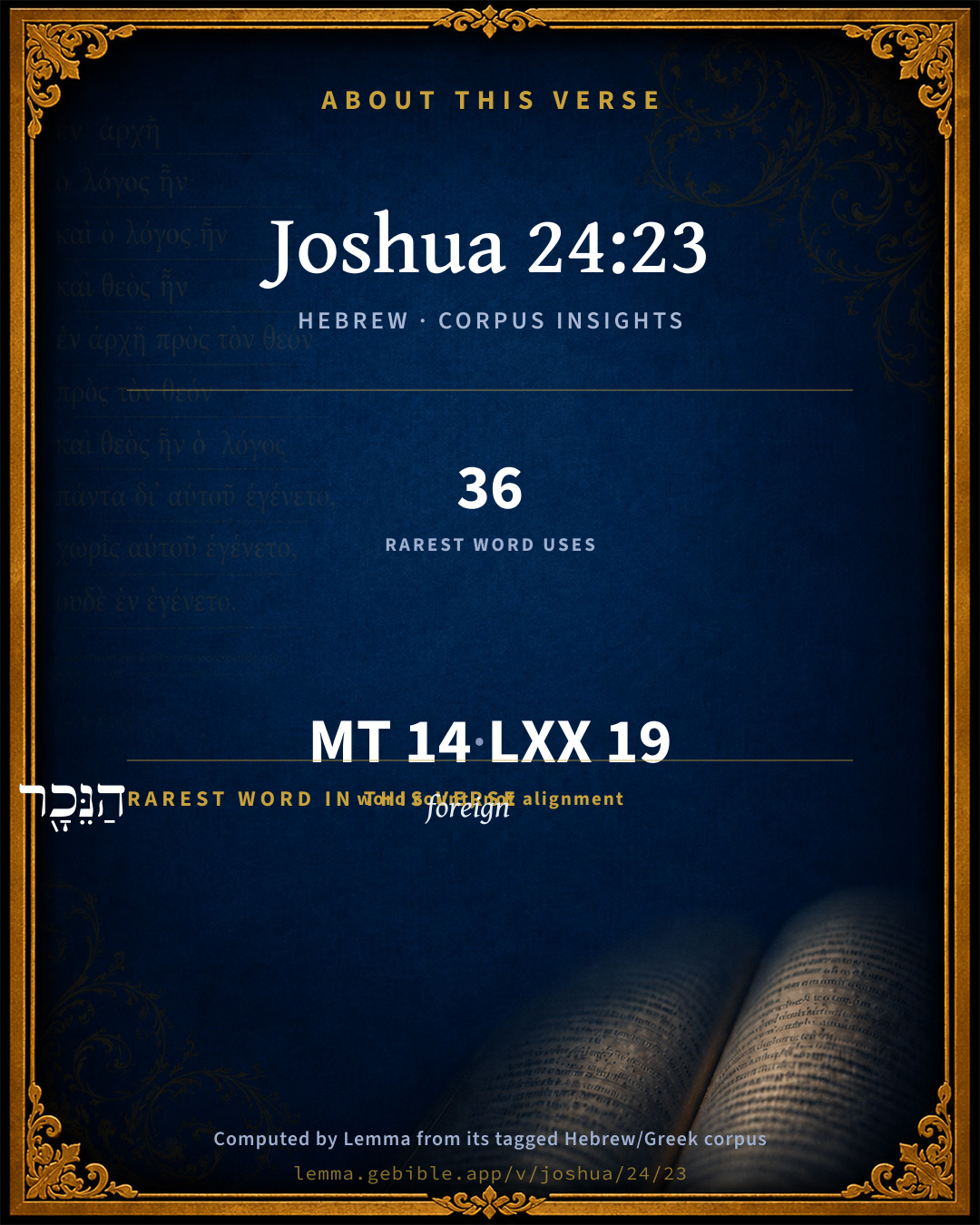
These counts appear in no published source. They are computed here, from the morphology-tagged text and Lemma’s own curated glosses. What Lemma adds →

14
words
12
distinct lemmas
Historical
section

Shared distinctive vocabulary

הַנֵּכָ֖ר foreign H5236 occurs in 35 verses of the Hebrew Bible. Also found in:

Grammatical profile

  • 2 verbs
  • 7 nouns
  • 1 preposition
  • 1 adverb
  • 3 particles

Verb forms

  • הָסִ֛ירוּ Hiphil · Imperative
  • וְהַטּוּ֙ Hiphil · Imperative

Repetition

A word recurs within this verse — often emphatic in Hebrew:

  • אֱלֹהֵ֥י God H430 ×2

Hebrew & Septuagint length

In English translation the verse runs 23 words from the Hebrew and 22 from the Septuagint (LXX English) — closely comparable.

A rough comparison of the two English renderings, which tokenize alike — not a word-level alignment.

Word counts can differ between the Hebrew and the Greek without any difference in meaning — e.g. the Hebrew direct-object marker אֵת has no separate Greek word, and Greek often adds the article ὁ.

In the original languages it is 14 Hebrew tokens and 19 Greek tokens — but the two are counted differently (Hebrew bundles its prefixes and suffixes into one token; the Greek is in lemma form), so that isn’t a like-for-like length.

Cross-references

14

Topical passages linked to Joshua 24:23 in the Treasury of Scripture Knowledge — connected by theme and wording, ordered by reader-vote popularity; previews shown in the World English Bible.

  • Joshua 24:14 Now therefore fear Yahweh, and serve him in sincerity and in truth; and put away the gods which your fathers served beyond the River, and in Egypt; and serve you Yahweh.
  • 2 Corinthians 6:16–18 What agreement has a temple of God with idols? For you are a temple of the living God. Even as God said, "I will dwell in them, and walk in them; and I will be their God, and they will be my people."
  • Genesis 35:2–4 Then Jacob said to his household, and to all who were with him, "Put away the foreign gods that are among you, purify yourselves, change your garments.
  • Judges 10:15–16 The children of Israel said to Yahweh, We have sinned: do you to us whatever seems good to you; only deliver us, we pray you, this day.
  • 1 Samuel 7:3–4 Samuel spoke to all the house of Israel, saying, If you do return to Yahweh with all your heart, then put away the foreign gods and the Ashtaroth from among you, and direct your hearts to Yahweh, and serve him only; and he will deliver you out of the hand of the Philistines.
  • Proverbs 2:2 So as to turn your ear to wisdom, And apply your heart to understanding;
  • Hebrews 12:28–29 Therefore, receiving a Kingdom that can't be shaken, let us have grace, through which we serve God acceptably, with reverence and awe,
  • Exodus 20:23 You shall most certainly not make alongside of me gods of silver, or gods of gold for yourselves.
  • 1 Kings 8:58 that he may incline our hearts to him, to walk in all his ways, and to keep his commandments, and his statutes, and his ordinances, which he commanded our fathers.
  • Psalms 119:36 Turn my heart toward your statutes, Not toward selfish gain.
  • Psalms 141:4 Don't incline my heart to any evil thing, To practice deeds of wickedness with men who work iniquity. Don't let me eat of their delicacies.
  • Hosea 14:2–3 Take words with you, and return to Yahweh. Tell him, "Forgive all our sins, And accept that which is good: So we offer like bulls our lips.
  • 1 Corinthians 10:19–21 What am I saying then? That a thing sacrificed to idols is anything, or that an idol is anything?
  • Hosea 14:8 Ephraim, what have I to do any more with idols? I answer, and will take care of him. I am like a green fir tree; From me your fruit is found."

Cross-references courtesy of OpenBible.info (CC BY 4.0).

Hebrew and Greek witnesses Masoretic Hebrew ↔ Greek Septuagint

The same verse in the two great witnesses to the Old Testament, shown verse-for-verse.

These are two independent witnesses, not word-aligned to each other, and the Septuagint is shown in lemma (dictionary) form.

Hebrew Joshua 24:23 Masoretic · Westminster Leningrad Codex

וְעַתָּ֕ה הָסִ֛ירוּ אֶת אֱלֹהֵ֥י הַנֵּכָ֖ר אֲשֶׁ֣ר בְּקִרְבְּכֶ֑ם וְהַטּוּ֙ אֶת לְבַבְכֶ֔ם אֶל יְהוָ֖ה אֱלֹהֵ֥י יִשְׂרָאֵֽל

Now therefore put away, [said he], the foreign gods which are among you, and incline your heart to Yahweh, the God of Israel.

World English Bible · Public Domain

Greek LXX Joshua 24:23 Septuagint · lemma form

καί νῦν περιαἱρέω ὁ θεός ὁ ἀλλότριος ὁ ἐν σύ καί εὐθύνω ὁ καρδία σύ πρός κύριος θεός ἰσραήλ

And now take away the strange gods that are among you, and set your heart right toward the Lord God of Israel.

LXX2012 (modern English Septuagint) · Public Domain

Hebrew: Westminster Leningrad Codex (CC BY 4.0). Greek: Septuagint (public domain); English from LXX2012 (modern English Septuagint) (Public Domain). How the Septuagint differs from the Hebrew →

Targum (Aramaic paraphrase)

1

The Targum is the ancient Jewish Aramaic paraphrase of the Hebrew Scriptures — an interpretive translation, not the Hebrew text itself. Onkelos (literal) and Pseudo-Jonathan (expansive) render the Torah, and Jonathan the Prophets. Coverage is partial: where no permissively-licensed English translation exists for a verse, only the Aramaic is shown. This is verse-level text, not a word-by-word alignment to the Hebrew.

  1. Targum Jonathan Prophets (Joshua–Malachi)
    וּכְעַן אַעֲדוֹ יַת טַעֲוַת עַמְמַיָא דִי בֵינֵיכוֹן וְאַפְנוּ יַת לִבְּכוֹן לְפוּלְחָנָא דַייָ אֱלָהָא דְיִשְׂרָאֵל:

    (no public-domain English translation for this verse)

    Targum Jonathan — Aramaic: “Mikraot Gedolot” (public domain). English: “Sefaria Community Translation” (CC0 1.0 (public-domain dedication)); “London "Chaldee Paraphrase," 1871” (public domain). Text via Sefaria.

Commentary

Notes on Joshua 24:23 from classic Christian and Jewish commentators (each source and its license shown beneath its notes). The classic Christian expositions comment on the surrounding passage and are grouped to its opening verse, so a note may address several verses; the Jewish commentaries on the Tanakh (Rashi and others) are per-verse, so they appear only where the commentator wrote on this verse.

Lemma curates 59 commentaries, every one of them public domain or Creative Commons licensed, each selected and text-cleaned for this edition rather than reprinted as found. About our sources →

Trapp's Complete Commentary

John Trapp

Jos 24:23 Now therefore put away, [said he], the strange gods which [are] among you, and incline your heart unto the LORD God of Israel.

Ver. 23. Now therefore.] Set forthwith upon the work of reformation which you have covenanted.

Put away the strange.] Out of doors with those Balaam’s blocks, those mawmets and monuments of idolatry, those images of jealousy which provoke to jealousy: {Eze 8:3} throw also all your sinful lusts out of service, and serve the Lord. See Jos 24:14.

John Trapp, A Commentary or Exposition upon All the Books of the Old and New Testament (1647–1656) — public domain. Text from a community e-Sword module.

Joseph Benson's Commentary

Jos 24:23. Put away the strange gods which are among you — Meaning those idols which they had either brought out of Egypt, or had taken in Canaan, and which some of them kept, contrary to God’s command, whether for the preciousness of the matter, or rather from some secret inclination to superstition and idolatry.

Joseph Benson's Commentary on the Old and New Testaments (1811–1818) — public domain. Text from a community e-Sword module.

Tyndale Open Study Notes

Tyndale Open Resources

24:23 Some Israelites had continued to worship idols since they left Egypt and after experiencing forty years of God’s love and power. Joshua directed them to destroy the idols and turn their hearts to the Lord to serve him alone.

Tyndale Open Study Notes — © Tyndale Open Resources, licensed CC BY-SA 4.0. Text via the HelloAO Bible API.

Geneva Bible (1599)

Geneva Bible translators

Out of your hearts and otherwise.

Geneva Bible (1599) marginal notes — public domain. Text via Bolls.life.

Adam Clarke's Commentary

Verse 23. Now therefore put away] As you have promised to reform, begin instantly the work of reformation. A man's promise to serve God soon loses its moral hold of his conscience if he do not instantaneously begin to put it in practice. The grace that enables him to promise is that by the strength of which he is to begin the performance.

Adam Clarke's Commentary on the Bible (1810–1826) — public domain. Text from a community e-Sword/MySword module.

John Calvin's Commentaries

23. Now, therefore, put away the strange gods, etc How can it be that those who were lately such stern avengers of superstition, have themselves given admission to idols? Yet the words expressly enjoin that they are to put away strange gods from the midst of them. If we interpret that their own houses were still polluted by idols, we may see, as in a bright mirror, how complacently the greater part of mankind can indulge in vices which they prosecute with inexorable severity in others. But, as I do not think it probable that they dared, after the execution of Achan, to pollute themselves with manifest sacrilege, I am inclined to think that reference is made not to their practice but to their inclinations, and that they are told to put all ideas of false gods far away from them. For he had previously exhorted them in this same chapter to take away the gods whom their fathers had served beyond the river and in Egypt. But nobody will suppose that the idols of Chaldea were treasured up in their repositories, or that they had brought impure deities with them from Egypt, to be a cause of hostility between God and themselves. The meaning, therefore, simply is, that they are to renounce all idols, and clear themselves of all profanity, in order that they may purely worship God alone. This seems to be the purport of the clause, incline your heart unto the Lord, which may be taken as equivalent to, rest in him, and so give up your heart to the love of him, as to delight and be contented only with him.

John Calvin's Commentaries (1540-1563) — public domain. Text from the Calvin Translation Society English edition (1840s-50s) via the Christian Classics Ethereal Library (ccel.org). Calvin's coverage is partial (roughly two-thirds of the Bible); uncommented books and verses are honest gaps, never fabricated. The 19th-century editor's footnotes and remarks are omitted so the notes are faithfully Calvin's own voice.

The Cambridge Bible for Schools and Colleges

gen. ed. J. J. S. Perowne

23. Now therefore put away] “Now thanne, he said, do çe awey alien goddis fro the middil of çou,” Wyclif. He again reverts to their secret practice of idolatry. Comp. Gen_35:2; 1Sa_7:3.

The Cambridge Bible for Schools and Colleges (gen. ed. J. J. S. Perowne; Cambridge University Press, 1878–1918) — public domain. Text from a community e-Sword module.

John Gill's Exposition

Now therefore put away, said he,.... Which last words are rightly supplied, for they are the words of Joshua:

the strange gods which are among you; not their private notions and secret sentiments that some of them had imbibed in favour of idols, and the worship of them, as Ben Gersom thinks; but, as the Targum expresses it,"the idols of the Gentiles;''either such as they had brought out of Egypt, or had found among the plunder of the Canaanites, and had secretly retained; or, as others think, their "penates", or household gods, they had privately kept and worshipped, such as those that were in Jacob's family, which he caused to be delivered to him, and which he hid under an oak in this place where Israel were now assembled, Gen 35:2; and which Joshua by a prophetic discerning spirit perceived were now among them:

and incline your heart unto the Lord God of Israel; to love, fear, and serve him; that is, pray that your hearts may be inclined thereunto, and make use of all means that may tend to direct your hearts to him, and his service; so the Targum,"to the worship of the Lord God of Israel.''

John Gill's Exposition of the Whole Bible (1746–1763) — public domain (CC PDM 1.0). Text via the HelloAO Bible API.

Matthew Poole's English Annotations

The strange gods which are among you; those idols which yon either brought out of Egypt, or have taken in Canaan, which I have too much reason to believe that some of you, contrary to God’s command, do keep, whether for the preciousness of the matter, or rather for some secret inclination to superstition and idolatry, as the following words imply. See Jos 24:14.

Matthew Poole's English Annotations on the Holy Bible (1683–1685) — public domain. Text from a community e-Sword/MySword module.

Whedon's Commentary on the Bible

Daniel D. Whedon

23. The strange gods — The teraphim. See note on Jos_24:14.

Incline your heart — By the free act of your will in the use of the power by God’s grace conferred on all.

Daniel D. Whedon (gen. ed.), Commentary on the Old and New Testaments (1874–1909) — public domain. Text from a community e-Sword module.

The Pulpit Commentary

Now therefore put away, said he, the strange gods which are among you. Keil and Delitzsch notice that the words translated "among you" have also the meaning, "within you," and argue that Joshua is speaking of inward tendencies to idolatry. But this is very improbable. For

(1) the word is the same as we find translated in ver. 17, "through whom." And

(2) the internal scrutiny which the law demanded was hardly so well understood at this early period as by diligent study it afterwards became. The plain provisions of the law demanded obedience. Comparatively little heed was given at first to inward feelings and tendencies. There can be little doubt that the meaning is precisely the same as in Gen_35:2, and that though the Israelites dare not openly worship strange gods, yet that teraphim and other images were, if not worshipped, yet preserved among them in such a way as to be likely to lead them into temptation. The history of Micah in Jud_1:17:5 is a proof of this, and it must be remembered that this history is out of its proper place. The zealous Phinehas (Jud_1:20:28) was then still alive, and the worship at Micah"s house had evidently been carried on for some time previous to the disgraceful outrage at Gibeah. The putting away the strange gods was to be the outward and visible sign, the inclining of the heart the inward and spiritual grace wrought within them by the mercy of God. For it is not denied that God desired their affections, and that those affections could scarcely be given while their heart went secretly after idols. It may be further remarked in support of this view that the Israelites are not exhorted to turn their heart from the false gods, but to put them away. It is a plain, positive precept, not a guide for the inner consciousness. On the other hand, the command to incline the heart to the Lord rests upon the simple ground of common gratitude. St. Augustine thinks that if any false gods were secretly in Israel at this time, they would have been met by a severer punishment than that accorded to Achan. Masius divini viri proceeds to argue that murders, thefts, and adulteries were worse sins than those of Achan, that it were not reasonable to suppose that Israel was free from such sins, and they were not punished like Achan"s. He forgets to urge

(1) that the condition of the children of Israel was very different in Achan"s time to that of the death of Joshua, and

(2) that Achan"s was a special act of disobedience to a very special enactment, considerations which would have materially strengthened his argument.

The Pulpit Commentary (1880–1919), ed. H.D.M. Spence-Jones & Joseph S. Exell — public domain. Text from a community e-Sword module.

John Wesley's Explanatory Notes

Strange gods - Those idols which you either brought out of Egypt, or have taken in Canaan, which some of you keep contrary to God's command, whether for the preciousness of the matter, or rather for some secret inclination to superstition and idolatry.

John Wesley, Explanatory Notes Upon the Whole Bible (1754–1765) — public domain. Text via the GEBible commentary corpus.

Lesson kit

Teaching starters — assembled from the data on this page, not authored interpretation. Every prompt links to the verse data it draws on. Edit before teaching.

Joshua, in the Historical, opens this verse with 14 words (12 distinct Hebrew lemmas). Its most distinctive word is nêkâr (“foreign”). A historical commentator’s framing appears above. Read the whole chapter for the surrounding context.

Discussion questions

  1. What does “foreign” (nêkâr) contribute to the verse as a whole?
  2. How does Genesis 17:12, which shares the word «foreign», read alongside this verse?
  3. What does the repetition of “God” (2× in this one verse) do in this verse?
  4. The translations on this page render this verse differently — a whole-verse word diff, not a word-by-word alignment. What might account for the different wordings?
  5. «הָסִ֛ירוּ» is a Hiphil Imperative verb. How does that grammatical form shape the action described?
  6. Compare how Trapp's Complete Commentary and Joseph Benson's Commentary read this verse. Where do they agree or differ?

Things to notice

Reading settings

Reading text

Shown beneath each verse's original-language words.

Old Testament
Old Testament edition

Read the OT as the Masoretic Hebrew (MT) or the Greek Septuagint (LXX).

English shown for the Greek Septuagint (in the Hebrew ↔ Greek comparison).

Comparing translations? Open the Compare panel on any verse page to stack up to four side by side.