
Job 23:11

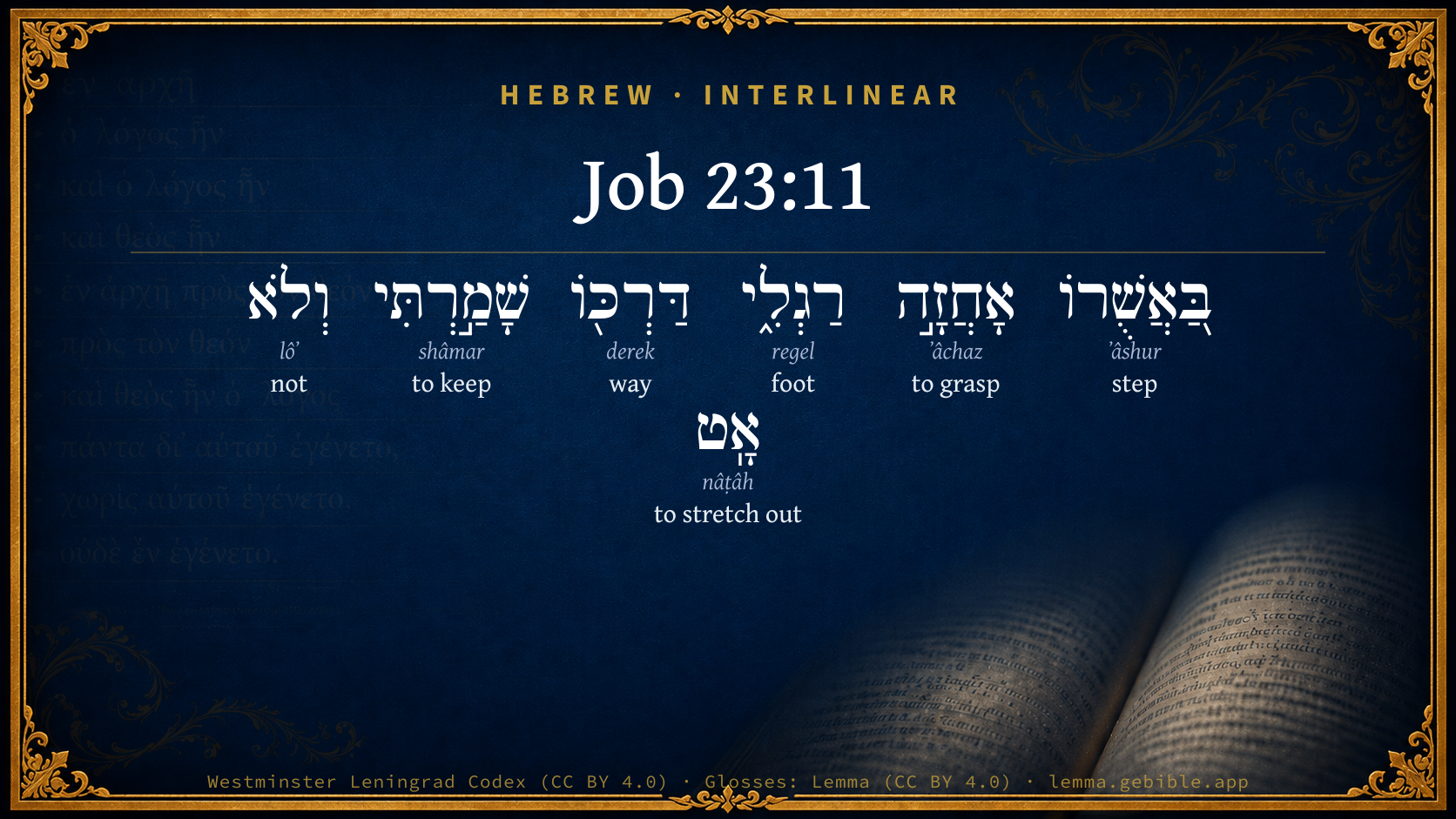
Hebrew (Westminster Leningrad Codex) Job 23:11 appears in the Hebrew Old Testament. The text above is from the Westminster Leningrad Codex. Each word links to its Strong’s number, a concise gloss, and parsing drawn from the Open Scriptures Hebrew Bible morphology. Click any word for its full Brown-Driver-Briggs (BDB) entry.
Download image
Cite this verse

Job 23:11 (World English Bible). Public Domain. Lemma interlinear Bible study tool, https://lemma.gebible.app/v/job/23/11.

Show BibTeX & RIS
BibTeX
RIS
English Translation
My foot has held fast to his steps. His way have I kept, and not turned aside.
World English Bible · Public Domain
Highlights Full analysis ↓
Download a study sheet

One document with this verse’s original text, its word-by-word gloss line, the meaning frame, cross-references with their text, attributed commentary, and full source and license credits — printable, and it pastes into notes with its structure intact.

This verse Autodidact and up

Study sheet (.html) Plain text (.txt)

A passage Seminary Student

Up to 50 verses in one chapter. A passage sheet keeps up to 6 commentary sources and 12 cross-references per verse, in the order this page ranks them, and says so on the sheet whenever that leaves anything out. Ask for a single verse and you get the Autodidact verse sheet above.

Everything on this page stays free to read, with no account — the sheet is a download of what is already on screen, not access to it.

Want to remove ads? Support Godless Engineer
Compare translations 3

The same verse in 3 English versions, stacked beneath the original-language interlinear above. Click any original word for its lexicon entry.

Each is an independent rendering of the whole verse — the interlinear is not word-aligned to these translations.

Highlighted words mark where these versions differ — a whole-verse word diff, not a word-by-word alignment.

  • World English Bible Public Domain
    My foot has held fast to his steps. His way have I kept, and not turned aside.
  • King James Version Public Domain
    My foot hath held his steps, his way have I kept, and not declined.
  • unfoldingWord Literal Text CC BY-SA 4.0
    My foot has held onto his step; I have kept his way and I have not turned aside.

unfoldingWord Literal Text — © unfoldingWord, licensed CC BY-SA 4.0. Word-aligned USFM3 via Door43 (git.door43.org/unfoldingWord/en_ult).

Versions to compare (up to 4)

3 of 4 selected

Show all 18 translations

Every available English version of this verse, each an independent rendering of the whole verse.

  • World English Bible Public Domain
    My foot has held fast to his steps. His way have I kept, and not turned aside.
  • Berean Standard Bible Public Domain
    My feet have followed in His tracks; I have kept His way without turning aside.
  • Majority Standard Bible Public Domain
    My feet have followed in His tracks; I have kept His way without turning aside.
  • King James Version Public Domain
    My foot hath held his steps, his way have I kept, and not declined.
  • American Standard Version (1901) Public Domain
    My foot hath held fast to his steps; His way have I kept, and turned not aside.
  • Revised Version (1885) Public Domain
    My foot hath held fast to his steps; his way have I kept, and turned not aside.
  • Geneva Bible (1599) Public Domain
    My foote hath followed his steps: his way haue I kept, and haue not declined.
  • Douay-Rheims (1899) Public Domain
    My foot hath followed his steps, I have kept his way, and have not declined from it.
  • Young's Literal Translation Public Domain
    On His step hath my foot laid hold, His way I have kept, and turn not aside,
  • Literal Standard Version CC BY-SA 4.0
    My foot has laid hold on His step, || I have kept His way, and do not turn aside,
  • Unlocked Literal Bible CC BY-SA 4.0
    My foot has held fast to his steps; I have kept to his way and turned not aside.
  • unfoldingWord Literal Text CC BY-SA 4.0
    My foot has held onto his step; I have kept his way and I have not turned aside.
  • Darby Bible Public Domain
    My foot hath held to his steps; his way have I kept, and not turned aside.
  • World Messianic Bible Public Domain
    My foot has held fast to his steps. I have kept his way, and not turned away.
  • Webster's Bible Public Domain
    My foot hath held his steps, his way have I kept, and not declined.
  • Free Bible Version CC BY-SA 4.0
    I have kept in step with him; I have followed his way without turning aside.
  • Bible in Basic English Public Domain
    My feet have gone in his steps; I have kept in his way, without turning to one side or to the other.
  • JPS Tanakh (1917) Public Domain
    My foot hath held fast to His steps, His way have I kept, and turned not aside.

Literal Standard Version (2020), Covenant Press — licensed CC BY-SA 4.0. Text via the HelloAO Bible API (eBible.org). Unlocked Literal Bible (unfoldingWord) — licensed CC BY-SA 4.0. Text via the HelloAO Bible API (eBible.org). unfoldingWord Literal Text — © unfoldingWord, licensed CC BY-SA 4.0. Word-aligned USFM3 via Door43 (git.door43.org/unfoldingWord/en_ult). Free Bible Version, Dr. Jonathan Gallagher — licensed CC BY-SA 4.0. Text via the HelloAO Bible API (eBible.org).

Word by word

More ways to search: Search by grammar → Find every occurrence → Compare this word →

Practice this passage: Drill this verse → Learn its vocabulary →

About this verse

These counts appear in no published source. They are computed here, from the morphology-tagged text and Lemma’s own curated glosses. What Lemma adds →

7
words
7
distinct lemmas
Wisdom
section

Notable vocabulary

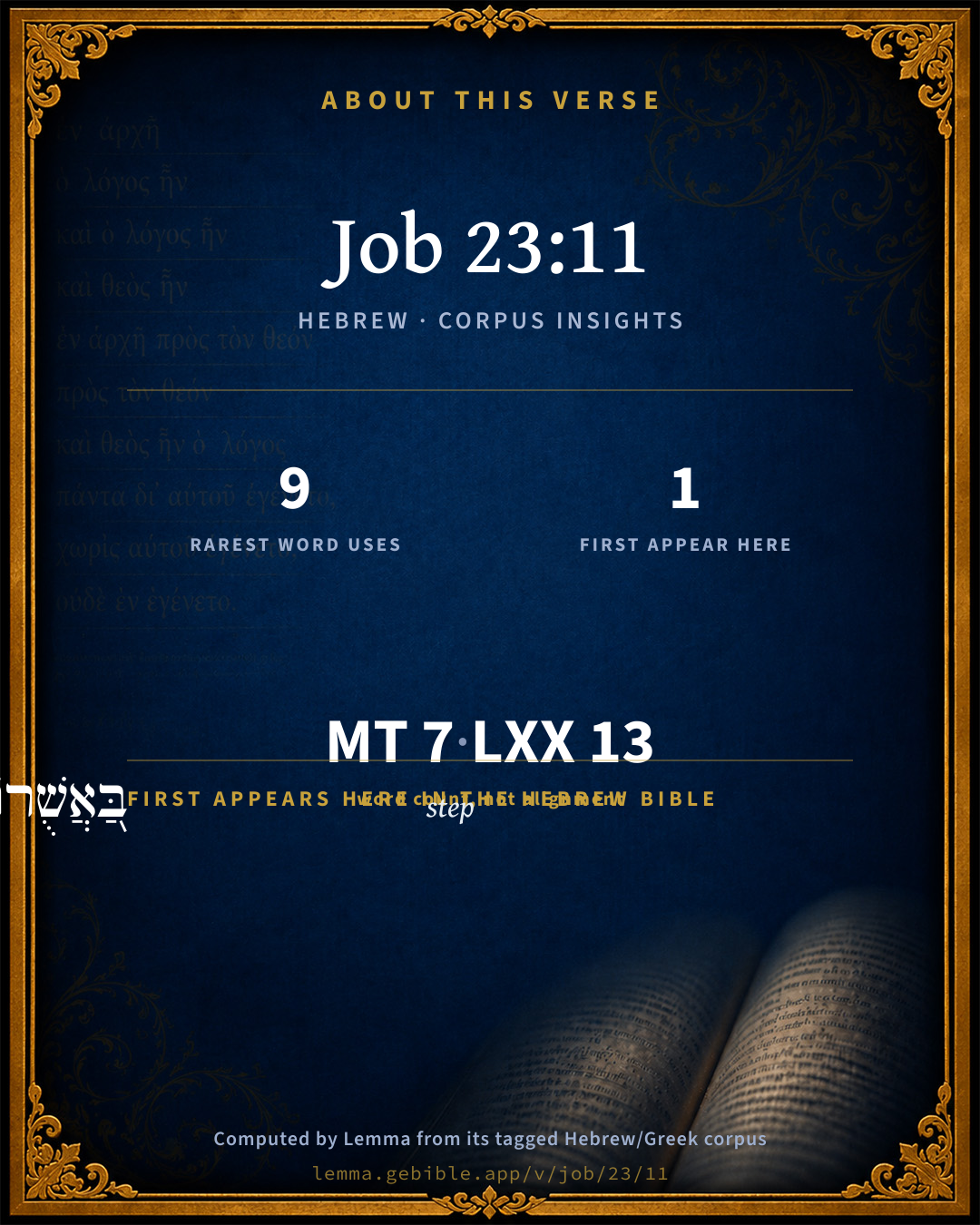
The rarest word here is בַּ֭אֲשֻׁרוֹ step H838 — appearing just 9 times in the whole Hebrew Bible.

First appearance in Scripture

This word makes its first canonical appearance in the Hebrew Bible here:

  • בַּ֭אֲשֻׁרוֹ step H838

Shared distinctive vocabulary

בַּ֭אֲשֻׁרוֹ step H838 occurs in 9 verses of the Hebrew Bible. Also found in:

Grammatical profile

  • 3 verbs
  • 3 nouns
  • 1 particle

Verb forms

  • אָחֲזָ֣ה Qal · Perfect
  • שָׁמַ֣רְתִּי Qal · Perfect
  • אָֽט Hiphil · Imperfect

Hebrew & Septuagint length

In English translation the verse runs 17 words from the Hebrew and 24 from the Septuagint (LXX English) — the Septuagint runs noticeably longer here. See the side-by-side →

A rough comparison of the two English renderings, which tokenize alike — not a word-level alignment.

Word counts can differ between the Hebrew and the Greek without any difference in meaning — e.g. the Hebrew direct-object marker אֵת has no separate Greek word, and Greek often adds the article ὁ.

In the original languages it is 7 Hebrew tokens and 13 Greek tokens — but the two are counted differently (Hebrew bundles its prefixes and suffixes into one token; the Greek is in lemma form), so that isn’t a like-for-like length.

Cross-references

14

Topical passages linked to Job 23:11 in the Treasury of Scripture Knowledge — connected by theme and wording, ordered by reader-vote popularity; previews shown in the World English Bible.

  • Psalms 44:18 Our heart has not turned back, Neither have our steps strayed from your path,
  • 2 Peter 2:20–22 For if, after they have escaped the defilement of the world through the knowledge of the Lord and Savior Jesus Christ, they are again entangled therein and overcome, the last state has become worse with them than the first.
  • Job 17:9 Yet shall the righteous hold on his way. He who has clean hands shall grow stronger and stronger.
  • Psalms 17:5 My steps have held fast to your paths, My feet have not slipped.
  • Psalms 125:5 But as for those who turn aside to their crooked ways, Yahweh will lead them away with the workers of iniquity. Peace be on Israel.
  • Romans 2:7 to those who by patience in well-doing seek for glory and honor and incorruptibility, eternal life;
  • Psalms 18:20–24 Yahweh has rewarded me according to my righteousness. According to the cleanness of my hands has he recompensed me.
  • Luke 8:13–15 Those on the rock are they who, when they hear, receive the word with joy; but these have no root, who believe for a while, then fall away in time of temptation.
  • Acts 20:18–19 When they had come to him, he said to them, "You yourselves know, from the first day that I set foot in Asia, how I was with you all the time,
  • 2 Corinthians 1:12 For our boasting is this: the testimony of our conscience, that in holiness and sincerity of God, not in fleshly wisdom but in the grace of God we behaved ourselves in the world, and more abundantly toward you.
  • Psalms 36:3 The words of his mouth are iniquity and deceit. He has ceased to be wise and to do good.
  • Zephaniah 1:6 those who have turned back from following Yahweh, and those who haven't sought Yahweh nor inquired after him.
  • 1 Samuel 12:2–5 Now, behold, the king walks before you; and I am old and gray-headed; and, behold, my sons are with you: and I have walked before you from my youth to this day.
  • Acts 20:33–34 I coveted no one's silver, or gold, or clothing.

Cross-references courtesy of OpenBible.info (CC BY 4.0).

Hebrew and Greek witnesses Masoretic Hebrew ↔ Greek Septuagint

The same verse in the two great witnesses to the Old Testament, shown verse-for-verse.

Here the Septuagint runs noticeably longer than the Hebrew — LXX2012 (modern English Septuagint) 24 words vs World English Bible 17. A rough length comparison of the two English translations, not a word-level alignment — read both below.

These are two independent witnesses, not word-aligned to each other, and the Septuagint is shown in lemma (dictionary) form.

Hebrew Job 23:11 Masoretic · Westminster Leningrad Codex

בַּ֭אֲשֻׁרוֹ אָחֲזָ֣ה רַגְלִ֑י דַּרְכּ֖וֹ שָׁמַ֣רְתִּי וְלֹא אָֽט

My foot has held fast to his steps. His way have I kept, and not turned aside.

World English Bible · Public Domain

Greek LXX Job 23:11 Septuagint · lemma form

ἐκἔρχομαι δέ ἐν ἔνταλμα αὐτός ὁδός γάρ αὐτός φυλάσσω καί οὐ μή ἐκκλίνω

And I will go forth according to his commandments, for I have kept his ways; and I shall not turn aside from his commandments,

LXX2012 (modern English Septuagint) · Public Domain

Hebrew: Westminster Leningrad Codex (CC BY 4.0). Greek: Septuagint (public domain); English from LXX2012 (modern English Septuagint) (Public Domain). How the Septuagint differs from the Hebrew →

Commentary

Notes on Job 23:11 from classic Christian and Jewish commentators (each source and its license shown beneath its notes). The classic Christian expositions comment on the surrounding passage and are grouped to its opening verse, so a note may address several verses; the Jewish commentaries on the Tanakh (Rashi and others) are per-verse, so they appear only where the commentator wrote on this verse.

Lemma curates 59 commentaries, every one of them public domain or Creative Commons licensed, each selected and text-cleaned for this edition rather than reprinted as found. About our sources →

Trapp's Complete Commentary

John Trapp

Job 23:11 My foot hath held his steps, his way have I kept, and not declined.

Ver. 11. My foot hath held his steps] I have followed God step by step, walking as I had him for an example, and pressing his footsteps. This Job speaketh of himself, not as vaunting, but as vindicating and defending his own innocence; and as giving Eliphaz to know, that he had already done, and still continued to do, as he had in the former chapter exhorted him, Job 22:21-22. Acquaint now thyself with God, &c. That is not now to do, saith Job; for my foot hath held his steps. Be at peace. I am so, saith he, for his way have I kept and not declined. Now, can two walk together, and they not be agreed? Receive, I pray thee, the law from his mouth. What else have I done, saith Job, when as I have not gone back from the commandment of his lips? Lay up his words in thine heart. This I have done ex instituto, saith he; vel prae demenso, more than my necessary food, have I esteemed the words of his mouth. So exact a pattern of the rule was Job; so consonant to Eliphaz’s good counsel. Plain things will join in every point one with another; not so round and rugged things: so do plain spirits close with holy counsels: not so such as are proud and unmortified. Let these be touched never so gently, nettle like, they will sting you. Deal with them roughly and roundly, they swagger, as that Hebrew did with Moses, saying, Who made thee a man of authority? &c., Exo 2:14. Good Job was of another spirit with God, as it is said of Caleb, Num 14:24, and followed him fully; ornavit doctrinam coelestem piis officiis, adorned the heavenly doctrine with his pious office, heavenly doctrine was as the mould, and he as the metal, which takes impression from it in one part as well as another. His constant endeavour was to express God to the world, and to preach forth his virtues or praises by a suitable practice, 1Pe 2:9. Gressum eius retinuit pes meus.

His way have I kept, and not declined] sc. In excess or defect, and therefore I am no such flagitious person as thou, Eliphaz, wouldst make of me.

John Trapp, A Commentary or Exposition upon All the Books of the Old and New Testament (1647–1656) — public domain. Text from a community e-Sword module.

The Biblical Illustrator

Joseph S. Exell

Job_23:11-12

My foot hath held His steps.

The fair portrait of a saint

Job has, in this part of his self-defence, sketched a fine picture of a man perfect and upright before God. He has set before us the image to which we should seek to be conformed.

I. Inspect this picture of Jobs holy life.

1. Job had been all along a man fearing God, and walking after the Divine rule. His way was Gods way. He knew no rule but the will of the Almighty. This is a great point to begin with; it is, indeed, the only sure basis of a noble character.

2. Consider Jobs first sentence. My foot hath held His steps. This expression sets forth great carefulness. He had watched every step of God to put his foot in it. He had observed the steps of Gods justice, that he might be just; the steps of Gods mercy, that he might be pitiful and compassionate; the steps of Gods bounty, that he might never be guilty of churlishness, or want of liberality; and the steps of Gods truth, that he might never deceive. He had watched Gods steps of forgiveness, that he might forgive his adversaries; and His steps of benevolence, that he might also do good and communicate, according to his ability, to all that were in need. Job had laboured to be exact in his obedience towards God, and in his imitation of the Divine character. There is no holy walking without careful watching. The expression here has something in it of tenacity; he speaks of taking hold upon Gods steps. Many Orientals have a power of grasp in their feet which we appear to have lost from want of use. An Arab in taking a determined stand, actually seems to grasp the ground with his toes. Dr. Good renders the passage, In His steps will I rivet my feet. So firm was his grip upon that holy way which his heart had chosen. The way of holiness is often craggy, and Satan tries to make it very slippery, and unless we can take hold of Gods steps we shall soon slip with our feet, and bring grievous injury upon ourselves, and dishonour to His holy name. To make up a holy character, there must be a tenacious adherence to integrity and piety. Again, to make a holy character, we must take hold of the steps of God in the sense of promptness and speed. Easterns say of a man who closely imitates his religious teacher, his feet have laid hold of his masters steps, meaning that he so closely follows his teacher that he seems to take hold of his heels. It is a blessed thing, when grace enables us to follow our Lord closely. You know what came of Peters following afar off; try what will come of close walking with Jesus. Three things, then, we get in the first sentence--an exactness of obedience; a tenacity of grip upon that which is good; and a promptness in endeavouring to keep touch with God, and to follow Him in all respects. Consider the second sentence. His way have I kept. Job had adhered to Gods way as the rule of his life. When he knew that such and such a thing was the mind of God, either by his conscience telling him that it was right, or by a Divine revelation, then he obeyed the intimation, and kept to it. Keeping to the way signifies not simply adherence, but continuance and progress in it. He had not grown tired of holiness, nor weary of devotion, neither had he grown sick of what men call straitlaced piety. I like a man whose mind is set upon being right with God. Give me a man who has a backbone. The third clause is, And not declined. He had neither declined from the way of holiness, nor declined in the way. Some turn from Gods way to the right hand, by doing more than Gods Word has bidden them do. They invent religious ceremonies, and vows, and bonds, and become superstitious. Turning to the left is being lax in observing Gods commandments. He had shunned omission as well as commission. Job had not begun by running hard, and then got out of breath and flagged. One more sentence remains. Neither have I gone back from the commandment of His lips. As he had not slackened his pace, so much less had he turned back. You can turn back, not only from all the commandments, and so become an utter apostate, but there is such a thing as backing at single commandments. You know the precept to be right, but you cannot face it; you look at it, but go back, refusing to obey. Job had never done so. Going back is dangerous. We have no armour for our back, no protection in retreat. Going back is ignoble and base.

II. How Job came by this character. Note Jobs holy sustenance. God spoke to Job. The words of His mouth. What God had spoken to him he treasured up. Job lived on Gods Word. He esteemed it more than his necessary food. Not more than his dainties only, for these are superfluities, but more than his necessary food, which a man esteems very highly. The natural life is more than meat, but our spiritual life feeds on meat even nobler than itself, for it feeds on the bread of heaven, the person of the Lord Jesus. Remember, then, that you cannot be holy unless you do in secret live upon the blessed Word of God, and you will not live on it unless it comes to you as the Word of His mouth. (C. H. Spurgeon.)

The Biblical Illustrator, edited by Joseph S. Exell (c. 1880s–1900s) — public domain. Text from a community e-Sword module.

Joseph Benson's Commentary

Job 23:11-12. My foot hath held his steps — Either the steps or ways in which God himself walks; the paths of justice, mercy, and holiness, wherein Job had made it his care to walk with, or after God, as the phrase is, Gen 5:24; or, which is the same thing, the steps or paths which God hath appointed men to walk in. These, Job says, his foot had held, that is, he had made a free and fixed choice of them; had taken fast hold of them; had been strongly and firmly resolved and settled to walk in them. Neither have I gone back — Turned aside to any crooked or sinful path, or course of life. I have esteemed the word of his mouth — Hebrew, צפנתי, tzaphanti; abscondi, reposui, I have hid, or laid it up, as men do their best treasures, or what they most love and value. The expression signifies a high esteem for it, a hearty affection to it, and a diligent care to preserve it. More than my necessary food — Or, my appointed, or daily portion; that food or provision which is necessary for the support of my life, (as the same word is used Gen 47:22.; Pro 30:8; and Pro 31:15,) and which is more prized and desired than all the riches of the world. There is, however, nothing in the Hebrew for the word food, which our translators have supplied, the term חקי, chokki, meaning simply statutum, vel, præscriptum mihi, what is appointed or prescribed to me. Chappelow, therefore, renders the whole verse thus: “As to the commandment of his lips, I have made no digression: according to what is prescribed me, I have kept the words of his mouth.”

Joseph Benson's Commentary on the Old and New Testaments (1811–1818) — public domain. Text from a community e-Sword module.

Jamieson, Fausset & Brown

Robert Jamieson, A. R. Fausset & David Brown

held--fast by His steps. The law is in Old Testament poetry regarded as a way, God going before us as our guide, in whose footsteps we must tread (Psa 17:5).

declined-- (Psa 125:5).

Jamieson, Fausset & Brown — Commentary Critical and Explanatory on the Whole Bible (1871) — public domain (CC PDM 1.0). Text via the HelloAO Bible API.

Adam Clarke's Commentary

Verse 11. My foot hath held his steps, his way have I kept] I have carefully marked his providential dealings; and in his way - his pure and undefiled religion - have I walked. I have not only been generally but particularly religious: I have attended carefully to the weightier matters of the law, and have not forgotten its slightest injunctions.

Coverdale is curious: - Nevertheles my fete kepe his path, his hye strete have I holden, and not gone out of it. The hye strete is highway, the causeway, or raised road; formed, as they anciently were, by stones in the manner of pavement. It has its name from the Latin strata, paved, via being understood: via lapidibus strata, "a way paved with stones:" hence street, a raised road or pavement either in town or country. And hence the four grand Roman or British roads which intersected this kingdom: viz. Watling street, Icknild or Ricknild street, Ermin street, and Fosse street. Some say these streets or roads were made by Bellinus, a British king.

Fosse street began in Cornwall, passed through Devonshire, Somersetshire, and along by Titbury upon Toteswould, beside Coventry, unto Leicester; and thence by the wide plains to Newark and to Lincoln, where it ends.

Watling street begins at Dover, passes through the middle of Kent, over the Thames by London, running near Westminster, and thence to St. Alban's, Dunstable, Stratford, Towcester, Weden, Lilbourn, Atherston, Wreaken by Severn, Worcester, Stratton, through Wales unto Cardigan, and on to the Irish sea.

Ermin, or Erminage street, running from St. David's in Wales, to Southampton.

Ricknild, or Icknild street, running by Worcester, Wycomb, Birmingham, Lichfield, Derby, Chesterfield, and by York, into Tynemouth. See Camden, Holinshed, and Minshieu.

Adam Clarke's Commentary on the Bible (1810–1826) — public domain. Text from a community e-Sword/MySword module.

The Cambridge Bible for Schools and Colleges

gen. ed. J. J. S. Perowne

11. hath held his steps] Or, held fast to His steps, i. e. followed closely His footsteps; comp. Isa_2:3.

11–12. Fuller particulars given by Job of “the way that is with him”—his innocent, upright life.

The Cambridge Bible for Schools and Colleges (gen. ed. J. J. S. Perowne; Cambridge University Press, 1878–1918) — public domain. Text from a community e-Sword module.

John Gill's Exposition

Neither have I gone back from the commandment of his lips,.... From any of the commandments his lips had uttered; meaning not the ten commandments given to Israel, which perhaps as yet were not given, or had not come to the knowledge of Job; some speak of the seven commandments, given to the sons of Noah; See Gill on Gen 9:4. It seems to design any and every commandment that God had given to Noah or Abraham, or any of the patriarchs, before the times of Job, and which he had knowledge of, and which he carefully observed, kept close to, and did not deviate from; but made it the rule of his walk and practice:

I have esteemed the words of his mouth more than my necessary food; the words of the Lord, the doctrines of grace that came from his mouth, are food for faith; there are in them milk for babes, and meat for strong men; they are savoury, salutary, and wholesome words, by which the people of God are nourished up unto eternal life; and they are esteemed by them more than the food that is necessary and convenient for their bodies; see Pro 30:8; for as the soul is preferable to the body, so the food of the one is preferable to the food of the other, and is sweeter, as the words of God are, to the taste of a believer, than honey, or the honeycomb: or "I have hid or laid up, the words of his mouth" (b); he had laid them up in his heart, in order to meditate upon them, and receive comfort and spiritual nourishment from them when he should want it, as men lay up their food in a proper place against the time they want it for their support and refreshment; and Job was more careful to lay up the one than the other; see Psa 119:11; here Job meets with, and has respect unto, the advice of Eliphaz, Job 22:22; and signifies that he had no need to have given him it, he had done this already.

(b) "abscondi", Pagninus, Montanus, Vatablus, Bolducius; "recondidi", Tigurine version, Beza, Junius & Tremellius, Piscator, Drusius, Mercerus, Cocceius, Michaelis, Schultens; so Broughton.

John Gill's Exposition of the Whole Bible (1746–1763) — public domain (CC PDM 1.0). Text via the HelloAO Bible API.

Albert Barnes' Notes on the Bible

My foot hath held his steps - Roberts, in his Oriental Illustrations, and the Editor of the Pictorial Bible, suppose that there is an allusion here to the active, grasping power which the Orientals have in their feet and toes. By constant usage they accustom themselves to make use of them in holding things in a manner which to us seems almost incredible, and they make the toes perform almost the work of fingers. We bind ours fast from early childhood in our close shoes, and they become useless except for the purpose of walking. But the Orientals use theirs differently. They seize upon an object with their toes, and hold it fast. If in walking along they see anything on the ground which they desire to pick up, instead of stooping as we would, they seize it with their toes, and lift it up. Alypulle, a Kandian chief, was about to be beheaded. When he arrived at the place of execution, he looked round for some object on which to seize, and saw a small shrub, and seized it with his toes, and held it fast in order to be firm while the executioner did his office. “Roberts.” So an Arab in treading firmly, or in taking a determined stand, seems to lay hold of, to grasp the ground with his toes, giving a fixedness of position inconceivable to those whose feet are cramped by the use of tight shoes. This may be the meaning here, that Job had fixed himself firmly in the footsteps of God, and had adhered tenaciously to him; or, as it is rendered by Dr. Good,” In his steps will I rivet my feet.”

And not declined - Turned aside.

Albert Barnes' Notes on the Bible (1834–1885) — public domain. Text from a community e-Sword/MySword module.

Matthew Poole's English Annotations

My foot hath held, i.e. made a free and fixed choice, and taken fast hold of them; been firmly and strongly settled, and resolved to continue in them, as the word signifies.

His steps; either,

1. Actively, the steps or ways in which God himself walks; the paths of holiness, justice, mercy, &c., wherein he walked with or after God, as the phrase is, Gen 5:24; 2Ki 23:3, following his example. Or,

2. Passively, the steps or paths which God hath appointed men to walk in, as Job 21:14.

His way have I kept, and not declined; the same thing with that in the former part of the verse, in different expressions.

Matthew Poole's English Annotations on the Holy Bible (1683–1685) — public domain. Text from a community e-Sword/MySword module.

Whedon's Commentary on the Bible

Daniel D. Whedon

11. Held his steps — The primary meaning of the word אחז, rendered held, is to seize, to lay fast hold of; upon which Kitto (Pic. Bib.) observes that “an unshod Oriental, particularly an Arab, in treading firmly or in taking a determined stand, does actually seem to lay hold of, seize or grasp, the ground with his toes, giving a sort of fixedness in his position inconceivable to those the power of whose feet is cramped by the habitual use of shoes.” Roberts, in his “Oriental Illustrations,” says of a Kandian chief who was to be beheaded, that when he arrived at the place where he was to be executed he looked around for some time for a small shrub, and on seeing one he seized it with his toes in order to be firm while the executioner did his office.

His steps — The steps are divine. Our entire pathway has been marked by such. Thus holy life is made the more easy, for we have but to “rivet” (Good) our steps in these, and nothing can move us. Life thus becomes the king’s highway, with its “example,” pattern, υπογραμμος, literally, writing copy, which Christ hath left that we should follow his steps. 1Pe_2:21. His way — The law was regarded by the Hebrew as a way wherein man should walk, under the leadership of God.

Daniel D. Whedon (gen. ed.), Commentary on the Old and New Testaments (1874–1909) — public domain. Text from a community e-Sword module.

The Pulpit Commentary

My foot hath held his steps; rather, hath held dose to his steps, or his path; i.e. I have followed in God"s way, and kept as close to it as possible. In other words. I have kept his way, and not declined from it.

Vers. 11, 12. A faithful life.

I ITS COURSE.

1. A course of conduct. Job speaks of his foot holding, etc. He is reviewing his actions. It would have been of little use for him to have vindicated his creed and his sentiments if his conduct had been faithless. The most important question is as to how a man lives, not as to what he thinks or how he feels.

2. A continuous course. It is a way, and Job has had to keep to it, A momentary spasm of virtue will not satisfy the requirements of the Divine Law. To achieve a single heroic deed that makes the world ring with one"s fame, and then sink into idle apathy, is not the way to earn the commendation, "Well done, good and faithful servant!

3. A Divine course. It is easy to persist in one"s own way. The difficulty is to leave that and to accept and follow faithfully in God"s way. Yet he has marked out the course of service for every one of his people, and the plain duty is to find it and follow it.

4. An arduous course. It is not easy to keep to God"s steps. The way is narrow. (Mat_7:13, Mat_7:14) Many temptations urge us to forsake it for flowery paths or for the broad road. The Christian life is a course of self-denial. The path leads uphill. Even while we only think of standing still we are really slipping back It is a mistake to suppose that the Christian life is necessarily a growth and a progress. There is danger of worse than stagnation, of declension and decay. We may have done well in the past, and yet have been hindered later on in life. To be true Christians we must be ever watchful, earnest, active in pressing forward along God"s way.

II ITS INSPIRATION. How is it possible to be faithful, keeping continuously to God"s way?

1. My the guidance of revelation. Job has been following God"s commandments. We cannot follow God"s way without the aid of light from heaven. Instinct and conscience are our natural guides; but instinct is blind, and conscience has been in some cases perverted. Therefore God has given us "the more sure word of prophecy." God"s Word is a lamp to the feet of his people. This is its chief object. Difficulties are felt as to certain questions about the Bible, e.g. how to reconcile Genesis with geology, how to settle the relation of the Law to the prophets, how to harmonize the gospel narratives. But these questions do not touch the main purpose of the Bible, which is to be a guide to conduct. The righteousness of the ten commandments, the blessedness of the sermon on the mount, and, above all, the glory of Christ, still shine from the sacred page as beacon-lights undimmed by the clouds of controversy that gather about quite secondary points.

2. In the power of affection. Job has set a supreme value on the words of God"s mouth. Their truth and goodness and beauty won the heart of the author of the hundred and nineteenth psalm. We have still greater attractions in the New Testament. Christ, the living Word of God, draws men to himself by his love and by his sacrifice of himself, so that when he is known and loved faithfulness becomes possible for his sake. Christians are called to walk, not only in the steps which God has marked out for them, but in those which Christ has trodden, which he has made sacred by his own presence. W.F.A.

The Pulpit Commentary (1880–1919), ed. H.D.M. Spence-Jones & Joseph S. Exell — public domain. Text from a community e-Sword module.

John Wesley's Explanatory Notes

Steps - The steps or paths which God hath appointed men to walk in.

John Wesley, Explanatory Notes Upon the Whole Bible (1754–1765) — public domain. Text via the GEBible commentary corpus.

Rashi

Rabbi Shlomo Yitzchaki (Rashi)

to His path Heb. באשרו, to His path, like (below 31:7), “If my foot (אשרי) has turned away from the road”; (Ps. 40:3), “He has established my paths (אשרי).”

and do not turn away I am not accustomed to turn away.

Rashi on the Tanakh — English translations: “The Judaica Press complete Tanach with Rashi, translated by A. J. Rosenberg” (CC BY 4.0); “Pentateuch with Rashi's commentary by M. Rosenbaum and A.M. Silbermann, 1929-1934” (public domain); “The Metsudah Tanach series, Lakewood, N.J” (CC BY 4.0); and “The Book of Joshua, Metsudah Publications, 1997” (CC BY 4.0). Text via Sefaria.

Lesson kit

Teaching starters — assembled from the data on this page, not authored interpretation. Every prompt links to the verse data it draws on. Edit before teaching.

Job, in the Wisdom, opens this verse with 7 words (7 distinct Hebrew lemmas). Its most distinctive word is ʼâshur (“step”). The Greek Septuagint runs longer here. A historical commentator’s framing appears above. Read the whole chapter for the surrounding context.

Discussion questions

  1. The word ʼâshur carries the sense “step.” How does it shape the verse?
  2. The word “step” first appears here in Scripture. What is being introduced at this debut?
  3. Job 31:7 shares the word «step» with this verse. How do the two illuminate each other?
  4. Compared with the Hebrew, the Septuagint runs longer here. What questions does that raise?
  5. These translations render this verse differently. What is at stake in choosing one wording over another?
  6. The verb «אָחֲזָ֣ה» is Qal Perfect. How does its form color the action?
  7. Reading how Trapp's Complete Commentary and The Biblical Illustrator read this verse, where do the two commentators agree and where do they part?

Things to notice

Reading settings

Reading text

Shown beneath each verse's original-language words.

Old Testament
Old Testament edition

Read the OT as the Masoretic Hebrew (MT) or the Greek Septuagint (LXX).

English shown for the Greek Septuagint (in the Hebrew ↔ Greek comparison).

Comparing translations? Open the Compare panel on any verse page to stack up to four side by side.