
Exodus 23:6

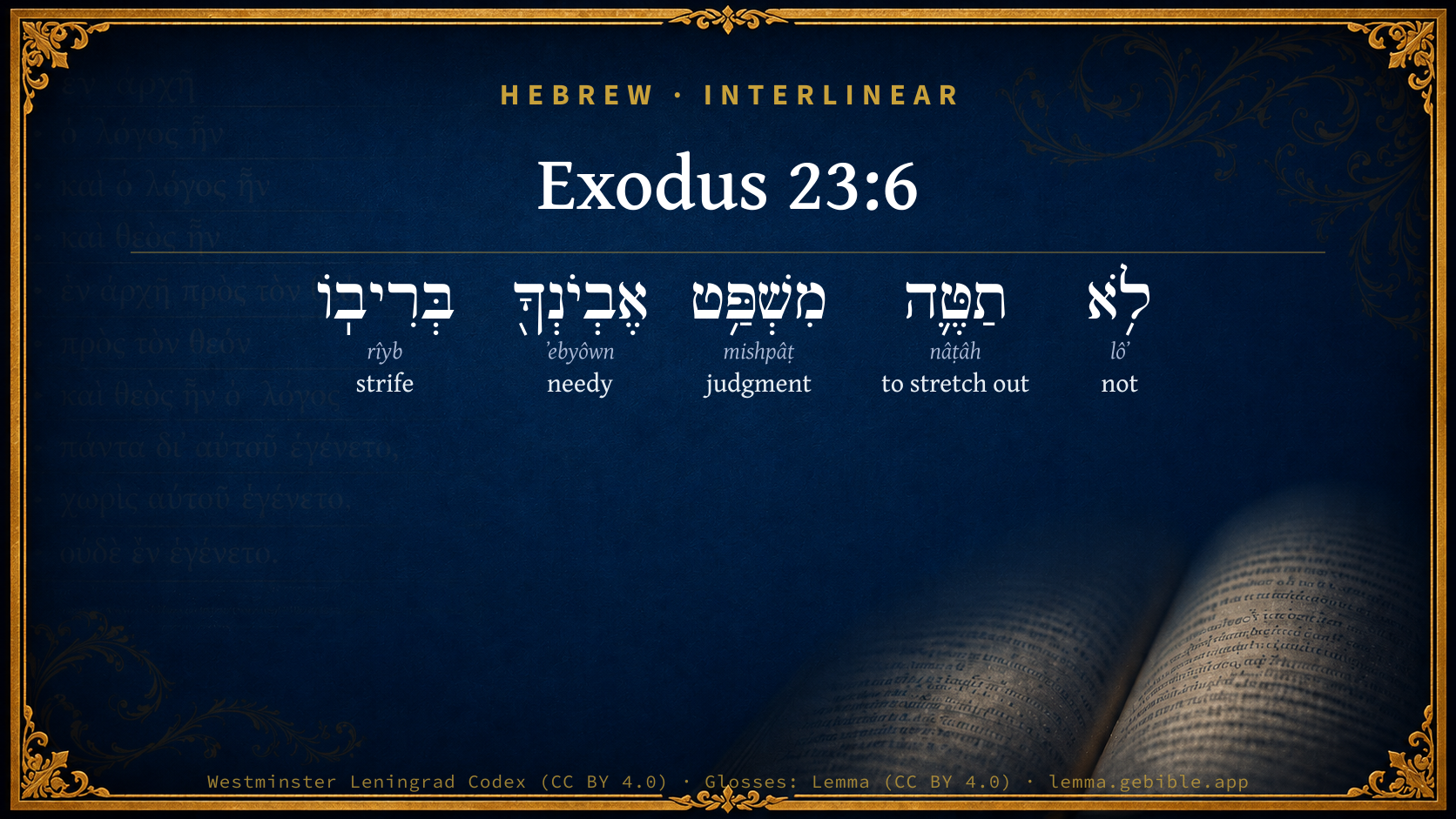
Hebrew (Westminster Leningrad Codex) Exodus 23:6 appears in the Hebrew Old Testament. The text above is from the Westminster Leningrad Codex. Each word links to its Strong’s number, a concise gloss, and parsing drawn from the Open Scriptures Hebrew Bible morphology. Click any word for its full Brown-Driver-Briggs (BDB) entry.
Download image
Cite this verse

Exodus 23:6 (World English Bible). Public Domain. Lemma interlinear Bible study tool, https://lemma.gebible.app/v/exodus/23/6.

Show BibTeX & RIS
BibTeX
RIS
English Translation
"You shall not deny justice to your poor people in their lawsuits.
World English Bible · Public Domain
Highlights
  • 1 first appearance in the Hebrew Bible
Full analysis ↓
Download a study sheet

One document with this verse’s original text, its word-by-word gloss line, the meaning frame, cross-references with their text, attributed commentary, and full source and license credits — printable, and it pastes into notes with its structure intact.

This verse Autodidact and up

Study sheet (.html) Plain text (.txt)

A passage Seminary Student

Up to 50 verses in one chapter. A passage sheet keeps up to 6 commentary sources and 12 cross-references per verse, in the order this page ranks them, and says so on the sheet whenever that leaves anything out. Ask for a single verse and you get the Autodidact verse sheet above.

Everything on this page stays free to read, with no account — the sheet is a download of what is already on screen, not access to it.

Want to remove ads? Support Godless Engineer
Compare translations 3

The same verse in 3 English versions, stacked beneath the original-language interlinear above. Click any original word for its lexicon entry.

Each is an independent rendering of the whole verse — the interlinear is not word-aligned to these translations.

Highlighted words mark where these versions differ — a whole-verse word diff, not a word-by-word alignment.

  • World English Bible Public Domain
    "You shall not deny justice to your poor people in their lawsuits.
  • King James Version Public Domain
    Thou shalt not wrest the judgment of thy poor in his cause.
  • unfoldingWord Literal Text CC BY-SA 4.0
    You shall not turn aside justice for your poor in his lawsuit.

unfoldingWord Literal Text — © unfoldingWord, licensed CC BY-SA 4.0. Word-aligned USFM3 via Door43 (git.door43.org/unfoldingWord/en_ult).

Versions to compare (up to 4)

3 of 4 selected

Show all 18 translations

Every available English version of this verse, each an independent rendering of the whole verse.

  • World English Bible Public Domain
    "You shall not deny justice to your poor people in their lawsuits.
  • Berean Standard Bible Public Domain
    You shall not deny justice to the poor in their lawsuits.
  • Majority Standard Bible Public Domain
    You shall not deny justice to the poor in their lawsuits.
  • King James Version Public Domain
    Thou shalt not wrest the judgment of thy poor in his cause.
  • American Standard Version (1901) Public Domain
    Thou shalt not wrest the justice `due' to thy poor in his cause.
  • Revised Version (1885) Public Domain
    Thou shalt not wrest the judgment of thy poor in his cause.
  • Geneva Bible (1599) Public Domain
    Thou shalt not ouerthrowe the right of thy poore in his sute.
  • Douay-Rheims (1899) Public Domain
    Thou shalt not go aside in the poor man's judgment.
  • Young's Literal Translation Public Domain
    `Thou dost not turn aside the judgment of thy needy one in his strife;
  • Literal Standard Version CC BY-SA 4.0
    You do not turn aside the judgment of your poor in his strife;
  • Unlocked Literal Bible CC BY-SA 4.0
    Do not thrust aside justice for your poor in his lawsuit.
  • unfoldingWord Literal Text CC BY-SA 4.0
    You shall not turn aside justice for your poor in his lawsuit.
  • Darby Bible Public Domain
    Thou shalt not pervert the judgment of thy poor in his cause.
  • World Messianic Bible Public Domain
    “You shall not deny justice to your poor people in their lawsuits.
  • Webster's Bible Public Domain
    Thou shalt not wrest the judgment of thy poor in his cause.
  • Free Bible Version CC BY-SA 4.0
    You must not prevent the poor from getting justice in their lawsuits.
  • Bible in Basic English Public Domain
    Let no wrong decisions be given in the poor man's cause.
  • JPS Tanakh (1917) Public Domain
    Thou shalt not wrest the judgment of thy poor in his cause.

Literal Standard Version (2020), Covenant Press — licensed CC BY-SA 4.0. Text via the HelloAO Bible API (eBible.org). Unlocked Literal Bible (unfoldingWord) — licensed CC BY-SA 4.0. Text via the HelloAO Bible API (eBible.org). unfoldingWord Literal Text — © unfoldingWord, licensed CC BY-SA 4.0. Word-aligned USFM3 via Door43 (git.door43.org/unfoldingWord/en_ult). Free Bible Version, Dr. Jonathan Gallagher — licensed CC BY-SA 4.0. Text via the HelloAO Bible API (eBible.org).

Word by word

More ways to search: Search by grammar → Find every occurrence → Compare this word →

Practice this passage: Drill this verse → Learn its vocabulary →

אֶבְיֹנְךָ֖
ʼebyôwn
H34
“needy · your”
Adjective, Adjective, Masculine, Singular, Construct + Suffix, Personal, 2nd Person, Masculine, Singular
Part of Speech
Adjective
Type
Adjective
Gender
Masculine
Number
Singular
State
Construct
Full BDB Definition

Origin: from H14 , in the sense of want (especially in feeling)

TWOT: 3a

in want, needy, chiefly poor, needy person - subject to oppression and abuse - needing help, deliverance from trouble, especially as delivered by God - general reference to lowest class
  1. לֹ֥א lôʼ H3808 “not” Particle, Negative
  2. תַטֶּ֛ה nâṭâh H5186 “to stretch out” Verb, Hiphil, Imperfect, 2nd Person, Masculine, Singular
  3. מִשְׁפַּ֥ט mishpâṭ H4941 “judgment of” Noun, Common, Masculine, Singular, Construct
  4. בְּרִיבֽוֹ rîyb H7379 “in/at · strife · his” Preposition + Noun, Common, Both, Singular, Construct + Suffix, Personal, 3rd Person, Masculine, Singular

About this verse

These counts appear in no published source. They are computed here, from the morphology-tagged text and Lemma’s own curated glosses. What Lemma adds →

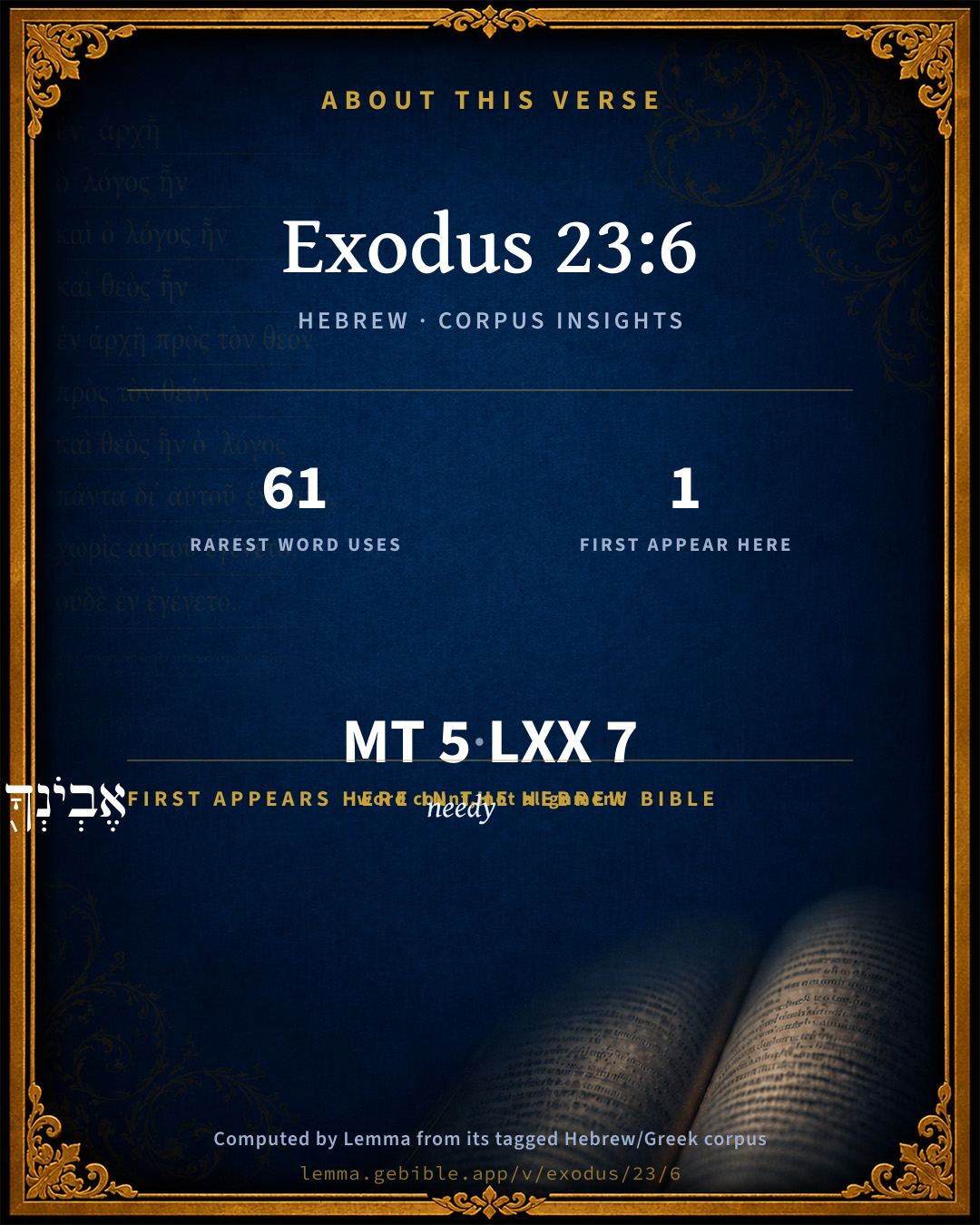
5
words
5
distinct lemmas
Pentateuch
section

First appearance in Scripture

This word makes its first canonical appearance in the Hebrew Bible here:

  • אֶבְיֹנְךָ֖ needy H34

Grammatical profile

  • 1 verb
  • 2 nouns
  • 1 adjective
  • 1 particle

Verb forms

  • תַטֶּ֛ה Hiphil · Imperfect

Hebrew & Septuagint length

In English translation the verse runs 12 words from the Hebrew and 12 from the Septuagint (LXX English) — the same length.

A rough comparison of the two English renderings, which tokenize alike — not a word-level alignment.

Word counts can differ between the Hebrew and the Greek without any difference in meaning — e.g. the Hebrew direct-object marker אֵת has no separate Greek word, and Greek often adds the article ὁ.

In the original languages it is 5 Hebrew tokens and 7 Greek tokens — but the two are counted differently (Hebrew bundles its prefixes and suffixes into one token; the Greek is in lemma form), so that isn’t a like-for-like length.

Cross-references

18

Topical passages linked to Exodus 23:6 in the Treasury of Scripture Knowledge — connected by theme and wording, ordered by reader-vote popularity; previews shown in the World English Bible.

  • Malachi 3:5 I will come near to you to judgment; and I will be a swift witness against the sorcerers, and against the adulterers, and against the perjurers, and against those who oppress the hireling in his wages, the widow, and the fatherless, and who deprive the foreigner of justice, and don't fear me," says Yahweh of Hosts.
  • Exodus 23:2–3 You shall not follow a crowd to do evil; neither shall you testify in court to side with a multitude to pervert justice;
  • Leviticus 19:15 "'You shall do no injustice in judgment: you shall not be partial to the poor, nor show favoritism to the great; but in righteousness shall you judge your neighbor.
  • Deuteronomy 16:19 You shall not wrest justice: you shall not respect persons; neither shall you take a bribe; for a bribe does blind the eyes of the wise, and pervert the words of the righteous.
  • Deuteronomy 27:19 Cursed be he who wrests the justice [due] to the foreigner, fatherless, and widow. All the people shall say, Amen.
  • Ecclesiastes 5:8 If you see the oppression of the poor, and the violent taking away of justice and righteousness in a district, don't marvel at the matter: for one official is eyed by a higher one; and there are officials over them.
  • Isaiah 10:1–2 Woe to those who decree unrighteous decrees, and to the writers who write perverseness;
  • Jeremiah 5:28 They are grew fat, they shine: yes, they overpass in deeds of wickedness; they don't plead the cause, the cause of the fatherless, that they may prosper; and the right of the needy they don't judge.
  • James 2:5–6 Listen, my beloved brothers. Didn't God choose those who are poor in this world to be rich in faith, and heirs of the Kingdom which he promised to those who love him?
  • 2 Chronicles 19:7 Now therefore let the fear of Yahweh be on you; take heed and do it: for there is no iniquity with Yahweh our God, nor respect of persons, nor taking of bribes.
  • Job 31:13 "If I have despised the cause of my man-servant Or of my maid-servant, When they contended with me;
  • Job 31:21–22 If I have lifted up my hand against the fatherless, Because I saw my help in the gate:
  • Psalms 82:3–4 "Defend the weak, the poor, and the fatherless. Maintain the rights of the poor and oppressed.
  • Jeremiah 6:28 They are all grievous rebels, going about with slanders; they are brass and iron: they all of them deal corruptly.
  • Jeremiah 7:6 if you don't oppress the foreigner, the fatherless, and the widow, and don't shed innocent blood in this place, neither walk after other gods to your own hurt:
  • Amos 5:11–12 Forasmuch therefore as you trample on the poor, And take taxes from him of wheat: You have built houses of hewn stone, But you will not dwell in them. You have planted pleasant vineyards, But you shall not drink their wine.
  • Micah 3:1–4 I said, "Please listen, you heads of Jacob, And rulers of the house of Israel: Isn't it for you to know justice?
  • Zephaniah 3:1–4 Woe to her who is rebellious and polluted, the oppressing city!

Cross-references courtesy of OpenBible.info (CC BY 4.0).

Hebrew and Greek witnesses Masoretic Hebrew ↔ Greek Septuagint

The same verse in the two great witnesses to the Old Testament, shown verse-for-verse.

These are two independent witnesses, not word-aligned to each other, and the Septuagint is shown in lemma (dictionary) form.

Hebrew Exodus 23:6 Masoretic · Westminster Leningrad Codex

לֹ֥א תַטֶּ֛ה מִשְׁפַּ֥ט אֶבְיֹנְךָ֖ בְּרִיבֽוֹ

"You shall not deny justice to your poor people in their lawsuits.

World English Bible · Public Domain

Greek LXX Exodus 23:6 Septuagint · lemma form

οὐ διαστρέφω κρίμα πένης ἐν κρίσις αὐτός

You shall not wrest the sentence of the poor in his judgment.

LXX2012 (modern English Septuagint) · Public Domain

Hebrew: Westminster Leningrad Codex (CC BY 4.0). Greek: Septuagint (public domain); English from LXX2012 (modern English Septuagint) (Public Domain). How the Septuagint differs from the Hebrew →

Targum (Aramaic paraphrase)

2

The Targum is the ancient Jewish Aramaic paraphrase of the Hebrew Scriptures — an interpretive translation, not the Hebrew text itself. Onkelos (literal) and Pseudo-Jonathan (expansive) render the Torah, and Jonathan the Prophets. Coverage is partial: where no permissively-licensed English translation exists for a verse, only the Aramaic is shown. This is verse-level text, not a word-by-word alignment to the Hebrew.

  1. Targum Onkelos Torah (Genesis–Deuteronomy)
    לָא תַצְלֵי דִין מִסְכֵּינָךְ בְּדִינֵהּ:

    (no public-domain English translation for this verse)

    Targum Onkelos — Aramaic: “Onkelos Genesis” (public domain); “Onkelos Exodus” (public domain); “Onkelos Leviticus” (public domain); “Onkelos Numbers” (public domain); “Onkelos Deuteronomy” (public domain). English: “Sefaria Community Translation” (CC0 1.0 (public-domain dedication)); “J.W. Etheridge. The Targums of Onkelos and Jonathan Ben Uzziel on the Pentateuch. London: Longmans, Green, 1862” (public domain). Text via Sefaria.

  2. Targum Pseudo-Jonathan Torah (Genesis–Deuteronomy)
    עַמִּי בְּנֵי יִשְרָאֵל לָא תַצְלוּן דִּין מִסְכֵּינָא בְּדִינֵיהּ

    Sons of Israel My people, ye shall not warp the judgment of the poor in his cause.

    Targum Pseudo-Jonathan — Aramaic: “Targum Jonathan on Genesis” (public domain); “Targum Jonathan on Exodus” (public domain); “Targum Jonathan on Leviticus” (public domain); “Targum Jonathan on Numbers” (public domain); “Targum Jonathan on Deuteronomy” (public domain). English: “The Targum of Jonathan ben Uzziel, trans. J. W. Etheridge, London, 1862” (public domain). Text via Sefaria.

Commentary

Notes on Exodus 23:6 from classic Christian and Jewish commentators (each source and its license shown beneath its notes). The classic Christian expositions comment on the surrounding passage and are grouped to its opening verse, so a note may address several verses; the Jewish commentaries on the Tanakh (Rashi and others) are per-verse, so they appear only where the commentator wrote on this verse.

Lemma curates 59 commentaries, every one of them public domain or Creative Commons licensed, each selected and text-cleaned for this edition rather than reprinted as found. About our sources →

Trapp's Complete Commentary

John Trapp

Exo 23:6 Thou shalt not wrest the judgment of thy poor in his cause.

Ver. 6. The judgment of thy poor.] I have seen, saith one, {a} the king of Persia many times to alight from his horse, only to do justice to a poor body. Causes are to be heard, and not persons: the Athenian judges passed sentence in the dark.

{a} The Preacher’s Travels, by J. Cartwright.

John Trapp, A Commentary or Exposition upon All the Books of the Old and New Testament (1647–1656) — public domain. Text from a community e-Sword module.

Albert Barnes' Notes on the Bible

Four precepts evidently addressed to those in authority as judges:

(a) To do justice to the poor. Comparing Exo 23:6 with Exo 23:3, it was the part of the judge to defend the poor against the oppression of the rich, and the part of the witness to take care lest his feelings of natural pity should tempt him to falsify evidence.

(b) To be cautious of inflicting capital punishment on one whose guilt was not clearly proved. A doubtful case was rather to be left to God Himself, who would “not justify the wicked,” nor suffer him to go unpunished though he might be acquitted by an earthly tribunal. Exo 23:7.

(c) To take no bribe or present which might in any way pervert judgment Exo 23:8; compare Num 16:15; 1Sa 12:3; Act 26:26.

(d) To vindicate the rights of the stranger Exo 23:9 - rather, the foreigner. (Exo 20:10 note.) This verse is a repetition of Exo 22:21, but the precept is there addressed to the people at large, while it is here addressed to the judges in reference to their official duties. The caution was perpetually necessary. Compare Eze 22:7; Mal 3:5. The word rendered “heart” is more strictly “soul,” and would be better represented here by feelings.

Albert Barnes' Notes on the Bible (1834–1885) — public domain. Text from a community e-Sword/MySword module.

The Biblical Illustrator

Joseph S. Exell

Exo_23:6-8

Thou shalt not wrest the judgment.

Duties of judges

I. That judges should be impartial.

1. In particular towards the poor (Exo_23:6).

(1) Because the poor are most open to the oppression of the powerful.

(2) Because the poor are often at a disadvantage for the want of technical knowledge or means to procure legal assistance.

(3) Because the poor are easily overawed.

2. In general towards the right (Exo_23:7, first clause). Not to aid or abet a wrong cause.

II. That judges should be cautious, particularly with regard to matters relating to capital punishment. The innocent and righteous slay thou not.

1. The case must be clearly proved.

2. The accused to have the benefit of the doubt.

3. Because justice would be done. If the criminal escaped an earthly doom, God would not justify the wicked (Pro_11:21).

III. That judges should be incorrupt (Exo_23:8), either in the shape of direct bribe or indirect present.

1. Because the bribe may blind him to the true merit of the case; and--

2. Because the bribe may weigh down and pervert his judgment on the wrong side.

IV. That judges should be considerate (Exo_23:9), particularly in regard to foreigners. Because--

1. They had been foreigners themselves, and had suffered for the want of consideration.

2. They therefore knew something of the sufferings of foreigners.

(1) Foreigners may be ignorant of the law and unwittingly break it.

(2) When broken, they may know nothing of legal technicalities, or be unable to pay legal expenses. (J. W. Burn.)

The administration of justice

There was a close connection between the civil and the military constitution of the Hebrews. The same men who were captains of thousands and captains of hundreds in war were magistrates in time of peace. In every Oriental state the point of greatest weakness is the administration of justice. Those who have lived long in the East testify that there is no such thing as justice; that no cadi, sitting in the place of judgment, ever pretends to such exceptional virtue as to be above receiving bribes. The utmost that can be expected is the hypocrisy which is the homage of vice to virtue; and even this is seldom rendered, for where bribery is universal no one is constrained by shame to conceal it. Against this terrible demoralization no rock can stand but that of the Divine authority. In the administration of justice a theocracy is an ideal government, for it is Divinity enthroned on earth as in heaven; and no other form of government enforces justice in a manner so absolute and peremptory. In the eyes of the Hebrew lawgiver, the civil tribunal was as sacred as the Holy of Holies. The office of the judge was as truly authorized and his duty as solemnly enjoined as that of the priest. The judgment is Gods, said Moses; and he who gave a false judgment disregarded the authority of Him whose nature is justice and truth. The judgment-seat was a holy place, which no private malice might profane. Evidence was received with religious care. Oaths were administered to give solemnity to the testimony (Lev_5:1). Then the judge, standing in the place of God, was to pronounce equitably, whatever might be the rank of the contending parties (Deu_1:17). He recognized no distinctions; all were alike to him. The judge was to know no difference. He was not to be biased even by sympathy for the poor (Exo_23:3; Lev_19:15). Magistrates were not allowed to accept a gift, for fear of bribery. (H. M. Field, D. D.)

Bribery resisted

Persuaded that Marvell would be theirs (the Administrations) for properly asking, they sent his old schoolfellow, the Lord Treasurer Danby, to renew acquaintance with him in his garret. At parting, the Lord Treasurer, out of pure affection, slipped into his hand an order upon the Treasury for £1,000, and then went to his chariot. Marvell, looking at the paper, called after the Treasurer, My lord, I request another moment. They went up again to the garret, and Jack, the servant-boy, was called. Jack, child, what had I for dinner yesterday? Dont you remember, sir? You had the little shoulder of mutton that you ordered me to bring from the woman in the market. Very right, child. What have I for dinner to-day? Dont you know, sir, that you bade me lay by the blade-bone to broil? Tis so; very right, child; go away. My lord, do you hear that? Andrew Marvells dinner is provided. Theres your piece of paper--I want it not. I know the sort of kindness you intended. I live here to serve my constituents. The Ministry may seek men for their purpose. I am not one. (Coleridge.)

Bribes declined

Why, asked one of the English Tortes of the Tory Governor of Massachusetts--why hath not Mr. Adams been taken off from his opposition by an office? To which the Governor replied, Such is the obstinacy and inflexible disposition of the man, that he never would be conciliated by any office whatever. His daughter used to say that her father refused a pension from the British Government of f2,000 a year. Once, when a secret messenger from General Gage threatened him with a trial for treason if he persisted in his opposition to the Government and promised him honours and wealth if he would desist, Adams rose to his feet and replied, Sir, I trust I have long since made my peace with the King of kings. No personal consideration shall induce me to abandon the righteous cause of my country.

A judge to refuse bribes

I dare say many of you may have heard of the celebrated Sir Matthew Hale, that he was in the habit of receiving a present from a person annually; and it happened once, that about the usual time when this friend made him the present, that he was accused of some offence, and was to appear as an accused person before Sir Matthew Hale. On this occasion Sir Matthew Hale returned him the present, lest it should afford even the shadow of a suspicion that the purity of judicial impartiality should be disturbed, or seem to be disturbed, by a gift from one who was to appear before the court accused of an offence, and demanding a fair trial. And I believe still it would be thought the most scandalous outrage upon our constitution, and every judge would repudiate it with scorn and disdain, were any one, expecting to have his cause tried by that judge, to attempt to propitiate his favour by gifts. Now, this beautiful rule--so just, so reasonable, so proper--was anticipated and was known, you observe, three thousand years ago, and was first revealed by Him who is the Fountain of all wisdom and justice. (J. Cumming, D. D.)

Bribery resisted

A speculator heard that an amalgamation between two joint-stock companies was projected, which would afford an opportunity to make a large sum of money by prompt purchases of shares. He was acquainted with an official holding a subordinate and poorly paid position in one of the companies, and went to him to obtain reliable information. But the official was a Christian and a man of honour, and knowing the information would operate to the disadvantage of his employers, refused to say whether the amalgamation was contemplated or not. I can make £60,000 by my speculation if you will tell me, said the tempter, and I will give you half. I cannot betray my trust, was the reply. You need not speak, said the speculator; just wink your eye and I shall know, and you shall have £30,000. The temptation was fierce, but the Christian conquered it. A few days afterwards, when the amalgamation was completed, the speculator reproached his acquaintance for not giving the information, but he was told that an approving conscience was above price. It is satisfactory to learn that the faithful official prospered in his subsequent career, and is now receiving a salary of £5,000 a year.

The Biblical Illustrator, edited by Joseph S. Exell (c. 1880s–1900s) — public domain. Text from a community e-Sword module.

Joseph Benson's Commentary

Exo 23:6. Thou shalt not wrest the judgment of thy poor — As a judge should beware, lest through motives of compassion, or an affectation of popularity, he be biassed in favour of the poor; so, on the other hand, he must not despise a man because he is poor and without friends: he must not take advantage of his poverty to misrepresent his cause, to refuse to give him an impartial hearing, to strain a point of equity to his prejudice, or pass sentence wrongfully against him. The words thy poor, are emphatical, importing that they were members of their body, though poor.

Joseph Benson's Commentary on the Old and New Testaments (1811–1818) — public domain. Text from a community e-Sword module.

Adam Clarke's Commentary

Verse 6. Thou shalt not wrest the judgment of thy poor] Thou shalt neither countenance him in his crimes, nor condemn him in his righteousness. See Ex 23:5; Ex 23:7.

Adam Clarke's Commentary on the Bible (1810–1826) — public domain. Text from a community e-Sword/MySword module.

Ellicott's Commentary for English Readers

(6) Thou shalt not wrest the judgment of thy poor.—If we are not to favour the poor man in a court of justice on account of his poverty (Exo_23:3), much less are we to treat him with disfavour. (Comp. Deu_24:17; Deu_27:19; Jer_5:28, &c.)

A Bible Commentary for English Readers, edited by Charles John Ellicott (1878–1897) — public domain. Text from a community e-Sword module.

The Cambridge Bible for Schools and Colleges

gen. ed. J. J. S. Perowne

6. Cf. Deu_1:17; and, more generally, Lev_19:15 (H), Deu_16:19. As is well known, the maladministration of justice is, and always has been, a crying evil among Oriental nations; and the poor, especially, are rarely able to get their rights. Comp. allusions in the OT., Amo_5:12, Isa_10:2, Jer_5:28, Psa_10:17; Psa_82:4, Pro_31:9; also Jer_22:16 (where Josiah is praised for having ‘judged the cause of the poor and the needy’), Psa_72:12-14.

6–9. Justice to be administered impartially: bribes not to be taken; the poor and the gêr not to be oppressed. The verses form the continuation of vv. 1–3, vv. 1–3 dealing with fairness in bearing witness, and these verses with fairness in administering justice.

The Cambridge Bible for Schools and Colleges (gen. ed. J. J. S. Perowne; Cambridge University Press, 1878–1918) — public domain. Text from a community e-Sword module.

John Gill's Exposition

Thou shalt not wrest the judgment of thy poor in his cause. As the poor man was not to be favoured when his cause was bad through an affected pity for him as a poor man, so his judgment was not to be wrested or perverted, when his cause was good, because of his poverty; which is too often the case, through the power of rich men, and the prevalence of their gifts and bribes, and to curry favour with them: the phrase, "thy poor", is very emphatic, and intended to engage judges to regard them, as being of the same flesh and blood with them, of the same nation and religion; and who were particularly committed to their care and protection under God, who is the Judge and protector of the poor, of the widow and the fatherless.

Thou shalt not wrest the judgment of thy poor in his cause. As the poor man was not to be favoured when his cause was bad through an affected pity for him as a poor man, so his judgment was not to be wrested or perverted, when his cause was good, because of his poverty; which is too often the case, through the power of rich men, and the prevalence of their gifts and bribes, and to curry favour with them: the phrase, "thy poor", is very emphatic, and intended to engage judges to regard them, as being of the same flesh and blood with them, of the same nation and religion; and who were particularly committed to their care and protection under God, who is the Judge and protector of the poor, of the widow and the fatherless.

Exodus 23:7

exo 23:7

exo 23:7

exo 23:7Keep thee far from a false matter,.... Or "word" (z); from receiving a false testimony, or taking the false or wrong side of a cause, or engaging in a bad one; keep aloof off from it, as much at a distance from it as possible:

and the innocent and the righteous slay thou not; that is, do not condemn them to death, nor join with the majority in their condemnation, if they appear to be innocent and righteous; nor give orders, or join in giving orders to the executioner to put such to death. The Targum of Jonathan is,"he that goes righteous out of the house of thy judgment (out of the sanhedrim, to which he belonged), and they find out his sin (afterwards), and he that goes out guilty, and they (afterwards) find out his righteousness, do not slay:"

for I will not justify the wicked: the wicked judge in pronouncing an unjust sentence on innocent and righteous men, or if they absolve wicked men, at the same time they put to death the innocent and righteous, God will not justify those wicked men cleared by them, but will, in his own time and way, sooner or later, inflict the deserved punishment on them: this is not contrary to Rom 4:5 for though God justifies the ungodly, he does not justify ungodliness in them, or them in ungodliness, but from it, and that by the imputation of the righteousness of his Son.

(z) "a verbo mendacii", Pagninus, Montanus, Vatablus, Drusius, Junius & Tremellius, Tigurine version, Fagius.

John Gill's Exposition of the Whole Bible (1746–1763) — public domain (CC PDM 1.0). Text via the HelloAO Bible API.

Matthew Poole's English Annotations

i.e. Of the poor which is among thee, not of the poor Jews only, as some peradventure may conceive; for common right must be done even to the Gentiles. Compare Deu 27:19.

Matthew Poole's English Annotations on the Holy Bible (1683–1685) — public domain. Text from a community e-Sword/MySword module.

The Pulpit Commentary

As in verse 3 men were warned not to favour the poor unduly in courts of justice out of compassion for them, so here there is a warning against the opposite, and far more usual error, of leaning against the poor man in our evidence or in our decisions The scales of justice are to be held even; strict right is to be done; our feelings are not be allowed to influence us, much less our class prejudices.

The Pulpit Commentary (1880–1919), ed. H.D.M. Spence-Jones & Joseph S. Exell — public domain. Text from a community e-Sword module.

unfoldingWord translationNotes

Door43 World Missions Community

General Information:

Yahweh continues telling Moses his laws for the people of Israel.

Do not thrust aside justice for your poor in his lawsuit

"Do not decide to treat a poor man unjustly in legal matters"

lawsuit

Here, this refers to any matter that a court decides.

I will not acquit the wicked

"I will not find the wicked not guilty" or "I will not say of wicked people that they are innocent"

bribe blinds ... perverts

Here a "bribe" is described as if it were a person. AT: "bribe discredits ... undermines" (See: Personification)

the life of a foreigner

"the kind of life a stranger lives in a foreign land"

translationWords

just

innocent

righteous

acquit

evil

bribe

oppress

Egypt

unfoldingWord translationNotes — © Distant Shores Media and the Door43 World Missions Community, licensed CC BY-SA 4.0. Source: git.door43.org/Door43/en_tn.

Rashi

Rabbi Shlomo Yitzchaki (Rashi)

אבינך — from the root אבה “to long for”, “to desire” — one who is poverty-stricken and longs for all the good things which he lacks.

Rashi on the Tanakh — English translations: “The Judaica Press complete Tanach with Rashi, translated by A. J. Rosenberg” (CC BY 4.0); “Pentateuch with Rashi's commentary by M. Rosenbaum and A.M. Silbermann, 1929-1934” (public domain); “The Metsudah Tanach series, Lakewood, N.J” (CC BY 4.0); and “The Book of Joshua, Metsudah Publications, 1997” (CC BY 4.0). Text via Sefaria.

Lesson kit

Teaching starters — assembled from the data on this page, not authored interpretation. Every prompt links to the verse data it draws on. Edit before teaching.

Exodus, in the Pentateuch, opens this verse with 5 words (5 distinct Hebrew lemmas). Its most distinctive word is ʼebyôwn (“needy”). A historical commentator’s framing appears above. Read the whole chapter for the surrounding context.

Discussion questions

  1. What does “needy” (ʼebyôwn) contribute to the verse as a whole?
  2. This is the first place “needy” appears in Scripture (first appears here). What does its debut here establish?
  3. How does Malachi 3:5, which shares this passage’s theme, read alongside this verse?
  4. These translations render this verse differently. What is at stake in choosing one wording over another?
  5. «תַטֶּ֛ה» is a Hiphil Imperfect verb. How does that grammatical form shape the action described?
  6. Compare how Trapp's Complete Commentary and Albert Barnes' Notes on the Bible read this verse. Where do they agree or differ?

Things to notice

Reading settings

Reading text

Shown beneath each verse's original-language words.

Old Testament
Old Testament edition

Read the OT as the Masoretic Hebrew (MT) or the Greek Septuagint (LXX).

English shown for the Greek Septuagint (in the Hebrew ↔ Greek comparison).

Comparing translations? Open the Compare panel on any verse page to stack up to four side by side.