Isaiah 30:11

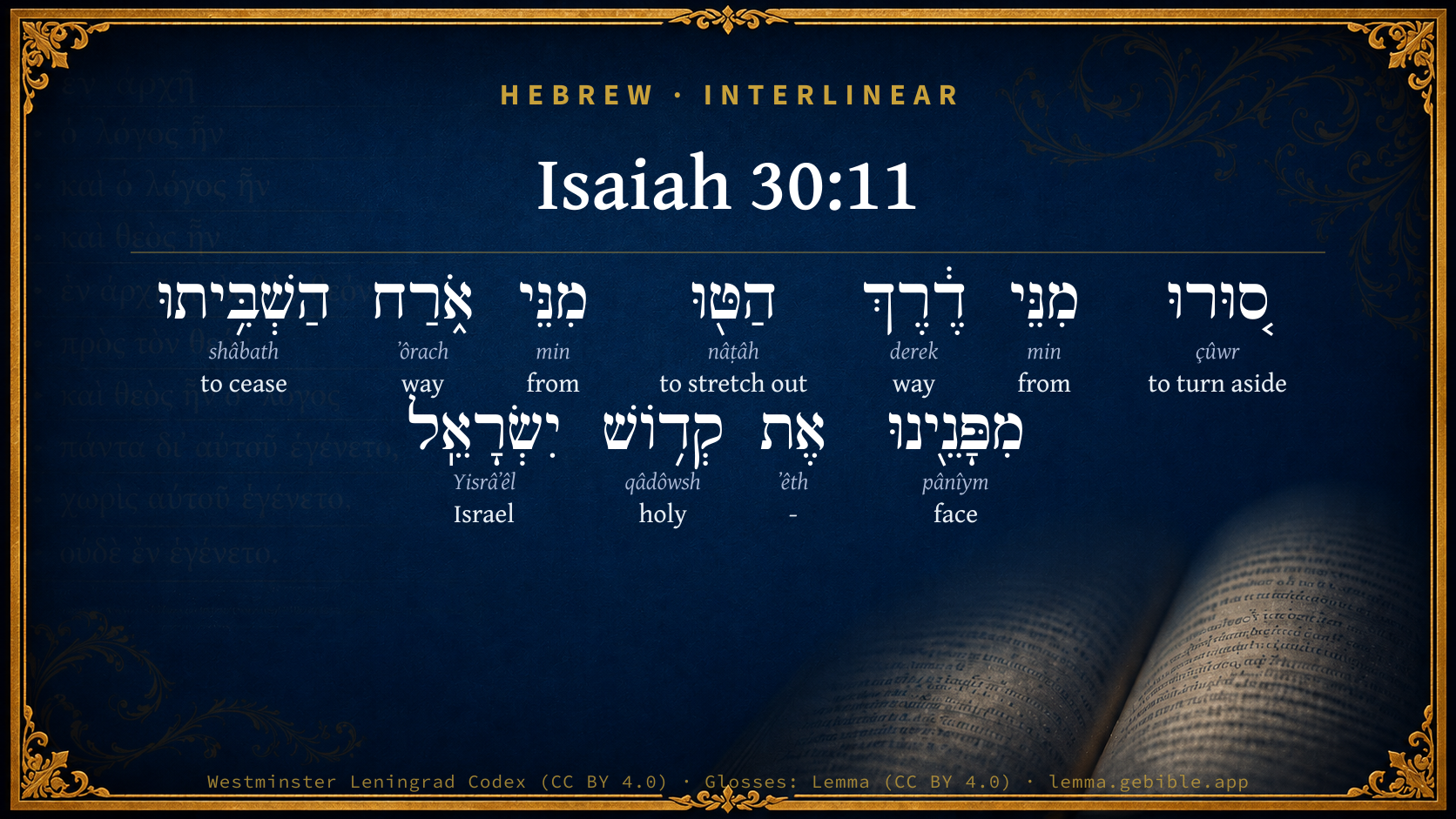
Hebrew (Westminster Leningrad Codex) Isaiah 30:11 appears in the Hebrew Old Testament. The text above is from the Westminster Leningrad Codex. Each word links to its Strong’s number, a concise gloss, and parsing drawn from the Open Scriptures Hebrew Bible morphology. Click any word for its full Brown-Driver-Briggs (BDB) entry.
Download image
Cite this verse

Isaiah 30:11 (World English Bible). Public Domain. Lemma interlinear Bible study tool, https://lemma.gebible.app/v/isaiah/30/11.

Show BibTeX & RIS
BibTeX
RIS
English Translation
get out of the way, turn aside out of the path, cause the Holy One of Israel to cease from before us."
World English Bible · Public Domain
Download a study sheet

One document with this verse’s original text, its word-by-word gloss line, the meaning frame, cross-references with their text, attributed commentary, and full source and license credits — printable, and it pastes into notes with its structure intact.

This verse Autodidact and up

Study sheet (.html) Plain text (.txt)

A passage Seminary Student

Up to 50 verses in one chapter. A passage sheet keeps up to 6 commentary sources and 12 cross-references per verse, in the order this page ranks them, and says so on the sheet whenever that leaves anything out. Ask for a single verse and you get the Autodidact verse sheet above.

Everything on this page stays free to read, with no account — the sheet is a download of what is already on screen, not access to it.

Want to remove ads? Support Godless Engineer
Compare translations 3

The same verse in 3 English versions, stacked beneath the original-language interlinear above. Click any original word for its lexicon entry.

Each is an independent rendering of the whole verse — the interlinear is not word-aligned to these translations.

Highlighted words mark where these versions differ — a whole-verse word diff, not a word-by-word alignment.

  • World English Bible Public Domain
    get out of the way, turn aside out of the path, cause the Holy One of Israel to cease from before us."
  • King James Version Public Domain
    Get you out of the way, turn aside out of the path, cause the Holy One of Israel to cease from before us.
  • unfoldingWord Literal Text CC BY-SA 4.0
    Turn aside from the way; turn away from the path. Make the Holy of Israel cease from our faces.”

unfoldingWord Literal Text — © unfoldingWord, licensed CC BY-SA 4.0. Word-aligned USFM3 via Door43 (git.door43.org/unfoldingWord/en_ult).

Versions to compare (up to 4)

3 of 4 selected

Show all 18 translations

Every available English version of this verse, each an independent rendering of the whole verse.

  • World English Bible Public Domain
    get out of the way, turn aside out of the path, cause the Holy One of Israel to cease from before us."
  • Berean Standard Bible Public Domain
    Get out of the way; turn off the road. Rid us of the Holy One of Israel!”
  • Majority Standard Bible Public Domain
    Get out of the way; turn off the road. Rid us of the Holy One of Israel!”
  • King James Version Public Domain
    Get you out of the way, turn aside out of the path, cause the Holy One of Israel to cease from before us.
  • American Standard Version (1901) Public Domain
    get you out of the way, turn aside out of the path, cause the Holy One of Israel to cease from before us.
  • Revised Version (1885) Public Domain
    get you out of the way, turn aside out of the path, cause the Holy One of Israel to cease from before us.
  • Geneva Bible (1599) Public Domain
    Depart out of the way: go aside out of the path: cause the holy one of Israel to cease from vs.
  • Douay-Rheims (1899) Public Domain
    Take away from me the way, turn away the path from me, let the Holy One of Israel cease from before us.
  • Young's Literal Translation Public Domain
    Turn aside from the way, decline from the path, Cause to cease from before us the Holy One of Israel.'
  • Literal Standard Version CC BY-SA 4.0
    Turn aside from the way, || Decline from the path, || Cause the Holy One of Israel || To cease from before us.”
  • Unlocked Literal Bible CC BY-SA 4.0
    Turn aside from the way, stray off the path; cause the Holy One of Israel to cease speaking before our face.”
  • unfoldingWord Literal Text CC BY-SA 4.0
    Turn aside from the way; turn away from the path. Make the Holy of Israel cease from our faces.”
  • Darby Bible Public Domain
    get you out of the way, turn aside out of the path, cause the Holy One of Israel to cease from before us!
  • World Messianic Bible Public Domain
    Get out of the way. Turn away from the path. Cause the Holy One of Israel to cease from before us.”
  • Webster's Bible Public Domain
    Withdraw from the way, turn aside from the path, cause the Holy One of Israel to cease from before us.
  • Free Bible Version CC BY-SA 4.0
    Stop telling us straight; go a different direction! We don't want to hear any more about the Holy One of Israel.”
  • Bible in Basic English Public Domain
    Get out of the good way, turning from the right road; do not keep the Holy One of Israel before our minds.
  • JPS Tanakh (1917) Public Domain
    Get you out of the way, turn aside out of the path, cause the Holy One of Israel to cease from before us.'

Literal Standard Version (2020), Covenant Press — licensed CC BY-SA 4.0. Text via the HelloAO Bible API (eBible.org). Unlocked Literal Bible (unfoldingWord) — licensed CC BY-SA 4.0. Text via the HelloAO Bible API (eBible.org). unfoldingWord Literal Text — © unfoldingWord, licensed CC BY-SA 4.0. Word-aligned USFM3 via Door43 (git.door43.org/unfoldingWord/en_ult). Free Bible Version, Dr. Jonathan Gallagher — licensed CC BY-SA 4.0. Text via the HelloAO Bible API (eBible.org).

Word by word

More ways to search: Search by grammar → Find every occurrence → Compare this word →

Practice this passage: Drill this verse → Learn its vocabulary →

About this verse

These counts appear in no published source. They are computed here, from the morphology-tagged text and Lemma’s own curated glosses. What Lemma adds →

11
words
10
distinct lemmas
Prophets
section

Shared distinctive vocabulary

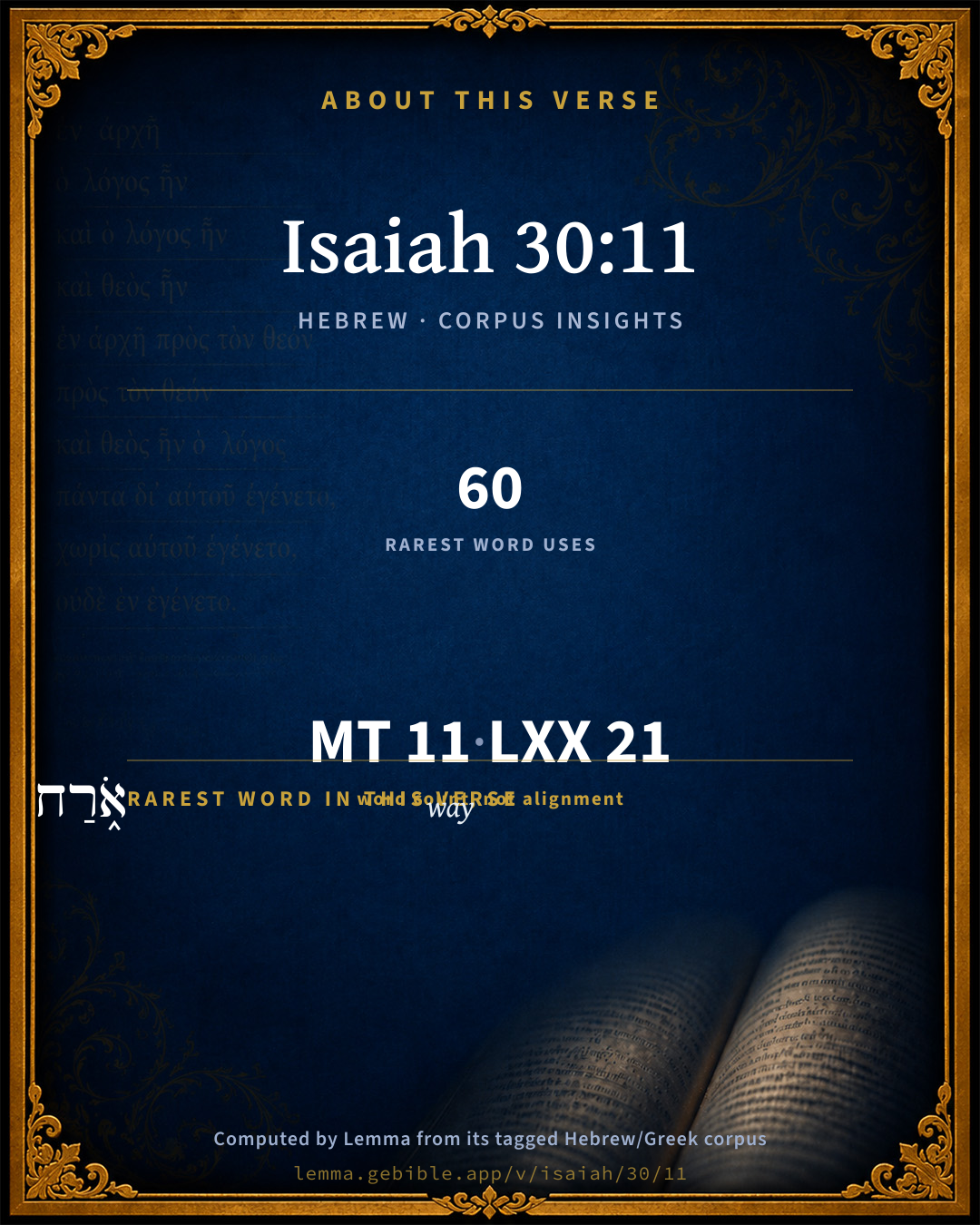
אֹ֑רַח way H734 occurs in 58 verses of the Hebrew Bible. Also found in:

Grammatical profile

  • 3 verbs
  • 4 nouns
  • 1 adjective
  • 2 prepositions
  • 1 particle

Verb forms

  • ס֚וּרוּ Qal · Imperative
  • הַטּ֖וּ Hiphil · Imperative
  • הַשְׁבִּ֥יתוּ Hiphil · Imperative

Repetition

A word recurs within this verse — often emphatic in Hebrew:

  • מִנֵּי from H4480 ×2

Hebrew & Septuagint length

In English translation the verse runs 22 words from the Hebrew and 20 from the Septuagint (LXX English) — closely comparable.

A rough comparison of the two English renderings, which tokenize alike — not a word-level alignment.

Word counts can differ between the Hebrew and the Greek without any difference in meaning — e.g. the Hebrew direct-object marker אֵת has no separate Greek word, and Greek often adds the article ὁ.

In the original languages it is 11 Hebrew tokens and 21 Greek tokens — but the two are counted differently (Hebrew bundles its prefixes and suffixes into one token; the Greek is in lemma form), so that isn’t a like-for-like length.

Cross-references

8

Topical passages linked to Isaiah 30:11 in the Treasury of Scripture Knowledge — connected by theme and wording, ordered by reader-vote popularity; previews shown in the World English Bible.

  • Romans 8:7 because the mind of the flesh is hostile towards God; for it is not subject to God's law, neither indeed can it be.
  • Job 21:14 They tell God, 'Depart from us, For we don't want to know about your ways.
  • Isaiah 29:21 that make a man an offender in [his] cause, and lay a snare for him who reproves in the gate, and turn aside the just with a thing of nothing.
  • Amos 7:13 but don't prophesy again any more at Bethel; for it is the king's sanctuary, and it is a royal house!"
  • John 15:23–24 He who hates me, hates my Father also.
  • Romans 1:28 Even as they refused to have God in their knowledge, God gave them up to a reprobate mind, to do those things which are not fitting;
  • Romans 1:30 backbiters, hateful to God, insolent, haughty, boastful, inventors of evil things, disobedient to parents,
  • Ephesians 4:18 being darkened in their understanding, alienated from the life of God, because of the ignorance that is in them, because of the hardening of their hearts;

Cross-references courtesy of OpenBible.info (CC BY 4.0).

Hebrew and Greek witnesses Masoretic Hebrew ↔ Greek Septuagint

The same verse in the two great witnesses to the Old Testament, shown verse-for-verse.

These are two independent witnesses, not word-aligned to each other, and the Septuagint is shown in lemma (dictionary) form.

Hebrew Isaiah 30:11 Masoretic · Westminster Leningrad Codex

ס֚וּרוּ מִנֵּי דֶ֔רֶךְ הַטּ֖וּ מִנֵּי אֹ֑רַח הַשְׁבִּ֥יתוּ מִפָּנֵ֖ינוּ אֶת קְד֥וֹשׁ יִשְׂרָאֵֽל

get out of the way, turn aside out of the path, cause the Holy One of Israel to cease from before us."

World English Bible · Public Domain

Greek LXX Isaiah 30:11 Septuagint · lemma form

καί ἀποστρέφω ἐγώ ἀπό ὁ ὁδός οὗτος ἀποαἱρέω ἀπό ἐγώ ὁ τρίβος οὗτος καί ἀποαἱρέω ἀπό ἐγώ ὁ ἅγιος ὁ ἰσραήλ

and turn us aside from this way; remove from us this path, and remove from us the oracle of Israel.

LXX2012 (modern English Septuagint) · Public Domain

Hebrew: Westminster Leningrad Codex (CC BY 4.0). Greek: Septuagint (public domain); English from LXX2012 (modern English Septuagint) (Public Domain). How the Septuagint differs from the Hebrew →

Targum (Aramaic paraphrase)

1

The Targum is the ancient Jewish Aramaic paraphrase of the Hebrew Scriptures — an interpretive translation, not the Hebrew text itself. Onkelos (literal) and Pseudo-Jonathan (expansive) render the Torah, and Jonathan the Prophets. Coverage is partial: where no permissively-licensed English translation exists for a verse, only the Aramaic is shown. This is verse-level text, not a word-by-word alignment to the Hebrew.

  1. Targum Jonathan Prophets (Joshua–Malachi)
    אַסְטְיוּנָא מֵאוֹרְחָא דְתַקְנָא אַבְטְלוּנָא מִמְסַרְתָּא אַרְחִיקוּ מִן קֳדָמָנָא יַת מֵימַר קַדִישָׁא דְיִשְׂרָאֵל:

    Turn us from the right path, make us to cease from tradition; put at a distance from us the WORD of the Holy One of Israel.

    Targum Jonathan — Aramaic: “Mikraot Gedolot” (public domain). English: “Sefaria Community Translation” (CC0 1.0 (public-domain dedication)); “London "Chaldee Paraphrase," 1871” (public domain). Text via Sefaria.

Commentary

Notes on Isaiah 30:11 from classic Christian and Jewish commentators (each source and its license shown beneath its notes). The classic Christian expositions comment on the surrounding passage and are grouped to its opening verse, so a note may address several verses; the Jewish commentaries on the Tanakh (Rashi and others) are per-verse, so they appear only where the commentator wrote on this verse.

Lemma curates 59 commentaries, every one of them public domain or Creative Commons licensed, each selected and text-cleaned for this edition rather than reprinted as found. About our sources →

Trapp's Complete Commentary

John Trapp

Isa 30:11 Get you out of the way, turn aside out of the path, cause the Holy One of Israel to cease from before us.

Ver. 11. Get ye out of the way.] If that be the way which you so much insist upon, warp a little, remit of your rigour. Religiosum opertet esse, sed non religentem. Let a religious man work but not to be bound.

Cause the Holy One of Israel to depart from us.] Desinat ille nos per prophetas obtundere; let us hear no more of him: molest us not with so many messages from him. See Mic 2:6.

John Trapp, A Commentary or Exposition upon All the Books of the Old and New Testament (1647–1656) — public domain. Text from a community e-Sword module.

Tyndale Open Study Notes

Tyndale Open Resources

30:11 Stop telling us: The people of Judah did not want to be confronted about sin or judgment.

Tyndale Open Study Notes — © Tyndale Open Resources, licensed CC BY-SA 4.0. Text via the HelloAO Bible API.

Jamieson, Fausset & Brown

Robert Jamieson, A. R. Fausset & David Brown

Depart from the true "way" (so in Act 19:9, Act 19:23) of religion.

cause . . . to cease--Let us hear no more of His name. God's holiness is what troubles sinners most.

Jamieson, Fausset & Brown — Commentary Critical and Explanatory on the Whole Bible (1871) — public domain (CC PDM 1.0). Text via the HelloAO Bible API.

Ellicott's Commentary for English Readers

(11) Cause the Holy One of Israel to cease from before us.—It would seem as if the iterated utterance of this Divine name by Isaiah caused a bitterness of irritation which was not roused by the more familiar “Lord,” or even by “Jehovah.” It made men feel that they stood face to face with an infinite holiness, and this they could not bear.

A Bible Commentary for English Readers, edited by Charles John Ellicott (1878–1897) — public domain. Text from a community e-Sword module.

The Cambridge Bible for Schools and Colleges

gen. ed. J. J. S. Perowne

11. Get ye out of the way, turn aside …] i.e. “Discontinue your hackneyed methods: adopt a more conciliatory tone, and do not seek to influence us by reiterated prophecies of evil.”

cause the Holy One of Israel to cease] The meaning is not, of course, that the people disown Jehovah as the national deity, but that they repudiate Isaiah’s conception of Him as the Holy One of Israel, and the teaching based on that conception.

The Cambridge Bible for Schools and Colleges (gen. ed. J. J. S. Perowne; Cambridge University Press, 1878–1918) — public domain. Text from a community e-Sword module.

John Gill's Exposition

Get ye out of the way: turn aside out of the path,.... These two expressions mean one and the same thing; either that the prophets would go out of their usual way of threatening ruin and destruction; or that they would go out of the way of the people, and not stand in it to hinder them pursuing their own lusts and pleasures; or that they would go out of the right way, as the Targum, which is God's way, and join with them; or, at least, connive at, and indulge them, in their ways:

cause the Holy One of Israel to cease from before us; do not so often make mention of his name, or come to us with a "thus saith the Lord"; let us hear no more of him, or messages from him; and especially under this character of "the Holy One of Israel", who is by nature holy, loves holiness, and requires it, and hates sin. The Targum is,

"remove far from us the word of the Holy One of Israel;''

let us hear no more of that.

John Gill's Exposition of the Whole Bible (1746–1763) — public domain (CC PDM 1.0). Text via the HelloAO Bible API.

Albert Barnes' Notes on the Bible

Get ye out of the way - Or, rather, ‘Recede from the way;’ or ‘Turn aside from the way.’ The words “way” and “path” are used to denote the true religion, or the true doctrines of God Mat 7:14; Mat 22:16; Joh 14:4; Act 18:26; Act 19:9, Act 19:23; 2Pe 2:15. The request here was that the true prophets would recede from the stern and true precepts of religion, and turn to the ways of falsehood and deceit.

Cause the Holy One of Israel to cease from before us - The sense of this is, ‘Let us hear no more of this name. We are weary of constantly hearing it, as if there was nothing else but the ceaseless repetition of the name “The Holy One of Israel.’” It is to be remembered that the prophets spoke in this name, and often commenced their prophecies with the announcement, ‘thus saith the Holy One of Israel.’ No one more frequently used this than Isaiah (see Isa 30:12, Isa 30:15; compare Isa 1:4; Isa 5:19, Isa 5:24; Isa 10:20; Isa 12:6; Isa 17:7; Isa 29:19; Isa 31:1; Isa 41:14). It is probable that a reference constantly to the fact that he was holy, was that which most troubled them. How descriptive of the feelings of sinners! How striking an illustration of the fact that they do not wish to hear of the name or laws of the Holy Lord God! And what a melancholy proof of depravity is it when people pursue such a course that they do not wish to hear of Him, and desire no more to be troubled with His name and laws!

Albert Barnes' Notes on the Bible (1834–1885) — public domain. Text from a community e-Sword/MySword module.

Haydock's Catholic Bible Commentary

Us. Mention God no more, or let him not meddle with our affairs. Seek not to reclaim us, we are pleased with our delusion. (Calmet)

George Leo Haydock (1774–1849), Haydock's Catholic Family Bible and Commentary, 1859 edition — public domain. Excludes Psalms (Douay-Rheims chapter numbering differs from Protestant) and Deuterocanonical books (Catholic canon only).

Matthew Poole's English Annotations

Out of the way in which you now walk, out of you present course of preaching unsavoury and frightful things to us.

Cause the Holy One of Israel to cease from before us; do not trouble us with harsh and repeated messages from God, as you used to do.

Matthew Poole's English Annotations on the Holy Bible (1683–1685) — public domain. Text from a community e-Sword/MySword module.

The Pulpit Commentary

Cause the Holy One of Israel to cease from before us. "The Holy One of Israel" was one of Isaiah"s most frequent names for the Almighty. He used it especially when rebuking Israel"s unholiness. (Isa_1:4 Isa_5:24, etc.) The irreligious Jews were weary of this constant iteration, and wished to hear no more concerning this "Holy One," whose very holiness was a reproach to them.

The Pulpit Commentary (1880–1919), ed. H.D.M. Spence-Jones & Joseph S. Exell — public domain. Text from a community e-Sword module.

John Wesley's Explanatory Notes

Cause, &c. - Do not trouble us with harsh messages from God.

John Wesley, Explanatory Notes Upon the Whole Bible (1754–1765) — public domain. Text via the GEBible commentary corpus.

J. A. Alexander on Isaiah

Joseph Addison Alexander

“Depart from the way, swerve from the path, cause to cease from before us the Holy One of Israel.” The request is not that they would go out of the people’s way, so as no longer to prevent their going on in sin, but that they would get out of their own way, (i.e., wander from it or forsake it). Cause to cease from before us, (i.e., remove from our sight). It was a common opinion with the older writers, that this clause alludes to Isaiah’s frequent repetition of the name Holy One of Israel, and contains a request that they might hear it no more. But the modern interpreters appear to be agreed that the allusion is not to the name but the person.

Joseph Addison Alexander, The Prophecies of Isaiah (1846–1847; New York: Scribner, 1870–1878) — public domain. Text from a community e-Sword module.

Rashi

Rabbi Shlomo Yitzchaki (Rashi)

turn away (Turn) us (away).

from the path We want the false prophecy.

Rashi on the Tanakh — English translations: “The Judaica Press complete Tanach with Rashi, translated by A. J. Rosenberg” (CC BY 4.0); “Pentateuch with Rashi's commentary by M. Rosenbaum and A.M. Silbermann, 1929-1934” (public domain); “The Metsudah Tanach series, Lakewood, N.J” (CC BY 4.0); and “The Book of Joshua, Metsudah Publications, 1997” (CC BY 4.0). Text via Sefaria.

Ibn Ezra

Rabbi Abraham ibn Ezra

Get you out of the way, etc. These words are addressed by the people to the prophets.

Cause the Holy One, etc. Cause the mention or the name of the Holy One of Israel to cease, etc.

Ibn Ezra on the Tanakh — English translations: “Sefaria Community Translation” (CC0 1.0 (public-domain dedication)); “Yalkut, Sifsei Chachomim Chumash, Metsudah Publications, 2009” (CC BY 4.0); and “Commentary of Ibn Ezra on Isaiah - trans. by M. Friedlander, 1873” (public domain). Text via Sefaria.

Lesson kit

Teaching starters — assembled from the data on this page, not authored interpretation. Every prompt links to the verse data it draws on. Edit before teaching.

Isaiah, in the Prophets, opens this verse with 11 words (10 distinct Hebrew lemmas). Its most distinctive word is ʼôrach (“way”). A historical commentator’s framing appears above. Read the whole chapter for the surrounding context.

Discussion questions

  1. What does “way” (ʼôrach) contribute to the verse as a whole?
  2. Genesis 18:11 shares the word «way» with this verse. How do the two illuminate each other?
  3. “from” occurs 2× in this one verse. What is the effect of the repetition?
  4. The translations on this page render this verse differently — a whole-verse word diff, not a word-by-word alignment. What might account for the different wordings?
  5. The verb «ס֚וּרוּ» is Qal Imperative. How does its form color the action?
  6. Reading how Trapp's Complete Commentary and Tyndale Open Study Notes read this verse, where do the two commentators agree and where do they part?

Things to notice

Reading settings

Reading text

Shown beneath each verse's original-language words.

Old Testament
Old Testament edition

Read the OT as the Masoretic Hebrew (MT) or the Greek Septuagint (LXX).

English shown for the Greek Septuagint (in the Hebrew ↔ Greek comparison).

Comparing translations? Open the Compare panel on any verse page to stack up to four side by side.