
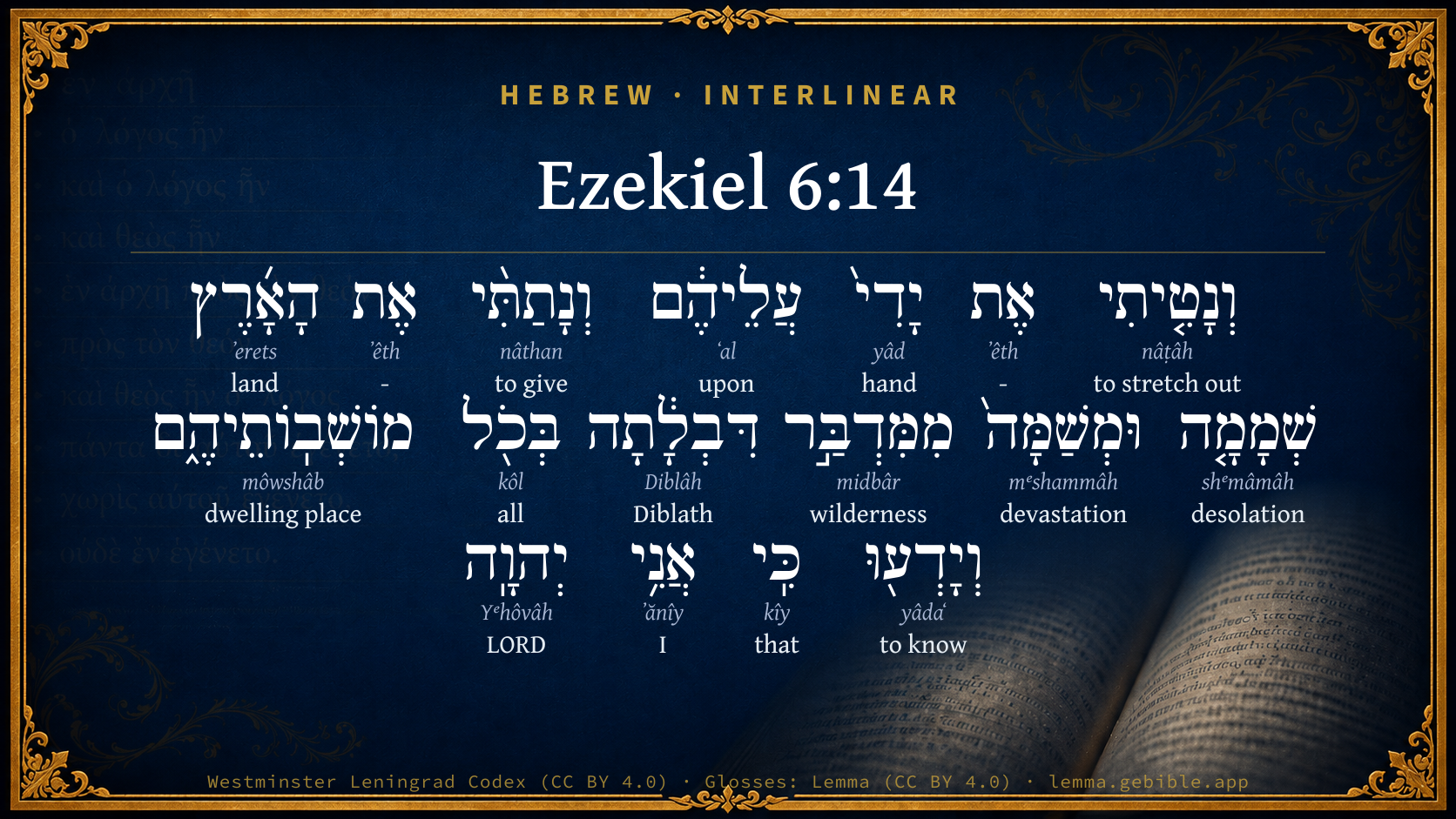
Ezekiel 6:14

Hebrew (Westminster Leningrad Codex) Ezekiel 6:14 appears in the Hebrew Old Testament. The text above is from the Westminster Leningrad Codex. Each word links to its Strong’s number, a concise gloss, and parsing drawn from the Open Scriptures Hebrew Bible morphology. Click any word for its full Brown-Driver-Briggs (BDB) entry.
Download image
Cite this verse

Ezekiel 6:14 (World English Bible). Public Domain. Lemma interlinear Bible study tool, https://lemma.gebible.app/v/ezekiel/6/14.

Show BibTeX & RIS
BibTeX
RIS
English Translation
I will stretch out my hand on them, and make the land desolate and waste, from the wilderness toward Diblah, throughout all their habitations: and they shall know that I am Yahweh.
World English Bible · Public Domain
Highlights
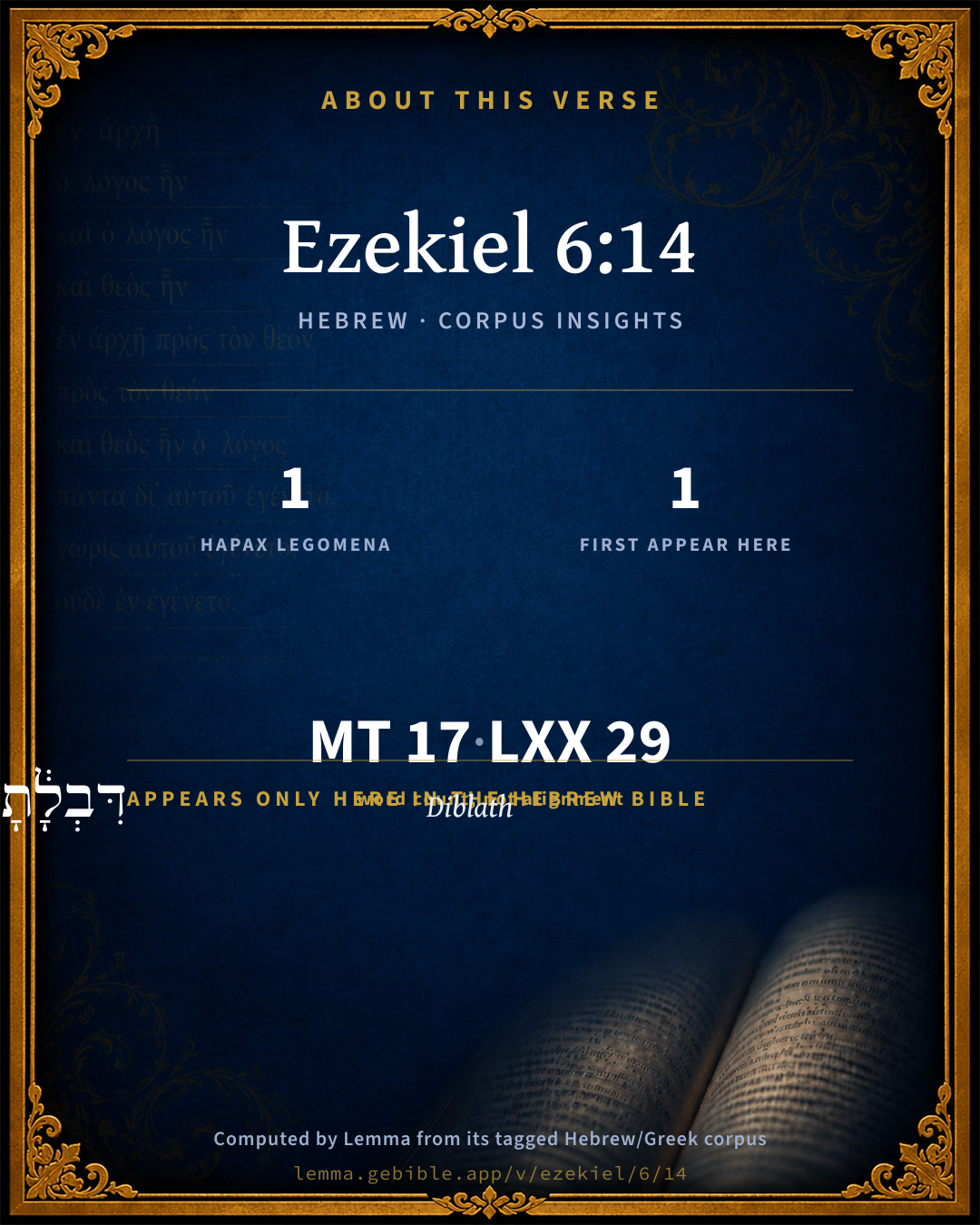
  • 1 hapax legomenon — only here in the Hebrew Bible
  • 1 first appearance in the Hebrew Bible
Full analysis ↓
Download a study sheet

One document with this verse’s original text, its word-by-word gloss line, the meaning frame, cross-references with their text, attributed commentary, and full source and license credits — printable, and it pastes into notes with its structure intact.

This verse Autodidact and up

Study sheet (.html) Plain text (.txt)

A passage Seminary Student

Up to 50 verses in one chapter. A passage sheet keeps up to 6 commentary sources and 12 cross-references per verse, in the order this page ranks them, and says so on the sheet whenever that leaves anything out. Ask for a single verse and you get the Autodidact verse sheet above.

Everything on this page stays free to read, with no account — the sheet is a download of what is already on screen, not access to it.

Want to remove ads? Support Godless Engineer
Compare translations 3

The same verse in 3 English versions, stacked beneath the original-language interlinear above. Click any original word for its lexicon entry.

Each is an independent rendering of the whole verse — the interlinear is not word-aligned to these translations.

Highlighted words mark where these versions differ — a whole-verse word diff, not a word-by-word alignment.

  • World English Bible Public Domain
    I will stretch out my hand on them, and make the land desolate and waste, from the wilderness toward Diblah, throughout all their habitations: and they shall know that I am Yahweh.
  • King James Version Public Domain
    So will I stretch out my hand upon them, and make the land desolate, yea, more desolate than the wilderness toward Diblath, in all their habitations: and they shall know that I am the LORD.
  • unfoldingWord Literal Text CC BY-SA 4.0
    I will strike with my hand and make the land desolate and a waste, from the wilderness to Diblah, throughout all the places where they live. Then they will know that I am Yahweh.”

unfoldingWord Literal Text — © unfoldingWord, licensed CC BY-SA 4.0. Word-aligned USFM3 via Door43 (git.door43.org/unfoldingWord/en_ult).

Versions to compare (up to 4)

3 of 4 selected

Show all 18 translations

Every available English version of this verse, each an independent rendering of the whole verse.

  • World English Bible Public Domain
    I will stretch out my hand on them, and make the land desolate and waste, from the wilderness toward Diblah, throughout all their habitations: and they shall know that I am Yahweh.
  • Berean Standard Bible Public Domain
    I will stretch out My hand against them, and wherever they live I will make the land a desolate waste, from the wilderness to Diblah. Then they will know that I am the LORD.’”
  • Majority Standard Bible Public Domain
    I will stretch out My hand against them, and wherever they live I will make the land a desolate waste, from the wilderness to Diblah. Then they will know that I am the LORD.’”
  • King James Version Public Domain
    So will I stretch out my hand upon them, and make the land desolate, yea, more desolate than the wilderness toward Diblath, in all their habitations: and they shall know that I am the LORD.
  • American Standard Version (1901) Public Domain
    And I will stretch out my hand upon them, and make the land desolate and waste, from the wilderness toward Diblah, throughout all their habitations: and they shall know that I am Jehovah.
  • Revised Version (1885) Public Domain
    And I will stretch out my hand upon them, and make the land desolate and waste, from the wilderness toward Diblah, throughout all their habitations: and they shall know that I am the LORD.
  • Geneva Bible (1599) Public Domain
    So will I stretch mine hand vpon them, and make the lande waste, and desolate from the wildernes vnto Diblath in all their habitations, and they shall know, that I am the Lord.
  • Douay-Rheims (1899) Public Domain
    And I will stretch forth my hand upon them: and I will make the land desolate, and abandoned from the desert of Deblatha in all their dwelling places: and they shall know that I am the Lord.
  • Young's Literal Translation Public Domain
    And I have stretched out my hand against them, And have made the land a desolation, Even a desolation from the wilderness to Diblath, In all their dwellings, And they have known that I `am' Jehovah!'
  • Literal Standard Version CC BY-SA 4.0
    And I have stretched out My hand against them, || And have made the land a desolation, || Even a desolation from the wilderness to Diblath, || In all their dwellings, || And they have known that I [am] YHWH!”
  • Unlocked Literal Bible CC BY-SA 4.0
    I will strike with my hand and make the land desolate and a waste, from the wilderness to Diblah, throughout all the places where they live. Then they will know that I am Yahweh.”
  • unfoldingWord Literal Text CC BY-SA 4.0
    I will strike with my hand and make the land desolate and a waste, from the wilderness to Diblah, throughout all the places where they live. Then they will know that I am Yahweh.”
  • Darby Bible Public Domain
    And I will stretch out my hand upon them, and make the land desolate, yea, more desolate than the wilderness of Diblath, in all their dwellings; and they shall know that I [am] Jehovah.
  • World Messianic Bible Public Domain
    I will stretch out my hand on them and make the land desolate and waste, from the wilderness toward Diblah, throughout all their habitations. Then they will know that I am the LORD.’”
  • Webster's Bible Public Domain
    So will I stretch out my hand upon them, and make the land desolate, even, more desolate than the wilderness towards Diblath, in all their habitations: and they shall know that I am the LORD.
  • Free Bible Version CC BY-SA 4.0
    I'm going to lift up my hand to punish them. In every place they live I will make their country a wasteland, all the way from the desert in the south to Diblah in the north. Then they will know that I am the Lord.”
  • Bible in Basic English Public Domain
    And my hand will be stretched out against them, making the land waste and unpeopled, from the waste land to Riblah, through all their living-places: and they will be certain that I am the Lord.
  • JPS Tanakh (1917) Public Domain
    And I will stretch out My hand upon them, and make the land desolate and waste, more than the wilderness of Diblah, throughout all their habitations; and they shall know that I am the LORD.'

Literal Standard Version (2020), Covenant Press — licensed CC BY-SA 4.0. Text via the HelloAO Bible API (eBible.org). Unlocked Literal Bible (unfoldingWord) — licensed CC BY-SA 4.0. Text via the HelloAO Bible API (eBible.org). unfoldingWord Literal Text — © unfoldingWord, licensed CC BY-SA 4.0. Word-aligned USFM3 via Door43 (git.door43.org/unfoldingWord/en_ult). Free Bible Version, Dr. Jonathan Gallagher — licensed CC BY-SA 4.0. Text via the HelloAO Bible API (eBible.org).

Word by word

More ways to search: Search by grammar → Find every occurrence → Compare this word →

Practice this passage: Drill this verse → Learn its vocabulary →

דִּבְלָ֔תָה
Diblâh
H1689
“Diblath · toward”
Noun, Proper + Suffix, Demonstrative
Part of Speech
Noun
Type
Proper
Full BDB Definition

Origin: probably an orthographical error for H7247

TWOT: None

Diblath = "place of the fig cake" - a place near the wilderness
  1. וְנָטִ֤יתִי nâṭâh H5186 “and · to stretch out” Conjunction + Verb, Qal, Sequential Perfect, 1st Person, Common, Singular
  2. אֶת ʼêth H853 “-” Particle, Direct Object
  3. יָדִי֙ yâd H3027 “hand · my” Noun, Common, Both, Singular, Construct + Suffix, Personal, 1st Person, Common, Singular
  4. עֲלֵיהֶ֔ם ʻal H5921 “upon · them” Preposition + Suffix, Personal, 3rd Person, Masculine, Plural
  5. וְנָתַתִּ֨י nâthan H5414 “and · to give” Conjunction + Verb, Qal, Sequential Perfect, 1st Person, Common, Singular
  6. אֶת ʼêth H853 “-” Particle, Direct Object
  7. הָאָ֜רֶץ ʼerets H776 “the · land” Particle, Definite Article + Noun, Common, Both, Singular, Absolute
  8. שְׁמָמָ֤ה shᵉmâmâh H8077 “desolation” Noun, Common, Feminine, Singular, Absolute
  9. וּמְשַׁמָּה֙ mᵉshammâh H4923 “and · devastation” Conjunction + Noun, Common, Feminine, Singular, Absolute
  10. מִמִּדְבַּ֣ר midbâr H4057 “from · wilderness of” Preposition + Noun, Common, Masculine, Singular, Construct
  11. בְּכֹ֖ל kôl H3605 “in/at · all of” Preposition + Noun, Common, Masculine, Singular, Construct
  12. מוֹשְׁבֽוֹתֵיהֶ֑ם môwshâb H4186 “dwelling places · their” Noun, Common, Masculine, Plural, Construct + Suffix, Personal, 3rd Person, Masculine, Plural
  13. וְיָדְע֖וּ yâdaʻ H3045 “and · to know” Conjunction + Verb, Qal, Sequential Perfect, 3rd Person, Common, Plural
  14. כִּֽי kîy H3588 “that” Conjunction
  15. אֲנִ֥י ʼănîy H589 “I” Pronoun, Personal, 1st Person, Common, Singular
  16. יְהוָֽה Yᵉhôvâh H3068 “LORD” Noun, Proper

About this verse

These counts appear in no published source. They are computed here, from the morphology-tagged text and Lemma’s own curated glosses. What Lemma adds →

17
words
16
distinct lemmas
Prophets
section

Notable vocabulary

1 hapax legomenon — a word that appears only here in the entire Hebrew Bible:

  • דִּבְלָ֔תָה Diblath H1689

First appearance in Scripture

This word makes its first canonical appearance in the Hebrew Bible here:

  • דִּבְלָ֔תָה Diblath H1689

Shared distinctive vocabulary

וּמְשַׁמָּה֙ devastation H4923 occurs in 7 verses of the Hebrew Bible. Also found in:

Grammatical profile

  • 3 verbs
  • 9 nouns
  • 1 pronoun
  • 1 preposition
  • 1 conjunction
  • 2 particles

Verb forms

  • וְנָטִ֤יתִי Qal · Sequential Perfect
  • וְנָתַתִּ֨י Qal · Sequential Perfect
  • וְיָדְע֖וּ Qal · Sequential Perfect

Hebrew & Septuagint length

In English translation the verse runs 32 words from the Hebrew and 36 from the Septuagint (LXX English) — closely comparable.

A rough comparison of the two English renderings, which tokenize alike — not a word-level alignment.

Word counts can differ between the Hebrew and the Greek without any difference in meaning — e.g. the Hebrew direct-object marker אֵת has no separate Greek word, and Greek often adds the article ὁ.

In the original languages it is 17 Hebrew tokens and 29 Greek tokens — but the two are counted differently (Hebrew bundles its prefixes and suffixes into one token; the Greek is in lemma form), so that isn’t a like-for-like length.

Cross-references

11

Topical passages linked to Ezekiel 6:14 in the Treasury of Scripture Knowledge — connected by theme and wording, ordered by reader-vote popularity; previews shown in the World English Bible.

  • Isaiah 5:25 Therefore Yahweh's anger burns against his people, And he has stretched out his hand against them, and has struck them. The mountains tremble, And their dead bodies are as refuse in the midst of the streets. For all this, his anger is not turned away, But his hand is still stretched out.
  • Isaiah 9:12 the Syrians before, and the Philistines behind; and they shall devour Israel with open mouth. For all this his anger is not turned away, but his hand is stretched out still.
  • Ezekiel 20:33–34 As I live, says the Lord Yahweh, surely with a mighty hand, and with an outstretched arm, and with wrath poured out, will I be king over you:
  • Numbers 33:46 They traveled from Dibon-gad, and encamped in Almon Diblathaim.
  • Isaiah 9:17 Therefore the Lord will not rejoice over their young men, neither will he have compassion on their fatherless and widows; for everyone is profane and an evil-doer, and every mouth speaks folly. For all this his anger is not turned away, but his hand is stretched out still.
  • Isaiah 9:21 Manasseh, Ephraim; and Ephraim, Manasseh; and they together shall be against Judah. For all this his anger is not turned away, but his hand is stretched out still.
  • Isaiah 10:4 They shall only bow down under the prisoners, and shall fall under the slain. For all this his anger is not turned away, but his hand is stretched out still.
  • Isaiah 26:11 Yahweh, your hand is lifted up, yet they don't see: but they shall see [your] zeal for the people, and be disappointed; yes, fire shall devour your adversaries.
  • Jeremiah 48:22 and on Dibon, and on Nebo, and on Beth Diblathaim,
  • Ezekiel 14:13 Son of man, when a land sins against me by committing a trespass, and I stretch out my hand on it, and break the staff of the bread of it, and send famine on it, and cut off from it man and animal;
  • Ezekiel 16:27 See therefore, I have stretched out my hand over you, and have diminished your ordinary [food], and delivered you to the will of those who hate you, the daughters of the Philistines, who are ashamed of your lewd way.

Cross-references courtesy of OpenBible.info (CC BY 4.0).

Hebrew and Greek witnesses Masoretic Hebrew ↔ Greek Septuagint

The same verse in the two great witnesses to the Old Testament, shown verse-for-verse.

These are two independent witnesses, not word-aligned to each other, and the Septuagint is shown in lemma (dictionary) form.

Hebrew Ezekiel 6:14 Masoretic · Westminster Leningrad Codex

וְנָטִ֤יתִי אֶת יָדִי֙ עֲלֵיהֶ֔ם וְנָתַתִּ֨י אֶת הָאָ֜רֶץ שְׁמָמָ֤ה וּמְשַׁמָּה֙ מִמִּדְבַּ֣ר דִּבְלָ֔תָה בְּכֹ֖ל מוֹשְׁבֽוֹתֵיהֶ֑ם וְיָדְע֖וּ כִּֽי אֲנִ֥י יְהוָֽה

I will stretch out my hand on them, and make the land desolate and waste, from the wilderness toward Diblah, throughout all their habitations: and they shall know that I am Yahweh.

World English Bible · Public Domain

Greek LXX Ezekiel 6:14 Septuagint · lemma form

καί ἐκτείνω ὁ χείρ ἐγώ ἐπί αὐτός καί τίθημι ὁ γῆ εἰς ἀφανισμός καί εἰς ὄλεθρος ἀπό ὁ ἔρημος δεβλαθα ἐκ πᾶς ὁ κατοικία καί ἐπιγιγνώσκω ὅτι ἐγώ κύριος

And I will stretch out my hand against them, and I will make the land desolate and ruined from the wilderness of Deblatha, in all their habitations: and you⌃ shall know that I am the Lord.

LXX2012 (modern English Septuagint) · Public Domain

On this verse, The Cambridge Bible for Schools and Colleges discusses the Septuagint’s reading. Read the note in Commentary ↓

Hebrew: Westminster Leningrad Codex (CC BY 4.0). Greek: Septuagint (public domain); English from LXX2012 (modern English Septuagint) (Public Domain). How the Septuagint differs from the Hebrew →

Targum (Aramaic paraphrase)

1

The Targum is the ancient Jewish Aramaic paraphrase of the Hebrew Scriptures — an interpretive translation, not the Hebrew text itself. Onkelos (literal) and Pseudo-Jonathan (expansive) render the Torah, and Jonathan the Prophets. Coverage is partial: where no permissively-licensed English translation exists for a verse, only the Aramaic is shown. This is verse-level text, not a word-by-word alignment to the Hebrew.

  1. Targum Jonathan Prophets (Joshua–Malachi)
    וְאָרִים יַת מְחַת גְבוּרְתִּי עֲלֵיהוֹן וְאֶתֵּן יַת אַרְעָא לְצָדוּ וְאִשְׁתְּמָמוּ מִמִדְבַּר דִבְלָת בְּכָל מוֹתְבָנֵיהוֹן וְיֵדְעוּן אֲרֵי אֲנָא יְיָ:

    (no public-domain English translation for this verse)

    Targum Jonathan — Aramaic: “Mikraot Gedolot” (public domain). English: “Sefaria Community Translation” (CC0 1.0 (public-domain dedication)); “London "Chaldee Paraphrase," 1871” (public domain). Text via Sefaria.

Commentary

Notes on Ezekiel 6:14 from classic Christian and Jewish commentators (each source and its license shown beneath its notes). The classic Christian expositions comment on the surrounding passage and are grouped to its opening verse, so a note may address several verses; the Jewish commentaries on the Tanakh (Rashi and others) are per-verse, so they appear only where the commentator wrote on this verse.

Lemma curates 59 commentaries, every one of them public domain or Creative Commons licensed, each selected and text-cleaned for this edition rather than reprinted as found. About our sources →

Trapp's Complete Commentary

John Trapp

Eze 6:14 So will I stretch out my hand upon them, and make the land desolate, yea, more desolate than the wilderness toward Diblath, in all their habitations: and they shall know that I [am] the LORD.

Ver. 14. Than the wilderness toward Diblath.] Which was horriditate nobile, bordering upon that terrible howling wilderness mentioned by Moses. {Deu 8:15 Jer 48:22}

John Trapp, A Commentary or Exposition upon All the Books of the Old and New Testament (1647–1656) — public domain. Text from a community e-Sword module.

Geneva Bible (1599)

Geneva Bible translators

Some read, more desolate than the wilderness of Diblath, which was in Syria, and bordered upon Israel, or from the wilderness, which was South unto Diblath, which was North: meaning, the whole country.

Geneva Bible (1599) marginal notes — public domain. Text via Bolls.life.

Jamieson, Fausset & Brown

Robert Jamieson, A. R. Fausset & David Brown

Diblath--another form of Diblathaim, a city in Moab (Num 33:46; Jer 48:22), near which, east and south of the Dead Sea, was the wilderness of Arabia-Deserta.

Next: Ezekiel Chapter 7

Jamieson, Fausset & Brown — Commentary Critical and Explanatory on the Whole Bible (1871) — public domain (CC PDM 1.0). Text via the HelloAO Bible API.

Adam Clarke's Commentary

Verse 14. And make the land-more desolate than the wilderness toward Diblath] Diblath or Diblathayim is situated in the land of Moab. It is mentioned Nu 33:46, Almon-Diblathaim; and in Jer 48:22, Beth-Diblathaim. It was a part of that horrible wilderness mentioned by Moses, De 8:15, "wherein were fiery serpents, and scorpions, and drought." The precise reason why it is mentioned here is not very evident. Some think it is the same as Riblah, where Nebuchadnezzar slew the princes of Israel, and put out Zedekiah's eyes; the principal difference lying between the ד daleth and the ר resh, which in MSS. is often scarcely discernible; and hence vast multitudes of various readings. Five, probably six, of Kennicott's MSS. have רבלתה riblathah, as likewise two of my oldest MSS.; though in the margin of one a later hand directs the word to be read בדלת bedaleth, with daleth. But all the Versions read the word with a D. This may appear a matter of little importance, but we should take pains to recover even one lost letter of the word of God.

Adam Clarke's Commentary on the Bible (1810–1826) — public domain. Text from a community e-Sword/MySword module.

John Calvin's Commentaries

Ezekiel pursues the same sentiment, but it is necessary to persist with more words in confirmation of his prophecy, because it was somewhat difficult of belief, especially among men so secure, and who had been hardened against God by long habit. This is the reason, then, why he uses so many words about a thing in itself by no means obscure. Now he speaks concerning the extension of God’s hand, which is a Scriptural form of speech sufficiently familiar; for it is said that God extends his hand when he puts forth manifest examples of his wrath. But the phrase is taken from men, who, if they wish to accomplish anything great extend their arm. We know that God accomplishes all things by his nod alone, but because through our sluggishness we do not comprehend his judgment, the Scripture, in compassion to our rudeness represents his hand as extended. But he says, that he will place the land in devastation and stupor The two words, שממה, shemmeh, and שמה, shemeh, are different, though derived from the same root. שמה, shemeh, signifies to destroy and lay waste; also to wonder at: so that the explanation of some is not bad — I will place the land for a desolation and an astonishment. But because the comparison of a desert follows immediately, I willingly subscribe to the opinion of those who translate desolation or solitude, and vacancy or waste: for although these: two words are synonymous, as they say, yet the Prophet properly adds vacancy or solitude to waste, because he does not inculcate the same thing too often, for the sake of explanation, but only that he may confirm what he otherwise knew would not be attended to by the Israelites. Some translate from the desert even to Diblathah; and there are some who think Riblatha should be read instead of Diblathah — and it may happen that an error has crept in, on account of the similarity of the letters ד and ר. But I do not think any change is needed: and besides, I reject as absurd, the explanation from the desert even to Diblathah or Riblatha. But מ is rather a mark of comparison: the land of Israel shall be reduced to desolation more than the desert of Diblathah. For how could the Prophet have said — from the desert even to Diblathah? The threat is against the land of Israel, but Diblathah was in Syria beyond the land, for they think it was Antioch: hence the true sense, according to the Prophet’s intention, could not be elicited from this. But it is most suitable that the desert should be placed before the eyes of the Israelites, because it was not far from their country: Syria was between them and it, but since there was frequent intercourse, that desert was sufficiently known to them. Already had they passed through the desert when they passed into exile, and the difference in the aspect of the country would rather waken up their senses: for the whole of Syria is fertile, and Antioch has an excellent site, as geographers relate. Since, therefore, the Israelites had traversed a pleasant land, and one filled with all opulence, when they came to a desert vast and sorrowful, that appearance, as I have said, would stir them up the more. This, therefore, appears to me the reason why the Prophet says that the desert Diblathah was not so waste, or solitary, or dry, or squalid, as the land of Israel should become.

He says, in all their habitations, that they may know that there would be no corner free from that devastation which he predicts: for it will often happen that some land is partially seized and spoiled, but here the Prophet comprehends all habitations. And they shall know, he says, that I am Jehovah: that is, they shall know that I have spoken by my Prophets. But God announces this with displeasure, because the Prophet’s authority ought to have been sacred and established among the people. For his calling was so marked out that they could not contend against him without being opposed to God. Hence Ezekiel is omitted here, and God comes forward, as if he had spoken himself. They shall know, therefore, he says, both my faithfulness and power. Besides this knowledge is extended to the reprobate who do not profit by God’s chastisements. Although, therefore, experience compels them to acknowledge God as a judge, yet they remain obstinate, as we shall soon see again and again. It follows —

John Calvin's Commentaries (1540-1563) — public domain. Text from the Calvin Translation Society English edition (1840s-50s) via the Christian Classics Ethereal Library (ccel.org). Calvin's coverage is partial (roughly two-thirds of the Bible); uncommented books and verses are honest gaps, never fabricated. The 19th-century editor's footnotes and remarks are omitted so the notes are faithfully Calvin's own voice.

Ellicott's Commentary for English Readers

(14) More desolate than the wilderness toward Diblath.—The name Diblath does not occur elsewhere; but Diblathaim, the dual form, is mentioned in Num_33:46-47, Jer_48:22, as a double city on the eastern border of Moab, beyond which lay the great desert which stretches thence eastward, nearly to the Euphrates. It was customary to call any wilderness by the name of the nearest town. (See 1Sa_23:14-15; 1Sa_23:24-25; 1Sa_25:2, &c.) That wilderness appears from this passage to have been proverbial for its desolation.

A Bible Commentary for English Readers, edited by Charles John Ellicott (1878–1897) — public domain. Text from a community e-Sword module.

The Cambridge Bible for Schools and Colleges

gen. ed. J. J. S. Perowne

14. desolate, yea, more desolate] Rather: desolate and waste (ch. Eze_33:28-29, Eze_35:3) more than the wilderness of Diblah. The comparative “more than,” however, is not probable. Moreover a wilderness of Diblah is unknown; Diblathaim besides being in Moab could not be called desert. The construction is difficult, but probably the reading should be: from the wilderness to Riblah, i.e. from south to north. Riblah was situated on the northern border of the country (Num_34:11); it is said to be in “the land of Hamath,” Jer_52:9; Jer_52:27 (where by the converse substitution of d for r, LXX. reads Diblah). A few MSS. read Riblah. It must be acknowledged that this way of designating the whole extent of the land from S. to N. is nowhere else employed, the northern limit being usually expressed by “the entering in of Hamath.”

The Cambridge Bible for Schools and Colleges (gen. ed. J. J. S. Perowne; Cambridge University Press, 1878–1918) — public domain. Text from a community e-Sword module.

Haydock's Catholic Bible Commentary

From, or, "more than," (Haydock) as Hebrew may signify. Deblatha was in the land of Moab, Numbers xxxiii. 46. (Calmet)

George Leo Haydock (1774–1849), Haydock's Catholic Family Bible and Commentary, 1859 edition — public domain. Excludes Psalms (Douay-Rheims chapter numbering differs from Protestant) and Deuterocanonical books (Catholic canon only).

Matthew Poole's English Annotations

Stretch out my hand: this noteth the greatness of the blow, God striketh hard when he stretcheth out his hand, and therefore you find a mighty hand joined with outstretched arm.

Desolate; a desolation, (a Hebraism,) for most desolate.

Yea, more desolate; and a desolation greater or above the desolation of that most horrid wilderness of Moab, which is here called

Diblah, mentioned in a dual form, Num 33:46; Jer 48:22, as some think; and described by Moses, Deu 8:15. It was that wherein the fiery serpents so much annoyed Israel. Or, I will lay their habitations waste and desolate, from Jerusalem unto Diblath, the borders of Moab, and the land all along shall be as desolate as that very wilderness. So the Lord will turn a most fruitful land into barrenness for the sins of the people.

They shall have; some instructed and bettered shall own me and fear me, the rest convinced and astonished shall confess that God hath done this great thing against them.

Matthew Poole's English Annotations on the Holy Bible (1683–1685) — public domain. Text from a community e-Sword/MySword module.

Whedon's Commentary on the Bible

Daniel D. Whedon

14. This punishment comes from the same Hand that in former times was lifted up against their enemies. The “spoiler of Moab” (Jer_48:18-22) has now become the destroyer of his own chosen people (Eze_33:28). It is seen from the Moabite stone that Diblath and Diblathaim may be used interchangeably. “Yea, desolate from the wilderness unto Riblah,” is a reading favored by some, but without sufficient reason.

Daniel D. Whedon (gen. ed.), Commentary on the Old and New Testaments (1874–1909) — public domain. Text from a community e-Sword module.

The Pulpit Commentary

More desolate than the wilderness towards Diblath; better, with the Authorized Version, from the wilderness. The name does not appear elsewhere, and has not been identified. Assuming the Authorized Version rendering, we must think of Ezekiel as naming, as Dante haines the Valdichiana ("Inf.," 29:47), some specially horrible and desolate region. For such a region the name of Diblah (a cake of figs) does not seem appropriate. Taking the Revised Version translation ("from the wilderness toward Diblah"), we have a phrase analogous to "from Dan to Beersheba," as denoting the extent of the desolation. The "wilderness" is usually applied to the nomad region south of Palestine, and this would lead us to look for Diblah in the north, and so to look elsewhere than to the two places Beth-diblathaim (Jer_48:22) and Almon-diblathaim, (Num_33:46) both of which are in Moab. The difficulty was solved by Jerome by the conjectural emendation of Riblah, the two Hebrew letters for d and r being often written by copyists for each other. Riblah (it is a suggestive fact that the two chief manuscripts of the LXX the Alexandrian and the Vatican, have Deblatha, or Deblaa, in 2Ki_23:33 2Ki_25:6) was a fortified town on the north road from Palestine to Babylon, where the Babylonian kings used to take up their position during their invasions of the former. Within a short time after Ezekiel wrote this chapter, it became memorable in its connection with Zedekiah"s sufferings. (comp. 2Ki_23:33 2Ki_25:6, 2Ki_25:20, 2Ki_25:21; Jer_39:5, 6 52:9, 10, 26) Its probable site is fixed on the banks of the Orontes. The evidence, on the whole, is, I think, in favour of this interpretation. It is adopted by Ewald, Cornill, Smend, Gesenius, and most recent critics. An additional fact in its favour is that Hamath, in the same region, appears as an ideal northern boundary in Eze_47:16.

The outstretched hand.

We usually picture to ourselves God"s hand stretched out to help and heal. Here, however, we see a prediction of the same exertion of Divine energy for a contrary purpose to smite and make desolate. The prediction suggests certain features of Divine chastisement.

I IT IS OCCASIONAL. "I will stretch out my hand." This refers to one definite act, not to a perpetual treatment. "He will not always chide." "The mercy of the Lord endureth forever. " But his anger and punishing are limited to occasion and necessity. The very fact that men refuse to believe in the wrath of God bears testimony to his long suffering. In life-giving energy God works unceasingly, so that "in him we live, and move, and have our being." It is an eternal truth, not representing a sudden interposition, but the normal order of providence, that "underneath are the everlasting arms." Nevertheless, there are occasions when another mode of action is necessary, and the hand of God must smite in anger.

II IT BELONGS TO THE FUTURE. God says he will stretch out his hand. It is not yet done. Future punishment will be far worse than any present sufferings of sin. It is impossible for us to measure that punishment by what we now experience, because sentence is not yet executed. But if the punishment is future, there is a possibility of its being averted, or of the sinner finding some means of escape. The warnings of Scripture are not written in order to fix our doom, but for the very opposite purpose, to drive us to the refuge of repentance and pardon.

III IT IS FAR-REACHING. The hand stretched out signifies God"s action at a distance. Though locally close to all, he is spiritually far off from those who have forgotten his presence, forsaken his way, and wandered into remote tracks of sin. Yet God can reach the most distant sinner. He met Jonah on the ocean. It is impossible to flee from God. Our utter neglect of God does not cause his utter neglect of us. The godless will be judged by God. This is a most merciful fact. To be abandoned by God would be worse than to be punished by him. Left alone to our self chosen late, we should perish in the outer darkness. The outstretched hand of God, which extends to the most remote, is their one ground of hope, even though at first it only reaches them to smite.

IV IT IS WIDE IN ITS GRASP. It is not said that God"s finger will touch a distant people, but that his hand will be outstretched. There is breadth and comprehensiveness in the image. It suggests a large sweep of Divine energy. There is to be a national judgment. The greatness of the number of guilty persons will be no safeguard in the day when God comes to judgment. There is, indeed, a sense of security in the consciousness of companionship. But if the many sin, the m.u,y must suffer. On the other hand, the wide grasp will reach those who seek to dude it by subtlety, singularity, and subterfuge. There is no possibility of escaping general punishment by a secret withdrawal from the scenes of ordinary evil to a peculiar region of our own wickedness.

V IT IS POWERFUL. When God stretches out his hand he is evidently about to exert some mighty energy. He is awake and active in our midst. Then the fertile land may become a desert. This fearful manifestation of God will assuredly prove his present power. Woe to them who wait for such a proof before giving heed to God!

The Pulpit Commentary (1880–1919), ed. H.D.M. Spence-Jones & Joseph S. Exell — public domain. Text from a community e-Sword module.

John Wesley's Explanatory Notes

Wilderness - The horrid wilderness of Moab. Therein the fiery serpents so much annoyed Israel. Accordingly the land of Canaan is at this day one of the most desolate countries in the world.

John Wesley, Explanatory Notes Upon the Whole Bible (1754–1765) — public domain. Text via the GEBible commentary corpus.

Rashi

Rabbi Shlomo Yitzchaki (Rashi)

a desolation Heb. שְּׁמָמָה, without an inhabitant.

and an astonishment Heb. ומשמה, a wonder, i.e., that all who see it will wonder about it.

Rashi on the Tanakh — English translations: “The Judaica Press complete Tanach with Rashi, translated by A. J. Rosenberg” (CC BY 4.0); “Pentateuch with Rashi's commentary by M. Rosenbaum and A.M. Silbermann, 1929-1934” (public domain); “The Metsudah Tanach series, Lakewood, N.J” (CC BY 4.0); and “The Book of Joshua, Metsudah Publications, 1997” (CC BY 4.0). Text via Sefaria.

Lesson kit

Teaching starters — assembled from the data on this page, not authored interpretation. Every prompt links to the verse data it draws on. Edit before teaching.

Ezekiel, in the Prophets, opens this verse with 17 words (16 distinct Hebrew lemmas). Its most distinctive word is Diblâh (“Diblath”). A historical commentator’s framing appears above. Read the whole chapter for the surrounding context.

Discussion questions

  1. How does “Diblath” (Diblâh) shape what this verse is saying?
  2. This verse holds 1 word here found nowhere else in the Hebrew Bible. What might the rare word draw attention to?
  3. The word “Diblath” first appears here in Scripture. What is being introduced at this debut?
  4. Isaiah 15:6 shares the word «devastation» with this verse. How do the two illuminate each other?
  5. These translations render this verse differently. What is at stake in choosing one wording over another?
  6. The verb «וְנָטִ֤יתִי» is Qal Sequential Perfect. How does its form color the action?
  7. Reading how Trapp's Complete Commentary and Geneva Bible (1599) read this verse, where do the two commentators agree and where do they part?

Things to notice

Reading settings

Reading text

Shown beneath each verse's original-language words.

Old Testament
Old Testament edition

Read the OT as the Masoretic Hebrew (MT) or the Greek Septuagint (LXX).

English shown for the Greek Septuagint (in the Hebrew ↔ Greek comparison).

Comparing translations? Open the Compare panel on any verse page to stack up to four side by side.