
Jeremiah 43:10

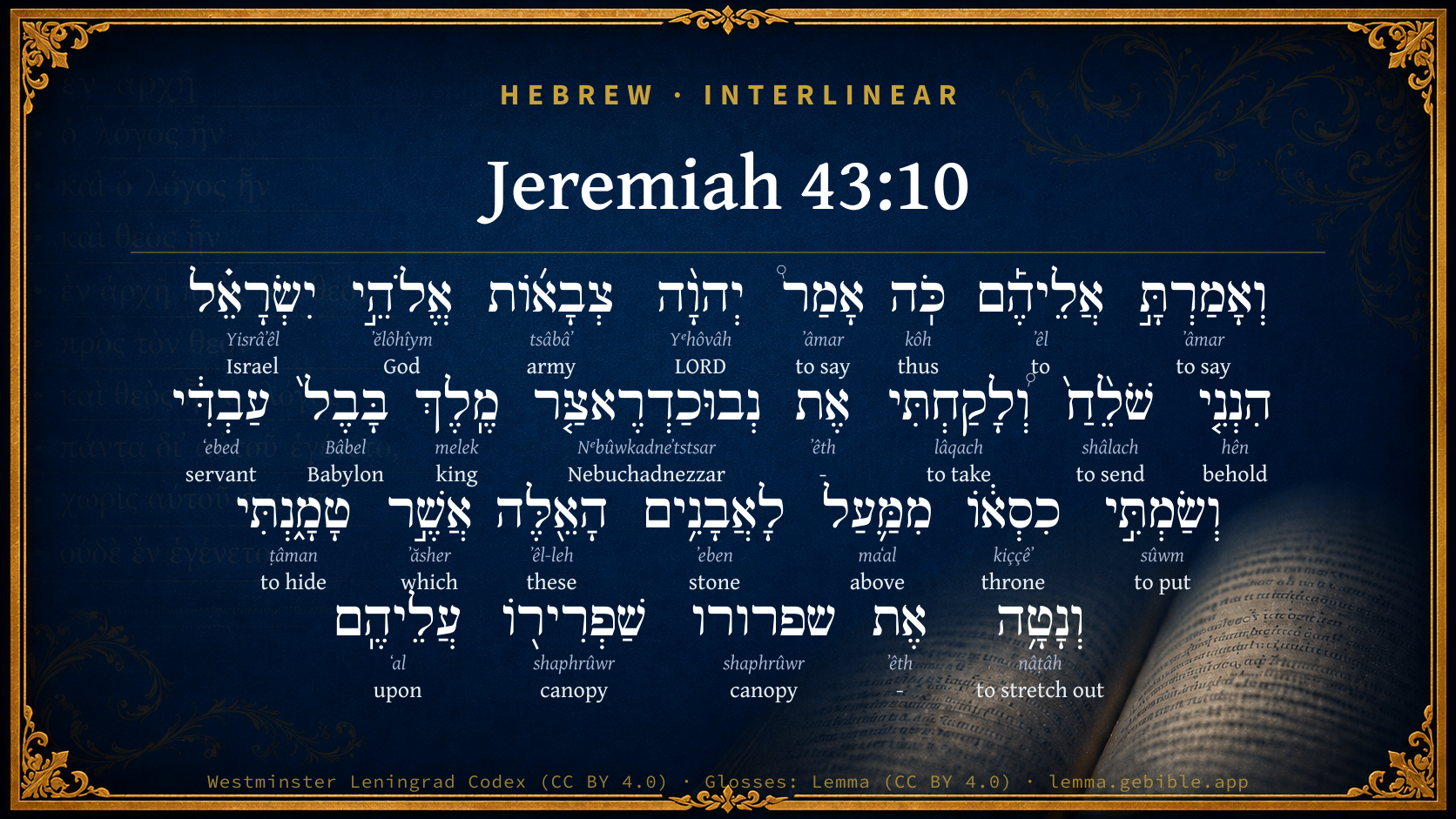
Hebrew (Westminster Leningrad Codex) Jeremiah 43:10 appears in the Hebrew Old Testament. The text above is from the Westminster Leningrad Codex. Each word links to its Strong’s number, a concise gloss, and parsing drawn from the Open Scriptures Hebrew Bible morphology. Click any word for its full Brown-Driver-Briggs (BDB) entry.
Download image
Cite this verse

Jeremiah 43:10 (World English Bible). Public Domain. Lemma interlinear Bible study tool, https://lemma.gebible.app/v/jeremiah/43/10.

Show BibTeX & RIS
BibTeX
RIS
English Translation
and tell them, Thus says Yahweh of Hosts, the God of Israel: Behold, I will send and take Nebuchadrezzar the king of Babylon, my servant, and will set his throne on these stones that I have hidden; and he shall spread his royal pavilion over them.
World English Bible · Public Domain
Highlights
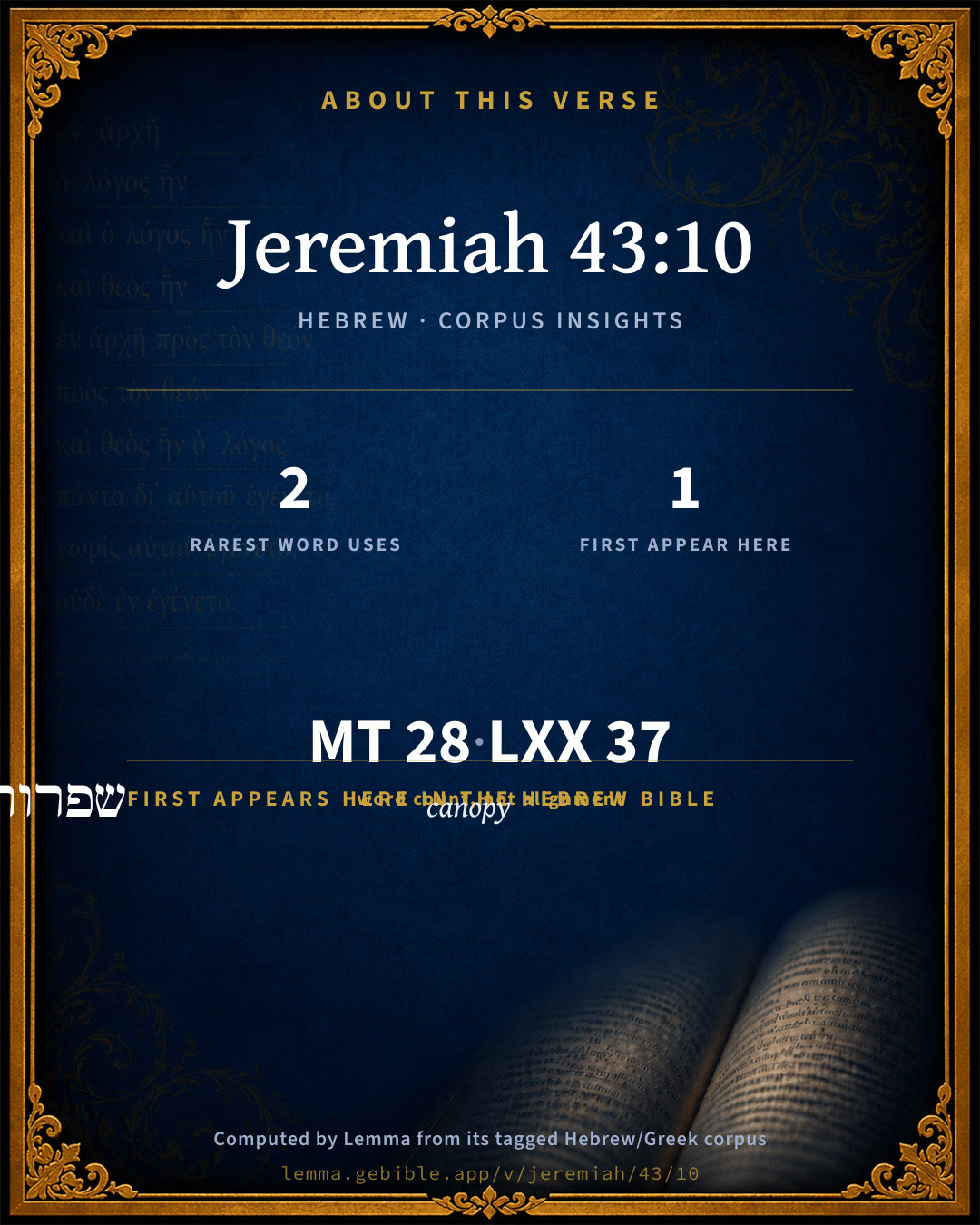
  • 1 first appearance in the Hebrew Bible
Full analysis ↓
Download a study sheet

One document with this verse’s original text, its word-by-word gloss line, the meaning frame, cross-references with their text, attributed commentary, and full source and license credits — printable, and it pastes into notes with its structure intact.

This verse Autodidact and up

Study sheet (.html) Plain text (.txt)

A passage Seminary Student

Up to 50 verses in one chapter. A passage sheet keeps up to 6 commentary sources and 12 cross-references per verse, in the order this page ranks them, and says so on the sheet whenever that leaves anything out. Ask for a single verse and you get the Autodidact verse sheet above.

Everything on this page stays free to read, with no account — the sheet is a download of what is already on screen, not access to it.

Want to remove ads? Support Godless Engineer
Compare translations 3

The same verse in 3 English versions, stacked beneath the original-language interlinear above. Click any original word for its lexicon entry.

Each is an independent rendering of the whole verse — the interlinear is not word-aligned to these translations.

Highlighted words mark where these versions differ — a whole-verse word diff, not a word-by-word alignment.

  • World English Bible Public Domain
    and tell them, Thus says Yahweh of Hosts, the God of Israel: Behold, I will send and take Nebuchadrezzar the king of Babylon, my servant, and will set his throne on these stones that I have hidden; and he shall spread his royal pavilion over them.
  • King James Version Public Domain
    And say unto them, Thus saith the LORD of hosts, the God of Israel; Behold, I will send and take Nebuchadrezzar the king of Babylon, my servant, and will set his throne upon these stones that I have hid; and he shall spread his royal pavilion over them.
  • unfoldingWord Literal Text CC BY-SA 4.0
    Then say to them, “Yahweh of hosts, God of Israel, says this, ‘See, I am about to send messengers to take Nebuchadnezzar king of Babylon as my servant. I will place his throne over these stones that you, Jeremiah, have buried. Nebuchadnezzar will place his pavilion over them.

unfoldingWord Literal Text — © unfoldingWord, licensed CC BY-SA 4.0. Word-aligned USFM3 via Door43 (git.door43.org/unfoldingWord/en_ult).

Versions to compare (up to 4)

3 of 4 selected

Show all 18 translations

Every available English version of this verse, each an independent rendering of the whole verse.

  • World English Bible Public Domain
    and tell them, Thus says Yahweh of Hosts, the God of Israel: Behold, I will send and take Nebuchadrezzar the king of Babylon, my servant, and will set his throne on these stones that I have hidden; and he shall spread his royal pavilion over them.
  • Berean Standard Bible Public Domain
    Then tell them that this is what the LORD of Hosts, the God of Israel, says: ‘I will send for My servant Nebuchadnezzar king of Babylon, and I will set his throne over these stones that I have embedded, and he will spread his royal pavilion over them.
  • Majority Standard Bible Public Domain
    Then tell them that this is what the LORD of Hosts, the God of Israel, says: ‘I will send for My servant Nebuchadnezzar king of Babylon, and I will set his throne over these stones that I have embedded, and he will spread his royal pavilion over them.
  • King James Version Public Domain
    And say unto them, Thus saith the LORD of hosts, the God of Israel; Behold, I will send and take Nebuchadrezzar the king of Babylon, my servant, and will set his throne upon these stones that I have hid; and he shall spread his royal pavilion over them.
  • American Standard Version (1901) Public Domain
    and say unto them, Thus saith Jehovah of hosts, the God of Israel: Behold, I will send and take Nebuchadrezzar the king of Babylon, my servant, and will set his throne upon these stones that I have hid; and he shall spread his royal pavilion over them.
  • Revised Version (1885) Public Domain
    and say unto them, Thus saith the LORD of hosts, the God of Israel: Behold, I will send and take Nebuchadrezzar the king of Babylon, my servant, and will set his throne upon these stones that I have hid; and he shall spread his royal pavilion over them.
  • Geneva Bible (1599) Public Domain
    And say vnto them, Thus sayeth the Lord of hostes the God of Israel, Beholde, I will sende and bring Nebuchad-nezzar the King of Babel my seruant, and will set his throne vpon these stones that I haue hid, and he shall spread his pauilion ouer them.
  • Douay-Rheims (1899) Public Domain
    And thou shalt say to them: Thus saith the Lord of hosts the God of Israel: Behold I will send, and take Nabuchodonosor the king of Babylon my servant: and I will set his throne over these stones which I have hid, and he shall set his throne over them.
  • Young's Literal Translation Public Domain
    and thou hast said unto them: Thus said Jehovah of Hosts, God of Israel: `Lo, I am sending, and I have taken Nebuchadrezzar king of Babylon, My servant, and I have set his throne above these stones that I have hid, and he hath stretched out his pavilion over them,
  • Literal Standard Version CC BY-SA 4.0
    and you have said to them, Thus said YHWH of Hosts, God of Israel: Behold, I am sending, and I have taken Nebuchadnezzar king of Babylon, My servant, and I have set his throne above these stones that I have hid, and he has stretched out his pavilion over them,
  • Unlocked Literal Bible CC BY-SA 4.0
    Then say to them, “Yahweh of hosts, God of Israel, says this, 'See, I am about to send messengers to take Nebuchadnezzar king of Babylon as my servant. I will place his throne over these stones that you, Jeremiah, have buried. Nebuchadnezzar will place his pavilion over them.
  • unfoldingWord Literal Text CC BY-SA 4.0
    Then say to them, “Yahweh of hosts, God of Israel, says this, ‘See, I am about to send messengers to take Nebuchadnezzar king of Babylon as my servant. I will place his throne over these stones that you, Jeremiah, have buried. Nebuchadnezzar will place his pavilion over them.
  • Darby Bible Public Domain
    and say unto them, Thus saith Jehovah of hosts, the God of Israel: Behold, I will send and take Nebuchadrezzar the king of Babylon, my servant, and will set his throne upon these stones which I have hidden, and he shall spread his royal pavilion over them.
  • World Messianic Bible Public Domain
    Tell them, the LORD of Hosts, the God of Israel, says: ‘Behold, I will send and take Nebuchadnezzar the king of Babylon, my servant, and will set his throne on these stones that I have hidden; and he will spread his royal pavilion over them.
  • Webster's Bible Public Domain
    And say to them, Thus saith the LORD of hosts, the God of Israel, Behold, I will send and take Nebuchadrezzar the king of Babylon, my servant, and will set his throne upon these stones that I have hid; and he shall spread his royal pavilion over them.
  • Free Bible Version CC BY-SA 4.0
    Tell them that this is what the Lord Almighty, the God of Israel, says: I'm going to send for my servant Nebuchadnezzar king of Babylon, and bring him here. I will place his throne over these stones that I have set into the pavement, and he will spread out his royal tent over them.
  • Bible in Basic English Public Domain
    And say to them, This is what the Lord of armies, the God of Israel, has said: See, I will send and take Nebuchadrezzar, the king of Babylon, my servant, and he will put the seat of his kingdom on these stones which have been put in a safe place here by you; and his tent will be stretched over them.
  • JPS Tanakh (1917) Public Domain
    and say unto them: Thus saith the LORD of hosts, the God of Israel: Behold, I will send and take Nebuchadrezzar the king of Babylon, My servant, and will set his throne upon these stones that I have hid; and he shall spread his royal pavilion over them.

Literal Standard Version (2020), Covenant Press — licensed CC BY-SA 4.0. Text via the HelloAO Bible API (eBible.org). Unlocked Literal Bible (unfoldingWord) — licensed CC BY-SA 4.0. Text via the HelloAO Bible API (eBible.org). unfoldingWord Literal Text — © unfoldingWord, licensed CC BY-SA 4.0. Word-aligned USFM3 via Door43 (git.door43.org/unfoldingWord/en_ult). Free Bible Version, Dr. Jonathan Gallagher — licensed CC BY-SA 4.0. Text via the HelloAO Bible API (eBible.org).

Word by word

More ways to search: Search by grammar → Find every occurrence → Compare this word →

Practice this passage: Drill this verse → Learn its vocabulary →

שפרורו
shaphrûwr
H8237
“canopy · his”
Noun, Common, Masculine, Singular, Construct + Suffix, Personal, 3rd Person, Masculine, Singular
Part of Speech
Noun
Type
Common
Gender
Masculine
Number
Singular
State
Construct
Full BDB Definition

Origin: from H8231

TWOT: 2449d

canopy, royal pavilion - meaning doubtful
  1. וְאָמַרְתָּ֣ ʼâmar H559 “and · to say” Conjunction + Verb, Qal, Sequential Perfect, 2nd Person, Masculine, Singular
  2. אֲלֵיהֶ֡ם ʼêl H413 “to · them” Preposition + Suffix, Personal, 3rd Person, Masculine, Plural
  3. כֹּֽה kôh H3541 “thus” Adverb
  4. אָמַר֩ ʼâmar H559 “to say” Verb, Qal, Perfect, 3rd Person, Masculine, Singular
  5. יְהוָ֨ה Yᵉhôvâh H3068 “LORD” Noun, Proper
  6. צְבָא֜וֹת tsâbâʼ H6635 “armies” Noun, Common, Both, Plural, Absolute
  7. אֱלֹהֵ֣י ʼĕlôhîym H430 “God(s) of” Noun, Common, Masculine, Plural, Construct
  8. יִשְׂרָאֵ֗ל Yisrâʼêl H3478 “Israel” Noun, Proper
  9. הִנְנִ֤י hên H2005 “behold · me” Particle, Demonstrative + Suffix, Personal, 1st Person, Common, Singular
  10. שֹׁלֵ֨חַ֙ shâlach H7971 “sending” Verb, Qal, Participle Active, Masculine, Singular, Absolute
  11. וְ֠לָקַחְתִּי lâqach H3947 “and · to take” Conjunction + Verb, Qal, Sequential Perfect, 1st Person, Common, Singular
  12. אֶת ʼêth H853 “-” Particle, Direct Object
  13. נְבוּכַדְרֶאצַּ֤ר Nᵉbûwkadneʼtstsar H5019 “Nebuchadnezzar” Noun, Proper
  14. מֶֽלֶךְ melek H4428 “king of” Noun, Common, Masculine, Singular, Construct
  15. בָּבֶל֙ Bâbel H894 “Babylon” Noun, Proper
  16. עַבְדִּ֔י ʻebed H5650 “servant · my” Noun, Common, Masculine, Singular, Construct + Suffix, Personal, 1st Person, Common, Singular
  17. וְשַׂמְתִּ֣י sûwm H7760 “and · to put” Conjunction + Verb, Qal, Sequential Perfect, 1st Person, Common, Singular
  18. כִסְא֔וֹ kiççêʼ H3678 “throne · his” Noun, Common, Masculine, Singular, Construct + Suffix, Personal, 3rd Person, Masculine, Singular
  19. מִמַּ֛עַל maʻal H4605 “from · above” Preposition + Adverb
  20. לָאֲבָנִ֥ים ʼeben H68 “to/for the · stones” Preposition, Determined + Noun, Common, Feminine, Plural, Absolute
  21. הָאֵ֖לֶּה ʼêl-leh H428 “the · these” Particle, Definite Article + Pronoun, Demonstrative, Common, Plural
  22. אֲשֶׁ֣ר ʼăsher H834 “which” Particle, Relative
  23. טָמָ֑נְתִּי ṭâman H2934 “to hide” Verb, Qal, Perfect, 1st Person, Common, Singular
  24. וְנָטָ֥ה nâṭâh H5186 “and · to stretch out” Conjunction + Verb, Qal, Sequential Perfect, 3rd Person, Masculine, Singular
  25. אֶת ʼêth H853 “-” Particle, Direct Object
  26. שַׁפְרִיר֖וֹ shaphrûwr H8237 “canopy · his” Noun, Common, Masculine, Singular, Construct + Suffix, Personal, 3rd Person, Masculine, Singular
  27. עֲלֵיהֶֽם ʻal H5921 “upon · them” Preposition + Suffix, Personal, 3rd Person, Masculine, Plural

About this verse

These counts appear in no published source. They are computed here, from the morphology-tagged text and Lemma’s own curated glosses. What Lemma adds →

28
words
25
distinct lemmas
Prophets
section

Notable vocabulary

The rarest word here is שפרורו canopy H8237 — appearing just 2 times in the whole Hebrew Bible.

First appearance in Scripture

This word makes its first canonical appearance in the Hebrew Bible here:

  • שפרורו canopy H8237

Grammatical profile

  • 7 verbs
  • 12 nouns
  • 1 pronoun
  • 2 prepositions
  • 2 adverbs
  • 4 particles

Verb forms

  • וְאָמַרְתָּ֣ Qal · Sequential Perfect
  • אָמַר֩ Qal · Perfect
  • שֹׁלֵ֨חַ֙ Qal · Participle Active
  • וְ֠לָקַחְתִּי Qal · Sequential Perfect
  • וְשַׂמְתִּ֣י Qal · Sequential Perfect
  • טָמָ֑נְתִּי Qal · Perfect
  • וְנָטָ֥ה Qal · Sequential Perfect

Repetition

Words recur within this verse — often emphatic in Hebrew:

  • וְאָמַרְתָּ֣ to say H559 ×2
  • שפרורו canopy H8237 ×2

Hebrew & Septuagint length

In the original languages it is 28 Hebrew tokens and 37 Greek tokens — but the two are counted differently (Hebrew bundles its prefixes and suffixes into one token; the Greek is in lemma form), so that isn’t a like-for-like length.

Cross-references

14

Topical passages linked to Jeremiah 43:10 in the Treasury of Scripture Knowledge — connected by theme and wording, ordered by reader-vote popularity; previews shown in the World English Bible.

  • Isaiah 44:28–45:1 Who says of Cyrus, [He is] my shepherd, and shall perform all my pleasure, even saying of Jerusalem, She shall be built; and of the temple, Your foundation shall be laid.
  • Jeremiah 1:15 For, behold, I will call all the families of the kingdoms of the north, says Yahweh; and they shall come, and they shall set everyone his throne at the entrance of the gates of Jerusalem, and against all the walls of it round about, and against all the cities of Judah.
  • Ezekiel 29:18–20 Son of man, Nebuchadrezzar king of Babylon caused his army to serve a great service against Tyre: every head was made bald, and every shoulder was worn; yet had he no wages, nor his army, from Tyre, for the service that he had served against it.
  • Psalms 18:11 He made darkness his hiding-place, his pavilion around him, Darkness of waters, thick clouds of the skies.
  • Psalms 27:5 For in the day of trouble he will keep me secretly in his pavilion. In the covert of his tent he will hide me. He will lift me up on a rock.
  • Psalms 31:20 In the shelter of your presence you will hide them from the plotting of man. You will keep them secretly in a dwelling away from the strife of tongues.
  • 1 Kings 20:12 It happened, when [Ben Hadad] heard this message, as he was drinking, he and the kings, in the pavilions, that he said to his servants, Set [yourselves in array]. They set [themselves in array] against the city.
  • 1 Kings 20:16 They went out at noon. But Ben Hadad was drinking himself drunk in the pavilions, he and the kings, the thirty-two kings who helped him.
  • Jeremiah 25:6–26 and don't go after other gods to serve them or worship them, and don't provoke me to anger with the work of your hands; and I will do you no harm.
  • Jeremiah 27:6–8 Now have I given all these lands into the hand of Nebuchadnezzar the king of Babylon, my servant; and the animals of the field also have I given him to serve him.
  • Jeremiah 46:27–28 But don't be afraid you, Jacob my servant, neither be dismayed, Israel: for, behold, I will save you from afar, and your seed from the land of their captivity; and Jacob shall return, and shall be quiet and at ease, and none shall make him afraid.
  • Daniel 2:21 He changes the times and the seasons; he removes kings, and sets up kings; he gives wisdom to the wise, and knowledge to those who have understanding;
  • Daniel 5:18–19 You king, the Most High God gave Nebuchadnezzar your father the kingdom, and greatness, and glory, and majesty:
  • Matthew 22:7 When the king heard that, he was angry, and he sent his armies, destroyed those murderers, and burned their city.

Cross-references courtesy of OpenBible.info (CC BY 4.0).

Hebrew and Greek witnesses Masoretic Hebrew ↔ Greek Septuagint

The same verse in the two great witnesses to the Old Testament, shown verse-for-verse.

These are two independent witnesses, not word-aligned to each other, and the Septuagint is shown in lemma (dictionary) form.

Hebrew Jeremiah 43:10 Masoretic · Westminster Leningrad Codex

וְאָמַרְתָּ֣ אֲלֵיהֶ֡ם כֹּֽה אָמַר֩ יְהוָ֨ה צְבָא֜וֹת אֱלֹהֵ֣י יִשְׂרָאֵ֗ל הִנְנִ֤י שֹׁלֵ֨חַ֙ וְ֠לָקַחְתִּי אֶת נְבוּכַדְרֶאצַּ֤ר מֶֽלֶךְ בָּבֶל֙ עַבְדִּ֔י וְשַׂמְתִּ֣י כִסְא֔וֹ מִמַּ֛עַל לָאֲבָנִ֥ים הָאֵ֖לֶּה אֲשֶׁ֣ר טָמָ֑נְתִּי וְנָטָ֥ה אֶת שפרורו שַׁפְרִיר֖וֹ עֲלֵיהֶֽם

and tell them, Thus says Yahweh of Hosts, the God of Israel: Behold, I will send and take Nebuchadrezzar the king of Babylon, my servant, and will set his throne on these stones that I have hidden; and he shall spread his royal pavilion over them.

World English Bible · Public Domain

Greek LXX Structure differs

In the Septuagint, Jeremiah is about an eighth shorter than the Hebrew and arranges its material differently — the Oracles Against the Nations (Hebrew chapters 46–51) appear in the middle of the Greek book, after 25:13. Because the chapter and verse boundaries do not line up, a verse-for-verse comparison with the Hebrew is not shown.

A verse-for-verse comparison isn’t shown here because the chapters and verses don’t line up. Switch to the LXX edition with the MT / LXX toggle above to read the Greek directly.

On this verse, The Cambridge Bible for Schools and Colleges discusses the Septuagint’s reading. Read the note in Commentary ↓

Hebrew: Westminster Leningrad Codex (CC BY 4.0). Greek: Septuagint (public domain); English from a public-domain English Septuagint. How the Septuagint differs from the Hebrew →

Targum (Aramaic paraphrase)

1

The Targum is the ancient Jewish Aramaic paraphrase of the Hebrew Scriptures — an interpretive translation, not the Hebrew text itself. Onkelos (literal) and Pseudo-Jonathan (expansive) render the Torah, and Jonathan the Prophets. Coverage is partial: where no permissively-licensed English translation exists for a verse, only the Aramaic is shown. This is verse-level text, not a word-by-word alignment to the Hebrew.

  1. Targum Jonathan Prophets (Joshua–Malachi)
    וְתֵימַר לְהוֹן כִּדְנַן אֲמַר יְיָ צְבָאוֹת אֱלָהָא דְיִשְׂרָאֵל הָא אֲנָא שְׁלַח וַאֲדַבֵּר יַת נְבוּכַדְרֶאצַר מַלְכָּא דְבָבֶל עַבְדִי וַאֲשַׁוֵי יַת כּוּרְסוֹהִי עֵיל מִן אַבְנַיָא הָאִלֵין דְטַמָרֵית וְיִגוֹד יַת אַפַּדְנֵיהּ עֲלֵיהוֹן:

    (no public-domain English translation for this verse)

    Targum Jonathan — Aramaic: “Mikraot Gedolot” (public domain). English: “Sefaria Community Translation” (CC0 1.0 (public-domain dedication)); “London "Chaldee Paraphrase," 1871” (public domain). Text via Sefaria.

Commentary

Notes on Jeremiah 43:10 from classic Christian and Jewish commentators (each source and its license shown beneath its notes). The classic Christian expositions comment on the surrounding passage and are grouped to its opening verse, so a note may address several verses; the Jewish commentaries on the Tanakh (Rashi and others) are per-verse, so they appear only where the commentator wrote on this verse.

Lemma curates 59 commentaries, every one of them public domain or Creative Commons licensed, each selected and text-cleaned for this edition rather than reprinted as found. About our sources →

Trapp's Complete Commentary

John Trapp

Jer 43:10 And say unto them, Thus saith the LORD of hosts, the God of Israel; Behold, I will send and take Nebuchadrezzar the king of Babylon, my servant, and will set his throne upon these stones that I have hid; and he shall spread his royal pavilion over them.

Ver. 10. Behold, I will send and take Nebuchadnezzar.] By a secret instinct put into his heart.

And will set his throne upon these stones.] This was dangerous for Jeremiah to say at the court gate, and in the hearing of so many disaffected Jews, who would be ready enough to make the worst of everything. Some say they stoned him with brickbats {a} for this very prophecy.

{a} A piece or fragment of a brick; properly, according to Gwilt, less than one half of its length. It is the typical ready missile, where stones are scarce.

John Trapp, A Commentary or Exposition upon All the Books of the Old and New Testament (1647–1656) — public domain. Text from a community e-Sword module.

Joseph Benson's Commentary

Jer 43:10-11. And say, Thus saith the Lord, I will send Nebuchadrezzar, &c. — God now commands his prophet to expound to the Jews the design of the order given him in the preceding verse. The stones hid in the clay, at the entry of Pharaoh’s house, were intended to be a sign that the king of Babylon should make himself master of that royal city, and set his throne in that very place. This minute circumstance is particularly foretold, that, when it was accomplished, they might be put in mind of the prophecy, and confirmed in their belief of the extent and certainty of the divine prescience; to which the smallest and most contingent events are evident. God calls Nebuchadnezzar his servant, because in this instance he should execute God’s will, accomplish his purposes, and be instrumental in carrying on his designs. And when he cometh, he shall smite the land of Egypt — Though Egypt has always been a warlike nation, it shall not be able to withstand the king of Babylon; but whom he will he shall slay, and in what way he pleases; and deliver such as are for death to death — See note on Jer 15:2. Death here signifies the pestilence which the prophet foretels would overspread the country of Egypt by reason of the famine occasioned by sieges and other ravages of war.

Joseph Benson's Commentary on the Old and New Testaments (1811–1818) — public domain. Text from a community e-Sword module.

Tyndale Open Study Notes

Tyndale Open Resources

43:10 Nebuchadnezzar: Cp. 42:2-22; Ezek 29:19-20. According to an Akkadian inscription, Nebuchadnezzar invaded Egypt in 568–567 BC, less than twenty years after Jeremiah’s message.

Tyndale Open Study Notes — © Tyndale Open Resources, licensed CC BY-SA 4.0. Text via the HelloAO Bible API.

Geneva Bible (1599)

Geneva Bible translators

Read Jer. 25:9.

Geneva Bible (1599) marginal notes — public domain. Text via Bolls.life.

Jamieson, Fausset & Brown

Robert Jamieson, A. R. Fausset & David Brown

my servant--God often makes one wicked man or nation a scourge to another (Eze 29:18-20).

royal pavilion--the rich tapestry (literally, "ornament") which hung round the throne from above.

Jamieson, Fausset & Brown — Commentary Critical and Explanatory on the Whole Bible (1871) — public domain (CC PDM 1.0). Text via the HelloAO Bible API.

John Calvin's Commentaries

Behold, I, — the particle demonstrative and the pronoun are both emphatical, הנני, enni; Behold, I send, he says, to bring Nebuchadnezzar, the king of Babylon, my servant, and will set his throne on these stones We now understand the drift of the whole, even that these stones were thrown into the cement, that God might build up a throne for Nebuchadnezzar. The time, indeed, for building the throne had not yet come; but God’s purpose was to lay the foundations, so that they might be hid until the time arrived. The Prophet, then, built a throne for Nebuchadnezzar, when he cast; these stones into the place of the brick-kiln.

We must now examine each particular in order. God says that he would send to bring Nebuchadnezzar, the king of Babylon. This mission must not be understood otherwise than that of the secret providence of God; for he had no attendants by whom he might send for Nebuchadnezzar, but he called him, as it were, by his nod only. Moreover, this mode of speaking is borrowed, taken from men, who, when they wish anything to be done, intimate what their object is; and then, when they give orders, they issue their commands. This is what earthly kings do, because they can by a nod only accomplish whatever comes to their minds. But God, who needs no external aids, is said to send when he executes his own purpose, and that by his incomprehensible power. And further, God intimates that when Nebuchadnezzar came, it would by no means be by chance, but to take vengeance on the perverse Jews, who hoped for a safe retirement in Egypt, when yet God promised them a quiet habitation in the land of Judah, had they remained there. Then God declares that he would be the leader of that march when Nebuchadnezzar came into Egypt, as though he had said that the war would be carried on under his banner. Nebuchadnezzar did not from design render obedience to God; for ambition and pride led him to Egypt when he came, and for this reason, because the Egyptians had so often provoked him, so that without dishonor to himself he could no longer defer vengeance. It was, then, for this reason he came, if we look to his object. But God declares that he overruled the king as well as all the Babylonians, so that he would arm them when he pleased, and bring them into Egypt, and by their means carry on war with the Egyptians.

For the same reason he calls him his servant; not that Nebuchadnezzar was worthy of so honorable a name, for he had nothing less, as we have said, than a design to serve God; but he is called God’s servant, because he executed what God himself had decreed: for the Scripture sometimes calls even the devils the servants of God; but in strict language, angels and the faithful are alone his servants. Kings and prophets are also, for a special reason, called God’s servants, to whom is committed the authority to rule or to teach. But in this place, as in many other places, the Scripture calls those God’s servants whom he employs to effect his purpose, even when they themselves have no such design. But the Prophet, no doubt, had also in view the Jews, so that they might know that this war was approved by God; for Nebuchadnezzar would not have come except he had been brought there by God.

It then follows, and I will set his throne This, also, is what God claims for himself, even the erecting of the throne of the King Nebuchadnezzar before the palace of the king of Egypt. The king of Babylon, doubtless, thought that the war was carried on through his own efforts and valor, and the courage of his soldiers; moreover, he sacrificed to his own fortune, as heathens use to do; and hence it is said in Isaiah of the Assyrian,

“He will not think so.” (Isaiah 10:7)

But God designed this to be declared to the Jews before the time, that they might then know that the just reward of their obstinacy would be rendered to them, for they were to be taught, as we have said, for their good and benefit. But as they were already inexcusable, it was God’s purpose to shame them more and more, so that they might know that a just punishment would be inflicted on them, because they had so obstinately rejected all the counsel of God.

I will, then, erect his throne on the stones which I have hidden The Prophet here speaks irregularly, now in God’s name, then in his own; but this was not done without reason. We have stated why he introduced God as the speaker, even that he might make the Jews more attentive; for he knew that all his threatenings would be derided except God’s majesty was set before them: but now he connects himself with God, as though he had said that he had nothing apart from God. This is the reason why he said, upon the stones which I have hid God had not hidden the stones, but the Prophet speaks, nevertheless, in the person of God. But, as I have already said, this connection shews that the prophetic word is so connected with the hand and power of God, that when the Prophet speaks, it ought to be counted the same, as though God openly thundered from heaven. And this mode of speaking ought to be carefully noticed, so that we may learn reverently to receive whatever faithful teachers declare in his name, while performing the duties of their office; for they are not to be looked upon as men, for otherwise whatever proceeds from them may be disregarded; but we ought to receive the doctrine proclaimed by their mouth as though God himself had descended from heaven to speak to us.

He afterwards adds, and he shall extend his tabernacle or his tent; for שפריר, shepherir, is taken from a word which means beauty, and properly means here a royal tent. The hebrews do not give this name to the tents of shepherds, but only to those tents which excel in magnificence and splendor, according to what we say in French, Le pavillon du Roy. It now follows —

John Calvin's Commentaries (1540-1563) — public domain. Text from the Calvin Translation Society English edition (1840s-50s) via the Christian Classics Ethereal Library (ccel.org). Calvin's coverage is partial (roughly two-thirds of the Bible); uncommented books and verses are honest gaps, never fabricated. The 19th-century editor's footnotes and remarks are omitted so the notes are faithfully Calvin's own voice.

Ellicott's Commentary for English Readers

(10) He shall spread his royal pavilion over them.—Here, again, the meaning of the Hebrew word is doubtful. The English Version, as before, follows Luther in taking it for the awning or canopy which was stretched over the throne when the king sat in state as judge. Others (e.g., Hitzig) find in it the leather covering which was placed over the pavement on which the throne was set, upon which the criminal knelt as on a scaffold to receive the death-stroke of the executioner. So taken, the prediction assumes a more definite and terrible aspect. The king was to sit upon the stones which Jeremiah had hidden, not merely in his regal pomp, but in the character of an avenger executing the wrath of Jehovah against the rebellious.

A Bible Commentary for English Readers, edited by Charles John Ellicott (1878–1897) — public domain. Text from a community e-Sword module.

The Cambridge Bible for Schools and Colleges

gen. ed. J. J. S. Perowne

10. Nebuchadrezzar] Erbt (p. 72) points out that up to this time Jeremiah in his utterances seems to have avoided naming the king.

my servant] See on Jer_25:9.

and will set] LXX (better) he will set.

his royal pavilion] rather, as mg. glittering, as this appears to be the meaning of the root, though the actual word occurs only here. It refers either to the richly decorated carpet on which the throne was to be placed or to the canopy over it.

The Cambridge Bible for Schools and Colleges (gen. ed. J. J. S. Perowne; Cambridge University Press, 1878–1918) — public domain. Text from a community e-Sword module.

John Gill's Exposition

And say unto them,.... The men of Judah, now in Egypt:

thus saith the Lord of hosts, the God of Israel; See Gill on Jer 42:15;

behold, I will send and take Nebuchadnezzar the king of Babylon, my servant; as all men are by creation, and as he was in a very eminent sense, being an instrument in his hand of executing his designs, both on the Jews and other nations; him he would send for, and take to perform his counsel; secretly work upon and dispose his mind to such an undertaking, and lay a train of providences, and, by a concourse of them, bring him to Egypt to do his will:

and will set his throne upon these stones that I have hid; which he had ordered the prophet to hide, and which he did by him; signifying, that the king at Babylon should come with his army against this city, and should take it, and set up his throne, and keep his court here:

and he shall spread his royal pavilion over them; his tent; he shall place here his beautiful one, as the word (i) signifies; this should be set up where these stones were laid, as if they were designed for the foundation of it, though they were only a symbol of it; and would be a token to the Jews, when accomplished, of the certainty of the divine prescience, and of prophecy, with respect to future events, even those the most minute and contingent.

(i) "teutorium elegans", Montanus, Vatablus; "pulchrum", Munster. So Ben Melech.

John Gill's Exposition of the Whole Bible (1746–1763) — public domain (CC PDM 1.0). Text via the HelloAO Bible API.

Albert Barnes' Notes on the Bible

My servant - See Jer 25:9 note.

That I have hid - i. e., that I have embedded in the mortar by the instrumentality of my prophet.

Pavilion - Rather, canopy. It probably means the parasol held over kings, which had a tall and thick pole, grasped with both hands, and in the early times a somewhat small circular top.

Albert Barnes' Notes on the Bible (1834–1885) — public domain. Text from a community e-Sword/MySword module.

Haydock's Catholic Bible Commentary

Servant. The greatest monarchs only execute God’s decrees.

George Leo Haydock (1774–1849), Haydock's Catholic Family Bible and Commentary, 1859 edition — public domain. Excludes Psalms (Douay-Rheims chapter numbering differs from Protestant) and Deuterocanonical books (Catholic canon only).

Matthew Poole's English Annotations

Now God expounds his meaning in his former command: he ordered Jeremiah to take stones, and hide them in a place near the king of Egypt’s palace; now he tells them that this was for a sign that Nebuchadnezzar should set his throne and spread his pavilion in that place. This Nebuchadnezzar God calls his servant, because he was to obey him in what he should do, though he intended not so. Thus Assyria is called the rod of his anger, Isa 10:5; and Nebuchadnezzar is so called, Jer 25:9; 27:6.

Upon these stones that I have hid; God owneth the stones to be laid by himself, because they were laid at his command.

Matthew Poole's English Annotations on the Holy Bible (1683–1685) — public domain. Text from a community e-Sword/MySword module.

Whedon's Commentary on the Bible

Daniel D. Whedon

10. Royal pavilion — The original word occurs nowhere else. Keil explains it as “the gorgeous tapestry with which the seat of the throne was covered;” Smith, as a “canopy” — the parasol which was carried over the head of the monarch when exposed to the sun’s rays, and so was an emblem of royalty. See Rawlinson’s Ancient Monarchies, 1:495. The sense favoured by Keil suits the language best.

Daniel D. Whedon (gen. ed.), Commentary on the Old and New Testaments (1874–1909) — public domain. Text from a community e-Sword module.

The Pulpit Commentary

And will set his throne, etc.; viz. for the victorious king to hold judgment. (comp. Jer_1:15, 16 49:38) He shall spread his royal pavilion; rather, his tapestry (the root means "brilliance"); i.e. the bright coloured covering of the throne.

The Pulpit Commentary (1880–1919), ed. H.D.M. Spence-Jones & Joseph S. Exell — public domain. Text from a community e-Sword module.

Rashi

Rabbi Shlomo Yitzchaki (Rashi)

his pavilion Heb. שפרירו, his tent, and a similar case is [found] in Job 26:13: “By His breath, He made the heavens a tent (שפרה).”

Rashi on the Tanakh — English translations: “The Judaica Press complete Tanach with Rashi, translated by A. J. Rosenberg” (CC BY 4.0); “Pentateuch with Rashi's commentary by M. Rosenbaum and A.M. Silbermann, 1929-1934” (public domain); “The Metsudah Tanach series, Lakewood, N.J” (CC BY 4.0); and “The Book of Joshua, Metsudah Publications, 1997” (CC BY 4.0). Text via Sefaria.

Lesson kit

Teaching starters — assembled from the data on this page, not authored interpretation. Every prompt links to the verse data it draws on. Edit before teaching.

Jeremiah, in the Prophets, opens this verse with 28 words (25 distinct Hebrew lemmas). Its most distinctive word is shaphrûwr (“canopy”). A historical commentator’s framing appears above. Read the whole chapter for the surrounding context.

Discussion questions

  1. The word shaphrûwr carries the sense “canopy.” How does it shape the verse?
  2. This is the first place “canopy” appears in Scripture (first appears here). What does its debut here establish?
  3. How does Isaiah 44:28–45:1, which shares this passage’s theme, read alongside this verse?
  4. What does the repetition of “to say” (2× in this one verse) do in this verse?
  5. The translations on this page render this verse differently — a whole-verse word diff, not a word-by-word alignment. What might account for the different wordings?
  6. «וְאָמַרְתָּ֣» is a Qal Sequential Perfect verb. How does that grammatical form shape the action described?
  7. Compare how Trapp's Complete Commentary and Joseph Benson's Commentary read this verse. Where do they agree or differ?

Things to notice

Reading settings

Reading text

Shown beneath each verse's original-language words.

Old Testament
Old Testament edition

Read the OT as the Masoretic Hebrew (MT) or the Greek Septuagint (LXX).

English shown for the Greek Septuagint (in the Hebrew ↔ Greek comparison).

Comparing translations? Open the Compare panel on any verse page to stack up to four side by side.