
Genesis 24:14

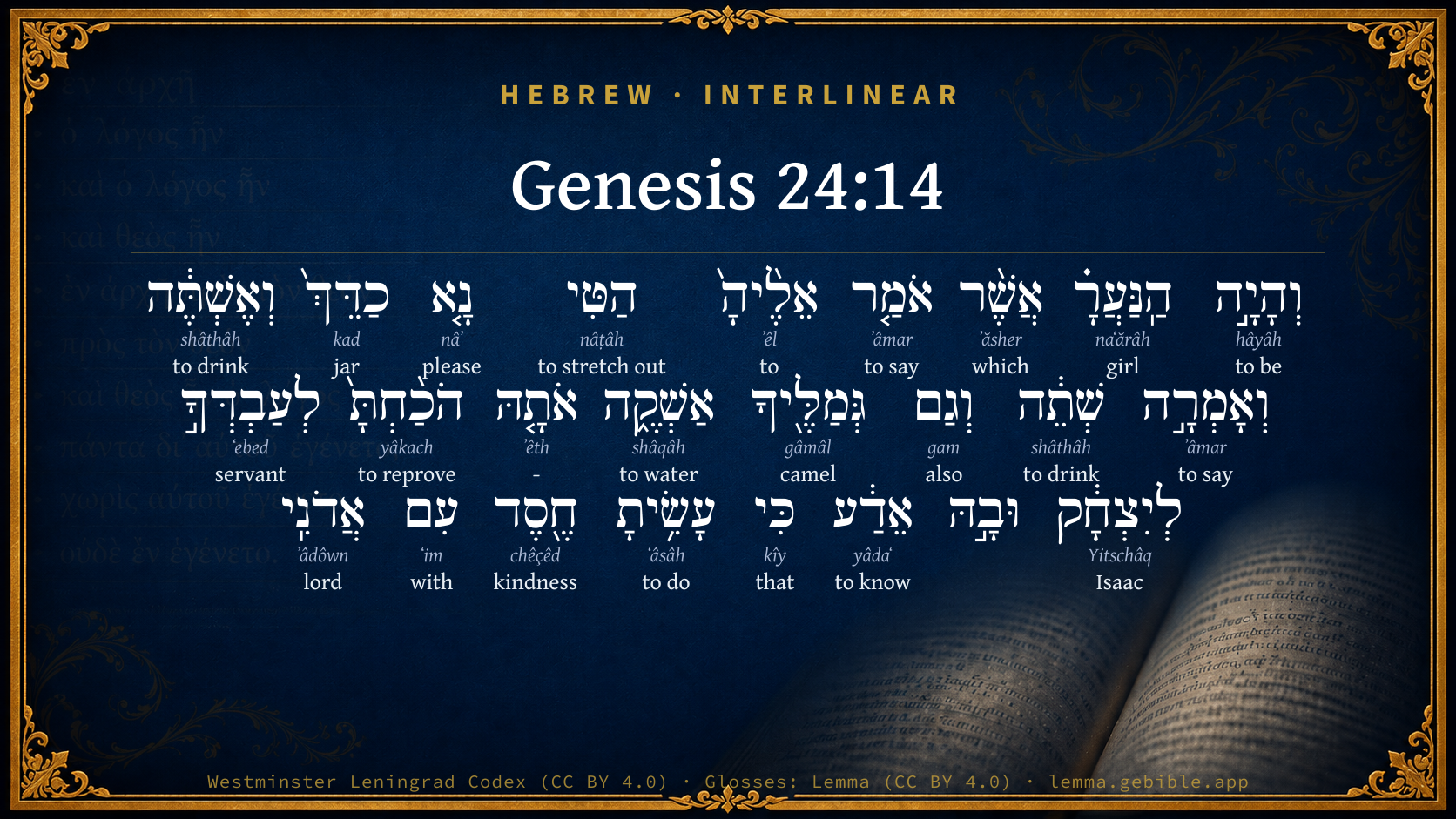
Hebrew (Westminster Leningrad Codex) Genesis 24:14 appears in the Hebrew Old Testament. The text above is from the Westminster Leningrad Codex. Each word links to its Strong’s number, a concise gloss, and parsing drawn from the Open Scriptures Hebrew Bible morphology. Click any word for its full Brown-Driver-Briggs (BDB) entry.
Download image
Cite this verse

Genesis 24:14 (World English Bible). Public Domain. Lemma interlinear Bible study tool, https://lemma.gebible.app/v/genesis/24/14.

Show BibTeX & RIS
BibTeX
RIS
English Translation
Let it happen, that the young lady to whom I will say, 'Please let down your pitcher, that I may drink.' She will say, 'Drink, and I will also give your camels a drink.' Let the same be she who you have appointed for your servant Isaac. Thereby will I know that you have shown kindness to my master."
World English Bible · Public Domain
Highlights
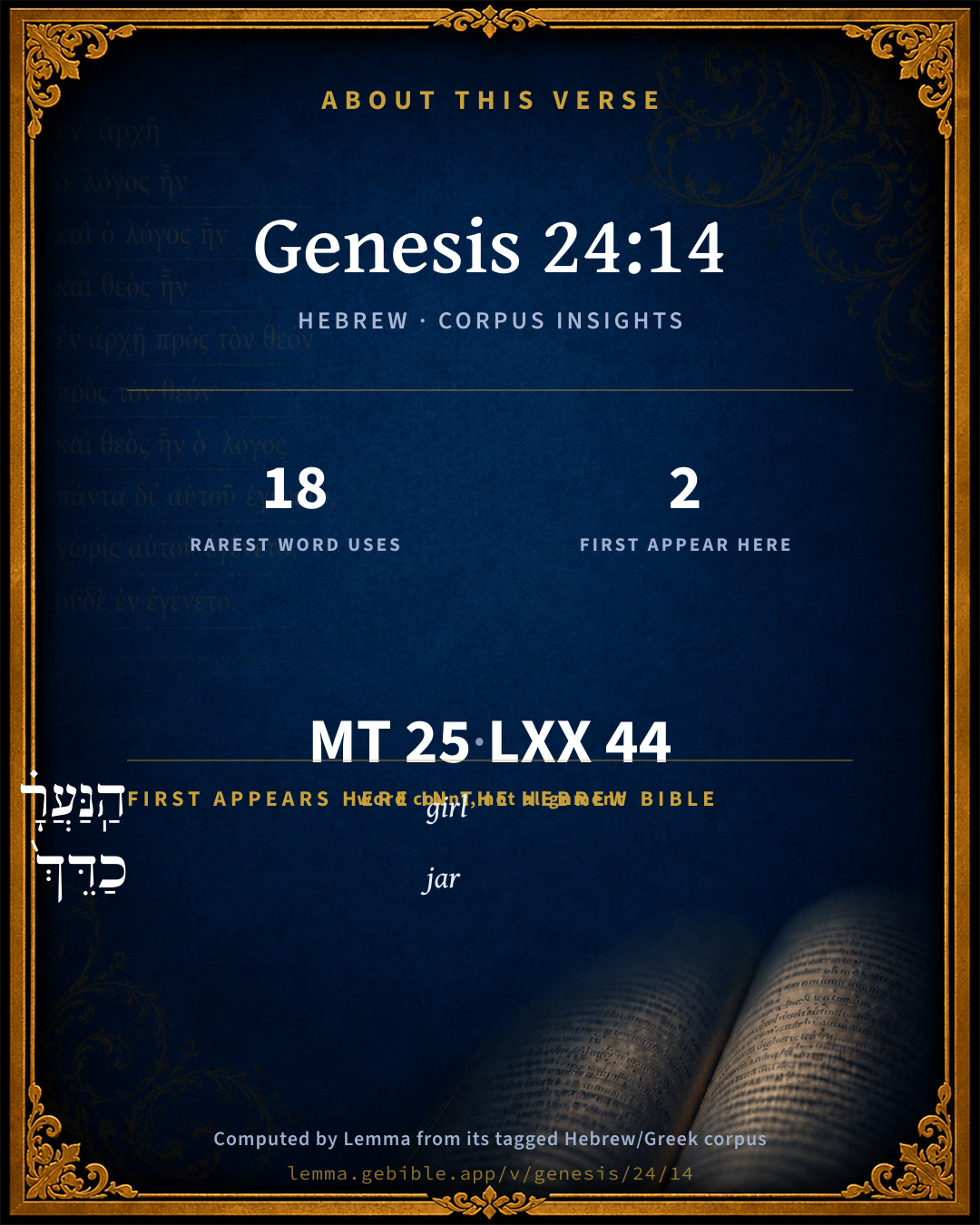
  • 2 first appearances in the Hebrew Bible
Full analysis ↓
Download a study sheet

One document with this verse’s original text, its word-by-word gloss line, the meaning frame, cross-references with their text, attributed commentary, and full source and license credits — printable, and it pastes into notes with its structure intact.

This verse Autodidact and up

Study sheet (.html) Plain text (.txt)

A passage Seminary Student

Up to 50 verses in one chapter. A passage sheet keeps up to 6 commentary sources and 12 cross-references per verse, in the order this page ranks them, and says so on the sheet whenever that leaves anything out. Ask for a single verse and you get the Autodidact verse sheet above.

Everything on this page stays free to read, with no account — the sheet is a download of what is already on screen, not access to it.

Want to remove ads? Support Godless Engineer
Compare translations 3

The same verse in 3 English versions, stacked beneath the original-language interlinear above. Click any original word for its lexicon entry.

Each is an independent rendering of the whole verse — the interlinear is not word-aligned to these translations.

Highlighted words mark where these versions differ — a whole-verse word diff, not a word-by-word alignment.

  • World English Bible Public Domain
    Let it happen, that the young lady to whom I will say, 'Please let down your pitcher, that I may drink.' She will say, 'Drink, and I will also give your camels a drink.' Let the same be she who you have appointed for your servant Isaac. Thereby will I know that you have shown kindness to my master."
  • King James Version Public Domain
    And let it come to pass, that the damsel to whom I shall say, Let down thy pitcher, I pray thee, that I may drink; and she shall say, Drink, and I will give thy camels drink also: let the same be she that thou hast appointed for thy servant Isaac; and thereby shall I know that thou hast showed kindness unto my master.
  • unfoldingWord Literal Text CC BY-SA 4.0
    And let it be the young woman whom I say to her, ‘Please let down your jar so that I may drink,’ and she says, ‘Drink and I will also water your camels,’ her you have appointed for your servant, for Isaac. And by her I will know that you have shown kindness toward my master.”

unfoldingWord Literal Text — © unfoldingWord, licensed CC BY-SA 4.0. Word-aligned USFM3 via Door43 (git.door43.org/unfoldingWord/en_ult).

Versions to compare (up to 4)

3 of 4 selected

Show all 18 translations

Every available English version of this verse, each an independent rendering of the whole verse.

  • World English Bible Public Domain
    Let it happen, that the young lady to whom I will say, 'Please let down your pitcher, that I may drink.' She will say, 'Drink, and I will also give your camels a drink.' Let the same be she who you have appointed for your servant Isaac. Thereby will I know that you have shown kindness to my master."
  • Berean Standard Bible Public Domain
    Now may it happen that the girl to whom I say, ‘Please let down your jar that I may drink,’ and who responds, ‘Drink, and I will water your camels as well’—let her be the one You have appointed for Your servant Isaac. By this I will know that You have shown kindness to my master.”
  • Majority Standard Bible Public Domain
    Now may it happen that the girl to whom I say, ‘Please let down your jar that I may drink,’ and who responds, ‘Drink, and I will water your camels as well’—let her be the one You have appointed for Your servant Isaac. By this I will know that You have shown kindness to my master.”
  • King James Version Public Domain
    And let it come to pass, that the damsel to whom I shall say, Let down thy pitcher, I pray thee, that I may drink; and she shall say, Drink, and I will give thy camels drink also: let the same be she that thou hast appointed for thy servant Isaac; and thereby shall I know that thou hast showed kindness unto my master.
  • American Standard Version (1901) Public Domain
    And let it come to pass, that the damsel to whom I shall say, Let down thy pitcher, I pray thee, that I may drink. And she shall say, Drink, and I will give thy camels drink also. Let the same be she that thou hast appointed for thy servant Isaac. And thereby shall I know that thou hast showed kindness unto my master.
  • Revised Version (1885) Public Domain
    and let it come to pass, that the damsel to whom I shall say, Let down thy pitcher, I pray thee, that I may drink; and she shall say, Drink, and I will give thy camels drink also: let the same be she that thou hast appointed for thy servant Isaac; and thereby shall I know that thou hast shewed kindness unto my master.
  • Geneva Bible (1599) Public Domain
    Graunt therefore that ye maide, to whom I say, Bowe downe thy pitcher, I pray thee, that I may drinke: if she say, Drinke, and I will giue thy camels drinke also: may be she that thou hast ordeined for thy seruant Izhak: and thereby shall I know that thou hast shewed mercy on my master.
  • Douay-Rheims (1899) Public Domain
    Now, therefore, the maid to whom I shall say: Let down thy pitcher that I may drink: and she shall answer, Drink, and I will give thy camels drink also: let it be the same whom thou hast provided for thy servant Isaac: and by this I shall understand, that thou hast shown kindness to my master.
  • Young's Literal Translation Public Domain
    and it hath been, the young person unto whom I say, Incline, I pray thee, thy pitcher, and I drink, and she hath said, Drink, and I water also thy camels) -- her Thou hast decided for Thy servant, for Isaac; and by it I know that Thou hast done kindness with my lord.'
  • Literal Standard Version CC BY-SA 4.0
    and it has been, the young person to whom I say, Please incline your pitcher and I drink, and she has said, Drink, and I also water your camels)—her [whom] You have decided for Your servant, for Isaac; and by it I know that You have done kindness with my lord.”
  • Unlocked Literal Bible CC BY-SA 4.0
    Let it happen like this. When I say to a young woman, 'Please lower your pitcher so that I may drink,' and she says to me, 'Drink, and I will water your camels too,' then let her be the one that you have appointed for your servant Isaac. By this I will know that you have shown covenant faithfulness to my master.”
  • unfoldingWord Literal Text CC BY-SA 4.0
    And let it be the young woman whom I say to her, ‘Please let down your jar so that I may drink,’ and she says, ‘Drink and I will also water your camels,’ her you have appointed for your servant, for Isaac. And by her I will know that you have shown kindness toward my master.”
  • Darby Bible Public Domain
    And let it come to pass, [that] the maiden to whom I shall say, Let down thy pitcher, I pray thee, that I may drink, and who will say, Drink, and I will give thy camels drink also, be she whom thou hast appointed for thy servant Isaac; and hereby I shall know that thou hast dealt kindly with my master.
  • World Messianic Bible Public Domain
    Let it happen, that the young lady to whom I will say, ‘Please let down your pitcher, that I may drink,’ then she says, ‘Drink, and I will also give your camels a drink,’—let her be the one you have appointed for your servant Isaac. By this I will know that you have shown kindness to my master.”
  • Webster's Bible Public Domain
    And let it come to pass, that the damsel to whom I shall say, Let down thy pitcher, I pray thee, that I may drink; and she shall say, Drink, and I will give thy camels drink also: let the same be she that thou hast appointed for thy servant Isaac; and by that shall I know that thou hast shown kindness to my master.
  • Free Bible Version CC BY-SA 4.0
    May it happen like this. The young woman that I ask, ‘Please hold your water jar so I can have a drink,’ and she replies, ‘Please drink, and I'll give your camels water too’ —may she be the one you've chosen as a wife for your servant Isaac. This way I'll know that you've shown your faithfulness to my master.”
  • Bible in Basic English Public Domain
    Now, may the girl to whom I say, Let down your vessel and give me a drink, and who says in answer, Here is a drink for you and let me give water to your camels: may she be the one marked out by you for your servant Isaac: so may I be certain that you have been good to my master Abraham.
  • JPS Tanakh (1917) Public Domain
    So let it come to pass, that the damsel to whom I shall say: Let down thy pitcher, I pray thee, that I may drink; and she shall say: Drink, and I will give thy camels drink also; let the same be she that Thou hast appointed for Thy servant, even for Isaac; and thereby shall I know that Thou hast shown kindness unto my master.'

Literal Standard Version (2020), Covenant Press — licensed CC BY-SA 4.0. Text via the HelloAO Bible API (eBible.org). Unlocked Literal Bible (unfoldingWord) — licensed CC BY-SA 4.0. Text via the HelloAO Bible API (eBible.org). unfoldingWord Literal Text — © unfoldingWord, licensed CC BY-SA 4.0. Word-aligned USFM3 via Door43 (git.door43.org/unfoldingWord/en_ult). Free Bible Version, Dr. Jonathan Gallagher — licensed CC BY-SA 4.0. Text via the HelloAO Bible API (eBible.org).

Word by word

More ways to search: Search by grammar → Find every occurrence → Compare this word →

Practice this passage: Drill this verse → Learn its vocabulary →

כַדֵּךְ֙
kad
H3537
“jar · your”
Noun, Common, Feminine, Singular, Construct + Suffix, Personal, 2nd Person, Feminine, Singular
Part of Speech
Noun
Type
Common
Gender
Feminine
Number
Singular
State
Construct
Full BDB Definition

Origin: from an unused root meaning to deepen

TWOT: 953a

jar, large jar (portable)
  1. וְהָיָ֣ה hâyâh H1961 “and · to be” Conjunction + Verb, Qal, Perfect, 3rd Person, Masculine, Singular
  2. הַֽנַּעֲרָ֗ naʻărâh H5291 “the · girl” Particle, Definite Article + Noun, Common, Feminine, Singular, Absolute
  3. אֲשֶׁ֨ר ʼăsher H834 “which” Particle, Relative
  4. אֹמַ֤ר ʼâmar H559 “to say” Verb, Qal, Imperfect, 1st Person, Common, Singular
  5. אֵלֶ֨יהָ֙ ʼêl H413 “to · her” Preposition + Suffix, Personal, 3rd Person, Feminine, Singular
  6. הַטִּי nâṭâh H5186 “stretch out” Verb, Hiphil, Imperative, 2nd Person, Feminine, Singular
  7. נָ֤א nâʼ H4994 “please” Particle, Exhortation
  8. וְאֶשְׁתֶּ֔ה shâthâh H8354 “and · to drink” Conjunction + Verb, Qal, Imperfect, 1st Person, Common, Singular
  9. וְאָמְרָ֣ה ʼâmar H559 “and · to say” Conjunction + Verb, Qal, Perfect, 3rd Person, Feminine, Singular
  10. שְׁתֵ֔ה shâthâh H8354 “drink” Verb, Qal, Imperative, 2nd Person, Masculine, Singular
  11. וְגַם gam H1571 “and · also” Conjunction + Particle, Accusative
  12. גְּמַלֶּ֖יךָ gâmâl H1581 “camels · your” Noun, Common, Masculine, Plural, Construct + Suffix, Personal, 2nd Person, Masculine, Singular
  13. אַשְׁקֶ֑ה shâqâh H8248 “to water” Verb, Hiphil, Imperfect, 1st Person, Common, Singular
  14. אֹתָ֤הּ ʼêth H853 “- · her” Particle, Direct Object + Suffix, Personal, 3rd Person, Feminine, Singular
  15. הֹכַ֨חְתָּ֙ yâkach H3198 “to reprove” Verb, Hiphil, Perfect, 2nd Person, Masculine, Singular
  16. לְעַבְדְּךָ֣ ʻebed H5650 “to/for · servant · your” Preposition + Noun, Common, Masculine, Singular, Construct + Suffix, Personal, 2nd Person, Masculine, Singular
  17. לְיִצְחָ֔ק Yitschâq H3327 “to/for · Isaac” Preposition + Noun, Proper
  18. אֵדַ֔ע yâdaʻ H3045 “to know” Verb, Qal, Imperfect, 1st Person, Common, Singular
  19. כִּי kîy H3588 “that” Conjunction
  20. עָשִׂ֥יתָ ʻâsâh H6213 “to do” Verb, Qal, Perfect, 2nd Person, Masculine, Singular
  21. חֶ֖סֶד chêçêd H2617 “kindness” Noun, Common, Masculine, Singular, Absolute
  22. עִם ʻim H5973 “with” Preposition
  23. אֲדֹנִֽי ʼâdôwn H113 “lord · my” Noun, Common, Masculine, Singular, Construct + Suffix, Personal, 1st Person, Common, Singular

About this verse

These counts appear in no published source. They are computed here, from the morphology-tagged text and Lemma’s own curated glosses. What Lemma adds →

25
words
22
distinct lemmas
Pentateuch
section

Notable vocabulary

The rarest word here is כַדֵּךְ֙ jar H3537 — appearing just 18 times in the whole Hebrew Bible.

First appearance in Scripture

These words make their first canonical appearance in the Hebrew Bible here:

  • הַֽנַּעֲרָ֗ girl H5291
  • כַדֵּךְ֙ jar H3537

Shared distinctive vocabulary

כַדֵּךְ֙ jar H3537 occurs in 17 verses of the Hebrew Bible. Also found in:

Grammatical profile

  • 10 verbs
  • 7 nouns
  • 3 prepositions
  • 1 conjunction
  • 4 particles

Verb forms

  • וְהָיָ֣ה Qal · Perfect
  • אֹמַ֤ר Qal · Imperfect
  • הַטִּי Hiphil · Imperative
  • וְאֶשְׁתֶּ֔ה Qal · Imperfect
  • וְאָמְרָ֣ה Qal · Perfect
  • שְׁתֵ֔ה Qal · Imperative
  • אַשְׁקֶ֑ה Hiphil · Imperfect
  • הֹכַ֨חְתָּ֙ Hiphil · Perfect
  • אֵדַ֔ע Qal · Imperfect
  • עָשִׂ֥יתָ Qal · Perfect

Repetition

Words recur within this verse — often emphatic in Hebrew:

  • אֹמַ֤ר to say H559 ×2
  • וְאֶשְׁתֶּ֔ה to drink H8354 ×2

Hebrew & Septuagint length

In English translation the verse runs 59 words from the Hebrew and 60 from the Septuagint (LXX English) — closely comparable.

A rough comparison of the two English renderings, which tokenize alike — not a word-level alignment.

Word counts can differ between the Hebrew and the Greek without any difference in meaning — e.g. the Hebrew direct-object marker אֵת has no separate Greek word, and Greek often adds the article ὁ.

In the original languages it is 25 Hebrew tokens and 44 Greek tokens — but the two are counted differently (Hebrew bundles its prefixes and suffixes into one token; the Greek is in lemma form), so that isn’t a like-for-like length.

Cross-references

17

Topical passages linked to Genesis 24:14 in the Treasury of Scripture Knowledge — connected by theme and wording, ordered by reader-vote popularity; previews shown in the World English Bible.

  • Judges 6:37 behold, I will put a fleece of wool on the threshing floor; if there be dew on the fleece only, and it be dry on all the ground, then shall I know that you will save Israel by my hand, as you have spoken.
  • Judges 6:17 He said to him, If now I have found favor in your sight, then show me a sign that it is you who talk with me.
  • Genesis 15:8 He said, "Lord Yahweh, how will I know that I will inherit it?"
  • 2 Samuel 5:24 It shall be, when you hear the sound of marching in the tops of the mulberry trees, that then you shall bestir yourself; for then is Yahweh gone out before you to strike the host of the Philistines.
  • 2 Kings 20:8–11 Hezekiah said to Isaiah, What shall be the sign that Yahweh will heal me, and that I shall go up to the house of Yahweh the third day?
  • Isaiah 7:11 "Ask a sign of Yahweh your God; ask it either in the depth, or in the height above."
  • Exodus 4:1–9 Moses answered, "But, behold, they will not believe me, nor listen to my voice; for they will say, 'Yahweh has not appeared to you.'"
  • Judges 18:5 They said to him, Ask counsel, we pray you, of God, that we may know whether our way which we go shall be prosperous.
  • 1 Samuel 14:8–10 Then said Jonathan, Behold, we will pass over to the men, and we will disclose ourselves to them.
  • Proverbs 19:14 House and riches are an inheritance from fathers, But a prudent wife is from Yahweh.
  • Genesis 24:44 She will tell me, "Drink, and I will also draw for your camels." Let the same be the woman whom Yahweh has appointed for my master's son.'
  • Judges 7:13–15 When Gideon had come, behold, there was a man telling a dream to his fellow; and he said, Behold, I dreamed a dream; and, behold, a cake of barley bread tumbled into the camp of Midian, and came to the tent, and struck it so that it fell, and turned it upside down, so that the tent lay flat.
  • 1 Samuel 6:7–9 Now therefore take and prepare yourselves a new cart, and two milk cattle, on which there has come no yoke; and tie the cattle to the cart, and bring their calves home from them;
  • 1 Samuel 10:2–10 When you are departed from me today, then you shall find two men by Rachel's tomb, in the border of Benjamin at Zelzah; and they will tell you, The donkeys which you went to seek are found; and, behold, your father has left off caring for the donkeys, and is anxious for you, saying, What shall I do for my son?
  • 1 Samuel 20:7 If he says, 'It is well;' your servant shall have peace: but if he be angry, then know that evil is determined by him.
  • 2 Samuel 20:9 Joab said to Amasa, Is it well with you, my brother? Joab took Amasa by the beard with his right hand to kiss him.
  • Romans 1:10 requesting, if by any means now at last I may be prospered by the will of God to come to you.

Cross-references courtesy of OpenBible.info (CC BY 4.0).

Hebrew and Greek witnesses Masoretic Hebrew ↔ Greek Septuagint

The same verse in the two great witnesses to the Old Testament, shown verse-for-verse.

These are two independent witnesses, not word-aligned to each other, and the Septuagint is shown in lemma (dictionary) form.

Hebrew Genesis 24:14 Masoretic · Westminster Leningrad Codex

וְהָיָ֣ה הַֽנַּעֲרָ֗ אֲשֶׁ֨ר אֹמַ֤ר אֵלֶ֨יהָ֙ הַטִּי נָ֤א כַדֵּךְ֙ וְאֶשְׁתֶּ֔ה וְאָמְרָ֣ה שְׁתֵ֔ה וְגַם גְּמַלֶּ֖יךָ אַשְׁקֶ֑ה אֹתָ֤הּ הֹכַ֨חְתָּ֙ לְעַבְדְּךָ֣ לְיִצְחָ֔ק וּבָ֣הּ אֵדַ֔ע כִּי עָשִׂ֥יתָ חֶ֖סֶד עִם אֲדֹנִֽי

Let it happen, that the young lady to whom I will say, 'Please let down your pitcher, that I may drink.' She will say, 'Drink, and I will also give your camels a drink.' Let the same be she who you have appointed for your servant Isaac. Thereby will I know that you have shown kindness to my master."

World English Bible · Public Domain

Greek LXX Genesis 24:14 Septuagint · lemma form

καί εἰμί ὁ παρθένος ὅς ἄν ἐγώ εἶπον ἐπικλίνω ὁ ὑδρία σύ ἵνα πίνω καί εἶπον ἐγώ πίνω καί ὁ κάμηλος σύ ποτίζω ἕως ἄν παύω πίνω οὗτος ἑτοιμάζω ὁ παῖς σύ ισαακ καί ἐν οὗτος γιγνώσκω ὅτι ποιέω ἔλεος ὁ κύριος ἐγώ αβρααμ

And it shall be, the virgin to whoever I shall say, Incline your water-pot, that I may drink, and she shall say, Drink you, and I will give your camels drink, until they shall have done drinking—even this one you have prepared for your servant Isaac, and hereby shall I know that you have dealt mercifully with my master Abraam.

LXX2012 (modern English Septuagint) · Public Domain

Hebrew: Westminster Leningrad Codex (CC BY 4.0). Greek: Septuagint (public domain); English from LXX2012 (modern English Septuagint) (Public Domain). How the Septuagint differs from the Hebrew →

Targum (Aramaic paraphrase)

2

The Targum is the ancient Jewish Aramaic paraphrase of the Hebrew Scriptures — an interpretive translation, not the Hebrew text itself. Onkelos (literal) and Pseudo-Jonathan (expansive) render the Torah, and Jonathan the Prophets. Coverage is partial: where no permissively-licensed English translation exists for a verse, only the Aramaic is shown. This is verse-level text, not a word-by-word alignment to the Hebrew.

  1. Targum Onkelos Torah (Genesis–Deuteronomy)
    וּתְהֵי עוּלֶמְתָּא דְּאֵימַר לַהּ אַרְכִינִי כְעַן קוּלְתִיךְ וְאֶשְׁתִּי וְתֵימַר אֵשְׁתְּ וְאַף גַּמְלָךְ אַשְׁקֵי יָתַהּ זַמִּנְתָּא לְעבְדָּךְ לְיִצְחָק וּבַהּ אִידַע אֲרֵי עֲבַדְתָּ טִיבוּ עִם רִבּוֹנִי

    (no public-domain English translation for this verse)

    Targum Onkelos — Aramaic: “Onkelos Genesis” (public domain); “Onkelos Exodus” (public domain); “Onkelos Leviticus” (public domain); “Onkelos Numbers” (public domain); “Onkelos Deuteronomy” (public domain). English: “Sefaria Community Translation” (CC0 1.0 (public-domain dedication)); “J.W. Etheridge. The Targums of Onkelos and Jonathan Ben Uzziel on the Pentateuch. London: Longmans, Green, 1862” (public domain). Text via Sefaria.

  2. Targum Pseudo-Jonathan Torah (Genesis–Deuteronomy)
    וּתְהֵי רִיבָא דַאֲמַר לָהּ אַרְכִינִי כְדוֹן לְגִינִיךְ וְאֵשְׁתִּי וְתֵימַר שְׁתֵי וְאוּף גַמְלִיךְ אַשְׁקֵי יָתָהּ זְמִינְתָּא בְּמַזָלָא לְעַבְדָךְ לְיִצְחָק וּבָהּ אִינְדַע אֲרוּם עֲבַדְתְּ טִיבוּ עִם רִיבּוֹנִי

    Let the damsel to whom I say, Reach me now thy pitcher, that I may drink, and she say, Drink, and I will also make my camels drink, be she whom thou hast provided to go to thy servant Izhak; and herein shall I know that Thou hast dealt graciously with my master.

    Targum Pseudo-Jonathan — Aramaic: “Targum Jonathan on Genesis” (public domain); “Targum Jonathan on Exodus” (public domain); “Targum Jonathan on Leviticus” (public domain); “Targum Jonathan on Numbers” (public domain); “Targum Jonathan on Deuteronomy” (public domain). English: “The Targum of Jonathan ben Uzziel, trans. J. W. Etheridge, London, 1862” (public domain). Text via Sefaria.

Commentary

Notes on Genesis 24:14 from classic Christian and Jewish commentators (each source and its license shown beneath its notes). The classic Christian expositions comment on the surrounding passage and are grouped to its opening verse, so a note may address several verses; the Jewish commentaries on the Tanakh (Rashi and others) are per-verse, so they appear only where the commentator wrote on this verse.

Lemma curates 59 commentaries, every one of them public domain or Creative Commons licensed, each selected and text-cleaned for this edition rather than reprinted as found. About our sources →

Trapp's Complete Commentary

John Trapp

Gen 24:14 And let it come to pass, that the damsel to whom I shall say, Let down thy pitcher, I pray thee, that I may drink; and she shall say, Drink, and I will give thy camels drink also: [let the same be] she [that] thou hast appointed for thy servant Isaac; and thereby shall I know that thou hast shewed kindness unto my master.

Ver. 14. Drink, and I will give thy camels, &c.] This argued a good nature, a kind, courteous disposition; which therefore may be he singled out as a token of a suitable wife, as a thing especially to be looked at in a wife. Good dispositions sanctified, become more useful, because more amiable; and so more graceful to the gospel, and powerful with others. As if not yet sanctified, yet there is more hopes they may be. For where a good nature is, the soul is a plain, smooth board, whereon a painter may more easily draw a picture: and a harsh crabbed nature, is as a board full of knots, and rugged, whereon the artificer cannot so well show his workmanship. And though the power of God will show itself wherever he intends to make a vessel of mercy, yet it is with more ado; and will cost a man the more sorrow, and him that hath the working of it the more pains. {a}

{a} See Mr Valent’s Fast. Serm.

John Trapp, A Commentary or Exposition upon All the Books of the Old and New Testament (1647–1656) — public domain. Text from a community e-Sword module.

Joseph Benson's Commentary

Gen 24:14. Let it come to pass — He prays that God would be pleased to make his way plain and clear before him, by the concurrence of minute circumstances in his favour. It is the comfort, as well as the belief, of a good man, that God’s providence extends itself to the smallest occurrences, and admirably serves its own purposes by them.

Joseph Benson's Commentary on the Old and New Testaments (1811–1818) — public domain. Text from a community e-Sword module.

Tyndale Open Study Notes

Tyndale Open Resources

24:14 Abraham’s future daughter-in-law manifested hospitality and industry like Abraham’s (see 18:1-8). Ten thirsty camels could drink 250 gallons of water, so a woman who would work that hard for a stranger was certainly not lazy, but generous and hospitable.

Tyndale Open Study Notes — © Tyndale Open Resources, licensed CC BY-SA 4.0. Text via the HelloAO Bible API.

Geneva Bible (1599)

Geneva Bible translators

The servant moved by God’s spirit desired to be assured by a sign, whether God prospered his journey or no.

Geneva Bible (1599) marginal notes — public domain. Text via Bolls.life.

The Cambridge Bible for Schools and Colleges

gen. ed. J. J. S. Perowne

14. and let it come to pass] The servant contemplates the possibility of repeated application and failure. The sign for which he makes petition is the voluntary offer on the part of a girl to give water, not only to himself, but also to his camels. This would be no mere formality, but a practical and laborious act of kindness towards a stranger, done probably in the presence of many bystanders and idlers; and therefore making a demand upon energy and moral courage as well as physical strength.

The Cambridge Bible for Schools and Colleges (gen. ed. J. J. S. Perowne; Cambridge University Press, 1878–1918) — public domain. Text from a community e-Sword module.

John Gill's Exposition

And let it come to pass, that the damsel to whom I shall say,

let down thy pitcher, I pray thee, that I may drink,.... The pitcher of water she should have upon her shoulder, after she had drawn it out of the well:

and she shall say, drink, and I will give thy camels drink also; not only very readily and courteously invite him to drink himself but also propose to draw water for his camels too:

let the same be she that thou hast appointed for thy servant Isaac; to be his wife; he desired this might be the token by which he might know who the person was God had appointed, and whom he approved of as a proper wife for Isaac, and whom he pointed at in his Providence most clearly to be the person he had designed for him; and this was a very agreeable sign and token; for hereby he would know that she was a careful and industrious person, willing to set her hand to business when necessary; that she was humane and courteous to strangers; humble and condescending, and willing to do the meanest offices for the good of others; and such a wife as this he sought for, and knew would be a good one, and greatly acceptable to his master and to his son:

and thereby shall I know that thou hast shewed kindness to my master; by directing to so good a wife for his son, and prospering the journey of his servant according to his wishes.

John Gill's Exposition of the Whole Bible (1746–1763) — public domain (CC PDM 1.0). Text via the HelloAO Bible API.

Haydock's Catholic Bible Commentary

By this. He chose a mark which would manifest the kindness and humility of the maid, who would be a fit match for the pious Isaac. This was no vain observation. God heard his fervent prayer. (St. Chrysostom) (Calmet) --- It is sometimes lawful to ask a sign or miracle of God, (Acts i. 24; iv. 30; 1 Kings xiv, &c.,) but we must carefully avoid whatever the Church disapproves. (St. Augustine de Gen. ii. 17; xii. 22.) (Worthington)

George Leo Haydock (1774–1849), Haydock's Catholic Family Bible and Commentary, 1859 edition — public domain. Excludes Psalms (Douay-Rheims chapter numbering differs from Protestant) and Deuterocanonical books (Catholic canon only).

Matthew Poole's English Annotations

That this was not a rash and vain fancy, but a special expectation and confidence wrought in him by God’s Spirit, appears both by the eminent prudence and godliness of this person, and by the exact correspondency of the event with his prayer, and by parallel examples, as Jdg 6:36; 1Sa 6:7; 14:8.

She that thou hast appointed; Heb. evidently pointed out; or, exactly searched out, as a person meet for him.

Matthew Poole's English Annotations on the Holy Bible (1683–1685) — public domain. Text from a community e-Sword/MySword module.

John Wesley's Explanatory Notes

Let it come to pass - He prays God, that he would please to make his way plain and clear before him, by the concurrence of minute circumstances in his favour. It is the comfort, as well as the belief, of a good man, that God's providence extends itself to the smallest occurrences, and admirably serves its own purposes by them. And it is our wisdom, in all our affairs, to follow providence. Yea, it is very desirable, and that which we may lawfully pray for, while, in the general, we set God's will before us as our rule, that he will, by hints of providence, direct us in the way of our duty, and give us indications what his mind is. Thus he guides his people with his eye, and leads them in a plain path.

John Wesley, Explanatory Notes Upon the Whole Bible (1754–1765) — public domain. Text via the GEBible commentary corpus.

Scofield Reference Notes

C. I. Scofield

thereby

Jdg 6:17; Jdg 6:37; 2Ki 20:9; Pro 16:33; Act 1:26. Cf: Mat 12:39. Signs are given to faith, not to doubt.

The Scofield Reference Bible (1917 edition), notes by C. I. Scofield — public domain. Text from a community e-Sword module.

Rashi

Rabbi Shlomo Yitzchaki (Rashi)

אתה הכחת HER THOU HAST APPOINTED — She is fit for him since she will be charitable and will therefore be worthy of admission into the house of Abraham. The word הכחת means selected; old French approuvest; English thou hast selected.

ובה אדע This is a petition: “Let me know through her”.

כי עשית חסד THAT THOU HAST SHOWN KINDNESS — if she is of his family and a fit companion for him I shall know that thou hast shown kindness to my master.

Rashi on the Tanakh — English translations: “The Judaica Press complete Tanach with Rashi, translated by A. J. Rosenberg” (CC BY 4.0); “Pentateuch with Rashi's commentary by M. Rosenbaum and A.M. Silbermann, 1929-1934” (public domain); “The Metsudah Tanach series, Lakewood, N.J” (CC BY 4.0); and “The Book of Joshua, Metsudah Publications, 1997” (CC BY 4.0). Text via Sefaria.

Ramban (Nachmanides)

Rabbi Moshe ben Nachman (Ramban / Nachmanides)

HER THOU HAST APPOINTED FOR THY SERVANT, EVEN FOR ISAAC. Rashi comments: “She is fit for him since she is charitable and worthy of admission into the house of Abraham. And thereby shall I know — this is a petition: ‘Let me know through her that Thou hast shown kindness unto my master.’” If so, Eliezer is saying, “I know for certain that You have appointed her for Your servant Isaac.” But in that case [his petition, which still indicates a doubt as to whether she was the appointed one,] does not connect well.Its interpretation however is as follows: “Make it happen to me this day that the girl to whom I will speak be the one that You have appointed for Your servant Isaac, and with this, show kindness to my master Abraham for with this I will know that You have shown kindness to him if she be of his family and of good mind and of beautiful appearance.” And so he said [when recounting the events of the day]: And let it come to pass, that the maiden, etc., let the same be the woman whom the Eternal hath appointed.

Ramban (Nachmanides) on the Tanakh — English translation: “Commentary on the Torah by Ramban (Nachmanides). Translated and annotated by Charles B. Chavel. New York, Shilo Pub. House, 1971-1976” (CC BY 4.0). Text via Sefaria.

Sforno

Rabbi Ovadia Sforno

I will also water your camels. A supplicant should ask for less than his needs and the giver should provide him with all his needs or more.

Whom You have determined. Hochachta in Hebrew can also be rendered “whom You have rebuked” — You admonished and instructed her until she was worthy of marrying Yitzchok.

Sforno on the Tanakh — English translation: “Yalkut, Sifsei Chachomim Chumash, Metsudah Publications, 2009” (CC BY 4.0). Text via Sefaria.

Radak

Rabbi David Kimhi (Radak)

והיה הנערה, seeing that the subject matter had already been introduced, the definitive article ה is in place, as opposed to Deuteronomy 22,23 כי יהיה נערה, where the subject had not been referred to previously.

אשר אמר אליה, by this qualification Eliezer freed himself from the obligation to address a blind or lame girl. However, he still did not free himself from the obligation of speaking to a slave-girl. or someone born from an incestuous relationship, etc., seeing that such girls have no exterior marks by which one can immediately identify their status. Seeing that this was so, he prayed that G’d would do a kindness to his master and arrange that the girl whom he would approach to offer water would be a girl suitable as a potential wife for Yitzchok.

אותה הוכחת, after passing this test, I will know that she is the one which You, G’d, have selected for Yitzchok, and I will take her as a wife for him.

ובה אדע, if she will be good, and the daughter of good people I will know that You have indeed performed a kindness for my master.

Radak on the Tanakh — English translations: “Sefaria Community Translation” (CC0 1.0 (public-domain dedication)); “Eliyahu Munk, HaChut Hameshulash” (CC BY 4.0); “Rabbi Mike Feuer, Jerusalem Anthology” (CC BY 4.0); and “R. David Kimhi on the first book of Psalms, Translated by R.G. Finch, London, 1919” (public domain). Text via Sefaria.

Lesson kit

Teaching starters — assembled from the data on this page, not authored interpretation. Every prompt links to the verse data it draws on. Edit before teaching.

Genesis, in the Pentateuch, opens this verse with 25 words (22 distinct Hebrew lemmas). Its most distinctive word is kad (“jar”). A historical commentator’s framing appears above. Read the whole chapter for the surrounding context.

Discussion questions

  1. The word kad carries the sense “jar.” How does it shape the verse?
  2. 2 words make their first appearance in Scripture here. What does this debut establish?
  3. How does Genesis 24:15, which shares the word «jar», read alongside this verse?
  4. What does the repetition of “to say” (2× in this one verse) do in this verse?
  5. These translations render this verse differently. What is at stake in choosing one wording over another?
  6. «וְהָיָ֣ה» is a Qal Perfect verb. How does that grammatical form shape the action described?
  7. Compare how Trapp's Complete Commentary and Joseph Benson's Commentary read this verse. Where do they agree or differ?

Things to notice

Reading settings

Reading text

Shown beneath each verse's original-language words.

Old Testament
Old Testament edition

Read the OT as the Masoretic Hebrew (MT) or the Greek Septuagint (LXX).

English shown for the Greek Septuagint (in the Hebrew ↔ Greek comparison).

Comparing translations? Open the Compare panel on any verse page to stack up to four side by side.