
Isaiah 9:21

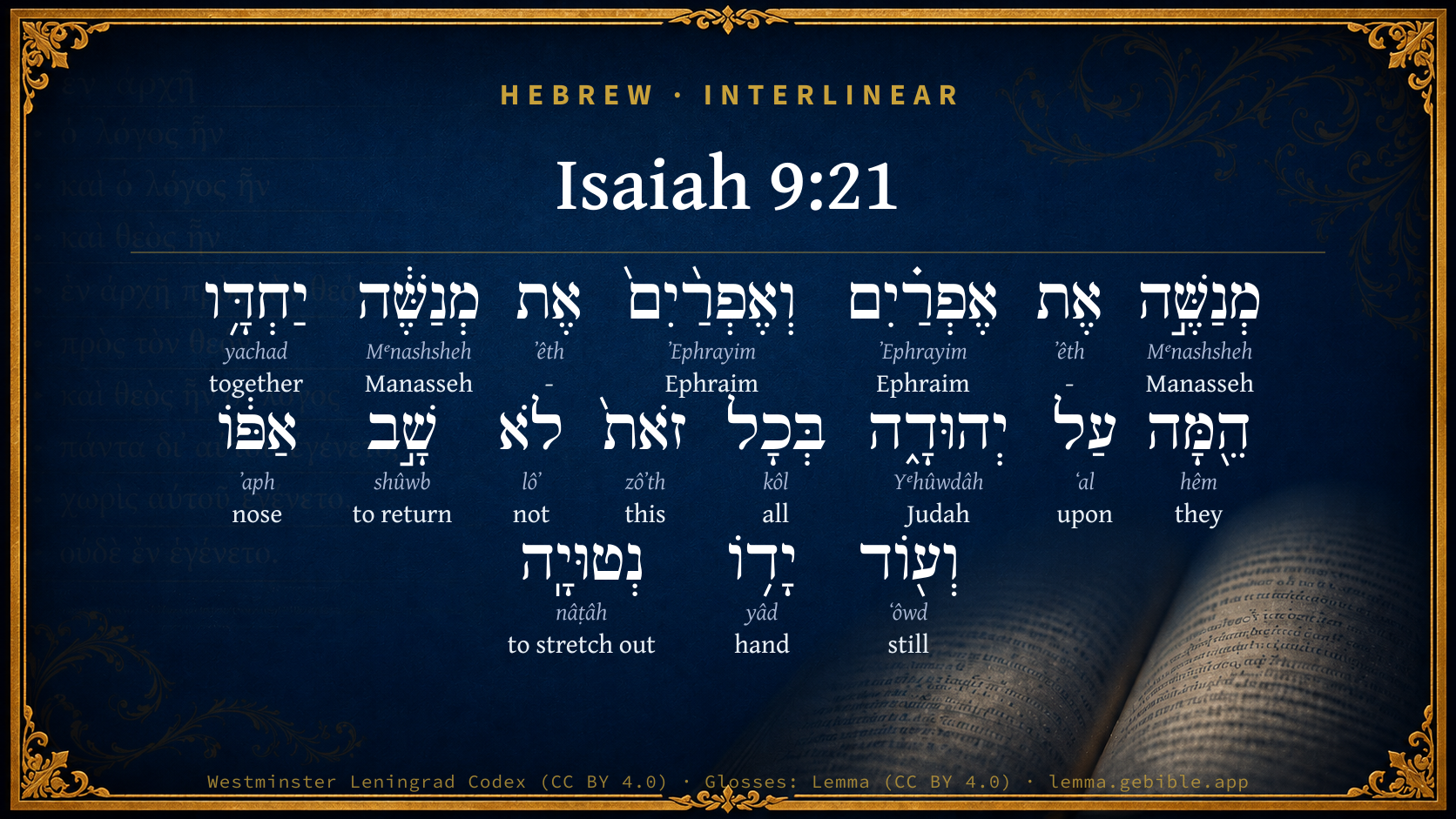
Hebrew (Westminster Leningrad Codex) Isaiah 9:21 appears in the Hebrew Old Testament. The text above is from the Westminster Leningrad Codex. Each word links to its Strong’s number, a concise gloss, and parsing drawn from the Open Scriptures Hebrew Bible morphology. Click any word for its full Brown-Driver-Briggs (BDB) entry.
Download image
Cite this verse

Isaiah 9:21 (World English Bible). Public Domain. Lemma interlinear Bible study tool, https://lemma.gebible.app/v/isaiah/9/21.

Show BibTeX & RIS
BibTeX
RIS
English Translation
Manasseh, Ephraim; and Ephraim, Manasseh; and they together shall be against Judah. For all this his anger is not turned away, but his hand is stretched out still.
World English Bible · Public Domain
Download a study sheet

One document with this verse’s original text, its word-by-word gloss line, the meaning frame, cross-references with their text, attributed commentary, and full source and license credits — printable, and it pastes into notes with its structure intact.

This verse Autodidact and up

Study sheet (.html) Plain text (.txt)

A passage Seminary Student

Up to 50 verses in one chapter. A passage sheet keeps up to 6 commentary sources and 12 cross-references per verse, in the order this page ranks them, and says so on the sheet whenever that leaves anything out. Ask for a single verse and you get the Autodidact verse sheet above.

Everything on this page stays free to read, with no account — the sheet is a download of what is already on screen, not access to it.

Want to remove ads? Support Godless Engineer
Compare translations 3

The same verse in 3 English versions, stacked beneath the original-language interlinear above. Click any original word for its lexicon entry.

Each is an independent rendering of the whole verse — the interlinear is not word-aligned to these translations.

Highlighted words mark where these versions differ — a whole-verse word diff, not a word-by-word alignment.

  • World English Bible Public Domain
    Manasseh, Ephraim; and Ephraim, Manasseh; and they together shall be against Judah. For all this his anger is not turned away, but his hand is stretched out still.
  • King James Version Public Domain
    Manasseh, Ephraim; and Ephraim, Manasseh: and they together shall be against Judah. For all this his anger is not turned away, but his hand is stretched out still.
  • unfoldingWord Literal Text CC BY-SA 4.0
    Manasseh, Ephraim; and Ephraim, Manasseh; together they against Judah. q1 In all of this, his nose has not turned back, and his hand still stretched out.

unfoldingWord Literal Text — © unfoldingWord, licensed CC BY-SA 4.0. Word-aligned USFM3 via Door43 (git.door43.org/unfoldingWord/en_ult).

Versions to compare (up to 4)

3 of 4 selected

Show all 18 translations

Every available English version of this verse, each an independent rendering of the whole verse.

  • World English Bible Public Domain
    Manasseh, Ephraim; and Ephraim, Manasseh; and they together shall be against Judah. For all this his anger is not turned away, but his hand is stretched out still.
  • Berean Standard Bible Public Domain
    Manasseh devours Ephraim, and Ephraim Manasseh; together they turn against Judah. Despite all this, His anger is not turned away; His hand is still upraised.
  • Majority Standard Bible Public Domain
    Manasseh devours Ephraim, and Ephraim Manasseh; together they turn against Judah. Despite all this, His anger is not turned away; His hand is still upraised.
  • King James Version Public Domain
    Manasseh, Ephraim; and Ephraim, Manasseh: and they together shall be against Judah. For all this his anger is not turned away, but his hand is stretched out still.
  • American Standard Version (1901) Public Domain
    Manasseh, Ephraim; and Ephraim, Manasseh; and they together shall be against Judah. For all this his anger is not turned away, but his hand is stretched out still.
  • Revised Version (1885) Public Domain
    Manasseh, Ephraim; and Ephraim, Manasseh: and they together shall be against Judah. For all this his anger is not turned away, but his hand is stretched out still.
  • Geneva Bible (1599) Public Domain
    Manasseh, Ephraim: and Ephraim Manasseh, and they both shall be against Iudah yet for all this his wrath is not turned away, but his hand is stretched out still.
  • Douay-Rheims (1899) Public Domain
    After all these things his indignation is not turned away, but his hand is stretched out still.
  • Young's Literal Translation Public Domain
    Manasseh -- Ephraim, and Ephraim -- Manasseh, Together they `are' against Judah, With all this not turned back hath His anger. And still His hand is stretched out!
  • Literal Standard Version CC BY-SA 4.0
    Manasseh—Ephraim, and Ephraim—Manasseh, || Together they [are] against Judah, || With all this His anger has not turned back. And His hand is still stretched out!
  • Unlocked Literal Bible CC BY-SA 4.0
    Manasseh will devour Ephraim, and Ephraim, Manasseh; and they together will attack Judah. In all these things, his anger does not subside; instead, his hand is still stretched out.
  • unfoldingWord Literal Text CC BY-SA 4.0
    Manasseh, Ephraim; and Ephraim, Manasseh; together they against Judah. q1 In all of this, his nose has not turned back, and his hand still stretched out.
  • Darby Bible Public Domain
    Manasseh, Ephraim, and Ephraim, Manasseh; [and] they together are against Judah. For all this his anger is not turned away, and his hand is stretched out still.
  • World Messianic Bible Public Domain
    Manasseh eating Ephraim and Ephraim eating Manasseh, and they together will be against Judah. For all this his anger is not turned away, but his hand is stretched out still.
  • Webster's Bible Public Domain
    Manasseh, Ephraim; and Ephraim, Manasseh: and they together shall be against Judah. For all this his anger is not turned away, but his hand is stretched out still.
  • Free Bible Version CC BY-SA 4.0
    Manasseh destroys Ephraim, and Ephraim destroys Manasseh. Together they turn to destroy Judah. In all of this he is still angry and his hand is still raised.
  • Bible in Basic English Public Domain
    Manasseh was making a meal of Ephraim, and Ephraim of Manasseh; and together they were attacking Judah. For all this his wrath is not turned away, but his hand is stretched out still.
  • JPS Tanakh (1917) Public Domain
    (9-20) Manasseh, Ephraim; and Ephraim, Manasseh; and they together are against Judah. For all this His anger is not turned away, but His hand is stretched out still.

Literal Standard Version (2020), Covenant Press — licensed CC BY-SA 4.0. Text via the HelloAO Bible API (eBible.org). Unlocked Literal Bible (unfoldingWord) — licensed CC BY-SA 4.0. Text via the HelloAO Bible API (eBible.org). unfoldingWord Literal Text — © unfoldingWord, licensed CC BY-SA 4.0. Word-aligned USFM3 via Door43 (git.door43.org/unfoldingWord/en_ult). Free Bible Version, Dr. Jonathan Gallagher — licensed CC BY-SA 4.0. Text via the HelloAO Bible API (eBible.org).

Word by word

More ways to search: Search by grammar → Find every occurrence → Compare this word →

Practice this passage: Drill this verse → Learn its vocabulary →

יַחְדָּ֥ו
yachad
H3162
“together”
Adverb
Part of Speech
Adverb
Full BDB Definition

Origin: from H3161

TWOT: 858b

union, unitedness (noun masculine) - together, altogether, all together, alike (adverb)
  1. מְנַשֶּׁ֣ה Mᵉnashsheh H4519 “Manasseh” Noun, Proper
  2. אֶת ʼêth H853 “-” Particle, Direct Object
  3. אֶפְרַ֗יִם ʼEphrayim H669 “Ephraim” Noun, Proper
  4. וְאֶפְרַ֨יִם֙ ʼEphrayim H669 “and · Ephraim” Conjunction + Noun, Proper
  5. אֶת ʼêth H853 “-” Particle, Direct Object
  6. מְנַשֶּׁ֔ה Mᵉnashsheh H4519 “Manasseh” Noun, Proper
  7. הֵ֖מָּה hêm H1992 “they” Pronoun, Personal, 3rd Person, Masculine, Plural
  8. עַל ʻal H5921 “upon” Preposition
  9. יְהוּדָ֑ה Yᵉhûwdâh H3063 “Judah” Noun, Proper
  10. בְּכָל kôl H3605 “in/at · all of” Preposition + Noun, Common, Masculine, Singular, Construct
  11. זֹאת֙ zôʼth H2063 “this” Pronoun, Demonstrative, Feminine, Singular
  12. לֹא lôʼ H3808 “not” Particle, Negative
  13. שָׁ֣ב shûwb H7725 “to return” Verb, Qal, Perfect, 3rd Person, Masculine, Singular
  14. אַפּ֔וֹ ʼaph H639 “nose · his” Noun, Common, Masculine, Singular, Construct + Suffix, Personal, 3rd Person, Masculine, Singular
  15. וְע֖וֹד ʻôwd H5750 “and · still” Conjunction + Adverb
  16. יָד֥וֹ yâd H3027 “hand · his” Noun, Common, Both, Singular, Construct + Suffix, Personal, 3rd Person, Masculine, Singular
  17. נְטוּיָֽה nâṭâh H5186 “stretched out” Verb, Qal, Participle Passive, Feminine, Singular, Absolute

About this verse

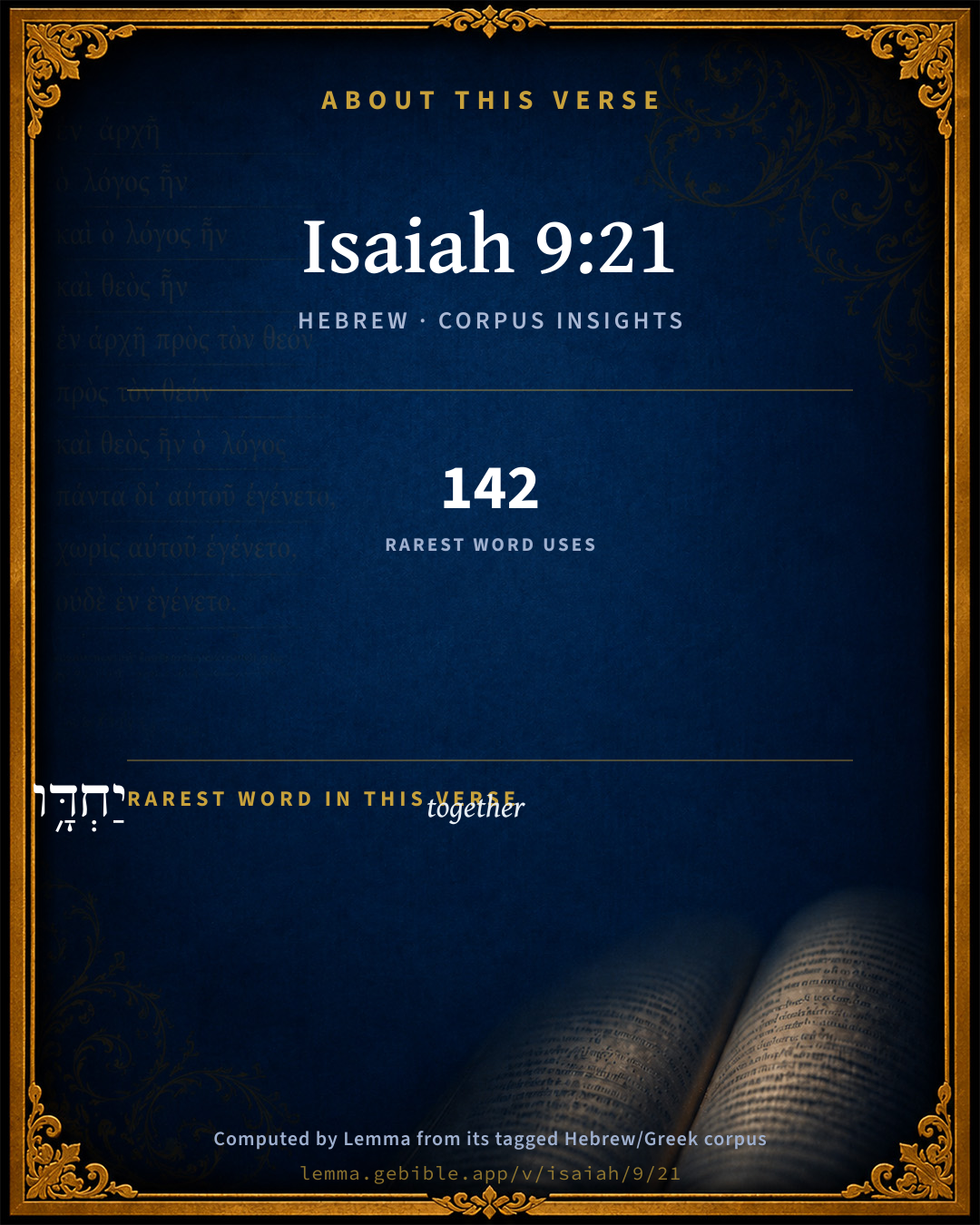
These counts appear in no published source. They are computed here, from the morphology-tagged text and Lemma’s own curated glosses. What Lemma adds →

18
words
15
distinct lemmas
Prophets
section

Grammatical profile

  • 2 verbs
  • 8 nouns
  • 2 pronouns
  • 1 preposition
  • 2 adverbs
  • 3 particles

Verb forms

  • שָׁ֣ב Qal · Perfect
  • נְטוּיָֽה Qal · Participle Passive

Repetition

Words recur within this verse — often emphatic in Hebrew:

  • מְנַשֶּׁ֣ה Manasseh H4519 ×2
  • אֶפְרַ֗יִם Ephraim H669 ×2

Hebrew & Septuagint length

In English translation the verse runs 28 words from the Hebrew and 35 from the Septuagint (LXX English) — closely comparable.

A rough comparison of the two English renderings, which tokenize alike — not a word-level alignment.

Word counts can differ between the Hebrew and the Greek without any difference in meaning — e.g. the Hebrew direct-object marker אֵת has no separate Greek word, and Greek often adds the article ὁ.

Cross-references

12

Topical passages linked to Isaiah 9:21 in the Treasury of Scripture Knowledge — connected by theme and wording, ordered by reader-vote popularity; previews shown in the World English Bible.

  • Isaiah 5:25 Therefore Yahweh's anger burns against his people, And he has stretched out his hand against them, and has struck them. The mountains tremble, And their dead bodies are as refuse in the midst of the streets. For all this, his anger is not turned away, But his hand is still stretched out.
  • 2 Chronicles 28:6–8 For Pekah the son of Remaliah killed in Judah one hundred twenty thousand in one day, all of them valiant men; because they had forsaken Yahweh, the God of their fathers.
  • Isaiah 9:12 the Syrians before, and the Philistines behind; and they shall devour Israel with open mouth. For all this his anger is not turned away, but his hand is stretched out still.
  • Galatians 5:15 But if you bite and devour one another, be careful that you don't consume one another.
  • Judges 7:2 Yahweh said to Gideon, The people who are with you are too many for me to give the Midianites into their hand, lest Israel vaunt themselves against me, saying, My own hand has saved me.
  • 1 Samuel 14:20 Saul and all the people who were with him were gathered together, and came to the battle: and, behold, every man's sword was against his fellow, [and there was] a very great confusion.
  • 2 Kings 15:30 Hoshea the son of Elah made a conspiracy against Pekah the son of Remaliah, and struck him, and killed him, and reigned in his place, in the twentieth year of Jotham the son of Uzziah.
  • Isaiah 9:17 Therefore the Lord will not rejoice over their young men, neither will he have compassion on their fatherless and widows; for everyone is profane and an evil-doer, and every mouth speaks folly. For all this his anger is not turned away, but his hand is stretched out still.
  • Isaiah 10:4 They shall only bow down under the prisoners, and shall fall under the slain. For all this his anger is not turned away, but his hand is stretched out still.
  • Isaiah 11:13 The envy also of Ephraim shall depart, and those who vex Judah shall be cut off: Ephraim shall not envy Judah, and Judah shall not vex Ephraim.
  • Jeremiah 4:8 For this gird you with sackcloth, lament and wail; for the fierce anger of Yahweh hasn't turned back from us.
  • Matthew 24:10 Then many will stumble, and will deliver up one another, and will hate one another.

Cross-references courtesy of OpenBible.info (CC BY 4.0).

Hebrew and Greek witnesses Masoretic Hebrew ↔ Greek Septuagint

The same verse in the two great witnesses to the Old Testament, shown verse-for-verse.

These are two independent witnesses, not word-aligned to each other, and the Septuagint is shown in lemma (dictionary) form.

Hebrew Isaiah 9:21 Masoretic · Westminster Leningrad Codex

מְנַשֶּׁ֣ה אֶת אֶפְרַ֗יִם וְאֶפְרַ֨יִם֙ אֶת מְנַשֶּׁ֔ה יַחְדָּ֥ו הֵ֖מָּה עַל יְהוּדָ֑ה בְּכָל זֹאת֙ לֹא שָׁ֣ב אַפּ֔וֹ וְע֖וֹד יָד֥וֹ נְטוּיָֽה

Manasseh, Ephraim; and Ephraim, Manasseh; and they together shall be against Judah. For all this his anger is not turned away, but his hand is stretched out still.

World English Bible · Public Domain

Greek LXX Isaiah 9:21 Septuagint · lemma form
For Manasses shall eat the flesh of Ephraim, and Ephraim the flesh of Manasses; for they shall besiege Juda together. For all this his anger is not turned away, but his hand is yet exalted.

LXX2012 (modern English Septuagint) · Public Domain

On this verse, John Gill's Exposition discusses the Septuagint’s reading. Read the note in Commentary ↓

Hebrew: Westminster Leningrad Codex (CC BY 4.0). Greek: Septuagint (public domain); English from LXX2012 (modern English Septuagint) (Public Domain). How the Septuagint differs from the Hebrew →

Commentary

Notes on Isaiah 9:21 from classic Christian and Jewish commentators (each source and its license shown beneath its notes). The classic Christian expositions comment on the surrounding passage and are grouped to its opening verse, so a note may address several verses; the Jewish commentaries on the Tanakh (Rashi and others) are per-verse, so they appear only where the commentator wrote on this verse.

Lemma curates 59 commentaries, every one of them public domain or Creative Commons licensed, each selected and text-cleaned for this edition rather than reprinted as found. About our sources →

Trapp's Complete Commentary

John Trapp

Isa 9:21 Manasseh, Ephraim; and Ephraim, Manasseh: [and] they together [shall be] against Judah. For all this his anger is not turned away, but his hand [is] stretched out still.

Ver. 21. Manasseh, Ephraim; and Ephraim, Manasseh.] Snarling at and intertearing one another, as dogs, about the kingly dignity, or some other reasonless reason. Thus the prophet exemplifieth what he had spoken.

And they together shall be against Judah.] So Herod and Pilate could unite against Christ, {Luk 23:7-9} and those that were at greatest enmity among themselves against the Church. {Psa 83:5; Psa 83:8} So in Julian the apostate’s time Jews and Gentiles combined against Christians; and in our days Papists and Lutherans against Calvinists. {a} How unworthily and impotently do the Lutherans of Suevia rail upon that holy man Oecolampadius, whose note it is upon this text, that these last dangerous times were foretold by St Paul. {2Ti 3:1-2} Annon eosdem describunt Paulus et Iesaias? saith he: Do not Paul and Isaiah describe the same men? Bullinger observeth concerning the Anabaptists of Germany, that as they are at great odds among themselves, so they all agree against goldly ministers of the truth, to despise and disparage them to the utmost.

{a} In Syngram.

John Trapp, A Commentary or Exposition upon All the Books of the Old and New Testament (1647–1656) — public domain. Text from a community e-Sword module.

Tyndale Open Study Notes

Tyndale Open Resources

9:21 Manasseh and Ephraim represent the northern kingdom as its largest tribes. The two largest tribes of Israel and Judah fought amongst themselves. This is probably a reference to the war between Judah and the alliance of Syria and Israel, which is commonly called the Syro-Ephraimite War (7:1-12). In that conflict, brothers savagely fought against brothers (2 Chr 28).

Tyndale Open Study Notes — © Tyndale Open Resources, licensed CC BY-SA 4.0. Text via the HelloAO Bible API.

Jamieson, Fausset & Brown

Robert Jamieson, A. R. Fausset & David Brown

Manasseh, Ephraim--the two sons of Joseph. So closely united as to form between them but one tribe; but now about to be rent into factions, thirsting for each other's blood. Disunited in all things else, but united "together against their brother Judah" (Kg2 15:10, Kg2 15:30).

Next: Isaiah Chapter 10

Jamieson, Fausset & Brown — Commentary Critical and Explanatory on the Whole Bible (1871) — public domain (CC PDM 1.0). Text via the HelloAO Bible API.

The Cambridge Bible for Schools and Colleges

gen. ed. J. J. S. Perowne

21. Manasseh, Ephraim … Manasseh] Ancient tribal jealousies would naturally be revived in a period of anarchy and civil war. Something of this kind seems to be implied in the account of the accession of the usurper Pekah, who murdered Pekahiah, at the head of a band of fifty Gileadites (2Ki_15:25). The tribal names, however, need not be taken quite literally; indeed it is hardly probable that the tribes had preserved their separate identity to so late a time.

The Cambridge Bible for Schools and Colleges (gen. ed. J. J. S. Perowne; Cambridge University Press, 1878–1918) — public domain. Text from a community e-Sword module.

John Gill's Exposition

Manasseh, Ephraim; and Ephraim, Manasseh,.... That is, "Manasseh" shall eat or devour "Ephraim"; and "Ephraim" shall eat or devour "Manasseh"; as the Septuagint, Syriac, and Arabic versions render it; which is to be understood of their quarrels, contentions, and wars among themselves, whereby they bit, devoured, and consumed each other, though they were brethren; which explains and confirms what is before said, of no man sparing his brother, and everyone eating the flesh of his own arm. The Targum paraphrases the words thus,

"they of the house of "Manasseh", with those of the house of "Ephraim", and they of the house of "Ephraim", with those of the house of "Manasseh", shall be joined together as one, to come against them of the house of Judah;''

and so Jarchi interprets them,

""Manasseh" shall be joined with "Ephraim", and "Ephraim" shall be joined with "Manasseh", and they together shall be joined against Judah;''

so it follows,

and they together shall be against Judah; as the ten tribes did sometimes make war against the two tribes of Judah and Benjamin, see Ch2 28:6,

for all this his anger is not turned away, but his hand is stretched out still; more and sorer judgments were to come upon this people for their sins. See Gill on Isa 9:12.

John Gill's Exposition of the Whole Bible (1746–1763) — public domain (CC PDM 1.0). Text via the HelloAO Bible API.

Albert Barnes' Notes on the Bible

Manasseh, Ephraim - This verse is a continuation of the statement in regard to the extent and fearfulness of the faction. Those who were hitherto most tenderly and intimately allied to each other, would now be engaged in furious strife. Manasseh and Ephraim were the two sons of Joseph Gen 46:20, and their names are used as expressive of tender union and friendship; compare Gen 48:20. The tribes of Ephraim and Manasseh were near each other, and they always were allied together. The expression here denotes that they who had hitherto been joined in tender alliance, would be rent into contending factions, thirsting for each other’s blood.

And they together - They would be united in opposing Judah while they were devouring each other, as it is not an uncommon thing for those who are opposed to each other to unite in hostility to a common foe; compare Luk 23:12. This is an image that heightens the description of the anarchy - introducing implacable animosity against another tribe, while they were contending among themselves. That such anarchies and factions existed, is apparent from all the history of the kingdom of Israel; compare 2Ki 15:10 ff; 2Ki 15:30. In this last passage, the death of Pekah is describer as having occurred in a conspiracy formed by Hoshea.

For all this ... - see Isa 9:12, note Isa 5:25. This closes the third strophe or part of the prophecy under consideration. The fourth and last strophe occurs in Isa 10:1-4.

Albert Barnes' Notes on the Bible (1834–1885) — public domain. Text from a community e-Sword/MySword module.

Haydock's Catholic Bible Commentary

CHAPTER IX.

George Leo Haydock (1774–1849), Haydock's Catholic Family Bible and Commentary, 1859 edition — public domain. Excludes Psalms (Douay-Rheims chapter numbering differs from Protestant) and Deuterocanonical books (Catholic canon only).

Matthew Poole's English Annotations

Manasseh, Ephraim; though more near and dear to one another than any other tribe, being both sons of Joseph.

They together shall be against Judah; which might be accomplished either before Shalmaneser took Samaria, or afterwards. For though the Israelites were miserably destroyed at that time, yet they were not utterly rooted out; of which See Poole "Isa 7:8".

Matthew Poole's English Annotations on the Holy Bible (1683–1685) — public domain. Text from a community e-Sword/MySword module.

Whedon's Commentary on the Bible

Daniel D. Whedon

21. Manasseh, Ephraim — The close tribal relationships in Israel are represented as broken, and each tribe as preying on the other, even of the same federation, while they are together scheming to break up Judah. The two tribes named are occasionally put for the whole of the northern kingdom, (see 2Ch_30:1;) so here. Their territory lay beside each other, among the rich hills and plains of middle Palestine. The illustrative tropes of this strophe exhibit the nation of Israel in the last throes of dissolution.

Daniel D. Whedon (gen. ed.), Commentary on the Old and New Testaments (1874–1909) — public domain. Text from a community e-Sword module.

The Pulpit Commentary

Manasseh, Ephraim. These two are mentioned as the two principal tribes of the northern kingdom. (comp. 1Ch_9:3 2Ch_30:1, 2Ch_30:10, 18 31:1 34:9) It is not to be supposed that civil discord was confined to them. Probably there was a general disorganization. Still, all the tribes would at any time willingly unite "together against Judah". (see 2Ki_15:37 2Ch_28:6-8)

The Pulpit Commentary (1880–1919), ed. H.D.M. Spence-Jones & Joseph S. Exell — public domain. Text from a community e-Sword module.

John Wesley's Explanatory Notes

Manasseh - Though more near and dear to one another than any other tribe, being both sons of Joseph.

John Wesley, Explanatory Notes Upon the Whole Bible (1754–1765) — public domain. Text via the GEBible commentary corpus.

J. A. Alexander on Isaiah

Joseph Addison Alexander

The application of the figures in v. 20 is now made plain by the Prophet himself, who has been drawing no imaginary scene. It is Israel, the chosen race, that feeds on its own flesh. They devour each the flesh of his own arm-Manasseh (devours) Ephraim, and Ephraim Manasseh, and together they (are) against Judah. For all this his wrath is not turned back and still his hand (is) stretched out. The tribes here specified are chosen for two reasons: first, because Judah and Joseph were the most important branches of the stock of Israel, as well before as after the disruption; and secondly, because the tribes of Ephraim and Manasseh were more nearly related to each other than to any of the rest, and therefore their hostility afforded the most striking illustration of the mutual rancor which the Prophet had described as prevalent. ‘Together’ implies unity of time, place, and action. Not only is it common for intestine (civil) wars to give occasion and give place to foreign ones, but this clause really continues the description and adds greatly to its force, by suggesting the idea that the mutual enmity of these two kindred tribes could only be exceeded by their common hatred to their common relative, the tribe of Judah. The allusions of the verse are not to one exclusive period, but to a protracted series of events. The intestine strifes of Ephraim and Manasseh, although not recorded in detail, may be inferred from various incidental statements. Of their ancient rivalry we have examples in the history of Gideon (Jdg 8:1-3) and Jephthah (Jdg 12:1-5), and as to later times, it has been observed that of all who succeeded Jeroboam the Second on the throne of Israel, Pekahiah alone appears to have attained it without treachery or bloodshed. That Manasseh and Ephraim were both against Judah, may refer either to their constant enmity or to particular attacks. No sooner did one party gain the upper hand in the kingdom of the ten tribes, than it seems to have addressed itself to the favorite work of harassing or conquering Judah, as in the case of Pekah, who invaded it almost as soon as he had waded to the throne through the blood of Pekahiah. The repetition in the last clause intimates that even these extreme evils should be followed by still worse; that these were but the beginning of sorrows; that the end was not yet.

Joseph Addison Alexander, The Prophecies of Isaiah (1846–1847; New York: Scribner, 1870–1878) — public domain. Text from a community e-Sword module.

Lesson kit

Teaching starters — assembled from the data on this page, not authored interpretation. Every prompt links to the verse data it draws on. Edit before teaching.

Isaiah, in the Prophets, opens this verse with 18 words (15 distinct Hebrew lemmas). Its most distinctive word is yachad (“together”). A historical commentator’s framing appears above. Read the whole chapter for the surrounding context.

Discussion questions

  1. The word yachad carries the sense “together.” How does it shape the verse?
  2. How does Isaiah 5:25, which shares this passage’s theme, read alongside this verse?
  3. What does the repetition of “Manasseh” (2× in this one verse) do in this verse?
  4. These translations render this verse differently. What is at stake in choosing one wording over another?
  5. «שָׁ֣ב» is a Qal Perfect verb. How does that grammatical form shape the action described?
  6. Compare how Trapp's Complete Commentary and Tyndale Open Study Notes read this verse. Where do they agree or differ?

Things to notice

  • These translations choose different wording for 7 words in this verse.
  • “Manasseh” occurs 2× in this single verse.
  • 15 distinct Hebrew lemmas span 18 words in this verse.

Reading settings

Reading text

Shown beneath each verse's original-language words.

Old Testament
Old Testament edition

Read the OT as the Masoretic Hebrew (MT) or the Greek Septuagint (LXX).

English shown for the Greek Septuagint (in the Hebrew ↔ Greek comparison).

Comparing translations? Open the Compare panel on any verse page to stack up to four side by side.