
Job 15:25

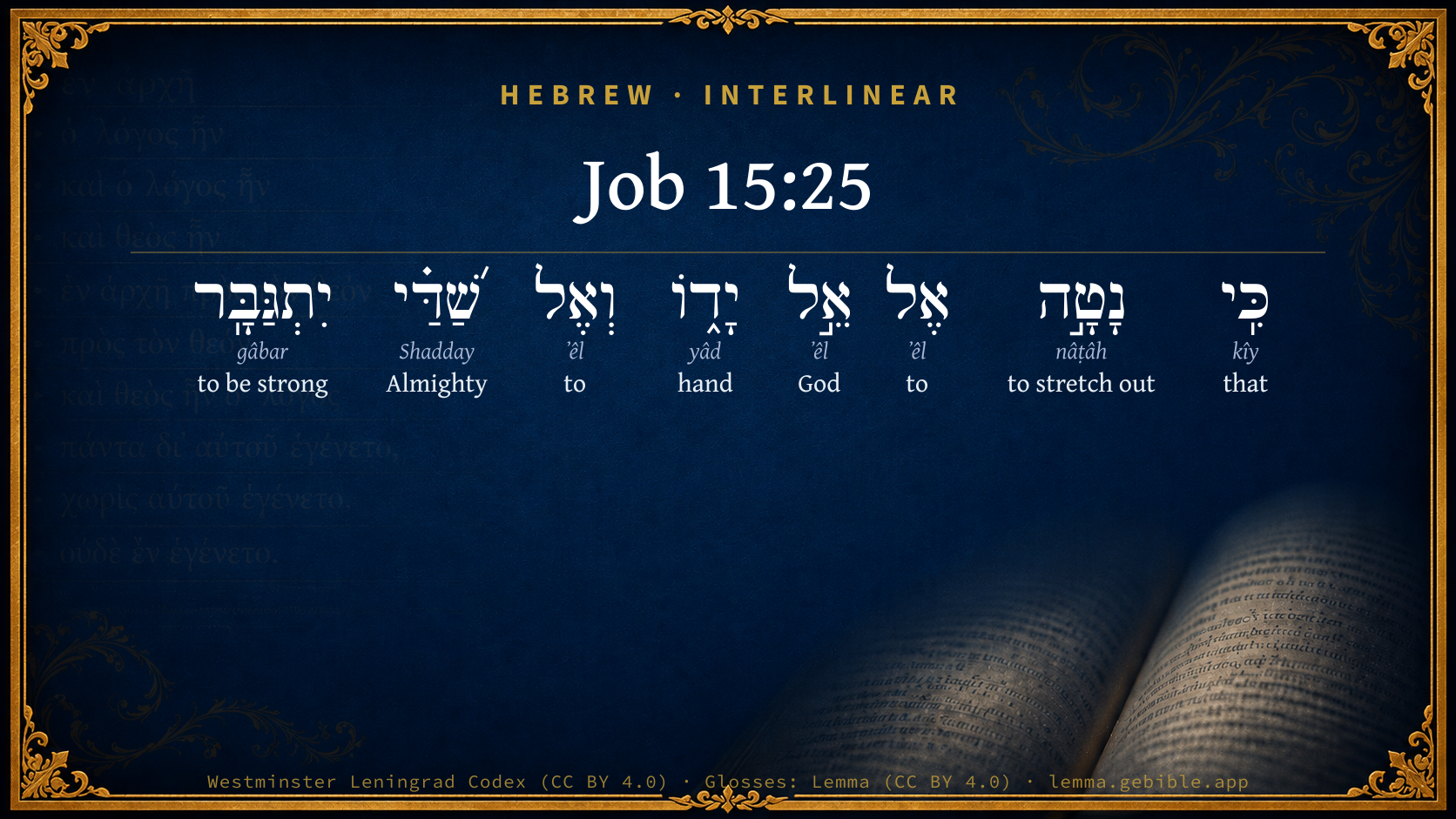
Hebrew (Westminster Leningrad Codex) Job 15:25 appears in the Hebrew Old Testament. The text above is from the Westminster Leningrad Codex. Each word links to its Strong’s number, a concise gloss, and parsing drawn from the Open Scriptures Hebrew Bible morphology. Click any word for its full Brown-Driver-Briggs (BDB) entry.
Download image
Cite this verse

Job 15:25 (World English Bible). Public Domain. Lemma interlinear Bible study tool, https://lemma.gebible.app/v/job/15/25.

Show BibTeX & RIS
BibTeX
RIS
English Translation
Because he has stretched out his hand against God, And behaves himself proudly against the Almighty;
World English Bible · Public Domain
Download a study sheet

One document with this verse’s original text, its word-by-word gloss line, the meaning frame, cross-references with their text, attributed commentary, and full source and license credits — printable, and it pastes into notes with its structure intact.

This verse Autodidact and up

Study sheet (.html) Plain text (.txt)

A passage Seminary Student

Up to 50 verses in one chapter. A passage sheet keeps up to 6 commentary sources and 12 cross-references per verse, in the order this page ranks them, and says so on the sheet whenever that leaves anything out. Ask for a single verse and you get the Autodidact verse sheet above.

Everything on this page stays free to read, with no account — the sheet is a download of what is already on screen, not access to it.

Want to remove ads? Support Godless Engineer
Compare translations 3

The same verse in 3 English versions, stacked beneath the original-language interlinear above. Click any original word for its lexicon entry.

Each is an independent rendering of the whole verse — the interlinear is not word-aligned to these translations.

Highlighted words mark where these versions differ — a whole-verse word diff, not a word-by-word alignment.

  • World English Bible Public Domain
    Because he has stretched out his hand against God, And behaves himself proudly against the Almighty;
  • King James Version Public Domain
    For he stretcheth out his hand against God, and strengtheneth himself against the Almighty.
  • unfoldingWord Literal Text CC BY-SA 4.0
    because he has stretched out his hand against God and against the Almighty he has vaunted himself.

unfoldingWord Literal Text — © unfoldingWord, licensed CC BY-SA 4.0. Word-aligned USFM3 via Door43 (git.door43.org/unfoldingWord/en_ult).

Versions to compare (up to 4)

3 of 4 selected

Show all 18 translations

Every available English version of this verse, each an independent rendering of the whole verse.

  • World English Bible Public Domain
    Because he has stretched out his hand against God, And behaves himself proudly against the Almighty;
  • Berean Standard Bible Public Domain
    For he has stretched out his hand against God and has vaunted himself against the Almighty,
  • Majority Standard Bible Public Domain
    For he has stretched out his hand against God and has vaunted himself against the Almighty,
  • King James Version Public Domain
    For he stretcheth out his hand against God, and strengtheneth himself against the Almighty.
  • American Standard Version (1901) Public Domain
    Because he hath stretched out his hand against God, And behaveth himself proudly against the Almighty;
  • Revised Version (1885) Public Domain
    Because he hath stretched out his hand against God, and behaveth himself proudly against the Almighty;
  • Geneva Bible (1599) Public Domain
    For he hath stretched out his hand against GOD, and made him selfe strong against the Almightie.
  • Douay-Rheims (1899) Public Domain
    For he hath stretched out his hand against God, and hath strengthened himself against the Almighty.
  • Young's Literal Translation Public Domain
    For he stretched out against God his hand, And against the Mighty he maketh himself mighty.
  • Literal Standard Version CC BY-SA 4.0
    For he stretched out his hand against God, || And against the Mighty he makes himself mighty.
  • Unlocked Literal Bible CC BY-SA 4.0
    Because he has reached out with his hand against God and has behaved proudly against the Almighty,
  • unfoldingWord Literal Text CC BY-SA 4.0
    because he has stretched out his hand against God and against the Almighty he has vaunted himself.
  • Darby Bible Public Domain
    For he hath stretched out his hand against ùGod, and strengthened himself against the Almighty:
  • World Messianic Bible Public Domain
    Because he has stretched out his hand against God, and behaves himself proudly against the Almighty,
  • Webster's Bible Public Domain
    For he stretcheth out his hand against God, and strengtheneth himself against the Almighty.
  • Free Bible Version CC BY-SA 4.0
    They shake their fists in God's face, defiantly challenging the Almighty,
  • Bible in Basic English Public Domain
    Because his hand is stretched out against God, and his heart is lifted up against the Ruler of all,
  • JPS Tanakh (1917) Public Domain
    Because he hath stretched out his hand against God, and behaveth himself proudly against the Almighty;

Literal Standard Version (2020), Covenant Press — licensed CC BY-SA 4.0. Text via the HelloAO Bible API (eBible.org). Unlocked Literal Bible (unfoldingWord) — licensed CC BY-SA 4.0. Text via the HelloAO Bible API (eBible.org). unfoldingWord Literal Text — © unfoldingWord, licensed CC BY-SA 4.0. Word-aligned USFM3 via Door43 (git.door43.org/unfoldingWord/en_ult). Free Bible Version, Dr. Jonathan Gallagher — licensed CC BY-SA 4.0. Text via the HelloAO Bible API (eBible.org).

Word by word

More ways to search: Search by grammar → Find every occurrence → Compare this word →

Practice this passage: Drill this verse → Learn its vocabulary →

About this verse

These counts appear in no published source. They are computed here, from the morphology-tagged text and Lemma’s own curated glosses. What Lemma adds →

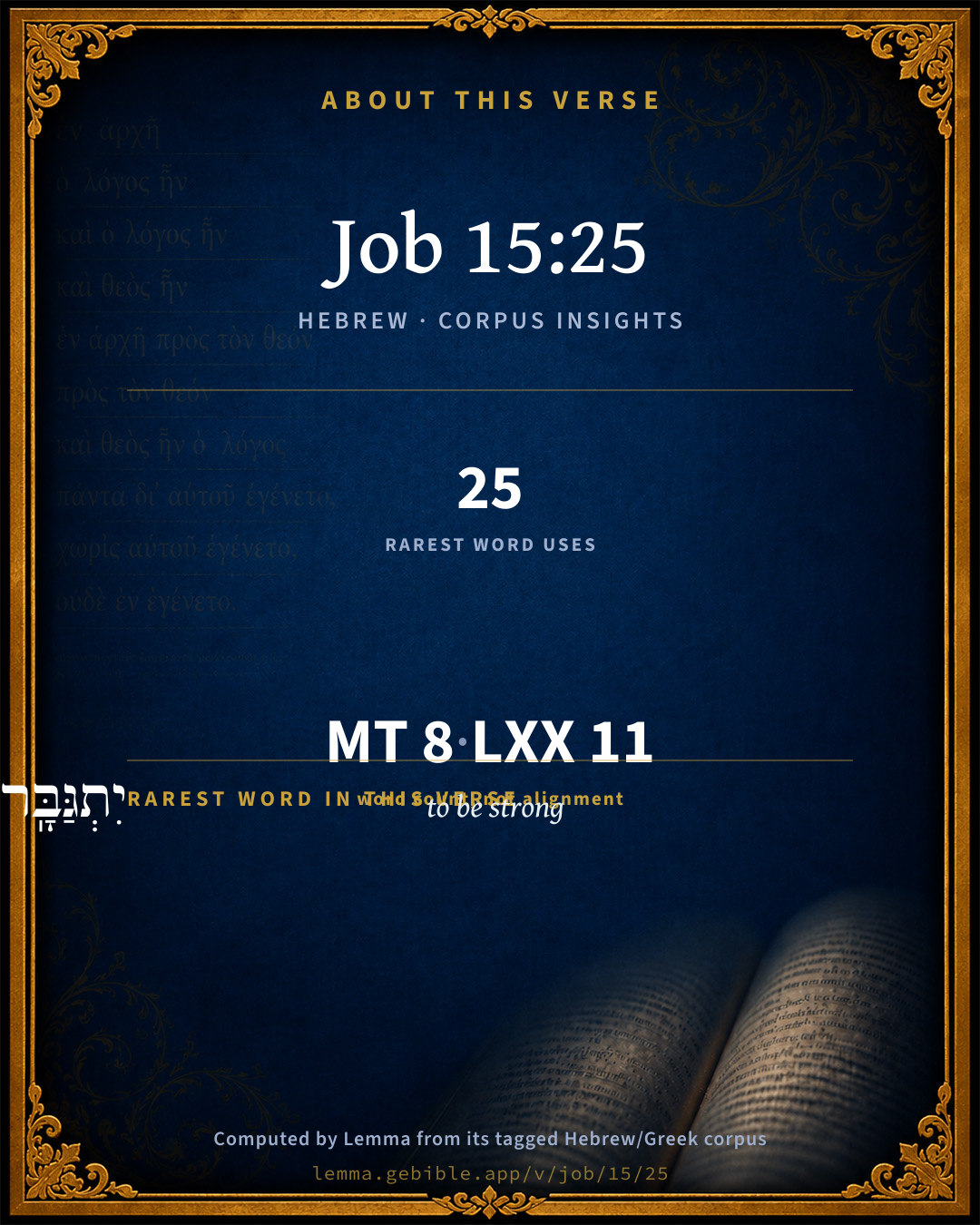
8
words
7
distinct lemmas
Wisdom
section

Notable vocabulary

The rarest word here is יִתְגַּבָּֽר to be strong H1396 — appearing just 25 times in the whole Hebrew Bible.

Shared distinctive vocabulary

יִתְגַּבָּֽר to be strong H1396 occurs in 24 verses of the Hebrew Bible. Also found in:

Grammatical profile

  • 2 verbs
  • 3 nouns
  • 2 prepositions
  • 1 conjunction

Verb forms

  • נָטָ֣ה Qal · Perfect
  • יִתְגַּבָּֽר Hithpael · Imperfect

Repetition

A word recurs within this verse — often emphatic in Hebrew:

  • אֶל to H413 ×2

Hebrew & Septuagint length

In English translation the verse runs 16 words from the Hebrew and 19 from the Septuagint (LXX English) — closely comparable.

A rough comparison of the two English renderings, which tokenize alike — not a word-level alignment.

Word counts can differ between the Hebrew and the Greek without any difference in meaning — e.g. the Hebrew direct-object marker אֵת has no separate Greek word, and Greek often adds the article ὁ.

In the original languages it is 8 Hebrew tokens and 11 Greek tokens — but the two are counted differently (Hebrew bundles its prefixes and suffixes into one token; the Greek is in lemma form), so that isn’t a like-for-like length.

Cross-references

20

Topical passages linked to Job 15:25 in the Treasury of Scripture Knowledge — connected by theme and wording, ordered by reader-vote popularity; previews shown in the World English Bible.

  • Job 9:4 God who is wise in heart, and mighty in strength: Who has hardened himself against him, and prospered?
  • Psalms 52:7 "Behold, this is the man who didn't make God his strength, But trusted in the abundance of his riches, And strengthened himself in his wickedness."
  • Psalms 73:9 They have set their mouth in the heavens. Their tongue walks through the earth.
  • Daniel 5:23 but have lifted up yourself against the Lord of heaven; and they have brought the vessels of his house before you, and you and your lords, your wives and your concubines, have drunk wine from them; and you have praised the gods of silver and gold, of brass, iron, wood, and stone, which don't see, nor hear, nor know; and the God in whose hand your breath is, and whose are all your ways, you have not glorified.
  • 1 Samuel 6:6 Why then do you harden your hearts, as the Egyptians and Pharaoh hardened their hearts? When he had worked wonderfully among them, didn't they let the people go, and they departed?
  • Job 36:9 Then he shows them their work, And their transgressions, that they have behaved themselves proudly.
  • Psalms 73:11 They say, "How does God know? Is there knowledge in the Most High?"
  • Malachi 3:13 "Your words have been stout against me," says Yahweh. "Yet you say, 'What have we spoken against you?'
  • Exodus 5:2–3 Pharaoh said, "Who is Yahweh, that I should listen to his voice to let Israel go? I don't know Yahweh, and moreover I will not let Israel go."
  • Exodus 9:17 as you still exalt yourself against my people, that you won't let them go.
  • Leviticus 26:23 "'If by these things you won't be reformed to me, but will walk contrary to me;
  • 1 Samuel 4:7–9 The Philistines were afraid, for they said, God is come into the camp. They said, Woe to us! for there has not been such a thing heretofore.
  • Job 40:9–11 Or have you an arm like God? Can you thunder with a voice like him?
  • Isaiah 8:9–10 Make an uproar, O you peoples, and be broken in pieces! And give ear, all you of far countries: gird yourselves, and be broken in pieces! Gird yourselves, and be broken in pieces!
  • Isaiah 10:12–14 Therefore it shall happen that, when the Lord has performed his whole work on Mount Zion and on Jerusalem, I will punish the fruit of the stout heart of the king of Assyria, and the glory of his high looks.
  • Isaiah 27:4 Wrath is not in me: would that the briers and thorns were against me in battle! I would march on them, I would burn them together.
  • Isaiah 41:4–7 Who has worked and done it, calling the generations from the beginning? I, Yahweh, the first, and with the last, I am he.
  • Acts 9:5 He said, "Who are you, Lord?" The Lord said, "I am Jesus, whom you are persecuting.
  • Acts 12:1 Now about that time, Herod the king stretched out his hands to oppress some of the assembly.
  • Acts 12:23 Immediately an angel of the Lord struck him, because he didn't give God the glory, and he was eaten by worms and died.

Cross-references courtesy of OpenBible.info (CC BY 4.0).

Hebrew and Greek witnesses Masoretic Hebrew ↔ Greek Septuagint

The same verse in the two great witnesses to the Old Testament, shown verse-for-verse.

These are two independent witnesses, not word-aligned to each other, and the Septuagint is shown in lemma (dictionary) form.

Hebrew Job 15:25 Masoretic · Westminster Leningrad Codex

כִּֽי נָטָ֣ה אֶל אֵ֣ל יָד֑וֹ וְאֶל שַׁ֝דַּ֗י יִתְגַּבָּֽר

Because he has stretched out his hand against God, And behaves himself proudly against the Almighty;

World English Bible · Public Domain

Greek LXX Job 15:25 Septuagint · lemma form

ὅτι αἴρω χείρ ἐναντίον ὁ κύριος ἔναντι δέ κύριος παντοκράτωρ τραχηλάω

For he has lifted his hands against the Lord, and he has hardened his neck against the Almighty Lord.

LXX2012 (modern English Septuagint) · Public Domain

On this verse, Keil & Delitzsch discusses the Septuagint’s reading. Read the note in Commentary ↓

Hebrew: Westminster Leningrad Codex (CC BY 4.0). Greek: Septuagint (public domain); English from LXX2012 (modern English Septuagint) (Public Domain). How the Septuagint differs from the Hebrew →

Commentary

Notes on Job 15:25 from classic Christian and Jewish commentators (each source and its license shown beneath its notes). The classic Christian expositions comment on the surrounding passage and are grouped to its opening verse, so a note may address several verses; the Jewish commentaries on the Tanakh (Rashi and others) are per-verse, so they appear only where the commentator wrote on this verse.

Lemma curates 59 commentaries, every one of them public domain or Creative Commons licensed, each selected and text-cleaned for this edition rather than reprinted as found. About our sources →

Trapp's Complete Commentary

John Trapp

Job 15:25 For he stretcheth out his hand against God, and strengtheneth himself against the Almighty.

Ver. 25. For he stretcheth out his hand against God] Worthy therefore to have a dead palsy transfused into it, or dried up, as Jeroboam’s was, when but stretched out against a prophet; and as Valens the emperor’s hand was made unable to hold a pen, when he would have subscribed a warrant for the banishing of Basil. Such a giant-like generation there are to this day among men, as face the heavens, cast down the gauntlet against God, Erecto collo valido impetu, arrogantia incurva cervice, saith Brentius upon the text, with stiff necks, full force, and insufferable insolence, as it were on purpose to cross the Almighty, and to wrestle a fall with him; they sin with a high hand, Lev 26:21 Num 15:30, and do as wickedly as they can, Jer 3:5, yea, with both hands earnestly, Mic 7:3; persecuting his people who are unto him as the apple of his eye, and resisting the Holy Ghost always, Act 7:51. Surely he would even destroy God if he could, for he hateth him, Rom 1:30, with a hellish hatred, as the word θεοστυγεις there signifieth, such as striketh at God’s very essence, Psa 18:40; confer 1Jn 3:15.

And strengtheneth himself against the Almighty] Sed vanae sine viribus irae. To his sinews of iron he hath added brows of brass, Isa 48:4. To his natural crossness habitual hardness and hardiness; so that now, like a stout warrior, he bends all his strength against the Almighty, but with no better success than to be broken in pieces, Isa 8:9, with his iron mace, Psa 2:9, Sennacherib for instance. {See Trapp on "Job 9:4"}

John Trapp, A Commentary or Exposition upon All the Books of the Old and New Testament (1647–1656) — public domain. Text from a community e-Sword module.

Joseph Benson's Commentary

Job 15:25. For he stretcheth out his hand against God — He sinned against him with a high and outstretched hand; that is, boldly and presumptuously, as one that neither desired his favour, nor feared his anger. Thus he gives the reason of the fore-mentioned calamities that befell him, which was his great wickedness in the time of his peace and prosperity. And strengthened himself against the Almighty — Putteth his forces in array, as if he would fight with him who is almighty, and therefore irresistible. This aggravates the madness of this weak and contemptible worm, that he should dare to fight against the omnipotent God!

Joseph Benson's Commentary on the Old and New Testaments (1811–1818) — public domain. Text from a community e-Sword module.

Whedon's Commentary on the Bible

Daniel D. Whedon

Second strophe — Titans in impiety, they not only rushed madly against God, but fattened themselves upon the ruin of the innocent. If their punishment be aggravated it springs from aggravated sin, Job_15:25-30.

25. Strengtheneth himself — Boasteth himself. The first reason given for his wretched doom is his stiff-necked hostility to God. (Job_15:25-26.) “When all vices flee from God, pride alone opposes itself to him.” — Boetius.

Daniel D. Whedon (gen. ed.), Commentary on the Old and New Testaments (1874–1909) — public domain. Text from a community e-Sword module.

Keil & Delitzsch

C. F. Keil & F. Delitzsch

25 Because he stretched out his hand against God,

And was insolent towards the Almighty;

26 He assailed Him with a stiff neck,

With the thick bosses of his shield;

27 Because he covered his face with his fatness,

And addeth fat to his loins,

28 And inhabited desolated cities,

Houses which should not be inhabited,

Which were appointed to be ruins.

29 He shall not be rich, and his substance shall not continue

And their substance boweth not to the ground.

30 He escapeth not darkness;

The flame withereth his shoots;

And he perisheth in the breath of His mouth.

This strophe has periodic members: Job 15:25-28 an antecedent clause with a double beginning (כּי־נטה because he has stretched out, כּי־כסּה because he has covered; whereas ירוּץ may be taken as more independent, but under the government of the כי that stands at the commencement of the sentence); Job 15:29, Job 15:30, is the conclusion. Two chief sins are mentioned as the cause of the final destiny that comes upon the evil-doer: (1) his arrogant opposition to God, and (2) his contentment on the ruins of another's prosperity. The first of these sins is described Job 15:25-27. The fut. consec. is once used instead of the perf., and the simple fut. is twice used with the signification of an imperf. (as Job 4:3 and freq.). The Hithpa. התגּבּר signifies here to maintain a heroic bearing, to play the hero; התעשּׁר to make one's self rich, to play the part of a rich man, Pro 13:7. And בּצוּאר expresses the special prominence of the neck in his assailing God אל רוּץ, as Dan 8:6, comp. על, Job 16:14); it is equivalent to erecto collo (Vulg.), and in meaning equivalent to ὕβρει (lxx). Also in Psa 75:6, בצואר (with Munach, which there represents a distinctive)

(Note: Vid., Dachselt's Biblia Accentuata, p. 816.))

is absolute, in the sense of stiff-necked or hard-headed; for the parallels, as Psa 31:19; Psa 94:4, and especially the primary passage, Sa1 2:3, show that עתק is to be taken as an accusative of the object. The proud defiance with which he challengingly assails God, and renders himself insensible to the dispensations of God, which might bring him to a right way of thinking, is symbolized by the additional clause: with the thickness (עבי cognate form to עבי) of the bosses of his shields. גּב is the back (Arab. dhr) or boss (umbo) of the shield; the plurality of shields has reference to the diversified means by which he hardens himself. Job 15:27, similarly to Psa 73:4-7, pictures this impregnable carnal security against all unrest and pain, to which, on account of his own sinfulness and the distress of others, the nobler-minded man is so sensitive: he has covered his face with his fat, so that by the accumulation of fat, for which he anxiously labours, it becomes a gross material lump of flesh, devoid of mind and soul, and made fat, i.e., added fat, caused it to accumulate, upon his loins (כּסל for כּסליו); עשׂה (which has nothing to do with Arab. gšâ, to cover) is used as in Job 14:9, and in the phrase corpus facere (in Justin), in the sense of producing outwardly something from within. פּימה reminds one of πιμ-ελή (as Aquila and Symmachus translate here), o-pim-us, and of the Sanscrit piai, to be fat (whence adj. pı̂van, pı̂vara, πιαρός, part. pı̂na, subst. according to Roth pı̂vas); the Arabic renders it probable that it is a contraction of פּאימה (Olsh. 171, b). The Jewish expositors explain it according to the misunderstood פּים, Sa1 13:21, of the furrows or wrinkles which are formed in flabby flesh, as if the ah were paragogic.

Job 15:28 describes the second capital sin of the evil-doer. The desolated cities that he dwells in are not cities that he himself has laid waste; Job 15:28 distinctly refers to a divinely appointed punishment, for התעתּדוּ does not signify: which they (evil-doers) have made ruins (Hahn), which is neither probable from the change of number, nor accords with the meaning of the verb, which signifies "to appoint to something in the future." Hirzel, by referring to the law, Deu 13:13-18 (comp. Kg1 16:34), which forbids the rebuilding of such cities as are laid under the curse, explains it to a certain extent more correctly. But such a play upon the requirements of the Mosaic law is in itself not probable in the book of Job, and here, as Lwenthal rightly remarks, is the less indicated, since it is not the dwelling in such cities that is forbidden, but only the rebuilding of them, so far as they had been destroyed; here, however, the reference is only to dwelling, not to rebuilding. The expression must therefore be understood more generally thus, that the powerful man settles down carelessly and indolently, without any fear of the judgments of God or respect for the manifestations of His judicial authority, in places in which the marks of a just divine retribution are still visible, and which are appointed to be perpetual monuments of the execution of divine judgments.

(Note: For the elucidation of this interpretation of the passage, Consul Wetzstein has contributed the following: "As one who yields to inordinate passion is without sympathy cast from human society because he is called muqtal rabbuh, 'one who is beaten in the conflict against his God' (since he has sinned against the holy command of chastity), and as no one ventures to pronounce the name of Satan because God has cursed him (Gen 3:14), without adding 'alh el-la'ne, 'God's curse upon him!' so a man may not presume to inhabit places which God has appointed to desolation. Such villages and cities, which, according to tradition, have perished and been frequently overthrown (maqlbe, muqlbe, munqualibe) by the visitation of divine judgment, are not uncommon on the borders of the desert. They are places, it is said, where the primary commandments of the religion of Abraham (Dn Ibrhim) have been impiously transgressed. Thus the city of Babylon will never be colonized by a Semitic tribe, because they hold the belief that it has been destroyed on account of Nimrod's apostasy from God, and his hostility to His favoured one, Abraham. The tradition which has even been transferred by the tribes of Arabia Petraea into Islamism of the desolation of the city of Higr (or Medin Slih) on account of disobedience to God, prevents any one from dwelling in that remarkable city, which consists of thousands of dwellings cut in the rock, some of which are richly ornamented; without looking round, and muttering prayers, the desert ranger hurries through, even as does the great procession of pilgrims to Mekka, from fear of incurring the punishment of God by the slightest delay in the accursed city. The destruction of Sodom, brought about by the violation of the right of hospitality (Gen 19:5, comp. Job 31:32), is to be mentioned here, for this legend certainly belongs originally to the 'Din Ibrhm' rather than to the Mosaic. At the source of the Rakkd (the largest river of the Golan region) there are a number of erect and remarkably perforated jasper formations, which are called 'the bridal procession' (el-frida). This bridal procession was turned to stone, because a woman of the party cleaned her child that had made itself dirty with a bread-cake (qurss). Near it is its village (Ufne), which in spite of repeated attempts is no more to be inhabited. It remains forsaken, as an eternal witness that ingratitude (kufrn en-ni'ma), especially towards God, does not remain unpunished.)

Only by this rendering is the form of expression of the elliptical clause לא־ישׁבוּ למו explained. Hirz. refers למו to בּתּים: in which they do not dwell; but ל ישׁב does not signify: to dwell in a place, but: to settle down in a place; Schlottm. refers למו to the inhabitants: therein they dwell not themselves, i.e., where no one dwelt; but the אשׁר which would be required in this case as acc. localis could not be omitted. One might more readily, with Hahn, explain: those to whom they belong do not inhabit them; but it is linguistically impossible for למו to stand alone as the expression of this subject (the possessors). The most natural, and also an admissible explanation, is, that yshbw refers to the houses, and that למו, which can be used not only of persons, but also of things, is dat. ethicus. The meaning, however, is not: which are uninhabited, which would not be expressed as future, but rather by אין בהם יושׁב or similarly, but: which shall not inhabit, i.e., shall not be inhabited to them (ישׁב to dwell = to have inhabitants, as Isa 13:10; Jer 50:13, Jer 50:39, and freq.), or, as we should express it, which ought to remain uninhabited.

Job 15:29 begins the conclusion: (because he has acted thus) he shall not be rich (with a personal subject as Hos 12:9, and יעשּׁר to be written with a sharpened שׁ, like יעצר above, Job 12:15), and his substance shall not endure (קוּם, to take place, Isa 7:7; to endure, Sa1 13:14; and hold fast, Job 41:18), and מנלם shall not incline itself to the earth. The interpretation of the older expositors, non extendet se in terra, is impossible - that must be בּארץ eb tsum taht - elbi ינּטה; whereas Kal is commonly used in the intransitive sense to bow down, bend one's self or incline (Ges. 53, 2). But what is the meaning of the subject מנלם? We may put out of consideration those interpretations that condemn themselves: לם מן, ex iis (Targ.), or לם מן, quod iis, what belongs to them (Saad.), or מלּם, their word (Syr. and Gecatilia), and such substitutions as σκιάν (צלם or צללם) of the lxx, and radicem of Jerome (which seems only to be a guess). Certainly that which throws most light on the signification of the word is כּנּלתך (for כּהנלתך with Dag. dirimens, as Job 17:2), which occurs in Isa 33:1. The oldest Jewish lexicographers take this הנלה (parall. התם .ll) as a synonym of כּלּה in the signification, to bring to an end; on the other hand, Ges., Knobel, and others, consider כּכלּתך to be the original reading, because the meaning perficere is not furnished for נלה from the Arab. nâl, and because נל, standing thus together, is in Arabic an incompatible root combination (Olsh. 9, 4). This union of consonants certainly does not occur in any Semitic root, but the Arab. nâla (the long a of which can in the inflection become a short changeable bowel) furnishes sufficient protection for this one exception; and the meaning consequi, which belongs to the Arab. nâla, fut. janı̂lu, is perfectly suited to Isa 33:1 : if thou hast fully attained (Hiph. as intensive of the transitive Kal, like הזעיק, הקנה) to plundering. If, however, the verb נלה is established, there is no need for any conjecture in the passage before us, especially since the improvement nearest at hand, מכלם (Hupf. מגּלה), produces a sentence (non figet in terra caulam) which could not be flatter and tamer; whereas the thought that is gained by Olshausen's more sensible conjecture, מגּלם (their sickle does not sink to the earth, is not pressed down by the richness of the produce of the field), goes to the other extreme.

(Note: Carey proposes to take מנלם = נמלם, their cutting, layer for planting; but the verb-group מלל, מול, נמל (vid., supra, p. 224) is not favourable to the supposition of a substantive נמל in this signification, according to the usual application of the language.)

Juda b. Karisch (Kureisch) has explained the word correctly by Arab. mnâlhm: that which they have offered (from nâla, janûlu) or attained (nâla, janı̂lu), i.e., their possession

(Note: Freytag has erroneously placed the infinitives nail and manl under Arab. nl med. Wau, instead of under Arab. nl me. Je, where he only repeats nail, and erroneously gives manl the signification donum, citing in support of it a passage from Fkihat al-chulaf, where 'azz al-manl (a figure borrowed from places difficult of access, and rendered strong and impregnable by nature or art) signifies "one who was hard to get at" (i.e., whose position of power is made secure). The true connection is this: Arab. nl med. Wau signifies originally to extend, reach, to hand anything to any one with outstretched arm or hand, the correlatum Arab. nl med. Je: to attain, i.e., first to touch or reach anything with outstretched arm or hand, and then really to grasp and take it, gen. adipisci, consequi, assequi, impetrare, with the ordinary infinitives nail and manl. Therefore manl (from Arab. nl med. Je) signifies primarily as abstract, attainment; it may then, however, like nail and the infinitives generally, pass over to the concrete signification: what one attains to, or what one has attained, gotten, although I can give no special example in support of it. - Fl.)

(not: their perfection, as it is chiefly explained by the Jewish expositors, according to נלה = כלה). When the poet says, "their prosperity inclines not to the ground," he denies to it the likeness to a field of corn, which from the weight of the ears bows itself towards the ground, or to a tree, whose richly laden branches bend to the ground. We may be satisfied with this explanation (Hirz., Ew., Stickel, and most others): מנלם from מנלה (with which Kimchi compares מכרם, Num 20:19, which however is derived not from מכרה, but from מכר), similar in meaning to the post-biblical ממון, μαμωνᾶς; the suff., according to the same change of number as in Job 15:35; Job 20:23, and freq., refers to רשׁעים.

In Job 15:30, also, a figure taken from a plant is interwoven with what is said of the person of the ungodly: the flame withers up his tender branch without its bearing fruit, and he himself does not escape darkness, but rather perishes by the breath of His mouth, i.e., God's mouth (Job 4:9, not of his own, after Isa 33:11). The repetition of יסוּר ("he escapes not," as Pro 13:14; "he must yield to," as Kg1 15:14, and freq.) is an impressive play upon words.

Keil & Delitzsch — Biblical Commentary on the Old Testament (1861–1891) — public domain (CC PDM 1.0). Text via the HelloAO Bible API. (Old Testament only.)

Tyndale Open Study Notes

Tyndale Open Resources

15:25 Job had complained earlier that God was treating him like a formidable foe (7:19-21; 13:24).

Tyndale Open Study Notes — © Tyndale Open Resources, licensed CC BY-SA 4.0. Text via the HelloAO Bible API.

Jamieson, Fausset & Brown

Robert Jamieson, A. R. Fausset & David Brown

stretcheth . . . hand--wielding the spear, as a bold rebel against God (Job 9:4; Isa 27:4).

Jamieson, Fausset & Brown — Commentary Critical and Explanatory on the Whole Bible (1871) — public domain (CC PDM 1.0). Text via the HelloAO Bible API.

Adam Clarke's Commentary

Verse 25. He stretcheth out his hand against God] While in power he thought himself supreme. He not only did not acknowledge God, by whom kings reign, but stretched out his hand-used his power, not to protect, but to oppress those over whom he had supreme rule; and thus strengthened himself against the Almighty.

Adam Clarke's Commentary on the Bible (1810–1826) — public domain. Text from a community e-Sword/MySword module.

Ellicott's Commentary for English Readers

(25) For he stretcheth out his hand.—It is instructive to note the difference in time indicated here. “Because he hath stretched out his hand against God. and behaveth himself proudly against the Almighty. He runneth upon Him with haughty neck, with the thick bosses of his bucklers; “fully protected as he supposes against the vengeance of the Most High. (Comp. Psa_10:6; Psa_10:11, &c.) The English version, with less probability, represents the armour as being God’s; on the contrary, it is the wicked man’s prosperity which hath thus blinded and hardened him. (See Deu_32:15; Psa_17:10.)

A Bible Commentary for English Readers, edited by Charles John Ellicott (1878–1897) — public domain. Text from a community e-Sword module.

The Cambridge Bible for Schools and Colleges

gen. ed. J. J. S. Perowne

25. he stretcheth out] Rather, stretched. The tenses in the following verses would all be better put in the past, as they describe either distinct or continued past actions. So strengthened, or emboldened himself, lit. behaved himself mightily (Isa_42:13 margin), or, proudly.

25–28. Reason of these terrors of conscience and presentiments of evil—his defiance of heaven and sensual life.

The Cambridge Bible for Schools and Colleges (gen. ed. J. J. S. Perowne; Cambridge University Press, 1878–1918) — public domain. Text from a community e-Sword module.

John Gill's Exposition

He runneth upon him, even on his neck,.... As a fierce and furious enemy runs upon another with great wrath and fury; as the he goat in Daniel's vision ran upon the ram, in the fury of his power, that is, Alexander upon Darius; which instance Bar Tzemach refers to; and as an adversary, who throws down his weapons, and goes in to closer quarters, and takes his antagonist by the throat, or round the neck, in order to throw him down to the ground; in such a bold and insolent manner does the wicked man encounter with God; he makes up to him, and flies in his face, and most audaciously attacks him: or he runs upon him "with his neck" (y); with a stretched out neck, in the most haughty manner, with a neck like an iron sinew, and with a brow like brass:

upon the thick bosses of his bucklers; alluding to shields, embossed in the middle, where they are thicker than in the other parts, and used to have a spike of iron set in the middle; so that it was daring and dangerous to run upon them: these may design the perfections of God, denied by the wicked man; or his providential dispensations, despised by him; or his purposes and decrees ridiculed, replied unto, and disputed; or the flaming sword of justice, and the curses of a righteous law, in defiance of which wicked men go on in sin: or "with the bosses of his bucklers" (z); with all his family, as Schmidt; or employing all his wealth and riches, his power and authority, against God, and the interest of religion in the world. Some understand this of God, meeting the wicked man, stretching out his hand, and strengthening himself against him, as if he, God, ran upon the wicked man, and upon his neck, and took him by it, and shook him; as in Job 16:12; and upon the thick bosses of his buckler, his bones and nerves, as Mr. Broughton; or on his power and wealth, which are not able to secure him from the vengeance of the Almighty; but the former sense seems best.

(y) "erecto collo", V. L. Piscator; "duro collo", Drusius, Michaelis; "cum cervice", Cocceius, Schmidt, Schultens. (z) "cum erassitie umbonum clypeorum suorum", Cocceius; so Schmidt, Michaelis, Schultens.

John Gill's Exposition of the Whole Bible (1746–1763) — public domain (CC PDM 1.0). Text via the HelloAO Bible API.

Albert Barnes' Notes on the Bible

For he stretcheth out his hand against God - The hand is stretched out for battle. It wields the spear or the sword against an enemy. The idea here is, that the wicked man makes God an adversary. He does not contend with his fellow-man, with fate, with the elements, with evil angels, but with God. His opponent is an Almighty Being, and he cannot prevail against him; compare the notes at Isa 27:4.

And strengtheneth himself - As an army does that throws up a rampart, or constructs a fortification. The whole image here is taken from the practice of war; and the sense is, that a wicked man is really making war on the Almighty, and that in that war he must be vanquished; compare Job 9:4.

Albert Barnes' Notes on the Bible (1834–1885) — public domain. Text from a community e-Sword/MySword module.

Matthew Poole's English Annotations

Now he gives the reason of all the forementioned calamities which befell him, which was his great wickedness in the time of his peace and prosperity.

He stretcheth out his hand against God, i.e. he commonly and customarily sinned against God with a high and out-stretched hand, i.e. boldly and presumptuously, as one that neither desired his favour, nor feared his anger.

Strengtheneth himself, i.e. he putteth his forces in array, as if he would fight with him.

Against the Almighty; which aggravates the madness of this poor contemptible worm that durst fight against the omnipotent God.

Matthew Poole's English Annotations on the Holy Bible (1683–1685) — public domain. Text from a community e-Sword/MySword module.

The Pulpit Commentary

For he stretcheth out his hand against God. The wicked man ventures even to threaten the Almighty. So in Eastern legend Nimrod was supposed to have done, and in Greek legend the giants. And strengtheneth himself against the Almighty; rather, behaveth himself proudly. See the Revised Version, and compare Schultens, who renders the Hebrew rBgty, by "ferocius et insolentius se gessit."

The Pulpit Commentary (1880–1919), ed. H.D.M. Spence-Jones & Joseph S. Exell — public domain. Text from a community e-Sword module.

John Wesley's Explanatory Notes

For - Now he gives the reason of all the fore-mentioned calamities, which was his great wickedness. Against God - He sinned against God with an high hand. The Almighty - Which aggravates the madness of this poor worm that durst fight against the omnipotent God.

John Wesley, Explanatory Notes Upon the Whole Bible (1754–1765) — public domain. Text via the GEBible commentary corpus.

unfoldingWord translationNotes

Door43 World Missions Community

he has reached out with his hand against God

"he has shook his fist against God." This is a sign of aggression. (See: Symbolic Action)

runs at God

This speaks of the wicked man acting aggressively against God as if he were running towards him to attack him. AT: "attacks God" or "acts violently against God" (See: Metaphor)

with a thick shield

"with his strong shield"

translationWords

hand

God

proud

Almighty

evil

stiff-necked

shield

unfoldingWord translationNotes — © Distant Shores Media and the Door43 World Missions Community, licensed CC BY-SA 4.0. Source: git.door43.org/Door43/en_tn.

Lesson kit

Teaching starters — assembled from the data on this page, not authored interpretation. Every prompt links to the verse data it draws on. Edit before teaching.

Job, in the Wisdom, opens this verse with 8 words (7 distinct Hebrew lemmas). Its most distinctive word is gâbar (“to be strong”). A historical commentator’s framing appears above. Read the whole chapter for the surrounding context.

Discussion questions

  1. How does “to be strong” (gâbar) shape what this verse is saying?
  2. Genesis 7:18 shares the word «to be strong» with this verse. How do the two illuminate each other?
  3. “to” occurs 2× in this one verse. What is the effect of the repetition?
  4. The translations on this page render this verse differently — a whole-verse word diff, not a word-by-word alignment. What might account for the different wordings?
  5. The verb «נָטָ֣ה» is Qal Perfect. How does its form color the action?
  6. Reading how Trapp's Complete Commentary and Joseph Benson's Commentary read this verse, where do the two commentators agree and where do they part?

Things to notice

Reading settings

Reading text

Shown beneath each verse's original-language words.

Old Testament
Old Testament edition

Read the OT as the Masoretic Hebrew (MT) or the Greek Septuagint (LXX).

English shown for the Greek Septuagint (in the Hebrew ↔ Greek comparison).

Comparing translations? Open the Compare panel on any verse page to stack up to four side by side.