Jeremiah 7:26

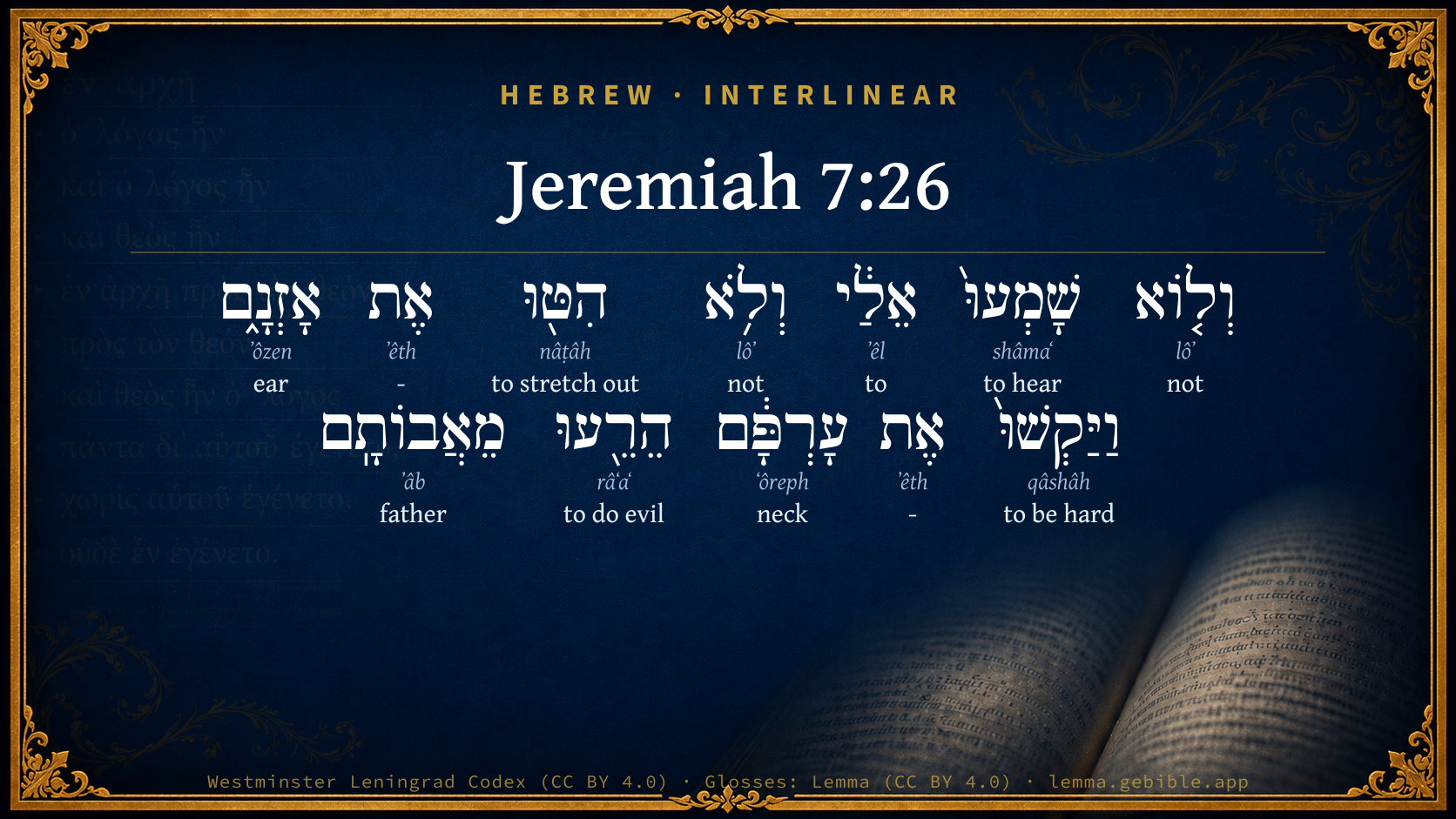
Hebrew (Westminster Leningrad Codex) Jeremiah 7:26 appears in the Hebrew Old Testament. The text above is from the Westminster Leningrad Codex. Each word links to its Strong’s number, a concise gloss, and parsing drawn from the Open Scriptures Hebrew Bible morphology. Click any word for its full Brown-Driver-Briggs (BDB) entry.
Download image
Cite this verse

Jeremiah 7:26 (World English Bible). Public Domain. Lemma interlinear Bible study tool, https://lemma.gebible.app/v/jeremiah/7/26.

Show BibTeX & RIS
BibTeX
RIS
English Translation
yet they didn't listen to me, nor inclined their ear, but made their neck stiff: they did worse than their fathers.
World English Bible · Public Domain
Download a study sheet

One document with this verse’s original text, its word-by-word gloss line, the meaning frame, cross-references with their text, attributed commentary, and full source and license credits — printable, and it pastes into notes with its structure intact.

This verse Autodidact and up

Study sheet (.html) Plain text (.txt)

A passage Seminary Student

Up to 50 verses in one chapter. A passage sheet keeps up to 6 commentary sources and 12 cross-references per verse, in the order this page ranks them, and says so on the sheet whenever that leaves anything out. Ask for a single verse and you get the Autodidact verse sheet above.

Everything on this page stays free to read, with no account — the sheet is a download of what is already on screen, not access to it.

Want to remove ads? Support Godless Engineer
Compare translations 3

The same verse in 3 English versions, stacked beneath the original-language interlinear above. Click any original word for its lexicon entry.

Each is an independent rendering of the whole verse — the interlinear is not word-aligned to these translations.

Highlighted words mark where these versions differ — a whole-verse word diff, not a word-by-word alignment.

  • World English Bible Public Domain
    yet they didn't listen to me, nor inclined their ear, but made their neck stiff: they did worse than their fathers.
  • King James Version Public Domain
    Yet they hearkened not unto me, nor inclined their ear, but hardened their neck: they did worse than their fathers.
  • unfoldingWord Literal Text CC BY-SA 4.0
    And yet they did not listen to me, and they did not incline their ear, but they stiffened their neck. They did evil more than their fathers.’

unfoldingWord Literal Text — © unfoldingWord, licensed CC BY-SA 4.0. Word-aligned USFM3 via Door43 (git.door43.org/unfoldingWord/en_ult).

Versions to compare (up to 4)

3 of 4 selected

Show all 18 translations

Every available English version of this verse, each an independent rendering of the whole verse.

  • World English Bible Public Domain
    yet they didn't listen to me, nor inclined their ear, but made their neck stiff: they did worse than their fathers.
  • Berean Standard Bible Public Domain
    Yet they would not listen to Me or incline their ear, but they stiffened their necks and did more evil than their fathers.
  • Majority Standard Bible Public Domain
    Yet they would not listen to Me or incline their ear, but they stiffened their necks and did more evil than their fathers.
  • King James Version Public Domain
    Yet they hearkened not unto me, nor inclined their ear, but hardened their neck: they did worse than their fathers.
  • American Standard Version (1901) Public Domain
    yet they hearkened not unto me, nor inclined their ear, but made their neck stiff: they did worse than their fathers.
  • Revised Version (1885) Public Domain
    yet they hearkened not unto me, nor inclined their ear, but made their neck stiff: they did worse than their fathers.
  • Geneva Bible (1599) Public Domain
    Yet would they not heare me nor encline their eare, but hardened their necke and did worse then their fathers.
  • Douay-Rheims (1899) Public Domain
    And they have not hearkened to me: nor inclined their ear: but have hardened their neck, and have done worse than their fathers.
  • Young's Literal Translation Public Domain
    And they have not hearkened unto Me, Nor inclined their ear, and harden their neck, They have done evil above their fathers.
  • Literal Standard Version CC BY-SA 4.0
    And they have not listened to Me, || Nor inclined their ear—and they harden their neck, || They have done evil above their fathers.
  • Unlocked Literal Bible CC BY-SA 4.0
    But they did not listen to me. They paid no attention. Instead, they hardened their necks. They were more wicked than their ancestors.'
  • unfoldingWord Literal Text CC BY-SA 4.0
    And yet they did not listen to me, and they did not incline their ear, but they stiffened their neck. They did evil more than their fathers.’
  • Darby Bible Public Domain
    but they have not hearkened unto me, nor inclined their ear; and they have hardened their neck: they have done worse than their fathers.
  • World Messianic Bible Public Domain
    Yet they didn’t listen to me or incline their ear, but made their neck stiff. They did worse than their fathers.
  • Webster's Bible Public Domain
    Yet they hearkened not to me, nor inclined their ear, but hardened their neck: they did worse than their fathers.
  • Free Bible Version CC BY-SA 4.0
    But you refused to listen or pay them attention. Instead, you became more stubborn and rebellious than your forefathers!
  • Bible in Basic English Public Domain
    But still they took no note and would not give ear, but they made their necks stiff, doing worse than their fathers.
  • JPS Tanakh (1917) Public Domain
    yet they hearkened not unto Me, nor inclined their ear, but made their neck stiff; they did worse than their fathers.

Literal Standard Version (2020), Covenant Press — licensed CC BY-SA 4.0. Text via the HelloAO Bible API (eBible.org). Unlocked Literal Bible (unfoldingWord) — licensed CC BY-SA 4.0. Text via the HelloAO Bible API (eBible.org). unfoldingWord Literal Text — © unfoldingWord, licensed CC BY-SA 4.0. Word-aligned USFM3 via Door43 (git.door43.org/unfoldingWord/en_ult). Free Bible Version, Dr. Jonathan Gallagher — licensed CC BY-SA 4.0. Text via the HelloAO Bible API (eBible.org).

Word by word

More ways to search: Search by grammar → Find every occurrence → Compare this word →

Practice this passage: Drill this verse → Learn its vocabulary →

וַיַּקְשׁוּ֙
qâshâh
H7185
“and · to be hard”
Conjunction + Verb, Hiphil, Sequential Imperfect, 3rd Person, Masculine, Plural
Part of Speech
Conjunction + Verb
Stem
Hiphil
Form
Sequential Imperfect
Person
3rd Person
Gender
Masculine
Number
Plural
Full BDB Definition

Origin: a primitive root

TWOT: 2085

to be hard, be severe, be fierce, be harsh - (Qal) - to be hard, be difficult - to be hard, be severe - (Niphal) - to be ill-treated - to be hard pressed - (Piel) to have severe labour (of women) - (Hiphil) - to make difficult, make difficulty - to make severe, make burdensome - to make hard, make stiff, make stubborn - of obstinacy (figuratively) - to show stubbornness
  1. וְל֤וֹא lôʼ H3808 “and · not” Conjunction + Particle, Negative
  2. שָׁמְעוּ֙ shâmaʻ H8085 “to hear” Verb, Qal, Perfect, 3rd Person, Common, Plural
  3. אֵלַ֔י ʼêl H413 “to · me” Preposition + Suffix, Personal, 1st Person, Common, Singular
  4. וְלֹ֥א lôʼ H3808 “and · not” Conjunction + Particle, Negative
  5. הִטּ֖וּ nâṭâh H5186 “to stretch out” Verb, Hiphil, Perfect, 3rd Person, Common, Plural
  6. אֶת ʼêth H853 “-” Particle, Direct Object
  7. אָזְנָ֑ם ʼôzen H241 “ear · their” Noun, Common, Feminine, Singular, Construct + Suffix, Personal, 3rd Person, Masculine, Plural
  8. אֶת ʼêth H853 “-” Particle, Direct Object
  9. עָרְפָּ֔ם ʻôreph H6203 “neck · their” Noun, Common, Masculine, Singular, Construct + Suffix, Personal, 3rd Person, Masculine, Plural
  10. הֵרֵ֖עוּ râʻaʻ H7489 “to do evil” Verb, Hiphil, Perfect, 3rd Person, Common, Plural
  11. מֵאֲבוֹתָֽם ʼâb H1 “from · fathers · their” Preposition + Noun, Common, Masculine, Plural, Construct + Suffix, Personal, 3rd Person, Masculine, Plural

About this verse

These counts appear in no published source. They are computed here, from the morphology-tagged text and Lemma’s own curated glosses. What Lemma adds →

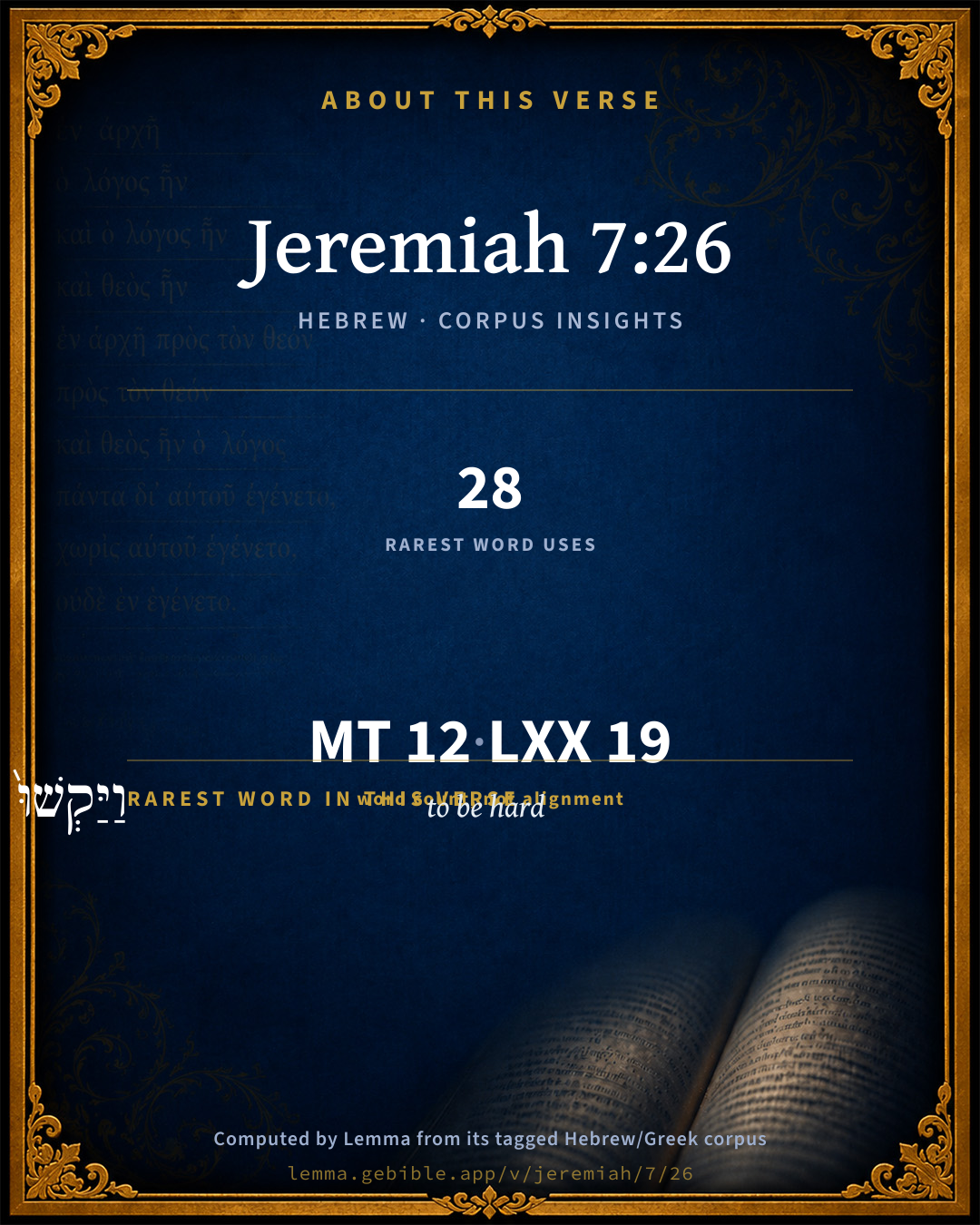
12
words
10
distinct lemmas
Prophets
section

Shared distinctive vocabulary

וַיַּקְשׁוּ֙ to be hard H7185 occurs in 28 verses of the Hebrew Bible. Also found in:

Grammatical profile

  • 4 verbs
  • 3 nouns
  • 1 preposition
  • 4 particles

Verb forms

  • שָׁמְעוּ֙ Qal · Perfect
  • הִטּ֖וּ Hiphil · Perfect
  • וַיַּקְשׁוּ֙ Hiphil · Sequential Imperfect
  • הֵרֵ֖עוּ Hiphil · Perfect

Repetition

A word recurs within this verse — often emphatic in Hebrew:

  • וְל֤וֹא not H3808 ×2

Hebrew & Septuagint length

In the original languages it is 12 Hebrew tokens and 19 Greek tokens — but the two are counted differently (Hebrew bundles its prefixes and suffixes into one token; the Greek is in lemma form), so that isn’t a like-for-like length.

Cross-references

24

Topical passages linked to Jeremiah 7:26 in the Treasury of Scripture Knowledge — connected by theme and wording, ordered by reader-vote popularity; previews shown in the World English Bible.

  • Jeremiah 16:12 and you have done evil more than your fathers; for, behold, you walk every one after the stubbornness of his evil heart, so that you don't listen to me:
  • 2 Chronicles 30:8 Now don't you be stiff-necked, as your fathers were; but yield yourselves to Yahweh, and enter into his sanctuary, which he has sanctified forever, and serve Yahweh your God, that his fierce anger may turn away from you.
  • Jeremiah 7:24 But they didn't listen nor turn their ear, but walked in [their own] counsels [and] in the stubbornness of their evil heart, and went backward, and not forward.
  • Jeremiah 17:23 But they didn't listen, neither turn their ear, but made their neck stiff, that they might not hear, and might not receive instruction.
  • Jeremiah 19:15 Thus says Yahweh of Hosts, the God of Israel, Behold, I will bring on this city and on all its towns all the evil that I have pronounced against it; because they have made their neck stiff, that they may not hear my words.
  • Matthew 23:32 Fill up, then, the measure of your fathers.
  • 2 Kings 17:14 Notwithstanding, they would not hear, but hardened their neck, like the neck of their fathers, who didn't believe in Yahweh their God.
  • 2 Chronicles 33:10 Yahweh spoke to Manasseh, and to his people; but they gave no heed.
  • Nehemiah 9:16–17 But they and our fathers dealt proudly and hardened their neck, and didn't listen to your commandments,
  • Nehemiah 9:29 and testified against them, that you might bring them again to your law. Yet they dealt proudly, and didn't listen to your commandments, but sinned against your ordinances, (which if a man do, he shall live in them), and withdrew the shoulder, and hardened their neck, and would not hear.
  • Proverbs 29:1 He who is often rebuked and stiffens his neck Will be destroyed suddenly, with no remedy.
  • Isaiah 48:4 Because I knew that you are obstinate, and your neck is an iron sinew, and your brow brass;
  • Jeremiah 6:17 I set watchmen over you, [saying], Listen to the sound of the trumpet; but they said, We will not listen.
  • Jeremiah 11:8 Yet they didn't obey, nor turn their ear, but walked everyone in the stubbornness of their evil heart: therefore I brought on them all the words of this covenant, which I commanded them to do, but they didn't do them.
  • Jeremiah 25:3 From the thirteenth year of Josiah the son of Amon, king of Judah, even to this day, these twenty-three years, the word of Yahweh has come to me, and I have spoken to you, rising up early and speaking; but you have not listened.
  • Jeremiah 25:7 Yet you have not listened to me, says Yahweh; that you may provoke me to anger with the work of your hands to your own hurt.
  • Jeremiah 26:5 to listen to the words of my servants the prophets, whom I send to you, even rising up early and sending them, but you have not listened;
  • Jeremiah 29:19 because they have not listened to my words, says Yahweh, with which I sent to them my servants the prophets, rising up early and sending them; but you would not hear, says Yahweh.
  • Jeremiah 34:14 At the end of seven years you shall let go every man his brother who is a Hebrew, who has been sold to you, and has served you six years, you shall let him go free from you: but your fathers didn't listen to me, neither inclined their ear.
  • Jeremiah 44:16 As for the word that you have spoken to us in the name of Yahweh, we will not listen to you.
  • Daniel 9:6 neither have we listened to your servants the prophets, who spoke in your name to our kings, our princes, and our fathers, and to all the people of the land.
  • Matthew 21:38 But the farmers, when they saw the son, said among themselves, 'This is the heir. Come, let's kill him, and seize his inheritance.'
  • Acts 7:51 "You stiff-necked and uncircumcised in heart and ears, you always resist the Holy Spirit! As your fathers did, so you do.
  • Romans 2:5 But according to your hardness and unrepentant heart you are treasuring up for yourself wrath in the day of wrath, revelation, and of the righteous judgment of God;

Cross-references courtesy of OpenBible.info (CC BY 4.0).

Hebrew and Greek witnesses Masoretic Hebrew ↔ Greek Septuagint

The same verse in the two great witnesses to the Old Testament, shown verse-for-verse.

These are two independent witnesses, not word-aligned to each other, and the Septuagint is shown in lemma (dictionary) form.

Hebrew Jeremiah 7:26 Masoretic · Westminster Leningrad Codex

וְל֤וֹא שָׁמְעוּ֙ אֵלַ֔י וְלֹ֥א הִטּ֖וּ אֶת אָזְנָ֑ם וַיַּקְשׁוּ֙ אֶת עָרְפָּ֔ם הֵרֵ֖עוּ מֵאֲבוֹתָֽם

yet they didn't listen to me, nor inclined their ear, but made their neck stiff: they did worse than their fathers.

World English Bible · Public Domain

Greek LXX Structure differs

In the Septuagint, Jeremiah is about an eighth shorter than the Hebrew and arranges its material differently — the Oracles Against the Nations (Hebrew chapters 46–51) appear in the middle of the Greek book, after 25:13. Because the chapter and verse boundaries do not line up, a verse-for-verse comparison with the Hebrew is not shown.

A verse-for-verse comparison isn’t shown here because the chapters and verses don’t line up. Switch to the LXX edition with the MT / LXX toggle above to read the Greek directly.

Hebrew: Westminster Leningrad Codex (CC BY 4.0). Greek: Septuagint (public domain); English from a public-domain English Septuagint. How the Septuagint differs from the Hebrew →

Targum (Aramaic paraphrase)

1

The Targum is the ancient Jewish Aramaic paraphrase of the Hebrew Scriptures — an interpretive translation, not the Hebrew text itself. Onkelos (literal) and Pseudo-Jonathan (expansive) render the Torah, and Jonathan the Prophets. Coverage is partial: where no permissively-licensed English translation exists for a verse, only the Aramaic is shown. This is verse-level text, not a word-by-word alignment to the Hebrew.

  1. Targum Jonathan Prophets (Joshua–Malachi)
    וְלָא קַבִּילוּ לְמֵימְרִי וְלָא אַרְכִינוּ יַת אוּדְנֵיהוֹן וְקַשִׁיאוּ יַת קְדַלְהוֹן אַבְאִישׁוּ מֵאֲבָהַתְהוֹן:

    (no public-domain English translation for this verse)

    Targum Jonathan — Aramaic: “Mikraot Gedolot” (public domain). English: “Sefaria Community Translation” (CC0 1.0 (public-domain dedication)); “London "Chaldee Paraphrase," 1871” (public domain). Text via Sefaria.

Commentary

Notes on Jeremiah 7:26 from classic Christian and Jewish commentators (each source and its license shown beneath its notes). The classic Christian expositions comment on the surrounding passage and are grouped to its opening verse, so a note may address several verses; the Jewish commentaries on the Tanakh (Rashi and others) are per-verse, so they appear only where the commentator wrote on this verse.

Lemma curates 59 commentaries, every one of them public domain or Creative Commons licensed, each selected and text-cleaned for this edition rather than reprinted as found. About our sources →

Trapp's Complete Commentary

John Trapp

Jer 7:26 Yet they hearkened not unto me, nor inclined their ear, but hardened their neck: they did worse than their fathers.

Ver. 26. Yet they hearkened not unto me.] This God speaketh to the prophet, as weary of talking to them any longer, since it was to no better purpose.

John Trapp, A Commentary or Exposition upon All the Books of the Old and New Testament (1647–1656) — public domain. Text from a community e-Sword module.

Jamieson, Fausset & Brown

Robert Jamieson, A. R. Fausset & David Brown

hardened . . . neck-- (Deu 31:27; Isa 48:4; Act 7:51).

worse than their fathers-- (Jer 16:12). In Jer 7:22 He had said, "your fathers"; here He says, "their fathers"; the change to the third person marks growing alienation from them. He no longer addresses themselves, as it would be a waste of words in the case of such hardened rebels.

Jamieson, Fausset & Brown — Commentary Critical and Explanatory on the Whole Bible (1871) — public domain (CC PDM 1.0). Text via the HelloAO Bible API.

John Calvin's Commentaries

He afterwards subjoins, And they hearkened not There is here a change of person; for he said in the last verse, “your fathers,” “I sent to you;” but now he says, They hearkened not, nor inclined their ear It is indeed true, that the reference is to the fathers; but in the next verse God includes the people who were then living. There is then no doubt but that it was an evidence of indignation, that he changed the person, and that he was wearied in addressing them, for he saw that he spoke in vain to a stupid people: and this will appear evident from the next verse. They hearkened not, he says, nor inclined their ear The words we have already explained: the Jews are here precluded from having any excuse on the ground of error or ignorance; for they had refused to be taught, they would not attend, but on the contrary made deaf their cars. And he says also, that they hardened their neck; by which their perverseness is still more fully expressed: they designedly as it were despised God, and carried on war even with his favor and kindness. And he concludes by saying, that they had done worse than their fathers He had said, “your fathers;” but now, “their fathers.” We hence see that the sentence is changed, for God knew that he could produce no effect on them, as we find by what follows —

John Calvin's Commentaries (1540-1563) — public domain. Text from the Calvin Translation Society English edition (1840s-50s) via the Christian Classics Ethereal Library (ccel.org). Calvin's coverage is partial (roughly two-thirds of the Bible); uncommented books and verses are honest gaps, never fabricated. The 19th-century editor's footnotes and remarks are omitted so the notes are faithfully Calvin's own voice.

Ellicott's Commentary for English Readers

(26) Worse than their fathers.—The rapid survey of the past makes it doubtful whether the comparison is made between the generations that came out of Egypt and their immediate followers, or between those followers and their successors. Probably the general thought was that the whole history of Israel had been one of progressive deterioration, reaching its climax in the generation in which Jeremiah lived. His words find a striking parallel in the complaint of the Roman historian (Livy, Præf), or of the poet :—

“Ætas parentum, pejor avis, tulit

Nos nequiores.”—Hor., Od. iii. 6.

“Our fathers’ age, more stained with crime

Than were their sires in older time,

Has brought us forth a later race

Yet more iniquitous and base.”

A Bible Commentary for English Readers, edited by Charles John Ellicott (1878–1897) — public domain. Text from a community e-Sword module.

The Cambridge Bible for Schools and Colleges

gen. ed. J. J. S. Perowne

26. made their neck stiff] Cp. for the phrase ch. Jer_19:15; 2Ki_17:14; Neh_9:16-17; Neh_9:29; Pro_29:1.

The Cambridge Bible for Schools and Colleges (gen. ed. J. J. S. Perowne; Cambridge University Press, 1878–1918) — public domain. Text from a community e-Sword module.

John Gill's Exposition

Yet they hearkened not unto me,.... Speaking by the prophets:

nor inclined their ear; to what was said to them; would not listen to it, and much less obey what was commanded them:

but hardened their neck; and so became stiffnecked, and would not submit to bear the yoke of the law:

they did worse than their fathers; every generation grew more and more wicked, and went on to be so until the measure of their iniquity was filled up; hence it follows:

John Gill's Exposition of the Whole Bible (1746–1763) — public domain (CC PDM 1.0). Text via the HelloAO Bible API.

Matthew Poole's English Annotations

Their fathers had done bad enough, but they were so far from reforming, that they did worse than their fathers, Jdg 2:19, Jer 9:3; and whereas he had said before your fathers, now changing the person he saith

their fathers, as it were in great displeasure turning away from them to the prophet, as one speaking, but in vain, to such a stupid people.

Matthew Poole's English Annotations on the Holy Bible (1683–1685) — public domain. Text from a community e-Sword/MySword module.

Lesson kit

Teaching starters — assembled from the data on this page, not authored interpretation. Every prompt links to the verse data it draws on. Edit before teaching.

Jeremiah, in the Prophets, opens this verse with 12 words (10 distinct Hebrew lemmas). Its most distinctive word is qâshâh (“to be hard”). A historical commentator’s framing appears above. Read the whole chapter for the surrounding context.

Discussion questions

  1. What does “to be hard” (qâshâh) contribute to the verse as a whole?
  2. Genesis 35:16 shares the word «to be hard» with this verse. How do the two illuminate each other?
  3. “not” occurs 2× in this one verse. What is the effect of the repetition?
  4. These translations render this verse differently; the difference is in the English rendering, not the original. What questions does that raise?
  5. The verb «שָׁמְעוּ֙» is Qal Perfect. How does its form color the action?
  6. Reading how Trapp's Complete Commentary and Jamieson, Fausset & Brown read this verse, where do the two commentators agree and where do they part?

Things to notice

Reading settings

Reading text

Shown beneath each verse's original-language words.

Old Testament
Old Testament edition

Read the OT as the Masoretic Hebrew (MT) or the Greek Septuagint (LXX).

English shown for the Greek Septuagint (in the Hebrew ↔ Greek comparison).

Comparing translations? Open the Compare panel on any verse page to stack up to four side by side.