
Numbers 22:33

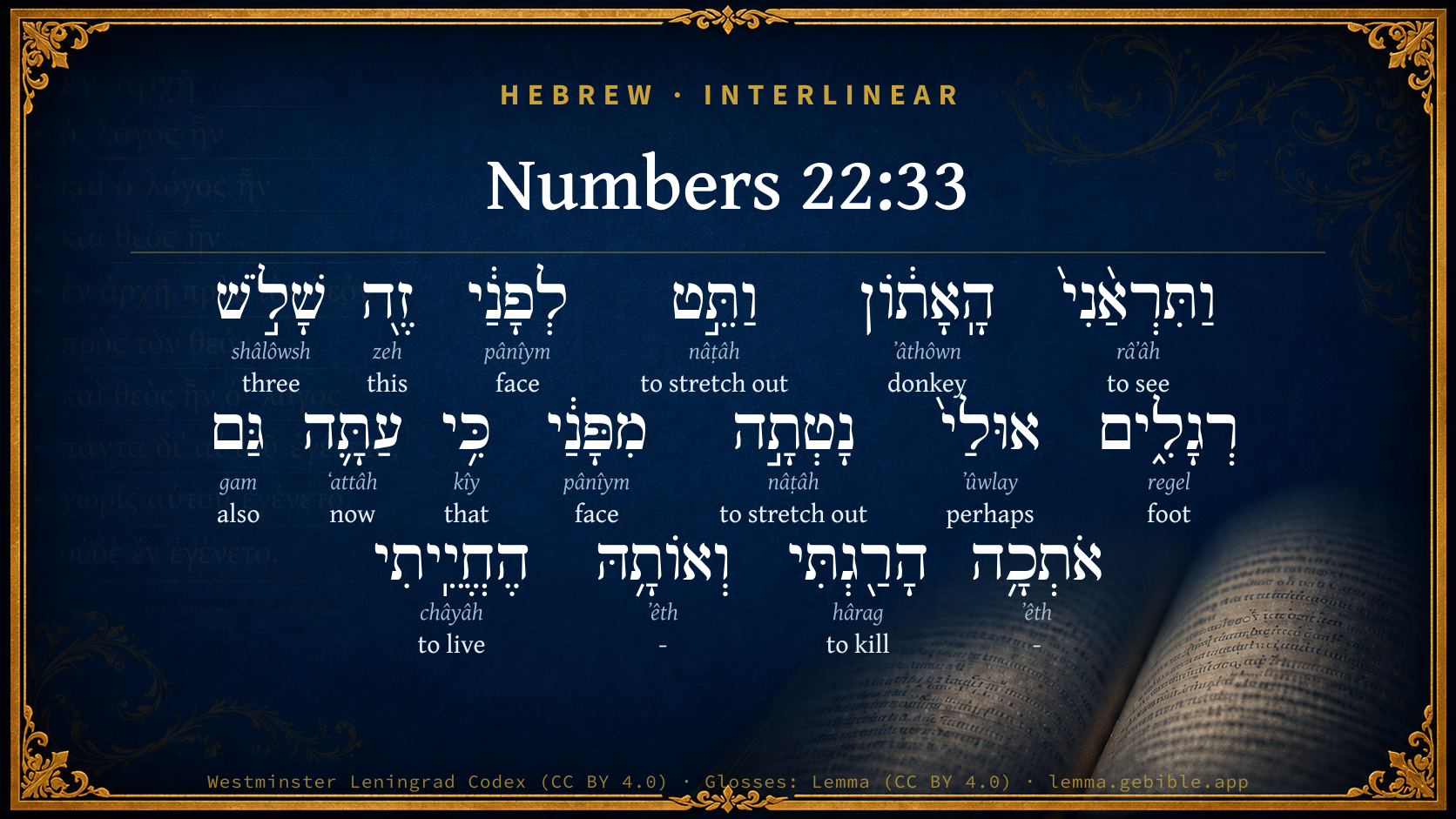
Hebrew (Westminster Leningrad Codex) Numbers 22:33 appears in the Hebrew Old Testament. The text above is from the Westminster Leningrad Codex. Each word links to its Strong’s number, a concise gloss, and parsing drawn from the Open Scriptures Hebrew Bible morphology. Click any word for its full Brown-Driver-Briggs (BDB) entry.
Download image
Cite this verse

Numbers 22:33 (World English Bible). Public Domain. Lemma interlinear Bible study tool, https://lemma.gebible.app/v/numbers/22/33.

Show BibTeX & RIS
BibTeX
RIS
English Translation
and the donkey saw me, and turned aside before me these three times: unless she had turned aside from me, surely now I had even slain you, and saved her alive.
World English Bible · Public Domain
Download a study sheet

One document with this verse’s original text, its word-by-word gloss line, the meaning frame, cross-references with their text, attributed commentary, and full source and license credits — printable, and it pastes into notes with its structure intact.

This verse Autodidact and up

Study sheet (.html) Plain text (.txt)

A passage Seminary Student

Up to 50 verses in one chapter. A passage sheet keeps up to 6 commentary sources and 12 cross-references per verse, in the order this page ranks them, and says so on the sheet whenever that leaves anything out. Ask for a single verse and you get the Autodidact verse sheet above.

Everything on this page stays free to read, with no account — the sheet is a download of what is already on screen, not access to it.

Want to remove ads? Support Godless Engineer
Compare translations 3

The same verse in 3 English versions, stacked beneath the original-language interlinear above. Click any original word for its lexicon entry.

Each is an independent rendering of the whole verse — the interlinear is not word-aligned to these translations.

Highlighted words mark where these versions differ — a whole-verse word diff, not a word-by-word alignment.

  • World English Bible Public Domain
    and the donkey saw me, and turned aside before me these three times: unless she had turned aside from me, surely now I had even slain you, and saved her alive.
  • King James Version Public Domain
    And the ass saw me, and turned from me these three times: unless she had turned from me, surely now also I had slain thee, and saved her alive.
  • unfoldingWord Literal Text CC BY-SA 4.0
    And the female donkey saw me and turned aside from my face these three times. Perhaps she turned aside from my face, for now I would have even killed you and kept her alive.”

unfoldingWord Literal Text — © unfoldingWord, licensed CC BY-SA 4.0. Word-aligned USFM3 via Door43 (git.door43.org/unfoldingWord/en_ult).

Versions to compare (up to 4)

3 of 4 selected

Show all 18 translations

Every available English version of this verse, each an independent rendering of the whole verse.

  • World English Bible Public Domain
    and the donkey saw me, and turned aside before me these three times: unless she had turned aside from me, surely now I had even slain you, and saved her alive.
  • Berean Standard Bible Public Domain
    The donkey saw me and turned away from me these three times. If she had not turned away, then by now I would surely have killed you and let her live.”
  • Majority Standard Bible Public Domain
    The donkey saw me and turned away from me these three times. If she had not turned away, then by now I would surely have killed you and let her live.”
  • King James Version Public Domain
    And the ass saw me, and turned from me these three times: unless she had turned from me, surely now also I had slain thee, and saved her alive.
  • American Standard Version (1901) Public Domain
    and the ass saw me, and turned aside before me these three times: unless she had turned aside from me, surely now I had even slain thee, and saved her alive.
  • Revised Version (1885) Public Domain
    and the ass saw me, and turned aside before me these three times: unless she had turned aside from me, surely now I had even slain thee, and saved her alive.
  • Geneva Bible (1599) Public Domain
    But the asse sawe me, and turned from me now three times: for els, if she had not turned from me, surely I had euen nowe slaine thee, and saued her aliue.
  • Douay-Rheims (1899) Public Domain
    And unless the ass had turned out of the way, giving place to me who stood against thee, I had slain thee, and she should have lived.
  • Young's Literal Translation Public Domain
    and the ass seeth me, and turneth aside at my presence these three times; unless she had turned aside from my presence, surely now also, thee I had slain, and her kept alive.'
  • Literal Standard Version CC BY-SA 4.0
    and the donkey sees Me and turns aside at My presence these three times; unless she had turned aside from My presence, surely I had also slain you now, and kept her alive.”
  • Unlocked Literal Bible CC BY-SA 4.0
    The donkey saw me and turned away from me these three times. If she had not turned away from me, I would certainly have killed you and spared her life.”
  • unfoldingWord Literal Text CC BY-SA 4.0
    And the female donkey saw me and turned aside from my face these three times. Perhaps she turned aside from my face, for now I would have even killed you and kept her alive.”
  • Darby Bible Public Domain
    And the ass saw me, and turned from me these three times; had she not turned from me, I had now certainly slain thee, and saved her alive.
  • World Messianic Bible Public Domain
    The donkey saw me, and turned away before me these three times. Unless she had turned away from me, surely now I would have killed you, and saved her alive.”
  • Webster's Bible Public Domain
    And the ass saw me, and turned from me these three times: unless she had turned from me, surely now also I had slain thee, and saved her alive.
  • Free Bible Version CC BY-SA 4.0
    The donkey saw me and avoided me three times. If it had not avoided me, by now I definitely would have killed you and allowed the donkey to live.”
  • Bible in Basic English Public Domain
    And the ass saw me, turning to one side from me three times: if she had not gone to one side, I would certainly have put you to death and kept her safe.
  • JPS Tanakh (1917) Public Domain
    and the ass saw me, and turned aside before me these three times; unless she had turned aside from me, surely now I had even slain thee, and saved her alive.'

Literal Standard Version (2020), Covenant Press — licensed CC BY-SA 4.0. Text via the HelloAO Bible API (eBible.org). Unlocked Literal Bible (unfoldingWord) — licensed CC BY-SA 4.0. Text via the HelloAO Bible API (eBible.org). unfoldingWord Literal Text — © unfoldingWord, licensed CC BY-SA 4.0. Word-aligned USFM3 via Door43 (git.door43.org/unfoldingWord/en_ult). Free Bible Version, Dr. Jonathan Gallagher — licensed CC BY-SA 4.0. Text via the HelloAO Bible API (eBible.org).

Word by word

More ways to search: Search by grammar → Find every occurrence → Compare this word →

Practice this passage: Drill this verse → Learn its vocabulary →

הָֽאָת֔וֹן
ʼâthôwn
H860
“the · donkey”
Particle, Definite Article + Noun, Common, Feminine, Singular, Absolute
Part of Speech
Particle + Noun
Type
Common
Gender
Feminine
Number
Singular
State
Absolute
Full BDB Definition

Origin: probably from the same as H386 (sense of patience)

TWOT: 190a

she-ass, she-donkey
  1. וַתִּרְאַ֨נִי֙ râʼâh H7200 “and · to see · me” Conjunction + Verb, Qal, Sequential Imperfect, 3rd Person, Feminine, Singular + Suffix, Personal, 1st Person, Common, Singular
  2. וַתֵּ֣ט nâṭâh H5186 “and · to stretch out” Conjunction + Verb, Qal, Sequential Imperfect, 3rd Person, Feminine, Singular
  3. לְפָנַ֔י pânîym H6440 “to/for · face(s) · my” Preposition + Noun, Common, Both, Plural, Construct + Suffix, Personal, 1st Person, Common, Singular
  4. זֶ֖ה zeh H2088 “this” Pronoun, Demonstrative, Masculine, Singular
  5. שָׁלֹ֣שׁ shâlôwsh H7969 “three” Adjective, Cardinal number, Feminine, Singular, Absolute
  6. רְגָלִ֑ים regel H7272 “feet” Noun, Common, Feminine, Plural, Absolute
  7. אוּלַי֙ ʼûwlay H194 “perhaps” Adverb
  8. נָטְתָ֣ה nâṭâh H5186 “to stretch out” Verb, Qal, Perfect, 3rd Person, Feminine, Singular
  9. מִפָּנַ֔י pânîym H6440 “from · face(s) · my” Preposition + Noun, Common, Both, Plural, Construct + Suffix, Personal, 1st Person, Common, Singular
  10. כִּ֥י kîy H3588 “that” Conjunction
  11. עַתָּ֛ה ʻattâh H6258 “now” Adverb
  12. גַּם gam H1571 “also” Particle, Accusative
  13. אֹתְכָ֥ה ʼêth H853 “- · you” Particle, Direct Object + Suffix, Personal, 2nd Person, Masculine, Singular
  14. הָרַ֖גְתִּי hârag H2026 “to kill” Verb, Qal, Perfect, 1st Person, Common, Singular
  15. וְאוֹתָ֥הּ ʼêth H853 “and · - · her” Conjunction + Particle, Direct Object + Suffix, Personal, 3rd Person, Feminine, Singular
  16. הֶחֱיֵֽיתִי châyâh H2421 “to live” Verb, Hiphil, Perfect, 1st Person, Common, Singular

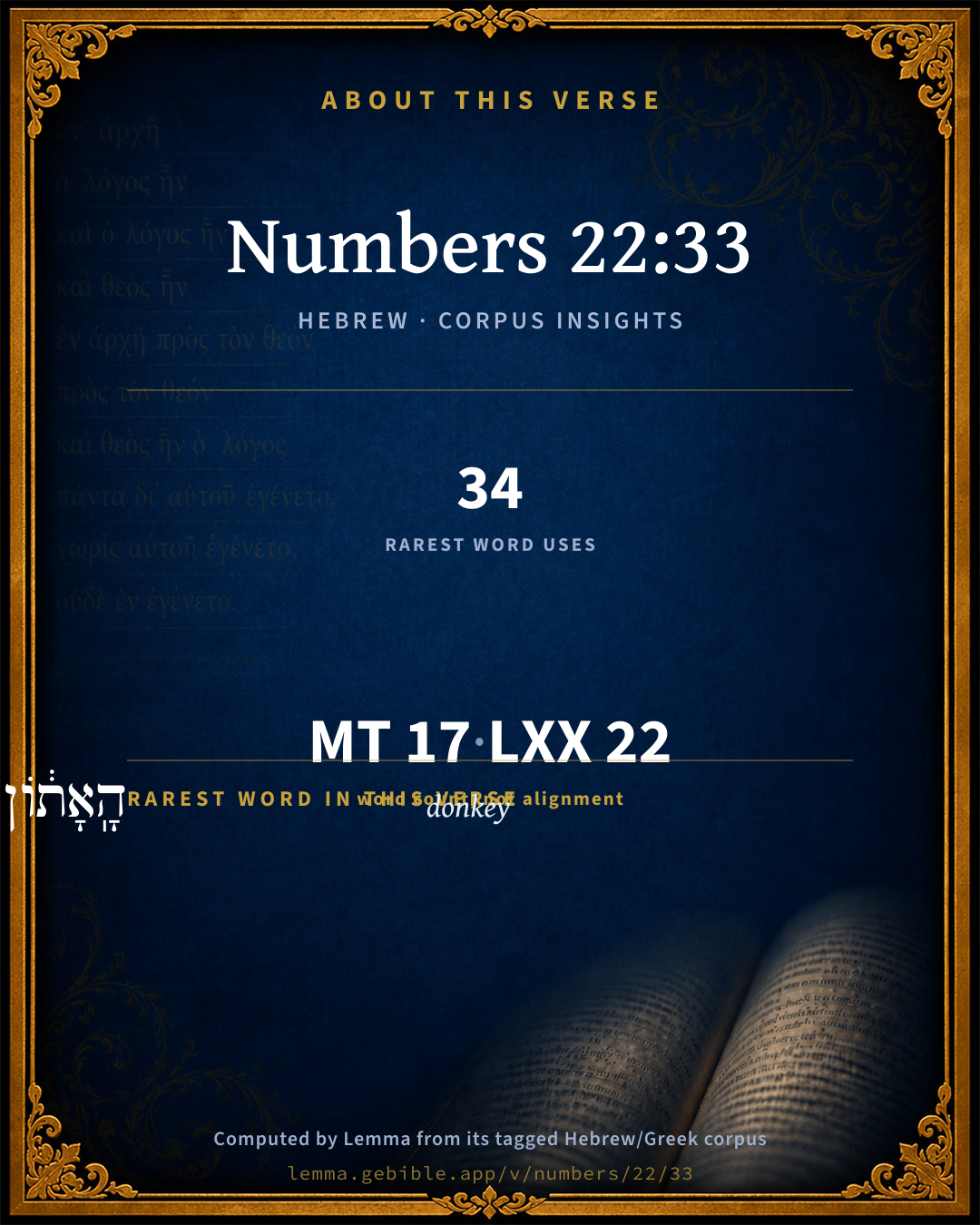
About this verse

These counts appear in no published source. They are computed here, from the morphology-tagged text and Lemma’s own curated glosses. What Lemma adds →

17
words
14
distinct lemmas
Pentateuch
section

Shared distinctive vocabulary

הָֽאָת֔וֹן donkey H860 occurs in 28 verses of the Hebrew Bible. Also found in:

Grammatical profile

  • 5 verbs
  • 4 nouns
  • 1 adjective
  • 1 pronoun
  • 1 conjunction
  • 2 adverbs
  • 3 particles

Verb forms

  • וַתִּרְאַ֨נִי֙ Qal · Sequential Imperfect
  • וַתֵּ֣ט Qal · Sequential Imperfect
  • נָטְתָ֣ה Qal · Perfect
  • הָרַ֖גְתִּי Qal · Perfect
  • הֶחֱיֵֽיתִי Hiphil · Perfect

Repetition

Words recur within this verse — often emphatic in Hebrew:

  • וַתֵּ֣ט to stretch out H5186 ×2
  • לְפָנַ֔י face H6440 ×2

Hebrew & Septuagint length

In English translation the verse runs 31 words from the Hebrew and 23 from the Septuagint (LXX English) — closely comparable.

A rough comparison of the two English renderings, which tokenize alike — not a word-level alignment.

Word counts can differ between the Hebrew and the Greek without any difference in meaning — e.g. the Hebrew direct-object marker אֵת has no separate Greek word, and Greek often adds the article ὁ.

In the original languages it is 17 Hebrew tokens and 22 Greek tokens — but the two are counted differently (Hebrew bundles its prefixes and suffixes into one token; the Greek is in lemma form), so that isn’t a like-for-like length.

Cross-references

3

Topical passages linked to Numbers 22:33 in the Treasury of Scripture Knowledge — connected by theme and wording, ordered by reader-vote popularity; previews shown in the World English Bible.

  • Numbers 14:37 even those men who did bring up an evil report of the land, died by the plague before Yahweh.
  • Numbers 16:33–35 So they, and all that appertained to them, went down alive into Sheol: and the earth closed on them, and they perished from among the assembly.
  • 1 Kings 13:24–28 When he was gone, a lion met him by the way, and killed him: and his body was cast in the way, and the donkey stood by it; the lion also stood by the body.

Cross-references courtesy of OpenBible.info (CC BY 4.0).

Hebrew and Greek witnesses Masoretic Hebrew ↔ Greek Septuagint

The same verse in the two great witnesses to the Old Testament, shown verse-for-verse.

These are two independent witnesses, not word-aligned to each other, and the Septuagint is shown in lemma (dictionary) form.

Hebrew Numbers 22:33 Masoretic · Westminster Leningrad Codex

וַתִּרְאַ֨נִי֙ הָֽאָת֔וֹן וַתֵּ֣ט לְפָנַ֔י זֶ֖ה שָׁלֹ֣שׁ רְגָלִ֑ים אוּלַי֙ נָטְתָ֣ה מִפָּנַ֔י כִּ֥י עַתָּ֛ה גַּם אֹתְכָ֥ה הָרַ֖גְתִּי וְאוֹתָ֥הּ הֶחֱיֵֽיתִי

and the donkey saw me, and turned aside before me these three times: unless she had turned aside from me, surely now I had even slain you, and saved her alive.

World English Bible · Public Domain

Greek LXX Numbers 22:33 Septuagint · lemma form

καί ὁράω ἐγώ ὁ ὄνος ἐκκλίνω ἀπό ἐγώ τρίτος οὗτος καί εἰ μή ἐκκλίνω νῦν οὖν σύ μέν ἀποκτείνω ἐκεῖνος δέ περιποιέω

And if she had not turned out of the way, surely now, I should have slain you, and should have saved her alive.

LXX2012 (modern English Septuagint) · Public Domain

On this verse, The Pulpit Commentary discusses the Septuagint’s reading. Read the note in Commentary ↓

Hebrew: Westminster Leningrad Codex (CC BY 4.0). Greek: Septuagint (public domain); English from LXX2012 (modern English Septuagint) (Public Domain). How the Septuagint differs from the Hebrew →

Targum (Aramaic paraphrase)

2

The Targum is the ancient Jewish Aramaic paraphrase of the Hebrew Scriptures — an interpretive translation, not the Hebrew text itself. Onkelos (literal) and Pseudo-Jonathan (expansive) render the Torah, and Jonathan the Prophets. Coverage is partial: where no permissively-licensed English translation exists for a verse, only the Aramaic is shown. This is verse-level text, not a word-by-word alignment to the Hebrew.

  1. Targum Onkelos Torah (Genesis–Deuteronomy)
    וַחֲזַתְנִי אֲתָּנָא וּסְטַת מִן קֳדָמַי דְנַן תְּלַת זִמְנִין אִילוּפוֹן לָא סְטַּת מִן קֳדָמַי אֲרֵי כְעַן אַף יָתָךְ קְטָלִית וְיָתַהּ קַיֵימִית

    (no public-domain English translation for this verse)

    Targum Onkelos — Aramaic: “Onkelos Genesis” (public domain); “Onkelos Exodus” (public domain); “Onkelos Leviticus” (public domain); “Onkelos Numbers” (public domain); “Onkelos Deuteronomy” (public domain). English: “Sefaria Community Translation” (CC0 1.0 (public-domain dedication)); “J.W. Etheridge. The Targums of Onkelos and Jonathan Ben Uzziel on the Pentateuch. London: Longmans, Green, 1862” (public domain). Text via Sefaria.

  2. Targum Pseudo-Jonathan Torah (Genesis–Deuteronomy)
    וַחֲמַתְנִי אַתְנָא וּסְטַת מִן קֳדָמַי דְנַן תְּלַת זִמְנִין אִלוּלֵי פוֹן לָא סְטַת מִן קֳדָמַי אֲרוּם כְּעַן אוּף יָתָךְ קְטָלִית וְיָתָהּ קַיֵימִית

    But the ass discerned me, and turned away from me these three times: had she not turned from me, surely now I should have slain thee, and spared her alive.

    Targum Pseudo-Jonathan — Aramaic: “Targum Jonathan on Genesis” (public domain); “Targum Jonathan on Exodus” (public domain); “Targum Jonathan on Leviticus” (public domain); “Targum Jonathan on Numbers” (public domain); “Targum Jonathan on Deuteronomy” (public domain). English: “The Targum of Jonathan ben Uzziel, trans. J. W. Etheridge, London, 1862” (public domain). Text via Sefaria.

Commentary

Notes on Numbers 22:33 from classic Christian and Jewish commentators (each source and its license shown beneath its notes). The classic Christian expositions comment on the surrounding passage and are grouped to its opening verse, so a note may address several verses; the Jewish commentaries on the Tanakh (Rashi and others) are per-verse, so they appear only where the commentator wrote on this verse.

Lemma curates 59 commentaries, every one of them public domain or Creative Commons licensed, each selected and text-cleaned for this edition rather than reprinted as found. About our sources →

Trapp's Complete Commentary

John Trapp

Num 22:33 And the ass saw me, and turned from me these three times: unless she had turned from me, surely now also I had slain thee, and saved her alive.

Ver. 33. I had slain thee.] As thou wouldst have slain thine ass, for a less fault.

John Trapp, A Commentary or Exposition upon All the Books of the Old and New Testament (1647–1656) — public domain. Text from a community e-Sword module.

Joseph Benson's Commentary

Num 22:33. I had slain thee — Thee alone, and not the ass; therefore her turning aside and falling down was wholly for thy benefit, not for her own, and thy anger against her was unjust and unreasonable.

Joseph Benson's Commentary on the Old and New Testaments (1811–1818) — public domain. Text from a community e-Sword module.

Adam Clarke's Commentary

Verse 33. Surely now also I had slain thee] How often are the meanest animals, and the most trivial occurrences, instruments of the preservation of our lives, and of the salvation of our souls! The messenger of justice would have killed Balaam, had not the mercy of God prevented the ass from proceeding.

Adam Clarke's Commentary on the Bible (1810–1826) — public domain. Text from a community e-Sword/MySword module.

Ellicott's Commentary for English Readers

(33) Unless she had turned from me.—There may be an aposiopesis in this verse. Perhaps she turned aside from (or, before) me . . . for (otherwise) now I had killed thee, &c. According to this view the angel does not assign a reason why the ass turned aside, but leaves this to be inferred by Balaam. (Comp. Keil, in loc.)

A Bible Commentary for English Readers, edited by Charles John Ellicott (1878–1897) — public domain. Text from a community e-Sword module.

John Gill's Exposition

And when Balak heard that Balaam was come,.... Messengers being sent to acquaint him with it, either by Balaam, or by the princes:

he went out to meet him; overjoyed at the news that his princes had succeeded, and to show him respect, and do him honour, and all to encourage him to do his utmost for him:

unto a city of Moab, which is in the border of Arnon, which is in the utmost coast; by the situation of it, being on the border of the river Arnon, which river was in the extreme parts of Moab, and divided between the Moabites and Amorites, it is generally thought to be the city Ar, called "Ar of Moab", see Num 21:13, and the king coming to meet Balaam so far as the uttermost border of his dominions showed the greater respect to him.

John Gill's Exposition of the Whole Bible (1746–1763) — public domain (CC PDM 1.0). Text via the HelloAO Bible API.

Haydock's Catholic Bible Commentary

CHAPTER XXII.

George Leo Haydock (1774–1849), Haydock's Catholic Family Bible and Commentary, 1859 edition — public domain. Excludes Psalms (Douay-Rheims chapter numbering differs from Protestant) and Deuterocanonical books (Catholic canon only).

Matthew Poole's English Annotations

I had slain thee alone, and left her; and therefore her turning aside and falling down was wholly for thy sake and benefit, not for her own, and thy anger against her was unjust and unreasonable.

Matthew Poole's English Annotations on the Holy Bible (1683–1685) — public domain. Text from a community e-Sword/MySword module.

Whedon's Commentary on the Bible

Daniel D. Whedon

33. Unless she had turned — “This rendering,” says Keil, “cannot be defended according to the rules of the language.” He translates it thus: “Perhaps it turned out before me; for otherwise I should have killed thee and let her live,” leaving it uncertain why the ass had turned out of the way. Knobel suggests a slight alteration of the text, so that it will read unless instead of perhaps. Furst sustains the amendment.

And saved her alive — An instance of killing a prophet and sparing his ass occurs in 1Ki_13:23-28. The cabalists infer that this ass did die immediately after speaking, lest the heathen should worship her as a god.

Daniel D. Whedon (gen. ed.), Commentary on the Old and New Testaments (1874–1909) — public domain. Text from a community e-Sword module.

The Pulpit Commentary

Unless ... surely. yKiAAAylWa. It is somewhat doubtful whether this phrase can be translated as in the Septuagint (ei mh ... nun oun ) and in all the versions; but even if the construction of the sentence be broken, this is no doubt the meaning of it. And saved her alive. Compare the case of the ass of the disobedient prophet in 1Ki_13:24. It is plainly a righteous thing with God that obedience and faithfulness should be respected, and in some sense rewarded, even in an ass.

The Pulpit Commentary (1880–1919), ed. H.D.M. Spence-Jones & Joseph S. Exell — public domain. Text from a community e-Sword module.

John Wesley's Explanatory Notes

I had slain thee - I had slain thee alone, and not her, therefore her turning aside and falling down was wholly for thy benefit, not for her own, and thy anger against her was unjust and unreasonable.

John Wesley, Explanatory Notes Upon the Whole Bible (1754–1765) — public domain. Text via the GEBible commentary corpus.

Keil & Delitzsch

C. F. Keil & F. Delitzsch

The angel of the Lord sought to preserve Balaam from the destruction which threatened him, by standing in his way; but he did not see him, though his ass did. וגו נטתה אוּלי, "perhaps it turned out before me; for otherwise I should surely have killed thee, and let her live." The first clause is to be regarded, as Hengstenberg supposes, as an aposiopesis. The angel does not state positively what was the reason why perhaps the ass had turned out of the way: he merely hints at it lightly, and leaves it to Balaam to gather from the hint, that the faithful animal had turned away from affection to its master, with a dim foreboding of the danger which threatened him, and yet for that very reason, as it were as a reward for its service of love, had been ill-treated by him. The traditional rendering, "if the ass had not turned aside, surely," etc., cannot be defended according to the rules of the language; and there is not sufficient ground for any such alteration of the text as Knobel suggests, viz., into לוּלי. These words made an impression, and Balaam made this acknowledgment (Num 22:34): "I have sinned, for I knew not that thou stoodest in the way against me; and now, if it displease thee, I will get me back again." The angel of the Lord replied, however (Num 22:35): "Go with the men; but only the word that I shall speak unto thee, that shalt you speak." This was sufficient to show him, that it was not the journey in itself that was displeasing to God, but the feelings and intentions with which he had entered upon it. The whole procedure was intended to sharpen his conscience and sober his mind, that he might pay attention to the word which the Lord would speak to him. At the same time the impression which the appearance and words of the angel of the Lord made upon his heart, enveloped in mist as it was by the thirst for gold and honour, was not a deep one, nor one that led him to a thorough knowledge of his own heart; otherwise, after such a warning, he would never have continued his journey.

Keil & Delitzsch — Biblical Commentary on the Old Testament (1861–1891) — public domain (CC PDM 1.0). Text via the HelloAO Bible API. (Old Testament only.)

Rashi

Rabbi Shlomo Yitzchaki (Rashi)

אולי נטתה — This is the same as לולא: UNLESS SHE HAD [TURNED ASIDE]. Sometimes אולי is used in the sense of לולא “unless”.

גם אתכה הרגתי SURELY NOW ALSO THEE HAD I SLAIN — This is an inverted sentence, and it is the same as גם הרגתי אותך — I would also have slain thee, as much as to say: not only would this delay have happened to you through me, but death also.

ואותה החייתי AND IT WOULD I HAVE KEPT ALIVE — but now because it spoke and rebuked you andyou could not stand against its rebuke, — just as it is written, "and he said, No!" — I have killed it in order that people should not be able to say: This is the animal that silenced Balaam by its rebuke, so that he could not reply. For God has regard for human dignity. Similar is (Leviticus 20:16): “And thou shalt slay the woman and the animal (with which sin was committed)”, and similarly Leviticus 20:15): “And the animal shalt thou slay” (Midrash Tanchuma, Balak 9).

Rashi on the Tanakh — English translations: “The Judaica Press complete Tanach with Rashi, translated by A. J. Rosenberg” (CC BY 4.0); “Pentateuch with Rashi's commentary by M. Rosenbaum and A.M. Silbermann, 1929-1934” (public domain); “The Metsudah Tanach series, Lakewood, N.J” (CC BY 4.0); and “The Book of Joshua, Metsudah Publications, 1997” (CC BY 4.0). Text via Sefaria.

Ramban (Nachmanides)

Rabbi Moshe ben Nachman (Ramban / Nachmanides)

AND SHE TURNED ASIDE ‘L’PHANAI’ (BEFORE ME). Commentators (‘from’ before me) and not l’phanai (‘before’ me). have explained this [word ‘l’phanai’ as meaning]: “and she turned aside into the field when she was before me.” But there is no need [for this interpretation and addition], for the meaning [of the word l’phanai] is like mipanai (“from” before me), for such is the usage of the letter lamed, as in [the verses]; and they left off ‘livnoth’ (to build) the city [which is like mivnoth — literally: “from building” the city]; he hath left off ‘l’haskil’ (to be wise), to do good [which is like meihaskil — literally: “from being wise”]. There are also many other cases [like this]. Similarly: And Joab and the captains of the host went out ‘liphnei’ [literally: “before,” but really meaning mipnei — “from before,” i.e. “from the presence of”] the king, to number the people of Israel.

ULAI’ normally means “perhaps,” which is inappropriate in the context of this verse, since there was no doubt as to whether the ass had turned aside. Hence the commentators explained it as meaning lulei — “unless,” and the angel is thus saying, in defense of the animal, that “had she not turned aside from me, I would have killed you [Balaam].” Ramban later on offers his own interpretation of the verse and the word ulai actually used by Scripture. SHE HAD TURNED ASIDE FROM ME. In the opinion of the commentators [the word ‘ulai’ here] is like lulei — “‘unless’ she had turned aside from me [surely now also I had slain thee.” The word ulai] in this context is thus used [with a meaning] different than that of all the other occasions where it is found. But in my opinion it is used here in its literal meaning [“perhaps:” — implying a doubt]; for the ass felt the presence of — or saw — the angel, but did not know what it meant, and [the reason why she turned aside] was because of the drawn sword, as animals are wont to do [when they see a drawn sword]. Therefore the angel said to Balaam: “And the ass saw me and turned aside from me, [although it was only] because of a doubt that she turned aside from before me [not knowing my intentions], for I came to slay you, but I would have saved her life, since the sin is in you and not in the ass.”

GAM OTHCHAH HARAGTI’ (“ALSO” THEE I HAD SURELY SLAIN). Rabbi Abraham ibn Ezra commented that “the word gam [meaning “also”] is a proof that the ass died after it had spoken. And the meaning of [the phrase] and saved her alive [which implies that she should have died, were it not for the angel that kept her alive] is that when [even] a human being sees an angel, he dies [straightaway, whereas the ass lived on for a while until after she had spoken to Balaam] — proof being [Jacob’s statement]: and my life is preserved — and how much more so [does it follow that] an animal, which has no common factor with an angel, as a human being has [ought to die immediately upon seeing an angel].” she saw me! But I saved her alive for some time after she had seen me, in order that she should speak to you.” Nonetheless, after she had spoken to Balaam she did die, as implied by the angel’s words: “had the ass not turned aside, ‘also’ you I would have killed,” meaning: “The ass will now have to die, because I [only] saved her life so that she should speak to you. But had she not turned aside, I would have ‘also’ killed you.” Ramban disagrees with this interpretation, and explains that the ass did not die, as explained further on.But the word gam cannot be interpreted as Ibn Ezra explains it, for [if so, we do not find any circumstances under which] both of them [Balaam and the ass] would die; because now when she did turn aside, the ass died and Balaam was saved alive, and had she not turned aside, he [the angel] would have killed Balaam and saved the ass alive! the ass would have been killed by the angel. To this Ramban replies that this cannot be so, because Scripture states explicitly here that had the ass not turned aside, the angel would have killed Balaam but saved her [the ass] alive; and now that she did turn aside, he saved Balaam, but killed the ass [according to Ibn Ezra]! Hence Ibn Ezra’s statement that both Balaam and the ass would have been killed is not possible under any circumstances! Therefore the word gam must be interpreted differently. [See my Hebrew commentary p. 292, for sources in Hebrew commentaries on the elucidation of this difficult text of Ramban]. However, the word gam is [to be interpreted] as Rashi explains it, its meaning being as if [the word-order of the verse were] inverted, namely: gam haragti othchah [“also would I slay thee,” meaning to say: “not only would I have held you up on your journey, but I would also have killed you”]. And the meaning of the expression and saved her alive is [not that “I would have kept her alive temporarily, but later on killed her,” as Ibn Ezra explained, but that the angel was stressing that] “the entire [burden of] sin is upon you [Balaam], and [therefore] I would have killed you because of it, [but would have kept her alive even had she not turned aside], for she has done no sin for which she ought to die. Thus her act of turning aside, which she did on account of me, was for your good [only] and not for her sake at all, [because she would anyhow not have been killed], and you have therefore smitten her for no reason, and have repaid her evil for good.”Now Scripture does not say whether Balak’s princes were present with Balaam at these events, or [it may be] that they were riding ahead of him and there was a [considerable] distance between them and him [so that they did not notice any of these events]. The most likely [interpretation, however] is that they were together with him, because they did not become separated from him, and they saw the ass turning aside and Balaam smiting her, but thought that she was merely behaving as bad animals do, because they did not hear her speak; and they certainly [did not hear] the words of the angel, who was [visible only] to the opened eyes of Balaam. But our Rabbis have said that the princes of Moab were astonished, because they saw a miracle the like of which had never occurred in the world. And they [also] said that as soon as the ass had finished speaking; she died, in order that the nations should not say [about her]: “This is [the ass] that spoke,” and should not make her [an object of] idol-worship. Moreover, the Holy One, blessed be He, was concerned [even] about the honor of the wicked, [and therefore killed the ass so that] people should not say: “This is [the ass] that caused Balaam’s downfall.” All this is possible, [but is] in accordance with a tradition, for Scripture [itself] does not speak about her dying at all, as I have explained.

Ramban (Nachmanides) on the Tanakh — English translation: “Commentary on the Torah by Ramban (Nachmanides). Translated and annotated by Charles B. Chavel. New York, Shilo Pub. House, 1971-1976” (CC BY 4.0). Text via Sefaria.

Lesson kit

Teaching starters — assembled from the data on this page, not authored interpretation. Every prompt links to the verse data it draws on. Edit before teaching.

Numbers, in the Pentateuch, opens this verse with 17 words (14 distinct Hebrew lemmas). Its most distinctive word is ʼâthôwn (“donkey”). A historical commentator’s framing appears above. Read the whole chapter for the surrounding context.

Discussion questions

  1. The word ʼâthôwn carries the sense “donkey.” How does it shape the verse?
  2. Genesis 12:16 shares the word «donkey» with this verse. How do the two illuminate each other?
  3. “to stretch out” occurs 2× in this one verse. What is the effect of the repetition?
  4. These translations render this verse differently; the difference is in the English rendering, not the original. What questions does that raise?
  5. The verb «וַתִּרְאַ֨נִי֙» is Qal Sequential Imperfect. How does its form color the action?
  6. Reading how Trapp's Complete Commentary and Joseph Benson's Commentary read this verse, where do the two commentators agree and where do they part?

Things to notice

Reading settings

Reading text

Shown beneath each verse's original-language words.

Old Testament
Old Testament edition

Read the OT as the Masoretic Hebrew (MT) or the Greek Septuagint (LXX).

English shown for the Greek Septuagint (in the Hebrew ↔ Greek comparison).

Comparing translations? Open the Compare panel on any verse page to stack up to four side by side.