
Isaiah 9:17

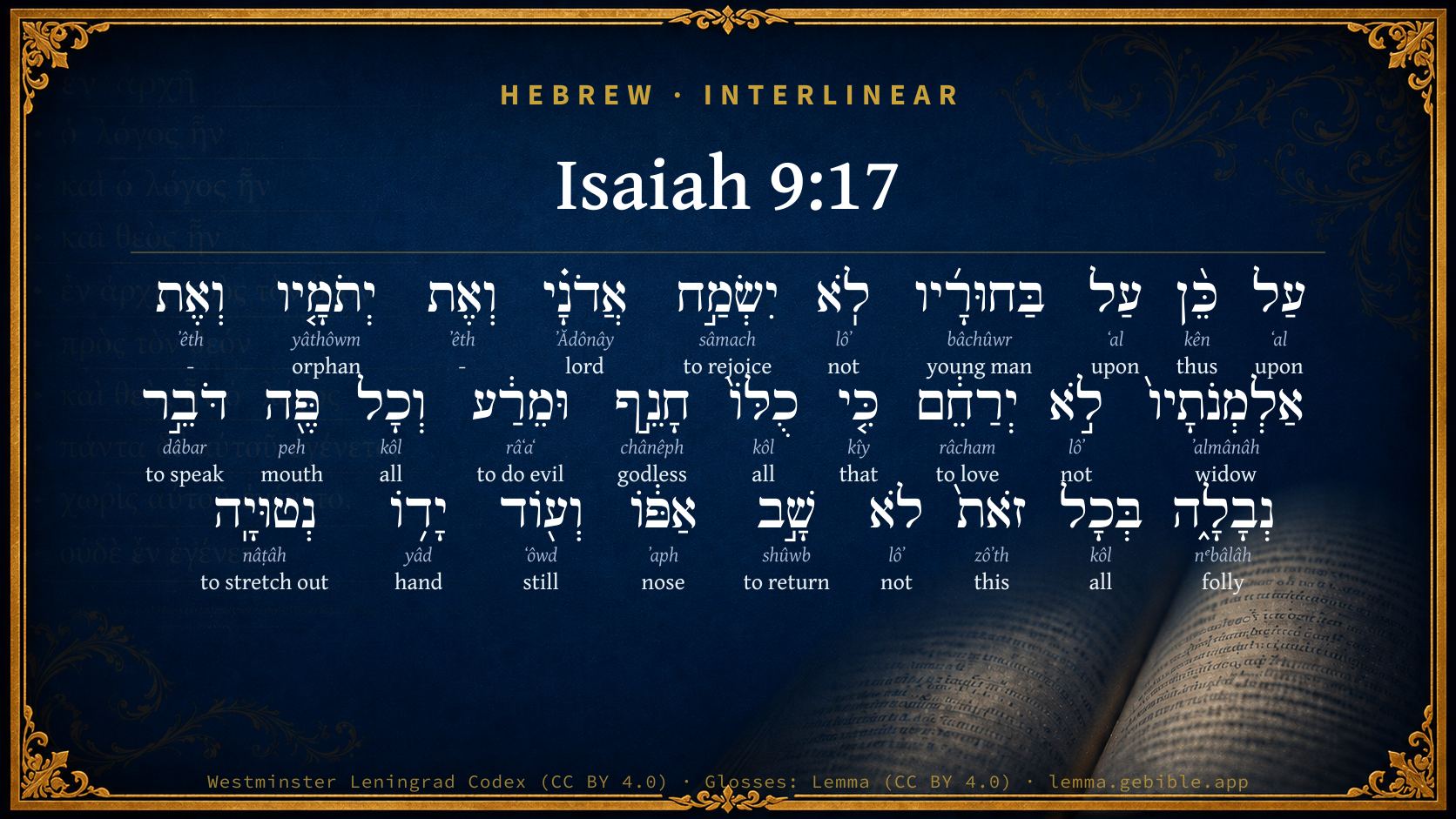
Hebrew (Westminster Leningrad Codex) Isaiah 9:17 appears in the Hebrew Old Testament. The text above is from the Westminster Leningrad Codex. Each word links to its Strong’s number, a concise gloss, and parsing drawn from the Open Scriptures Hebrew Bible morphology. Click any word for its full Brown-Driver-Briggs (BDB) entry.
Download image
Cite this verse

Isaiah 9:17 (World English Bible). Public Domain. Lemma interlinear Bible study tool, https://lemma.gebible.app/v/isaiah/9/17.

Show BibTeX & RIS
BibTeX
RIS
English Translation
Therefore the Lord will not rejoice over their young men, neither will he have compassion on their fatherless and widows; for everyone is profane and an evil-doer, and every mouth speaks folly. For all this his anger is not turned away, but his hand is stretched out still.
World English Bible · Public Domain
Download a study sheet

One document with this verse’s original text, its word-by-word gloss line, the meaning frame, cross-references with their text, attributed commentary, and full source and license credits — printable, and it pastes into notes with its structure intact.

This verse Autodidact and up

Study sheet (.html) Plain text (.txt)

A passage Seminary Student

Up to 50 verses in one chapter. A passage sheet keeps up to 6 commentary sources and 12 cross-references per verse, in the order this page ranks them, and says so on the sheet whenever that leaves anything out. Ask for a single verse and you get the Autodidact verse sheet above.

Everything on this page stays free to read, with no account — the sheet is a download of what is already on screen, not access to it.

Want to remove ads? Support Godless Engineer
Compare translations 3

The same verse in 3 English versions, stacked beneath the original-language interlinear above. Click any original word for its lexicon entry.

Each is an independent rendering of the whole verse — the interlinear is not word-aligned to these translations.

Highlighted words mark where these versions differ — a whole-verse word diff, not a word-by-word alignment.

  • World English Bible Public Domain
    Therefore the Lord will not rejoice over their young men, neither will he have compassion on their fatherless and widows; for everyone is profane and an evil-doer, and every mouth speaks folly. For all this his anger is not turned away, but his hand is stretched out still.
  • King James Version Public Domain
    Therefore the LORD shall have no joy in their young men, neither shall have mercy on their fatherless and widows: for every one is an hypocrite and an evildoer, and every mouth speaketh folly. For all this his anger is not turned away, but his hand is stretched out still.
  • unfoldingWord Literal Text CC BY-SA 4.0
    Therefore, the Lord does not rejoice over its young men, and he does not pity its orphans and its widows, for all of it godless and doing evil, and every mouth is speaking foolishness. q1 In all of this, his nose has not turned back, and his hand still stretched out. q1

unfoldingWord Literal Text — © unfoldingWord, licensed CC BY-SA 4.0. Word-aligned USFM3 via Door43 (git.door43.org/unfoldingWord/en_ult).

Versions to compare (up to 4)

3 of 4 selected

Show all 18 translations

Every available English version of this verse, each an independent rendering of the whole verse.

  • World English Bible Public Domain
    Therefore the Lord will not rejoice over their young men, neither will he have compassion on their fatherless and widows; for everyone is profane and an evil-doer, and every mouth speaks folly. For all this his anger is not turned away, but his hand is stretched out still.
  • Berean Standard Bible Public Domain
    Therefore the Lord takes no pleasure in their young men; He has no compassion on their fatherless and widows. For every one of them is godless and wicked, and every mouth speaks folly. Despite all this, His anger is not turned away; His hand is still upraised.
  • Majority Standard Bible Public Domain
    Therefore the Lord takes no pleasure in their young men; He has no compassion on their fatherless and widows. For every one of them is godless and wicked, and every mouth speaks folly. Despite all this, His anger is not turned away; His hand is still upraised.
  • King James Version Public Domain
    Therefore the LORD shall have no joy in their young men, neither shall have mercy on their fatherless and widows: for every one is an hypocrite and an evildoer, and every mouth speaketh folly. For all this his anger is not turned away, but his hand is stretched out still.
  • American Standard Version (1901) Public Domain
    Therefore the Lord will not rejoice over their young men, neither will he have compassion on their fatherless and widows; for every one is profane and an evil-doer, and every mouth speaketh folly. For all this his anger is not turned away, but his hand is stretched out still.
  • Revised Version (1885) Public Domain
    Therefore the Lord shall not rejoice over their young men, neither shall he have compassion on their fatherless and widows: for every one is profane and an evil-doer, and every mouth speaketh folly. For all this his anger is not turned away, but his hand is stretched out still.
  • Geneva Bible (1599) Public Domain
    Therefore shall the Lord haue no pleasure in their yong men, neither will he haue compassion of their fatherlesse and of their widowes: for euery one is an hypocrite and wicked, and euery mouth speaketh follie: yet for all this his wrath is not turned away, but his hand is stretched out stil.
  • Douay-Rheims (1899) Public Domain
    Therefore the Lord shell have no joy in their young men: neither shall he have mercy on their fatherless, and widows: for every one is a hypocrite and wicked, and every mouth hath spoken folly. For all this his indignation is not turned away, but his bend is stretched out still.
  • Young's Literal Translation Public Domain
    Therefore, over its young men the Lord rejoiceth not, And its orphans, and its widows He pitieth not, For every one `is' profane, and an evil doer, And every mouth is speaking folly. With all this not turned back hath His anger, And still His hand is stretched out.
  • Literal Standard Version CC BY-SA 4.0
    Therefore, the Lord does not rejoice over its young men, || And He does not pity its orphans and its widows, || For everyone [is] profane, and an evildoer, || And every mouth is speaking folly. With all this His anger has not turned back, || And His hand is still stretched out.
  • Unlocked Literal Bible CC BY-SA 4.0
    Therefore the Lord will not rejoice over their young men nor will he have compassion on their fatherless and widows, since every one is godless and an evildoer, and every mouth speaks foolish things. In all these things, his anger does not subside; instead, his hand is still stretched out.
  • unfoldingWord Literal Text CC BY-SA 4.0
    Therefore, the Lord does not rejoice over its young men, and he does not pity its orphans and its widows, for all of it godless and doing evil, and every mouth is speaking foolishness. q1 In all of this, his nose has not turned back, and his hand still stretched out. q1
  • Darby Bible Public Domain
    Therefore the Lord will not rejoice in their young men, neither will he have mercy on their fatherless and on their widows; for every one is a hypocrite and an evildoer, and every mouth speaketh folly. For all this his anger is not turned away, and his hand is stretched out still.
  • World Messianic Bible Public Domain
    Therefore the Lord will not rejoice over their young men, neither will he have compassion on their fatherless and widows; for everyone is profane and an evildoer, and every mouth speaks folly. For all this his anger is not turned away, but his hand is stretched out still.
  • Webster's Bible Public Domain
    Therefore the Lord will have no joy in their young men, neither will have mercy on their fatherless and widows: for every one is a hypocrite and an evil-doer, and every mouth speaketh folly. For all this his anger is not turned away, but his hand is stretched out still.
  • Free Bible Version CC BY-SA 4.0
    As a result the Lord isn't pleased with their young men, he has no compassion for their orphans and widows, because all of them are hypocrites and do what's evil—they all talk stupidly. In all of this he is still angry and his hand is still raised.
  • Bible in Basic English Public Domain
    For this cause the Lord will have no pleasure in their young men, and no pity on their widows and the children without fathers: for they are all haters of God and evil-doers, and foolish words come from every mouth. For all this his wrath is not turned away, but his hand is stretched out still.
  • JPS Tanakh (1917) Public Domain
    (9-16) Therefore the Lord shall have no joy in their young men, neither shall He have compassion on their fatherless and widows; for every one is ungodly and an evil-doer, and every mouth speaketh wantonness. For all this His anger is not turned away, but His hand is stretched out still.

Literal Standard Version (2020), Covenant Press — licensed CC BY-SA 4.0. Text via the HelloAO Bible API (eBible.org). Unlocked Literal Bible (unfoldingWord) — licensed CC BY-SA 4.0. Text via the HelloAO Bible API (eBible.org). unfoldingWord Literal Text — © unfoldingWord, licensed CC BY-SA 4.0. Word-aligned USFM3 via Door43 (git.door43.org/unfoldingWord/en_ult). Free Bible Version, Dr. Jonathan Gallagher — licensed CC BY-SA 4.0. Text via the HelloAO Bible API (eBible.org).

Word by word

More ways to search: Search by grammar → Find every occurrence → Compare this word →

Practice this passage: Drill this verse → Learn its vocabulary →

חָנֵ֣ף
chânêph
H2611
“godless”
Adjective, Adjective, Masculine, Singular, Absolute
Part of Speech
Adjective
Type
Adjective
Gender
Masculine
Number
Singular
State
Absolute
Full BDB Definition

Origin: from H2610

TWOT: 696b

hypocritical, godless, profane, hypocrite, irreligious
  1. עַל ʻal H5921 “upon” Preposition
  2. כֵּ֨ן kên H3651 “thus” Particle, Demonstrative
  3. עַל ʻal H5921 “upon” Preposition
  4. בַּחוּרָ֜יו bâchûwr H970 “young men · his” Noun, Common, Masculine, Plural, Construct + Suffix, Personal, 3rd Person, Masculine, Singular
  5. לֹֽא lôʼ H3808 “not” Particle, Negative
  6. יִשְׂמַ֣ח sâmach H8055 “to rejoice” Verb, Qal, Imperfect, 3rd Person, Masculine, Singular
  7. אֲדֹנָ֗י ʼĂdônây H136 “Lord · my” Noun, Common, Masculine, Plural, Construct + Suffix, Personal, 1st Person, Common, Singular
  8. וְאֶת ʼêth H853 “and · -” Conjunction + Particle, Direct Object
  9. יְתֹמָ֤יו yâthôwm H3490 “orphans · his” Noun, Common, Masculine, Plural, Construct + Suffix, Personal, 3rd Person, Masculine, Singular
  10. וְאֶת ʼêth H853 “and · -” Conjunction + Particle, Direct Object
  11. אַלְמְנֹתָיו֙ ʼalmânâh H490 “widows · his” Noun, Common, Feminine, Plural, Construct + Suffix, Personal, 3rd Person, Masculine, Singular
  12. לֹ֣א lôʼ H3808 “not” Particle, Negative
  13. יְרַחֵ֔ם râcham H7355 “to love” Verb, Piel, Imperfect, 3rd Person, Masculine, Singular
  14. כִּ֤י kîy H3588 “that” Conjunction
  15. כֻלּוֹ֙ kôl H3605 “all · his” Noun, Common, Masculine, Singular, Construct + Suffix, Personal, 3rd Person, Masculine, Singular
  16. וּמֵרַ֔ע râʻaʻ H7489 “and · doing evil” Conjunction + Verb, Hiphil, Participle Active, Masculine, Singular, Absolute
  17. וְכָל kôl H3605 “and · all of” Conjunction + Noun, Common, Masculine, Singular, Construct
  18. פֶּ֖ה peh H6310 “mouth” Noun, Common, Masculine, Singular, Absolute
  19. דֹּבֵ֣ר dâbar H1696 “speaking” Verb, Qal, Participle Active, Masculine, Singular, Absolute
  20. נְבָלָ֑ה nᵉbâlâh H5039 “folly” Noun, Common, Feminine, Singular, Absolute
  21. בְּכָל kôl H3605 “in/at · all of” Preposition + Noun, Common, Masculine, Singular, Construct
  22. זֹאת֙ zôʼth H2063 “this” Pronoun, Demonstrative, Feminine, Singular
  23. לֹא lôʼ H3808 “not” Particle, Negative
  24. שָׁ֣ב shûwb H7725 “to return” Verb, Qal, Perfect, 3rd Person, Masculine, Singular
  25. אַפּ֔וֹ ʼaph H639 “nose · his” Noun, Common, Masculine, Singular, Construct + Suffix, Personal, 3rd Person, Masculine, Singular
  26. וְע֖וֹד ʻôwd H5750 “and · still” Conjunction + Adverb
  27. יָד֥וֹ yâd H3027 “hand · his” Noun, Common, Both, Singular, Construct + Suffix, Personal, 3rd Person, Masculine, Singular
  28. נְטוּיָֽה nâṭâh H5186 “stretched out” Verb, Qal, Participle Passive, Feminine, Singular, Absolute

About this verse

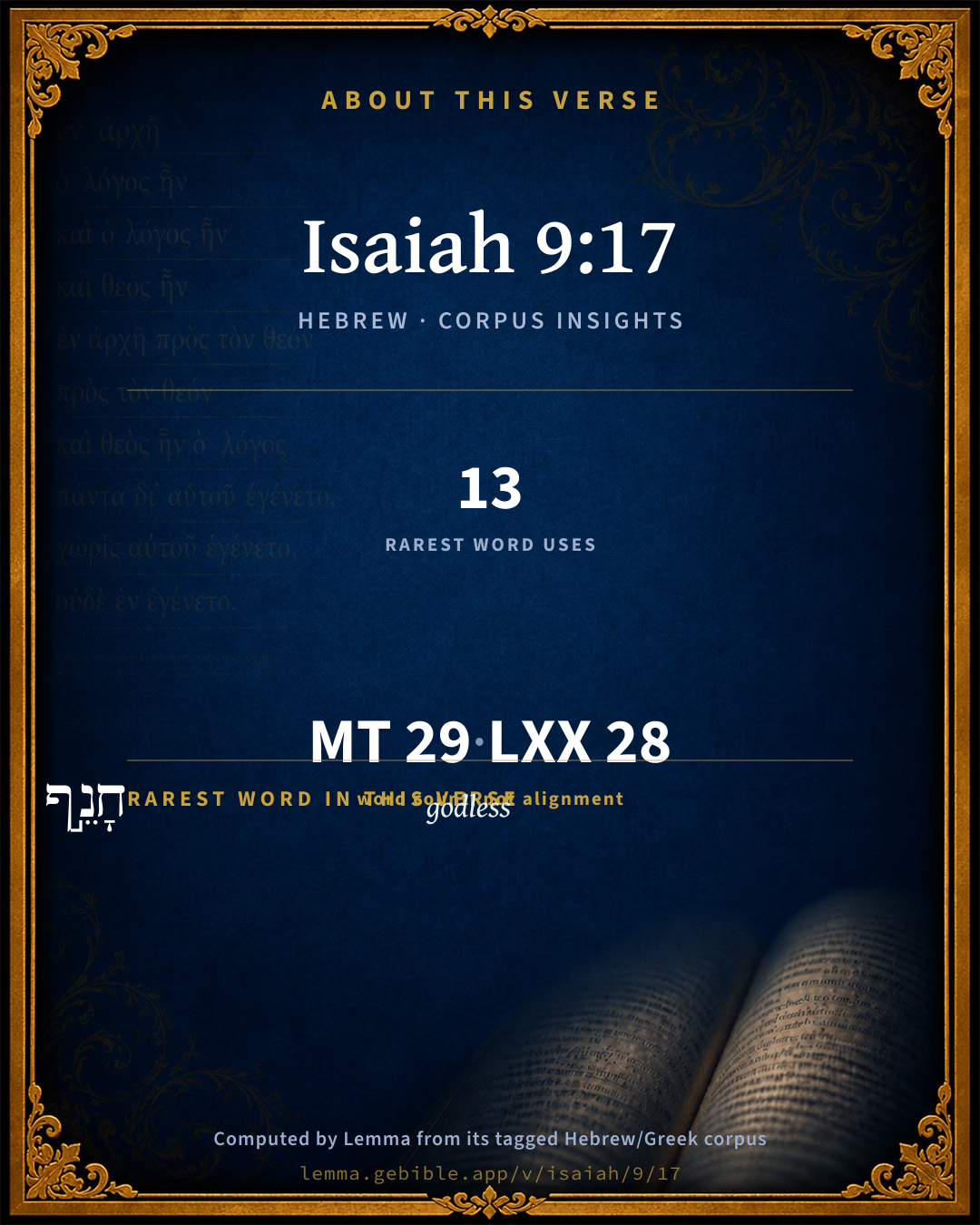
These counts appear in no published source. They are computed here, from the morphology-tagged text and Lemma’s own curated glosses. What Lemma adds →

29
words
23
distinct lemmas
Prophets
section

Notable vocabulary

The rarest word here is חָנֵ֣ף godless H2611 — appearing just 13 times in the whole Hebrew Bible.

Shared distinctive vocabulary

חָנֵ֣ף godless H2611 occurs in 13 verses of the Hebrew Bible. Also found in:

Grammatical profile

  • 6 verbs
  • 11 nouns
  • 1 adjective
  • 1 pronoun
  • 2 prepositions
  • 1 conjunction
  • 1 adverb
  • 6 particles

Verb forms

  • יִשְׂמַ֣ח Qal · Imperfect
  • יְרַחֵ֔ם Piel · Imperfect
  • וּמֵרַ֔ע Hiphil · Participle Active
  • דֹּבֵ֣ר Qal · Participle Active
  • שָׁ֣ב Qal · Perfect
  • נְטוּיָֽה Qal · Participle Passive

Repetition

Words recur within this verse — often emphatic in Hebrew:

  • כֻלּוֹ֙ all H3605 ×3
  • עַל upon H5921 ×2
  • לֹֽא not H3808 ×3

Hebrew & Septuagint length

In English translation the verse runs 48 words from the Hebrew and 50 from the Septuagint (LXX English) — closely comparable.

A rough comparison of the two English renderings, which tokenize alike — not a word-level alignment.

Word counts can differ between the Hebrew and the Greek without any difference in meaning — e.g. the Hebrew direct-object marker אֵת has no separate Greek word, and Greek often adds the article ὁ.

In the original languages it is 29 Hebrew tokens and 28 Greek tokens — but the two are counted differently (Hebrew bundles its prefixes and suffixes into one token; the Greek is in lemma form), so that isn’t a like-for-like length.

Cross-references

21

Topical passages linked to Isaiah 9:17 in the Treasury of Scripture Knowledge — connected by theme and wording, ordered by reader-vote popularity; previews shown in the World English Bible.

  • Isaiah 5:25 Therefore Yahweh's anger burns against his people, And he has stretched out his hand against them, and has struck them. The mountains tremble, And their dead bodies are as refuse in the midst of the streets. For all this, his anger is not turned away, But his hand is still stretched out.
  • Isaiah 10:6 I will send him against a profane nation, and against the people of my wrath will I give him a charge, to take the spoil, and to take the prey, and to tread them down like the mire of the streets.
  • Jeremiah 18:21 Therefore deliver up their children to the famine, and give them over to the power of the sword; and let their wives become childless, and widows; and let their men be slain of death, [and] their young men struck of the sword in battle.
  • Isaiah 9:12 the Syrians before, and the Philistines behind; and they shall devour Israel with open mouth. For all this his anger is not turned away, but his hand is stretched out still.
  • Isaiah 27:11 When the boughs of it are withered, they shall be broken off; the women shall come, and set them on fire; for it is a people of no understanding: therefore he who made them will not have compassion on them, and he who formed them will show them no favor.
  • Matthew 12:34 You offspring of vipers, how can you, being evil, speak good things? For out of the abundance of the heart, the mouth speaks.
  • Psalms 147:10 He doesn't delight in the strength of the horse. He takes no pleasure in the legs of a man.
  • Isaiah 9:21 Manasseh, Ephraim; and Ephraim, Manasseh; and they together shall be against Judah. For all this his anger is not turned away, but his hand is stretched out still.
  • Isaiah 10:4 They shall only bow down under the prisoners, and shall fall under the slain. For all this his anger is not turned away, but his hand is stretched out still.
  • Isaiah 1:4 Ah sinful nation, A people loaded with iniquity, A seed of evil-doers, Children who deal corruptly! They have forsaken Yahweh. They have despised the Holy One of Israel. They are estranged and backward.
  • Isaiah 10:2 to turn aside the needy from justice, and to rob the poor of my people of their right, that widows may be their spoil, and that they may make the fatherless their prey!
  • Isaiah 13:18 [Their] bows shall dash the young men in pieces; and they shall have no pity on the fruit of the womb; their eye shall not spare children.
  • Isaiah 32:6–7 For the fool will speak folly, and his heart will work iniquity, to practice profanity, and to utter error against Yahweh, to make empty the soul of the hungry, and to cause the drink of the thirsty to fail.
  • Isaiah 62:5 For as a young man marries a virgin, so shall your sons marry you; and as the bridegroom rejoices over the bride, so shall your God rejoice over you.
  • Isaiah 65:19 I will rejoice in Jerusalem, and joy in my people; and there shall be heard in her no more the voice of weeping and the voice of crying.
  • Jeremiah 5:1 Run you back and forth through the streets of Jerusalem, and see now, and know, and seek in the broad places of it, if you can find a man, if there are any who does justly, who seeks truth; and I will pardon her.
  • Ezekiel 20:33 As I live, says the Lord Yahweh, surely with a mighty hand, and with an outstretched arm, and with wrath poured out, will I be king over you:
  • Micah 7:2 The godly man has perished out of the earth, And there is no one upright among men. They all lie in wait for blood; Every man hunts his brother with a net.
  • Zechariah 9:17 For how great is his goodness, And how great is his beauty! Grain will make the young men flourish, And new wine the virgins.
  • Matthew 16:3 In the morning, 'It will be foul weather today, for the sky is red and threatening.' Hypocrites! You know how to discern the appearance of the sky, but you can't discern the signs of the times!
  • Job 15:34 For the company of the godless shall be barren, And fire shall consume the tents of bribery.

Cross-references courtesy of OpenBible.info (CC BY 4.0).

Hebrew and Greek witnesses Masoretic Hebrew ↔ Greek Septuagint

The same verse in the two great witnesses to the Old Testament, shown verse-for-verse.

These are two independent witnesses, not word-aligned to each other, and the Septuagint is shown in lemma (dictionary) form.

Hebrew Isaiah 9:17 Masoretic · Westminster Leningrad Codex

עַל כֵּ֨ן עַל בַּחוּרָ֜יו לֹֽא יִשְׂמַ֣ח אֲדֹנָ֗י וְאֶת יְתֹמָ֤יו וְאֶת אַלְמְנֹתָיו֙ לֹ֣א יְרַחֵ֔ם כִּ֤י כֻלּוֹ֙ חָנֵ֣ף וּמֵרַ֔ע וְכָל פֶּ֖ה דֹּבֵ֣ר נְבָלָ֑ה בְּכָל זֹאת֙ לֹא שָׁ֣ב אַפּ֔וֹ וְע֖וֹד יָד֥וֹ נְטוּיָֽה

Therefore the Lord will not rejoice over their young men, neither will he have compassion on their fatherless and widows; for everyone is profane and an evil-doer, and every mouth speaks folly. For all this his anger is not turned away, but his hand is stretched out still.

World English Bible · Public Domain

Greek LXX Isaiah 9:17 Septuagint · lemma form

καί καίω ὡς πῦρ ὁ ἀνομία καί ὡς ἄγρωστις ξηρός βιβρώσκω ὑπό πῦρ καί καίω ἐν ὁ δάσος ὁ δρυμός καί συν καταἐσθίω ὁ κύκλος ὁ βουνός πᾶς

Therefore the Lord shall not take pleasure in their young men, neither shall he have pity on their orphans or on their widows: for they are all transgressors and wicked, and every mouth speaks unjustly. For all this his anger is not turned away, but his hand is yet exalted.

LXX2012 (modern English Septuagint) · Public Domain

Hebrew: Westminster Leningrad Codex (CC BY 4.0). Greek: Septuagint (public domain); English from LXX2012 (modern English Septuagint) (Public Domain). How the Septuagint differs from the Hebrew →

Targum (Aramaic paraphrase)

1

The Targum is the ancient Jewish Aramaic paraphrase of the Hebrew Scriptures — an interpretive translation, not the Hebrew text itself. Onkelos (literal) and Pseudo-Jonathan (expansive) render the Torah, and Jonathan the Prophets. Coverage is partial: where no permissively-licensed English translation exists for a verse, only the Aramaic is shown. This is verse-level text, not a word-by-word alignment to the Hebrew.

  1. Targum Jonathan Prophets (Joshua–Malachi)
    אֲרֵי תַדְלִיק כְּאֶשְׁתָּא פּוּרְעֲנוּת חוֹבֵיהוֹן חַטָאַיָא וְחַיָבַיָא תְּשֵׁיצֵי וְתִשְׁלוֹט בִּשְׁאַר עַמָא וּתְשֵׁיצֵי סַגִי מַשִׁרְיָתָא:

    The punishment of their sins shall burn like fire; it shall consume the sinners and the wicked, and shall rule over the rest of the people, and shall make an end of a great host.

    Targum Jonathan — Aramaic: “Mikraot Gedolot” (public domain). English: “Sefaria Community Translation” (CC0 1.0 (public-domain dedication)); “London "Chaldee Paraphrase," 1871” (public domain). Text via Sefaria.

Commentary

Notes on Isaiah 9:17 from classic Christian and Jewish commentators (each source and its license shown beneath its notes). The classic Christian expositions comment on the surrounding passage and are grouped to its opening verse, so a note may address several verses; the Jewish commentaries on the Tanakh (Rashi and others) are per-verse, so they appear only where the commentator wrote on this verse.

Lemma curates 59 commentaries, every one of them public domain or Creative Commons licensed, each selected and text-cleaned for this edition rather than reprinted as found. About our sources →

Trapp's Complete Commentary

John Trapp

Isa 9:17 Therefore the Lord shall have no joy in their young men, neither shall have mercy on their fatherless and widows: for every one [is] an hypocrite and an evildoer, and every mouth speaketh folly. For all this his anger is not turned away, but his hand [is] stretched out still.

Ver. 17. Therefore the Lord shall have no joy in their young men.] Nay, he shall laugh at their destruction. {Pro 1:26}

Neither shall have mercy on their fatherless and widows.] They are deceived therefore that, being unregenerate, hope to find favour with God merely for their adversity; and because they have their hell, as they call it, here, think to have heaven hereafter.

Because every one is an hypocrite and an evildoer.] That facies hypocritica of our nation is facies hippocratica, saith one; a mortal complexion, a sad prognostic.

And every mouth speaketh folly.] Or, Villany. Sapless, worthless, rotten, and stinking stuff. {Eph 4:29}

John Trapp, A Commentary or Exposition upon All the Books of the Old and New Testament (1647–1656) — public domain. Text from a community e-Sword module.

The Biblical Illustrator

Joseph S. Exell

Isa_9:17

Therefore the Lord shall have no Joy in their young men

The Lord shall have no joy in their young men

The meaning is full of suggestion God delights in the young.

God has made the young a ministry of instruction and comfort to old age. God keeps the world young by keeping children in it, and helpless ones. But God shall cease to see in young men any hope for the future. Henceforth God withdraws from the young, and they become old; He takes from them His all-vitalising and all-blessing smile, and they wither as flowers die when the sun turns away. (J. Parker, D. D.)

General corruption followed by general desolation

The desolation should be as general as the corruption has been, and none should escape it.

1. Not those that were the objects of complacency; none shall be spared for love. The Lord shall have no joy in their young men. etc.

2. Not those that were the objects of compassion; none shall be spared for pity. He shall not have mercy on their fatherless and widows. They had corrupted their way like the rest; and if the poverty and helplessness of their state was not an argument with them to keep them from sin, they could not expect it should be an argument with God to protect them from judgments (M. Henry.)

The Biblical Illustrator, edited by Joseph S. Exell (c. 1880s–1900s) — public domain. Text from a community e-Sword module.

The Preacher's Complete Homiletical Commentary

Joseph S. Exell (gen. ed.)

LEADERSHIP [940]

[940] See outline: “BLIND LEADERS,” p. 92.

(An Ordination Sermon.)

Isa_9:15-16. The prophet that teacheth lies, he is the tail, &c.

I. The world is so constituted that leaders of the people are at present a necessity. It is no disparagement of oak trees to say that few of them are sixty feet high; and it is no disparagement of our fellow-men to say that few of them are qualified to lead others. In both cases we have to do with an ordinance of God. We are all included in it. We all need, in some respect or other, to be led. This arises from the disparity between human needs and human powers. Our faculties and time are too limited to allow any man to dispense with guidance. Even the accomplished statesman needs to be guided in the matter of health by the physician; the skilled physician needs to be guided in building by an architect, and so on through all the grades of human life. Men need guidance in commerce, politics, literature, art, philosophy, and in religion. There is to be a time when in this last respect guidance will not be needed (Jer_31:33-34), but that time is not yet. The people still need guidance in religion, because,

1. While in some of its aspects it is so simple that a child is capable of it, in others it is so profound that they need the most thoughtful instruction concerning it.

2. There are many false forms of religion seeking to win acceptance (Mat_24:24; 2Pe_2:1; 1Jn_4:1).

3. The natural tendency of the human heart inclines it to the acceptance of those forms of faith which are most unscriptural. This is the real secret of the power of Romanism. To-day, therefore, the people still need religious leaders, and leaders of the highest order. Even with the Bible in their hands, most men need guidance (Act_9:30-31). Woe to them, if they take as their guides men who have not themselves been taught of the Holy Ghost!

II. Leadership involves for the leaders the highest honour or the deepest shame. Many aspire to lead: few think of the difficulties and responsibilities of leadership.

1. The man who leads his fellow-men well is entitled to the highest honour. He cannot do it without noble qualities of mind and heart. Those who are well led are, as a rule, not slow to acknowledge and reward the service that has been rendered them.

2. But leadership does not necessarily involve any honour at all. The post of prominence may only bring out into view the leader’s incompetency, mental and moral. “The fierce light that beats upon a throne,” and upon a pulpit, reveals every speck and flaw in its occupant. It is a perilous thing to exchange the pew for the pulpit.

3. Through leadership a man may reach the most utter degradation and shame. He may do this

(1.) through his incompetency. Admiral Byng might have lived and died a respectable English gentleman, if he had not been made an admiral. Many envied him when he was so gazetted: none envied him when he was shot. Many a “stickit minister” would have made a highly respectable and useful church-member.

(2.) Through his dishonesty. Many a leader, claiming to be the head of a community, has really been its “tail,” carried by it, not carrying it on in paths of truth and honesty. His aim has been, not the welfare of his followers, but his own aggrandisement and popularity; his concern has been, not to speak the truth, but to say what would be pleasant. This was the sin of many who claimed to be prophets in Israel (Isa_3:12; Isa_5:20; Jer_5:31). It is a common sin to-day, both in the political and religious world. Let those who claim to be ministers of God shun it. Self-seeking, everywhere despicable, is in the pulpit most hateful and criminal (P. D. 2482). Let every preacher regard as warnings those base prophets of Israel; let him endeavour to realise that wonderful picture of a true leader drawn by Christ’s enemies (Mat_22:16).

III. Leadership involves for the led salvation or destruction. It is not a trivial matter to be well or ill led. How true this is politically, commercially, legally; it is not less true religiously. That community shows little wisdom that chooses its leaders carelessly. That community is insane which demands that its prophets shall prophesy unto it only smooth things (Isa_30:10). The following of righteous leaders who are themselves led by the Spirit of God will result in temporal and eternal well-being; but trust in “religious” demagogues, whose aim is not to speak the truth, but to flatter those who listen to them, results inevitably in social and spiritual ruin. In self-defence, then, demand of your minister that he speak to you, not what is pleasant, but what is true; and count him not your enemy, but your best friend, when he utters what, just because it is the truth of God, shall smite and wound as if it were a sharp two-edged sword (Heb_4:12).

TWO CONSTANT FEELINGS IN THE MIND OF GOD

Isa_9:17. Therefore the Lord shall have no joy in their young men, neither shall have mercy on their fatherless and widows.

From one point of view, this is a terrible text! it shows us that a people may arrive at such a condition of desperate and incorrigible wickedness, that God may feel constrained, as the upholder of truth and righteousness in the world, to destroy them. But, on the other hand, how worthy of thought and thanksgiving is this revelation of God’s constant feelings towards two very opposite classes of persons—those who are most joyful, and those who are most sorrowful.

I. God’s feelings toward young men. He has “joy” in them, a fact of which young men seldom think. Doubtless He has joy in them, 1, because of what they are; and 2, because of what they may become. He has this joy in them as their Creator. The great Artist has a delight in all His works (Gen_1:31; Pro_8:31). Young men are a realisation, more or less perfect, of a thought, an ideal in the Divine mind. Strength and comeliness of body, courage and vivacity of mind, modesty and generosity of heart, are the ideal characteristics of a young man, and precisely as they are actually found in any young man, God has “joy” in him, just as He has joy in the strength of the horse, the beauty of the swan, or the melody that is poured forth by the lark or the nightingale. We frequently see a young man who is obviously a glorious work of God; and had not sin so terribly cursed and marred our race, all young men would have been such as the British youths whose beauty called forth the old pleasant jest, “Not Angles but angels.”

All this is, of course, equally true of young women. For the Bible is in this respect to be interpreted like our English laws, concerning which it is decreed that the word “man” shall mean “woman” also in all cases in which nature herself does not forbid such an interpretation. A young woman is more than a pleasing mass of flesh and blood; she is a realisation of a thought of God, a work of the unseen Artist, to whom all that is beautiful in the universe owes its existence [943] Many a young woman is so beautiful that the human artist counts himself happy indeed if he can make on the canvas any fair transcript of her loveliness; and, what is better still, the beautiful body is but a casket in which a more beautiful body is enshrined.

[943] The world is God’s journal, wherein He writes His thoughts and traces His tastes. The world overflows with beauty. Beauty should no more be called trivial, since it is the thought of God.—Beecher.

Young men and women, think of this—God delights in you! What effects will a realisation of this thought have upon you?

1. It will check that vanity by which the strength of the young man and the beauty of the young woman are often so pitifully marred (1Co_4:7).

2. It will cause you to reverence yourselves. Those who think that no one cares for them, are apt not to care for themselves; but consciousness that we are observed leads us to circumspection and self-control. If the observation be friendly and approving, it is a stimulus to endeavour to merit it. Respect kindles self-respect. Remembering how God looks upon you, you will shrink from doing anything that will lessen His “joy” in you; you will not voluntarily permit faults or vices to mar the nobleness and beauty that call it forth, any more than the roses, if they had power of self-defence, would give a lodgment to those insects which blight the beauty that causes beholders to joy in them.

3. Kindly, loving feelings towards God will spring up in you. Friendliness and love tend to call forth friendship and love; just as the sunshine and rain that in early summer descend from the natural heavens cause flowers to spring forth from the earth.

Consider what joy God must have had in the young man Jesus of Nazareth, and why He had it, and resolve that the same causes for this Divine joy shall exist in you.

II. God’s feelings toward orphans and widows. “Mercy on their fatherless and widows.” A more familiar thought, but let us not therefore overlook its preciousness. How frequent and how emphatic are the declarations of God’s pity for orphans and widows (Exo_22:22; Deu_10:18; Psa_10:14; Psa_10:18; Psa_68:5; Psa_82:3; Psa_146:9; Jer_49:11, &c.) Yea, we are taught that at least one-half of religion consists in being like God in this respect (Jas_1:27). God’s pity is practical; let those to whom it is promised trust in it confidently [946] And let God’s people make it their business—put themselves to pain and trouble—to be like Him in this respect: this is the way to secure His favour for themselves.

[946] There are no such promises to those who are free from sorrow and trial as are full and abundant to the afflicted. A good country physician in New England went to a neighbour’s house to tell a wife and mother of the sudden death of her absent husband. She was more than ordinarily frail and dependent. She had a large family. Her husband had acquired no property. The fresh blow was indeed terrible to her. When the first wild burst of sorrow was over, she looked up through her tears to her sympathising friend, and said in agony, “But, Doctor, what shall I do?” “My dear woman, I don’t know,” said the kind-hearted physician. “All I can say is, I only wish I had as many promises of God to take right home to myself as you have just now. The Bible is full of promises to those who are in your case.” And the stricken woman lived to realise the truth and preciousness of the richest of those promises.—Trumbull.

DIVINE ANGER

Isa_9:17. For all this His anger is not turned away, but His hand is stretched out still.

I. Anger in God is a calm and just sense of displeasure against sin [949] II. Has its expression in the judgments executed upon men in this life. III. These under an administration of mercy are designed to be corrective. IV. Cannot in the case of failure satisfy the purposes of the Divine anger. V. Hence in all cases of impenitence God’s anger is not turned away, &c.—J. Lyth, D.D.: Homiletical Treasury. Part I. p. 15.

[949] The anger which God feels and displays is always anger against sin. It is never against sinners as offenders against Himself personally, but as violators of the eternal laws of righteousness and love. It is not possible for the most daring transgressor to injure God in the slightest degree, and therefore He can never feel anything approaching to that personal vindictiveness which we feel against those who have wronged us. There are some passages which at first sight convey a different impression, as when it is said, “Know therefore that the Lord thy God … repayeth them that hate Him to their face, to destroy them; He will not be slack to him that hateth Him; He will repay him to his face” (Deu_7:10); and again, “God is jealous, and the Lord revengeth, and is furious; the Lord will take vengeance upon His adversaries, and He reserveth wrath for His enemies” (Nah_1:2). But terrible as such passages are, they admit of a ready explanation. In them God manifestly speaks as “the Judge of all the earth,” as the Representative and Administrator of righteousness. Some years ago, proclamations denouncing the severest penalties against Fenianism were issued in the name of our beloved Queen; but no one imagined that she cherished any personal hostility against those offenders against her authority. Every month it is her melancholy duty to sign documents that consign convicted murderers to the scaffold, but no one regards these death-warrants as any proof that she delights in the sufferings of those whose sentence she confirms. Nor will any thoughtful person interpret such passages as setting forth anything else than God’s resolve to be faithful to His duties as the supreme administrator of justice, notwithstanding that in being so He must perform many things that are revolting to His infinite tenderness and compassion. His expostulations with sinners to repent and turn from their transgressions are a sufficient confirmation of this interpretation (Eze_18:31-32, &c.) His anger against sin and sinners is no passion of personal vindictiveness, but is the natural revulsion of purity from impurity, of honesty from fraud, of truthfulness for falsehood; the instinctive abhorrence of generosity for meanness, of benevolence for malice, of kindness for cruelty.

If God did not feel and manifest this anger against sin, it would be impossible to respect and love Him. If He could look down on the mean and dastardly things that are done every day, and yet remain cold and emotionless as an iceberg, as indifferent to the sufferings of His creatures as some Oriental despots have been to the miseries of their wretched subjects, our whole soul would rise up in righteous condemnation of Him.—R. A. B.

See outlines: GOD OPPRESSED, pp. 28–32; A TERRIBLE RESOLVE, pp. 61, 62; THE PURPOSE OF PUNISHMENT, pp. 63, 64.

The Preacher's Complete Homiletical Commentary (gen. ed. Joseph S. Exell; Funk & Wagnalls, c. 1892) — public domain (pre-1929). A full-Bible homiletical/sermon-outline anthology covering 65 of 66 books (2 John is absent from the source module). Text from a community e-Sword module.

Tyndale Open Study Notes

Tyndale Open Resources

9:17 Even widows and orphans, ordinarily objects of God’s compassion (1:17, 23; 10:2), became objects of his wrath when they were unrepentant.

Tyndale Open Study Notes — © Tyndale Open Resources, licensed CC BY-SA 4.0. Text via the HelloAO Bible API.

Jamieson, Fausset & Brown

Robert Jamieson, A. R. Fausset & David Brown

no joy--the parallelism, "neither . . . mercy," shows that this means, He shall have no such delight in their youthful warriors, however much they be the nation's delight and reliance, as to save them from the enemy's sword (Isa 31:8; compare Jer 18:21).

fatherless, &c.--not even the usual objects of His pity (Psa 10:14, Psa 10:18; Psa 68:5; Jer 49:11; Hos 14:3) shall be spared.

hypocrite--rather, a libertine, polluted [HORSLEY].

folly--wickedness (Psa 14:1).

still--Notwithstanding all these judgments, more remain.

Jamieson, Fausset & Brown — Commentary Critical and Explanatory on the Whole Bible (1871) — public domain (CC PDM 1.0). Text via the HelloAO Bible API.

Adam Clarke's Commentary

Verse 17. The Lord - "JEHOVAH"] For אדני Adonai, a great number of MSS. read יהוה Yehovah.

Adam Clarke's Commentary on the Bible (1810–1826) — public domain. Text from a community e-Sword/MySword module.

Ellicott's Commentary for English Readers

(17) Therefore the Lord shall have no joy . . .—The Hebrew tenses are in the past, The Lord had no joy. The severity of the coming judgment is represented as not sparing even the flower of the nation’s youth, the widows and orphans who were the special objects of compassion both to God and man. The corruption of the time was universal, and the prophet’s formula, “For all this his anger is not turned away . . .” tolls again like the knell of doom.

Folly.—Better, blasphemy or villainy.

A Bible Commentary for English Readers, edited by Charles John Ellicott (1878–1897) — public domain. Text from a community e-Sword module.

The Cambridge Bible for Schools and Colleges

gen. ed. J. J. S. Perowne

17. A sentence of utter rejection. The unwonted severity of the threat against the widows and orphans is justified by the universal corruptness of the nation.

a hypocrite] Rather, profane (R.V.), “impious.” Cf. ch. Isa_10:6, Isa_32:6, Isa_33:14; Job_8:13; Psa_35:16.

every mouth speaketh folly] ch. Isa_32:6 (“villany” A.V.). In the O.T. folly and wickedness are practically synonymous.

The Cambridge Bible for Schools and Colleges (gen. ed. J. J. S. Perowne; Cambridge University Press, 1878–1918) — public domain. Text from a community e-Sword module.

John Gill's Exposition

Therefore the Lord shall have no joy in their young men,.... Take no delight and pleasure in them; but, on the contrary, detest and abhor them, and so destroy them, being depraved and corrupted by the bad instructions and examples of their parents:

neither shall have mercy on their fatherless and widows; who are objects of pity and compassion; yet these being wicked, as well as the fathers of the one, and the husbands of the other, shall be no more spared than they have been; so that this expresses both the general corruption and destruction of this people:

for everyone is a hypocrite and an evildoer; a hypocrite, as Aben Ezra on the place observes, is one that is outwardly good, and inwardly wicked; which was the general character of the people of Israel in Isaiah's time, as it was of the Jews in the times of Christ, see Mat 23:25 they pretended to do good, but were doers of evil, workers of iniquity, continually committing sin; and yet would be thought to be very upright and sincere, both in their religion towards God, and in their dealings with men; but deceitful in both:

and every mouth speaketh folly; or falsehood; a lie, as the Targum, as all lies are foolish; as also all vain words, all impious ones; or the savour of irreligion or superstition, and indeed every idle word, and all unsavoury and corrupt speech, and there is particularly foolish talking, which is not convenient, Eph 5:4,

for all this his anger is not turned away, but his hand is stretched out still; which is repeated from Isa 9:12. See Gill on Isa 9:12.

John Gill's Exposition of the Whole Bible (1746–1763) — public domain (CC PDM 1.0). Text via the HelloAO Bible API.

Albert Barnes' Notes on the Bible

Shall have no joy - He shall not delight in them so as to preserve them. The parallel part of the verse shows that the phrase is used in the sense of having mercy.

In their young men - The hope and strength of the nation. The word used here commonly denotes those who are chosen, particularly for purposes of war. The sense is, that the hope and strength of the nation, that on which the chief reliance would be placed, would be cut off.

Neither shall have mercy ... - Judgment would sweep through the nation, even over those who were the usual objects of the divine protection - widows and orphans; compare Psa 10:14, Psa 10:18; Psa 48:5; Deu 10:18; Jer 49:11; Hos 14:3. These passages show that the fatherless and the widow are the special objects of the divine favor; and when, therefore, it is said that the Lord would not have mercy been on these, it shows the extent and severity of the divine judgments that were coming on the nation.

For every one is a hypocrite - A deceiver; a dissembler. The word used here, however. חנף chânêph, means rather a profane or profligate man, a man who is defiled or polluted, than a dissembler. It is applied often to idolaters and licentious persons, but not to hypocrites; see Job 8:13; Job 13:16; Job 15:34; Job 17:8; Dan 11:32.

Every mouth speaketh folly - The word rendered folly, may denote foolishness, but it is also used to denote wickedness or crime; 1Sa 25:23. Probably this is the meaning here. That the character here given of the Ephraimites is correct, is abundantly shown also by other prophets; see particularly Hosea.

For all this - Notwithstanding all the judgments that should come thus upon the young men, and widows, and orphans, still his anger was not turned away. This is the close of the second strophe or part of this prophecy.

Albert Barnes' Notes on the Bible (1834–1885) — public domain. Text from a community e-Sword/MySword module.

Haydock's Catholic Bible Commentary

Folly. Sin. They are all guilty. He will shew no compassion.

George Leo Haydock (1774–1849), Haydock's Catholic Family Bible and Commentary, 1859 edition — public domain. Excludes Psalms (Douay-Rheims chapter numbering differs from Protestant) and Deuterocanonical books (Catholic canon only).

Matthew Poole's English Annotations

Shall have no joy in their young men; shall not rejoice over them to do them good, as he doth to his people, Isa 62:5; Zep 3:17; will not have mercy or pity on them, as the next clause explains it. but will abhor and utterly destroy them; for more is here intended than is expressed, as Pro 17:21.

Neither shall have mercy on their fatherless and widows, who are the special objects of his care and pity, Deu 16:11,14; 24:19,20, and much less upon others.

Every one; not precisely, for there were seven thousand elect persons among them, when they seemed to Elijah to be universally corrupt, 1Ki 19:18; but the body or generality of the people.

Is an hypocrite; for though they professed to worship and serve the true God, yet indeed they had forsaken him. Or, a profane person, as this word is rendered, Jer 23:15, as also Isa 32:6.

An evil-doer; elsewhere called a worker of iniquity, as Job 31:3; Psa 5:5; Mat 7:23; one that gives up himself to a constant course and custom of sinning.

Speaketh folly, i.e. wickedness, which is commonly called folly. They are not ashamed to proclaim their own wickedness, and the corruption of their hearts breaketh forth into ungodly speeches.

Matthew Poole's English Annotations on the Holy Bible (1683–1685) — public domain. Text from a community e-Sword/MySword module.

Whedon's Commentary on the Bible

Daniel D. Whedon

17. No joy in their young men — God, because of the perversity of even their “young men,” can take no delight in them; for they are not, as they should be, the hope of the nation. And if due judgment is to sweep through the nation, it will take all.

Fatherless and widows — The Old Testament religion enjoins extreme care of these classes; hence the expression that he will have no mercy on these implies an utter exhaustion of divine forbearance.

Every one… a hypocrite — There is no sincere recognition of God among them, but every so-called service of him is a pretence.

Folly — Wickedness.

For all this — Because of all this: Israel’s resolute impenitence.

Stretched out still — Notwithstanding severe judgments already, more will follow.

Daniel D. Whedon (gen. ed.), Commentary on the Old and New Testaments (1874–1909) — public domain. Text from a community e-Sword module.

The Pulpit Commentary

The Lord shall have no joy in their young men. "The Lord taketh pleasure in them that fear him, in those that hope in his mercy". (Psa_147:11) He can have no joy or delight in evil-doers, or idolaters, or in those whose speech is profanity. Neither shall have mercy on their fatherless and widows. The widow and the orphan are objects of God"s tenderest love and compassion; (Exo_22:22 Deu_10:18 Deu_14:29 Isa_1:17, etc.) but when the wickedness of a land provokes him to send any one of his "four sore judgments" upon it, the widow and the fatherless must suffer with the other inhabitants. God pities them, doubtless, but his justice and his righteous anger force him to restrain his pity, and carry out his judgment in spite of it. Every one is an hypocrite; or, corrupt; compare, They are all gone aside, they are all together become filthy; there is none that doeth good, no, not one". (Psa_14:3) A certain allowance must be made for the natural hyperbole of strong feeling. Every mouth speaketh folly. The word translated here (and generally) folly" is rendered villany" in Isa_32:6 and Jer_29:23. Its proper meaning seems to be lewdness"or profligacy."

The Pulpit Commentary (1880–1919), ed. H.D.M. Spence-Jones & Joseph S. Exell — public domain. Text from a community e-Sword module.

John Wesley's Explanatory Notes

No joy - Shall not rejoice over them to do them good. Fatherless - Who are the special objects of his care and pity, and much less upon others. Everyone - Not precisely; for there were seven thousand elect persons among them, when they seemed to Elijah to be universally corrupt, but the body of the people. Hypocrite - For though they professed to worship God, yet indeed they had forsaken him. Folly - Wickedness.

John Wesley, Explanatory Notes Upon the Whole Bible (1754–1765) — public domain. Text via the GEBible commentary corpus.

J. A. Alexander on Isaiah

Joseph Addison Alexander

“Therefore (because the people are thus incorrigibly impenitent) the Lord will not rejoice over their young men” (literally chosen ones, (i.e., for military service), the word being used in the general sense of youths, but seldom without reference to war), “and on their orphans and their widows (elsewhere represented as peculiarly the objects of God’s care) He will not have mercy (expressing in the strongest form the extent and severity of the threatened judgments); for every one of them (literally of it, referring to the singular noun people) is profane (or impious) and an evil doer, and every mouth (is) speaking folly (in the strong Hebrew sense of wickedness). For all this His wrath is not turned back, and still is His hand outstretched.”

Joseph Addison Alexander, The Prophecies of Isaiah (1846–1847; New York: Scribner, 1870–1878) — public domain. Text from a community e-Sword module.

Rashi

Rabbi Shlomo Yitzchaki (Rashi)

For wickedness has burnt like fire Their wickedness shall burn them and consume them like fire.

worms and thorns [i.e.,] their [worms and thorns] shall consume their rebels and their transgressors.

and it kindled in the thickets of the forest in the impoverished segment of the population. “Thicket” refers to the branches.

and they have become entangled by the thickening smoke. They shall become entangled and hemmed in by the strength of the conflagration. Every expression of entanglement has only בך as its radical. Comp. (Job 28:11) “From the recesses (מִבְּכִי) of the rivers”; (Psalms 94:7) “The valley of entanglement (הַבָּכָא).” And the ‘nun’ appears in it sometimes, and here an ‘aleph’ appears in place of the ‘nun,’ like the ‘aleph’ of אִבְחַת, “the howling of the sword” (Ezekiel 21:20), and the ‘aleph’ of וְאַחְוָתִי, “And my speech in your ears” (Job 13:17).

Rashi on the Tanakh — English translations: “The Judaica Press complete Tanach with Rashi, translated by A. J. Rosenberg” (CC BY 4.0); “Pentateuch with Rashi's commentary by M. Rosenbaum and A.M. Silbermann, 1929-1934” (public domain); “The Metsudah Tanach series, Lakewood, N.J” (CC BY 4.0); and “The Book of Joshua, Metsudah Publications, 1997” (CC BY 4.0). Text via Sefaria.

Ibn Ezra

Rabbi Abraham ibn Ezra

For wickedness burneth, etc. The prophet compares the fate of the wicked with the fire which consumes the thing that has produced the fire.

Thorns and thistles. The wicked. ויתאבכו Hapax legomenon. And they mount up.

Ibn Ezra on the Tanakh — English translations: “Sefaria Community Translation” (CC0 1.0 (public-domain dedication)); “Yalkut, Sifsei Chachomim Chumash, Metsudah Publications, 2009” (CC BY 4.0); and “Commentary of Ibn Ezra on Isaiah - trans. by M. Friedlander, 1873” (public domain). Text via Sefaria.

Lesson kit

Teaching starters — assembled from the data on this page, not authored interpretation. Every prompt links to the verse data it draws on. Edit before teaching.

Isaiah, in the Prophets, opens this verse with 29 words (23 distinct Hebrew lemmas). Its most distinctive word is chânêph (“godless”). A historical commentator’s framing appears above. Read the whole chapter for the surrounding context.

Discussion questions

  1. How does “godless” (chânêph) shape what this verse is saying?
  2. Job 8:13 shares the word «godless» with this verse. How do the two illuminate each other?
  3. “all” occurs 3× in this one verse. What is the effect of the repetition?
  4. The translations on this page render this verse differently — a whole-verse word diff, not a word-by-word alignment. What might account for the different wordings?
  5. The verb «יִשְׂמַ֣ח» is Qal Imperfect. How does its form color the action?
  6. Reading how Trapp's Complete Commentary and The Biblical Illustrator read this verse, where do the two commentators agree and where do they part?

Things to notice

Reading settings

Reading text

Shown beneath each verse's original-language words.

Old Testament
Old Testament edition

Read the OT as the Masoretic Hebrew (MT) or the Greek Septuagint (LXX).

English shown for the Greek Septuagint (in the Hebrew ↔ Greek comparison).

Comparing translations? Open the Compare panel on any verse page to stack up to four side by side.