
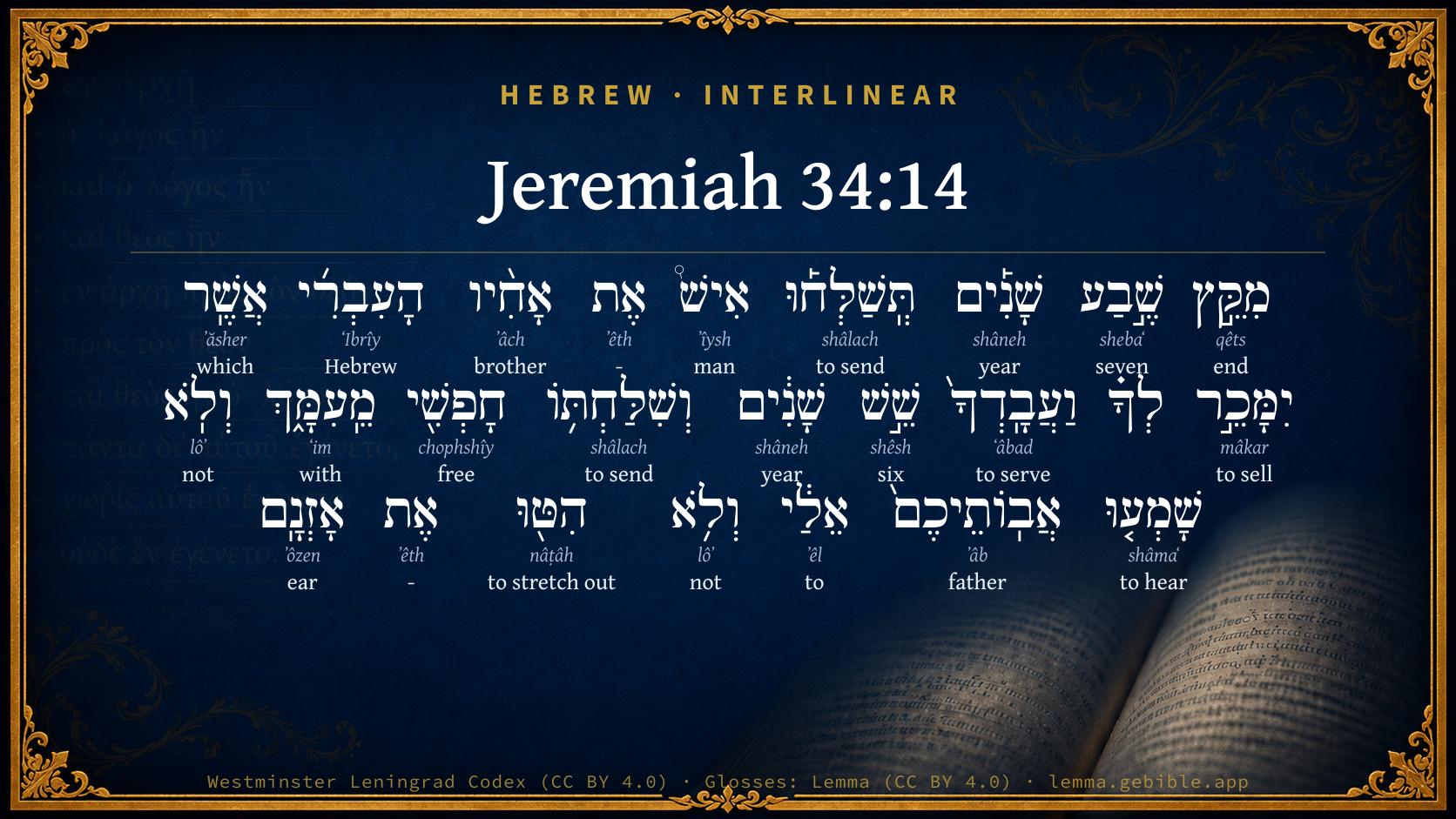
Jeremiah 34:14

Hebrew (Westminster Leningrad Codex) Jeremiah 34:14 appears in the Hebrew Old Testament. The text above is from the Westminster Leningrad Codex. Each word links to its Strong’s number, a concise gloss, and parsing drawn from the Open Scriptures Hebrew Bible morphology. Click any word for its full Brown-Driver-Briggs (BDB) entry.
Download image
Cite this verse

Jeremiah 34:14 (World English Bible). Public Domain. Lemma interlinear Bible study tool, https://lemma.gebible.app/v/jeremiah/34/14.

Show BibTeX & RIS
BibTeX
RIS
English Translation
At the end of seven years you shall let go every man his brother who is a Hebrew, who has been sold to you, and has served you six years, you shall let him go free from you: but your fathers didn't listen to me, neither inclined their ear.
World English Bible · Public Domain
Download a study sheet

One document with this verse’s original text, its word-by-word gloss line, the meaning frame, cross-references with their text, attributed commentary, and full source and license credits — printable, and it pastes into notes with its structure intact.

This verse Autodidact and up

Study sheet (.html) Plain text (.txt)

A passage Seminary Student

Up to 50 verses in one chapter. A passage sheet keeps up to 6 commentary sources and 12 cross-references per verse, in the order this page ranks them, and says so on the sheet whenever that leaves anything out. Ask for a single verse and you get the Autodidact verse sheet above.

Everything on this page stays free to read, with no account — the sheet is a download of what is already on screen, not access to it.

Want to remove ads? Support Godless Engineer
Compare translations 3

The same verse in 3 English versions, stacked beneath the original-language interlinear above. Click any original word for its lexicon entry.

Each is an independent rendering of the whole verse — the interlinear is not word-aligned to these translations.

Highlighted words mark where these versions differ — a whole-verse word diff, not a word-by-word alignment.

  • World English Bible Public Domain
    At the end of seven years you shall let go every man his brother who is a Hebrew, who has been sold to you, and has served you six years, you shall let him go free from you: but your fathers didn't listen to me, neither inclined their ear.
  • King James Version Public Domain
    At the end of seven years let ye go every man his brother an Hebrew, which hath been sold unto thee; and when he hath served thee six years, thou shalt let him go free from thee: but your fathers hearkened not unto me, neither inclined their ear.
  • unfoldingWord Literal Text CC BY-SA 4.0
    “At the end of every seven years, each man must send away his brother, his fellow Hebrew who had sold himself to you and served you for six years. Send him away in freedom.” But your ancestors did not listen to me or incline their ears to me.

unfoldingWord Literal Text — © unfoldingWord, licensed CC BY-SA 4.0. Word-aligned USFM3 via Door43 (git.door43.org/unfoldingWord/en_ult).

Versions to compare (up to 4)

3 of 4 selected

Show all 18 translations

Every available English version of this verse, each an independent rendering of the whole verse.

  • World English Bible Public Domain
    At the end of seven years you shall let go every man his brother who is a Hebrew, who has been sold to you, and has served you six years, you shall let him go free from you: but your fathers didn't listen to me, neither inclined their ear.
  • Berean Standard Bible Public Domain
    Every seventh year, each of you must free his Hebrew brother who has sold himself to you. He may serve you six years, but then you must let him go free. But your fathers did not listen or incline their ear.
  • Majority Standard Bible Public Domain
    Every seventh year, each of you must free his Hebrew brother who has sold himself to you. He may serve you six years, but then you must let him go free. But your fathers did not listen or incline their ear.
  • King James Version Public Domain
    At the end of seven years let ye go every man his brother an Hebrew, which hath been sold unto thee; and when he hath served thee six years, thou shalt let him go free from thee: but your fathers hearkened not unto me, neither inclined their ear.
  • American Standard Version (1901) Public Domain
    At the end of seven years ye shall let go every man his brother that is a Hebrew, that hath been sold unto thee, and hath served thee six years, thou shalt let him go free from thee: but your fathers hearkened not unto me, neither inclined their ear.
  • Revised Version (1885) Public Domain
    At the end of seven years ye shall let go every man his brother that is an Hebrew, which hath been sold unto thee, and hath served thee six years, thou shalt let him go free from thee: but your fathers hearkened not unto me, neither inclined their ear.
  • Geneva Bible (1599) Public Domain
    At the terme of seuen yeres let ye go, euery man his brother an Ebrewe which hath bene solde vnto thee: and when he hath serued the sixe yeres, thou shalt let him go free from thee: but your fathers obeyed me not, neither inclined their eares.
  • Douay-Rheims (1899) Public Domain
    At the end of seven years, let ye go every man his brother being a Hebrew, who hath been sold to thee, so he shall serve thee six years: and thou shalt let him go free from thee: and your fathers did not hearken to me, nor did they incline their ear.
  • Young's Literal Translation Public Domain
    At the end of seven years ye do send forth each his brother, the Hebrew, who is sold to thee, and hath served thee six years, yea, thou hast sent him forth free from thee: and your fathers hearkened not unto Me, nor inclined their ear.
  • Literal Standard Version CC BY-SA 4.0
    At the end of seven years you each send forth his brother, the Hebrew, who is sold to you, and has served you six years, indeed, you have sent him forth from you free: and your fathers did not listen to Me, nor inclined their ear.
  • Unlocked Literal Bible CC BY-SA 4.0
    “At the end of every seven years, each man must send away his brother, his fellow Hebrew who had sold himself to you and served you for six years. Send him away in freedom.” But your ancestors did not listen to me or incline their ears to me.
  • unfoldingWord Literal Text CC BY-SA 4.0
    “At the end of every seven years, each man must send away his brother, his fellow Hebrew who had sold himself to you and served you for six years. Send him away in freedom.” But your ancestors did not listen to me or incline their ears to me.
  • Darby Bible Public Domain
    At the end of seven years ye shall let go every man his brother, a Hebrew, who hath sold himself unto thee; when he hath served thee six years, thou shalt let him go free from thee. But your fathers hearkened not unto me, neither inclined their ear.
  • World Messianic Bible Public Domain
    At the end of seven years, every man of you shall release his brother who is a Hebrew, who has been sold to you, and has served you six years. You shall let him go free from you. But your fathers didn’t listen to me, and didn’t incline their ear.
  • Webster's Bible Public Domain
    At the end of seven years dismiss ye every man his brother a Hebrew, who hath been sold to thee; and when he hath served thee six years, thou shalt let him go free from thee: but your fathers hearkened not to me, neither inclined their ear.
  • Free Bible Version CC BY-SA 4.0
    Every seventh year, each of you must set free all fellow Hebrews who have sold themselves to you. They can serve you for six years, but then you must set them free. But your forefathers didn't pay attention and didn't obey what I told them.
  • Bible in Basic English Public Domain
    At the end of seven years every man is to let go his countryman who is a Hebrew, who has become yours for a price and has been your servant for six years; you are to let him go free: but your fathers gave no attention and did not give ear.
  • JPS Tanakh (1917) Public Domain
    'At the end of seven years ye shall let go every man his brother that is a Hebrew, that hath been sold unto thee, and hath served thee six years, thou shalt let him go free from thee'; but your fathers hearkened not unto Me, neither inclined their ear.

Literal Standard Version (2020), Covenant Press — licensed CC BY-SA 4.0. Text via the HelloAO Bible API (eBible.org). Unlocked Literal Bible (unfoldingWord) — licensed CC BY-SA 4.0. Text via the HelloAO Bible API (eBible.org). unfoldingWord Literal Text — © unfoldingWord, licensed CC BY-SA 4.0. Word-aligned USFM3 via Door43 (git.door43.org/unfoldingWord/en_ult). Free Bible Version, Dr. Jonathan Gallagher — licensed CC BY-SA 4.0. Text via the HelloAO Bible API (eBible.org).

Word by word

More ways to search: Search by grammar → Find every occurrence → Compare this word →

Practice this passage: Drill this verse → Learn its vocabulary →

חָפְשִׁ֖י
chophshîy
H2670
“free”
Adjective, Adjective, Masculine, Singular, Absolute
Part of Speech
Adjective
Type
Adjective
Gender
Masculine
Number
Singular
State
Absolute
Full BDB Definition

Origin: from H2666

TWOT: 717c

free - free (from slavery) - free (from taxes or obligations)
  1. מִקֵּ֣ץ qêts H7093 “from · end of” Preposition + Noun, Common, Masculine, Singular, Construct
  2. שֶׁ֣בַע shebaʻ H7651 “seven” Adjective, Cardinal number, Feminine, Singular, Absolute
  3. שָׁנִ֡ים shâneh H8141 “years” Noun, Common, Feminine, Plural, Absolute
  4. תְּֽשַׁלְּח֡וּ shâlach H7971 “to send” Verb, Piel, Imperfect, 2nd Person, Masculine, Plural
  5. אִישׁ֩ ʼîysh H376 “man” Noun, Common, Masculine, Singular, Absolute
  6. אֶת ʼêth H853 “-” Particle, Direct Object
  7. אָחִ֨יו ʼâch H251 “brother · his” Noun, Common, Masculine, Singular, Construct + Suffix, Personal, 3rd Person, Masculine, Singular
  8. הָעִבְרִ֜י ʻIbrîy H5680 “the · Hebrew” Particle, Definite Article + Noun, Gentilic, Masculine, Singular, Absolute
  9. אֲשֶֽׁר ʼăsher H834 “which” Particle, Relative
  10. יִמָּכֵ֣ר mâkar H4376 “to sell” Verb, Niphal, Imperfect, 3rd Person, Masculine, Singular
  11. וַעֲבָֽדְךָ֙ ʻâbad H5647 “and · to serve · you” Conjunction + Verb, Qal, Sequential Perfect, 3rd Person, Masculine, Singular + Suffix, Personal, 2nd Person, Masculine, Singular
  12. שֵׁ֣שׁ shêsh H8337 “six” Adjective, Cardinal number, Feminine, Singular, Absolute
  13. שָׁנִ֔ים shâneh H8141 “years” Noun, Common, Feminine, Plural, Absolute
  14. וְשִׁלַּחְתּ֥וֹ shâlach H7971 “and · to send · him” Conjunction + Verb, Piel, Sequential Perfect, 2nd Person, Masculine, Singular + Suffix, Personal, 3rd Person, Masculine, Singular
  15. מֵֽעִמָּ֑ךְ ʻim H5973 “from · with · you” Preposition + Preposition + Suffix, Personal, 2nd Person, Feminine, Singular
  16. וְלֹֽא lôʼ H3808 “and · not” Conjunction + Particle, Negative
  17. שָׁמְע֤וּ shâmaʻ H8085 “to hear” Verb, Qal, Perfect, 3rd Person, Common, Plural
  18. אֲבֽוֹתֵיכֶם֙ ʼâb H1 “fathers · your” Noun, Common, Masculine, Plural, Construct + Suffix, Personal, 2nd Person, Masculine, Plural
  19. אֵלַ֔י ʼêl H413 “to · me” Preposition + Suffix, Personal, 1st Person, Common, Singular
  20. וְלֹ֥א lôʼ H3808 “and · not” Conjunction + Particle, Negative
  21. הִטּ֖וּ nâṭâh H5186 “to stretch out” Verb, Hiphil, Perfect, 3rd Person, Common, Plural
  22. אֶת ʼêth H853 “-” Particle, Direct Object
  23. אָזְנָֽם ʼôzen H241 “ear · their” Noun, Common, Feminine, Singular, Construct + Suffix, Personal, 3rd Person, Masculine, Plural

About this verse

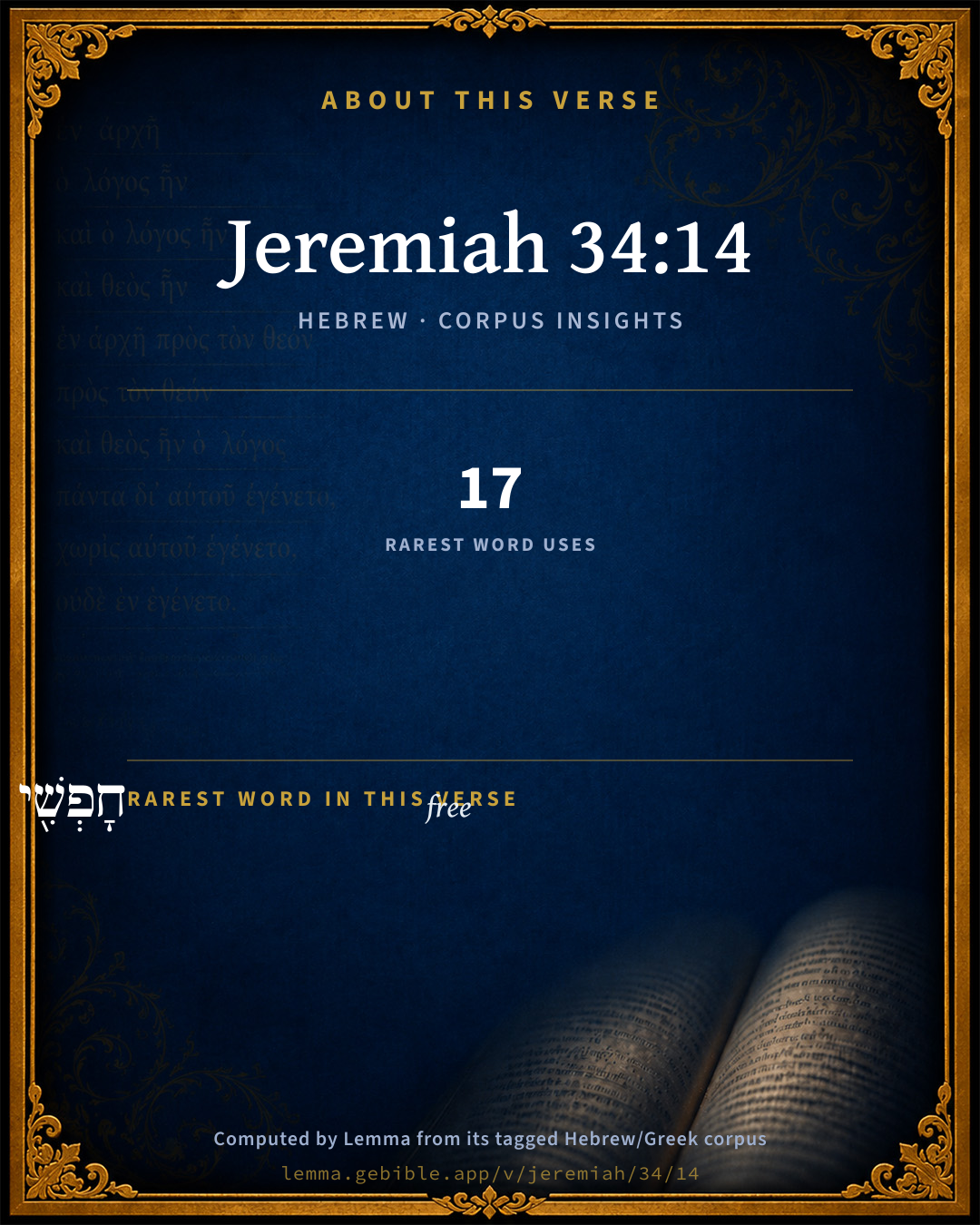
These counts appear in no published source. They are computed here, from the morphology-tagged text and Lemma’s own curated glosses. What Lemma adds →

25
words
20
distinct lemmas
Prophets
section

Notable vocabulary

The rarest word here is חָפְשִׁ֖י free H2670 — appearing just 17 times in the whole Hebrew Bible.

Shared distinctive vocabulary

חָפְשִׁ֖י free H2670 occurs in 17 verses of the Hebrew Bible. Also found in:

Grammatical profile

  • 6 verbs
  • 8 nouns
  • 3 adjectives
  • 3 prepositions
  • 5 particles

Verb forms

  • תְּֽשַׁלְּח֡וּ Piel · Imperfect
  • יִמָּכֵ֣ר Niphal · Imperfect
  • וַעֲבָֽדְךָ֙ Qal · Sequential Perfect
  • וְשִׁלַּחְתּ֥וֹ Piel · Sequential Perfect
  • שָׁמְע֤וּ Qal · Perfect
  • הִטּ֖וּ Hiphil · Perfect

Repetition

Words recur within this verse — often emphatic in Hebrew:

  • שָׁנִ֡ים year H8141 ×2
  • תְּֽשַׁלְּח֡וּ to send H7971 ×2
  • וְלֹֽא not H3808 ×2

Cross-references

23

Topical passages linked to Jeremiah 34:14 in the Treasury of Scripture Knowledge — connected by theme and wording, ordered by reader-vote popularity; previews shown in the World English Bible.

  • Deuteronomy 15:12 If your brother, a Hebrew man, or a Hebrew woman, be sold to you, and serve you six years; then in the seventh year you shall let him go free from you.
  • 1 Samuel 8:7–8 Yahweh said to Samuel, Listen to the voice of the people in all that they tell you; for they have not rejected you, but they have rejected me, that I should not be king over them.
  • 1 Kings 9:22 But of the children of Israel did Solomon make no bondservants; but they were the men of war, and his servants, and his princes, and his captains, and rulers of his chariots and of his horsemen.
  • 2 Kings 17:13–14 Yet Yahweh testified to Israel, and to Judah, by every prophet, and every seer, saying, Turn you from your evil ways, and keep my commandments and my statutes, according to all the law which I commanded your fathers, and which I sent to you by my servants the prophets.
  • Exodus 21:1–4 "Now these are the ordinances which you shall set before them.
  • Exodus 23:10–11 "For six years you shall sow your land, and shall gather in its increase,
  • 1 Kings 21:25 (But there was none like Ahab, who did sell himself to do that which was evil in the sight of Yahweh, whom Jezebel his wife stirred up.
  • 2 Chronicles 28:10 Now you purpose to keep under the children of Judah and Jerusalem for bondservants and bondmaids to you: [but] aren't there even with you trespasses of your own against Yahweh your God?
  • 2 Chronicles 36:16 but they mocked the messengers of God, and despised his words, and scoffed at his prophets, until the wrath of Yahweh arose against his people, until there was no remedy.
  • Nehemiah 9:30 Yet many years did you bear with them, and testified against them by your Spirit through your prophets: yet would they not give ear: therefore gave you them into the hand of the peoples of the lands.
  • Isaiah 50:1 Thus says Yahweh, Where is the bill of your mother's divorce, with which I have put her away? or which of my creditors is it to whom I have sold you? Behold, for your iniquities were you sold, and for your transgressions was your mother put away.
  • Isaiah 58:6 Isn't this the fast that I have chosen: to loose the bonds of wickedness, to undo the bands of the yoke, and to let the oppressed go free, and that you break every yoke?
  • Jeremiah 7:25–26 Since the day that your fathers came forth out of the land of Egypt to this day, I have sent to you all my servants the prophets, daily rising up early and sending them:
  • Jeremiah 11:8–10 Yet they didn't obey, nor turn their ear, but walked everyone in the stubbornness of their evil heart: therefore I brought on them all the words of this covenant, which I commanded them to do, but they didn't do them.
  • Jeremiah 32:30 For the children of Israel and the children of Judah have done only that which was evil in my sight from their youth; for the children of Israel have only provoked me to anger with the work of their hands, says Yahweh.
  • Jeremiah 34:8–9 The word that came to Jeremiah from Yahweh, after that the king Zedekiah had made a covenant with all the people who were at Jerusalem, to proclaim liberty to them;
  • Ezekiel 20:4 Will you judge them, son of man, will you judge them? Cause them to know the abominations of their fathers;
  • Ezekiel 20:8 But they rebelled against me, and would not listen to me; they did not every man cast away the abominations of their eyes, neither did they forsake the idols of Egypt. Then I said I would pour out my wrath on them, to accomplish my anger against them in the midst of the land of Egypt.
  • Amos 2:6 Thus says Yahweh: "For three transgressions of Israel, yes, for four, I will not turn away its punishment; Because they have sold the righteous for silver, And the needy for a pair of shoes;
  • Amos 8:6 That we may buy the poor for silver, And the needy for a pair of shoes, And sell the sweepings with the wheat?'"
  • Zechariah 7:11–12 But they refused to listen, and turned their backs, and stopped their ears, that they might not hear.
  • Romans 7:14–17 For we know that the law is spiritual, but I am fleshly, sold under sin.
  • Romans 7:24 What a wretched man I am! Who will deliver me out of the body of this death?

Cross-references courtesy of OpenBible.info (CC BY 4.0).

Hebrew and Greek witnesses Masoretic Hebrew ↔ Greek Septuagint

The same verse in the two great witnesses to the Old Testament, shown verse-for-verse.

These are two independent witnesses, not word-aligned to each other, and the Septuagint is shown in lemma (dictionary) form.

Hebrew Jeremiah 34:14 Masoretic · Westminster Leningrad Codex

מִקֵּ֣ץ שֶׁ֣בַע שָׁנִ֡ים תְּֽשַׁלְּח֡וּ אִישׁ֩ אֶת אָחִ֨יו הָעִבְרִ֜י אֲשֶֽׁר יִמָּכֵ֣ר לְךָ֗ וַעֲבָֽדְךָ֙ שֵׁ֣שׁ שָׁנִ֔ים וְשִׁלַּחְתּ֥וֹ חָפְשִׁ֖י מֵֽעִמָּ֑ךְ וְלֹֽא שָׁמְע֤וּ אֲבֽוֹתֵיכֶם֙ אֵלַ֔י וְלֹ֥א הִטּ֖וּ אֶת אָזְנָֽם

At the end of seven years you shall let go every man his brother who is a Hebrew, who has been sold to you, and has served you six years, you shall let him go free from you: but your fathers didn't listen to me, neither inclined their ear.

World English Bible · Public Domain

Greek LXX Structure differs

In the Septuagint, Jeremiah is about an eighth shorter than the Hebrew and arranges its material differently — the Oracles Against the Nations (Hebrew chapters 46–51) appear in the middle of the Greek book, after 25:13. Because the chapter and verse boundaries do not line up, a verse-for-verse comparison with the Hebrew is not shown.

A verse-for-verse comparison isn’t shown here because the chapters and verses don’t line up. Switch to the LXX edition with the MT / LXX toggle above to read the Greek directly.

On this verse, The Cambridge Bible for Schools and Colleges discusses the Septuagint’s reading. Read the note in Commentary ↓

Hebrew: Westminster Leningrad Codex (CC BY 4.0). Greek: Septuagint (public domain); English from a public-domain English Septuagint. How the Septuagint differs from the Hebrew →

Targum (Aramaic paraphrase)

1

The Targum is the ancient Jewish Aramaic paraphrase of the Hebrew Scriptures — an interpretive translation, not the Hebrew text itself. Onkelos (literal) and Pseudo-Jonathan (expansive) render the Torah, and Jonathan the Prophets. Coverage is partial: where no permissively-licensed English translation exists for a verse, only the Aramaic is shown. This is verse-level text, not a word-by-word alignment to the Hebrew.

  1. Targum Jonathan Prophets (Joshua–Malachi)
    מִסוֹף שְׁבַע שְׁנִין תִּשְׁלְחוּן גְבַר יַת אֲחוּהִי בַר יִשְׂרָאֵל דְיִזְדַבַן לָךְ וְיִפְלְחִינָךְ שִׁית שְׁנִין וְתִפְטְרִינֵיהּ בַּר חוֹרִין מֵעִמָךְ וְלָא קַבִּילוּ אֲבָהַתְכוֹן לְמֵימְרִי וְלָא אַרְכִינוּ יַת אוּדְנְהוֹן:

    (no public-domain English translation for this verse)

    Targum Jonathan — Aramaic: “Mikraot Gedolot” (public domain). English: “Sefaria Community Translation” (CC0 1.0 (public-domain dedication)); “London "Chaldee Paraphrase," 1871” (public domain). Text via Sefaria.

Commentary

Notes on Jeremiah 34:14 from classic Christian and Jewish commentators (each source and its license shown beneath its notes). The classic Christian expositions comment on the surrounding passage and are grouped to its opening verse, so a note may address several verses; the Jewish commentaries on the Tanakh (Rashi and others) are per-verse, so they appear only where the commentator wrote on this verse.

Lemma curates 59 commentaries, every one of them public domain or Creative Commons licensed, each selected and text-cleaned for this edition rather than reprinted as found. About our sources →

Trapp's Complete Commentary

John Trapp

Jer 34:14 At the end of seven years let ye go every man his brother an Hebrew, which hath been sold unto thee; and when he hath served thee six years, thou shalt let him go free from thee: but your fathers hearkened not unto me, neither inclined their ear.

Ver. 14. At the end of seven years let ye go.] He layeth before them God’s law, which they had transgressed, out of Exo 21:2 Deu 15:12. A law so full of equity, humanity, and benignity, that the more honest heathens approved and observed it, as the Romans and Athenians. Only these latter had an action at law (which they called ‘Aποστασιον) for a master against his servant, ungrateful for his manumission, and not doing his duty to his master, for such were again to be made bondslaves, if the crime could be proved against them. {a}

{a} Val. Max., lib. ii. cap. 1.

John Trapp, A Commentary or Exposition upon All the Books of the Old and New Testament (1647–1656) — public domain. Text from a community e-Sword module.

Jamieson, Fausset & Brown

Robert Jamieson, A. R. Fausset & David Brown

At the end of seven years--that is, not on the eighth year, but within the limit of the seventh year, not later than the end of the seventh year (Exo 21:2; Exo 23:10; Deu 15:12). So "at the end of three years" (Deu 14:28; Kg2 18:10), and "after three days, I will rise again" (Mat 27:63), that is, on the third day (compare Mat 27:64).

Jamieson, Fausset & Brown — Commentary Critical and Explanatory on the Whole Bible (1871) — public domain (CC PDM 1.0). Text via the HelloAO Bible API.

John Calvin's Commentaries

This passage, as many others, clearly shews the great perverseness of the people. Certainly the Law spoken of here ought to have been well approved by the Jews, for they found that they were by a privilege exempted from the common lot of men, and had been preferred before all nations. As, then, they saw that it was a signal evidence of God’s bounty towards the seed of Abraham, this ought to have allured them to observe the Law, inasmuch as they found in it what was especially suitable to them; but as every one became addicted to his own private advantage, the poor were oppressed, and a temporary servitude was changed into what was perpetual. There is no wonder then that men soon forgot what was right, though they seemed to have hearkened for a short time to God. It has been the common vice of all ages that the laws of God became soon forgotten and disregarded; so the law of freedom, though especially excellent, became, as we see, neglected.

He adds, Nor inclined their ear We have stated elsewhere that this phrase is emphatic, when added to the expression of not hearkening; for it is a proof of deliberate wickedness, when men close up their ears, and listen not to what is right. It is possible for one to neglect what is said, or not to understand it; but when one intentionally closes his ears, it is a proof of hopeless obstinacy. God, then, is wont to express by this mode of speaking, the perverseness and hardness that prevailed in the ancient people, through which they rejected all sound doctrine. And this ought to be carefully noticed; for where the word of God is made clearly known, in vain we excuse ourselves for not following what he commands, for he speaks not obscurely, as he says by Isaiah. (Isaiah 45:19) How comes it, then, that doctrine does not produce fruit in us? even because we wilfully reject it, closing our cars and disregarding God himself when he speaks. Now the reason why God brings a charge against the fathers is, that the comparison might enhance the wickedness of their children, who, after having professed that they had some regard for religion and some feeling of mercy, soon returned to their old ways, according to what follows —

John Calvin's Commentaries (1540-1563) — public domain. Text from the Calvin Translation Society English edition (1840s-50s) via the Christian Classics Ethereal Library (ccel.org). Calvin's coverage is partial (roughly two-thirds of the Bible); uncommented books and verses are honest gaps, never fabricated. The 19th-century editor's footnotes and remarks are omitted so the notes are faithfully Calvin's own voice.

Ellicott's Commentary for English Readers

(14) At the end of seven years . . .—The immediate context, “when he hath served thee six years,” shows that the liberation was intended to take place at the beginning of the seventh year. The Sabbath-year was to bring its rest to the slave as well as to the land.

Your fathers hearkened not unto me . . .—The words imply the fact already stated, that there had been a long-continued violation of the law to which the prophet refers. In Isa_58:6; Isa_61:1 (assuming the earlier date of those prophecies) we may trace a protest against that violation.

A Bible Commentary for English Readers, edited by Charles John Ellicott (1878–1897) — public domain. Text from a community e-Sword module.

The Cambridge Bible for Schools and Colleges

gen. ed. J. J. S. Perowne

14. At the end of seven years] As we should say of six (so LXX) years. In Hebrew counting of this kind both the first and the last items were reckoned in. So the jubilee was in strictness the forty-ninth (the seventh Sabbatical) not the fiftieth year. Compare the rite of circumcision administered on the eighth (seventh) day after birth, and our Lord’s Resurrection on “the third (second) day.” The words are quoted somewhat freely from Deu_15:12, rather than from the parallel passage Exo_21:2 (“The Book of the Covenant”).

The Cambridge Bible for Schools and Colleges (gen. ed. J. J. S. Perowne; Cambridge University Press, 1878–1918) — public domain. Text from a community e-Sword module.

John Gill's Exposition

At the end of seven years,.... Not when seven years were elapsed and fully completed; but within the compass of seven years, or as soon as the seventh year was began; for this term of seven years is the term of the seventh year coming in, and not going out, as appears from the law itself, Exo 21:9; and from an after clause in this verse, "when he hath served thee six years"; at the end of which, and the beginning of the seventh: and so Maimonides (m) interprets this law,

"he whom the sanhedrim sold served six years from the day of his sale, and at the beginning of the seventh year he was free:''

though the Vulgate Latin version very wrongly renders it, "when seven years are completed"; which version Sanctius takes a good deal of pains to reconcile to the original law. A Hebrew might sell himself for more years than six; he might sell himself for ten or twelve, as the above Jewish writer says, and nothing could release him but the year of jubilee; and that would do it, if he had served but one year (n);

let ye go every man his brother, an Hebrew, which hath been sold unto thee; or, "hath sold himself unto thee" (o); to be a servant; for money was not given with apprentices to their masters, as is usual with us; but masters gave money for their servants, and bought them either of themselves, or of the magistrates; hence it is said, "if thou buy an Hebrew servant", &c. Exo 21:2. A Hebrew servant was sold either against his will, or with it; if a man committed a theft, and he had not wherewith to make restoration, the sanhedrim or magistrates said him: if he was exceeding poor, the law gave him liberty to sell himself; but he might not sell himself as long as he had anything left, even a covering; and after that was gone, he might sell himself; and he was bought with silver or the value of silver or by contract or bond (p);

and when he hath served thee six years, thou shall let him go free from thee; or "from with thee" (q); from being with thee, from being in thy house, as well as from being in thy service; he was to be dismissed, so as to go where he pleased, and work for himself, or another, as he thought fit;

but your fathers hearkened not unto me, neither inclined their ear; to obey the laws of God, and particularly this concerning servants. This is not to be understood of the fathers with whom the covenant was first made, and to whom this law was first given; but their posterity in later times, who yet lived long before the present generation, and so might with great propriety be called their fathers; and by which it appears that this law had been long neglected.

(m) Hilchot Abadim, c. 2. sect. 2. (n) Ibid. (o) "se ventdiderit tibi", Junius & Tremellius, Piscator. (p) Hilchot Abadim, c. 1. sect. 1, 2. & c. 2. sect. 1. (q) "acuta te", Schmidt.

John Gill's Exposition of the Whole Bible (1746–1763) — public domain (CC PDM 1.0). Text via the HelloAO Bible API.

Haydock's Catholic Bible Commentary

End, or commencement. (Glass.; Gram. iii. 6.) (Exodus xxi. 2., Deuteronomy xv. 12., and Luke ii. 21.) (Calmet)

George Leo Haydock (1774–1849), Haydock's Catholic Family Bible and Commentary, 1859 edition — public domain. Excludes Psalms (Douay-Rheims chapter numbering differs from Protestant) and Deuterocanonical books (Catholic canon only).

Matthew Poole's English Annotations

This is but a repetition of the law, Exo 21:2; Deu 15:12, which concerned such persons as were sold by others, or had sold themselves. God would not have his people take advantage of the sudden and rash acts of their brethren, which were the effects of passion. Notwithstanding this law the Jews, who were always a very covetous, griping people, did otherwise.

Matthew Poole's English Annotations on the Holy Bible (1683–1685) — public domain. Text from a community e-Sword/MySword module.

Whedon's Commentary on the Bible

Daniel D. Whedon

14. Seven years — At the close of six years the bondage of a Hebrew ceased. See Deu_15:12.

Daniel D. Whedon (gen. ed.), Commentary on the Old and New Testaments (1874–1909) — public domain. Text from a community e-Sword module.

The Pulpit Commentary

At the end of seven years, etc. This is the literal rendering, but the sense, as is clear from the parallel passage in Deu_15:12, and indeed from the next clause of this very verse, is "in the seventh (not, the eighth) year."

The Pulpit Commentary (1880–1919), ed. H.D.M. Spence-Jones & Joseph S. Exell — public domain. Text from a community e-Sword module.

Lesson kit

Teaching starters — assembled from the data on this page, not authored interpretation. Every prompt links to the verse data it draws on. Edit before teaching.

Jeremiah, in the Prophets, opens this verse with 25 words (20 distinct Hebrew lemmas). Its most distinctive word is chophshîy (“free”). A historical commentator’s framing appears above. Read the whole chapter for the surrounding context.

Discussion questions

  1. What does “free” (chophshîy) contribute to the verse as a whole?
  2. How does Exodus 21:2, which shares the word «free», read alongside this verse?
  3. What does the repetition of “year” (2× in this one verse) do in this verse?
  4. These translations render this verse differently. What is at stake in choosing one wording over another?
  5. «תְּֽשַׁלְּח֡וּ» is a Piel Imperfect verb. How does that grammatical form shape the action described?
  6. Compare how Trapp's Complete Commentary and Jamieson, Fausset & Brown read this verse. Where do they agree or differ?

Things to notice

Reading settings

Reading text

Shown beneath each verse's original-language words.

Old Testament
Old Testament edition

Read the OT as the Masoretic Hebrew (MT) or the Greek Septuagint (LXX).

English shown for the Greek Septuagint (in the Hebrew ↔ Greek comparison).

Comparing translations? Open the Compare panel on any verse page to stack up to four side by side.