

Proverbs 1:24

Hebrew (Westminster Leningrad Codex) Proverbs 1:24 appears in the Hebrew Old Testament. The text above is from the Westminster Leningrad Codex. Each word links to its Strong’s number, a concise gloss, and parsing drawn from the Open Scriptures Hebrew Bible morphology. Click any word for its full Brown-Driver-Briggs (BDB) entry.
Download image
Cite this verse

Proverbs 1:24 (World English Bible). Public Domain. Lemma interlinear Bible study tool, https://lemma.gebible.app/v/proverbs/1/24.

Show BibTeX & RIS
BibTeX
RIS
English Translation
Because I have called, and you have refused; I have stretched out my hand, and no one has paid attention;
World English Bible · Public Domain
Download a study sheet

One document with this verse’s original text, its word-by-word gloss line, the meaning frame, cross-references with their text, attributed commentary, and full source and license credits — printable, and it pastes into notes with its structure intact.

This verse Autodidact and up

Study sheet (.html) Plain text (.txt)

A passage Seminary Student

Up to 50 verses in one chapter. A passage sheet keeps up to 6 commentary sources and 12 cross-references per verse, in the order this page ranks them, and says so on the sheet whenever that leaves anything out. Ask for a single verse and you get the Autodidact verse sheet above.

Everything on this page stays free to read, with no account — the sheet is a download of what is already on screen, not access to it.

Want to remove ads? Support Godless Engineer
Compare translations 3

The same verse in 3 English versions, stacked beneath the original-language interlinear above. Click any original word for its lexicon entry.

Each is an independent rendering of the whole verse — the interlinear is not word-aligned to these translations.

Highlighted words mark where these versions differ — a whole-verse word diff, not a word-by-word alignment.

  • World English Bible Public Domain
    Because I have called, and you have refused; I have stretched out my hand, and no one has paid attention;
  • King James Version Public Domain
    Because I have called, and ye refused; I have stretched out my hand, and no man regarded;
  • unfoldingWord Literal Text CC BY-SA 4.0
    Because I have called and you have refused, I have stretched out my hand, and there was no one listening attentively,

unfoldingWord Literal Text — © unfoldingWord, licensed CC BY-SA 4.0. Word-aligned USFM3 via Door43 (git.door43.org/unfoldingWord/en_ult).

Versions to compare (up to 4)

3 of 4 selected

Show all 18 translations

Every available English version of this verse, each an independent rendering of the whole verse.

  • World English Bible Public Domain
    Because I have called, and you have refused; I have stretched out my hand, and no one has paid attention;
  • Berean Standard Bible Public Domain
    Because you refused my call, and no one took my outstretched hand,
  • Majority Standard Bible Public Domain
    Because you refused my call, and no one took my outstretched hand,
  • King James Version Public Domain
    Because I have called, and ye refused; I have stretched out my hand, and no man regarded;
  • American Standard Version (1901) Public Domain
    Because I have called, and ye have refused; I have stretched out my hand, and no man hath regarded;
  • Revised Version (1885) Public Domain
    Because I have called, and ye refused; I have stretched out my hand, and no man regarded;
  • Geneva Bible (1599) Public Domain
    Because I haue called, and ye refused: I haue stretched out mine hand, and none woulde regarde.
  • Douay-Rheims (1899) Public Domain
    Because I called, and you refused: I stretched out my hand, and there was none that regarded.
  • Young's Literal Translation Public Domain
    Because I have called, and ye refuse, I stretched out my hand, and none is attending,
  • Literal Standard Version CC BY-SA 4.0
    Because I have called, and you refuse, || I stretched out my hand, and none is attending,
  • Unlocked Literal Bible CC BY-SA 4.0
    I have called, and you have refused to listen; I reached out with my hand, but there was no one who paid attention.
  • unfoldingWord Literal Text CC BY-SA 4.0
    Because I have called and you have refused, I have stretched out my hand, and there was no one listening attentively,
  • Darby Bible Public Domain
    Because I have called, and ye refused; I have stretched out my hand, and no one regarded;
  • World Messianic Bible Public Domain
    Because I have called, and you have refused; I have stretched out my hand, and no one has paid attention;
  • Webster's Bible Public Domain
    Because I have called, and ye refused; I have stretched out my hand, and no man regarded;
  • Free Bible Version CC BY-SA 4.0
    For I have called you, but you refused to listen; I reached out my hand to you, but you didn't care.
  • Bible in Basic English Public Domain
    Because your ears were shut to my voice; no one gave attention to my out-stretched hand;
  • JPS Tanakh (1917) Public Domain
    Because I have called, and ye refused, I have stretched out my hand, and no man attended,

Literal Standard Version (2020), Covenant Press — licensed CC BY-SA 4.0. Text via the HelloAO Bible API (eBible.org). Unlocked Literal Bible (unfoldingWord) — licensed CC BY-SA 4.0. Text via the HelloAO Bible API (eBible.org). unfoldingWord Literal Text — © unfoldingWord, licensed CC BY-SA 4.0. Word-aligned USFM3 via Door43 (git.door43.org/unfoldingWord/en_ult). Free Bible Version, Dr. Jonathan Gallagher — licensed CC BY-SA 4.0. Text via the HelloAO Bible API (eBible.org).

Word by word

More ways to search: Search by grammar → Find every occurrence → Compare this word →

Practice this passage: Drill this verse → Learn its vocabulary →

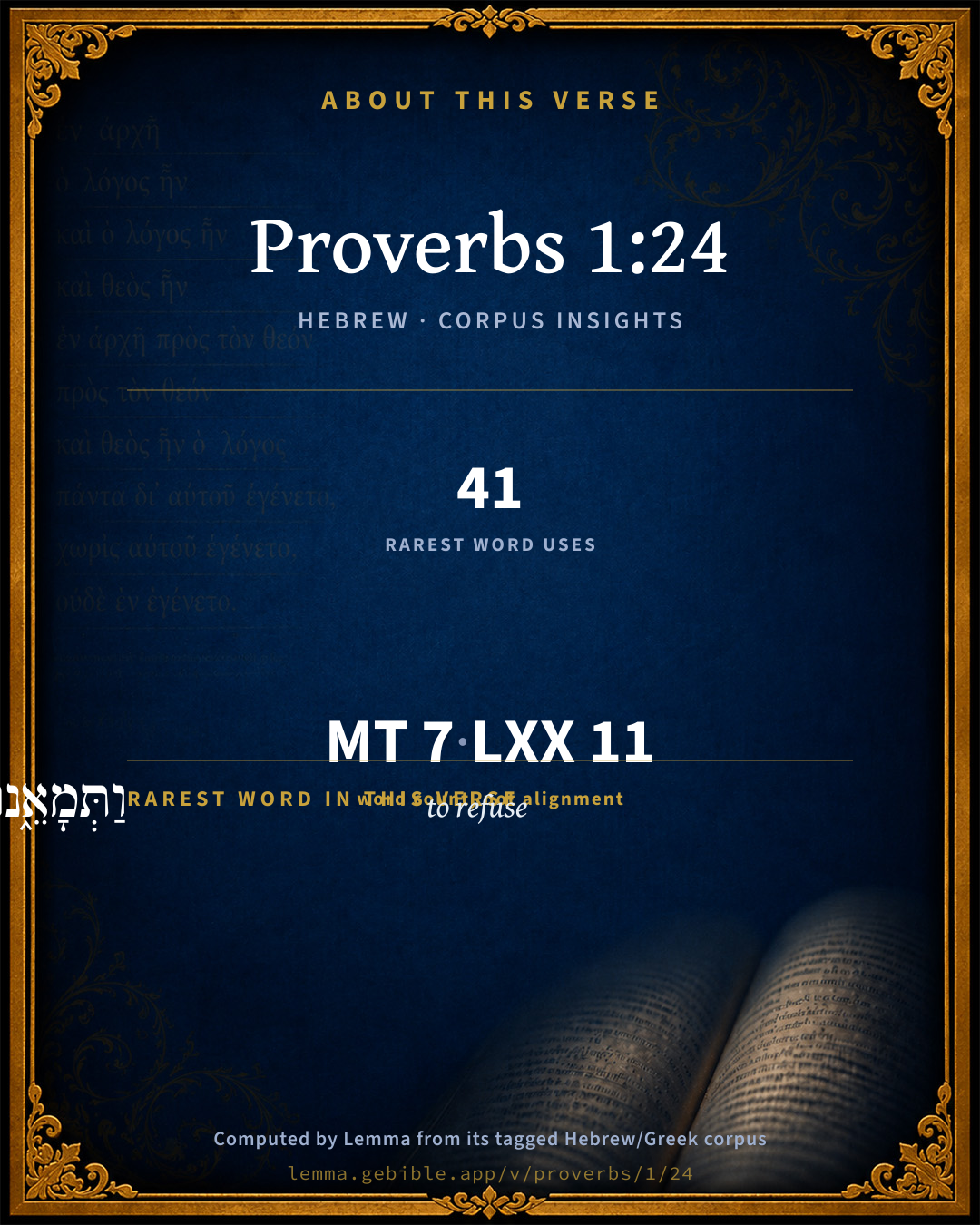
About this verse

These counts appear in no published source. They are computed here, from the morphology-tagged text and Lemma’s own curated glosses. What Lemma adds →

7
words
7
distinct lemmas
Wisdom
section

Shared distinctive vocabulary

וַתְּמָאֵ֑נוּ to refuse H3985 occurs in 39 verses of the Hebrew Bible. Also found in:

Grammatical profile

  • 4 verbs
  • 1 noun
  • 1 conjunction
  • 1 particle

Verb forms

  • קָ֭רָאתִי Qal · Perfect
  • וַתְּמָאֵ֑נוּ Piel · Sequential Imperfect
  • נָטִ֥יתִי Qal · Perfect
  • מַקְשִֽׁיב Hiphil · Participle Active

Hebrew & Septuagint length

In English translation the verse runs 20 words from the Hebrew and 18 from the Septuagint (LXX English) — closely comparable.

A rough comparison of the two English renderings, which tokenize alike — not a word-level alignment.

Word counts can differ between the Hebrew and the Greek without any difference in meaning — e.g. the Hebrew direct-object marker אֵת has no separate Greek word, and Greek often adds the article ὁ.

In the original languages it is 7 Hebrew tokens and 11 Greek tokens — but the two are counted differently (Hebrew bundles its prefixes and suffixes into one token; the Greek is in lemma form), so that isn’t a like-for-like length.

Cross-references

12

Topical passages linked to Proverbs 1:24 in the Treasury of Scripture Knowledge — connected by theme and wording, ordered by reader-vote popularity; previews shown in the World English Bible.

  • Isaiah 65:12 I will destine you to the sword, and you shall all bow down to the slaughter; because when I called, you did not answer; when I spoke, you did not hear; but you did that which was evil in my eyes, and chose that in which I didn't delight.
  • Romans 10:21 But as to Israel he says, "All day long I stretched out my hands to a disobedient and contrary people."
  • Jeremiah 7:13 Now, because you have done all these works, says Yahweh, and I spoke to you, rising up early and speaking, but you didn't hear; and I called you, but you didn't answer:
  • Isaiah 66:4 I also will choose their delusions, and will bring their fears on them; because when I called, none did answer; when I spoke, they did not hear: but they did that which was evil in my eyes, and chose that in which I didn't delight.
  • Hebrews 12:25–26 See that you don't refuse him who speaks. For if they didn't escape when they refused him who warned on the Earth, how much more will we not escape who turn away from him who warns from heaven,
  • Ezekiel 8:18 Therefore will I also deal in wrath; my eye shall not spare, neither will I have pity; and though they cry in my ears with a loud voice, yet will I not hear them.
  • Zechariah 7:11–12 But they refused to listen, and turned their backs, and stopped their ears, that they might not hear.
  • Matthew 22:5–6 But they made light of it, and went their ways, one to his own farm, another to his merchandise,
  • Isaiah 50:2 Why, when I came, was there no man? when I called, was there none to answer? Is my hand shortened at all, that it can't redeem? or have I no power to deliver? Behold, at my rebuke I dry up the sea, I make the rivers a wilderness: their fish stink, because there is no water, and die for thirst.
  • Matthew 23:37–38 "Jerusalem, Jerusalem, who kills the prophets, and stones those who are sent to her! How often would I have gathered your children together, even as a hen gathers her chickens under her wings, and you would not!
  • Psalms 31:20 In the shelter of your presence you will hide them from the plotting of man. You will keep them secretly in a dwelling away from the strife of tongues.
  • Acts 4:30 while you stretch out your hand to heal; and that signs and wonders may be done through the name of your holy Servant Jesus."

Cross-references courtesy of OpenBible.info (CC BY 4.0).

Hebrew and Greek witnesses Masoretic Hebrew ↔ Greek Septuagint

The same verse in the two great witnesses to the Old Testament, shown verse-for-verse.

These are two independent witnesses, not word-aligned to each other, and the Septuagint is shown in lemma (dictionary) form.

Hebrew Proverbs 1:24 Masoretic · Westminster Leningrad Codex

יַ֣עַן קָ֭רָאתִי וַתְּמָאֵ֑נוּ נָטִ֥יתִי יָ֝דִ֗י וְאֵ֣ין מַקְשִֽׁיב

Because I have called, and you have refused; I have stretched out my hand, and no one has paid attention;

World English Bible · Public Domain

Greek LXX Proverbs 1:24 Septuagint · lemma form

ἐπειδή καλέω καί οὐ ὑποἀκούω καί ἐκτείνω λόγος καί οὐ προςἔχω

Since I called, and you⌃ did not listen; and I spoke at length, and you⌃ gave no heed;

LXX2012 (modern English Septuagint) · Public Domain

On this verse, The Cambridge Bible for Schools and Colleges discusses the Septuagint’s reading. Read the note in Commentary ↓

Hebrew: Westminster Leningrad Codex (CC BY 4.0). Greek: Septuagint (public domain); English from LXX2012 (modern English Septuagint) (Public Domain). How the Septuagint differs from the Hebrew →

Commentary

Notes on Proverbs 1:24 from classic Christian and Jewish commentators (each source and its license shown beneath its notes). The classic Christian expositions comment on the surrounding passage and are grouped to its opening verse, so a note may address several verses; the Jewish commentaries on the Tanakh (Rashi and others) are per-verse, so they appear only where the commentator wrote on this verse.

Lemma curates 59 commentaries, every one of them public domain or Creative Commons licensed, each selected and text-cleaned for this edition rather than reprinted as found. About our sources →

The Cambridge Bible for Schools and Colleges

gen. ed. J. J. S. Perowne

24. The abruptness of the transition from gracious invitation to awful threatening has led to the suggestion that a pause is to be introduced between the two divisions (Pro_1:20-33) of this appeal of Wisdom. But, as Maurer points out, Pro_1:22 (How long!) shews, as do these Pro_1:24-25, that this is rather the last appeal of Wisdom than the first. She has already “all day long stretched forth her hands unto a disobedient and gainsaying people” (Isa_65:2; Rom_10:21). This is indicated by the LXX. by the tense used, ἐκάλουν, ἐξέτεινον. The rejection of her overtures has been persistent and scornful; and now by the very abruptness and sternness of her address she makes a last effort to awaken and rescue.

“Save, Lord, by love or fear.”

Comp. Luk_13:24-28.

The Cambridge Bible for Schools and Colleges (gen. ed. J. J. S. Perowne; Cambridge University Press, 1878–1918) — public domain. Text from a community e-Sword module.

Trapp's Complete Commentary

John Trapp

Pro 1:24 Because I have called, and ye refused; I have stretched out my hand, and no man regarded;

Ver. 24. Because I have called, and ye refused.] If any ask, why did God suffer them to refuse, and not make them yield? I answer with Augustine, Doctiorem quaerat, qui hanc quaestionem ei explicet: Let him look one that can tell him, for I cannot.

John Trapp, A Commentary or Exposition upon All the Books of the Old and New Testament (1647–1656) — public domain. Text from a community e-Sword module.

The Biblical Illustrator

Joseph S. Exell

Pro_1:24-28

Because I have called, and ye refused.

The rejected call of Wisdom

I. The manner in which it has called upon you--in which the appeals of Wisdom and of religion have been made. In the manner, the variety, the intensity, the tenderness, the unwearied nature, and the sleepless watchfulness of appeal, nothing has occurred that can be compared with the calls which have been made to you to abandon a sinful course and to give your heart to God.

II. The manner of the reception of this call. You have neglected these calls and warnings; you paid no attention to them, as if they did not pertain to you, or as if they had no claim to your regard. You have argued against the truth; you have cavilled against the truth; you have urged excuses that you might not obey the truth; you have sought plausible reasons for neglecting to do what you knew to be your duty; you have taken refuge under the imperfections of Christians for not being yourself a Christian. You have done this long. In some cases it has been the work of a life; in all cases it has been a leading object of life thus far.

III. The effect of neglecting and disregarding these calls. When your fear cometh, etc. Your wealth cannot save you; your accomplishments cannot save you. Death cares for none of these things.

1. You will die, and the fear of death will come upon you.

2. The fear of the judgment day will come upon you, for that cannot always be avoided.

IV. When these things come it will be too late to cry for mercy. There must be a limit to the calls of religion and mercy, for life is very brief, and they all lie this side the grave. Can you suppose that He will always appeal to the sceptic and the caviller, and bear with his scepticism and cavils through a vast eternity? This cannot be; and somewhere there must be a limit to the offers of mercy to men. That may occur before you shall reach the deathbed, short as is the journey thither. May not the mind become so worldly, and the heart so vain, and the conscience so seared, and the life so wicked, and the will so obdurate, and the whole soul so utterly shattered and ruined by sin, that conversion shall be hopeless and ruin certain? It may occur on the death-bed: then the cry for mercy may be vain. And there is a world where the cry of mercy is never heard. Embrace the call, whether to you it be the last or not, and your eternal welfare will be secure. (A. Barnes, D.D.)

The folly and danger of refusing the calls of mercy

I. That God calls on sinners.

1. This is clear from many parts of Scripture (Isa_55:1; Isa_55:3; Isa_55:6, etc., 65:1, 2; Eze_18:30-31).

2. The end to which He calls us in these different ways is to repent and turn from our sins, and believe on the Lord Jesus Christ (Act_20:21; Mar_1:15). As to the nature and manner of those calls, they are--

(1) Kind and gracious; they are full of love, tenderness, and pity (Deu_32:29; Hos_11:8; Mat_23:37; Luk_19:41-42). What moving expostulations are these!

(2) They carry the highest reason and persuasion along with them. It is to avoid our own ruin and secure our own happiness.

(3) They last but for a season. His patience will at last be worn out by our many obstinate refusals. The shining day of grace at last ends in the eternal shades of night (Mat_23:38; Isa_66:4; Jer_7:13-15).

II. That sinners too often refuse to hearken to the calls of God. Many hear the gospel calls, but few are obedient to them. The old world would not be reformed by the preaching of Noah. The Israelites stoned the prophets that were sent to them (Jer_7:24-26; 2Ch_24:21). Now, whence can this proceed, that so many are disobedient to the heavenly call?

1. It is partly owing to unbelief.

2. Others slight the Word because they are prejudiced against the messenger that brings it, regarding his imperfections and inadvertencies more than the weight of those things which he delivers.

3. Others do it through ignorance: darkness and blindness of mind make them hardened and obstinate. They know not God, their sinful state, their need of Christ, nor the beauty and excellency of spiritual things.

4. Others through pride reject the calls of God (Rev_3:17).

5. Others through love of the world. The business of the world engrosses their time, and the pleasures of it entirely captivate their affections.

6. Others through a false peace.

III. The evil and danger of refusing to hearken to Gods calls, His counsel and reproof

1. It is the most heinous ingratitude to God.

2. It is a contempt of Gods power.

3. We rob ourselves of the greatest advantages.

4. By rejecting the calls of God we run ourselves into the greatest misery and ruin.

What threatenings and woe are denounced against the obstinate sinner! I now come to apply the subject.

1. Let us admire the mercy of God in thus calling sinners.

2. Let such as have obeyed the calls of God rejoice therein; they have cause of eternal joy and eternal thankfulness.

3. Let such as have shut their ears against the calls of God be persuaded now to hearken to them. (T. Hannam.)

Irreversible chastisements

These words are awful, but not hopeless; they pronounce Gods judgment on the finally impenitent; the penitent they but awaken, that they may hear the voice of the Son of God and live. The sentence pronounced is final. If, hearing, men will not hearken, a time will come when all these calls will but increase their anguish and misery. Because these words relate to the day of judgment, is there no sense in which they are fulfilled in this life? It should appal any one to find that they do not appal him. Conscience bears witness that he has been one of those against whom the words denounce woe. All suffering, mental or bodily, has a twofold character; it is at once punishment and chastisement; it at once expresses Gods hatred for sin and mercy to the sinner; it is at once the wrath and love of Almighty God. Of Gods judgments, many are for this life without remedy. God warns that He may not strike; but, when He does strike, a mans whole life is changed. To certain courses of sin God annexes certain punishments, and although, for a time and up to a certain degree of sin, they may not, to any extent, follow, yet, beyond that bound, they do follow irresistibly, irreversibly. Manifold diseases of mind, body, or estate, whereby God chastens sin, have this in common, that there is no certain time when the blow comes. We cannot tell the rule by which God dispenseth suffering and loss. To us they seem to fall more suddenly on some, while others go on longer without visible punishment. We only know that happy they who are chastened soonest. The judgments God is constantly sending should awe us all, especially such as are even half-conscious that there is some besetting sin, slight as it may seem, to which they are continually yielding. Unheedful, such permit sin to accumulate after sin. And sin after sin is filling up the measure of their provocations and the fearful treasure of the wrath of Almighty God. All sin must be eating out the love of God and His life in the soul. If Gods fire do fall, then mans only wisdom is, with what strength he has, darkened though his path be by the bewildering of past sin, to grope his way onward in the new path wherein God has set him. The past is, in one sense, closed. He has been tried, has failed, and is in this way, perhaps, tried no more. His trial is changed. If we failed, we have missed what, by Gods grace, we might have become. Man may gather hope from the very severity of Gods punishments. While we mourn our neglect of past calls, our sorrow, which is still His gift and call within us, will draw down His gladdening look, which will anew call us unto Him. As we would hear the last blissful call, hearken we each one of us to the next, whereby He calleth us to break off any, the very slightest, evil, or to gird ourselves to any good, and follow Him without delay. (E. B. Pusey, D. D.)

God and the impenitent sinner

I. God and the impenitent sinner in probation.

1. Gods conduct towards the sinner in probation.

(1) He calls them, by His Word, His ministry, His Spirit.

(2) He stretches out His hand to them. His arms are outstretched to receive them.

(3) He counsels them. Presents lessons of wisdom to them.

(4) He reproves them. Rebukes them for their sins.

2. The sinner s conduct towards God in probation.

(1) They refuse His call. Ye refused.

(2) They disregard His outstretched hands. No man regarded.

(3) They set at nought His counsel. They rejected His reproof.

II. God and the impenitent sinner in retribution. 1.Gods conduct towards the impenitent sinner in retribution.

(1) He laughs at their distress. I will laugh at your calamity. Their distress is great. Their destruction has come as a whirlwind, and what is more, it has grown out of their conduct. They eat of the fruit of their own way.

(2) He disregards their prayers. I will not answer.

2. The impenitent sinners conduct towards God. They cried to Him for help. They may bitterly call upon Me, but I will not answer. There is earnest prayer in hell, but it is fruitless. (Homilist.)

Wisdom personified, and love incarnate

Wisdom is one of the Divine attributes; and Christ is of God made unto us wisdom, as well as righteousness, and sanctification, and redemption. We may surely expect, then, that up to a certain point the utterances of Wisdom and of Christ would coincide; so that in these passages in the Book of Proverbs we should be able to find, as we find throughout the whole of the Old Testament, some portion of the testimony of Jesus. But does it follow that because some, or even many, of Wisdoms utterances may be correctly spoken of as the words of Christ Himself, therefore all of them may be so regarded? To see how utterly foolish is this way of reasoning, we have only to remember how many of Davids words not only coincide with those of Christ, but are actually quoted in the New Testament as if Christ Himself had uttered them; and yet no one is so foolish as to insist that all the words of David can be safely put into the mouth of Christ. As we said at the beginning, wisdom is one of the attributes of God; and therefore the words of Wisdom must be, up to a certain point, the expression of the Divine mind. We may say that Wisdom expresses the mind of God in creation, in providence, in the whole realm of law. And in this realm, as well as in the realm of grace, the Son of God has His place as the Revealer. We may regard Christ and Wisdom as identical throughout the realm of natural law; so that no error would result from the substitution of the one for the other within that range of truth; but when we leave the realm of law and enter that of grace, it is entirely different; then it may not only be injurious but fatal to take the utterances of mere wisdom and put them into the mouth of Christ. If Christ had been only wisdom, He could not have heard the sinners prayer. But He is also righteousness, and sanctification, and redemption; and that makes all the difference, for now that He has made an atonement for our sins and opened up the way of life, He can speak, not only in the name of wisdom, but of pardoning mercy and redeeming grace; and, accordingly, far from laughing at calamity and scorning the penitents prayer, which wisdom if it were alone might do, He can, and will, and does save them to the uttermost that come unto God by Him. Having thus considered the extent to which we may expect to find the testimony of Jesus in the words of Wisdom, let us now test the principle we have laid down by an examination of the passage. The paragraph begins with this bold and striking personification: Wisdom crieth without; she uttereth her voice in the streets: she crieth in the chief place of concourse, in the openings of the gates: in the city she uttereth her words, saying--and then follows the passage with which we have mainly to do. Let us, then, listen to Wisdoms cry, and observe how truthfully and powerfully it is translated into the language of men. We shall see its truth to nature better if we first look back a little. She begins, not with a cry, but with tender words of counsel and of promise (verses 8, 9), My son, hear the instruction of thy father, etc. These are the tender and kindly words of counsel in which she addresses the young man setting out in life. Following this are tender and yet solemn words of warning against the tempter whom every one must meet (verse 19): My, son, if sinners entice thee, consent thou not, etc. But now time passes on, and Wisdoms protegé begins to go astray, to forget the instruction of the father and the loving law of the mother; and so now she lifts up her voice and cries, entreating the wanderer to turn before it is too late (verses 22, 23). Time passes on, and the warning cry has been as little heeded as had been the tender voice of Wisdom at the first. The son, instead of being prudent, has been rash; he has been, not economical, but extravagant; not temperate, but dissipated; and so he has gone on till his last opportunity has been thrown away, his patrimony squandered, his health gone, his last friend lost. Then once more his early monitor appears. The prodigal remembers the tender words of counsel and of promise. He remembers how, when he was just beginning to go astray, before he had become hopelessly entangled in evil, Wisdom lifted up her voice and cried. For a long time his old counsellor has not been present to his mind at all. He has been hurrying on in courses of evil, but now his very wretchedness forces him to stop and think. And, again, there stands Wisdom before him. How does she address him now? Does she speak to him in soothing tones? Does she promise to restore him his money, or his health, or his friends? Alas, no: she cannot. All she can say is, I told you it would be so. I warned you what would be the end; and now the end has come. You must eat the fruit of your own ways, and be filled with your own devices. That is positively all that Wisdom can say; and there is no tenderness in her tone. She seems to mock him rather, she seems to laugh at his calamity. Such is the voice of Wisdom in the end to those who have despised her counsel in the beginning. And is not the whole representation true to nature? Yes, it is perfectly true that Wisdom crieth without, she uttereth her voice in the streets, and says these things so loudly that no listening ear can fail to hear them. It is no matter of deep philosophy. It is no ecclesiastical or theological dogma. It belongs to the Proverbs, the proverbs of the streets. The merit of Solomon, in this chapter, is not in telling us something we should not otherwise have known; but in putting what everybody knows in a very striking form. I question whether in all literature there can be found any more vivid and alarming description of the terror and despair of a remorseful conscience, as it looks back and recalls, when too late, the neglected counsels alike of earthly and of heavenly wisdom. So far Wisdom; and if it were only with her that sinners had to do, it would go hard, not only with the profligate and openly vicious, but with the most respectable. But He with whom we have to do is not known as wisdom. He is wise indeed; and all wisdom is from Him. But there is that in Him which is higher than wisdom. God is love. Wisdom is the expression of His will in the realm of law; but love is the expression of Himself. The love of God is not a lawless love. It is not at variance with wisdom. The law which ordains that the sinner must eat of the fruit of his own way and be filled with his own devices cannot be set aside by the mere emotion of compassion. Hence it was necessary, in order to redeem man from the condemnation of sin, that the Holy One of God should suffer. Hence, too, it is that, though by the suffering and death of Christ believers in Him are set free from the condemnation of sin, yet the natural consequences of the transgressions of wisdoms laws are not abolished. If health has been wasted, it will not be miraculously restored. If money has been squandered, there must be suffering from the want of it. If character has been forfeited by dishonesty and impurity, it may never be redeemed on this side the grave. The laws of wisdom are not repealed or set at naught; they remain in force. But such has been the ingenuity, so to speak, of the Divine love, that without infringing on the proper domain of wisdom expressing itself in law, the way has been opened up for the full pardon and ultimate restoration even of those who have wandered farthest and sinned most. And accordingly, a passage like this awful one in the first chapter of the Book of Proverbs, instead of obscuring the Divine love in the smallest degree, or interposing so much as a thread between the sinner and his Saviour, rather serves as a background on which to set forth the radiant form of the Saviour of mankind,

Whose love appears more orient and more bright,

Having a foil whereon to show its light.

(J. M. Gibson, D.D.)

A neglected warning

Some years ago a terrible inundation occurred in Noah Holland, due entirely to neglected warnings. The dykes, as the custom is, are inspected by a dyke engineer on certain days every year. A farmer reported the dangerous condition of one repeatedly, but whether from carelessness or because he considered it interference, the engineer laughed at all his fears, saying the dyke would stand many years yet. Not long after, during a violent storm, part of the dyke was carried away by the waters. In a short time several villages, and miles of cultivated land, were under water, many lives being lost. (S. S. Chronicle.)

Critical periods in a sinners life

Every sinner, while unreconciled to God, is in constant and imminent danger of the loss of all things. Yet there are seasons of special danger, periods in his life when, unless he repent and turn to God, he ripens very fast for judgment.

I. The season of youth is one. The mind is then receptive, the heart is tender, the character is unformed, evil habits are not yet matured, and all things invite. It is flood-tide, and is sure to lead on to victory if he takes advantage of it. But neglected, thrown away, the future is almost sure to miscarry.

II. The period of conviction of sin is one of extreme peril. Then the sinner is on the threshold of life. But hesitating, grieving the Spirit, turning back, losing his conviction, he may be ruined for ever.

III. The period of Divine chastisements is a critical period. Gods end in these usually is to reclaim men. To sin on in spite of them; to refuse to be corrected; to wax worse and worse in the day of trial, and under Gods afflictive dispensations, is to run a fearful risk of final and eternal abandonment. (Anon.)

I also will laugh at your calamity.

Retribution

We have here a personification of that attribute of God which is specially employed in words of counsel and admonition, and is here made to represent God. The voice of Wisdom is the voice of God.

I. The merciful appeal of God to sinners, and its rejection.

1. God is said to call.

2. God is said to stretch out His hand. In the gesture of earnest appeal, making use of arguments of deed as well as of word. Providence warns. The hand of God in history demonstrates what providence in its dealings with individuals teaches, that virtue and happiness, vice and misery, go hand in hand; that morality and self-interest in the long run merge; that the path of duty and the path of safety coincide.

3. God is said to counsel. The message of Scripture, with its manifold invitations and warnings, is faithfully delivered.

4. God is said to reprove. By severe strokes of discipline God speaks to those who in their infatuation have refused to pay attention to His former appeals. But the rod of correction may be disregarded. The possibility of such reckless opposition to the merciful appeal of God demonstrates the power of the evil principle in fallen human nature. We have here a complete reversal of the ordinary principles of self-interest which actuate men in all circumstances, except in the sphere of morality.

II. The despairing appeal of sinners to God, and its futility. Their position, as here depicted--

1. It is unspeakably awful. The text speaks of calamity, of fear, of desolation, of destruction like a whirlwind, of distress and anguish. The text speaks of a terrible aggravation of their distress, occasioned by the stinging sarcasm which accompanies their suffering.

2. It is strictly retributive. All their suffering has been earned by themselves. As they formerly eluded Him in His efforts to seek and to save them, so now He will not be found of them.

3. It is utterly hopeless. The futility of their appeal is absolute. Their cry is the cry of blank despair. They have sinned away their day of grace, and their offended God will be entreated of them no more. It may be said that the moral sense is shocked by such a representation of Gods conduct towards impenitent sinners as that which we have drawn from the text. Our reply is, that it is presumptuous for any mortal to say what is, and what is not, in harmony with the Divine perfection, or consistent with the Divine character. In nature we know God can assume an attitude of sternness. In the moral sphere there may be occasions when He shall stand forth as an inflexible Ruler, as an immovable, righteous Judge. (A. O. Smith, B. A.)

The after-time for the sinner

Wisdom is represented as calling, waiting, pleading; but, as concerning some who heard the call, altogether in vain. At last Wisdom grows indignant, as well she may. In carrying out His gracious purpose of revealing Himself to us, God may use every act and every feeling that is genuine to man. It is quite proper that men should deride the proud and the malicious when they are baffled and put to shame, and this natural feeling is here used to represent the feeling of God towards those who contemptuously despise the riches of His grace. The merely human gave the tone to the revelations of God that were made in Old Testament times. It is the divinely human--it is humanity at its best--which gives tone to all the representations of God made in the New Testament. So we have now severities and indignations, even the wrath of the Lamb, but not derisions, not scorn, not any laughing at calamity. The text does but express the feeling we have when the wicked meet their deserts.

I. Evil has its certain fixed consequences. Law equally reigns in the moral and in the material world. Every moral action has its certain and well-defined consequences.

II. Nothing checks consequences but the removal of causes. Illustrate from cases of infectious disease. Mans great evil is wilfulness, and to remove this ever-fruitful source of moral mischief requires no less than a regeneration.

III. By the resistance of good counsel the evil grows stronger. He who goes after sin has to resist much counsel and persuasive influence. And this is the ever-working law, good resisted leaves evil stronger.

IV. If evil grows stronger, its consequences must become more serious, and will be brought on more rapidly. The simple ones turn deaf ears, and hurry after the tempters; and then their fear comes as desolation.

V. Evil may grow beyond all influence of reproof, and then its issues must prow overwhelming indeed. Men may get beyond the reach of all available moral influences. Conceive what that condition must be. Compare the state of the devil-possessed. A most awful and alarming picture is that of a moral being abusing himself until he actually becomes insusceptible of moral impressions. In those who resist moral counsel and invitation a wilfulness grows up which becomes every day more difficult to overcome; a process of heart-hardening is actually going on. Be warned, then, of the wrath of the Lamb. (Weekly -Pulpit.)

And your destruction cometh as a whirlwind.--

The figure of the whirlwind

In eastern countries, so rapid and impetuous sometimes is the whirlwind that it is in vain to think of flying; the swiftest horse or the fastest sailing ship could be of no use to carry the traveller out of danger. Torrents of burning sand roll before it, the firmament is enveloped in a thick veil, and the sun appears of the colour of blood. The Arab who conducted Mr. Bruce through the frightful deserts of Senaar pointed out to him a spot among some sandy hillocks, where the ground seemed to be more elevated than the rest, where one of the largest caravans which ever came out to Egypt, to the number of several thousand camels, was covered with sand. The destruction of Sennacheribs army (2Ki_19:25) was probably (comp. Isa_37:7) by the blast of the hot pestilential south wind blowing from the deserts of Lybia, called the simoom. (B. E. Nicholls, M.A.)

The Biblical Illustrator, edited by Joseph S. Exell (c. 1880s–1900s) — public domain. Text from a community e-Sword module.

Joseph Benson's Commentary

Pro 1:24-28. Because I have called, &c. — By my ministers, my judgments, the motions of my Spirit, and your own consciences; and ye refused — To obey my call; I have stretched out my hand — Offering mercy and grace to you, and earnestly inviting you to accept of them; and no man regarded — Few or none complied with my will, and accepted my offers. But ye have set at naught all my counsel — Have despised or made void my design of doing you good, and have disregarded my commands, counsels, and exhortations; I also will laugh at your calamity — As you have scoffed at me and my ways, so I will not pity and relieve you, when sickness, pain, and death assault you, as they soon will do; I will mock when your fear cometh — The misery which you do or should fear. When your fear cometh as desolation — As the sword, or some desolating judgment, which quickly overruns a whole country; and your destruction cometh as a whirlwind — Which instantly spreads itself from place to place with great and irresistible violence, sweeping all before it, and making terrible destruction; when distress, outwardly, and anguish, inwardly, cometh upon you. Then shall they call upon me — When it is too late, and would gladly be beholden to me for that mercy, which they now reject and make light of; but I will not answer — Because when I called they would not answer me: all the answer then will be, Depart from me, I know you not. This has been the case of some, even in this life, as of Saul, whom God answered not by Urim, or by prophets; but ordinarily, while there is life there is room for prayer, and hope of being answered; and therefore this must chiefly refer to the inexorable justice of the last judgment. Then those that slighted God will seek him early, that is, earnestly, and without delay, but in vain; they shall not find him, because they did not seek him when he might be found, Isa 55:6. The rich man, in torment, begged in vain for a drop of water to cool his tongue; and much more would he have been denied if he had begged to be released out of the infernal prison.

Joseph Benson's Commentary on the Old and New Testaments (1811–1818) — public domain. Text from a community e-Sword module.

Keil & Delitzsch

C. F. Keil & F. Delitzsch

The address of Wisdom now takes another course. Between Pro 1:23 and Pro 1:24 there is a pause, as between Isa 1:20 and Isa 1:21. In vain Wisdom expects that her complaints and enticements will be heard. Therefore she turns her call to repentance into a discourse announcing judgment.

24 Because I have called, and ye refused;

Stretched out my hand, and no man regarded;

25 And ye have rejected all my counsel

And to my reproof have not yielded:

26 Therefore will I also laugh at your calamity,

Will mock when your terror cometh;

27 When like a storm your terror cometh,

And your destruction swept on like a whirlwind;

When distress and anguish cometh upon you.

Commencing with יען (which, like מען, from ענה, to oppose, denotes the intention, but more the fundamental reason or the cause than, as למען, the motive or object), the clause, connected with גּם־אני, ego vicissim, turns to the conclusion. As here יען קראתי (as the word of Jahve) are connected by גּם־אני to the expression of the talio in Isa 66:4, so also מאם, with its contrast אבה, Isa 1:19. The construction quoniam vocavi et renuistis for quoniam quum vocarem renuistis (cf. Isa 12:1) is the common diffuse (zerstreute) Semitic, the paratactic instead of the periodizing style. The stretching out of the hand is, like the "spreading out" in Isa 65:2, significant of striving to beckon to the wandering, and to bring them near. Regarding הקשׁיב, viz., אזנו, to make the ear still (R. קש), arrigere, incorrectly explained by Schultens, after the Arab ḳashab, polire, by aurem purgare, vid., Isaiah, p. 257, note.

Pro 1:25

פּרע is synonymous with נטשׁ, Pro 1:8; cf. Pro 4:15 פּרעהוּ, turn from it. Gesenius has inaccurately interpreted the phrase פרע ראש of the shaving off of the hair, instead of the letting it fly loose. פרע means to loosen (= to lift up, syn. החל), to release, to set free; it combines the meanings of loosening and making empty, or at liberty, which is conveyed in Arab. by fr' and frg. The latter means, intrans., to be set free, therefore to be or to become free from occupation or business; with mn of an object, to be free from it, i.e., to have accomplished it, to have done with it (Fl.). Thus: since ye have dismissed (missum fecistis) all my counsel (עצה as לדה, from יעץ, Arabic w'd), i.e., what I always would advise to set you right. אבה combines in itself the meanings of consent, Pro 1:10, and compliance, Pro 1:30 (with ל), and, as here, of acceptance. The principal clause begins like an echo of Psa 2:4 (cf. Jer 20:7).

Pro 1:26-27

שׂחק, as Pro 31:25 shows, is not to be understood with בּ; בּ is that of the state or time, not of the object. Regarding איד, calamitas opprimens, obruens (from אוּד = Arabic âda, to burden, to oppress), see at Psa 31:12. בא is related to יאתה as arriving to approaching; פחדּכם is not that for which they are in terror - for those who are addressed are in the condition of carnal security - but that which, in the midst of this, will frighten and alarm them. The Chethı̂b שאוה is pointed thus, שׁאוה (from שׁאו = שׁאה, as ראוה, זעוה after the form אהבה, דּאבה); the Kerı̂ substitutes for this infinitive name the usual particip. שׁאה (where then the Vav is יתיר, "superfluous"), crashing (fem. of שׁאה), then a crash and an overthrow with a crash; regarding its root-meaning (to be waste, and then to sound hollow), see under Psa 35:8. סוּפה (from סוּף = ספה), sweeping forth as a (see Pro 10:25) whirlwind. The infinitive construction of 27a is continued in 27b in the finite. "This syntactical and logical attraction, by virtue of which a modus or tempus passes by ו or by the mere parallel arrangement (as Pro 2:2) from one to another, attracted into the signification and nature of the latter, is peculiar to the Hebr. If there follows a new clause or section of a clause where the discourse takes, as it were, a new departure, that attraction ceases, and the original form of expression is resumed; cf. 1:22, where after the accent Athnach the future is returned to, as here in 27c the infinitive construction is restored" (Fl.). The alliterating words צרה וצוּקה, cf. Isa 30:6; Zep 1:15, are related to each other as narrowness and distress (Hitzig); the Mashal is fond of the stave-rhyme.

(Note: Jul. Ley, in his work on the Metrical Forms of Hebrew Poetry, 1866, has taken too little notice of these frequently occurring alliteration staves; Lagarde communicated to me (8th Sept. 1846) his view of the stave-rhyme in the Book of Proverbs, with the remark, "Only the Hebr. technical poetry is preserved to us in the O.T. records; but in such traces as are found of the stave-rhyme, there are seen the echoes of the poetry of the people, or notes passing over from it.")

Keil & Delitzsch — Biblical Commentary on the Old Testament (1861–1891) — public domain (CC PDM 1.0). Text via the HelloAO Bible API. (Old Testament only.)

Bridges on Proverbs

Charles Bridges

The Savior calls by his word, his providence, his ministers, conscience. But ye refused. Not till his calls have been refused, does he thunder forth his warnings. But such grace, so rich and free, yet rejected — who can take the gauge of this guilt? All creatures beside are his servants. (Psa 119:91 .) Man alone resists his yoke. He stretched out his hand (Isa 65:2 ) to afford help; to confer a blessing; to beseech its acceptance; yea, even to command attention to his call. (See Acts, 21:40.) But no man regarded. The wisest counsel, the most solemn reproof, all is set at nought. Thus does he "endure with much long-suffering the vessels of wrath fitted to destruction." (Rom 9:22 .) But, O sinner! The day cometh, when he, who once yearned, and wept, and prayed, and died, will have no pity (Eze 5:11 . Eze 8:18, with Eze 33:11 ); when he shall be, as if he laughed and mocked at your calamity (Compare Jdg 10:14 . Isa 1:24 ); when he shall delight in the exercise of his sovereign justice over you. (Compare Deu 28:63 . Eze 5:13 .) All will then be the desolation of realized fear (Pro 10:24 ); sudden as a whirlwind;†1 the distress and anguish of utter despair. (Job 15:24 . Dan 5:5-6, Dan 5:30 .)

This is his solemn denunciation. And then, as if he could bear these despisers no longer in his sight, he changes his address, and pictures the scene itself in its strongest colors. They would not hear when I called. Then shall they call upon me, and I will not answer. They would not listen to my warnings; I will not listen to their cries. They shall call upon me — yea, they shall seek me early; but they shall not find me.†2 Prayer, once omnipotent, will then be powerless. ’The last judgment before the very last of all is come; the very outward court or portal of hell;’†3 the misery of deserted souls. To be forsaken of God at any time is awful woe (Hos 9:12 ); how much more in the time of trouble! (1Sa 28:15 .) But to have his countenance not only turned from us, but turned against us, his eternal frown instead of his smile — this will be hell instead of heaven.

Does this unmeasured wrath seem inconsistent with a God of love? "The LORD our God is a consuming fire." (Deu 4:24 .) And think of his knowledge, instead of being a delight, being hated; his fear not chosen; none of his gracious counsel regarded; all his reproof despised. It is not just, that the sinner, thus obstinately bent upon the choice of his own way, should not only gather, but eat the fruit of it? (Pro 13:2 ); that it should enter into him, and become his substance; that he should be filled with it, even to satiety;†4 and that — not only during his road (Num 11:4, Num 11:20 . Psa 106:13-15 ), but at the end, throughout eternity? (Isa 3:11 . Gal 6:7 .) The moral elements of sin constitute a hell of themselves, apart from the material fire. ’The fruit of sin in time, when arrived at full and finished maturity, is just the fruit of sin through eternity. It is merely the sinner reaping what he has sown. It makes no violent or desultory step from sin in time to hell in eternity. The one emerges from the other, as does the fruit from the flower. It is simply, that the sinner be filled with his own ways, and that he eat the fruit of his own devices.’†5

This picture might seem to be the foreboding of despair. Yet, such miracles of Divine grace have we seen; nay — such are we ourselves — that we despair of none. We must not, however, soften down God’s own words by a misplaced presumptuous tenderness. Have we never seen them verified in the dying sinner, who has neglected and scoffed at the Gospel, and never sent up one cry for mercy on his soul? Is this no warning of the danger of a protracted repentance; of the worthlessness of confessions extorted by terror; "howling on the bed, not weeping at the cross"? (Hos 7:14, with Luk 18:13 .) And does it not solemnly tell us, that the day of grace has its limits (Gen 6:3 . Heb 4:7 ); that there is a knock, which will be the last knock; that a sinner may be lost on this side of hell; intreated, pleaded with, wept over — yet lost! lost even in the day of salvation? To "do despite to the Spirit of grace" (mark the endearing name) — the Spirit of all kindness, of alluring love; who pleads so tenderly with us — to wound him, as it were, to the soul (Heb 10:29, Greek) — this is a provocation beyond words, beyond thought. "There remaineth" only that, which might strike into the very centre of the man, "the fearful looking for of judgment and fiery indignation, which shall devour the adversaries. It is a fearful thing to fall into the hands of the living God." (Ib. Verses Heb 10:26-27, Heb 10:31 .)

Footnotes

†1 Proverbs 10:25. Psa 58:9 . Isa 17:13 ; Isa 40:24 . Eastern travellers furnish abundant illustration of this striking figure. Paxton’s Illustrations of Scripture Geography, pp. 412-416 — (Oliphant.)

†2 Mat 25:6-12 . Luk 13:24-26 . Dr. Owen admirably remarks upon this remonstrance as a proof of the Personality of Wisdom — ’If these things express not a person, and that a Divine person, the Scripture gives us no due apprehension of anything whatever. Who is it that pours out the Holy Spirit? Who is it that men sin against, in refusing to be obedient? Who is it, that in their distress they call upon, and seek early in their trouble? The whole Scriptures declare to whom, and to whom alone, these things belong, and may be ascribed.’ — Exposition of Hebrews. Prelim. Exercit. 27:8-12. We might add — Who besides could threaten rebels with ruin, and promise peace and security to the obedient?

†3 Bishop Reynolds Works. p. 971.

†4 Proverbs 14:14. Compare Pro 25:16 . — ’Ad nauseam implebuntur, et comedent, ita ut consiliorum vehementer tandem, sed nimis sero, ipsos pœniteant.’ — Michaelis.

†5 Chalmers on Rom 6:21 .

Charles Bridges, An Exposition of the Book of Proverbs (1846) — public domain. Text from a community e-Sword module.

Tyndale Open Study Notes

Tyndale Open Resources

1:24-27 You ignored my advice—i.e., the call of God himself (see Ps 14). God calls to us through creation (Ps 8; Rom 1:18-20) and Scripture (2 Tim 3:16-17; 2 Pet 1:20-21).

Tyndale Open Study Notes — © Tyndale Open Resources, licensed CC BY-SA 4.0. Text via the HelloAO Bible API.

Jamieson, Fausset & Brown

Robert Jamieson, A. R. Fausset & David Brown

stretched . . . hand--Earnestness, especially in beseeching, is denoted by the figure (compare Job 11:13; Psa 68:31; Psa 88:9).

Jamieson, Fausset & Brown — Commentary Critical and Explanatory on the Whole Bible (1871) — public domain (CC PDM 1.0). Text via the HelloAO Bible API.

Adam Clarke's Commentary

Verse 24. Because I have called] These and the following words appear to be spoken of the persons who are described, Pr 1:11-19, who have refused to return from their evil ways till arrested by the hand of justice; and here the wise man points out their deplorable state.

They are now about to suffer according to the demands of the law, for their depredations. They now wish they had been guided by wisdom, and had chosen the fear of the Lord; but it is too late: die they must, for their crimes are proved against them, and justice knows nothing of mercy.

This, or something like this, must be the wise man's meaning; nor can any thing spoken here be considered as applying or applicable to the eternal state of the persons in question, much less to the case of any man convinced of sin, who is crying to God for mercy. Such persons as the above, condemned to die, may call upon justice for pardon, and they may do this early, earnestly; but they will call in vain. But no poor penitent sinner on this side of eternity can call upon God early, or seek him through Christ Jesus earnestly for the pardon of his sins, without being heard. Life is the time of probation, and while it lasts the vilest of the vile is within the reach of mercy. It is only in eternity that the state is irreversibly fixed, and where that which was guilty must be guilty still. But let none harden his heart because of this longsuffering of God, for if he die in his sin, where God is he shall never come. And when once shut up in the unquenchable fire, he will not pray for mercy, as he shall clearly see and feel that the hope of his redemption is entirely cut off.

Adam Clarke's Commentary on the Bible (1810–1826) — public domain. Text from a community e-Sword/MySword module.

Ellicott's Commentary for English Readers

(24) Because I have called.—Wisdom’s call having been rejected, she now changes her tone from “mercy” to “judgment” (Psa_101:1). (Comp. Rom_10:21 : “All day long I have stretched forth my hands,” &c.)

A Bible Commentary for English Readers, edited by Charles John Ellicott (1878–1897) — public domain. Text from a community e-Sword module.

John Gill's Exposition

Because I have called, and ye refused,.... This is to be understood not of the internal call of Wisdom, or Christ, which is by the special grace of his Spirit; is according to an eternal purpose, the fruit of everlasting love, peculiar to God's elect, and by a divine power; and is also a call to special blessings of grace, and to eternal glory; and which is always effectual, unchangeable, and irreversible, and can never be refused, rejected, and resisted, so as to become void and of no effect: but of the external call by the word, to the natural duties of religion, and to an attendance on the means of grace; which may be where no election goes before, no sanctification attends, nor salvation follows, Mat 20:16; and this may be refused and rejected, as it often is; as when men, notwithstanding that call, do not attend on the ministry of the word, or, if they do, it is in a negligent careless way; or, they show an aversion to it, despise, contradict, and blaspheme it, as the Jews did, who were the persons first called to hear it; see Mat 22:2;

I have stretched out my hand, and no man regarded; this is a gesture of persons calling to others, as orators and preachers, requiring silence and attention; and when eager and fervent, and importunate in their discourses; it is attributed to Christ, Isa 65:2; but, notwithstanding all Wisdom's eagerness, zeal, warmth, and importunity, expressed by words and gestures, it was all disregarded; no attention was given to it, which is here complained of.

John Gill's Exposition of the Whole Bible (1746–1763) — public domain (CC PDM 1.0). Text via the HelloAO Bible API.

Albert Barnes' Notes on the Bible

The threats and warnings of Wisdom are also foreshadowings of the teaching of Jesus. There will come a time when “too late” shall be written on all efforts, on all remorse. Compare Mat 25:10, Mat 25:30.

Albert Barnes' Notes on the Bible (1834–1885) — public domain. Text from a community e-Sword/MySword module.

Matthew Poole's English Annotations

I have called, by my ministers, and by my judgments upon you or others, and by the motions of my Spirit and your own consciences. Stretched out my hand; offering grace and mercy to you, and earnestly inviting you to accept of it. Lest through your deafness or distance from me you should not hear, I have beckoned to you with my hand, which this phrase signifies, Isa 13:2; 65:2.

No man regarded; few or none complied with it.

Matthew Poole's English Annotations on the Holy Bible (1683–1685) — public domain. Text from a community e-Sword/MySword module.

Whedon's Commentary on the Bible

Daniel D. Whedon

24. Stretched out my hand — To invite you, welcome you, receive you.

Daniel D. Whedon (gen. ed.), Commentary on the Old and New Testaments (1874–1909) — public domain. Text from a community e-Sword module.

The Pulpit Commentary

Because I have called, and ye refused. A pause may be imagined, and seems to be implied, between this and the preceding verses (22 and 23), when the address passes into a new phase from that of invitation and promise to that of judgment and stern denunciation (vers. 24-27). In the subsection the antecedent clauses are vers. 24, 25, introduced by the conjunction "because" (y, yaan; quia, Vulgate), which expresses the reason or cause for the conclusion in vers. 26 and 27, introduced by "I also," to which the "because" answers. A similar grammatical construction and judgment is to be found in Isaiah: "I also will choose their delusions, and will bring their fears upon them; because when I called, none did answer; when I Spake, they did not hear" (Isa_66:4; see also Jer_7:13). Refused; i.e. refused to hearken, as signified in the LXX upakousate . I have stretched out my hand. A forensic gesture to arrest attention. The expression is equivalent to "I have spread out my hands"; (Isa_65:2) cf. "Then Paul stretched forth the hand (ekteinav th )". (Act_26:1) Regarded (byviqm, mak"shiv). The original idea of the verb bvq (kashav), used here, is that of erecting or pricking up the ear, like the Latin arrigere, sc. aures, in Plaut., "Rud.," 5, 2, 6; and cf. "arrectisque auribus adstant" (Virgil, "AEneid," 1:153).

Vers. 24-30. Left to their doom.

Broad and encouraging as are the promises of Divine grace, if we forget the darker facts of life we shall be deluded into a false security; for nothing could be more unreasonable than to suppose that the mercy of God takes no account of moral considerations. Legally our sovereign is vested with an unfettered right of pardoning every criminal, but principles of justice and public order put great restraints upon the exercise of such a right. Bald representations of prayer as a means for securing immediate deliverance from trouble, and especially as a sure door of escape from the consequences of sin, are as false as they are shallow. It is most important that we should know under what circumstances God will reject the prayer of his troubled children and leave them to their doom.

I AN OBSTINATE REJECTION OF GOD"S INVITATIONS AND COUNSELS. No word is here said of the great mass of the heathen world, who have never heard the full declaration of God"s will. Clearly it is implied that such men do not come under the same condemnation as that of the persons immediately referred to. For the special accusation is based on the rejection of the overtures of grace, which must have been known to have been refused. The guilt of this rejection may be measured in two directions.

1. By the character of the Divine voice.

(1) It was an invitation, not a mere declaration of truth. "I have called.

(2) It was a persuading. "I have stretched out my hand.

(3) It was a warning. "Counsel" and "reproof" are referred to. The sin was plainly demonstrated, the danger clearly revealed. To reject such a Divine message is no slight error.

2. By the character of the rejection itself.

(1) It was an obstinate refusal. There was no indecision. But, practically, not to decide to obey the voice of God is to decide to rebel against him.

(2) It was an insulting indifference. "No man regarded." They refused, and went on their own ways, to their farms and merchandise and pleasure, without further thought.

II A CRY FOR DELIVERANCE FROM TROUBLE WITHOUT REPENTANCE OF SIN. The simple ingratitude of sin would be no barrier to the full exercise of God"s pardon in Christ if it were hated and repented of, for "he is able to save to the uttermost," etc. But without repentance the smallest sin cannot be forgiven. And repentance is not the mere feeling of distress at the consequence of sin every sane and sentient being would have that feeling; nor is it a mere regret that the wrong thing was done now its horrible fruits are ripening. It must be a hearty abhorrence of the wickedness itself, and a genuine desire to do nothing of the kind in the future. The dying sinner who is appalled at his future prospects, and shrieks for deliverance from the powers of hell, will not be heard, but will be left to his fate, and most reasonably so, if he has experienced no moral change, and feels no compunctions of conscience, but would do all his vile deeds over again if only he could ensure himself against the just penalties of them.

III AN ATTEMPT TO ESCAPE FROM THE INEVITABLE. The earthly consequences of sin are many of them fixed immutably by laws of nature. Prayer will not heal the shattered constitution of the drunkard, nor restore the squandered fortune of the spendthrift, nor recover the lost reputation of the thief. No doubt many spiritual consequences of sin are also inevitable, and, though God may pardon the sinner, he will take vengeance on his devices. But when there is true penitence and trust in the mercy of God, the incidence of the calamity is shifted, though the calamity itself is not altered, so that it comes as wholesome chastisement, and is then not laughed at by the Divine wisdom, but graciously overruled for the discipline of the penitent.

Vers. 24-33. The Divine ultimatum.

There is something which is fearful and appalling in these verses. We are ready to tremble as we read them. We are ready to exclaim, "How far may human perversity, and Divine retribution gel" With hushed voice, with subdued spirit, as those before whose eyes the lightnings of heaven are flashing, we consider the significance of the words. But first we see

I THAT GOD MAKES MANY APPEALS TO THE HUMAN SOUL. He calls, and we refuse; he stretches out his hands, and no man regards (ver. 24). He multiplies his counsel and his reproof (vers. 25 and 30). Thus his statement is sustained by his dealings with us; he gives us the repeated and manifold admonitions of our own conscience, of the house, of the sanctuary, of friendship, of his Word, of his Spirit, etc.

II THAT HUMAN PERVERSITY GOES AS FAR AS THE DIVINE PATIENCE. Man "refuses," "regards not" (turns away his eyes, closes his ears), "sets at nought," "will not have," "hates," does not choose (deliberately rejects), all the counsel of God. Perhaps the course of human perversity may be thus traced: first temporizing, with the idea of submitting; then postponing, without any such intention; then disregarding, hearing without heeding; then positively disliking and getting away from; then actually hating, cherishing a feeling of rebellious aversion, ending in mockery and scorn. So far may human perversity go. God"s wonderful patience in seeking to win is extended far, but not further than human opposition and resistance. To every "Come" from Heaven there is an answer, "I will not," in the human spirit.

III THAT GOD FINALLY ABANDONS SIN TO ITS DOOM. We must, of course, understand the language of vers. 26, 27 as highly figurative. No proverb is to be pressed to its fullest possible meaning. The author always assumes that it will be applied with intelligence and discrimination. This is the language of hyperbole. No one could for a moment believe that the eternal Father of our spirits would, literally and actually, laugh and mock at our calamity and alarm. The significance of the passage is that, after a certain point of perverse refusal has been past, God no longer pleads and strives with his wayward children. He interposes no further between a man and the consequences of his folly. He "leaves him alone". (Hos_4:17) He "gives him up". (Act_7:42 Rom_1:26) He permits sin to do its own sad work in the soul, and to produce its own natural results in the life; he removes his restraining hand, and suffers them "to eat of the fruit of their own way, and be filled with their own devices" (ver. 31). This is the end of impenitence. We see it only too often illustrated before our eyes. Men act as if they might defy their Maker, as if they might draw indefinitely on the patience of their Divine Saviour, as if they might reckon on the unlimited striving of the Holy Spirit. They are wrong; they make a fatal mistake; they commit the one unpardonable sin! They try to go beyond the Divine ultimatum. God"s marvellous patience reaches far, but it has its bounds. When these are passed his voice is still, his hand is taken down, his interposing influence is withdrawn. Sin must bear its penalty. But this awful passage closes with a word of hope. Let us turn to a brighter aspect, and see

IV THAT SO LONG AS MAN HONESTLY DESIRES GOD"S SERVICE, HE MAY FIND PEACE AND REST. (Ver. 33.) If at any time it is in our heart to obey the voice of the All-wise, to lend an attentive ear to the Divine counsel, we may reckon on his grace and favour. Happy the heart that heeds the voice of Wisdom! Others may be rocked and tossed on the heaving billows of care and anxiety, of alarm and dread; but he, "dwelling in the secret place of the Most High," hiding in the Rock of his salvation, shall "dwell safely, and be quiet from fear of evil." God will hide him in his pavilion; he will "rest in the Lord. C.

The Pulpit Commentary (1880–1919), ed. H.D.M. Spence-Jones & Joseph S. Exell — public domain. Text from a community e-Sword module.

John Wesley's Explanatory Notes

Called - By my ministers, by my judgments, and by the motions of my spirit and your own conscience.

John Wesley, Explanatory Notes Upon the Whole Bible (1754–1765) — public domain. Text via the GEBible commentary corpus.

Rashi

Rabbi Shlomo Yitzchaki (Rashi)

I stretched out my hand to beckon to you to turn to me, like a man who beckons to his friend with his hand, stretching out his hand to him to turn to him.

Rashi on the Tanakh — English translations: “The Judaica Press complete Tanach with Rashi, translated by A. J. Rosenberg” (CC BY 4.0); “Pentateuch with Rashi's commentary by M. Rosenbaum and A.M. Silbermann, 1929-1934” (public domain); “The Metsudah Tanach series, Lakewood, N.J” (CC BY 4.0); and “The Book of Joshua, Metsudah Publications, 1997” (CC BY 4.0). Text via Sefaria.

Lesson kit

Teaching starters — assembled from the data on this page, not authored interpretation. Every prompt links to the verse data it draws on. Edit before teaching.

Proverbs, in the Wisdom, opens this verse with 7 words (7 distinct Hebrew lemmas). Its most distinctive word is mâʼên (“to refuse”). A historical commentator’s framing appears above. Read the whole chapter for the surrounding context.

Discussion questions

  1. How does “to refuse” (mâʼên) shape what this verse is saying?
  2. Genesis 37:35 shares the word «to refuse» with this verse. How do the two illuminate each other?
  3. These translations render this verse differently. What is at stake in choosing one wording over another?
  4. The verb «קָ֭רָאתִי» is Qal Perfect. How does its form color the action?
  5. Reading how The Cambridge Bible for Schools and Colleges and Trapp's Complete Commentary read this verse, where do the two commentators agree and where do they part?

Things to notice

Reading settings

Reading text

Shown beneath each verse's original-language words.

Old Testament
Old Testament edition

Read the OT as the Masoretic Hebrew (MT) or the Greek Septuagint (LXX).

English shown for the Greek Septuagint (in the Hebrew ↔ Greek comparison).

Comparing translations? Open the Compare panel on any verse page to stack up to four side by side.