Jeremiah 51:15

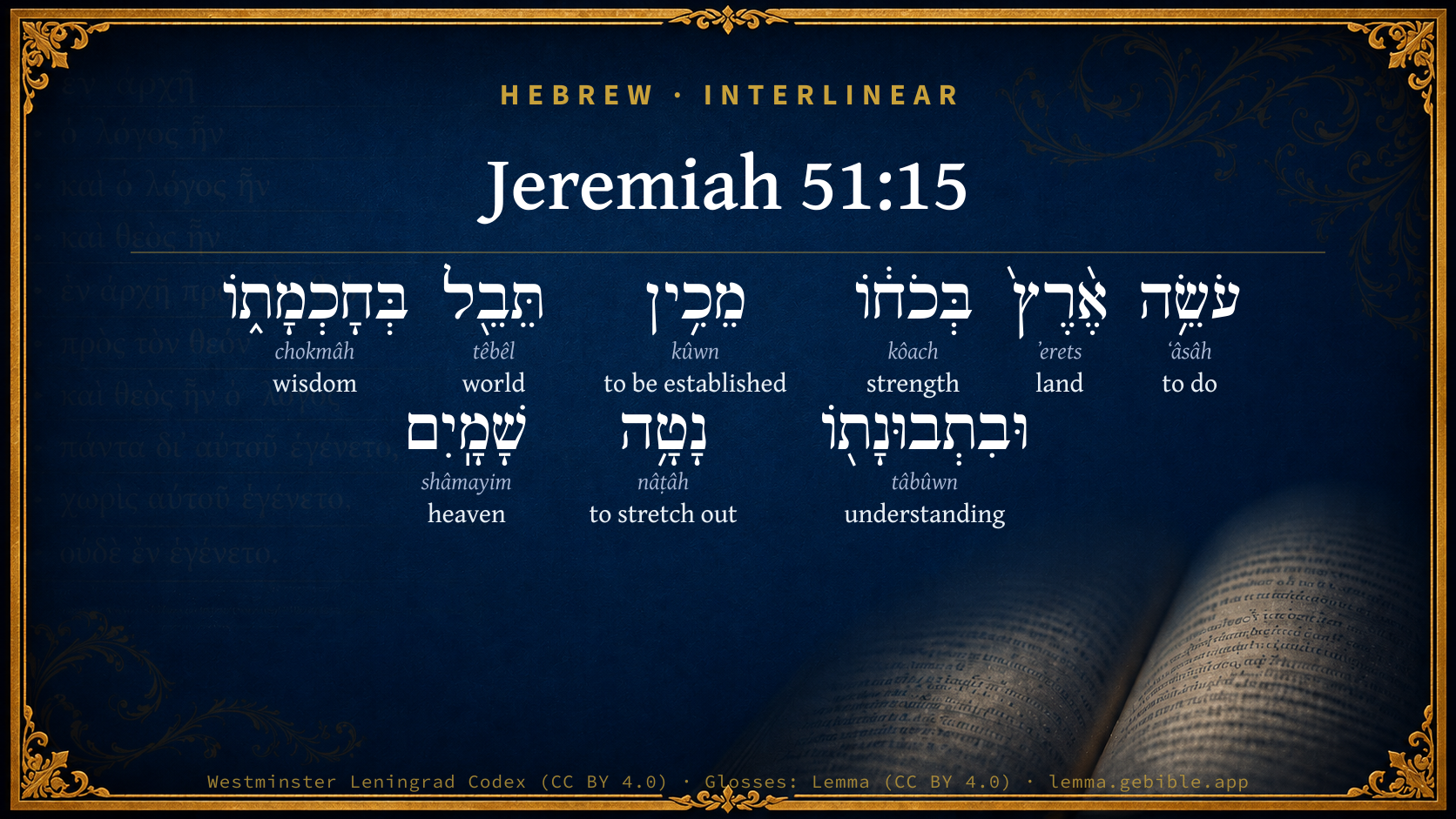
Hebrew (Westminster Leningrad Codex) Jeremiah 51:15 appears in the Hebrew Old Testament. The text above is from the Westminster Leningrad Codex. Each word links to its Strong’s number, a concise gloss, and parsing drawn from the Open Scriptures Hebrew Bible morphology. Click any word for its full Brown-Driver-Briggs (BDB) entry.
Download image
Cite this verse

Jeremiah 51:15 (World English Bible). Public Domain. Lemma interlinear Bible study tool, https://lemma.gebible.app/v/jeremiah/51/15.

Show BibTeX & RIS
BibTeX
RIS
English Translation
He has made the earth by his power, he has established the world by his wisdom, and by his understanding has he stretched out the heavens:
World English Bible · Public Domain
Download a study sheet

One document with this verse’s original text, its word-by-word gloss line, the meaning frame, cross-references with their text, attributed commentary, and full source and license credits — printable, and it pastes into notes with its structure intact.

This verse Autodidact and up

Study sheet (.html) Plain text (.txt)

A passage Seminary Student

Up to 50 verses in one chapter. A passage sheet keeps up to 6 commentary sources and 12 cross-references per verse, in the order this page ranks them, and says so on the sheet whenever that leaves anything out. Ask for a single verse and you get the Autodidact verse sheet above.

Everything on this page stays free to read, with no account — the sheet is a download of what is already on screen, not access to it.

Want to remove ads? Support Godless Engineer
Compare translations 3

The same verse in 3 English versions, stacked beneath the original-language interlinear above. Click any original word for its lexicon entry.

Each is an independent rendering of the whole verse — the interlinear is not word-aligned to these translations.

Highlighted words mark where these versions differ — a whole-verse word diff, not a word-by-word alignment.

  • World English Bible Public Domain
    He has made the earth by his power, he has established the world by his wisdom, and by his understanding has he stretched out the heavens:
  • King James Version Public Domain
    He hath made the earth by his power, he hath established the world by his wisdom, and hath stretched out the heaven by his understanding.
  • unfoldingWord Literal Text CC BY-SA 4.0
    He has made the earth by his power; he set in place the world by his wisdom. By his understanding he stretched out the heavens.

unfoldingWord Literal Text — © unfoldingWord, licensed CC BY-SA 4.0. Word-aligned USFM3 via Door43 (git.door43.org/unfoldingWord/en_ult).

Versions to compare (up to 4)

3 of 4 selected

Show all 18 translations

Every available English version of this verse, each an independent rendering of the whole verse.

  • World English Bible Public Domain
    He has made the earth by his power, he has established the world by his wisdom, and by his understanding has he stretched out the heavens:
  • Berean Standard Bible Public Domain
    The LORD made the earth by His power; He established the world by His wisdom and stretched out the heavens by His understanding.
  • Majority Standard Bible Public Domain
    The LORD made the earth by His power; He established the world by His wisdom and stretched out the heavens by His understanding.
  • King James Version Public Domain
    He hath made the earth by his power, he hath established the world by his wisdom, and hath stretched out the heaven by his understanding.
  • American Standard Version (1901) Public Domain
    He hath made the earth by his power, he hath established the world by his wisdom, and by his understanding hath he stretched out the heavens:
  • Revised Version (1885) Public Domain
    He hath made the earth by his power, he hath established the world by his wisdom, and by his understanding hath he stretched out the heavens:
  • Geneva Bible (1599) Public Domain
    He hath made the earth by his power, and established the world by his wisedome, and hath stretched out the heauen by his discretion.
  • Douay-Rheims (1899) Public Domain
    He that made the earth by his power, that hath prepared the world by his wisdom, and stretched out the heavens by his understanding.
  • Young's Literal Translation Public Domain
    The maker of earth by His power, The establisher of the world by His wisdom, Who by His understanding stretched out the heavens,
  • Literal Standard Version CC BY-SA 4.0
    Making [the] earth by His power, || Establishing [the] world by His wisdom, || Who by His understanding stretched out the heavens,
  • Unlocked Literal Bible CC BY-SA 4.0
    He has made the earth by his power; he set in place the world by his wisdom. By his understanding he stretched out the heavens.
  • unfoldingWord Literal Text CC BY-SA 4.0
    He has made the earth by his power; he set in place the world by his wisdom. By his understanding he stretched out the heavens.
  • Darby Bible Public Domain
    He hath made the earth by his power, he hath established the world by his wisdom, and hath stretched out the heavens by his understanding.
  • World Messianic Bible Public Domain
    “He has made the earth by his power. He has established the world by his wisdom. By his understanding he has stretched out the heavens.
  • Webster's Bible Public Domain
    He hath made the earth by his power, he hath established the world by his wisdom, and hath stretched out the heaven by his understanding.
  • Free Bible Version CC BY-SA 4.0
    It was God who made the earth by his power. He created the world by his wisdom and by his understanding he put the heavens in place.
  • Bible in Basic English Public Domain
    He has made the earth by his power, he has made the world strong in its place by his wisdom, and by his wise design the heavens have been stretched out:
  • JPS Tanakh (1917) Public Domain
    He that hath made the earth by His power, that hath established the world by His wisdom, and hath stretched out the heavens by His discernment;

Literal Standard Version (2020), Covenant Press — licensed CC BY-SA 4.0. Text via the HelloAO Bible API (eBible.org). Unlocked Literal Bible (unfoldingWord) — licensed CC BY-SA 4.0. Text via the HelloAO Bible API (eBible.org). unfoldingWord Literal Text — © unfoldingWord, licensed CC BY-SA 4.0. Word-aligned USFM3 via Door43 (git.door43.org/unfoldingWord/en_ult). Free Bible Version, Dr. Jonathan Gallagher — licensed CC BY-SA 4.0. Text via the HelloAO Bible API (eBible.org).

Word by word

More ways to search: Search by grammar → Find every occurrence → Compare this word →

Practice this passage: Drill this verse → Learn its vocabulary →

תֵּבֵ֖ל
têbêl
H8398
“world”
Noun, Common, Feminine, Singular, Absolute
Part of Speech
Noun
Type
Common
Gender
Feminine
Number
Singular
State
Absolute
Full BDB Definition

Origin: from H2986

TWOT: 835h

world
  1. עֹשֵׂ֥ה ʻâsâh H6213 “doing” Verb, Qal, Participle Active, Masculine, Singular, Construct
  2. אֶ֨רֶץ֙ ʼerets H776 “land” Noun, Common, Both, Singular, Absolute
  3. בְּכֹח֔וֹ kôach H3581 “in/at · strength · his” Preposition + Noun, Common, Masculine, Singular, Construct + Suffix, Personal, 3rd Person, Masculine, Singular
  4. מֵכִ֥ין kûwn H3559 “being established” Verb, Hiphil, Participle Active, Masculine, Singular, Construct
  5. בְּחָכְמָת֑וֹ chokmâh H2451 “in/at · wisdom · his” Preposition + Noun, Common, Feminine, Singular, Construct + Suffix, Personal, 3rd Person, Masculine, Singular
  6. וּבִתְבוּנָת֖וֹ tâbûwn H8394 “and · in/at · understanding · his” Conjunction + Preposition + Noun, Common, Feminine, Singular, Construct + Suffix, Personal, 3rd Person, Masculine, Singular
  7. נָטָ֥ה nâṭâh H5186 “to stretch out” Verb, Qal, Perfect, 3rd Person, Masculine, Singular
  8. שָׁמָֽיִם shâmayim H8064 “heaven(s)” Noun, Common, Masculine, Plural, Absolute

About this verse

These counts appear in no published source. They are computed here, from the morphology-tagged text and Lemma’s own curated glosses. What Lemma adds →

9
words
9
distinct lemmas
Prophets
section

Shared distinctive vocabulary

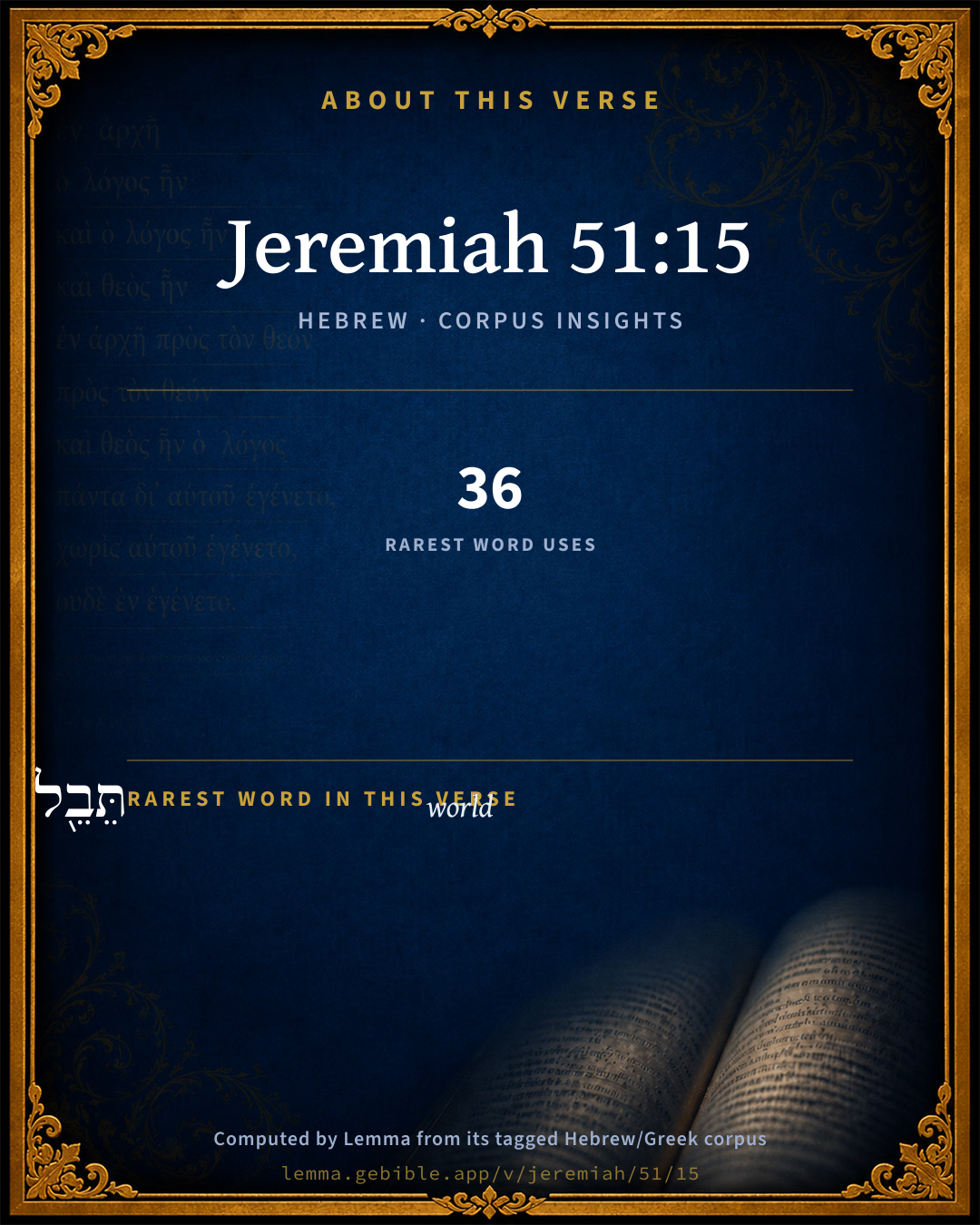
תֵּבֵ֖ל world H8398 occurs in 36 verses of the Hebrew Bible. Also found in:

Grammatical profile

  • 3 verbs
  • 6 nouns

Verb forms

  • עֹשֵׂ֥ה Qal · Participle Active
  • מֵכִ֥ין Hiphil · Participle Active
  • נָטָ֥ה Qal · Perfect

Cross-references

26

Topical passages linked to Jeremiah 51:15 in the Treasury of Scripture Knowledge — connected by theme and wording, ordered by reader-vote popularity; previews shown in the World English Bible.

  • Jeremiah 10:12–16 He has made the earth by his power, he has established the world by his wisdom, and by his understanding has he stretched out the heavens:
  • Revelation 4:11 "Worthy are you, our Lord and God, the Holy One, to receive the glory, the honor, and the power, for you created all things, and because of your desire they existed, and were created!"
  • Jeremiah 32:17 Ah Lord Yahweh! behold, you have made the heavens and the earth by your great power and by your outstretched arm; there is nothing too hard for you,
  • Acts 14:15 "Men, why are you doing these things? We also are men of like passions with you, and bring you good news, that you should turn from these vain things to the living God, who made the sky and the earth and the sea, and all that is in them;
  • Romans 1:20 For the invisible things of him since the creation of the world are clearly seen, being perceived through the things that are made, even his everlasting power and divinity; that they may be without excuse.
  • Colossians 1:16–17 For by him were all things created, in the heavens and on the earth, things visible and things invisible, whether thrones or dominions or principalities or powers; all things have been created through him, and for him.
  • Job 9:8 Who alone stretches out the heavens, Treads on the waves of the sea;
  • Psalms 148:1–5 Praise Yah! Praise Yahweh from the heavens! Praise him in the heights!
  • Proverbs 3:19 By wisdom Yahweh founded the earth. By understanding, he established the heavens.
  • Genesis 1:1–6 In the beginning God created the heavens and the earth.
  • Psalms 104:2 He covers himself with light as with a garment. He stretches out the heavens like a curtain.
  • Psalms 136:5 To him who by understanding made the heavens; For his loving kindness endures forever:
  • Psalms 146:5–6 Happy is he who has the God of Jacob for his help, Whose hope is in Yahweh, his God:
  • Isaiah 40:22 [It is] he who sits above the circle of the earth, and the inhabitants of it are as grasshoppers; who stretches out the heavens as a curtain, and spreads them out as a tent to dwell in;
  • Isaiah 40:26 Lift up your eyes on high, and see who has created these, who brings out their host by number; he calls them all by name; by the greatness of his might, and because he is strong in power, not one is lacking.
  • Isaiah 42:5 Thus says God Yahweh, he who created the heavens, and stretched them forth; he who spread abroad the earth and that which comes out of it; he who gives breath to the people on it, and spirit to those who walk therein:
  • Romans 11:33 Oh the depth of the riches both of the wisdom and the knowledge of God! How unsearchable are his judgments, and his ways past tracing out!
  • Hebrews 1:2–3 has at the end of these days spoken to us by his Son, whom he appointed heir of all things, through whom also he made the worlds.
  • Psalms 104:24 Yahweh, how many are your works! In wisdom have you made them all. The earth is full of your riches.
  • Psalms 107:25 For he commands, and raises the stormy wind, Which lifts up its waves.
  • Isaiah 44:24 Thus says Yahweh, your Redeemer, and he who formed you from the womb: I am Yahweh, who makes all things; who stretches forth the heavens alone; who spreads abroad the earth (who is with me?);
  • Isaiah 45:12 I have made the earth, and created man on it: I, even my hands, have stretched out the heavens; and all their host have I commanded.
  • Isaiah 48:13 Yes, my hand has laid the foundation of the earth, and my right hand has spread out the heavens: when I call to them, they stand up together.
  • Isaiah 51:13 and have forgotten Yahweh your Maker, who stretched forth the heavens, and laid the foundations of the earth; and fear continually all the day because of the fury of the oppressor, when he makes ready to destroy? and where is the fury of the oppressor?
  • Jeremiah 51:15–19 He has made the earth by his power, he has established the world by his wisdom, and by his understanding has he stretched out the heavens:
  • Acts 17:24 The God who made the world and all things in it, he, being Lord of heaven and earth, doesn't dwell in temples made with hands,

Cross-references courtesy of OpenBible.info (CC BY 4.0).

Hebrew and Greek witnesses Masoretic Hebrew ↔ Greek Septuagint

The same verse in the two great witnesses to the Old Testament, shown verse-for-verse.

These are two independent witnesses, not word-aligned to each other, and the Septuagint is shown in lemma (dictionary) form.

Hebrew Jeremiah 51:15 Masoretic · Westminster Leningrad Codex

עֹשֵׂ֥ה אֶ֨רֶץ֙ בְּכֹח֔וֹ מֵכִ֥ין תֵּבֵ֖ל בְּחָכְמָת֑וֹ וּבִתְבוּנָת֖וֹ נָטָ֥ה שָׁמָֽיִם

He has made the earth by his power, he has established the world by his wisdom, and by his understanding has he stretched out the heavens:

World English Bible · Public Domain

Greek LXX Structure differs

In the Septuagint, Jeremiah is about an eighth shorter than the Hebrew and arranges its material differently — the Oracles Against the Nations (Hebrew chapters 46–51) appear in the middle of the Greek book, after 25:13. Because the chapter and verse boundaries do not line up, a verse-for-verse comparison with the Hebrew is not shown.

A verse-for-verse comparison isn’t shown here because the chapters and verses don’t line up. Switch to the LXX edition with the MT / LXX toggle above to read the Greek directly.

On this verse, Keil & Delitzsch discusses the Septuagint’s reading. Read the note in Commentary ↓

Hebrew: Westminster Leningrad Codex (CC BY 4.0). Greek: Septuagint (public domain); English from a public-domain English Septuagint. How the Septuagint differs from the Hebrew →

Targum (Aramaic paraphrase)

1

The Targum is the ancient Jewish Aramaic paraphrase of the Hebrew Scriptures — an interpretive translation, not the Hebrew text itself. Onkelos (literal) and Pseudo-Jonathan (expansive) render the Torah, and Jonathan the Prophets. Coverage is partial: where no permissively-licensed English translation exists for a verse, only the Aramaic is shown. This is verse-level text, not a word-by-word alignment to the Hebrew.

  1. Targum Jonathan Prophets (Joshua–Malachi)
    אֲמַר אִלֵין דַעֲבַד אַרְעָא בְּחֵילֵיהּ שַׁכְלֵיל תֵּבֵל בְּחוּכְמְתֵיהּ וּבְסוּכְלְתָנוּתֵיהּ תְּלָא שְׁמַיָא:

    (no public-domain English translation for this verse)

    Targum Jonathan — Aramaic: “Mikraot Gedolot” (public domain). English: “Sefaria Community Translation” (CC0 1.0 (public-domain dedication)); “London "Chaldee Paraphrase," 1871” (public domain). Text via Sefaria.

Commentary

Notes on Jeremiah 51:15 from classic Christian and Jewish commentators (each source and its license shown beneath its notes). The classic Christian expositions comment on the surrounding passage and are grouped to its opening verse, so a note may address several verses; the Jewish commentaries on the Tanakh (Rashi and others) are per-verse, so they appear only where the commentator wrote on this verse.

Lemma curates 59 commentaries, every one of them public domain or Creative Commons licensed, each selected and text-cleaned for this edition rather than reprinted as found. About our sources →

Jamieson, Fausset & Brown

Robert Jamieson, A. R. Fausset & David Brown

Repeated from Jer 10:12-16; except that "Israel" is not in the Hebrew of Jer 51:19, which ought, therefore, to be translated, "He is the Former of all things, and (therefore) of the rod of His inheritance" (that is, of the nation peculiarly His own). In the tenth chapter the contrast is between the idols and God; here it is between the power of populous Babylon and that of God: "Thou dwellest upon many waters" (Jer 51:13); but God can, by merely "uttering His voice," create "many waters" (Jer 51:16). The "earth" (in its material aspect) is the result of His "power"; the "world" (viewed in its orderly system) is the result of His "wisdom," &c. (Jer 51:15). Such an Almighty Being can be at no loss for resources to effect His purpose against Babylon.

Jamieson, Fausset & Brown — Commentary Critical and Explanatory on the Whole Bible (1871) — public domain (CC PDM 1.0). Text via the HelloAO Bible API.

Trapp's Complete Commentary

John Trapp

Jer 51:15 He hath made the earth by his power, he hath established the world by his wisdom, and hath stretched out the heaven by his understanding.

Ver. 15. He hath made the earth by his power.] And can therefore easily and quickly unmake this great monarchy. See Jer 10:12. {See Trapp on "Jer 10:12"}

John Trapp, A Commentary or Exposition upon All the Books of the Old and New Testament (1647–1656) — public domain. Text from a community e-Sword module.

The Biblical Illustrator

Joseph S. Exell

Jer_51:15

He hath made the earth by His power, He hath established the world by His wisdom.

The being of God proved from the frame of the world

The attentive observation of this world, or visible frame, is not only a worthy employment of our thoughts, but even a considerable duty not to be neglected by us. For it is that which affords most cogent and satisfactory arguments to convince us of, and to confirm us in, the belief of that truth which is the foundation of all religion and piety, the being of one God, incomprehensibly excellent in all perfections, the maker and upholder of all things; it also serves to beget in our minds affections toward God, suitable to those notions; a reverent adoration of His unsearchable wisdom; an awful dread of His powerful majesty; a grateful love of His gracious benignity and goodness.

1. View we first, singly, those things which are most familiar and obvious to our senses. First, those plants we every day do see, smell, and taste: Have not that number, that figure, that order, that temperament, that whole contexture of parts we discern in them, a manifest relation to those operations they perform? Whence, then, I inquire, could that fitness proceed? from chance, or casual motions of matter? But is it not repugnant to the name and nature of chance, that anything regular or constant should arise from it? Are not confusion, disparity, deformity, unaccountable change and variety, the proper issues of chance? It is not, therefore, reasonable to ascribe those things to chance: to what then? will you say, to necessity? If you do, you only alter the phrase; for necessary causality is but another name for chance; they both are but several terms denoting blindness and unadvisedness in action; both must imply a fortuitous determination of causes, acting without design or rule. These effects must therefore, I say, proceed from wisdom, and that no mean one, but such as greatly surpasses our comprehension, joined with a power equally great: for to digest bodies so very many, so very fine and subtile, so divers in motion and tendency, that they shall never hinder or disturb one another, but always conspire to the same design, is a performance exceedingly beyond our capacity to reach how it could be contrived or accomplished; all the endeavours of our deepest skill and most laborious industry cannot arrive to the producing of any work not extremely inferior to any of these, not in comparison very simple and base; neither can our wits serve to devise, nor our sense to direct, nor our hand to execute any work, in any degree like to those. And ii we have reason to acknowledge so much wisdom and power discovered in one plant, and the same consequently multiplied in so many thousands of divers kinds; how much more may we discern them in any one animal, in all of them? Who shaped and tempered those hidden subtile springs of life, sense, imagination, memory, passion; who impressed on them a motion so regular and so durable, which through so many years, among so many adverse contingencies assailing it, is yet so steadily maintained? Thus doth commonsense from these sort of beings, whereof there be innumerable exposed daily to our observation, even singly considered, deduce the existence of a wisdom, power, and goodness unconceivably great; and there are probably divers others (stones, metals, minerals, &c.) no less obvious, even here on the earth, our place of dwelling, which, were our senses able to discern their constitution and texture, would afford matter of the same acknowledgment.

2. But if, passing from such particulars, we observe the relation of several kinds of things each to other, we shall find more reason to be convinced concerning the same excellent perfections farther extending themselves. Is there not, for instance, a palpable relation between the frame, the temper, the natural inclinations or instincts of each animal, and its element or natural place and abode; wherein it can only live, finding therein its food, its harbour, its refuge? Is not to each faculty within an object without prepared, exactly correspondent thereto; which were it wanting, the faculty would become vain and useless, yea sometime harmful and destructive; as reciprocally the object would import little or nothing, if such a faculty were not provided and suited thereto? As for example, what would an eye signify, if there were not light prepared to render things visible thereto? and how much less considerable than it is would the goodly light itself be, were all things in nature blind, and uncapable to discern thereby? What would the ear serve for, if the air were not suitably disposed in a due consistency, and capable of moderate undulations distinguishable there-by? The like we might with the same reason inquire concerning the other senses and faculties, vital or animal, and their respective objects, which we may observe with admirable congruity respecting each other. So many, so plain, so exactly congruous are the relations of things here about us each to other; which surely could not otherwise come than from one admirable wisdom and power conspiring thus to adapt and connect them together; as also from an equal goodness, declared in all these things being squared so fitly for mutual benefit and convenience. Well, then, is it to a fortuitous necessity (or a necessary chance) that we owe all these choice accommodations and pre-eminences of nature? must we bless and worship fortune for all this? did she so especially love us, and tender our good? was she so indulgent toward us, so provident for us in so many things, in everything; making us the scope of all her workings and motions here about us? Oh, brutish degeneracy! Are we not, not only wretchedly blind and stupid, if we are not able to discern so clear beams of wisdom shining through so many perspicuous correspondences; if we cannot trace the Divine power by footsteps so express and remarkable; if we cannot read so legible characters of transcendent goodness; but extremely unworthy and ungrateful, if we are not ready to acknowledge, and with hearty thankfulness to celebrate all these excellent perfections, by which all these things have been so ordered, as to conspire and co-operate for our benefit?

3. Yea, all of them join together in one universal consort, with one harmonious voice, to proclaim one and the same wisdom to have designed, one and the same power to have produced, one and the same goodness to have set both wisdom and power on work in designing and in producing their being; in preserving and governing it: for this whole system of things what is it, but one goodly body, as it were, compacted of several members and organs; so aptly compacted together, that each confers its being and its operation to the grace and ornament, to the strength and stability of the whole; one soul (of Divine providence) enlivening in a manner, and actuating it all? We may perhaps not discern the use of each part, or the tendency of each particular effect; but of many they are so plain and palpable, that reason obliges us to suppose the like of the rest. Even as a person whom we observe frequently to act with great consideration and prudence when at other times we cannot penetrate the drift of his proceedings, we must yet imagine that he hath some latent reason, some reach of policy, that we are not aware of; or, as in an engine consisting of many parts, curiously combined, whereof we do perceive the general use, and apprehend how divers parts thereof conduce thereto, reason prompts us (although we neither see them all, nor can comprehend the immediate serviceableness of some) to think they are all in some way or other subservient to the artists design: such an agent is God, the wisdom of whose proceedings being in so many instances notorious, we ought to suppose it answerable in the rest; such an engine is this world, of which we may easily enough discern the general end, and how many of its parts do conduce thereto; and cannot therefore in reason but suppose the rest in their kind alike congruous, and conducible to the same purpose. If the nature of any cause be discoverable by its effects; if from any work we may infer the workmans ability; if in any case the results of wisdom are distinguishable from the consequences of chance, we have reason to believe that the Architect of this magnificent and beautiful frame was one incomprehensibly wise, powerful, and good Being; so that they are inexcusable, who from hence do not know God; or knowing Him do not render unto Him His due glory and service. (Isaac Barrow, D. D.)

The Biblical Illustrator, edited by Joseph S. Exell (c. 1880s–1900s) — public domain. Text from a community e-Sword module.

Whedon's Commentary on the Bible

Daniel D. Whedon

GOD AGAINST THE IDOLS OF BABYLON, Jer_51:15-26.

15-19. He hath made the earth by his power — These verses are almost an exact transcript of Jer_10:12-16, and hold up before the people the almightiness of Jehovah, the nothingness of idols, and the foolishness of those who put their trust in them. In one particular only is there a difference between the passage as given here and as found in the tenth chapter. In Jer_51:19 the word Israel has been omitted, and the predicate is connected with the general subject, God. This is not an error of the text, as some have concluded, and the introduction of the word in several of the Versions is to be condemned.

Daniel D. Whedon (gen. ed.), Commentary on the Old and New Testaments (1874–1909) — public domain. Text from a community e-Sword module.

Keil & Delitzsch

C. F. Keil & F. Delitzsch

The omnipotence of the Lord and Creator of the whole world will destroy the idols of Babylon, and break the mighty kingdom that rules the world. Jer 51:15. "He who made the earth by His strength, establishing the world by His wisdom, and stretched out the heavens by His understanding; Jer 51:16. When, thundering, He makes a roaring sound of water in the heavens, He causes clouds to ascend from the end of the earth, makes lightnings for the rain, and brings forth the wind out of His treasures. Jer 51:17. Every man without knowledge is brutish; every goldsmith is ashamed because of the image: for his molten work is a lie, and there is no spirit in them. Jer 51:18. They are vanity, a work of mockery; in their time of visitation they perish. Jer 51:19. The Portion of Jacob is not like these; for He is the framer of all, and of the tribe of his inheritance: Jahveh of hosts is His name. Jer 51:20. Thou art a hammer to me, weapons of war; and with thee I will break nations in pieces, and with thee destroy kingdoms. Jer 51:21. And with thee I will break in pieces the horse and his rider, and with thee I will break in pieces the chariot and its rider. Jer 51:22. And with thee I will break in pieces man and woman, and with thee I will break in pieces old and young, and with thee I will break in pieces young man and maiden. Jer 51:23. And with thee I will break in pieces the shepherd and his flock, and with thee I will break in pieces the husbandman and his yoke [of oxen], and with thee I will break in pieces governors and deputy-governors. Jer 51:24. And I will recompense to Babylon, and to all the inhabitants of Chaldea, all their evil which they have done in Zion before your eyes, saith Jahveh. Jer 51:25. Behold, I am against thee, O mountain of destruction, saith Jahve, that destroyed all the earth; and I will stretch out my hand against thee, and roll thee down from the rocks, and make thee a burnt mountain, Jer 51:26. So that they shall not take from thee a stone for a corner, or a stone for foundations; but thou shalt be desolations for ever, saith Jahveh."

In order to establish, against all doubt, the fall of Babylon that has been announced under solemn oath, Jeremiah, in Jer 51:15-19. repeats a passage from the address in Jer 10:12-16, in which he holds up before the people, by way of warning, the almighty power of the living God, and the destruction of the idols at the time of the judgment. In Jer 51:10 he wished, by means of this announcement, to combat the fears of the idolatrous people for the power of the heathen gods; here he seeks by the same means to destroy the confidence of the Chaldeans in their gods, and to state that all idols will be destroyed before the almighty power of the Creator and Ruler of the whole world on the day of judgment, and Israel shall then learn that He who formed the universe will show Himself, by the fall of Babylon, as the Creator of Israel. The whole passage is repeated verbatim, on till a change made in Jer 51:19, where ישׂראל is omitted before שׁבט נחלתו, and these words are connected with what precedes: "He is the former of all, and of the tribe which belongs to Him as His own property," i.e., Israel. This alteration is not to be put to the account of a copyist, who omitted the word "Israel" through an oversight, but is due to Jeremiah: there was no need here, as in Jer 10, for bringing into special prominence the relation of Israel to his God.

(Note: In Jer 10:16 the lxx have taken no account either of ישׂראל or שׁבט. Hence Movers, Hitzig, and Ewald infer that these words have found their way into the text as a gloss suggested by Deu 32:9, and should be deleted. But in this they are wrong. The omission of the two words by the lxx is a result of the erroneous translation there given of the first clause of the verse. This the lxx have rendered ου ̓ τοιαύτη μερὶς τῷ ̓Ιακωβ, instead of ου ̓ τοιαύτη ἡ μερὶς τοῦ ̓Ιακώβ. Having done so, it was impossible for them to continue, ὅτι ὁ πλάσας τὰ πάντα αὐτός, because they could not predicate this of μερίς, which they evidently did not take to mean God. And if they were to connect הוּא with what followed, they were bound to omit the two words, for it would never have done to take together הוּא וישׂראל שׁבט נחלתו. They therefore simply omitted the troublesome words, and went on to translate: ὅτι ὁ πλάσας τὰ πάντα αὐτός κληρονομία αὐτοῦ. Cf. Ngelsbach. Jeremia u. Babylon, S. 94.)

As to the rest, see the exposition of Jer 10:12-16. In Jer 51:20-26 the destruction of Babylon and its power is further carried out in two figures. In Jer 51:20-24 Babylon is compared to a hammer, which God uses for the purpose of beating to pieces nations and kingdoms, with their forces and their inhabitants, but on which He will afterwards requite the evil done to Zion. מפּץ is equivalent to מפיץ ot tnelaviuqe si, Pro 25:18, one who breaks in pieces; hence a battle-hammer. Hitzig takes כּלי to be a singular, "formed thus in order to avoid an accumulation of i sounds (cf. פּליטים with פּליטי)." This is possible, but neither necessary nor probable. The plural, "weapons of war," is added, because the battle-hammer is considered as including all weapons of war. By the hammer, Ewald understands "the true Israel;" Hitzig, Cyrus, the destroyer of Babylon; Ngelsbach, an ideal person. These three views are based on the fact that the operation performed by means of the hammer (breaking to pieces) is marked by perfects with ו relative (ונפּצתּי), which is also true of the retribution to be made on Babylon: from this it is inferred that the breaking with the hammer, as well as the retribution, is still future, and that the meaning is, "When I hammer in this way with thee, I will requite Babylon" (Hitzig); while Ewald concludes from nothing but the context that the words refer to Israel.

But none of these reasons is decisive, nor any of the three views tenable. The context gives decided support to the opinion that in Jer 51:20. it is Babylon that is addressed, just as in Jer 51:13. and Jer 51:25; a further proof is, that as early as Jer 50:23, Babylon is called "the hammer of the whole earth." Only very weighty reasons, then, could induce us to refer the same figure, as used here, to another nation. The word פּטּישׁ (Jer 50:23), "hammer, smith's hammer" (Isa 41:7), is not essentially different from מפּץ, which is used here. The figure is quite inapplicable to Israel, because "Israel is certainly to be delivered through the destruction of Babylon, but is not to be himself the instrument of the destruction" (Graf). Finally, the employment of the perfect with w relative, both in connection with the shattering to pieces which God accomplishes with (by means of) Babylon, and also the retribution He will execute on Babylon, is explained by the fact, that just as, in prophetic vision, what Babylon does to the nations, and what happens to it, was not separated into two acts, distinct from one another, but appeared as one continuous whole, so also the work of Babylon as the instrument of destruction was not yet finished, but had only begun, and still continuing, was partly future, like the retribution which it was to receive for its offence against Zion; just as in Jer 51:13 Babylon is viewed as then still in the active exercise of its power; and the purpose for which God employs it, as well as the fate that is to befall it, is presented together in something like this manner: "O Babylon, who art my hammer with which I break peoples and kingdoms in pieces, thee will I requite!" There is separate mention made of the instances of breaking, in a long enumeration, which becomes tedious through the constant repetition of the verb - something like the enumeration in Jer 50:35-38, where, however, the constant repetition of חרב gives great emphasis to the address. First comes the general designation, nations and kingdoms; then military forces; then (Jer 51:25) the inhabitants of the kingdoms, arranged, as in Eze 23:6, Eze 23:23, according to sex, age, and class, labouring classes (shepherds, and husbandmen with their cattle); and lastly dignitaries, satraps and lieutenant-governors, פּחות וּסגנים, as in Eze 23:6, Eze 23:23. פּחה probably comes from the Zendic pavan (root pa), of which a dialectic form is pagvan, "upholder of government;" see on Hag 1:1. סגן corresponds to the ζωγάνης of the Athenians, "lieutenant-governor;" but it is not much that has hitherto been ascertained with regard to this office; see Delitzsch on Isa 41:25 Clark's translation. On 'ושׁלּמתּי וגו, cf. Jer 51:6 and Jer 50:15, Jer 50:29; "before your eyes," towards the end of this verse, belongs to this verb in the main clause.

This retribution is set forth in Jer 51:25. under a new figure. Babylon is called the "mountain of destruction;" this name is immediately explained by the predicate, "that destroys the whole earth," brings destruction on it. The name הר המשׁחית is applied in Kg2 23:13 to the Mount of Olives, or its southern summit, the so-called mons offensionis vel scandali of ecclesiastical tradition, on which Solomon had erected idolatrous altars for his foreign wives; the name refers to the pernicious influence thereby exercised on the religious life of Israel. In this verse, "destruction" is used in a comprehensive sense of the physical and moral ruin which Babylon brought on the nations. Babylon is a "mountain," as being a powerful kingdom, supereminent above others; whether there is also a reference in the title to its lofty buildings (C. B. Michaelis) seems doubtful. "I will roll thee down from the rocks," de petris, in quarum fastigiis hucusque eminuisti. Non efferes te amplius super alia regna (C. B. Mich.). To this Hitzig adds, by way of explanation: "The summit of the mountain is sometimes changed into the very position occupied by the crater." From what follows, "I will make thee a mountain of burning," i.e., either a burning, or burnt, burnt-out mountain, modern expositors infer, with J. D. Michaelis, that the prophet has before his mind a volcano in active eruption, "for no other kind of mountains could devastate countries; it is just volcanoes which have been hollowed out by fire that fall in, or, it may be, tumble down into the valley below, scattering their constituent elements here and there; the stones of such mountains, too, are commonly so much broken and burnt, that they are of no use for building" (Hitzig). Of the above remarks this much is correct, that the words, "I will make thee a burning mountain," are founded on the conception of a volcano; any more extended application, however, of the figure to the whole verse is unwarranted. The clause, "I will roll thee down from the rocks," cannot possibly be applied to the action of a volcano in eruption (though Ngelsbach does so apply it), unless we are ready to impute to the prophet a false notion regarding the eruptions of volcanoes. By the eruption, a mountain is not loosened from the rock on which it rests, and hurled down into the valleys round about; it is only the heart of the mountain, or the rocks on which its summit rests, that seem to be vomited out of it. Besides, the notion that there is a representation of an active volcano in the first clauses of the verse, is disproved by the very fact that the mountain, Babylon, does not bring ruin on the earth, as one that is burning; it is not to become such until after it has been rolled down from the rocks on which it rests. The laying waste of the countries is not ascribed to the fire that issues from the mountain, but the mountain begins to burn only after it has been rolled down from its rocks. Babylon, as a kingdom and city, is called a mountain, because it mightily surpassed and held sway over them; cf. Isa 2:14. It brings ruin on the whole earth by subjugation of the nations and devastation of the countries. The mountain rests on rocks, i.e., its power has a foundation as firm as a rock, until the Lord rolls it down from its height, and burns the strong mountain, making it like an extinct volcano, the stones of which, having been rendered vitreous by the fire, no longer furnish material that can be employed for the foundation of new buildings. "A corner-stone," etc., is explained by C. B. Michaelis, after the Chaldee, Kimchi, and others, to mean, "no one will appoint a king or a prince any more out of the stock of the Chaldeans." This is against the context, according to which the point treated of is, not the fall of the kingdom in or of Babylon, but the destruction of Babylon as a city and kingdom. Hitzig and Graf, accordingly, take the meaning to be this: Not a stone of the city will be used for a new building - no one will any more build for himself among their ruins, and out of the material there. The corner-stone and the foundation (it is further asserted) are mentioned by way of example, not because particularly large and good stones are needed for these parts, but because every house begins with them. But though the following clause, "thou shalt be an everlasting desolation," contains this idea, yet this interpretation neither exhausts nor gives a generally correct view of the meaning of the words, "no one will take from thee a corner-stone or a foundation-stone." The burning of the mountain signifies not merely that Babylon was to be burned to ashes, but that her sway over the world was to be quite at an end; this was only to come about when the city was burnt. When no stone of any value for a new building is to be left after this conflagration, this is equivalent to saying that nothing will be left of the empire that has been destroyed, which would be of any use in the foundation of another state. The last clause also ("for thou shalt be," etc.) refers to more than the destruction of the city of Babylon. This is seen even in the fundamental passage, Jer 25:12, where the same threat is uttered against the land of the Chaldeans.

Keil & Delitzsch — Biblical Commentary on the Old Testament (1861–1891) — public domain (CC PDM 1.0). Text via the HelloAO Bible API. (Old Testament only.)

Lange's Commentary on the Holy Scriptures

PASSAGE INSERTED FROM Jer_16:12-16

Jer_51:15-19

15          Who maketh the earth by his power,

Establisheth the globe by his wisdom,

And by his understanding stretched out the heavens.

16     At the sound of his voice, throng of waters in the heavens,

And vapors he bringeth up from the ends of the earth;

He maketh lightnings to the rain,

And bringeth the wind out of his chambers.

17     All men stand there mute, without understanding;

All the founders of idol images are put to shame,

For a lie is their molten work, no spirit is therein.

18     They are vapor, turned to ridicule;

At the time of their visitation they perish.

19     Not so the portion of Jacob;

For he formeth all things and the rod of his inheritance.

Jehovah Zebaoth is his name.

EXEGETICAL AND CRITICAL

This whole passage is a quotation from Jer_16:12-16. It interrupts the connection in a disturbing manner. For even if the words in Jer_51:15-16 may be regarded as suitable to support the thought that Jehovah, who has sworn in Jer_51:14 to destroy Babylon, has also the power to realize this threat, the following exposition of the vanity of idols is a superfluous appendage to the present prophecy. There is no point either in the following or previous context which requires such an exposition. It is a mere digression. Add to this, that in Jer_51:19 the words וְיִשְׂרָאֵל are omitted before שֵׁבֶט (comp. Jer_10:16). If this omission is not due to a mere oversight, it betrays the hand of an emendator, who, to honor the tribe of Judah, wishes to remove the appearance as though only the Israel of the ten tribes were the stock of Jehovah’s inheritance. Comp. Naegelsb. Jer. u. Bab., S. 131 ff.; Graf, S 590, 1.

DOCTRINAL AND ETHICAL

1. “Daniel’s Babylonian empire resumes, as it were, the thread which was broken off with the tower-erection and kingdom of Nimrod. In the Babylonian tower-building the whole of the then existing humanity was united against God; with the Babylonian kingdom began the period of the universal monarchies, which again aspired after an atheistical union of entire humanity. Babylon has since and even to the Revelation (Jeremiah 18) remained the standing type of this world.” Auberlen, Der proph. Daniel, S. 230.

2. For what reason does Babylon appear as a type of the world? Why not Nineveh, or Persepolis, or Tyre, or Memphis, or Rome? Certainly not because Babylon was greater, more glorious, more powerful or prouder and more ungodly than those cities and kingdoms. Nineveh especially was still greater than Babylon (comp. Duncker, Gesch. d. Alterth. I. S. 474, 5), and Assyria was not less hostile to the theocracy, having carried away into captivity the northern and larger half of the people of Israel. Babylon is qualified for this representation in two ways: 1. because it is the home of worldly princedom and titanic arrogance (Gen_10:8; Gen_11:1-4); 2. because Babylon destroyed the centre of the theocracy, Jerusalem, the temple and the theocratic kingdom, and first assumed to be the single supreme power of the globe.

3. “When God has used a superstitious, wicked and tyrannical nation long enough as His rod, He breaks it in pieces and finally throws it into the fire. For even those whom He formerly used as His chosen anointed instruments He then regards as but the dust in the streets or as chaff before the wind.” Cramer.

4. “No monarch is too rich, too wicked, too strong for God the Lord. And He can soon enlist and engage soldiers whom He can use against His declared enemies.” Cramer.

5. “Israel was founded on everlasting foundations, even God’s word and promise. The sins of the people brought about that it was laid low in the dust, but not without hope of a better resurrection. Babylon, on the other hand, must perish forever, for in it is the empire of evil come to its highest bloom. Jeremiah owns the nothingness of all worldly kingdoms, since they are all under this national order to serve only for a time. We are to be subject to them and seek their welfare for the sake of the souls of men, whom God is educating therein; a Christian however cannot be enthusiastic for them after the manner of the ancient heathen nor of ancient Israel, for here we have no abiding city, our citizenship is in heaven. The kingdoms of this world are no sanctuaries for us and we supplicate their continuance only with the daily bread of the fourth petition. Jeremiah applies many words and figures to Babylon which he has already used in the judgments on other nations, thus to intimate that in Babylon all the heathenism of the world culminates, and that here also must be the greatest anguish. What, however, is here declared of Babylon must be fulfilled again on all earthly powers in so far as, treading in its footprints, they take flesh for their arm and regard the material of this world as power, whether they be called states or churches.” Diedrich.

6. On Jer_50:2. In putting into the mouth of Israel, returning from Babylon, the call to an everlasting covenant with Jehovah, the prophet causes them 1. to confess that they have forgotten the first covenant; 2. he shows us that the time of the new covenant begins with the redemption from the Babylonish captivity. He was far, however, from supposing that this redemption would be only a weak beginning, that the appearance of the Saviour would be deferred for centuries, that Israel would sink still deeper as an external πολιτεία, and that finally the Israel of the new covenant would itself appear as a μυστήριον, εἰς ὃ ἐπιθυμοῦσιν ἄγγελοι παρακύψαι (1Pe_1:9-12).

7. From what Jeremiah has already said in Jer_31:31-34 of the new covenant we see that its nature and its difference from the old is not unknown to him. Yet he knows the new covenant only in general. He knows that it will be deeply spiritual and eternal, but how and why it will be so is still to him part of the μυστήριον.

8. On Jer_50:6. Jeremiah here points back to Jeremiah 23. Priests, kings and prophets, who should discharge the office of shepherds, prove to be wolves. Yea, they are the worst of wolves, who go about in official clothing. There is therefore no more dangerous doctrine than that of an infallible office. Jer_14:14; Mat_7:15; Mat_23:2-12.

9. On Jer_50:7. It is the worst condition into which a church of God can come, when the enemies who desolate it can maintain that they are in the right in doing so. It is, however, a just nemesis when those who will not hear the regular messengers of God must be told by the extraordinary messengers of God what they should have done. Comp. Jer_40:2-3.

10. On Jer_50:8. “Babylon is opened, and it must be abandoned not clung to, for the captivity is a temporary chastisement, not the divine arrangement for the children of God. God’s people must in the general redemption go like rams before the herd of the nations, that these may also attach themselves to Israel, as this was fulfilled at the time of Christ in the first churches and the apostles, who now draw the whole heathen world after them to eternal life. Here the prophet recognizes the new humanity, which proceeds from the ruins of the old, in which also ancient Israel leads the way; thus all, who follow it, become Israel.” Diedrich.—“The heathen felt somewhat of the divine punishment when they overcame so easily the usually so strongly protected nation. But Jeremiah shows them still how they deceived themselves in thinking that God had wholly rejected His people, for of the eternal covenant of grace they certainly understood nothing.” Heim and Hoffmann on the Major Prophets.

11. On Jer_50:18. “The great powers of the world form indeed the history of the world, but they have no future. Israel, however, always returns home to the dear and glorious land. The Jews might as a token of this return under Cyrus; the case is however this, that the true Holy One in Israel, Christ, guides us back to Paradise, when we flee to His hand from the Babylon of this world and let it be crucified for us.” Diedrich.

12. On Jer_50:23. “Although the Chaldeans were called of God for the purpose of making war on the Jewish nation on account of their multitudinous sins, yet they are punished because they did it not as God with a pure intention, namely, to punish the wrong in them and keep them for reformation; for they were themselves greater sinners than the Jews and continued with impenitence in their sins. Therefore they could not go scot-free and remain unpunished. Moreover, they acted too roughly and dealt with the Jews more harshly than God had commanded, for which He therefore fairly punished them. As God the Lord Himself says (Isa_47:6): When I was angry with My people I gave them into thine hands; but thou shewedst them no mercy. Therefore it is not enough that God’s will be accomplished, but there must be the good intention in it, which God had, otherwise such a work may be a sin and call down the divine punishment upon it.” Würtemb. Summ.

13. On Jer_50:31-34. “God calls Babylon Thou Pride, for pride was their inward force and impulse in all their actions. But worldly pride makes a Babylon and brings on a Babylon’s fate .… Pride must fall, for it is in itself a lie against God, and all its might must perish in the fire; thus will the humble and meek remain in possession of the earth: this has a wide application through all times, even to eternity.” Diedrich.

14. On Jer_51:33. “Israel is indeed weak and must suffer in a time of tyranny; it cannot help itself, nor needs it to do so, for its Redeemer is strong, His name The Lord Zebaoth—and He is, now, having assumed our flesh, among us and conducts our cause so that the world trembles.” Diedrich.

15. On Jer_50:45. “An emblem of the destruction of anti-christian Babylon, which was also the true hammer of the whole world. This has God also broken and must and will do it still more. And this will the shepherd-boys do, as is said here in Jer_51:45 (according to Luther’s translation), that is, all true teachers and preachers.” Cramer.

16. On Jeremiah 51. “The doctrines accord in all points with the previous chapter. And the prophet Jeremiah both in this and the previous chapter does nothing else but make out for the Babylonians their final discharge and passport, because they behaved so valiantly and well against the people of Judah, that they might know they would not go unrecompensed. For payment is according to service. And had they done better it would have gone better with them. It is well that when tyrants succeed in their evil undertakings they should not suppose they are God’s dearest children and lean on His bosom, since they will yet receive the recompense on their crown, whatever they have earned.” Cramer.

17. [“Though in the hand of Babylon is a golden cup; she chooses such a cup, in order that men’s eyes may be dazzled with the glitter of the gold, and may not inquire what it contains. But mark well, in the golden cup of Babylon is the poison of idolatry, the poison of false doctrines, which destroy the souls of men. I have often seen such a golden cup, in fair speeches of seductive eloquence: and when I have examined the venomous ingredients of the golden chalice, I have recognized the cup of Babylon.” Origen in Wordsworth.—S. R. A.]

“The seat and throne of Anti-christ is expressly named Babylon, namely, the city of Rome, built on the seven hills (Rev_17:9). Just as Babylon brought so many lands and kingdoms under its sway and ruled them with great pomp and pride (the golden cup, which made all the world drunk, was Babylon in the hand of the Lord (Jer_51:7), and all the heathen drank of the wine and became mad)—so has the spiritual Babylon a cup in its hand, full of the abomination and uncleanness of its whoredom, of which the kings of the earth and all who dwell on the earth have been made drunk. As it is said of Babylon that she dwells by great waters and has great treasures, so writes John of the Romish Babylon, that it is clothed in silk and purple and scarlet and adorned with gold, precious stones and pearls (Rev_18:12). Of Babylon it is said that the slain in Israel were smitten by her; so also the spiritual Babylon is become drunk with the blood of the saints (Rev_17:6). Just, however, as the Chaldean Babylon is a type of the spiritual in its pride and despotism, so also is it a type of the destruction which will come upon it. Many wished to heal Babylon but she would not be healed; so many endeavor to support the ruinous anti-christian Babylon, but all in vain. For as Babylon was at last so destroyed as to be a heap of stones and abode of dragons, so will it be with anti-christian Babylon. Of this it is written in Rev_14:8 : She is fallen, fallen, that great city, for she has made all nations drink of the wine of her fornication. And again, Babylon the great is fallen, and is become the habitation of devils and a hold of all foul and hateful birds (Rev_18:2). As the inhabitants of Babylon were admonished to flee from her, that every man might deliver his soul (Jer_51:6)—and again, My people, go ye out from the midst of her and deliver every man his soul, etc. (Jer_51:45)—so the Holy Spirit admonishes Christians almost in the same words to go out from the spiritual Babylon, that they be not polluted by her sins and at the same time share in her punishment. For thus it is written in Rev_18:4, I heard, says John, a voice from heaven saying, Go ye out of her, My people, that ye be not partakers of her sins and that ye receive not of her plagues, for her sins reach unto heaven and God remembers her iniquities.” Wurtemb. Summarien.

18. On Jer_51:5. “A monarch can sooner make an end of half a continent than draw a nail from a hut which the Lord protects.—And if it is true that Kaiser Rudolph, when he revoked the toleration of the Picards and the same day lost one of his principal forts, said, ‘I thought it would be so, for I grasped at God’s sceptre’ (Weismanni, Hist. Eccl. Tom. II. p. 320)—this was a sage remark, a supplement to the words of the wise.” Zinzendorf.

19. On Jer_51:9. We heal Babylon, but she will not be healed. Babylon is an outwardly beautiful but inwardly worm-eaten apple. Hence sooner or later the foulness must become noticeable. So is it with all whose heart and centre is not God. All is inwardly hollow and vain. When this internal vacuity begins to render itself externally palpable, when here and there a rent or foul spot becomes visible, then certainly come the friends and admirers of the unholy form and would improve, cover up, sew up, heal. But it does not avail. When once there is death in the body no physician can effect a cure.

20. On Jer_51:17; Jer_51:19-20. “The children of God have three causes why they may venture on Him. 1. All men are fools, their treasure is it not; 2. The Lord is their hammer; He breaks through everything, and 3, they are an instrument in His hand, a heritage; in this there is happiness.” Zinzendorf.

21. On Jer_51:41-44. “How was Sheshach thus won, the city renowned in all the world thus taken? No one would have thought it possible, but God does it. He rules with wonders and with wonders He makes His church free. Babylon is a wonder no longer for its power, but for its weakness. We are to know the world’s weakness even where it still appears strong. A sea of hostile nations has covered Babylon. Her land is now a desolation. God takes Bel, the principal idol of Babylon, symbolizing its whole civil powers in hand, and snatches his prey from his teeth. Our God is stronger than all worldly forces, and never leaves us to them.” Diedrich.

22. On Jer_51:58. “Yea, so it is with all walls and towers, in which God’s word is not the vital force, even though they be entitled churches and cathedrals … God’s church alone possesses permanence through His pure word.” Diedrich.

23. On Jer_51:60-64. When we wish to preserve an archive safely, we deposit it in a record-office where it is kept in a dry place that no moisture may get to it. Seraiah throws his book-roll into the waters of the Euphrates, which must wash it away, dissolve and destroy it. But this was of no account. The main point was that he, Seraiah, as representative of the holy nation had taken solemn stock of the word of God against Babylon, and as it were taken God at His word, and reminded Him of it. In this manner the matter was laid up in the most enduring and safest archive that could be imagined; it was made a case of honor with the omniscient and omnipotent God. Such matters can, however, neither be forgotten, nor remain in dead silence, nor be neglected. They must be brought to such an end as the honor of God requires.

HOMILETICAL AND PRACTICAL

1. On Jer_50:2. This text may be used on the feast of the Reformation, or any other occasion with reference to a rem bene gestam. The Triumph of the Good Cause, 1. over what enemies it is gained; 2. to what it should impel us; (a) to the avoidance of that over which we new triumph; (b) to the grateful proclamation of what the Lord has done for us, by word and by deed.

2. On Jer_50:4-8. The deliverance of Israel from the Babylonian captivity a type of the deliverance of the Church. 1. The Church must humbly acknowledge the captivity suffered as a judgment of God. 2. She must turn like Israel inwardly with an upright heart unto the Lord; 3. She must become like Israel to all men a pattern and leader to freedom.

3. On Jer_50:5. A confirmation sermon. “What is the hour of confirmation? 1. An hour which calls to separation; 2. an hour which leads to new connections; 3. an hour which fixes forever the old covenant with the soul’s friend.” Florey, 1853.

4. On Jer_50:18-20. Assyria and Babylon the types of all the spiritual enemies of the church as of individual Christians. Every one has his Assyria and his Babylon. Sin is the destruction of men. Forgiveness of sins is the condition of life, for only where forgiveness of sins is, is there life and blessedness. In Christ we find the forgiveness of sins. He destroys the handwriting. He washes us clean. He is also the good shepherd who leads our souls into green pastures, to the spiritual Carmel.

5. On Jer_50:31-32. Warning against pride. Babylon was very strong and powerful, rich and splendid. It seemed invincible by nature and by art. Had it not then a certain justification in being proud, at least towards men? No; for no one has to contend only with men. Every one who contends has the Lord either for his friend or his enemy. It is the Lord from whom cometh victory (Pro_21:31). He it is who teacheth our hands to fight (Psa_18:35; Psa_144:1). His strength is made perfect in weakness (2Co_12:9). He can make the lame (Isa_33:23; Mic_4:7) and mortally wounded (Jer_37:10) so strong that they overmaster the sound (comp. Jer_51:45). He can make one man put to flight a thousand (Deu_32:30; Isa_30:17). With him can one dash in pieces a troop and leap over a wall (Psa_18:29). No one accordingly should be proud. The word of the Lord, “I am against thee, thou proud one!” is a terrible word which no one should conjure up against himself.

6. On Jer_50:33-34. The consolation of the Church in persecution. 1. It suffers violence and injustice. 2. Its redeemer is strong.

7. On Jer_51:5. God the Lord manifests such favor to Israel as to declare Himself her husband (Jer_2:2; Jer_3:1). But now that Israel and Judah are in exile, it seems as if they were rejected or widowed women. This, however, is only appearance. Israel’s husband does not die. He may well bring a period of chastisement, of purification and trial on His people, but when this period is over, the Lord turns the handle, and smites those through whom He chastised Israel, when they had forgotten that they were not to satisfy their own desire, but only to accomplish the Lord’s will on Israel.

8. On Jer_51:6. A time may come when it is well to separate one’s self. For although it is said in Pro_18:1; he who separateth himself, seeketh that which pleaseth him and opposeth all that is good—and therefore separation, as the antipodes of churchliness, i.e., of churchly communion and humble subjection to the law of the co-operation of members (1Co_12:25 sqq.) is to be repudiated, yet there may come moments in the life of the church, when it will be a duty to leave the community and separate one’s self. Such a moment is come when the community has become a Babylon. It should, however, be noted that one should not be too ready with such a decision. For even the life of the church is subject to many vacillations. There are periods of decay, obscurations, as it were, comparable to eclipses of the stars, but to these, so long as the foundations only subsist, must always follow a restoration and return to the original brightness. No one is to consider the church a Babylon on account of such a passing state of disease. It is this only when it has withheld the objective divine foundations, the means of grace, the word and sacrament, altogether and permanently in their saving efficacy. Then, when the soul can no longer find in the church the pure and divine bread of life; it is well “to deliver the soul that it perish not in the iniquity of the church.” From this separation from the church is, however, to be carefully distinguished the separation within the church, from all that which is opposed to the healthy life of the church, and is therefore to be regarded as a diseased part of the ecclesiastical body. Such separation is the daily duty of the Christian. He has to perform it with respect to his private life in all the manifold relations, indicated to us in Mat_18:17; Rom_16:17; 1Co_5:9 sqq.; 2Th_3:6; Tit_3:10; 2Jn_1:10-11.—Comp. the article on Sects, by Palmer in Herzog, R.-Enc., XXI., S. 21, 22.

9. On Jer_51:10. The righteousness which avails before God. 1. Its origin (not our work or merit, but God’s grace in Christ); 2. Its fruit, praise of that which the Lord has wrought in us (a) by words, (b) by works.

10. On Jer_51:50. This text may be used at the sending out of missionaries or the departure of emigrants. Occasion may be taken to speak 1, of the gracious help and deliverance, which the Lord has hitherto shown to the departing; 2, they may be admonished to remain united in their distant land with their brethren at home by (a) remembering the Lord, i.e., ever remaining sincerely devoted to the Lord as the common shield of salvation; (b) faithfuly serving Jerusalem, i.e., the common mother of us all (Gal_4:26), the church, with all our powers in the proper place and measure, and ever keeping her in our hearts.

Lange's Commentary on the Holy Scriptures (Critical, Doctrinal, and Homiletical), ed. John Peter Lange, English translation edited by Philip Schaff (1864–1880) — public domain. Text from a community e-Sword module.

Tyndale Open Study Notes

Tyndale Open Resources

51:15-19 This anthem of praise affirms the Lord’s uniqueness and majesty. It contrasts the reality of the one true God with the emptiness of idols.

51:15-16 As the Creator and preserver of all things, God, not Baal, controls the storm with its thunder, rain, lightning, and wind. The Lord can use these forces whenever he desires.

Tyndale Open Study Notes — © Tyndale Open Resources, licensed CC BY-SA 4.0. Text via the HelloAO Bible API.

Adam Clarke's Commentary

Verse 15. He hath made the earth by his power] The omnipotence of God is particularly manifested in the works of creation.

He hath established the world by his wisdom] The omniscience of God is particularly seen in the government of תבל tebel, the inhabited surface of the globe. What a profusion of wisdom and skill is apparent in that wondrous system of providence by which he governs and provides for every living thing.

And hath stretched out the heaven by his understanding.] Deep thought, comprehensive design, and consummate skill are especially seen in the formation, magnitudes, distances, revolutions, and various affections of the heavenly bodies.

Adam Clarke's Commentary on the Bible (1810–1826) — public domain. Text from a community e-Sword/MySword module.

John Calvin's Commentaries

The Prophet commends here, as I have already said, in high terms, the power of God; but we must bear in mind his purpose, for abrupt sentences would be otherwise uninteresting. His object was to encourage the Jews to entertain hope; for they were not to judge of Babylon according to its splendor, which dazzled the eyes of all; nor were they to measure by their own notions what God had testified, he bids the faithful to raise all their thoughts above the world, and to behold with admiration the incomprehensible power of God, that they might not doubt but that Babylon would at length be trodden under foot; for had they fixed their eyes on that monarchy, they could have hardly believed the words of prophecy; for the Prophet spoke of things which could not be comprehended by the human mind.

We now then understand why the Prophet set forth the power of God, even that. the faithful might learn to think of something sublimer than the whole world, while contemplating the destruction of Babylon, for that would not be effected in a way usual or natural, but through the incredible power of God. The same words are also found in the tenth chapter; and the five verses we meet with here were there explained. But Jeremiah had then a different object in view, for he addressed the Jewish exiles, and bade them firmly to persevere in the worship of God: though religion was oppressed, and though the victorious Chaldeans proudly derided God, he yet bade them to stand firm in their religion, and then said,

“When ye come to Babylon, say, Cursed are all the gods who made not the heaven and the earth.” (Jeremiah 10:11)

And there, indeed, he used a foreign language, and taught them to speak in the Chaldee, that they might more plainly profess that they would persevere in the worship of the only true God. He afterwards added what he now repeats, even that the power of God was not diminished, though he had chastised for a time his own people. But now, as we have said, he speaks in sublime terms of the power of God, in order that the faithful might know that what the judgment of the flesh held as impossible, could easily be done by that God who can do all things.

He says first, He who made the earth He does not mention God’s name; but the expression is more emphatical, when he says, the Maker of the earth; as though he had said, “Who can be found to be the creator of the heaven and the earth except the only true God?” We hence see more force in the sentence than if God’s name had been expressed; for he thus excluded all the fictitious gods, who had been devised by the heathens; as though he had said, “The only true God is He who made the earth.” Then he says, by his power He speaks of God’s power in connection with the earth, as it is probable, on account of its stability.

He afterwards adds, Who hath constituted the world by his wisdom, and by his knowledge extended the heavens The wisdom of God is visible through the whole world, but especially in the heavens. The Prophet indeed speaks briefly, but he leads us to contemplate God’s wonderful work in its manifold variety, which appears above and below. For though it may seem a light matter, when he says, that the world was constituted by the wisdom of God, yet were any one to apply his mind to the meditation of God’s wisdom in the abundance of all fruits, in the wealth of the whole world, in the sea, (which is included in the world,) it could not, doubtless, be, but that he must be a thousand times filled with wonder and admiration: for the more carefully we attend to the consideration of God’s works, we ourselves in a manner vanish into nothing; the miracles which present themselves on every side, before our eyes, overwhelm us. As to the heavens, what do we see there? an innumerable multitude of stars so arranged, as though an army were so in order throughout, all its ranks; and then the wandering planets, not fixed, having each its own course, and yet appearing among the stars. Then the course of the sun, how much admiration ought it to produce in us! — I say, not in those only who understand the whole system of astronomy, but also in those who see it only with their own eyes; for when the sun, in its daily course, completes so great and so immense a distance, they who are not amazed at such a miracle must be more than stupid; and then the sun, as it is well known, has its own course, which is performed every year, and never passes in the least beyond its own boundaries; and the bulk of that body is immense (for, as it is well known, it far exceeds the earth,) and yet it rolls with great celerity and at the same time in such order as though it advanced by degrees quietly. Surely it is a wonderful specimen of God’s wisdom. The Prophet, then, though he speaks in an ordinary way, yet suppress the godly with materials of thought, so that they might apply their minds to the consideration of God’s works. Some explain the words, that God expands the heavens whenever they are covered with clouds; but this is wholly foreign to the meaning of the Prophet; for there is no doubt but that he points out in this verse the perpetual order of nature, as in the next verse he speaks of those changes which sometimes happen.

John Calvin's Commentaries (1540-1563) — public domain. Text from the Calvin Translation Society English edition (1840s-50s) via the Christian Classics Ethereal Library (ccel.org). Calvin's coverage is partial (roughly two-thirds of the Bible); uncommented books and verses are honest gaps, never fabricated. The 19th-century editor's footnotes and remarks are omitted so the notes are faithfully Calvin's own voice.

Ellicott's Commentary for English Readers

(15-19) He hath made the earth by his power . . .—The five verses are a reproduction of Jer_10:12-16, fitted in here to enhance the majesty of Him Who decrees the destruction of Babylon, and appoints Israel to be the instrument of that destruction. The word “Israel,” as the italics show, is wanting in the Hebrew, and we have a sufficient sense without it. “He is the former of all things, and of the rod (i.e., the tribe) of his inheritance.” The English version follows the Vulgate and the Targum in treating the omission as an error of transcription. (See Notes on Jer_10:12-16.)

A Bible Commentary for English Readers, edited by Charles John Ellicott (1878–1897) — public domain. Text from a community e-Sword module.

The Cambridge Bible for Schools and Colleges

gen. ed. J. J. S. Perowne

15–19. These vv. are taken almost verbatim from Jer_10:12-16. The object of the insertion is to emphasize the powerlessness of Babylon’s idols against Jehovah.

The Cambridge Bible for Schools and Colleges (gen. ed. J. J. S. Perowne; Cambridge University Press, 1878–1918) — public domain. Text from a community e-Sword module.

John Gill's Exposition

He hath made the earth by his power, he hath established the world by his wisdom, and hath stretched out the heaven by his understanding. The Targum prefaces the words thus,

"these things saith he who hath made the earth, &c.''

The verses Jer 51:16 are the same with Jer 10:12. God is described by his sovereignty, power, and wisdom; and the stupidity of men that trust in idols, and the vanity of them, are exposed, to convince the Babylonians that the Lord, who had determined on their destruction, would surely effect it, and that it would not be in the power of their idols to prevent it. See Gill on Jer 10:12.

John Gill's Exposition of the Whole Bible (1746–1763) — public domain (CC PDM 1.0). Text via the HelloAO Bible API.

Albert Barnes' Notes on the Bible

A transcript of Jer 10:12-16.

Albert Barnes' Notes on the Bible (1834–1885) — public domain. Text from a community e-Sword/MySword module.

The Pulpit Commentary

Vers. 15-19. Probably interpolated from Jer_10:12-16 (the only verbal difference is in ver. 19, where "Israel" is left out before "the rod of his inheritance"). But may not Jeremiah have quoted himself? Conceivably, yes; but he would surely not have quoted such a passage here, where it spoils the context. For granting that a point of contact with ver. 14 may be found for vers. 15, 16 (Jehovah who has sworn has also the power to accomplish), yet the passage on the idols stands quite by itself, and distracts the attention of the reader.

The resources of Jehovah.

Here are the resources of Jehovah as over against the resources of Babylon. Note the differences between them.

I THEY ARE RESOURCES IN JEHOVAH HIMSELF. It is from the very being of Jehovah that his works flow forth, whether these works be considered as illustrating his power, his wisdom, or his understanding. When a prophet of Jehovah has to speak of human resources, he speaks of things outside the man. Apart from the soil on which he stands, the world in which he lives, what can man do? His very body is derived from the soil, and to the soil returns. His chosen treasures, the things on which he leans, are treasures upon earth. But when a prophet comes to speak of Jehovah, he can think of him separated from all the visible and tangible. He does not depend on these things, for they would have had no existence but for him. We may, in a certain qualified sense, speak of human power, wisdom, and understanding; we must indeed use such terms, for some men are so weak that others must be spoken of as powerful, some so foolish that others must be spoken of as wise, some so shallow and ignorant that others must be spoken of as men of understanding. But the very power of a man reveals in time his essential weakness, his very wisdom his essential folly, his very understanding his essential ignorance. God alone is power, and in him is no weakness at all; God alone is wisdom, and in him no folly at all; God alone is understanding, and in him nothing of the limited and erroneous knowledge which is so often a humiliation to human pride.

II THEY ARE RESOURCES UNITED IN ONE BEING. Judged according to human standards, some men are powerful, some men wise, and some are men of understanding; but very seldom, even according to the human standard, are all three qualities united in one man; and it is not very often that even two of them are found. Man may have power, mere muscular strength, the power of the athlete, the power of the ox, without anything worthy the name of wisdom. So there may be wisdom without power; and there may be a very high degree of wisdom apart from large knowledge or a powerful understanding. Men are made so that what is defective in one may be supplied by another. The greatest human works are done when the power of one is joined with the wisdom of a second and the understanding of a third. But with Jehovah all these qualities, in their highest degree, are found united in One. The only account after all that man can give of the making of matter is that it has been made by a God. And then his wisdom has reduced everything to order, arranged the world in all its grades, organisms, and mutual connections. The natural man comes nearest to God when he can combine the power of one, the wisdom of another, and the understanding of yet a third, to make as it were one new man for the doing of special work; and the spiritual man comes nearest to God when, still preserving his individuality of action, he exchanges for his natural weakness the spiritual power of Christ, for his natural folly the spiritual wisdom of Christ, and for his often useless and deluding knowledge of the things of this world that knowledge which comes in the revelation of the glory of God in the face of Jesus Christ. Y.

The Pulpit Commentary (1880–1919), ed. H.D.M. Spence-Jones & Joseph S. Exell — public domain. Text from a community e-Sword module.

unfoldingWord translationNotes

Door43 World Missions Community

When he thunders, there is the roar of waters in the heavens

These phrases compare the voice of Yahweh to the loud sound made by thunder and rain. (See: Metaphor)

storehouses

A storehouse is a building where people keep things they might want to use in the future.

translationWords

earth

power

wise

heaven

water

send

storehouse

unfoldingWord translationNotes — © Distant Shores Media and the Door43 World Missions Community, licensed CC BY-SA 4.0. Source: git.door43.org/Door43/en_tn.

Lesson kit

Teaching starters — assembled from the data on this page, not authored interpretation. Every prompt links to the verse data it draws on. Edit before teaching.

Jeremiah, in the Prophets, opens this verse with 9 words (9 distinct Hebrew lemmas). Its most distinctive word is têbêl (“world”). A historical commentator’s framing appears above. Read the whole chapter for the surrounding context.

Discussion questions

  1. What does “world” (têbêl) contribute to the verse as a whole?
  2. How does 1 Samuel 2:8, which shares the word «world», read alongside this verse?
  3. These translations render this verse differently; the difference is in the English rendering, not the original. What questions does that raise?
  4. «עֹשֵׂ֥ה» is a Qal Participle Active verb. How does that grammatical form shape the action described?
  5. Compare how Jamieson, Fausset & Brown and Trapp's Complete Commentary read this verse. Where do they agree or differ?

Things to notice

Reading settings

Reading text

Shown beneath each verse's original-language words.

Old Testament
Old Testament edition

Read the OT as the Masoretic Hebrew (MT) or the Greek Septuagint (LXX).

English shown for the Greek Septuagint (in the Hebrew ↔ Greek comparison).

Comparing translations? Open the Compare panel on any verse page to stack up to four side by side.