Isaiah 14:26

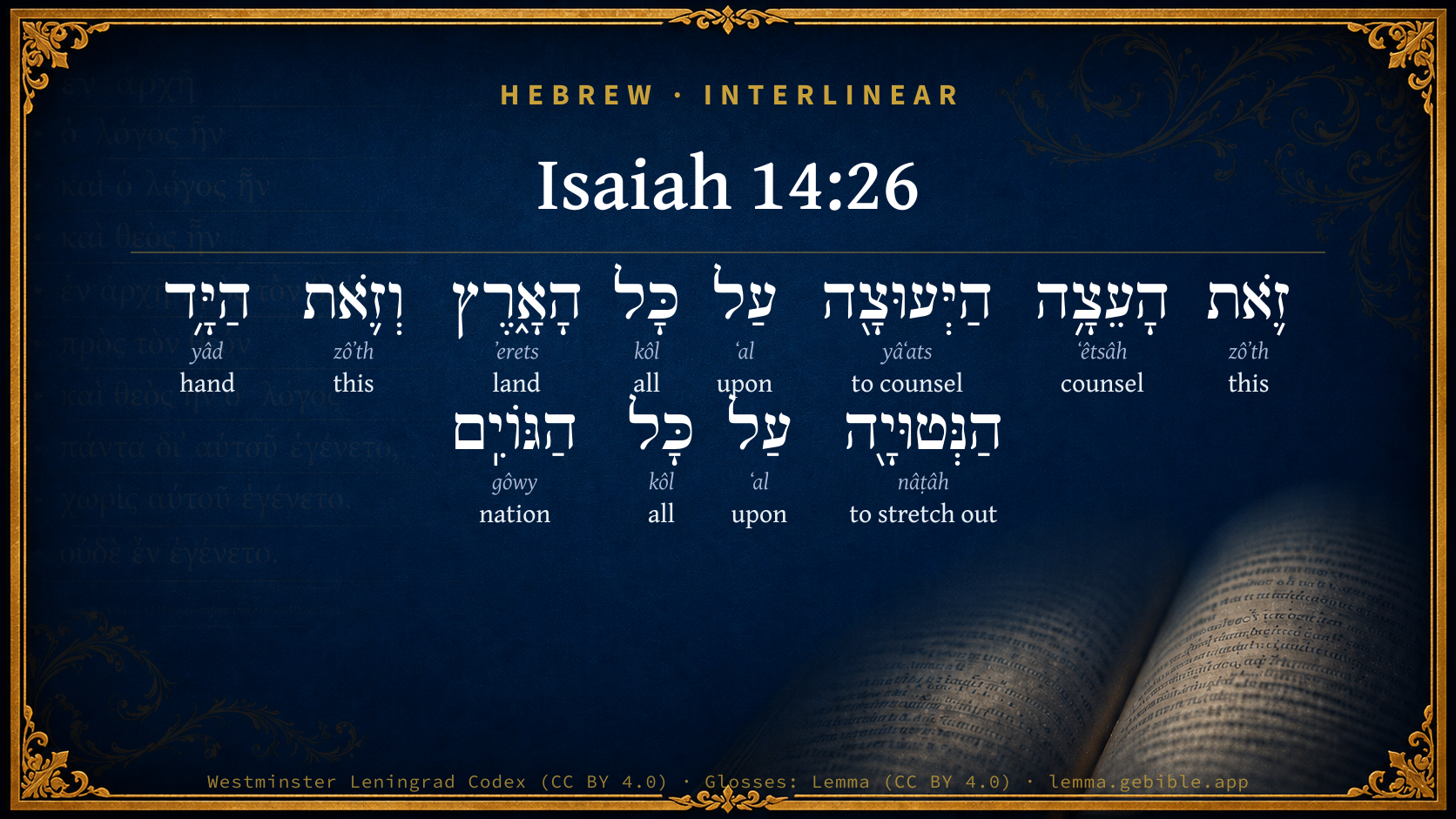
Hebrew (Westminster Leningrad Codex) Isaiah 14:26 appears in the Hebrew Old Testament. The text above is from the Westminster Leningrad Codex. Each word links to its Strong’s number, a concise gloss, and parsing drawn from the Open Scriptures Hebrew Bible morphology. Click any word for its full Brown-Driver-Briggs (BDB) entry.
Download image
Cite this verse

Isaiah 14:26 (World English Bible). Public Domain. Lemma interlinear Bible study tool, https://lemma.gebible.app/v/isaiah/14/26.

Show BibTeX & RIS
BibTeX
RIS
English Translation
This is the purpose that is purposed on the whole earth; and this is the hand that is stretched out on all the nations.
World English Bible · Public Domain
Download a study sheet

One document with this verse’s original text, its word-by-word gloss line, the meaning frame, cross-references with their text, attributed commentary, and full source and license credits — printable, and it pastes into notes with its structure intact.

This verse Autodidact and up

Study sheet (.html) Plain text (.txt)

A passage Seminary Student

Up to 50 verses in one chapter. A passage sheet keeps up to 6 commentary sources and 12 cross-references per verse, in the order this page ranks them, and says so on the sheet whenever that leaves anything out. Ask for a single verse and you get the Autodidact verse sheet above.

Everything on this page stays free to read, with no account — the sheet is a download of what is already on screen, not access to it.

Want to remove ads? Support Godless Engineer
Compare translations 3

The same verse in 3 English versions, stacked beneath the original-language interlinear above. Click any original word for its lexicon entry.

Each is an independent rendering of the whole verse — the interlinear is not word-aligned to these translations.

Highlighted words mark where these versions differ — a whole-verse word diff, not a word-by-word alignment.

  • World English Bible Public Domain
    This is the purpose that is purposed on the whole earth; and this is the hand that is stretched out on all the nations.
  • King James Version Public Domain
    This is the purpose that is purposed upon the whole earth: and this is the hand that is stretched out upon all the nations.
  • unfoldingWord Literal Text CC BY-SA 4.0
    This the plan planned over all of the earth, and this the hand stretched out over all of the nations.

unfoldingWord Literal Text — © unfoldingWord, licensed CC BY-SA 4.0. Word-aligned USFM3 via Door43 (git.door43.org/unfoldingWord/en_ult).

Versions to compare (up to 4)

3 of 4 selected

Show all 18 translations

Every available English version of this verse, each an independent rendering of the whole verse.

  • World English Bible Public Domain
    This is the purpose that is purposed on the whole earth; and this is the hand that is stretched out on all the nations.
  • Berean Standard Bible Public Domain
    This is the plan devised for the whole earth, and this is the hand stretched out over all the nations.
  • Majority Standard Bible Public Domain
    This is the plan devised for the whole earth, and this is the hand stretched out over all the nations.
  • King James Version Public Domain
    This is the purpose that is purposed upon the whole earth: and this is the hand that is stretched out upon all the nations.
  • American Standard Version (1901) Public Domain
    This is the purpose that is purposed upon the whole earth; and this is the hand that is stretched out upon all the nations.
  • Revised Version (1885) Public Domain
    This is the purpose that is purposed upon the whole earth: and this is the hand that is stretched out upon all the nations.
  • Geneva Bible (1599) Public Domain
    This is the counsell that is consulted vpon the whole worlde, and this is the hande stretched out ouer all the nations,
  • Douay-Rheims (1899) Public Domain
    This is the counsel, that I have purposed upon all the earth, and this is the hand that is stretched out upon all nations.
  • Young's Literal Translation Public Domain
    This `is' the counsel that is counselled for all the earth, And this `is' the hand that is stretched out for all the nations.
  • Literal Standard Version CC BY-SA 4.0
    This [is] the counsel that is counseled for all the earth, || And this [is] the hand that is stretched out for all the nations.
  • Unlocked Literal Bible CC BY-SA 4.0
    This is the plan that is intended for the whole earth, and this is the hand that is raised over all the nations.
  • unfoldingWord Literal Text CC BY-SA 4.0
    This the plan planned over all of the earth, and this the hand stretched out over all of the nations.
  • Darby Bible Public Domain
    This is the counsel which is purposed concerning the whole earth; and this is the hand which is stretched out upon all the nations.
  • World Messianic Bible Public Domain
    This is the plan that is determined for the whole earth. This is the hand that is stretched out over all the nations.
  • Webster's Bible Public Domain
    This is the purpose that is purposed upon the whole earth: and this is the hand that is stretched over all the nations.
  • Free Bible Version CC BY-SA 4.0
    This is the plan I have made regarding the whole earth; my hand stretches out to control all the nations.
  • Bible in Basic English Public Domain
    This is the purpose for all the earth: and this is the hand stretched out over all nations.
  • JPS Tanakh (1917) Public Domain
    This is the purpose that is purposed upon the whole earth; and this is the hand that is stretched out upon all the nations.

Literal Standard Version (2020), Covenant Press — licensed CC BY-SA 4.0. Text via the HelloAO Bible API (eBible.org). Unlocked Literal Bible (unfoldingWord) — licensed CC BY-SA 4.0. Text via the HelloAO Bible API (eBible.org). unfoldingWord Literal Text — © unfoldingWord, licensed CC BY-SA 4.0. Word-aligned USFM3 via Door43 (git.door43.org/unfoldingWord/en_ult). Free Bible Version, Dr. Jonathan Gallagher — licensed CC BY-SA 4.0. Text via the HelloAO Bible API (eBible.org).

Word by word

More ways to search: Search by grammar → Find every occurrence → Compare this word →

Practice this passage: Drill this verse → Learn its vocabulary →

הַיְּעוּצָ֖ה
yâʻats
H3289
“the · counseled”
Particle, Definite Article + Verb, Qal, Participle Passive, Feminine, Singular, Absolute
Part of Speech
Particle + Verb
Stem
Qal
Form
Participle Passive
Gender
Feminine
Number
Singular
State
Absolute
Full BDB Definition

Origin: a primitive root

TWOT: 887

to advise, consult, give counsel, counsel, purpose, devise, plan - (Qal) - to advise, counsel, give counsel, consult - counsellor (participle) - (Niphal) to consult together, exchange counsel, deliberate, counsel together - (Hithpael) to conspire
  1. זֹ֛את zôʼth H2063 “this” Pronoun, Demonstrative, Feminine, Singular
  2. הָעֵצָ֥ה ʻêtsâh H6098 “the · counsel” Particle, Definite Article + Noun, Common, Feminine, Singular, Absolute
  3. עַל ʻal H5921 “upon” Preposition
  4. כָּל kôl H3605 “all of” Noun, Common, Masculine, Singular, Construct
  5. הָאָ֑רֶץ ʼerets H776 “the · land” Particle, Definite Article + Noun, Common, Both, Singular, Absolute
  6. וְזֹ֛את zôʼth H2063 “and · this” Conjunction + Pronoun, Demonstrative, Feminine, Singular
  7. הַיָּ֥ד yâd H3027 “the · hand” Particle, Definite Article + Noun, Common, Both, Singular, Absolute
  8. הַנְּטוּיָ֖ה nâṭâh H5186 “the · stretched out” Particle, Definite Article + Verb, Qal, Participle Passive, Feminine, Singular, Absolute
  9. עַל ʻal H5921 “upon” Preposition
  10. כָּל kôl H3605 “all of” Noun, Common, Masculine, Singular, Construct
  11. הַגּוֹיִֽם gôwy H1471 “the · nations” Particle, Definite Article + Noun, Common, Masculine, Plural, Absolute

About this verse

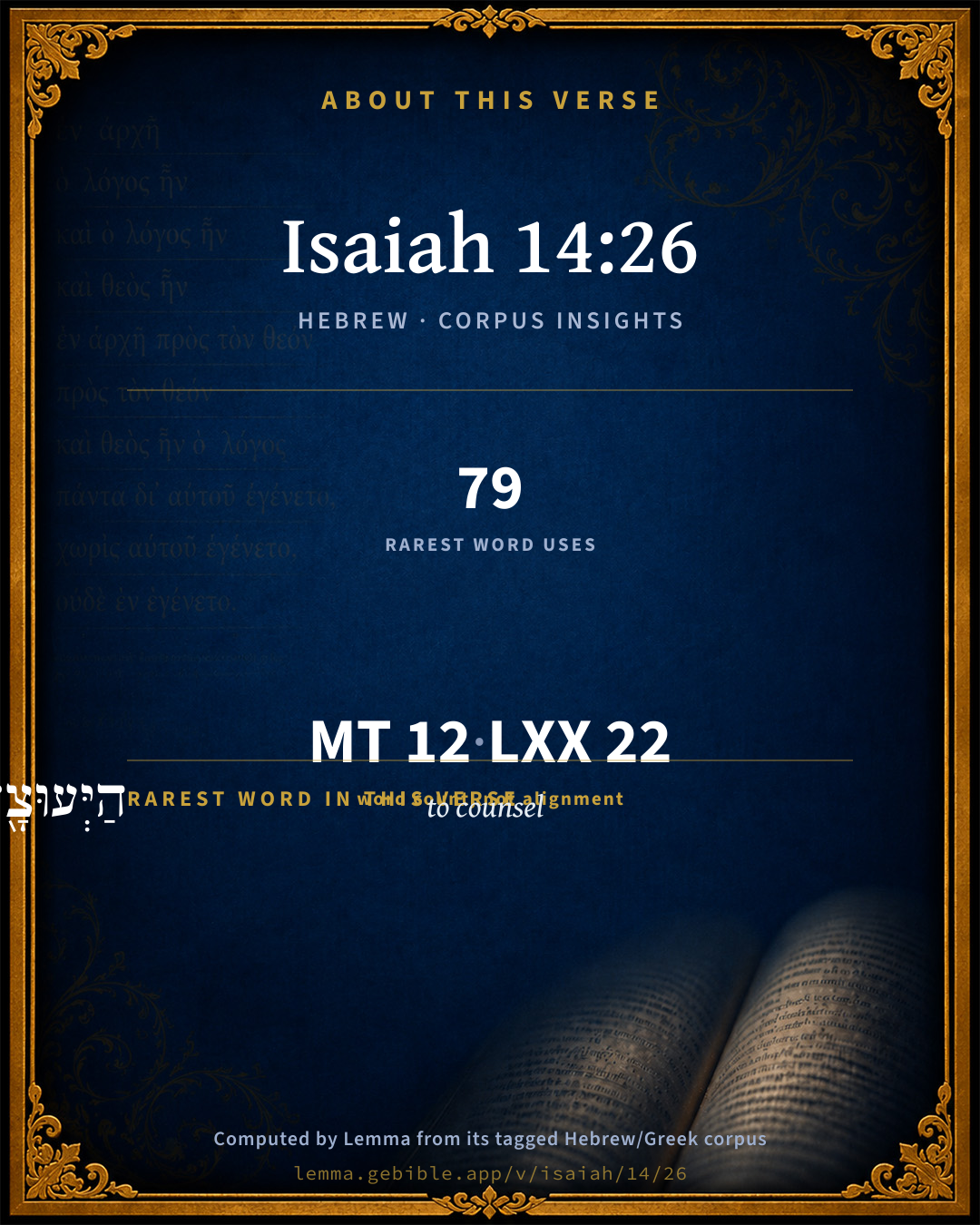
These counts appear in no published source. They are computed here, from the morphology-tagged text and Lemma’s own curated glosses. What Lemma adds →

12
words
9
distinct lemmas
Prophets
section

Grammatical profile

  • 2 verbs
  • 6 nouns
  • 2 pronouns
  • 2 prepositions

Verb forms

  • הַיְּעוּצָ֖ה Qal · Participle Passive
  • הַנְּטוּיָ֖ה Qal · Participle Passive

Repetition

Words recur within this verse — often emphatic in Hebrew:

Hebrew & Septuagint length

In English translation the verse runs 24 words from the Hebrew and 24 from the Septuagint (LXX English) — the same length.

A rough comparison of the two English renderings, which tokenize alike — not a word-level alignment.

Word counts can differ between the Hebrew and the Greek without any difference in meaning — e.g. the Hebrew direct-object marker אֵת has no separate Greek word, and Greek often adds the article ὁ.

In the original languages it is 12 Hebrew tokens and 22 Greek tokens — but the two are counted differently (Hebrew bundles its prefixes and suffixes into one token; the Greek is in lemma form), so that isn’t a like-for-like length.

Cross-references

4

Topical passages linked to Isaiah 14:26 in the Treasury of Scripture Knowledge — connected by theme and wording, ordered by reader-vote popularity; previews shown in the World English Bible.

  • Isaiah 23:9 Yahweh of hosts has purposed it, to stain the pride of all glory, to bring into contempt all the honorable of the earth.
  • Exodus 15:12 You stretched out your right hand. The earth swallowed them.
  • Isaiah 5:25 Therefore Yahweh's anger burns against his people, And he has stretched out his hand against them, and has struck them. The mountains tremble, And their dead bodies are as refuse in the midst of the streets. For all this, his anger is not turned away, But his hand is still stretched out.
  • Zephaniah 3:6–8 I have cut off nations. Their battlements are desolate. I have made their streets waste, so that no one passes by. Their cities are destroyed, so that there is no man, so that there is no inhabitant.

Cross-references courtesy of OpenBible.info (CC BY 4.0).

Hebrew and Greek witnesses Masoretic Hebrew ↔ Greek Septuagint

The same verse in the two great witnesses to the Old Testament, shown verse-for-verse.

These are two independent witnesses, not word-aligned to each other, and the Septuagint is shown in lemma (dictionary) form.

Hebrew Isaiah 14:26 Masoretic · Westminster Leningrad Codex

זֹ֛את הָעֵצָ֥ה הַיְּעוּצָ֖ה עַל כָּל הָאָ֑רֶץ וְזֹ֛את הַיָּ֥ד הַנְּטוּיָ֖ה עַל כָּל הַגּוֹיִֽם

This is the purpose that is purposed on the whole earth; and this is the hand that is stretched out on all the nations.

World English Bible · Public Domain

Greek LXX Isaiah 14:26 Septuagint · lemma form

οὗτος ὁ βουλή ὅς βουλεύω κύριος ἐπί ὁ οἰκέω ὅλος καί οὗτος ὁ χείρ ὁ ὑψηλός ἐπί πᾶς ὁ ἔθνος ὁ οἰκέω

This is the purpose which the Lord has purposed upon the whole earth: and this the hand that is uplifted against all the nations.

LXX2012 (modern English Septuagint) · Public Domain

On this verse, John Gill's Exposition discusses the Septuagint’s reading. Read the note in Commentary ↓

Hebrew: Westminster Leningrad Codex (CC BY 4.0). Greek: Septuagint (public domain); English from LXX2012 (modern English Septuagint) (Public Domain). How the Septuagint differs from the Hebrew →

Targum (Aramaic paraphrase)

1

The Targum is the ancient Jewish Aramaic paraphrase of the Hebrew Scriptures — an interpretive translation, not the Hebrew text itself. Onkelos (literal) and Pseudo-Jonathan (expansive) render the Torah, and Jonathan the Prophets. Coverage is partial: where no permissively-licensed English translation exists for a verse, only the Aramaic is shown. This is verse-level text, not a word-by-word alignment to the Hebrew.

  1. Targum Jonathan Prophets (Joshua–Malachi)
    דָא מַלְכָּא דִי מְלִיךְ עַל כָּל יַתְבֵי אַרְעָא וְדָא גְבוּרְתָּא דִי מְרַמְמָא דְשַׁלִיט עַל כָּל מַלְכְּוָתָא:

    This is the purpose that is purposed upon all the inhabitants of the earth; and this is the might of the ruler which is lifted up over all the kingdoms.

    Targum Jonathan — Aramaic: “Mikraot Gedolot” (public domain). English: “Sefaria Community Translation” (CC0 1.0 (public-domain dedication)); “London "Chaldee Paraphrase," 1871” (public domain). Text via Sefaria.

Commentary

Notes on Isaiah 14:26 from classic Christian and Jewish commentators (each source and its license shown beneath its notes). The classic Christian expositions comment on the surrounding passage and are grouped to its opening verse, so a note may address several verses; the Jewish commentaries on the Tanakh (Rashi and others) are per-verse, so they appear only where the commentator wrote on this verse.

Lemma curates 59 commentaries, every one of them public domain or Creative Commons licensed, each selected and text-cleaned for this edition rather than reprinted as found. About our sources →

The Cambridge Bible for Schools and Colleges

gen. ed. J. J. S. Perowne

26, 27. This plan of Jehovah embraces the destinies of all nations (see ch. Isa_28:22, Isa_10:23, Isa_8:9). The expression “the whole earth” is not to be restricted to the Assyrian Empire, nor on the other hand is the meaning that all other peoples shall suffer the same fate as Assyria; it is simply that the event announced is of world-wide importance, and affects the interests of humanity at large. This indeed followed from the ambitious designs of Assyria, which could not stop short of universal empire. But Isaiah no doubt looked deeper than this, and thought of its bearings on the religious future of mankind. The two verses are a striking testimony to the grandeur of Isaiah’s conception of the Divine government.

this is the hand that is stretched out] cf. Isa_14:26, ch. Isa_5:25, Isa_9:12, &c.

ii. Isa_14:28-32. An oracle on Philistia. The Philistines, who are rejoicing at the fall of some cruel oppressor, are warned that the dreaded power will soon be re-established in a more terrible form than ever (Isa_14:29). A contrast is then drawn between the miserable fate of the Philistines and the peace and security in store for Israel (Isa_14:30). In Isa_14:31 the warning is repeated, and it is indicated that the formidable enemy is one who comes from the north. Meanwhile ambassadors from a foreign people (no doubt the Philistines) are in Jerusalem awaiting an answer to their proposals; and the prophet gives the answer in the name of Jehovah, as he does in the case of the Ethiopian envoys in ch. 18.

The situation which best combines the various allusions of the prophecy would seem to be the death of some Assyrian monarch, which in Isaiah’s time was invariably the signal for active conspiracy among the states of Palestine (General Introd., pp. xiv f.). That the broken rod is Ahaz and the future oppressor Hezekiah, although suggested by the title, appears to be excluded by Isa_14:31, where the invasion is said to come from the north. It is still less natural to suppose that the rod is a Jewish dominion, and the threatened danger an Assyrian supremacy, because Isa_14:29 seems to imply that the new tyranny springs from the same root as the old. Assuming, then, that two successive Assyrian kings are meant, there are three occasions within the lifetime of Isaiah which satisfy the conditions required by the prophecy: the death of Tiglath-pileser III. in 727; of Shalmaneser IV. in 722; and of Sargon in 705. It is hardly possible with the data at our disposal to decide between these periods. Each of the monarchs named had ravaged the Philistine territory; the death of each was followed by an outbreak of disaffection in which the Philistines took a leading part, and at any time Isaiah would have given the advice to his countrymen which he virtually gives here. On the last occasion we might perhaps have expected a reference to the overthrow of Assyria, as in the answer to the Ethiopians about the same time (ch. 18). The first event mentioned corresponds approximately with one of the dates assigned for the death of Ahaz (727), and would therefore go far to vindicate the accuracy of the superscription.

The Cambridge Bible for Schools and Colleges (gen. ed. J. J. S. Perowne; Cambridge University Press, 1878–1918) — public domain. Text from a community e-Sword module.

Trapp's Complete Commentary

John Trapp

Isa 14:26 This [is] the purpose that is purposed upon the whole earth: and this [is] the hand that is stretched out upon all the nations.

Ver. 26. This is the purpose that is purposed.] Heb., The council that is consulted. Now there are many devices in the heart of man, but, when all is done, the counsel of the Lord, that shall stand. {Pro 19:21}

John Trapp, A Commentary or Exposition upon All the Books of the Old and New Testament (1647–1656) — public domain. Text from a community e-Sword module.

Tyndale Open Study Notes

Tyndale Open Resources

14:26 The Lord’s power over Assyria is just one example of his sovereignty over the whole earth.

Tyndale Open Study Notes — © Tyndale Open Resources, licensed CC BY-SA 4.0. Text via the HelloAO Bible API.

Jamieson, Fausset & Brown

Robert Jamieson, A. R. Fausset & David Brown

This is . . . purpose . . . whole earth--A hint that the prophecy embraces the present world of all ages in its scope, of which the purpose concerning Babylon and Assyria, the then representatives of the world power, is but a part.

hand . . . stretched out upon--namely, in punishment (Isa 5:25).

Jamieson, Fausset & Brown — Commentary Critical and Explanatory on the Whole Bible (1871) — public domain (CC PDM 1.0). Text via the HelloAO Bible API.

Ellicott's Commentary for English Readers

(26) This is the hand that is stretched out . . .—The words point, as it were, to the idea of a universal history. The fall of the Assyrian power and of Babylon does not stand alone, but forms part of a scheme embracing all nations and all ages (Isa_9:12).

A Bible Commentary for English Readers, edited by Charles John Ellicott (1878–1897) — public domain. Text from a community e-Sword module.

John Gill's Exposition

This is the purpose that is purposed upon the whole earth, &c. Or, "counsel that is counselled". The Targum is,

"all the inhabitants of the earth;''

and the Septuagint version, "the whole world", meaning the Assyrian empire, and all states depending on it; as the Roman empire is called, Luk 2:1 for this purpose respects not the end of the world, and the judgment of it at the last day, as some have thought; but the preceding prophecy, purpose, or counsel, concerning breaking and trampling under foot the Assyrians, and delivering the Jews from subjection to them:

and this is the hand that is stretched out upon all the nations; of which the Assyrian army consisted, or which made up the Assyrian monarchy, or depended on it, and fell with it. "Purpose" denotes the counsel, will, and decree of God, about this business; and "hand" the execution of it. The Targum renders it "power"; so "hand" and "counsel" go together in Act 4:28. The Targum is

"on all kingdoms.''

John Gill's Exposition of the Whole Bible (1746–1763) — public domain (CC PDM 1.0). Text via the HelloAO Bible API.

Albert Barnes' Notes on the Bible

This is the purpose - This is the sum of the whole design - a design that embraces the destruction both of the king of Assyria, and of Babylon.

Upon the whole earth - The successive kingdoms of Assyria and Babylonia embraced the whole earth, and to destroy them would in fact affect all the nations.

Albert Barnes' Notes on the Bible (1834–1885) — public domain. Text from a community e-Sword/MySword module.

Matthew Poole's English Annotations

Upon the whole earth; upon this vast empire, now in the hands of the Assyrians, and shortly to come into the hands of the Babylonians.

The whole earth is put synecdochically for a great part of it. The hand; the providence of God executing his purpose.

Matthew Poole's English Annotations on the Holy Bible (1683–1685) — public domain. Text from a community e-Sword/MySword module.

Whedon's Commentary on the Bible

Daniel D. Whedon

26, 27. This is the purpose — The sense of these verses is, That the “purpose” formed against Babylon and Assyria is also formed against all peoples who deserve punishment, and it must be executed. Rules of justice control the Almighty in regard to all nations, and they cannot be changed.

Daniel D. Whedon (gen. ed.), Commentary on the Old and New Testaments (1874–1909) — public domain. Text from a community e-Sword module.

John Wesley's Explanatory Notes

The earth - Upon this vast empire, now in the hands of the Assyrians, and shortly to come into the hands of the Babylonians. The hand - The providence of God executing his purpose.

John Wesley, Explanatory Notes Upon the Whole Bible (1754–1765) — public domain. Text via the GEBible commentary corpus.

J. A. Alexander on Isaiah

Joseph Addison Alexander

The Prophet now explains his previous conjunction of events so remote as the Assyrian overthrow and the fall of Babylon, by declaring both to be partial executions of one general decree against all hostile and opposing powers. “This is the purpose that is purposed upon all the earth, and this the hand that is stretched out over all the nations.” The outstretched hand is a gesture of threatening.

Joseph Addison Alexander, The Prophecies of Isaiah (1846–1847; New York: Scribner, 1870–1878) — public domain. Text from a community e-Sword module.

Scofield Reference Notes

C. I. Scofield

whole earth

This universality is significant and marks the whole passage as referring, not merely to a near judgment upon Assyria, but in a yet larger sense to the final crash of the present world-system at the end of the age. (See "Times of the Gentiles," Luk 21:24; Rev 16:14; Dan 2:44; Dan 2:45 "Armageddon,"; Rev 16:14; Rev 19:17. No other such universal catastrophe on the nations is known to Scripture.

The Scofield Reference Bible (1917 edition), notes by C. I. Scofield — public domain. Text from a community e-Sword module.

unfoldingWord translationNotes

Door43 World Missions Community

General Information:

This may be Isaiah speaking or it may be Yahweh speaking.

This is the plan that is intended for the whole earth

The idea of "is intended" can be expressed with an active verb. AT: "This is the plan that God intends for the whole earth" (See: Active or Passive)

this is the hand that is raised over all the nations

God being ready to punish the nations is spoken of as if he raised his hand in order to hit them. The word "hand" may also represent his power. AT: "this is Yahweh's power to punish all the nations" or "this is how Yahweh will punish the nations" (See: Metaphor and Metonymy)

who will stop him?

This question emphasizes that no one can stop Yahweh. AT: "there is no one who can stop him." (See: Rhetorical Question)

Yahweh of hosts

See how you translated this in Isaiah 1:9.

His hand is raised

This represents Yahweh being ready to punish the nations. AT: "He is ready to punish them" (See: Metaphor)

who will turn it back?

This question is used to say that no one can turn back God's hand. Turning back his hand represents stopping him from punishing the nations. AT: "no one can turn it back." or "no one can stop him from punishing them." (See: Rhetorical Question and Metaphor)

translationWords

earth

hand

nation

Yahweh of hosts

unfoldingWord translationNotes — © Distant Shores Media and the Door43 World Missions Community, licensed CC BY-SA 4.0. Source: git.door43.org/Door43/en_tn.

Rashi

Rabbi Shlomo Yitzchaki (Rashi)

over all the nations Over Assyria in its time and over Babylon in its time.

Rashi on the Tanakh — English translations: “The Judaica Press complete Tanach with Rashi, translated by A. J. Rosenberg” (CC BY 4.0); “Pentateuch with Rashi's commentary by M. Rosenbaum and A.M. Silbermann, 1929-1934” (public domain); “The Metsudah Tanach series, Lakewood, N.J” (CC BY 4.0); and “The Book of Joshua, Metsudah Publications, 1997” (CC BY 4.0). Text via Sefaria.

Ibn Ezra

Rabbi Abraham ibn Ezra

This is the purpose, etc. So will this plan be carried out, which I formed against Babylon.

For all the nations. For Assyria, for Babylon, each in its turn.

Ibn Ezra on the Tanakh — English translations: “Sefaria Community Translation” (CC0 1.0 (public-domain dedication)); “Yalkut, Sifsei Chachomim Chumash, Metsudah Publications, 2009” (CC BY 4.0); and “Commentary of Ibn Ezra on Isaiah - trans. by M. Friedlander, 1873” (public domain). Text via Sefaria.

Lesson kit

Teaching starters — assembled from the data on this page, not authored interpretation. Every prompt links to the verse data it draws on. Edit before teaching.

Isaiah, in the Prophets, opens this verse with 12 words (9 distinct Hebrew lemmas). Its most distinctive word is yâʻats (“to counsel”). A historical commentator’s framing appears above. Read the whole chapter for the surrounding context.

Discussion questions

  1. The word yâʻats carries the sense “to counsel.” How does it shape the verse?
  2. Isaiah 23:9 shares this passage’s theme. How do the two illuminate each other?
  3. “upon” occurs 2× in this one verse. What is the effect of the repetition?
  4. These translations render this verse differently. What is at stake in choosing one wording over another?
  5. The verb «הַיְּעוּצָ֖ה» is Qal Participle Passive. How does its form color the action?
  6. Reading how The Cambridge Bible for Schools and Colleges and Trapp's Complete Commentary read this verse, where do the two commentators agree and where do they part?

Things to notice

Reading settings

Reading text

Shown beneath each verse's original-language words.

Old Testament
Old Testament edition

Read the OT as the Masoretic Hebrew (MT) or the Greek Septuagint (LXX).

English shown for the Greek Septuagint (in the Hebrew ↔ Greek comparison).

Comparing translations? Open the Compare panel on any verse page to stack up to four side by side.