
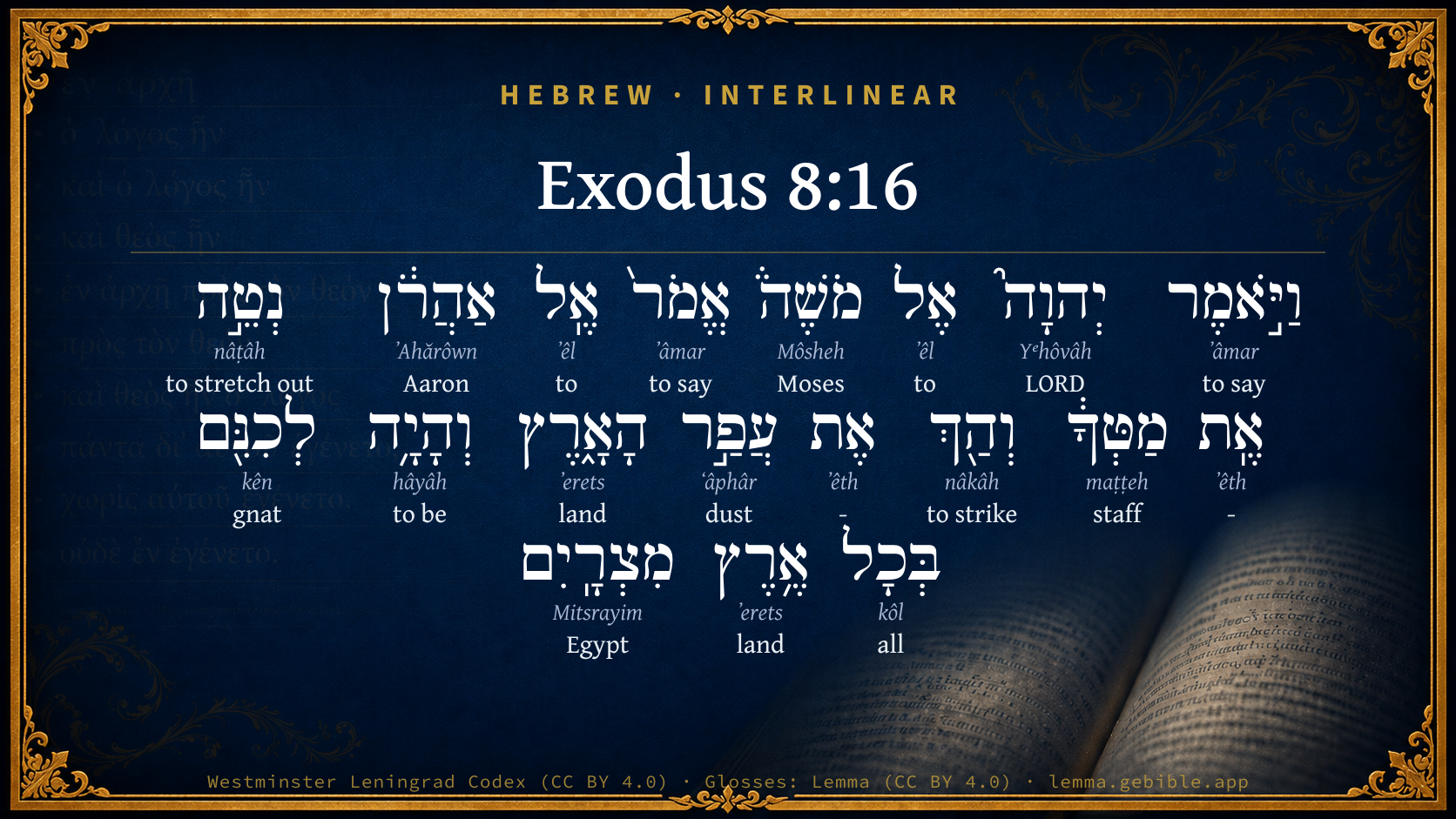
Exodus 8:16

Hebrew (Westminster Leningrad Codex) Exodus 8:16 appears in the Hebrew Old Testament. The text above is from the Westminster Leningrad Codex. Each word links to its Strong’s number, a concise gloss, and parsing drawn from the Open Scriptures Hebrew Bible morphology. Click any word for its full Brown-Driver-Briggs (BDB) entry.
Download image
Cite this verse

Exodus 8:16 (World English Bible). Public Domain. Lemma interlinear Bible study tool, https://lemma.gebible.app/v/exodus/8/16.

Show BibTeX & RIS
BibTeX
RIS
English Translation
Yahweh said to Moses, "Tell Aaron, 'Stretch out your rod, and strike the dust of the earth, that it may become lice throughout all the land of Egypt.'"
World English Bible · Public Domain
Highlights Full analysis ↓
Download a study sheet

One document with this verse’s original text, its word-by-word gloss line, the meaning frame, cross-references with their text, attributed commentary, and full source and license credits — printable, and it pastes into notes with its structure intact.

This verse Autodidact and up

Study sheet (.html) Plain text (.txt)

A passage Seminary Student

Up to 50 verses in one chapter. A passage sheet keeps up to 6 commentary sources and 12 cross-references per verse, in the order this page ranks them, and says so on the sheet whenever that leaves anything out. Ask for a single verse and you get the Autodidact verse sheet above.

Everything on this page stays free to read, with no account — the sheet is a download of what is already on screen, not access to it.

Want to remove ads? Support Godless Engineer
Compare translations 3

The same verse in 3 English versions, stacked beneath the original-language interlinear above. Click any original word for its lexicon entry.

Each is an independent rendering of the whole verse — the interlinear is not word-aligned to these translations.

Highlighted words mark where these versions differ — a whole-verse word diff, not a word-by-word alignment.

  • World English Bible Public Domain
    Yahweh said to Moses, "Tell Aaron, 'Stretch out your rod, and strike the dust of the earth, that it may become lice throughout all the land of Egypt.'"
  • King James Version Public Domain
    And the LORD said unto Moses, Say unto Aaron, Stretch out thy rod, and smite the dust of the land, that it may become lice throughout all the land of Egypt.
  • unfoldingWord Literal Text CC BY-SA 4.0
    And Yahweh said to Moses, “Say to Aaron, ‘Stretch out your staff and strike the dust of the ground, and it will become lice in all the land of Egypt.’”

unfoldingWord Literal Text — © unfoldingWord, licensed CC BY-SA 4.0. Word-aligned USFM3 via Door43 (git.door43.org/unfoldingWord/en_ult).

Versions to compare (up to 4)

3 of 4 selected

Show all 18 translations

Every available English version of this verse, each an independent rendering of the whole verse.

  • World English Bible Public Domain
    Yahweh said to Moses, "Tell Aaron, 'Stretch out your rod, and strike the dust of the earth, that it may become lice throughout all the land of Egypt.'"
  • Berean Standard Bible Public Domain
    Then the LORD said to Moses, “Tell Aaron, ‘Stretch out your staff and strike the dust of the earth, that it may turn into swarms of gnats throughout the land of Egypt.’”
  • Majority Standard Bible Public Domain
    Then the LORD said to Moses, “Tell Aaron, ‘Stretch out your staff and strike the dust of the earth, that it may turn into swarms of gnats throughout the land of Egypt.’”
  • King James Version Public Domain
    And the LORD said unto Moses, Say unto Aaron, Stretch out thy rod, and smite the dust of the land, that it may become lice throughout all the land of Egypt.
  • American Standard Version (1901) Public Domain
    And Jehovah said unto Moses, Say unto Aaron, Stretch out thy rod, and smite the dust of the earth, that is may become lice throughout all the land of Egypt.
  • Revised Version (1885) Public Domain
    And the LORD said unto Moses, Say unto Aaron, Stretch out thy rod, and smite the dust of the earth, that it may become lice throughout all the land of Egypt.
  • Geneva Bible (1599) Public Domain
    Againe the Lord sayd vnto Moses, Say vnto Aaron, Stretche out the rod, and smite the dust of the earth, that it may bee turned to lyce throughout all the land of Egypt.
  • Douay-Rheims (1899) Public Domain
    And the Lord said to Moses: Say to Aaron, Stretch forth thy rod, and strike the dust of the earth: and may there be sciniphs in all the land of Egypt.
  • Young's Literal Translation Public Domain
    And Jehovah saith unto Moses, `Say unto Aaron, Stretch out thy rod, and smite the dust of the land, and it hath become gnats in all the land of Egypt.'
  • Literal Standard Version CC BY-SA 4.0
    And YHWH says to Moses, “Say to Aaron, Stretch out your rod, and strike the dust of the land, and it has become gnats in all the land of Egypt.”
  • Unlocked Literal Bible CC BY-SA 4.0
    Yahweh said to Moses, “Say to Aaron, 'Reach out with your staff and strike the dust on the ground, that it may become gnats throughout all the land of Egypt.'”
  • unfoldingWord Literal Text CC BY-SA 4.0
    And Yahweh said to Moses, “Say to Aaron, ‘Stretch out your staff and strike the dust of the ground, and it will become lice in all the land of Egypt.’”
  • Darby Bible Public Domain
    And Jehovah said to Moses, Say unto Aaron, Stretch out thy staff, and smite the dust of the earth, and it shall become gnats throughout the land of Egypt.
  • World Messianic Bible Public Domain
    The LORD said to Moses, “Tell Aaron, ‘Stretch out your rod, and strike the dust of the earth, that it may become lice throughout all the land of Egypt.’”
  • Webster's Bible Public Domain
    And the LORD said to Moses, Say to Aaron, Stretch out thy rod, and smite the dust of the land, that it may become lice throughout all the land of Egypt.
  • Free Bible Version CC BY-SA 4.0
    The Lord said to Moses, “Tell Aaron, ‘Pick up your walking stick and hit the dust of the ground. The dust will become gnats swarming all over Egypt.’”
  • Bible in Basic English Public Domain
    And the Lord said to Moses, Say to Aaron, Let your rod be stretched out over the dust of the earth so that it may become insects through all the land of Egypt.
  • JPS Tanakh (1917) Public Domain
    (8-12) And the LORD said unto Moses: 'Say unto Aaron: Stretch out thy rod, and smite the dust of the earth, that it may become gnats throughout all the land of Egypt.'

Literal Standard Version (2020), Covenant Press — licensed CC BY-SA 4.0. Text via the HelloAO Bible API (eBible.org). Unlocked Literal Bible (unfoldingWord) — licensed CC BY-SA 4.0. Text via the HelloAO Bible API (eBible.org). unfoldingWord Literal Text — © unfoldingWord, licensed CC BY-SA 4.0. Word-aligned USFM3 via Door43 (git.door43.org/unfoldingWord/en_ult). Free Bible Version, Dr. Jonathan Gallagher — licensed CC BY-SA 4.0. Text via the HelloAO Bible API (eBible.org).

Word by word

More ways to search: Search by grammar → Find every occurrence → Compare this word →

Practice this passage: Drill this verse → Learn its vocabulary →

לְכִנִּ֖ם
kên
H3654
“to/for · gnats”
Preposition + Noun, Common, Masculine, Plural, Absolute
Part of Speech
Preposition + Noun
Type
Common
Gender
Masculine
Number
Plural
State
Absolute
Full BDB Definition

Origin: from H3661 in the sense of fastening

TWOT: 999a

gnat, gnats, gnat-swarm
  1. וַיֹּ֣אמֶר ʼâmar H559 “and · to say” Conjunction + Verb, Qal, Sequential Imperfect, 3rd Person, Masculine, Singular
  2. יְהוָה֮ Yᵉhôvâh H3068 “LORD” Noun, Proper
  3. אֶל ʼêl H413 “to” Preposition
  4. מֹשֶׁה֒ Môsheh H4872 “Moses” Noun, Proper
  5. אֱמֹר֙ ʼâmar H559 “say” Verb, Qal, Imperative, 2nd Person, Masculine, Singular
  6. אֶֽל ʼêl H413 “to” Preposition
  7. אַהֲרֹ֔ן ʼAhărôwn H175 “Aaron” Noun, Proper
  8. נְטֵ֣ה nâṭâh H5186 “stretch out” Verb, Qal, Imperative, 2nd Person, Masculine, Singular
  9. אֶֽת ʼêth H853 “-” Particle, Direct Object
  10. מַטְּךָ֔ maṭṭeh H4294 “staff · your” Noun, Common, Masculine, Singular, Construct + Suffix, Personal, 2nd Person, Masculine, Singular
  11. וְהַ֖ךְ nâkâh H5221 “and · strike” Conjunction + Verb, Hiphil, Imperative, 2nd Person, Masculine, Singular
  12. אֶת ʼêth H853 “-” Particle, Direct Object
  13. עֲפַ֣ר ʻâphâr H6083 “dust of” Noun, Common, Masculine, Singular, Construct
  14. הָאָ֑רֶץ ʼerets H776 “the · land” Particle, Definite Article + Noun, Common, Both, Singular, Absolute
  15. וְהָיָ֥ה hâyâh H1961 “and · to be” Conjunction + Verb, Qal, Sequential Perfect, 3rd Person, Masculine, Singular
  16. בְּכָל kôl H3605 “in/at · all of” Preposition + Noun, Common, Masculine, Singular, Construct
  17. אֶ֥רֶץ ʼerets H776 “land of” Noun, Common, Both, Singular, Construct
  18. מִצְרָֽיִם Mitsrayim H4714 “Egypt” Noun, Proper

About this verse

These counts appear in no published source. They are computed here, from the morphology-tagged text and Lemma’s own curated glosses. What Lemma adds →

19
words
15
distinct lemmas
Pentateuch
section

Notable vocabulary

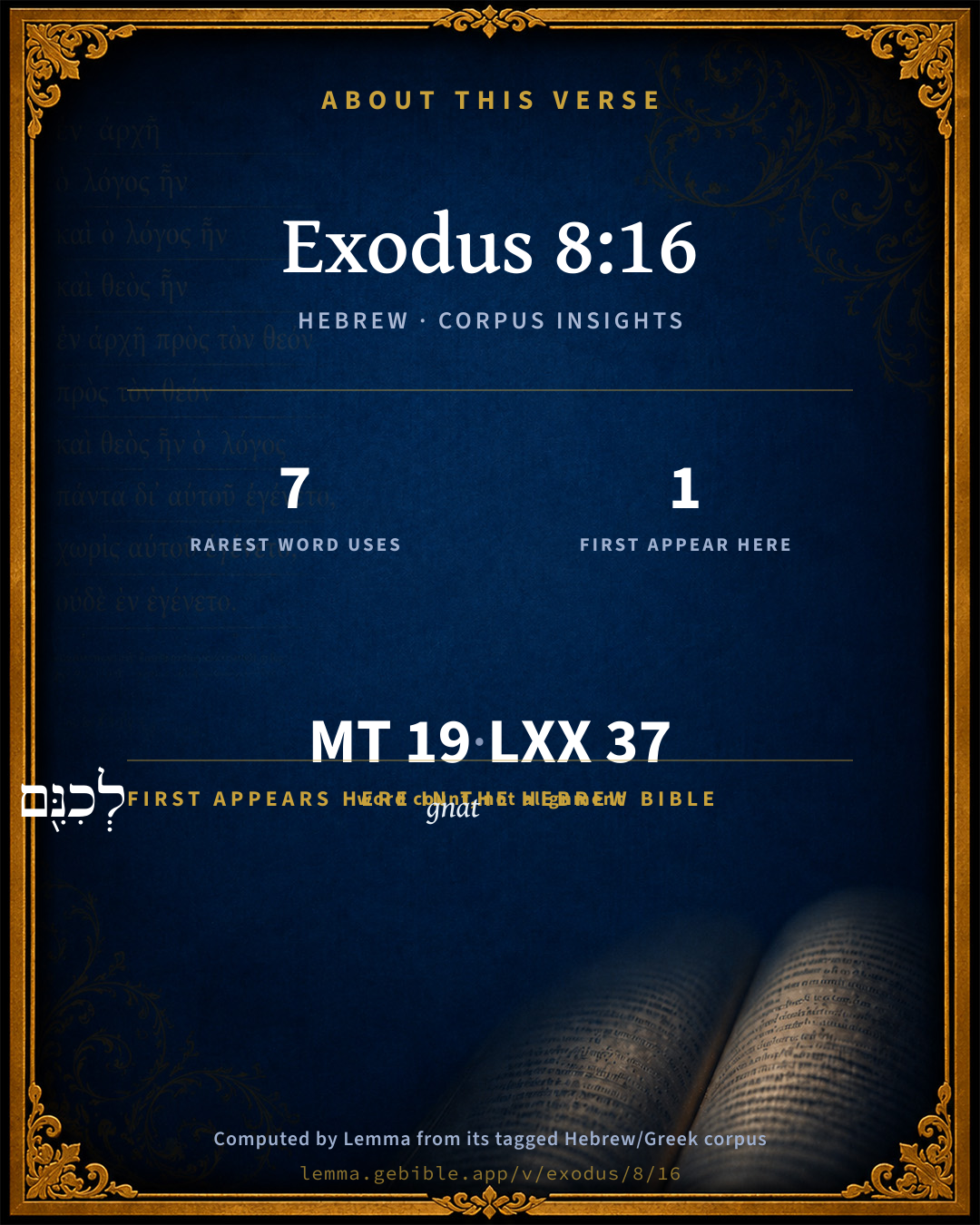
The rarest word here is לְכִנִּ֖ם gnat H3654 — appearing just 7 times in the whole Hebrew Bible.

First appearance in Scripture

This word makes its first canonical appearance in the Hebrew Bible here:

  • לְכִנִּ֖ם gnat H3654

Shared distinctive vocabulary

לְכִנִּ֖ם gnat H3654 occurs in 5 verses of the Hebrew Bible. Also found in:

Grammatical profile

  • 5 verbs
  • 10 nouns
  • 2 prepositions
  • 2 particles

Verb forms

  • וַיֹּ֣אמֶר Qal · Sequential Imperfect
  • אֱמֹר֙ Qal · Imperative
  • נְטֵ֣ה Qal · Imperative
  • וְהַ֖ךְ Hiphil · Imperative
  • וְהָיָ֥ה Qal · Sequential Perfect

Repetition

Words recur within this verse — often emphatic in Hebrew:

  • וַיֹּ֣אמֶר to say H559 ×2
  • הָאָ֑רֶץ land H776 ×2
  • אֶל to H413 ×2

Hebrew & Septuagint length

In English translation the verse runs 28 words from the Hebrew and 41 from the Septuagint (LXX English) — the Septuagint runs noticeably longer here. See the side-by-side →

A rough comparison of the two English renderings, which tokenize alike — not a word-level alignment.

Word counts can differ between the Hebrew and the Greek without any difference in meaning — e.g. the Hebrew direct-object marker אֵת has no separate Greek word, and Greek often adds the article ὁ.

In the original languages it is 19 Hebrew tokens and 37 Greek tokens — but the two are counted differently (Hebrew bundles its prefixes and suffixes into one token; the Greek is in lemma form), so that isn’t a like-for-like length.

Cross-references

2

Topical passages linked to Exodus 8:16 in the Treasury of Scripture Knowledge — connected by theme and wording, ordered by reader-vote popularity; previews shown in the World English Bible.

  • Exodus 8:5 Yahweh said to Moses, "Tell Aaron, 'Stretch forth your hand with your rod over the rivers, over the streams, and over the pools, and cause frogs to come up on the land of Egypt.'"
  • Exodus 8:17 They did so; and Aaron stretched out his hand with his rod, and struck the dust of the earth, and there were lice on man, and on animal; all the dust of the earth became lice throughout all the land of Egypt.

Cross-references courtesy of OpenBible.info (CC BY 4.0).

Hebrew and Greek witnesses Masoretic Hebrew ↔ Greek Septuagint

The same verse in the two great witnesses to the Old Testament, shown verse-for-verse.

Here the Septuagint runs noticeably longer than the Hebrew — LXX2012 (modern English Septuagint) 41 words vs World English Bible 28. A rough length comparison of the two English translations, not a word-level alignment — read both below.

These are two independent witnesses, not word-aligned to each other, and the Septuagint is shown in lemma (dictionary) form.

Hebrew Exodus 8:16 Masoretic · Westminster Leningrad Codex

וַיֹּ֣אמֶר יְהוָה֮ אֶל מֹשֶׁה֒ אֱמֹר֙ אֶֽל אַהֲרֹ֔ן נְטֵ֣ה אֶֽת מַטְּךָ֔ וְהַ֖ךְ אֶת עֲפַ֣ר הָאָ֑רֶץ וְהָיָ֥ה לְכִנִּ֖ם בְּכָל אֶ֥רֶץ מִצְרָֽיִם

Yahweh said to Moses, "Tell Aaron, 'Stretch out your rod, and strike the dust of the earth, that it may become lice throughout all the land of Egypt.'"

World English Bible · Public Domain

Greek LXX Exodus 8:16 Septuagint · lemma form

εἶπον δέ κύριος πρός μωυσῆς ὀρθρίζω ὁ πρωΐ καί ἵστημι ἐναντίον φαραώ καί ἰδού αὐτός ἐκἔρχομαι ἐπί ὁ ὕδωρ καί εἶπον πρός αὐτός ὅδε λέγω κύριος ἐκ ἀποστέλλω ὁ λαός ἐγώ ἵνα ἐγώ λατρεύω ἐν ὁ ἔρημος

And the Lord said to Moses, Say to Aaron, Stretch forth your rod with your hand and strike the dust of the earth; and there shall be lice both upon man, and upon quadrupeds, and in all the land of Egypt.

LXX2012 (modern English Septuagint) · Public Domain

On this verse, The Cambridge Bible for Schools and Colleges discusses the Septuagint’s reading. Read the note in Commentary ↓

Hebrew: Westminster Leningrad Codex (CC BY 4.0). Greek: Septuagint (public domain); English from LXX2012 (modern English Septuagint) (Public Domain). How the Septuagint differs from the Hebrew →

Targum (Aramaic paraphrase)

2

The Targum is the ancient Jewish Aramaic paraphrase of the Hebrew Scriptures — an interpretive translation, not the Hebrew text itself. Onkelos (literal) and Pseudo-Jonathan (expansive) render the Torah, and Jonathan the Prophets. Coverage is partial: where no permissively-licensed English translation exists for a verse, only the Aramaic is shown. This is verse-level text, not a word-by-word alignment to the Hebrew.

  1. Targum Onkelos Torah (Genesis–Deuteronomy)
    וַאֲמַר יְיָ לְמשֶׁה אַקְדֵם בְּצַפְרָא וְאִתְעַתַּד קֳדָם פַּרְעֹה הָא נָפֵק לְמַיָא וְתֵימַר לֵהּ כִּדְנַן אֲמַר יְיָ שַׁלַח עַמִי וְיִפְלְחוּן קֳדָמָי:

    (no public-domain English translation for this verse)

    Targum Onkelos — Aramaic: “Onkelos Genesis” (public domain); “Onkelos Exodus” (public domain); “Onkelos Leviticus” (public domain); “Onkelos Numbers” (public domain); “Onkelos Deuteronomy” (public domain). English: “Sefaria Community Translation” (CC0 1.0 (public-domain dedication)); “J.W. Etheridge. The Targums of Onkelos and Jonathan Ben Uzziel on the Pentateuch. London: Longmans, Green, 1862” (public domain). Text via Sefaria.

  2. Targum Pseudo-Jonathan Torah (Genesis–Deuteronomy)
    וַאֲמַר יְיָ לְמשֶׁה אַקְדֵם בְּצַפְרָא וְתִתְעַתַּד קֳדָם פַּרְעה הָא נָפִיק לְמִנְטַר קוּסְמִין עִילוֹי מַיָא הֵי כְּאַמְגוּשָׁא וְתֵימַר לֵיהּ כִּדְנָא אָמַר יְיָ פְּטוֹר יַת עַמִי וְיִפְלְחוּן קֳדָמַי

    And the Lord spake to Mosheh, Arise in the morning, and stand before Pharoh: behold, be goeth forth to observe divinations at the water, as a magician; and thou shalt say to him, Thus saith the Lord, Emancipate My people, that they may worship before Me;

    Targum Pseudo-Jonathan — Aramaic: “Targum Jonathan on Genesis” (public domain); “Targum Jonathan on Exodus” (public domain); “Targum Jonathan on Leviticus” (public domain); “Targum Jonathan on Numbers” (public domain); “Targum Jonathan on Deuteronomy” (public domain). English: “The Targum of Jonathan ben Uzziel, trans. J. W. Etheridge, London, 1862” (public domain). Text via Sefaria.

Commentary

Notes on Exodus 8:16 from classic Christian and Jewish commentators (each source and its license shown beneath its notes). The classic Christian expositions comment on the surrounding passage and are grouped to its opening verse, so a note may address several verses; the Jewish commentaries on the Tanakh (Rashi and others) are per-verse, so they appear only where the commentator wrote on this verse.

Lemma curates 59 commentaries, every one of them public domain or Creative Commons licensed, each selected and text-cleaned for this edition rather than reprinted as found. About our sources →

Matthew Henry's Commentary

Here is a short account of the plague of lice. It does not appear that any warning was given of it before. Pharaoh's abuse of the respite granted to him might have been a sufficient warning to him to expect another plague: for if the removal of an affliction harden us, and so we lose the benefit of it, we may conclude it goes away with a purpose to return or to make room for a worse. Observe,

I. How this plague of lice was inflicted on the Egyptians, Exo 8:16, Exo 8:17. The frogs were produced out of the waters, but these live out of the dust of the earth; for out of any part of the creation God can fetch a scourge, with which to correct those that rebel against him. He has many arrows in his quiver. Even the dust of the earth obeys him. "Fear not then, thou worm Jacob, for God can use thee as a threshing instrument, if he please," Isa 41:14, Isa 41:15. These lice, no doubt, were extremely vexatious, as well as scandalous, to the Egyptians. Though they had respite, they had respite but awhile, Rev 11:14. The second woe was past, but behold the third woe came very quickly.

II. How the magicians were baffled by it, Exo 8:18. They attempted to imitate it, but they could not. When they failed in this, it should seem they attempted to remove it; for it follows, So there were lice upon man and beast, in spite of them. This forced them to confess themselves overpowered: This is the finger of God (Exo 8:19); that is, "This check and restraint put upon us must needs be from a divine power." Note, 1. God has the devil in a chain, and limits him both as a deceiver and as a destroyer; hitherto he shall come, but no further. The devil's agents when God permitted them, could do great things; but when he laid an embargo upon them, though but with his finger, they could do nothing. The magicians' inability, in this less instance, showed whence they had their ability in the former instances which seemed greater, and that they had no power against Moses but what was given them from above. 2. Sooner or later God will extort, even from his enemies, an acknowledgment of his own sovereignty and over-ruling power. It is certain they must all (as we say) knock under at last, as Julian the apostate did, when his dying lips confessed, Thou hast overcome me, O thou Galilean! God will not only be too hard for all opposers, but will force them to own it.

III. How Pharaoh, notwithstanding this, was made more and more obstinate (Exo 8:19); even those that had deceived him now said enough to undeceive him, and yet he grew more and more obstinate. Even the miracles and the judgments were to him a savour of death unto death. Note, Those that are not made better by God's word and providences are commonly made worse by them.

Matthew Henry's Commentary on the Whole Bible (1708–1710) — public domain (CC PDM 1.0). Text via the HelloAO Bible API.

Jamieson, Fausset & Brown

Robert Jamieson, A. R. Fausset & David Brown

PLAGUE OF LICE. (Exo 8:16-19)

smite the dust of the land, &c.--Aaron's rod, by the direction of Moses, who was commanded by God, was again raised, and the land was filled with gnats, mosquitoes--that is the proper meaning of the original term. In ordinary circumstances they embitter life in Eastern countries, and therefore the terrible nature of this infliction on Egypt may be imagined when no precautions could preserve from their painful sting. The very smallness and insignificance of these fierce insects made them a dreadful scourge. The magicians never attempted any imitation, and what neither the blood of the river nor the nuisance of the frogs had done, the visitation of this tiny enemy constrained them to acknowledge "this is the finger of God"--properly "gods," for they spoke as heathens.

Jamieson, Fausset & Brown — Commentary Critical and Explanatory on the Whole Bible (1871) — public domain (CC PDM 1.0). Text via the HelloAO Bible API.

The Cambridge Bible for Schools and Colleges

gen. ed. J. J. S. Perowne

16. lice] Marg. gnats. The Heb. kinnîm or kinnâm occurs only Exo_8:16-18, Psa_105:31, and doubtfully in the sing. Isa_51:6; and it as been differently interpreted. Both the renderings here given are ancient: gnats are found in LXX. (σκνῖφες1[121]), Vulg. sciniphes; lice in Pesh. and Targ. (so Jos. Ant ii. 14. 3). Gnats, or, as we should say, mosquitos, are abundant in Egypt: they are generated from the water (which is full of their larvas); and in the autumn especially, when the Nile is still overflowing, and the rice-fields stand in water, they rise from it in such swarms that the air is sometimes darkened with them. Their sting occasions swelling and irritation; and the annoyance caused by them is often alluded to by travellers in Egypt. Lice, on the other hand, are nothing characteristic of Egypt. Hence most moderns (Ges., Keil, Dillm. &c.) agree that gnats is the most probable rendering. The gnats in Egypt often look like clouds of dust; accordingly, they are described here as produced from the dust.

[121] Philo (Vit. Mos., p. 97) describes the σκνῖφες as small insects, which not only pierced the skin, but also set up intolerable itching, and penetrated the ears and nostrils; and OriExo (Hom. in Exo_4:6) as small stinging insects, i.e. mosquitos. Herodotus (ii. 95) also mentions how troublesome the κώνωπες, another species of gnat, were in Egypt.

16–19. The third plague. The dust of the land turned to gnats. Entirely P.

The Cambridge Bible for Schools and Colleges (gen. ed. J. J. S. Perowne; Cambridge University Press, 1878–1918) — public domain. Text from a community e-Sword module.

Trapp's Complete Commentary

John Trapp

Exo 8:16 And the LORD said unto Moses, Say unto Aaron, Stretch out thy rod, and smite the dust of the land, that it may become lice throughout all the land of Egypt.

Ver. 16. Stretch out thy rod.] Here is no warning given; which shows great wrath. Impenitency makes God "weary of repenting." {Jer 15:6} Absolute in his threatenings, if any; resolute in his executions, as Deu 29:19-20.

John Trapp, A Commentary or Exposition upon All the Books of the Old and New Testament (1647–1656) — public domain. Text from a community e-Sword module.

The Biblical Illustrator

Joseph S. Exell

Exo_8:16-19

That it may become lice.

The plague of lice

I. The plague itself.

1. This punishment was sent without any previous warning.

2. This plague was inflicted by a very small insect.

3. This plague could not be imitated by the magicians. This rendered Pharaohs refusal to humble himself all the more unpardonable.

II. Its teaching.

1. Its infliction produced no real good. How soon the human mind becomes accustomed to novelties, even of the most extraordinary character. So the fallen soul becomes naturalized to the paths of sin and the lessons of Gods judgment.

2. Observe the resources of God. The least thing in His hand can become an instrument of torment.

3. How foolish, then, and how mad, to resist the will of this Divine Being! (Homilist.)

Lessons

1. The devil will try his utmost to counterwork God.

2. The devil is impotent upon the least check from God.

3. Gods power sets on His judgments when the power of Satan fails (Exo_8:18).

4. The devils instruments are forced at last to say they are against God, and He against them.

5. Gods finger or the least of His power makes the devil and his instruments fail.

6. Innate unbelief loves to be kept up by liars, but will not yield when they fail.

7. Treble hardening comes on the wicked by treble judgments.

8. Gods word faileth not which He hath spoken of the sin and judgment of wicked persecutors (Exo_8:19). ( G. Hughes, B. D.)

The plague of lice; or, an enforced recognition of a Supreme Power in the dire retributions of human life

I. That men are slow to recognize the Supreme Power in the retributions of life.

1. Because they have not right views of the character of God.

2. Because they have not a due consciousness of sin and its demerit.

II. That wicked men are made by continuous retributions ultimately to recognize the Supreme Power against them. Then the magicians said unto Pharaoh, This is the finger of God. God sometimes plagues men until they acknowledge Him. The events of life are charged with retributions which cannot be hidden by the art of the sorcerer.

III. That when wicked men are made to acknowledge the Supreme Power in the retributions of life they may nevertheless continue in open opposition to it. And Pharaohs heart was hardened. Lessons:

1. That the retributions of life are designed to lead men to the performance of moral duty.

2. That there are many deceptions calculated to blind men to the hand of God in the events of life.

3. That wicked men are not able to contend with God, and are at times brought to acknowledge His supremacy. (J. S. Exell, M. A.)

Dangerous dust

Dangerous dust in the air is circulated by the elevated railways in New York. A member of the staff of The Scientific American hung a magnet under the track of the elevated road, and when a few minutes later he took it down it was coated with minute particulars of iron dust. This dust, he said, is the cause of many severe cases of eye troubles. The swift passing trains grind off showers of iron particles, which often fall or are blown into the eyes of pedestrians. The microscope shows, that the particles are of innumerable shapes, and they usually have jagged fringes, and many of them have barbs like a fish hook. When lodged in the eye they cannot be attracted therefrom with a magnet, but a gouge-shaped instrument the size of a sewing needle had been devised for the purpose. This peculiarity of the dust resembles that of moral evil It is in the air, and when once it finds a lodgment in the human heart it cannot be withdrawn without difficulty and suffering. This is the of finger God--Like Phidias, who in his image carved his own name, there is God engraven upon every creature. Not in characters of human writing is it written, but in the character of the work. Phidias needed not to have written the word phidias in so many letters, for the masters hand had a cunning of its own which none could counterfeit. An instructed person had only to look at a statue and say at once, Phidias did this, for no other hand could have chiselled such a countenance; and believers have only to look either at creation, providence, or the Divine Word, and they will Cry instinctively, This is the finger of God. Yet, alas, man has great powers of wilful blindness, and these are aided by the powers of darkness, so that, being both blind and in the dark, man is unable to see his God, though His presence is as clear as that of the sun in the heavens. (C. H. Spurgeon.)

The limit of false religion

Human religions can go to a certain point in good works, especially if they have borrowed their systems and copied their charities from the teachings of Christ, which most of them have done. But beyond a certain point they cannot go. It has been observed that the magicians could not bring living things out of the dust of the ground, as Moses did. And a false religion cannot bring life out of death, as the gospel does. Morality and certain good works it can conjure up; but spiritual life it cannot produce. Atheism, in the form of scientific materialism, may point to some notable and heroic disciple, such as Professor Clifford, who died without fear, steadfast in his faith that death was the end of him; but it cannot enable a man to die as Stephen and Paul died. It is not unworthy of our passing thought that the scientific magicians of our day, who are saying, Who is the Lord? have tried very hard to generate a living thing out of the dust; but they have as utterly and signally failed as the magicians did in the days of Moses. We may confidently keep a good courage in these days, when the scientific and religious magicians are trying to discredit the Word of God with their enchantments. Be sore that if the conflict is pushed far enough they will come to signal grief. In the end God will give glorious victory to those who stand by His truth, and who continue to cast their rods down in the face of an unbelieving world. (G. F. Pentecost, D. D.)

The Biblical Illustrator, edited by Joseph S. Exell (c. 1880s–1900s) — public domain. Text from a community e-Sword module.

Whedon's Commentary on the Bible

Daniel D. Whedon

THIRD PLAGUE — LICE, Exo_8:16-19.

16. Smite the dust of the land, that it may become lice — The Hebrew word here rendered lice occurs only in the account of this miracle, and its meaning has been much disputed, many considering that the insect was a gnat or mosquito; but Josephus and the Rabbies all give the same rendering as our English version. The Septuagint has been erroneously supposed to establish this meaning, but its word, σχνιφες, may mean any small biting or stinging insect, whether winged or wingless. Modern travellers describe the louse as a great pest in Egypt; and Sir Samuel Baker, especially, speaks of the abundance of the vermin in almost Scripture language — “It is as though the very dust were turned into lice.”

This plague struck at the Egyptian idolatry less directly, but even more effectually, than either of the preceding. It made all the sacred animals, and the priests themselves, unclean, so as to cut off the worship in the temples. The priests were most scrupulously attentive to cleanliness, being always careful to have their linen garments fresh washed, scouring their drinking cups each day, bathing in cold water twice each day and twice each night, and shaving not only the head and beard, but the “whole body every other day, that no lice or other impure thing might adhere to them when engaged in the service of their gods.” (Herod., 2:37.) Think of these fastidiously cleanly servants swarming with lice, and finding their gods covered with them also! Thus the word of Moses smote every temple and every god in Egypt.

Daniel D. Whedon (gen. ed.), Commentary on the Old and New Testaments (1874–1909) — public domain. Text from a community e-Sword module.

The Preacher's Complete Homiletical Commentary

Joseph S. Exell (gen. ed.)

CRITICAL NOTES.—

Exo_8:16. Lice] “Gnats”—Ges. Fü. Dav.

MAIN HOMILETICS OF THE PARAGRAPH.—Exo_8:16-19

THE PLAGUE OF LICE, OR, AN ENFORCED RECOGNITION OF A SUPREME POWER IN THE DIRE RETRIBUTIONS OF HUMAN LIFE

The third plague was now sent upon the land without any warning. The two previous plagues arose from the river, this arises from the dust of the earth which was quickened into life, by a miraculous power. Here was another blow aimed at the false deities of Egypt. The priests were very particular not to harbour vermin, and considered it a profanation of their temples if any animalcule were carried into them. This plague was general (Psa_105:31). The Egyptians were accustomed to humble themselves in many of their religious ceremonies, and especially in their acts of mourning, by throwing dust upon their heads. This plague was a rebuke to their superstition. The magicians were baffled by this retribution. The finger of God was sufficient to curb the power of Satan.

I. That men are slow to recognize the Supreme Power in the retributions of human life. As we read the history of those plagues we cannot but wonder that Pharaoh and his people should have been so long in recognizing the finger of God. The first plague was enough to subdue their haughty spirit, and to give them to see that they were in conflict with the power of the Most High. They ought to have recognized the hand of God in these retributions:—

1. Because of the warnings given by the servants of God. Moses and Aaron had warned the king that if he did not give Israel their freedom, he and his nation would be smitten with sore plagues. But these indications of woe were neglected and despised, and in no way rendered Pharaoh sensitive to the claims of duty. And there are multitudes in our own day warned by the ministers of the Gospel of dire retribution to come upon them if they give no heed to the commands of God, to repent and believe in Christ, and even when the sorrows of life come upon them they see not the finger of God. There are many warnings of retribution in this life to those who persists in doing evil. But men see them not.

2. Because of the miraculous element in the-retribution they were called to experience. The great River of Egypt was turned into blood. Their homes were tilled with croaking frogs. The dust of their land was smitten into lice. True these occurrences were apparently brought about by the effort of Moses and Aaron, but the Egyptians must have seen that these two men were but the agents of a higher Power. But even when the events of life are striking and evidently the outcome of Divine intervention, men will not behold in them the finger of God.

3. Because of the suffering through which they were called to pass. We should have thought that the suffering through which the Egyptians were called to pass would have made them readily acknowledge the finger of God. In the hour of pain men generally turn their souls to heaven. But in affliction men will not always see the retribution of God. Why are men so slow to recognize the hand of God in the retributions of human life?

1. Because they have not right views of the character of God. They may have theoretical notions of the Divine character, correct and true, but not such as to influence moral conduct. Men want not merely to know that God is just in His method of government, but to feel that He is. If they were deeply impressed with a sense of the Divine justice they would see retribution written in large letters upon many of the circumstances of life, which now they regard with complacency.

2. Because they have not a due consciousness of sin and its demerit. Men know that they have sinned against God and against the moral good of the community, but they contemplate not the great injury they have done, the offence of which they are guilty. They have no deep consciousness of personal sin. Hence they do not regard the events of life as a rebuke to them. They link not the pain of society to their own demerit. Hence when the retributions of heaven come upon them, they are more ready to acknowledge their own improvidence or indiscretion, the unfavourable working of natural law, the fortuitous combination of circumstances, rather than the finger of God. In this we see the moral blindness of the unregenerate soul.

II. That wicked men are made by continuous retributions ultimately to recognize the Supreme Power against them. “Then the magicians said unto Pharaoh, this is the finger of God.” These sorcerers endeavoured to imitate the retribution of heaven. In so doing they were prompted and aided by Satan. But the power of Satan is limited by the Divine will. Heaven can show men the delusions of hell. Hence the deluded are without excuse. Sometimes the servants of the devil are made unconsciously to minister to the truth. The sorcerer may announce to his dupe that the hand of God is against him. It may be asked, how came these magicians to make this confession to Pharaoh? It is not unlikely that they made it upon a sudden impulse, prompted by the Holy Spirit. And so there will come a time when all the artifices which bind men, and prevent them from seeing the retributive hand of God, will be made known, defeated, and brought to an open shame. God sometimes plagues men until they acknowledge Him. The events of life are charged with retributions which cannot be hidden by the art of the sorcerer.

III. That when wicked men are made to acknowledge the Supreme Power in the retributions of life they may nevertheless continue in open opposition to it. “And Pharaoh’s heart was hardened.” The magicians by their recognition of the finger of God did not wish to undo the moral injury they had done to Pharaoh. They had established him in obstinate rebellion against God, and they had no wish that his obstinacy should cease. The agents of Satan do not wish to nullify the evil influence of their hellish art. Unbelief remains when the lies that wrought it are made known. The magicians here refer this calamity to a Providence of God altogether beyond their control. They regard it as the outcome of Divine power. They did not intend by this confession to give glory to the God of Moses, but simply to protect their own honour. LESSONS:

1. That the retributions of life are designed to lead men to the performance of moral duty.

2. That there are many deceptions calculated to blind men to the hand of God in the events of life.

3. That wicked men are not able to contend with God. and are at times brought to acknowledge His supremacy. Many commentators think that the magicians referred to the gods of Egypt when they made mention of the “finger of God.” But we cannot accept this interpretation, as the gods of Egypt were defeated by this retribution; and, moreover, Pharaoh had previously identified Moses with the God of Israel in asking him to seek the removal of the plagues.

SUGGESTIVE COMMENTS ON THE VERSES

Exo_8:16-19. At God’s word dust shall become lice to torment proud sinners.

God’s servants are obedient in executing His commands for vengeance.

All creatures are at God’s command to plague His enemies.

The poorest creatures armed by God hath power enough against greatest kings.

The devil will try his utmost to counterwork God.

The devil is impotent upon the least check from God.

There is not the least doubt that the creatures here named is the mosquito gnat. In the Greek Septuagint the word is σκνιφες, which denotes gnats. And in a warm climate we can imagine what a terrible infliction this would be.

ILLUSTRATIONS

BY THE

REV. WM. ADAMSON

Lice! Exo_8:16. Travellers speak of the dust of Egypt as in itself almost a plague. Yet the soil of Egypt was worshipped. The black mud of the Nile was especially an object of superstitious veneration; and to throw this dust over them was to give a special sanctity to their fasting and mourning. When it became dry under the rays of the sun, it generated this vermin, concerning which Mr. Lane says in very thrilling terms that they are a sort of tick, not larger than a grain of sand which, when filled with blood, expands to the size of a hazel nut. Sir Samuel Baker says that at certain seasons these prevail to such an extent that it is as though the very dust were turned into lice. Oftentimes God sends innumerable minute sufferings before He sends greater ones; but great and small are alike designed to lead us to repentence.

“Oh! let me suffer, till I find

What plants of sorrow can impart,

Some gift, some triumph of the mind,

Some flower, some fruitage of the heart.”

—Uphan.

Finger of God! Exo_8:19. At the time of the battle of Waterloo, the Iron Duke was still without an experimental knowledge of true religion. Yet God prompted him—upon a sudden impulse, perhaps by the Holy Spirit, to pen a few brief words, which have come down to posterity. When the dreadful fight was over, the Duke’s feelings, kept so long at the highest tension, gave way. As he rode among the dying and wounded on the field of battle—saw the reeking carnage—and heard the shout of conquerors and vanquished fainter and fainter through the gloom of night, he wept. Soon after he wrote these words: “I have escaped unhurt; the Finger of God was on me.” Alike are the preserving mercies and judicial visitations the Finger of Jehovah. It is in such seasons that even the most godless feel their frail mortality, and acknowledge that a Supreme Being guides and governs all things:—and

“That man, who madly deems himself the lord

Of all, is naught but weakness and dependence.”

—Thomson.

The Preacher's Complete Homiletical Commentary (gen. ed. Joseph S. Exell; Funk & Wagnalls, c. 1892) — public domain (pre-1929). A full-Bible homiletical/sermon-outline anthology covering 65 of 66 books (2 John is absent from the source module). Text from a community e-Sword module.

Lange's Commentary on the Holy Scriptures

C.—The gnats

Exo_8:12-15 [Exo_8:16-19]

12 [Exo_8:16]And Jehovah said unto Moses, Say unto Aaron, Stretch out thy rod, and smite the dust of the land, that it may become lice [gnats] throughout all the 13 [17]land of Egypt. And they did so; for [and] Aaron stretched out his hand with his rod, and smote the dust of the earth [land], and it became lice [gnats] in [on] man, and in [on] beast; all the dust of the land became lice [gnats] 14 [18]throughout all the land of Egypt. And the magicians did so with their enchantments [secret arts] to bring forth lice [the gnats], but they could not: 15 [19]so [and] there were lice [gnats] upon man, and upon beast. Then [And] the magicians said unto Pharaoh, This is the finger of God: and Pharaoh’s heart was hardened, and he hearkened not unto them; as Jehovah had said.

EXEGETICAL AND CRITICAL

Exo_8:12 [Exo_8:16] seq. Gnats. כִּנִּם or כִּנִּים. Josephus, the Rabbins, [the A. V.], and Luther render: “lice.” The LXX., σκνῖφες; the Vulg., sciniphes. Very small, painfully stinging gnats, crawling on the skin, and even in the nose and ears. They are very abundant in Egypt. The dust marks the transition from the mire to the time of drought. The transformation of the dust into gnats is a symbolic act, like the transformation of water into blood. They come out of the dust, and fly around like the dust, too small to measure or to seize. Keil says: “The gnats come out of the eggs laid in the dust or ground by the preceding generation.… The miracle consists in both cases not in an immediate creation, but in the pre-announcement, and the corresponding sudden creative (?) generation and supernatural (?) increase of these animals.” Out of the eggs, and at the same time supernatural—this is discordant.

Exo_8:14 [Exo_8:18]. The scribes.חַרְטֻמִּים. Of the three forms of designation, מְבַשְּׁפִים sorcerers, חֲכָמִים wise men, and חַרְטֻמִּיםἱερογραμματεῖς, Egyptian scribes, attached to the court, interpreters of hieroglyphic writings, the chief one is here selected, making the expression of their impotence the stronger. They cannot imitate this miracle. Why not? Knobel says: Because, according to the writer’s view, this was a case involving the production of creatures. Keil: Because God’s omnipotence in the case of this miracle put a check upon the demoniacal forces which the sorcerers had employed. Strange that the characteristic mark of magic wonders is again continually overlooked. The agency of Satan consists in lying forces and signs and miracles. Satan, in all that he says (Matthew 4) is the liar. If we take Exo_8:13 literally, we might say that Moses had already transformed all the dust of Egypt into gnats, and that hence there was no dust left for them to work miracles on. But it is more obvious to assume that in this case they found the deception harder, or rather, that they were seized with a religious terror, and now declared to Pharaoh that they could go with him no further, in order to induce him to retrace his steps. This seems to be implied in their declaration: “This is the finger of God.” According to Bochart this means: nos non cohibent Moses et Aaron, sed divina vis, ulrisque major. Keil adds: “If they had meant the God of Israel, יהוה would be used.” But did they know Jehovah? And did they not also, as Egyptian priests, refer all their doings to the influence of the Godhead? According to Kurtz, by “finger” they meant an indication [Fingerzeig], a warning of the Egyptian gods themselves. Keil, on the other hand, finds in the finger of God simply an expression of creative omnipotence, as in Psa_8:4 [3]; Luk_11:20; Exo_31:18. Yet the educating wisdom of God is emphasized, especially in Exo_31:18. The recognition of the fact that God’s finger displayed itself is the prelude of the perception of His strong hand and His outstretched arm. Therefore the phrase cannot be intended to designate either the gods of Egypt, who could not possibly, in the mind of the priests, take part with Moses and Aaron, or the God of Israel according to the Egyptian notion of Him, but only the deity, as conceived by a general overpowering religious feeling.

Exo_8:15 [Exo_8:19]. Was hardened. Keil’s inference, “This punitive miracle, therefore, made on Pharaoh no impression,” obliterates the antithesis which the text brings out [viz., that although the magicians saw a divine hand in the miracle, yet Pharaoh remained obdurate].

Lange's Commentary on the Holy Scriptures (Critical, Doctrinal, and Homiletical), ed. John Peter Lange, English translation edited by Philip Schaff (1864–1880) — public domain. Text from a community e-Sword module.

Tyndale Open Study Notes

Tyndale Open Resources

8:16-19 The third plague was the plague of gnats. The word translated “gnats” is very general. Technical Old Testament dictionaries often translate it as “vermin.” The English term “bugs” would come close. The whole land was infested with insects of one sort or another.

Tyndale Open Study Notes — © Tyndale Open Resources, licensed CC BY-SA 4.0. Text via the HelloAO Bible API.

Geneva Bible (1599)

Geneva Bible translators

The third plague.

Geneva Bible (1599) marginal notes — public domain. Text via Bolls.life.

Adam Clarke's Commentary

The THIRD plague - LICE

Verse 16. Smite the dust of the land, that it may become lice] If the vermin commonly designated by this name be intended, it must have been a very dreadful and afflicting plague to the Egyptians, and especially to their priests, who were obliged to shave the hair off every part of their bodies, and to wear a single tunic, that no vermin of this kind might be permitted to harbour about them. See Herod. in Euterp., c. xxxvii., p. 104, edit. Gale. Of the nature of these insects it is not necessary to say much. The common louse is very prolific. In the space of twelve days a full-grown female lays one hundred eggs, from which, in the space of six days, about fifty males and as many females are produced. In eighteen days these young females are at their full growth, each of which may lay one hundred eggs, which will be all hatched in six days more. Thus, in the course of six weeks, the parent female may see 5,000 of its own descendants! So mightily does this scourge of indolence and filthiness increase!

But learned men are not agreed on the signification of the original word כנים kinnim, which different copies of the Septuagint render σκνιφες, σκνιπες, and σκνηπες, gnats; and the Vulgate renders sciniphes, which signifies the same.

Mr. Harmer supposes he has found out the true meaning in the word tarrentes, mentioned by Vinisauf, one of our ancient English writers; who, speaking of the expedition of King Richard I. to the Holy Land, says, that "while the army were marching from Cayphas to Caesarea, they were greatly distressed every night by certain worms called tarrentes, which crept on the ground, and occasioned a very burning heat by most painful punctures; for, being armed with stings, they conveyed a poison which quickly occasioned those who were wounded by them to swell, and was attended with the most acute pain." All this is far fetched. Bochart has endeavoured to prove that the כנים kinnim of the text may mean lice in the common acceptation of the term, and not gnats.

1. Because those in question sprang from the dust of the earth, and not from the waters.

2. Because they were both on men and cattle, which cannot be spoken of gnats.

3. Because their name comes from the radix כון kun, which signifies to make firm, fix, establish, which can never agree to gnats, flies, c., which are ever changing their place, and are almost constantly on the wing.

4. Because כנה kinnah is the term by which the Talmudists express the louse, &c. See his Hierozoicon, vol. ii., c. xviii., col. 571.

The circumstance of their being in man and in beast agrees so well with the nature of the acarus sanguisugus, commonly called the tick, belonging to the seventh order of insects called APTERA, that I am ready to conclude this is the insect meant. This animal buries both its sucker and head equally in man or beast and can with very great difficulty be extracted before it is grown to its proper size, and filled with the blood and juices of the animal on which it preys. When fully grown, it has a glossy black oval body: not only horses, cows, and sheep are infested with it in certain countries, but even the common people, especially those who labour in the field, in woods, c. I know no insect to which the Hebrew term so properly applies. This is the fixed, established insect, which will permit itself to be pulled in pieces rather than let go its hold and this is literally באדם ובבהמה baadam ubabbehemah, IN man and IN beast, burying its trunk and head in the flesh of both. In woodland countries I have seen many persons as well as cattle grievously infested with these insects.

Adam Clarke's Commentary on the Bible (1810–1826) — public domain. Text from a community e-Sword/MySword module.

Ellicott's Commentary for English Readers

THE THIRD PLAGUE. (16, 17)

It is disputed whether this plague was one of lice or of mosquitoes. Josephus and the Jewish commentators generally take the former view, while the latter is supported by the LXX. and Vulgate, by the authorities of Philo, Artapanus, Origen, and St. Augustine in ancient, and by those of Rosenmüller, Michaelis, Œdmann, Gesenius, Keil, and Kalisch in modern times. The word used (kinnim) seems connected with the Greek κίνψ, or κώνωψ, and is reasonably regarded as formed by onomatopoeia, from the sharp tingling sound given out by the insect when on the wing.[58] The trouble caused to the Egyptians of the Delta by mosquitoes is noticed by Herodotus (ii. 95); while moderns, as Forskal (Descript. Anim. p. 85), declare that they amount to an absolute pest at certain seasons. They are most troublesome towards October, and are said to attack not only the exposed parts of the skin, but especially the ears, the nostrils, and the eyes, where they do great damage. Some have thought that mosquitoes do not molest cattle (Exo_8:17); but Kalisch says, “They molest especially beasts, as oxen and horses, flying into their eyes and nostrils, driving them to madness and fury, and sometimes even torturing them to death.”

[58] In Egyptian the word for “mosquito” is Khnemms, (Brugsch, Diet. Hierogl. p. 1103).

It is to be noticed that the third plague, whatever it was, came without warning. It was God’s judgment on Pharaoh for hardening his heart and breaking his promise (Exo_8:15); and he was not given the option of avoiding it by submission to God’s will.

(16) Smite the dust of the land.—Dust prevails in Egypt to an extent that is highly inconvenient. “We travelled to Ashmim.” says one writer, “through clouds of dust, raised by a high wind, which intercepted our view as much as if we had been travelling in a fog.” “There is one great source of discomfort,” says another, “arising from the dryness of the atmosphere, namely, an excessive quantity of dust.” When “all the dust of the land became mosquitoes” (Exo_8:17), the plague must indeed have been great.

A Bible Commentary for English Readers, edited by Charles John Ellicott (1878–1897) — public domain. Text from a community e-Sword module.

John Gill's Exposition

And they did so,.... As follows:

for Aaron stretched out his hand with his rod; as directed and ordered:

and smote the dust of the earth, and it became lice in man and in beast; which shows it was a miraculous operation, since lice do not usually spring from dust, but thrive in the sweat of bodies, and the nastiness of them, through sloth and idleness; and moreover, this was like the creation of man at first, which was out of the dust of the earth, and alike the effect of almighty power:

all the dust of the land became lice throughout all the land of Egypt; that is, the greatest part of it, not that every atom of dust became lice, nor was the land of Goshen, in which the Israelites dwelt, infected with this plague, unless where any of the Egyptians were; though Dr. Lightfoot (d) thinks, that lice were in Goshen as in other parts of Egypt, there being no severing between Goshen and Egypt mentioned until the next plague; and since Israel had partook of many of the sins of Egypt, they must partake of some of her punishments; and he thinks this is the reason that the plague of lice is not reckoned among the plagues of Egypt in Psa 78:44 because it was common to Israel, and to the Egyptians, and which is the sense of Aben Ezra on Exo 7:24. The account that Artapanus (e), the Heathen historian, gives of this plague, is this;"Moses smote the earth with a rod, and produced a certain flying animal, which greatly distressed the Egyptians, and raised ulcers in their bodies, which no physicians could cure.''And so Origen (f) describes this creature as"having wings and flying in the air, but so subtile and minute as to escape the eye, unless very sharp sighted; but when it lights upon a body, it stings most bitterly, so that what a man cannot see flying, he feels stinging.''Both seem to design the gnat, but this sort of vermin do not stick in and abide with men or beasts, as these here are said to do, but buzz about and bite, and then are gone.

(d) Works, vol. 1. p. 705, 706. (e) Apud Euseb. ut supra. (Praepar. Evangel. l. 9. c. 27. p. 435.) (f) In Exod. Homil. 4. fol. 35. col. 2.

John Gill's Exposition of the Whole Bible (1746–1763) — public domain (CC PDM 1.0). Text via the HelloAO Bible API.

Albert Barnes' Notes on the Bible

It is observed by Hebrew commentators that the nine plagues are divided into three groups: distinct warnings are given of the first two plagues in each group; the third in each is inflicted without any previous notice; namely, the third, lice, the sixth, boils, the ninth, darkness.

The dust of the land - The two preceding plagues fell upon the Nile. This fell on the earth, which was worshipped in Egypt as the father of the gods. An special sacredness was attached to the black fertile soil of the basin of the Nile, called Chemi, from which the ancient name of Egypt is supposed to be derived.

Lice - The Hebrew word occurs only in connection with this plague. These insects are generally identified with mosquitos, a plague nowhere greater than in Egypt. They are most troublesome toward October, i. e. soon after the plague of frogs, and are dreaded not only for the pain and annoyance which they cause, but also because they are said to penetrate into the body through the nostrils and ears.

Albert Barnes' Notes on the Bible (1834–1885) — public domain. Text from a community e-Sword/MySword module.

Haydock's Catholic Bible Commentary

Sciniphs, or Cinifs, Hebrew Cinnim, small flying insects, very troublesome both to men and beasts. (Challoner) --- Like midges. (Origen, hom. 4.) Others think they were lice. (Bochart.) Pharao is not forewarned of this plague.

George Leo Haydock (1774–1849), Haydock's Catholic Family Bible and Commentary, 1859 edition — public domain. Excludes Psalms (Douay-Rheims chapter numbering differs from Protestant) and Deuterocanonical books (Catholic canon only).

Matthew Poole's English Annotations

God, it seems, gave him no warning, because he showed himself in the very last plague to be both perfidious and incorrigible. Others think he was forewarned, though that be not here expressed.

Lice, so the Hebrew word is rendered by all the Jewish and most other interpreters. But it is probable that what is said of the locusts, Exo 10:14, was true of these, that they were much more loathsome and troublesome than ordinary.

Matthew Poole's English Annotations on the Holy Bible (1683–1685) — public domain. Text from a community e-Sword/MySword module.

The Pulpit Commentary

Vers. 16-19. THE THIRD PLAGUE. The breach of promise on the part of Pharaoh (ver. 15), was punished by the third plague, which was inflicted without being announced. It is disputed among the best critics, whether the plague was really one of "lice"(as given in the Authorised Version) or of mosquitoes. To the present writer the arguments in favour of mosquitoes seem to preponderate; and he believes the kinnim to represent those subtle pests. Such is the view of the LXX translators, of Philo, Artapanus, Origen, Rosenmuller, Gesenins, Geddes, Boothroyd, Keil, and Kalisch. Mosquitoes are, under ordinary circumstances, a terrible annoyance in Egypt, when the inundation is going off, especially about October. Their power to annoy is witnessed to in ancient times by Herodotus (2:95), Philo (Vit. Mos. 2. p. 97), and St. Augustine; in modem by Wilkinson and others. That Aaron was ordered to produce them out of "the dust of the land," whereas mosquitoes come from larvae deposited in stagnant waters (Cook), is only a proof that God can transform any kind of matter into any other. He who made man of the dust of the ground (Gen_2:7) could with still greater ease have transformed that dust into gnats. It is undoubtedly remarkable that the magi-clans could not produce the kinnim; but this disability does not help us to determine what exactly the kinnim were. Conceivably, the magicians were tired of the contest, and feeling that they would ultimately be worsted in it,. withdrew before the circumstances compelled them to withdraw. Lice. Kinnim the word is only found here and in the Psalms which celebrate the Exodus. (Psa_78:46 Psa_105:31) It was understood as "lice"by Josephus, the Talmudical writers, Bochart, Pool, and our translators in the reign of James I But the great weight of authority is in favour of the rendering gnats" or "mosquitoes." See the preceding paragraph. It must also be berne in mind that the nearest Egyptian equivalent, khennems, has the signification of mosquito (Speaker"s Commentary, vol. 1. p. 490).

HOMILIES BY J. ORR Vers. 16-19. The plague of lice.

The precise nature of the visitation is matter of dispute. The word "Kinnim" seems to include various kinds of poisonous flies and insects (Geikie; and see Exposition). Some take it to denote mosquitoes. The plague stands at any rate in immediate relation to the natural troubles of the country. Travellers tell how, as the Nile waters spread over the surface of the land, and moisten its fine dust, gnats and flies burst from their pupae, and spring into perfect existence. They "vivify instantaneously on the dust absorbing moisture enough to discolour it. As the flood advances slowly onwards, a black line of moving insects on the extreme verge moves with it"(Osburn). There is a terrible "tick" described by Sir Samuel Baker, which lives in hot sand and dust, and preys on the blood of animals. "From the size of a grain of sand, in its natural state, it swells to the size of a hazel nut," and is "the greatest enemy to man and beast." Here, then, was a new horror, the intolerableness of the plague being increased by the insignificance of the enemy, and the hopelessness of fighting it down. Note

I THIS PLAGUE CAME FROM THE LAND, AS THE TWO FORMER FROM THE RIVER. Aaron "smote the dust of the earth, and it became lice (Kinnim) in man, and in beast"(ver. 17). This was a new blow at Egyptian idolatry, the earth being worshipped as well as the river. The suddenness, extent, and fearfully aggravated character of the plague, and its appearance in immediate connection with Aaron"s act in smiting the earth, proved it to be of supernatural origin, while cognate with the phenomena of the country.

1. At the stroke of God"s anger, trouble may be made to break forth uponus from any quarter of our existence. Now, the river; again, the dust. The quarter it comes from is not likely to be that from which we are expecting it.

2. Troubles spring not from the dust; (Job_5:6) but they may be madeto rise so thickly around us that it may almost seem as if they did spring from it.

3. The most insignificant agencies (and circumstances) may be made the means of severe retribution. It is intensely painful to be made to suffer through things which we despise.

4. God"s retributions are often such as strike home to our tenderest points. The Egyptians especially the priestly classes were extremely cleanly, and this plague, if it was one of vermin, must have been a grievous infliction to them.

II THE THIRD PLAGUE CAME UNANNOUNCED. We forfeit our claim to warnings by acting presumptuously. (Pro_29:1)

III IT LED THE MAGICIANS TO GIVE UP THE CONTEST (ver. 19). We find them still standing before Pharaoh, (Exo_9:11) but from this point we hear of no more attempts at imitation. They may have abandoned the contest

1. From a sense of shame. The paltriness of their attempts at imitating the miracles of Moses and Aaron was so apparent, that the magicians must almost have blushed at them. They would rather give up the attempt than expose themselves to more humiliations.

2. From astonishment. As experts in magical arts, they knew very well the difference between false miracles and real ones. They are confounded to find men who can work wonders of so stupendous a character, and this, manifestly, by the real assistance of Deity.

3. From fear and pain. They had no interest in courting a continuance of these terrible plagues, which they recognised as true works of God. They were as painful to them as to others, and they dreaded the consequences of perseverance in so unequal a conflict. We see from this

(1) That involuntary testimony to the truth is often extracted from those whose inclinations would lead them to oppose it. There are remarkable examples in the life of Christ, e.g. "Then gathered the chief priests and the Pharisees a council, and said, What do we? for this man doeth many miracles. If we let him thus alone, all men will believe on him," etc.; (Joh_11:47, Joh_11:48) and in the lives of the Apostles, e.g. Act_4:16; Act_16:17. The confessions of the demons in Christ"s history are of the sameorder. Many testimonies of an extraordinary kind have come from unbelievers.

(2) That there are great differences in degree of moral hardihood. Pharaoh held out, but the magicians gave in. They were not converted to the truth, in the sense of becoming servants of Jehovah, but they thought it prudent not to go further in open opposition. Even this degree of submission saved them from being hardened as Pharaoh was subsequently.

IV THE PLAGUE HAD NO GOOD EFFECT ON PHARAOH (ver. 19). In itself, it was as likely to have produced submission as the previous one, and Pharaoh had now, in addition, the testimony of his own magicians to the reality of the wonder. But to place against this, there was the fact that he had already submitted, and had broken his promise. It was doubly bard to submit again, and stronger means would be required to bring him to the point of a second entreaty. Thus do the influences that work for our good gradually lose their power over us, because so frequently resisted. Every time a vow is made and token, a good resolution formed, and not kept, it is rendered harder to repeat the act. J.O.

HOMILIES BY D. YOUNG Vers. 16-19. The third plague the gnats: the finger of God.

I CONSIDER THE PLAGUE ITSELF. From the water God comes to the land. He who has power over every drop of water has power over every grain of dust. Everywhere at his touch the inorganic becomes the organic. And he still keeps in the same line of action which has been begun with the frogs. He produces small creatures in immense numbers, rather than larger creatures in fewer numbers; that thus he may the more irritate and humiliate Pharaoh. Individually, the gnats are nothing; their delicate little bodies may be crushed out of existence between thumb and finger. Collectively, they amount to the dimensions of a plague.

II CONSIDER THE VERDICT OF THE MAGICIANS UPON THIS PLAGUE. The noticeable thing in the plague of the gnats is not so much the new agents of chastisement as the discomfiture of the magicians. Not that they had been really successful before. On any view of their proceedings they were deceivers, for what they did was done either by trickery or by the power of God working through them; whereas they took it all to their own credit and the credit of Egypt"s deities. This was not success. No man can be called successful when he has the daily fear that his resources are coming to an end. Much that is reckoned success is only failure after all, ingeniously and impudently delayed. The verdict of the magicians was worthless so far as it seemed to indicate the real state of affairs. They say, "This is the finger of God," but we see only too clearly the motive of their admission. When an admission is extorted, as theirs was, it is deprived of all virtue and grace. That the magicians talked of the finger of God was no proof that the finger of God was present. They talked thus because they had no other way of cloaking their own shame, and accounting for their failure. The finger of God was not more evident in the gnats than in the frogs or in the bloody streams, or in the converted rod. He who could really see the finger of God in one of these, could see it in all the rest. That finger had been pointing all the time just as it pointed now. It was a question of hand rather than finger; and the hand was certainly pressing more heavily. Still, though the magicians took up this way of speaking merely for excuse, we have to thank them for an expressive and appropriate phrase. They, in their blind selfishness, speak of the finger of God, not knowing all they say; but the finger of God is a great and helpful reality to those who will lock for it and be guided by it. It should ever be our business to look for this great finger. In a world of weathercocks, blown about with changing and conflicting opinions, that finger ever points in one direction; and yet while it teaches us to maintain a rigorous adhesion to Christian principles, teaches us at the same time to maintain them in a spirit of wise expediency. He has no true eye for the finger of God who knows not when to bend that he may not break. Pharaoh would not recognise the finger even when his own magicians were compelled to make a show of recognition. When they were defeated he seemed to think they were no longer of any account among his advisers. Thus we have to notice again what poor judges we are of the relative severity of the plagues. Pharaoh was more affected by the frogs than by the gnats. Perhaps he was so disgusted with the failure of the magicians as to be filled with a more rebellious spirit than ever. They said they saw the finger of God; he stubbornly refused to see it. Whether a man will really see this finger depends on what he is looking for. Equally pernicious is it to see Divine power where it is not, and to fail in seeing it where it is. Y.

HOMILIES BY J. URQUHART Vers. 16-19.

I THERE IS A LIMIT TO THE DIVINE MERCY. This, like every third plague, came without warning. Opportunity was given twice to avert coming judgment. None is given now. Unannounced it startles them in the midst of their fancied security.

1. When men have baffled the servants of God by unrepentantstubbornness and broken vows the matter is not ended. God who has spoken will also act.

2. God will not always strive. Those who resist mercy pass on to meetsudden destruction.

II THE JUDGMENT UPON THE IDOLATRY OF EGYPT. In the two first plagues God"s hand was laid upon the river which the Egyptians worshipped as the giver of life. In this it was laid upon the land also an Egyptian god and the giver of their food, etc. God proves that these are his servants, and that they will bless or harm according to his word. The works of God"s hands earth, sea, etc. are still regarded as bestowing good independently of his will. Let us not need Egypt"s chastisements to teach us that all are serving him, both in blessing and in judgment.

III THE WORLD"S WISDOM TURNED INTO FOOLISHNESS. They who have hitherto contended so proudly with God are confounded before the basest of all the miracles.

1. The wisdom that seeks to rob man"s heart of God is brought to nothingbefore the gospel. With all its vaunted power it could not bring peace to a sinner"s heart nor change to his life.

2. Atheistic science, that can see God nowhere, will yet be confoundedbefore his judgments. U.

The Pulpit Commentary (1880–1919), ed. H.D.M. Spence-Jones & Joseph S. Exell — public domain. Text from a community e-Sword module.

Keil & Delitzsch

C. F. Keil & F. Delitzsch

The Gnats, or the third plague. - The כּנּם, or כּנּים (also כּנּם, probably an old singular form, Ewald, 163f), were not "lice," but σκνῖφες, sciniphes, a species of gnats, so small as to be hardly visible to the eye, but with a sting which, according to Philo and Origen, causes a most painful irritation of the skin. They even creep into the eyes and nose, and after the harvest they rise in great swarms from the inundated rice-fields. This plague was caused by the fact that Aaron smote the dust of the ground with his staff, and all the dust throughout the land of Egypt turned into gnats, which were upon man and beast (Exo 8:17). "Just as the fertilizing water of Egypt had twice become a plague, so through the power of Jehovah the soil so richly blessed became a plague to the king and his people."

Keil & Delitzsch — Biblical Commentary on the Old Testament (1861–1891) — public domain (CC PDM 1.0). Text via the HelloAO Bible API. (Old Testament only.)

Kretzmann's Popular Commentary

Paul E. Kretzmann

The Plague of the Lice

v. 16. And the Lord said unto Moses, Say unto Aaron, Stretch out thy rod, and smite the dust of the land, that it may become lice throughout all the land of Egypt. The insects referred to are very small gnats, which crawl on the skin, and even into the noses and ears, and inflict painful stings. These tiny animals were, by a special creative act of God, to come up out of the dust in countless millions, like the dust.

v. 17. And they did so; for Aaron stretched out his hand with his rod, and smote the dust of the earth, and it became lice in man and in beast; all the dust of the land became lice throughout all the land of Egypt. The Nile had twice become the source of a plague, and here the very land which yielded such rich harvests brought forth an insect pest which was unbearable.

v. 18. And the magicians did so with their enchantments, they also smote the dust while they murmured verses of incantation, to bring forth lice, but they could not; so there were lice upon man and upon beast. In this case the Lord did not consent to their imitating His miracle, and so they were unable to perform the apparently simple feat.

v. 19. Then the magicians said unto Pharaoh, This is the finger of God. They were forced to declare their impotence in the face of God’s almighty power, to acknowledge that the God of the Hebrews was mightier than they. And Pharaoh’s heart was hardened, and he hearkened not unto them; as the Lord had said. In spite of all the evidence, in spite of the confession of his wisest sorcerers, he persisted in his obstinacy. Even the blind children of this world are obliged to acknowledge occasionally that God’s punishments strike the world, and yet they refuse to repent.

Paul E. Kretzmann, Popular Commentary of the Bible (1921–1924) — public domain. Text from a community e-Sword module.

unfoldingWord translationNotes

Door43 World Missions Community

translationWords

Yahweh

Moses

Aaron

unfoldingWord translationNotes — © Distant Shores Media and the Door43 World Missions Community, licensed CC BY-SA 4.0. Source: git.door43.org/Door43/en_tn.

Ramban (Nachmanides)

Rabbi Moshe ben Nachman (Ramban / Nachmanides)

In the case of certain plagues, [i.e., blood, swarms, and hail], G-d said to Moses, Rise up early in the morning … lo he cometh forth to the water. In line with the plain meaning of Scripture, to ease himself. Pharaoh claimed to be a god and asserted that [because of his divine powers], he did not need to ease himself. Therefore he would rise early and go forth to the Nile to ease himself in secret.” This interpretation of Rashi which is based upon a Midrash (Tanchuma Va’eira, 14) is alluded to by Ramban’s words that his own explanation is “in line with the plain meaning of Scripture,” thus implying that there is a Midrashic or homiletic interpretation of the verse, namely, that of Rashi mentioned above. this was the time when the kings were wont to go forth in the morning to enjoy themselves in the waters, and the Holy One, blessed be He, commanded Moses to go there. The reason for it is that since the plague of blood was the first one [of the plagues], He wanted Moses to do it in the sight of the king and without fear of him. This is the sense of the expression, and thou shalt place thyself towards him. Similarly, in the plague of swarms it is said, Rise up early in the morning, and stand before Pharaoh; lo, he cometh forth to the water, and also in the case of hail it is said, Rise up early in the morning and stand before Pharaoh, which likewise took place when the king went forth to the water. He wanted these two plagues to be wrought [at that particular time] because since swarms and hail brought death and punishment upon the people, the Holy One, blessed be He, wanted the warning to be given in the sight of all people. When the king went forth to the water, a multitude of people followed him, and when Moses will then forewarn him in their sight, perhaps they might plead with their master to return from his evil way. In case they do not do so, they will deserve punishment. But in the case of the other plagues, the warning given to the king alone was sufficient, and therefore in connection with them it is said, Go in unto Pharaoh, meaning that Moses was to go into the palace. In the case of gnats and boils, it does not say [that Moses was to go into the palace] because Aaron had to strike the dust of the earth [to bring on the plague of the gnats], and in the king’s palace there is no dust, as it has a pavement of green and white marble. In the case of boils, Moses had to throw the soot of the furnace heavenward. Thus [we must say that] these two plagues, [i.e., gnats and boils], were done in the sight of Pharaoh when he was in the court of the garden of the king’s palace, or some similar place.

Ramban (Nachmanides) on the Tanakh — English translation: “Commentary on the Torah by Ramban (Nachmanides). Translated and annotated by Charles B. Chavel. New York, Shilo Pub. House, 1971-1976” (CC BY 4.0). Text via Sefaria.

Lesson kit

Teaching starters — assembled from the data on this page, not authored interpretation. Every prompt links to the verse data it draws on. Edit before teaching.

Exodus, in the Pentateuch, opens this verse with 19 words (15 distinct Hebrew lemmas). Its most distinctive word is kên (“gnat”). The Greek Septuagint runs longer here. A historical commentator’s framing appears above. Read the whole chapter for the surrounding context.

Discussion questions

  1. What does “gnat” (kên) contribute to the verse as a whole?
  2. This is the first place “gnat” appears in Scripture (first appears here). What does its debut here establish?
  3. How does Exodus 8:17, which shares the word «gnat», read alongside this verse?
  4. What does the repetition of “to say” (2× in this one verse) do in this verse?
  5. The Septuagint runs longer here than the Hebrew. What might account for the difference?
  6. These translations render this verse differently. What is at stake in choosing one wording over another?
  7. «וַיֹּ֣אמֶר» is a Qal Sequential Imperfect verb. How does that grammatical form shape the action described?
  8. Compare how Matthew Henry's Commentary and Jamieson, Fausset & Brown read this verse. Where do they agree or differ?

Things to notice

Reading settings

Reading text

Shown beneath each verse's original-language words.

Old Testament
Old Testament edition

Read the OT as the Masoretic Hebrew (MT) or the Greek Septuagint (LXX).

English shown for the Greek Septuagint (in the Hebrew ↔ Greek comparison).

Comparing translations? Open the Compare panel on any verse page to stack up to four side by side.