
Isaiah 66:12

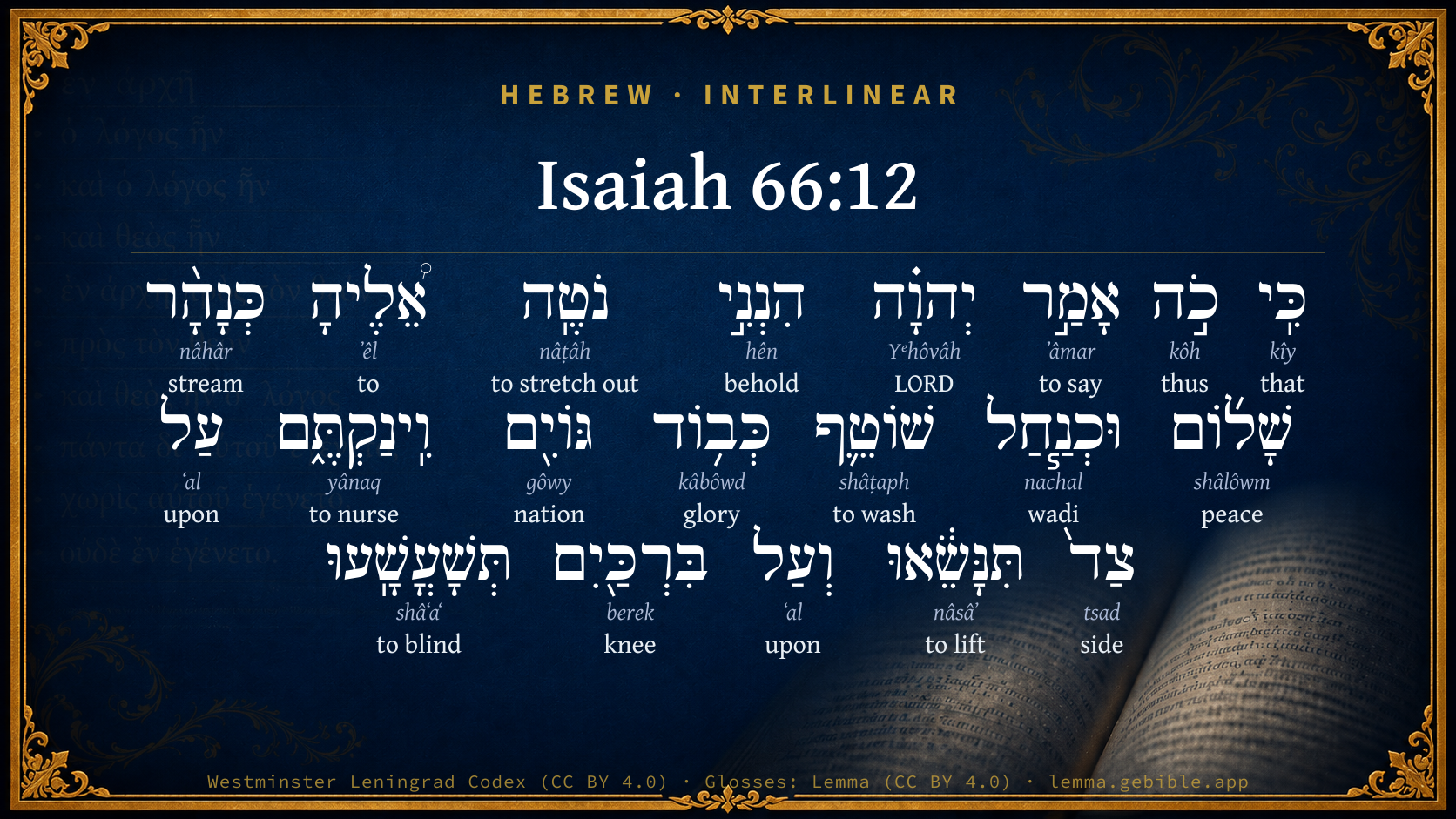
Hebrew (Westminster Leningrad Codex) Isaiah 66:12 appears in the Hebrew Old Testament. The text above is from the Westminster Leningrad Codex. Each word links to its Strong’s number, a concise gloss, and parsing drawn from the Open Scriptures Hebrew Bible morphology. Click any word for its full Brown-Driver-Briggs (BDB) entry.
Download image
Cite this verse

Isaiah 66:12 (World English Bible). Public Domain. Lemma interlinear Bible study tool, https://lemma.gebible.app/v/isaiah/66/12.

Show BibTeX & RIS
BibTeX
RIS
English Translation
For thus says Yahweh, Behold, I will extend peace to her like a river, and the glory of the nations like an overflowing stream: and you shall suck [of it]; you shall be borne on the side, and shall be dandled on the knees.
World English Bible · Public Domain
Download a study sheet

One document with this verse’s original text, its word-by-word gloss line, the meaning frame, cross-references with their text, attributed commentary, and full source and license credits — printable, and it pastes into notes with its structure intact.

This verse Autodidact and up

Study sheet (.html) Plain text (.txt)

A passage Seminary Student

Up to 50 verses in one chapter. A passage sheet keeps up to 6 commentary sources and 12 cross-references per verse, in the order this page ranks them, and says so on the sheet whenever that leaves anything out. Ask for a single verse and you get the Autodidact verse sheet above.

Everything on this page stays free to read, with no account — the sheet is a download of what is already on screen, not access to it.

Want to remove ads? Support Godless Engineer
Compare translations 3

The same verse in 3 English versions, stacked beneath the original-language interlinear above. Click any original word for its lexicon entry.

Each is an independent rendering of the whole verse — the interlinear is not word-aligned to these translations.

Highlighted words mark where these versions differ — a whole-verse word diff, not a word-by-word alignment.

  • World English Bible Public Domain
    For thus says Yahweh, Behold, I will extend peace to her like a river, and the glory of the nations like an overflowing stream: and you shall suck [of it]; you shall be borne on the side, and shall be dandled on the knees.
  • King James Version Public Domain
    For thus saith the LORD, Behold, I will extend peace to her like a river, and the glory of the Gentiles like a flowing stream: then shall ye suck, ye shall be borne upon her sides, and be dandled upon her knees.
  • unfoldingWord Literal Text CC BY-SA 4.0
    For thus says Yahweh: “Behold me, extending peace to her like a river, and like an overflowing stream, the glory of the nations, and you will nurse. You will be carried on side, and you will be bounced on knees.

unfoldingWord Literal Text — © unfoldingWord, licensed CC BY-SA 4.0. Word-aligned USFM3 via Door43 (git.door43.org/unfoldingWord/en_ult).

Versions to compare (up to 4)

3 of 4 selected

Show all 18 translations

Every available English version of this verse, each an independent rendering of the whole verse.

  • World English Bible Public Domain
    For thus says Yahweh, Behold, I will extend peace to her like a river, and the glory of the nations like an overflowing stream: and you shall suck [of it]; you shall be borne on the side, and shall be dandled on the knees.
  • Berean Standard Bible Public Domain
    For this is what the LORD says: “I will extend peace to her like a river, and the wealth of nations like a flowing stream; you will nurse and be carried on her arm, and bounced upon her knees.
  • Majority Standard Bible Public Domain
    For this is what the LORD says: “I will extend peace to her like a river, and the wealth of nations like a flowing stream; you will nurse and be carried on her arm, and bounced upon her knees.
  • King James Version Public Domain
    For thus saith the LORD, Behold, I will extend peace to her like a river, and the glory of the Gentiles like a flowing stream: then shall ye suck, ye shall be borne upon her sides, and be dandled upon her knees.
  • American Standard Version (1901) Public Domain
    For thus saith Jehovah, Behold, I will extend peace to her like a river, and the glory of the nations like an overflowing stream: and ye shall suck `thereof'; ye shall be borne upon the side, and shall be dandled upon the knees.
  • Revised Version (1885) Public Domain
    For thus saith the LORD, Behold, I will extend peace to her like a river, and the glory of the nations like an overflowing stream, and ye shall suck thereof; ye shall be borne upon the side, and shall be dandled upon the knees.
  • Geneva Bible (1599) Public Domain
    For thus saith the Lord, Beholde, I will extend peace ouer her like a flood, and the glorie of the Gentiles like a flowing streame: then shall ye sucke, ye shall be borne vpon her sides, and be ioyfull vpon her knees.
  • Douay-Rheims (1899) Public Domain
    For thus saith the Lord: Behold I will bring upon her as it were a river of peace, and as an overflowing torrent the glory of the Gentiles, which you shall suck; you shall be carried at the breasts, end upon the knees they shall caress you.
  • Young's Literal Translation Public Domain
    For thus said Jehovah: `Lo, I am stretching out to her peace as a river, And as an overflowing stream the honour of nations, And ye have sucked, on the side ye are carried, And on the knees ye are dandled.
  • Literal Standard Version CC BY-SA 4.0
    For thus said YHWH: “Behold, I am stretching out to her peace as a river, || And the glory of nations as an overflowing stream, || And you have sucked, || You are carried on the side, || And you are dandled on the knees.
  • Unlocked Literal Bible CC BY-SA 4.0
    This is what Yahweh says, “I am about to spread prosperity over her like a river, and the riches of the nations like an overflowing stream. You will nurse at her side, be carried in her arms, and be dandled on her knees.
  • unfoldingWord Literal Text CC BY-SA 4.0
    For thus says Yahweh: “Behold me, extending peace to her like a river, and like an overflowing stream, the glory of the nations, and you will nurse. You will be carried on side, and you will be bounced on knees.
  • Darby Bible Public Domain
    For thus saith Jehovah: Behold, I will extend peace to her like a river, and the glory of the nations like an overflowing torrent; and ye shall suck, ye shall be carried upon the side, and be dandled upon the knees.
  • World Messianic Bible Public Domain
    For the LORD says, “Behold, I will extend peace to her like a river, and the glory of the nations like an overflowing stream, and you will nurse. You will be carried on her side, and will be dandled on her knees.
  • Webster's Bible Public Domain
    For thus saith the LORD, Behold, I will extend peace to her like a river, and the glory of the Gentiles like a flowing stream: then shall ye suck, ye shall be borne upon her sides, and be dandled upon her knees.
  • Free Bible Version CC BY-SA 4.0
    This is what the Lord says: Watch! I'm going to give her peace and prosperity like a flowing river, the wealth of nations like an overflowing stream. You will nurse and be carried on her hip and played with on her knees.
  • Bible in Basic English Public Domain
    For the Lord says, See, I will make her peace like a river, and the glory of the nations like an overflowing stream, and she will take her children in her arms, gently caring for them on her knees.
  • JPS Tanakh (1917) Public Domain
    For thus saith the LORD: Behold, I will extend peace to her like a river, and the wealth of the nations like an overflowing stream, and ye shall suck thereof: Ye shall be borne upon the side, and shall be dandled upon the knees.

Literal Standard Version (2020), Covenant Press — licensed CC BY-SA 4.0. Text via the HelloAO Bible API (eBible.org). Unlocked Literal Bible (unfoldingWord) — licensed CC BY-SA 4.0. Text via the HelloAO Bible API (eBible.org). unfoldingWord Literal Text — © unfoldingWord, licensed CC BY-SA 4.0. Word-aligned USFM3 via Door43 (git.door43.org/unfoldingWord/en_ult). Free Bible Version, Dr. Jonathan Gallagher — licensed CC BY-SA 4.0. Text via the HelloAO Bible API (eBible.org).

Word by word

More ways to search: Search by grammar → Find every occurrence → Compare this word →

Practice this passage: Drill this verse → Learn its vocabulary →

תְּשָׁעֳשָֽׁעוּ
shâʻaʻ
H8173
“to blind”
Verb, Polpal, Imperfect, 2nd Person, Masculine, Plural
Part of Speech
Verb
Stem
Polpal
Form
Imperfect
Person
2nd Person
Gender
Masculine
Number
Plural
Full BDB Definition

Origin: a primitive root

TWOT: 2435 , 2436

to stroke, be smeared over, be blinded - (Qal) - to be smeared over, be blinded - to smear eyes shut - (Hiphil) to besmear (of eyes), smear over eyes - (Hithpalpel) to blind oneself, be blinded - to sport, take delight in - (Pilpel) to sport, delight in, take delight in, delight oneself - (Palpal) to be fondled - (Hithpalpel) to delight oneself
  1. כִּֽי kîy H3588 “that” Conjunction
  2. כֹ֣ה kôh H3541 “thus” Adverb
  3. אָמַ֣ר ʼâmar H559 “to say” Verb, Qal, Perfect, 3rd Person, Masculine, Singular
  4. יְהוָ֗ה Yᵉhôvâh H3068 “LORD” Noun, Proper
  5. הִנְנִ֣י hên H2005 “behold · me” Particle, Demonstrative + Suffix, Personal, 1st Person, Common, Singular
  6. נֹטֶֽה nâṭâh H5186 “stretching out” Verb, Qal, Participle Active, Masculine, Singular, Absolute
  7. אֵ֠לֶיהָ ʼêl H413 “to · her” Preposition + Suffix, Personal, 3rd Person, Feminine, Singular
  8. כְּנָהָ֨ר nâhâr H5104 “like/as · stream” Preposition + Noun, Common, Masculine, Singular, Absolute
  9. שָׁל֜וֹם shâlôwm H7965 “peace” Noun, Common, Masculine, Singular, Absolute
  10. וּכְנַ֧חַל nachal H5158 “and · like/as · wadi” Conjunction + Preposition + Noun, Common, Masculine, Singular, Absolute
  11. שׁוֹטֵ֛ף shâṭaph H7857 “washing” Verb, Qal, Participle Active, Masculine, Singular, Absolute
  12. כְּב֥וֹד kâbôwd H3519 “glory of” Noun, Common, Both, Singular, Construct
  13. גּוֹיִ֖ם gôwy H1471 “nations” Noun, Common, Masculine, Plural, Absolute
  14. וִֽינַקְתֶּ֑ם yânaq H3243 “and · to nurse” Conjunction + Verb, Qal, Sequential Perfect, 2nd Person, Masculine, Plural
  15. עַל ʻal H5921 “upon” Preposition
  16. צַד֙ tsad H6654 “side” Noun, Common, Masculine, Singular, Absolute
  17. תִּנָּשֵׂ֔אוּ nâsâʼ H5375 “to lift” Verb, Niphal, Imperfect, 2nd Person, Masculine, Plural
  18. וְעַל ʻal H5921 “and · upon” Conjunction + Preposition
  19. בִּרְכַּ֖יִם berek H1290 “knees” Noun, Common, Feminine, Dual, Absolute

About this verse

These counts appear in no published source. They are computed here, from the morphology-tagged text and Lemma’s own curated glosses. What Lemma adds →

20
words
19
distinct lemmas
Prophets
section

Notable vocabulary

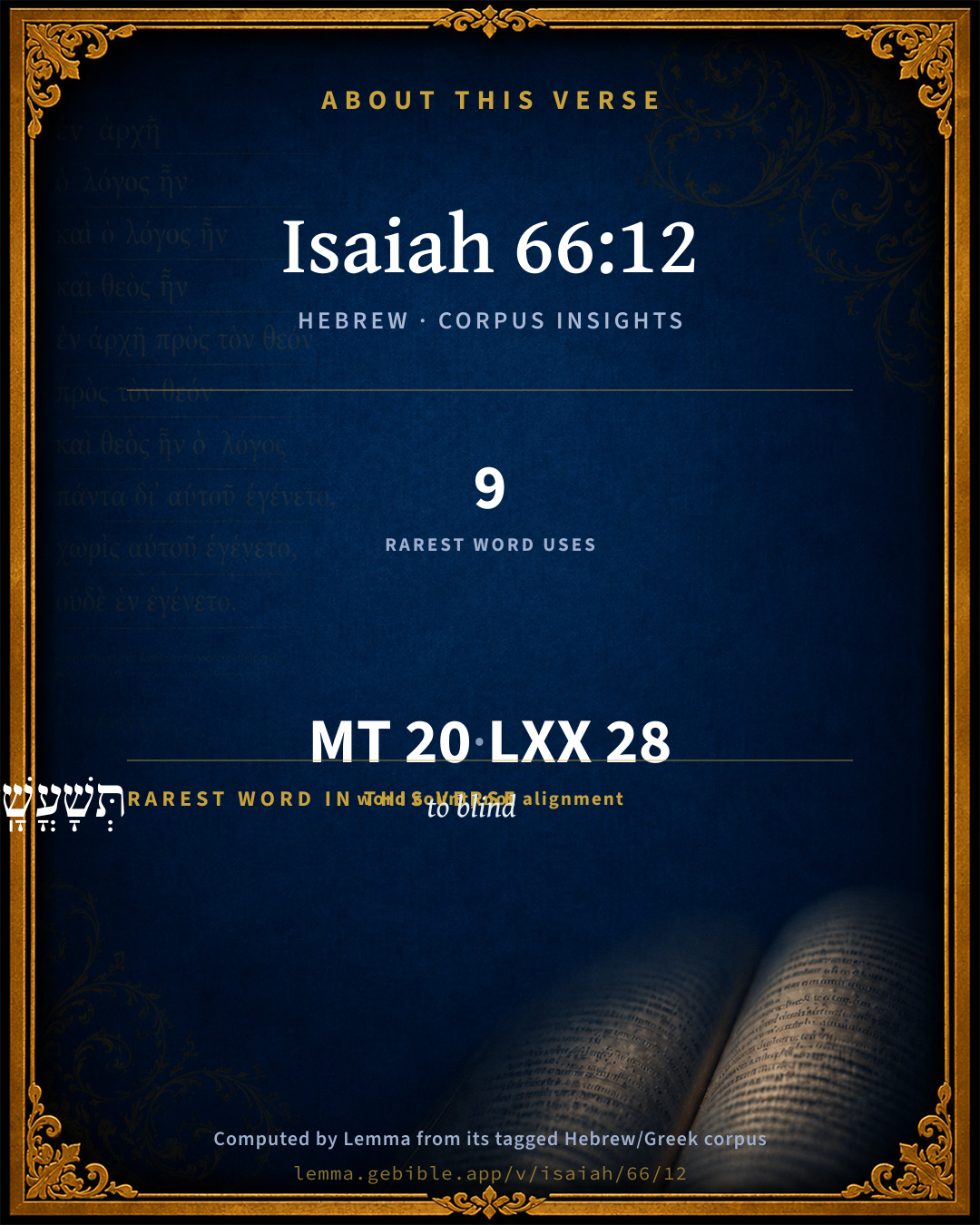
The rarest word here is תְּשָׁעֳשָֽׁעוּ to blind H8173 — appearing just 9 times in the whole Hebrew Bible.

Shared distinctive vocabulary

תְּשָׁעֳשָֽׁעוּ to blind H8173 occurs in 8 verses of the Hebrew Bible. Also found in:

Grammatical profile

  • 6 verbs
  • 8 nouns
  • 3 prepositions
  • 1 conjunction
  • 1 adverb
  • 1 particle

Verb forms

  • אָמַ֣ר Qal · Perfect
  • נֹטֶֽה Qal · Participle Active
  • שׁוֹטֵ֛ף Qal · Participle Active
  • וִֽינַקְתֶּ֑ם Qal · Sequential Perfect
  • תִּנָּשֵׂ֔אוּ Niphal · Imperfect
  • תְּשָׁעֳשָֽׁעוּ Polpal · Imperfect

Repetition

A word recurs within this verse — often emphatic in Hebrew:

Hebrew & Septuagint length

In English translation the verse runs 44 words from the Hebrew and 43 from the Septuagint (LXX English) — closely comparable.

A rough comparison of the two English renderings, which tokenize alike — not a word-level alignment.

Word counts can differ between the Hebrew and the Greek without any difference in meaning — e.g. the Hebrew direct-object marker אֵת has no separate Greek word, and Greek often adds the article ὁ.

In the original languages it is 20 Hebrew tokens and 28 Greek tokens — but the two are counted differently (Hebrew bundles its prefixes and suffixes into one token; the Greek is in lemma form), so that isn’t a like-for-like length.

Cross-references

11

Topical passages linked to Isaiah 66:12 in the Treasury of Scripture Knowledge — connected by theme and wording, ordered by reader-vote popularity; previews shown in the World English Bible.

  • Isaiah 48:18 Oh that you had listened to my commandments! then had your peace been as a river, and your righteousness as the waves of the sea:
  • Isaiah 60:16 You shall also suck the milk of the nations, and shall suck the breast of kings; and you shall know that I, Yahweh, am your Savior, and your Redeemer, the Mighty One of Jacob.
  • Isaiah 45:14 Thus says Yahweh: "The labor of Egypt, and the merchandise of Ethiopia, and the Sabeans, men of stature, shall come over to you, and they shall be yours. They shall go after you. In chains they shall come over; and they shall fall down to you. They shall make supplication to you: 'Surely God is in you; and there is none else, there is no other god.
  • Isaiah 66:11 that you may suck and be satisfied with the breasts of her consolations; that you may milk out, and be delighted with the abundance of her glory.
  • Isaiah 49:19–23 For, as for your waste and your desolate places, and your land that has been destroyed, surely now shall you be too small for the inhabitants, and those who swallowed you up shall be far away.
  • Isaiah 54:3 For you shall spread aboard on the right hand and on the left; and your seed shall possess the nations, and make the desolate cities to be inhabited.
  • Isaiah 61:6 But you shall be named the priests of Yahweh; men shall call you the ministers of our God: you shall eat the wealth of the nations, and in their glory shall you boast yourselves.
  • Isaiah 9:7 Of the increase of his government and of peace there shall be no end, on the throne of David, and on his kingdom, to establish it, and to uphold it with justice and with righteousness from henceforth even forever. The zeal of Yahweh of Hosts will perform this.
  • Isaiah 66:19–20 I will set a sign among them, and I will send such as escape of them to the nations, to Tarshish, Pul, and Lud, who draw the bow, to Tubal and Javan, to the isles afar off, who have not heard my fame, neither have seen my glory; and they shall declare my glory among the nations.
  • Psalms 72:3–7 The mountains shall bring prosperity to the people. The hills bring the fruit of righteousness.
  • Isaiah 60:4–14 Lift up your eyes round about, and see: they all gather themselves together, they come to you; your sons shall come from far, and your daughters shall be carried in the arms.

Cross-references courtesy of OpenBible.info (CC BY 4.0).

Hebrew and Greek witnesses Masoretic Hebrew ↔ Greek Septuagint

The same verse in the two great witnesses to the Old Testament, shown verse-for-verse.

These are two independent witnesses, not word-aligned to each other, and the Septuagint is shown in lemma (dictionary) form.

Hebrew Isaiah 66:12 Masoretic · Westminster Leningrad Codex

כִּֽי כֹ֣ה אָמַ֣ר יְהוָ֗ה הִנְנִ֣י נֹטֶֽה אֵ֠לֶיהָ כְּנָהָ֨ר שָׁל֜וֹם וּכְנַ֧חַל שׁוֹטֵ֛ף כְּב֥וֹד גּוֹיִ֖ם וִֽינַקְתֶּ֑ם עַל צַד֙ תִּנָּשֵׂ֔אוּ וְעַל בִּרְכַּ֖יִם תְּשָׁעֳשָֽׁעוּ

For thus says Yahweh, Behold, I will extend peace to her like a river, and the glory of the nations like an overflowing stream: and you shall suck [of it]; you shall be borne on the side, and shall be dandled on the knees.

World English Bible · Public Domain

Greek LXX Isaiah 66:12 Septuagint · lemma form

ὅτι ὅδε λέγω κύριος ἰδού ἐγώ ἐκκλίνω εἰς αὐτός ὡς ποταμός εἰρήνη καί ὡς χειμάρρους ἐπικλύζω δόξα ἔθνος ὁ παιδεία αὐτός ἐπί ὦμος αἴρω καί ἐπί γόνυ παρακαλέω

For thus says the Lord, Behold, I turn toward them as a river of peace, and as a torrent bringing upon them in a flood the glory of the Gentiles: their children shall be borne upon the shoulders, and comforted on the knees.

LXX2012 (modern English Septuagint) · Public Domain

Hebrew: Westminster Leningrad Codex (CC BY 4.0). Greek: Septuagint (public domain); English from LXX2012 (modern English Septuagint) (Public Domain). How the Septuagint differs from the Hebrew →

Targum (Aramaic paraphrase)

1

The Targum is the ancient Jewish Aramaic paraphrase of the Hebrew Scriptures — an interpretive translation, not the Hebrew text itself. Onkelos (literal) and Pseudo-Jonathan (expansive) render the Torah, and Jonathan the Prophets. Coverage is partial: where no permissively-licensed English translation exists for a verse, only the Aramaic is shown. This is verse-level text, not a word-by-word alignment to the Hebrew.

  1. Targum Jonathan Prophets (Joshua–Malachi)
    אֲרֵי כִדְנַן אֲמַר יְיָ הָא אֲנָא מַיְתִי לָהּ כִּשְׁפַע נְהַר פְּרָת שְׁלַם וְכִנְחַל מַגְבַּר יְקַר עַמְמַיָא וְתִתְפַּנְקוּן עַל גִסְסִין תִּתְנַטְלוּן וְעַל רְכוּבִין תִּתְרַבּוּן:

    For thus saith the Lord, behold, I bring unto her peace, as the floods of the river Euphrates, and the glory of the nations, as an overwhelming stream, and ye shall delight yourselves: ye shall be borne upon the sides, and ye shall be nourished upon the knees.

    Targum Jonathan — Aramaic: “Mikraot Gedolot” (public domain). English: “Sefaria Community Translation” (CC0 1.0 (public-domain dedication)); “London "Chaldee Paraphrase," 1871” (public domain). Text via Sefaria.

Commentary

Notes on Isaiah 66:12 from classic Christian and Jewish commentators (each source and its license shown beneath its notes). The classic Christian expositions comment on the surrounding passage and are grouped to its opening verse, so a note may address several verses; the Jewish commentaries on the Tanakh (Rashi and others) are per-verse, so they appear only where the commentator wrote on this verse.

Lemma curates 59 commentaries, every one of them public domain or Creative Commons licensed, each selected and text-cleaned for this edition rather than reprinted as found. About our sources →

Trapp's Complete Commentary

John Trapp

Isa 66:12 For thus saith the LORD, Behold, I will extend peace to her like a river, and the glory of the Gentiles like a flowing stream: then shall ye suck, ye shall be borne upon [her] sides, and be dandled upon [her] knees.

Ver. 12. Behold, I will extend peace to her.] This and the following promises are the delicious milk spoken of before - scil., pax copiosa et perennis, peace as a river, as the waters cover the sea; joy unspeakable and full of glory, God’s fatherly care, motherly affection, &c., all that heart can wish, or need require.

Like a river.] As Euphrates, saith the Chaldee.

Like a flowing stream.] Or, Overflowing as Nile -

“ Qui cunctis amnibus extat

Utilior. ” - Claudian.

Ye shall be borne upon her side.] Humanissime et suavissime tractabimini, ye shall be borne in the Church’s arms, laid to her breasts, set in her lap, dandled on her knees, &c. Hac similitudine nihil fieri potest suavius. See Num 11:12.

John Trapp, A Commentary or Exposition upon All the Books of the Old and New Testament (1647–1656) — public domain. Text from a community e-Sword module.

The Biblical Illustrator

Joseph S. Exell

Isa_66:12

For thus saith the Lord, Behold I will extend peace to her like a river

The Church in peace and prosperity

The members of the Church can then revel in peace and wealth, like a child on its mothers breast; the world belongs entirely to the Church, for the Church belongs entirely to God.

(F. Delitzsch, D. D.)

The peace of the river

The illustrations which Grace borrows from Nature are strikingly appropriate. The history of this appropriateness is that Nature and Grace proceed from one and the same Hand, are children of one and the same Parent. You have in the text two objects compared and put side by side--the peace of Gods Church and a river. The quietness of a river is perhaps the most obvious ground of the comparison. The peace of Gods Church resembles a river--

I. IN ITS SOURCE. The source of a river is hidden. It wells up from the fountains of the great deep beneath the earth. And even the spot where it first rises is often inaccessible, being situated in the heart of tangled brushwood, or beneath the perilous vault of an ice-cave. The source of peace to Gods children is God Himself. And God is a God who hides Himself--a God who is apprehended only by those into whose hearts the light of the glorious Gospel has shined. And the spot, too, whence the peace of Gods children takes its rise lies not open to the scrutiny of mans eye, or the passage of mans footstep. That spot is the heart, the inmost spirit. Accordingly, men can see that peace only in its effects. And there is yet another sense in which the source of the Christian peace is hidden. The events, the great historical facts, which lie at the root of it--the means by which God ministers it--are by-gone and accomplished. The great central facts of the death and resurrection of Jesus are now, if I may say so, buried and out of sight, and centuries are piled upon them, like rocks and icebergs on the soot where some mighty river takes its rise. But these events, nevertheless, are Gods instruments, whereby He exerts a mighty influence on many a heart even at the present day.

II. IN THE METHOD OF ITS NOURISHMENT. It is true that rivers are fed perpetually by their springs. But an external nourishment is also supplied to them by occasional rains and land floods. The river of the Christians peace--I do not say flows from, but is augmented by contrition. Strangeparadox this, that what seems to destroy peace should promote it! But so it is.

III. IN ITS COURSE.

1. A river in its course is quietly progressive. Its quietness is not the quietness of stagnation, but of advancement. The Christians peace is a peace of progress in grace. It is not a peace which leaves him where it found him, but a peace which bears him on silently towards the bosom of his God.

2. It is exceeding deep. And the peace of God is said to pass all understanding. This may be understood in two ways. The nature and character of this peace is unintelligible to those who have not tasted it, and by those who have tasted it its depth is unfathomable.

3. It is fertilizing and enriching. The country smiles with plenty along its banks. It is also the great medium of commerce and traffic, whereby men are made rich and their estate and substance is increased. It is a means of communication for those who live on its margin with the ocean and with one another. The peace of God is at the root of all holy fruitfulness. Many people accept the truth that the fruit of righteousness is peace, and the effect of righteousness quietness and assurance for ever, while they discard the truth--equally important and Scriptural--that peace is the root, as well as the fruit of righteousness, and that the Lord Jesus Christ promises to give rest to the weary and heavy laden, before they can and in order that they may, submit themselves to His yoke. At the root of the Christians love is peace--at the root of his joy is peace--at the root of his long-suffering, gentleness and goodness is peace--at the root of his meekness and temperance is peace. Peace it is which, like the broad bosom of a fair river, quietly undulates along and ministers nourishment to the roots of all these graces, nor is it possible that the leaf of any of them should be green, were the streams of this river diverted another way. This peace is enriching as well as fertilizing, because it opens into the ocean; it is the medium of communicating with God and with the saints of God. It is on the broad bosom of this peace--even because it is through Jesus Christ alone that our prayers float towards our heavenly Father. And I need not tell you what a peculiarly rich traffic is the traffic with heaven. Then, again, this peace of God is enriching, in that it is a medium of communication between us and those who have obtained like precious faith with ourselves. It is a pleasant river, on whose margin both I and my brother dwell--and which conveys from me to him sympathies, and prayers, and outgoings of the heart, and brings back the same from him to me. And when my prayers and missives are sent forth on their way towards heaven, my brothers meet and join them--and both perform the voyage side by side--and no sooner shall both return than he shall send me notice of the treasure he hath acquired, and demand on his part an account of mine. Such is in a figure that doctrine which we profess, when we say/ I believe in the communion of saints.

4. It is clean and cleansing. And we need not to be told that the peace of Gods Church is a clean and holy (because a living) peace--clear as crystal and perfectly alien from all defilement. The slightest allowed filthiness of flesh or spirit is abhorrent to the nature of this peace. There is no peace, saith my God, to the wicked. And as this peace is clean, so also it makes clean. As soon as it enters into the conscience, it cleanses it:5. It bears burdens. Barges and ships of many tons weight float on its bosom down to the ocean. It is one of the most delightful characteristics of the Christians peace that its buoyancy supports many and grievous burdens. Into Gods bosom they are carried in the exercise of confession and faithful repentance; in His breast they must be lodged, if we desire them to be finally obliterated and annulled. But surely, if it were not for His peace within, we could neither have courage to lodge them there, nor strength to support the burden of them ourselves.

IV. AT ITS MOUTH It expands. For the last few miles of its progress, the distance between its banks becomes wider, till at length it pours itself with a full flood into the ocean. So it is as a matter of fact in the Christians experience. The peace of the true believer is enlarged as he draws near to the heavenly goal, and accordingly the country of his soul is more abundantly fertilized. Who shall say how wide its flood may not extend, when it pours itself into His bosom in eternity, from whom it issued forth in time? (Dean Goulburn, D. C. L.)

The Biblical Illustrator, edited by Joseph S. Exell (c. 1880s–1900s) — public domain. Text from a community e-Sword module.

Joseph Benson's Commentary

Isa 66:12-13. For, behold, I will extend — Or am extending, peace to her — That is, all good; like a river — That runs in a constant stream, still increasing till it is swallowed up in the ocean. The gospel brings with it, wherever it is received in its power, peace, which proceeds forward like a river, supplying the souls of believers with all good, and making them fruitful as a river doth the lands through which it passes: such peace as the springs of this world’s comforts cannot send forth, and the dams of the world’s troubles cannot stop or drive back; such a river of peace as will carry us to the ocean of boundless and endless bliss. And the glory of the Gentiles like a flowing stream — Gentile converts shall come pouring into the church, and shall swell the river of her peace and prosperity; for they shall bring their glory with them; their wealth and honour, their power and interest shall all be devoted to the Lord and employed for the good of the church. Then shall ye suck — Ye Jews also. When you see such crowding for a share in those comforts, you shall be the more solicitous, and the more earnest and diligent to secure your share; not through a fear lest you should have the less, because others come in such multitudes to partake of them, for Christ has enough for all, and enough for each; but their zeal shall provoke you to a holy jealousy. Ye shall be borne upon her sides — Compare chap. 60:4, where see the note. Those that are joined to the church should be treated thus affectionately. The great Shepherd gathers the lambs in his arms, and carries them in his bosom; and so must the under shepherds, that young converts may not be discouraged. As one whom his mother comforteth, &c. — That is, in the most tender and compassionate way. So will I comfort you — I will not only use rational arguments to comfort you, such as a prudent father uses toward his child in distress, but I will manifest toward you such tender affections and compassions, as a loving mother feels toward her afflicted infant. And ye shall be comforted in Jerusalem — In the favours bestowed on the church, which you shall partake of; and in the thanksgivings offered by the church, which you shall concur with.

Joseph Benson's Commentary on the Old and New Testaments (1811–1818) — public domain. Text from a community e-Sword module.

Tyndale Open Study Notes

Tyndale Open Resources

66:12 a river: The people, who lost peace and prosperity in the Exile, would receive it back abundantly (see 48:18).

Tyndale Open Study Notes — © Tyndale Open Resources, licensed CC BY-SA 4.0. Text via the HelloAO Bible API.

Geneva Bible (1599)

Geneva Bible translators

I will give her felicity and prosperity in great abundance.

Read Isa. 60:16.

Ye shall be cherished as her dearly beloved children.

Geneva Bible (1599) marginal notes — public domain. Text via Bolls.life.

Jamieson, Fausset & Brown

Robert Jamieson, A. R. Fausset & David Brown

extend--I will turn peace (prosperity) upon her, like a river turned in its course [GESENIUS]. Or, "I will spread peace over her as an overflowing river" [BARNES], (Isa 48:18).

flowing stream--as the Nile by its overflow fertilizes the whole of Egypt.

borne upon . . . sides--(See on Isa 60:4).

her . . . her--If "ye" refers to the Jews, translate, "ye shall be borne upon their sides . . . their knees," namely, those of the Gentiles, as in Isa 49:22; and as "suck" (Isa 60:16) refers to the Jews sucking the Gentile wealth. However, English Version gives a good sense: The Jews, and all who love Jehovah (Isa 66:10), "shall suck, and be borne" by her as a mother.

Jamieson, Fausset & Brown — Commentary Critical and Explanatory on the Whole Bible (1871) — public domain (CC PDM 1.0). Text via the HelloAO Bible API.

Adam Clarke's Commentary

Verse 12. Like a river, and - like a flowing stream - "Like the great river, and like the overflowing stream"] That is, the Euphrates, (it ought to have been pointed כנהר cannahar, ut fluvius ille, as the river,) and the Nile.

Then shall ye suck - "And ye shall suck at the breast"] These two words על שד al shad, at the breast, seem to have been omitted in the present text, from their likeness to the two words following; על צד al tsad, at the side. A very probable conjecture of Houbigant. The Chaldee and Vulgate have omitted the two latter words instead of the two former. See Clarke on Isa 60:4.

Adam Clarke's Commentary on the Bible (1810–1826) — public domain. Text from a community e-Sword/MySword module.

Ellicott's Commentary for English Readers

(12) Ye shall be borne upon her sides.—Better, upon the side, or upon the knee, or hip. (See Note on Isa_60:4.) The outward figure is now presented as in an inverted form, to express a new spiritual fact. The children of Zion will find a maternal tenderness and care at the hands of the heathen nations, who are to be as their “nursing mothers.” (Comp. 60:16.)

A Bible Commentary for English Readers, edited by Charles John Ellicott (1878–1897) — public domain. Text from a community e-Sword module.

The Cambridge Bible for Schools and Colleges

gen. ed. J. J. S. Perowne

12. I will extend (cf. Gen_39:21) peace … like a river] See ch. Isa_48:18.

the glory of the Gentiles] the wealth of nations. Cf. ch. Isa_60:5, Isa_61:6.

borne upon the side (see on Isa_60:4) … the knees] So R.V. The insertion of “her” is misleading. As in Isa_60:4 (Isa_49:22) the children of Zion are represented as carried and nursed by the Gentiles.

dandled] the passive of the verb rendered “play” in ch. Isa_11:8; “delight” in ch. Isa_66:7 (R.V. marg.) is a cognate noun.

12–14. A promise of prosperity to Jerusalem and her inhabitants.

The Cambridge Bible for Schools and Colleges (gen. ed. J. J. S. Perowne; Cambridge University Press, 1878–1918) — public domain. Text from a community e-Sword module.

John Gill's Exposition

For thus saith the Lord, behold, I will extend peace to her like a river,.... As the river Euphrates, so the Targum; or as the Nile, which overflowed Egypt, and made it fruitful; or as any flowing river, large and spreading, continuing to flow, and brings blessings with it where it comes; and so denotes the abundance of this peace, the perpetuity of it, and its blessed effects. This respects not the first times of the Gospel; for though Christ the peacemaker came and made peace by his blood, and went and preached peace to Jews and Gentiles, and many enjoyed spiritual peace in believing, flowing from his blood and righteousness, yet there was very little outward peace to the churches of Christ; and when at any time had, did not last long: but, in the latter day, not only spiritual peace, which passeth all understanding, and joy unspeakable and full of glory, will be extended unto and possessed by the saints; but outward peace in great abundance, and of lasting continuance, with all kind of prosperity, temporal and spiritual, Psa 72:7, and the glory of the Gentiles like a flowing stream; like the Nile, that overflows; meaning either the vast number of converts, from among the Gentiles, that shall flow into the church, and especially many of their great men, princes, nobles, even kings and queens, who shall be nursing fathers and nursing mothers to her; see Isa 60:3, or their riches, which are the honour and glory they shall bring with them to the church in great abundance, and shall cheerfully and freely expend them in the service and worship of God, Isa 60:6 so Kimchi interprets it of their wealth and substance:

then shall ye suck; the milk of the Gentiles, and the breasts of kings; that is, partake of their good things, Isa 60:16 or the church's breasts of consolation, the sincere milk of the word and ordinances, Isa 60:11, this is spoken to the friends of Zion, and lovers of Jerusalem, newly converted persons, Isa 66:10,

ye shall be borne upon her sides, or "side" (y); children being carried by parents or nurses on one side of them in their arms; it denotes the affectionate care and regard the church has to young converts, who are said to be nursed at her side, Isa 60:4 she supporting and supplying them with everything in her power, by means of the word and ordinances:

and be dandled upon her knees: as darling children are, who are taken into the lap, and played with, and are the delight, the exceeding great delight, of their parents; and where they delight to be, as the word (z) used signifies. All shows that young converts are and should be made much of, and tenderly used; the day of small things should not be despised, or the bruised reed broken, or the smoking flax quenched; but these lambs should be gathered into the arms, and carried in the bosom, like sucking children.

(y) "ad latus", Vitringa; "super latus", Calvin, Pagninus, Montanus. (z) "super genua oblectabimini", Montanus; "delectabiliter fovebimini", Munster, Vitringa.

John Gill's Exposition of the Whole Bible (1746–1763) — public domain (CC PDM 1.0). Text via the HelloAO Bible API.

Albert Barnes' Notes on the Bible

For thus saith the Lord - This verse contains a promise of the conversion of the Gentiles, and the fact that what constituted their glory would be brought and consecrated to the church of God.

I will extend - The word rendered, I will extend ( נטה nâṭâh) means properly to stretch out, as the hand or a measure; then to spread out or expand, as a tent is spread out, to which it is often applied Gen 12:8; Gen 26:5; or to the heavens spread out over our heads like a tent or a curtain Isa 40:22. Here it may mean either that peace would be spread out over the country like the Nile or Euphrates spread out over a vast region in an inundation; or it may mean, as Gesenius supposes, ‘I will turn peace upon her like a river; that is, as a stream is turned in its course.’ To me it seems that the former is the correct interpretation; and that the idea is, that God would bring prosperity upon Zion like a broad majestic river overflowing all its banks, and producing abundant fertility.

Peace - A general word denoting prosperity of all kinds - a favorite word with Isaiah to describe the future happiness of the church of God (see Isa 9:6-7; Isa 26:12; Isa 32:17; Isa 45:7; Isa 48:18; Isa 52:7; Isa 54:13; Isa 55:12; Isa 57:19).

Like a river - That is, says Lowth like the Euphrates. So the Chaldee interprets it. But there is no evidence that the prophet refers particularly to the Euphrates. The image is that suggested above - of a river that flows full, and spreads over the banks - at once an image of sublimity, and a striking emblem of great prosperity. This same image occurs in Isa 48:18. See the note at that place.

And the glory of the Gentiles - (See the notes at Isa 60:5, Isa 60:11).

Like a flowing stream - Like the Nile, says Vitringa. But the word נחל nachal is not commonly applied to a river like the Nile; but to a torrent, a brook, a rivulet - either as flowing from a perennial fountain, or more commonly a stream running in a valley that is swelled often by rain, or by the melting of snows in the mountain (see Reland’s Palestine, chapter xlv.) Such is the idea here. The peace or prosperity of Zion would be like such a swollen stream - a stream overflowing (שׁוטף shôṭēph) its banks.

Then shall ye suck - Isa 66:11.

Ye shall be borne upon her sides - See this phrase explained in the notes at Isa 60:4.

And be dandled upon her knees - As a child is by its nurse or mother. The idea is, that the tenderest care would be exercised for the church; the same care which an affectionate mother evinces for her children. The insertion of the word ‘her’ here by our translators weakens the sense. The meaning is, not that they should be borne upon the sides and dandled upon the knees of Zion or of the church; but that God would manifest to them the feelings of a parent, and treat them with the tenderness which a mother evinces for her children. As a mother nurses her children at her side (compare the notes at Isa 60:4), so would God tenderly provide for the church; as she affectionately dandles her children on her knees, so tenderly and affectionately would he regard Zion.

Albert Barnes' Notes on the Bible (1834–1885) — public domain. Text from a community e-Sword/MySword module.

Haydock's Catholic Bible Commentary

You. St. Paul fed the weak with milk, 1 Corinthians iii. 2., and Hebrews v. 12., and 1 Peter ii. 2.

George Leo Haydock (1774–1849), Haydock's Catholic Family Bible and Commentary, 1859 edition — public domain. Excludes Psalms (Douay-Rheims chapter numbering differs from Protestant) and Deuterocanonical books (Catholic canon only).

Matthew Poole's English Annotations

That this promise respects the times of the Messias seems plain, not only from the consideration that no history giveth us any account of any great or long peace or prosperity the Jews had before that time, nor indeed then, if we understand it not of a spiritual gospel

peace, which Christ preached to them that were nigh as well as to those afar off, Eph 2:17. It also appears from the mention of the glory of the Gentiles as a flowing stream, which can hardly be understood of any thing but Christ, and the preaching of the gospel to the Gentiles. But I leave it to the issues of Providence to expound and determine whether the prophecy of this text doth not relate to a further conversion and calling of the Jews than hath yet been seen. When Christ was revealed to the Jews, not those only of the Gentiles, but those of the Jews who belonged to God’s election sucked gospel doctrine; the Gentiles were borne upon the sides of Jerusalem, and dandled upon her knees, as first hearing from the apostles, who were some of the daughters of Jerusalem, members of the Jewish church, the glad tidings of salvation.

Matthew Poole's English Annotations on the Holy Bible (1683–1685) — public domain. Text from a community e-Sword/MySword module.

Whedon's Commentary on the Bible

Daniel D. Whedon

12. Peace… like a river — Her unbroken spiritual prosperity is to be as an ever-full and sometimes an overflowing stream, like the Nile, or the Euphrates, each in its sphere the chief of oriental rivers. The words, I will extend peace to her like, etc., lead some to render the phrase: “I will extend, or cause to spread over her, an overwhelming prosperity (‘peace,’ a synonyme for prosperity) like an overflowing stream.” In this way the figure is changed somewhat more than the Hebrew can admit, except tropically; but the idea seems more forcible, and equally beautiful.

Shall ye suck — These words resume the figure of the preceding verse, denoting Zion-Jerusalem as the figuratively original source of revealed knowledge respecting the great salvation to be shared by all. The objects of address in this speech are the sons of Zion, to be gathered out of all nations.

Daniel D. Whedon (gen. ed.), Commentary on the Old and New Testaments (1874–1909) — public domain. Text from a community e-Sword module.

The Pulpit Commentary

I will extend peace to her like a river; literally, I will direct peace to her, like a river. The waters of streams are in the East directed hither and thither by the agriculturist. God would have given his people "peace, as a river," long previously, had they permitted him. (Isa_48:18) And the glory of the Gentiles. (comp. Isa_60:5, 11 61:6, etc) Like a flowing stream; literally, as an overflowing torrent. There is perhaps a contrast intended between the former and the latter times. In the former times Assyria had swept over Israel like an overwhelming flood to destroy her; (Isa_8:7, Isa_8:8) now the glory of the whole Gentile world should similarly overflow and overwhelm, but only to enrich and exalt. Ye shall be borne upon her sides (see the comment on Isa_9:4). It is Jerusalem, and not the Gentile world (Delitzsch, Cheyne), that will thus care for and caress her children. The continuance of the metaphor from ver. 11 is marked by the repetition of the verb, "ye shall suck.

"Peace like a river.

"Behold, I will extend peace to her like a river." The prophet used the image of a river by intention, and in contrast with the figure of the sea. In ancient times, and Eastern lands, the sea was a terrible thing; so the prophet figures the wicked as like the "troubled sea, whose waters cast up mire and dirt." The sea is restless, is storm-test, is a devourer. In ancient times there seemed to be no music in her ripple, her wave-swell, or the bass of her ceaseless moan. We feel quite differently, because for us the sea is almost conquered. It is a servant whom we may employ, and not a vague mysterious god whose trident we must fear. The state of mind and heart, the conditions of relation and circumstances, for those who know the redemption of God in Christ Jesus, will not go into any figures taken from the sea. Their peace is like a river. How does a river differ from a sea? We note that their peace is like a river; it is

I SUPPLIED FROM EXHAUSTLESS FOUNTAINS. The peace and joy of the worldly and the wicked can only be likened to the "crackling of thorns under a pot," very noisy, very short-lived. At the back of the good man"s peace is the" God of all peace;" and "when he speaks peace, who shall make trouble?" Christ"s peace is given to us. "My peace I give unto you." It

II FLOWS ON THROUGH A WHOLE LIFE. You cannot stop the rivers. Dam them up a little while, and they are sure to gather, and flood the land until they can find the stream again and flow on. So the cares and sorrows of life may seem to stop the good man"s peace. But it cannot be; over and under and round the Divine waters will flow, find their way back to their channel, and flow on again. It

III REFRESHES AND BLESSES ALL THE LAND THROUGH WHICH IT FLOWS. The bordering fields are rich with grass and. flowers; the trees drink up its moisture, and hold out great leaf-clad branches, and the "little hills rejoice on every side." So the good man, the man of peace, the peace-lover, and the peace-maker, sweetens, soothes, sanctifies, all the society in which he takes his place. He makes a reviving, delightful atmosphere wherever he may be. We rejoice in him, even as thirsty lands rejoice in the sweet pure river, that day and night flows on unceasingly, past bank and brae. R.T.

The Pulpit Commentary (1880–1919), ed. H.D.M. Spence-Jones & Joseph S. Exell — public domain. Text from a community e-Sword module.

John Wesley's Explanatory Notes

Like a river - It is plain this prophecy relates to a farther conversion of the Jews than hath been yet seen. Ye - Ye Jews also. Her sides - The Gentiles were born upon the sides of Jerusalem and dandled upon her knees, as first hearing from the Apostles (who were members of the Jewish church) the glad tidings of salvation.

John Wesley, Explanatory Notes Upon the Whole Bible (1754–1765) — public domain. Text via the GEBible commentary corpus.

Keil & Delitzsch

C. F. Keil & F. Delitzsch

The reason is now given, why the church of the future promises such abundant enjoyment to those who have suffered with her. "For thus saith Jehovah, Behold, I guide peace to her like a river, and the glory of the Gentiles like an overflowing stream, that ye may suck; ye shall be borne upon arms, and fondled upon knees." Jehovah guides or turns (Gen 39:21) peace to Jerusalem, the greatest of all inward blessings, and at the same time the most glorious of all the outward blessings, that are in the possession of the Gentile world (kâbhōd as in Isa 56:6), both of them in the richest superabundance ("like a river," as in Isa 48:18), so that (perf. cons.) "ye may be able to suck yourselves full according to your heart's desire" (Isa 60:16). The figure of the new maternity of Zion, and of her children as quasimodogeniti, is still preserved. The members of the church can then revel in peace and wealth, like a child at its mother's breasts. The world is now altogether in the possession of the church, because the church is altogether God's. The allusion to the heathen leads on to the thought, which was already expressed in a similar manner in Isa 49:22 and Isa 60:4 : "on the side (arm or shoulder) will ye be carried, and fondled (שׁעשׁע, pulpal of the pilpel שׁעשׁע, Isa 11:8) upon the knees," viz., by the heathen, who will vie with one another in the effort to show you tenderness and care (Isa 49:23).

Keil & Delitzsch — Biblical Commentary on the Old Testament (1861–1891) — public domain (CC PDM 1.0). Text via the HelloAO Bible API. (Old Testament only.)

J. A. Alexander on Isaiah

Joseph Addison Alexander

“For thus saith Jehovah, Behold I am extending to her peace like a river, and like an overflowing stream the glory of nations and ye shall suck, on the side shall ye be borne, and on the knees shall ye be dandled.” By a beautiful figure the Prophet represents a river suddenly or gradually widening its channel or its flow until it reaches to a certain spot, its actual submersion being not expressed, though it may be implied. ‘Peace’ is here to be taken in its frequent sense of welfare or prosperity. (See above, on Isa 48:18) The words ‘and ye shall suck’ are added to announce a resumption of the figure of the foregoing verse. The objects of address in this verse are the sons of Zion, to be gathered from all nations.

Joseph Addison Alexander, The Prophecies of Isaiah (1846–1847; New York: Scribner, 1870–1878) — public domain. Text from a community e-Sword module.

unfoldingWord translationNotes

Door43 World Missions Community

General Information:

Yahweh continues speaking about Jerusalem as if it were a mother. (See: Isaiah 66:7-8)

like a river ... like an overflowing stream

This means God will cause the people of the nations to bring a very large amount of riches, which will be permanent like a river and abundant. (See: Simile)

You will nurse at her side, be carried in her arms, and be dandled on her knees

This means Jerusalem will be a place of safety and comfort for God's people. (See: Metaphor)

be carried in her arms, and be dandled on her knees

This can be stated in active form. AT: "she will carry you in her arms and bounce you on her knees with delight" (See: Active or Passive)

so I will comfort you, and you will be comforted in Jerusalem

This can be stated in active form. AT: "so I will comfort you in Jerusalem" (See: Active or Passive)

translationWords

Yahweh

nation

comfort

children

Jerusalem

unfoldingWord translationNotes — © Distant Shores Media and the Door43 World Missions Community, licensed CC BY-SA 4.0. Source: git.door43.org/Door43/en_tn.

Rashi

Rabbi Shlomo Yitzchaki (Rashi)

and like a flooding stream I extend to her the wealth of the nations.

on the side On the sides of your nurses, [in Aramaic,] גִּסְסִין.

you shall be dandled You shall be dandled as they dandle an infant. Esbanier in O.F.

Rashi on the Tanakh — English translations: “The Judaica Press complete Tanach with Rashi, translated by A. J. Rosenberg” (CC BY 4.0); “Pentateuch with Rashi's commentary by M. Rosenbaum and A.M. Silbermann, 1929-1934” (public domain); “The Metsudah Tanach series, Lakewood, N.J” (CC BY 4.0); and “The Book of Joshua, Metsudah Publications, 1997” (CC BY 4.0). Text via Sefaria.

Ibn Ezra

Rabbi Abraham ibn Ezra

I shall extend to Zion peace like a river, etc. חיל means property; comp. החיל הזה this wealth (Deut. 8:17).

Ye shall be borne on her sides, when returning from exile.

תשעשעו Ye will play. Comp. ושעשע and shall play (11:8). The ע has a short Kamez because of the pause.

Ibn Ezra on the Tanakh — English translations: “Sefaria Community Translation” (CC0 1.0 (public-domain dedication)); “Yalkut, Sifsei Chachomim Chumash, Metsudah Publications, 2009” (CC BY 4.0); and “Commentary of Ibn Ezra on Isaiah - trans. by M. Friedlander, 1873” (public domain). Text via Sefaria.

Lesson kit

Teaching starters — assembled from the data on this page, not authored interpretation. Every prompt links to the verse data it draws on. Edit before teaching.

Isaiah, in the Prophets, opens this verse with 20 words (19 distinct Hebrew lemmas). Its most distinctive word is shâʻaʻ (“to blind”). A historical commentator’s framing appears above. Read the whole chapter for the surrounding context.

Discussion questions

  1. How does “to blind” (shâʻaʻ) shape what this verse is saying?
  2. Psalms 94:19 shares the word «to blind» with this verse. How do the two illuminate each other?
  3. “upon” occurs 2× in this one verse. What is the effect of the repetition?
  4. These translations render this verse differently; the difference is in the English rendering, not the original. What questions does that raise?
  5. The verb «אָמַ֣ר» is Qal Perfect. How does its form color the action?
  6. Reading how Trapp's Complete Commentary and The Biblical Illustrator read this verse, where do the two commentators agree and where do they part?

Things to notice

Reading settings

Reading text

Shown beneath each verse's original-language words.

Old Testament
Old Testament edition

Read the OT as the Masoretic Hebrew (MT) or the Greek Septuagint (LXX).

English shown for the Greek Septuagint (in the Hebrew ↔ Greek comparison).

Comparing translations? Open the Compare panel on any verse page to stack up to four side by side.