Ezekiel 1:22

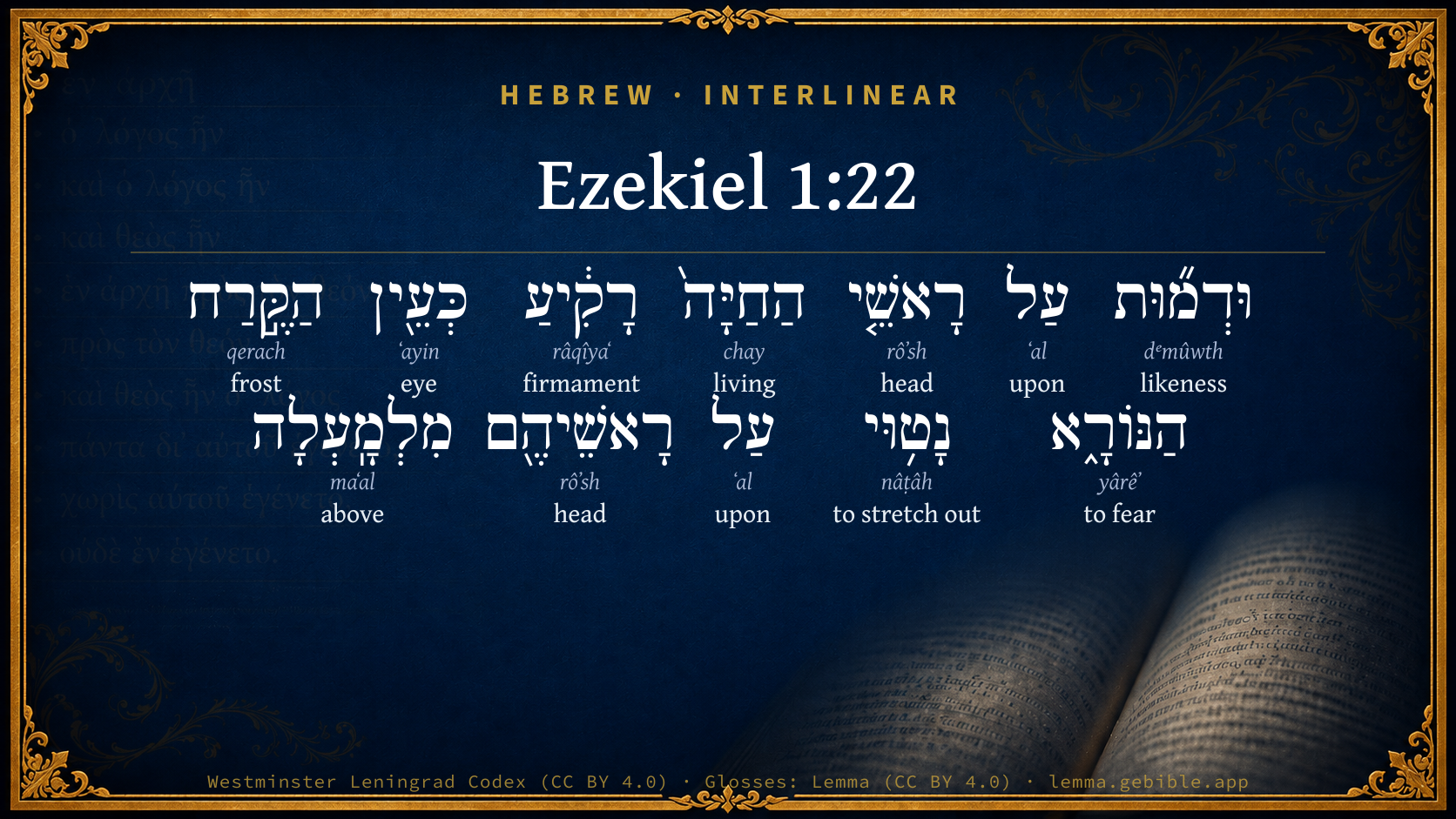
Hebrew (Westminster Leningrad Codex) Ezekiel 1:22 appears in the Hebrew Old Testament. The text above is from the Westminster Leningrad Codex. Each word links to its Strong’s number, a concise gloss, and parsing drawn from the Open Scriptures Hebrew Bible morphology. Click any word for its full Brown-Driver-Briggs (BDB) entry.
Download image
Cite this verse

Ezekiel 1:22 (World English Bible). Public Domain. Lemma interlinear Bible study tool, https://lemma.gebible.app/v/ezekiel/1/22.

Show BibTeX & RIS
BibTeX
RIS
English Translation
Over the head of the living creature there was the likeness of an expanse, like the awesome crystal to look on, stretched forth over their heads above.
World English Bible · Public Domain
Download a study sheet

One document with this verse’s original text, its word-by-word gloss line, the meaning frame, cross-references with their text, attributed commentary, and full source and license credits — printable, and it pastes into notes with its structure intact.

This verse Autodidact and up

Study sheet (.html) Plain text (.txt)

A passage Seminary Student

Up to 50 verses in one chapter. A passage sheet keeps up to 6 commentary sources and 12 cross-references per verse, in the order this page ranks them, and says so on the sheet whenever that leaves anything out. Ask for a single verse and you get the Autodidact verse sheet above.

Everything on this page stays free to read, with no account — the sheet is a download of what is already on screen, not access to it.

Want to remove ads? Support Godless Engineer
Compare translations 3

The same verse in 3 English versions, stacked beneath the original-language interlinear above. Click any original word for its lexicon entry.

Each is an independent rendering of the whole verse — the interlinear is not word-aligned to these translations.

Highlighted words mark where these versions differ — a whole-verse word diff, not a word-by-word alignment.

  • World English Bible Public Domain
    Over the head of the living creature there was the likeness of an expanse, like the awesome crystal to look on, stretched forth over their heads above.
  • King James Version Public Domain
    And the likeness of the firmament upon the heads of the living creature was as the colour of the terrible crystal, stretched forth over their heads above.
  • unfoldingWord Literal Text CC BY-SA 4.0
    Over the heads of the living creatures was the likeness of an expansive dome; it looked like awe-inspiring crystal stretched out over their heads above.

unfoldingWord Literal Text — © unfoldingWord, licensed CC BY-SA 4.0. Word-aligned USFM3 via Door43 (git.door43.org/unfoldingWord/en_ult).

Versions to compare (up to 4)

3 of 4 selected

Show all 18 translations

Every available English version of this verse, each an independent rendering of the whole verse.

  • World English Bible Public Domain
    Over the head of the living creature there was the likeness of an expanse, like the awesome crystal to look on, stretched forth over their heads above.
  • Berean Standard Bible Public Domain
    Spread out above the heads of the living creatures was the likeness of an awesome expanse, gleaming like crystal.
  • Majority Standard Bible Public Domain
    Spread out above the heads of the living creatures was the likeness of an awesome expanse, gleaming like crystal.
  • King James Version Public Domain
    And the likeness of the firmament upon the heads of the living creature was as the colour of the terrible crystal, stretched forth over their heads above.
  • American Standard Version (1901) Public Domain
    And over the head of the living creature there was the likeness of a firmament, like the terrible crystal to look upon, stretched forth over their heads above.
  • Revised Version (1885) Public Domain
    And over the head of the living creature there was the likeness of a firmament, like the colour of the terrible crystal, stretched forth over their heads above.
  • Geneva Bible (1599) Public Domain
    And the similitude of the firmament vpon the heads of the beasts was wonderfull, like vnto chrystall, spred ouer their heads aboue.
  • Douay-Rheims (1899) Public Domain
    And over the heads of the living creatures was the likeness of the firmament, as the appearance of crystal terrible to behold, and stretched out over their heads above.
  • Young's Literal Translation Public Domain
    And a likeness `is' over the heads of the living creatures of an expanse, as the colour of the fearful ice, stretched out over their heads from above.
  • Literal Standard Version CC BY-SA 4.0
    And over the heads of the living creatures—a likeness of an expanse, as the color of the fearful ice, stretched out over their heads from above.
  • Unlocked Literal Bible CC BY-SA 4.0
    Over the heads of the living creatures was the likeness of an expansive dome; it looked like awe-inspiring crystal stretched out over their heads above.
  • unfoldingWord Literal Text CC BY-SA 4.0
    Over the heads of the living creatures was the likeness of an expansive dome; it looked like awe-inspiring crystal stretched out over their heads above.
  • Darby Bible Public Domain
    And there was the likeness of an expanse over the heads of the living creature, as the look of the terrible crystal, stretched forth over their heads above.
  • World Messianic Bible Public Domain
    Over the head of the living creature there was the likeness of an expanse, like an awesome crystal to look at, stretched out over their heads above.
  • Webster's Bible Public Domain
    And the likeness of the firmament upon the heads of the living creature was as the color of the terrible crystal, stretched forth over their heads above.
  • Free Bible Version CC BY-SA 4.0
    Extending above the heads of the being was something that looked like an amazing expanse that glittered like ice crystal.
  • Bible in Basic English Public Domain
    And over the heads of the living beings there was the form of an arch, looking like ice, stretched out over their heads on high.
  • JPS Tanakh (1917) Public Domain
    And over the heads of the living creatures there was the likeness of a firmament, like the colour of the terrible ice, stretched forth over their heads above.

Literal Standard Version (2020), Covenant Press — licensed CC BY-SA 4.0. Text via the HelloAO Bible API (eBible.org). Unlocked Literal Bible (unfoldingWord) — licensed CC BY-SA 4.0. Text via the HelloAO Bible API (eBible.org). unfoldingWord Literal Text — © unfoldingWord, licensed CC BY-SA 4.0. Word-aligned USFM3 via Door43 (git.door43.org/unfoldingWord/en_ult). Free Bible Version, Dr. Jonathan Gallagher — licensed CC BY-SA 4.0. Text via the HelloAO Bible API (eBible.org).

Word by word

More ways to search: Search by grammar → Find every occurrence → Compare this word →

Practice this passage: Drill this verse → Learn its vocabulary →

הַקֶּ֣רַח
qerach
H7140
“the · frost”
Particle, Definite Article + Noun, Common, Masculine, Singular, Absolute
Part of Speech
Particle + Noun
Type
Common
Gender
Masculine
Number
Singular
State
Absolute
Full BDB Definition

Origin: from H7139

TWOT: 2070a

frost, ice, ice crystal - frost (of night) - ice
  1. וּדְמ֞וּת dᵉmûwth H1823 “and · likeness” Conjunction + Noun, Common, Feminine, Singular, Absolute
  2. עַל ʻal H5921 “upon” Preposition
  3. רָאשֵׁ֤י rôʼsh H7218 “heads of” Noun, Common, Masculine, Plural, Construct
  4. הַחַיָּה֙ chay H2416 “the · living” Particle, Definite Article + Noun, Common, Feminine, Singular, Absolute
  5. רָקִ֔יעַ râqîyaʻ H7549 “firmament” Noun, Common, Masculine, Singular, Absolute
  6. כְּעֵ֖ין ʻayin H5869 “like/as · eye of” Preposition + Noun, Common, Both, Singular, Construct
  7. הַנּוֹרָ֑א yârêʼ H3372 “the · fearing” Particle, Definite Article + Verb, Niphal, Participle Active, Masculine, Singular, Absolute
  8. נָט֥וּי nâṭâh H5186 “stretched out” Verb, Qal, Participle Passive, Masculine, Singular, Absolute
  9. עַל ʻal H5921 “upon” Preposition
  10. רָאשֵׁיהֶ֖ם rôʼsh H7218 “heads · their” Noun, Common, Masculine, Plural, Construct + Suffix, Personal, 3rd Person, Masculine, Plural
  11. מִלְמָֽעְלָה maʻal H4605 “from · to/for · above · toward” Preposition + Preposition + Adverb + Suffix, Demonstrative

About this verse

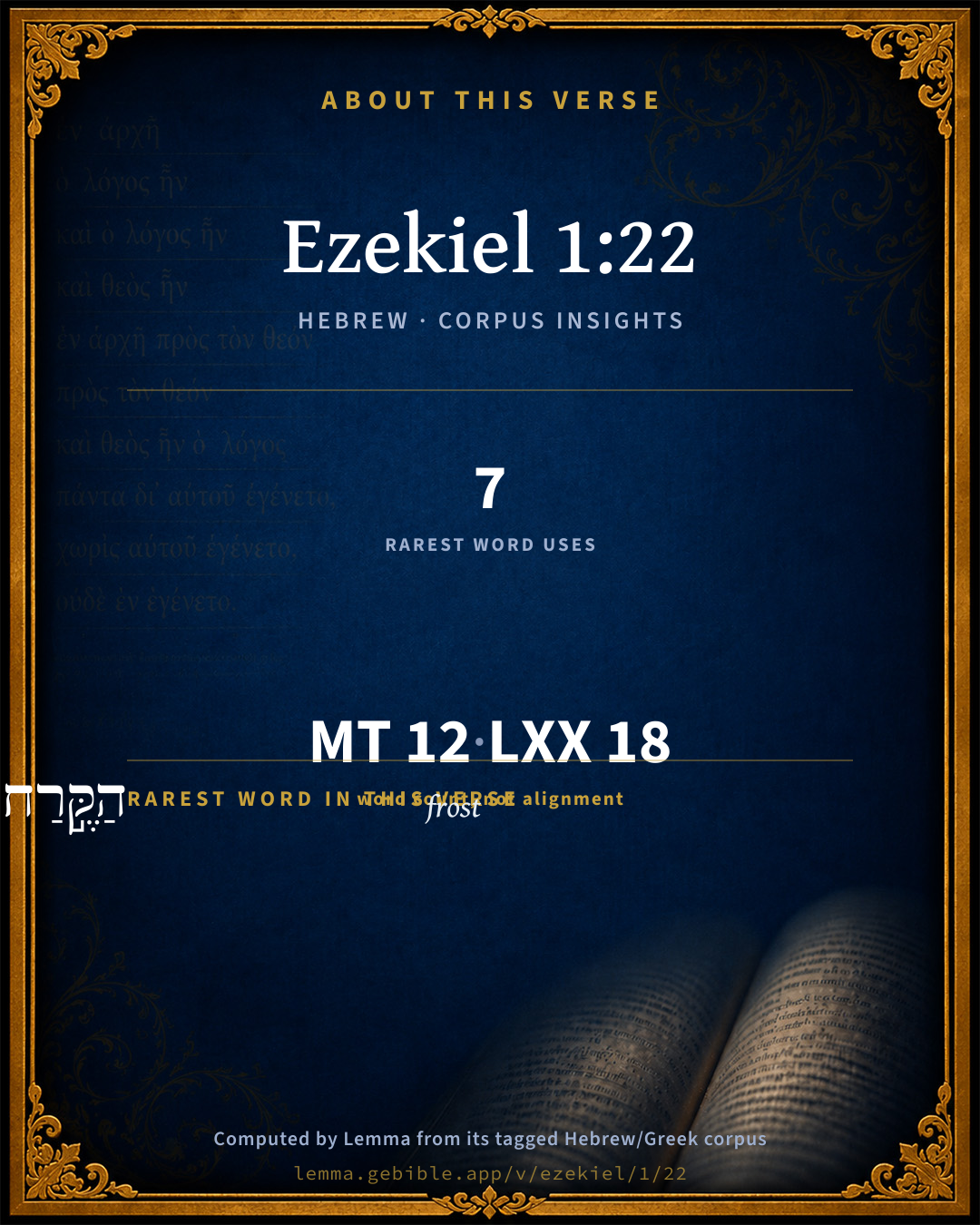
These counts appear in no published source. They are computed here, from the morphology-tagged text and Lemma’s own curated glosses. What Lemma adds →

12
words
10
distinct lemmas
Prophets
section

Notable vocabulary

The rarest word here is הַקֶּ֣רַח frost H7140 — appearing just 7 times in the whole Hebrew Bible.

Shared distinctive vocabulary

הַקֶּ֣רַח frost H7140 occurs in 7 verses of the Hebrew Bible. Also found in:

Grammatical profile

  • 2 verbs
  • 7 nouns
  • 2 prepositions
  • 1 adverb

Verb forms

  • הַנּוֹרָ֑א Niphal · Participle Active
  • נָט֥וּי Qal · Participle Passive

Repetition

Words recur within this verse — often emphatic in Hebrew:

  • עַל upon H5921 ×2
  • רָאשֵׁ֤י head H7218 ×2

Hebrew & Septuagint length

In English translation the verse runs 27 words from the Hebrew and 25 from the Septuagint (LXX English) — closely comparable.

A rough comparison of the two English renderings, which tokenize alike — not a word-level alignment.

Word counts can differ between the Hebrew and the Greek without any difference in meaning — e.g. the Hebrew direct-object marker אֵת has no separate Greek word, and Greek often adds the article ὁ.

In the original languages it is 12 Hebrew tokens and 18 Greek tokens — but the two are counted differently (Hebrew bundles its prefixes and suffixes into one token; the Greek is in lemma form), so that isn’t a like-for-like length.

Cross-references

7

Topical passages linked to Ezekiel 1:22 in the Treasury of Scripture Knowledge — connected by theme and wording, ordered by reader-vote popularity; previews shown in the World English Bible.

  • Ezekiel 10:1 Then I looked, and see, in the expanse that was over the head of the cherubim there appeared above them as it were a sapphire stone, as the appearance of the likeness of a throne.
  • Ezekiel 1:26 Above the expanse that was over their heads was the likeness of a throne, as the appearance of a sapphire stone; and on the likeness of the throne was a likeness as the appearance of a man on it above.
  • Revelation 4:6 Before the throne was something like a sea of glass, similar to crystal. In the midst of the throne, and around the throne were four living creatures full of eyes before and behind.
  • Exodus 24:10 They saw the God of Israel. Under his feet was like a paved work of sapphire stone, like the skies for clearness.
  • Job 37:22 Out of the north comes golden splendor; With God is awesome majesty.
  • Revelation 4:3 that looked like a jasper stone and a sardius. There was a rainbow around the throne, like an emerald to look at.
  • Revelation 21:11 having the glory of God. Her light was like a most precious stone, as if it was a jasper stone, clear as crystal;

Cross-references courtesy of OpenBible.info (CC BY 4.0).

Hebrew and Greek witnesses Masoretic Hebrew ↔ Greek Septuagint

The same verse in the two great witnesses to the Old Testament, shown verse-for-verse.

These are two independent witnesses, not word-aligned to each other, and the Septuagint is shown in lemma (dictionary) form.

Hebrew Ezekiel 1:22 Masoretic · Westminster Leningrad Codex

וּדְמ֞וּת עַל רָאשֵׁ֤י הַחַיָּה֙ רָקִ֔יעַ כְּעֵ֖ין הַקֶּ֣רַח הַנּוֹרָ֑א נָט֥וּי עַל רָאשֵׁיהֶ֖ם מִלְמָֽעְלָה

Over the head of the living creature there was the likeness of an expanse, like the awesome crystal to look on, stretched forth over their heads above.

World English Bible · Public Domain

Greek LXX Ezekiel 1:22 Septuagint · lemma form

καί ὁμοίωμα ὑπέρ κεφαλή αὐτός ὁ ζῷον ὡσεί στερέωμα ὡς ὅρασις κρυστάλλος ἐκτείνω ἐπί ὁ πτέρυξ αὐτός ἐπάνωθεν

And the likeness over the heads of the living creatures was as a firmament, as the appearance of crystal, spread out over their wings above.

LXX2012 (modern English Septuagint) · Public Domain

On this verse, The Cambridge Bible for Schools and Colleges discusses the Septuagint’s reading. Read the note in Commentary ↓

Hebrew: Westminster Leningrad Codex (CC BY 4.0). Greek: Septuagint (public domain); English from LXX2012 (modern English Septuagint) (Public Domain). How the Septuagint differs from the Hebrew →

Targum (Aramaic paraphrase)

1

The Targum is the ancient Jewish Aramaic paraphrase of the Hebrew Scriptures — an interpretive translation, not the Hebrew text itself. Onkelos (literal) and Pseudo-Jonathan (expansive) render the Torah, and Jonathan the Prophets. Coverage is partial: where no permissively-licensed English translation exists for a verse, only the Aramaic is shown. This is verse-level text, not a word-by-word alignment to the Hebrew.

  1. Targum Jonathan Prophets (Joshua–Malachi)
    וּדְמוּת עַל רֵישֵׁי בִּרְיָתָא רְקִיעָא כְּעֵין גְלִיד חֲסִין מַרְכֵן עַל רֵישֵׁיהוֹן מִלְעֵלָא:

    (no public-domain English translation for this verse)

    Targum Jonathan — Aramaic: “Mikraot Gedolot” (public domain). English: “Sefaria Community Translation” (CC0 1.0 (public-domain dedication)); “London "Chaldee Paraphrase," 1871” (public domain). Text via Sefaria.

Commentary

Notes on Ezekiel 1:22 from classic Christian and Jewish commentators (each source and its license shown beneath its notes). The classic Christian expositions comment on the surrounding passage and are grouped to its opening verse, so a note may address several verses; the Jewish commentaries on the Tanakh (Rashi and others) are per-verse, so they appear only where the commentator wrote on this verse.

Lemma curates 59 commentaries, every one of them public domain or Creative Commons licensed, each selected and text-cleaned for this edition rather than reprinted as found. About our sources →

The Cambridge Bible for Schools and Colleges

gen. ed. J. J. S. Perowne

22. And the likeness of the firmament] Rather: and there was a likeness over the heads of the living creature (of) a firmament. The term “firmament” has come from the LXX. (stereôma) through the Vulgate. The verb is used of the creation of the earth, Isa_42:5; Isa_44:24; Psa_136:6, and once, Job_37:18, of the creation of the heavens; and the noun is always used of the heavens. In the above passages LXX. renders “make strong,” and the noun “firmament.” The word “firmament” occurs only in Genesis 1; Ezekiel 1; Eze_10:1; Psa_19:1; Psa_150:1; Dan_12:3.

the terrible crystal] Cf. Exo_24:10, “and they saw the God of Israel, and there was under his feet as it were a pavework of sapphire stone, and as it were the very heaven for clearness.” In Revelation 4, which is largely indebted to Ezekiel 1, the crystal firmament here becomes “a sea of glass like unto crystal” (Eze_1:6). The word “terrible” is wanting in LXX., which reads also as a firmament in the first clause.

22–28. The Firmament, and Throne, and Glory of God

Over the heads and outstretched wings of the four living creatures there appeared a firmament like crystal (Eze_1:22-25); and above the firmament an appearance as of a throne, like a sapphire stone; and upon the throne the appearance of a man (Eze_1:26). From his loins upwards he had the appearance of glancing amber (electrum), and from his loins downwards of fire; and there was a splendour around him like that of the rainbow in the day of rain (Eze_1:25-28).

The Cambridge Bible for Schools and Colleges (gen. ed. J. J. S. Perowne; Cambridge University Press, 1878–1918) — public domain. Text from a community e-Sword module.

Trapp's Complete Commentary

John Trapp

Eze 1:22 And the likeness of the firmament upon the heads of the living creature [was] as the colour of the terrible crystal, stretched forth over their heads above.

Ver. 22. And the likeness of the firmament.] The glory of God in Christ is revealed to the prophet in this ensuing vision, even that great "mystery of godliness, God manifested in the flesh," {1Ti 3:16} whereof this was a kind of prelude. To like purpose also was that vision. {Isa 6:1-13; Joh 12:39-41}

Upon the heads of the living creature.] Between them and the Lord Christ as a screen, and supplied likely the office of that other pair of wings. {Isa 6:2 Exo 24:10}

Was as the colour of the terrible crystal.] Heb., Of the formidable frost, that is, of the most vehement frost, a periphrasis of crystal. {a} All things above are dreadfully glorious, as all things below are pellucid, pervious, and clear to God’s eye, like a diaphanous body. {Heb 4:13} Mountains of brass are as transparent to him as the clearest crystal. The firmament is so clear that Christ seeth through it. It is "a molten looking glass"; {Job 37:18} and those atheists are utterly out who ask, "How doth God know? can he judge through the dark clouds" {Job 22:13}

{a} Vide Plin., lib. xxxvii, cap. 2. Chrysiallus est gelu concretum.

John Trapp, A Commentary or Exposition upon All the Books of the Old and New Testament (1647–1656) — public domain. Text from a community e-Sword module.

Joseph Benson's Commentary

Eze 1:22-25. And the likeness — The appearance or resemblance; of the firmament — The expanse, as the word signifies. Upon the heads of the living creatures — And, of course, of the wheels connected with them; was as the colour of the terrible crystal — For splendour, purity, and solidity. All that was above these creatures and wheels was beautiful, majestic, and glorious, insomuch that none could behold it without being dazzled and astonished at it: it could not but impress the mind of every beholder with veneration, solemnity, and awe, and therefore it is said to be terrible. And under the firmament — Below, at a great distance; were their wings straight — That is, the living creatures stood with their wings stretched out, ready for motion. The one toward the other — Prepared to concur in all their motions and actings. Every one had two, which covered on this side and on that side — On the right hand and on the left. The sense seems to be the same with that of Eze 1:11, denoting that two of the wings of each living creature were stretched upward, to express their readiness to obey the divine commands; and with the other two they covered their bodies: see note on Eze 1:11. And when they went — Were executing the commands of God; I heard the noise of their wings like the noise of great waters — Denoting “the terribleness of the judgments which they were to execute upon Jerusalem and the whole Jewish nation.” As the voice of the Almighty — It resembled great and dreadful thunder. The voice of speech like the noise of a host — Like the confused murmur of an army, intending the army of the Babylonians. All these noises signified that the commands which God had given, or was now giving, to these ministering spirits, were of a dreadful nature. When they stood — When they presented themselves before God, having performed their office; they let down their wings — Put themselves in a posture of hearkening to God’s voice, and as it were quietly waited to receive his commands. And there was a voice, &c., when they stood — The Vulgate seems to give the sense of this verse more exactly, thus: Cum fieret vox-super caput eorum, stabant et submittebant alas suas: when there was a voice over their heads they stood, &c, namely, in an attentive posture.

Joseph Benson's Commentary on the Old and New Testaments (1811–1818) — public domain. Text from a community e-Sword module.

Keil & Delitzsch

C. F. Keil & F. Delitzsch

Description of the theophany seen by the spirit of the prophet. - Eze 1:4. And I saw, and, lo, a tempestuous wind came from the north, a great cloud, and a fire rolled together like a ball, and the brightness of light round about it, and out of its midst, as the appearance of glowing metal from the midst of the fire. - The description begins with a general outline of the phenomenon, as the same presented itself to the spiritual eye of the prophet on its approach from the north. A tempestuous wind brings hither from the north a great cloud, the centre of which appears as a lump of fire, which throws around the cloud the brightness of light, and presents in its midst the appearance of glowing metal. The coming of the phenomenon from the north is, as a matter of course, not connected with the Babylonian representation of the mountain of the gods situated in the extreme north, Isa 14:13. According to the invariable usage of speech followed by the prophets, especially by Jeremiah (cf. e.g., Eze 1:14; Eze 4:6; Eze 6:1, etc.), the north is the quarter from which the enemies who were to execute judgment upon Jerusalem and Judah break in. According to this usage, the coming of this divine appearance from the north signifies that it is from the north that God will bring to pass the judgment upon Judah. אשׁ מתלקּחת, "fire rolled together like a ball," is an expression borrowed from Exo 9:10. לו refers to ענן, and מתּוכהּ to אשׁ, as we see from the words in apposition, מתּוך האשׁ. The fire, which formed the centre of the cloud, had the appearance of השׁמל. The meaning of this word, which occurs again in Eze 1:27 and Eze 8:2, is disputed. The Septuagint and Vulgate translate it by ἤλεκτρον, electrum, i.e., a metal having a bright lustre, and consisting of a mixture of gold and silver. Cf. Strabo, III. 146; Plin. Hist. Nat. xxxiii. 4. To the explanation of Bochart, that it is a compound of נחשׁת, "brass," and the Talmudic word מלל or מללא, "aurum rude," and signifies "rough gold ore," is opposed the fact that the reading מללא in the Talmud is not certain, but purports to be ממלא (cf. Gesen. Thesaur. p. 535, and Buxtorf, Lexic. Talmud, p. 1214), as well as the circumstance that raw gold ore has not a lustre which could shine forth out of the fire. Still less probability has the supposition that it is a compound of l#x, in Syriac "conflavit, fabricavit," and חשׁם, "fricuit," on which Hvernick and Maurer base the meaning of "a piece of metal wrought in the fire." The word appears simply to be formed from חשׁם , probably "to glow," with ל appended, as כּרמל from כרם morf , and to denote "glowing ore." This meaning is appropriate both in v. 27, where עין השׁמל is explained by מראה־אשׁ, as well as in Eze 8:2, where זהר, "brilliancy," stands as parallel to it. השׁמל, however, is different from נחשׁת קלל in Eze 1:7 and in Dan 10:6, for חשׁמל refers in all the three places to the person of Him who is enthroned above the cherubim; while נחשׁת קלל in Eze 1:7 is spoken of the feet of the cherubim, and in Dan 10:6 of the arms and feet of the personage who there manifests Himself. In verse fifth the appearance is described more minutely. There first present themselves to the eye of the seer four beings, whom he describes according to their figure and style.

Eze 1:5-14

The four cherubim. - Eze 1:5. And out of its midst there prominently appeared a figure, consisting of four creatures, and this was their appearance: they had the figure of a man. Eze 1:6. And each had four faces, and each of them had four wings. Eze 1:7. And their feet were upright-standing feet; and the soles of their feet like the soles of a calf, and sparkling like the appearance of shining brass. Eze 1:8. And the hands of a man were under their wings on their four sides; and all four had faces and wings. Eze 1:9. Their wings were joined one to another; they turned not as they went; they went each one in the direction of his face. Eze 1:10. And the form of their faces was that of a man; and on the right all four had a lion's face; and on the left all four had the face of an ox; and all four had an eagle's face. Eze 1:11. And their faces and their wings were divided above, two of each uniting with one another, and two covering their bodies. Eze 1:12. And they went each in the direction of his face; whithersoever the spirit was to go, they went; they turned not as they went. Eze 1:13. And the likeness of the creatures resembled burning coals of fire, like the appearance of torches: it (the fire) went hither and thither amongst the beings; and the fire was brilliant, and from the fire came forth lightning. Eze 1:14. And the beings ran hither and thither in a zig-zag manner.

From out of the fiery centre of the cloud there shows itself the form (tw%md@;, properly "resemblance," "picture") of four חיּות, animantia, "living creatures;" ζῶα, Rev 4:6; not θηρία, "wild beasts," as Luther has incorrectly rendered it, after the animalia of the Vulgate. These four creatures had דּמוּת אדם, "the figure of a man." Agreeably to this notice, placed at the head of the description, these creatures are to be conceived as presenting the appearance of a human body in all points not otherwise specified in the following narrative. Each of them had four faces and four wings (אחת without the article stands as a distributive, and כּנפים are "pinions," as in Isa 6:2, not "pairs of wings"). Their feet were רגל ישׁרה, "a straight foot;" the singular stands generically, stating only the nature of the feet, without reference to their number. We have accordingly to assume in each of the four creatures two legs, as in a man. ישׁר .nam a , "straight," i.e., standing upright, not bent, as when sitting or kneeling. רגל is the whole leg, including the knee and thigh, and כּף רגל, "sole of the foot," or the under part of the leg, with which we tread on the ground. This part, not the whole leg, resembled the calf's foot, which is firmly planted on the ground. The legs sparkled like the appearance of נחשׁה קלל. The subject of נצצים is not "the כּרוּבים, which are understood to be intended under the חיּות in verse fifth" (Hitzig), for this subject is too far distant, but רגליהם, which is here construed as masculine, as in Jer 13:16. In this sense are these words apprehended in Rev 1:15, and נחשׁת there translated by χαλκολίβανος. On this word see Hengstenberg and Dsterdieck on Rev 1:15. נח' קלל probably signifies "light," i.e., "bright, shining brass," as the old translators have rendered it. The Septuagint has ἐξαστράπτων; the Vulgate, aes candens; and the Chaldee paraphrase, aes flammans. The signification "smoothed, polished brass" (Bochart), rests upon uncertain combinations; cf. Gesen. Thes. p. 1217, and is appropriate neither here nor in Dan 10:6, where these words precede, "His face had the appearance of lightning, and his eyes were as a flame of fire." Under the four wings were four hands on the four sides of each cherub, formed like the hands of a man. The wings accordingly rested upon the shoulders, from which the hands came forth. The Chetib וידו may certainly be defended if with Kimchi and others we punctuate וידו, and take the suffix distributively and אדם elliptically, "his (i.e., each of the four creatures) hands were (the hands of) a man;" cf. for such an ellipsis as this, passages like that in Psa 18:34, רגלי כּאיּלות, "my feet as the (feet) of hinds;" Job 35:2, מאל, "before the righteousness of God." It is extremely probable, however, that ו is only the error of an old copyist for י, and that the Keri וידי is the correct reading, as the taking of אדם elliptically is not in keeping with the broad style of Ezekiel, which in its verbosity verges on tautology. The second half of Eze 1:8 is neither, with Hvernick, to be referred to the following ninth verse, where the faces are no more spoken of, nor, with Hitzig, to be arbitrarily mutilated; but is to be taken as it stands, comprising all that has hitherto been said regarding the faces and wings, in order to append thereto in Eze 1:9. the description of the use and nature of these members. The definite statement, that "the wings were joined one to another," is in Eze 1:11 limited to the two upper wings, according to which we have so to conceive the matter, that the top or the upper right wing of each cherub came in contact with the top of the left wing of the neighbouring cherub. This junction presented to the eye of the seer the unity and coherence of all the four creatures as a complete whole - a חיּה, and implied, as a consequence, the harmonious action in common of the four creatures. They did not turn as they went along, but proceeded each in the direction of his face. אל, "over against his face." The meaning is thus rightly given by Kliefoth: "As they had four faces, they needed not to turn as they went, but went on as (i.e., in the direction in which) they were going, always after the face."

In the closer description of the faces in Eze 1:10, the face of the man is first mentioned as that which was turned towards the seer, that of the lion to the right side, the ox to the left, and that of the eagle (behind). In naming these three, it is remarked that all the four creatures had these faces: in naming the man's face, this remark is omitted, because the word פּניהם (referring to all the four) immediately precedes. In Eze 1:11, it is next remarked of the faces and wings, that they were divided above (מלמעלה, "from above," "upward"); then the direction of the wings is more precisely stated. The word וּפניהם is neither to be referred to the preceding, "and it was their faces," nor, with Hitzig, to be expunged as a gloss; but is quite in order as a statement that not only the wings but also the faces were divided above, consequently were not like Janus' faces upon one head, but the four faces were planted upon four heads and necks. In the description that follows, חוברות אישׁ is not quite distinct, and #y)i is manifestly to be taken as an abbreviation of אשּׁה אל־אחותהּ in Eze 1:9 : on each were two wings joining one another, i.e., touching with their tops the tips of the wings of the cherub beside them, in accordance with which we have to conceive the wings as expanded. Two were covering their bodies, i.e., each cherub covered his body with the pair of wings that folded downwards; not, as Kliefoth supposes, that the lower wings of the one cherub covered the body of the other cherub beside him, which also is not the meaning in Eze 1:23; see note on that verse. In Eze 1:12, what is to be said about their movements is brought to a conclusion, while both statements are repeated in Eze 1:9, and completed by the addition of the principium movens. In whatever direction the רוּח "was to go, in that direction they went;" i.e., not according to the action of their own will, but wherever the רוּח impelled them. רוּח, however, signifies not "impulse," nor, in this place, even "the wind," as the vehicle of the power of the spiritual life palpable to the senses, which produced and guided their movements, (Kliefoth), but spirit. For, according to Eze 1:20, the movement of the wheels, which was in harmony with the movements of the cherubim, was not caused by the wind, but proceeded from the רוּח החיּה, i.e., from the spirit dwelling in the creature. On the contrary, there is not in the whole description, with the exception of the general statement that a tempestuous wind drove from the north the great cloud in which the theophany was enwrapped, any allusion to a means of motion palpable to the senses. In the 13th and 14th verses is described the entire impression produced by the movement of the whole appearance. וּדמוּת החיּות precedes, and is taken absolutely "as regards the form of the creatures," and corresponds to the דּמוּת ארבּע חיּות in Eze 1:5, with which the description of the individual figures which appeared in the brightness of the fire was introduced. Their appearance was like burning coals of fire, like the appearance of torches. היא refers to אשׁ as the principal conception. Fire, like the fire of burning coals and torches, went, moved hither and thither amongst the four creatures. This fire presented a bright appearance, and out of it came forth lightnings. The creatures, moreover, were in constant motion. רצוא, from רצא, an Aramaising form for the Hebrew רוּץ, to run. The infin. absol. stands instead of the finite verb. The conjecture of יצוא, after Gen 8:7 (Hitzig), is inappropriate, because here we have not to think of "coming out," and no reason exists for the striking out of the words, as Hitzig proposes. The continued motion of the creatures is not in contradiction with their perpetually moving on straight before them. "They went hither and thither, and yet always in the direction of their countenances; because they had a countenance looking in the direction of every side" (Kliefoth). בּזק signifies not "lightning" (=בּרק), but comes from בּזק; in Syriac, "to be split," and denotes "the splitting," i.e., the zigzag course of the lightning (Kliefoth).

Eze 1:15-21

The four wheels beside the cherubim. - Eze 1:15. And I saw the creatures, and, lo, there was a wheel upon the earth beside the creatures, towards their four fronts. Eze 1:16. The appearance of the wheels and their work was like the appearance of the chrysolite; and all four had one kind of figure: and their appearance and their work was as if one wheel were within the other. Eze 1:17. Towards their four sides they went when they moved: they turned not as they went. Eze 1:18. And their felloes, they were high and terrible; and their felloes were full of eyes round about in all the four. Eze 1:19. And when the creatures moved, the wheels moved beside them; and when the creatures raised themselves up from the earth, the wheels also raised themselves. Eze 1:20. Whithersoever the spirit was to go, they went in the direction in which the spirit was to go; and the wheels raised themselves beside them: for the spirit of the creatures was in the wheels. Eze 1:21. When the former moved, the latter moved also; when the former stood, the latter stood; and when the former raised themselves from the ground, the wheels raised themselves beside them: for the spirit of the creatures was in the wheels. - The words, "and I saw the creatures," prepare the way for the transition to the new object which presented itself in these creatures to the eye of the seer. By the side of these creatures upon the ground he sees a wheel, and that at the four fronts, or front faces of the creatures. The singular suffix in לארבּעת פּניו can neither be referred, with Rosenmller, to the chariot, which is not mentioned at all, nor, with Hitzig, to the preposition אצל, nor, with Hvernick, Maurer, and Kliefoth, to אופן, and so be understood as if every wheel looked towards four sides, because a second wheel was inserted in it at right angles. This meaning is not to be found in the words. The suffix refers ad sensum to חיּות (Ewald), or, to express it more correctly, to the figure of the cherubim with its four faces turned to the front, conceived as a unity - as one creature (החיּה, Eze 1:22). Accordingly, we have so to represent the matter, that by the side of the four cherubim, namely, beside his front face, a wheel was to be seen upon the earth. Ezekiel then saw four wheels, one on each front of a cherub, and therefore immediately speaks in Eze 1:16 of wheels (in the plural). In this verse מראה is adspectus, and מעשׂה "work;" i.e., both statements employing the term "construction," although in the first hemistich only the appearance, in the second only the construction, of the wheels is described. תּרשׁישׁ is a chrysolite of the ancients, the topaz of the moderns, - a stone having the lustre of gold. The construction of the wheels was as if one wheel were within a wheel, i.e., as if in the wheel a second were inserted at right angles, so that without being turned it could go towards all the four sides. גּבּיהן, in Eze 1:18, stands absolutely. "As regards their felloes," they possessed height and terribleness-the latter because they were full of eyes all round. Hitzig arbitrarily understands גּבהּ of the upper sides; and יראה, after the Arabic, of the under side, or that which lies towards the back. The movement of the wheels completely followed the movement of the creatures (Eze 1:19-21), because the spirit of the creature was in the wheels. החיּה, in Eze 1:20 and Eze 1:21, is not the "principle of life" (Hvernick), but the cherubic creatures conceived as a unity, as in Eze 1:22, where the meaning is undoubted. The sense is: the wheels were, in their motion and rest, completely bound by the movements and rest of the creatures, because the spirit which ruled in them was also in the wheels, and regulated their going, standing, and rising upwards. By the רוּח the wheels are bound in one with the cherub-figures, but not by means of a chariot, to or upon which the cherubim were attached.

Ezekiel 1:22

eze 1:22

The throne of Jehovah. - Eze 1:22. And over the heads of the creature there appeared an expanse like the appearance of the terrible crystal, stretched out over their heads above. Eze 1:23. And under the expanse were their wings, extended straight one towards another: each had two wings, covering to these, and each two (wings), covering to those, their bodies. Eze 1:24. And I heard the sound of their wings, as the sound of many waters, like the voice of the Almighty, as they went: a loud rushing like the clamour of a camp: when they stood, they let down their wings. Eze 1:25. And there came a voice from above the expanse which was above their heads; when they stood, they let their wings sink down. Eze 1:26. Over the expanse above their heads was to be seen, like a sapphire stone, the figure of a throne: and over the figure of the throne was a figure resembling a man above it. Eze 1:27. And I saw like the appearance of glowing brass, like the appearance of fire within the same round about; from the appearance of his loins upwards, and from the appearance of his loins downwards, I saw as of the appearance of fire, and a shining light was round about it. Eze 1:28. Like the appearance of the bow, which is in the clouds in the day of rain, was the appearance of the shining light round about. This was the appearance of the likeness of the glory of Jehovah. And I saw it, and fell upon my face, and I heard the voice of one that spake. - Above, over the heads of the figures of the cherubim, Ezekiel sees something like the firmament of heaven (Eze 1:22.), and hears from above this canopy a voice, which re-echoes in the rushing of the wings of the cherubim, and determines the movement as well as the standing still of these creatures. The first sentence of Eze 1:22 literally signifies: "And a likeness was over the heads of the creature - a canopy, as it were, stretched out." רקיע is not the genitive after דּמוּת, but an explanatory apposition to it, and before רקיע; neither has כּ fallen out (as Hitzig supposes), nor is it to be supplied. For דּמוּת denotes not any definite likeness, with which another could be compared, but, properly, similitudo, and is employed by Ezekiel in the sense of "something like." רקיע, without the article, does not mean the firmament of heaven, but any expanse, the appearance of which is first described as resembling the firmament by the words כּעין הקּרח. It is not the firmament of heaven which Ezekiel sees above the heads of the cherubim, but an expanse resembling it, which has the shining appearance of a fear-inspiring crystal. נורא, used of crystal, in so far as the appearance of this glittering mass dazzles the eyes, and assures terror, as in Jdg 13:6, of the look of the angel; and in Job 37:22, of the divine majesty. The description is based upon Exo 24:10, and the similitude of the crystal has passed over to the Apocalypse, Rev 4:6. Under the canopy were the wings of the cherubim, ישׁרות, standing straight, i.e., spread out in a horizontal direction, so that they appeared to support the canopy. אשּׁה אל־אחותה is not, with Jerome and others, to be referred to the cherubim (החיּה), but to כּנפיהם, as in Eze 1:9. The לאישׁ which follows does refer, on the contrary, to the cherub, and literally signifies, "To each were two wings, covering, namely, to these and those, their bodies." להנּה corresponds to לאישׁ, in a manner analogous to לאחת להם in Eze 1:6. By the repetition of the להנּה, "to these and those," the four cherubim are divided into two pairs, standing opposite to one another. That this statement contradicts, as Hitzig asserts, the first half of the verse, is by no means evident. If the two creatures on each side covered their bodies with the two wings, then two other wings could very easily be so extended under the canopy that the tops of the one should touch those of the other. As the creatures moved, Ezekiel hears the sound, i.e., the rustling of their wings, like the roaring of mighty billows. This is strengthened by the second comparison, "like the voice of the Almighty," i.e., resembling thunder, cf. Eze 10:5. The קול המלּה that follows still depends on אשׁמע. המלּה, which occurs only here and in Jer 11:6, is probably synonymous with המון "roaring," "noise," "tumult." This rushing sound, however, was heard only when the creatures were in motion; for when they stood, they allowed their wings to fall down. This, of course, applies only to the upper wings, as the under ones, which covered the body, hung downwards, or were let down. From this it clearly appears that the upper wings neither supported nor bore up the canopy over their heads, but only were so extended, when the cherubim were in motion, that they touched the canopy. In Eze 1:25 is also mentioned whence the loud sound came, which was heard, during the moving of the wings, from above the canopy, consequently from him who was placed above it, so that the creatures, always after this voice resounded, went on or stood still, i.e., put themselves in motion, or remained without moving, according to its command.

With the repetition of the last clause of Eze 1:24 this subject is concluded in Eze 1:25. Over or above upon the firmament was to be seen, like a sapphire stone, the likeness of a throne, on which sat one in the form of a man - i.e., Jehovah appeared in human form, as in Dan 7:9. Upon this was poured out a fiery, shining light, like glowing brass (עין חשׁמל, as in Eze 1:4) and like fire, בּית־להּ סביב, "within it round about" (מבּית = בּית, "within," and להּ, pointing back to דּמוּת כּסּא). This appears to be the simplest explanation of these obscure words. They are rendered differently by Hitzig, who translates them: "like fire which has a covering round about it, i.e., like fire which is enclosed, whose shining contrasts so much the more brightly on account of the dark surrounding." But, to say nothing of the change which would then be necessary of בּית into בּית, this meaning seems very far-fetched, and cannot be accepted for this reason alone, that מראה אשׁ, neither in the following hemistich (Eze 1:27) nor in Eze 8:2, has any such or similar strengthening addition. The appearance above shows, as the centre of the cloud (Eze 1:4), a fiery gleam of light, only there is to be perceived upon the throne a figure resembling a man, fiery-looking from the loins upwards and downwards, and round about the figure, or rather round the throne, a shining light (נגהּ, cf. Eze 1:4), like the rainbow in the clouds, cf. Rev 4:3. This הוּא, Eze 1:28, does not refer to הנּגהּ, but to the whole appearance of him who was enthroned - the covering of light included, but throne and cherubim (Eze 10:4, Eze 10:19) excluded (Hitzig)] was the appearance of the likeness of Jehovah's glory. With these words closes the description of the vision. The following clause, "And I saw, etc.," forms the transition to the word of Jehovah, which follows on the second chapter, and which summoned Ezekiel to become a prophet to Israel. Before we pass, however, to an explanation of this word, we must endeavour to form to ourselves a clear conception of the significance of this theophany.

For its full understanding we have first of all to keep in view that it was imparted to Ezekiel not merely on his being called to the office of prophet, but was again repeated three times - namely, in Eze 3:22., where he was commissioned to predict symbolically the impending siege of Jerusalem; Eze 8:4., when he is transported in spirit to the temple-court at Jerusalem for the purpose of beholding the abominations of the idol-worship practised by the people, and to announce the judgment which, in consequence of these abominations, was to burst upon the city and the temple, in which it is shown to him how the glory of the Lord abandons, first the temple and thereafter the city also; and in Eze 43:1., in which is shown to him the filling of the new temple with the glory of the Lord, to swell for ever among the children of Israel. In all three passages it is expressly testified that the divine appearance was like the first which he witnessed on the occasion of his call. From this Kliefoth has drawn the right conclusion, that the theophany in Eze 1:4. bears a relation not to the call only, but to the whole prophetic work of Ezekiel: "We may not say that God so appears to Ezekiel at a later time, because He so appeared to him at his call; but we must say, conversely, that because God wills and must so appear to Ezekiel at a later time while engaged in his prophetic vocation, therefore He also appears to him in this form already at his call." The intention, however, with which God so appears to him is distinctly contained in the two last passages, Ezekiel 8-11 and Ezekiel 43: "God withdraws in a visible manner from the temple and Jerusalem, which are devoted to destruction on account of the sin of the people: in a visible manner God enters into the new temple of the future; and because the whole of what Ezekiel was inspired to foretell was comprehended in these two things - the destruction of the existing temple and city, and the raising up of a new and a better; - because the whole of his prophetic vocation had its fulfilment in these, therefore God appears to Ezekiel on his call to be a prophet in the same form as that in which He departs from the ancient temple and Jerusalem, in order to their destruction, and in which He enters into the new edifice in order to make it a temple. The form of the theophany, therefore, is what it is in Eze 1:4., because its purpose was to show and announce to the prophet, on the one side the destruction of the temple, and on the other its restoration and glorification." These remarks are quite correct, only the significance of the theophany itself is not thereby made clear. If it is clear from the purpose indicated why God here has the cherubim with Him, while on the occasion of other appearances (e.g., Dan 7:9; Isa 6:1) He is without cherubim; as the cherubim here have no other significance than what their figures have in the tabernacle, viz., that God has there His dwelling-place, the seat of His gracious presence; yet this does not satisfactorily explain either the special marks by which the cherubim of Ezekiel are distinguished from those in the tabernacle and in Solomon's temple, or the other attributes of the theophany. Kliefoth, moreover, does not misapprehend those diversities in the figures of the cherubim, and finds indicated therein the intention of causing it distinctly to appear that it is the one and same Jehovah, enthroned amid the cherubim, who destroys the temple, and who again uprears it. Because Ezekiel was called to predict both events, he therefore thinks there must be excluded, on the one hand, such attributes in the form of the manifestation as would be out of harmony with the different aims of the theophany; while, on the other, those which are important for the different aims must be combined and comprehended in one form, that this one form may be appropriate to all the manifestations of the theophany. It could not therefore have in it the ark of the covenant and the mercy-seat; because, although these would probably have been appropriate to the manifestation for the destruction of the old temple (Eze 8:1.), they would not have been in keeping with that for entering into the new temple. Instead of this, it must show the living God Himself upon the throne among "the living creatures;" because it belongs to the new and glorious existence of the temple of the future, that it should have Jehovah Himself dwelling within it in a visible form.

From this, too, may be explained the great fulness of the attributes, which are divisible into three classes: 1. Those which relate to the manifestation of God for the destruction of Jerusalem; 2. Those which relate to the manifestation of God for entering into the new temple; and, 3. Those which serve both objects in common. To the last class belongs everything which is essential to the manifestation of God in itself, e.g., the visibility of God in general, the presence of the cherubim in itself, and so on: to the first class all the signs that indicate wrath and judgment, consequently, first, the coming from the north, especially the fire, the lightnings, in which God appears as He who is coming to judgment; but to the second, besides the rainbow and the appearance of God in human form, especially the wheels and the fourfold manifestation in the cherubim and wheels. For the new temple does not represent the rebuilding of the temple by Zerubbabel, but the economy of salvation founded by Christ at His appearing, to which they belong as essential tokens; to be founded, on the one hand, by God's own coming and dwelling upon the earth; on the other, to be of an oecumenic character, in opposition to the particularities and local nature of the previous ancient dispensation of salvation. God appears bodily, in human form; lowers down to earth the canopy on which His throne is seated; the cherubim, which indicate God's gracious presence with His people, appear not merely in symbol, but in living reality, plant their feet upon the ground, while each cherub has at his side a wheel, which moves, not in the air, but only upon the earth. By this it is shown that God Himself is to descend to the earth, to walk and to dwell visibly among His people; while the oecumenic character of the new economy of salvation, for the establishment of which God is to visit the earth, is represented in the fourfold form of the cherubim and wheels. The number four - the sign of the oecumenicity which is to come, and the symbol of its being spread abroad into all the world - is assigned to the cherubim and wheels, to portray the spreading abroad of the new kingdom of God over the whole earth. But how much soever that is true and striking this attempt at explanation may contain in details, it does not touch the heart of the subject, and is not free from bold combinations. The correctness of the assumption, that in the theophany attributes of an opposite kind are united, namely, such as should refer only to the destruction of Jerusalem and of the temple, and such as relate only to the foundation and nature of the new economy of salvation, is beset with well-founded doubts. Why, on such a hypothesis, should the form of the theophany remain the same throughout in all three or four cases? This question, which lies on the surface, is not satisfactorily answered by the remark that Ezekiel had to predict not only the destruction of the old, but also the foundation of a new and much more glorious kingdom of God. For not only would this end, but also the object of showing that it is the same God who is to accomplish both, have been fully attained if the theophany had remained the same only in those attributes which emblemize in a general way God's gracious presence in His temple; while the special attributes, which typify only the one and the other purpose of the divine appearance, would only they have been added, or brought prominently out, where this or that element of the theophany had to be announced. Moreover, the necessity in general of a theophany for the purpose alleged is not evident, much less the necessity of a theophany so peculiar in form. Other prophets also, e.g., Micah, without having seen a theophany, have predicted in the clearest and distinctest manner both the destruction of Jerusalem and the temple, and the raising up of a new and more glorious kingdom of God. The reason, then, why Ezekiel witnessed such a theophany, not only at his call, but had it repeated to him at every new turn in his prophetic ministry, must be dee

Keil & Delitzsch — Biblical Commentary on the Old Testament (1861–1891) — public domain (CC PDM 1.0). Text via the HelloAO Bible API. (Old Testament only.)

Tyndale Open Study Notes

Tyndale Open Resources

1:22-25 The surface like the sky, glittering like crystal separated the realm of God’s presence (heaven) from the realm of humanity (earth). References to the sky, the cherubim (see study note on 1:11-14), and the rainbow (1:28) remind us of the opening chapters of Genesis and suggest that the narrative about to unfold concerns the destruction of what God had created, followed by its re-creation. Just as God destroyed the world he had made with a flood and then restored it through Noah, Ezekiel’s world was also being unmade and restored.

Tyndale Open Study Notes — © Tyndale Open Resources, licensed CC BY-SA 4.0. Text via the HelloAO Bible API.

Jamieson, Fausset & Brown

Robert Jamieson, A. R. Fausset & David Brown

upon the heads--rather, "above the heads" [FAIRBAIRN].

colour--glitter.

terrible crystal--dazzling the spectator by its brightness.

Jamieson, Fausset & Brown — Commentary Critical and Explanatory on the Whole Bible (1871) — public domain (CC PDM 1.0). Text via the HelloAO Bible API.

Adam Clarke's Commentary

Verse 22. The colour of the terrible crystal] Like a crystal, well cut and well polished, with various faces, by which rays of light were refracted, assuming either a variety of prismatic colours, or an insufferably brilliant splendour. This seems to be the meaning of the terrible crystal. Newcome translates, fearful ice. The common translation is preferable.

Adam Clarke's Commentary on the Bible (1810–1826) — public domain. Text from a community e-Sword/MySword module.

John Calvin's Commentaries

Now the Prophet states the principal thing in this vision — that God was seated on his throne: because if he had spoken only of wheels and living creatures, the vision had been partial, and therefore inefficient. But when he places God upon his own throne, we understand that angels, who inspire motion in other things, have neither vigor nor motion peculiar to themselves. On the whole, the Prophet here says that angels so move all things that are done under heaven, that no proper motion ought to be ascribed to them. And why? because God presides over them and governs their actions. This is the object of the latter part of the vision, which we are now going to explain.

He says then, above the heads of the living creatures was the likeness of a firmament By these words he wishes gradually to draw us to God himself, and God also so deals with his Prophet that he places different steps by which the Prophet himself according to his capacity may gradually climb to an immense altitude. The Prophet does not here speak concerning the throne of God, but only concerning the firmament. For when we raise our eyes upwards, God’s glory appears nearer to us than it does on earth. True it is, that it shines equally on all sides; but heaven has in itself: greater excellence than the whole earth, and the nearer we approach to God, the more conspicuous to us becomes his image. For truly God there exercises his own power and wisdom much more clearly than on earth. How many wonders does the sun present to us! If we consider first the planets, and next the stars, we shall be inspired a hundred times with admiration. Therefore when the Prophet speaks of the firmament, he raises our thoughts so that they approach by degrees unto God. He saw therefore the likeness of the firmament Had he simply seen the firmament, it would not have been a vision: for this is always visible. I know not why the Greeks used the word στερέωμα, nor why the Latins followed them: for the Hebrew word רקיע, rekiang, has nothing like it or in affinity with it. Yet I use the received word. The heavens then, which are always visible, could not render the Prophet sufficiently attentive. But he saw the likeness of the firmament, whence he noticed that it was not the mere sky, but a new form submitted to his eyes, as if God were bringing the Prophet himself into heaven with outstretched hand. Above the heads of the living creatures an expansion was spread out Here another participle is used, נטוי, netvi, signifying “extended,” for the word נטה, neteh, means to extend or stretch out. As the appearance of terrible crystal, he says; for the color of crystal was in this sky which the Prophet saw, but God added the terror, because, as I have previously mentioned, on account of our sluggishness God must put forth violence when he wishes to attach us entirely to himself. Above the heads of the living creatures themselves, he says, upwards; that is, that we may understand them to be subject to the sway of Almighty God, as we shall afterwards see. It follows —

John Calvin's Commentaries (1540-1563) — public domain. Text from the Calvin Translation Society English edition (1840s-50s) via the Christian Classics Ethereal Library (ccel.org). Calvin's coverage is partial (roughly two-thirds of the Bible); uncommented books and verses are honest gaps, never fabricated. The 19th-century editor's footnotes and remarks are omitted so the notes are faithfully Calvin's own voice.

Ellicott's Commentary for English Readers

(22) The likeness of the firmament.—The word rendered “firmament” has undoubtedly originated, etymologically, from a verb originally signifying to beat out, as in the case of metals; but the derivative word, in its use in connection with the heavens, had wholly lost this reference, and had come to mean simply an expanse. The Hebrews do not appear to have ever entertained the classical idea of the sky as a metallic vault, the only passage seeming to indicate such a notion (Job_37:18) being capable of quite a different explanation. We are here to conceive, therefore, of that which was “stretched forth over their heads above” as a simple expanse, like the sky, as if he had said, “And above their heads was stretched forth the sky.” This expanse is not represented as supported by the cherubim, or resting upon them, and it remained undisturbed when they let down their wings (Eze_1:25). It was simply “stretched forth over their heads,” at once separating them from, and yet uniting them with, the throne above. It fulfils, therefore, the complementary part to the wheels. They connected the vision with the earth; this connects it with God.

The colour of the terrible crystal—The expression “crystal” is doubtless derived from Exo_24:10, as in turn it became the foundation for Rev_4:6. Yet it is not here any particular crystal; the word is Merely used to convey some idea of the appearance of the expanse beneath the throne, clear as crystal, terrible in its dazzling brightness.

A Bible Commentary for English Readers, edited by Charles John Ellicott (1878–1897) — public domain. Text from a community e-Sword module.

John Gill's Exposition

And the likeness of the firmament upon the heads of the living creature,.... This was not a real firmament, but the likeness of one; it was like the firmament which God created on the second day, which divided between the waters above and below, and which he called Heaven; and is no other than the airy and starry heavens. Its name is in Hebrew "an expanse"; from its being stretched out as a curtain, and a tent to dwell in; and a "firmament" from its firmness and continuance; and therefore called the firmament of his power, Gen 1:8, Psa 150:1; and this visionary one was "over the heads of the living creatures"; which shows that they could not be angels, for those have their habitation in the third heaven, above the firmament; much less in hieroglyphic of the trinity of Persons, who are the three that bear record in heaven, and are not under the firmament; but ministers of the Gospel, who are on earth, and are subject to Christ, whose throne is above the firmament, Eze 1:26; and who receive their commission and gifts from him, and are accountable to him. This firmament

was as the colony of the tenable crystal; crystal is a very white, transparent, precious stone, resembling ice, from whence it has its name; hence Pliny (t) thought it was no other than ice vehemently frozen; and here it is called "terrible", because exceeding clear and bright, so that there was no looking upon it, without the eyes being dazzled with the glory of it. The sky is called a molten looking glass, in which the glory of God, and his handiwork, may be seen, Job 37:18; and as the throne of Christ was over this crystal firmament, it shows that, though he is in heaven, he sees all that is done on earth, and in his churches, and by his ministers; and the saints also see him by faith, and through the glass of the Gospel: it is only a crystal firmament that is between them,

stretched forth over their heads above; that is, over the heads of the living creatures, as before; said to be stretched out, in allusion to its name, an expanse, as before observed.

(t) Nat. Hit. l. 37. c. 2.

John Gill's Exposition of the Whole Bible (1746–1763) — public domain (CC PDM 1.0). Text via the HelloAO Bible API.

Albert Barnes' Notes on the Bible

“The color” (Hebrew, “eye”) “of the terrible crystal” refers to the dazzling brightness of the “firmament,” a clear bright expanse between the “throne” and the “living creatures,” separating heaven from earth.

Albert Barnes' Notes on the Bible (1834–1885) — public domain. Text from a community e-Sword/MySword module.

Haydock's Catholic Bible Commentary

Crystal, or sapphire, ver. 26., and chap. x. 1. This shining sky was like the footstool of the Lord, and rested on eight wings, ver. 9, 23.

George Leo Haydock (1774–1849), Haydock's Catholic Family Bible and Commentary, 1859 edition — public domain. Excludes Psalms (Douay-Rheims chapter numbering differs from Protestant) and Deuterocanonical books (Catholic canon only).

Matthew Poole's English Annotations

The likeness; the appearance or resemblance; of which word before, Eze 1:13,16.

The firmament: the living creatures, the wheels, and these upon the earth, our prophet had seen and mentioned; now he speaks of the firmament, which must be supposed to be stretched forth above the earth; as the prophet saw the one, so he saw the other. This firmament was not that we behold, it was emblematical and representative. It appeared, but much more august and wonderful than the natural.

Upon; not resting upon, but over their heads stretched out, and the Hebrew were better read, over, in this place and on this occasion.

The colour, Heb. eye, a word twice already here used, and in the same sense; the aspect, and shape or form, as Eze 1:8,16.

Of the terrible crystal, for splendour, purity, and solidity: all that was above these creatures and wheels was beautiful and very majestical, as indeed it was meet it should be; and it is therefore called terrible, because it impresseth a veneration upon the mind of the beholders, it dazzleth the eye, and overpowereth it: the same word is used concerning the name of God, holy and reverend, Psa 99:3; 111:9.

Matthew Poole's English Annotations on the Holy Bible (1683–1685) — public domain. Text from a community e-Sword/MySword module.

Whedon's Commentary on the Bible

Daniel D. Whedon

22. The firmament — Literally, And there was the likeness of a firmament, etc. This is a new feature. It seems to rest just above the pavement made by the outstretched wings of the cherubim. It is always elsewhere used in Scripture for the heavens. It is here the platform of Jehovah’s throne. This is the “paved work of a sapphire stone, and as it were the body of heaven in clearness,” which Moses saw under Jehovah’s feet (Exo_24:10), and which in St. John’s vision became, as it were, “a sea of glass like unto crystal” (Rev_4:6). If this crystal firmament seemed ablaze, as if “mingled with fire” (Rev_15:2), it may explain why it seemed to the onlooker “terrible.”

Daniel D. Whedon (gen. ed.), Commentary on the Old and New Testaments (1874–1909) — public domain. Text from a community e-Sword module.

The Pulpit Commentary

And the likeness of the firmament, etc. The word is the same as that in Ge 1, passim; Psa_19:1; cf. 1; Dan_12:3. It meets us again in vers. 23, 25, 26, and in 10:1, but does not occur elsewhere in the Old Testament. What met the prophet"s eye was the expanse, the "body of heaven in its clearness", (Exo_24:10) the deep intense blue of an Eastern sky. Like the colour of the terrible crystal, etc. The Hebrew noun is not found elsewhere. Its primary meaning, like that of the Greek krustallov, is that of "cold," and I incline therefore to the margin of the Revised Version, "ice." Rock crystal, seen, as it is, in small masses, and in its pure colourless transparency, hardly suggests the idea of terror; but the intense brightness of masses of ice, as shining in the morning sun, might well make that impression. Had Ezekiel seen the glories of a mountain throne of ice as he looked up, on his nay from Palestine to Chaldea, at the heights of Lebanon, or Hermon, and thought of them as the fitting symbol of the throne of God? We note, in this connection, the use of "terrible" in Job_37:22 (see note on ver. 4).

Vers. 22-28. The vision of God is the source of prophetic inspiration.

We cannot fail to observe in Scripture that the prominent prophets were prepared for their responsible work by an ecstatic sight of Deity. Without a clear and overpowering sense of the greatness of God, along with the undeserved honour of being his messenger, mortal men shrink from the perilous task of reproving and warning their fellows. This was the royal university in which the prophets received their high commission; and every evangelic prophet, too, must hear his message from Jehovah"s lips before he can speak with authority to the people. In the words of St. Paul, modern preachers should be able to say, "I have received of the Lord that which also I delivered unto you." We learn

I THAT GOD"S ELEVATION ABOVE HIS CREATURES IS A MORAL ATTITUDE RATHER THAN MATERIAL DISTANCE. His eminence measured by intrinsic excellence, not by intervening space. That both angels and men all the principalities and powers are symbolized in the "living creatures" (or cherubim) is evident from the fact that immediately above the wings of these ideal beings stretched the floor of heaven a crystal firmament, awe-inspiring in its splendour and on this was erected the sapphire throne of Deity. Between the blue transparent floor of the heavenly palace and the wings of the cherubim no distance intervened. "He is not far from every one of us; in him we live." We may see, not only the rod, but also the hand that has appointed it. "Because he is at my right hand, I shall not be moved;" "The Lord of hosts is with us;" "Thou encompassest my path;" "Blessed are the pure in heart: for they shall see God.

II THAT GOD IS ACTIVELY ENGAGED IN THE ADMINISTRATION OF THIS UNIVERSE. He was seen by Ezekiel, as also by Isaiah, occupying a throne. This implies that he has not given himself up to majestic and well earned repose. The crystal firmament and the sapphire throne bespeak the presence of serene and perfect peace. Yet there is no indolence in heaven. Perfect life means constant activity. "My Father worketh hitherto, and I work;" "They serve him day and night in his temple." It is an exploded fallacy of the sceptics that God has withdrawn himself from the scenes of earth, and takes no interest in human affairs. The very opposite is the truth. He acts mediately in the most minute changes and events. "His throne is prepared in the heavens: his kingdom ruleth over all.

III THAT THE MOST HIGH GOD DEIGNS TO REVEAL HIMSELF IN HUMAN FORM. This is an unquestionable honour put upon human nature. We have in these visions of Ezekiel mysterious forms of cherubic life, but God does not disclose himself to the view of the prophet in any of these forms. "Verily he took not on him the nature of angels." It is nowhere said that God created the angels in his own image. It is said that man was formed after the likeness of himself. It is nowhere said that recovery was provided for fallen angels; for man it is provided, and at prodigious expense. Angels are uniformly styled "servants;" the redeemed from humanity are designated "sons." In the apocalpytic visions of St. John, the angels stand in an outer circle round about the throne; while the elders representatives of the Church sit on thrones nearer to the Deity. God has put stupendous honour on human nature. There is a Man upon the highest throne. God has stooped to our poor level, that he might raise us up to his. "We are to be partakers of the Divine nature." In this vision granted to Ezekiel we have a forecast of the Incarnation an anticipation of Bethlehem.

IV THAT GOD"S NATURE GLOWS WITH FIERY INDIGNATION AGAINST SIN. The glorious Being who occupied the throne, presented in one respect a twofold appearance. From the loins as a dividing line upwards he appeared as chasmal, electron as when gold and silver are fused in the flame. From the loins downward there was the appearance of fire. No other interpretation can be put upon this, but that the God of heaven was about to proceed on an errand of judgment. It was still in his heart to forgive, if only men would abandon the abominable thing; but the lower parts of his person his legs and feet burned with fierce resolve to vindicate his outraged honour. Similar is the declaration of the Apostle Paul, that "the Lord Jesus will be revealed from heaven, in flaming fire taking vengeance on them that know not God, and that obey not the gospel of his Son;" "He will burn up the chaff with unquenchable fire;" "Our God is a consuming Fire.

V THAT IN THE MIDST OF JUDGMENT GOD IS MINDFUL OF HIS COVENANTED MERCY, "As the appearance of the bow that is in the cloud in the day of rain, so was the appearance of the brightness round about." The execution of righteous retribution upon the ungodly will be an occasion of advantage, and blessing to the redeemed. The blacker the storm cloud, the more clear and beauteous is the rainbow traced upon its departing form, when the Sun of Righteousness again shines forth. This is God"s repeated proclamation of mercy the renewal of his gracious covenant. This brightness was round about Jehovah"s head a halo of glory, a diadem of transcendent beauty redemption"s matchless crown. In it are blended all the attributes of Divine perfection, from the scarlet hue of righteousness to the soft blue of perfect peace. "He will be ever mindful of his covenant;" and it increases our strong consolation to be ever mindful of it also. On the raindrops this heavenly bow of beauty is sketched, as if to suggest that on the daily gifts which flow from the Divine hand we may discern the "everlasting covenant, ordered in all things and sure.

VI THAT THE SUPREME LORD OF HEAVES AND EARTH STOOPS TO HOLD INTERCOURSE WITH MEN. This series of magnificent visions was intended to prepare the mind of the prophet to receive new disclosures of truth, new commissions of duty. The splendour of the scene, when once the prophet"s visual organ was enlarged the glorious sovereignty of Jehovah especially so impressed and awed the prophet"s mind, that he fell upon his face. Nothing so humbles the proud heart of man as the sight of God, or even a general sense of his nearness. In the presence of God"s greatness, he perceived by contrast his own littleness; in the presence of God"s purity, he saw his own vileness; under a sense of God"s absolute rule, he was constrained to render glad and preempt obedience. Such lowliness of spirit is a prerequisite for the Master"s service. "The meek will he teach his way." Because the lawgiver of Israel was the meekest of men, God "made known his ways unto Moses." So is it still. "With the froward thou wilt show thyself froward." Humility of mind is the only attitude in which we can wait with patience at wisdom"s gate, and really pray, "Speak, Lord; for thy servants hear." And still God speaks to humble men. Prayer is not a mere traditional custom of piety. It is a real application poured into the attentive ear of God, and gracious messages of love come to us in return. Said oar Lord in his last days on earth, "If a man love me, he will keep my commandments, and my Father will love him, and we will come unto him, and make our abode with him." Ezekiel a man of like passions with ourselves records, "I heard the voice of One that spake. D.

The Pulpit Commentary (1880–1919), ed. H.D.M. Spence-Jones & Joseph S. Exell — public domain. Text from a community e-Sword module.

John Wesley's Explanatory Notes

Likeness - The appearance or resemblance. As crystal - For splendour, purity, and solidity, all that was above these creatures and wheels was beautiful and very majestic, and 'tis therefore called terrible, because it impressed a veneration upon the mind of the beholders.

John Wesley, Explanatory Notes Upon the Whole Bible (1754–1765) — public domain. Text via the GEBible commentary corpus.

unfoldingWord translationNotes

Door43 World Missions Community

the likeness of an expansive dome

Here the abstract noun "likeness" means that what Ezekiel saw looked like "an expansive dome." The word can be translated with a verbal phrase. AT: "what looked like an expansive dome" (See: Abstract Nouns)

an expansive dome

A dome looks like a hollow ball that is cut in half. "Expansive" means very large. "a huge upside-down bowl"

awe-inspiring crystal

"awe-inspiring ice" or "crystal that makes people marvel when they look at it"

stretched out over their heads above

"and the expansive dome was spread out above the heads of the creatures" or "and the expansive dome took up a lot of space over the heads of the creatures"

Beneath the dome

"under the dome"

Each of the living creatures also had a pair to cover themselves; each had a pair to cover his own body

"Each of the living creatures also had two other wings, which they used to cover their bodies"

unfoldingWord translationNotes — © Distant Shores Media and the Door43 World Missions Community, licensed CC BY-SA 4.0. Source: git.door43.org/Door43/en_tn.

Rashi

Rabbi Shlomo Yitzchaki (Rashi)

the severe frost Jonathan rendered: גְלִיד חֲסִין, severe frost, gelee forte in French.

Rashi on the Tanakh — English translations: “The Judaica Press complete Tanach with Rashi, translated by A. J. Rosenberg” (CC BY 4.0); “Pentateuch with Rashi's commentary by M. Rosenbaum and A.M. Silbermann, 1929-1934” (public domain); “The Metsudah Tanach series, Lakewood, N.J” (CC BY 4.0); and “The Book of Joshua, Metsudah Publications, 1997” (CC BY 4.0). Text via Sefaria.

Lesson kit

Teaching starters — assembled from the data on this page, not authored interpretation. Every prompt links to the verse data it draws on. Edit before teaching.

Ezekiel, in the Prophets, opens this verse with 12 words (10 distinct Hebrew lemmas). Its most distinctive word is qerach (“frost”). A historical commentator’s framing appears above. Read the whole chapter for the surrounding context.

Discussion questions

  1. The word qerach carries the sense “frost.” How does it shape the verse?
  2. Genesis 31:40 shares the word «frost» with this verse. How do the two illuminate each other?
  3. “upon” occurs 2× in this one verse. What is the effect of the repetition?
  4. These translations render this verse differently. What is at stake in choosing one wording over another?
  5. The verb «הַנּוֹרָ֑א» is Niphal Participle Active. How does its form color the action?
  6. Reading how The Cambridge Bible for Schools and Colleges and Trapp's Complete Commentary read this verse, where do the two commentators agree and where do they part?

Things to notice

Reading settings

Reading text

Shown beneath each verse's original-language words.

Old Testament
Old Testament edition

Read the OT as the Masoretic Hebrew (MT) or the Greek Septuagint (LXX).

English shown for the Greek Septuagint (in the Hebrew ↔ Greek comparison).

Comparing translations? Open the Compare panel on any verse page to stack up to four side by side.