
Jeremiah 11:8

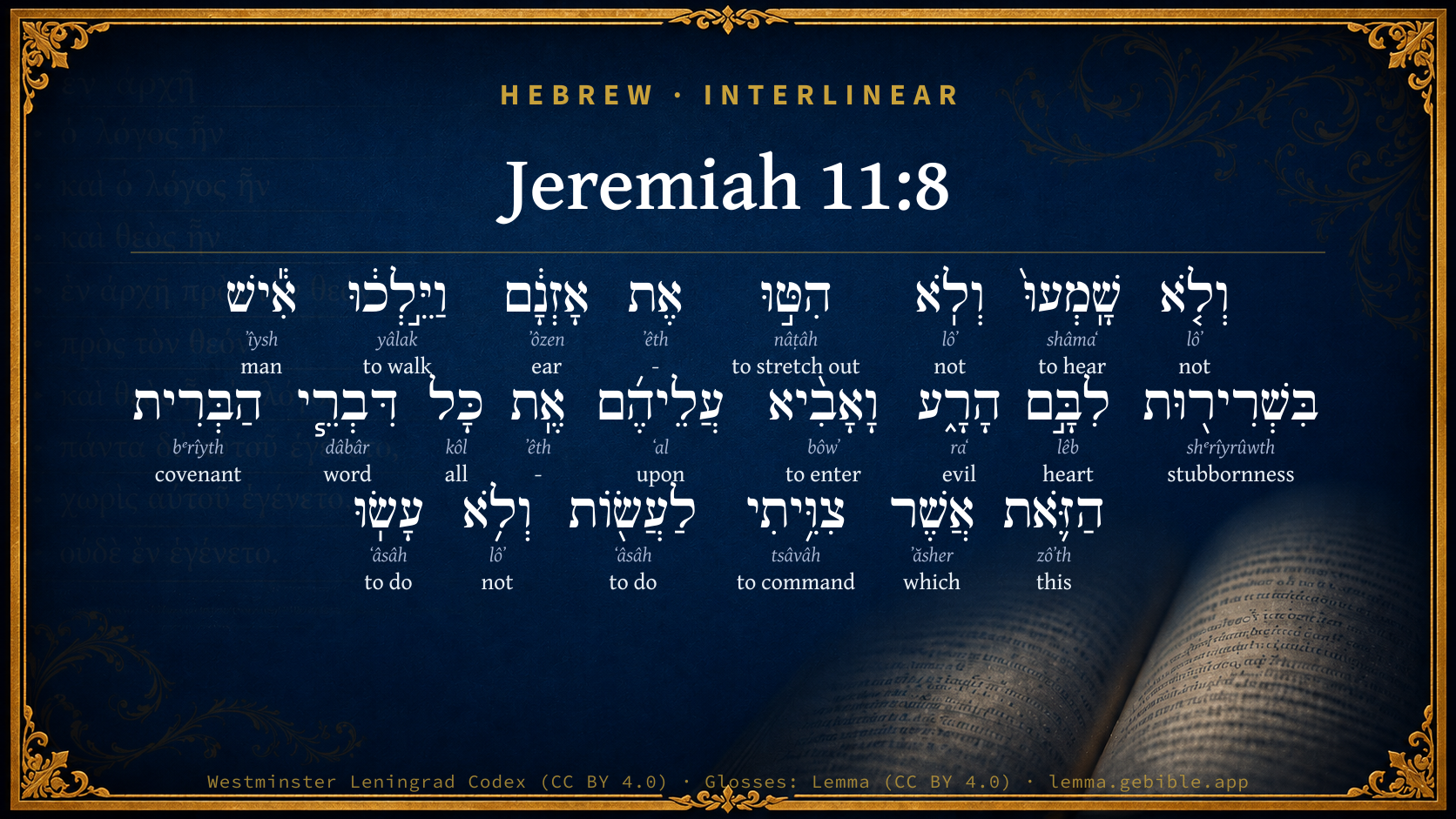
Hebrew (Westminster Leningrad Codex) Jeremiah 11:8 appears in the Hebrew Old Testament. The text above is from the Westminster Leningrad Codex. Each word links to its Strong’s number, a concise gloss, and parsing drawn from the Open Scriptures Hebrew Bible morphology. Click any word for its full Brown-Driver-Briggs (BDB) entry.
Download image
Cite this verse

Jeremiah 11:8 (World English Bible). Public Domain. Lemma interlinear Bible study tool, https://lemma.gebible.app/v/jeremiah/11/8.

Show BibTeX & RIS
BibTeX
RIS
English Translation
Yet they didn't obey, nor turn their ear, but walked everyone in the stubbornness of their evil heart: therefore I brought on them all the words of this covenant, which I commanded them to do, but they didn't do them.
World English Bible · Public Domain
Download a study sheet

One document with this verse’s original text, its word-by-word gloss line, the meaning frame, cross-references with their text, attributed commentary, and full source and license credits — printable, and it pastes into notes with its structure intact.

This verse Autodidact and up

Study sheet (.html) Plain text (.txt)

A passage Seminary Student

Up to 50 verses in one chapter. A passage sheet keeps up to 6 commentary sources and 12 cross-references per verse, in the order this page ranks them, and says so on the sheet whenever that leaves anything out. Ask for a single verse and you get the Autodidact verse sheet above.

Everything on this page stays free to read, with no account — the sheet is a download of what is already on screen, not access to it.

Want to remove ads? Support Godless Engineer
Compare translations 3

The same verse in 3 English versions, stacked beneath the original-language interlinear above. Click any original word for its lexicon entry.

Each is an independent rendering of the whole verse — the interlinear is not word-aligned to these translations.

Highlighted words mark where these versions differ — a whole-verse word diff, not a word-by-word alignment.

  • World English Bible Public Domain
    Yet they didn't obey, nor turn their ear, but walked everyone in the stubbornness of their evil heart: therefore I brought on them all the words of this covenant, which I commanded them to do, but they didn't do them.
  • King James Version Public Domain
    Yet they obeyed not, nor inclined their ear, but walked every one in the imagination of their evil heart: therefore I will bring upon them all the words of this covenant, which I commanded them to do: but they did them not.
  • unfoldingWord Literal Text CC BY-SA 4.0
    Yet they did not listen and they did not incline their ear, but everyone walked in the stubbornness of their evil heart, therefore I brought upon them all of the words of this covenant that I commanded to do, but they did not do.’”

unfoldingWord Literal Text — © unfoldingWord, licensed CC BY-SA 4.0. Word-aligned USFM3 via Door43 (git.door43.org/unfoldingWord/en_ult).

Versions to compare (up to 4)

3 of 4 selected

Show all 18 translations

Every available English version of this verse, each an independent rendering of the whole verse.

  • World English Bible Public Domain
    Yet they didn't obey, nor turn their ear, but walked everyone in the stubbornness of their evil heart: therefore I brought on them all the words of this covenant, which I commanded them to do, but they didn't do them.
  • Berean Standard Bible Public Domain
    Yet they would not obey or incline their ears, but each one followed the stubbornness of his evil heart. So I brought on them all the curses of this covenant I had commanded them to follow but they did not keep.”
  • Majority Standard Bible Public Domain
    Yet they would not obey or incline their ears, but each one followed the stubbornness of his evil heart. So I brought on them all the curses of this covenant I had commanded them to follow but they did not keep.”
  • King James Version Public Domain
    Yet they obeyed not, nor inclined their ear, but walked every one in the imagination of their evil heart: therefore I will bring upon them all the words of this covenant, which I commanded them to do: but they did them not.
  • American Standard Version (1901) Public Domain
    Yet they obeyed not, nor inclined their ear, but walked every one in the stubbornness of their evil heart: therefore I brought upon them all the words of this covenant, which I commanded them to do, but they did them not.
  • Revised Version (1885) Public Domain
    Yet they obeyed not, nor inclined their ear, but walked every one in the stubbornness of their evil heart: therefore I brought upon them all the words of this covenant, which I commanded them to do, but they did them not.
  • Geneva Bible (1599) Public Domain
    Neuerthelesse they would not obey, nor encline their eare: but euery one walked in the stubbernesse of his wicked heart: therefore I will bring vpon them all the wordes of this couenant, which I commanded them to do, but they did it not.
  • Douay-Rheims (1899) Public Domain
    And they obeyed not, nor inclined their ear: but walked every one in the perverseness of his own wicked heart: and I brought upon them all the words of this covenant, which I commanded them to do, but they did them not.
  • Young's Literal Translation Public Domain
    And they have not hearkened nor inclined their ear, And they walk each in the stubbornness of their evil heart, And I bring on them all the words of this covenant, That I commanded to do, and they did not.'
  • Literal Standard Version CC BY-SA 4.0
    And they have not listened nor inclined their ear, || And they each walk in the stubbornness of their evil heart, || And I bring on them all the words of this covenant, || That I commanded to do, and they did not.”
  • Unlocked Literal Bible CC BY-SA 4.0
    But they did not listen or pay attention. Each person has been walking in the stubbornness of his wicked heart. So I brought all the curses in this covenant that I commanded to come against them. But the people still did not obey.”
  • unfoldingWord Literal Text CC BY-SA 4.0
    Yet they did not listen and they did not incline their ear, but everyone walked in the stubbornness of their evil heart, therefore I brought upon them all of the words of this covenant that I commanded to do, but they did not do.’”
  • Darby Bible Public Domain
    But they have not hearkened, nor inclined their ear, but have walked every one in the stubbornness of their evil heart; and I have brought upon them all the words of this covenant, which I commanded [them] to do, and they have not done.
  • World Messianic Bible Public Domain
    Yet they didn’t obey, nor turn their ear, but everyone walked in the stubbornness of their evil heart. Therefore I brought on them all the words of this covenant, which I commanded them to do, but they didn’t do them.’”
  • Webster's Bible Public Domain
    Yet they obeyed not, nor inclined their ear, but walked every one in the imagination of their evil heart: therefore I will bring upon them all the words of this covenant, which I commanded them to do; but they did them not.
  • Free Bible Version CC BY-SA 4.0
    But they refused to obey, they wouldn't listen. Instead each of them followed their own stubborn and evil thinking. I had ordered them to follow the agreement, but they didn't do so. So I brought down on them all the curses contained in the agreement.
  • Bible in Basic English Public Domain
    But they gave no attention and did not give ear, but they went on, every man in the pride of his evil heart: so I sent on them all the curses in this agreement, which I gave them orders to keep, but they did not.
  • JPS Tanakh (1917) Public Domain
    Yet they hearkened not, nor inclined their ear, but walked every one in the stubbornness of their evil heart; therefore I brought upon them all the words of this covenant, which I commanded them to do, but they did them not.'

Literal Standard Version (2020), Covenant Press — licensed CC BY-SA 4.0. Text via the HelloAO Bible API (eBible.org). Unlocked Literal Bible (unfoldingWord) — licensed CC BY-SA 4.0. Text via the HelloAO Bible API (eBible.org). unfoldingWord Literal Text — © unfoldingWord, licensed CC BY-SA 4.0. Word-aligned USFM3 via Door43 (git.door43.org/unfoldingWord/en_ult). Free Bible Version, Dr. Jonathan Gallagher — licensed CC BY-SA 4.0. Text via the HelloAO Bible API (eBible.org).

Word by word

More ways to search: Search by grammar → Find every occurrence → Compare this word →

Practice this passage: Drill this verse → Learn its vocabulary →

בִּשְׁרִיר֖וּת
shᵉrîyrûwth
H8307
“in/at · stubbornness of”
Preposition + Noun, Common, Feminine, Singular, Construct
Part of Speech
Preposition + Noun
Type
Common
Gender
Feminine
Number
Singular
State
Construct
Full BDB Definition

Origin: from H8324 in the sense of twisted, i.e. firm

TWOT: 2469d

stubbornness, hardness, firmness
  1. וְלֹ֤א lôʼ H3808 “and · not” Conjunction + Particle, Negative
  2. שָֽׁמְעוּ֙ shâmaʻ H8085 “to hear” Verb, Qal, Perfect, 3rd Person, Common, Plural
  3. וְלֹֽא lôʼ H3808 “and · not” Conjunction + Particle, Negative
  4. הִטּ֣וּ nâṭâh H5186 “to stretch out” Verb, Hiphil, Perfect, 3rd Person, Common, Plural
  5. אֶת ʼêth H853 “-” Particle, Direct Object
  6. אָזְנָ֔ם ʼôzen H241 “ear · their” Noun, Common, Feminine, Singular, Construct + Suffix, Personal, 3rd Person, Masculine, Plural
  7. וַיֵּ֣לְכ֔וּ yâlak H3212 “and · to walk” Conjunction + Verb, Qal, Sequential Imperfect, 3rd Person, Masculine, Plural
  8. אִ֕ישׁ ʼîysh H376 “man” Noun, Common, Masculine, Singular, Absolute
  9. לִבָּ֣ם lêb H3820 “heart · their” Noun, Common, Masculine, Singular, Construct + Suffix, Personal, 3rd Person, Masculine, Plural
  10. הָרָ֑ע raʻ H7451 “the · evil” Particle, Definite Article + Adjective, Adjective, Masculine, Singular, Absolute
  11. וָאָבִ֨יא bôwʼ H935 “and · to enter” Conjunction + Verb, Hiphil, Sequential Imperfect, 1st Person, Common, Singular
  12. עֲלֵיהֶ֜ם ʻal H5921 “upon · them” Preposition + Suffix, Personal, 3rd Person, Masculine, Plural
  13. אֶֽת ʼêth H853 “-” Particle, Direct Object
  14. כָּל kôl H3605 “all of” Noun, Common, Masculine, Singular, Construct
  15. דִּבְרֵ֧י dâbâr H1697 “words of” Noun, Common, Masculine, Plural, Construct
  16. הַבְּרִית bᵉrîyth H1285 “the · covenant” Particle, Definite Article + Noun, Common, Feminine, Singular, Absolute
  17. הַזֹּ֛את zôʼth H2063 “the · this” Particle, Definite Article + Pronoun, Demonstrative, Feminine, Singular
  18. אֲשֶׁר ʼăsher H834 “which” Particle, Relative
  19. צִוִּ֥יתִי tsâvâh H6680 “to command” Verb, Piel, Perfect, 1st Person, Common, Singular
  20. לַעֲשׂ֖וֹת ʻâsâh H6213 “to do” Preposition + Verb, Qal, Infinitive Construct
  21. וְלֹ֥א lôʼ H3808 “and · not” Conjunction + Particle, Negative
  22. עָשֽׂוּ ʻâsâh H6213 “to do” Verb, Qal, Perfect, 3rd Person, Common, Plural

About this verse

These counts appear in no published source. They are computed here, from the morphology-tagged text and Lemma’s own curated glosses. What Lemma adds →

23
words
19
distinct lemmas
Prophets
section

Notable vocabulary

The rarest word here is בִּשְׁרִיר֖וּת stubbornness H8307 — appearing just 10 times in the whole Hebrew Bible.

Shared distinctive vocabulary

בִּשְׁרִיר֖וּת stubbornness H8307 occurs in 10 verses of the Hebrew Bible. Also found in:

Grammatical profile

  • 7 verbs
  • 7 nouns
  • 1 adjective
  • 1 pronoun
  • 1 preposition
  • 6 particles

Verb forms

  • שָֽׁמְעוּ֙ Qal · Perfect
  • הִטּ֣וּ Hiphil · Perfect
  • וַיֵּ֣לְכ֔וּ Qal · Sequential Imperfect
  • וָאָבִ֨יא Hiphil · Sequential Imperfect
  • צִוִּ֥יתִי Piel · Perfect
  • לַעֲשׂ֖וֹת Qal · Infinitive Construct
  • עָשֽׂוּ Qal · Perfect

Repetition

Words recur within this verse — often emphatic in Hebrew:

  • לַעֲשׂ֖וֹת to do H6213 ×2
  • וְלֹ֤א not H3808 ×3

Cross-references

21

Topical passages linked to Jeremiah 11:8 in the Treasury of Scripture Knowledge — connected by theme and wording, ordered by reader-vote popularity; previews shown in the World English Bible.

  • Jeremiah 7:24 But they didn't listen nor turn their ear, but walked in [their own] counsels [and] in the stubbornness of their evil heart, and went backward, and not forward.
  • Jeremiah 7:26 yet they didn't listen to me, nor inclined their ear, but made their neck stiff: they did worse than their fathers.
  • Jeremiah 3:17 At that time they shall call Jerusalem the throne of Yahweh; and all the nations shall be gathered to it, to the name of Yahweh, to Jerusalem: neither shall they walk any more after the stubbornness of their evil heart.
  • Jeremiah 35:15 I have sent also to you all my servants the prophets, rising up early and sending them, saying, Return you now every man from his evil way, and amend your doings, and don't go after other gods to serve them, and you shall dwell in the land which I have given to you and to your fathers: but you have not inclined your ear, nor listened to me.
  • Ezekiel 20:8 But they rebelled against me, and would not listen to me; they did not every man cast away the abominations of their eyes, neither did they forsake the idols of Egypt. Then I said I would pour out my wrath on them, to accomplish my anger against them in the midst of the land of Egypt.
  • Leviticus 26:14–46 "'But if you will not listen to me, and will not do all these commandments;
  • Deuteronomy 28:15–68 But it shall come to pass, if you will not listen to the voice of Yahweh your God, to observe to do all his commandments and his statutes which I command you this day, that all these curses shall come on you, and overtake you.
  • Deuteronomy 29:21–24 Yahweh will set him apart to evil out of all the tribes of Israel, according to all the curses of the covenant that is written in this book of the law.
  • Deuteronomy 30:17–19 But if your heart turn away, and you will not hear, but shall be drawn away, and worship other gods, and serve them;
  • Deuteronomy 31:17–18 Then my anger shall be kindled against them in that day, and I will forsake them, and I will hide my face from them, and they shall be devoured, and many evils and troubles shall come on them; so that they will say in that day, Haven't these evils come on us because our God is not among us?
  • Deuteronomy 32:20–26 He said, I will hide my face from them, I will see what their end shall be: For they are a very perverse generation, Children in whom is no faithfulness.
  • Joshua 23:13–16 know for a certainty that Yahweh your God will no more drive these nations from out of your sight; but they shall be a snare and a trap to you, and a scourge in your sides, and thorns in your eyes, until you perish from off this good land which Yahweh your God has given you.
  • Nehemiah 9:16–17 But they and our fathers dealt proudly and hardened their neck, and didn't listen to your commandments,
  • Nehemiah 9:26 Nevertheless they were disobedient, and rebelled against you, and cast your law behind their back, and killed your prophets that testified against them to turn them again to you, and they committed awful blasphemies.
  • Nehemiah 9:29 and testified against them, that you might bring them again to your law. Yet they dealt proudly, and didn't listen to your commandments, but sinned against your ordinances, (which if a man do, he shall live in them), and withdrew the shoulder, and hardened their neck, and would not hear.
  • Jeremiah 6:16–17 Thus says Yahweh, Stand you in the ways and see, and ask for the old paths, where is the good way; and walk therein, and you shall find rest for your souls: but they said, We will not walk [therein].
  • Jeremiah 9:13–14 Yahweh says, Because they have forsaken my law which I set before them, and have not obeyed my voice, neither walked therein,
  • Jeremiah 44:17 But we will certainly perform every word that is gone forth out of our mouth, to burn incense to the queen of the sky, and to pour out drink-offerings to her, as we have done, we and our fathers, our kings and our princes, in the cities of Judah, and in the streets of Jerusalem; for then had we plenty of food, and were well, and saw no evil.
  • Ezekiel 20:18–21 I said to their children in the wilderness, Don't you walk in the statutes of your fathers, neither observe their ordinances, nor defile yourselves with their idols.
  • Ezekiel 20:37–38 I will cause you to pass under the rod, and I will bring you into the bond of the covenant;
  • Zechariah 7:11 But they refused to listen, and turned their backs, and stopped their ears, that they might not hear.

Cross-references courtesy of OpenBible.info (CC BY 4.0).

Hebrew and Greek witnesses Masoretic Hebrew ↔ Greek Septuagint

The same verse in the two great witnesses to the Old Testament, shown verse-for-verse.

These are two independent witnesses, not word-aligned to each other, and the Septuagint is shown in lemma (dictionary) form.

Hebrew Jeremiah 11:8 Masoretic · Westminster Leningrad Codex

וְלֹ֤א שָֽׁמְעוּ֙ וְלֹֽא הִטּ֣וּ אֶת אָזְנָ֔ם וַיֵּ֣לְכ֔וּ אִ֕ישׁ בִּשְׁרִיר֖וּת לִבָּ֣ם הָרָ֑ע וָאָבִ֨יא עֲלֵיהֶ֜ם אֶֽת כָּל דִּבְרֵ֧י הַבְּרִית הַזֹּ֛את אֲשֶׁר צִוִּ֥יתִי לַעֲשׂ֖וֹת וְלֹ֥א עָשֽׂוּ

Yet they didn't obey, nor turn their ear, but walked everyone in the stubbornness of their evil heart: therefore I brought on them all the words of this covenant, which I commanded them to do, but they didn't do them.

World English Bible · Public Domain

Greek LXX Structure differs

In the Septuagint, Jeremiah is about an eighth shorter than the Hebrew and arranges its material differently — the Oracles Against the Nations (Hebrew chapters 46–51) appear in the middle of the Greek book, after 25:13. Because the chapter and verse boundaries do not line up, a verse-for-verse comparison with the Hebrew is not shown.

A verse-for-verse comparison isn’t shown here because the chapters and verses don’t line up. Switch to the LXX edition with the MT / LXX toggle above to read the Greek directly.

Hebrew: Westminster Leningrad Codex (CC BY 4.0). Greek: Septuagint (public domain); English from a public-domain English Septuagint. How the Septuagint differs from the Hebrew →

Targum (Aramaic paraphrase)

1

The Targum is the ancient Jewish Aramaic paraphrase of the Hebrew Scriptures — an interpretive translation, not the Hebrew text itself. Onkelos (literal) and Pseudo-Jonathan (expansive) render the Torah, and Jonathan the Prophets. Coverage is partial: where no permissively-licensed English translation exists for a verse, only the Aramaic is shown. This is verse-level text, not a word-by-word alignment to the Hebrew.

  1. Targum Jonathan Prophets (Joshua–Malachi)
    וְלָא קַבִּילוּ וְלָא אַרְכִינוּ יַת אוּדְנֵהוֹן וַאֲזָלוּ גְבַר בְּהִרְהוּר לִבְּהוֹן בִּישָׁא וְאַיְתֵיתִי עֲלֵיהוֹן פּוּרְעֲנוּתָא עַל דְלָא קַבִּילוּ פִּתְגְמֵי קְיָמֵא הָדֵין דְפַקְדֵית לְמֶעְבַּד וְלָא עֲבָדוּ:

    (no public-domain English translation for this verse)

    Targum Jonathan — Aramaic: “Mikraot Gedolot” (public domain). English: “Sefaria Community Translation” (CC0 1.0 (public-domain dedication)); “London "Chaldee Paraphrase," 1871” (public domain). Text via Sefaria.

Commentary

Notes on Jeremiah 11:8 from classic Christian and Jewish commentators (each source and its license shown beneath its notes). The classic Christian expositions comment on the surrounding passage and are grouped to its opening verse, so a note may address several verses; the Jewish commentaries on the Tanakh (Rashi and others) are per-verse, so they appear only where the commentator wrote on this verse.

Lemma curates 59 commentaries, every one of them public domain or Creative Commons licensed, each selected and text-cleaned for this edition rather than reprinted as found. About our sources →

Trapp's Complete Commentary

John Trapp

Jer 11:8 Yet they obeyed not, nor inclined their ear, but walked every one in the imagination of their evil heart: therefore I will bring upon them all the words of this covenant, which I commanded [them] to do; but they did [them] not.

Ver. 8. Yet they obeyed not.] See Jer 7:24.

Therefore I will bring.] Heb., And I brought upon them.

John Trapp, A Commentary or Exposition upon All the Books of the Old and New Testament (1647–1656) — public domain. Text from a community e-Sword module.

The Biblical Illustrator

Joseph S. Exell

Jer_11:8

They obeyed not.

Sins of omission

I. The great commonness of sins of omission.

1. In a certain sense all offences against the law of God come under the head of sins of omission. Every sin is a breach of the all-comprehensive law, Thou shalt love the Lord thy God with all thy heart, and thy neighbour as thyself. How multitudinous our omissions in respect to this command! Too often we have had other gods beside Him. So, too, in regard to our neighbour. What sins of omission daily occur in our various relationships--our neighbours, our children, our household.

2. Sins of omission are seen in all who neglect to perform the first and all-essential Gospel command: Repent and be converted; Repent and be baptized; Believe on the Lord Jesus Christ.

3. Sins of omission in religious duties. Multitudes neglect the outward worship of God. But others show religious regard; yet what omissions as to prayer; how lax in devotion are the most of us! As to the Bible: left unread! As to service: talents wrapped up in napkin! Our omissions lie upon the horizon of memory like masses of storm clouds accumulating for a horrible tempest.

II. The cause of this excessive multiplicity of sins of omission.

1. The great cause lies in our evil hearts. Absence of clean heart and right spirit is at the root: Ye must be born again.

2. The conscience of man is not well alive to sins of omission. While conscience will chastise men for direct acts of wrong, not awake to sins of neglect.

3. These sins are multiplied through indolence. In the face of eternity, life, death, heaven, and hell, multitudes are simply ruined because they neglect the great salvation, and are absolutely too idle to concern themselves.

4. Ignorance. With many ignorance is wilful; have Bible, conscience; yet sin against light and knowledge.

5. Men excuse themselves so readily about these sins of omission. A more convenient season is anticipated for repentance, faith, prayer.

6. Many neglect because of the prevalence of the like conduct. To omit to love and serve the Lord is the custom. But enlightened conscience warns us that custom is no excuse for sin: it will be no plea at the bar of God.

III. The sinfulness of sins of omission. They cannot be trivial, for--

1. Consider what would be the consequences if God were to omit His mercies to us for one moment! Suppose Jesus had left an omission in His plan of salvation; the whole would have failed, and humanity left without remedy or hope.

2. Reflect what an influence they would have upon an ordinary commonwealth. If one person has a right to omit his duty, another has, and all have--watchman, judge, merchant, husbandman; society soon collapse, kingdom break to pieces.

3. Think how you would judge of omissions towards yourselves. In the case of your servant, you instantly resent it. So in a soldier. Even in your child: to neglect your command is regarded as equally criminal as to commit offence.

4. Consider what God thinks of omissions. Saul was ordered to kill the Amalekites--not one to escape: he saved Agag and best of the cattle; therefore the Lord said, I have put thee away from being king over Israel! Ahab was commanded to kill Benhadad on account of great criminality: Ahab only captured him; therefore, Because thou hast let this man go, thy life shall be for his life! The man with one talent was condemned because he neglected to sue it.

IV. The result and punishment of sins of omission.

1. They will condemn us. The King shall say, I was hungered and ye gave Me no meat, etc. The absence of virtue rather than the presence of vice condemned them. Without holiness no man shall see the Lord.

2. If persevered in, they will effectually shut against us the possibilities of pardon. He that believeth not--is there pardon, rescue for him? No; he is condemned already, because he hath not believed on the Son of God. Will the mercy of God blot out sins uurepented of? Nay; sins will cling to us as the leprosy to the house of Gehazi. (C. H. Spurgeon.)

The Biblical Illustrator, edited by Joseph S. Exell (c. 1880s–1900s) — public domain. Text from a community e-Sword module.

Tyndale Open Study Notes

Tyndale Open Resources

11:8 The Old Testament books of Numbers, Judges, Samuel, and Kings describe how the people of Israel repeatedly violated the covenant right up to Jeremiah’s time.

Tyndale Open Study Notes — © Tyndale Open Resources, licensed CC BY-SA 4.0. Text via the HelloAO Bible API.

Geneva Bible (1599)

Geneva Bible translators

According to his own fantasy, and not as my word appointed him.

Meaning, the menaces and curses contained in the Law, Lev. 26:14; Deut. 28:16.

Geneva Bible (1599) marginal notes — public domain. Text via Bolls.life.

Jamieson, Fausset & Brown

Robert Jamieson, A. R. Fausset & David Brown

imagination--rather, "stubbornness."

will bring--The words, "even unto this day" (Jer 11:7), confirm English Version rather than the rendering of ROSENMULLER: "I brought upon them."

words--threats (Jer 11:3; Deu 27:15-26).

Jamieson, Fausset & Brown — Commentary Critical and Explanatory on the Whole Bible (1871) — public domain (CC PDM 1.0). Text via the HelloAO Bible API.

John Calvin's Commentaries

It afterwards follows, Yet they heard not, and bent not, or inclined not their ear Here the Prophet does not accuse a few men of perverseness, but says that, from the time they had been redeemed, they had been rebellious against God: and he exaggerates their sin by saying that they inclined not their ear; for this was no doubt added for the sake of emphasis, as though the Prophet had said, — that it was only their own fault that the right way was not quite evident to them, for they deigned not to give ear to God. Now, it is a proof of extreme contempt, when we not only repudiate what God says to us, and refuse to obey his authority and advice, but when we close up every avenue, and, as Tar as we can, forbid him to speak to us; this is surely an extremity of insolence. It may indeed be, that one will hear another speaking, and yet will not do what he says; he still will shew some courtesy, lest a complaint of inattention be made; but it is an intolerable barbarity when we do not listen to the words of another. God here complains that the Israelites had not only been disobedient to him, after having been instructed, but that they had been so refractory, that they insolently rejected all the words of the prophets; which was not only a proof of base impiety, but also of barbarous perverseness. We now then understand what the Prophet means.

He says, that they walked every one in the wickedness of his own evil heart As he had before shewn that they had been in due time warned, it is clear that they followed not through mistake their impious superstitions, but because they rejected the true worship of God, and hearkened not to the teaching of the prophets. By saying that they walked every one, etc., the Prophet doubtless intended to include them all as it were in one bundle; as though he had said, that they had not been drawn away by a sudden impulse, as it is often the case when an agitation is made by a few, and when the most follow, being driven as it were by a storm, and think not what they do; for thus some terror often seizes on the minds of the many, so that they go here and there without knowing where they are going. But the Prophet here teaches us that every one followed his own counsel; as though he had said that the worship of God had not been thus rejected by the influence of the multitude, but that each one had his own object, and had concocted the wickedness and the great sin of rejecting God. There is then more meaning and force in this way of speaking, than if he had said that they all walked in the wickedness of their own hearts. He further shews that they were all, from the least to the greatest, implicated, as they say, in the same impiety.

He afterwards adds, that God had brought upon them the words, that is, the threatenings of the covenant By the words of the covenant he means not here the doctrine or precepts of the law. He indeed mentioned before the words of the covenant for the commands of God; but now, on finding that he had to do with refractory men, who were not capable of receiving any doctrine, he comes to threatenings. But God prescribes first in his law what he wins to be done, and then adds not only kind invitations, but also what is alluring, in order to conciliate the minds of men: but when there is no attention to obedience, and no care for it, he then comes to threatenings. Though the Prophet had omitted the promises, he had yet spoken previously of the law itself; but he says now that God had executed what he had denounced on them.

He further says, Which I have commanded to be done; and they did them not There seems indeed to be a confusion here; for by the words of this covenant, he no doubt means threatenings, as I have stated: then he immediately adds, which I have commanded to be done, and they did them not But, as I have already reminded you, the Prophet had previously, with sufficient clearness, taught them that the rule of a godly and holy life was set forth in the law; but he now refers especially to threatenings. It is then not strange that he speaks thus indistinctly, for the people had in a manner perverted the law. There were indeed in the law these two distinct things — doctrine, or a rule of life; and threatenings, which were added as stimulants to rouse the sloth of men, or rather to subdue their perverseness. But as the Israelite, and the Jews had not attended to the voice of God, the Prophet here blends threatenings with precepts.

We now understand what the Prophet means in this passage, when he says that he was sent by God to cry, Hear ye the words of this covenant; for they were forgetful of true religion; and such was their oblivion and impious’ contempt of the whole law, that they had need of being taught its first rudiments. This is one thing. He then shews how solicitous God had been about their welfare, so that he had not neglected any of the duties of the best of fathers, and that yet his labor had been all in vain; for they had not only been led away by their own lusts, but their inward wickedness had closed their ears, so that they deigned not to listen to God’s voice; and this had not been in one age only, but from the time they came out of Egypt to that day. It hence follows that they were justly punished, for God had tried all means before he had recourse to severity; but since he had adopted all kinds of ways to reform them, and all in vain, the only thing that remained was to punish them as men past all remedy. This is the import of the whole. He now adds —

John Calvin's Commentaries (1540-1563) — public domain. Text from the Calvin Translation Society English edition (1840s-50s) via the Christian Classics Ethereal Library (ccel.org). Calvin's coverage is partial (roughly two-thirds of the Bible); uncommented books and verses are honest gaps, never fabricated. The 19th-century editor's footnotes and remarks are omitted so the notes are faithfully Calvin's own voice.

Ellicott's Commentary for English Readers

(8) Imagination.—Better, as before (Jer_3:17), stubbornness.

Therefore I will bring upon them.—Better, I have brought upon them. The words contain not a direct prediction, but an appeal to the experience of the past as in itself foreshadowing the future.

A Bible Commentary for English Readers, edited by Charles John Ellicott (1878–1897) — public domain. Text from a community e-Sword module.

The Cambridge Bible for Schools and Colleges

gen. ed. J. J. S. Perowne

8. stubbornness] Cp. ch. Jer_3:17.

The Cambridge Bible for Schools and Colleges (gen. ed. J. J. S. Perowne; Cambridge University Press, 1878–1918) — public domain. Text from a community e-Sword module.

John Gill's Exposition

And the Lord said unto me,.... After he had given him the order to publish and proclaim the words of the covenant, and exhort to obedience to them; he showed the prophet the reason of it, and opened to him a secret he was not acquainted with:

a conspiracy is found among the men of Judah, and among the inhabitants of Jerusalem; not against the king, and against the civil government, but against the King of kings, against God and his covenant, his word and his worship; some designs were forming to cashier these, and introduce a new religion, the idolatry of the Gentiles; and it was not a few only that were in the scheme, the combination was general, city and country were in it; the inhabitants of Jerusalem, the more polite part of the nation, and the country people, that dwelt in the several cities of Judah, were all united in this affair; and this was found out by him who sees and knows all things. It is common for innovators in religion to lay schemes privately, and secretly inculcate them, before things are ripe for the open introduction of them. The Syriac version renders it, "a rebellion"; and conspiracies often issue in open rebellion; and so the Targum,

"and it is found that the men of Judah, and the inhabitants of Jerusalem, have rebelled against my word.''

John Gill's Exposition of the Whole Bible (1746–1763) — public domain (CC PDM 1.0). Text via the HelloAO Bible API.

Albert Barnes' Notes on the Bible

I will bring - Rather, I have brought. The breach of the covenant upon their part had always brought temporal calamity. The last examples were the deportation of the ten tribes by Salmanezer, and the leading of Manasseh prisoner to Babylon in chains (2Ch 33:11).

Albert Barnes' Notes on the Bible (1834–1885) — public domain. Text from a community e-Sword/MySword module.

Haydock's Catholic Bible Commentary

Brought; or "will bring," seems preferable. What does the history of God’s people till the captivity exhibit, but scenes of disorder and of succeeding misery? (Calmet)

George Leo Haydock (1774–1849), Haydock's Catholic Family Bible and Commentary, 1859 edition — public domain. Excludes Psalms (Douay-Rheims chapter numbering differs from Protestant) and Deuterocanonical books (Catholic canon only).

Matthew Poole's English Annotations

But had not hearkened unto his counsels, but every one had walked after the imaginations of his own heart. A phrase by which sin is often expressed in holy writ, Deu 29:19; Jer 3:17; 7:24; 9:14; 13:10; 16:12; 18:12; 23:17. The imaginations of man’s heart are only evil, Gen 6:5; 8:21. Hence holiness is set out by the notion of self-denying, not pleasing ourselves, mortifying our members, &c. For this God threateneth to bring upon them all his words of threatening annexed to the covenant of the law.

Matthew Poole's English Annotations on the Holy Bible (1683–1685) — public domain. Text from a community e-Sword/MySword module.

John Wesley's Explanatory Notes

Did them not - For this God threatens to bring upon them all his words of threatening, annexed to the covenant of the law.

John Wesley, Explanatory Notes Upon the Whole Bible (1754–1765) — public domain. Text via the GEBible commentary corpus.

Rashi

Rabbi Shlomo Yitzchaki (Rashi)

And I brought upon them all the words of this covenant The curses stated in the covenant for the things that I commanded to do and they did not do.

Rashi on the Tanakh — English translations: “The Judaica Press complete Tanach with Rashi, translated by A. J. Rosenberg” (CC BY 4.0); “Pentateuch with Rashi's commentary by M. Rosenbaum and A.M. Silbermann, 1929-1934” (public domain); “The Metsudah Tanach series, Lakewood, N.J” (CC BY 4.0); and “The Book of Joshua, Metsudah Publications, 1997” (CC BY 4.0). Text via Sefaria.

Lesson kit

Teaching starters — assembled from the data on this page, not authored interpretation. Every prompt links to the verse data it draws on. Edit before teaching.

Jeremiah, in the Prophets, opens this verse with 23 words (19 distinct Hebrew lemmas). Its most distinctive word is shᵉrîyrûwth (“stubbornness”). A historical commentator’s framing appears above. Read the whole chapter for the surrounding context.

Discussion questions

  1. What does “stubbornness” (shᵉrîyrûwth) contribute to the verse as a whole?
  2. How does Deuteronomy 29:19, which shares the word «stubbornness», read alongside this verse?
  3. What does the repetition of “to do” (2× in this one verse) do in this verse?
  4. The translations on this page render this verse differently — a whole-verse word diff, not a word-by-word alignment. What might account for the different wordings?
  5. «שָֽׁמְעוּ֙» is a Qal Perfect verb. How does that grammatical form shape the action described?
  6. Compare how Trapp's Complete Commentary and The Biblical Illustrator read this verse. Where do they agree or differ?

Things to notice

Reading settings

Reading text

Shown beneath each verse's original-language words.

Old Testament
Old Testament edition

Read the OT as the Masoretic Hebrew (MT) or the Greek Septuagint (LXX).

English shown for the Greek Septuagint (in the Hebrew ↔ Greek comparison).

Comparing translations? Open the Compare panel on any verse page to stack up to four side by side.