
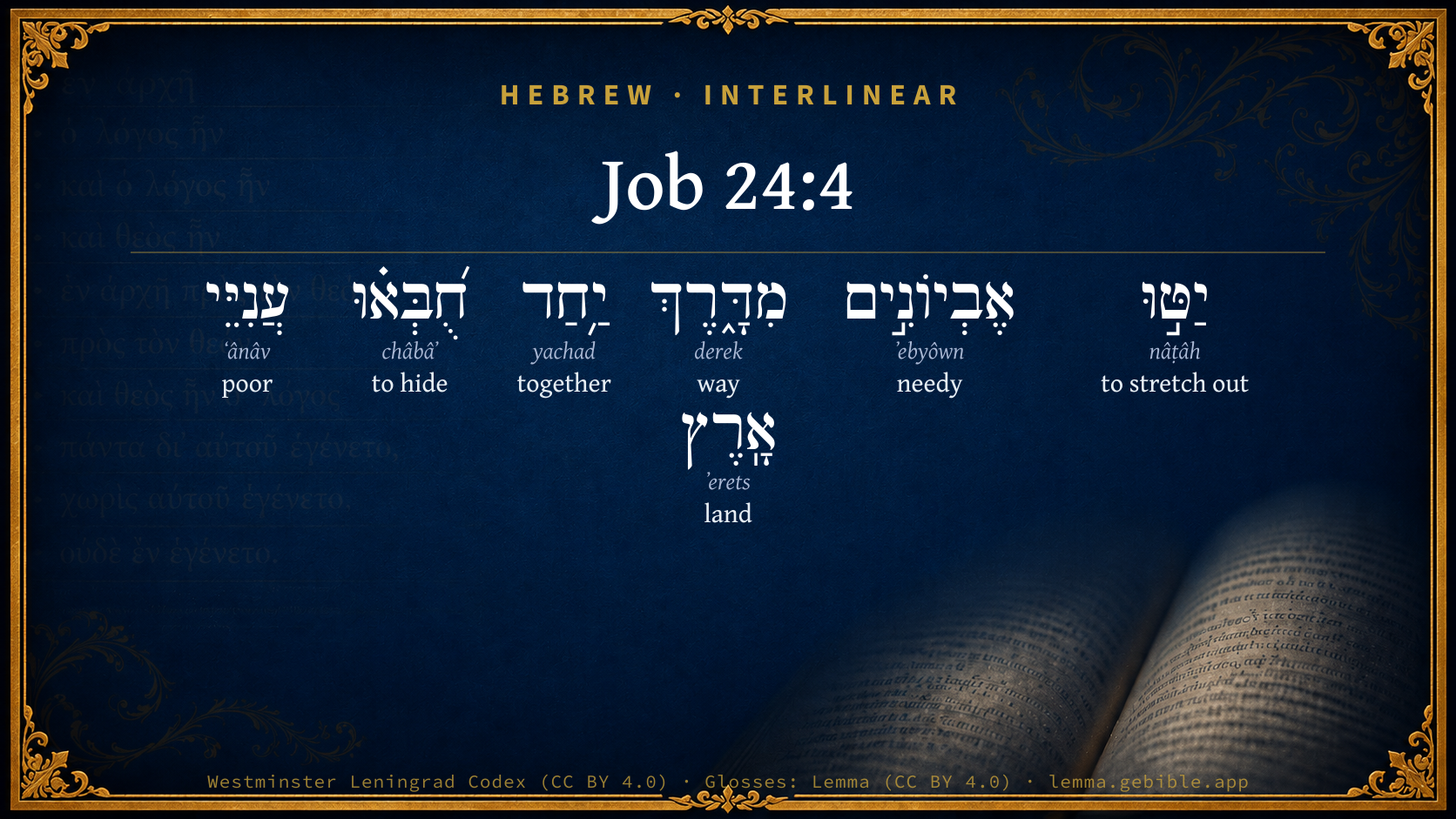
Job 24:4

Hebrew (Westminster Leningrad Codex) Job 24:4 appears in the Hebrew Old Testament. The text above is from the Westminster Leningrad Codex. Each word links to its Strong’s number, a concise gloss, and parsing drawn from the Open Scriptures Hebrew Bible morphology. Click any word for its full Brown-Driver-Briggs (BDB) entry.
Download image
Cite this verse

Job 24:4 (World English Bible). Public Domain. Lemma interlinear Bible study tool, https://lemma.gebible.app/v/job/24/4.

Show BibTeX & RIS
BibTeX
RIS
English Translation
They turn the needy out of the way. The poor of the earth all hide themselves.
World English Bible · Public Domain
Download a study sheet

One document with this verse’s original text, its word-by-word gloss line, the meaning frame, cross-references with their text, attributed commentary, and full source and license credits — printable, and it pastes into notes with its structure intact.

This verse Autodidact and up

Study sheet (.html) Plain text (.txt)

A passage Seminary Student

Up to 50 verses in one chapter. A passage sheet keeps up to 6 commentary sources and 12 cross-references per verse, in the order this page ranks them, and says so on the sheet whenever that leaves anything out. Ask for a single verse and you get the Autodidact verse sheet above.

Everything on this page stays free to read, with no account — the sheet is a download of what is already on screen, not access to it.

Want to remove ads? Support Godless Engineer
Compare translations 3

The same verse in 3 English versions, stacked beneath the original-language interlinear above. Click any original word for its lexicon entry.

Each is an independent rendering of the whole verse — the interlinear is not word-aligned to these translations.

Highlighted words mark where these versions differ — a whole-verse word diff, not a word-by-word alignment.

  • World English Bible Public Domain
    They turn the needy out of the way. The poor of the earth all hide themselves.
  • King James Version Public Domain
    They turn the needy out of the way: the poor of the earth hide themselves together.
  • unfoldingWord Literal Text CC BY-SA 4.0
    They turn the needy from the way; the poor of the land are hidden together.

unfoldingWord Literal Text — © unfoldingWord, licensed CC BY-SA 4.0. Word-aligned USFM3 via Door43 (git.door43.org/unfoldingWord/en_ult).

Versions to compare (up to 4)

3 of 4 selected

Show all 18 translations

Every available English version of this verse, each an independent rendering of the whole verse.

  • World English Bible Public Domain
    They turn the needy out of the way. The poor of the earth all hide themselves.
  • Berean Standard Bible Public Domain
    They push the needy off the road and force all the poor of the land into hiding.
  • Majority Standard Bible Public Domain
    They push the needy off the road and force all the poor of the land into hiding.
  • King James Version Public Domain
    They turn the needy out of the way: the poor of the earth hide themselves together.
  • American Standard Version (1901) Public Domain
    They turn the needy out of the way: The poor of the earth all hide themselves.
  • Revised Version (1885) Public Domain
    They turn the needy out of the way: the poor of the earth hide themselves together.
  • Geneva Bible (1599) Public Domain
    They make the poore to turne out of the way, so that the poore of the earth hide themselues together.
  • Douay-Rheims (1899) Public Domain
    They have overturned the way of the poor, and have oppressed together the meek of the earth.
  • Young's Literal Translation Public Domain
    They turn aside the needy from the way, Together have hid the poor of the earth.
  • Literal Standard Version CC BY-SA 4.0
    They turn aside the needy from the way, || Together have hid the poor of the earth.
  • Unlocked Literal Bible CC BY-SA 4.0
    They force needy people out of their path; poor people of the earth all hide themselves from them.
  • unfoldingWord Literal Text CC BY-SA 4.0
    They turn the needy from the way; the poor of the land are hidden together.
  • Darby Bible Public Domain
    They turn the needy out of the way: the afflicted of the land all hide themselves.
  • World Messianic Bible Public Domain
    They turn the needy out of the way. The poor of the earth all hide themselves.
  • Webster's Bible Public Domain
    They turn the needy out of the way: the poor of the earth hide themselves together.
  • Free Bible Version CC BY-SA 4.0
    They push the poor out of their way; the destitute are forced to hide from them.
  • Bible in Basic English Public Domain
    The crushed are turned out of the way; all the poor of the earth go into a secret place together.
  • JPS Tanakh (1917) Public Domain
    They turn the needy out of the way; the poor of the earth hide themselves together.

Literal Standard Version (2020), Covenant Press — licensed CC BY-SA 4.0. Text via the HelloAO Bible API (eBible.org). Unlocked Literal Bible (unfoldingWord) — licensed CC BY-SA 4.0. Text via the HelloAO Bible API (eBible.org). unfoldingWord Literal Text — © unfoldingWord, licensed CC BY-SA 4.0. Word-aligned USFM3 via Door43 (git.door43.org/unfoldingWord/en_ult). Free Bible Version, Dr. Jonathan Gallagher — licensed CC BY-SA 4.0. Text via the HelloAO Bible API (eBible.org).

Word by word

More ways to search: Search by grammar → Find every occurrence → Compare this word →

Practice this passage: Drill this verse → Learn its vocabulary →

About this verse

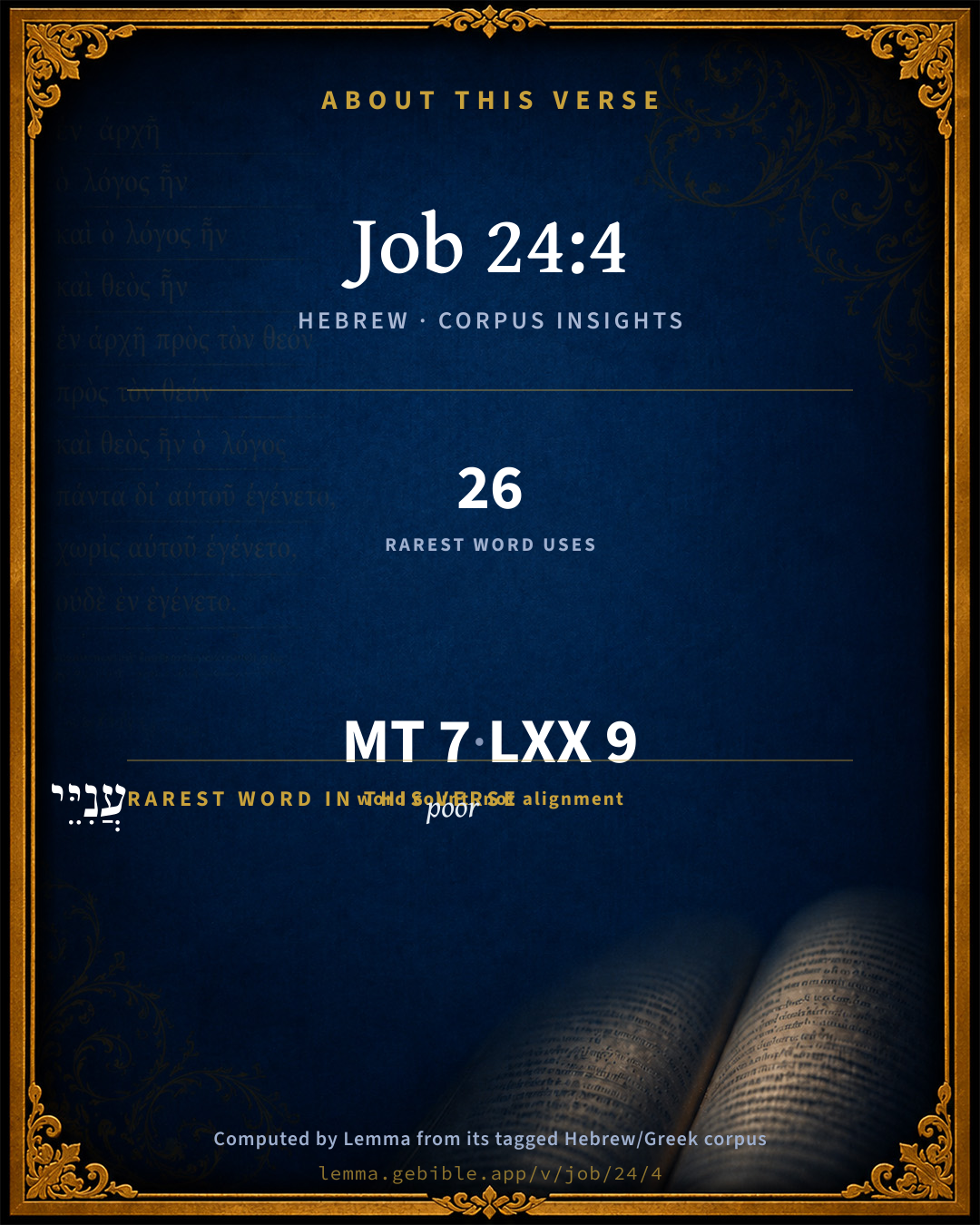
These counts appear in no published source. They are computed here, from the morphology-tagged text and Lemma’s own curated glosses. What Lemma adds →

7
words
7
distinct lemmas
Wisdom
section

Shared distinctive vocabulary

עֲנִיֵּי poor H6035 occurs in 24 verses of the Hebrew Bible. Also found in:

Grammatical profile

  • 2 verbs
  • 2 nouns
  • 2 adjectives
  • 1 adverb

Verb forms

  • יַטּ֣וּ Hiphil · Imperfect
  • חֻ֝בְּא֗וּ Pual · Perfect

Hebrew & Septuagint length

In English translation the verse runs 16 words from the Hebrew and 20 from the Septuagint (LXX English) — closely comparable.

A rough comparison of the two English renderings, which tokenize alike — not a word-level alignment.

Word counts can differ between the Hebrew and the Greek without any difference in meaning — e.g. the Hebrew direct-object marker אֵת has no separate Greek word, and Greek often adds the article ὁ.

In the original languages it is 7 Hebrew tokens and 9 Greek tokens — but the two are counted differently (Hebrew bundles its prefixes and suffixes into one token; the Greek is in lemma form), so that isn’t a like-for-like length.

Cross-references

18

Topical passages linked to Job 24:4 in the Treasury of Scripture Knowledge — connected by theme and wording, ordered by reader-vote popularity; previews shown in the World English Bible.

  • Proverbs 28:28 When the wicked rise, men hide themselves; But when they perish, the righteous thrive.
  • Job 24:14 The murderer rises with the light. He kills the poor and needy. In the night he is like a thief.
  • Ezekiel 22:29 The people of the land have used oppression, and exercised robbery; yes, they have vexed the poor and needy, and have oppressed the foreigner wrongfully.
  • Amos 2:7 They trample on the dust of the earth on the head of the poor, And deny justice to the oppressed; And a man and his father use the same maiden, to profane my holy name;
  • Job 29:12 Because I delivered the poor who cried, And the fatherless also, who had none to help him.
  • Job 30:25 Didn't I weep for him who was in trouble? Wasn't my soul grieved for the needy?
  • Job 31:16 "If I have withheld the poor from their desire, Or have caused the eyes of the widow to fail,
  • Psalms 41:1 Blessed is he who considers the poor: Yahweh will deliver him in the day of evil.
  • Psalms 109:16 Because he didn't remember to show kindness, But persecuted the poor and needy man, The broken in heart, to kill them.
  • Proverbs 22:16 Whoever oppresses the poor for his own increase and whoever gives to the rich, Both come to poverty.
  • Proverbs 28:12 When the righteous triumph, there is great glory; But when the wicked rise, men hide themselves.
  • Proverbs 30:14 There is a generation whose teeth are like swords, And their jaws like knives, To devour the poor from the earth, and the needy from among men.
  • Isaiah 10:2 to turn aside the needy from justice, and to rob the poor of my people of their right, that widows may be their spoil, and that they may make the fatherless their prey!
  • Ezekiel 18:12 has wronged the poor and needy, has taken by robbery, has not restored the pledge, and has lifted up his eyes to the idols, has committed abomination,
  • Ezekiel 18:18 As for his father, because he cruelly oppressed, robbed his brother, and did that which is not good among his people, behold, he shall die in his iniquity.
  • Amos 8:4–6 Hear this, you who desire to swallow up the needy, And cause the poor of the land to fail,
  • Micah 2:1–2 Woe to those who devise iniquity And work evil on their beds! When the morning is light, they practice it, Because it is in the power of their hand.
  • James 5:4–6 Behold, the wages of the laborers who mowed your fields, which you have kept back by fraud, cry out, and the cries of those who reaped have entered into the ears of the Lord of Hosts.

Cross-references courtesy of OpenBible.info (CC BY 4.0).

Hebrew and Greek witnesses Masoretic Hebrew ↔ Greek Septuagint

The same verse in the two great witnesses to the Old Testament, shown verse-for-verse.

These are two independent witnesses, not word-aligned to each other, and the Septuagint is shown in lemma (dictionary) form.

Hebrew Job 24:4 Masoretic · Westminster Leningrad Codex

יַטּ֣וּ אֶבְיוֹנִ֣ים מִדָּ֑רֶךְ יַ֥חַד חֻ֝בְּא֗וּ עֲנִיֵּי אָֽרֶץ

They turn the needy out of the way. The poor of the earth all hide themselves.

World English Bible · Public Domain

Greek LXX Job 24:4 Septuagint · lemma form

ἐκκλίνω ἀδύνατος ἐκ ὁδός δίκαιος ὁμοθυμαδόν κρύπτω πραΰς γῆ

They have turned aside the weak from the right way: and the meek of the earth have hidden themselves together.

LXX2012 (modern English Septuagint) · Public Domain

On this verse, Haydock's Catholic Bible Commentary discusses the Septuagint’s reading. Read the note in Commentary ↓

Hebrew: Westminster Leningrad Codex (CC BY 4.0). Greek: Septuagint (public domain); English from LXX2012 (modern English Septuagint) (Public Domain). How the Septuagint differs from the Hebrew →

Commentary

Notes on Job 24:4 from classic Christian and Jewish commentators (each source and its license shown beneath its notes). The classic Christian expositions comment on the surrounding passage and are grouped to its opening verse, so a note may address several verses; the Jewish commentaries on the Tanakh (Rashi and others) are per-verse, so they appear only where the commentator wrote on this verse.

Lemma curates 59 commentaries, every one of them public domain or Creative Commons licensed, each selected and text-cleaned for this edition rather than reprinted as found. About our sources →

Trapp's Complete Commentary

John Trapp

Job 24:4 They turn the needy out of the way: the poor of the earth hide themselves together.

Ver. 4. They turn the needy out of the way] Either to make room for themselves, as the only men. Stand back, say the Sodomites to Lot, Gen 19:9. Stand further off, say those in Isaiah. See Pro 30:14 Amo 8:4. Or else, because when these spoilers are abroad, they beset the ways, and no travellers, be they never so poor and needy, can pass freely by them (Beza); insomuch that they are constrained to leave the broad beaten way, and everywhere to seek out by ways and unknown passages, to escape their hands.

And the poor of the earth hide themselves together] Lest after their cattle driven away, as before, themselves, ut mancipia nexa, as slaves linked together (Junius), should be taken and carried away by them to such base offices, as are mentioned in the next verses. Tyrants are looked upon as so many comets or tempests. Attilas styleth himself, Dei flagellum, et orbis vastitatem, The scourge in God’s hand, and the world’s waste good; he arrogantly said, that the stars fell before him, the earth shook under him, and that he would make the inhabitants thereof wriggle into corners, as worms do into their holes when once it thundereth. We know who they were (even those worthies of whom the world was not worthy) who, hunted as partridges by their cruel persecutors, and driven out from house and home, wandered in deserts, and in mountains, and in dens and caves of the earth, Heb 11:38, where they found the wild beasts were more mild and merciful to them than those hard hearted tyrants.

John Trapp, A Commentary or Exposition upon All the Books of the Old and New Testament (1647–1656) — public domain. Text from a community e-Sword module.

Geneva Bible (1599)

Geneva Bible translators

And for cruelty and oppression dare not show their faces.

Geneva Bible (1599) marginal notes — public domain. Text via Bolls.life.

Jamieson, Fausset & Brown

Robert Jamieson, A. R. Fausset & David Brown

Literally, they push the poor out of their road in meeting them. Figuratively, they take advantage of them by force and injustice (alluding to the charge of Eliphaz, Job 22:8; Sa1 8:3).

poor--in spirit and in circumstances (Mat 5:3).

hide--from the injustice of their oppressors, who have robbed them of their all and driven them into unfrequented places (Job 20:19; Job 30:3-6; Pro 28:28).

Jamieson, Fausset & Brown — Commentary Critical and Explanatory on the Whole Bible (1871) — public domain (CC PDM 1.0). Text via the HelloAO Bible API.

Adam Clarke's Commentary

Verse 4. They turn the needy out of the way] They will not permit them to go by the accustomed paths; they oblige them to take circuitous routes. When the Marquis of H. was made ranger of Richmond Park, he thought it his duty to shut up a pathway which had existed for a long time; and those who presumed, after this shutting up, to break the fence, and take that path as formerly, were prosecuted. A cobbler near the place entered an action against the marquis: the cause was tried, the marquis cast, and the path ordered to be opened, on the ground that it had, time out of mind, been a public undisputed path. When one asked the cobbler, "How he could have the boldness to go to law with the Marquis of H.?" he answered, "Because I did not like to leave the world worse than I found it." All tolerated oppression and voluntary forfeiture of ancient rights, are injurious to society at large, and they who wink at them leave the world worse than they found it.

Adam Clarke's Commentary on the Bible (1810–1826) — public domain. Text from a community e-Sword/MySword module.

The Cambridge Bible for Schools and Colleges

gen. ed. J. J. S. Perowne

4. “Turning the needy out of the way” is a general expression for doing them wrong, hindering them of their just rights; comp. Amo_5:12. The last clause “the poor hide themselves together” seems to sum up the general effect of the preceding wrongs. The poor, violently dispossessed of what belonged to them, or stripped through forms of law little different from violence (“for a pledge,” Job_24:3), and deprived of their fields, are forced to hide themselves away from men, among whom they had formerly lived in respect, and huddle together in obscure haunts.

The Cambridge Bible for Schools and Colleges (gen. ed. J. J. S. Perowne; Cambridge University Press, 1878–1918) — public domain. Text from a community e-Sword module.

John Gill's Exposition

They turn the needy out of the way,.... Either, in a moral sense, out of the right way, the way of righteousness and truth, by their bad examples, or by their threatenings or flatteries; or, in a civil sense, out of the way of their livelihood, by taking that from them by which they got it; or, in a literal sense, obliging them to turn out of the way from them, in a supercilious and haughty manner, or causing them, through fear of them, to get out of the way, that they might not meet them, lest they should insult them, beat and abuse them, or take that little from them they had, as follows:

the poor of the earth hide themselves together; who are not only poor in purse, but poor in spirit, meek, humble, and lowly, and have not spirit and courage to stand against such oppressors, but are easily crushed by them; these through fear of them hide themselves in holes and corners in a body, in a large company together, lest they should fall into their cruel hands, and be used by them in a barbarous manner, see Pro 28:28.

John Gill's Exposition of the Whole Bible (1746–1763) — public domain (CC PDM 1.0). Text via the HelloAO Bible API.

Albert Barnes' Notes on the Bible

They turn the needy out of the way - They crowd the poor out of the path, and thus oppress and injure them. They do not allow them the advantages of the highway.

The poor of the earth hide themselves together - For fear of the rich and mighty man. Driven from the society of the rich, without their patronage and friendship, they are obliged to associate together, and find in the wicked man neither protector nor friend. And yet the proud oppressor is not punished.

Albert Barnes' Notes on the Bible (1834–1885) — public domain. Text from a community e-Sword/MySword module.

Haydock's Catholic Bible Commentary

Poor, by oppression, not allowing them to get their bread, or to walk on the same road. (Calmet) --- And have. Hebrew and Septuagint, "the meek....have hidden themselves together."

George Leo Haydock (1774–1849), Haydock's Catholic Family Bible and Commentary, 1859 edition — public domain. Excludes Psalms (Douay-Rheims chapter numbering differs from Protestant) and Deuterocanonical books (Catholic canon only).

Matthew Poole's English Annotations

Out of the way; either,

1. Out of the way of piety and justice. They engage them to take evil courses by their examples, or promises, or threatenings. Or,

2. Out of their right. Or,

3. Out of their course and way of living. Or rather, (as the word properly signifies, and as the next clause explains it,) out of the high-way; out of the path or place in which these wicked oppressors walk and range. They labour to keep out of their way and sight for fear of their further injuries and oppressions.

Hide themselves, for fear of these wicked tyrants and persecutors.

Together, for their mutual comfort and defence against those who should invade or disturb them there. Or, alike. Though some of the poor are more nearly related, or have been more serviceable to these oppressors, yet none of them can escape their rage and violence.

Matthew Poole's English Annotations on the Holy Bible (1683–1685) — public domain. Text from a community e-Sword/MySword module.

Whedon's Commentary on the Bible

Daniel D. Whedon

4. Out of the way — To which all had equal rights. “Perhaps equivalent to our phrase, ‘kick out of the way.’” — Dillmann. The sense is, that the poor are forced to betake themselves to bypaths that they may escape overt acts of violence.

Hide themselves — Are made to hide themselves. They huddle together in cave or den, like wild beasts, from the fury of the storm.

Daniel D. Whedon (gen. ed.), Commentary on the Old and New Testaments (1874–1909) — public domain. Text from a community e-Sword module.

The Pulpit Commentary

They turn the needy out of the way. Either "they force poor men to turn out of the road when they are using it, and wait till they have passed" (compare the recent practice of the Japanese daimios), or "they make the highways so dangerous with their violence that they compel the poor and needy to seek byways for safety". (Jud_1:5:6) The second hemistich favours the latter interpretation. The poor of the earth (or, the meek of the earth) hide themselves together. In the East there have always been superior and subject races, as well as proud nobles and downtrodden men of the same race. It is not clear of which of these two Job speaks. The former were often hunted out of all the desirable lands, and forced to fly to rooks and caves and holes in the ground, whence they were known as "Troglodytes." The latter, less frequently, handed together, and withdrew to remote and sequestered spots, where they might hope to live unmolested by their oppressors. (Heb_11:38)

Oppressing the poor.

I A COMMON PRACTICE. The Old Testament rings with denunciations of this evil, showing that it was rife in the days of ancient Israel. The New Testament repeats the denunciations of the Old. John the Baptist and Christ himself had to speak against unjust exactions. St. James suggests that the practice was even found in Christian Churches. (Jam_5:4) It has not disappeared in our own day, though it often assumes subtle and deceptive forms. Many things contribute to an unfair treatment of the poor.

1. Their ignorance. They do not always know their rights, nor perceive where cunning men have an advantage over them. Thus they are not able to protect themselves fairly.

2. Their obscurity. It is difficult for a poor person who has been wronged to attract attention. Nobody knows him. He has no influential friends.

3. Their inability to obtain legal redress. Theoretically the law is equal in its treatment of rich and poor. Practically it is nothing of the kind. For the law is proverbially costly, and a poor man cannot afford to put its machinery in motion.

4. Their prejudiced position. People look askance at shabby clothes. If a man is low in the social scale, a certain stigma attaches to him in the eyes of money-worshippers. His poverty is a reproach. Our own day has seen the emancipation of labour. The organized working classes can exact their rights. But the very poor are beneath the help of the new trades union machinery. The tendency of the sweating system and of other forms of selfishness is to grind down and oppress the most helpless and needy.

II A GREAT SIN. The commonness of the practice does not lessen its guilt. Because many of the well-to-do people who manage affairs combine to get as much as they can for themselves out of the less fortunate people beneath them, they are not individually innocent. The law regards combination to do a wrong as conspiracy, and therefore as an aggravated offence; and conspiracy to oppress the poor is an aggravated offence in the sight of God.

1. Against justice. Poor men have their rights, even if the law cannot help them to exact them. A right is not the less morally inviolable because means cannot be found to put it in force. This may not be recognized now. But the righteous government of God cannot ignore the sin of trampling on the just claims of the helpless.

2. Against Christian brotherhood. Christ has taught us to rise above the plea of Cain, "Am I my brother"s keeper?" He has shown that we are not to regard ourselves as self-contained, or as having no interest in our neighbours. The parable of "the good Samaritan" has set before us for all time the pattern of the conduct that he approves of. All who need have claims upon us claims springing directly out of their need and our neighbourhood in regard to them. Christ"s own life and work teach us that the helpless are our brothers. To oppress them is to commit an outrage against members of our own family. It is the mission of Christianity to spread the spirit of brotherhood among men, and so to substitute brotherly kindness for heartless oppression. W.F.A.

The Pulpit Commentary (1880–1919), ed. H.D.M. Spence-Jones & Joseph S. Exell — public domain. Text from a community e-Sword module.

John Wesley's Explanatory Notes

Way - Out of the path or place in which these oppressors walk and range. They labour to keep out of their way for fear of their farther injuries. Hide - For fear of these tyrants.

John Wesley, Explanatory Notes Upon the Whole Bible (1754–1765) — public domain. Text via the GEBible commentary corpus.

Rashi

Rabbi Shlomo Yitzchaki (Rashi)

the poor of the land hide together because they fear them.

Rashi on the Tanakh — English translations: “The Judaica Press complete Tanach with Rashi, translated by A. J. Rosenberg” (CC BY 4.0); “Pentateuch with Rashi's commentary by M. Rosenbaum and A.M. Silbermann, 1929-1934” (public domain); “The Metsudah Tanach series, Lakewood, N.J” (CC BY 4.0); and “The Book of Joshua, Metsudah Publications, 1997” (CC BY 4.0). Text via Sefaria.

Lesson kit

Teaching starters — assembled from the data on this page, not authored interpretation. Every prompt links to the verse data it draws on. Edit before teaching.

Job, in the Wisdom, opens this verse with 7 words (7 distinct Hebrew lemmas). Its most distinctive word is ʻânâv (“poor”). A historical commentator’s framing appears above. Read the whole chapter for the surrounding context.

Discussion questions

  1. How does “poor” (ʻânâv) shape what this verse is saying?
  2. How does Numbers 12:3, which shares the word «poor», read alongside this verse?
  3. These translations render this verse differently; the difference is in the English rendering, not the original. What questions does that raise?
  4. «יַטּ֣וּ» is a Hiphil Imperfect verb. How does that grammatical form shape the action described?
  5. Compare how Trapp's Complete Commentary and Geneva Bible (1599) read this verse. Where do they agree or differ?

Things to notice

Reading settings

Reading text

Shown beneath each verse's original-language words.

Old Testament
Old Testament edition

Read the OT as the Masoretic Hebrew (MT) or the Greek Septuagint (LXX).

English shown for the Greek Septuagint (in the Hebrew ↔ Greek comparison).

Comparing translations? Open the Compare panel on any verse page to stack up to four side by side.