Psalms 125:5

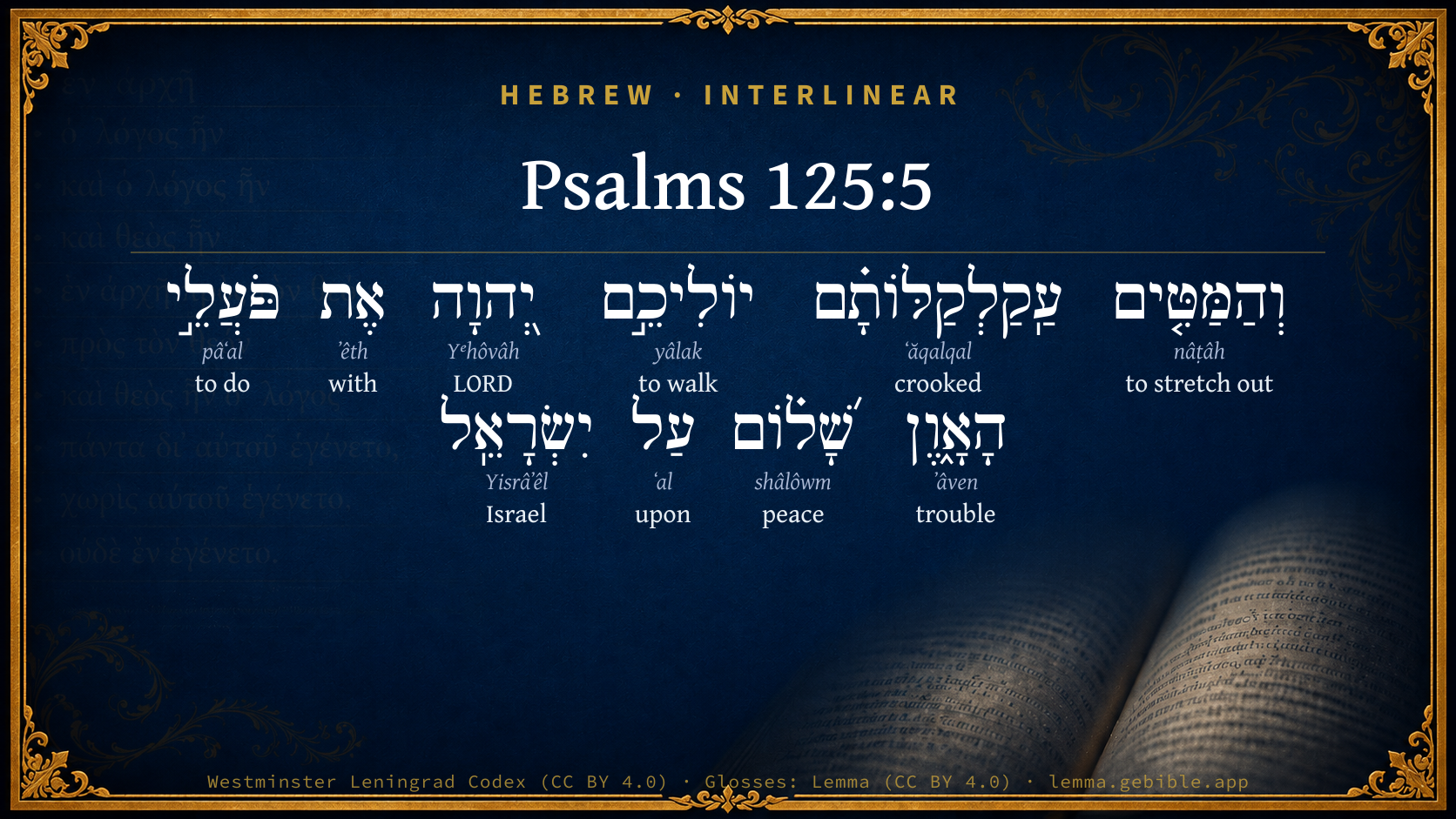
Hebrew (Westminster Leningrad Codex) Psalms 125:5 appears in the Hebrew Old Testament. The text above is from the Westminster Leningrad Codex. Each word links to its Strong’s number, a concise gloss, and parsing drawn from the Open Scriptures Hebrew Bible morphology. Click any word for its full Brown-Driver-Briggs (BDB) entry.
Download image
Cite this verse

Psalms 125:5 (World English Bible). Public Domain. Lemma interlinear Bible study tool, https://lemma.gebible.app/v/psalms/125/5.

Show BibTeX & RIS
BibTeX
RIS
English Translation
But as for those who turn aside to their crooked ways, Yahweh will lead them away with the workers of iniquity. Peace be on Israel.
World English Bible · Public Domain
Download a study sheet

One document with this verse’s original text, its word-by-word gloss line, the meaning frame, cross-references with their text, attributed commentary, and full source and license credits — printable, and it pastes into notes with its structure intact.

This verse Autodidact and up

Study sheet (.html) Plain text (.txt)

A passage Seminary Student

Up to 50 verses in one chapter. A passage sheet keeps up to 6 commentary sources and 12 cross-references per verse, in the order this page ranks them, and says so on the sheet whenever that leaves anything out. Ask for a single verse and you get the Autodidact verse sheet above.

Everything on this page stays free to read, with no account — the sheet is a download of what is already on screen, not access to it.

Want to remove ads? Support Godless Engineer
Compare translations 3

The same verse in 3 English versions, stacked beneath the original-language interlinear above. Click any original word for its lexicon entry.

Each is an independent rendering of the whole verse — the interlinear is not word-aligned to these translations.

Highlighted words mark where these versions differ — a whole-verse word diff, not a word-by-word alignment.

  • World English Bible Public Domain
    But as for those who turn aside to their crooked ways, Yahweh will lead them away with the workers of iniquity. Peace be on Israel.
  • King James Version Public Domain
    As for such as turn aside unto their crooked ways, the LORD shall lead them forth with the workers of iniquity: but peace shall be upon Israel.
  • unfoldingWord Literal Text CC BY-SA 4.0
    And those twisting their crooked, Yahweh will make them go with the workers of iniquity. Peace upon Israel.

unfoldingWord Literal Text — © unfoldingWord, licensed CC BY-SA 4.0. Word-aligned USFM3 via Door43 (git.door43.org/unfoldingWord/en_ult).

Versions to compare (up to 4)

3 of 4 selected

Show all 18 translations

Every available English version of this verse, each an independent rendering of the whole verse.

  • World English Bible Public Domain
    But as for those who turn aside to their crooked ways, Yahweh will lead them away with the workers of iniquity. Peace be on Israel.
  • Berean Standard Bible Public Domain
    But those who turn to crooked ways the LORD will banish with the evildoers. Peace be upon Israel.
  • Majority Standard Bible Public Domain
    But those who turn to crooked ways the LORD will banish with the evildoers. Peace be upon Israel.
  • King James Version Public Domain
    As for such as turn aside unto their crooked ways, the LORD shall lead them forth with the workers of iniquity: but peace shall be upon Israel.
  • American Standard Version (1901) Public Domain
    But as for such as turn aside unto their crooked ways, Jehovah will lead them forth with the workers of iniquity. Peace be upon Israel. Psalm 126 A Song of Ascents.
  • Revised Version (1885) Public Domain
    But as for such as turn aside unto their crooked ways, the LORD shall lead them forth with the workers of iniquity. Peace be upon Israel.
  • Geneva Bible (1599) Public Domain
    But these that turne aside by their crooked wayes, them shall the Lord leade with the workers of iniquitie: but peace shalbe vpon Israel.
  • Douay-Rheims (1899) Public Domain
    Our soul hath passed through a torrent: perhaps our soul had passed through a water insupportable.
  • Young's Literal Translation Public Domain
    As to those turning `to' their crooked ways, Jehovah causeth them to go with workers of iniquity. Peace on Israel!
  • Literal Standard Version CC BY-SA 4.0
    As for those turning [to] their crooked ways, || YHWH causes them to go with workers of iniquity. Peace on Israel!
  • Unlocked Literal Bible CC BY-SA 4.0
    But as for those who turn aside to their crooked ways, Yahweh will lead them away with the evildoers. May peace be on Israel.
  • unfoldingWord Literal Text CC BY-SA 4.0
    And those twisting their crooked, Yahweh will make them go with the workers of iniquity. Peace upon Israel.
  • Darby Bible Public Domain
    But as for such as turn aside unto their crooked ways, Jehovah will lead them forth with the workers of iniquity. Peace be upon Israel!
  • World Messianic Bible Public Domain
    But as for those who turn away to their crooked ways, the LORD will lead them away with the workers of iniquity. Peace be on Israel.
  • Webster's Bible Public Domain
    As for such as turn aside to their crooked ways, the LORD shall lead them forth with the workers of iniquity: but peace shall be upon Israel.
  • Free Bible Version CC BY-SA 4.0
    But as for those who turn aside to follow their own crooked ways—the Lord will lead them away together with those who do evil. May Israel be at peace!
  • Bible in Basic English Public Domain
    But as for such as are turned out of the straight way, the Lord will take them away with the workers of evil. Let peace be on Israel.
  • JPS Tanakh (1917) Public Domain
    But as for such as turn aside unto their crooked ways, the LORD will lead them away with the workers of iniquity. Peace be upon Israel.

Literal Standard Version (2020), Covenant Press — licensed CC BY-SA 4.0. Text via the HelloAO Bible API (eBible.org). Unlocked Literal Bible (unfoldingWord) — licensed CC BY-SA 4.0. Text via the HelloAO Bible API (eBible.org). unfoldingWord Literal Text — © unfoldingWord, licensed CC BY-SA 4.0. Word-aligned USFM3 via Door43 (git.door43.org/unfoldingWord/en_ult). Free Bible Version, Dr. Jonathan Gallagher — licensed CC BY-SA 4.0. Text via the HelloAO Bible API (eBible.org).

Word by word

More ways to search: Search by grammar → Find every occurrence → Compare this word →

Practice this passage: Drill this verse → Learn its vocabulary →

עַֽקַלְקַלּוֹתָ֗ם
ʻăqalqal
H6128
“crooked · their”
Adjective, Adjective, Feminine, Plural, Construct + Suffix, Personal, 3rd Person, Masculine, Plural
Part of Speech
Adjective
Type
Adjective
Gender
Feminine
Number
Plural
State
Construct
Full BDB Definition

Origin: from H6127

TWOT: 1680a

winding, devious, crooked
  1. וְהַמַּטִּ֤ים nâṭâh H5186 “and · the · stretching out” Conjunction + Particle, Definite Article + Verb, Hiphil, Participle Active, Masculine, Plural, Absolute
  2. יוֹלִיכֵ֣ם yâlak H3212 “to walk · them” Verb, Hiphil, Imperfect, 3rd Person, Masculine, Singular + Suffix, Personal, 3rd Person, Masculine, Plural
  3. יְ֭הוָה Yᵉhôvâh H3068 “LORD” Noun, Proper
  4. אֶת ʼêth H854 “with” Preposition
  5. פֹּעֲלֵ֣י pâʻal H6466 “doing” Verb, Qal, Participle Active, Masculine, Plural, Construct
  6. הָאָ֑וֶן ʼâven H205 “the · trouble” Particle, Definite Article + Noun, Common, Masculine, Singular, Absolute
  7. שָׁ֝ל֗וֹם shâlôwm H7965 “peace” Noun, Common, Masculine, Singular, Absolute
  8. עַל ʻal H5921 “upon” Preposition
  9. יִשְׂרָאֵֽל Yisrâʼêl H3478 “Israel” Noun, Proper

About this verse

These counts appear in no published source. They are computed here, from the morphology-tagged text and Lemma’s own curated glosses. What Lemma adds →

10
words
10
distinct lemmas
Wisdom
section

Notable vocabulary

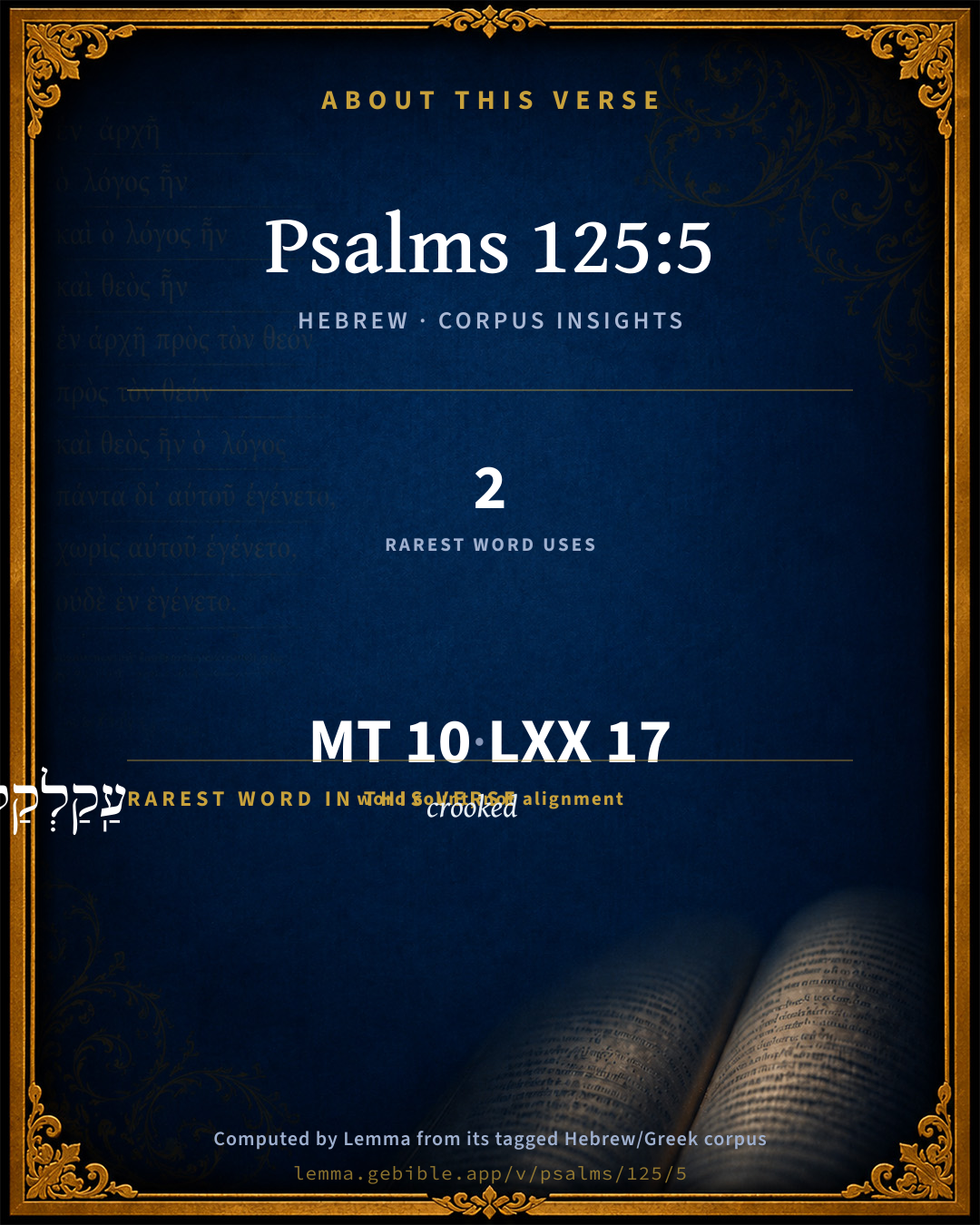
The rarest word here is עַֽקַלְקַלּוֹתָ֗ם crooked H6128 — appearing just 2 times in the whole Hebrew Bible.

Shared distinctive vocabulary

עַֽקַלְקַלּוֹתָ֗ם crooked H6128 occurs in 2 verses of the Hebrew Bible. Also found in:

Grammatical profile

  • 3 verbs
  • 4 nouns
  • 1 adjective
  • 2 prepositions

Verb forms

  • וְהַמַּטִּ֤ים Hiphil · Participle Active
  • יוֹלִיכֵ֣ם Hiphil · Imperfect
  • פֹּעֲלֵ֣י Qal · Participle Active

Hebrew & Septuagint length

In English translation the verse runs 25 words from the Hebrew and 24 from the Septuagint (LXX English) — closely comparable.

A rough comparison of the two English renderings, which tokenize alike — not a word-level alignment.

Word counts can differ between the Hebrew and the Greek without any difference in meaning — e.g. the Hebrew direct-object marker אֵת has no separate Greek word, and Greek often adds the article ὁ.

In the original languages it is 10 Hebrew tokens and 17 Greek tokens — but the two are counted differently (Hebrew bundles its prefixes and suffixes into one token; the Greek is in lemma form), so that isn’t a like-for-like length.

Cross-references

23

Topical passages linked to Psalms 125:5 in the Treasury of Scripture Knowledge — connected by theme and wording, ordered by reader-vote popularity; previews shown in the World English Bible.

  • Isaiah 59:8 The way of peace they don't know; and there is no justice in their goings: they have made them crooked paths; whoever goes therein does not know peace.
  • Proverbs 2:15 Who are crooked in their ways, And wayward in their paths:
  • Psalms 128:6 Yes, may you see your children's children. Peace be upon Israel.
  • Psalms 40:4 Blessed is the man who makes Yahweh his trust, And doesn't respect the proud, nor such as turn aside to lies.
  • Galatians 6:16 As many as walk by this rule, peace and mercy be on them, and on God's Israel.
  • Psalms 101:3 I will set no vile thing before my eyes. I hate the deeds of faithless men. They will not cling to me.
  • Matthew 7:23 Then I will tell them, 'I never knew you. Depart from me, you who work iniquity.'
  • John 14:27 Peace I leave with you. My peace I give to you; not as the world gives, give I to you. Don't let your heart be troubled, neither let it be fearful.
  • Philippians 2:15 that you may become blameless and harmless, children of God without blemish in the midst of a crooked and perverse generation, among whom you are seen as lights in the world,
  • 1 Chronicles 10:13–14 So Saul died for his trespass which he committed against Yahweh, because of the word of Yahweh, which he didn't keep; and also because he asked counsel of one who had a familiar spirit, to inquire [thereby],
  • Job 23:11 My foot has held fast to his steps. His way have I kept, and not turned aside.
  • Psalms 92:7 Though the wicked spring up as the grass, And all the evil-doers flourish, They will be destroyed forever.
  • Psalms 94:4 They pour out arrogant words. All the evil-doers boast.
  • Proverbs 14:14 The unfaithful will be repaid for his own ways; Likewise a good man will be rewarded for his ways.
  • Isaiah 54:10 For the mountains may depart, and the hills be removed; but my loving kindness shall not depart from you, neither shall my covenant of peace be removed, says Yahweh who has mercy on you.
  • Isaiah 54:13 All your children shall be taught of Yahweh; and great shall be the peace of your children.
  • Jeremiah 2:19 Your own wickedness shall correct you, and your backsliding shall reprove you: know therefore and see that it is an evil thing and a bitter, that you have forsaken Yahweh your God, and that my fear is not in you, says the Lord, Yahweh of Hosts.
  • Ezekiel 37:26 Moreover I will make a covenant of peace with them; it shall be an everlasting covenant with them; and I will place them, and multiply them, and will set my sanctuary in the midst of them forevermore.
  • Hosea 2:18 In that day I will make a covenant for them with the animals of the field, And with the birds of the sky, And with the creeping things of the ground. I will break the bow, the sword, and the battle out of the land, And will make them lie down safely.
  • Zephaniah 1:6 those who have turned back from following Yahweh, and those who haven't sought Yahweh nor inquired after him.
  • Matthew 24:48–51 But if that evil servant should say in his heart, 'My lord is delaying his coming,'
  • Hebrews 10:38 But the righteous will live by faith. If he shrinks back, my soul has no pleasure in him."
  • 1 Peter 1:2 according to the foreknowledge of God the Father, in sanctification of the Spirit, that you may obey Jesus Christ and be sprinkled in his blood: Grace to you and peace be multiplied.

Cross-references courtesy of OpenBible.info (CC BY 4.0).

Hebrew and Greek witnesses Masoretic Hebrew ↔ Greek Septuagint

The same verse in the two great witnesses to the Old Testament, shown verse-for-verse.

You’re reading Greek Psalm 124 (Hebrew Psalm 125). The Septuagint counts the superscription, so verse numbers can differ from the Hebrew — chapter-level alignment, not verse-by-verse. Numbering follows Rahlfs.

These are two independent witnesses, not word-aligned to each other, and the Septuagint is shown in lemma (dictionary) form.

Hebrew Psalms 125:5 Masoretic · Westminster Leningrad Codex

וְהַמַּטִּ֤ים עַֽקַלְקַלּוֹתָ֗ם יוֹלִיכֵ֣ם יְ֭הוָה אֶת פֹּעֲלֵ֣י הָאָ֑וֶן שָׁ֝ל֗וֹם עַל יִשְׂרָאֵֽל

But as for those who turn aside to their crooked ways, Yahweh will lead them away with the workers of iniquity. Peace be on Israel.

World English Bible · Public Domain

Greek LXX Greek Psalm 124:5 Septuagint · lemma form

ὁ δέ ἐκκλίνω εἰς ὁ στραγγαλιά ἀποἄγω κύριος μετά ὁ ἐργάζομαι ὁ ἀνομία εἰρήνη ἐπί ὁ ἰσραήλ

But them that turn aside to crooked ways the Lord will lead away with the workers of iniquity: but peace shall be upon Israel.

LXX2012 (modern English Septuagint) · Public Domain

Hebrew: Westminster Leningrad Codex (CC BY 4.0). Greek: Septuagint (public domain); English from LXX2012 (modern English Septuagint) (Public Domain). How the Septuagint differs from the Hebrew →

Commentary

Notes on Psalms 125:5 from classic Christian and Jewish commentators (each source and its license shown beneath its notes). The classic Christian expositions comment on the surrounding passage and are grouped to its opening verse, so a note may address several verses; the Jewish commentaries on the Tanakh (Rashi and others) are per-verse, so they appear only where the commentator wrote on this verse.

Lemma curates 59 commentaries, every one of them public domain or Creative Commons licensed, each selected and text-cleaned for this edition rather than reprinted as found. About our sources →

Trapp's Complete Commentary

John Trapp

Psa 125:5 As for such as turn aside unto their crooked ways, the LORD shall lead them forth with the workers of iniquity: [but] peace [shall be] upon Israel.

Ver. 5. As for such as turn aside unto their crooked ways] In lubricitates vel tortuositates, such as pretend piety to their worldly and wicked designs and dealings; dissemblers, warpers, versuti et vafri, who would defraud God of heaven if they could tell how.

The Lord shall lead them forth] Quantumvis reluctantes, as cattle led to the slaughter; or malefactors to execution. Transfugas arboribus suspendunt, they hang up fugitives, saith Tacitus concerning the Germans; there is martial law for such, Heb 10:38-39, as there is for scoundrels among us.

With the workers of iniquity] They shall to hell with the rest of the wicked crew, notwithstanding their professions and pretences of piety, whereunto they are perfect strangers; hypocrites are the freeholders of hell, and other evil persons are, as it were, tenants to them; shall have their part with them, Mat 24:51.

But peace shall be upon Israel] Peace shall be upon them and mercy, Gal 6:16. "The remnant of Israel shall not do iniquity, nor speak lies, neither shall a deceitful tongue be found in their mouth; for they shall feed and lie down, and none shall make them afraid," Zep 3:13.

John Trapp, A Commentary or Exposition upon All the Books of the Old and New Testament (1647–1656) — public domain. Text from a community e-Sword module.

The Biblical Illustrator

Joseph S. Exell

Psa_125:5

The Lord shall lead them forth with the workers of iniquity: but peace shall be upon Israel

The time of trial

1.

In the time of trial, there will sundry be found hypocrites, counterfeit dealers, misbelievers, who will shift for themselves, and turn aside from the obedience of faith, by their own crooked courses.

2. God will decipher hypocrites, who do not trust God, or do not adhere to the obedience of faith in time of trouble and trial, and will put them as corn-pliers with the wicked, in the same reckoning with His open enemies.

3. To look upon the judgments of God, pursuing backsliding misbelievers in time of persecution, should be a strong motive to make professors constant in the obedience of faith, on all hazards in time of trial: for the punishment of the wily misbeliever is set down here to teach men to be honest and stout in the faith and obedience of God. 4, Whatsoever trouble the Lords people shall be put unto in the time of trial, they shall still remain in Gods favour and grace; and when the Lord hath purged His Church in some measure, by winnowing corrupt hypocrites out from among His people, the Church shall be restored to her peace. (D. Dickson.)

Peace shall be upon Israel.--

The peace of Gods people

Theirs is a peace which the world can neither give nor take away. Tumult there may be without, but there is tranquillity within; and probably not the less so because there is tumult without. The music in a room does not fall with less pleasure on the ear, and less move the soul with its wondrous harmonies, because at times, during a pause, you hear the wind raging outside, and the rain rattling against the windowpanes. What can disturb him upon whom the Divine countenance is shining, and who pillows his head on the bosom of Jesus! If there be wars and rumours of wars in the world, it is not the fault of the Christian. He has been at the foot of the Cross, and he has learned there, that he who loves God must love his brother also. Receiving a kingdom which cannot be moved, he has no apprehensions as to its stability. He has no feeling except of pity to the poor victims, who are involved in fields of slaughter, in the shakings of nations, and the revolutions of empires. Their roots shall be as rottenness, and their blossoms shall go up as dust, who would dim the starry brightness of the Redeemers glory, and keep back the worlds regeneration. Peace shall be his at death. The Christian knows in whom he has believed. No unknown Redeemer stands beside his bed. No unknown hands are thrown around him. And there shall be peace in heaven. No jarring discords are there; but the delightful anthems of gratitude, which burst almost unconsciously from the hearts of the redeemed. How pleasant the murmurs of the crystal river of life, which glides so gently between its green banks! How softly the wind breathes, as it stirs the branches of the tree of life, distilling odorous dews! How sublime the repose of that magnificent city of our God! (N. McMichael.)

.

Psa_126:1-6

The Biblical Illustrator, edited by Joseph S. Exell (c. 1880s–1900s) — public domain. Text from a community e-Sword module.

The Treasury of David

Charles H. Spurgeon

Ver. 5. As for such as turn aside unto their crooked ways, the LORD shall lead them forth with the workers of iniquity. Two kinds of men are always to be found, the upright and the men of crooked ways. Alas, there are some who pass from one class to another, not by a happy conversion, turning from the twisting lanes of deceit into the highway of truth, but by an unhappy declension leaving the main road of honesty and holiness for the bypaths of wickedness. Such apostates have been seen in all ages, and David knew enough of them; he could never forget Saul, and Ahithophel, and others. How sad that men who once walked in the right way should turn aside from it! Observe the course of the false hearted: first, they look out for crooked ways; next, they choose them and make them "their crooked ways"; and then they turn aside into them. They never intend to go back unto perdition, but only to make a curve and drop into the right road again. The straight way becomes a little difficult, and so they make a circumbendibus, which all along aims at coming out right, though it may a little deviate from precision. These people are neither upright in heart, nor good, nor trusters in Jehovah, and therefore the Lord will deal otherwise with them than with his own people: when execution day comes these hypocrites and time servers shall be led out to the same gallows as the openly wicked. All sin will one day be expelled the universe, even as criminals condemned to die are led out of the city; then shall secret traitors find themselves ejected with open rebels. Divine truth will unveil their hidden pursuits, and lead them forth, and to the surprise of many they shall be set in the same rank with those who avowedly wrought iniquity.

But peace shall be upon Israel. In fact the execution of the deceivers shall tend to give the true Israel peace. When God is smiting the unfaithful not a blow shall fall upon the faithful. The chosen of the Lord shall not only be like Salem, but they shall have salem, or peace. Like a prince, Israel has prevailed with God, and therefore he need not fear the face of man; his wrestlings are over, the blessing of peace has been pronounced upon him. He who has peace with God may enjoy peace concerning all things. Bind the first and last verses together: Israel trusts in the Lord Ps 125:1, and Israel has peace Ps 125:5.

Ver. 5. Such as turn aside unto their crooked ways. This is the anxiety of the pastor in this pilgrim song. The shepherd would keep his sheep from straggling. His distress is that all in Israel are not true Israelites. Two sorts of people, described by the poet, have ever been in the church. The second class, instead of being at the trouble to "withstand in the evil day", will "put forth their hands unto iniquity". Rather than feel, they will follow the rod of the wicked. They will "turn aside unto their crooked ways", sooner than risk temporal and material interests. Edward Jewitt Robinson, in "The Caravan and the Temple", 1878.

Ver. 5. Such as turn aside unto their crooked ways. All the ways of sin are called "crooked ways", and they are our own ways. The Psalmist calls them "their crooked ways"; that is, the ways of their own devising; whereas the way of holiness is the Lord's way. To exceed or do more; to be deficient or do less, than God requires, both these are "crooked ways". The way of the Lord lies straight forward, right before us. "Whoso walketh uprightly shall be saved; but he that is perverse (or crooked) in his ways shall fall at once": Pr 28:18. The motion of a godly man is like that of the kine that carried the ark: "Who took the straight way to the way of Bethshemesh, and went along the highway, lowing as they went, and turned not aside to the right hand or to the left": 1Sa 6:12. Joseph Caryl.

Ver. 5. Crooked ways. The ways of sinners are "crooked"; they shift from one pursuit to another, and turn hither and thither to deceive; they wind about a thousand ways to conceal their base intentions, to accomplish their iniquitous projects, or to escape the punishment of their crimes; yet disappointment, detection, confusion, and misery, are their inevitable portion. Thomas Scott, 1747-1821.

Ver. 5. The LORD shall lead them forth with the workers of iniquity. They walked according to the prince of the air, and they shall go where the prince of the air is. God will bring forth men from their hiding places. Though they walk among the drove of his children, in procession now, yet if they also walk in by lanes of sin, God will rank them at the latter day, yea, often in this world, with the workers of iniquity. They walk after workers of iniquity here before God, and God will make manifest that it is so before he hath done with them. The reason, my brethren, why they are to be reckoned among workers of iniquity, and as walkers among them, though they sever themselves from them in respect of external conversation, is, because they agree in the same internal principle of sin. They walk in their lusts: every unregenerate man doth so. Refine him how you will, it is certain he doth in heart pursue "crooked ways." Thomas Goodwin, 1600-1679.

Ver. 5. Sometimes God takes away a barren professor by permitting him to fall into open profaneness. There is one that hath taken up a profession of the worthy name of the Lord Jesus Christ, but this profession is only a cloak; he secretly practises wickedness; he is a glutton, or a drunkard, or covetous, or unclean. Well, saith God, I will loose the reins of this professor, I will give him up to his vile affections. I will loose the reins of his sins before him, he shall be entangled with his filthy lusts, he shall be overcome of ungodly company. Thus they that turn aside to their own crooked ways, the Lord shall lead them forth with the workers of iniquity. John Bunyan, 1628-1688.

Ver. 5. But peace shall be upon Israel. Do you ask, What is the peace upon Israel? I answer: First, the peace of Israel, that is, of a believing and holy soul, is from above, and is higher than all the disturbances of the world; it rests upon him, and makes him calm and peaceful, and lifts him above the world: for upon him rests the Holy Spirit, who is the Comforter; who is essential love and uncreated peace. Secondly, the peace of a believing and holy soul is internal for it is sent down from heaven upon his head, flows into his heart, and dwells there, and stills all agitations of mind. Thirdly, the peace of a believing and holy soul, is also external. It is a fountain of Paradise watering all the face of the earth: Ge 2:6: you see it in the man's face and life. Fourthly, the peace of a believing and holy soul is divine: for chiefly, it maintains peace with God. Fifthly, the peace of a believing and holy soul is universal:to wit, with neighbours, with God, with himself: in the body, in the eyes, in the cars, in tasting, smelling, feeling, in all the members, and in all the appetites. This peace is not disturbed by devils, the world, and the flesh, setting forth their honours, riches, pleasures. Sixthly, the peace of a believing and holy soul is peace eternal and never interrupted; for it flows from an eternal and exhaustless fountain, even from God himself. Condensed from Le Blanc, 1599-1669.

Ver. 5. Israel. The Israelites derived their joint names from the two chief parts of religion: Israelites, from Israel, whose prayer was his "strength" (Ho 12:3), and Jews, from Judah, whose name means "praise." George Seaton Bowes, in "Illustrative Gatherings", 1869.

Ver. 5. Temporary Professors.

1. The crucial test: "They turn aside."

2. The crooked policy: they make crooked ways their own.

3. The crushing doom: "led forth with workers of iniquity."

Ver. 5. Hypocrites.

1. Their ways: "crooked."

a) Like the way of a winding stream, seeking out the fair level, or the easy descent.

b) Like the course of a tacking ship, which skilfully makes every wind to drive her forward.

c) Ways constructed upon no principle but that of pure selfishness.

2. Their conduct under trial. They "turn aside."

a) From their religious profession.

b) From their former companions.

c) To become the worst scorners of spiritual things, and the most violent calumniators of spiritually minded men.

3. Their doom: "The Lord shall", etc.

a) In the judgment they shall be classed with the most flagrant of sinners; "with the workers of iniquity."

b) They shall be exposed by an irresistible power: "The Lord shall lead them forth."

c) They shall meet with terrible execution with the wicked in hell. J. Field.

Ver. 5. (last clause). To whom peace belongs. To "Israel"; the chosen, the once wrestler, the now prevailing prince. Consider Jacob's life after he obtained the name of Israel; note his trials, and his security under them as illustrating this text. Then take the text as a sure promise.

Ver. 5. (last clause). Enquire,

1. Who are the Israel?

a) Converted ones.

b) Circumcised in heart.

c) True worshippers.

2. What is the peace?

a) Peace of conscience.

b) Of friendship with God.

c) Of a settled and satisfied heart.

d) Of eternal glory, in reversion.

3. Why the certainty ("shall be")?

a) Christ has made peace for them.

b) The Holy Spirit brings peace to them.

c) They walk in the way of peace.

J. Field.

For lists of Works upon the Psalms of Degrees, see note for Psalm 120.

Charles H. Spurgeon's The Treasury of David (1869–1885) — public domain. Psalms only. Text from a community e-Sword/MySword module.

J. A. Alexander on Psalms

Joseph Addison Alexander

5. (Psa 125:5) And, (as to) those turning aside (in) their crooked (ways), Jehovah will let them, go with the doers of iniquity. Peace (be) upon Israel! The participle in the first clause is properly a transitive and means causing toturn aside, but has here the sense of going aside, or turning in the intransitive sense, the English verb having precisely the same double usage. This construction of the Hebrew verb, which occurs also in Isa 30:11, Job 23:11, may be resolved into the usual one, by supposing an ellipsis of their feet or steps. The adjective translated crooked occurs only here and in Jdg 5:6, where the noun (ways or paths) is expressed. It denotes the by-ways of corrupt inclination and transgression, by which men deviate from the straight and narrow highway of God's commandments. Compare Deu 9:16, Mal 2:8-9. The workers of iniquity are not a different class from these wanderers, but that to which they belong, and the doom of which they would gladly escape; but the Lord will let them go on still with those whom they resemble in character, and as they have been like them by the way, they shall be like them in the end. Compare Psa 26:9; Psa 28:3. Having thus excluded hypocritical pretenders from the object of the benediction, he concludes by wishing or invoking peace upon (the true or spiritual) Israel. Compare Isa 57:19; Isa 57:21.

Joseph Addison Alexander, The Psalms Translated and Explained (1850) — public domain. Text from a community e-Sword module.

Geneva Bible (1599)

Geneva Bible translators

He desireth God to purge his Church from hypocrites, and such as have no zeal of the truth.

Geneva Bible (1599) marginal notes — public domain. Text via Bolls.life.

Adam Clarke's Commentary

Verse 5. As for such as turn aside] Who are not faithful; who give way to sin; who backslide, and walk in a crooked way, widely different from the straight way of the upright, ישרים yesharim, the straight in heart; they shall be led forth to punishment with the common workers of iniquity. Thus thy Church will be purified, and thy peace rest upon thy true Israel. Let him that readeth understand.

ANALYSIS OF THE HUNDRED AND TWENTY-FIFTH PSALM

It is the purpose of the psalmist to comfort the people of God, -

I. By an assurance of their perpetuity, both from God's presence and protection, Ps 125:1-2.

II. That though he may permit them to be harassed by the wicked, yet he will not leave them under their rod. Ps 125:3.

III. He prays for the good; and,

IV. Sets down the portion of the wicked, Ps 125:4-5.

I. A general promise of the perpetuity of the Church; that is, of them "that trust in God."

1. "They that trust in the Lord:" "The congregation of God's faithful people, who have the pure word of God preached, and the sacraments duly administered," Acts xix. ??

2. "Shall be as Mount Zion," secure and immovable; immovable, because a mountain, - a holy mountain, - and particularly dear to God.

3. "Which abideth for ever:" So surely as Mount Zion shall never be removed, so surely shall the Church of God be preserved. Is it not strange that wicked and idolatrous powers have not joined together, dug down this mount, and carried it into the sea, that they might nullify a promise in which the people of God exult! Till ye can carry Mount Zion into the Mediterranean Sea, the Church of Christ shall grow and prevail. Hear this, ye murderous Mohammedans!

4. "As the mountains are round about Jerusalem," - to fortify it.

5. "So the Lord is round about his people" - to preserve them.

6."From henceforth, even for ever:" Through both time and eternity.

II. 1. But the Church is often persecuted and harassed. Granted; for the "rod," the power and scourge, "of the wicked, may come into the heritage of the righteous."

2. But then may it not finally prevail? No: for though it come, it shall not rest.

3. And why? Because it might finally destroy the Church, pervert the good, and cause them to join issue with the ungodly. Therefore, "they shall not be tempted above that they are able."

III. Therefore the psalmist prays, -

1. "Do good to the good:" Give them patience, and keep them faithful.

2. And "to the upright in heart:" Let not the weak and the sincere be overcome by their enemies:

IV. He sets down the lot of the ungodly: -

1. "They turn aside."

2. They get into crooked paths; they get into the spirit of the world, and are warped into its crooked and winding ways.

3. They shall be condemned, and then led forth to punishment. The backslider in heart shall be filled with his own ways; he shall have writhing in pain, for crooked walking in sin.

4. But while this is their portion, "peace," prosperity, and blessedness, "shall be upon Israel."

Adam Clarke's Commentary on the Bible (1810–1826) — public domain. Text from a community e-Sword/MySword module.

John Calvin's Commentaries

5. But those who turn aside into their crooked paths, etc. As the participle המטים, hammattim, is in the conjugation Hiphil, it should, according to the rules of grammar, be rather translated in an active sense — those who cause to turn aside; but it being no uncommon thing for verbs in that conjugation to be taken in a neuter sense, the, version which I have followed is probably the correct one. Still, as the active signification is not less appropriate, I would leave the reader freely to exercise his own judgment. The meaning is, that God does not always connive at the wickedness of those who, while boasting of a hollow and counterfeit profession, wander hither and thither according to their own lust, or even corrupt the simple, and draw them into the same excess of sinning with themselves. I have no doubt that the Psalmist here speaks of hypocrites, who are so hardened by temporary impunity, as to claim to themselves a place among the holiest of men, because God exercises forbearance towards them. Not only do we see the good mingled with the bad in the world, but we also behold on the barn-floor of the Lord the wheat lying hidden under the chaff and refuse. In this dubious and confused state of matters, the bad are elated with pride, as if they were among the best of God’s servants. We ought therefore to pray that God would drag them into the light, and, with the workers of iniquity, thrust them down into the punishment which they have deserved. The consequence is that peace, which the Prophet desires may be the privilege of Israel. He does not speak generally of all the race of Abraham, according to the flesh; he rather wishes that the Church of God may be purged of hypocrites, who occupy a place in her, until God lift up his hand to judgment. On this account I have said, that the peace of the Church springs from this — that; God, while executing his just vengeance upon reigned and counterfeit Israelites, who rend and tear in pieces her bowels, gathers together the upright in heart, and openly shows by his blessing the fatherly love which he bears towards them.

John Calvin's Commentaries (1540-1563) — public domain. Text from the Calvin Translation Society English edition (1840s-50s) via the Christian Classics Ethereal Library (ccel.org). Calvin's coverage is partial (roughly two-thirds of the Bible); uncommented books and verses are honest gaps, never fabricated. The 19th-century editor's footnotes and remarks are omitted so the notes are faithfully Calvin's own voice.

Ellicott's Commentary for English Readers

(5) Turn aside unto their crooked ways.—Or, bend their crooked ways, i.e., pursue evil courses.

But peace.—Better, as an innovation on the customary form, peace be in Israel. (See Note on Psa_122:6, and comp. Psa_128:6.)

A Bible Commentary for English Readers, edited by Charles John Ellicott (1878–1897) — public domain. Text from a community e-Sword module.

The Cambridge Bible for Schools and Colleges

gen. ed. J. J. S. Perowne

5. But as for such as turn aside &c.] Renegades who forsake the straight course of duty to their God and country for tortuous courses of intrigue with enemies: the disloyal party in Jerusalem, some of whom, like Shemaiah, took bribes from Sanballat and Tobiah to entrap Nehemiah, while others kept up a treasonable correspondence with them. See Neh_6:12-13; Neh_6:17.

shall lead them away] To share the judgement of those whose hostility to Israel they have chosen to abet. Cp. Mat_25:41.

but peace shall be upon Israel] Better as a separate sentence, a concluding prayer or benediction: Peace be upon Israel (R.V.). Cp. Psa_122:6-8; Psa_128:6; Num_6:26; and Gal_6:16, “Peace be … upon the Israel of God.” The preceding words “as many as shall walk by this rule” suggest that St Paul may have had this passage in mind. “In these words the Psalmist gathers up all his hopes and prayers and wishes, as it were stretching out his hands over Israel in priestly benediction. Peace is the end of tyranny, hostility, division, disquiet, alarm: peace is freedom and harmony and security and blessedness” (Delitzsch).

The Cambridge Bible for Schools and Colleges (gen. ed. J. J. S. Perowne; Cambridge University Press, 1878–1918) — public domain. Text from a community e-Sword module.

John Gill's Exposition

As for such as turn aside unto their crooked ways,.... The ways of sin, immorality, or error; which are crooked ways, not agreeing with the word of God, the rule of faith and practice. This seems to design not openly profane sinners, who have always lived in a course of sin and wickedness; but carnal professors, who, through affliction and persecution because of the word, are offended, and desert the good ways of God; and turn from the holy commandment, word, and ordinances, they have professionally embraced;

the Lord shall lead them forth with the workers of iniquity; the Targum adds,

"to hell.''

These hypocrites shall be led forth by the Lord with abandoned sinners, like malefactors to the place of execution; when he shall bid them depart from him, and they shall go into everlasting fire; and if there is any place in hell hotter than another, those shall have it; see Mat 7:23;

but peace shall be upon Israel; upon every true Israelite, upon the whole Israel of God; the apostle seems to have respect to this passage in Gal 6:16; such shall have spiritual peace in their hearts now, and eternal peace hereafter. The words may be read either as a prayer that it might be, or as a prophecy that it should be; and may have regard unto the latter day, when all the enemies of Christ and his church shall be destroyed, and there shall be abundance of peace, so long as the moon endures, Psa 72:7. Aben Ezra observes, that the psalmist prays that God would remove the wicked far off, and then there would be peace in Israel; and to the same purpose Arama and Kimchi interpret it.

Next: Psalms Chapter 126

John Gill's Exposition of the Whole Bible (1746–1763) — public domain (CC PDM 1.0). Text via the HelloAO Bible API.

Albert Barnes' Notes on the Bible

As for such as turn aside unto their crooked ways - The wicked. Those who leave the right or straight path, and wander in forbidden ways. The word here rendered “crooked ways” occurs nowhere else except in Jdg 5:6, where it is rendered “by-ways,” meaning unfrequented paths or roads; narrow and crooked paths, remote from the highways, or the ways commonly traversed. Hence, the word means also paths of sin - as deviations from the straight road which man should travel.

The Lord shall lead them forth with the workers of iniquity - They shall be dealt with as sinners. They shall be punished. The allusion is to backsliders; to those who forsake the worship of God; who cease to do “good;” who, though among the professed people of God, wander from him in by-paths and forbidden ways. The idea is, that their profession of religion will not save them; that they will not obtain the divine blessing merely because they are avowedly the people of God, or are numbered among them, but that they will be treated as all other sinners are: they will be led forth with all the wicked, and will be treated like them. Compare Eze 33:12-13; Mat 7:22-23; Mat 25:11-12.

But peace shall be upon Israel - Upon the real Israel; upon the true people of God. Gal 6:16; Isa 54:13; Isa 55:12; Isa 57:2; Isa 66:12; Joh 14:27; Joh 16:33; Eph 2:17; Phi 4:7.

Albert Barnes' Notes on the Bible (1834–1885) — public domain. Text from a community e-Sword/MySword module.

Matthew Poole's English Annotations

But those hypocrites, who either through fear of the rod, mentioned Psa 125:3, or for other considerations, shall turn aside from the ways of God, which for a time they professed and seemed to own, unto sinful courses, whom he opposeth to the upright, Psa 125:4, the Lord shall lead them forth, to wit, unto punishment, as malefactors are commonly led to the place of execution.

With the workers of iniquity; with the most obstinate and profligate sinners, of whose plagues they shall certainly partake, as they did of their sins.

Upon Israel; upon the true Israel of God.

Matthew Poole's English Annotations on the Holy Bible (1683–1685) — public domain. Text from a community e-Sword/MySword module.

Whedon's Commentary on the Bible

Daniel D. Whedon

5. Such as turn aside—Incline to crooked ways. See introduction to the psalm, Haggai 1, and Zec_1:1-6. In all ages there have been superficial and unstable professors of the true religion, ready to give up their faith at sight of persecution. See Mat_13:20-21; Mal_3:8-15.

Crooked ways—The paths of an apostate, ever devious through a worldly policy, and opposed to integrity, uprightness, fidelity. See Mat_7:14; Jer_6:16; Jer_18:15.

The Lord shall lead them forth with the workers of iniquity—God shall classify these false professors with the openly wicked and abandoned, and treat them as such in the judgment. The leading forth is judicial—the bringing them to trial and execution.

But peace shall be upon Israel—Can language make it more plain, that false profession is irreligion, and that the outcome of the lives of the true and false Israelites shall be finally and totally different?

Daniel D. Whedon (gen. ed.), Commentary on the Old and New Testaments (1874–1909) — public domain. Text from a community e-Sword module.

The Pulpit Commentary

As for such as turn aside unto their crooked ways. The word translated "crooked ways" occurs only here and in Jud_1:5:6. It means properly "by-paths," deviations from the straight path of right. The Lord shall lead them forth with the workers of iniquity. God shall give them no better portion than he assigns to the open evildoers, since their heart is not really whole with him. But peace shall be upon Israel; rather, but peace be upon Israel. The psalmist winds up with a prayer, not a prophecy.

God is against the willful.

The Targum reads," And those that turn after their depravity, he shall bring them into Gehenna as their portion, with the workers of falsehood." Literally, the first sentence of the verse reads, "bend their crooked paths," i.e . so turn their paths aside as to make them crooked. (Jud_1:5:6) "The expression does not necessarily denote a going over to heathenism; it would describe the conduct of those who, in the time of Jeremiah, made common cause with the enemies of Israel." "The emphasis is on truth of heart and steadfastness, as against the turning back to the old wickedness of idolatry, which had drawn down God"s righteous anger. The backslider has desired to cast in his lot with the ungodly; that desire shall be fulfilled to his ruin." "The lukewarm and sly, false, and equivocal ones, are in no way inferior to the open, manifest sinner, as a source of danger to the Church." Carefully notice that it is incipient, not pronounced, willfulness which is here in consideration. The fixedly willful are called the workers of iniquity." The persons here are those who are willful, but do not realize that they are. The figure is of persons who bend about, from this side to that, of the right road, though they do not step over into by-paths. They do not walk straight on, and steadily. "The wavering, unsteadfast, half-hearted disciple shall be as the hypocrite and rebellious." Illustrate from the warnings of the Epistle to the Hebrews.

I THE SPIRIT OF WILLFULNESS NEEDS DEALING WITH IN ITS BEGINNINGS. Illustrate by the kindly warnings sent to King Saul, when the spirit of self-will began to be encouraged, and by the reproofs of the living Christ to the seven Churches of Asia. Dealing with it is difficult, because

(1) its first germs in the character are not easily detected;

(2) its process of growth is secret and insidious. And yet it is in pulling up the first blades of the weeds that the hope of the garden lies.

II THE DIVINE AID IS READY FOR JUST THAT STAGE OF OUR WORK. It comes:

1. As the discovery of the beginnings of the evil in our hearts. Saul would have gone on sell-deluded, but for the Divine arrest and revelation.

2. As the warning of the real character of the evil. At first the blades of the tare are very like the blades of the wheat. We need a Divine discrimination.

3. As the offer of help for immediately dealing with the evil. When the cancer has threaded the tissue with its fibers the case is hopeless. R.T.

The Pulpit Commentary (1880–1919), ed. H.D.M. Spence-Jones & Joseph S. Exell — public domain. Text from a community e-Sword module.

John Wesley's Explanatory Notes

Lead them - Unto sinful courses. Israel - Upon the true Israel of God.

John Wesley, Explanatory Notes Upon the Whole Bible (1754–1765) — public domain. Text via the GEBible commentary corpus.

Rashi

Rabbi Shlomo Yitzchaki (Rashi)

and those who turn their crooked ways on the people to find wicked accusationsmay the Lord lead them away with the workers of iniquity.

Rashi on the Tanakh — English translations: “The Judaica Press complete Tanach with Rashi, translated by A. J. Rosenberg” (CC BY 4.0); “Pentateuch with Rashi's commentary by M. Rosenbaum and A.M. Silbermann, 1929-1934” (public domain); “The Metsudah Tanach series, Lakewood, N.J” (CC BY 4.0); and “The Book of Joshua, Metsudah Publications, 1997” (CC BY 4.0). Text via Sefaria.

Lesson kit

Teaching starters — assembled from the data on this page, not authored interpretation. Every prompt links to the verse data it draws on. Edit before teaching.

Psalms, in the Wisdom, opens this verse with 10 words (10 distinct Hebrew lemmas). Its most distinctive word is ʻăqalqal (“crooked”). A historical commentator’s framing appears above. Read the whole chapter for the surrounding context.

Discussion questions

  1. What does “crooked” (ʻăqalqal) contribute to the verse as a whole?
  2. How does Judges 5:6, which shares the word «crooked», read alongside this verse?
  3. These translations render this verse differently; the difference is in the English rendering, not the original. What questions does that raise?
  4. «וְהַמַּטִּ֤ים» is a Hiphil Participle Active verb. How does that grammatical form shape the action described?
  5. Compare how Trapp's Complete Commentary and The Biblical Illustrator read this verse. Where do they agree or differ?

Things to notice

Reading settings

Reading text

Shown beneath each verse's original-language words.

Old Testament
Old Testament edition

Read the OT as the Masoretic Hebrew (MT) or the Greek Septuagint (LXX).

English shown for the Greek Septuagint (in the Hebrew ↔ Greek comparison).

Comparing translations? Open the Compare panel on any verse page to stack up to four side by side.