Jeremiah 15:6

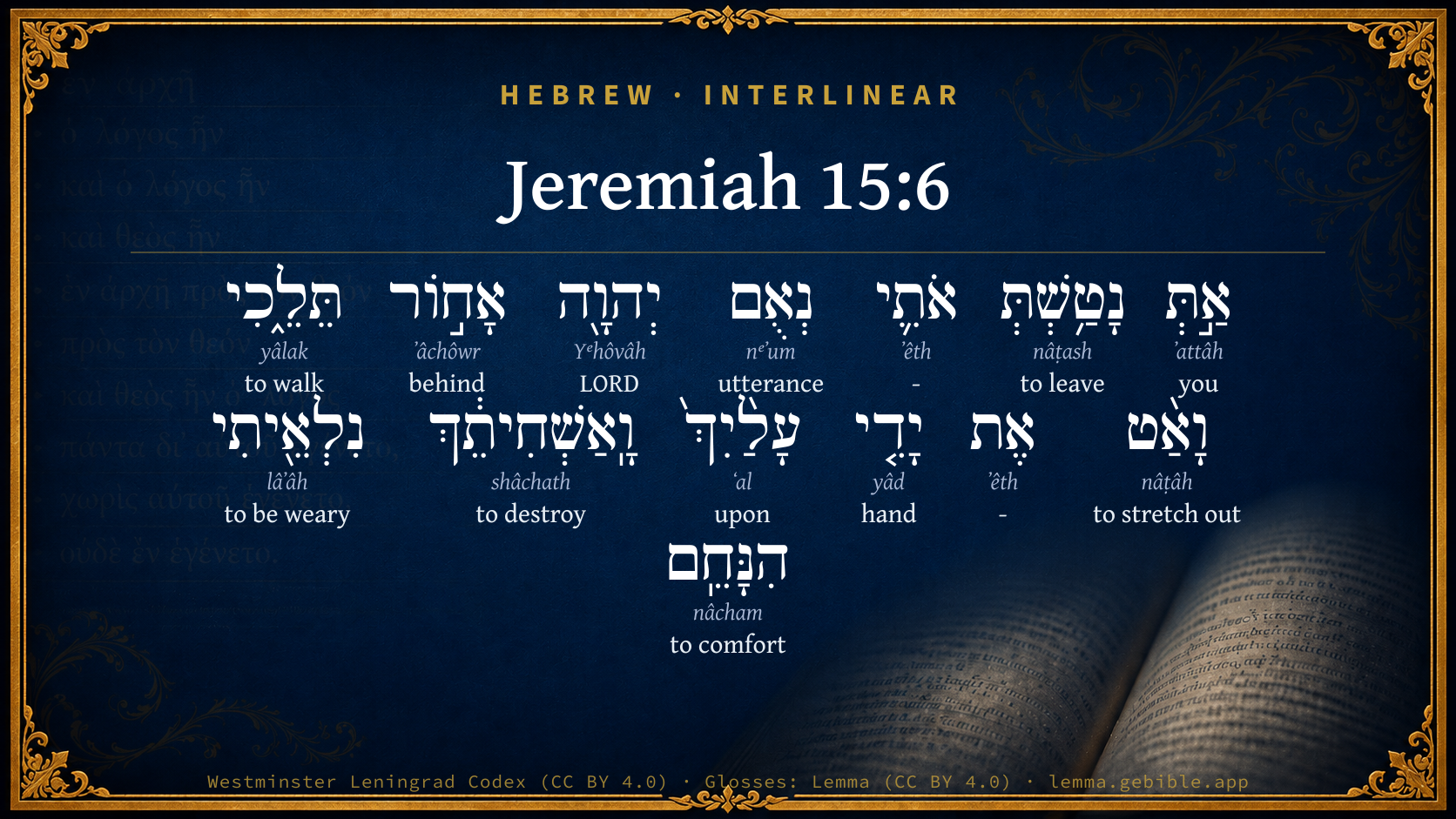
Hebrew (Westminster Leningrad Codex) Jeremiah 15:6 appears in the Hebrew Old Testament. The text above is from the Westminster Leningrad Codex. Each word links to its Strong’s number, a concise gloss, and parsing drawn from the Open Scriptures Hebrew Bible morphology. Click any word for its full Brown-Driver-Briggs (BDB) entry.
Download image
Cite this verse

Jeremiah 15:6 (World English Bible). Public Domain. Lemma interlinear Bible study tool, https://lemma.gebible.app/v/jeremiah/15/6.

Show BibTeX & RIS
BibTeX
RIS
English Translation
You have rejected me, says Yahweh, you are gone backward: therefore have I stretched out my hand against you, and destroyed you; I am weary with repenting.
World English Bible · Public Domain
Download a study sheet

One document with this verse’s original text, its word-by-word gloss line, the meaning frame, cross-references with their text, attributed commentary, and full source and license credits — printable, and it pastes into notes with its structure intact.

This verse Autodidact and up

Study sheet (.html) Plain text (.txt)

A passage Seminary Student

Up to 50 verses in one chapter. A passage sheet keeps up to 6 commentary sources and 12 cross-references per verse, in the order this page ranks them, and says so on the sheet whenever that leaves anything out. Ask for a single verse and you get the Autodidact verse sheet above.

Everything on this page stays free to read, with no account — the sheet is a download of what is already on screen, not access to it.

Want to remove ads? Support Godless Engineer
Compare translations 3

The same verse in 3 English versions, stacked beneath the original-language interlinear above. Click any original word for its lexicon entry.

Each is an independent rendering of the whole verse — the interlinear is not word-aligned to these translations.

Highlighted words mark where these versions differ — a whole-verse word diff, not a word-by-word alignment.

  • World English Bible Public Domain
    You have rejected me, says Yahweh, you are gone backward: therefore have I stretched out my hand against you, and destroyed you; I am weary with repenting.
  • King James Version Public Domain
    Thou hast forsaken me, saith the LORD, thou art gone backward: therefore will I stretch out my hand against thee, and destroy thee; I am weary with repenting.
  • unfoldingWord Literal Text CC BY-SA 4.0
    You have forsaken me”—the declaration of Yahweh—“you have gone backward, therefore I will stretch out my hand against you and destroy you; I am weary of relenting.

unfoldingWord Literal Text — © unfoldingWord, licensed CC BY-SA 4.0. Word-aligned USFM3 via Door43 (git.door43.org/unfoldingWord/en_ult).

Versions to compare (up to 4)

3 of 4 selected

Show all 18 translations

Every available English version of this verse, each an independent rendering of the whole verse.

  • World English Bible Public Domain
    You have rejected me, says Yahweh, you are gone backward: therefore have I stretched out my hand against you, and destroyed you; I am weary with repenting.
  • Berean Standard Bible Public Domain
    You have forsaken Me, declares the LORD. You have turned your back. So I will stretch out My hand against you and I will destroy you; I am weary of showing compassion.
  • Majority Standard Bible Public Domain
    You have forsaken Me, declares the LORD. You have turned your back. So I will stretch out My hand against you and I will destroy you; I am weary of showing compassion.
  • King James Version Public Domain
    Thou hast forsaken me, saith the LORD, thou art gone backward: therefore will I stretch out my hand against thee, and destroy thee; I am weary with repenting.
  • American Standard Version (1901) Public Domain
    Thou hast rejected me, saith Jehovah, thou art gone backward: therefore have I stretched out my hand against thee, and destroyed thee; I am weary with repenting.
  • Revised Version (1885) Public Domain
    Thou hast rejected me, saith the LORD, thou art gone backward: therefore have I stretched out my hand against thee, and destroyed thee; I am weary with repenting.
  • Geneva Bible (1599) Public Domain
    Thou hast forsaken me, sayth the Lord, and gone backward: therefore wil I stretch out mine hand against thee, and destroy thee: for I am weary with repenting.
  • Douay-Rheims (1899) Public Domain
    Thou hast forsaken me, saith the Lord, thou art gone backward: and I will stretch out my hand against thee, and I will destroy thee: I am weary of entreating thee.
  • Young's Literal Translation Public Domain
    Thou -- thou hast left Me -- an affirmation of Jehovah, Backward thou goest, And I stretch out My hand against thee, And I destroy thee, I have been weary of repenting,
  • Literal Standard Version CC BY-SA 4.0
    You have left Me,” || A declaration of YHWH, || “You go backward, || And I stretch out My hand against you, || And I destroy you, || I have been weary of relenting,
  • Unlocked Literal Bible CC BY-SA 4.0
    You have forsaken me—this is Yahweh's declaration—you have gone back from me. So I will strike you with my hand and destroy you. I am tired of having mercy on you.
  • unfoldingWord Literal Text CC BY-SA 4.0
    You have forsaken me”—the declaration of Yahweh—“you have gone backward, therefore I will stretch out my hand against you and destroy you; I am weary of relenting.
  • Darby Bible Public Domain
    Thou hast cast me off, saith Jehovah, thou art gone backward; and I have stretched out my hand against thee, and will destroy thee: I am become weary of repenting.
  • World Messianic Bible Public Domain
    You have rejected me,” says the LORD. “You have gone backward. Therefore I have stretched out my hand against you and destroyed you. I am weary of showing compassion.
  • Webster's Bible Public Domain
    Thou hast forsaken me, saith the LORD, thou art gone backward: therefore will I stretch out my hand against thee, and destroy thee; I am weary with repenting.
  • Free Bible Version CC BY-SA 4.0
    You have deserted me, declares the Lord. You have turned your back on me. So I will take action against you and destroy you; I am tired of showing you mercy.
  • Bible in Basic English Public Domain
    You have given me up, says the Lord, you have gone back: so my hand is stretched out against you for your destruction; I am tired of changing my purpose.
  • JPS Tanakh (1917) Public Domain
    Thou hast cast Me off, saith the LORD, thou art gone backward; Therefore do I stretch out My hand against thee, and destroy thee; I am weary with repenting.

Literal Standard Version (2020), Covenant Press — licensed CC BY-SA 4.0. Text via the HelloAO Bible API (eBible.org). Unlocked Literal Bible (unfoldingWord) — licensed CC BY-SA 4.0. Text via the HelloAO Bible API (eBible.org). unfoldingWord Literal Text — © unfoldingWord, licensed CC BY-SA 4.0. Word-aligned USFM3 via Door43 (git.door43.org/unfoldingWord/en_ult). Free Bible Version, Dr. Jonathan Gallagher — licensed CC BY-SA 4.0. Text via the HelloAO Bible API (eBible.org).

Word by word

More ways to search: Search by grammar → Find every occurrence → Compare this word →

Practice this passage: Drill this verse → Learn its vocabulary →

נִלְאֵ֖יתִי
lâʼâh
H3811
“to be weary”
Verb, Niphal, Perfect, 1st Person, Common, Singular
Part of Speech
Verb
Stem
Niphal
Form
Perfect
Person
1st Person
Gender
Common
Number
Singular
Full BDB Definition

Origin: a primitive root

TWOT: 1066

to be weary, be impatient, be grieved, be offended - (Qal) to be weary, be impatient - (Niphal) to be tired of something, weary oneself - (Hiphil) to weary, make weary, exhaust
  1. אַ֣תְּ ʼattâh H859 “you” Pronoun, Personal, 2nd Person, Feminine, Singular
  2. נָטַ֥שְׁתְּ nâṭash H5203 “to leave” Verb, Qal, Perfect, 2nd Person, Feminine, Singular
  3. אֹתִ֛י ʼêth H853 “- · me” Particle, Direct Object + Suffix, Personal, 1st Person, Common, Singular
  4. נְאֻם nᵉʼum H5002 “utterance of” Noun, Common, Masculine, Singular, Construct
  5. יְהוָ֖ה Yᵉhôvâh H3068 “LORD” Noun, Proper
  6. אָח֣וֹר ʼâchôwr H268 “behind” Noun, Common, Masculine, Singular, Absolute
  7. תֵּלֵ֑כִי yâlak H3212 “to walk” Verb, Qal, Imperfect, 2nd Person, Feminine, Singular
  8. וָאַ֨ט nâṭâh H5186 “and · to stretch out” Conjunction + Verb, Hiphil, Sequential Imperfect, 1st Person, Common, Singular
  9. אֶת ʼêth H853 “-” Particle, Direct Object
  10. יָדִ֤י yâd H3027 “hand · my” Noun, Common, Both, Singular, Construct + Suffix, Personal, 1st Person, Common, Singular
  11. עָלַ֨יִךְ֙ ʻal H5921 “upon · you” Preposition + Suffix, Personal, 2nd Person, Feminine, Singular
  12. וָֽאַשְׁחִיתֵ֔ךְ shâchath H7843 “and · to destroy · you” Conjunction + Verb, Hiphil, Sequential Imperfect, 1st Person, Common, Singular + Suffix, Personal, 2nd Person, Feminine, Singular
  13. הִנָּחֵֽם nâcham H5162 “to comfort” Verb, Niphal, Infinitive Construct

About this verse

These counts appear in no published source. They are computed here, from the morphology-tagged text and Lemma’s own curated glosses. What Lemma adds →

14
words
13
distinct lemmas
Prophets
section

Notable vocabulary

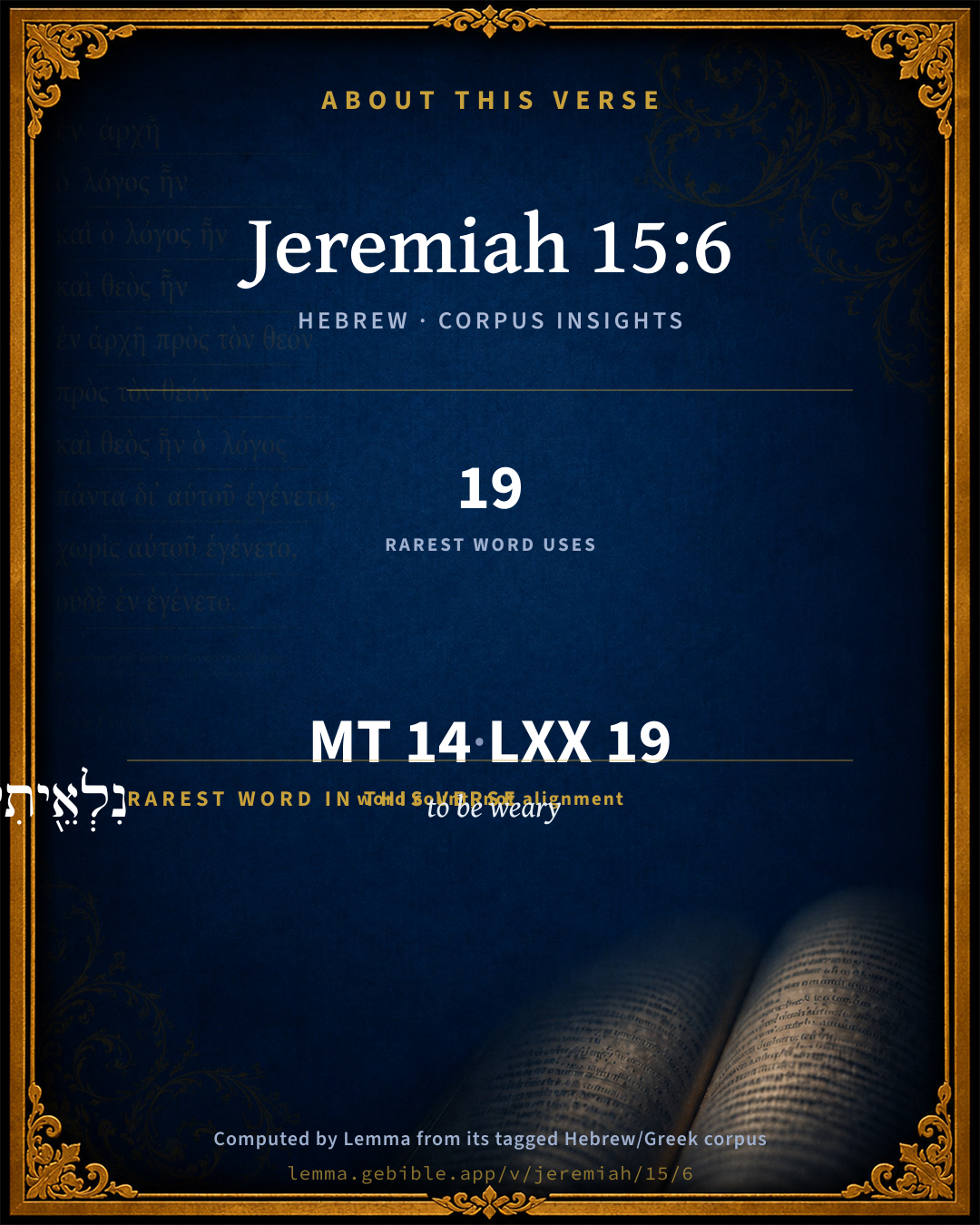
The rarest word here is נִלְאֵ֖יתִי to be weary H3811 — appearing just 19 times in the whole Hebrew Bible.

Shared distinctive vocabulary

נִלְאֵ֖יתִי to be weary H3811 occurs in 18 verses of the Hebrew Bible. Also found in:

Grammatical profile

  • 6 verbs
  • 4 nouns
  • 1 pronoun
  • 1 preposition
  • 2 particles

Verb forms

  • נָטַ֥שְׁתְּ Qal · Perfect
  • תֵּלֵ֑כִי Qal · Imperfect
  • וָאַ֨ט Hiphil · Sequential Imperfect
  • וָֽאַשְׁחִיתֵ֔ךְ Hiphil · Sequential Imperfect
  • נִלְאֵ֖יתִי Niphal · Perfect
  • הִנָּחֵֽם Niphal · Infinitive Construct

Hebrew & Septuagint length

In the original languages it is 14 Hebrew tokens and 19 Greek tokens — but the two are counted differently (Hebrew bundles its prefixes and suffixes into one token; the Greek is in lemma form), so that isn’t a like-for-like length.

Cross-references

21

Topical passages linked to Jeremiah 15:6 in the Treasury of Scripture Knowledge — connected by theme and wording, ordered by reader-vote popularity; previews shown in the World English Bible.

  • Jeremiah 7:24 But they didn't listen nor turn their ear, but walked in [their own] counsels [and] in the stubbornness of their evil heart, and went backward, and not forward.
  • Zephaniah 1:4 I will stretch out my hand against Judah, and against all the inhabitants of Jerusalem. I will cut off the remnant of Baal from this place: the name of the idolatrous and pagan priests,
  • Isaiah 1:4 Ah sinful nation, A people loaded with iniquity, A seed of evil-doers, Children who deal corruptly! They have forsaken Yahweh. They have despised the Holy One of Israel. They are estranged and backward.
  • Hosea 11:7 My people are determined to turn from me. Though they call to the Most High, He certainly won't exalt them.
  • Zechariah 7:11 But they refused to listen, and turned their backs, and stopped their ears, that they might not hear.
  • Jeremiah 1:16 I will utter my judgments against them touching all their wickedness, in that they have forsaken me, and have burned incense to other gods, and worshiped the works of their own hands.
  • Jeremiah 2:17 Haven't you procured this to yourself, in that you have forsaken Yahweh your God, when he led you by the way?
  • Jeremiah 6:11 Therefore I am full of the wrath of Yahweh; I am weary with holding in: pour it out on the children in the street, and on the assembly of young men together; for even the husband with the wife shall be taken, the aged with him who is full of days.
  • Jeremiah 6:19 Hear, earth: behold, I will bring evil on this people, even the fruit of their thoughts, because they have not listened to my words; and as for my law, they have rejected it.
  • Ezekiel 25:7 therefore, behold, I have stretched out my hand on you, and will deliver you for a spoil to the nations; and I will cut you off from the peoples, and I will cause you to perish out of the countries: I will destroy you; and you shall know that I am Yahweh.
  • Hosea 13:14 I will ransom them from the power of Sheol. I will redeem them from death! Death, where are your plagues? Sheol, where is your destruction? Compassion will be hidden from my eyes.
  • Psalms 78:38–40 But he, being merciful, forgave iniquity, and didn't destroy them. Yes, many times he turned his anger away, And didn't stir up all his wrath.
  • Isaiah 28:13 Therefore shall the word of Yahweh be to them precept on precept, precept on precept; line on line, line on line; here a little, there a little; that they may go, and fall backward, and be broken, and snared, and taken.
  • Jeremiah 2:13 For my people have committed two evils: they have forsaken me, the spring of living waters, and hewed them out cisterns, broken cisterns, that can hold no water.
  • Jeremiah 2:19 Your own wickedness shall correct you, and your backsliding shall reprove you: know therefore and see that it is an evil thing and a bitter, that you have forsaken Yahweh your God, and that my fear is not in you, says the Lord, Yahweh of Hosts.
  • Jeremiah 8:5 Why then is this people of Jerusalem slidden back by a perpetual backsliding? they hold fast deceit, they refuse to return.
  • Jeremiah 20:9 If I say, I will not make mention of him, nor speak any more in his name, then there is in my heart as it were a burning fire shut up in my bones, and I am weary with forbearing, and I can't [contain].
  • Ezekiel 12:26–28 Again the word of Yahweh came to me, saying,
  • Ezekiel 14:9 If the prophet be deceived and speak a word, I, Yahweh, have deceived that prophet, and I will stretch out my hand on him, and will destroy him from the midst of my people Israel.
  • Hosea 4:16 For Israel has behaved extremely stubbornly, like a stubborn heifer. Then how will Yahweh feed them like a lamb in a meadow.
  • Amos 7:3–8 Yahweh relented concerning this. "It shall not be," says Yahweh.

Cross-references courtesy of OpenBible.info (CC BY 4.0).

Hebrew and Greek witnesses Masoretic Hebrew ↔ Greek Septuagint

The same verse in the two great witnesses to the Old Testament, shown verse-for-verse.

These are two independent witnesses, not word-aligned to each other, and the Septuagint is shown in lemma (dictionary) form.

Hebrew Jeremiah 15:6 Masoretic · Westminster Leningrad Codex

אַ֣תְּ נָטַ֥שְׁתְּ אֹתִ֛י נְאֻם יְהוָ֖ה אָח֣וֹר תֵּלֵ֑כִי וָאַ֨ט אֶת יָדִ֤י עָלַ֨יִךְ֙ וָֽאַשְׁחִיתֵ֔ךְ נִלְאֵ֖יתִי הִנָּחֵֽם

You have rejected me, says Yahweh, you are gone backward: therefore have I stretched out my hand against you, and destroyed you; I am weary with repenting.

World English Bible · Public Domain

Greek LXX Structure differs

In the Septuagint, Jeremiah is about an eighth shorter than the Hebrew and arranges its material differently — the Oracles Against the Nations (Hebrew chapters 46–51) appear in the middle of the Greek book, after 25:13. Because the chapter and verse boundaries do not line up, a verse-for-verse comparison with the Hebrew is not shown.

A verse-for-verse comparison isn’t shown here because the chapters and verses don’t line up. Switch to the LXX edition with the MT / LXX toggle above to read the Greek directly.

On this verse, Haydock's Catholic Bible Commentary discusses the Septuagint’s reading. Read the note in Commentary ↓

Hebrew: Westminster Leningrad Codex (CC BY 4.0). Greek: Septuagint (public domain); English from a public-domain English Septuagint. How the Septuagint differs from the Hebrew →

Targum (Aramaic paraphrase)

1

The Targum is the ancient Jewish Aramaic paraphrase of the Hebrew Scriptures — an interpretive translation, not the Hebrew text itself. Onkelos (literal) and Pseudo-Jonathan (expansive) render the Torah, and Jonathan the Prophets. Coverage is partial: where no permissively-licensed English translation exists for a verse, only the Aramaic is shown. This is verse-level text, not a word-by-word alignment to the Hebrew.

  1. Targum Jonathan Prophets (Joshua–Malachi)
    אַתְּ שְׁבַקְתְּ פּוּלְחָנִי אֲמַר יְיָ לַאֲחוֹרָא אִסְתַּחַרְתְּ וְאָרֵים יַת מְחַת גְבוּרְתִּי עֲלָךְ וֶאֱחַבְּלִינָךְ עַל דַהֲוֵית יָכְלָא לְמֵיתַב וְלָא תָבְתְּ:

    (no public-domain English translation for this verse)

    Targum Jonathan — Aramaic: “Mikraot Gedolot” (public domain). English: “Sefaria Community Translation” (CC0 1.0 (public-domain dedication)); “London "Chaldee Paraphrase," 1871” (public domain). Text via Sefaria.

Commentary

Notes on Jeremiah 15:6 from classic Christian and Jewish commentators (each source and its license shown beneath its notes). The classic Christian expositions comment on the surrounding passage and are grouped to its opening verse, so a note may address several verses; the Jewish commentaries on the Tanakh (Rashi and others) are per-verse, so they appear only where the commentator wrote on this verse.

Lemma curates 59 commentaries, every one of them public domain or Creative Commons licensed, each selected and text-cleaned for this edition rather than reprinted as found. About our sources →

Trapp's Complete Commentary

John Trapp

Jer 15:6 Thou hast forsaken me, saith the LORD, thou art gone backward: therefore will I stretch out my hand against thee, and destroy thee; I am weary with repenting.

Ver. 6. I am weary with repenting.] Patiendo, ac parcendo. I have so oft revoked my threats, that unless I should wrong my justice, I can do so no more.

John Trapp, A Commentary or Exposition upon All the Books of the Old and New Testament (1647–1656) — public domain. Text from a community e-Sword module.

The Biblical Illustrator

Joseph S. Exell

Jer_15:6

I am weary with repenting.

The Almighty weary with repenting

I. God repenting. God condescends to designate His conduct by that name. The expression may be inadequate and defective, but still language had nothing better to describe the idea, nor human experience to represent the fact. When God is pleased to speak of Himself as pitying, repenting, grieving for mans sake, what is evidently intended is, that so intense is His love for man, that were His infinite nature capable of these creature passions, His love would show itself in these very forms.

II. God provoked to a degree that He can repent no more. He is weary with repenting: worn and tired out with having to cancel threatened sentences so often--as a potentate of earth might be at finding that every fresh display of patience in his subjects masked but deeper hatred to his rule, and every amnesty he declared was but a signal for raising the standard of rebellion anew. What can man do, to move the Author of his being to regard him in this way? We must not speculate; we must let the great God speak for Himself; we must try to gather out of other Scriptures what those things are which are said to weary God, wear out His patience, make Him tired of His forgivenesses, reprieves, and revoked sentences.

1. Among these provocations we may note hypocrisy and allowed formality in religious duty (Isa_1:13-14).

2. We may make God weary by presumptuous and unwarranted calculations upon His mercy (Mal_2:17).

3. Another thing Scripture teaches us wearies, puts God out of patience, is unbelief, a restoring to creature trust and dependencies, a want of simplicity and unreservedness in accepting His promises, as if we thought He would not pay them in full, or did not mean them to be taken by us, in all their length and breadth, and depth and worth.

4. The awful limit prescribed in the text may be reached, and the Divine forbearance tasked one step too far, by provocations after mercies. (D. Moore, M. A.)

Jehovah weary with repenting

The fact that God is weary of repenting shows--

1. That God had often turned from His threatenings, and dealt in mercy with the people.

2. That the Divine mercy had been frequently abused, and the people had gone back again to their sins.

3. That not a change in His being, but only a change of relationship, is expressed by the word repent.

4. That judgment is alien to Gods heart, whereas mercy is His delight.

5. That when God is met with persistent ingratitude, and men relapse continually into sin, He must eventually punish them.

6. That the operations of the Divine mind can only be expressed in human language with difficulty and limitation.

7. That we should be careful not to trifle with or abuse, the patient long-suffering of God. (W. Whale.)

Divine judgments and mans relation to them

Famine, pestilence, revolution, war, are judgments of the Ruler of the world. What sort of a ruler, we ask, is He? The answer to that question will determine the true sense of the term--the judgment of God. The heathen saw Him as a passionate, capricious, changeable Being, who could be angered and appeased by men. The Jewish prophet saw Him as a God whose ways were equal, who was unchangeable, who was not to be bought off by sacrifices but pleased by righteous dealing, and who would remove the punishment when the causes which brought it on were taken away; in other words, when men repented God would repent. That does not mean that He changed His laws to relieve them of their suffering, but that they changed their relationships to His law, so that, to them thus changed, God seemed to change. A boat rows against the stream; the current punishes it. So is a nation violating the law of God, it is subject to punishment, judgment. The boat turns and goes with the stream; and the current assists it. So is a nation which has repented and put itself into harmony with Gods law; it is subject to a blessing. But the current is the same; it has not changed, only the boat has changed its relation to the current. Neither does God change--we change; and the same law which executed itself in punishment now expresses itself in reward. (W. Brooke.)

Jer_15:6-9

Thou hast forsaken Me.

God forsaking and God forsaken

I. A God-forsaking people. Conviction by God Himself of this great folly and sin. In Jer_2:13, the charge is more complete. Creation is called upon to express surprise at a folly so conspicuous.

1. Thou--who oughtest to have been unto Me a loyal and loving people, testifying of My power and grace, and proving by separation from the nation your preference for the living and true God.

2. Hast forsaken--not simply forgotten, or disobeyed, but of deliberate choice hast taken other gods, and disregarded Jehovah.

3. Me--who called Abraham, etc.

II. A God-forsaken people.

1. Always retrograde. Unless they repent and obey God, there is no way forward and upward.

2. Always in danger of destruction. If we forsake the mercy, we inherit the misery.

3. Always exposed to terrors and disasters.

4. Always drifting into languor, premature decline, shame, and death. (W. Whale.)

How men forsake God

A rule I have had for years is to treat the Lord Jesus Christ as a personal friend. It is not a creed, a mere empty doctrine, but it is Christ Himself we have. The moment we receive Christ we should receive Him as a friend. When I go away from home I bid my wife and children good-bye; I bid my friends and acquaintances good-bye; but I never heard of a poor backslider going down on his knees and saying, I have been near You for ten years. Your service has become tedious and monotonous. I have come to bid You farewell. Good-bye, Lord Jesus Christ! I never heard of one doing this. I will tell you how they go away; they just run away. (D. L. Moody.)

The Biblical Illustrator, edited by Joseph S. Exell (c. 1880s–1900s) — public domain. Text from a community e-Sword module.

Joseph Benson's Commentary

Jer 15:6-7. Thou hast forsaken me, thou art gone backward — God here, by more expressions of the same import with many that we have before met with, declares his steady resolution to destroy them for their apostacy from him; and represents himself as an angry prince or parent, that had frequently been provoked by a subject or child whom he had often resolved to punish, but out of his clemency, or upon the mediation of others, had altered his mind, and resolved to spare him; but afterward had met with so many fresh provocations that his patience was quite tired out, and he was determined to bear no longer. I will fan them with a fan — Not a purging fan, to separate the chaff from them, but a scattering fan, to disperse and scatter them to all the winds, as Ezekiel expresses it, Eze 5:12. In the gates of the land — He alludes to a man standing in the gate of his thrashing-floor to fan and cleanse his corn. I will deprive them of children — The words, of children, are not in the Hebrew, and are unnecessarily supplied: it may as well be of any, or all their comforts and good things. I will destroy my people — The privilege they claim of being my people shall not protect them while they go on in their sinful courses.

Joseph Benson's Commentary on the Old and New Testaments (1811–1818) — public domain. Text from a community e-Sword module.

Tyndale Open Study Notes

Tyndale Open Resources

15:6-7 The people had heard the charge that they had abandoned God and turned their back on him before (2:13), but they had not taken it seriously. Though the Lord had often given them another chance to repent, their sin provoked him to carry out the curses of the Sinai covenant (Deut 27:15-26).

Tyndale Open Study Notes — © Tyndale Open Resources, licensed CC BY-SA 4.0. Text via the HelloAO Bible API.

Geneva Bible (1599)

Geneva Bible translators

That is, I will not call back my plagues or spare thee any more.

Geneva Bible (1599) marginal notes — public domain. Text via Bolls.life.

Jamieson, Fausset & Brown

Robert Jamieson, A. R. Fausset & David Brown

weary with repenting-- (Hos 13:14; Hos 11:8). I have so often repented of the evil that I threatened (Jer 26:19; Exo 32:14; Ch1 21:15), and have spared them, without My forbearance moving them to repentance, that I will not again change My purpose (God speaking in condescension to human modes of thought), but will take vengeance on them now.

Jamieson, Fausset & Brown — Commentary Critical and Explanatory on the Whole Bible (1871) — public domain (CC PDM 1.0). Text via the HelloAO Bible API.

Adam Clarke's Commentary

Verse 6. I am weary with repenting.] With repeatedly changing my purpose. I have often, after purposing to punish, showed them mercy. I will do it no longer; it is useless. I took them often at their promise, and in every instance they have failed.

Adam Clarke's Commentary on the Bible (1810–1826) — public domain. Text from a community e-Sword/MySword module.

John Calvin's Commentaries

Then follows the reason — For thou hast forsaken me, saith Jehovah Since, then, God had been rejected by the Jews, did not such a defection bring its deserved reward, when they were deprived of every human aid? He afterwards adds, Backward hast thou gone He intimates that there was a continuance in their wicked defection; for they not only forgot God for a time, but departed far from him, so as to become wholly alienated.

It then follows — And I will stretch out, etc.; that is, “therefore will I stretch out,” etc.; for the copulative is to be taken here as an inative. This may be viewed as in the past or the future tense; for God had in a measure already afflicted the people; but heavier judgments awaited them. I am inclined to regard it as a prediction of what was to come, as it immediately follows, I am weary with repenting, that is, “I have so often repented that I cannot possibly be induced now to forgive; for I see that I have been so often deceived, that I camlot hear to be deceived any longer.” Some, indeed, give this version, — “I am weary with consoling myself,” and נחם, nuchem, means both; but the other sense seems to me the most suitable. I doubt not then but that the Prophet means repentance. We indeed know that God changes not his purpose; for men repent because their expectation often disappoints them, when things happen otherwise than they had thought; but no such thing can happen to God; and he is said to repent according to our apprehensions. God then repents of his severity whenever he mitigates it towards his people, whenever he withdraws his hand from executing his vengeance, whenever he forgives sins. And this had been often done to the Jews; but they had made a mock of such mercy, and the oftener God spared them the more audaciously did they provoke his wrath. Hence he says, “I am weary with repenting so often;” that is, that he had so often spared them and suspended his judgment.

In short, he deprives the Jews of every excuse, and shews that they acted impiously when they murmured against God, for they allowed no place to his mercy; nay, whenever they found him recentliable they abused his forbearance with extreme indignity and perverseness. It follows —

John Calvin's Commentaries (1540-1563) — public domain. Text from the Calvin Translation Society English edition (1840s-50s) via the Christian Classics Ethereal Library (ccel.org). Calvin's coverage is partial (roughly two-thirds of the Bible); uncommented books and verses are honest gaps, never fabricated. The 19th-century editor's footnotes and remarks are omitted so the notes are faithfully Calvin's own voice.

Ellicott's Commentary for English Readers

(6) Thou hast forsaken me.—The Hebrew word has the stronger sense of rejecting or repudiating as well as simply leaving, and gives the reason for a like rejection on the part of Jehovah.

I am weary with repenting.—The long-suffering of God is described, as before, in anthropomorphic language (comp. 1Sa_15:35). He had “repented,” i.e., changed His purpose of punishing, but patience was now exhausted, and justice was weary of the delay, and must take its course. Perhaps, however, I am weary of pitying or of relenting would be a better rendering.

A Bible Commentary for English Readers, edited by Charles John Ellicott (1878–1897) — public domain. Text from a community e-Sword module.

John Gill's Exposition

Thou hast forsaken me, saith the Lord,.... His worship, as the Targum; and had set up idols, and idol worship; and this was the cause of the sword, pestilence, famine, and captivity, and of all the evils that befell them:

thou art gone backward; from the law of the Lord, and from his pure worship and service, from his ways and from his ordinances; and therefore it was but just they should go into captivity; hence it follows:

therefore will I stretch out mine hand against thee, and destroy thee; his hand of power and vengeance, which when stretched out, and falls with weight, whether on particular persons, or on a nation, brings inevitable ruin and destruction with it:

I am weary with repenting; not that the Lord ever changes his mind, or the counsel of his will; in this sense he is without repentance; but the conduct of his providence, and the dispensations of it; not executing the threatenings denounced, but sparing them a little longer, showing mercy, and exercising patience and longsuffering; but now he was as one weary and tired out, and was determined to bear no longer with them, but stir up all his wrath against them, and destroy them.

John Gill's Exposition of the Whole Bible (1746–1763) — public domain (CC PDM 1.0). Text via the HelloAO Bible API.

Albert Barnes' Notes on the Bible

This verse gives the reason of the refusal of Yahweh to hear the prophet’s intercession. The punishment due has been delayed unto wearisomeness, and this seeming failure of justice has made Judah withdraw further from God.

Albert Barnes' Notes on the Bible (1834–1885) — public domain. Text from a community e-Sword/MySword module.

Haydock's Catholic Bible Commentary

Intreating thee. Hebrew, "of being intreated;" (St. Jerome) or, "of repenting," and suspending the effects of my wrath. (Calmet) --- Septuagint, "I will no longer spare them." (Haydock)

George Leo Haydock (1774–1849), Haydock's Catholic Family Bible and Commentary, 1859 edition — public domain. Excludes Psalms (Douay-Rheims chapter numbering differs from Protestant) and Deuterocanonical books (Catholic canon only).

Matthew Poole's English Annotations

God here, by more phrases of the same import with many that we have before met with, declareth his steady resolution to destroy them for their apostacy from him; and sets out himself to them as angry princes or parents, that had been often provoked against a subject or a child, and often resolved to punish the offender; but out of their own clemency, or upon the mediation and intercession of others for them, had altered their minds, and resolved to spare them, but at last met with so many fresh provocations, that they are weary of forgiving them any longer; so God declareth himself weary of his patient bearing with them, and resolved to bear no longer.

Matthew Poole's English Annotations on the Holy Bible (1683–1685) — public domain. Text from a community e-Sword/MySword module.

Whedon's Commentary on the Bible

Daniel D. Whedon

6. Forsaken — The original is still stronger — rejected.

Daniel D. Whedon (gen. ed.), Commentary on the Old and New Testaments (1874–1909) — public domain. Text from a community e-Sword module.

The Pulpit Commentary

Will I stretch; literally, I stretched the perfect of prophetic certitude (so in next verse). I am weary with repenting; i.e. with recalling my (conditional) sentence of punishment. (see on Jer_18:1-10)

God weary of repenting.

I GOD OFTEN APPEARS TO REPENT. He seems to repent of his merciful intentions when the conduct of men has called forth his righteous indignation even repenting that he had ever made men, (Gen_6:6) and to repent of his wrathful intentions when his children repent of their sins. (e.g. Exo_32:14) Absolutely it cannot be said that God repents. (1Sa_15:29) He never does wrong, never errs, is never moved from reason by passion, knows the end from the beginning, and therefore never sees a new thing to modify his thoughts. Yet he acts as if he repented, i.e. he grieves for the sorrow he has righteously brought, and desires that it may cease as soon as possible; and he changes his action towards his children as they change their conduct towards him. This fact is not inconsistent with the essential Divine immutability. The sun does not vary in itself because, after developing a flower in moist weather, it withers it in drought. A government does not change its policy if it enters into amicable arrangements with a loyal dependency, though it was carrying out warlike measures so long as the province was in revolt. So God does not change in his own nature because his action is varied according to the varied requirements of his people. Such variation is rather a result of his essential changelessness. Righteousness, which requires the punishment of the guilty, approves of the forgiveness of the penitent; so that if the action of God did not change from wrath to mercy with the change of the guilty person to penitence, it would seem as though the nature of God had been turned aside from its essential righteousness. Because the sun is stationary it appears to rise and set as the earth revolves; if it did not so appear it must be moving too; and because God is eternally good it must seem to us, who are constantly giving occasion for differences of treatment from the hand of God, that he repents. We can only speak of God after the manner of men; therefore we say he repents.

II GOD MAY BE WEARY OF REPENTING. Here is a second anthropomorphic expression, which corresponds to a great and terrible fact.

1. We may cease to repent of our sin; then God will cease to repent of his wrath.

2. We may sin so deeply and so persistently that he may no longer find it possible to withhold his threatened punishment. God is long-suffering; he waits for the return of his children. Though the recompense of evil-doing is due, it is deferred; God spares the guilty for the sake of the intercession of the righteous. But this cannot be forever. We may sin away the grace of God. Though God"s mercy endureth forever the enjoyment of it by the impenitent cannot be perpetual. Eternal mercy may have to give place to eternal justice.

CONCLUSION. Consider

(1) the wonderful love of God in repeatedly "repenting" of his wrathful intentions, showing that he does not desire the woe of his children, but does all that is possible to avert it;

(2) the great sin of persisting in impenitence after God has shown so wonderful a love; and

(3) the danger that God may be weary with repenting, and therefore the folly and presumption of relying upon our present immunity for future safety.

The Pulpit Commentary (1880–1919), ed. H.D.M. Spence-Jones & Joseph S. Exell — public domain. Text from a community e-Sword module.

John Wesley's Explanatory Notes

I am weary - I am resolved to bear no longer.

John Wesley, Explanatory Notes Upon the Whole Bible (1754–1765) — public domain. Text via the GEBible commentary corpus.

Scofield Reference Notes

C. I. Scofield

repenting

(See Scofield "Zec 8:14")

The Scofield Reference Bible (1917 edition), notes by C. I. Scofield — public domain. Text from a community e-Sword module.

Rashi

Rabbi Shlomo Yitzchaki (Rashi)

I am weary of repenting Many times I planned to destroy but repented of the evil. Now I am weary of repenting. הִנָחֵם (Dporpnser in O.F.)

Rashi on the Tanakh — English translations: “The Judaica Press complete Tanach with Rashi, translated by A. J. Rosenberg” (CC BY 4.0); “Pentateuch with Rashi's commentary by M. Rosenbaum and A.M. Silbermann, 1929-1934” (public domain); “The Metsudah Tanach series, Lakewood, N.J” (CC BY 4.0); and “The Book of Joshua, Metsudah Publications, 1997” (CC BY 4.0). Text via Sefaria.

Lesson kit

Teaching starters — assembled from the data on this page, not authored interpretation. Every prompt links to the verse data it draws on. Edit before teaching.

Jeremiah, in the Prophets, opens this verse with 14 words (13 distinct Hebrew lemmas). Its most distinctive word is lâʼâh (“to be weary”). A historical commentator’s framing appears above. Read the whole chapter for the surrounding context.

Discussion questions

  1. How does “to be weary” (lâʼâh) shape what this verse is saying?
  2. How does Genesis 19:11, which shares the word «to be weary», read alongside this verse?
  3. These translations render this verse differently. What is at stake in choosing one wording over another?
  4. «נָטַ֥שְׁתְּ» is a Qal Perfect verb. How does that grammatical form shape the action described?
  5. Compare how Trapp's Complete Commentary and The Biblical Illustrator read this verse. Where do they agree or differ?

Things to notice

Reading settings

Reading text

Shown beneath each verse's original-language words.

Old Testament
Old Testament edition

Read the OT as the Masoretic Hebrew (MT) or the Greek Septuagint (LXX).

English shown for the Greek Septuagint (in the Hebrew ↔ Greek comparison).

Comparing translations? Open the Compare panel on any verse page to stack up to four side by side.