
2 Kings 21:13

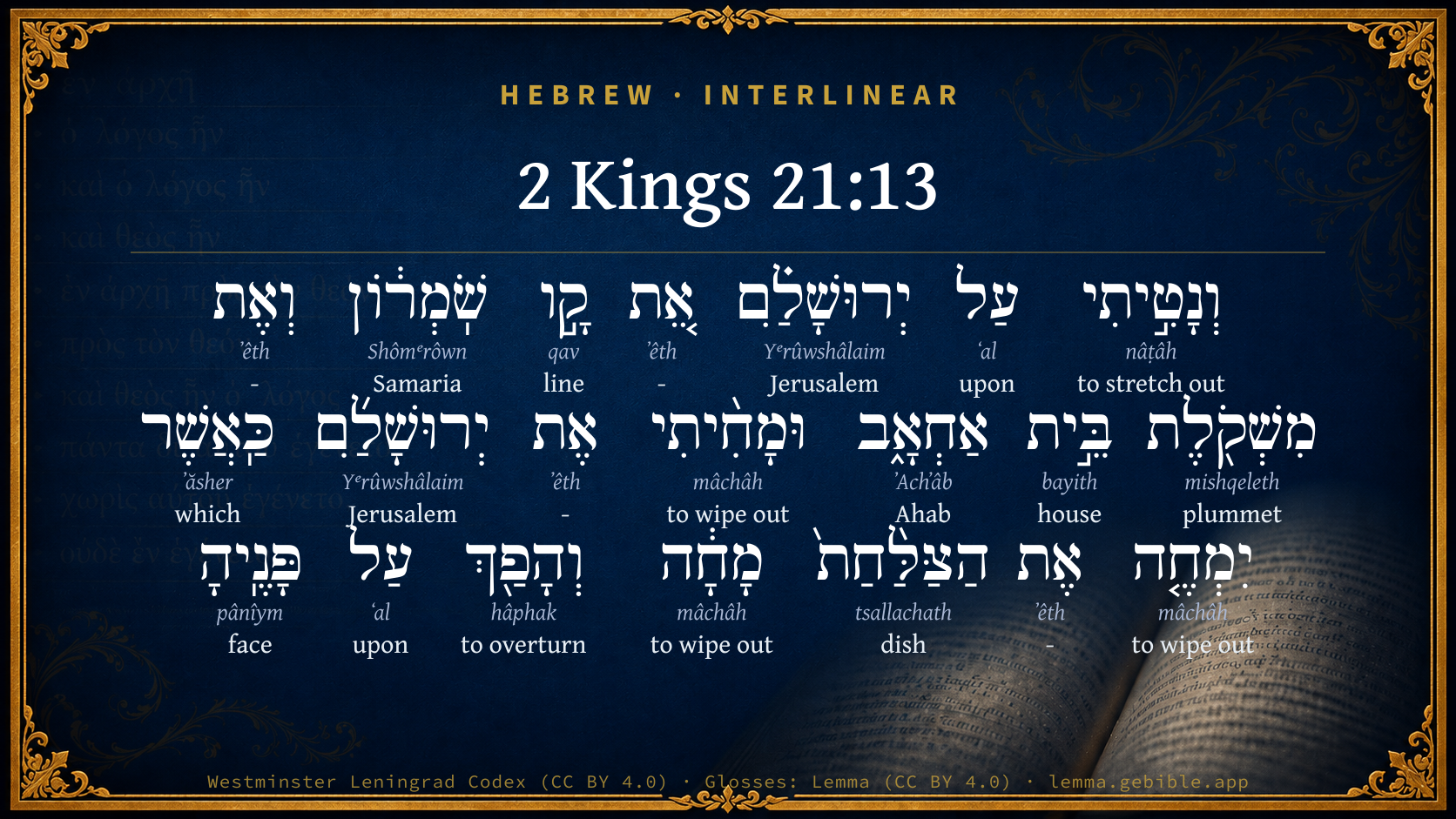
Hebrew (Westminster Leningrad Codex) 2 Kings 21:13 appears in the Hebrew Old Testament. The text above is from the Westminster Leningrad Codex. Each word links to its Strong’s number, a concise gloss, and parsing drawn from the Open Scriptures Hebrew Bible morphology. Click any word for its full Brown-Driver-Briggs (BDB) entry.
Download image
Cite this verse

2 Kings 21:13 (World English Bible). Public Domain. Lemma interlinear Bible study tool, https://lemma.gebible.app/v/2-kings/21/13.

Show BibTeX & RIS
BibTeX
RIS
English Translation
I will stretch over Jerusalem the line of Samaria, and the plummet of the house of Ahab; and I will wipe Jerusalem as a man wipes a dish, wiping it and turning it upside down.
World English Bible · Public Domain
Highlights
  • 3 first appearances in the Hebrew Bible
Full analysis ↓
Download a study sheet

One document with this verse’s original text, its word-by-word gloss line, the meaning frame, cross-references with their text, attributed commentary, and full source and license credits — printable, and it pastes into notes with its structure intact.

This verse Autodidact and up

Study sheet (.html) Plain text (.txt)

A passage Seminary Student

Up to 50 verses in one chapter. A passage sheet keeps up to 6 commentary sources and 12 cross-references per verse, in the order this page ranks them, and says so on the sheet whenever that leaves anything out. Ask for a single verse and you get the Autodidact verse sheet above.

Everything on this page stays free to read, with no account — the sheet is a download of what is already on screen, not access to it.

Want to remove ads? Support Godless Engineer
Compare translations 3

The same verse in 3 English versions, stacked beneath the original-language interlinear above. Click any original word for its lexicon entry.

Each is an independent rendering of the whole verse — the interlinear is not word-aligned to these translations.

Highlighted words mark where these versions differ — a whole-verse word diff, not a word-by-word alignment.

  • World English Bible Public Domain
    I will stretch over Jerusalem the line of Samaria, and the plummet of the house of Ahab; and I will wipe Jerusalem as a man wipes a dish, wiping it and turning it upside down.
  • King James Version Public Domain
    And I will stretch over Jerusalem the line of Samaria, and the plummet of the house of Ahab: and I will wipe Jerusalem as a man wipeth a dish, wiping it, and turning it upside down.
  • unfoldingWord Literal Text CC BY-SA 4.0
    And I will stretch over Jerusalem the measuring line of Samaria and the plumb line of the house of Ahab. And I will wipe Jerusalem away, just as one wipes a dish, he wipes and turns on its face.

unfoldingWord Literal Text — © unfoldingWord, licensed CC BY-SA 4.0. Word-aligned USFM3 via Door43 (git.door43.org/unfoldingWord/en_ult).

Versions to compare (up to 4)

3 of 4 selected

Show all 18 translations

Every available English version of this verse, each an independent rendering of the whole verse.

  • World English Bible Public Domain
    I will stretch over Jerusalem the line of Samaria, and the plummet of the house of Ahab; and I will wipe Jerusalem as a man wipes a dish, wiping it and turning it upside down.
  • Berean Standard Bible Public Domain
    I will stretch out over Jerusalem the measuring line used against Samaria and the plumb line used against the house of Ahab, and I will wipe out Jerusalem as one wipes out a bowl—wiping it and turning it upside down.
  • Majority Standard Bible Public Domain
    I will stretch out over Jerusalem the measuring line used against Samaria and the plumb line used against the house of Ahab, and I will wipe out Jerusalem as one wipes out a bowl—wiping it and turning it upside down.
  • King James Version Public Domain
    And I will stretch over Jerusalem the line of Samaria, and the plummet of the house of Ahab: and I will wipe Jerusalem as a man wipeth a dish, wiping it, and turning it upside down.
  • American Standard Version (1901) Public Domain
    And I will stretch over Jerusalem the line of Samaria, and the plummet of the house of Ahab; and I will wipe Jerusalem as a man wipeth a dish, wiping it and turning it upside down.
  • Revised Version (1885) Public Domain
    And I will stretch over Jerusalem the line of Samaria, and the plummet of the house of Ahab: and I will wipe Jerusalem as a man wipeth a dish, wiping it and turning it upside down.
  • Geneva Bible (1599) Public Domain
    And I will stretch ouer Ierusalem the line of Samaria, and the plommet of the house of Ahab: and I will wipe Ierusalem, as a man wipeth a dish, which he wipeth, and turneth it vpside downe.
  • Douay-Rheims (1899) Public Domain
    And I will stretch over Jerusalem the line of Samaria, and the weight of the house of Achab: and I will efface Jerusalem, as tables are wont to be effaced, and I will erase and turn it, and draw the pencil often over the face thereof.
  • Young's Literal Translation Public Domain
    And I have stretched out over Jerusalem the line of Samaria, and the plummet of the house of Ahab, and wiped Jerusalem as one wipeth the dish -- he hath wiped, and hath turned `it' on its face.
  • Literal Standard Version CC BY-SA 4.0
    And I have stretched out the line of Samaria over Jerusalem, and the plummet of the house of Ahab, and wiped Jerusalem as one wipes the dish—he has wiped, and has turned [it] on its face.
  • Unlocked Literal Bible CC BY-SA 4.0
    I will stretch over Jerusalem the measuring line used against Samaria, and the plumb line used against the house of Ahab; I will wipe Jerusalem clean, as a man wipes a dish, wiping it and turning it upside down.
  • unfoldingWord Literal Text CC BY-SA 4.0
    And I will stretch over Jerusalem the measuring line of Samaria and the plumb line of the house of Ahab. And I will wipe Jerusalem away, just as one wipes a dish, he wipes and turns on its face.
  • Darby Bible Public Domain
    And I will stretch over Jerusalem the line of Samaria, and the plummet of the house of Ahab, and I will wipe Jerusalem as one wipeth a pan, wiping it and turning it upside down.
  • World Messianic Bible Public Domain
    I will stretch over Jerusalem the line of Samaria, and the plumb line of Ahab’s house; and I will wipe Jerusalem as a man wipes a dish, wiping it and turning it upside down.
  • Webster's Bible Public Domain
    And I will stretch over Jerusalem the line of Samaria, and the plummet of the house of Ahab: and I will wipe Jerusalem as a man wipeth a dish, wiping it, and turning it upside down.
  • Free Bible Version CC BY-SA 4.0
    I will extend over Jerusalem the measuring line used against Samaria and the plumb line used against the house of Ahab, and I will wipe away Jerusalem as people wipe clean a bowl, wiping it and turning it upside down.
  • Bible in Basic English Public Domain
    And over Jerusalem will be stretched the line of Samaria and the weight of Ahab; Jerusalem will be washed clean as a plate is washed, and turned over on its face.
  • JPS Tanakh (1917) Public Domain
    And I will stretch over Jerusalem the line of Samaria, and the plummet of the house of Ahab; and I will wipe Jerusalem as a man wipeth a dish, wiping it and turning it upside down.

Literal Standard Version (2020), Covenant Press — licensed CC BY-SA 4.0. Text via the HelloAO Bible API (eBible.org). Unlocked Literal Bible (unfoldingWord) — licensed CC BY-SA 4.0. Text via the HelloAO Bible API (eBible.org). unfoldingWord Literal Text — © unfoldingWord, licensed CC BY-SA 4.0. Word-aligned USFM3 via Door43 (git.door43.org/unfoldingWord/en_ult). Free Bible Version, Dr. Jonathan Gallagher — licensed CC BY-SA 4.0. Text via the HelloAO Bible API (eBible.org).

Word by word

More ways to search: Search by grammar → Find every occurrence → Compare this word →

Practice this passage: Drill this verse → Learn its vocabulary →

מִשְׁקֹ֖לֶת
mishqeleth
H4949
“plummet of”
Noun, Common, Feminine, Singular, Construct
Part of Speech
Noun
Type
Common
Gender
Feminine
Number
Singular
State
Construct
Full BDB Definition

Origin: from H4948 or H4947

TWOT: 2454d

level, levelling tool or instrument, plummet
  1. וְנָטִ֣יתִי nâṭâh H5186 “and · to stretch out” Conjunction + Verb, Qal, Sequential Perfect, 1st Person, Common, Singular
  2. עַל ʻal H5921 “upon” Preposition
  3. יְרוּשָׁלִַ֗ם Yᵉrûwshâlaim H3389 “Jerusalem” Noun, Proper
  4. אֵ֚ת ʼêth H853 “-” Particle, Direct Object
  5. קָ֣ו qav H6957 “line of” Noun, Common, Masculine, Singular, Construct
  6. שֹֽׁמְר֔וֹן Shômᵉrôwn H8111 “Samaria” Noun, Proper
  7. וְאֶת ʼêth H853 “and · -” Conjunction + Particle, Direct Object
  8. בֵּ֣ית bayith H1004 “house of” Noun, Common, Masculine, Singular, Construct
  9. אַחְאָ֑ב ʼAchʼâb H256 “Ahab” Noun, Proper
  10. וּמָחִ֨יתִי mâchâh H4229 “and · to wipe out” Conjunction + Verb, Qal, Sequential Perfect, 1st Person, Common, Singular
  11. אֶת ʼêth H853 “-” Particle, Direct Object
  12. יְרוּשָׁלִַ֜ם Yᵉrûwshâlaim H3389 “Jerusalem” Noun, Proper
  13. כַּֽאֲשֶׁר ʼăsher H834 “like/as · which” Preposition + Particle, Relative
  14. יִמְחֶ֤ה mâchâh H4229 “to wipe out” Verb, Qal, Imperfect, 3rd Person, Masculine, Singular
  15. אֶת ʼêth H853 “-” Particle, Direct Object
  16. הַצַּלַּ֨חַת֙ tsallachath H6747 “the · dish” Particle, Definite Article + Noun, Common, Feminine, Singular, Absolute
  17. מָחָ֔ה mâchâh H4229 “to wipe out” Verb, Qal, Perfect, 3rd Person, Masculine, Singular
  18. וְהָפַ֖ךְ hâphak H2015 “and · to overturn” Conjunction + Verb, Qal, Sequential Perfect, 3rd Person, Masculine, Singular
  19. עַל ʻal H5921 “upon” Preposition
  20. פָּנֶֽיהָ pânîym H6440 “face(s) · her” Noun, Common, Both, Plural, Construct + Suffix, Personal, 3rd Person, Feminine, Singular

About this verse

These counts appear in no published source. They are computed here, from the morphology-tagged text and Lemma’s own curated glosses. What Lemma adds →

21
words
14
distinct lemmas
Historical
section

Notable vocabulary

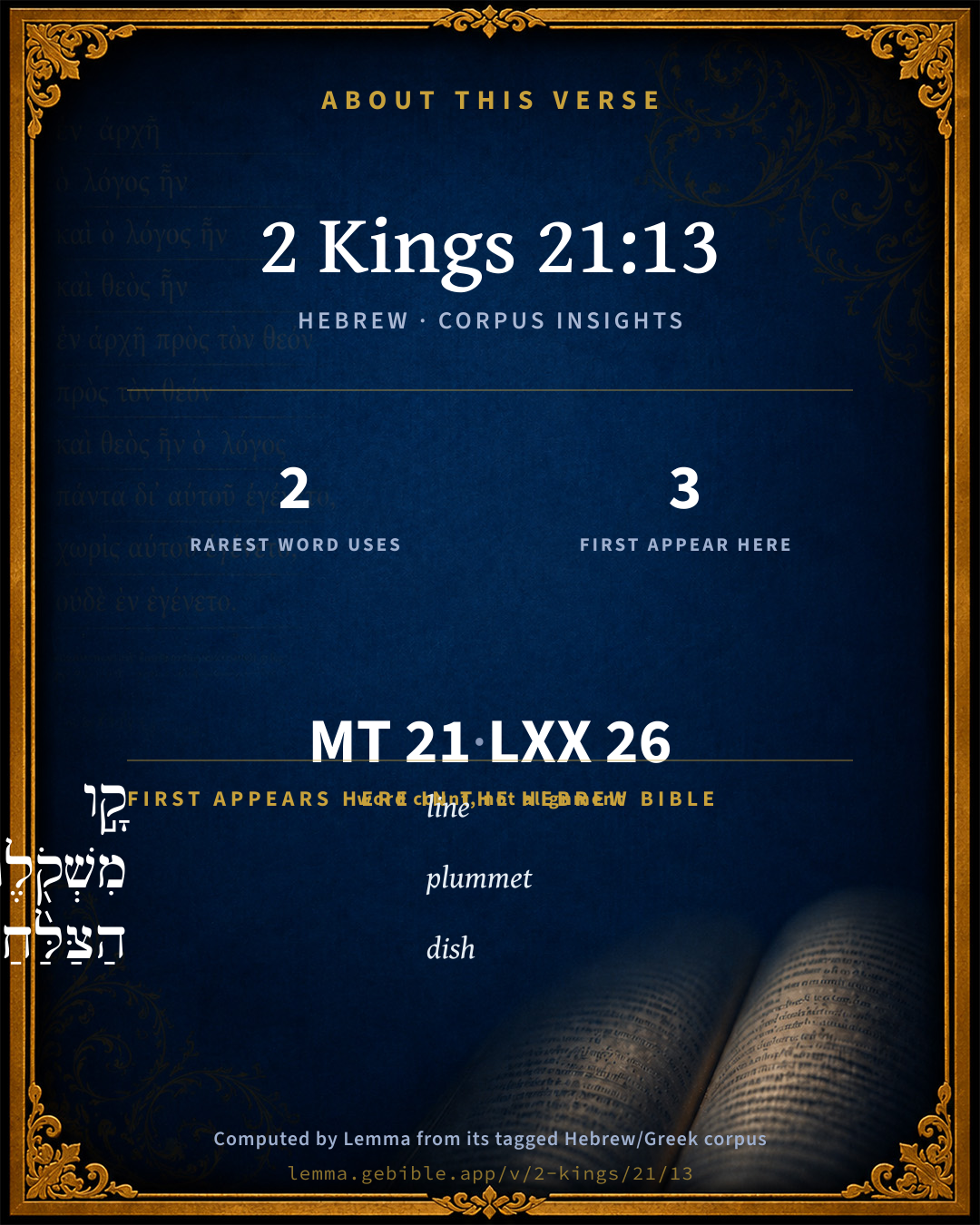
The rarest word here is מִשְׁקֹ֖לֶת plummet H4949 — appearing just 2 times in the whole Hebrew Bible.

First appearance in Scripture

These words make their first canonical appearance in the Hebrew Bible here:

  • קָ֣ו line H6957
  • מִשְׁקֹ֖לֶת plummet H4949
  • הַצַּלַּ֨חַת֙ dish H6747

Shared distinctive vocabulary

מִשְׁקֹ֖לֶת plummet H4949 occurs in 2 verses of the Hebrew Bible. Also found in:

Grammatical profile

  • 5 verbs
  • 9 nouns
  • 2 prepositions
  • 5 particles

Verb forms

  • וְנָטִ֣יתִי Qal · Sequential Perfect
  • וּמָחִ֨יתִי Qal · Sequential Perfect
  • יִמְחֶ֤ה Qal · Imperfect
  • מָחָ֔ה Qal · Perfect
  • וְהָפַ֖ךְ Qal · Sequential Perfect

Repetition

Words recur within this verse — often emphatic in Hebrew:

  • וּמָחִ֨יתִי to wipe out H4229 ×3
  • עַל upon H5921 ×2
  • יְרוּשָׁלִַ֗ם Jerusalem H3389 ×2

Hebrew & Septuagint length

In English translation the verse runs 35 words from the Hebrew and 36 from the Septuagint (LXX English) — closely comparable.

A rough comparison of the two English renderings, which tokenize alike — not a word-level alignment.

Word counts can differ between the Hebrew and the Greek without any difference in meaning — e.g. the Hebrew direct-object marker אֵת has no separate Greek word, and Greek often adds the article ὁ.

In the original languages it is 21 Hebrew tokens and 26 Greek tokens — but the two are counted differently (Hebrew bundles its prefixes and suffixes into one token; the Greek is in lemma form), so that isn’t a like-for-like length.

Cross-references

15

Topical passages linked to 2 Kings 21:13 in the Treasury of Scripture Knowledge — connected by theme and wording, ordered by reader-vote popularity; previews shown in the World English Bible.

  • Amos 7:7–8 Thus he showed me and, behold, the Lord stood beside a wall made by a plumb line, with a plumb line in his hand.
  • Lamentations 2:8 Yahweh has purposed to destroy the wall of the daughter of Zion; He has stretched out the line, he has not withdrawn his hand from destroying; He has made the rampart and wall to lament; they languish together.
  • Isaiah 34:11 But the pelican and the porcupine shall possess it; and the owl and the raven shall dwell therein: and he will stretch over it the line of confusion, and the plummet of emptiness.
  • 2 Kings 10:11 So Jehu struck all that remained of the house of Ahab in Jezreel, and all his great men, and his familiar friends, and his priests, until he left him none remaining.
  • Isaiah 10:22 For though your people, Israel, be as the sand of the sea, [only] a remnant of them shall return: a destruction [is] determined, overflowing with righteousness.
  • Isaiah 28:17 I will make justice the line, and righteousness the plummet; and the hail shall sweep away the refuge of lies, and the waters shall overflow the hiding-place.
  • Jeremiah 25:9 behold, I will send and take all the families of the north, says Yahweh, and [I will send] to Nebuchadrezzar the king of Babylon, my servant, and will bring them against this land, and against the inhabitants of it, and against all these nations round about; and I will utterly destroy them, and make them an astonishment, and a hissing, and perpetual desolations.
  • Ezekiel 23:31–34 You have walked in the way of your sister; therefore will I give her cup into your hand.
  • 1 Kings 14:10 therefore, behold, I will bring evil on the house of Jeroboam, and will cut off from Jeroboam every man-child, him who is shut up and him who is left at large in Israel, and will utterly sweep away the house of Jeroboam, as a man sweeps away dung, until it be all gone.
  • 2 Kings 17:6 In the ninth year of Hoshea the king of Assyria took Samaria, and carried Israel away to Assyria, and placed them in Halah, and on the Habor, the river of Gozan, and in the cities of the Medes.
  • Isaiah 14:23 I will also make it a possession for the porcupine, and pools of water: and I will sweep it with the broom of destruction, says Yahweh of Hosts.
  • Ezekiel 24:10–11 Heap on the wood, make the fire hot, boil well the flesh, and make thick the broth, and let the bones be burned.
  • Zechariah 1:16 Therefore thus says Yahweh: "I have returned to Jerusalem with mercy. My house shall be built in it," says Yahweh of Hosts, "and a line shall be stretched forth over Jerusalem."'
  • Revelation 18:21–23 A mighty angel took up a stone like a great millstone and cast it into the sea, saying, "Thus with violence will Babylon, the great city, be thrown down, and will be found no more at all.
  • 1 Kings 21:21–24 Behold, I will bring evil on you, and will utterly sweep you away and will cut off from Ahab every man-child, and him who is shut up and him who is left at large in Israel:

Cross-references courtesy of OpenBible.info (CC BY 4.0).

Hebrew and Greek witnesses Masoretic Hebrew ↔ Greek Septuagint

The same verse in the two great witnesses to the Old Testament, shown verse-for-verse.

These are two independent witnesses, not word-aligned to each other, and the Septuagint is shown in lemma (dictionary) form.

Hebrew 2 Kings 21:13 Masoretic · Westminster Leningrad Codex

וְנָטִ֣יתִי עַל יְרוּשָׁלִַ֗ם אֵ֚ת קָ֣ו שֹֽׁמְר֔וֹן וְאֶת מִשְׁקֹ֖לֶת בֵּ֣ית אַחְאָ֑ב וּמָחִ֨יתִי אֶת יְרוּשָׁלִַ֜ם כַּֽאֲשֶׁר יִמְחֶ֤ה אֶת הַצַּלַּ֨חַת֙ מָחָ֔ה וְהָפַ֖ךְ עַל פָּנֶֽיהָ

I will stretch over Jerusalem the line of Samaria, and the plummet of the house of Ahab; and I will wipe Jerusalem as a man wipes a dish, wiping it and turning it upside down.

World English Bible · Public Domain

Greek LXX 2 Kings 21:13 Septuagint · lemma form

καί ἐκτείνω ἐπί ἰερουσαλήμ ὁ μέτρον σαμαρεία καί ὁ στάθμιον οἶκος αχααβ καί ἀποἀλείφω ὁ ἰερουσαλήμ καθώς ἀποἀλείφω ὁ ἀλάβαστρος ἀποἀλείφω καί καταστρέφω ἐπί πρόσωπον αὐτός

And I will stretch out over Jerusalem the measure of Samaria, and the plummet of the house of Achaab: and I will wipe Jerusalem as a jar is wiped, and turned upside down in the wiping.

LXX2012 (modern English Septuagint) · Public Domain

On this verse, John Gill's Exposition discusses the Septuagint’s reading. Read the note in Commentary ↓

Hebrew: Westminster Leningrad Codex (CC BY 4.0). Greek: Septuagint (public domain); English from LXX2012 (modern English Septuagint) (Public Domain). How the Septuagint differs from the Hebrew →

Targum (Aramaic paraphrase)

1

The Targum is the ancient Jewish Aramaic paraphrase of the Hebrew Scriptures — an interpretive translation, not the Hebrew text itself. Onkelos (literal) and Pseudo-Jonathan (expansive) render the Torah, and Jonathan the Prophets. Coverage is partial: where no permissively-licensed English translation exists for a verse, only the Aramaic is shown. This is verse-level text, not a word-by-word alignment to the Hebrew.

  1. Targum Jonathan Prophets (Joshua–Malachi)
    וְאֱגוֹד עַל יְרוּשְׁלֵם יַת חוּט חוּרְבַּן שֹׁמְרוֹן וְיַת מַתְקוֹלֶת צָרוֹת בֵּית אַחְאָב וְאֶמְחֵי יַת יְרוּשְׁלֵם כְּמָא דְמִתְמַחְיָא צְלוּחִיתָא מִתְמַחְיָא וּמִתְהַפְּכָא עַל אַפָּהָא:

    (no public-domain English translation for this verse)

    Targum Jonathan — Aramaic: “Mikraot Gedolot” (public domain). English: “Sefaria Community Translation” (CC0 1.0 (public-domain dedication)); “London "Chaldee Paraphrase," 1871” (public domain). Text via Sefaria.

Commentary

Notes on 2 Kings 21:13 from classic Christian and Jewish commentators (each source and its license shown beneath its notes). The classic Christian expositions comment on the surrounding passage and are grouped to its opening verse, so a note may address several verses; the Jewish commentaries on the Tanakh (Rashi and others) are per-verse, so they appear only where the commentator wrote on this verse.

Lemma curates 59 commentaries, every one of them public domain or Creative Commons licensed, each selected and text-cleaned for this edition rather than reprinted as found. About our sources →

Trapp's Complete Commentary

John Trapp

2Ki 21:13 And I will stretch over Jerusalem the line of Samaria, and the plummet of the house of Ahab: and I will wipe Jerusalem as [a man] wipeth a dish, wiping [it], and turning [it] upside down.

Ver. 13. And I will stretch over Jerusalem the line.] A metaphor from carpenters, who with line and plummet do use to measure and mark out the wood that they intend to hew off or plane. See Isa 34:11.

I will wipe Jerusalem as a man wipeth a dish.] Gabatam, a porridge dish, Simili ab arte magirica. Well might God say, "I have also spoken by the prophets, I have multiplied visions, and used similitudes by the ministry of the prophets." {Hos 12:10}

Wiping it, and turning it upside down.] So I "overturn, overturn, overturn" this whole state. {Eze 21:27}

John Trapp, A Commentary or Exposition upon All the Books of the Old and New Testament (1647–1656) — public domain. Text from a community e-Sword module.

Joseph Benson's Commentary

2Ki 21:13. I will stretch over Jerusalem the line of Samaria — She shall have the same measure and lot; that is, the same judgments which Samaria has had. For the line is often put for one’s lot or portion, because men’s portions or possessions used to be measured by lines. Or it is a metaphor taken from workmen, who mark out by lines what parts of a building they would have thrown down, and what they would have to stand. I will wipe Jerusalem as a man wipeth a dish, &c. — As men do with a dish that hath been used, first wholly empty it of all that is in it, then thoroughly cleanse and wipe it, and lastly turn it upside down, that nothing may remain in it; so will I deal with Jerusalem, thoroughly empty and purge it from all its wicked inhabitants. Yet the comparison intimates, that this should be in order to the purifying, not the final destruction of Jerusalem. The dish shall not be broken in pieces, or wholly cast away, but only wiped.

Joseph Benson's Commentary on the Old and New Testaments (1811–1818) — public domain. Text from a community e-Sword module.

Geneva Bible (1599)

Geneva Bible translators

As I have destroyed Samaria and the house of Ahab, so will I destroy Judah.

Geneva Bible (1599) marginal notes — public domain. Text via Bolls.life.

Jamieson, Fausset & Brown

Robert Jamieson, A. R. Fausset & David Brown

the line of Samaria, and the plummet of the house of Ahab--Captives doomed to destruction were sometimes grouped together and marked off by means of a measuring-line and plummet (Sa2 8:2; Isa 34:11; Amo 7:7); so that the line of Samaria means the line drawn for the destruction of Samaria; the plummet of the house of Ahab, for exterminating his apostate family; and the import of the threatening declaration here is that Judah would be utterly destroyed, as Samaria and the dynasty of Ahab had been.

I will wipe Jerusalem, &c.--The same doom is denounced more strongly in a figure unmistakably significant.

Jamieson, Fausset & Brown — Commentary Critical and Explanatory on the Whole Bible (1871) — public domain (CC PDM 1.0). Text via the HelloAO Bible API.

Adam Clarke's Commentary

Verse 13. The line of Samaria] I will treat Jerusalem as I have treated Samaria. Samaria was taken, pillaged, ruined, and its inhabitants led into captivity; Jerusalem shall have the same measure.

And the plummet of the house of Ahab] The house of Ahab was totally destroyed, and not a man of his race left to sit upon the throne of Israel: so shall it be done to the house or royal family of Judah; they shall be all finally destroyed, and not a man of their race shall any more sit on the throne of Judah; nor shall Judah have a throne to sit on. Thus Jerusalem shall have the same weight as well as the same measure as Samaria, because it has copied all the abominations which brought that kingdom to total destruction.

I will wipe Jerusalem as a man wipeth a dish] The Vulgate translates this clause as follows: Delebo Jerusalem, sicut deleri solent tabulae; "I will blot out Jerusalem as tablets are wont to be blotted out." This is a metaphor taken from the ancient method of writing: they traced their letters with a stile on boards thinly spread over with wax; for this purpose one end of the stile was sharp, the other end blunt and smooth, with which they could rub out what they had written, and so smooth the place and spread back the wax, as to render it capable of receiving any other word. Thus the Lord had written down Jerusalem, never intending that its name or its memorial should be blotted out. It was written down The Holy City, The City of the Great King; but now God turns the stile and blots this out; and the Holy Jerusalem, the City of the Great King, is no longer to be found! This double use of the stile is pointed out in this ancient enigma: -

De summo planus; sed non ego planus in imo:

Versor utrinque manu, diverso et munere fungor:

Altera pars revocat, quicquid pars altera fecit.

"I am flat at the top, but sharp at the bottom;

I turn either end, and perform a double function:

One end destroys what the other end has made."

But the idea of emptying out and wiping a dish expresses the same meaning equally well. Jerusalem shall be emptied of all its wealth, and of all its inhabitants, as truly as a dish turned up is emptied of all its contents; and it shall be turned upside down, never to be filled again. This is true from that time to the present hour. Jerusalem is the dish turned upside down, the tablet blotted out to the present day! How great are God's mercies! and how terrible his judgments!

Adam Clarke's Commentary on the Bible (1810–1826) — public domain. Text from a community e-Sword/MySword module.

Ellicott's Commentary for English Readers

(13) And I will stretch over Jerusalem . . .—Comp. Amo_7:7-9; Isa_34:11; Lam_2:8. The sense is, I will deal with Jerusalem by the same rigorous rule of judgment as I have dealt already with Samaria. The figure of the measuring line and plummet suggests the idea that Jerusalem should be levelled and “laid even with the ground.”

As a man wipeth a (the) dish . . .—The wiping of the dish represents the destruction of the people, the turning it upside down, the overthrow of the city itself. Or perhaps, as Thenius says, the two acts together represent the single notion of making an end.

Wiping it and turning it . . .—This implies a different pointing of the text (infinitives instead of perfects, which is probably right).

A Bible Commentary for English Readers, edited by Charles John Ellicott (1878–1897) — public domain. Text from a community e-Sword module.

The Cambridge Bible for Schools and Colleges

gen. ed. J. J. S. Perowne

13. the line of Samaria, and the plummet of the house of Ahab] The figures are taken from the occupation of the builder. The builder employs line and plummet that he may carry out his work exactly according to the plan prescribed. But here the pattern is one of utter destruction, which God Himself threatens to carry out after the fashion of Samaria and the house of Ahab, which the previous generation had beheld utterly destroyed. Samaria and the house of Ahab were famous for building (see 1Ki_22:39 note). Hence the peculiar fitness of the figure. These great builders, with all that they had built, were swept away and just so should it be with Jerusalem. The way in which a portion of the judgement was carried out is described by the Chronicler: ‘The Lord brought upon them the captains of the host of the king of Assyria, which took Manasseh in chains (R.V.) and bound him with fetters, and carried him to Babylon’.

as a man wipeth a dish] The description is of a thing that is done with, and will be used no more. ‘To turn it upside down’, is literally ‘to turn it upon the face thereof’, a rendering which brings out very completely the intention of using the dish no more. Such God declares will be His manner of dealing with Jerusalem. The verb rendered ‘wipe’ is the same which is used Gen_7:4, ‘Every living substance … will I destroy’, and in Num_5:23 ‘he shall blot them out’, and in the solemn sentence, Exo_32:33, ‘him will I blot out of my book’. The original very markedly shews that God’s wiping was to be a wiping out.

The Cambridge Bible for Schools and Colleges (gen. ed. J. J. S. Perowne; Cambridge University Press, 1878–1918) — public domain. Text from a community e-Sword module.

John Gill's Exposition

And I will stretch over Jerusalem the line of Samaria,.... The Targum is, the line of destruction; and the sense is, that the same measure should be measured to Jerusalem as was to Samaria; that is, the same lot and portion should befall one as the other, that is, be utterly destroyed:

and the plummet of the house of Ahab; the Targum is, the weight or plummet of tribulation; signifying, that the same calamities should come upon the families of Jerusalem, and especially on the family of Manasseh as came upon the family of Ahab. It is a metaphor from builders that take down as well as raise up buildings by rule and measure, see Sa2 8:2.

and I will wipe Jerusalem, as a man wipeth a dish, wiping it, and turning it upside down; as when one takes a dish or cup that has broth in it, or any liquid, as oil; and the Septuagint render it alabaster, in which ointment used to be put; and wipes it clean, that nothing may appear in it; and then turns it with its mouth downward, that, if any thing should remain, it might drain out; signifying hereby the emptying o Jerusalem of its palaces and houses, wealth and riches and of all its inhabitants; and yet the empty dish being preserved, seems to denote the restoration of Jerusalem after the seventy years' captivity. According to the Vulgate Latin version, the metaphor is taken from the blotting out of writing tables, and turning and rubbing the style upon them till the writing is no more seen.

John Gill's Exposition of the Whole Bible (1746–1763) — public domain (CC PDM 1.0). Text via the HelloAO Bible API.

Albert Barnes' Notes on the Bible

The general meaning is plain, but the exact force of the metaphor used is not so clear. If the “line” and the “plummet” be “symbols of rule” or law, the meaning will be - “I will apply exactly the same measure and rule to Jerusalem as to Samaria - I will treat both alike with strict and even justice.”

Albert Barnes' Notes on the Bible (1834–1885) — public domain. Text from a community e-Sword/MySword module.

Haydock's Catholic Bible Commentary

The line, or rope, to pull down the walls, Lamentations ii. 8., (Calmet) and 2 Kings xvii. 13. Jerusalem, which has imitated Samaria in sinning, shall experience the same fate; the same weight of punishment shall fall upon the royal family, as upon the house of Achab. (Haydock) --- The prophets frequently entitle their menaces a weight, or burden, Isaias xiii. 1. (Menochius) --- Septuagint have, "the balance of the house," &c., as if God had weighed all the good and evil, and would now reward the people accordingly, (Haydock) with judgment. (Du Hamel) --- Table, or board, covered with wax. The ancients were accustomed to write in this manner with a style which was sharp at one end and blunt at the other. Altera pars revocat quicquid pars altera fecit. (Ænig. Symponii.) When the wax was rendered smooth, no vestige of the former writing could appear, and God threatened to destroy Jerusalem, in like manner. Hebrew is variously translated. (Calmet) --- Septuagint, "I will wipe out Jerusalem as an alabaster vase is wiped, and turned downwards." Protestants, "as a man wipeth a dish, wiping it and turning it upside down." (Haydock) --- Often. 1. Under Manasses; 2. under Josias and Joachaz; 3. under the last kings of Juda, 2 Paralipomenon xxiii., &c. (Tirinus)

George Leo Haydock (1774–1849), Haydock's Catholic Family Bible and Commentary, 1859 edition — public domain. Excludes Psalms (Douay-Rheims chapter numbering differs from Protestant) and Deuterocanonical books (Catholic canon only).

Matthew Poole's English Annotations

Jerusalem shall have the same measure and lot, i.e. the same judgments, which Samaria had. The line is oft put for one’s lot or portion, as Psa 16:6; 2Co 10:16, because men’s portions or possessions used to be measured by lines, Psa 78:55; Amo 7:17. Or it is a metaphor from workmen who mark out by lines what part of the building they would have thrown down, and what they would have stand. See Isa 34:11; Lam 2:8; Amo 7:7,8; Zec 1:16. Or it is an allusion to that fact of David, who destroyed the Moabites by a measuring line, 2Sa 8:2.

Wiping it, and turning it upside down, as men do with a dish that hath been used; first wholly empty it of all that is in it, then thoroughly cleanse and wipe it, and lastly turn it upside down, that nothing may remain in it: so will I deal with Jerusalem, thoroughly empty and purge it from all its wicked inhabitants, and that so as to cut off all hopes of restitution.

Matthew Poole's English Annotations on the Holy Bible (1683–1685) — public domain. Text from a community e-Sword/MySword module.

Whedon's Commentary on the Bible

Daniel D. Whedon

13. Line of Samaria… plummet of the house of Ahab — The line is used in measuring, the plummet in levelling or squaring, and both are used here metaphorically as standards of Divine Judgment. Jehovah will visit Jerusalem with the same measure of severity as he did Samaria and the house of Ahab; that is, he will destroy the city and exterminate its inhabitants. Compare 2Ki_17:6; 2Ki_10:11.

As a man wipeth a dish — A contemptuous simile. When one has finished using a dish he wipes it and turns it upside down; so Jehovah shall empty, and wipe out, and turn over, Jerusalem: that is, he shall utterly overthrow it, and leave it upside down, or literally, upon its face.

Daniel D. Whedon (gen. ed.), Commentary on the Old and New Testaments (1874–1909) — public domain. Text from a community e-Sword module.

The Pulpit Commentary

And I will stretch over Jerusalem the line of Samaria; i.e. "I will do to Jerusalem as I have done to Samaria; I will execute upon it a similar judgment." God applies his measuring-line, a perfectly uniform standard, to all nations, as to all individuals, and metes out to them an equal measure of justice. Jerusalem will be presently treated as Samaria has been recently treated; and a similar destruction will overtake it. The metaphor is not to be pressed, as if cities were destroyed with as much care as they are built, by constant use of the measuring-line and the plummet. And the plummet of the house of Ahab. The justice meted out to the house of Ahab shall be meted out also to the house of David. The ways of God are equal, (Eze_18:25) and he is no" respecter of persons." He has one law for all; and, as the house of David has sinned in the same way, and to the same extent, as the house of Ahab had sinned, one and the same punishment will fall upon both of them. And I will wipe Jerusalem as a man wipeth a dish, wiping it, and turning it upside down. Jerusalem will be emptied, as a man empties his dish of the refuse scraps remaining on it, and will be then put away, as done with. The metaphor expresses contempt as well as condemnation.

The Pulpit Commentary (1880–1919), ed. H.D.M. Spence-Jones & Joseph S. Exell — public domain. Text from a community e-Sword module.

John Wesley's Explanatory Notes

The line - She shall have the same measure, the same judgments which Samaria had. The line is often put for one's lot or portion, because mens portions or possessions used to be measured by lines. A dish - As men do with a dish that hath been used, first wholly empty it of all that is in it, then throughly cleanse and wipe it; and lastly, turn it upside down, that nothing may remain in it; so will I deal with Jerusalem, throughly empty and purge it from all its wicked inhabitants. Yet the comparison intimates, that this should be in order to the purifying, not the final destruction of Jerusalem. The dish shall not be broken in pieces, or wholly cast away, but only wiped.

John Wesley, Explanatory Notes Upon the Whole Bible (1754–1765) — public domain. Text via the GEBible commentary corpus.

unfoldingWord translationNotes

Door43 World Missions Community

stretch over Jerusalem the measuring line used against Samaria, and the plumb line used against the house of Ahab

The words "measuring line" and "plumb line" are metaphors for the standards Yahweh uses to judge people. AT: "judge Jerusalem using the same measure I used when I judged Samaria and the house of Ahab" (See: Metaphor)

against Samaria

Samaria is the capital city and it represents all the people of the kingdom of Israel. AT: "against the people of Israel" (See: Metonymy)

plumb line

a tool made of a heavy weight and a thin rope used to show if a wall is straight

the house of Ahab

Here "house" represents family. AT: "the family of Ahab" (See: Metonymy)

I will throw off

"I will abandon" or "I will reject"

give them into the hand of their enemies

Here the "hand" of the enemies refers to their enemies' control. AT: "let their enemies defeat them and take over their land" (See: Synecdoche)

translationWords

Samaria

house

Ahab

remnant

inherit

hand

anger

Egypt

unfoldingWord translationNotes — © Distant Shores Media and the Door43 World Missions Community, licensed CC BY-SA 4.0. Source: git.door43.org/Door43/en_tn.

Rashi

Rabbi Shlomo Yitzchaki (Rashi)

And the plumb line. That is the string to which the builders of a wall tie a lead weight to make the wall straight.

As one wipes a dish. As one wipes a dish.

Rashi on the Tanakh — English translations: “The Judaica Press complete Tanach with Rashi, translated by A. J. Rosenberg” (CC BY 4.0); “Pentateuch with Rashi's commentary by M. Rosenbaum and A.M. Silbermann, 1929-1934” (public domain); “The Metsudah Tanach series, Lakewood, N.J” (CC BY 4.0); and “The Book of Joshua, Metsudah Publications, 1997” (CC BY 4.0). Text via Sefaria.

Lesson kit

Teaching starters — assembled from the data on this page, not authored interpretation. Every prompt links to the verse data it draws on. Edit before teaching.

2 Kings, in the Historical, opens this verse with 21 words (14 distinct Hebrew lemmas). Its most distinctive word is mishqeleth (“plummet”). A historical commentator’s framing appears above. Read the whole chapter for the surrounding context.

Discussion questions

  1. What does “plummet” (mishqeleth) contribute to the verse as a whole?
  2. 3 words make their first appearance in Scripture here. What does this debut establish?
  3. How does Isaiah 28:17, which shares the word «plummet», read alongside this verse?
  4. What does the repetition of “to wipe out” (3× in this one verse) do in this verse?
  5. These translations render this verse differently; the difference is in the English rendering, not the original. What questions does that raise?
  6. «וְנָטִ֣יתִי» is a Qal Sequential Perfect verb. How does that grammatical form shape the action described?
  7. Compare how Trapp's Complete Commentary and Joseph Benson's Commentary read this verse. Where do they agree or differ?

Things to notice

Reading settings

Reading text

Shown beneath each verse's original-language words.

Old Testament
Old Testament edition

Read the OT as the Masoretic Hebrew (MT) or the Greek Septuagint (LXX).

English shown for the Greek Septuagint (in the Hebrew ↔ Greek comparison).

Comparing translations? Open the Compare panel on any verse page to stack up to four side by side.