
Jeremiah 27:5

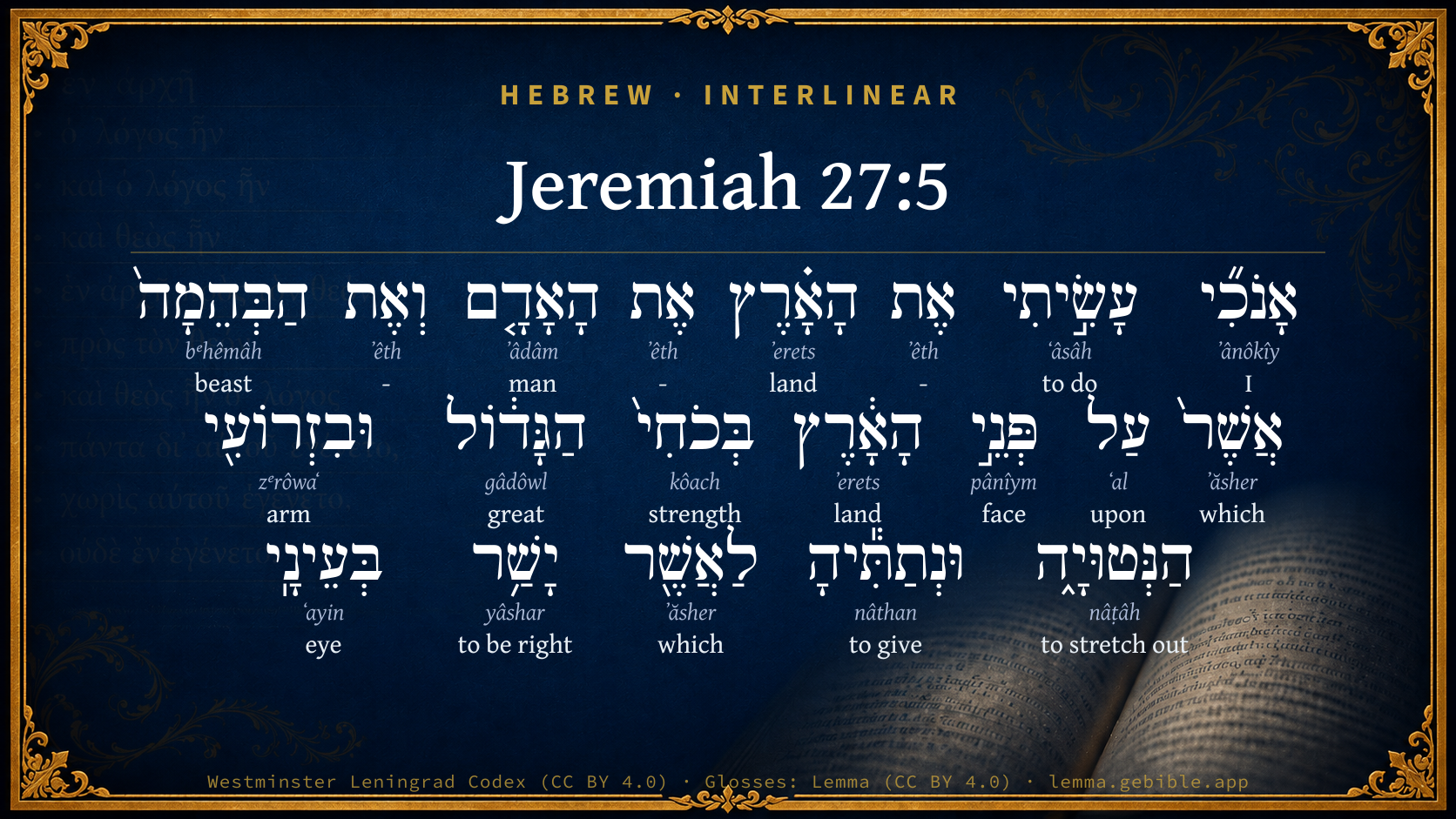
Hebrew (Westminster Leningrad Codex) Jeremiah 27:5 appears in the Hebrew Old Testament. The text above is from the Westminster Leningrad Codex. Each word links to its Strong’s number, a concise gloss, and parsing drawn from the Open Scriptures Hebrew Bible morphology. Click any word for its full Brown-Driver-Briggs (BDB) entry.
Download image
Cite this verse

Jeremiah 27:5 (World English Bible). Public Domain. Lemma interlinear Bible study tool, https://lemma.gebible.app/v/jeremiah/27/5.

Show BibTeX & RIS
BibTeX
RIS
English Translation
I have made the earth, the men and the animals that are on the surface of the earth, by my great power and by my outstretched arm; and I give it to whom it seems right to me.
World English Bible · Public Domain
Download a study sheet

One document with this verse’s original text, its word-by-word gloss line, the meaning frame, cross-references with their text, attributed commentary, and full source and license credits — printable, and it pastes into notes with its structure intact.

This verse Autodidact and up

Study sheet (.html) Plain text (.txt)

A passage Seminary Student

Up to 50 verses in one chapter. A passage sheet keeps up to 6 commentary sources and 12 cross-references per verse, in the order this page ranks them, and says so on the sheet whenever that leaves anything out. Ask for a single verse and you get the Autodidact verse sheet above.

Everything on this page stays free to read, with no account — the sheet is a download of what is already on screen, not access to it.

Want to remove ads? Support Godless Engineer
Compare translations 3

The same verse in 3 English versions, stacked beneath the original-language interlinear above. Click any original word for its lexicon entry.

Each is an independent rendering of the whole verse — the interlinear is not word-aligned to these translations.

Highlighted words mark where these versions differ — a whole-verse word diff, not a word-by-word alignment.

  • World English Bible Public Domain
    I have made the earth, the men and the animals that are on the surface of the earth, by my great power and by my outstretched arm; and I give it to whom it seems right to me.
  • King James Version Public Domain
    I have made the earth, the man and the beast that are upon the ground, by my great power and by my outstretched arm, and have given it unto whom it seemed meet unto me.
  • unfoldingWord Literal Text CC BY-SA 4.0
    ‘I myself made the earth, the man and the beast that on the face of the earth, by my great strength and by my outstretched arm, and I have given it to whoever is right in my eyes.

unfoldingWord Literal Text — © unfoldingWord, licensed CC BY-SA 4.0. Word-aligned USFM3 via Door43 (git.door43.org/unfoldingWord/en_ult).

Versions to compare (up to 4)

3 of 4 selected

Show all 18 translations

Every available English version of this verse, each an independent rendering of the whole verse.

  • World English Bible Public Domain
    I have made the earth, the men and the animals that are on the surface of the earth, by my great power and by my outstretched arm; and I give it to whom it seems right to me.
  • Berean Standard Bible Public Domain
    By My great power and outstretched arm, I made the earth and the men and beasts on the face of it, and I give it to whom I please.
  • Majority Standard Bible Public Domain
    By My great power and outstretched arm, I made the earth and the men and beasts on the face of it, and I give it to whom I please.
  • King James Version Public Domain
    I have made the earth, the man and the beast that are upon the ground, by my great power and by my outstretched arm, and have given it unto whom it seemed meet unto me.
  • American Standard Version (1901) Public Domain
    I have made the earth, the men and the beasts that are upon the face of the earth, by my great power and by my outstretched arm; and I give it unto whom it seemeth right unto me.
  • Revised Version (1885) Public Domain
    I have made the earth, the man and the beast that are upon the face of the earth, by my great power and by my outstretched arm; and I give it unto whom it seemeth right unto me.
  • Geneva Bible (1599) Public Domain
    I haue made the earth, the man, and the beast that are vpon the groud, by my great power, and by my outstreched arme, and haue giuen it vnto whom it pleased me.
  • Douay-Rheims (1899) Public Domain
    I made the earth, and the men, and the beasts that are upon the face of the earth, by my great power, and by my stretched out arm: and I have given it to whom it seemed good in my eyes.
  • Young's Literal Translation Public Domain
    Thus do ye say unto your lords, I -- I have made the earth with man, and the cattle that `are' on the face of the earth, by My great power, and by My stretched-out arm, and I have given it to whom it hath been right in Mine eyes.
  • Literal Standard Version CC BY-SA 4.0
    Thus you say to your lords, I have made the earth with man, and the livestock that [are] on the face of the earth, by My great power, and by My outstretched arm, and I have given it to whom it has been right in My eyes.
  • Unlocked Literal Bible CC BY-SA 4.0
    “I myself made the earth by my great strength and my raised arm. I also made the people and animals on the earth, and I give it to anyone who is right in my eyes.
  • unfoldingWord Literal Text CC BY-SA 4.0
    ‘I myself made the earth, the man and the beast that on the face of the earth, by my great strength and by my outstretched arm, and I have given it to whoever is right in my eyes.
  • Darby Bible Public Domain
    I have made the earth, man and beast that are upon the face of the earth, by my great power and by my outstretched arm; and I give them unto whom it seemeth right in mine eyes.
  • World Messianic Bible Public Domain
    ‘I have made the earth, the men, and the animals that are on the surface of the earth by my great power and by my outstretched arm. I give it to whom it seems right to me.
  • Webster's Bible Public Domain
    I have made the earth, the man and the beast that are upon the ground, by my great power and by my out-stretched arm, and have given it to whom it seemed meet to me.
  • Free Bible Version CC BY-SA 4.0
    It was by my strength and creative power that I made the earth and the human beings and animals that live there, and I give it to those who are right in my sight.
  • Bible in Basic English Public Domain
    I have made the earth, and man and beast on the face of the earth, by my great power and by my outstretched arm; and I will give it to anyone at my pleasure.
  • JPS Tanakh (1917) Public Domain
    I have made the earth, the man and the beast that are upon the face of the earth, by My great power and by My outstretched arm; and I give it unto whom it seemeth right unto Me.

Literal Standard Version (2020), Covenant Press — licensed CC BY-SA 4.0. Text via the HelloAO Bible API (eBible.org). Unlocked Literal Bible (unfoldingWord) — licensed CC BY-SA 4.0. Text via the HelloAO Bible API (eBible.org). unfoldingWord Literal Text — © unfoldingWord, licensed CC BY-SA 4.0. Word-aligned USFM3 via Door43 (git.door43.org/unfoldingWord/en_ult). Free Bible Version, Dr. Jonathan Gallagher — licensed CC BY-SA 4.0. Text via the HelloAO Bible API (eBible.org).

Word by word

More ways to search: Search by grammar → Find every occurrence → Compare this word →

Practice this passage: Drill this verse → Learn its vocabulary →

יָשַׁ֥ר
yâshar
H3474
“to be right”
Verb, Qal, Perfect, 3rd Person, Masculine, Singular
Part of Speech
Verb
Stem
Qal
Form
Perfect
Person
3rd Person
Gender
Masculine
Number
Singular
Full BDB Definition

Origin: a primitive root

TWOT: 930

to be right, be straight, be level, be upright, be just, be lawful, be smooth - (Qal) - to go straight - to be pleasing, be agreeable, be right (figuratively) - to be straightforward, be upright - (Piel) - to make right, make smooth, make straight - to lead, direct, lead straight along - to esteem right, approve - (Pual) to be made level, be laid smoothly out - (Hiphil) to make straight, look straight
  1. אָנֹכִ֞י ʼânôkîy H595 “I” Pronoun, Personal, 1st Person, Common, Singular
  2. עָשִׂ֣יתִי ʻâsâh H6213 “to do” Verb, Qal, Perfect, 1st Person, Common, Singular
  3. אֶת ʼêth H853 “-” Particle, Direct Object
  4. הָאָ֗רֶץ ʼerets H776 “the · land” Particle, Definite Article + Noun, Common, Both, Singular, Absolute
  5. אֶת ʼêth H853 “-” Particle, Direct Object
  6. הָאָדָ֤ם ʼâdâm H120 “the · man” Particle, Definite Article + Noun, Common, Masculine, Singular, Absolute
  7. וְאֶת ʼêth H853 “and · -” Conjunction + Particle, Direct Object
  8. הַבְּהֵמָה֙ bᵉhêmâh H929 “the · beast” Particle, Definite Article + Noun, Common, Feminine, Singular, Absolute
  9. אֲשֶׁר֙ ʼăsher H834 “which” Particle, Relative
  10. עַל ʻal H5921 “upon” Preposition
  11. פְּנֵ֣י pânîym H6440 “face(s) of” Noun, Common, Both, Plural, Construct
  12. הָאָ֔רֶץ ʼerets H776 “the · land” Particle, Definite Article + Noun, Common, Both, Singular, Absolute
  13. בְּכֹחִי֙ kôach H3581 “in/at · strength · my” Preposition + Noun, Common, Masculine, Singular, Construct + Suffix, Personal, 1st Person, Common, Singular
  14. הַגָּד֔וֹל gâdôwl H1419 “the · great” Particle, Definite Article + Adjective, Adjective, Masculine, Singular, Absolute
  15. וּבִזְרוֹעִ֖י zᵉrôwaʻ H2220 “and · in/at · arm · my” Conjunction + Preposition + Noun, Common, Both, Singular, Construct + Suffix, Personal, 1st Person, Common, Singular
  16. הַנְּטוּיָ֑ה nâṭâh H5186 “the · stretched out” Particle, Definite Article + Verb, Qal, Participle Passive, Feminine, Singular, Absolute
  17. וּנְתַתִּ֕יהָ nâthan H5414 “and · to give · her” Conjunction + Verb, Qal, Sequential Perfect, 1st Person, Common, Singular + Suffix, Personal, 3rd Person, Feminine, Singular
  18. לַאֲשֶׁ֖ר ʼăsher H834 “to/for · which” Preposition + Particle, Relative
  19. בְּעֵינָֽי ʻayin H5869 “in/at · eyes · my” Preposition + Noun, Common, Both, Dual, Construct + Suffix, Personal, 1st Person, Common, Singular

About this verse

These counts appear in no published source. They are computed here, from the morphology-tagged text and Lemma’s own curated glosses. What Lemma adds →

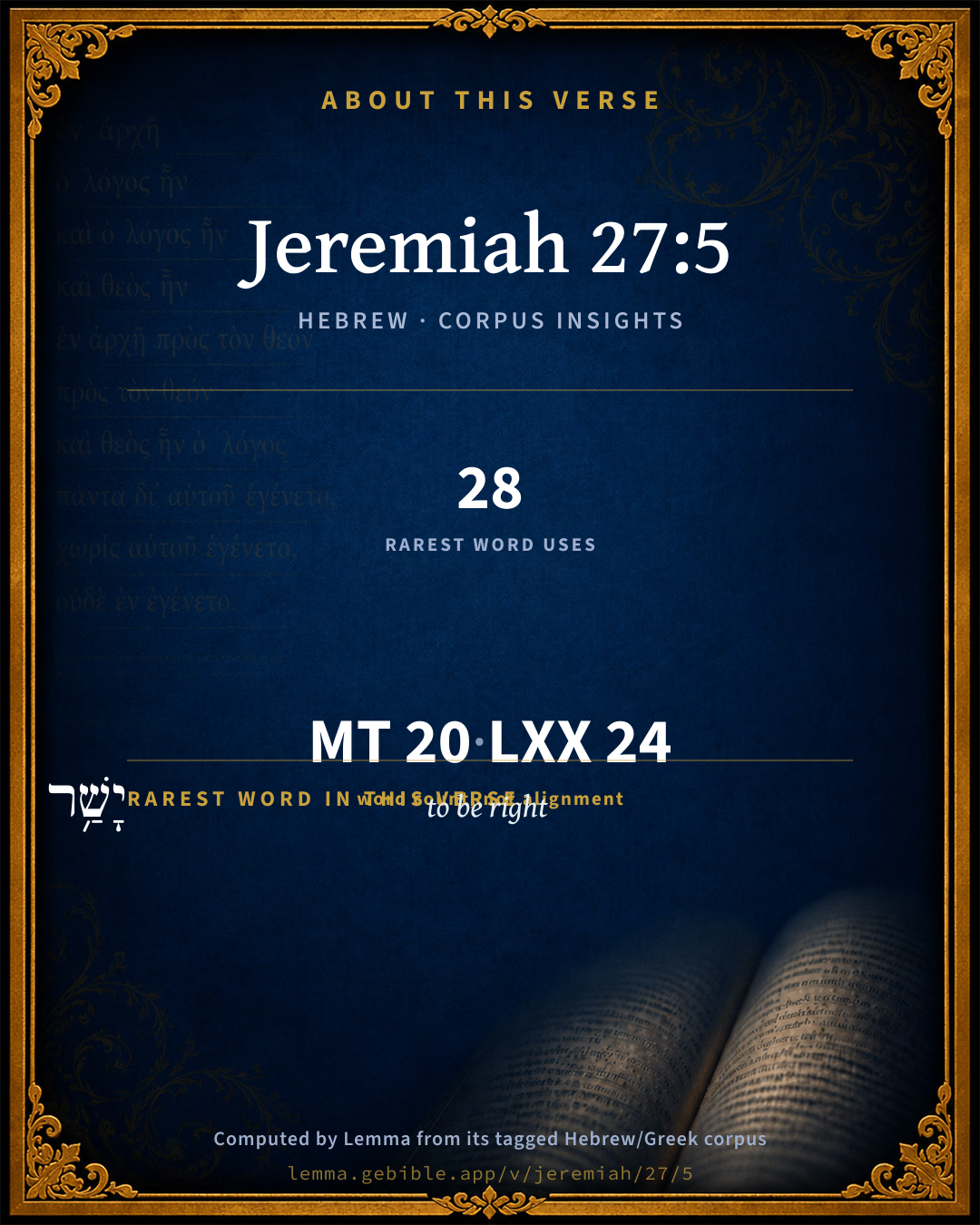
20
words
16
distinct lemmas
Prophets
section

Shared distinctive vocabulary

יָשַׁ֥ר to be right H3474 occurs in 26 verses of the Hebrew Bible. Also found in:

Grammatical profile

  • 4 verbs
  • 8 nouns
  • 1 adjective
  • 1 pronoun
  • 1 preposition
  • 5 particles

Verb forms

  • עָשִׂ֣יתִי Qal · Perfect
  • הַנְּטוּיָ֑ה Qal · Participle Passive
  • וּנְתַתִּ֕יהָ Qal · Sequential Perfect
  • יָשַׁ֥ר Qal · Perfect

Repetition

Words recur within this verse — often emphatic in Hebrew:

  • הָאָ֗רֶץ land H776 ×2
  • אֲשֶׁר֙ which H834 ×2

Hebrew & Septuagint length

In the original languages it is 20 Hebrew tokens and 24 Greek tokens — but the two are counted differently (Hebrew bundles its prefixes and suffixes into one token; the Greek is in lemma form), so that isn’t a like-for-like length.

Cross-references

42

Topical passages linked to Jeremiah 27:5 in the Treasury of Scripture Knowledge — connected by theme and wording, ordered by reader-vote popularity; previews shown in the World English Bible.

  • Jeremiah 32:17 Ah Lord Yahweh! behold, you have made the heavens and the earth by your great power and by your outstretched arm; there is nothing too hard for you,
  • Jeremiah 51:15 He has made the earth by his power, he has established the world by his wisdom, and by his understanding has he stretched out the heavens:
  • Psalms 115:15–16 Blessed are you by Yahweh, Who made heaven and earth.
  • Psalms 146:5–6 Happy is he who has the God of Jacob for his help, Whose hope is in Yahweh, his God:
  • Daniel 4:17 The sentence is by the decree of the watchers, and the demand by the word of the holy ones; to the intent that the living may know that the Most High rules in the kingdom of men, and gives it to whoever he will, and sets up over it the lowest of men.
  • Hebrews 1:10–11 And, "You, Lord, in the beginning, laid the foundation of the earth. The heavens are the works of your hands.
  • Isaiah 42:5 Thus says God Yahweh, he who created the heavens, and stretched them forth; he who spread abroad the earth and that which comes out of it; he who gives breath to the people on it, and spirit to those who walk therein:
  • Isaiah 44:24 Thus says Yahweh, your Redeemer, and he who formed you from the womb: I am Yahweh, who makes all things; who stretches forth the heavens alone; who spreads abroad the earth (who is with me?);
  • Isaiah 45:12 I have made the earth, and created man on it: I, even my hands, have stretched out the heavens; and all their host have I commanded.
  • Jeremiah 10:11–12 Thus shall you say to them, The gods that have not made the heavens and the earth, these shall perish from the earth, and from under the heavens.
  • Colossians 1:16 For by him were all things created, in the heavens and on the earth, things visible and things invisible, whether thrones or dominions or principalities or powers; all things have been created through him, and for him.
  • Ezra 1:2 Thus says Cyrus king of Persia, All the kingdoms of the earth has Yahweh, the God of heaven, given me; and he has charged me to build him a house in Jerusalem, which is in Judah.
  • Psalms 136:5–9 To him who by understanding made the heavens; For his loving kindness endures forever:
  • Isaiah 40:21–26 Have you not known? have yet not heard? has it not been told you from the beginning? have you not understood from the foundations of the earth?
  • Isaiah 48:13 Yes, my hand has laid the foundation of the earth, and my right hand has spread out the heavens: when I call to them, they stand up together.
  • Isaiah 51:13 and have forgotten Yahweh your Maker, who stretched forth the heavens, and laid the foundations of the earth; and fear continually all the day because of the fury of the oppressor, when he makes ready to destroy? and where is the fury of the oppressor?
  • Acts 14:15 "Men, why are you doing these things? We also are men of like passions with you, and bring you good news, that you should turn from these vain things to the living God, who made the sky and the earth and the sea, and all that is in them;
  • Acts 17:24 The God who made the world and all things in it, he, being Lord of heaven and earth, doesn't dwell in temples made with hands,
  • Revelation 4:11 "Worthy are you, our Lord and God, the Holy One, to receive the glory, the honor, and the power, for you created all things, and because of your desire they existed, and were created!"
  • Deuteronomy 32:8 When the Most High gave to the nations their inheritance, When he separated the children of men, He set the bounds of the peoples According to the number of the children of Israel.
  • Job 26:5–14 "Those who are deceased tremble, Those beneath the waters and all that live in them.
  • Job 38:4–41 "Where were you when I laid the foundations of the earth? Declare, if you have understanding.
  • Psalms 135:10–12 Who struck many nations, And killed mighty kings,
  • Psalms 148:2–5 Praise him, all his angels! Praise him, all his host!
  • John 1:1–3 In the beginning was the Word, and the Word was with God, and the Word was God.
  • Hebrews 1:2 has at the end of these days spoken to us by his Son, whom he appointed heir of all things, through whom also he made the worlds.
  • Genesis 1:29–30 God said, "Behold, I have given you every herb yielding seed, which is on the surface of all the earth, and every tree, which bears fruit yielding seed. It will be your food.
  • Genesis 9:2–3 The fear of you and the dread of you will be on every animal of the earth, and on every bird of the sky. Everything that the ground teems with, and all the fish of the sea are delivered into your hand.
  • Genesis 9:6 Whoever sheds man's blood, by man will his blood be shed, for in the image of God made he man.
  • Exodus 20:11 for in six days Yahweh made heaven and earth, the sea, and all that is in them, and rested the seventh day; therefore Yahweh blessed the Sabbath day, and made it holy.
  • Deuteronomy 2:7 For Yahweh your God has blessed you in all the work of your hand; he has known your walking through this great wilderness: these forty years Yahweh your God has been with you; you have lacked nothing.
  • Deuteronomy 2:9 Yahweh said to me, Don't bother Moab, neither contend with them in battle; for I will not give you of his land for a possession; because I have given Ar to the children of Lot for a possession.
  • Deuteronomy 2:19 and when you come near over against the children of Ammon, don't bother them, nor contend with them; for I will not give you of the land of the children of Ammon for a possession; because I have given it to the children of Lot for a possession.
  • Deuteronomy 2:21 a people great, and many, and tall, as the Anakim; but Yahweh destroyed them before them; and they succeeded them, and lived in their place;
  • Deuteronomy 4:17 the likeness of any animal that is on the earth, the likeness of any winged bird that flies in the sky,
  • Deuteronomy 4:25 When you shall father children, and children's children, and you shall have been long in the land, and shall corrupt yourselves, and make an engraved image in the form of anything, and shall do that which is evil in the sight of Yahweh your God, to provoke him to anger;
  • Deuteronomy 4:32 For ask now of the days that are past, which were before you, since the day that God created man on the earth, and from the one end of the sky to the other, whether there has been [any such thing] as this great thing is, or has been heard like it?
  • Deuteronomy 4:35 To you it was shown, that you might know that Yahweh he is God; there is none else besides him.
  • Deuteronomy 5:16 "Honor your father and your mother, as Yahweh your God commanded you; that your days may be long, and that it may go well with you, in the land which Yahweh your God gives you.
  • Deuteronomy 9:29 Yet they are your people and your inheritance, which you brought out by your great power and by your outstretched arm.
  • Joshua 1:2–3 Moses my servant is dead; now therefore arise, go over this Jordan, you, and all this people, to the land which I do give to them, even to the children of Israel.
  • Psalms 102:25 Of old, you laid the foundation of the earth. The heavens are the work of your hands.

Cross-references courtesy of OpenBible.info (CC BY 4.0).

Hebrew and Greek witnesses Masoretic Hebrew ↔ Greek Septuagint

The same verse in the two great witnesses to the Old Testament, shown verse-for-verse.

These are two independent witnesses, not word-aligned to each other, and the Septuagint is shown in lemma (dictionary) form.

Hebrew Jeremiah 27:5 Masoretic · Westminster Leningrad Codex

אָנֹכִ֞י עָשִׂ֣יתִי אֶת הָאָ֗רֶץ אֶת הָאָדָ֤ם וְאֶת הַבְּהֵמָה֙ אֲשֶׁר֙ עַל פְּנֵ֣י הָאָ֔רֶץ בְּכֹחִי֙ הַגָּד֔וֹל וּבִזְרוֹעִ֖י הַנְּטוּיָ֑ה וּנְתַתִּ֕יהָ לַאֲשֶׁ֖ר יָשַׁ֥ר בְּעֵינָֽי

I have made the earth, the men and the animals that are on the surface of the earth, by my great power and by my outstretched arm; and I give it to whom it seems right to me.

World English Bible · Public Domain

Greek LXX Structure differs

In the Septuagint, Jeremiah is about an eighth shorter than the Hebrew and arranges its material differently — the Oracles Against the Nations (Hebrew chapters 46–51) appear in the middle of the Greek book, after 25:13. Because the chapter and verse boundaries do not line up, a verse-for-verse comparison with the Hebrew is not shown.

A verse-for-verse comparison isn’t shown here because the chapters and verses don’t line up. Switch to the LXX edition with the MT / LXX toggle above to read the Greek directly.

On this verse, The Cambridge Bible for Schools and Colleges discusses the Septuagint’s reading. Read the note in Commentary ↓

Hebrew: Westminster Leningrad Codex (CC BY 4.0). Greek: Septuagint (public domain); English from a public-domain English Septuagint. How the Septuagint differs from the Hebrew →

Targum (Aramaic paraphrase)

1

The Targum is the ancient Jewish Aramaic paraphrase of the Hebrew Scriptures — an interpretive translation, not the Hebrew text itself. Onkelos (literal) and Pseudo-Jonathan (expansive) render the Torah, and Jonathan the Prophets. Coverage is partial: where no permissively-licensed English translation exists for a verse, only the Aramaic is shown. This is verse-level text, not a word-by-word alignment to the Hebrew.

  1. Targum Jonathan Prophets (Joshua–Malachi)
    אֲנָא בְמֵימְרֵי עֲבָדֵית יַת אַרְעָא יַת אֱנָשָׁא וְיַת בְּעִירָא דְעַל אַפֵּי אַרְעָא בְּחֵילִי רַבָּא וּבְאֶדְרְעִי מְרַמְמָא וִיהַבְתָּהּ לִדְכָשַׁר קֳדָמַי:

    (no public-domain English translation for this verse)

    Targum Jonathan — Aramaic: “Mikraot Gedolot” (public domain). English: “Sefaria Community Translation” (CC0 1.0 (public-domain dedication)); “London "Chaldee Paraphrase," 1871” (public domain). Text via Sefaria.

Commentary

Notes on Jeremiah 27:5 from classic Christian and Jewish commentators (each source and its license shown beneath its notes). The classic Christian expositions comment on the surrounding passage and are grouped to its opening verse, so a note may address several verses; the Jewish commentaries on the Tanakh (Rashi and others) are per-verse, so they appear only where the commentator wrote on this verse.

Lemma curates 59 commentaries, every one of them public domain or Creative Commons licensed, each selected and text-cleaned for this edition rather than reprinted as found. About our sources →

Trapp's Complete Commentary

John Trapp

Jer 27:5 I have made the earth, the man and the beast that [are] upon the ground, by my great power and by my outstretched arm, and have given it unto whom it seemed meet unto me.

Ver. 5. I have made the earth.] And I am therefore the great proprietary and Lord paramount of all, to transfer kingdoms at my pleasure. This Nebuchadnczzar, after seven years’ apprenticeship served among the beasts of the field, had learned to acknowledge. {Dan 4:23-25}

John Trapp, A Commentary or Exposition upon All the Books of the Old and New Testament (1647–1656) — public domain. Text from a community e-Sword module.

Jamieson, Fausset & Brown

Robert Jamieson, A. R. Fausset & David Brown

God here, as elsewhere, connects with the symbol doctrine, which is as it were its soul, without which it would be not only cold and frivolous, but even dead [CALVIN]. God's mention of His supreme power is in order to refute the pride of those who rely on their own power (Isa 45:12).

given it unto whom it seemed meet unto me-- (Psa 115:15-16; Dan 4:17, Dan 4:25, Dan 4:32). Not for his merits, but of My own sole good pleasure [ESTIUS].

Jamieson, Fausset & Brown — Commentary Critical and Explanatory on the Whole Bible (1871) — public domain (CC PDM 1.0). Text via the HelloAO Bible API.

Adam Clarke's Commentary

Verse 5. I have made the earth] I am the Creator and Governor of all things, and I dispose of the several kingdoms of the world as seemeth best to me.

Adam Clarke's Commentary on the Bible (1810–1826) — public domain. Text from a community e-Sword/MySword module.

John Calvin's Commentaries

Then follow these words, I have made the earth, the man and the beast, which are on the face of the earth, by my great power, and by mine extended arm. The spectacle would have been unmeaning and to no purpose, had Jeremiah only put the yoke on his neck, and added no instruction; for we know that all signs are as it were dead, except life is given them by the word. As then an image avails not much, so whatever signs may be set before our eyes, they would be frivolous and without meaning, were no doctrine added as the life. And hence also is condemned the madness of the Papists, who amuse the minds of the people with many signs, while no doctrine is conveyed. It therefore follows that they are mere figments, and attended with no profit. God, then, has ever added to signs his doctrine, which may therefore be truly compared to the soul, which gives life to the body, that would otherwise be without motion or strength. On this account Jeremiah shews what the yoke meant. He also speaks of the power and sovereign authority of God; for kings, though they confess that God holds the government of the world, cannot yet entertain the idea that they can be in a moment overwhelmed and cast down from their dignity. For they seem to themselves to be fixed in their nests, and so they promise to themselves a permanent condition, and imagine that they are not subject to the common lot of mortals.

As, then, kings are so inflated with pride, the Lord used this preface, that he made the earth and all living beings. He speaks not of heaven, but mentions only that he made the earth, and man, and the animals which are on the face of the earth; and adds, by my great power and extended arm Why was this said, except that men might be awakened on hearing that the earth continues not as it is, but as it is sustained by God’s power by which it was once created? The same power preserves men and animals; for nothing can remain safe except God exercises from heaven his hidden power. This, then, was the reason why these words were introduced. God set his own arm and power in opposition to the pride of those who thought that they stood by their own power, and did not acknowledge that they were dependent on the nod of God alone, who sustained them as long as he pleased, and then overthrew and reduced them to nothing when it seemed good to him.

This doctrine, then, ought to be applied to ourselves: for Jeremiah did not speak generally and indiscriminately of God’s power, but accommodated to the subject in hand what he said of God’s power, that men might, know that there is nothing fixed or permanent in this world, but that God preserves men and animals, and yet in such a way, that at any moment he can by a single breath reduce to nothing all those who exist and all that they have. It follows —

John Calvin's Commentaries (1540-1563) — public domain. Text from the Calvin Translation Society English edition (1840s-50s) via the Christian Classics Ethereal Library (ccel.org). Calvin's coverage is partial (roughly two-thirds of the Bible); uncommented books and verses are honest gaps, never fabricated. The 19th-century editor's footnotes and remarks are omitted so the notes are faithfully Calvin's own voice.

Ellicott's Commentary for English Readers

(5) I have made the earth . . .—The pronoun is emphatic. For “upon the ground” read on the face of the earth, and for “it seemed meet unto me” it seemed meet to my eyes. The “stretched-out arm” is a phrase specially characteristic of the Book of Deuteronomy (Deu_4:34; Deu_5:15; Deu_7:19; Deu_26:8), and may be noted among the many traces of its influence on Jeremiah’s language. The whole preface, which rises to a height of rhythmic loftiness not common in Jeremiah’s writings, asserts the truth that the Creator of the material world is also the ruler over the kingdoms of the earth. For a like utterance of the same thought, see Amo_4:13; Amo_9:6.

A Bible Commentary for English Readers, edited by Charles John Ellicott (1878–1897) — public domain. Text from a community e-Sword module.

The Cambridge Bible for Schools and Colleges

gen. ed. J. J. S. Perowne

5. The terms of the message are these:—God, as Creator of the world and of all that is in it, has the right to give it to whomsoever He will. He has therefore placed Nebuchadnezzar in power for such time as it shall please Him, and none may resist His will.

the man … of the earth] LXX omit.

my outstretched arm] See on Jer_32:17.

The Cambridge Bible for Schools and Colleges (gen. ed. J. J. S. Perowne; Cambridge University Press, 1878–1918) — public domain. Text from a community e-Sword module.

John Gill's Exposition

I have made the earth, the man and the beast that are upon the ground,.... The earth was made by him on the first day, and man and beast on the sixth day, of the creation; the earth is still supported in its being, and man and beast are continued on it in succession: this is mentioned to show his right and authority to dispose of the earth, and all in it, at his pleasure; which is founded on his creation and sustaining of it, and all creatures in it: which was, and is, as he says,

by my great power, and by my outstretched arm; for nothing less could have created the original chaos out of nothing, and brought that into form and order, and produced out of it such creatures as man and beast; and nothing less than that could continue it in being, and a succession of creatures on it:

and have given it unto whom it seemed meet unto me; some part of it to one, and some to another; and more to one than to another; but to none according to their merit, but according to his own sovereign will and pleasure; see Psa 115:16.

John Gill's Exposition of the Whole Bible (1746–1763) — public domain (CC PDM 1.0). Text via the HelloAO Bible API.

Haydock's Catholic Bible Commentary

Eyes. God disposes of all princes, &c. His prophets speak boldly. (Calmet)

George Leo Haydock (1774–1849), Haydock's Catholic Family Bible and Commentary, 1859 edition — public domain. Excludes Psalms (Douay-Rheims chapter numbering differs from Protestant) and Deuterocanonical books (Catholic canon only).

Matthew Poole's English Annotations

To evince to them that his dominion extendeth to them, he mindeth them that he was the first efficient cause of all the creatures, and made both all men and all beasts that are upon the earth, and therefore had a special propriety in them, and a universal power over them, it being in his power to dispose of what was at first the work of his hands, and accordingly in the methods and workings of his providence he did daily dispose of kingdoms and nations according to his pleasure, without being for such disposal of them accountable unto any person.

Matthew Poole's English Annotations on the Holy Bible (1683–1685) — public domain. Text from a community e-Sword/MySword module.

The Pulpit Commentary

Vers. 5, 6. Jehovah is the Creator and Proprietor of the earth and all that is therein. Therefore he can give any part of it to whomsoever he will. Therefore, Jeremiah being his trustworthy prophet, the kings are called upon to take notice that Jehovah has transferred their kingdoms to Nebuchadnezzar. Observe, in Jeremiah 27-29. the form employed is not "Nebuchadnezzar," but "Nebuchadnezzar". (so also Jer_34:1 Jer_39:5) (See on Jer_21:7)

Ver. 5. The rights of the Creator.

This address on the rights of the Creator is made to heathen men because God has rights over all men, and because they who cannot yet understand his higher character may be able to recognize his natural rights.

I THE FOUNDATION OF THE RIGHTS OF THE CREATOR.

1. They rest on the fact that all things that exist were created. It is a fundamental axiom of science that everything that has a beginning must have a cause. The universal testimony of experience is against the notion that existences could spring forth spontaneously from nothing, or that organisms could come of themselves from a lawless chaos. The theory of an endless chain of causation is illogical. If this is regarded as cyclic we have nothing to account for the motion of the whole cycle. The notion is parallel to that of a wheel revolving because the several parts of the circumference press on those which are before them a mechanical absurdity. If, however, the chain is regarded as infinitely long, we have another absurdity. Since it is made up of finite links each of which is no perfect cause in itself, we have not solved the question, we have only driven it buck to the infinite distance. It is the grand lesson of the first chapter of the Book of Genesis whatever we may think of the details of that chapter that it comes to our rescue with the assertion of a personal Creator, the only doctrine that will fit the requirements of the case.

2. The rights of the Creator rest on the fact that all things were created by his energy. We do not know what subordinate agencies God may employ. But in any case the fundamental power must be his. He cannot delegate powers of creation in the sense of investing any beings with them without any dependence on his power. The power must be God"s, though the channel through which it flows may be some lower agency. The doctrine of evolution would not touch this fact. The important question is not as to the method of creation, but as to the originating power. This lies behind the question of design. It is the question of primitive causation. Whether with successive sudden emergencies or through gradual development, it is equally true that God has created the world by his great power and by his outstretched hand.

II THE NATURE OF THE RIGHTS OF THE CREATOR. They are absolute. We know nothing like them among men. A man is supposed to have a right to dispose of the work of his own hands. But his work is not creation, if he has built a house he has not made the ground on which it stands, nor the stone and wood of which it is constructed. But by Divine creation we understand not merely building up the materials of the universe into new forms, but the original making of these materials and the determination of the laws of nature. From this fact comes the right of God to dispose of his creation as he thinks fit, to give the world and its contents to whomsoever he pleases. But in admitting this we are saying that he will do that which is best for the world itself. For God is just and good and merciful. He will please to do that which is right, and that which will bless his creatures. God exercises his rights through his will. If creation reveals the rights, Christ reveals the will. Through this higher revelation we see reasons for acquiescing in God"s exercise of sovereignty, not with mere resignation to the inevitable, nor even only with dutiful yielding to recognized law and authority, but with thankful submission to the care of a merciful Father. Thus we see that the exercise of God"s rights is limited by his character; limited by his justice, so that he can never dispose of things arbitrarily or cruelly; limited by his love, so that he will dispose of them so as to secure the welfare of his children. This is a consideration of the first importance. The neglect of it has led to the interpretation of such words as those of our text so as to represent God as an arbitrary, capricious Sovereign, who may be feared and must be submitted to, but cannot be loved or freely adored.

The Pulpit Commentary (1880–1919), ed. H.D.M. Spence-Jones & Joseph S. Exell — public domain. Text from a community e-Sword module.

unfoldingWord translationNotes

Door43 World Missions Community

by my great strength and my raised arm

The phrase "raised arm" refers to great power and intensifies the first phrase. AT: "by my very great power" (See: Idiom and Doublet)

I give it to anyone who is right in my eyes

Another possible meaning is "I give it to anyone I want to."

I ... am giving all these lands into the hand of Nebuchadnezzar ... servant

The hand is a metonym for the power that the hand exercises, and the word "lands" is a metonym for the people who live in those lands. AT: "I ... am putting the people who live in all these lands under the power of Nebuchadnezzar ... servant" (See: Metonymy)

the time for his land comes

You may need to make explicit the nature of the time. AT: "the time for me to destroy his land" (See: Assumed Knowledge and Implicit Information)

subdue him

Here "him" refers to Nebuchadnezzar who represents the kingdom of Babylon. AT: "will defeat Babylon" (See: Metonymy)

translationWords

earth

hand

Nebuchadnezzar

Babylon

servant

life

servant

nation

unfoldingWord translationNotes — © Distant Shores Media and the Door43 World Missions Community, licensed CC BY-SA 4.0. Source: git.door43.org/Door43/en_tn.

Lesson kit

Teaching starters — assembled from the data on this page, not authored interpretation. Every prompt links to the verse data it draws on. Edit before teaching.

Jeremiah, in the Prophets, opens this verse with 20 words (16 distinct Hebrew lemmas). Its most distinctive word is yâshar (“to be right”). A historical commentator’s framing appears above. Read the whole chapter for the surrounding context.

Discussion questions

  1. The word yâshar carries the sense “to be right.” How does it shape the verse?
  2. How does Numbers 23:27, which shares the word «to be right», read alongside this verse?
  3. What does the repetition of “land” (2× in this one verse) do in this verse?
  4. The translations on this page render this verse differently — a whole-verse word diff, not a word-by-word alignment. What might account for the different wordings?
  5. «עָשִׂ֣יתִי» is a Qal Perfect verb. How does that grammatical form shape the action described?
  6. Compare how Trapp's Complete Commentary and Jamieson, Fausset & Brown read this verse. Where do they agree or differ?

Things to notice

Reading settings

Reading text

Shown beneath each verse's original-language words.

Old Testament
Old Testament edition

Read the OT as the Masoretic Hebrew (MT) or the Greek Septuagint (LXX).

English shown for the Greek Septuagint (in the Hebrew ↔ Greek comparison).

Comparing translations? Open the Compare panel on any verse page to stack up to four side by side.