
Psalms 44:18

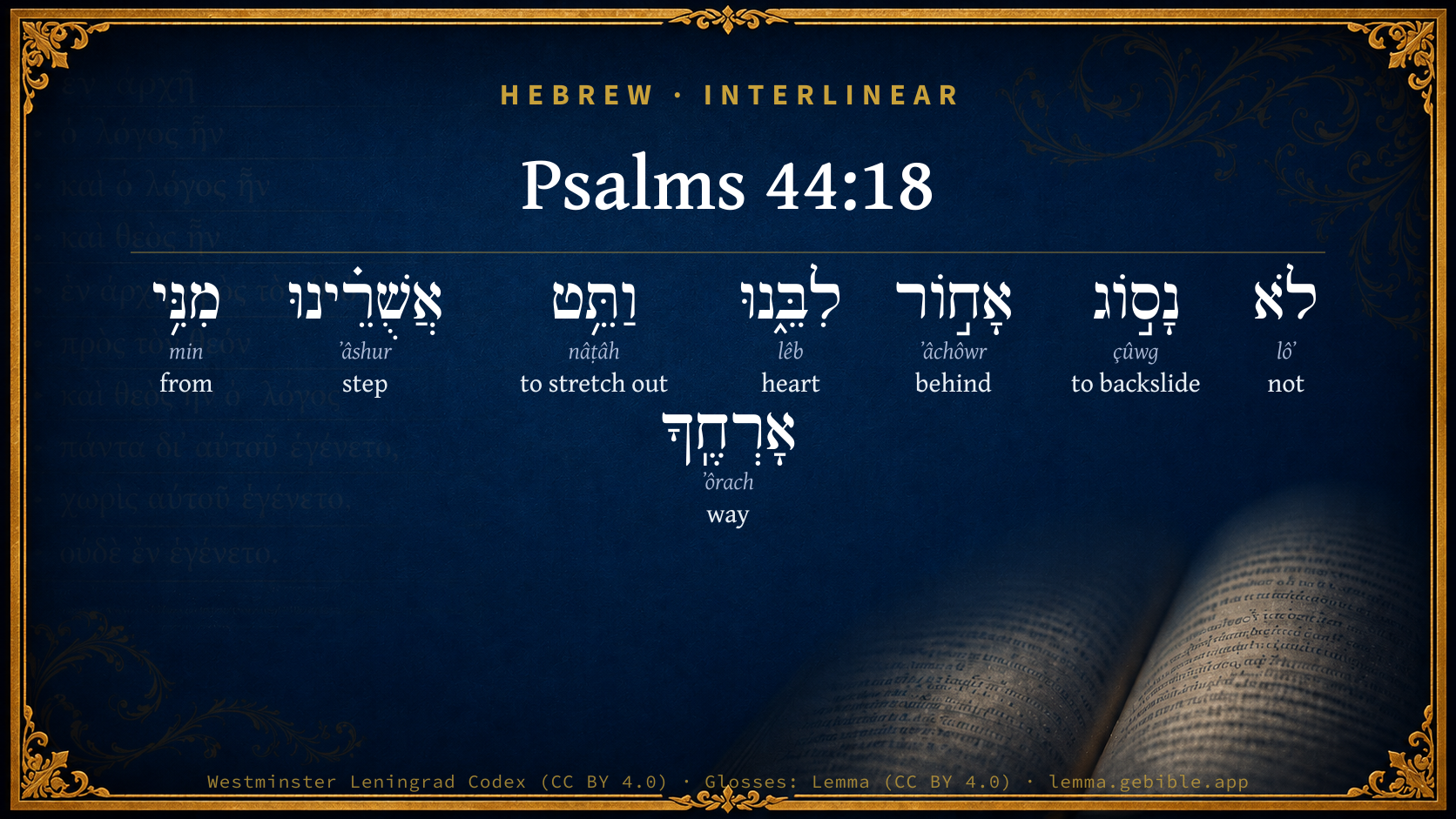
Hebrew (Westminster Leningrad Codex) Psalms 44:18 appears in the Hebrew Old Testament. The text above is from the Westminster Leningrad Codex. Each word links to its Strong’s number, a concise gloss, and parsing drawn from the Open Scriptures Hebrew Bible morphology. Click any word for its full Brown-Driver-Briggs (BDB) entry.
Download image
Cite this verse

Psalms 44:18 (World English Bible). Public Domain. Lemma interlinear Bible study tool, https://lemma.gebible.app/v/psalms/44/18.

Show BibTeX & RIS
BibTeX
RIS
English Translation
Our heart has not turned back, Neither have our steps strayed from your path,
World English Bible · Public Domain
Download a study sheet

One document with this verse’s original text, its word-by-word gloss line, the meaning frame, cross-references with their text, attributed commentary, and full source and license credits — printable, and it pastes into notes with its structure intact.

This verse Autodidact and up

Study sheet (.html) Plain text (.txt)

A passage Seminary Student

Up to 50 verses in one chapter. A passage sheet keeps up to 6 commentary sources and 12 cross-references per verse, in the order this page ranks them, and says so on the sheet whenever that leaves anything out. Ask for a single verse and you get the Autodidact verse sheet above.

Everything on this page stays free to read, with no account — the sheet is a download of what is already on screen, not access to it.

Want to remove ads? Support Godless Engineer
Compare translations 3

The same verse in 3 English versions, stacked beneath the original-language interlinear above. Click any original word for its lexicon entry.

Each is an independent rendering of the whole verse — the interlinear is not word-aligned to these translations.

Highlighted words mark where these versions differ — a whole-verse word diff, not a word-by-word alignment.

  • World English Bible Public Domain
    Our heart has not turned back, Neither have our steps strayed from your path,
  • King James Version Public Domain
    Our heart is not turned back, neither have our steps declined from thy way;
  • unfoldingWord Literal Text CC BY-SA 4.0
    Our heart has not turned itself back, nor have our steps turned aside from your way.

unfoldingWord Literal Text — © unfoldingWord, licensed CC BY-SA 4.0. Word-aligned USFM3 via Door43 (git.door43.org/unfoldingWord/en_ult).

Versions to compare (up to 4)

3 of 4 selected

Show all 18 translations

Every available English version of this verse, each an independent rendering of the whole verse.

  • World English Bible Public Domain
    Our heart has not turned back, Neither have our steps strayed from your path,
  • Berean Standard Bible Public Domain
    Our hearts have not turned back; our steps have not strayed from Your path.
  • Majority Standard Bible Public Domain
    Our hearts have not turned back; our steps have not strayed from Your path.
  • King James Version Public Domain
    Our heart is not turned back, neither have our steps declined from thy way;
  • American Standard Version (1901) Public Domain
    Our heart is not turned back, Neither have our steps declined from thy way,
  • Revised Version (1885) Public Domain
    Our heart is not turned back, neither have our steps declined from thy way;
  • Geneva Bible (1599) Public Domain
    Our heart is not turned backe: neither our steps gone out of thy paths,
  • Douay-Rheims (1899) Public Domain
    All these things have come upon us, yet we have not forgotten thee: and we have not done wickedly in they covenant.
  • Young's Literal Translation Public Domain
    We turn not backward our heart, Nor turn aside doth our step from Thy path.
  • Literal Standard Version CC BY-SA 4.0
    We do not turn our heart backward, || Nor turn aside our step from Your path.
  • Unlocked Literal Bible CC BY-SA 4.0
    Our heart has not turned back; our steps have not gone from your way.
  • unfoldingWord Literal Text CC BY-SA 4.0
    Our heart has not turned itself back, nor have our steps turned aside from your way.
  • Darby Bible Public Domain
    Our heart is not turned back, neither have our steps declined from thy path;
  • World Messianic Bible Public Domain
    Our heart has not turned back, neither have our steps strayed from your path,
  • Webster's Bible Public Domain
    \\44:17\\All this is come upon us; yet we have not forgotten thee, neither have we dealt falsely in thy covenant.
  • Free Bible Version CC BY-SA 4.0
    We have not turned away from you, not in thought, nor in action.
  • Bible in Basic English Public Domain
    Our hearts have not gone back, and our steps have not been turned out of your way;
  • JPS Tanakh (1917) Public Domain
    (44-19) Our heart is not turned back, neither have our steps declined from Thy path;

Literal Standard Version (2020), Covenant Press — licensed CC BY-SA 4.0. Text via the HelloAO Bible API (eBible.org). Unlocked Literal Bible (unfoldingWord) — licensed CC BY-SA 4.0. Text via the HelloAO Bible API (eBible.org). unfoldingWord Literal Text — © unfoldingWord, licensed CC BY-SA 4.0. Word-aligned USFM3 via Door43 (git.door43.org/unfoldingWord/en_ult). Free Bible Version, Dr. Jonathan Gallagher — licensed CC BY-SA 4.0. Text via the HelloAO Bible API (eBible.org).

Word by word

More ways to search: Search by grammar → Find every occurrence → Compare this word →

Practice this passage: Drill this verse → Learn its vocabulary →

About this verse

These counts appear in no published source. They are computed here, from the morphology-tagged text and Lemma’s own curated glosses. What Lemma adds →

8
words
8
distinct lemmas
Wisdom
section

Notable vocabulary

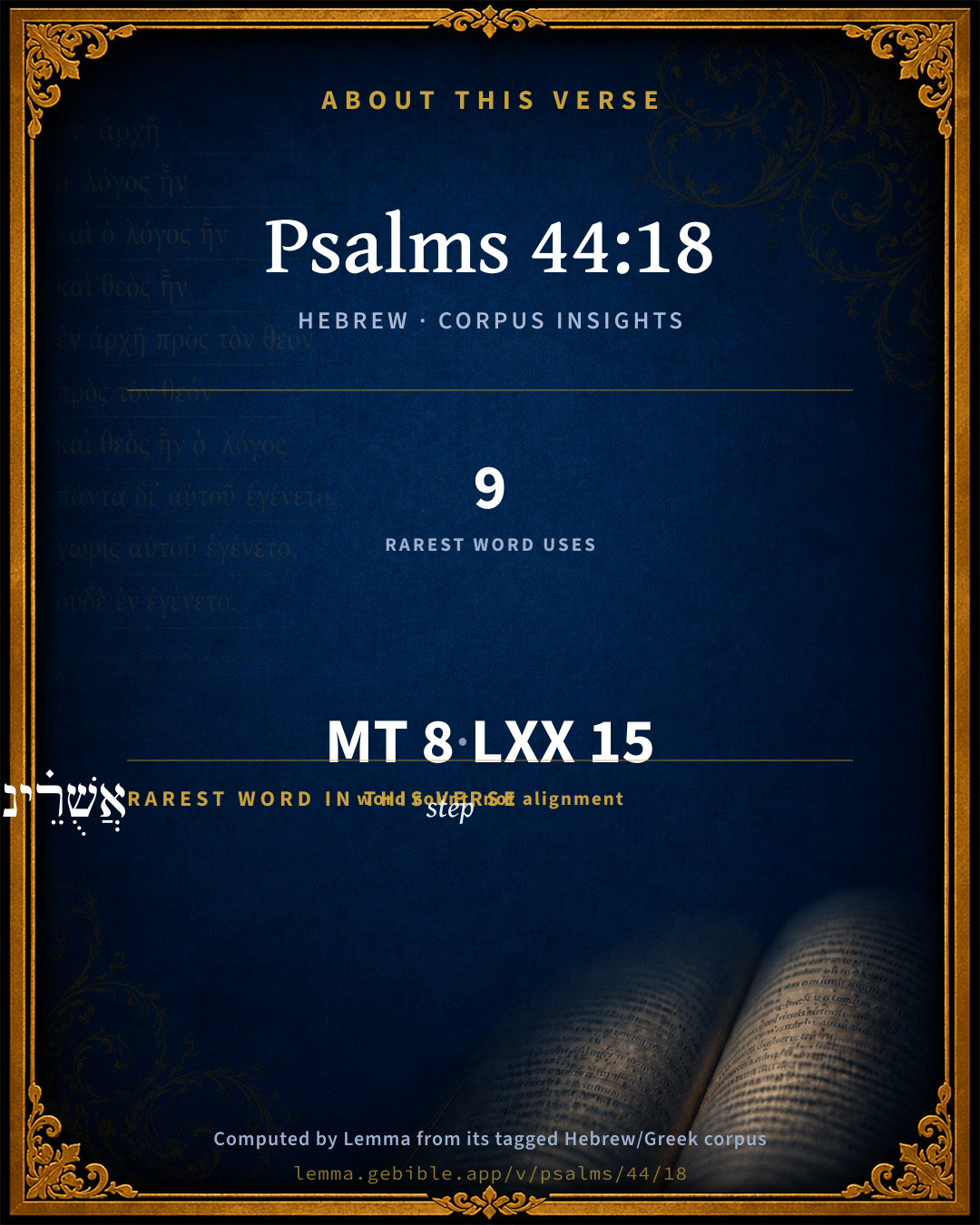
The rarest word here is אֲשֻׁרֵ֗ינוּ step H838 — appearing just 9 times in the whole Hebrew Bible.

Shared distinctive vocabulary

אֲשֻׁרֵ֗ינוּ step H838 occurs in 9 verses of the Hebrew Bible. Also found in:

Grammatical profile

  • 2 verbs
  • 4 nouns
  • 1 preposition
  • 1 particle

Verb forms

  • נָס֣וֹג Niphal · Perfect
  • וַתֵּ֥ט Qal · Sequential Imperfect

Hebrew & Septuagint length

In English translation the verse runs 14 words from the Hebrew and 17 from the Septuagint (LXX English) — closely comparable.

A rough comparison of the two English renderings, which tokenize alike — not a word-level alignment.

Word counts can differ between the Hebrew and the Greek without any difference in meaning — e.g. the Hebrew direct-object marker אֵת has no separate Greek word, and Greek often adds the article ὁ.

In the original languages it is 8 Hebrew tokens and 15 Greek tokens — but the two are counted differently (Hebrew bundles its prefixes and suffixes into one token; the Greek is in lemma form), so that isn’t a like-for-like length.

Cross-references

11

Topical passages linked to Psalms 44:18 in the Treasury of Scripture Knowledge — connected by theme and wording, ordered by reader-vote popularity; previews shown in the World English Bible.

  • Psalms 119:51 The arrogant mock me excessively, But I don't swerve from your law.
  • Psalms 119:157 Many are my persecutors and my adversaries. I haven't swerved from your testimonies.
  • Job 23:11–12 My foot has held fast to his steps. His way have I kept, and not turned aside.
  • Psalms 78:57 But turned back, and dealt treacherously like their fathers. They were turned aside like a deceitful bow.
  • Zephaniah 1:6 those who have turned back from following Yahweh, and those who haven't sought Yahweh nor inquired after him.
  • 1 Kings 15:5 because David did that which was right in the eyes of Yahweh, and didn't turn aside from anything that he commanded him all the days of his life, except only in the matter of Uriah the Hittite.
  • Job 34:27 Because they turned aside from following him, And wouldn't have regard in any of his ways:
  • Psalms 125:5 But as for those who turn aside to their crooked ways, Yahweh will lead them away with the workers of iniquity. Peace be on Israel.
  • Jeremiah 11:10 They are turned back to the iniquities of their forefathers, who refused to hear my words; and they are gone after other gods to serve them: the house of Israel and the house of Judah have broken my covenant which I made with their fathers.
  • Luke 17:32 Remember Lot's wife!
  • 1 Corinthians 15:58 Therefore, my beloved brothers, be steadfast, immovable, always abounding in the Lord's work, because you know that your labor is not in vain in the Lord.

Cross-references courtesy of OpenBible.info (CC BY 4.0).

Hebrew and Greek witnesses Masoretic Hebrew ↔ Greek Septuagint

The same verse in the two great witnesses to the Old Testament, shown verse-for-verse.

You’re reading Greek Psalm 43 (Hebrew Psalm 44). The Septuagint counts the superscription, so verse numbers can differ from the Hebrew — chapter-level alignment, not verse-by-verse. Numbering follows Rahlfs.

These are two independent witnesses, not word-aligned to each other, and the Septuagint is shown in lemma (dictionary) form.

Hebrew Psalms 44:18 Masoretic · Westminster Leningrad Codex

לֹא נָס֣וֹג אָח֣וֹר לִבֵּ֑נוּ וַתֵּ֥ט אֲשֻׁרֵ֗ינוּ מִנִּ֥י אָרְחֶֽךָ

Our heart has not turned back, Neither have our steps strayed from your path,

World English Bible · Public Domain

Greek LXX Greek Psalm 43:18 Septuagint · lemma form

οὗτος πᾶς ἔρχομαι ἐπί ἐγώ καί οὐ ἐπιλανθάνω σύ καί οὐ ἀδικέω ἐν διαθήκη σύ

And our heart has not gone back; but you have turned aside our paths from your way.

LXX2012 (modern English Septuagint) · Public Domain

On this verse, Albert Barnes' Notes on the Bible discusses the Septuagint’s reading. Read the note in Commentary ↓

Hebrew: Westminster Leningrad Codex (CC BY 4.0). Greek: Septuagint (public domain); English from LXX2012 (modern English Septuagint) (Public Domain). How the Septuagint differs from the Hebrew →

Commentary

Notes on Psalms 44:18 from classic Christian and Jewish commentators (each source and its license shown beneath its notes). The classic Christian expositions comment on the surrounding passage and are grouped to its opening verse, so a note may address several verses; the Jewish commentaries on the Tanakh (Rashi and others) are per-verse, so they appear only where the commentator wrote on this verse.

Lemma curates 59 commentaries, every one of them public domain or Creative Commons licensed, each selected and text-cleaned for this edition rather than reprinted as found. About our sources →

Trapp's Complete Commentary

John Trapp

Psa 44:18 Our heart is not turned back, neither have our steps declined from thy way;

Ver. 18. Our heart is not turned back] Metaphora a stadio, saith Vatablus. As those that run a race stand not at a stay, much less turn back again; so neither have we either stopped or stepped backward, but advanced still toward the mark, having Nondum metam, We have not yet attained, for our motto, as St Paul had, Php 3:12; being in nothing terrified by our adversaries, nor afraid with any amazement, Php 1:28 1Pe 3:6.

Neither have our steps declined] We have watched over every particular action; God’s people are best when at worst.

John Trapp, A Commentary or Exposition upon All the Books of the Old and New Testament (1647–1656) — public domain. Text from a community e-Sword module.

J. A. Alexander on Psalms

Joseph Addison Alexander

19. (Psa 44:18). Our heart has not turned back and our steps declined from thy path. The force of the negative extends to both clauses, as in Psa 9:19 (18). Heart and steps are put for inward affection and its fruit, external action. Turned back and turned aside are natural and common figures for moral delinquency. Thy path, the way of thy commandments.

Joseph Addison Alexander, The Psalms Translated and Explained (1850) — public domain. Text from a community e-Sword module.

Jamieson, Fausset & Brown

Robert Jamieson, A. R. Fausset & David Brown

declined--turned aside from God's law.

Jamieson, Fausset & Brown — Commentary Critical and Explanatory on the Whole Bible (1871) — public domain (CC PDM 1.0). Text via the HelloAO Bible API.

John Gill's Exposition

Our heart is not turned back,.... To its original hardness, blindness, and bondage, to its former sin and folly, to cherish, gratify, and fulfil its lusts and desires; not from God, from love to him, faith in him, and desires after him; nor from his worship and service; their trials had no such influence upon them as to cause them to apostatize from God, neither in heart, nor in action;

neither have our steps declined from thy way; from the way of his commandments, from the paths of holiness, truth, and faith, being directed and guided therein by the counsel of the Lord, and kept and preserved by his power.

John Gill's Exposition of the Whole Bible (1746–1763) — public domain (CC PDM 1.0). Text via the HelloAO Bible API.

Albert Barnes' Notes on the Bible

Our heart is not turned back - That is, We have not turned away from thy service; we have not apostatized from thee; we have not fallen into idolatry. This must mean that such was not at that time the characteristic of the nation; it was not a prominent thing among the people; there was no such general and pervading iniquity as to explain the fact that these calamities had come upon them, or to be properly the cause of these troubles.

Neither have our steps declined from thy way - Margin, goings. The idea as expressed by our translators is, that the people had not departed from the path prescribed by God; that is, from what he required in his law. The Septuagint and the Vulgate render it, “Thou hast turned our steps from thy way;” that is, though our heart is not turned back, and we have not revolted from thee, yet thou hast turned our steps from thy way, or hast turned us from the way of thy favor and from prosperity. The rendering in the common version, however, is more in conformity with the idea in the original.

Albert Barnes' Notes on the Bible (1834–1885) — public domain. Text from a community e-Sword/MySword module.

Matthew Poole's English Annotations

Is not turned back, to wit, from thee, or thy worship and service, unto idols, as it follows, Psa 44:20.

Neither have our steps declined from thy way: because it is easy and ordinary falsely to pretend sincerity of heart, which men cannot discern nor confute, they prove it from the unblamableness of their lives and actions.

Matthew Poole's English Annotations on the Holy Bible (1683–1685) — public domain. Text from a community e-Sword/MySword module.

The Treasury of David

Charles H. Spurgeon

Ver. 18. Our heart is not turned back, neither have our steps declined from thy way. Heart and life were agreed, and both were true to the Lord's way. Neither within nor without had the godly sufferers offended; they were not absolutely perfect, but they were sincerely free from all wilful transgression. It was a healthy sign for the nation that her prophet poet could testify to her uprightness before God, both in heart and act; far oftener the case would have worn quite another colour, for the tribes were all too apt to set up other gods and forsake the rock of their salvation.

Ver. 18. Our heart is not turned back. Serious piety has become a ludicrous subject with which the wanton wits of this atheistical world sport themselves; but behold the wisdom and goodness of God, exhibiting to the world undeniable testimonies of the truth of religion as often as the sincere professors thereof are brought to the test by afflictions from the hand of God, or persecutions from the hands of men. Lo! "here is the faith and patience of the saints; " here is their courage, meekness, and self denial, shining as gold in the fire. They have the real proofs of it before their eyes. Instead of casting them into hell, and convincing them by eternal fire, he is pleased to cast his own people into the fire of affliction, that they who scoff at them may be convinced at an easier and cheaper rate. It is no new thing to see the enemies of religion brought over to embrace it by the constancy and faithfulness of the saints in their trials and sufferings for it. God grant that the atheism of this present generation do not occasion a more fiery trial to the people of God in it than they have yet suffered. John Flavel.

Ver. 18. our heart. The word (bbl), or Greek kardia, that is rendered heart, both in the Old and New Testament, doth signify the understanding, the mind, will, affections, conscience, the whole soul. Our heart is not turned back. Our understandings and minds are the same as they were in a summer's day, though now we be in a winter's storm; though now we be afflicted, tossed, broken, and persecuted, yet notwithstanding, our heart is not turned back, our mind, will, affections, and conscience, our whole soul, is the same now as before. Thomas Brooks.

Ver. 18. (first clause). When we may be sure that our heart has not apostatised.

Ver. 18.

1. The position of the heart in religionit comes first.

2. The position of the outer moral life in religionit follows the heart.

3. Necessity of the agreement of the two.

4. The need that both should be faithful to God.

Ver. 18. Connection between the heart and the life, both in constancy and apostasy.

Ver. 18. God's delight in the progress of the upright. Thomas Brooks.

Upright hearts will hold on in the ways of God, and in the ways of well doing, notwithstanding all afflictions, troubles, and discouragements, they meet withal. Thomas Brooks.

Ver. 18. Thy ways. The ways of God are

(1) righteous ways;

(2) blessed ways;

(3) soul refreshing ways;

(4) transcendent waysways that transcend all other

ways;

(5) soul strengthening ways; and

(6) sometimes afflicted, perplexed, and persecuted

ways. Thomas Brooks.

Psalms 44:19*

Charles H. Spurgeon's The Treasury of David (1869–1885) — public domain. Psalms only. Text from a community e-Sword/MySword module.

The Pulpit Commentary

Our heart is not turned back; i.e. turned away from God, as it was when they passed through the wilderness. (Psa_78:41) Neither have our steps declined from thy way. Neither in respect of inward feeling nor of outward act have we strayed from the right path.

The Pulpit Commentary (1880–1919), ed. H.D.M. Spence-Jones & Joseph S. Exell — public domain. Text from a community e-Sword module.

John Wesley's Explanatory Notes

Turned - From thy worship to idols.

John Wesley, Explanatory Notes Upon the Whole Bible (1754–1765) — public domain. Text via the GEBible commentary corpus.

unfoldingWord translationNotes

Door43 World Missions Community

Our heart has not turned back ... have not gone from your way

These two phrases are parallel. The writer speaks of loyalty to God as if it were following him, and disloyalty as if it were turning away from him. (See: Parallelism and Metaphor)

Our heart has not turned back

Here the word "heart" refers to the emotions, and specifically to loyalty and devotion. AT: "We have not stopped being loyal to you" (See: Metonymy)

you have severely broken us

The writer speaks of God's punishment as if it were breaking a fragile object. AT: "you have punished us severely" (See: Metaphor)

in the place of jackals

The writer speaks of Israel after God's punishment as if it were a wild, uninhabitable place. AT: "and made our land like a place where jackals live" (See: Metaphor)

jackals

a type of wild dog

covered us with the shadow of death

The writer speaks of death as if it is an object that casts a shadow over those who are about to die. AT: "made us so that we are about to die" (See: Metaphor)

If we have forgotten the name of our God

Here the word "name" refers to God, himself. To forget God is to stop worshiping him. This is something that did not happen. AT: "If we had forgotten our God" or "If we had stopped worshiping our God" (See: Metonymy and Hypothetical Situations)

spread out our hands to a strange god

Spreading out the hands is a gesture that people used to worship and pray to a god. AT: "worshiped a strange god" or "prayed to a strange god" (See: Symbolic Action)

would not God search this out?

The writer uses this question to express that God would know if they worshiped another god. AT: "God would certainly find out" (See: Rhetorical Question)

he knows the secrets of the heart

Here the word "heart" refers to the mind and thoughts. AT: "he knows what a person secretly thinks" (See: Metonymy)

we are being killed all day long

The phrase "all day long" is an exaggeration to emphasize that their people are being killed frequently. This can be stated in active form. AT: "we are always in danger of people killing us" (See: Hyperbole and Generalization and Active or Passive)

we are considered to be sheep for the slaughter

This can be stated in active form. AT: "people consider us to be sheep for the slaughter" (See: Active or Passive)

sheep for the slaughter

The writer compares the Israelites to sheep that people kill and eat. As sheep are helpless before those who kill them, so the Israelites are helpless before their enemies. (See: Metaphor)

translationWords

heart

turn

shadow

die

name

false god

ewe

slaughter

unfoldingWord translationNotes — © Distant Shores Media and the Door43 World Missions Community, licensed CC BY-SA 4.0. Source: git.door43.org/Door43/en_tn.

Lesson kit

Teaching starters — assembled from the data on this page, not authored interpretation. Every prompt links to the verse data it draws on. Edit before teaching.

Psalms, in the Wisdom, opens this verse with 8 words (8 distinct Hebrew lemmas). Its most distinctive word is ʼâshur (“step”). A historical commentator’s framing appears above. Read the whole chapter for the surrounding context.

Discussion questions

  1. What does “step” (ʼâshur) contribute to the verse as a whole?
  2. How does Job 23:11, which shares the word «step», read alongside this verse?
  3. These translations render this verse differently; the difference is in the English rendering, not the original. What questions does that raise?
  4. «נָס֣וֹג» is a Niphal Perfect verb. How does that grammatical form shape the action described?
  5. Compare how Trapp's Complete Commentary and J. A. Alexander on Psalms read this verse. Where do they agree or differ?

Things to notice

Reading settings

Reading text

Shown beneath each verse's original-language words.

Old Testament
Old Testament edition

Read the OT as the Masoretic Hebrew (MT) or the Greek Septuagint (LXX).

English shown for the Greek Septuagint (in the Hebrew ↔ Greek comparison).

Comparing translations? Open the Compare panel on any verse page to stack up to four side by side.