
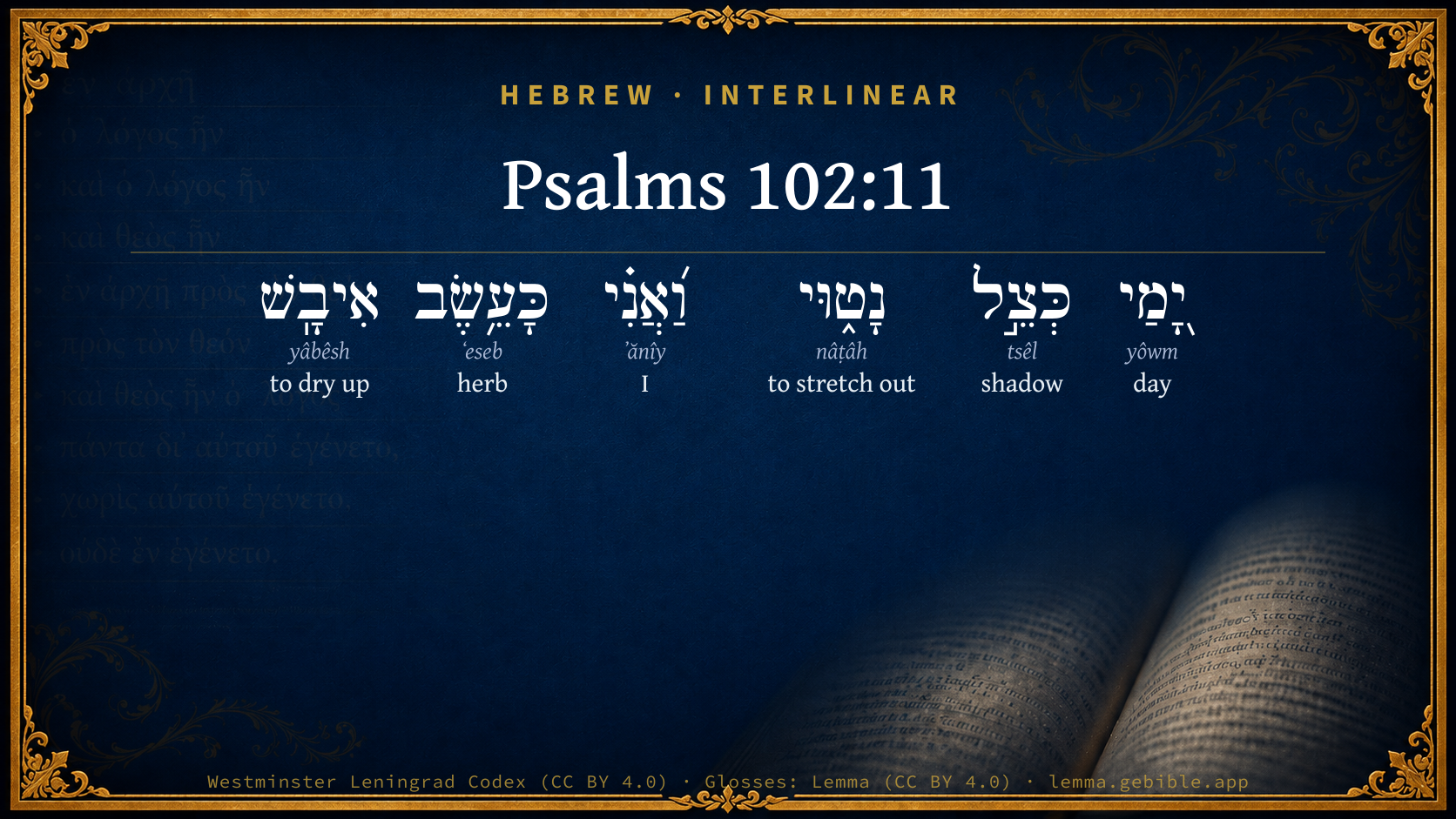
Psalms 102:11

Hebrew (Westminster Leningrad Codex) Psalms 102:11 appears in the Hebrew Old Testament. The text above is from the Westminster Leningrad Codex. Each word links to its Strong’s number, a concise gloss, and parsing drawn from the Open Scriptures Hebrew Bible morphology. Click any word for its full Brown-Driver-Briggs (BDB) entry.
Download image
Cite this verse

Psalms 102:11 (World English Bible). Public Domain. Lemma interlinear Bible study tool, https://lemma.gebible.app/v/psalms/102/11.

Show BibTeX & RIS
BibTeX
RIS
English Translation
My days are like a long shadow. I have withered like grass.
World English Bible · Public Domain
Download a study sheet

One document with this verse’s original text, its word-by-word gloss line, the meaning frame, cross-references with their text, attributed commentary, and full source and license credits — printable, and it pastes into notes with its structure intact.

This verse Autodidact and up

Study sheet (.html) Plain text (.txt)

A passage Seminary Student

Up to 50 verses in one chapter. A passage sheet keeps up to 6 commentary sources and 12 cross-references per verse, in the order this page ranks them, and says so on the sheet whenever that leaves anything out. Ask for a single verse and you get the Autodidact verse sheet above.

Everything on this page stays free to read, with no account — the sheet is a download of what is already on screen, not access to it.

Want to remove ads? Support Godless Engineer
Compare translations 3

The same verse in 3 English versions, stacked beneath the original-language interlinear above. Click any original word for its lexicon entry.

Each is an independent rendering of the whole verse — the interlinear is not word-aligned to these translations.

Highlighted words mark where these versions differ — a whole-verse word diff, not a word-by-word alignment.

  • World English Bible Public Domain
    My days are like a long shadow. I have withered like grass.
  • King James Version Public Domain
    My days are like a shadow that declineth; and I am withered like grass.
  • unfoldingWord Literal Text CC BY-SA 4.0
    My days like a lengthening shadow, and I, like grass, have withered.

unfoldingWord Literal Text — © unfoldingWord, licensed CC BY-SA 4.0. Word-aligned USFM3 via Door43 (git.door43.org/unfoldingWord/en_ult).

Versions to compare (up to 4)

3 of 4 selected

Show all 18 translations

Every available English version of this verse, each an independent rendering of the whole verse.

  • World English Bible Public Domain
    My days are like a long shadow. I have withered like grass.
  • Berean Standard Bible Public Domain
    My days are like lengthening shadows, and I wither away like grass.
  • Majority Standard Bible Public Domain
    My days are like lengthening shadows, and I wither away like grass.
  • King James Version Public Domain
    My days are like a shadow that declineth; and I am withered like grass.
  • American Standard Version (1901) Public Domain
    My days are like a shadow that declineth; And I am withered like grass.
  • Revised Version (1885) Public Domain
    My days are like a shadow that declineth; and I am withered like grass.
  • Geneva Bible (1599) Public Domain
    My dayes are like a shadowe that fadeth, and I am withered like grasse.
  • Douay-Rheims (1899) Public Domain
    Because of thy anger and indignation: for having lifted me up thou hast thrown me down.
  • Young's Literal Translation Public Domain
    My days as a shadow `are' stretched out, And I -- as the herb I am withered.
  • Literal Standard Version CC BY-SA 4.0
    My days [are] stretched out as a shadow, || And I am withered as the herb.
  • Unlocked Literal Bible CC BY-SA 4.0
    My days are like a shadow that fades, and I have withered like grass.
  • unfoldingWord Literal Text CC BY-SA 4.0
    My days like a lengthening shadow, and I, like grass, have withered.
  • Darby Bible Public Domain
    My days are like a lengthened-out shadow, and I, I am withered like grass.
  • World Messianic Bible Public Domain
    My days are like a long shadow. I have withered like grass.
  • Webster's Bible Public Domain
    \\102:10\\Because of thy indignation and thy wrath: for thou hast lifted me up, and cast me down.
  • Free Bible Version CC BY-SA 4.0
    My life is fading away like a shadow that lengthens—I'm withering away like grass.
  • Bible in Basic English Public Domain
    My days are like a shade which is stretched out; I am dry like the grass.
  • JPS Tanakh (1917) Public Domain
    (102-12) My days are like a lengthening shadow; and I am withered like grass.

Literal Standard Version (2020), Covenant Press — licensed CC BY-SA 4.0. Text via the HelloAO Bible API (eBible.org). Unlocked Literal Bible (unfoldingWord) — licensed CC BY-SA 4.0. Text via the HelloAO Bible API (eBible.org). unfoldingWord Literal Text — © unfoldingWord, licensed CC BY-SA 4.0. Word-aligned USFM3 via Door43 (git.door43.org/unfoldingWord/en_ult). Free Bible Version, Dr. Jonathan Gallagher — licensed CC BY-SA 4.0. Text via the HelloAO Bible API (eBible.org).

Word by word

More ways to search: Search by grammar → Find every occurrence → Compare this word →

Practice this passage: Drill this verse → Learn its vocabulary →

About this verse

These counts appear in no published source. They are computed here, from the morphology-tagged text and Lemma’s own curated glosses. What Lemma adds →

6
words
6
distinct lemmas
Wisdom
section

Shared distinctive vocabulary

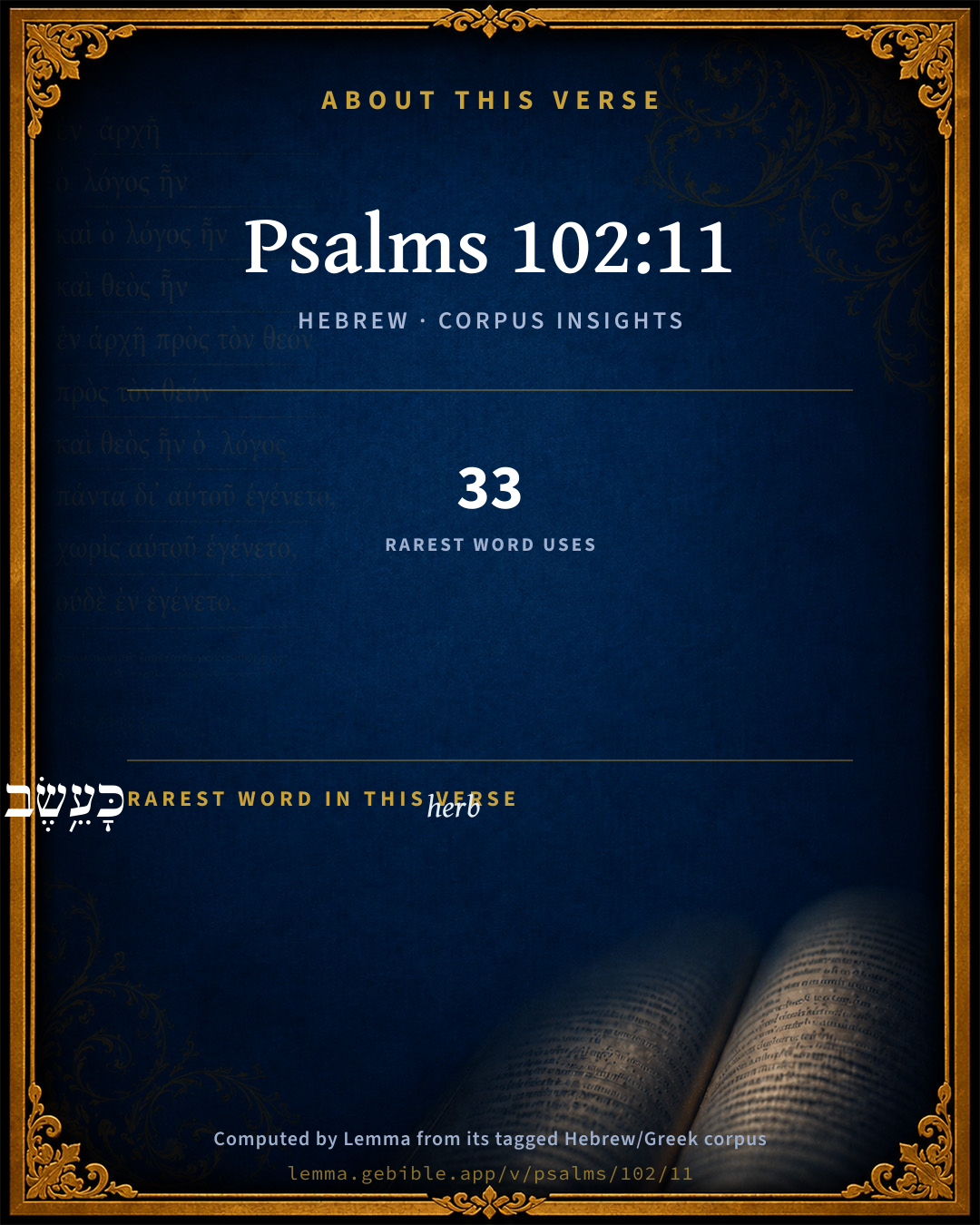
כָּעֵ֥שֶׂב herb H6212 occurs in 32 verses of the Hebrew Bible. Also found in:

Grammatical profile

  • 2 verbs
  • 3 nouns
  • 1 pronoun

Verb forms

  • נָט֑וּי Qal · Participle Passive
  • אִיבָֽשׁ Qal · Imperfect

Hebrew & Septuagint length

In English translation the verse runs 12 words from the Hebrew and 13 from the Septuagint (LXX English) — closely comparable.

A rough comparison of the two English renderings, which tokenize alike — not a word-level alignment.

Word counts can differ between the Hebrew and the Greek without any difference in meaning — e.g. the Hebrew direct-object marker אֵת has no separate Greek word, and Greek often adds the article ὁ.

Cross-references

10

Topical passages linked to Psalms 102:11 in the Treasury of Scripture Knowledge — connected by theme and wording, ordered by reader-vote popularity; previews shown in the World English Bible.

  • Job 14:2 He comes forth like a flower, and is cut down. He also flees like a shadow, and doesn't continue.
  • Psalms 109:23 I fade away like an evening shadow. I am shaken off like a locust.
  • Psalms 144:4 Man is like a breath. His days are like a shadow that passes away.
  • 1 Peter 1:24 For, "All flesh is like grass, And all of man's glory like the flower in the grass. The grass withers, and its flower falls;
  • Isaiah 40:6–8 The voice of one saying, Cry. One said, What shall I cry? All flesh is grass, and all the glory of it is as the flower of the field.
  • James 1:10 and the rich, in that he is made humble, because like the flower in the grass, he will pass away.
  • James 4:14 Whereas you don't know what your life will be like tomorrow. For what is your life? For you are a vapor, that appears for a little time, and then vanishes away.
  • Psalms 39:5–6 Behold, you have made my days handbreadths. My lifetime is as nothing before you. Surely every man stands as a breath." Selah.
  • Psalms 102:3–4 For my days consume away like smoke. My bones are burned as a firebrand.
  • Ecclesiastes 6:12 For who knows what is good for man in life, all the days of his vain life which he spends like a shadow? For who can tell a man what will be after him under the sun?

Cross-references courtesy of OpenBible.info (CC BY 4.0).

Hebrew and Greek witnesses Masoretic Hebrew ↔ Greek Septuagint

The same verse in the two great witnesses to the Old Testament, shown verse-for-verse.

You’re reading Greek Psalm 101 (Hebrew Psalm 102). The Septuagint counts the superscription, so verse numbers can differ from the Hebrew — chapter-level alignment, not verse-by-verse. Numbering follows Rahlfs.

These are two independent witnesses, not word-aligned to each other, and the Septuagint is shown in lemma (dictionary) form.

Hebrew Psalms 102:11 Masoretic · Westminster Leningrad Codex

יָ֭מַי כְּצֵ֣ל נָט֑וּי וַ֝אֲנִ֗י כָּעֵ֥שֶׂב אִיבָֽשׁ

My days are like a long shadow. I have withered like grass.

World English Bible · Public Domain

Greek LXX Greek Psalm 101:11 Septuagint · lemma form

ἀπό πρόσωπον ὁ ὀργή σύ καί ὁ θυμός σύ ὅτι ἐπιαἴρω καταῥάσσω ἐγώ

My days have declined like a shadow; and I am withered like grass.

LXX2012 (modern English Septuagint) · Public Domain

Hebrew: Westminster Leningrad Codex (CC BY 4.0). Greek: Septuagint (public domain); English from LXX2012 (modern English Septuagint) (Public Domain). How the Septuagint differs from the Hebrew →

Commentary

Notes on Psalms 102:11 from classic Christian and Jewish commentators (each source and its license shown beneath its notes). The classic Christian expositions comment on the surrounding passage and are grouped to its opening verse, so a note may address several verses; the Jewish commentaries on the Tanakh (Rashi and others) are per-verse, so they appear only where the commentator wrote on this verse.

Lemma curates 59 commentaries, every one of them public domain or Creative Commons licensed, each selected and text-cleaned for this edition rather than reprinted as found. About our sources →

Trapp's Complete Commentary

John Trapp

Psa 102:11 My days [are] like a shadow that declineth; and I am withered like grass.

Ver. 11. My days are like a shadow that declineth] As at sunset the shadows are at longest, but not longlasting.

And I am withered like grass] Mown down, and laid a drying.

John Trapp, A Commentary or Exposition upon All the Books of the Old and New Testament (1647–1656) — public domain. Text from a community e-Sword module.

Joseph Benson's Commentary

Psa 102:11-12. My days are like a shadow — Which “never continueth in one stay, but is still gliding imperceptibly on, lengthening as it goes, and at last vanisheth into darkness. The period of its existence is limited to a day at farthest. The rising sun gives it birth, and in the moment when the sun sets it is no more.” — Horne. And just so, the psalmist intimates, the hopes which they had sometimes entertained of a restitution were quickly cut off and disappointed. But thou shalt endure for ever — But this is my comfort, although we die, and our hopes vanish, yet our God is unchangeable and everlasting, and therefore not to be conquered by his and our enemies, however numerous and powerful, but is constant in his counsels and purposes of mercy to his church, steadfast and faithful in the performance of all his promises; and therefore he both can and will deliver his people. And thy remembrance unto all generations — To the end of time, nay, to eternity: thou shalt be known and honoured; and “the remembrance of thy former works and mercies comforts our hearts, and encourages us to hope, nay, even to rejoice, in the midst of our sorrow and tribulation.”

Joseph Benson's Commentary on the Old and New Testaments (1811–1818) — public domain. Text from a community e-Sword module.

J. A. Alexander on Psalms

Joseph Addison Alexander

12. (Psa 102:11) My days (are) like a shadow inclined, and I (myself) like the grass wither. An inclined shadow is an unusual and obscure expression, but seems to mean a shadow verging towards its disappearance, ready to vanish away. The double or reflexive pronoun (I myself) in the translation of the last clause is necessary to convey the full force of the Hebrew pronoun, which is seldom expressed, except when it is meant to be emphatic, I wither, am withering, or about to wither.

Joseph Addison Alexander, The Psalms Translated and Explained (1850) — public domain. Text from a community e-Sword module.

Tyndale Open Study Notes

Tyndale Open Resources

102:11 The psalmist’s existence seems empty and transitory (102:4; 109:23; 144:4).

Tyndale Open Study Notes — © Tyndale Open Resources, licensed CC BY-SA 4.0. Text via the HelloAO Bible API.

Adam Clarke's Commentary

Verse 11. My days are like a shadow that declineth] Or rather, My days decline like the shadow. I have passed my meridian, and the sun of my prosperity is about to set for ever. There may be here an allusion to the declination of the sun towards the south, which, by shortening their days, would greatly lengthen their nights. Similar to the exclamation of a contemporary prophet, Jer 8:20: "The harvest is past, the summer is ended, and we are not saved." There is now scarcely any human hope of our deliverance.

Adam Clarke's Commentary on the Bible (1810–1826) — public domain. Text from a community e-Sword/MySword module.

John Calvin's Commentaries

11. My days are like the shadow which declineth When the sun is directly over our heads, that is to say, at mid-day, we do not observe such sudden changes of the shadows which his light produces; but when he begins to decline towards the west the shadows vary almost every moment, This is the reason why the sacred writer expressly makes mention of the shadow which declineth What he attributes to the afflicted Church seems indeed to be equally applicable to all men; but he had a special reason for employing this comparison to illustrate the condition of the Church when subjected to the calamity of exile. It is true, that as soon as we advance towards old age, we speedily fall into decay. But the complaint here is, that this befell the people of God in the very flower of their age. By the term days is to be understood the whole course of their life; and the meaning is, that the captivity was to the godly as the setting of the sun, because they quickly failed. In the end of the verse the similitude of withered grass, used a little before, is repeated, to intimate that their life during the captivity was involved in many sorrows which dried up in them the very sap of life. Nor is this wonderful, since to live in that condition would have been worse than a hundred deaths had they not been sustained by the hope of future deliverance. But although they were not altogether overwhelmed by temptation, they must have been in great distress, because they saw themselves abandoned by God.

John Calvin's Commentaries (1540-1563) — public domain. Text from the Calvin Translation Society English edition (1840s-50s) via the Christian Classics Ethereal Library (ccel.org). Calvin's coverage is partial (roughly two-thirds of the Bible); uncommented books and verses are honest gaps, never fabricated. The 19th-century editor's footnotes and remarks are omitted so the notes are faithfully Calvin's own voice.

Ellicott's Commentary for English Readers

(11) A shadow that declineth.—Rather, a lengthening shadow, growing longer as the day declines, and therefore soon to vanish altogether. (Comp. Psa_109:23.)

“And now the sun had stretched out all the hills.”

MILTON: Lycidas,

See also Note, Son_2:17.

A Bible Commentary for English Readers, edited by Charles John Ellicott (1878–1897) — public domain. Text from a community e-Sword module.

The Cambridge Bible for Schools and Colleges

gen. ed. J. J. S. Perowne

11. like a shadow that declineth] Or, like a shadow stretched out (Jer_6:4) towards evening, and about to disappear altogether as the sun sinks below the horizon.

I am withered like grass] Rather, I am withering away like grass. The common emblem for frail and transitory mortality. Cp. Isa_40:7; Jas_1:11.

The Cambridge Bible for Schools and Colleges (gen. ed. J. J. S. Perowne; Cambridge University Press, 1878–1918) — public domain. Text from a community e-Sword module.

John Gill's Exposition

But thou, O Lord, shalt endure for ever,.... This address is made to Christ, as is clear from Psa 102:25, compared with Heb 1:10, who is a divine Person, endures for ever, is from everlasting to everlasting, unchangeably the same in his love, power, wisdom, faithfulness, &c. and though he died as man, he will die no more; he is alive, and lives for evermore; and because he lives, his people shall live also; and he will come again to take them to himself: and, as Mediator, he is King for ever; always continues, as such, to rule over, protect, and defend his people; and is a Priest for ever, and ever lives to make intercession for them; and his blood, righteousness, and sacrifice, have a constant virtue in them, to take away sin, and secure from it: the consideration of the perpetuity of Christ, in his person and offices, was a comfort to the psalmist under his troubles, and in a view of his own declining state: the Targum is,

"but thou, O Lord, thy habitation continues for ever in heaven:''

and thy remembrance to all generations; the remembrance of his name Jehovah, or Jesus, or Immanuel, or any other, is sweet and precious to his saints in all ages; and so the remembrance of his works, of what he has done and suffered, especially the great work of redemption; for the remembrance of which the ordinance of the Lord's supper is appointed to be continued till his second coming; and his Gospel is an everlasting one, which will transmit the memory of him to men in every age, to the end of the world; and though all flesh is as grass, and every man dies, even the ministers of the word, yet that itself lives for ever. Aben Ezra reads "thy throne", as agreeing with Lam 5:19, but Kimchi observes that this reading is owing to a bad copy.

John Gill's Exposition of the Whole Bible (1746–1763) — public domain (CC PDM 1.0). Text via the HelloAO Bible API.

Albert Barnes' Notes on the Bible

My days are like a shadow that declineth - The shadow made by the gnomon on a sun-dial, which marks the hours as they pass. See 2Ki 20:10. The idea is that the shadow made by the descending sun was about to disappear altogether. It had become less distinct and clear, and it would soon vanish. It would seem from this, that the dial was so made that the shadow indicating the hour ascended when the sun ascended, and declined when the sun went down. See the notes at Isa 38:8.

And I am withered like grass - See the notes at Psa 102:4.

Albert Barnes' Notes on the Bible (1834–1885) — public domain. Text from a community e-Sword/MySword module.

Matthew Poole's English Annotations

My days; my hopes, and comforts, and happiness; days being oft put for happy days, or a happy state, as Psa 37:18; Lam 5:21, as elsewhere they are put more generally for the events which happen in those days; in both which cases it is a metonymy of the adjunct.

That declineth; or, that is extended or stretched out to its utmost length, as it is when the sun is setting, when it speedily and totally vanisheth. And just so the hopes of our restitution, which sometimes we have, are quickly cut off and disappointed.

Matthew Poole's English Annotations on the Holy Bible (1683–1685) — public domain. Text from a community e-Sword/MySword module.

The Treasury of David

Charles H. Spurgeon

Ver. 11. My days are like a shadow that declineth. His days were but a shadow at best, but now they seem to be like a shadow which was passing away. A shadow is unsubstantial enough, how feeble a thing must a declining shadow be? No expression could more forcibly set forth his extreme feebleness.

And I am withered like grass. He was like grass, blasted by a parching wind, or cut down with a scythe, and then left to be dried up by the burning heat of the sun. There are times when through depression of spirit a man feels as if all life were gone from him, and existence had become merely a breathing death. Heart-break has a marvellously withering influence over our entire system; our flesh at its best is but as grass, and when it is wounded with sharp sorrows, its beauty fades, and it becomes a shrivelled, dried, uncomely thing.

Ver. 11 (first clause). My days (my term of life) are as the lengthened shade, the lengthening shade of evening, that shows the near approach of night. The comparison, though not strictly expressed, is beautifully suggestive of the thought intended. Thomas J. Conant.

Ver. 11 (last clause). The and I, in the Hebrew, stands in designed contrast to "But thou, "Ps 102:12. A. R. Fausset.

Ver. 11-12. I and Thou, or the notable contrast.

1. I: my days are like a shadow, (a) Because it is unsubstantial; because it partakes of the nature of the darkness which is to absorb it; because the longer it becomes the briefer its continuance. (b) I am like grass cut down by the scythe; scorched by drought.

2. Thou. Lord. Ever enduring. Ever memorable. Ever the study of passing generations of men. C. D.

Psalms 102:12*

Charles H. Spurgeon's The Treasury of David (1869–1885) — public domain. Psalms only. Text from a community e-Sword/MySword module.

Whedon's Commentary on the Bible

Daniel D. Whedon

11. Shadow that declineth—Which lengthens and darkens till it loses itself in night.

Withered like grass—See on Psa_102:4

Daniel D. Whedon (gen. ed.), Commentary on the Old and New Testaments (1874–1909) — public domain. Text from a community e-Sword module.

The Pulpit Commentary

My days are like a shadow that declineth; literally, that lengthens, as shadows do when the day declines (comp. ver. 24). The psalmist, like his nation, is old before his time; the shades of evening have come upon him, when he should have been in his midday brightness. And I am withered like grass (comp. ver. 4). The "I" here is emphatic (yna) not only is the psalmist"s heart withered, but he himself is altogether scorched and dried up.

The Pulpit Commentary (1880–1919), ed. H.D.M. Spence-Jones & Joseph S. Exell — public domain. Text from a community e-Sword module.

unfoldingWord translationNotes

Door43 World Missions Community

My days are like a shadow that fades

David compares his time left to live on earth to a fading shadow. AT: "My time to remain alive is short like an evening shadow that will soon be gone" (See: Simile)

I have withered like grass

As David's body becomes weak and he is nearing the end of his life, he compares himself to withering grass. AT: "my body has become weak like withered grass" (See: Simile)

withered

dry and wrinkled

your fame is for all generations

"you will be recognized for all generations to come"

fame

being known by many people

translationWords

shadow

life

Yahweh

eternity

generation

unfoldingWord translationNotes — © Distant Shores Media and the Door43 World Missions Community, licensed CC BY-SA 4.0. Source: git.door43.org/Door43/en_tn.

Rashi

Rabbi Shlomo Yitzchaki (Rashi)

for You picked me up First You picked me up and now You cast me down from heaven to the earth, and if You had not picked me up first, my disgrace would not be so great.

Rashi on the Tanakh — English translations: “The Judaica Press complete Tanach with Rashi, translated by A. J. Rosenberg” (CC BY 4.0); “Pentateuch with Rashi's commentary by M. Rosenbaum and A.M. Silbermann, 1929-1934” (public domain); “The Metsudah Tanach series, Lakewood, N.J” (CC BY 4.0); and “The Book of Joshua, Metsudah Publications, 1997” (CC BY 4.0). Text via Sefaria.

Lesson kit

Teaching starters — assembled from the data on this page, not authored interpretation. Every prompt links to the verse data it draws on. Edit before teaching.

Psalms, in the Wisdom, opens this verse with 6 words (6 distinct Hebrew lemmas). Its most distinctive word is ʻeseb (“herb”). A historical commentator’s framing appears above. Read the whole chapter for the surrounding context.

Discussion questions

  1. How does “herb” (ʻeseb) shape what this verse is saying?
  2. How does Genesis 1:11, which shares the word «herb», read alongside this verse?
  3. These translations render this verse differently. What is at stake in choosing one wording over another?
  4. «נָט֑וּי» is a Qal Participle Passive verb. How does that grammatical form shape the action described?
  5. Compare how Trapp's Complete Commentary and Joseph Benson's Commentary read this verse. Where do they agree or differ?

Things to notice

Reading settings

Reading text

Shown beneath each verse's original-language words.

Old Testament
Old Testament edition

Read the OT as the Masoretic Hebrew (MT) or the Greek Septuagint (LXX).

English shown for the Greek Septuagint (in the Hebrew ↔ Greek comparison).

Comparing translations? Open the Compare panel on any verse page to stack up to four side by side.