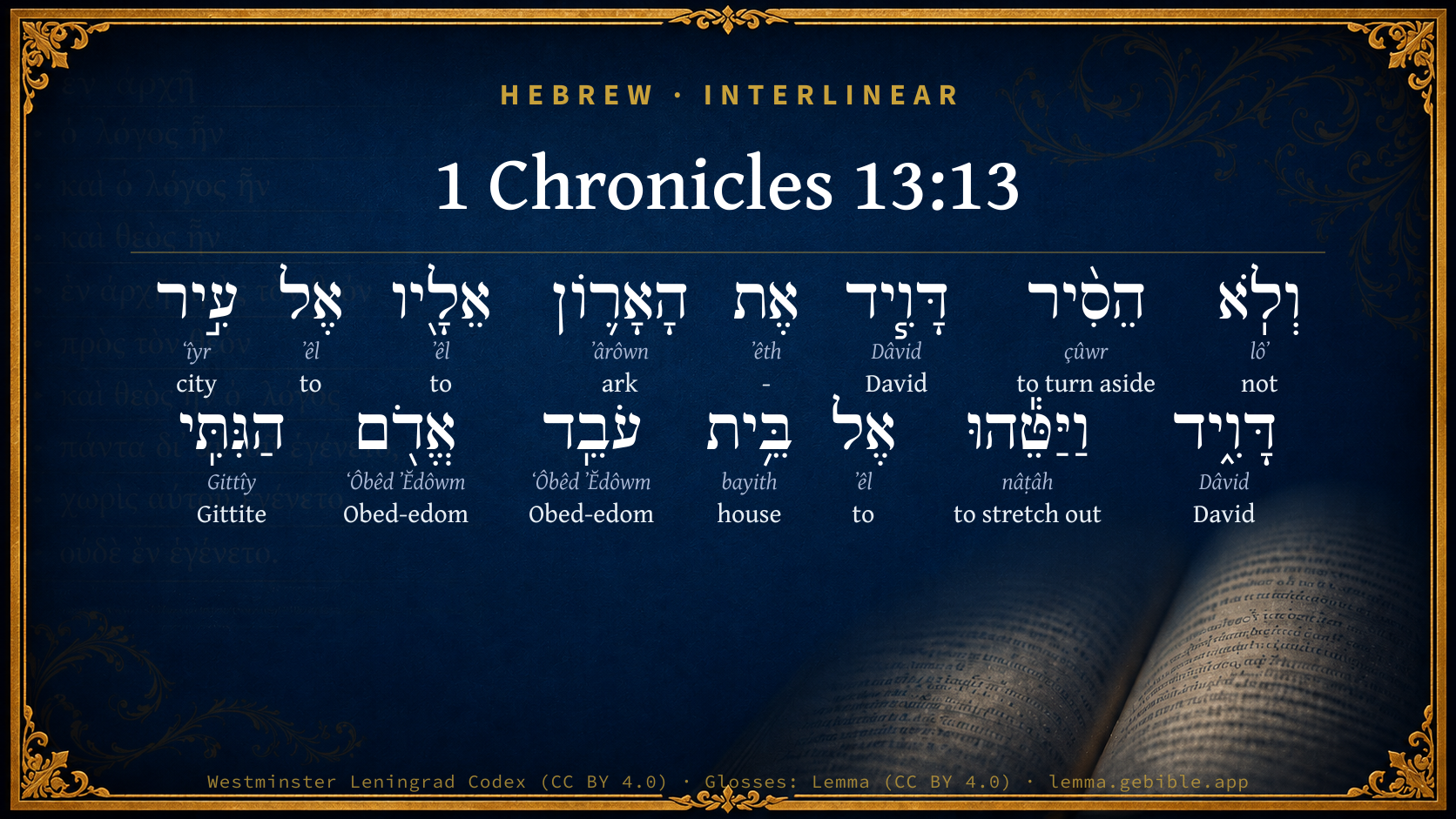
1 Chronicles 13:13

Hebrew (Westminster Leningrad Codex) 1 Chronicles 13:13 appears in the Hebrew Old Testament. The text above is from the Westminster Leningrad Codex. Each word links to its Strong’s number, a concise gloss, and parsing drawn from the Open Scriptures Hebrew Bible morphology. Click any word for its full Brown-Driver-Briggs (BDB) entry.
Download image
Cite this verse

1 Chronicles 13:13 (World English Bible). Public Domain. Lemma interlinear Bible study tool, https://lemma.gebible.app/v/1-chronicles/13/13.

Show BibTeX & RIS
BibTeX
RIS
English Translation
So David didn't move the ark to him into the city of David, but carried it aside into the house of Obed-edom the Gittite.
World English Bible · Public Domain
Download a study sheet

One document with this verse’s original text, its word-by-word gloss line, the meaning frame, cross-references with their text, attributed commentary, and full source and license credits — printable, and it pastes into notes with its structure intact.

This verse Autodidact and up

Study sheet (.html) Plain text (.txt)

A passage Seminary Student

Up to 50 verses in one chapter. A passage sheet keeps up to 6 commentary sources and 12 cross-references per verse, in the order this page ranks them, and says so on the sheet whenever that leaves anything out. Ask for a single verse and you get the Autodidact verse sheet above.

Everything on this page stays free to read, with no account — the sheet is a download of what is already on screen, not access to it.

Want to remove ads? Support Godless Engineer
Compare translations 3

The same verse in 3 English versions, stacked beneath the original-language interlinear above. Click any original word for its lexicon entry.

Each is an independent rendering of the whole verse — the interlinear is not word-aligned to these translations.

Highlighted words mark where these versions differ — a whole-verse word diff, not a word-by-word alignment.

  • World English Bible Public Domain
    So David didn't move the ark to him into the city of David, but carried it aside into the house of Obed-edom the Gittite.
  • King James Version Public Domain
    So David brought not the ark home to himself to the city of David, but carried it aside into the house of Obededom the Gittite.
  • unfoldingWord Literal Text CC BY-SA 4.0
    So David did not turn the Box to himself, to the city of David, but he turned it aside to the house of Obed Edom the Gittite.

unfoldingWord Literal Text — © unfoldingWord, licensed CC BY-SA 4.0. Word-aligned USFM3 via Door43 (git.door43.org/unfoldingWord/en_ult).

Versions to compare (up to 4)

3 of 4 selected

Show all 18 translations

Every available English version of this verse, each an independent rendering of the whole verse.

  • World English Bible Public Domain
    So David didn't move the ark to him into the city of David, but carried it aside into the house of Obed-edom the Gittite.
  • Berean Standard Bible Public Domain
    So he did not move the ark with him to the City of David; instead, he took it aside to the house of Obed-edom the Gittite.
  • Majority Standard Bible Public Domain
    So he did not move the ark with him to the City of David; instead, he took it aside to the house of Obed-edom the Gittite.
  • King James Version Public Domain
    So David brought not the ark home to himself to the city of David, but carried it aside into the house of Obededom the Gittite.
  • American Standard Version (1901) Public Domain
    So David removed not the ark unto him into the city of David, but carried it aside into the house of Obed-edom the Gittite.
  • Revised Version (1885) Public Domain
    So David removed not the ark unto him into the city of David, but carried it aside into the house of Obed-edom the Gittite.
  • Geneva Bible (1599) Public Domain
    Therefore Dauid brought not the Arke to him into the citie of Dauid, but caused it to turne into the house of Obed Edom the Gittite.
  • Douay-Rheims (1899) Public Domain
    And therefore he brought it not home to himself, that is, into the city of David, but carried it aside into the house of Obededom the Gethite.
  • Young's Literal Translation Public Domain
    And David hath not turned aside the ark unto himself, unto the city of David, and turneth it aside unto the house of Obed-Edom the Gittite.
  • Literal Standard Version CC BY-SA 4.0
    And David has not turned aside the Ark to himself, to the City of David, and turns it aside to the house of Obed-Edom the Gittite.
  • Unlocked Literal Bible CC BY-SA 4.0
    So David did not move the ark to the city of David, but put it aside in the house of Obed Edom the Gittite.
  • unfoldingWord Literal Text CC BY-SA 4.0
    So David did not turn the Box to himself, to the city of David, but he turned it aside to the house of Obed Edom the Gittite.
  • Darby Bible Public Domain
    And David brought not the ark home unto himself into the city of David, but he carried it aside into the house of Obed-Edom the Gittite.
  • World Messianic Bible Public Domain
    So David didn’t move the ark with him into David’s city, but carried it aside into Obed-Edom the Gittite’s house.
  • Webster's Bible Public Domain
    So David brought not the ark to himself to the city of David, but carried it aside into the house of Obed-edom the Gittite.
  • Free Bible Version CC BY-SA 4.0
    So David did not move the Ark of God to be with him in the City of David. Instead, he had it taken to the home of Obed-edom the Gittite.
  • Bible in Basic English Public Domain
    So David did not let the ark come back to him to the town of David, but had it turned away and put into the house of Obed-edom the Gittite.
  • JPS Tanakh (1917) Public Domain
    So David removed not the ark unto him into the city of David, but carried it aside into the house of Obed-edom the Gittite.

Literal Standard Version (2020), Covenant Press — licensed CC BY-SA 4.0. Text via the HelloAO Bible API (eBible.org). Unlocked Literal Bible (unfoldingWord) — licensed CC BY-SA 4.0. Text via the HelloAO Bible API (eBible.org). unfoldingWord Literal Text — © unfoldingWord, licensed CC BY-SA 4.0. Word-aligned USFM3 via Door43 (git.door43.org/unfoldingWord/en_ult). Free Bible Version, Dr. Jonathan Gallagher — licensed CC BY-SA 4.0. Text via the HelloAO Bible API (eBible.org).

Word by word

More ways to search: Search by grammar → Find every occurrence → Compare this word →

Practice this passage: Drill this verse → Learn its vocabulary →

הַגִּתִּֽי
Gittîy
H1663
“the · Gittite”
Particle, Definite Article + Noun, Gentilic, Masculine, Singular, Absolute
Part of Speech
Particle + Noun
Type
Gentilic
Gender
Masculine
Number
Singular
State
Absolute
Full BDB Definition

Origin: patrial from H1661

TWOT: None

Gittite = "belonging to Gath" - an inhabitant of Gath
  1. וְלֹֽא lôʼ H3808 “and · not” Conjunction + Particle, Negative
  2. הֵסִ֨יר çûwr H5493 “to turn aside” Verb, Hiphil, Perfect, 3rd Person, Masculine, Singular
  3. דָּוִ֧יד Dâvid H1732 “David” Noun, Proper
  4. אֶת ʼêth H853 “-” Particle, Direct Object
  5. הָאָר֛וֹן ʼârôwn H727 “the · ark” Particle, Definite Article + Noun, Common, Both, Singular, Absolute
  6. אֵלָ֖יו ʼêl H413 “to · him” Preposition + Suffix, Personal, 3rd Person, Masculine, Singular
  7. אֶל ʼêl H413 “to” Preposition
  8. עִ֣יר ʻîyr H5892 “city of” Noun, Common, Feminine, Singular, Construct
  9. דָּוִ֑יד Dâvid H1732 “David” Noun, Proper
  10. וַיַּטֵּ֕הוּ nâṭâh H5186 “and · to stretch out · him” Conjunction + Verb, Hiphil, Sequential Imperfect, 3rd Person, Masculine, Singular + Suffix, Personal, 3rd Person, Masculine, Singular
  11. אֶל ʼêl H413 “to” Preposition
  12. בֵּ֥ית bayith H1004 “house of” Noun, Common, Masculine, Singular, Construct
  13. עֹבֵֽד ʻÔbêd ʼĔdôwm H5654 “Obed-edom” Noun, Proper
  14. אֱדֹ֖ם ʻÔbêd ʼĔdôwm H5654 “Obed-edom” Noun, Proper

About this verse

These counts appear in no published source. They are computed here, from the morphology-tagged text and Lemma’s own curated glosses. What Lemma adds →

15
words
11
distinct lemmas
Historical
section

Notable vocabulary

The rarest word here is הַגִּתִּֽי Gittite H1663 — appearing just 10 times in the whole Hebrew Bible.

Shared distinctive vocabulary

הַגִּתִּֽי Gittite H1663 occurs in 10 verses of the Hebrew Bible. Also found in:

Grammatical profile

  • 2 verbs
  • 8 nouns
  • 3 prepositions
  • 2 particles

Verb forms

  • הֵסִ֨יר Hiphil · Perfect
  • וַיַּטֵּ֕הוּ Hiphil · Sequential Imperfect

Repetition

Words recur within this verse — often emphatic in Hebrew:

  • דָּוִ֧יד David H1732 ×2
  • עֹבֵֽד Obed-edom H5654 ×2
  • אֵלָ֖יו to H413 ×3

Hebrew & Septuagint length

In English translation the verse runs 24 words from the Hebrew and 26 from the Septuagint (LXX English) — closely comparable.

A rough comparison of the two English renderings, which tokenize alike — not a word-level alignment.

Word counts can differ between the Hebrew and the Greek without any difference in meaning — e.g. the Hebrew direct-object marker אֵת has no separate Greek word, and Greek often adds the article ὁ.

In the original languages it is 15 Hebrew tokens and 19 Greek tokens — but the two are counted differently (Hebrew bundles its prefixes and suffixes into one token; the Greek is in lemma form), so that isn’t a like-for-like length.

Cross-references

6

Topical passages linked to 1 Chronicles 13:13 in the Treasury of Scripture Knowledge — connected by theme and wording, ordered by reader-vote popularity; previews shown in the World English Bible.

  • 2 Samuel 6:10–11 So David would not remove the ark of Yahweh to him into the city of David; but David carried it aside into the house of Obed-edom the Gittite.
  • 1 Chronicles 15:18 and with them their brothers of the second degree, Zechariah, Ben, and Jaaziel, and Shemiramoth, and Jehiel, and Unni, Eliab, and Benaiah, and Maaseiah, and Mattithiah, and Eliphelehu, and Mikneiah, and Obed-edom, and Jeiel, the doorkeepers.
  • 1 Chronicles 26:4 Obed-edom had sons: Shemaiah the firstborn, Jehozabad the second, Joah the third, and Sacar the fourth, and Nethanel the fifth,
  • 2 Samuel 4:3 and the Beerothites fled to Gittaim, and have lived as foreigners there until this day).
  • 1 Chronicles 16:5 Asaph the chief, and second to him Zechariah, Jeiel, and Shemiramoth, and Jehiel, and Mattithiah, and Eliab, and Benaiah, and Obed-edom, and Jeiel, with psalteries and with harps; and Asaph with cymbals, sounding aloud;
  • 1 Chronicles 26:8 All these were of the sons of Obed-edom: they and their sons and their brothers, able men in strength for the service; sixty-two of Obed-edom.

Cross-references courtesy of OpenBible.info (CC BY 4.0).

Hebrew and Greek witnesses Masoretic Hebrew ↔ Greek Septuagint

The same verse in the two great witnesses to the Old Testament, shown verse-for-verse.

These are two independent witnesses, not word-aligned to each other, and the Septuagint is shown in lemma (dictionary) form.

Hebrew 1 Chronicles 13:13 Masoretic · Westminster Leningrad Codex

וְלֹֽא הֵסִ֨יר דָּוִ֧יד אֶת הָאָר֛וֹן אֵלָ֖יו אֶל עִ֣יר דָּוִ֑יד וַיַּטֵּ֕הוּ אֶל בֵּ֥ית עֹבֵֽד אֱדֹ֖ם הַגִּתִּֽי

So David didn't move the ark to him into the city of David, but carried it aside into the house of Obed-edom the Gittite.

World English Bible · Public Domain

Greek LXX 1 Chronicles 13:13 Septuagint · lemma form

καί οὐ ἀποστρέφω δαυίδ ὁ κιβωτός πρός ἑαυτοῦ εἰς πόλις δαυίδ καί ἐκκλίνω αὐτός εἰς οἶκος αβεδδαρα ὁ γεθθαῖος

So David brought not the ark home to himself into the city of David, but he turned it aside into the house of Abeddara the Gethite.

LXX2012 (modern English Septuagint) · Public Domain

Hebrew: Westminster Leningrad Codex (CC BY 4.0). Greek: Septuagint (public domain); English from LXX2012 (modern English Septuagint) (Public Domain). How the Septuagint differs from the Hebrew →

Commentary

Notes on 1 Chronicles 13:13 from classic Christian and Jewish commentators (each source and its license shown beneath its notes). The classic Christian expositions comment on the surrounding passage and are grouped to its opening verse, so a note may address several verses; the Jewish commentaries on the Tanakh (Rashi and others) are per-verse, so they appear only where the commentator wrote on this verse.

Lemma curates 59 commentaries, every one of them public domain or Creative Commons licensed, each selected and text-cleaned for this edition rather than reprinted as found. About our sources →

Trapp's Complete Commentary

John Trapp

1Ch 13:13 So David brought not the ark [home] to himself to the city of David, but carried it aside into the house of Obededom the Gittite.

1Ch 13:14 And the ark of God remained with the family of Obededom in his house three months. And the LORD blessed the house of Obededom, and all that he had.

Ver. 13,14. {See Trapp on "1Ch 13:12"}

John Trapp, A Commentary or Exposition upon All the Books of the Old and New Testament (1647–1656) — public domain. Text from a community e-Sword module.

The Biblical Illustrator

Joseph S. Exell

1Ch_13:13

But carried it aside into the house of Obed-edom

The asides of God

How much we owe to the asides of God.

Obed-edom owed the benediction which descended upon his house to this aside. Gods way through life is thus wondrous: always indeed one great line of progress, yet who can count the detours which He makes, the asides, the incidental variations, the small things which men regarded as unworthy of notice,--who can tell how all these are wrought up into a comprehensive revelation of wisdom and love. If we only took the things which came to us on the great main thoroughfares of life, some people would hardly be blessed at all. A study of the asides of life would confirm us in our general Christian faith. (J. Parker, D. D.)

The Biblical Illustrator, edited by Joseph S. Exell (c. 1880s–1900s) — public domain. Text from a community e-Sword module.

Geneva Bible (1599)

Geneva Bible translators

Who was a Levite, and called Gittite, because he had dwelt at Gath.

Geneva Bible (1599) marginal notes — public domain. Text via Bolls.life.

Ellicott's Commentary for English Readers

(13) Brought not . . . home.—A different verb from that in 1Ch_13:12. Literally, And David caused not the ark to turn aside unto himself. Slightly abridged. (See Samuel.)

Obed-edom the Gittite.—As, according to 1Ch_26:1-4, Obed-edom was a Korhitic Levite, the term “Gittite” is generally assumed to mean native of Gathrimmon, a Levitical township (Jos_21:24) belonging to the great clan of Kohath, which was charged with the carriage of the Ark, and of which Obed-edom was a member (Num_4:15).

A Bible Commentary for English Readers, edited by Charles John Ellicott (1878–1897) — public domain. Text from a community e-Sword module.

The Cambridge Bible for Schools and Colleges

gen. ed. J. J. S. Perowne

13. David brought not] R.V. David removed not.

Obed-edom the Gittite] As Gittite means man of Gath, Obed-edom was doubtless of Philistine origin; perhaps he attached himself to David during David’s sojourn among the Philistines. In 1Ch_15:18; 1Ch_15:24; 1Ch_16:38 an Obed-edom is mentioned who was a Levite and a porter (doorkeeper) for the ark, but the Chronicler does not identify him with the Gittite of the same name.

The Cambridge Bible for Schools and Colleges (gen. ed. J. J. S. Perowne; Cambridge University Press, 1878–1918) — public domain. Text from a community e-Sword module.

Haydock's Catholic Bible Commentary

Obededom. A Levite was judged more proper to guard the ark, chap. xv. 18. --- Gethite. Because he had dwelt in Geth. (Worthington)

George Leo Haydock (1774–1849), Haydock's Catholic Family Bible and Commentary, 1859 edition — public domain. Excludes Psalms (Douay-Rheims chapter numbering differs from Protestant) and Deuterocanonical books (Catholic canon only).

The Pulpit Commentary

Obed-edom the Gittite. That Obed-edom is called "the Gittite," i.e. of Gath-rimmon, a Levite city of Dan, (Jos_21:24) might probably indicate that there was another Obed-edom, from whom to distinguish him. Such a one would appear readily to offer in the name of Obed-edom, son of Jeduthun, a "Merarite Levite". (1Ch_15:18-24 1Ch_16:5, 38 26:4-15) But the difficulty occurs that an expression in this last quotation seems to identify him with the Obed-edom of 2Sa_6:11; and the last sentence of our next verse. If they are one and the same, it has been suggested that marriage might account for the Merarite living in a Kohathite city. (see "Speaker"s Commentary" on 2Sa_6:10)

Vers. 13, 14.

Superstitious error and religious truth.

We must take care to read these verses intelligently, or we may misread them altogether. It is possible to draw from them a conclusion which is not in accordance with the mind of God. There is

I A SUPERSTITIOUS ERROR AGAINST WHICH TO GUARD. It would be a great mistake to suppose that the mere fact of the presence of the ark in the house ensured prosperity; or that, similarly, the mere presence of sacred rites or persons will now command the favouring regard of God. That there was something more than this in the case of Obed-edom is proved by the facts:

1. That the presence of the ark in the midst of the Philistines proved to bedisastrous. (1Sa 5)

2. That the presence of the ark in the camp of the Israelites proved to befruitless of help. (1Sa 4)

3. That the ark was nothing more in itself than a box of wood, and, apartfrom God"s determination to bless, could not possibly effect anything at all.

4. That to trust in a thing manufactured of man and not in the living Godhimself would partake of the idolatrous. (see 2Ki_18:4) If we cherish the idea that, because we are connected by blood (or in any other way) with sacred persons, or that because we have much to do officially with sacred things, with the utterance of sacred words, or the performance of sacred rites, or the care of sacred buildings, therefore it will be well with us in the books of heaven, we are only harbouring a fiction, we are leaning on a brittle reed, we are building the house of our hope upon the sand.

II THE RELIGIOUS TRUTH TO BE RECEIVED AND WELCOMED. God blessed the house of Obed-edom because he cheerfully and reverently made room for the sacred chest. His act was one of simple piety, rendered in an hour of need and offered devoutly, intelligently unto God; therefore God "blessed the house of Obed-edom, and all that he had." It was the mark of God"s approval of a service rightly and worthily rendered. The truth for us to gather is that Gods abidingfavour is the one sure source of blessedness. If God be "with us," i.e. for us, on our side, who or what can be against us? "The fear of the Lord is the beginning of wisdom." Those who, in constructing their life, leave God"s favour out of the account, make a fundamental and fatal error. Those who go on the principle that his Divine favour will secure true prosperity are proceeding along the lilies of truth. Let every man be discontented and disturbed in soul until he has first made sure of the abiding approval of the Most High. Till then it will be wrong with him and with all that he has; when that is gained, all is well with him and his. But how is this approval to be secured?

1. By doing the one thing which God demands of all his children now.This, first of all and most of all, is the work or the will of God, that we "believe on the Name of his Son Jesus Christ," etc. (see Joh_6:29; 1Jn_3:23) The acceptance of Christ as our personal Saviour and Lord is the way to secure the abiding favour of the Father of all. Having thus gained his Divine regard, we must continue therein.

2. By striving to be and to do all those things in all our relations which arepleasing in his sight. (see Php_4:8; Col_3:17, Col_3:23) Among many other ways of pleasing Christ, we may win his approving smile in the particular way suggested in the text.

3. By showing special attention to that with which, and to those withwhom, he is specially connected his house and his disciples. C.

Vers. 13, 14.

The ark in the house of Obed-edom.

The ark was in the house of Obed-edom three months, and "the Lord blessed the house of Obed-edom, and all that he had." Why was this? Obed-edom was a Levite. He had been prepared of God to minister before it. None but a prepared heart can enjoy Christ. The ark was at home with Obed-edom, and he with it. So it is always with Christ and his people. But God not only blessed Obed-edom and his family; the significant words are added, and all that he had. " Everything went right with Obed-edom, in his house, his family, his duties, his joys, and his sorrows, because the ark was there. What a lesson! Reader, why do things not go right with you? Because Christ has not his right place in your heart, in your affections, in your home, in your duties, and in all you have. Let Christ be in all, and then it cannot but be with you as it was with Obed-edom, "the Lord blessed his house, and all that he had. W.

The Pulpit Commentary (1880–1919), ed. H.D.M. Spence-Jones & Joseph S. Exell — public domain. Text from a community e-Sword module.

Rashi

Rabbi Shlomo Yitzchaki (Rashi)

the Gittite He was from Gath originally and he previously sojourned in Gath. He was a Levite, as it is written (below 15:16): “And David said to the officers of the Levites to station their brethren, the singers,” and it says shortly after (verse 24): “... and Obed-Edom and Jehiah were gate sentries for the Ark.”

Rashi on the Tanakh — English translations: “The Judaica Press complete Tanach with Rashi, translated by A. J. Rosenberg” (CC BY 4.0); “Pentateuch with Rashi's commentary by M. Rosenbaum and A.M. Silbermann, 1929-1934” (public domain); “The Metsudah Tanach series, Lakewood, N.J” (CC BY 4.0); and “The Book of Joshua, Metsudah Publications, 1997” (CC BY 4.0). Text via Sefaria.

Lesson kit

Teaching starters — assembled from the data on this page, not authored interpretation. Every prompt links to the verse data it draws on. Edit before teaching.

1 Chronicles, in the Historical, opens this verse with 15 words (11 distinct Hebrew lemmas). Its most distinctive word is Gittîy (“Gittite”). A historical commentator’s framing appears above. Read the whole chapter for the surrounding context.

Discussion questions

  1. How does “Gittite” (Gittîy) shape what this verse is saying?
  2. How does Joshua 13:3, which shares the word «Gittite», read alongside this verse?
  3. What does the repetition of “David” (2× in this one verse) do in this verse?
  4. The translations on this page render this verse differently — a whole-verse word diff, not a word-by-word alignment. What might account for the different wordings?
  5. «הֵסִ֨יר» is a Hiphil Perfect verb. How does that grammatical form shape the action described?
  6. Compare how Trapp's Complete Commentary and The Biblical Illustrator read this verse. Where do they agree or differ?

Things to notice

Reading settings

Reading text

Shown beneath each verse's original-language words.

Old Testament
Old Testament edition

Read the OT as the Masoretic Hebrew (MT) or the Greek Septuagint (LXX).

English shown for the Greek Septuagint (in the Hebrew ↔ Greek comparison).

Comparing translations? Open the Compare panel on any verse page to stack up to four side by side.