
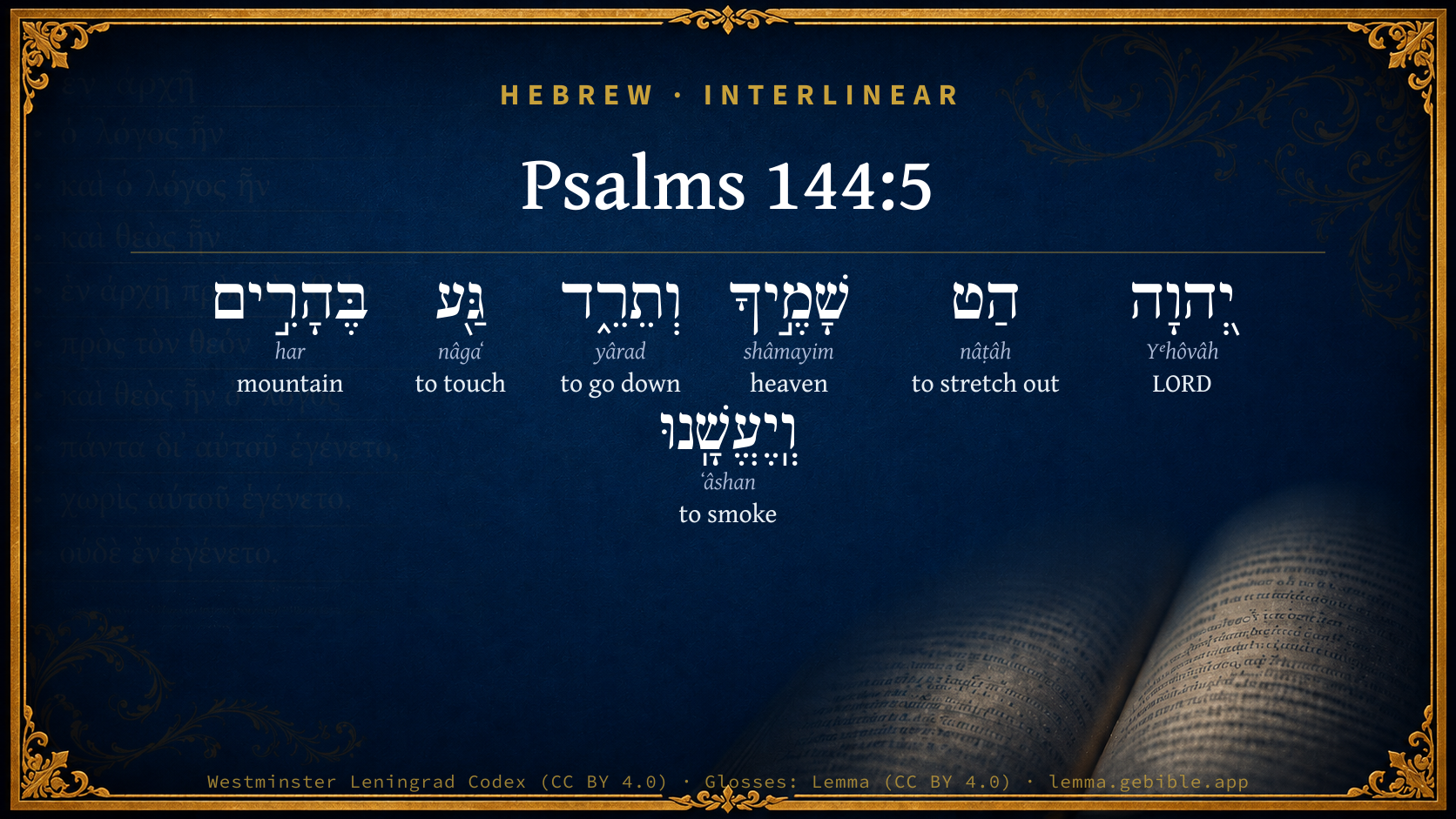
Psalms 144:5

Hebrew (Westminster Leningrad Codex) Psalms 144:5 appears in the Hebrew Old Testament. The text above is from the Westminster Leningrad Codex. Each word links to its Strong’s number, a concise gloss, and parsing drawn from the Open Scriptures Hebrew Bible morphology. Click any word for its full Brown-Driver-Briggs (BDB) entry.
Download image
Cite this verse

Psalms 144:5 (World English Bible). Public Domain. Lemma interlinear Bible study tool, https://lemma.gebible.app/v/psalms/144/5.

Show BibTeX & RIS
BibTeX
RIS
English Translation
Part your heavens, Yahweh, and come down. Touch the mountains, and they will smoke.
World English Bible · Public Domain
Download a study sheet

One document with this verse’s original text, its word-by-word gloss line, the meaning frame, cross-references with their text, attributed commentary, and full source and license credits — printable, and it pastes into notes with its structure intact.

This verse Autodidact and up

Study sheet (.html) Plain text (.txt)

A passage Seminary Student

Up to 50 verses in one chapter. A passage sheet keeps up to 6 commentary sources and 12 cross-references per verse, in the order this page ranks them, and says so on the sheet whenever that leaves anything out. Ask for a single verse and you get the Autodidact verse sheet above.

Everything on this page stays free to read, with no account — the sheet is a download of what is already on screen, not access to it.

Want to remove ads? Support Godless Engineer
Compare translations 3

The same verse in 3 English versions, stacked beneath the original-language interlinear above. Click any original word for its lexicon entry.

Each is an independent rendering of the whole verse — the interlinear is not word-aligned to these translations.

Highlighted words mark where these versions differ — a whole-verse word diff, not a word-by-word alignment.

  • World English Bible Public Domain
    Part your heavens, Yahweh, and come down. Touch the mountains, and they will smoke.
  • King James Version Public Domain
    Bow thy heavens, O LORD, and come down: touch the mountains, and they shall smoke.
  • unfoldingWord Literal Text CC BY-SA 4.0
    Yahweh, bow your heavens and come down; touch the mountains, that they may smoke.

unfoldingWord Literal Text — © unfoldingWord, licensed CC BY-SA 4.0. Word-aligned USFM3 via Door43 (git.door43.org/unfoldingWord/en_ult).

Versions to compare (up to 4)

3 of 4 selected

Show all 18 translations

Every available English version of this verse, each an independent rendering of the whole verse.

  • World English Bible Public Domain
    Part your heavens, Yahweh, and come down. Touch the mountains, and they will smoke.
  • Berean Standard Bible Public Domain
    Part Your heavens, O LORD, and come down; touch the mountains, that they may smoke.
  • Majority Standard Bible Public Domain
    Part Your heavens, O LORD, and come down; touch the mountains, that they may smoke.
  • King James Version Public Domain
    Bow thy heavens, O LORD, and come down: touch the mountains, and they shall smoke.
  • American Standard Version (1901) Public Domain
    Bow thy heavens, O Jehovah, and come down: Touch the mountains, and they shall smoke.
  • Revised Version (1885) Public Domain
    Bow thy heavens, O LORD, and come down: touch the mountains, and they shall smoke.
  • Geneva Bible (1599) Public Domain
    Bow thine heauens, O Lord, and come downe: touch the mountaines and they shall smoke.
  • Douay-Rheims (1899) Public Domain
    I remembered the days of old, I meditated on all thy works: I meditated upon the works of thy hands.
  • Young's Literal Translation Public Domain
    Jehovah, incline Thy heavens and come down, Strike against mountains, and they smoke.
  • Literal Standard Version CC BY-SA 4.0
    YHWH, incline Your heavens and come down, || Strike against mountains, and they smoke.
  • Unlocked Literal Bible CC BY-SA 4.0
    Cause the sky to sink and come down, Yahweh; touch the mountains and make them smoke.
  • unfoldingWord Literal Text CC BY-SA 4.0
    Yahweh, bow your heavens and come down; touch the mountains, that they may smoke.
  • Darby Bible Public Domain
    Jehovah, bow thy heavens, and come down; touch the mountains, that they smoke;
  • World Messianic Bible Public Domain
    Part your heavens, LORD, and come down. Touch the mountains, and they will smoke.
  • Webster's Bible Public Domain
    Bow thy heavens, O LORD, and come down: touch the mountains, and they shall smoke.
  • Free Bible Version CC BY-SA 4.0
    Part your heavens and come down. Touch the mountains so that they give off smoke.
  • Bible in Basic English Public Domain
    Come down, O Lord, from your heavens: at your touch let the mountains give out smoke.
  • JPS Tanakh (1917) Public Domain
    O LORD, bow Thy heavens, and come down; touch the mountains, that they may smoke.

Literal Standard Version (2020), Covenant Press — licensed CC BY-SA 4.0. Text via the HelloAO Bible API (eBible.org). Unlocked Literal Bible (unfoldingWord) — licensed CC BY-SA 4.0. Text via the HelloAO Bible API (eBible.org). unfoldingWord Literal Text — © unfoldingWord, licensed CC BY-SA 4.0. Word-aligned USFM3 via Door43 (git.door43.org/unfoldingWord/en_ult). Free Bible Version, Dr. Jonathan Gallagher — licensed CC BY-SA 4.0. Text via the HelloAO Bible API (eBible.org).

Word by word

More ways to search: Search by grammar → Find every occurrence → Compare this word →

Practice this passage: Drill this verse → Learn its vocabulary →

About this verse

These counts appear in no published source. They are computed here, from the morphology-tagged text and Lemma’s own curated glosses. What Lemma adds →

7
words
7
distinct lemmas
Wisdom
section

Notable vocabulary

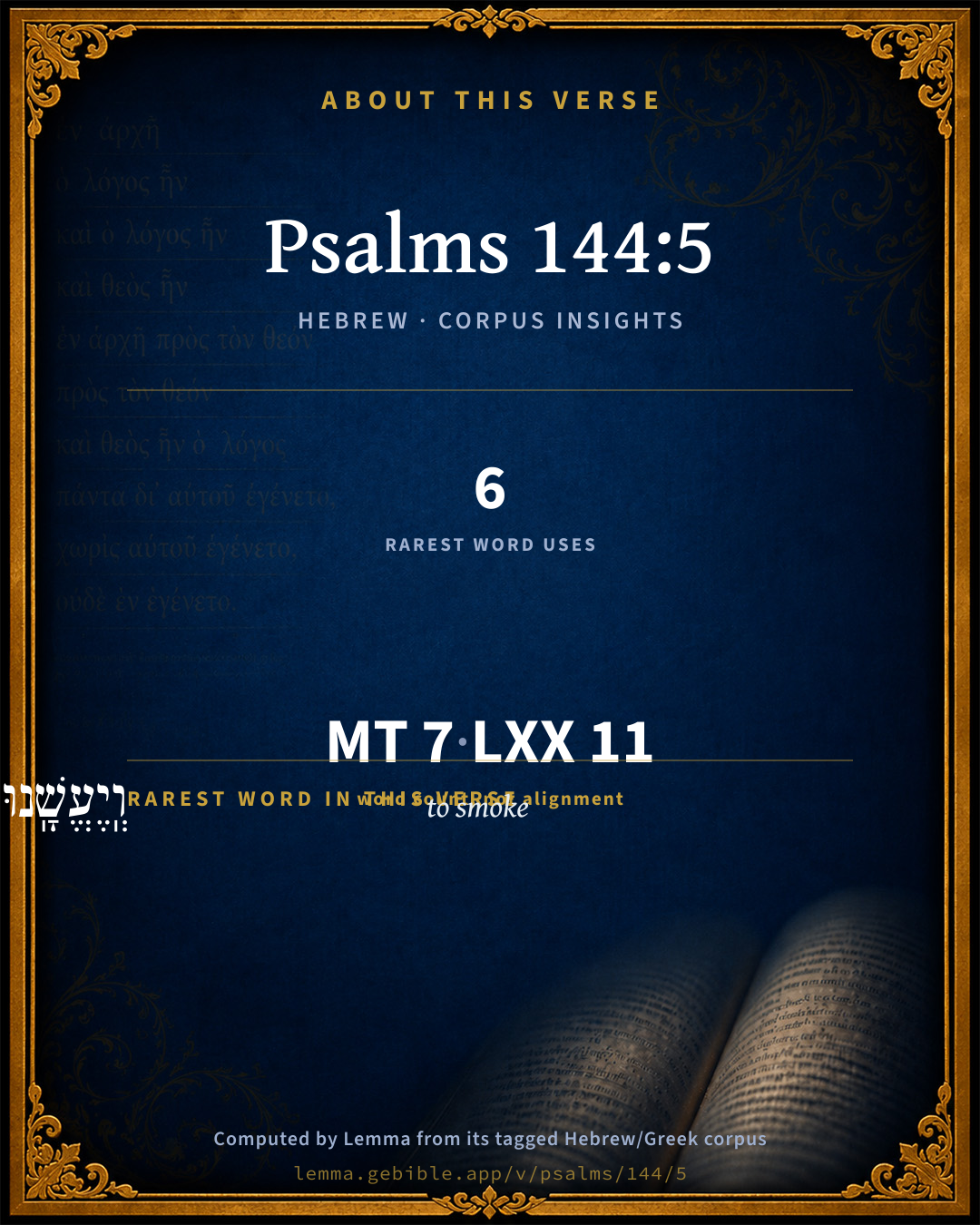
The rarest word here is וְֽיֶעֱשָֽׁנוּ to smoke H6225 — appearing just 6 times in the whole Hebrew Bible.

Shared distinctive vocabulary

וְֽיֶעֱשָֽׁנוּ to smoke H6225 occurs in 6 verses of the Hebrew Bible. Also found in:

Grammatical profile

  • 4 verbs
  • 3 nouns

Verb forms

  • הַט Hiphil · Imperative
  • וְתֵרֵ֑ד Qal · Imperfect
  • גַּ֖ע Qal · Imperative
  • וְֽיֶעֱשָֽׁנוּ Qal · Imperfect

Hebrew & Septuagint length

In English translation the verse runs 14 words from the Hebrew and 15 from the Septuagint (LXX English) — closely comparable.

A rough comparison of the two English renderings, which tokenize alike — not a word-level alignment.

Word counts can differ between the Hebrew and the Greek without any difference in meaning — e.g. the Hebrew direct-object marker אֵת has no separate Greek word, and Greek often adds the article ὁ.

In the original languages it is 7 Hebrew tokens and 11 Greek tokens — but the two are counted differently (Hebrew bundles its prefixes and suffixes into one token; the Greek is in lemma form), so that isn’t a like-for-like length.

Cross-references

7

Topical passages linked to Psalms 144:5 in the Treasury of Scripture Knowledge — connected by theme and wording, ordered by reader-vote popularity; previews shown in the World English Bible.

  • Psalms 18:9 He bowed the heavens also, and came down. Thick darkness was under his feet.
  • Psalms 104:32 He looks at the earth, and it trembles. He touches the mountains, and they smoke.
  • Exodus 19:18 Mount Sinai, the whole of it, smoked, because Yahweh descended on it in fire; and its smoke ascended like the smoke of a furnace, and the whole mountain quaked greatly.
  • Habakkuk 3:3–6 God came from Teman, The Holy One from Mount Paran. Selah. His glory covered the heavens, And his praise filled the earth.
  • Isaiah 64:1–2 Oh that you would tear the heavens, that you would come down, that the mountains might quake at your presence,
  • Nahum 1:3–6 Yahweh is slow to anger, and great in power, and will by no means leave the guilty unpunished. Yahweh has his way in the whirlwind and in the storm, and the clouds are the dust of his feet.
  • Hebrews 12:18 For you have not come to a mountain that might be touched, and that burned with fire, and to blackness, darkness, tempest,

Cross-references courtesy of OpenBible.info (CC BY 4.0).

Hebrew and Greek witnesses Masoretic Hebrew ↔ Greek Septuagint

The same verse in the two great witnesses to the Old Testament, shown verse-for-verse.

You’re reading Greek Psalm 143 (Hebrew Psalm 144). The Septuagint counts the superscription, so verse numbers can differ from the Hebrew — chapter-level alignment, not verse-by-verse. Numbering follows Rahlfs.

These are two independent witnesses, not word-aligned to each other, and the Septuagint is shown in lemma (dictionary) form.

Hebrew Psalms 144:5 Masoretic · Westminster Leningrad Codex

יְ֭הוָה הַט שָׁמֶ֣יךָ וְתֵרֵ֑ד גַּ֖ע בֶּהָרִ֣ים וְֽיֶעֱשָֽׁנוּ

Part your heavens, Yahweh, and come down. Touch the mountains, and they will smoke.

World English Bible · Public Domain

Greek LXX Greek Psalm 143:5 Septuagint · lemma form

κύριος κλίνω οὐρανός σύ καί καταβαίνω ἅπτομαι ὁ ὄρος καί καπνίζω

O Lord, bow your heavens, and come down: touch the mountains, and they shall smoke.

LXX2012 (modern English Septuagint) · Public Domain

Hebrew: Westminster Leningrad Codex (CC BY 4.0). Greek: Septuagint (public domain); English from LXX2012 (modern English Septuagint) (Public Domain). How the Septuagint differs from the Hebrew →

Commentary

Notes on Psalms 144:5 from classic Christian and Jewish commentators (each source and its license shown beneath its notes). The classic Christian expositions comment on the surrounding passage and are grouped to its opening verse, so a note may address several verses; the Jewish commentaries on the Tanakh (Rashi and others) are per-verse, so they appear only where the commentator wrote on this verse.

Lemma curates 59 commentaries, every one of them public domain or Creative Commons licensed, each selected and text-cleaned for this edition rather than reprinted as found. About our sources →

Trapp's Complete Commentary

John Trapp

Psa 144:5 Bow thy heavens, O LORD, and come down: touch the mountains, and they shall smoke.

Ver. 5. Bow thy heavens, O Lord] Come to my help suddenly and seasonably, as it were out of an engine, εκ της μηχανης.

Touch the mountains] These high and haughty enemies of mine, do thou but lightly touch them, and it shall suffice; they shall soon burn, and be turned into smoke, as the mountains that are thunder struck.

John Trapp, A Commentary or Exposition upon All the Books of the Old and New Testament (1647–1656) — public domain. Text from a community e-Sword module.

The Biblical Illustrator

Joseph S. Exell

Psa_144:5

Touch the mountains, and they shall smoke.

The kindling of the heart

It must be striking indeed to any one living in the neighbourhood of a chain of volcanoes to see those mountains which have long lain dormant suddenly tremble and throw up smoke. It must seem to them as though God laid His finger on the mountain peak, and called its hidden forces into activity, as the touch of a musician on the key of an instrument awakes a musical note. Some such scenes, transacted in the moral world, are quite as striking as those which occur in the material world. There are human natures which are cold and impassive, which become full of emotion and glow with heat at the touch of God. It was so at Pentecost. Before that day how faint-hearted, narrow-minded, short-visioned were the apostles. But how changed were they after the cloven tongues had rested on their heads. Fear was banished, their caution had disappeared, trampled down by their zeal, their understandings were illumined, their hearts burned with the fire of love, it was woe to them if they preached not the Gospel. If He do but touch the mountains, they shall smoke. And now, what are we to learn from this? That there are times when God touches the heart, and the emotions are stirred. Perhaps the conscience is agitated by remorse for sin, perhaps with a sudden pang of sorrow for wasted opportunities, perhaps it quakes with fear of the judgments of God, perhaps there comes the flame of Divine love touching the heart, as a taper touches the wick of a candle, bidding it flame. And what then? If the feeling be allowed to be transient, if it be not followed up by an act of will, accepting the call, responding to grace, if it be followed by no resolutions, no struggle for amendment,--then it is the old story of Felix, and Agrippa, and Simon the Sorcerer over again. But, oh! if the touch of the finger of God calls up the long dormant will, if resolutions of amendment are formed, and a struggle be entered on which is to continue through life, then it is the old and beautiful story over again of Magdalen penitent and loving much, of Peter weeping and rising courageous to die for his Lord, of Saul the persecutor becoming Paul the preacher of righteousness, of John Boanerges transformed into the apostle of love. If ever your heart is stirred, at once turn the emotion to account, transform the feeling into practice. Then the feeling does not pass away for ever, it has left its trace, it has stirred your whole being, and has begun to transform your life. The whole mount of your heart will quake with the consciousness of sin, and your affections will smoke altogether as an offering of a sweet savour to God. (S. Baring Gould, M. A.)

The Biblical Illustrator, edited by Joseph S. Exell (c. 1880s–1900s) — public domain. Text from a community e-Sword module.

Joseph Benson's Commentary

Psa 144:5-8. Bow thy heavens and come down — To help me before it be too late, remembering what a frail and perishing creature I am. “David having celebrated his victories over some of his enemies, and extolled the mercy and goodness of God, to whom he ascribed the achievement of them, now proceeds to request a further manifestation of the omnipotent arm in his favour against other hostile forces, which still threatened his country upon his accession to the throne.” Touch the mountains and they shall smoke — As Sinai did at thy glorious appearance, Exo 19:18. This is a figurative and poetical description of God’s coming to take vengeance on his enemies, which is continued in the next verse. The images used are taken from the promulgation of the law on Sinai. Cast forth lightning and scatter them — Namely, the enemies of David and Judah, such as the Philistines, Moabites, Ammonites, and Syrians: see 2Sa 5:8. Shoot out thine arrows — Thy thunderbolts, or lightnings, as before; and destroy them — Totally: for these weapons of thine are irresistible. Send thy hand — Thy power; from above — For from thence we look for help; deliver me out of great waters — Which are ready to overflow me, namely, the multitude of enemies, which assault me on all sides; from the hand of strange children — Either of the heathen nations, or of the rebellious Israelites. Whose mouth speaketh vanity — Empty boasts, or vain threatenings which come to nothing; or false and deceitful promises and professions of friendship, which they cannot, or do not, make good; and their right hand, a right hand of falsehood — “For, with that hand, as with a pledge, they confirmed the treaties of peace, and leagues of friendship made with Israel, all which they had perfidiously broken. Lifting up the hand was the usual ceremony at the taking of an oath, Gen 14:22. So that this clause seems to be a repetition of the sense contained in the former: agreeably to which the Chaldee interprets the former part of the verse to mean a false oath; and the Arabic renders the latter part thus; and their oath is an oath of iniquity.” — Dodd.

Joseph Benson's Commentary on the Old and New Testaments (1811–1818) — public domain. Text from a community e-Sword module.

Keil & Delitzsch

C. F. Keil & F. Delitzsch

The deeds of God which Ps 18 celebrates are here made an object of prayer. We see from Psa 18:10 that ותרד, Psa 144:5, has Jahve and not the heavens as its subject; and from Psa 18:15 that the suffix em in Psa 144:6 is meant in both instances to be referred to the enemies. The enemies are called sons of a foreign country, i.e., barbarians, as in Psa 18:45. The fact that Jahve stretches forth His hand out of the heavens and rescues David out of great waters, is taken verbatim from Psa 18:17; and the poet has added the interpretation to the figure here. On Psa 144:8 cf. Psa 12:3; Psa 41:7. The combination of words "right hand of falsehood" is the same as in Psa 109:2. But our poet, although so great an imitator, has, however, much also that is peculiar to himself. The verb בּרק, "to send forth lightning;" the verb פּצה in the Aramaeo-Arabic signification "to tear out of, rescue," which in David always only signifies "to tear open, open wide" (one's mouth), Psa 22:14; Psa 66:14; and the combination "the right hand of falsehood" (like "the tongue of falsehood" in Psa 109:2), i.e., the hand raised for a false oath, are only found here. The figure of Omnipotence, "He toucheth the mountains and they smoke," is, as in Psa 104:32, taken from the mountains that smoked at the giving of the Law, Exo 19:18; Exo 20:15. The mountains, as in Psa 68:17 (cf. Psa 76:5), point to the worldly powers. God only needs to touch these as with the tip of His finger, and the inward fire, which will consume them, at once makes itself known by the smoke, which ascends from them. The prayer for victory is followed by a vow of thanksgiving for that which is to be bestowed.

Keil & Delitzsch — Biblical Commentary on the Old Testament (1861–1891) — public domain (CC PDM 1.0). Text via the HelloAO Bible API. (Old Testament only.)

J. A. Alexander on Psalms

Joseph Addison Alexander

5. (Psa 144:5) Jehovah, bow thy heavens and come down; touch the mountains and let them smoke. With the first clause compare Psa 18:9. What God is there described as doing, he is here besought to do again. With the last clause compare Psa 104:32. Mountains, in all such connections, would necessarily suggest the idea of states and kingdoms. See above, on Psa 46:2-3.

Joseph Addison Alexander, The Psalms Translated and Explained (1850) — public domain. Text from a community e-Sword module.

Tyndale Open Study Notes

Tyndale Open Resources

144:5-8 The psalmist prays for God’s intervention against his enemies (cp. 18:7-19).

Tyndale Open Study Notes — © Tyndale Open Resources, licensed CC BY-SA 4.0. Text via the HelloAO Bible API.

Geneva Bible (1599)

Geneva Bible translators

He desireth God to continue his graces, and to send help for the present necessity.

Geneva Bible (1599) marginal notes — public domain. Text via Bolls.life.

Adam Clarke's Commentary

Verse 5. Bow thy heavens] See Clarke on Ps 18:9.

Adam Clarke's Commentary on the Bible (1810–1826) — public domain. Text from a community e-Sword/MySword module.

John Calvin's Commentaries

5. O Jehovah! bow thy heavens. After extolling, as was due, the great goodness of God, he requests him to furnish such help for the preservation of the kingdom as was necessary in the present exigency. As formerly we saw that he had gloried in God with a heroical courage, so here he makes use of the same lofty terms in his prayers, That he would bow the heavens — that he would make the mountains to smoke — disturb the air with thunderings — and shoot forth arrows; forms of speech by which, doubtless, he would put away from him all the obstacles which stand between us and a believing apprehension of the omnipotence of God, and from which we find it so difficult to emerge. He employs almost the same phraseology in the eighteenth Psalm, but it is in praising God for help already extended, and to signify that he had been preserved from above in a wonderful and unusual manner. For although such signs as he mentions might not always occur when God interposed in his behalf, he had good ground to celebrate what had happened to him of an unexpected kind, by reference to extraordinary phenomena. In the passage before us his purpose is different. Threatened by destruction of various kinds, which might overwhelm his mind with despair, he would realize the wonderful power of God, before which all obstacles of a worldly kind must necessarily give way. We may be certain at least that he indulged in this figurative phraseology for a good reason, that he might not confine deliverance to human remedies; for nothing could be more preposterous at such a time than to measure divine power by ordinary rules.

John Calvin's Commentaries (1540-1563) — public domain. Text from the Calvin Translation Society English edition (1840s-50s) via the Christian Classics Ethereal Library (ccel.org). Calvin's coverage is partial (roughly two-thirds of the Bible); uncommented books and verses are honest gaps, never fabricated. The 19th-century editor's footnotes and remarks are omitted so the notes are faithfully Calvin's own voice.

Ellicott's Commentary for English Readers

(5) Come down.—The theophany for which the psalmist prays is described in the classic language for such manifestations taken from Psa_18:9; Psa_18:13; Psa_18:16-17; Psa_18:43; Psa_18:45, with reminiscences of Psa_104:32; Exo_19:18. But there are touches of originality, as in the next clause.

A Bible Commentary for English Readers, edited by Charles John Ellicott (1878–1897) — public domain. Text from a community e-Sword module.

The Cambridge Bible for Schools and Colleges

gen. ed. J. J. S. Perowne

5. The descriptions of Psa_18:9, Psa_104:32 are turned into prayer.

5–8. Prayer that God will appear in His majesty and deliver the Psalmist from his treacherous enemies.

The Cambridge Bible for Schools and Colleges (gen. ed. J. J. S. Perowne; Cambridge University Press, 1878–1918) — public domain. Text from a community e-Sword module.

John Gill's Exposition

Bow thy heavens, O Lord, and come down,.... The heavens, which the Lord has made, and where he dwells; and which are under his influence, and he can cause to incline or bow at his pleasure: and which literally may be said to bow, particularly the airy heavens, when these are filled with clouds heavy with rain, and hang low, ready to fall upon the earth, and being rent, let down showers on it: and mystically may design storms of wrath gathering over the heads of ungodly men, and revealed from heaven against them. Or rather, as connected with the phrase, "and come down", denotes some appearance or manifestation of God; either for the help and assistance of his people; or in a way of vengeance against their enemies; or both: and which descent must be understood in consistence with the omnipresence of God; and supposes his habitation to be on high, and is expressive of regard to the persons and affairs of men on earth; and is by some considered as a prayer for the incarnation of Christ, which is sometimes signified by coming down from heaven; not by change of place, nor by bringing an human nature, soul or body, down with him from heaven; but by the assumption of our nature; and which was greatly wished, prayed, and longed for, by the Old Testament saints The Targum is,

"O Lord, bow the heavens, and manifest thyself;''

see Psa 18:9;

touch the mountains, and they shall smoke; as Mount Sinai did when the Lord descended on it, Exo 19:18; see Psa 104:32; These, according to Kimchi, signify mighty kings, strong as mountains: so kingdoms are sometimes called; as the Babylonian empire is called a mountain, a destroying and burnt mountain, Zac 4:7. Such kings and kingdoms rose up like mountains against Christ, when here incarnate; and against his Gospel, and the ministry of it by his apostles; as the kingdom and nation of the Jews, and the whole Pagan empire: but these, by a touch of his almighty power, have vanished into smoke, Psa 2:1, Rev 8:8.

John Gill's Exposition of the Whole Bible (1746–1763) — public domain (CC PDM 1.0). Text via the HelloAO Bible API.

Albert Barnes' Notes on the Bible

Bow thy heavens, O Lord ... - Come to my aid “as if” the heavens were bent down; come down with all thy majesty and glory. See the notes at Psa 18:9 : “He bowed down the heavens also, and came down.” What it is there declared that the Lord “had” done, he is here implored to do again.

Touch the mountains, and they shall smoke - See the notes at Psa 104:32 : “He toucheth the hills, and they smoke.” It is there affirmed as a characteristic of God that he “does” this; here the psalmist prays that, as this belonged to God, or was in his power, he “would” do it in his behalf. The prayer is, that God would come to his relief “as if” in smoke and tempest - in the fury of the storm.

Albert Barnes' Notes on the Bible (1834–1885) — public domain. Text from a community e-Sword/MySword module.

Matthew Poole's English Annotations

Come down, to help me, before it be too late, remembering what a frail and perishing creature I am.

And they shall smoke; or, that they may smoke; or, and let them smoke, as Sinai did at thy glorious appearance, Exo 19:18. This is a figurative and poetical description of God’s coming to take vengeance upon his enemies, which is continued in the next verse.

Matthew Poole's English Annotations on the Holy Bible (1683–1685) — public domain. Text from a community e-Sword/MySword module.

The Treasury of David

Charles H. Spurgeon

Ver. 5. Bow thy heavens, O LORD, and come down. The heavens are the Lord's own, and he who exalted them can bow them. His servant is struggling against bitter foes, and he finds no help in men, therefore he entreats Jehovah to come down to his rescue. It is, indeed, a coming down for Jehovah to interfere in the conflicts of his tried people. Earth cries to heaven to stoop; nay, the cry is to the Lord of heaven to bow the heaven, and appear among the sons of earth. The Lord has often done this, and never more fully than when in Bethlehem the Word was made flesh and dwelt among us: now doth he know the way, and he never refuses to come down to defend his beloved ones. David would have the real presence of God to counterbalance the mocking appearance of boastful man: eternal verity could alone relieve him of human vanity.

Touch the mountains, and they shall smoke. It was so when the Lord appeared on Sinai; the strongest pillars of earth cannot bear the weight of the finger of God. He is a consuming fire, and his touch kindles the peaks of the Alps, and makes them smoke. If Jehovah would appear, nothing could stand before him; if the mighty mountains smoke at his touch, then all mortal power which is opposed to the Lord must end in smoke. How long suffering he is to his adversaries, whom he could so readily consume. A touch would do it; God's finger of flame would set the hills on fire, and consume opposition of every kind.

Ver. 5. Bow thy heavens. This expression is derived from the appearance of the clouds during a tempest: they hang low, so as to obscure the hills and mountains, and seem to mingle earth and heaven together. Such an appearance is figuratively used to depict the coming of God, to execute vengeance upon the enemies of his people. See Ps 18:10, and other instances. William Walford.

Ver. 5. Bow thy heavens, O LORD, and come down, etc. This was never so remarkably fulfilled as in the incarnation of Jesus Christ, when heaven and earth were, as it were, brought together. Heaven itself was, as it were, made to bow that it might be united to the earth. God did, as it were, come down and bring heaven with him. He not only came down to the earth, but he brought heaven down with him to men and for men. It was a most strange and wonderful thing. But this will be more remarkably fulfilled still by Christ's second coming, when he will indeed bring all heaven down with himviz., all the inhabitants of heaven. Heaven shall be left empty of its inhabitants to come down to the earth; and then the mountains shall smoke, and shall indeed flow down at his presence, as in Isa 64:1. Jonathan Edwards.

Ver. 5. Touch the mountains, and they shall smoke. The meaning is, when God doth but lay his hand upon great men, upon the mightiest of the world, he makes them smoke or fume, which some understand of their anger; they are presently in a passion, if God do but touch them. Or we may understand it of their consumption. A smoking mountain will soon be a burnt mountain. In our language, to make a man smoke is a proverbial expression for destroying or subduing. Joseph Caryl.

Ver. 5-6.

Bow thy heavens, Jehovah,

Come down in thy might;

Let the rays of thy glory

The mountaintops light.

With the bolts of thy thunder

Discomfit my foe,

With the flash of thine arrows

Their force overthrow. William Digby Seymour.

Ver. 5. Condescension, visitation, contact, and conflagration.

Psalms 144:6*

Charles H. Spurgeon's The Treasury of David (1869–1885) — public domain. Psalms only. Text from a community e-Sword/MySword module.

Whedon's Commentary on the Bible

Daniel D. Whedon

5. Bow… come down—This appeal shows that David—badly as he has done—feels himself to be the rightful king of Israel. He, as such, may claim the help of Jehovah. The language is as if the deliverance from Egypt were in the writer’s mind, when the Lord looked out in flames upon Pharaoh and his host, but brought his people out of the great waters of the Red Sea.

Daniel D. Whedon (gen. ed.), Commentary on the Old and New Testaments (1874–1909) — public domain. Text from a community e-Sword module.

The Pulpit Commentary

Bow thy heavens, O Lord, and come down. The strain changes. From praise of God"s loving-kindness and might, the psalmist proceeds to invoke his aid. Taking his metaphors from Psa_18:9. "Bow thy heavens, O Lord," he says, "and come down" to earth appear in thy might, to the discomfiture of thy enemies and the relief of thy faithful ones. Touch the mountains, and they shall smoke. Do as thou wert pleased to do at Sinai, when thou showedst thyself the mountains, and let a smoke go up from them" (see Exo_19:16, 18 Deu_4:11 Psa_18:7-14) a consuming fire, that shall burn up the ungodly.

God"s intervention is his condescension.

"Bow thy heavens, and come down." This prayer follows on the acknowledgment of man"s frailty and transitoriness. His sphere is altogether below God, who must stoop down to help him. God"s intervention involving his condescension may be illustrated in several spheres. To create material things; to remedy the disturbance of things; to provide for the wants of things; to recover self-ruined things; all involve the Divine condescension.

I TO CREATE MATERIAL THINGS. We want the mind of a Hindu philosopher in order to conceive of God as an absolute, uncaused, unrelated, independent existence; eternally and infinitely happy in himself, without what we call "personality," because without relations. Just in the measure in which we can conceive such a being, we can realize his condescension in coming out of the abstract into the concrete, and making, and putting himself into relation with, a world of things.

II TO REMEDY THE DISTURBANCE OF THINGS. Once let things be in any sense separate from himself; once let there be forces (which we call laws) in nature, and free-will in man, and God"s order will be sure to get disturbed. But he may be sublimely indifferent to the disorder in his creation. It is his condescension that he is the constant Rectifier of the difficulties and disasters which come in his creation.

III TO PROVIDE FOR THE WANTS OF THINGS. What impresses us so greatly is the minuteness of attention which creation daily needs. We bow ourselves to do a thousand insignificant but necessary things in our households. How God must bow himself to guard the life of every grass-blade, and to feed every gnat that hums in the summer evening!

IV TO RECOVER RUINED THINGS. This brings to view the havoc which man"s sin has made in individual lives and in God"s fair world of things. For there is a ruin of the world which answers to the self-ruin of man. Why should not God let things go, and leave men to ruin themselves, and the world in which they dwell, if they please to do so? He is not bound to intervene. If he does, it can only be in condescending love. R.T.

The Pulpit Commentary (1880–1919), ed. H.D.M. Spence-Jones & Joseph S. Exell — public domain. Text from a community e-Sword module.

John Wesley's Explanatory Notes

Come - To help me. Smoke - As Sinai did at thy glorious appearance, Exod. xix, 18. This is a figurative and poetical description of God's coming to take vengeance upon his enemies.

John Wesley, Explanatory Notes Upon the Whole Bible (1754–1765) — public domain. Text via the GEBible commentary corpus.

unfoldingWord translationNotes

Door43 World Missions Community

Cause ... come down ... touch ... make ... Send ... scatter ... shoot ... drive

These should probably be translated as requests, not commands, since the psalmist considers God greater than him.

Cause the sky to sink

Possible meanings are 1) tear the sky open or 2) bend the heavens like a tree branch bends when someone walks on it or as one bends a bow before shooting arrows.

in confusion

"so they do not know what to think or what to do"

translationWords

heaven

send

bow and arrow

adversary

unfoldingWord translationNotes — © Distant Shores Media and the Door43 World Missions Community, licensed CC BY-SA 4.0. Source: git.door43.org/Door43/en_tn.

Lesson kit

Teaching starters — assembled from the data on this page, not authored interpretation. Every prompt links to the verse data it draws on. Edit before teaching.

Psalms, in the Wisdom, opens this verse with 7 words (7 distinct Hebrew lemmas). Its most distinctive word is ʻâshan (“to smoke”). A historical commentator’s framing appears above. Read the whole chapter for the surrounding context.

Discussion questions

  1. The word ʻâshan carries the sense “to smoke.” How does it shape the verse?
  2. Exodus 19:18 shares the word «to smoke» with this verse. How do the two illuminate each other?
  3. These translations render this verse differently. What is at stake in choosing one wording over another?
  4. The verb «הַט» is Hiphil Imperative. How does its form color the action?
  5. Reading how Trapp's Complete Commentary and The Biblical Illustrator read this verse, where do the two commentators agree and where do they part?

Things to notice

Reading settings

Reading text

Shown beneath each verse's original-language words.

Old Testament
Old Testament edition

Read the OT as the Masoretic Hebrew (MT) or the Greek Septuagint (LXX).

English shown for the Greek Septuagint (in the Hebrew ↔ Greek comparison).

Comparing translations? Open the Compare panel on any verse page to stack up to four side by side.